Mexican Coins Identification Guide: How to Read, Date, and Value Mexico's Coins
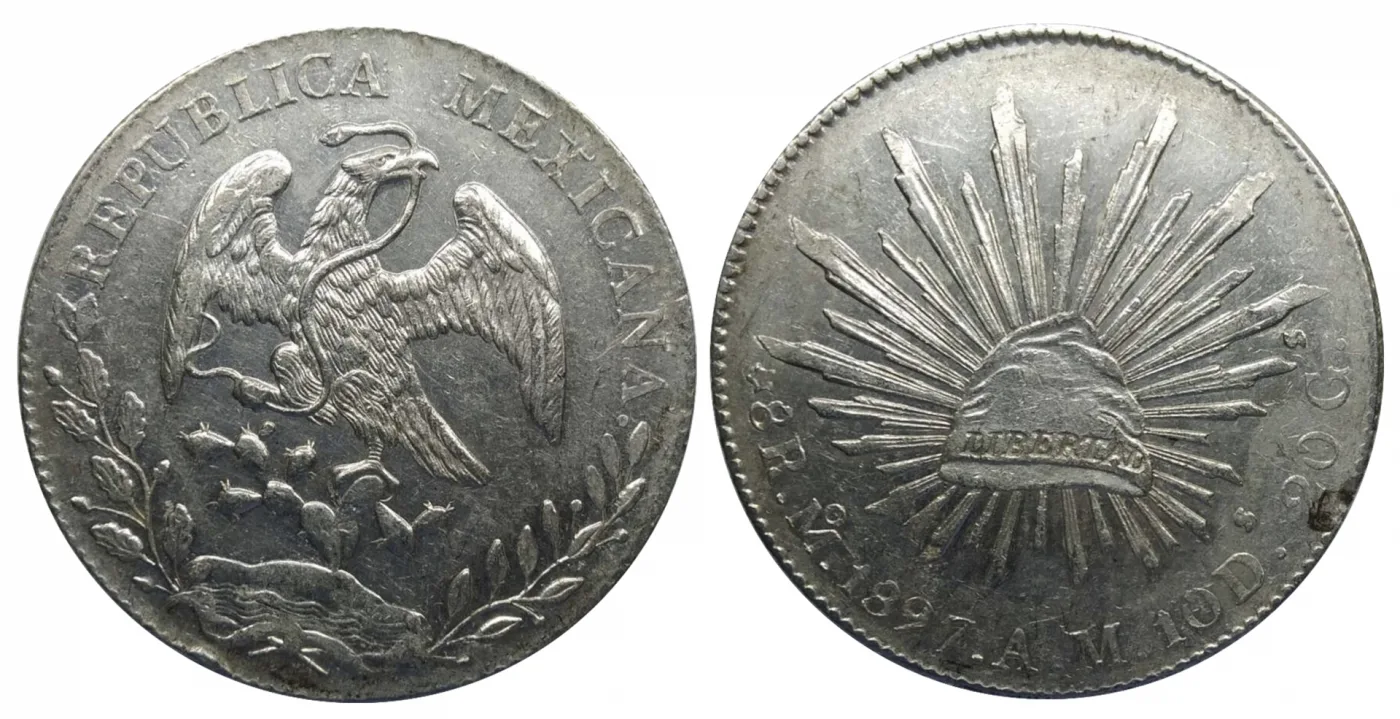
Mexico produced the most important coin in the history of the Americas — the silver eight reales, the original “piece of eight” — and its coinage runs in an unbroken line from the Spanish conquest to the peso in your pocket today. For collectors that makes Mexican coins uniquely rewarding and uniquely confusing: a single accumulation might hold a hand-hammered colonial cob, a machine-struck pillar dollar, an 1880s cap-and-rays peso, a 1940s silver peso, a 1970s giant copper-nickel coin, and a modern bimetallic piece stamped in “nuevos pesos” — each following different rules for dates, denominations, mint marks, and silver content. Because the United States and Mexico share a long border and the eight reales circulated legally in the U.S. well into the nineteenth century, Mexican silver turns up constantly in American coin jars, estate lots, and inherited collections.
The good news is that Mexican coins are logical once you know the framework. Nearly every one names the issuing authority, carries a date in plain Arabic numerals, and — crucially — shows a small mint mark and, on older pieces, one or two assayer initials that pin down exactly where and under whose authority it was struck. The national emblem, an eagle standing on a cactus with a serpent, appears on the great majority of Republic-era coins and instantly separates a Mexican coin from a same-size U.S. or other Latin American piece. And because Mexico was the silver capital of the world for three centuries, a huge share of these coins carry real precious-metal value that any collector can calculate.
This guide walks through the whole arc: the colonial reales system and the famous pieces of eight, the switch to the decimal peso, the full run of denominations from the tiny centavo to the big silver crowns, how to read mint marks and assayer initials, the silver-content dividing lines that determine melt value, the great types and famous rarities (the pillar dollar, the cap-and-rays peso, the Caballito peso, the 1921 Centenario, the gold 50 pesos), Mexican error coins, the modern Libertad bullion series, grading, realistic 2026 values, spotting fakes, and the reference tools that resolve any coin you cannot place. Whether you inherited a cigar box of silver or just pulled a strange “dollar” from a flea-market tray, you will finish able to read, date, and value Mexico’s coins with confidence.
Why Mexican Coins Matter to Collectors
No national coinage has shaped world money more than Mexico’s. Understanding why explains both the appeal of the series and why so many Mexican coins end up in American hands.
The Coin That Ran the World
From the sixteenth century, the silver mined at Zacatecas, Guanajuato, and other Mexican districts was struck into eight-reales coins that became the first true global currency. These Spanish colonial reales — the famous pieces of eight — circulated across the Americas, Europe, Africa, and Asia, underpinned trade with China, and were legal tender in the United States until 1857, changing hands alongside the great European trade crowns such as the German thaler. The U.S. silver dollar was deliberately modeled on the Mexican eight reales, so the two coins are close cousins — a fact that makes Mexican silver feel oddly familiar to anyone who knows the American Morgan Silver Dollar.
Why Mexican Coins Turn Up in the U.S.
Because the eight reales spent as money in America for generations, because the border is long and porous, and because Mexican silver was hoarded worldwide, U.S. collections routinely contain Mexican pieces. Colonial reales appear in East Coast and Southern accumulations; later pesos turn up throughout the Southwest and in any jar of “foreign silver.” A large share of the world’s surviving Mexican silver sits in the United States, which is why learning to read it is so useful to American collectors.
A Series With Something for Everyone
Mexican numismatics spans hand-struck colonial cobs, elegant milled pillar dollars, workmanlike Republic pesos, dramatic Revolution-era local issues, gold from tiny half-escudos to the massive 50 pesos, and modern bullion. It offers affordable circulated coins by the handful and world-class rarities that bring six and seven figures. Few fields reward a beginner as quickly or hold a specialist as long.
The Four Eras of Mexican Coinage
Every Mexican coin belongs to one of four broad periods, and placing a coin in its era is the first and most powerful identification step because each era looks different and follows different rules.
Colonial / Spanish Mexico (1536–1821)
Struck under Spanish rule at the Mexico City mint (the first mint in the Americas, opened 1536). Early pieces are crude, irregular hand-struck cobs; from 1732 they are neat machine-milled coins, first the pillar type and then the portrait type showing the Spanish king. Legends are in Latin and Spanish and name the reigning monarch — Philip, Ferdinand, Charles.
War of Independence and First Empire (1810–1823)
A turbulent transition. Royalist and insurgent factions struck emergency and provisional coins during the independence war, and briefly Emperor Agustín de Iturbide issued coins of the short-lived First Mexican Empire. These are a specialized, often scarce corner of the series.
Republic and Second Empire (1823–1905)
The First Republic introduced the national emblem — the eagle on the cactus — and the enduring cap-and-rays (“hand-on-book” / gorro frigio) eight reales, struck at more than a dozen regional mints. Emperor Maximilian’s Second Empire (1864–1867) briefly issued portrait coins denominated in decimal pesos and centavos before the Republic was restored.
Modern Mexico / United Mexican States (1905–present)
The 1905 monetary reform put the coinage fully on the decimal peso and consolidated striking at the Mexico City mint. This era covers the beloved Caballito peso, the silver pesos of the mid-twentieth century, the debased copper-nickel coins of the inflationary 1970s–80s, the 1993 “new peso” revaluation, and today’s bimetallic coins and Libertad bullion. Coins read ESTADOS UNIDOS MEXICANOS (“United Mexican States”).
The Colonial Reales System and Pieces of Eight
Before the peso, Mexico counted in reales, and understanding this system is essential to identifying colonial and early Republic silver — including the world-famous eight reales.
The Denomination Ladder
Silver was struck in ½, 1, 2, 4, and 8 reales, with the eight reales (the “piece of eight,” worth eight reales or one Spanish dollar) as the flagship. Gold was struck in escudos (½, 1, 2, 4, and 8 escudos, the eight-escudo gold “doubloon” being the largest). Because a real could be physically cut into halves and quarters to make change, the eight reales was literally divided into “bits” — the origin of the American slang “two bits” for a quarter dollar.
Cobs (1536–1732)
The earliest Mexican coins are cobs: lumps of silver cut from a bar and struck by hand, so they are irregular in shape, often off-center, and rarely show the full design. Genuine cobs are prized precisely for their crudeness and their association with Spanish treasure fleets and shipwrecks. Identifying them relies on the fragments of shield, cross, pillars, mint mark, assayer initial, and date that survive on the flan.
Pillar Dollars (1732–1772)
In 1732 Mexico City adopted screw-press milling and introduced the magnificent Pillar or “Columnario” eight reales: two hemispheres crowned between the twin Pillars of Hercules, with the motto PLVS VLTRA (“further beyond”) on banners. Beautifully made and internationally trusted, the pillar dollar is one of the most admired coins ever struck and a cornerstone of world numismatics.
Portrait (“Bust”) Dollars (1772–1821)
From 1772 the design changed to a portrait of the Spanish king (Charles III, Charles IV, Ferdinand VII) on the obverse with the crowned Spanish arms between pillars on the reverse. These “bust” eight reales are the most commonly encountered colonial dollars and were the workhorses of global trade in the late colonial period, frequently seen with Chinese merchant chop marks that authenticated them in Asian commerce, exactly as they appear on the Meiji silver yen that later competed with them in the same markets.
The Decimal Peso and Its Denominations
Mexico moved from reales to a decimal peso of 100 centavos in the mid-nineteenth century, and every coin struck since counts in this system. Recognizing the denominations quickly places a modern Mexican coin.
The Transition to Decimal
Decimalization was adopted under the reforms of the 1860s (the Second Empire and Restored Republic), replacing reales with the peso divided into 100 centavos. For a time the old cap-and-rays eight reales and the new peso coexisted, but by the 1905 reform the peso was the sole basis of the coinage.
The Centavo Coins
- 1, 2, 5, 10, 20, and 50 centavos — struck over the decades in copper, bronze, nickel, brass, copper-nickel, and (for the larger early pieces) silver. The bronze and copper minors are the everyday small change of the twentieth century.
- Early silver 10, 20, and 50 centavos exist and carry melt value; later same-denomination coins in base metal do not.
- Inflation eventually made the centavo meaningless; centavo coins vanished from circulation before the 1993 revaluation and returned only as tiny fractions afterward.
The Peso and Larger Coins
- 1 peso — a large silver coin for most of the twentieth century (the Caballito, then the Cap-and-Rays and Morelos types), later reduced in size and silver, and finally a small base-metal coin.
- 2½, 5, 10, 20, 25, 50, 100 pesos — higher denominations appeared over time, many as commemoratives; several mid-century 5, 10, and 25 peso coins are notable silver pieces.
The 1993 “Nuevo Peso” Revaluation
Runaway inflation in the 1980s produced enormous-denomination coins (1,000 and 5,000 pesos). In 1993 Mexico introduced the nuevo peso (“new peso”), lopping three zeros off the currency: 1,000 old pesos became 1 new peso. Coins dated 1992–1995 carry an N$ (“nuevos pesos”) mark; from 1996 the “nuevo” was dropped and the coins simply read pesos again. Recognizing the N$ instantly dates a coin to that brief transition and explains why a “5” coin from 1990 and a “5” coin from 2000 represent vastly different amounts of money.
The Mexican Eagle and How It Dates a Coin
The single most useful identifier on a Republic-era Mexican coin is the national eagle, because its style changed distinctly over time and doubles as a dating clue.
The Emblem and Its Meaning
Mexico’s coat of arms shows a golden eagle perched on a nopal cactus, devouring or holding a serpent — an image from the Aztec founding legend of Tenochtitlan. It appears on the reverse (or obverse) of the overwhelming majority of coins struck since the First Republic and is the clearest sign that a coin is Mexican rather than from another Spanish-speaking country.
The Eagle Styles as a Timeline
The eagle was redrawn many times, and specialists date coins in part by which eagle they carry:
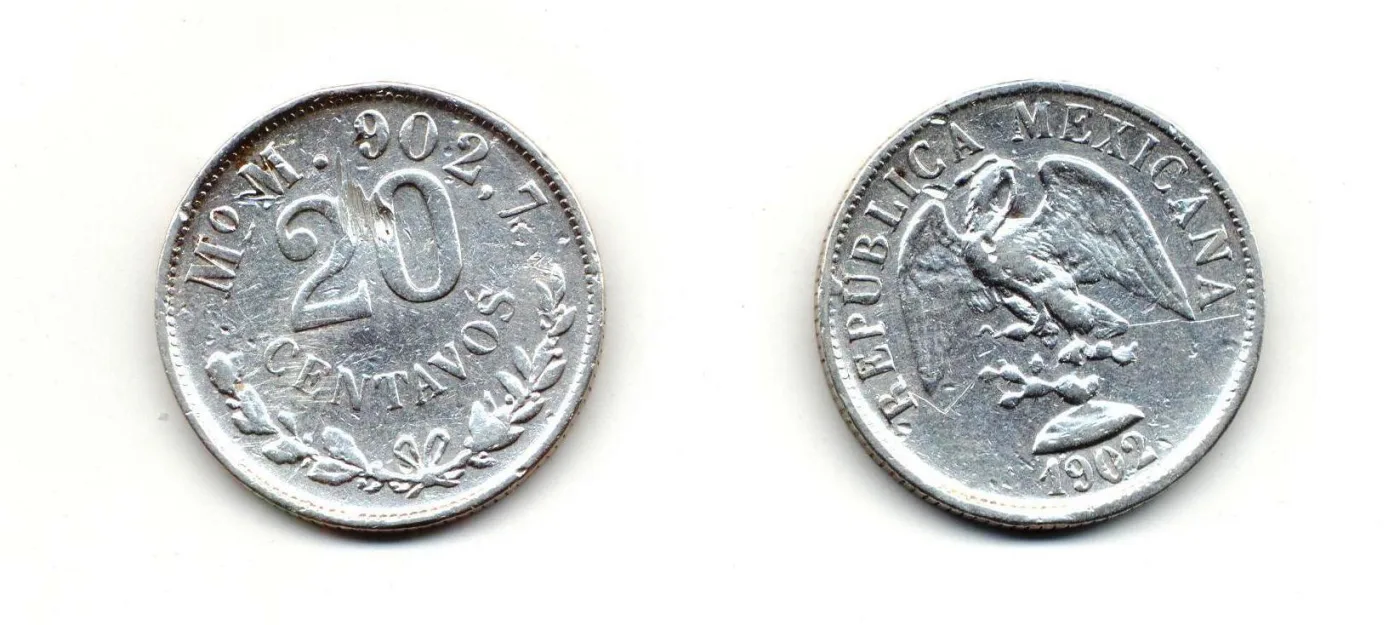
- Facing eagle, wings spread (“Republican” eagle) — the nineteenth-century cap-and-rays and early decimal coins show a front-facing eagle.
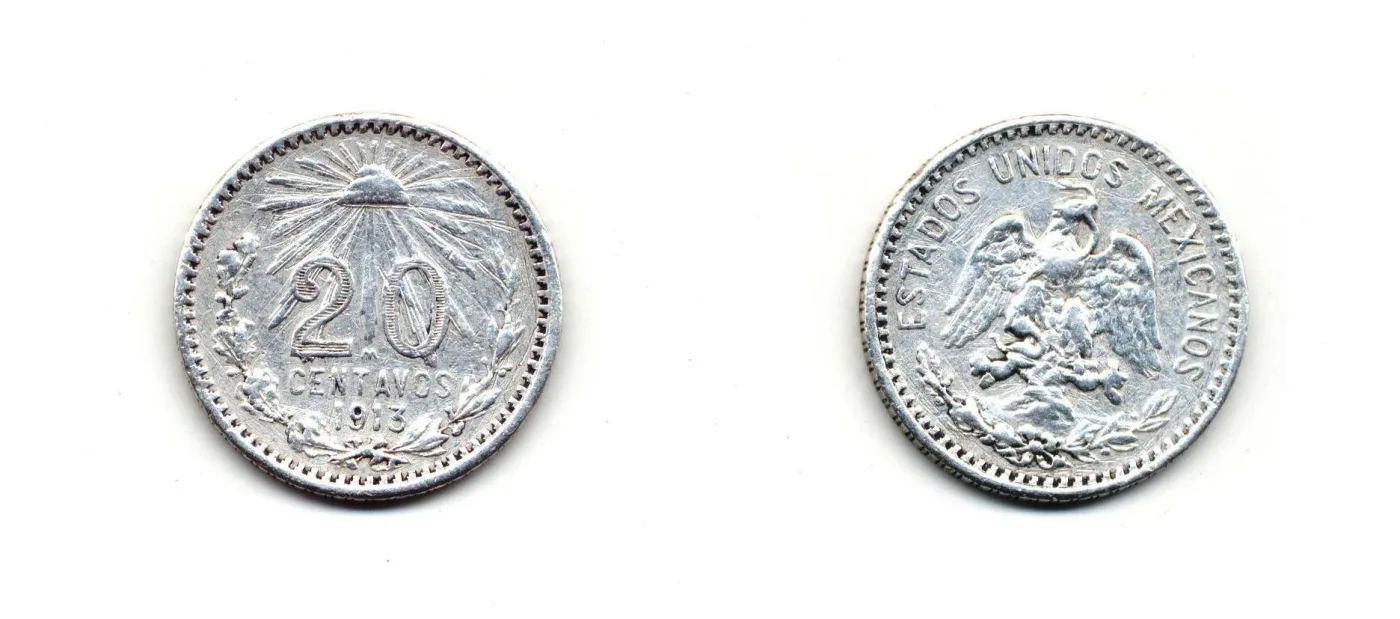
- Left-facing eagle in profile — the twentieth-century standard, seen on the Caballito and most modern coins, shows the eagle in side profile facing left.
- Restyled modern eagle — contemporary coins and the Libertad use a cleaner, updated version of the profile eagle within a wreath.
The Legend Around It
Republic and modern coins encircle the eagle with REPUBLICA MEXICANA (nineteenth century) or ESTADOS UNIDOS MEXICANOS (from around 1905). Reading which legend a coin carries brackets it into the right era before you even check the date, much as reading the legend on a British coin brackets it by monarch.
Anatomy of a Mexican Coin
Mexican coins follow consistent layouts within each era, and learning the vocabulary lets you extract the date, denomination, mint, and authority quickly. The general terms overlap with the basic coin anatomy used everywhere, with a few Mexican specialties.
Colonial Layout
A milled colonial eight reales shows, on one side, either the pillars-and-hemispheres (pillar type) or the king’s portrait (portrait type), and on the other the crowned Spanish shield. Around the design run the king’s Latin titles, the date, the denomination (e.g., 8R for eight reales), the mint mark, and the assayer’s initial(s). The value, mint, and assayer cluster together in the legend and are the keys to attribution.
Republic and Modern Layout
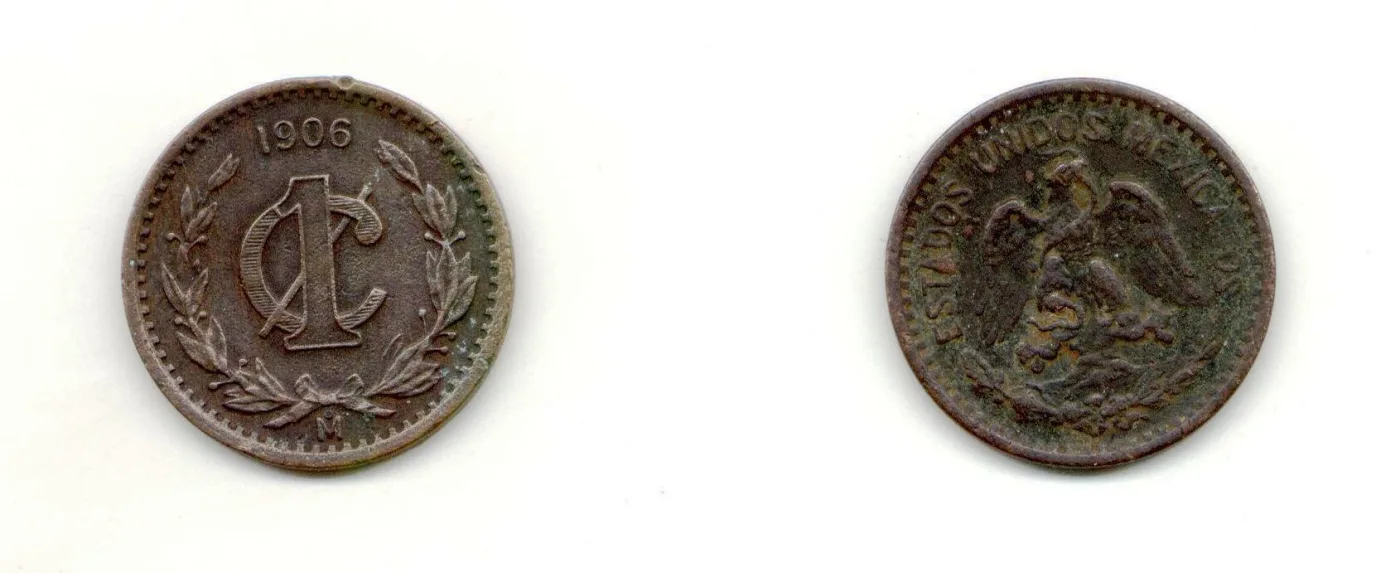
A Republic or modern coin typically shows the eagle on one side within a national legend and the denomination and date on the other, often with a cap-and-rays motif, a wreath, or a portrait of a national hero (Morelos, Hidalgo, Juárez). The mint mark and assayer initials appear in the field on nineteenth-century pieces; modern coins carry the Mexico City Mo mint mark or the mint’s monogram.
Reading the Date and Denomination
Dates are ordinary Arabic numerals, a great convenience compared with ancient coins that must be dated by ruler and style. The denomination is stated as a number plus unit — 8R (eight reales), UN PESO, 50 CENTAVOS, N$5 — so once you know the era’s units, the value is explicit. Edges may be plain, reeded, or lettered; many colonial and early Republic dollars have a decorative lettered or leaf edge that also helps authenticate them.
Mint Marks and Assayer Initials
Mexico used multiple mints, especially in the nineteenth century, and reading the mint mark and assayer initials is central to Mexican identification in a way it never is for a single-mint coinage. This is Mexico’s version of the U.S. mint mark system, but richer.
The Mexico City Mint (Mo)
The Casa de Moneda de México in Mexico City — the oldest mint in the Americas — is marked Mo (an “o” above or beside an “M”). It struck coins continuously from 1536 and is the mint behind most colonial dollars and virtually all modern coins. If you see Mo, the coin came from Mexico City.
The Regional Republic Mints
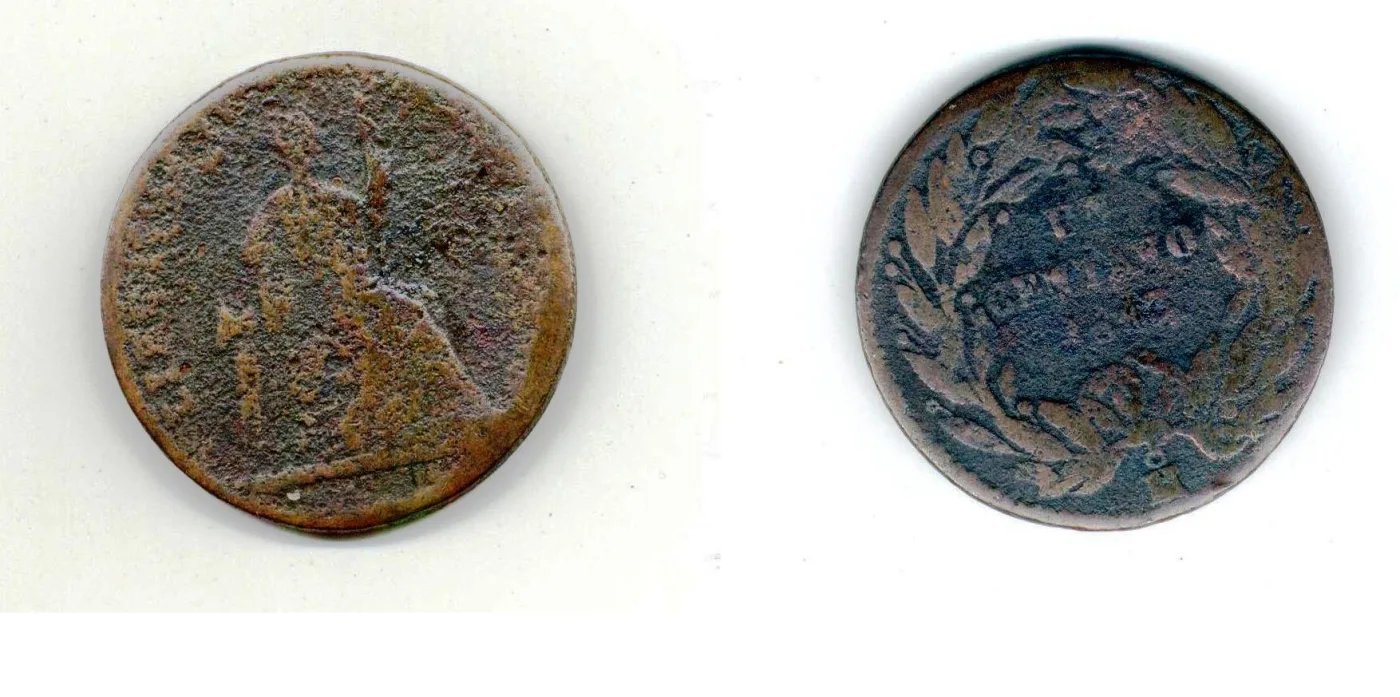
During the nineteenth century, to move silver from scattered mining districts, Mexico operated many branch mints, each with its own letter mark, including:
- Zs — Zacatecas · Go — Guanajuato · Ca or CH — Chihuahua
- Do — Durango · GC — Guadalupe y Calvo · Cn — Culiacán
- A or As — Alamos · Ho — Hermosillo · Pi or SLP — San Luis Potosí · Ce — Real de Catorce · EoMo/Oa — Oaxaca
The mint mark dramatically affects both attribution and value: a common date from Mexico City may be worth a fraction of the same date from a scarce branch mint like Guadalupe y Calvo or Real de Catorce.
Assayer Initials
The assayer was the mint official who guaranteed the coin’s fineness, and his initial (or two initials) appears near the value and mint mark. Because assayers changed over time, the initial helps date a coin within a mint’s output and, for some combinations, marks a scarce variety. On a colonial or Republic coin, always record the mint mark and the assayer initials together — the pair, with the date, is what uniquely identifies the piece in a catalog.

Silver Content: The Melt-Value Dividing Lines
For anyone weighing melt value, the vital fact about a Mexican silver coin is its fineness, which fell in stages over time. Because Mexico was a silver nation, an enormous number of its coins carry real precious metal — the Mexican counterpart to U.S. pre-1965 junk silver.
Colonial and Early Republic: Around .903–.902 Fine
Colonial reales and early Republic eight reales were struck to the Spanish standard of roughly 90–90.3% silver. A genuine pillar dollar, portrait dollar, or cap-and-rays eight reales is a substantial chunk of high-grade silver, quite apart from its collector value.
Early Twentieth-Century Pesos: .903 Then .720
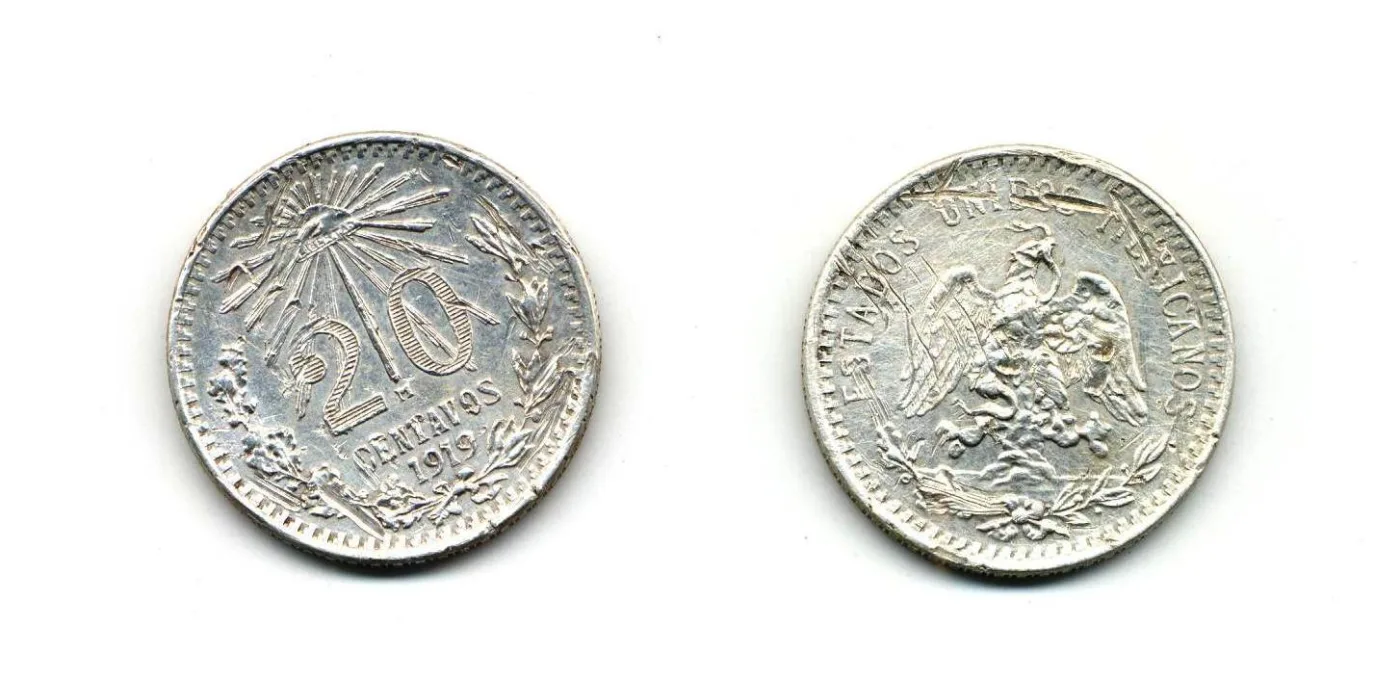
The early decimal pesos and the Caballito peso (1910–1914) were .903 fine. From the 1920s the standard silver peso dropped to .720 fine (72% silver) — the composition of the common “cap-and-rays” and Morelos pesos of the 1920s–1945. These .720 pesos are the bulk of collectable Mexican silver and are stacked and traded for their content.
Mid-Century Debasement: .500, .300, .100
As silver prices rose, fineness fell sharply. The one-peso coin went to .500 fine (1947–1949), then .300 (1950), then .100 fine (1957–1967) on the Morelos peso, and finally to copper-nickel with no silver from 1970. Larger denominations followed similar declines. The rule to remember: the older the silver peso, the higher its fineness; anything from 1970 on is base metal.
How to Test Quickly
Date and denomination usually settle fineness by reference to a catalog, but a few field checks help. Silver coins are non-magnetic and have a distinctive ring; heavily debased and copper-nickel coins may look grayer and, in some issues, are attracted to a magnet. For valuable pieces, specific-gravity testing confirms silver content without damage — the same non-destructive discipline used across counterfeit detection.
The Great Types Every Collector Knows
A handful of iconic types anchor Mexican collecting, and recognizing them on sight both identifies the coin and flags its significance.
The Pillar Dollar and Portrait Dollar
The 1732–1772 pillar eight reales (twin crowned columns over hemispheres, PLVS VLTRA) and the 1772–1821 portrait eight reales (Spanish king’s bust) are the colonial giants — the coins that circulated the globe and inspired the U.S. dollar. Both are widely collected by date, mint, and assayer, and high-grade or scarce-mint examples command strong premiums.
The Cap-and-Rays Eight Reales
The Republic’s cap-and-rays (“hand on book” / gorro y rayos) eight reales — a radiant liberty cap over an open book, with the facing eagle on the other side — was struck from the 1820s to the 1890s at many mints and in enormous numbers. It succeeded the Spanish dollar as the great trade coin of the nineteenth century and is the most collectible Mexican silver type by mint and date.
The Caballito Peso (1910–1914)
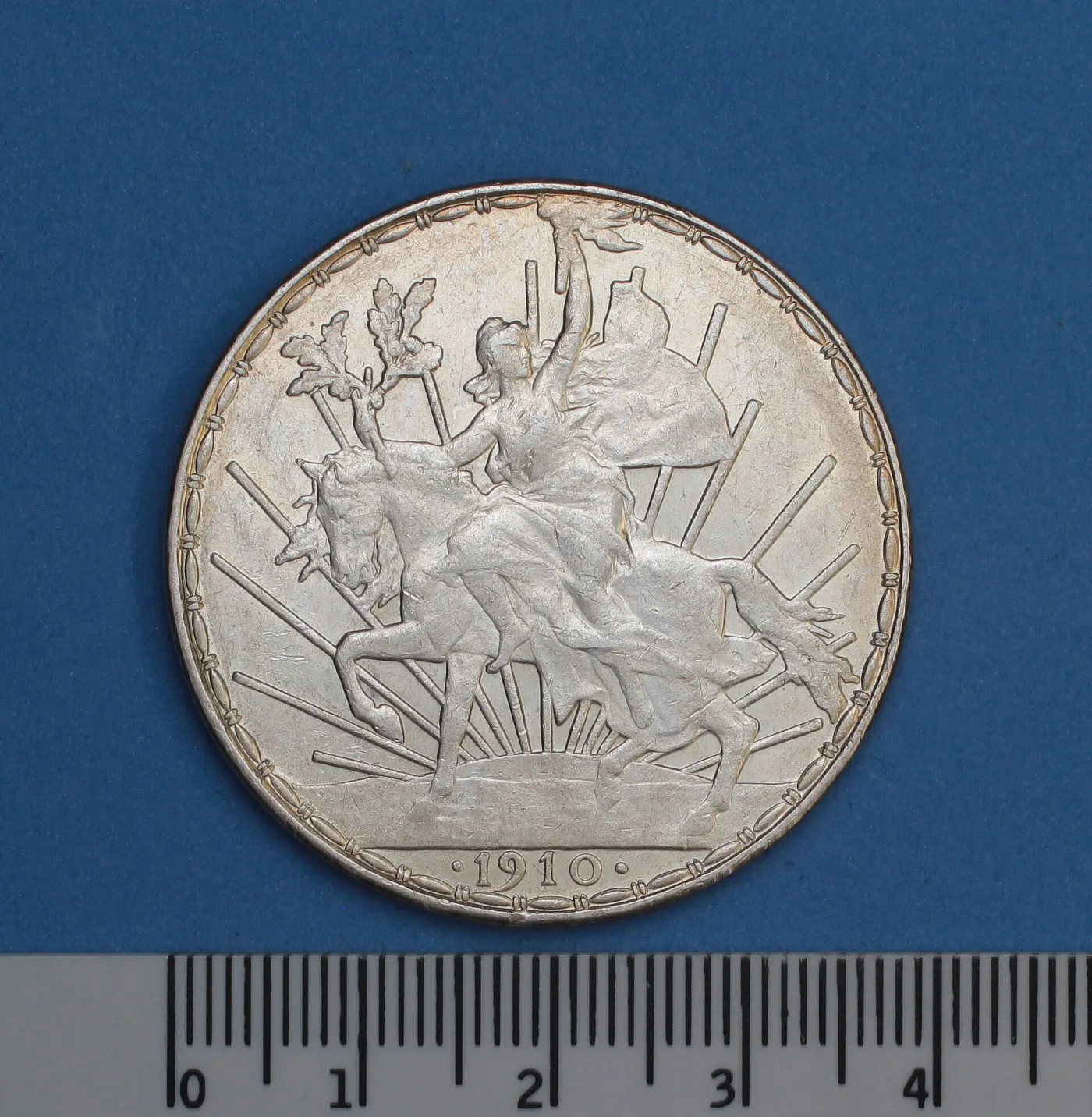
Widely regarded as Mexico’s most beautiful coin, the Caballito (“little horse”) peso shows Liberty on horseback holding a torch before a radiant sun, designed by Charles Pillet. Struck in .903 silver for only a few years around the Revolution, it is a hugely popular type coin; certain dates and the 1910/1911 varieties are keys.
The 1921 Centenario and the Silver Pesos
The 1947–1948 Cuauhtémoc and the Morelos pesos are the familiar mid-century silver pesos, while the large 1968 Olympic 25 pesos and the Hidalgo commemoratives are common, affordable silver. Above them sits the gold Centenario (50 pesos), discussed next, struck to mark the 1921 centennial of independence.
Mexican Gold Coins
Mexico struck gold throughout its history, and its modern gold pesos are among the most widely traded bullion-value coins in the world, encountered constantly alongside U.S. issues.
Colonial Escudos
Colonial gold came in escudos (½ to 8 escudos), the eight-escudo “doubloon” being the famous large gold coin of the Spanish Main. Genuine colonial gold is scarce and valuable, and — like the silver — attributed by mint mark, assayer, and date.
The Centenario (50 Pesos) and the Peso Gold Series
The gold 50 pesos — the “Centenario,” first struck in 1921 for the independence centennial and showing the Winged Victory (Ángel de la Independencia) before the volcanoes Popocatépetl and Iztaccíhuatl — is Mexico’s premier gold coin, containing 1.2057 troy ounces of gold. It heads a family of bullion-value gold pesos: the 2, 2½, 5, 10, and 20 pesos, all struck in .900 gold and traded for their metal. Many were restruck for years with a fixed date (the 50 pesos bears “1947” on restrikes), so a common Centenario is a bullion coin, comparable in role to the American Gold Eagle.
Bullion Versus Numismatic Gold
Most Mexican gold pesos are bought and sold for their metal content plus a small premium. Original early dates, low-mintage years, and high grades carry numismatic premiums on top, but for everyday purposes a common-date peso gold coin is worth its gold — buy from reputable dealers and prefer graded holders for high-value pieces.
Step-by-Step Identification Workflow
With the framework in place, here is a repeatable process for identifying any Mexican coin in hand.
1. Place It in an Era
Is it a crude hand-struck lump (colonial cob), a milled coin with pillars or a king’s portrait (colonial milled), a coin with a facing eagle and cap-and-rays and REPUBLICA MEXICANA (Republic), or a coin reading ESTADOS UNIDOS MEXICANOS with a profile eagle (modern)? The era sets which rules apply.
2. Read the Legend, Date, and Denomination
Identify the issuing authority from the legend (Spanish king’s titles; REPUBLICA MEXICANA; ESTADOS UNIDOS MEXICANOS), read the Arabic date, and note the stated value (8R, UN PESO, 50 CENTAVOS, N$5). The N$ mark flags a 1992–1995 “new peso.”
3. Find the Mint Mark and Assayer
Locate the mint mark (Mo, Zs, Go, Ca, Do, etc.) and, on colonial and Republic coins, the assayer initials near the value. Record them together — mint + assayer + date is the identity of the coin in any catalog and is where scarce combinations hide.
4. Determine Metal and Silver Content
Use the era and date to establish fineness: colonial and early Republic silver is ~.90; 1920s–1945 pesos are .720; later pesos step down to .500, .300, .100, then base metal from 1970. Confirm with a magnet and ring test, and specific gravity for valuable coins.
5. Check for Key Dates, Types, and Varieties
Finally, match the type, mint, and date against key-date and variety lists. Most Mexican coins are common, but a scarce mint, an early Caballito, a low-mintage peso, or a genuine error can be worth many multiples of the ordinary price — this last check is where value is found.
Key Dates and Famous Rarities
The great majority of Mexican coins are common and trade modestly, but the field turns on a well-known set of scarce types, mints, and dates. As with U.S. key dates, these are what collectors hunt.
Colonial Rarities
Early cobs, scarce assayer combinations, shipwreck-provenance pieces, and the finest pillar and portrait dollars command strong prices. The 1732 first-year pillar dollar and certain early pillar dates are landmark colonial coins.
Republic Branch-Mint Rarities
Among cap-and-rays eight reales, coins from short-lived or low-output mints — Guadalupe y Calvo (GC), Real de Catorce (Ce), Alamos (As), and certain Oaxaca and Chihuahua issues — are the keys, worth far more than common Mexico City, Zacatecas, or Guanajuato pieces of the same date.
The Caballito and Peso Keys
Among Caballito pesos, the 1910 and the 1913/2 overdate and low-mintage 1913/1914 dates are keys; the whole type is desirable in high grade. Among later pesos, low-mintage silver dates and certain proof-like issues stand out.
The 1921–1922 Commemoratives and Gold Keys
- 1921 “Winged Victory” 2 pesos — a one-year silver commemorative of the independence centennial, widely collected.
- Original-date gold Centenarios (genuine 1921–1931, as opposed to 1947-dated restrikes) — scarcer and worth a premium over bullion.
- Low-mintage 20 and 50 peso gold original dates — keys within the gold peso series.
As always, treat any apparent rarity with caution: the fame of these coins makes them targets for fakes and altered dates, so authenticate before you celebrate.
Mexican Error Coins and Varieties
Mexican mint errors follow the same categories as U.S. error coins, and the same caution applies: genuine errors are collectable, but ordinary damage, wear, and post-mint alteration are not.
Overdates and Die Varieties
Overdates — where one date is punched over another, such as the Caballito 1913/2 — are among the most collected Mexican varieties, alongside repunched mint marks, assayer changes mid-year, and small design differences. These are the Mexican equivalent of the variety hunting behind U.S. doubled dies, and specialist catalogs list them in detail.
Struck Errors
Off-center strikes, clipped planchets, wrong-planchet strikes, and die cracks appear on Mexican coins as they do worldwide. The debased mid-century and modern coins, struck in huge volumes, are a fertile field for such errors, and the bimetallic new-peso coins produce distinctive ring-and-center misalignments.
Revolution-Era Local and Necessity Coinage
The Mexican Revolution (1910–1917) produced a fascinating array of local, state, and necessity coins struck by revolutionary factions and regional governments — crude issues from Oaxaca, Guerrero, Chihuahua (including the famous Villa “Ejército del Norte” pieces), and others. These are a specialized field in their own right, often crude by necessity, and demand careful authentication because both period counterfeits and modern fakes exist.
The Libertad Bullion Coins
Beyond circulating coinage, the Mexican Mint (Casa de Moneda) strikes the Libertad series, among the world’s most respected — and most beautiful — bullion coins, encountered constantly by precious-metal buyers alongside American issues.
Silver and Gold Libertad
The Silver Libertad, launched in 1982, and the Gold Libertad show the Winged Victory (Ángel de la Independencia) before the two volcanoes on one side and the modern national coat of arms — historic and current — on the other. They are struck in .999 fine metal and issued in multiple sizes, including fractional and large multi-ounce silver pieces (up to a full kilo). The Silver Libertad competes directly with the American Silver Eagle and is prized for its rotating, uniquely Mexican design.
Low Mintages and Collector Premiums
Unlike some bullion series struck in the tens of millions, many Libertad issues — especially the fractional silver, the large kilo and 5-ounce pieces, and proof and reverse-proof strikes — have low mintages, so certain dates carry substantial numismatic premiums over their metal value. This makes the Libertad both a bullion coin and a genuine collector series.
Buying and Authenticating
A common-date bullion Libertad is worth its gold or silver content plus a premium; scarce dates and finishes add more. Because of their value and popularity, Libertads are counterfeited, so buy from reputable dealers, verify weight and dimensions, and prefer sealed or graded holders for key dates and larger pieces.
Grading Mexican Coins
Mexican coins are graded on the same 70-point Sheldon scale used for U.S. coins, and the leading third-party services grade Mexican issues routinely, so the vocabulary will be familiar.
The Grading Scale
- Good / Very Good (G/VG) — heavily worn, major detail gone but the type and legends clear.
- Fine / Very Fine (F/VF) — moderate wear, most design elements sharp.
- Extremely Fine (EF/XF) — light wear on the high points only.
- About Uncirculated (AU) — a trace of wear on the highest points.
- Mint State (MS-60 to MS-70) — no wear, as struck, graded by surfaces and strike.
Special Considerations for Mexican Coins
Colonial cobs are graded with allowance for their crude manufacture — completeness of the design, clarity of date and mint mark, and surface quality matter more than perfect centering. Chop marks on trade dollars are documented but generally lower value slightly. The general principles in our coin grading guide apply directly: judge wear on the high points of the eagle, the portrait, or the cap-and-rays, and weigh eye appeal, luster, and originality. Avoid cleaned coins, which lose much of their value.
Slabbing and Third-Party Grading
High-value Mexican coins are commonly sent to third-party grading services, which encapsulate them with a numeric grade and an authenticity guarantee. For a pillar or portrait dollar, a scarce branch-mint eight reales, a Caballito, gold, or a key Libertad, professional grading protects both value and buyer confidence — though it is rarely worth the cost for common circulated minors.
What Mexican Coins Are Worth in 2026
Mexican coin values span an enormous range, from a few cents for a worn modern minor to six and seven figures for the great colonial and rarity pieces. Here is a realistic picture for the coins most people actually hold.
Common Circulated Coins
Modern base-metal centavos and pesos in circulated grades are worth little more than face value (and, outside Mexico, essentially nothing as spending money). Their appeal is as inexpensive, historically interesting foreign coins. Common twentieth-century bronze and copper-nickel minors are abundant and modestly valued unless in top grade or a scarce date.
Silver Coins for Their Metal
Pre-1945 .720 silver pesos, the .903 Caballito and early pesos, and the colonial and Republic eight reales all carry real precious-metal value that rises and falls with the silver price, independent of any collector premium. A cap-and-rays eight reales or a stack of .720 pesos has genuine melt value; remember that later mid-century pesos are only .500, .300, or .100 fine and contain proportionally less silver.
Bullion Gold and Libertads
Common-date gold pesos (the 50-peso Centenario and its smaller relatives) and common bullion Libertads are worth their metal content plus a small premium, so their prices track the market. Original-date gold, low-mintage Libertads, and special finishes add premiums on top.
Key Types and Rarities
Four-, five-, six-, and even seven-figure values live among the great rarities: finest-known pillar and portrait dollars, scarce branch-mint eight reales, key Caballito dates, original-date gold, and choice Revolution-era pieces. These are exceptional. For everyday identification, assume any given coin is common until a type-, mint-, and date-check proves otherwise — and get a professional opinion before paying a premium, since fakes cluster around exactly these coins.
Counterfeits and How to Avoid Them
Because Mexican silver and gold are valuable and globally recognized, counterfeits are a serious concern — from centuries-old contemporary forgeries to modern cast and struck fakes. The same discipline used for counterfeit detection on U.S. coins applies here.
Fake Eight Reales and Trade Dollars
The eight reales was faked even in its own day, and modern replicas of pillar and portrait dollars are common — from tourist souvenirs to deceptive struck copies. Genuine coins have precise weight (about 27 grams) and diameter, sharp milled detail, and correct edge devices. A coin that is underweight, has a soft “greasy” cast surface, shows a seam on the edge, or has mushy legends is a red flag. This parallels the caution needed with the U.S. and Chinese Trade Dollar, another heavily counterfeited world crown.
Altered Dates and Mint Marks on Rarities
The value gap between common and scarce mints and dates tempts forgers to alter a common coin’s mint mark or date to imitate a rarity — a common cap-and-rays eight reales “converted” to a scarce branch mint, or a Caballito date altered to a key. Any high-value branch-mint or key-date coin demands expert authentication, because the incentive to fake it is high and the alterations can be skillful.
Fake Gold and Bullion
Gold Centenarios and Libertads are counterfeited because of their value and recognizability; because so many genuine 50 pesos bear the restrike date “1947,” fakes hide easily among them. Genuine pieces have exact specifications and, on modern bullion, fine detail that is hard to reproduce. Weigh and measure any gold coin, prefer graded holders or sealed assay packaging for larger purchases, and buy only from reputable dealers. As always, never clean a coin — harsh cleaning strips original surfaces and slashes value, a principle covered in our guide to coin toning.
References and Online Tools
When a coin resists identification, the right reference resolves it quickly. Mexican numismatics is exceptionally well documented in both English and Spanish.
The Standard Catalogs
The essential English-language references are the Standard Catalog of World Coins (Krause) volumes, which list every Mexican type, mint, assayer, and date with mintages and values, and specialist works such as the Guía Numismática and dedicated studies of the eight reales, the Caballito, the Revolution issues, and the Libertad series. For colonial coins, references keyed to mint mark and assayer are indispensable.
Free Online Resources
Several free databases let you match a coin by image and description without any purchase — searchable world-coin catalogs, auction-archive sites showing realized prices, the Banco de México and Casa de Moneda information pages, and active collector forums (in English and Spanish) where experts identify coins from photographs. Matching your coin’s era, legend, denomination, date, mint mark, and assayer against these sources resolves the great majority of pieces, and comparing sold prices gives a realistic value.
When to Get Expert Help
For a suspected key date or scarce mint, a colonial cob, a possible error, a gold coin, a Revolution-era issue, or anything you cannot confidently place, consult a reputable dealer or a grading service. Professional authentication is cheap insurance against buying a fake or misjudging a rarity, and it is indispensable before paying a premium for any high-value Mexican coin.
Frequently Asked Questions
How do I know if my Mexican coin is silver?
Use the era and date. Colonial reales and early Republic eight reales are about 90% silver; Caballito and early decimal pesos are .903; standard pesos from the 1920s to 1945 are .720 (72%) silver; later one-peso coins step down to .500, .300, and .100 fine, and everything from 1970 on is base-metal copper-nickel with no silver. Silver coins are non-magnetic and ring clearly; for valuable pieces, specific-gravity testing confirms the content without damage.
What is a "piece of eight," and is my coin one?
A "piece of eight" is a silver eight-reales coin — the Spanish-colonial dollar struck in Mexico and used worldwide, including in the United States until 1857. If your coin shows twin crowned pillars with PLVS VLTRA, or a Spanish king's portrait, and the denomination 8R, it is a genuine eight reales (a piece of eight). Beware, though: these are among the most reproduced coins in the world, so authenticate weight, diameter, and detail before assuming it is genuine.
What does the "Mo" on my Mexican coin mean?
"Mo" is the mint mark of the Mexico City mint (Casa de Moneda de México), the oldest mint in the Americas, in operation since 1536. It appears on most colonial dollars and virtually all modern Mexican coins. Nineteenth-century coins from other mints carry different marks — Zs (Zacatecas), Go (Guanajuato), Ca (Chihuahua), Do (Durango), and more — and the mint mark strongly affects a coin's value.
What is the eagle-and-cactus image on Mexican coins?
It is Mexico's national coat of arms: a golden eagle perched on a nopal cactus, holding a serpent, from the Aztec founding legend of Tenochtitlan. It appears on the great majority of Mexican coins struck since the First Republic and is the clearest sign a coin is Mexican. The eagle's style changed over time — front-facing in the nineteenth century, left-facing in profile in the twentieth — which helps date the coin.
What does "N$" mean on a Mexican coin?
"N$" stands for nuevos pesos ("new pesos") and appears on coins dated 1992–1995, after Mexico revalued its currency in 1993 by removing three zeros (1,000 old pesos = 1 new peso). From 1996 the "nuevo" was dropped and coins simply read pesos again. Seeing N$ dates a coin to that brief transition period.
Is my old Mexican coin a valuable rarity?
Usually no — most Mexican coins are common, especially modern minors and common-date silver and gold traded for metal. The valuable exceptions are finest-known pillar and portrait dollars, scarce branch-mint eight reales (Guadalupe y Calvo, Real de Catorce, Alamos, and others), key Caballito dates like the 1910 and 1913/2, original-date gold Centenarios, low-mintage Libertads, and choice Revolution-era pieces. Check the type, mint, and date against key-date lists, and treat any apparent rarity with caution, since altered dates and fakes exist.