American Silver Eagle Identification Guide: Key Dates, Type 1 vs Type 2, Mint Marks, and Values
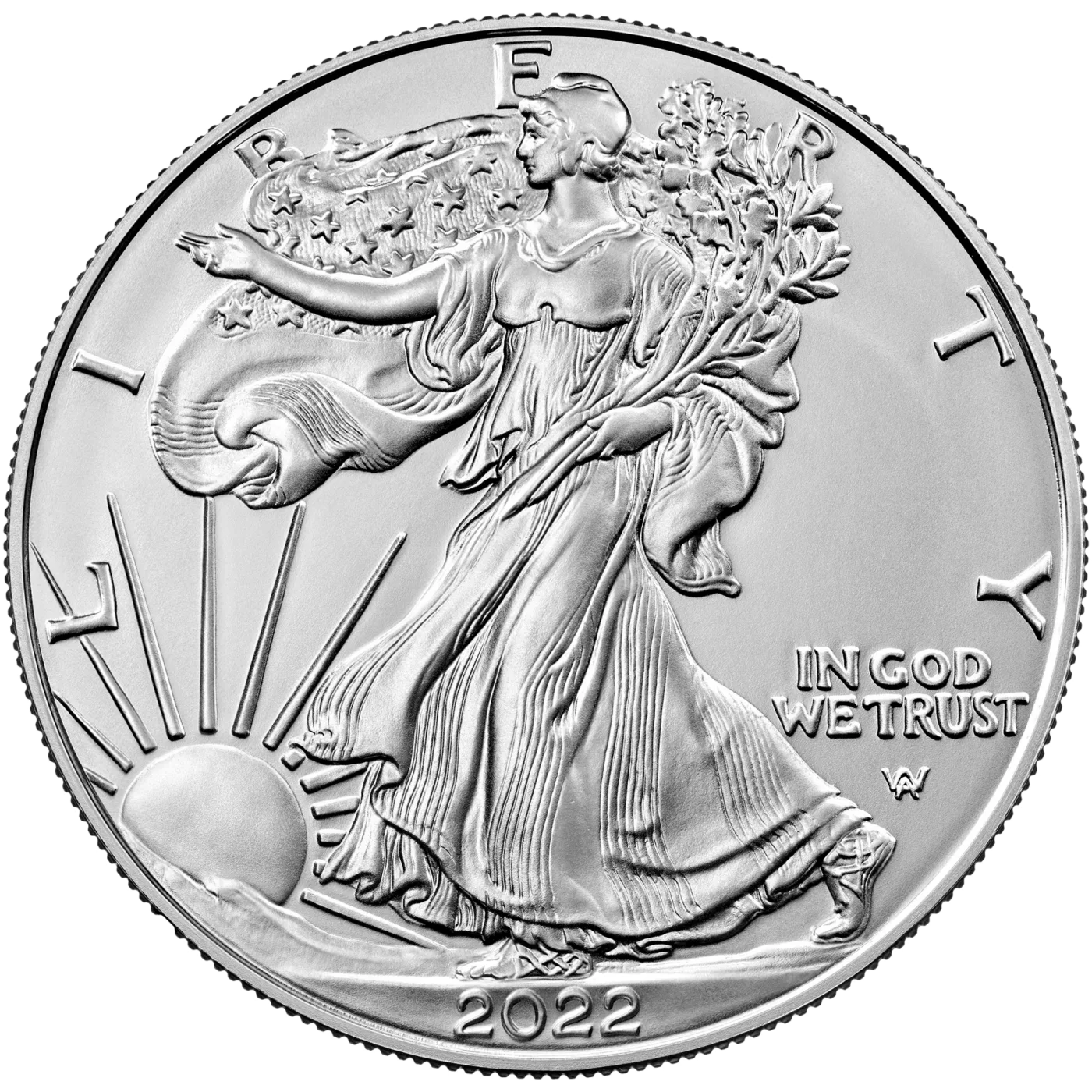
The American Silver Eagle is the best-selling silver bullion coin in the world and, since its 1986 debut, has become the cornerstone of modern American precious-metals collecting. Each coin contains exactly one troy ounce of .999 fine silver, carries a $1 face value it will never trade at, and wears two of the most cherished designs in U.S. numismatic history: Adolph A. Weinman’s striding Liberty on the obverse and, originally, John Mercanti’s heraldic eagle on the reverse. It is, in a real sense, a 20th-century masterpiece reissued for the modern stacker and collector alike.
What makes the Silver Eagle far more than a plain bullion round is the surprising depth of the series. Across four decades the U.S. Mint has produced bullion strikes, collector proofs, burnished (uncirculated) issues, reverse proofs, and enhanced finishes from five different facilities, each leaving a distinct mint mark or none at all. Within that production are genuine rarities: the low-mintage 1996 bullion key, the famous 2008-W Reverse of 2007 transitional error, the elusive 1995-W proof, the 2011-S from the 25th Anniversary set, and the 2021 mid-year switch from the Type 1 to Type 2 reverse that splits the series into two collectible halves.
This guide covers the complete American Silver Eagle story: how to identify each finish, where the mint marks appear, the all-important Type 1 versus Type 2 reverse distinction, every key date worth knowing, how bullion coins are graded, how to spot counterfeits in a heavily faked series, and what your coins are worth in 2026. If you are new to coins entirely, start with our general coin identification guide, then return here to master America’s flagship silver coin.
History and Origins of the Silver Eagle
The American Silver Eagle was authorized by the Liberty Coin Act, signed into law on July 9, 1985, and the first coins were struck in 1986. The program had an unusual genesis: it was tied directly to the disposal of silver from the Defense National Stockpile. Congress wanted a way to sell off government silver in a manner that benefited taxpayers, and a one-ounce legal-tender bullion coin — competing with the South African Krugerrand and the new Canadian Silver Maple Leaf — was the chosen vehicle.
The coin debuted alongside the American Gold Eagle in 1986, and the two programs together launched the modern U.S. bullion coin era — a family later completed in 1997 by the American Platinum Eagle. From the start the Silver Eagle was a hit. Collectors loved that it revived Weinman’s Walking Liberty design, last seen on circulating coinage in 1947, while investors valued a government-guaranteed one-ounce silver coin with a recognizable design and tight quality control.
Four Decades of Production
The Silver Eagle has been struck continuously since 1986, making it one of the longest-running silver coin programs in American history. Bullion versions have been produced every single year. Proof versions have been struck nearly every year, with two notable gaps: no proof was issued in 2009 (the Mint diverted all silver planchets to meet overwhelming bullion demand during the financial crisis) and proof production was briefly suspended in 2010 before resuming. Burnished (collector uncirculated) coins began in 2006, and various special finishes — reverse proofs, enhanced uncirculated, and enhanced reverse proofs — have appeared in anniversary and limited-edition sets.
The 2021 Redesign
In 2021, on the program’s 35th anniversary, the Mint introduced a brand-new reverse. The original Mercanti heraldic eagle (used 1986–2021) was retired and replaced mid-year by a new “eagle landing” reverse designed by Emily Damstra and sculpted by Michael Gaudioso. Because the change happened partway through 2021, that year exists in both Type 1 (old reverse) and Type 2 (new reverse) — a defining moment that every Silver Eagle collector must understand.
Design Elements and How to Identify the Coin
Identifying an American Silver Eagle is straightforward once you know the two designs. The obverse has remained constant since 1986; the reverse changed in 2021.
Obverse (Front) Design — Walking Liberty
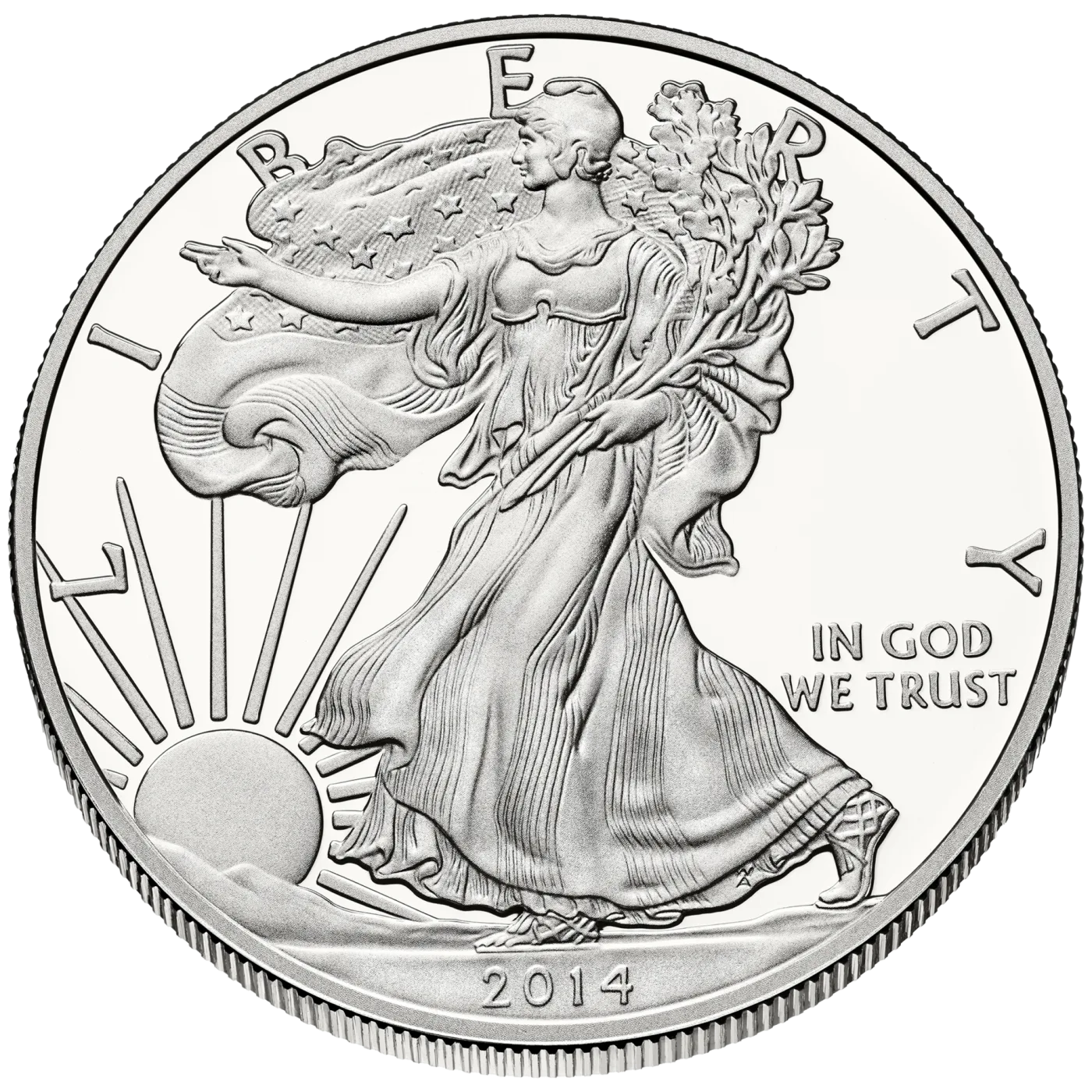
The obverse is Adolph A. Weinman’s Walking Liberty, adapted from his beloved 1916–1947 half dollar. Lady Liberty strides toward a rising sun, draped in the American flag, carrying branches of laurel and oak in her left arm with her right arm extended. The inscriptions read LIBERTY across the top, IN GOD WE TRUST to the right, and the date at the lower right. This is the same fundamental design celebrated on the Walking Liberty Half Dollar, which is exactly why so many collectors who love that classic series gravitate to the Silver Eagle. On 2021 and later coins, Weinman’s “AW” monogram was restored more prominently and the portrait was re-engraved from the original models for sharper detail.
Reverse (Back) Design — Heraldic Eagle (1986–2021)
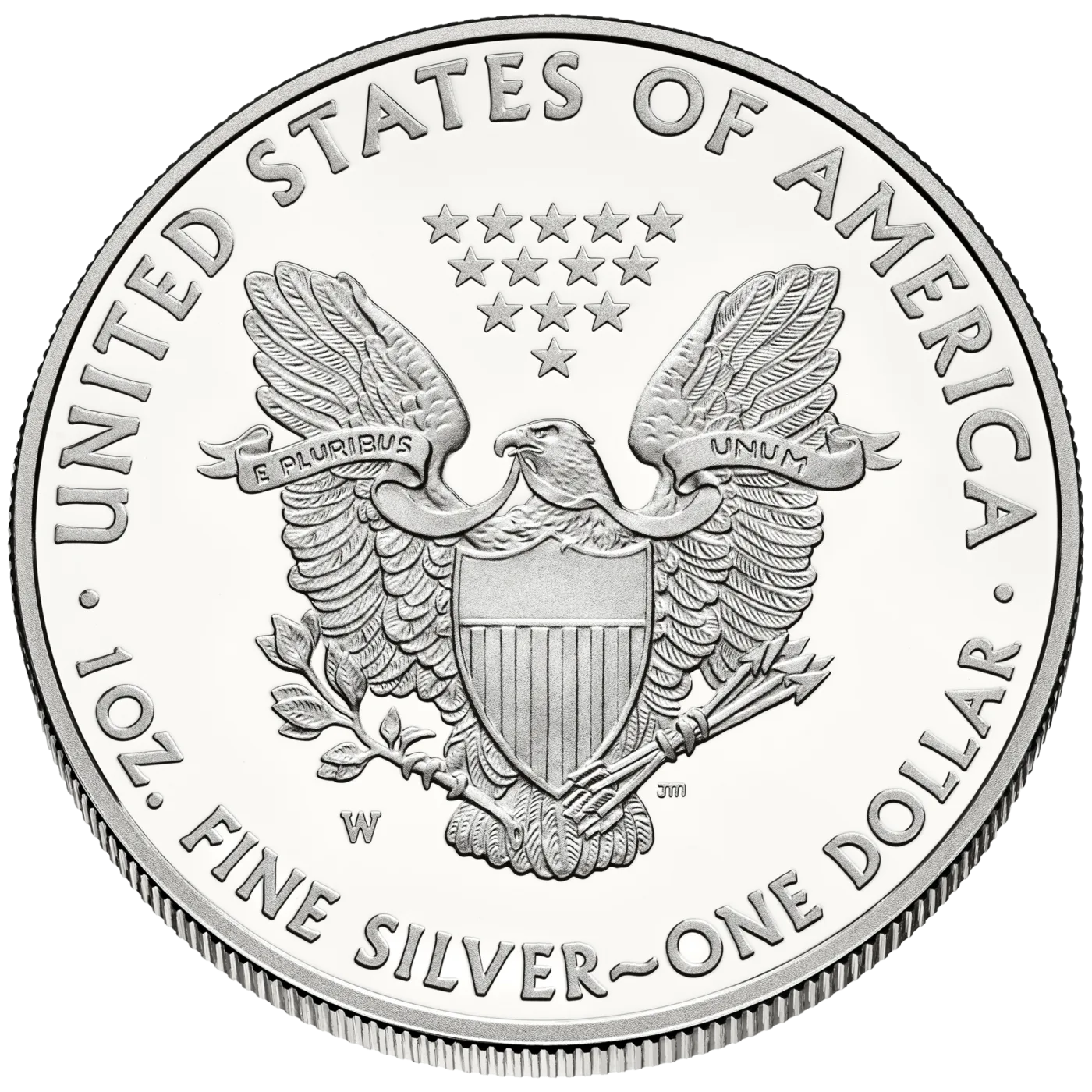
The original reverse, designed by U.S. Mint sculptor-engraver John Mercanti, shows a heraldic eagle behind a shield, clutching an olive branch in its right talon and a bundle of arrows in its left. Above the eagle are thirteen five-pointed stars arranged in a triangle representing the original colonies. The inscriptions read UNITED STATES OF AMERICA across the top, E PLURIBUS UNUM on a banner in the eagle’s beak, and 1 OZ. FINE SILVER ~ ONE DOLLAR across the bottom. This is the “Type 1” reverse.
Reverse (Back) Design — Eagle Landing (2021–present)
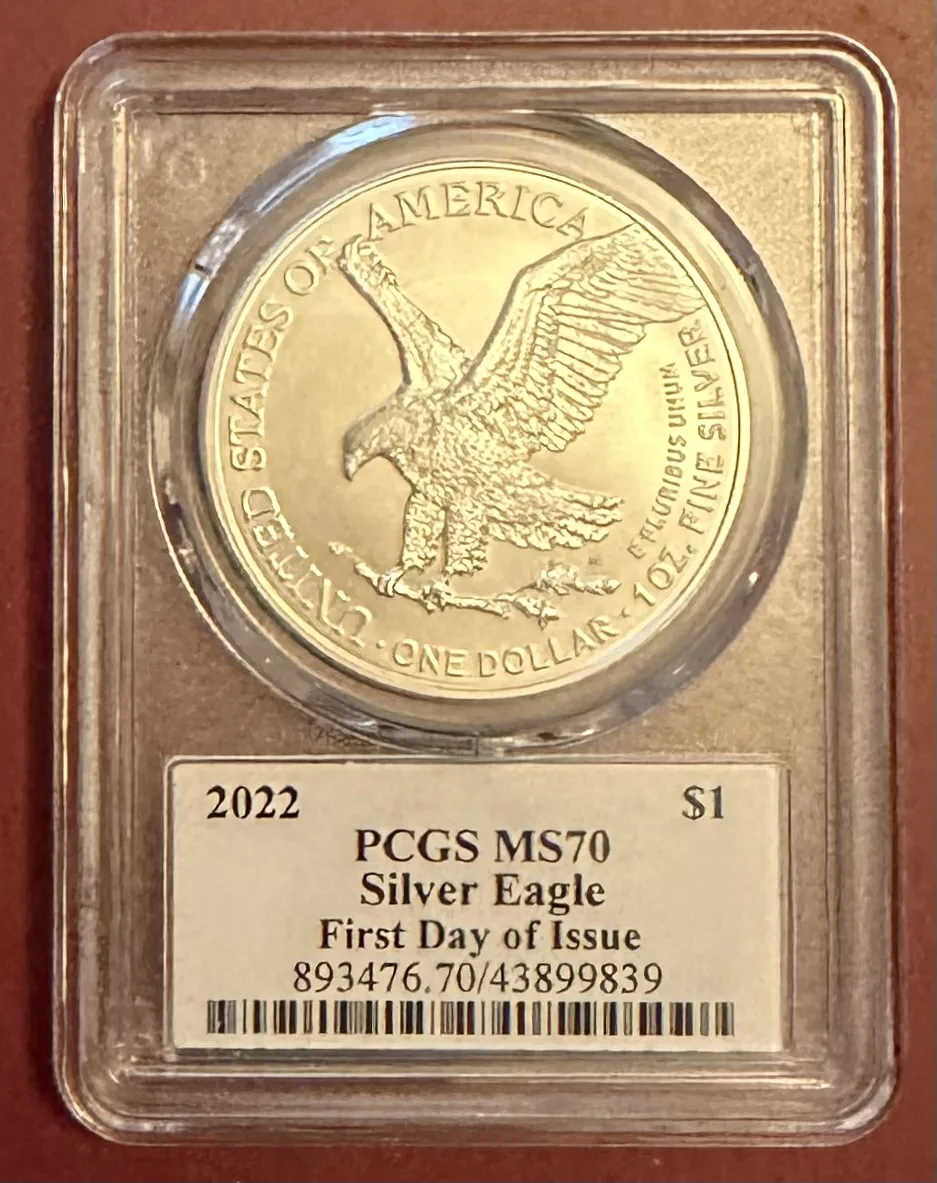
The new reverse, the “Type 2,” depicts an eagle approaching a landing, about to grasp an oak branch to add to its nest — symbolizing the delivery of a nation’s hopes to the next generation. The same legends appear: UNITED STATES OF AMERICA, E PLURIBUS UNUM, 1 OZ. FINE SILVER, and ONE DOLLAR. The composition is more naturalistic and detailed than the heraldic original.
How to Quickly Recognize a Silver Eagle
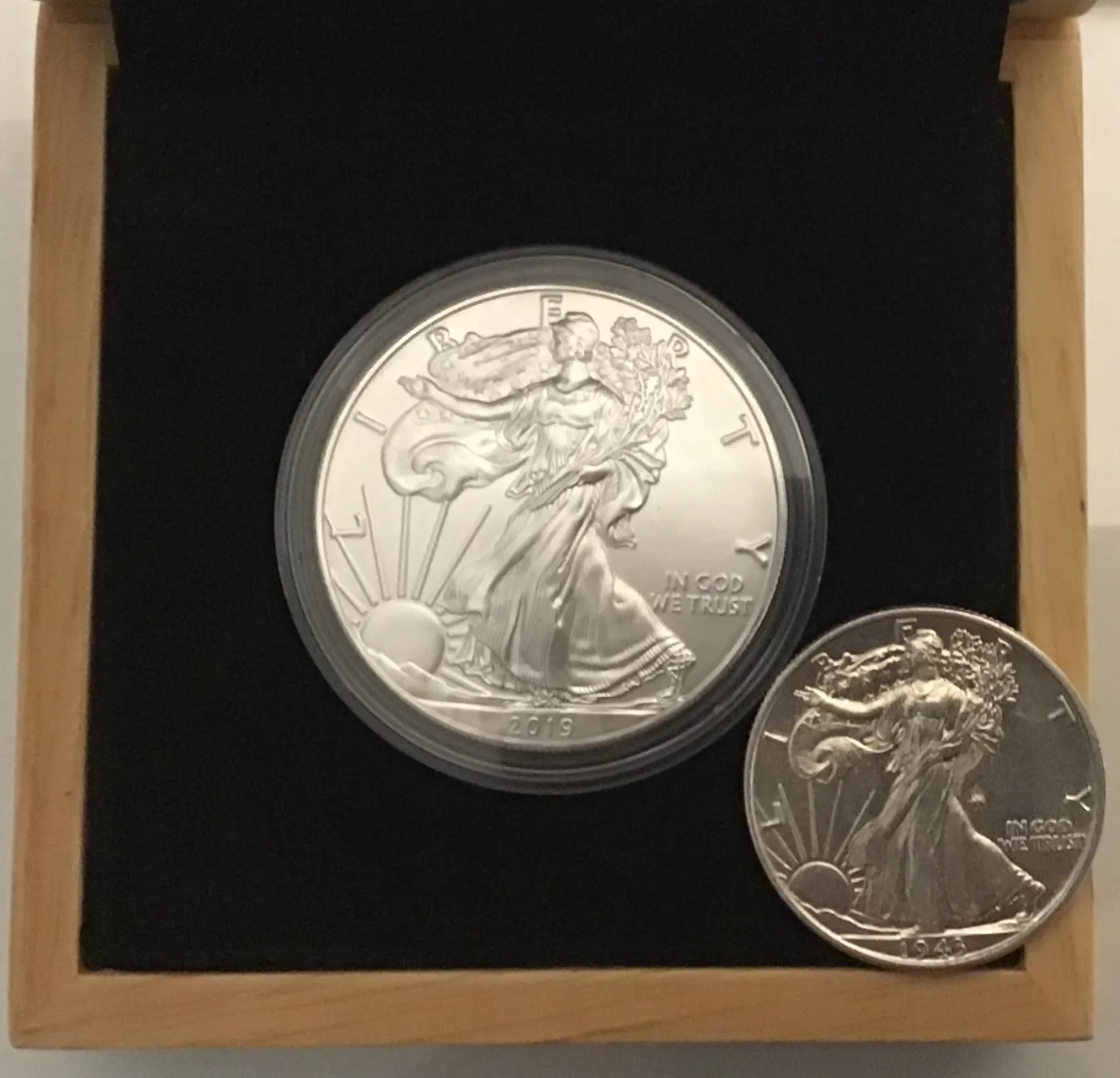
If the obverse shows full-figure Liberty striding toward a sunrise draped in a flag, and the reverse reads “1 OZ. FINE SILVER” with “ONE DOLLAR,” you are holding an American Silver Eagle. The “1 OZ. FINE SILVER” legend is the single fastest confirmation — no circulating U.S. coin carries it, and it instantly distinguishes the Silver Eagle from the original Walking Liberty Half Dollar, which is 90% silver and reads “HALF DOLLAR.”
Type 1 vs Type 2 Reverse (The 2021 Split)
The Type 1 / Type 2 distinction is the most important identification skill for any Silver Eagle collector, because 2021 is the only year that exists in both — and the two versions carry different premiums.
What Changed
Type 1 (1986–2021) is Mercanti’s heraldic eagle behind a shield. Type 2 (2021–present) is the Damstra/Gaudioso eagle coming in to land at its nest. Telling them apart is easy: Type 1 shows a stylized, formal eagle facing forward with a shield across its body; Type 2 shows a realistic eagle in flight, wings raised, viewed from a three-quarter angle.
Why 2021 Is Special
The Mint switched designs partway through 2021 to mark the 35th anniversary, so the year was produced in both reverses across bullion, proof, and burnished formats. This created an instant collectible: the 2021 Type 1 and 2021 Type 2 are both sought after, with the Type 1 generally commanding a premium as the “last of the old design” and certain Type 2 first-strikes also drawing interest. Sets pairing both 2021 reverses are popular.
The 2021 Emergency Issues
The 2021 transition also produced unusual “emergency production” bullion coins. To meet demand during the changeover, the Mint struck additional 2021 (P) and 2021 (S) Type 1 bullion eagles at the Philadelphia and San Francisco facilities even though bullion coins normally carry no mint mark. These coins are physically identical to West Point bullion strikes — they can only be attributed by the original sealed Monster Box label or by third-party verification, which has made certified examples genuinely scarce and valuable.
Bullion, Proof, Burnished, and Reverse Proof Finishes
The Silver Eagle exists in several distinct finishes, and knowing which one you have is essential to valuing the coin correctly. Two coins of the same date can differ in value by hundreds of dollars based on finish alone.
Bullion (Business Strike)
Bullion Silver Eagles are the standard investment version, struck in enormous quantities and sold through the Mint’s network of authorized purchasers (not directly to the public). They have a brilliant but non-mirrored finish and carry no mint mark in most years. These are the coins you buy “by the ounce” and the ones found in the green “Monster Boxes” of 500.
Proof
Proof Silver Eagles are struck on specially prepared planchets with polished dies, producing the deeply mirrored fields and frosted, cameo proof-coin finish collectors prize. They are sold directly to collectors in Mint packaging and carry a mint mark (S, W, or P depending on year), the same proof format the Mint uses for its modern commemorative coins. Proofs from West Point bear a “W,” and earlier proofs a “S.” Modern proofs routinely grade PR-69 and PR-70 Deep Cameo.
Burnished (Uncirculated with Mint Mark)
Beginning in 2006, the Mint introduced a collector “uncirculated” version struck on burnished planchets with a distinctive soft, matte-like satin luster and — critically — a “W” mint mark. These are often called “burnished” or “Unc W” eagles to distinguish them from the no-mint-mark bullion coins. The 2008-W is the source of the famous Reverse of 2007 error discussed below.
Reverse Proof
A reverse proof flips the normal proof contrast: the fields are frosted and the devices are mirrored. Reverse proofs are special-issue coins struck only for anniversary and limited-edition sets — for example the 2011-P and 2012-S reverse proofs and the 2021 reverse proof Type 2. They are always low-mintage and command strong premiums.
Enhanced Uncirculated and Enhanced Reverse Proof
The Mint has also produced “enhanced” finishes that combine multiple textures (mirror, frost, and laser-frosting) on a single coin. The 2019-S Enhanced Reverse Proof, sold in the Pride of Two Nations set, is among the most desirable modern issues. These exotic finishes appear only in special products and are among the scarcest Silver Eagles.
Mint Marks and Where to Find Them
Mint marks are central to Silver Eagle collecting because the same date can exist with different mint marks (or none) across different finishes, and the mint mark often determines value.
Where the Mint Mark Appears
On Type 1 reverse coins (1986–2021), the mint mark is on the reverse, located between the eagle’s tail feathers and the “ONE DOLLAR” inscription, just left of center near the bottom. On Type 2 reverse coins (2021–present), the mint mark moved to the obverse, positioned along the lower-left edge near the date and Liberty’s foot. Use a loupe — the mark is small.
The Facilities and Their Marks
- No mint mark (bullion): Standard bullion Silver Eagles carry no mint mark, regardless of which facility struck them. Over the years bullion eagles have been made at Philadelphia, West Point, and San Francisco, but the coins themselves are not distinguished.
- “S” (San Francisco): Used on most proofs from 1986–1992, the 2011-S and 2012-S anniversary issues, and the 2021 (S) emergency bullion coins.
- “P” (Philadelphia): Used on the 1995-P through 1998-P proofs era partially, the 2011-P reverse proof, and 2021 (P) emergency bullion. The “P” is uncommon on Silver Eagles and always notable.
- “W” (West Point): The dominant mint mark on modern proofs (2001 onward) and on every burnished/uncirculated collector coin since 2006. West Point is the workhorse facility for collector Silver Eagles.
Why Mint Marks Matter So Much Here
Because bullion coins are unmarked, the presence of any mint mark immediately signals a collector issue (proof or burnished), which is worth far more than a plain bullion coin of the same date. A 2008 with no mint mark is a common bullion coin; a 2008-W could be the rare Reverse of 2007 variety. Always check the mint mark first — it is the gateway to knowing what you actually have.
Key Dates: Bullion Strikes
Most bullion Silver Eagles trade at a modest premium over silver spot, but a handful of dates stand out as genuine keys even in the bullion series.
1996: The Bullion Key
The 1996 bullion Silver Eagle had the lowest mintage of any business-strike eagle for decades — about 3.6 million coins — at a time when silver prices were low and demand soft. It has long been recognized as the key date of the bullion series. Raw examples trade at $60–$120 depending on quality, and certified MS-69 coins run $80–$150, with MS-70 examples commanding several hundred dollars.
1986: The First Year
As the inaugural year, the 1986 bullion eagle carries collector demand beyond its silver content. It is common in absolute terms (over 5 million struck) but desirable as a first-year issue; certified MS-69 examples run $60–$90 and gem MS-70 coins are scarce and valuable because the early strikes were not made to today’s pristine standards.
2021 Type 1 and Emergency Issues
The 2021 Type 1 bullion eagle is the last of the Mercanti reverse and draws a premium. The 2021 (P) and 2021 (S) emergency-production bullion coins — verified from sealed Monster Boxes — are genuinely scarce and bring strong money in certified holders, often $150–$400+ depending on grade and label.
Low-Mintage Modern Years
Certain years saw relatively lower bullion mintages that give them mild key status, but for bullion the premiums beyond silver are driven mostly by 1996, first-year 1986, and the 2021 transition coins. Everything else trades close to melt plus the standard dealer premium.
Key Dates: Proofs and Special Issues
The proof and special-issue side of the Silver Eagle series contains the true rarities — coins with mintages in the tens of thousands rather than the millions.
1995-W Proof: The King of the Series
The 1995-W proof is the most famous and valuable regular-issue Silver Eagle. It was available only as part of a five-coin 10th Anniversary Gold and Silver Eagle proof set, with a mintage of just 30,125. Demand vastly outstrips supply. A certified PR-69 Deep Cameo runs $3,000–$4,500, and PR-70 examples bring $5,000–$10,000+. This is the coin most often counterfeited and most often the target of mint-mark alteration (adding a “W” to a common proof), so certification is essential.
2008-W Reverse of 2007
A celebrated transitional die error: some 2008-W burnished eagles were struck with a leftover 2007 reverse die. The two reverses differ in the shape of the “U” in “UNITED” — the Reverse of 2007 has a more rounded “U” with a serif, while the Reverse of 2008 has a flatter “U.” Certified examples run $300–$600 in MS-69 and over $1,000 in MS-70. This is covered in detail in the Errors section below.
2011-S (25th Anniversary Set)
The 2011-S uncirculated eagle was available only in the five-coin 25th Anniversary Set, with a mintage around 100,000. It is the key to the burnished/uncirculated subset. Certified MS-69 examples run $200–$350 and MS-70 coins bring $400–$700+.
2019-S Enhanced Reverse Proof (Pride of Two Nations)
With a mintage of approximately 30,000, the 2019-S Enhanced Reverse Proof from the U.S.–Canada Pride of Two Nations set is one of the scarcest modern eagles. Certified examples regularly bring $400–$900 depending on grade.
2006, 2011, 2016, and 2021 Anniversary Sets
Each major anniversary brought special sets containing reverse proofs, burnished coins, and enhanced finishes. The 2006 20th Anniversary Set (which introduced the reverse proof), the 2011 25th Anniversary Set, the 2016 30th Anniversary lettered-edge proof, and the 2021 two-coin Reverse Proof Set (Type 1 and Type 2) all contain coins worth far more than common dates.

Famous Errors and Transitional Varieties
For a modern bullion coin the Silver Eagle has a surprising roster of collectible errors and die varieties, the most important of which is a transitional reverse.
2008-W Reverse of 2007 (The Big One)
In 2008, a small number of West Point burnished eagles were struck using a reverse die left over from 2007. The Mint had slightly modified the reverse hub for 2008, so the two are distinguishable. The quickest diagnostic is the “U” in UNITED: on the Reverse of 2007 the “U” has a small serif at the bottom right and a more rounded interior; on the Reverse of 2008 the “U” is taller with a flatter, bowl-shaped bottom. The “F” in FINE and the spacing of stars also differ subtly. Genuine examples are certified by PCGS and NGC and are worth a substantial premium — never buy a raw “Reverse of 2007” claim.
Struck-Through and Planchet Errors
Because bullion eagles are made in such volume, mint errors do occur: struck-through-grease eagles, partial collar strikes, clipped planchets, and the occasional double strike. These are uncommon but real, and significant errors on a one-ounce silver coin can bring $100 to several thousand dollars depending on severity and eye appeal.
Spotted and Milk-Spot Coins (Not Errors)
Many Silver Eagles develop white “milk spots” — cloudy haze caused by residue from the planchet washing or annealing process reacting over time. Milk spots are a condition problem, not a variety, and they reduce eye appeal and grade. They cannot be safely removed. Buyers paying gem prices should inspect carefully for milk spots, which are extremely common on coins from certain years.
Counterfeit “Errors”
Be wary of dramatic “error” eagles offered cheaply online; many are altered or outright counterfeit, and the Silver Eagle is one of the most heavily faked bullion series, so knowing how to detect counterfeit coins by weight, dimension, and magnet tests is essential. The 2008-W Reverse of 2007 in particular has spawned fakes created by altering common coins. Genuine major varieties are virtually always encapsulated by a top grading service with the variety noted on the label.
Physical Specifications
The Silver Eagle’s specifications have remained constant since 1986, which makes weight-and-diameter checks a powerful first line of defense against counterfeits.
- Composition: .999 fine silver (99.9% pure). Note: beginning with later issues the Mint cites .999 fine; the coin contains exactly one troy ounce of pure silver regardless.
- Silver content: 1.000 troy ounce (31.103 grams) of pure silver.
- Total weight: 31.103 grams (1.000 troy ounce) — the coin is essentially pure silver, so total weight equals silver weight.
- Diameter: 40.6 millimeters (1.598 inches).
- Thickness: 2.98 millimeters.
- Edge: Reeded.
- Face value: $1 (legal tender, though never spent at face).
The large 40.6 mm diameter — bigger than a silver dollar — combined with the precise 31.103 g weight is hard for counterfeiters to replicate without using real silver or detectable substitutes. A genuine Silver Eagle that is significantly off on weight or diameter is a fake. The 2016 30th Anniversary issues are the one exception in appearance: they have a slightly different edge (lettered “30TH ANNIVERSARY”) but the same metal content.
How to Grade Silver Eagles
Silver Eagles are graded on the 70-point Sheldon scale, but because they are modern coins struck to high standards, the meaningful grading range is compressed at the top end. The same fundamental grading methods used across U.S. coins apply, with particular attention to bag marks, luster, and spotting.
Bullion (Mint State) Grading
- MS-69: The workhorse grade for bullion eagles — nearly flawless with one or two tiny ticks visible under magnification. Most certified bullion eagles grade MS-69.
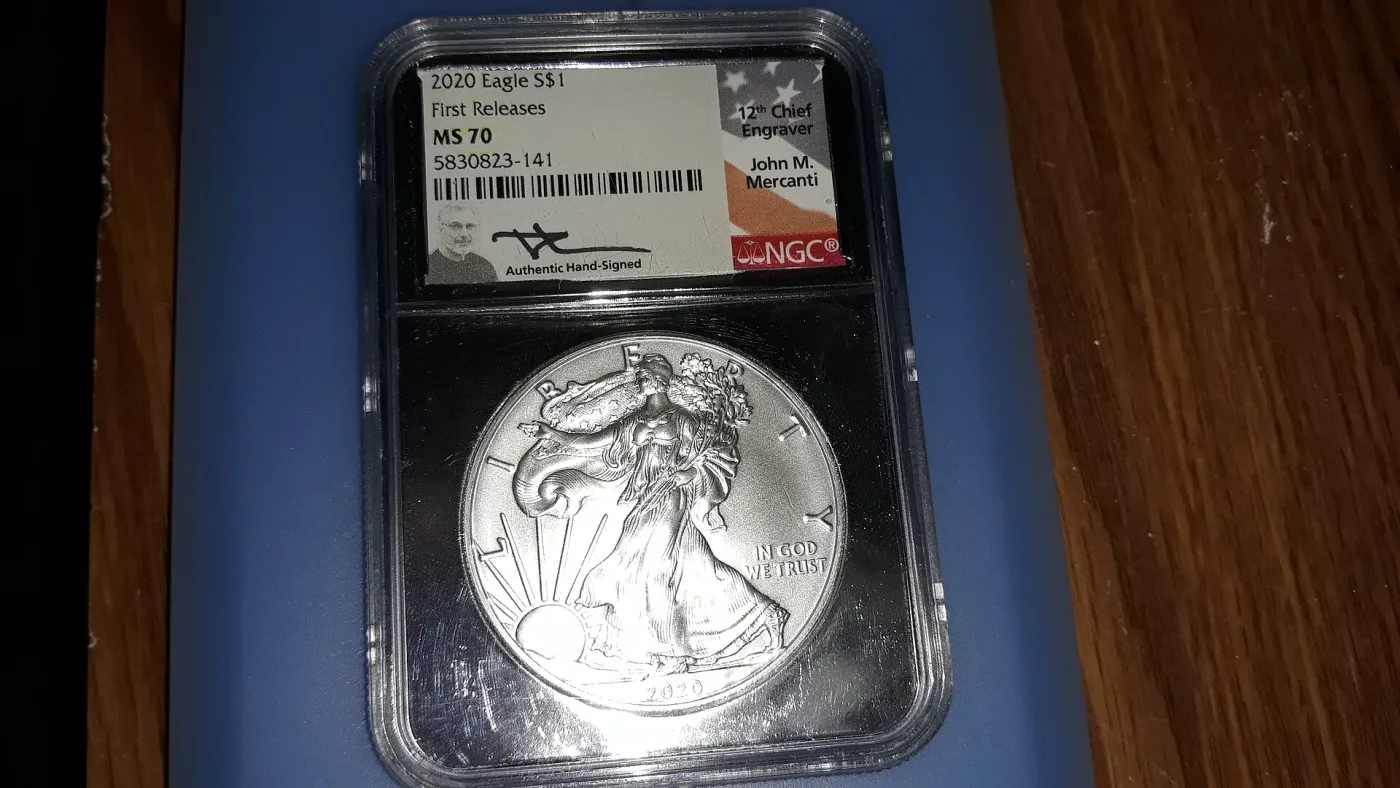
- MS-70: Perfect under 5x magnification — no contact marks, full luster, no spots. MS-70 commands a strong premium because the difference from MS-69 is subtle but the price gap is large.
- MS-68 and below: Uncommon for certified eagles; usually the result of heavy bag marks or milk spots. Raw eagles pulled from circulation-style handling can grade lower.
Proof Grading
Proofs are graded PR (or PF) on the same scale, almost always with a “Deep Cameo” (DCAM) or “Ultra Cameo” designation reflecting the frosted-device-on-mirror-field contrast. PR-69 DCAM is the common grade; PR-70 DCAM is the premium grade. For proofs, the enemies of a 70 grade are hairlines, tiny mirror disturbances, and spots.
Special Designations and Labels
Third-party graders offer first-strike / early-release labels (coins submitted within the first 30 days of release), signature labels (Mercanti, Damstra, etc.), and special holders. These labels can add to value among collectors but do not change the coin’s technical grade. A “First Strike MS-70” and a regular “MS-70” are the same coin technically; the premium is collector-driven.
Why Grade a Bullion Coin At All?
For common-date bullion eagles, paying $20–$30 to certify a coin rarely makes sense — they trade as silver. Certification pays off for key dates (1996, 2021 emergency issues), for proofs and special issues where MS-70/PR-70 carries a real premium, and for protecting against the counterfeits that plague this series.
Bullion Value vs Numismatic Premium
Understanding the difference between a Silver Eagle’s melt value and its collector premium is the key to buying and selling intelligently. This is the same bullion-versus-numismatic tension that gold collectors weigh on the Saint-Gaudens Double Eagle, only at silver-coin scale.
The Bullion Floor
Every Silver Eagle contains one troy ounce of pure silver, so its value can never fall below the silver spot price (less a small dealer spread). At 2026 silver prices, that floor is a meaningful anchor — a common-date eagle is “worth its weight” no matter what. This melt-value floor is what makes Silver Eagles attractive to stackers who simply want ounces of recognizable, liquid silver.
The Standard Premium
Bullion eagles trade at a premium over spot — historically a few dollars per coin, though the premium spikes during shortages (it exceeded $10–$15 over spot during the 2020–2021 demand surge). When you buy a tube of common-date eagles, you are paying spot plus this premium; when you sell, you receive spot plus a smaller premium. The spread is the dealer’s margin.
The Numismatic Premium
Key dates, proofs, burnished coins, special finishes, and top-grade examples carry a numismatic premium far above silver value. A 1995-W proof is worth thousands not because of its one ounce of silver but because of scarcity and demand. The art of Silver Eagle collecting is knowing which coins are “just silver” and which are genuine numismatic items — a distinction that comes down to date, mint mark, finish, and grade.
Silver Eagles as Stacking vs Collecting
Many people own Silver Eagles for two different reasons. Stackers buy common-date bullion for the metal and ignore premiums beyond the cheapest available. Collectors pursue dates, finishes, and grades — building proof sets, burnished sets, or a Type 1/Type 2 type set. Both are valid; just know which game you are playing before you pay a premium.
Authentication and Counterfeit Detection
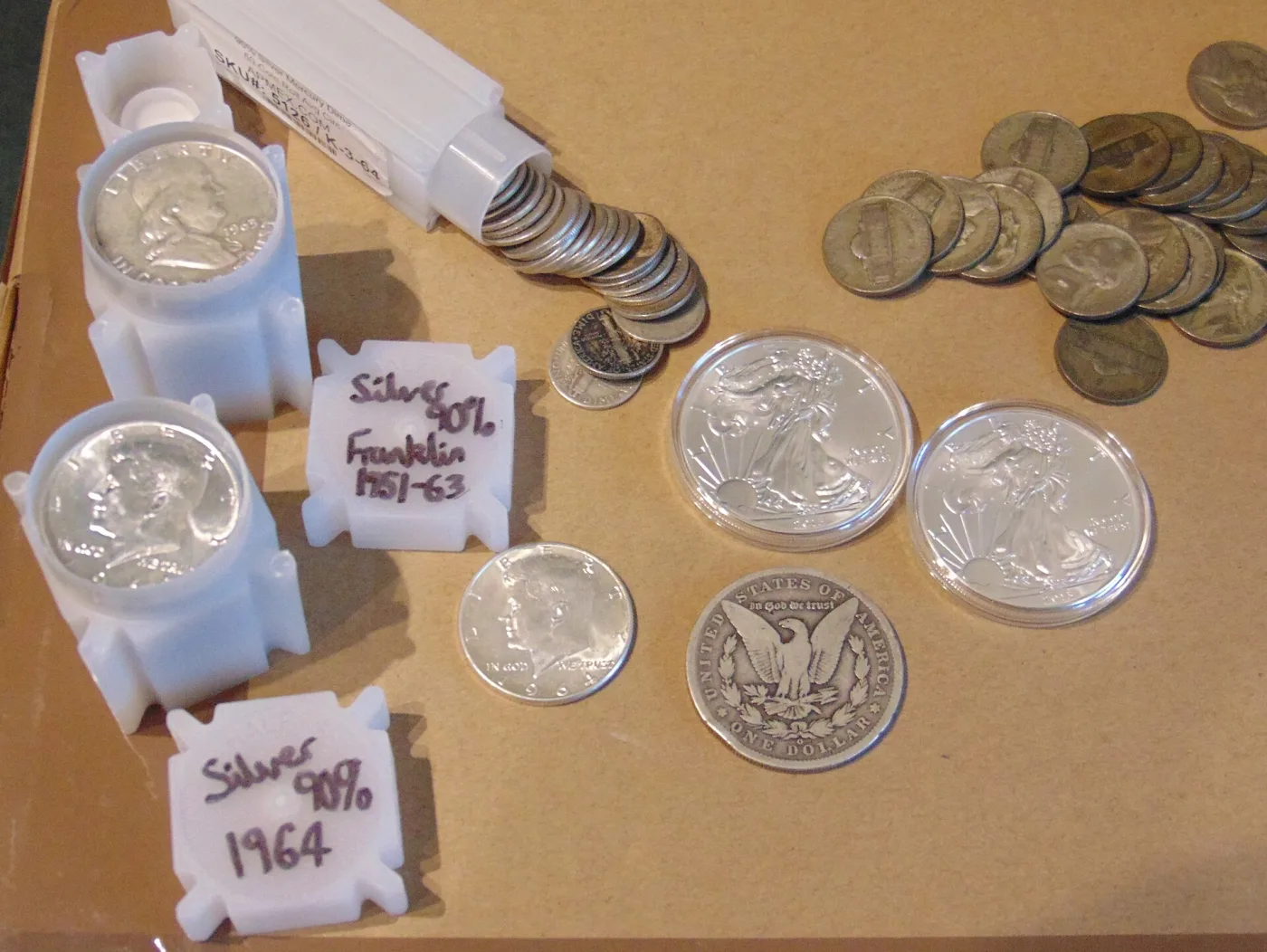
The American Silver Eagle is one of the most heavily counterfeited coins in the world precisely because it is so popular and trades close to a known silver value. Sophisticated fakes — including silver-plated tungsten and lead-core counterfeits — circulate widely. Authentication discipline is essential.
Weight and Dimension Checks
The single best first test is weight: a genuine Silver Eagle weighs 31.103 grams (±0.1 g). Counterfeits made of base metal almost always miss this, because matching silver’s density is difficult. Check the diameter (40.6 mm) and thickness (2.98 mm) with calipers. A coin that is the right diameter but wrong weight, or right weight but wrong thickness, is a fake. These same weight-and-caliper checks protect buyers of the Morgan Silver Dollar and Peace Dollar — for silver coins, density is the counterfeiter’s hardest obstacle.
The Magnet and “Ping” Tests
Silver is not magnetic, so a Silver Eagle should show no attraction to a strong neodymium magnet. A “slide test” — letting a magnet slide slowly down a tilted coin — should show gentle eddy-current braking on real silver. The “ping” test (balancing the coin and tapping it) produces a characteristic long, high ring on genuine silver versus a dull thud on a plated base-metal fake. Neither test is definitive alone, but together they catch many counterfeits.
Visual and Strike Quality
Genuine eagles have crisp, fully detailed designs with sharp lettering and clean fields. Counterfeits often show mushy details, weak or uneven reeding, incorrect font shapes, or a greasy/cast surface texture. Compare a suspect coin side-by-side with a known-genuine eagle under magnification. Cast fakes may show seams on the edge or tiny gas-bubble pits.
Conductivity Testing
For serious buyers, a precious-metal conductivity tester (such as a Sigma Metalytics verifier) reads through the coin and detects base-metal cores that pass weight and dimension checks. This is the gold standard for bulk buyers and is increasingly common at coin shops because of how good modern counterfeits have become.
Buy Certified for Key Dates
For any high-value eagle — the 1995-W proof, 2008-W Reverse of 2007, 2011-S, 2021 emergency issues, or any coin you are paying a large premium for — buy it certified by PCGS or NGC in a tamper-evident holder. The certification cost is trivial compared to the loss from a convincing fake.
Current Market Values
Silver Eagle values fall into two worlds: common coins that track silver spot, and key dates and special issues that carry large numismatic premiums. The figures below are approximate 2026 retail prices.
Common-Date Bullion
Common-date bullion eagles (most years 1986–present) trade at silver spot plus a premium of roughly a few dollars per coin in raw condition. Certified MS-69 examples of common dates run $45–$70; MS-70 examples run $60–$120 depending on year and demand. The premium over melt is modest for all but the keys.
Bullion Key Dates
- 1996 — $60–$120 raw; $80–$150 in MS-69; $300–$700+ in MS-70.
- 1986 (first year) — $55–$90 in MS-69; several hundred dollars in MS-70.
- 2021 Type 1 — $70–$150 depending on grade and label.
- 2021 (P) / 2021 (S) emergency — $150–$400+ certified with verified label.
Proofs and Special Issues
- 1995-W proof — $3,000–$4,500 in PR-69 DCAM; $5,000–$10,000+ in PR-70.
- 2008-W Reverse of 2007 — $300–$600 in MS-69; $1,000+ in MS-70.
- 2011-S (25th Anniversary) — $200–$350 in MS-69; $400–$700+ in MS-70.
- 2019-S Enhanced Reverse Proof — $400–$900 depending on grade.
- Common modern proofs (W) — $50–$90 in PR-69; $80–$150 in PR-70.
Factors Affecting Value
Beyond date and finish, Silver Eagle value is driven by grade (MS-70/PR-70 vs 69), absence of milk spots, label desirability (first strike, signed), and the prevailing silver spot price, which sets the floor for every coin in the series. In a rising silver market even common eagles appreciate; in a falling market the keys and special issues hold their numismatic premium better than plain bullion.
Storage, Handling, and Preservation
Because Silver Eagles are pure silver with pristine surfaces, they are unusually vulnerable to spotting, toning, and fingerprints. Proper storage protects both eye appeal and grade.
Handling
Always hold eagles by the edge, never touching the faces. Fingerprints on a brilliant or proof surface are nearly impossible to remove and will eventually etch into the metal. Wear cotton or nitrile gloves for proofs and high-grade coins, and work over a soft cloth to prevent damage from drops.
Holders and Capsules
For raw eagles, use Air-Tite capsules sized 40 mm (model “H40” or direct-fit) — these provide an airtight seal without contacting the coin’s surface. Avoid PVC-containing soft flips, which off-gas plasticizers that cause green corrosion on silver over time. For valuable coins, a PCGS or NGC slab is the best long-term protection. Original government packaging is fine for proofs but inspect periodically for haze.
Environmental Controls
Store eagles in a cool, dry, stable environment. Silica gel packets in the storage container absorb humidity; replace them periodically. Avoid sulfur sources — cardboard, rubber bands, newspaper, certain woods and paints — which accelerate toning on pure silver. The same preservation principles apply to any 20th-century silver coin, including the Walking Liberty Half Dollar whose design the eagle shares.
Milk Spots: Prevention, Not Cure
Milk spots cannot be removed without damaging the coin, so prevention is the only strategy: buy spot-free coins, store them in inert holders, and keep them dry. If you are buying gem-graded eagles as an investment, inspect for milk spots before purchase — a spotted MS-70 is worth far less than a clean one.
Cleaning: Don’t
Never clean a Silver Eagle. Cleaning leaves hairlines, destroys luster, and drops the grade — turning a $70 MS-69 into a “details” coin worth little more than melt. Even toned or hazy eagles should be left alone. If a coin shows active corrosion, consult a professional conservation service (NCS) rather than attempting any home remedy.
Building a Silver Eagle Collection
The American Silver Eagle is one of the most flexible modern series to collect, with paths for every budget from pure stacking to a complete certified date-and-finish run.
Date Set (Bullion)
The most popular approach is a complete bullion date set, one coin for every year from 1986 to the present. In raw or MS-69 condition this is affordable — most years cost a small premium over silver, with the 1996 key being the main expense. A complete MS-69 bullion date set runs roughly $1,500–$2,500 depending on silver prices and the 1996.
Type Set (Designs and Finishes)
A compact type set captures the major varieties: a Type 1 reverse, a Type 2 reverse, a proof, a burnished coin, and a reverse proof. This five- or six-coin set tells the whole design-and-finish story of the series for a few hundred dollars and makes an excellent display.
Proof Set Run
Collecting one proof eagle per year is a beautiful and achievable goal — but it includes the 1995-W, which alone costs thousands. Many collectors build the proof run “except the 1995-W” and add that key later. A complete proof run in PR-69/70 is a four-figure to five-figure project largely because of that one coin.
Burnished (Uncirculated W) Set
The burnished series only began in 2006, making it a shorter, more affordable run — with the 2011-S (from the anniversary set) as its key. A complete burnished set in MS-69/70 is an attainable mid-budget collection.
Key-Date Focus
Budget-conscious collectors often target just the recognized keys: the 1996 bullion, 1995-W proof, 2008-W Reverse of 2007, 2011-S, and 2019-S Enhanced Reverse Proof. Owning these few coins captures the series’ most important and valuable issues without buying every common date.
Budget and Buying Tips
Buy common dates as cheap bullion — never pay a numismatic premium for a coin that is “just silver.” Buy keys and special issues certified to avoid counterfeits and altered mint marks. Inspect for milk spots before paying gem prices. And track the silver spot price: it sets the floor under your entire collection and determines whether common eagles are a bargain or fully priced on any given day.
Frequently Asked Questions
How much is an American Silver Eagle worth?
A common-date Silver Eagle is worth its one troy ounce of silver plus a small premium — at 2026 prices, that is the silver spot value plus a few dollars. Certified MS-69 common dates run $45–$70 and MS-70 examples $60–$120. Key dates and special issues are worth far more: the 1996 bullion key runs $60–$700 depending on grade, and the 1995-W proof can exceed $5,000.
What is the difference between Type 1 and Type 2 Silver Eagles?
Type 1 (1986–2021) has John Mercanti's heraldic eagle behind a shield on the reverse. Type 2 (2021–present) has a new reverse showing an eagle coming in to land at its nest, designed by Emily Damstra. The Mint switched designs mid-2021, so that year exists in both types. On Type 1 the mint mark is on the reverse; on Type 2 it moved to the obverse near the date.
What is the rarest American Silver Eagle?
Among regular issues, the 1995-W proof is the most famous rarity, with a mintage of just 30,125 (available only in the 10th Anniversary set). Other major keys include the 2008-W Reverse of 2007 transitional error, the 1996 bullion (lowest bullion mintage), the 2011-S, and the 2019-S Enhanced Reverse Proof. The 2021 (P) and (S) emergency-production bullion coins are also genuinely scarce when certified.
Where is the mint mark on a Silver Eagle?
On Type 1 coins (1986–2021) the mint mark is on the reverse, between the eagle's tail and the "ONE DOLLAR" inscription near the bottom. On Type 2 coins (2021 onward) it moved to the obverse, along the lower-left edge near the date. Standard bullion eagles carry no mint mark at all; only proofs, burnished coins, and special issues are marked (S, P, or W).
Are Silver Eagles pure silver?
Yes. Every American Silver Eagle contains one troy ounce (31.103 grams) of .999 fine silver — 99.9% pure. The total coin weight equals its silver weight because there is essentially no other metal in it. This is different from pre-1965 U.S. silver coins, which were 90% silver alloyed with copper.
Should I buy Silver Eagles for investment?
Silver Eagles are among the most liquid and recognizable silver bullion coins, which makes them easy to buy and sell — but you pay a premium over spot, so they are best as a long-term silver holding rather than a short-term trade. Common-date bullion is the cheapest way to own ounces; key dates and proofs are collectibles whose value depends on numismatic demand, not just silver. Collect for enjoyment first and investment second.
What is the 2008-W Reverse of 2007 error?
It is a transitional die error where some 2008-W burnished eagles were struck with a reverse die left over from 2007 after the Mint slightly modified the reverse hub for 2008. The quickest way to tell them apart is the shape of the "U" in UNITED — the Reverse of 2007 has a more rounded, serifed "U." Genuine examples are certified and worth $300–$1,000+; raw claims are usually altered or fake.
How can I tell if my Silver Eagle is fake?
Start with weight: a genuine eagle weighs 31.103 grams. Check diameter (40.6 mm) and thickness (2.98 mm) with calipers. Silver is non-magnetic, so it should show only gentle eddy-current braking against a strong magnet, never attraction. Genuine coins have crisp details and a clean silver "ping" when tapped. For high-value coins, use a conductivity tester or simply buy them certified by PCGS or NGC.
Why do some Silver Eagles have white spots?
Those are "milk spots" — cloudy white haze caused by residue from the planchet preparation reacting with the surface over time. They are a condition flaw, not an error or variety, and they reduce the coin's grade and value. Milk spots cannot be safely removed, so the only solution is to buy spot-free coins and store them properly.
Is a Silver Eagle the same as a Walking Liberty Half Dollar?
No, though they share the same obverse design. The Walking Liberty Half Dollar (1916–1947) is a 90% silver, 30.6 mm circulating half dollar. The American Silver Eagle (1986–present) is a one-ounce, .999 fine, 40.6 mm bullion coin that reused Weinman's Liberty design. The eagle's reverse reads "1 OZ. FINE SILVER ~ ONE DOLLAR," which instantly distinguishes it from the half dollar.