Japanese Coins Identification Guide: How to Read, Date, and Value Japanese Coinage
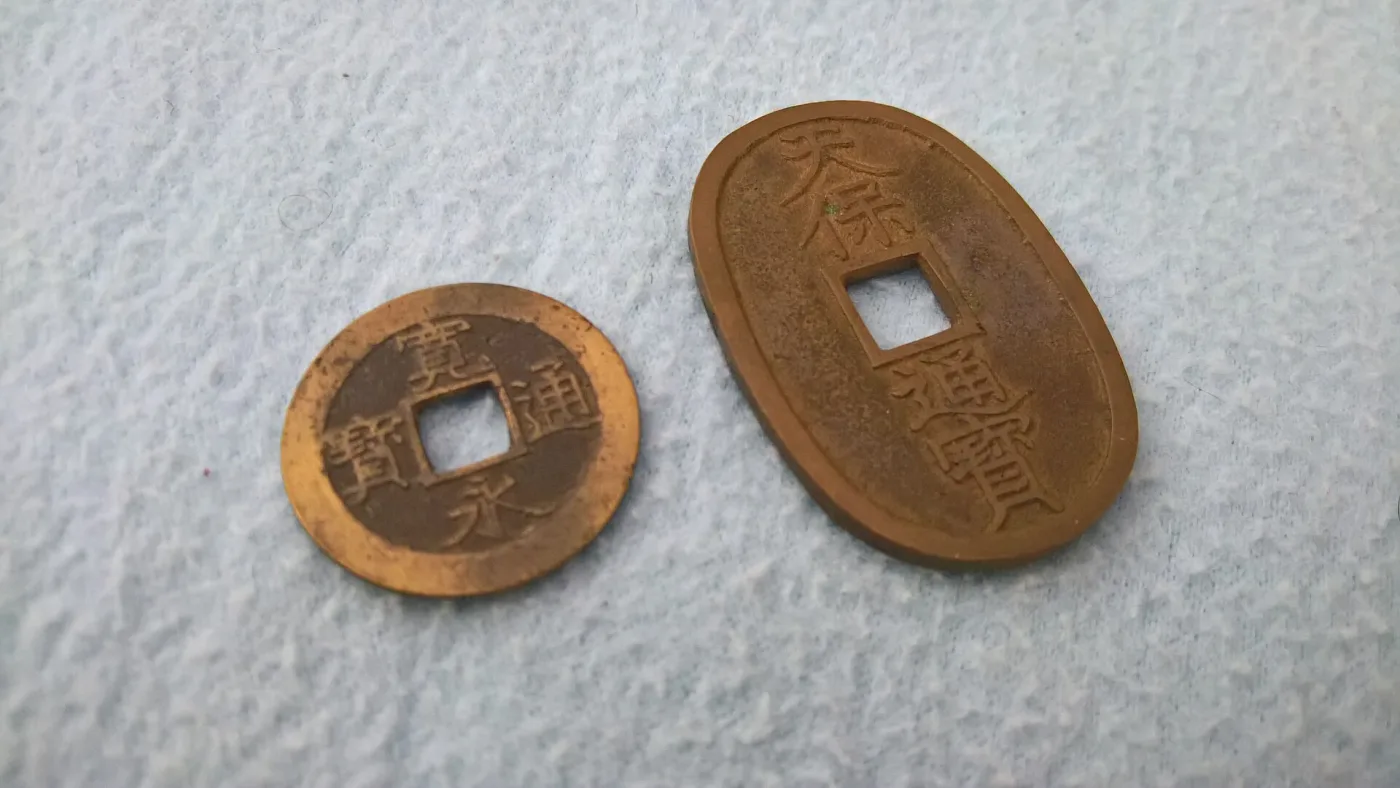
Japanese coins arrive in Western collections by an unusually large number of routes. Servicemen brought them home from the Occupation and from later postings at Yokosuka and Okinawa. Travelers empty their pockets at the end of a trip and never spend the change. Antique dealers buy them by the tray in estate lots. And because Japan issued a genuine trade dollar and a heavy silver yen that circulated across East Asia, Japanese silver turns up in old accumulations that have nothing to do with Japan at all. The result is that “an old Japanese coin” is one of the most common things people bring to a dealer’s counter — and one of the hardest for a beginner to place, because there is not a single Arabic numeral on most of them.
The encouraging news is that Japanese coinage is far more orderly than it first appears. Almost every Japanese coin struck since 1870 carries its date in the same fixed format: a two-character era name, a number, and the character for “year.” Learn five era names and ten numerals — a genuinely small amount of memorization — and you can date any modern Japanese coin exactly, to the year, without knowing a word of Japanese. Everything older splits into a handful of instantly recognizable physical categories: round cast coins with square holes, oval hammered gold, and lumpy cast silver. Shape alone gets you most of the way.
This guide covers the full sweep: the imperial coinages of the eighth century, the six-hundred-year gap when Japan imported Chinese money instead of making its own, the Kan’ei Tsuho that served the Edo period for 240 years, the oval koban gold of the shogunate, the 1871 New Currency Act that created the yen, the Meiji dragon yen and the Japanese trade dollar, the gin countermarks of 1897, wartime and puppet-state issues, the six coins in Japanese pockets today, and the modern key dates that make an ordinary-looking 50-yen piece worth keeping. It also covers the two traps that catch nearly everyone: confusing a Japanese cash coin with a Chinese one, and buying a modern replica koban in the belief that it is Edo-period gold.
Why Japanese Coins Turn Up Everywhere
Japanese coinage occupies an unusual position in world numismatics. It is simultaneously one of the most commonly encountered foreign coinages in the West and one of the least understood, and the reasons for both are historical.
A Century of Movement
Between the Meiji Restoration and the end of the Second World War, Japanese money circulated far beyond Japan: in Taiwan, Korea, Manchuria, and the treaty ports of China. After 1945 the Occupation put hundreds of thousands of Americans in direct daily contact with Japanese coins, and every subsequent decade of military presence, business travel, and tourism added more. Very few foreign coinages have been carried home to the United States in such volume over such a long period.
Continuity of Design
Japan has never had a currency reform that invalidated its coins. The yen introduced in 1871 is the same yen in use in 2026 — no redenomination, no revaluation, no new currency. That continuity means a 1930s coin looks recognizably related to a 2026 coin, and it also means that Japanese collectors have an unbroken series to chase, which supports a deep and active domestic market.
A Strong Home Market
Japan has one of the world’s largest collector bases, and demand for good Japanese material is driven primarily from inside Japan rather than from Western dealers. This matters practically: prices for high-grade Meiji silver and gold are set in Tokyo auction rooms, not in the West, and a coin that looks unremarkable in a Western price guide can be worth substantially more to a Japanese buyer. It also means that the best reference material and the best comparison photographs are frequently in Japanese.
Cheap at the Bottom, Serious at the Top
A worn Kan’ei Tsuho costs a couple of dollars. A circulated silver yen tracks its bullion content plus a modest premium. A choice Meiji gold 20-yen runs into five figures, and the great rarities of the Edo gold series into six. Like Chinese coins, the field stretches across an enormous price range while keeping a genuinely affordable entry point.
The Five Eras of Japanese Coinage
Before reading a single character, place your coin in one of five broad periods. Each looks completely different, and the physical form alone usually decides the question.
The Imperial Coinages (708–958)
Japan’s first official coin, the Wado Kaichin, was cast in 708 in direct imitation of Chinese Tang coinage: a round bronze disc with a square hole and four characters. Eleven further imperial issues followed over the next 250 years, known collectively as the kocho-sen, or “imperial coinages.” Then the government stopped. These twelve types are genuinely rare, are the object of serious scholarly collecting in Japan, and are also heavily reproduced — if you believe you have one, treat it as a reproduction until an expert says otherwise.
The Imported-Coin Period (roughly 958–1600)
For six centuries Japan minted almost nothing and instead used Chinese coins imported by the shipload, mostly Northern Song issues. These are called torai-sen, “coins that came over.” Private Japanese casters also produced crude local copies known as bita-sen. The practical consequence for identification is important: a genuinely medieval “Japanese” coin is usually a Chinese coin that circulated in Japan, and there is often no way to distinguish the two from the coin alone.
The Edo Period (1601–1868)
The Tokugawa shogunate rebuilt a national coinage from scratch and ran a three-metal system: gold in oval pieces, silver by weight, and copper cash for daily use. This is the era of the koban and of the Kan’ei Tsuho, and it produces the great majority of pre-modern Japanese coins that survive in quantity.
The Imperial Modern Era (1870–1945)
The Meiji government replaced everything with a Western-style decimal coinage struck on European machinery: yen, sen, and rin, with dragons on the silver and gold. Coins of this period carry the legend 大日本 (Dai Nippon, “Great Japan”) and read right to left.
The Post-War Era (1948–present)
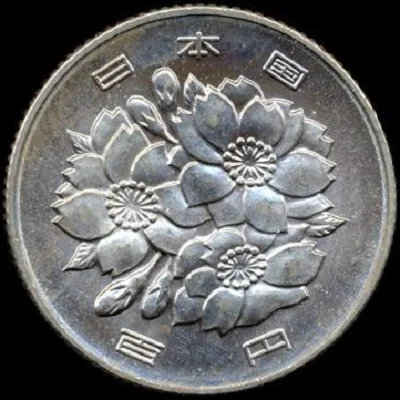
Defeat, inflation, and constitutional change produced a plain, modern coinage with no imperial titles. Post-war coins carry 日本国 (Nihonkoku, “State of Japan”) and read left to right. That single change of legend — Dai Nippon versus Nihonkoku — instantly sorts imperial coins from post-war ones, and it is the fastest sorting tool in the whole field.
Reading Dates: Era Names and the Gannen Rule
This is the single most useful skill in Japanese numismatics, and it takes about ten minutes to learn. Japanese coins are not dated by the Western calendar. They are dated by nengo — era names tied to the reign of an emperor.
The Format
A Japanese date consists of three parts in a fixed order: a two-character era name, then a number, then the character 年 (nen, “year”). So a date reads literally as “Showa, thirty-nine, year.” Find the 年 and you have found the end of the date; everything before it is era name plus number.
The Five Modern Era Names
Only five era names appear on machine-struck Japanese coins, and each has a fixed number you add to convert to the Western calendar:
- 明治 Meiji (1868–1912) — add 1867
- 大正 Taisho (1912–1926) — add 1911
- 昭和 Showa (1926–1989) — add 1925
- 平成 Heisei (1989–2019) — add 1988
- 令和 Reiwa (2019–present) — add 2018
So Showa 39 is 39 + 1925 = 1964. Heisei 12 is 12 + 1988 = 2000. Reiwa 5 is 5 + 2018 = 2023. The arithmetic never changes.
The Gannen Rule
The first year of an era is not written with the numeral “one.” It is written 元年 (gannen), “origin year.” A coin reading “Heisei gannen” is Heisei 1, which is 1989. Beginners routinely misread gannen as an unfamiliar numeral and give up; recognizing that single character pair solves the problem permanently.
Which Side Carries the Date
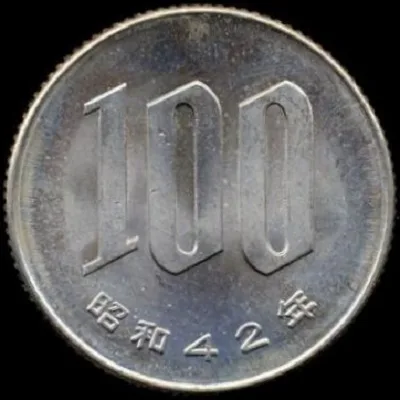
On modern Japanese coins the date is on the side opposite the large denomination. The Japan Mint treats the date side as the reverse. If you are staring at a big “100” and cannot find a date, turn the coin over. On Edo-period cash coins there is no date at all — a point covered below, and one of the most common sources of confusion in the whole series.
Era Overlaps in a Single Year
Because eras change mid-year when an emperor’s reign ends, two different era dates can share the same Western year. 1989 was both Showa 64 (the first seven days of January) and Heisei 1 (the rest of the year). 2019 was both Heisei 31 and Reiwa 1. These overlap years are exactly where the modern rarities live.
Japanese Numerals and Reading Direction
Ten characters cover every number you will meet on a Japanese coin. They are the same numerals used in Chinese, so learning them pays off across East Asian numismatics generally.
The Ten Numerals
- 一 = 1 二 = 2 三 = 3 四 = 4 五 = 5
- 六 = 6 七 = 7 八 = 8 九 = 9 十 = 10
Building Numbers Above Ten
The system is positional in a very simple way. A numeral before 十 multiplies it; a numeral after 十 adds to it. So 十二 is 10 + 2 = 12. 二十 is 2 × 10 = 20. 二十六 is (2 × 10) + 6 = 26. 四十二 is 42. That covers every year number a Japanese coin will ever show, since the longest era ran to 64.
Reading Direction: The Pre-War Trap
Japanese coins struck before the end of the Second World War read right to left. Post-war coins read left to right. This catches almost everyone the first time. On a Meiji-era coin you will physically see the 年 character on the left end of the date, because that is where the date ends when read from the right. Read a Meiji date left to right and you will get nonsense; read it right to left and it resolves immediately.
A Worked Example
Suppose the date on a silver coin appears, left to right on the coin’s face, as 年二十三治明. Reverse it: 明治 三十二 年 — Meiji, thirty-two, year. Meiji 32 is 32 + 1867 = 1899. That is the entire method, and it works on every imperial-era Japanese coin.
Kan’ei Tsuho: The Coin of the Edo Period
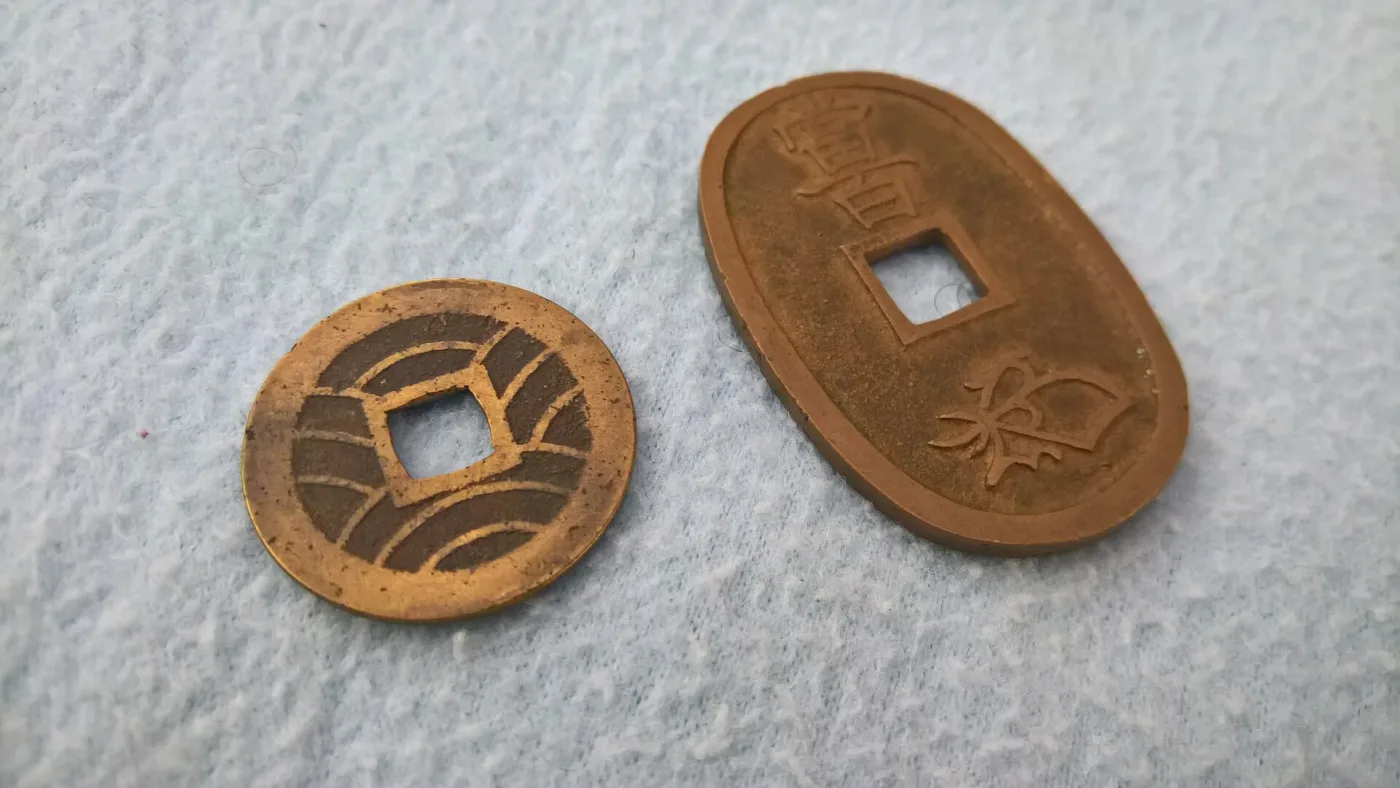
If you have an old Japanese coin with a square hole, it is almost certainly a Kan’ei Tsuho. It was cast from 1636 until 1868 in staggering quantities and remains the most commonly surviving pre-modern Japanese coin by an enormous margin.
Reading the Four Characters
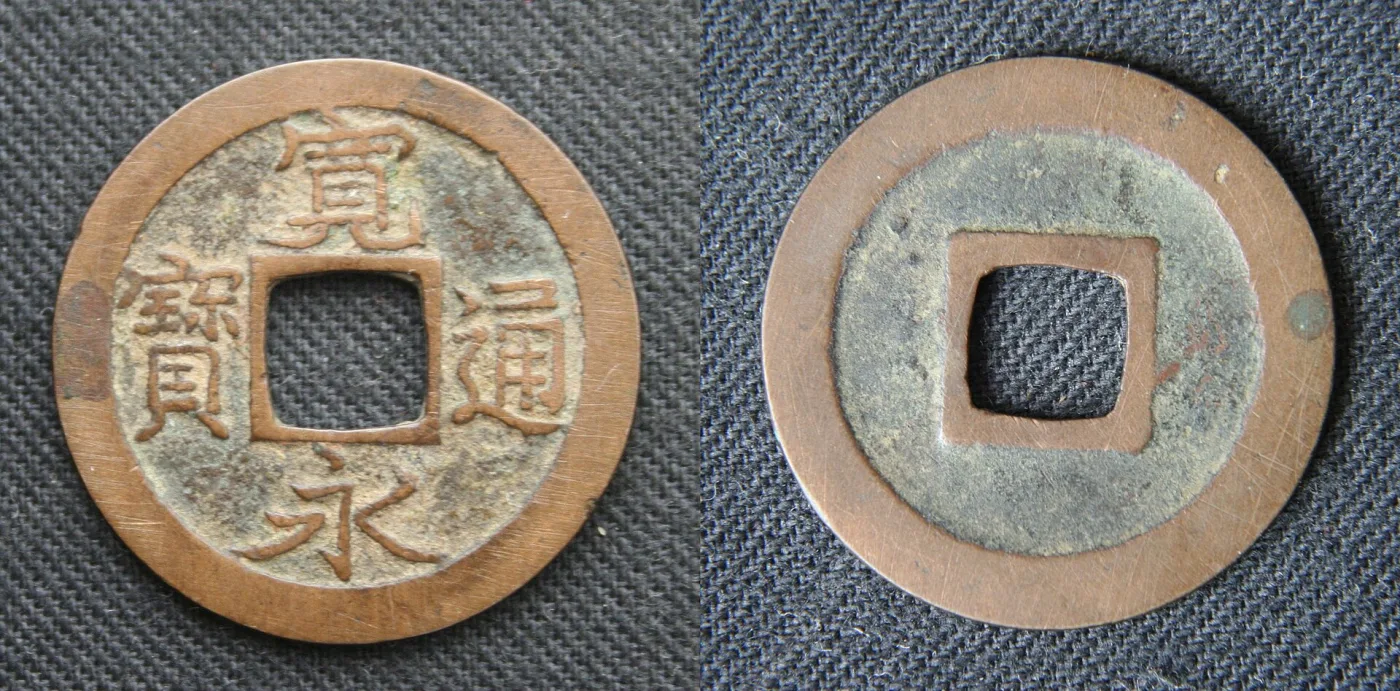
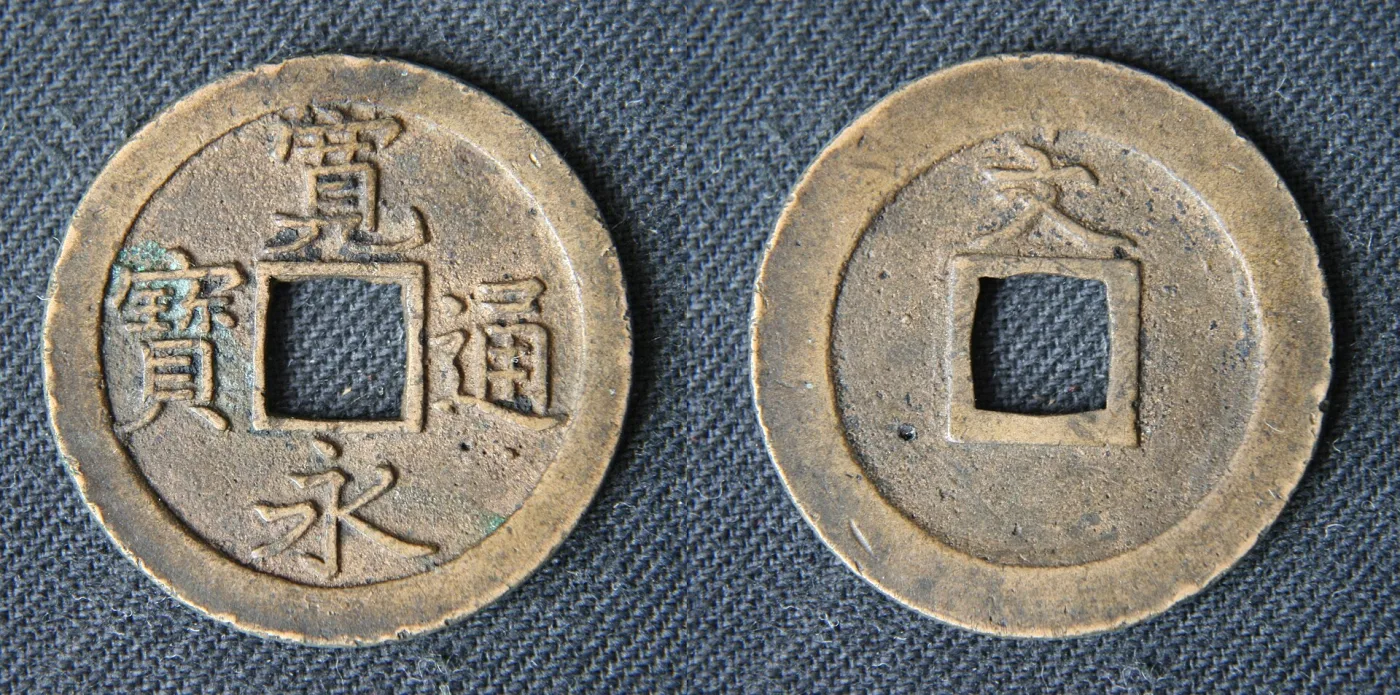
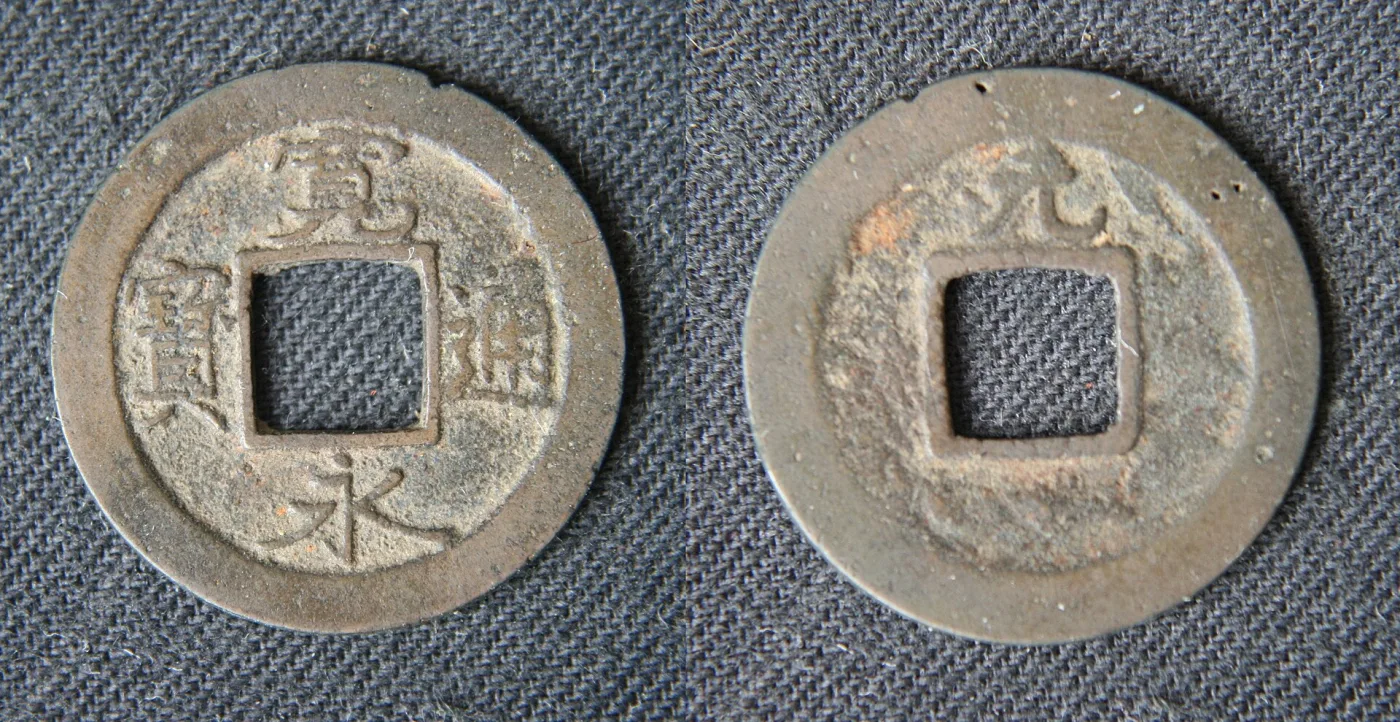
The obverse carries four characters read in the same fixed order used across East Asian cash coinage: top, bottom, right, left. They read 寛 永 通 寶 — Kan-ei Tsu-ho, “Kan’ei circulating treasure.” Note the archaic full form of the last character, 寶, rather than the simplified 宝 found on some other issues.
The Critical Point About the Date
“Kan’ei” was a Japanese era name that ran from 1624 to 1644. But the coin kept that name for the next 224 years, long after the Kan’ei era ended. This is the opposite of how Chinese cash coins work, where the reign title genuinely narrows the date. A Kan’ei Tsuho reading “Kan’ei” tells you almost nothing about when it was made. Dating one requires attention to calligraphy style, metal, size, and reverse marks — which is precisely why the series supports specialist collecting in Japan and why hundreds of varieties are catalogued.
Old Kan’ei and New Kan’ei
The broad division is between Ko-Kan’ei (“old Kan’ei,” roughly 1636–1659) and Shin-Kan’ei (“new Kan’ei,” 1668 onward). Old Kan’ei coins are generally heavier, better cast, and show a distinctly different calligraphic hand. Many coins from the Kanbun era carry the single character 文 (bun) on the reverse, which is a useful and easily spotted marker.
The Four-Mon Coin and Its Waves
From 1768 a larger brass Kan’ei Tsuho was cast with a face value of four mon, and it is instantly identifiable: the reverse carries a pattern of horizontal waves. The very first issue of 1768 shows 21 waves; from 1769 onward the design was changed to 11 waves, and every later four-mon coin uses the eleven-wave reverse. The 21-wave variety is scarce and desirable; the 11-wave is common. Counting the waves is one of the genuinely satisfying quick checks in Japanese numismatics.
Iron Kan’ei and the Magnet Test
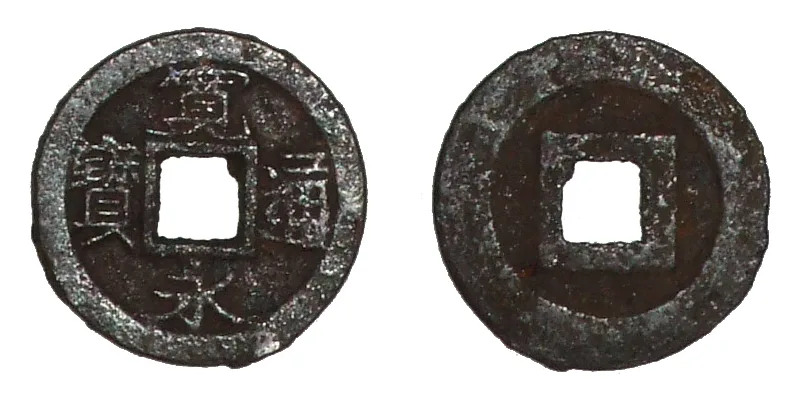
From 1739 the shogunate also cast Kan’ei Tsuho in iron. Iron examples are usually corroded, dark, and visibly rougher than the brass ones, and they are strongly magnetic. Because Chinese cash was cast in bronze and brass, a magnet is a fast and free first-pass sorting tool: a square-hole coin that jumps to a magnet is a good candidate for Japanese iron cash rather than Chinese coinage. Iron pieces are common and generally worth very little.

Telling Japanese Cash from Chinese Cash
Japan, China, Korea, Vietnam, and the Ryukyu Kingdom all used round cast coins with square holes and four-character legends. Sorting them is the most common practical problem people face with East Asian coins, and it is entirely learnable.
Start With the Legend
The four characters are the decisive evidence. A Japanese Kan’ei Tsuho reads 寛永通寶. Chinese cash reads with a Chinese reign title — Kangxi, Qianlong, Guangxu and the rest. If the first two characters do not match any Chinese reign, check the Japanese, Korean, and Vietnamese lists before concluding you have found something rare. In practice, the overwhelming majority of “unidentifiable” Chinese cash brought to dealers turns out to be Kan’ei Tsuho.
Check the Reverse
Qing dynasty Chinese cash carries Manchu script on the reverse — a distinctive vertical spine with wedge-shaped teeth branching off it, one word on each side of the hole. Japanese cash never does. A Japanese reverse is either blank, or carries waves (the four-mon), or a single character such as 文, or a mint-identifying character. Manchu script on the reverse means Chinese, full stop.
Use the Metal
Japanese iron cash is common; Chinese iron cash is comparatively unusual outside specific periods. A magnetic square-hole coin therefore leans Japanese. Japanese brass four-mon pieces also tend to have a distinctly yellow tone compared with the redder bronze of much Chinese cash, though this is a soft signal rather than proof.
Watch for the Ryukyu Issues
The Ryukyu Kingdom (modern Okinawa) issued its own coins in the mid-nineteenth century, including the Ryukyu Tsuho, before annexation by Japan. These sit awkwardly between categories, are scarcer than mainland Japanese cash, and are worth identifying properly rather than lumping in with common Kan’ei.
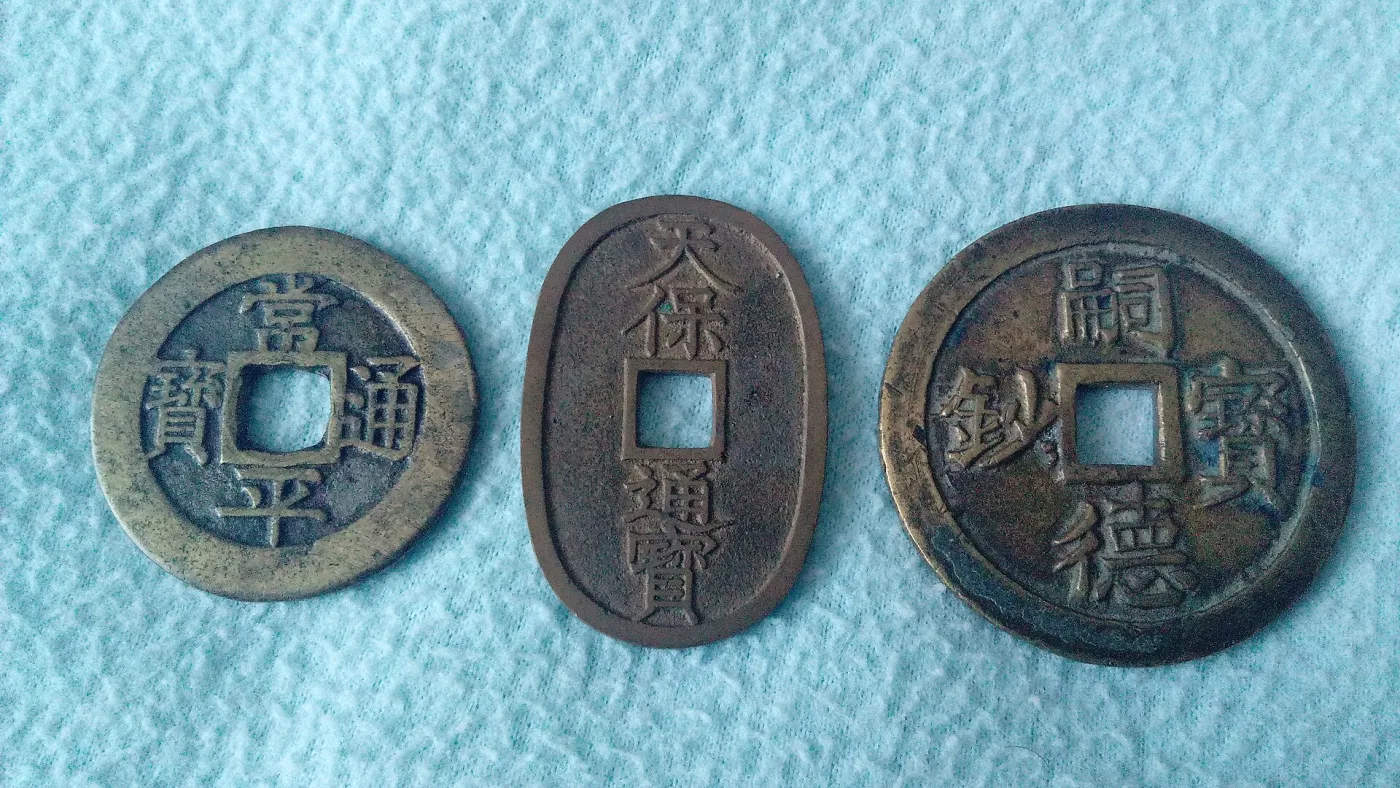
The same general coin identification techniques apply — work from physical form, to legend, to reverse marks, in that order.
Tenpo Tsuho and the Large Edo Denominations
Not every Edo coin is a small round disc. The most visually striking Japanese cash coin is oval, and it is common enough that most collections acquire one sooner or later.
The Oval Hundred-Mon
The Tenpo Tsuho was cast from 1835 to 1870 and is unmistakable: a flattened oval roughly 49 mm long and 32 mm wide with a square hole in the centre, carrying the four characters 天保通寶. It was tariffed at 100 mon though it contained nothing like a hundred mon of copper, which makes it a straightforward debasement issue of the kind that shows up in every currency system under fiscal strain.
The Reverse and the Kao
The reverse carries the characters 當百 (to hyaku, “worth one hundred”) beside the hole, and below them a distinctive stylized monogram known as a kao — the personal cipher of the Goto family, hereditary superintendents of the shogunate’s metalwork. The kao is a good authenticity checkpoint, because reproductions frequently render it poorly.
Provincial Imitations
Several domains cast their own versions of the Tenpo Tsuho, legally or otherwise, and these local issues are collected separately and are often scarcer than the shogunate’s own. Distinguishing them depends on subtleties of the calligraphy and the kao, which is specialist territory but well documented in the Japanese literature.
The Denomination System Behind It
Edo Japan ran parallel accounting systems, which is why “how much was that worth” has no simple answer. Gold was reckoned in ryo, divided into 4 bu and 16 shu. Copper was reckoned in mon. Silver circulated by weight rather than by face value, measured in monme. The exchange rates between the three floated and were a constant source of political friction throughout the period. One ryo was nominally about 4,000 mon, but the real rate moved substantially over two and a half centuries.
Koban, Oban, and the Gold and Silver of the Shogunate
The gold coinage of Tokugawa Japan looks like nothing else on earth, which makes it easy to recognize and, unfortunately, easy to reproduce as a souvenir.
The Koban
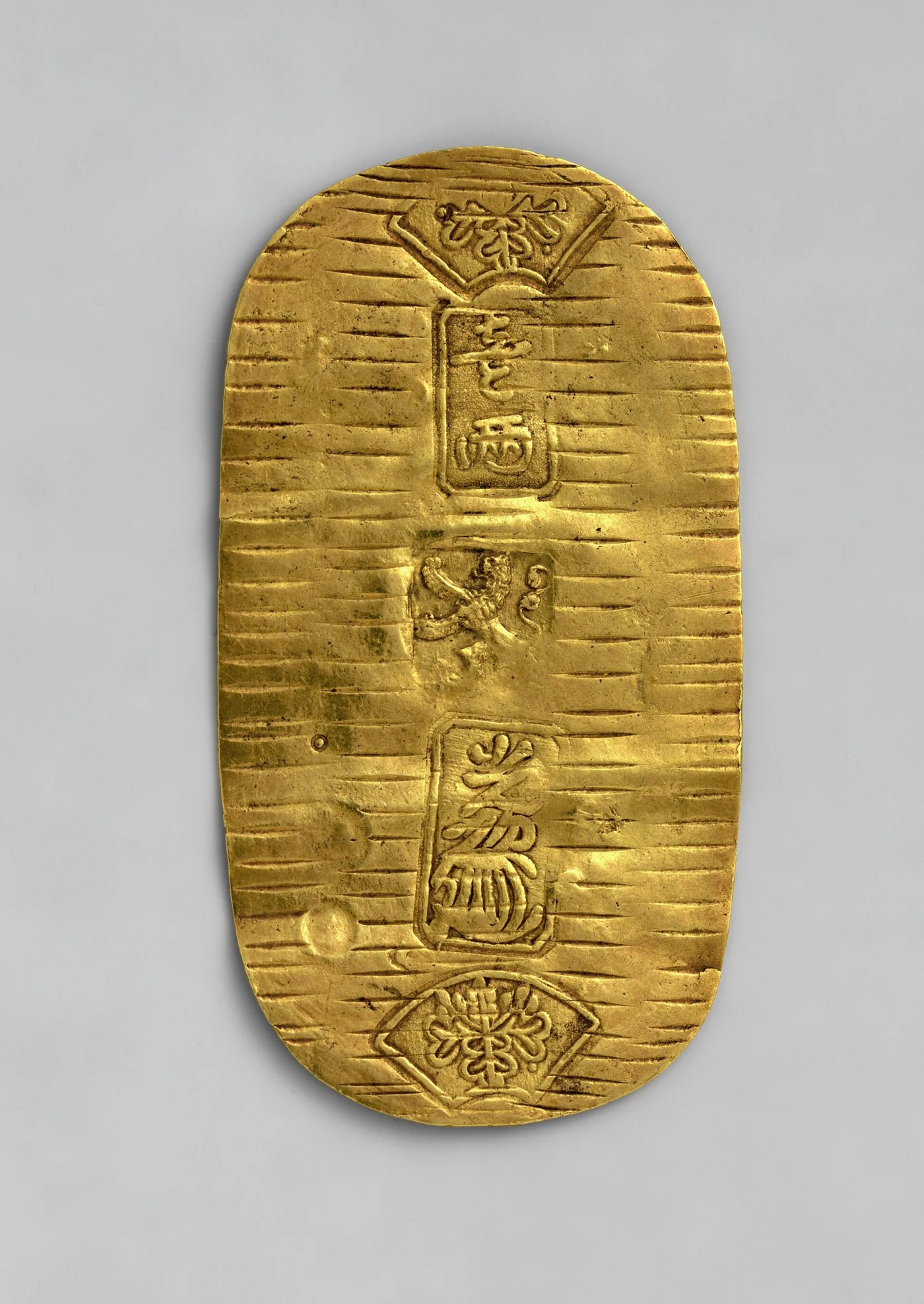
The koban is a thin, flattened oval of gold roughly the size of a large playing-card corner, first issued in 1601 under Tokugawa Ieyasu and valued at one ryo. Its surface is covered with fine parallel file lines called goza-me; it carries hallmark stamps at top and bottom, a vertical inscription giving the value, and the paulownia crest of the shogunate. The reverse is largely plain apart from small assay stamps.
Dating a Koban by Its Alloy
Koban were reissued roughly a dozen times across the Edo period, and each reissue changed the gold content. The Keicho koban of 1601 ran around 84–86% gold; successive debasements cut that steadily, and the last issues of the 1860s were far baser and much smaller. Because each series has its own stamps, size, and weight, a koban can generally be attributed to a specific issue — and the alloy is a large part of what determines value.
The Oban
The oban is the koban’s giant relative: an oval gold plate 14 to 17 cm long, hand-inscribed in ink with its value and the signature of the Goto family. Oban were never ordinary money. They were ceremonial gifts and rewards, issued in small numbers, and they are genuinely rare and extremely valuable. The ink inscription is a key point — it was periodically refreshed by the Goto, and its quality matters greatly to value.
Silver by Weight: Chogin and Mameita-gin
Edo silver did not look like coins at all. Chogin are elongated, sausage-shaped cast silver bars stamped with the god Daikoku and assay marks. Mameita-gin (“bean silver”) are small irregular blobs, sometimes barely larger than a pea. Both circulated by weight, were used chiefly in the Osaka merchant economy, and were weighed out on scales for each transaction. Their crude, irregular appearance leads people to dismiss them as slag or buttons; they are neither.
Rectangular Gold and Silver
Alongside the ovals, the shogunate issued neat rectangular pieces: ichibuban (one bu gold), nishuban and isshuban in gold, and later rectangular silver ichibugin. These small rectangles are the most affordable genuine Edo precious-metal coins, are far more common than koban, and make a much safer first purchase for anyone entering the field.
The Replica Problem
Souvenir koban are sold by the thousand across Japan and online, in brass, gilt base metal, and plastic, often oversized and shiny. A genuine koban is thin, soft-looking, and unmistakably worn; a replica is usually bright, sharply detailed, and far too heavy or too light for its size. If you have an oval “gold” coin from a family estate, weigh it and test its specific gravity before allowing yourself to get excited — the great majority are replicas.
The 1871 New Currency Act: Yen, Sen, and Rin
Meiji Japan abolished the entire Edo system in a single stroke, and the coinage that replaced it is the direct ancestor of what circulates today.
The New Decimal System
The New Currency Act of 1871 established a Western-style decimal currency: 1 yen = 100 sen = 1,000 rin, with round machine-struck coins replacing the cast and hammered pieces of the shogunate. The yen was initially defined against gold, at 1.5 grams of gold to the yen, and the coins were deliberately specified so that they slotted into international trade — the gold 10-yen was set close to the United States ten-dollar gold eagle.
The First Issues
Coins appeared from 1870 in a full ladder: silver 5, 10, 20 and 50 sen and 1 yen, and gold 2, 5, 10 and 20 yen, joined by a gold 1 yen in 1871 and copper 1 rin, half sen, 1 sen and 2 sen from 1873. The machinery and much of the technical expertise came from Britain; the Osaka mint was built with British equipment and initially run with British advice.
The Dragon Design
Nearly all Meiji silver and gold carries a dragon on one side, coiled and facing left, with the date around it, and a wreath with the chrysanthemum imperial seal on the other. The dragon is the visual signature of the whole imperial series and the reason these coins are collectively called “dragon” coins in the English-language trade.
No Mint Marks
Here is a point that repeatedly confuses collectors trained on American coins: Japanese coins carry no mint marks. All Japanese coinage comes from the Japan Mint, headquartered in Osaka with branches at Saitama and Hiroshima, and no letter distinguishes them. If you are hunting for a mint mark on a Japanese coin, stop — there is not one, and its absence is not a defect. Attribution comes from date and type alone, unlike the American series where mint marks drive so much of the rarity structure.
The Dragon Yen: Meiji Silver
The one-yen silver coin is the most significant Japanese coin in world numismatics, because it left Japan in quantity and became a trade coin across East Asia.
Specifications
The silver yen weighs 26.96 grams at .900 fine, giving roughly 0.78 troy ounces of pure silver — deliberately close to the Spanish and Mexican eight reales and to the American and British trade dollars it competed with. It was struck from 1870 to 1912 and again in 1914.
Large Type and Small Type
There are two size variants and telling them apart matters. The large type, struck through the 1870s and 1880s, measures about 38.6 mm. From 1887 the small type was introduced at about 38.1 mm with the same weight and fineness. Half a millimetre sounds trivial but the two are catalogued separately, and for the overlap years the type determines which listing — and which price — applies. Measure with calipers rather than guessing.
Dates and Rarity
Common dates in circulated grades trade close to their silver content plus a modest premium. Several years are genuinely scarce, and a handful — particularly some of the earliest and some very low-mintage later dates — command large multiples. Because the price range within a single design is so wide, reading the date accurately is the difference between a $30 coin and a four-figure one, which is why the right-to-left rule matters so much here.
Chop Marks
Many surviving silver yen carry chop marks: small punched characters applied by Chinese and other Asian merchants and bankers who tested the silver and stamped it to record their verification. Exactly as with the American Trade Dollar and with Spanish colonial pieces of eight, chops are historical evidence rather than damage. They generally reduce value to a Western collector relative to a clean example of the same grade, but heavily and attractively chopped coins have a dedicated following, and both major grading services certify them with the chops noted.
The Japanese Trade Dollar
Japan issued a dedicated trade coin for only three years, and confusing it with the ordinary silver yen is a classic and expensive beginner’s mistake — in the collector’s favour, for once.
What It Is
The Japanese trade dollar was struck from 1875 to 1877 (Meiji 8 to 10) specifically for circulation in Taiwan, Korea, and Manchuria, in the same competitive spirit that produced the United States Trade Dollar and the British trade dollar. Roughly 2,736,000 were made, the great majority in the last two years.
How to Tell It from a Silver Yen
The two coins look nearly identical at a glance — same dragon, same general layout, near-identical diameter. The differences are in the inscriptions and the weight:
- Weight. The trade dollar weighs 27.22 grams against the yen’s 26.96 grams. Both are .900 fine. A quarter of a gram is easily detected on any digital scale.
- Inscription. The trade dollar is explicitly marked “420 GRAINS. TRADE DOLLAR. 900 FINE” in English. The silver yen reads “416 ONE YEN 900” or similar. Reading the English legend settles the question in seconds.
- Japanese legend. The trade dollar carries the characters for “trade silver” rather than the yen denomination.
Why It Matters
The trade dollar was made in far smaller numbers than the silver yen and is worth substantially more in every grade. It is also heavily counterfeited — NGC lists the 1875 issue among the most commonly faked world coins — so weight and diameter should be checked before anything else, and any high-grade example should be certified.
Gin Countermarks: The 1897 Silver Problem
Some silver yen carry an extra character punched into the field beside the wreath. This is not damage and it is not a chop mark; it is an official countermark with a specific story.
What Happened
In 1897 Japan moved onto the gold standard. Silver had been falling in value, and the shift created an arbitrage problem: silver yen were worth more as bullion abroad than as money at home, and gold was flowing out of the country. The government’s solution was to demonetize the silver yen domestically while allowing it to keep circulating in the colonies and to be sold as bullion in Shanghai and Hong Kong.
The Mark
Coins destined for that export role were stamped with the character 銀 (gin, “silver”). The placement is informative: a countermark on the left of the value was applied at the Osaka branch, and one on the right at Tokyo. Both are collected, and the two placements have separate catalogue listings.
Effect on Value
Countermarked yen are a distinct and genuinely interesting sub-series rather than defaced coins. For most dates the countermark carries a modest premium or a modest discount depending on the date and the market, but for some dates the countermarked version is scarcer than the plain one. Do not assume the stamp is vandalism — check the specific date and placement before valuing.
Meiji Gold Coins
Japanese gold from the imperial period is a serious collecting field with a strong domestic market, and it splits into two clearly separated groups.
The Old Standard, 1870–1897
The first modern gold coins — 1, 2, 5, 10 and 20 yen — were struck to the original 1871 gold definition. The 20-yen of this period is a large, impressive coin, and early dates in high grade are among the most valuable Japanese coins in existence. Mintages for several of these years were tiny, and genuine examples of the rarest dates appear on the market only occasionally.
The New Standard, 1897 Onward
When Japan adopted the gold standard in 1897 it halved the gold content of the yen. New, physically smaller 5, 10 and 20-yen pieces were introduced at the reduced standard. This is a critical identification point: a 20-yen gold coin dated before 1897 and one dated after are dramatically different in size and weight despite sharing a denomination. Weigh and measure before you catalogue.
What to Watch For
Japanese gold is counterfeited at every level, from crude cast copies to well-made struck fakes in correct-weight gold intended to pass as rare dates. Because the value is concentrated in specific dates rather than spread across the type, date alteration is a real risk. For anything beyond common-date bullion-grade material, buy certified. The same caution applies as with any high-value gold series — our guide to detecting counterfeit coins covers the underlying techniques in detail.
Sen and Rin: Small Change of Imperial Japan
The bulk of surviving pre-war Japanese coinage is not silver yen but the sen denominations, and these are what most inherited accumulations actually contain.
Copper and Bronze
The 1 rin, half sen, 1 sen and 2 sen coins of the 1870s and 1880s are large, handsome copper pieces, most carrying the dragon. The 2 sen in particular is a substantial coin. Most dates are inexpensive, though a few are scarce and high-grade red examples of any date carry real premiums, since copper rarely survives with its original colour.
Silver Sen
The 5, 10, 20 and 50 sen silver coins ran from 1870 well into the twentieth century, passing through several design changes: the early dragon types, then the rising-sun and phoenix designs of the Taisho and early Showa years. Their silver content is low enough that most are collected for type rather than metal, but the earlier large-format issues carry meaningful silver.
The Holed 5 and 10 Sen
From 1917 Japan introduced small holed cupronickel 5-sen pieces, followed by holed 10 sen. The centre hole became a durable feature of Japanese small change and is the direct ancestor of the holed 5-yen and 50-yen coins in use today. A small holed coin with a chrysanthemum above the hole is almost always one of these pre-war nickel issues.
Why They Are Cheap
Sen coins were made in enormous numbers and survived in quantity, and the denominations were rendered worthless by post-war inflation before anyone thought to save them systematically. Common dates in circulated grade are worth very little. The interest lies in completing date runs, in the scarce years, and in genuinely uncirculated examples, which are much harder to find than the mintages suggest.
Wartime, Occupation, and Puppet-State Coinage
The 1930s and 1940s produced a distinctive group of coins that tell the story of a war economy running out of metal, plus a set of related issues that are frequently mistaken for Japanese coins.
Metal Substitution
As the war progressed, Japan stripped useful metals out of its coinage in stages. Nickel gave way to aluminium bronze, then to pure aluminium, and finally to tin and zinc. Late-war 1, 5 and 10-sen coins are strikingly light, dull grey, and often poorly struck. They are common, cheap, and historically vivid — a coin you can feel the shortage in.
The Clay Coins
At the very end of the war the mint produced baked clay 1, 5 and 10-sen coins, made from porcelain clay because there was no metal left. They were manufactured but never released into circulation, and surviving examples come from mint stocks that escaped destruction. They are genuine, collectible, and startling to hold. They are also easy to fake, since firing clay requires no special equipment.
Manchukuo and Other Puppet States
Japanese-controlled Manchukuo (1932–1945) issued its own coinage in copper, nickel, aluminium and, at the end, pressed fibre. These are commonly mistaken for Japanese coins because they use similar characters and were struck under Japanese supervision, but they are a separate series with their own catalogue listings. Look for the Manchukuo state name rather than Dai Nippon.
Japanese Invasion Money
The occupied territories of Southeast Asia were flooded with Japanese-issued paper currency, universally known as Japanese Invasion Money or JIM. It survives in vast quantities because it became worthless overnight in 1945 and was kept as a souvenir. Note that JIM is paper, not coinage — if someone offers you “rare Japanese occupation coins,” ask exactly what they mean. Most JIM notes are worth a dollar or two despite persistent internet claims to the contrary.
Modern Japanese Coins: The Six Denominations
Post-war Japan settled on six circulating coins, and identifying them takes seconds once you know the shapes. These are the coins in every returning traveler’s drawer.
The Current Six
- 1 yen — pure aluminium, 20 mm, 1.00 gram exactly. Light enough to float on water if placed carefully, thanks to surface tension. Introduced in this form in 1955.
- 5 yen — brass, 22 mm, 3.75 grams, with a round centre hole. It shows a rice ear, water, and a gear, representing agriculture, fisheries, and industry. It is the only Japanese coin with no Arabic numeral anywhere on it — the denomination appears only in Japanese characters, which is why visitors find it so confusing.
- 10 yen — bronze, 23.5 mm, 4.5 grams, showing the Phoenix Hall of Byodo-in temple.
- 50 yen — cupronickel, 21 mm, 4 grams, with a round centre hole and chrysanthemums.
- 100 yen — cupronickel, 22.6 mm, 4.8 grams, showing cherry blossoms. Adopted in this design in 1967.
- 500 yen — the largest circulating coin, showing the paulownia plant.
Why Two Coins Have Holes
The 5-yen received its hole in 1949 to save metal and to make counterfeiting harder. The 50-yen got its hole in 1959 for a more practical reason: without it, the 50-yen and 100-yen were too easily confused by touch and by vending machines. The holes are now a signature of Japanese coinage and a fast way to sort a mixed handful.
The Three Types of 500-Yen Coin
The 500-yen has been redesigned twice, both times because of counterfeiting, and the three types are easy to distinguish:
- 1982–1999: cupronickel. The original. Widely counterfeited, notably by altering South Korean 500-won coins, which were similar in size but far lower in value.
- 2000–2021: nickel-brass. Distinctly yellower, with a latent image in the zero of “500” that changes as the coin is tilted, plus fine micro-engraving.
- 2021–present: bi-metallic. A nickel-brass ring around a cupronickel-clad centre, 26.5 mm and 7.1 grams, with additional edge security. The two-tone appearance identifies it instantly.
Reading the Legends
Every post-war coin carries 日本国 (Nihonkoku) on the denomination side, and the date on the other side in era format reading left to right. If your coin reads Dai Nippon and right to left, it is pre-war, and it belongs in the sections above.
Modern Key Dates and Rarities
Modern Japanese circulation coins look uniformly worthless, and nearly all of them are. But a handful of dates are genuinely scarce, and because they are indistinguishable from common coins at a glance, they are still found in change and in tourist leftovers.
Showa 62 (1987) 50 Yen
This is the outstanding modern rarity. The Japan Mint struck only about 545,000 circulation-quality 50-yen pieces dated Showa 62, against more than 100 million the following year, plus a small proof issue. It is by a wide margin the scarcest post-war Japanese circulation coin of its denomination, and it commands a substantial premium in any condition. If you own a jar of Japanese change, this is the coin to look for first.
The Showa 64 Window
Emperor Hirohito died on 7 January 1989, which made Showa 64 seven days long. Coins dated Showa 64 were struck in a very short production window, and they were not struck at all in every denomination. The 1, 5, 10 and 500-yen pieces exist dated Showa 64. The 50-yen and 100-yen do not — production had already been switched over in anticipation of the reign change, so no circulating 50 or 100-yen coin bears that date. Anyone offering you a “Showa 64 100-yen coin” is selling something that does not exist.
The Milled-Edge Ten Yen
The 10-yen coins of 1951 to 1958 have a reeded edge — the giza-ju or “milled ten” — while every 10-yen from 1959 onward has a plain edge. The reeded-edge coins carry a premium, particularly the scarcer dates among them, and the check takes one second: run a fingernail around the rim.
Mint-Set-Only Years
Several other years exist chiefly or entirely in official mint sets rather than circulation, particularly in the late Showa and Heisei periods when low-denomination coins were barely needed. These are not rarities in the classical sense but they are hard to find as loose coins, and their catalogue values reflect that.
The 2019 Overlap
Coins exist dated both Heisei 31 and Reiwa 1 for the calendar year 2019, since the reign changed on 1 May. Neither is rare, but the pair makes a satisfying two-coin set marking the transition, and Reiwa 1 has obvious first-year appeal. The same logic applies as with any first-year issue — the interest is in the transition, not in scarcity.
Commemoratives and Bullion
Japan issues commemorative coins prolifically, and the field ranges from genuinely significant to purely promotional.
The 1964 Tokyo Olympics
Japan’s first modern commemoratives were struck for the 1964 Tokyo Games: a silver 1000-yen and a silver 100-yen. They were made in large numbers, are widely available, and are the single most commonly encountered Japanese commemorative in Western hands. The 1000-yen is a substantial silver coin and is frequently the “valuable Japanese coin” someone has inherited. It is worth a real premium over its silver, but it is not rare.
The Hirohito Anniversary Gold and Its Scandal
In 1986 Japan issued a 100,000-yen gold coin for the sixtieth year of Hirohito’s reign. It became the centre of one of the largest coin counterfeiting cases in modern history, with counterfeits produced in very large numbers and passed through Japanese banks. The episode is worth knowing about for a practical reason: this specific coin should never be bought without certification, and its history is why Japan invested so heavily in coin security features afterwards.
The 47 Prefectures Series
From 2008 to 2016 Japan issued a bi-metallic 500-yen and a coloured silver 1000-yen for each of the country’s 47 prefectures. It is a large, attractive, and genuinely collectible modern series, comparable in spirit to the American 50 State Quarters programme, though the Japanese coins were sold at a premium rather than released into circulation.
Bullion
Japan has no ongoing sovereign bullion programme comparable to the American Silver Eagle. Japanese “bullion” in the market generally means either commemorative silver and gold sold at issue premiums, or private-mint rounds. If you are buying Japanese precious metal, you are buying numismatics with metal attached, not efficient bullion.
Step-by-Step Identification Workflow
Put the pieces together into a repeatable routine. This sequence resolves the great majority of Japanese coins in under a minute.
Step 1: Look at the Shape
Oval with file lines means Edo gold — koban, or far more likely a replica. Oval with a square hole means Tenpo Tsuho. Round with a square hole means cash coinage. Irregular lumpy silver means chogin or mameita-gin. Round with a round hole means modern 5 or 50 yen, or a pre-war holed nickel. Round with no hole covers everything else.
Step 2: Check the Magnet
A magnetic square-hole coin is probably Japanese iron cash. Magnetic modern coins essentially do not exist in the Japanese series, so a magnetic “silver yen” is a fake, immediately and without further analysis.
Step 3: Find the Date Side
Turn the coin so the large denomination faces away. Look for the character 年. If you find it, you have a modern coin and can date it exactly. If there is no 年 anywhere, you are almost certainly holding Edo-period cash, which carries no date at all.
Step 4: Read the Country Legend
大日本 means pre-1945 imperial. 日本国 means post-war. This tells you which half of the catalogue to open and which reading direction applies.
Step 5: Read the Date
Identify the era name, read the numerals in the correct direction, and add the era’s offset. Remember gannen for year one.
Step 6: Weigh and Measure
A digital scale reading to 0.01 g and a set of calipers resolve the questions that visual inspection cannot: silver yen versus trade dollar, large type versus small type, pre-1897 versus post-1897 gold, and genuine versus counterfeit. This is the step most people skip and the one that catches the most errors.
Step 7: Look Up the Type
With country, denomination, date and weight in hand, a catalogue or online database will place the coin precisely. Only then is it worth thinking about value.
What Japanese Coins Are Worth in 2026
Expectations in this field are frequently unrealistic, usually because age is mistaken for scarcity. Japanese coins are old, and most of them are common.
Edo Cash
A common brass Kan’ei Tsuho is worth roughly $2 to $8 depending on condition and type. Iron examples are worth less. The scarce varieties — the 21-wave four-mon, certain old Kan’ei calligraphy types, some provincial issues — run from tens into hundreds of dollars, which is exactly why specialists study the varieties. Tenpo Tsuho typically bring $15 to $50, more for scarce provincial versions.
Edo Precious Metal
Rectangular ichibugin silver commonly trades in the $40 to $120 range and is the realistic entry point. Genuine koban start in the low four figures for later, baser, more common issues and climb steeply for early and scarce ones. Oban are five and six figures and are auction material. Anything described as a koban and priced under a few hundred dollars is a replica.
Meiji Silver
A circulated common-date silver yen tracks its roughly 0.78 troy ounces of silver plus a premium, typically landing in the $40 to $90 range in 2026 depending on the metal market and grade. Better grades and scarcer dates move into the hundreds and thousands. Trade dollars start meaningfully higher, and the scarce Meiji dates in mint state are four and five figures. The silver-content arithmetic works the same way as it does for American junk silver — know the melt value before you negotiate.
Sen and Modern Coins
Common pre-war sen coins are worth under a dollar in circulated grade, sometimes only a few cents. Modern circulating coins are worth face value with the specific exceptions listed above: the Showa 62 50-yen, the Showa 64 dates, and the reeded-edge 10-yen. Uncirculated pre-war coins with full original surfaces are the genuine sleeper category — far scarcer than the mintage figures imply, and consistently undervalued.
Where the Money Actually Is
High-grade Meiji gold, early silver yen in mint state, genuine Edo gold, and the recognized rarities of the cash series. Nothing else in Japanese numismatics is likely to be worth a great deal, and the most common mistake is assuming that a heavily worn but very old coin outranks a common but pristine one. In Japanese collecting, as in most fields, condition usually beats age.
Counterfeits and Reproductions
Japanese coins are faked at every level, and the fakes cluster in predictable places. Knowing where they concentrate is most of the defence.
Souvenir Koban
By volume this is the biggest category, and most are not really counterfeits at all — they are openly sold souvenirs that later get mistaken for real coins by heirs. They are typically brass or gilt zinc, brighter and sharper than genuine gold, and either far too heavy or far too light. Specific gravity settles it: gold is dramatically denser than any base metal used in replicas.
Silver Yen and Trade Dollars
The Meiji silver yen and especially the 1875 trade dollar are among the most commonly counterfeited world coins. Modern fakes are often struck rather than cast and can be visually convincing. Check weight to 0.01 g, check diameter, check that the coin is non-magnetic, and check specific gravity, which is decisive and needs nothing more than a scale and a glass of water. Then compare fine detail — dragon scales and the wreath — against certified reference images.
Date-Altered Coins
Because value in the Japanese series is concentrated in particular dates within a common design, altering a date is an efficient fraud. Examine the date characters under magnification for tooling, mismatched depth, or disturbed field metal around them. Any expensive date should be certified rather than assessed by eye.
The 100,000-Yen Gold Coin
Treat this one as a special case. Given the scale of the historical counterfeiting, buy only certified examples, and be sceptical of any raw specimen regardless of the seller’s story.
Cast Cash Reproductions
Kan’ei Tsuho and Tenpo Tsuho are reproduced for the tourist and decoration markets. The diagnostics are the same ones that apply to all East Asian cast coinage: modern casts show mushy, shrunken characters, uniform tiny bubbles or a soapy surface, applied rather than grown patina, and weights that miss the type standard. Common cash coins are cheap enough that the risk is trivial; the caution matters for the scarce varieties.
Grading, Certification, and Care
The grading conventions in Japanese numismatics differ between the machine-struck and cast portions of the field, and between Japanese and Western practice.
Machine-Struck Coins
PCGS and NGC grade Japanese coins on the standard 70-point Sheldon scale, both maintain Asian operations, and certified Japanese material is the norm at higher values. Japanese domestic grading uses its own descriptive vocabulary, and Japanese auction catalogues frequently describe coins in terms that do not map cleanly onto Sheldon numbers — something to be aware of when comparing prices across markets. Our overview of third-party grading services covers how the major services compare.
Cast Coins
Wear-based grading makes limited sense for cast cash, which was never uniform to begin with. What matters is casting quality, sharpness and completeness of the characters, surface condition, and whether the patina is original. Certification exists for scarce varieties but is uneconomic for the common ones.
Edo Gold and Silver
Koban, oban, and the rectangular pieces are graded with allowance for their hand manufacture. Completeness and clarity of the stamps, the state of the goza-me file lines, and the presence of original surfaces matter far more than the absence of marks. For oban, the condition of the ink inscription is a major value factor in its own right.
Care and the Cleaning Trap
Do not clean Japanese coins. Patina on bronze, brass, and iron cash is part of the surface, and removing it is permanent, obvious, and value-destroying. The soft gold of a koban shows hairlines from the gentlest wiping. Late-war aluminium and zinc coins are chemically fragile and react badly to almost everything. Dirt can be removed with distilled water and a soft brush; nothing stronger should come near an old coin. Our guide to coin cleaning and preservation covers safe handling and storage in detail, and the general principles about natural toning apply here just as they do to Western silver.
References and Online Tools
Japanese numismatics rewards reference material heavily, and the best of it is increasingly accessible in English.
Standard Catalogs
The Standard Catalog of World Coins from Krause covers the modern Japanese series comprehensively and is the usual English-language starting point, with the JNDA catalogue (the Japan Numismatic Dealers Association annual) serving as the domestic standard and the reference that actually sets Japanese market prices. For the cast coinage, David Hartill’s Early Japanese Coins does for Japan what his Cast Chinese Coins does for China, and Hartill numbers are the common attribution currency among Western collectors of both series.
Online Resources
Numista carries a well-photographed Japanese section with weights, diameters, and mintage figures, which makes it particularly useful for the type-versus-type questions that dominate Japanese identification. Both PCGS and NGC publish online world price guides and certification lookups covering Japan, and NGC’s census data helps judge the real rarity of certified material. Japanese auction house archives are an excellent free price reference if you are willing to work through them with a translation tool.
Museums and Institutions
The Currency Museum of the Bank of Japan in Tokyo maintains an outstanding collection with substantial English-language material online, and it is the authoritative source for the monetary history behind the coins. The Japan Mint publishes official specifications and mintage figures for every modern coin, which settles specification questions definitively. The British Museum and the American Numismatic Society both hold significant Japanese collections with online catalogues and photography — and comparison against genuine museum images remains the most reliable free defence against fakes.
Frequently Asked Questions
How do I read the date on a Japanese coin?
Find the character 年 (nen, "year") — the date ends there. Before it is a number, and before that a two-character era name. Add the era's offset: Meiji + 1867, Taisho + 1911, Showa + 1925, Heisei + 1988, Reiwa + 2018. Coins made before 1945 read right to left; later coins read left to right.
What is the Japanese coin with a square hole worth?
Usually a few dollars. Almost every square-hole Japanese coin found in the West is a Kan'ei Tsuho, cast in enormous numbers between 1636 and 1868 and worth roughly $2 to $8. The scarce varieties — particularly the 21-wave four-mon of 1768 — are worth considerably more, which is why it is worth counting the waves before assuming.
Is my old Japanese coin with a hole in the middle valuable?
If the hole is round and the coin is modern, it is a 5-yen or 50-yen piece worth face value, with one important exception: check the date for Showa 62 (1987) on the 50-yen, which had a mintage of only about 545,000 and is genuinely scarce. If the hole is square, you have Edo-period cash, covered above.
Why is there no English or numbers on my Japanese coin?
The 5-yen coin carries no Arabic numeral at all — its denomination appears only in Japanese characters, which makes it the coin visitors most often fail to recognize. Pre-war coins generally lack English too. The Meiji trade dollar is a deliberate exception, since it was made for foreign trade and carries "420 GRAINS. TRADE DOLLAR. 900 FINE" in English.
How can I tell a Japanese coin from a Chinese one?
Read the four characters. A Japanese Kan'ei Tsuho reads 寛永通寶; Chinese cash carries a Chinese reign title. Check the reverse: Manchu script means Chinese, never Japanese. And try a magnet — iron cash is common in Japan and unusual in China.
Is my koban real gold?
Almost certainly not. Souvenir koban outnumber genuine ones by an enormous margin, and genuine koban are worth four figures and up. Weigh it, measure it, and check its specific gravity; gold is far denser than the brass and gilt zinc used in replicas. A koban offered for a modest price is a replica by definition.
What is the difference between a silver yen and a Japanese trade dollar?
Weight and inscription. The trade dollar weighs 27.22 grams against the yen's 26.96, and it says "420 GRAINS. TRADE DOLLAR. 900 FINE" in English. The trade dollar was struck only from 1875 to 1877, is much scarcer, and is worth substantially more — and it is also among the most heavily counterfeited world coins.
What does the extra stamped character on my silver yen mean?
If it is a single neat character 銀 punched beside the value, it is an official gin countermark applied after Japan adopted the gold standard in 1897, so the coin could circulate in the colonies or be sold as bullion. Left of the value means Osaka, right means Tokyo. It is a legitimate variety, not damage. Small irregular punches scattered across the coin are chop marks instead, applied by Asian merchants verifying the silver.
Are Showa 64 coins rare?
They were struck in a short window because the Showa era lasted only seven days into 1989, and they carry a premium as a curiosity. But note which ones exist: the 1, 5, 10 and 500-yen were struck dated Showa 64, while the 50-yen and 100-yen were not. A "Showa 64 100-yen coin" does not exist.
Should I clean my old Japanese coins?
No. Cleaning routinely destroys a large share of a coin's value and the damage is permanent and obvious to any experienced buyer. This applies with particular force to Edo cash, where patina is part of the cast surface, and to koban, where the soft gold marks under the lightest wiping. Distilled water and a soft brush are the limit.
Where can I sell Japanese coins?
For common material, ordinary coin dealers and online marketplaces are fine. For anything significant — Meiji gold, high-grade silver yen, genuine Edo gold, scarce cash varieties — the strongest prices are generally realized in Japan, since the domestic collector base drives the market. Get it certified first, then approach dealers or auction houses with genuine Japanese expertise rather than a generalist.