French Coins Identification Guide: How to Read, Date, and Value France's Coins
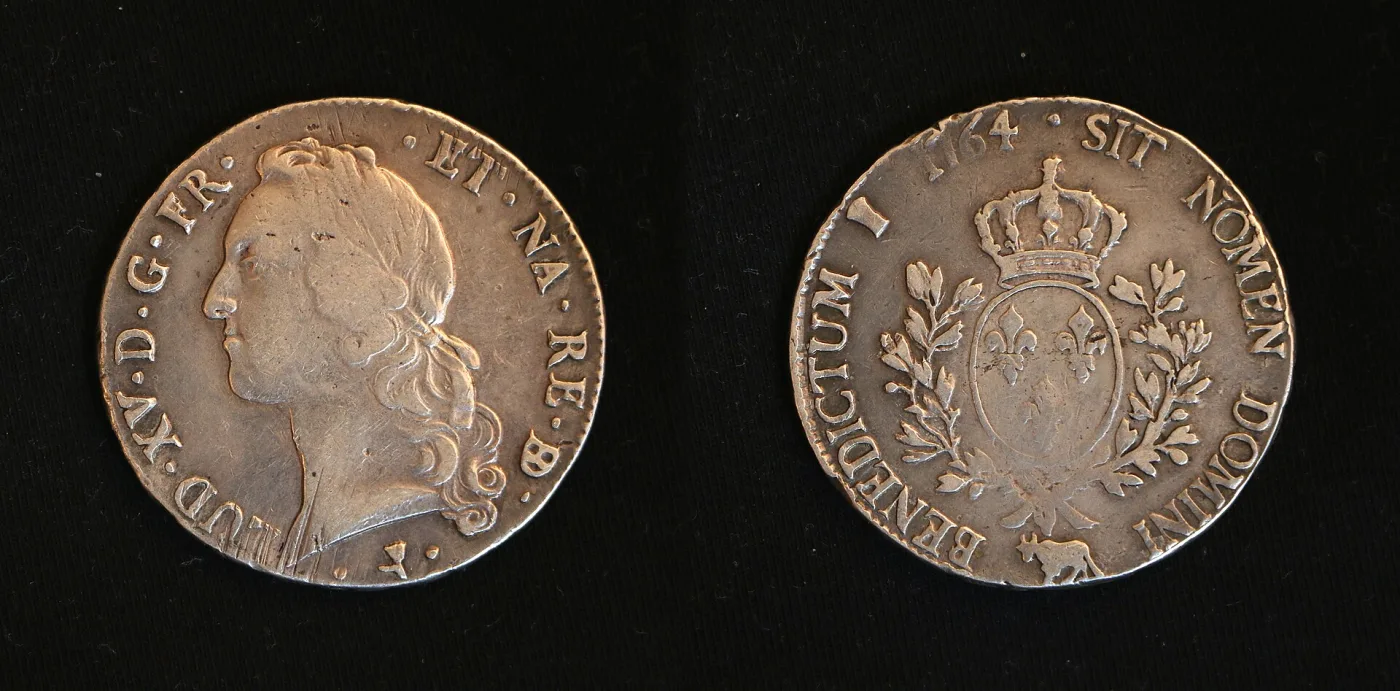
Few countries have minted coins as continuously, as beautifully, or as influentially as France. A single inherited box of “old French money” might hold a hammered silver coin of a medieval king, a heavy silver écu of Louis XIV, a gold louis, a Revolutionary coin that swept the monarchy away, a gold 20-franc Napoleon, a graceful silver Sower struck at the turn of the twentieth century, a wartime aluminum franc, a chunky 1960s coin bearing Marianne, and a modern euro minted in France — each following different rules for who issued it, what it was worth, where it was struck, and how much precious metal it holds. That sweep of history is exactly why French coins are so rewarding to collect and, at first glance, so easy to muddle.
The reassuring news is that French coinage becomes systematic once you learn a few anchors. Almost every coin since the Revolution names its issuing regime, carries a plain Arabic date, and shows a small mint mark letter together with a tiny privy mark (an engraver’s symbol) that together tell you exactly where and by whom it was struck. The great recurring types — the striding Sower (La Semeuse), the head of Marianne, the crowing Gallic rooster, and the seated figures of Liberty and Hercules — place a coin in its era before you reach for a catalog. And because France struck vast quantities of silver and gold, a large share of these coins carry genuine precious-metal value that any collector can calculate.
This guide walks the whole arc of French coinage: the royal livres, écus, and gold louis of the Ancien Régime; the coins of the Revolution and the two Empires; the long life of the franc from its creation in 1795 through the “new franc” of 1960; and today’s euro. Along the way you will learn to read mint marks and privy marks, decode the silver- and gold-content lines that set melt value, recognize the great types and famous rarities, spot fakes, grade what you have, and estimate realistic 2026 values. Whether you inherited a drawer of French coins or pulled a strange rooster coin from a dealer’s junk tray, you will finish able to read, date, and value France’s coins with confidence.
Why French Coins Matter to Collectors
French coinage is one of the richest and most artistically celebrated fields in all of numismatics. Understanding why explains both its appeal and why so much of it turns up in American and European collections.
Centuries of History in a Handful of Coins
French coins trace the story of Europe more vividly than almost any other series: the long line of medieval and Bourbon kings, the earthquake of the 1789 Revolution, the rise and fall of two Napoleonic empires, restored monarchies and short-lived republics, two world wars fought largely on French soil, and the modern republic that helped build the euro. A drawer of French coins is a physical timeline of modern Europe, which is a large part of why the field is so absorbing and why the same regime-first logic that dates a German coin works so well here.
Why French Coins Turn Up Everywhere
France was a great trading and colonial power, and returning soldiers from both world wars brought French coins home by the pocketful, so French pieces are among the most common “foreign coins” in American estates, jars, and inherited collections. A grandparent’s keepsakes might mix a pre-war Sower, a wartime aluminum franc kept as a souvenir, and post-war change — a natural companion to the U.S. and world coins collectors already know, from the Morgan Silver Dollar to British coins.
A Field for Every Budget and Interest
French numismatics offers something at every level: common circulated centimes and modern francs by the handful, affordable silver Sowers and Mariannes traded near their metal, beautiful royal écus and crowns, gold Napoleons and modern bullion, and world-class rarities that bring five and six figures. Few areas reward a beginner as quickly or hold a specialist as long, and the artistry of French dies is admired the world over.
The Great Eras of French Coinage
Every French coin belongs to one of a handful of broad periods, and placing a coin in its era is the first and most powerful identification step, because each era looks different and follows different rules.
Royal France (before 1793)
The kings of France, from the medieval period through the Bourbons, struck hammered and later milled coins denominated in livres, sols (sous), and deniers, alongside the large silver écu and the gold louis d’or. These coins name the king in Latin and carry royal arms, the fleur-de-lis, and a crown. This is the deepest and most complex era.
The Revolution and First Republic (1793–1804)
The Revolution abolished the monarchy and, in 1795, created the franc as the new decimal unit of 100 centimes. Early republican coins carry Revolutionary imagery and, briefly, the short-lived Revolutionary calendar dates (Year “L’AN” numbers). This is a small but historically pivotal era.
The First Empire and the Restoration (1804–1848)
Napoleon I crowned himself Emperor in 1804; his coins read NAPOLEON EMPEREUR with the franc system firmly in place. After his fall, the restored Bourbon and Orléans kings (Louis XVIII, Charles X, Louis-Philippe) struck franc coins bearing their own portraits.
The Second Republic and Second Empire (1848–1870)
A brief republic (with the first Ceres and Hercules types) gave way to Napoleon III, whose portrait francs and gold Napoleons are among the most commonly encountered nineteenth-century French coins.
The Third Republic and the Wars (1870–1940)
The long Third Republic produced France’s most beloved circulating types — the Sower (La Semeuse), the seated Ceres, and the winged-cap Marianne — in silver, bronze, nickel, and, during and after World War I, cheaper alloys. This is the classic era for the collector.
Vichy, the Fourth and Fifth Republics, and the Euro (1940–present)
Wartime État Français (Vichy) coins abandoned the republican motto for “TRAVAIL FAMILLE PATRIE” and used aluminum and zinc. Post-war republics restored the franc, revalued it as the “new franc” (nouveau franc) in 1960, and finally replaced it with the euro in 2002. French euros carry national designs (the Sower, Marianne, and the tree of liberty) alongside the shared European side.
Royal France: Livres, Écus, and the Gold Louis
The pre-Revolution coinage is the largest and most daunting corner of the field, but a few organizing ideas make it navigable, and it is where much of the beauty and value lives.
The Livre System
For centuries, French money of account was the livre tournois, divided into 20 sols (sous), each of 12 deniers — the same £sd logic behind pre-decimal British coins. Actual struck coins ranged from tiny billon (low-silver) deniers and liards up through silver pieces and the great crowns, and the relationship between the coins and the livre of account shifted over time with royal monetary policy.
The Silver Écu
The large silver écu is the signature royal coin — a handsome crown-sized piece bearing the king’s portrait and the royal arms, struck in high-grade silver. The écu of Louis XIV, Louis XV, and Louis XVI is the French counterpart to the Spanish eight reales or a German thaler, and its high silver content gives it solid intrinsic value much like an American Trade Dollar or other world crown. Fractional écus (½, ⅕, ⅒) circulated alongside it.
The Gold Louis d’Or
The louis d’or was the standard gold coin of royal France, introduced under Louis XIII and struck through Louis XVI, with the double louis and fractional pieces alongside it. Its designs and weights changed across reigns, and early hammered gold (the écu d’or, the franc à cheval of the medieval period) precedes it. Royal gold is scarce and valuable across the board.
How to Attribute a Royal Coin
Read the Latin legend for the king’s name (LUD. XIIII / LUDOVICUS for a Louis, HENRICUS for a Henri), note the denomination, date (or reign for undated hammered pieces), and match the arms, portrait, and mint mark against a catalog. Because there are so many reigns, mints, and types, a good reference or a photo-matching database is essential for the royal series — but the payoff is a field of extraordinary depth and artistry.
The Revolution and the Birth of the Franc
No episode in French coinage is more consequential than the Revolution, which swept away the livre and created the decimal franc that would serve France for two centuries.
Revolutionary Coinage and the Calendar
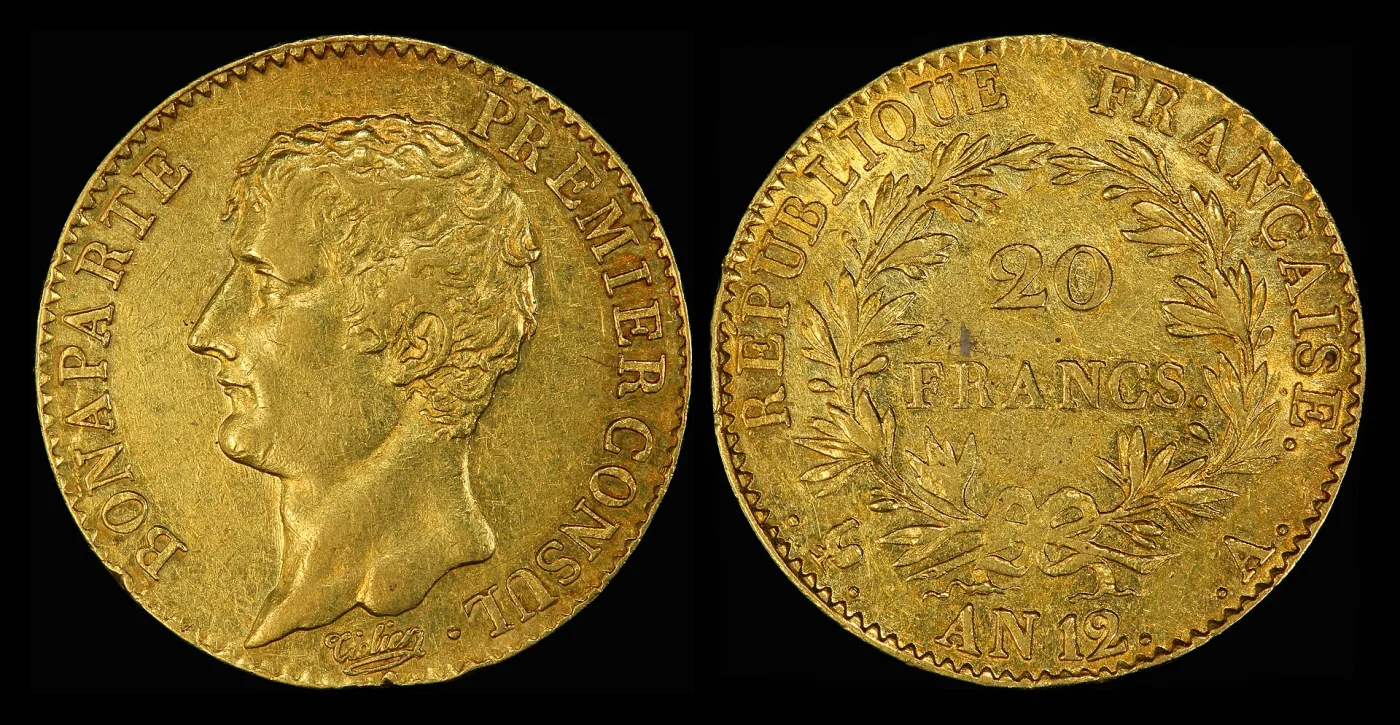
The early revolutionary coins of the 1790s carry striking new imagery — the Génie (the Spirit of the Nation inscribing a tablet), fasces, the Phrygian liberty cap, and the legends of the young republic. For a few years, coins were dated by the Revolutionary calendar: an “L’AN 4” (Year 4) or a Roman-numeral year rather than an ordinary date, which can briefly confuse a first-time identifier until you recognize the system.
The Creation of the Franc (1795)
In 1795 the franc was established as the base unit, decimally divided into 100 centimes — a clean, modern system in deliberate contrast to the old livre-sol-denier arithmetic. The franc’s weight and fineness were fixed by law, and although the name “franc” had appeared on earlier coins (the medieval franc à cheval), 1795 marks the birth of the modern French franc that runs unbroken to 2002.
The Franc Germinal
Under Napoleon, the Franc Germinal of 1803 set the enduring standard that defined French (and, through the Latin Monetary Union, much of European) coinage for over a century: silver francs of .900 fineness and gold of .900, with the 20-franc gold piece as the workhorse. This standard is why a French silver franc, a Belgian franc, a Swiss franc, and an Italian lira of the era share the same size and fineness — a convenience worth remembering when you sort a mixed European group.
The Franc System and Its Denominations
From 1795 to 2002 the franc anchored French money, and learning its denominations lets you read the value of almost any modern French coin at a glance.
The Circulating Denominations
Across the franc era the usual coins were the bronze/copper 1, 2, 5, and 10 centimes; the 25 centimes (often holed, in nickel); the silver (later nickel and alloy) 50 centimes, 1 franc, and 2 francs; the silver 5 francs crown; and larger silver 10, 20, and 50 francs in the twentieth century. Gold came as the 5, 10, 20, 40, 50, and 100 francs. The denomination is stated plainly on the coin, so once you know the era’s metal, the value is explicit.
The Five-Franc “Crown”
The silver 5-franc piece is the classic French crown of the nineteenth century — a large .900 silver coin nicknamed the écu by collectors out of habit, carrying successive portraits (Napoleon, the restored kings, Napoleon III) and the seated Hercules group of the republics. It is the French coin most often traded simply for its silver, comparable in role to a U.S. silver dollar such as the Morgan dollar.
Small Change and Base Metal
The centime coins were bronze and, later, holed nickel and aluminum-bronze; the twentieth century saw francs move from silver to nickel, aluminum-bronze, and finally cheap aluminum during the wars. Wartime and post-war minor coins carry no precious metal and are common and inexpensive, valued as historical foreign coins rather than as bullion.
The Great French Coin Types and How They Date a Coin
One of the most useful shortcuts in French identification is recognizing the recurring allegorical types, because each is tied to particular periods and denominations and doubles as a dating clue — the same way the eagle style dates a German coin.
La Semeuse — the Sower
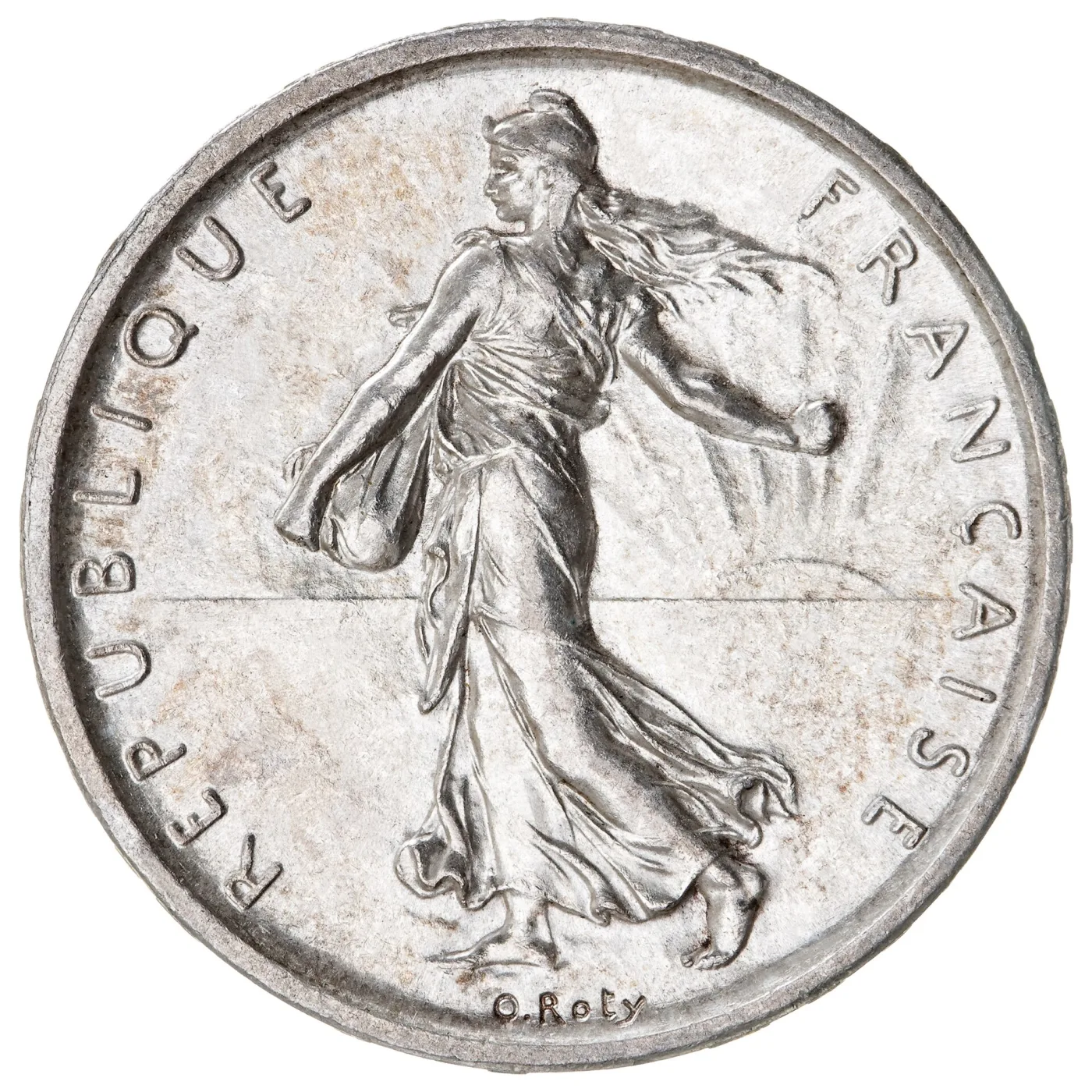
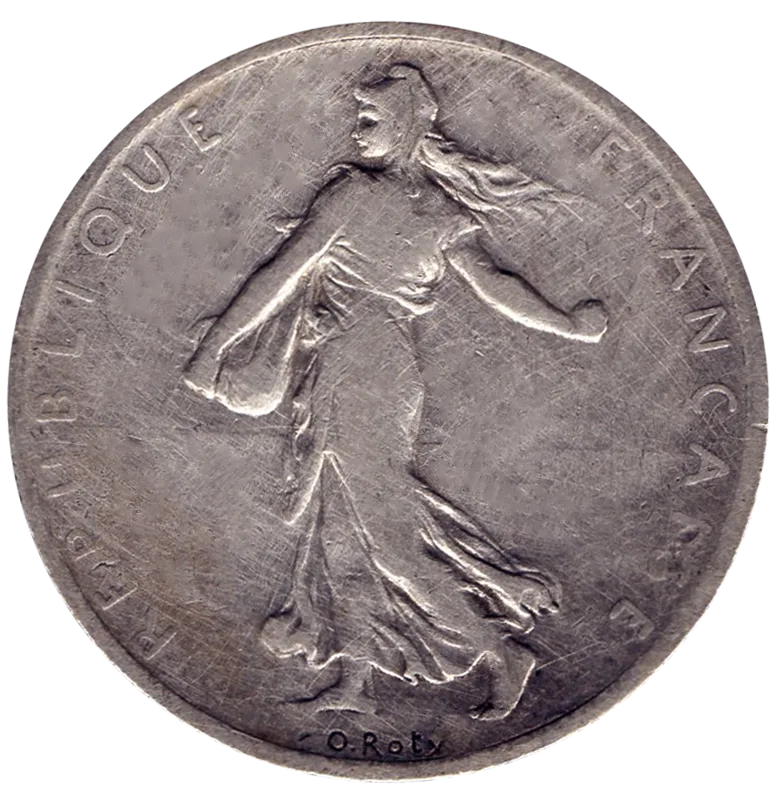
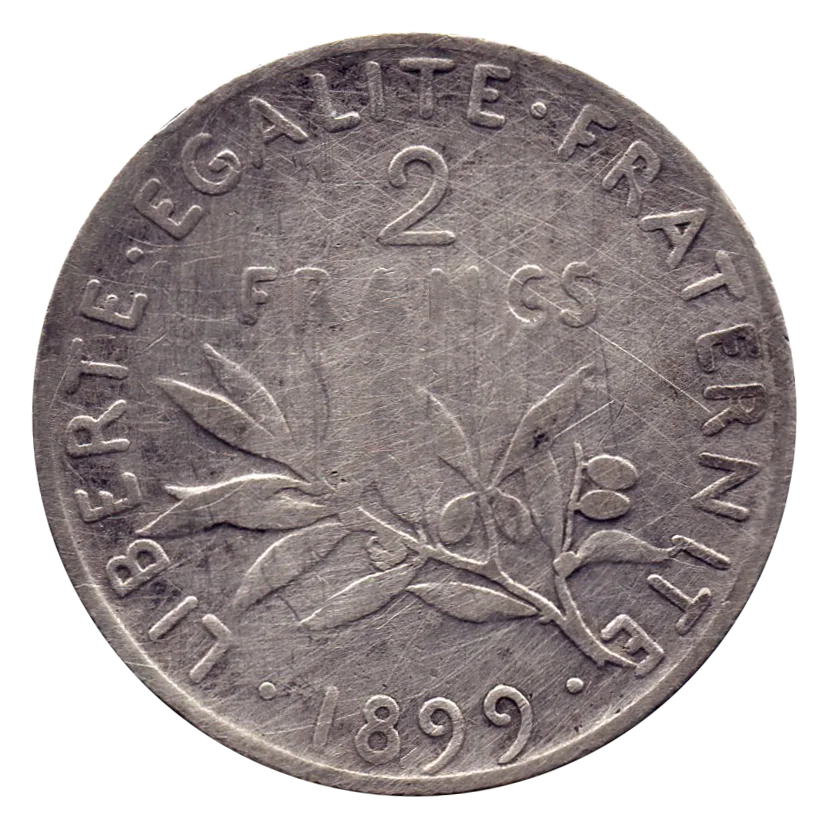
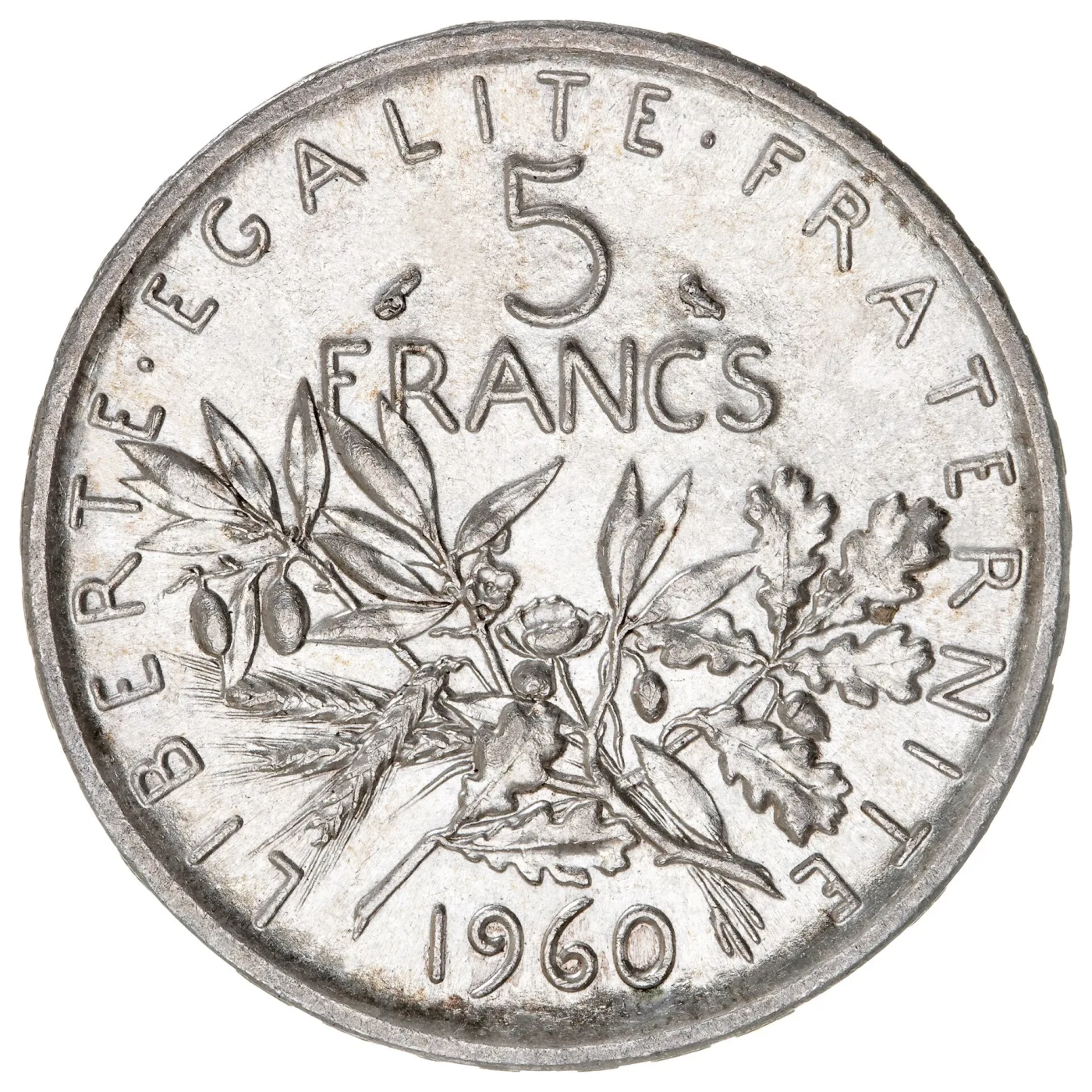
The Sower (La Semeuse), designed by Oscar Roty, shows a woman in a Phrygian cap striding into the wind and scattering seed against a rising sun. Introduced in 1897, she appeared on silver (and later nickel and alloy) francs and half-francs through the twentieth century and returned on modern French euro cents. She is the single most iconic French coin image, and her presence immediately signals a Third Republic or later piece.
Marianne and the Liberty Cap
Marianne — the personified Republic, usually a woman’s head wearing the Phrygian liberty cap — appears in many guises across the republics, from the winged-cap “Marianne” of the small bronzes to the modern head on Fifth Republic francs and euros. A Phrygian-capped female head almost always marks a republican coin.
The Gallic Rooster (le Coq)
The Gallic rooster, an ancient emblem of France, crows on the reverse of the beautiful gold 20-franc “Rooster” (Marianne obverse, coq reverse) of 1899–1914 and on various franc coins. Alongside the Sower it is one of the most recognizable French devices and a favorite of collectors.
Ceres, Hercules, and the Seated Figures
The seated Ceres (goddess of the harvest) and the standing Hercules group (Liberty and Equality flanking Hercules, from a design by Dupré) recur on republican silver from 1848 onward, the Hercules 5-franc and later 10- and 50-franc silver pieces being especially prized. Recognizing which allegory a coin carries narrows its era and denomination quickly.
Anatomy of a French Coin
French coins follow consistent layouts within each era, and learning the vocabulary lets you extract the date, denomination, issuer, and mint quickly. The general terms overlap with the basic coin anatomy used everywhere, with a few French specialties.
Republican and Modern Layout
A typical modern coin shows an allegory (Sower, Marianne, Ceres) or a ruler’s portrait with the national legend on one side, and the denomination, date, mint mark, and privy mark on the other. The legend reads RÉPUBLIQUE FRANÇAISE on republican coins, an emperor’s or king’s name on monarchical ones, and the republican motto LIBERTÉ ÉGALITÉ FRATERNITÉ frequently appears.
The Two Little Marks Beside the Date
Flanking the date on nearly every French coin since the eighteenth century are two small symbols that are central to attribution: a mint mark (a single letter identifying the mint city) and a privy mark or differént (a tiny engraver’s device — a cornucopia, a torch, an owl, a wing — identifying the mint’s chief engraver and thus the period). Learning to spot this pair is the single most French-specific identification skill.
Reading the Date and Denomination
Dates are ordinary Arabic numerals (aside from a few Revolutionary-calendar years) — a great convenience. Watch for the currency word and value: CENTIMES, FRANC/FRANCS, or (from 1960) NOUVEAUX FRANCS briefly, then FRANCS again, and EURO/CENT from 2002. The word, the type, and the legend together fix the era; the mint and privy marks fix the mint and engraver.
Mint Marks and Privy Marks: France’s Key to Attribution
France historically struck coins at many provincial mints simultaneously, each identified by a single letter, and reading that letter — together with the engraver’s privy mark — is central to French identification in a way it never is for a single-mint coinage. This is France’s counterpart to the U.S. mint mark system, only older and more elaborate.
The Mint Letters
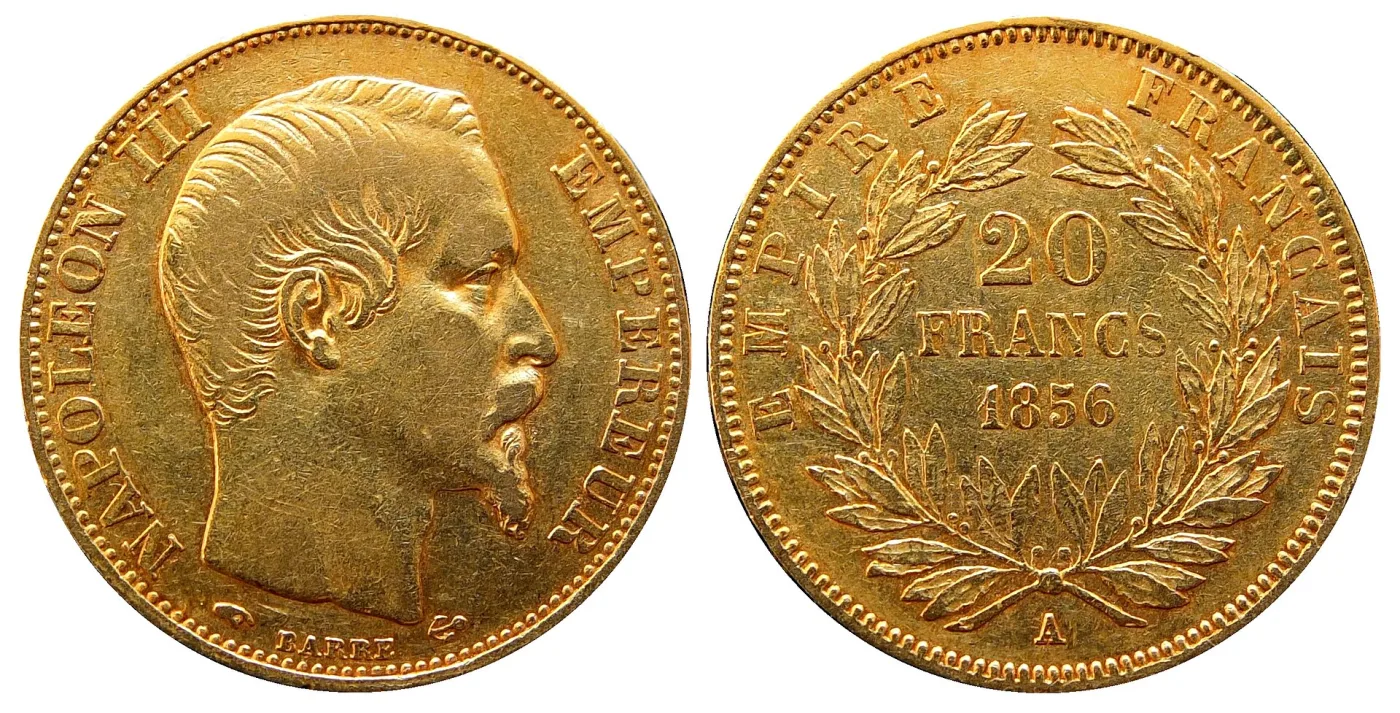
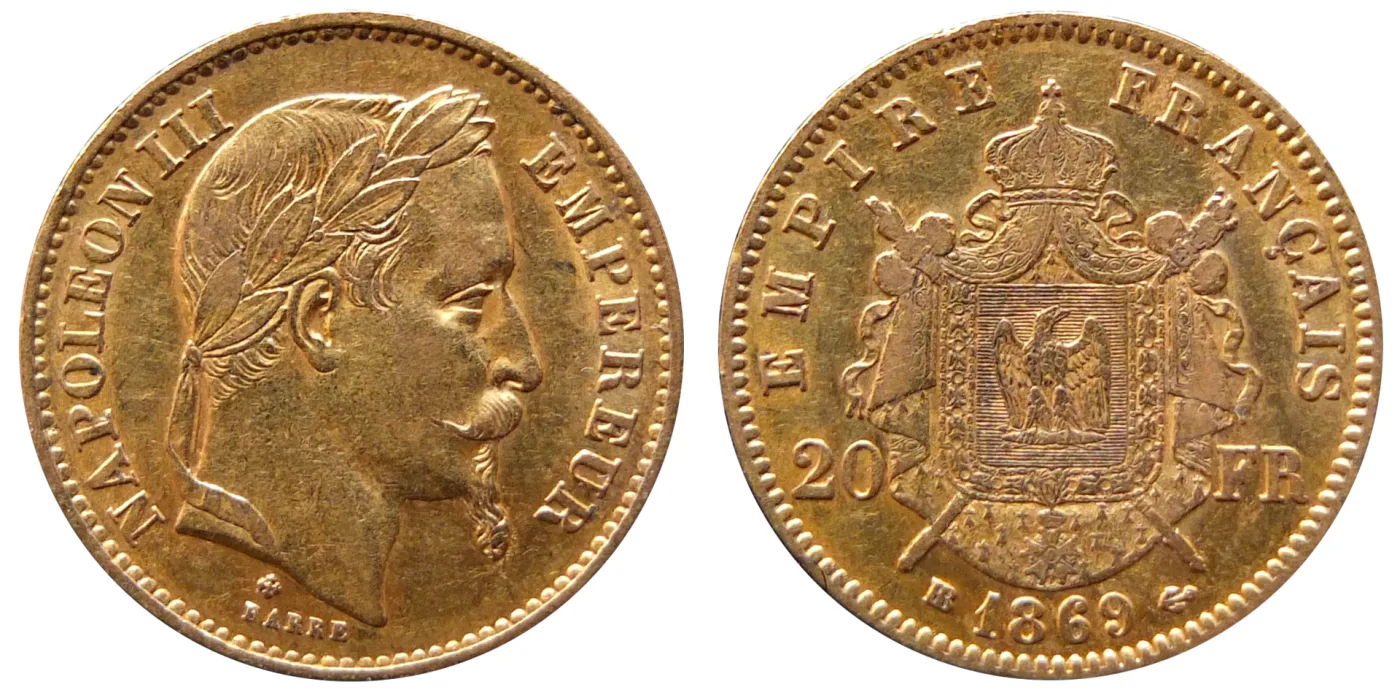
Dozens of mints operated over the centuries, each with its own letter. Among the most frequently seen are A (Paris), B (Rouen), D (Lyon), K (Bordeaux), W (Lille), and BB (Strasbourg), with many others (H for La Rochelle, M for Toulouse, and so on) on older coins. Since the mid-twentieth century essentially all French coins have been struck in Paris, so modern coins commonly show no letter or the Paris mark; the elaborate provincial system belongs mainly to the royal and nineteenth-century coins.
The Privy Mark (Differént)
Beside the mint letter sits a second small symbol, the privy mark or differént d’atelier / de graveur: a tiny cornucopia, torch, anchor, wing, owl, dolphin, or similar device that identifies the mint’s chief engraver during a given span of years. Because these engravers served known date ranges, the privy mark helps confirm a coin’s period and authenticity — a coin whose privy mark does not match its date is a warning sign.
Why the Marks Matter
The mint letter and privy mark are not decoration — they can dramatically affect scarcity and value. For a given type and date, coins from one mint may be common while the identical date from another mint is rare, because mintages differed sharply between facilities. Collectors routinely assemble sets “by date and mint,” and a low-mintage date-and-mint combination is where much of the value hides. Recording both little marks beside the date is a habit worth forming for every French coin you identify.

Silver and Gold Content: The Melt-Value Lines
For anyone weighing melt value, the vital facts about a French coin are its metal and its fineness, which changed sharply over time. Because royal France and the franc struck enormous quantities of silver, a great many French coins carry real precious metal — the French counterpart to U.S. pre-1965 junk silver.
Royal Silver and Gold
The silver écu and its fractions were struck in high-grade silver (commonly around .917), and the gold louis d’or in high-grade gold. Royal billon coins (deniers, liards, sols) contain only a little silver mixed with copper and have modest intrinsic value. A full-size écu or a louis is a substantial chunk of precious metal quite apart from its collector value.
Franc-Era Silver: .900 and .835
Under the Franc Germinal standard, the silver 5 francs and the smaller 50 centimes, 1 franc, and 2 francs were .900 fine silver through the nineteenth and into the twentieth century; some later issues (and Latin Monetary Union small silver) were reduced to .835. The big twentieth-century silver 10, 20, and 50 francs (Turin, Hercules, and similar types) were struck in silver as well, generally .680–.900 depending on the issue.
The Twentieth-Century Shift to Base Metal
As metals grew scarce around the world wars, French coinage moved to nickel, aluminum-bronze, and aluminum. Interwar and wartime francs in these alloys, and the Vichy aluminum and zinc pieces, contain no precious metal. Post-war Fourth and Fifth Republic small coins are base metal too, with only occasional silver commemorative and higher-value pieces.
Gold Across the Franc Era
French gold — the 20-franc Napoleon and Rooster, the 40- and 50-franc, and the large 100-franc — was struck in .900 fine gold throughout, making these among the most trusted small gold coins in the world. Modern French commemorative and bullion coins are struck in fine gold and silver.
How to Test Quickly
Date and denomination usually settle metal by reference to a catalog, but field checks help: genuine silver and gold coins are non-magnetic and ring clearly, whereas wartime steel and some base issues may be magnetic and look dull. For valuable pieces, specific-gravity testing confirms silver or gold content without damage — the same non-destructive discipline used across counterfeit detection.
The Napoleon and French Gold
No French coin is more famous worldwide than the gold “Napoleon,” and understanding it unlocks a huge and liquid corner of the market.
What “a Napoleon” Means
Strictly, a Napoleon is a 20-franc gold coin, first struck under Napoleon I and continued (with changing designs) under later regimes down to the famous Rooster type of 1899–1914. Each contains about 0.1867 troy ounce of pure gold in a .900 coin. Because so many tens of millions were struck to a single reliable standard, the 20-franc Napoleon is one of the most widely traded historic gold coins on earth, comparable in role to a fractional U.S. gold piece.
The Family of Denominations
Alongside the 20-franc came the 10-franc (a small “half Napoleon”), the 40-franc, the 50-franc, and the impressive 100-franc gold pieces, plus a 5-franc gold. Designs ran from Napoleon’s laureate head through the restored kings, Napoleon III (bare and laureate head), the seated Génie/Angel writing the constitution, and the Marianne-and-rooster type. Collectors pursue these by type, date, and mint.
Bullion vs. Numismatic Value
Common-date 20-franc Napoleons trade close to their gold content plus a modest premium and are a staple of European gold stacking, much like other classic gold. Scarcer dates, low-mintage mints, early Napoleon I issues, and high grades carry numismatic premiums on top. As always, weigh and measure any gold coin and prefer graded examples for valuable pieces, because famous gold is widely faked.
The New Franc and the Road to the Euro
The final chapters of the franc are easy to identify once you know two turning points: the 1960 revaluation and the 2002 euro changeover.
The New Franc of 1960
Post-war inflation had shrunk the old franc drastically, so on 1 January 1960 France introduced the nouveau franc (“new franc”) worth 100 old francs. For a few years coins were marked to distinguish the new unit, and old and new circulated side by side before the “nouveau” label faded and the coin was simply the franc again. A coin reading a small value in “nouveaux francs,” or the sudden change in coin sizes around 1960, signals this reform.
Fifth Republic Circulation Coins
The Fifth Republic’s familiar coins — the Sower half- and one-franc and 5-franc, the Marianne small centimes, the 10-franc bimetallic pieces, and the large nickel 5- and 10-franc — circulated until 2001. Most are base metal and common; a handful of silver commemorative francs and higher denominations carry precious-metal or collector value.
French Euro Coins
France adopted the euro on 1 January 2002. French euro coins pair the shared European reverse with a French national side: the Sower on the 10, 20, and 50-cent coins, a stylized Marianne on the 1, 2, and 5-cent coins, and a tree of liberty within the motto on the 1- and 2-euro coins. First-year 2002 coins, the small privy/mint marks that persist on euros, and low-mintage commemorative 2-euro issues are collected, and modern silver and gold collector euros continue France’s tradition of fine-metal commemoratives.
Step-by-Step Identification Workflow
With the framework in place, here is a repeatable process for identifying any French coin in hand.
1. Read the Legend and Place the Era
Look for the key words: RÉPUBLIQUE FRANÇAISE (a republic), an emperor’s name (NAPOLEON EMPEREUR), a king’s Latin name (LUDOVICUS, HENRICUS, CAROLUS), ÉTAT FRANÇAIS with “TRAVAIL FAMILLE PATRIE” (Vichy), or EURO (from 2002). The legend plus the coin type fixes the era.
2. Read the Date, Denomination, and Currency Word
Note the date (watch for a Revolutionary-calendar “L’AN” year on 1790s coins) and the stated value with its unit — CENTIMES, FRANC(S), NOUVEAUX FRANCS, EURO, CENT. The currency word confirms the era and the monetary system.
3. Find the Mint Mark and Privy Mark
Locate the single mint letter (A for Paris, B, D, K, W, BB, and historic letters) and the tiny privy-mark device beside the date. Record both — date + mint mark is what uniquely places a coin in a catalog, and the privy mark confirms the period and helps authenticate the piece.
4. Identify the Type and Designer (if applicable)
Name the allegory or portrait — Sower, Marianne, Ceres, Hercules, a specific ruler — and match it to the catalog listing for that denomination and era. The type plus the denomination usually pins down the exact catalog number once you add the date and mint.
5. Determine Metal and Content, Then Check Keys
Use era and date to set fineness (royal écu ~.917 and louis gold; franc-era silver .900 or .835; twentieth-century francs increasingly base metal; French gold .900), confirm with a magnet and ring test, and finally match the type, date, and mint against key-date and variety lists. Most French coins are common — but a scarce mint, a low-mintage year, or a genuine rarity can be worth many multiples of the ordinary price.
Key Dates and Famous Rarities
The great majority of French coins are common and trade modestly, but the field turns on a well-known set of scarce types, mints, and dates. As with U.S. key dates, these are what collectors hunt.
Royal Rarities
Among the royal coins, scarce mints, short-lived issues, pattern and piedfort strikes, and the finest-known examples of common écus and louis command strong prices. Medieval hammered gold and the coins of minor or short reigns are prized, and royal gold is scarce and valuable across the board.
Franc-Era Keys by Date and Mint
In the franc series, certain date-and-mint combinations of the silver 5 francs, the Sower and Ceres pieces, and the gold Napoleons have very low mintages and are the keys — for example, scarce years from provincial mints and issues struck only briefly. Early First Republic and Consulate coins, and the transitional issues of changing regimes, are widely collected and can be genuinely rare.
Twentieth-Century Rarities
The beloved twentieth-century types include several famous low-mintage dates and pattern (essai) pieces that collectors chase; a full type set is very achievable, but the scarcest dates and finest grades bring high prices. Vichy-era and Free-French coinages add historically charged rarities.
Rarities to Authenticate
- Scarce date-and-mint gold Napoleons and low-mintage royal gold — keys within the gold series.
- Low-mintage silver 5-franc and Sower dates — the classic franc keys.
- Pattern (essai) and piedfort strikes — special issues that are widely reproduced, so verify before celebrating.
As always, treat any apparent rarity with caution: the fame of these coins makes them targets for fakes, altered dates, and altered mint marks, so authenticate before you pay a premium.
French Error Coins and Varieties
French mint errors follow the same categories as U.S. error coins, and the same caution applies: genuine errors are collectable, but ordinary damage, wear, and post-mint alteration are not.
Die Varieties and the Little Marks
Repunched or altered mint letters, small design differences between dies, mismatched or missing privy marks, and occasional overdates are the French equivalent of the variety hunting behind U.S. doubled dies. Because France used the mint-letter and privy-mark system, “wrong mark” and “missing mark” varieties occasionally turn up and are documented in specialist catalogs.
Struck Errors
Off-center strikes, clipped planchets, wrong-planchet strikes, and die cracks appear on French coins as they do worldwide. The high-volume modern centime, franc, and euro coinages are the most fertile ground for such errors, and the bimetallic 10-franc and 1- and 2-euro coins produce distinctive ring-and-center misalignments and even mismatched national/European pairings.
Damage vs. Genuine Errors
A caution for older French base-metal coins: corrosion, environmental damage, and post-mint dents are often mistaken for mint errors. Genuine planchet and striking errors are original to the minting process; corrosion, tooling, and damage are not, and they reduce rather than add value. When in doubt, compare against documented error examples before assuming a premium.
Grading French Coins
French coins are graded on the same 70-point Sheldon scale used for U.S. coins, and the leading third-party services grade French issues routinely, so the vocabulary will be familiar. French collectors also use their own adjectival scale, which maps onto the numbers.
The Grading Scale
- Good / Very Good (G/VG) — heavily worn, major detail gone but the type and legends clear (French: B / TB).
- Fine / Very Fine (F/VF) — moderate wear, most design elements sharp (French: TB / TTB).
- Extremely Fine (EF/XF) — light wear on the high points only (French: SUP, superbe).
- About Uncirculated (AU) — a trace of wear on the highest points (French: SPL, splendide).
- Mint State (MS-60 to MS-70) — no wear, as struck, graded by surfaces and strike (French: FDC, fleur de coin).
Special Considerations for French Coins
Judge wear on the high points of the Sower’s body and knee, Marianne’s cheek and cap, or a ruler’s portrait, and weigh eye appeal, luster, and originality. Silver Sowers, Hercules crowns, and gold Napoleons are collected in high grade, where small differences in preservation mean large differences in price. Avoid cleaned coins, which lose much of their value; the general principles in our coin grading guide apply directly.
Slabbing and Third-Party Grading
High-value French coins — scarce royal écus and louis, key franc date-and-mint pieces, gold Napoleons, and pattern strikes — are commonly sent to third-party grading services, which encapsulate them with a numeric grade and an authenticity guarantee. Given the prevalence of gold and rarity fakes, professional authentication is especially valuable here, though it is rarely worth the cost for common circulated centimes and base-metal minors.
What French Coins Are Worth in 2026
French coin values span an enormous range, from a few cents for a worn aluminum centime to five and six figures for the great royal and rarity pieces. Here is a realistic picture for the coins most people actually hold.
Common Circulated Coins
Base-metal centimes, interwar and post-war francs, Vichy aluminum and zinc pieces, and modern euros in circulated grades are worth little more than face or a small collector premium. Their appeal is as inexpensive, historically interesting foreign coins rather than as bullion or rarities.
Silver Coins for Their Metal
Royal écus, franc-era silver (5 francs and the 50-centime/1-franc/2-franc pieces at .900 or .835), and the larger twentieth-century silver 10/20/50 francs all carry precious-metal value that rises and falls with the silver price, independent of any collector premium. A 5-franc crown or an écu has genuine melt value; remember that reduced-fineness issues contain proportionally less metal.
Gold Napoleons and Bullion
Common-date 20-franc Napoleons and Roosters trade close to their gold content (about 0.1867 oz) plus a modest premium, much like other classic European gold, and larger 40/50/100-franc gold and modern French bullion track the market for their metal. Original low-mintage dates and high grades add numismatic premiums on top.
Key Types and Rarities
Four-, five-, and six-figure values live among the great rarities: finest-known and scarce royal écus and louis, medieval hammered gold, low-mintage franc-era silver and gold date-and-mint pieces, and pattern and piedfort strikes. These are exceptional. For everyday identification, assume any given coin is common until a type-, date-, and mint-check proves otherwise — and get a professional opinion before paying a premium, since fakes cluster around exactly these coins.
Counterfeits and How to Avoid Them
Because French silver, gold, and historically charged coins are valuable and widely recognized, counterfeits are a serious concern — from period forgeries to modern cast and struck fakes and restrikes sold as originals. The same discipline used for counterfeit detection on U.S. coins applies here.
Fake Gold Napoleons and Silver Crowns
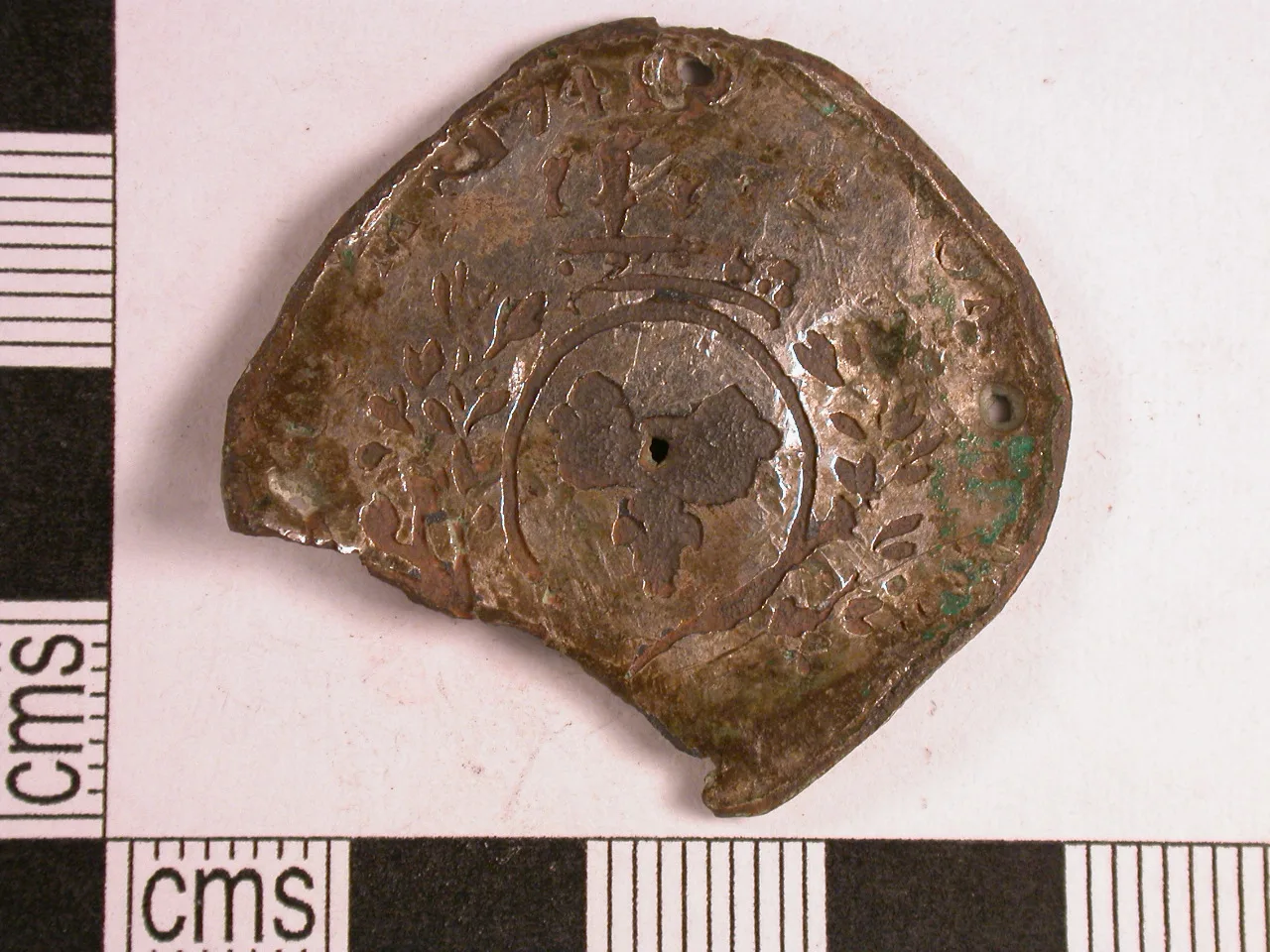
The 20-franc Napoleon, being so famous and liquid, is among the most reproduced gold coins in the world, and the silver écu and 5-franc crown are widely faked too. Genuine coins have precise weight and diameter, sharp detail, correct edge lettering or reeding, and a privy mark consistent with the date. A coin that is underweight, has a soft cast surface, shows a seam on the edge, has mushy legends, or carries a privy mark that does not match its date is a red flag. This parallels the caution needed with any heavily counterfeited world crown or gold coin.
Restrikes and “Official” Reproductions
Some French gold (and certain historic types) have been officially or unofficially restruck later using original or copy dies. Restrikes can be legitimate bullion but are not the same as an original-date coin and should not be paid for as rarities. Learn which types are commonly restruck, and treat an “unusually common rare date” with suspicion.
Altered Dates and Mint Marks
The value gap between common and scarce date-and-mint combinations tempts forgers to alter a common coin’s date or mint letter to imitate a key. Any high-value royal, franc-era, or gold rarity demands expert authentication, because the incentive to fake it is high and the alterations can be skillful. Weigh and measure any silver or gold coin, prefer graded holders for high-value pieces, and buy only from reputable dealers. As always, never clean a coin — harsh cleaning strips original surfaces and slashes value, a principle covered in our guide to coin toning.
References and Online Tools
When a coin resists identification, the right reference resolves it quickly. French numismatics is exceptionally well documented in both English and French.
The Standard Catalogs
The essential English-language references are the Standard Catalog of World Coins (Krause) volumes, which list every French type, mint, privy mark, and date with mintages and values. French-language standards include the Le Franc catalog (the definitive reference for coins from 1795 onward, cited constantly by collectors), the Gadoury catalogs, and specialist works on the royal series and the medieval coinage. For the pre-1795 royal coins, references keyed to king and mint are indispensable.
Free Online Resources
Several free databases let you match a coin by image and description without any purchase — searchable world-coin catalogs, auction-archive sites showing realized prices, the Monnaie de Paris information pages, and active collector forums (in English and French) where experts identify coins from photographs. Matching your coin’s era, legend, denomination, date, mint mark, and privy mark against these sources resolves the great majority of pieces, and comparing sold prices gives a realistic value.
When to Get Expert Help
For a suspected key date or scarce mint, a royal écu or louis, a possible error or pattern, a gold coin, or anything you cannot confidently place, consult a reputable dealer or a grading service. Professional authentication is cheap insurance against buying a fake or misjudging a rarity, and it is indispensable before paying a premium for any high-value French coin.
Frequently Asked Questions
How do I know if my French coin is silver?
Use the era and date. Royal écus are high-grade silver (around .917); franc-era 5 francs and the 50-centime/1-franc/2-franc coins are .900 (some later issues .835) silver; the larger twentieth-century 10/20/50 francs are often silver too. Interwar, wartime, and post-war minors are usually base metal (nickel, aluminum-bronze, aluminum). Silver coins are non-magnetic and ring clearly; wartime steel and some base issues can be magnetic and look dull. For valuable pieces, specific-gravity testing confirms the content without damage.
What are the small letter and symbol next to the date?
They are the mint mark and the privy mark. The letter identifies the mint city (A = Paris, B = Rouen, D = Lyon, K = Bordeaux, W = Lille, BB = Strasbourg, and historic others), while the tiny device (a cornucopia, torch, wing, owl, and so on) is the privy mark identifying the mint's chief engraver and thus the period. Both strongly affect attribution and value, because mintages differed sharply between mints for the same date.
What is a gold "Napoleon" and what is it worth?
A Napoleon is a 20-franc gold coin (Napoleon I through the 1899–1914 Rooster type), containing about 0.1867 troy ounce of gold in a .900 coin. Common dates trade close to their gold value plus a small premium and are among the most liquid historic gold coins in the world; scarce dates, mints, and high grades bring numismatic premiums. Because they are so famous, Napoleons are widely faked, so weigh, measure, and prefer graded examples for valuable pieces.
What does "nouveau franc" or "new franc" mean on my coin?
On 1 January 1960 France revalued its currency, introducing the nouveau franc ("new franc") worth 100 old francs. For a few years coins distinguished the new unit before the "nouveau" label faded and it became simply the franc again. A coin marked in "nouveaux francs," or the change in coin sizes around 1960, reflects this reform — it does not by itself make the coin valuable.
Is my Revolutionary or Napoleonic coin rare and valuable?
Some are genuinely scarce, but many are common in worn grades. Early First Republic and Consulate coins, transitional issues, scarce mints, and pattern strikes can be valuable, while ordinary circulated Napoleon III francs and common bronzes are inexpensive. Check the type, date, mint mark, and privy mark against key-date lists, and treat any apparent rarity with caution, since altered dates, altered mint marks, and fakes exist.
Is my old French coin a valuable rarity?
Usually no — most French coins are common, especially base-metal centimes, wartime aluminum, and common-date silver traded for metal. The valuable exceptions are finest-known and scarce royal écus and louis, medieval hammered gold, low-mintage franc-era silver and gold date-and-mint pieces, and pattern and piedfort strikes. Check the type, date, and mint against key-date lists, and treat any apparent rarity with caution, since altered dates, altered mint marks, and fakes exist.