American Gold Eagle Identification Guide: Sizes, Mint Marks, Type 1 vs Type 2, Key Dates, and Values
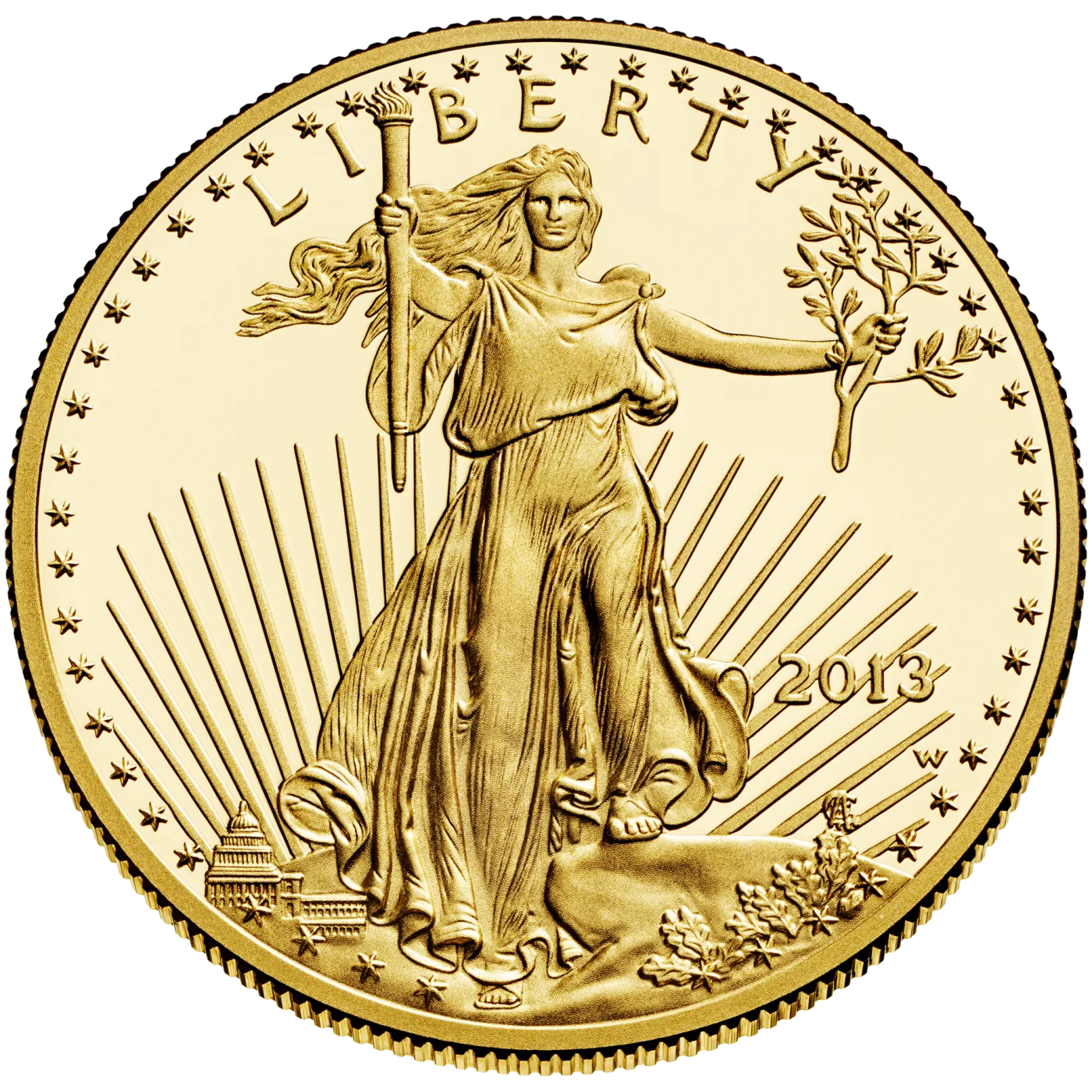
The American Gold Eagle is the official gold bullion coin of the United States and, since its 1986 launch, the most popular gold bullion coin in America. It pairs two of the country’s most beloved images: Augustus Saint-Gaudens’ striding Liberty — widely considered the most beautiful design ever to appear on U.S. coinage — on the obverse, and a “family of eagles” nest scene on the reverse symbolizing American family and tradition. Struck in 22-karat gold to a centuries-old durability standard, the Gold Eagle is at once a work of art, a legal-tender coin, and one of the world’s most trusted ways to own physical gold.
What trips up newcomers is that the Gold Eagle is not a single coin but a family of four. It is issued in one-ounce, half-ounce, quarter-ounce, and tenth-ounce sizes, each with its own diameter, weight, and face value ($50, $25, $10, and $5 respectively). On top of the four sizes there are multiple finishes — bullion, proof, and burnished (uncirculated) — plus a 2021 mid-year reverse redesign that splits the series into a classic Type 1 and a modern Type 2. Knowing which size, finish, and type you hold is the entire game, because two coins that look nearly identical can differ in value by hundreds or thousands of dollars.
This guide walks through the complete American Gold Eagle story: the history behind the program, how to identify each size and finish at a glance, where mint marks appear, the Type 1 versus Type 2 reverse distinction, the genuine key dates and low-mintage rarities, the famous 1999-W unfinished-proof-die varieties, how gold coins are graded, how to spot counterfeits, and what your coins are worth in 2026. If you are brand new to coins, start with our broad coin identification guide, then return here to master America’s flagship gold coin. If you already collect silver, you will find this is the natural gold companion to the American Silver Eagle.
History and Origins of the Gold Eagle
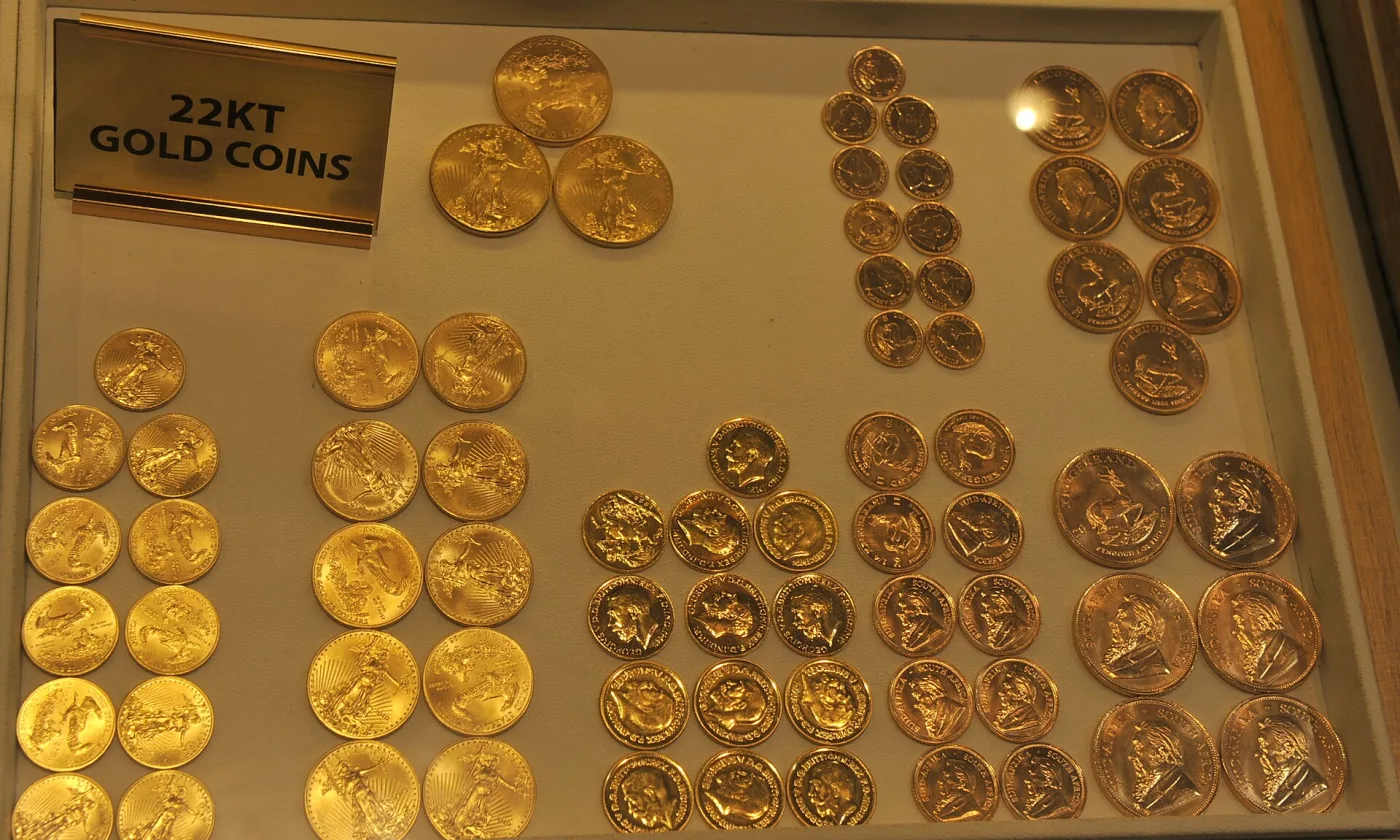
The American Gold Eagle was authorized by the Gold Bullion Coin Act of 1985 and first struck in 1986, debuting alongside the American Silver Eagle. Together the two programs launched the modern era of U.S. bullion coinage. The United States had not issued circulating gold coins since 1933, when the Gold Reserve Act ended the gold standard and the great classic series — the Saint-Gaudens double eagle, the Indian Head eagle, and the rest — came to an abrupt halt. For more than half a century, Americans who wanted to own gold coins had to look to foreign issues like the South African Krugerrand or the Canadian Gold Maple Leaf. The Gold Eagle was Congress’s answer: a homegrown, government-guaranteed gold coin to compete on the world stage.
The choice of designs was deliberate and patriotic. For the obverse, the Mint revived Augustus Saint-Gaudens’ Liberty from the 1907–1933 Saint-Gaudens Double Eagle — the very design President Theodore Roosevelt had championed in his crusade to beautify American coinage. For the reverse, the Mint selected a new design by sculptor Miley Busiek (later Miley Tucker-Frost) depicting a male eagle returning to a nest with a female eagle and their hatchlings, an image meant to evoke family, continuity, and the American spirit. The result married the grandeur of America’s classic gold age to a fresh, optimistic emblem.
The 22-Karat Tradition
One of the Gold Eagle’s defining features is its metal standard. Rather than being struck in pure .999 gold like many modern bullion coins, the Gold Eagle is made of 22-karat gold (.9167 fine), alloyed with silver and copper for durability. This is the same “crown gold” standard used for U.S. gold coins from 1837 onward, including all the classic pre-1933 issues. The alloy gives the coin a slightly warmer, more golden color and a hardness that resists the scratches and dings that plague softer pure-gold coins. Importantly, a one-ounce Gold Eagle still contains a full troy ounce of pure gold — the coin simply weighs more in total (about 1.09 ounces) to account for the alloy.
Four Decades of Production
The Gold Eagle has been struck every year since 1986 in all four sizes for the bullion (investment) versions, sold through the Mint’s network of authorized purchasers rather than directly to the public. Proof versions for collectors began with the one-ounce coin in 1986, expanded to all four sizes by 1988, and have been offered nearly every year since. A burnished (collector uncirculated) version with a “W” mint mark debuted in 2006. In 2021, on the program’s 35th anniversary, the Mint introduced a redesigned reverse, creating the Type 1 / Type 2 split that every collector now navigates.
Design Elements and How to Identify the Coin
Identifying an American Gold Eagle is straightforward once you recognize its two designs. The obverse has remained essentially constant since 1986; the reverse changed in 2021.
Obverse (Front) Design — Saint-Gaudens Liberty
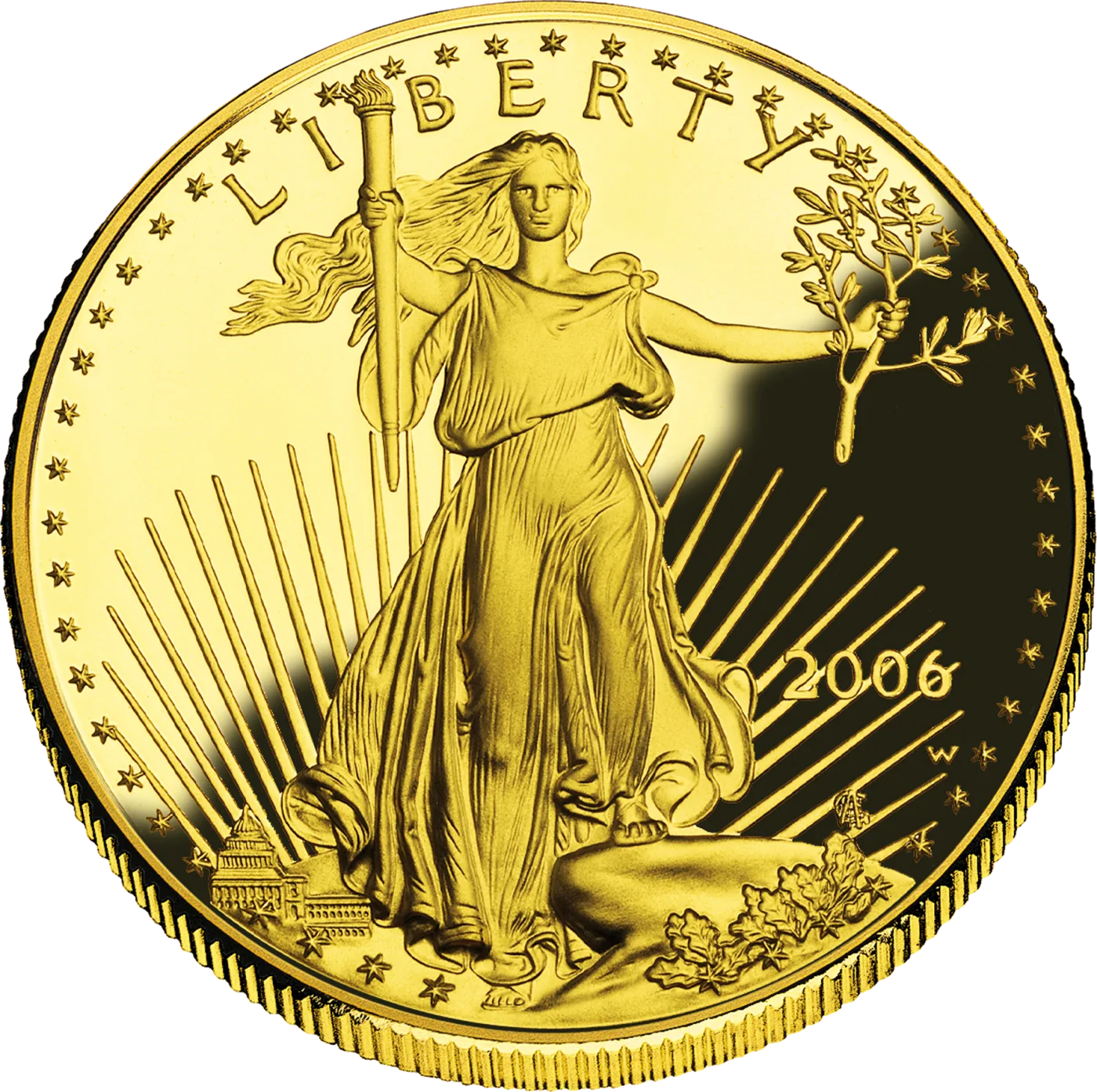
The obverse is Augustus Saint-Gaudens’ full-length Liberty, adapted from the 1907–1933 double eagle. Liberty strides boldly forward holding a lit torch in her right hand (symbolizing enlightenment) and an olive branch in her left (symbolizing peace). Behind her are the rays of a rising sun and, at lower left, the U.S. Capitol building. The word LIBERTY arcs across the top, the date appears at the right (in Roman numerals from 1986 to 1991, then Arabic numerals from 1992 onward), and stars line the border. On the original design there were 50 stars; the 2021 obverse was re-engraved from Saint-Gaudens’ original models for a sharper, higher-fidelity portrait.
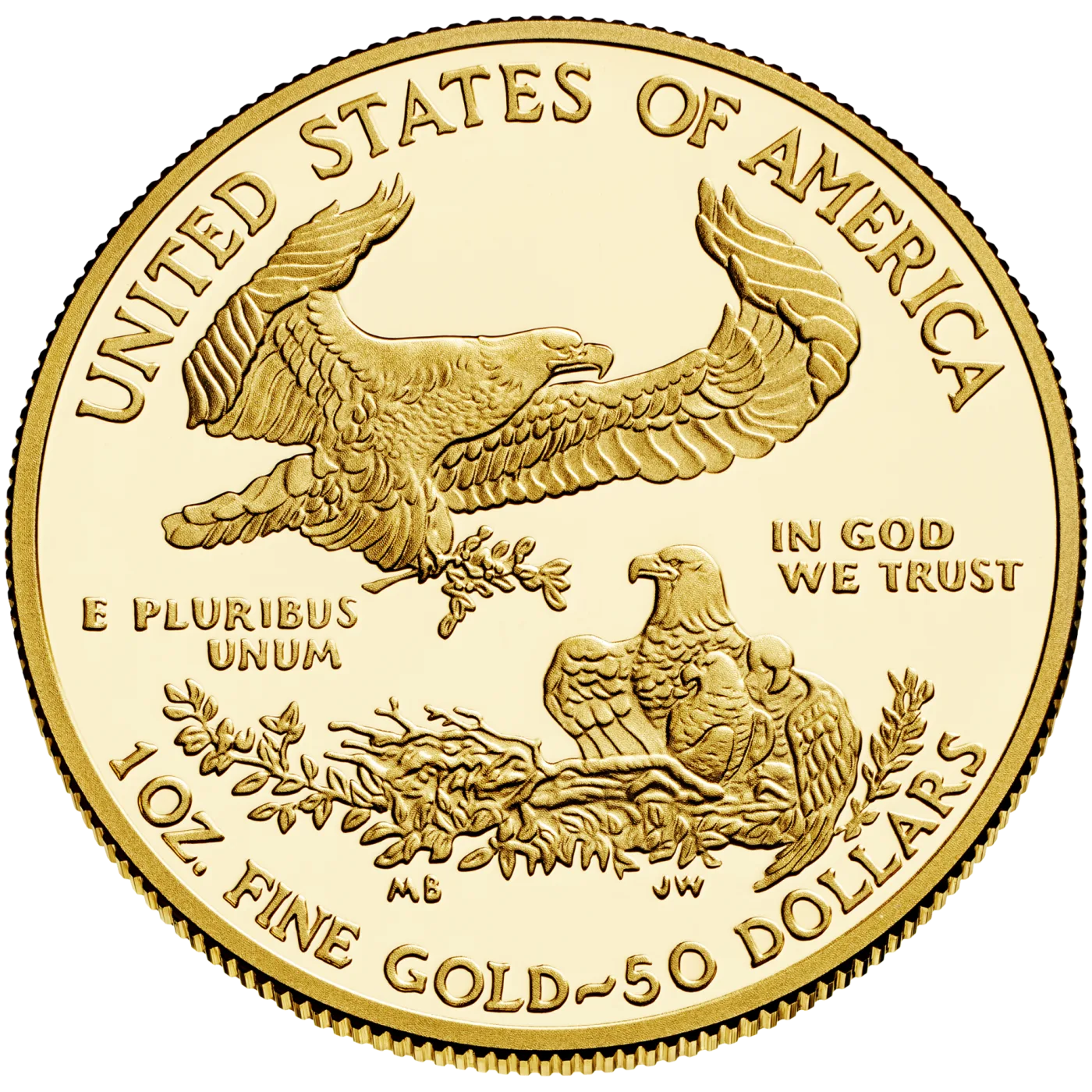
Reverse (Back) Design — Family of Eagles (1986–2021)
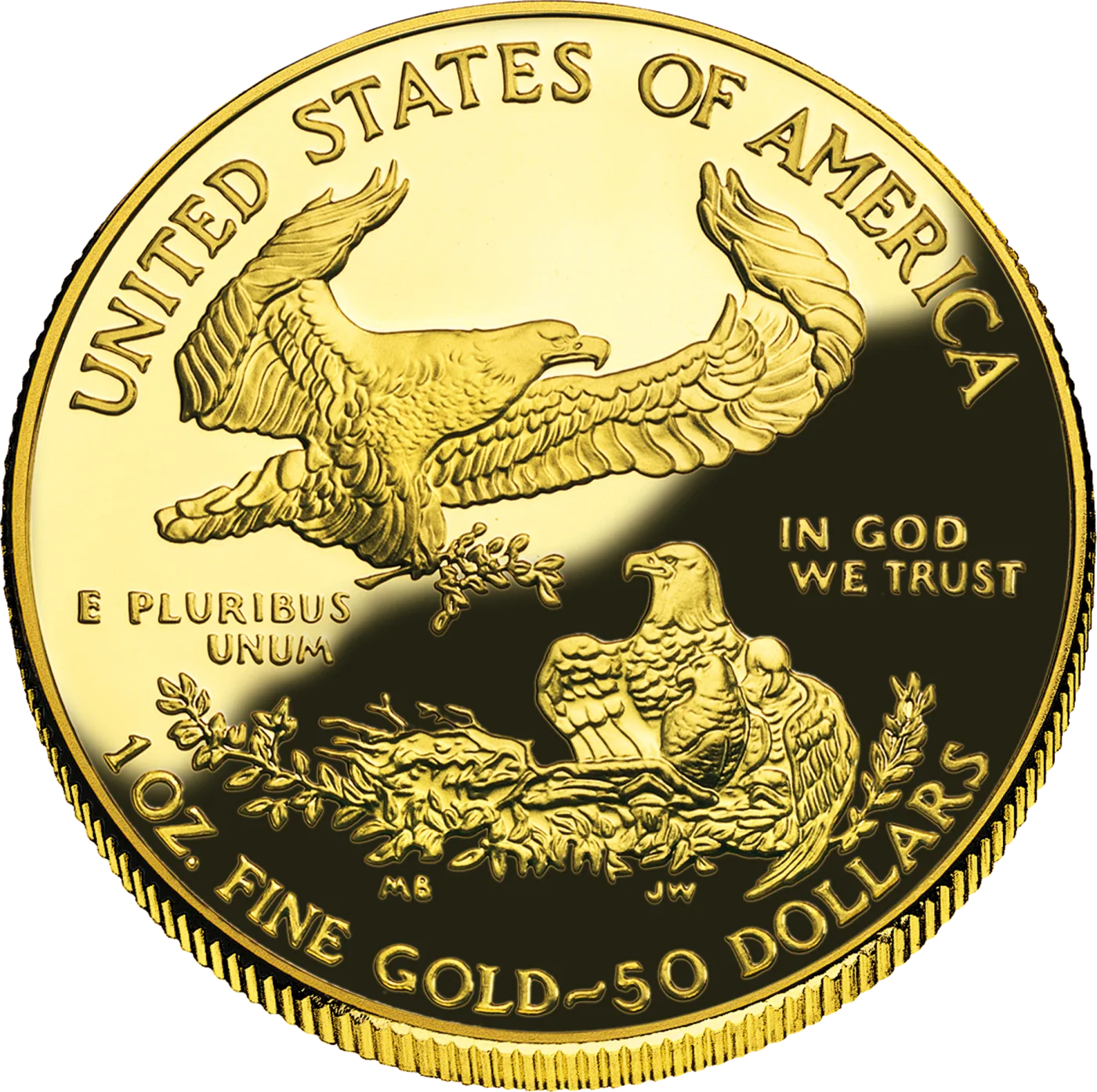
The original reverse, the “Type 1,” is Miley Busiek’s family of eagles: a male eagle flies in from the left carrying an olive branch to a nest where a female eagle watches over two hatchlings. The inscriptions read UNITED STATES OF AMERICA across the top, the weight and denomination across the bottom (for example, 1 OZ. FINE GOLD ~ 50 DOLLARS), and the mottos E PLURIBUS UNUM and IN GOD WE TRUST in the field. This warm, narrative scene is what distinguishes the Gold Eagle’s reverse from the soaring lone eagle of the classic double eagle.
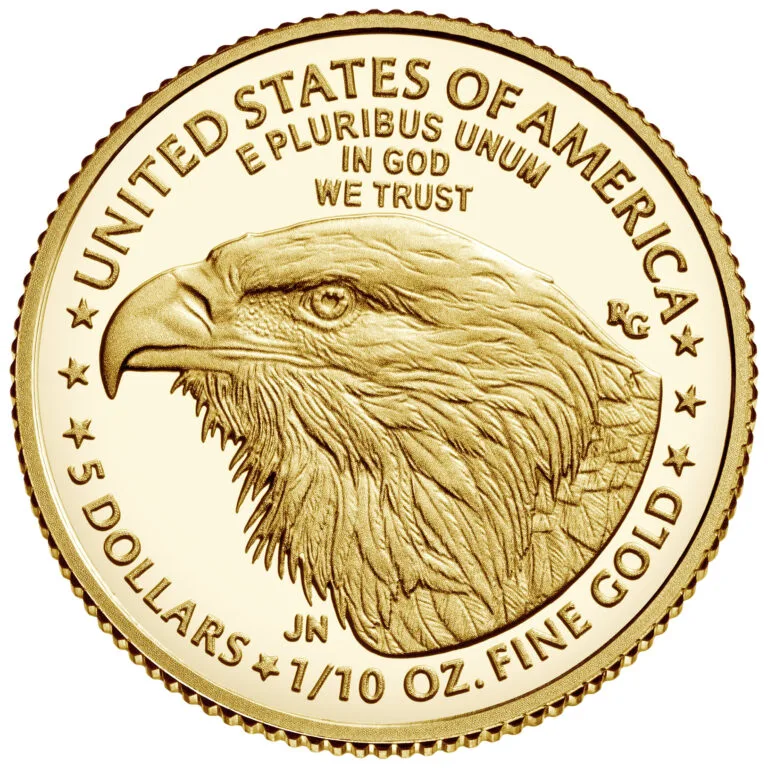
Reverse (Back) Design — Eagle Portrait (2021–present)
The new reverse, the “Type 2,” designed by Jennie Norris and sculpted by Renata Gordon, is a close-up portrait of a single American bald eagle’s head and eye, rendered in striking detail. The same legends remain — UNITED STATES OF AMERICA, the weight and denomination, E PLURIBUS UNUM, and IN GOD WE TRUST. The change from a full scene to an intimate, photographic-style portrait is the most obvious way to tell a modern Gold Eagle from a classic one.
How to Quickly Recognize a Gold Eagle
If the obverse shows full-figure Liberty striding toward a sunrise with a torch and olive branch, and the reverse reads “FINE GOLD” with a dollar denomination, you are holding an American Gold Eagle. The “FINE GOLD” legend plus the family-of-eagles nest (or, post-2021, the eagle portrait) is the fastest confirmation. Do not confuse it with the classic Saint-Gaudens double eagle, which shares the same striding Liberty obverse but has a flying eagle reverse and reads “TWENTY DOLLARS” with no weight statement, nor with the Indian Head Eagle, an entirely different classic $10 gold coin.
The Four Sizes and Face Values
The single most important identification step for a Gold Eagle is determining its size, because the four versions look almost identical at a glance but contain vastly different amounts of gold. Each carries a face value that is purely symbolic — the coins are worth many times their stamped denomination in gold.
The Four Versions
- One ounce — $50 face value: Contains 1 troy ounce of pure gold; 32.7 mm diameter. The flagship size and the most heavily produced. The reverse reads “1 OZ. FINE GOLD ~ 50 DOLLARS.”
- Half ounce — $25 face value: Contains 0.5 troy ounce of pure gold; 27.0 mm diameter. Reads “1/2 OZ. FINE GOLD ~ 25 DOLLARS.”
- Quarter ounce — $10 face value: Contains 0.25 troy ounce of pure gold; 22.0 mm diameter. Reads “1/4 OZ. FINE GOLD ~ 10 DOLLARS.”
- Tenth ounce — $5 face value: Contains 0.10 troy ounce of pure gold; 16.5 mm diameter. Reads “1/10 OZ. FINE GOLD ~ 5 DOLLARS.” This is the smallest and the most affordable entry point.
How to Tell the Sizes Apart
The reverse inscription states the exact weight and denomination, so reading “1/4 OZ. FINE GOLD ~ 10 DOLLARS” instantly tells you it is the quarter-ounce coin. If the legend is worn or you want to confirm, measure the diameter: 32.7 mm (one ounce), 27.0 mm (half), 22.0 mm (quarter), or 16.5 mm (tenth). Be careful — because all four share the same designs, a quarter-ounce and a half-ounce can look similar in a photo without a size reference. Weight is the definitive test, as each size has a precise total weight (see the Specifications section).
Why Smaller Coins Carry Higher Premiums
The fractional sizes (half, quarter, and especially tenth ounce) cost more per ounce of gold than the one-ounce coin. The Mint’s striking and handling costs are similar regardless of size, so those fixed costs are spread over less metal in a small coin. A tenth-ounce eagle can carry a premium of 8–15% over its gold value, versus 3–6% for a one-ounce coin. Stackers chasing the most gold per dollar buy one-ounce coins; collectors and gift-givers often prefer the charming fractional sizes despite the premium.
Type 1 vs Type 2 Reverse (The 2021 Redesign)
Just as with the Silver Eagle, 2021 is a watershed year for the Gold Eagle because the Mint changed the reverse design partway through, splitting the series into two collectible types.
What Changed
Type 1 (1986–2021) is Miley Busiek’s family-of-eagles nest scene. Type 2 (2021–present) is Jennie Norris’s close-up eagle-head portrait. The two are unmistakable: Type 1 shows multiple eagles and a nest in a wide composition; Type 2 shows a single eagle’s head filling the field. The obverse Liberty was also re-engraved in 2021 from Saint-Gaudens’ original models, giving Type 2 coins crisper detail and subtly different relief.
Why 2021 Is Special
Because the changeover happened mid-year, 2021 Gold Eagles exist in both Type 1 and Type 2 across the bullion, proof, and burnished formats and across all four sizes. This makes 2021 the only year you can collect in both reverses, and it created instant demand for “last of the Type 1” coins and “first of the Type 2” coins. Two-coin sets pairing the 2021 Type 1 and Type 2 proofs are especially popular, and certified first-strike examples of either type carry collector premiums.
Identifying the Two Types in Photos
When buying online, always confirm the reverse image for a 2021 coin. A nest with several eagles is Type 1; a single eagle head is Type 2. Sellers sometimes mislabel them, and because the Type 1 is the more historically significant “retired” design, it generally commands the stronger premium — so verifying the reverse protects you from overpaying or underbuying.
Bullion, Proof, and Burnished Finishes
Like the Silver Eagle, the Gold Eagle comes in several finishes, and the finish is just as important as the date in determining value. Two coins of the same date and size can differ dramatically in price based on finish alone.
Bullion (Business Strike)
Bullion Gold Eagles are the standard investment version, struck in large quantities and distributed through authorized purchasers. They have a brilliant, frosty luster but no mirror finish, and they carry no mint mark. These are the coins bought and sold “by the ounce” and the ones most stackers own. The vast majority of Gold Eagles in existence are bullion strikes.
Proof
Proof Gold Eagles are struck on specially polished planchets with mirror-finish dies, producing deep, reflective fields and frosted, cameo devices. They are sold directly to collectors in elegant Mint packaging with a certificate of authenticity, and they carry a “W” mint mark (earlier proofs used a “P”). Proofs are made in all four sizes and command a significant premium over bullion. Modern proofs routinely grade PR-69 and PR-70 Deep Cameo.
Burnished (Uncirculated with Mint Mark)
Beginning in 2006, the Mint introduced a collector “uncirculated” version struck on specially burnished planchets, giving a soft, matte-like satin finish distinct from both the brilliant bullion coin and the mirrored proof. Crucially, these carry a “W” mint mark, which is how you distinguish a burnished coin from a no-mint-mark bullion coin of the same date. Burnished Gold Eagles were not made every year — there are gaps (for example, none were issued in 2010–2010 era and some sizes were skipped) — which makes certain burnished issues genuinely scarce.
Why Finish Determines Value
A bullion Gold Eagle is worth its gold content plus a small premium. A proof or burnished coin of the same date and size is a collectible worth a substantial premium above gold — sometimes double or more for low-mintage years. The presence of a “W” mint mark immediately tells you the coin is a collector issue, not plain bullion. Always identify the finish before assigning a value.
Mint Marks and Where to Find Them
Mint marks on Gold Eagles are simpler than on many classic series, but they are essential because they separate common bullion from valuable collector coins.
Where the Mint Mark Appears
The mint mark is on the obverse throughout the series, on both reverse types: a single letter below the date at the right, tucked between the sun’s rays and the ring of border stars. There is nothing on the reverse — the only lettering below the design there is the designers’ initials — so a reader who checks that side will read every proof as bullion. The mark is small; use a loupe. Bullion coins carry no mint mark at all.
The Marks You Will See
- No mint mark (bullion): Standard investment Gold Eagles carry no mint mark regardless of which facility struck them. The overwhelming majority of Gold Eagles fall in this category.
- “P” (Philadelphia): Used on the earliest proof Gold Eagles, roughly 1986–1992, before proof production consolidated at West Point.
- “W” (West Point): The dominant collector mint mark. West Point strikes virtually all modern proof Gold Eagles (1992 onward) and every burnished/uncirculated coin since 2006. A “W” mint mark is the signature of a collector Gold Eagle.
Why Mint Marks Matter So Much
Because bullion coins are unmarked, any mint mark signals a collector issue worth far more than plain bullion. A 2008 one-ounce eagle with no mint mark is common bullion; a 2008-W is either a proof or a burnished coin worth a strong premium. The famous 1999-W variety (discussed below) exists precisely because a “W” appeared on coins struck from dies meant for proofs. Always check for a mint mark first — it is the gateway to knowing what you truly have.
The Roman Numeral Dates (1986–1991)
A quirk that surprises new collectors is that the earliest Gold Eagles are dated in Roman numerals, a nod to the classic Saint-Gaudens double eagles of 1907 (famously dated MCMVII).
How to Read the Early Dates
From 1986 through 1991, the date on the obverse is written in Roman numerals:
- 1986 = MCMLXXXVI
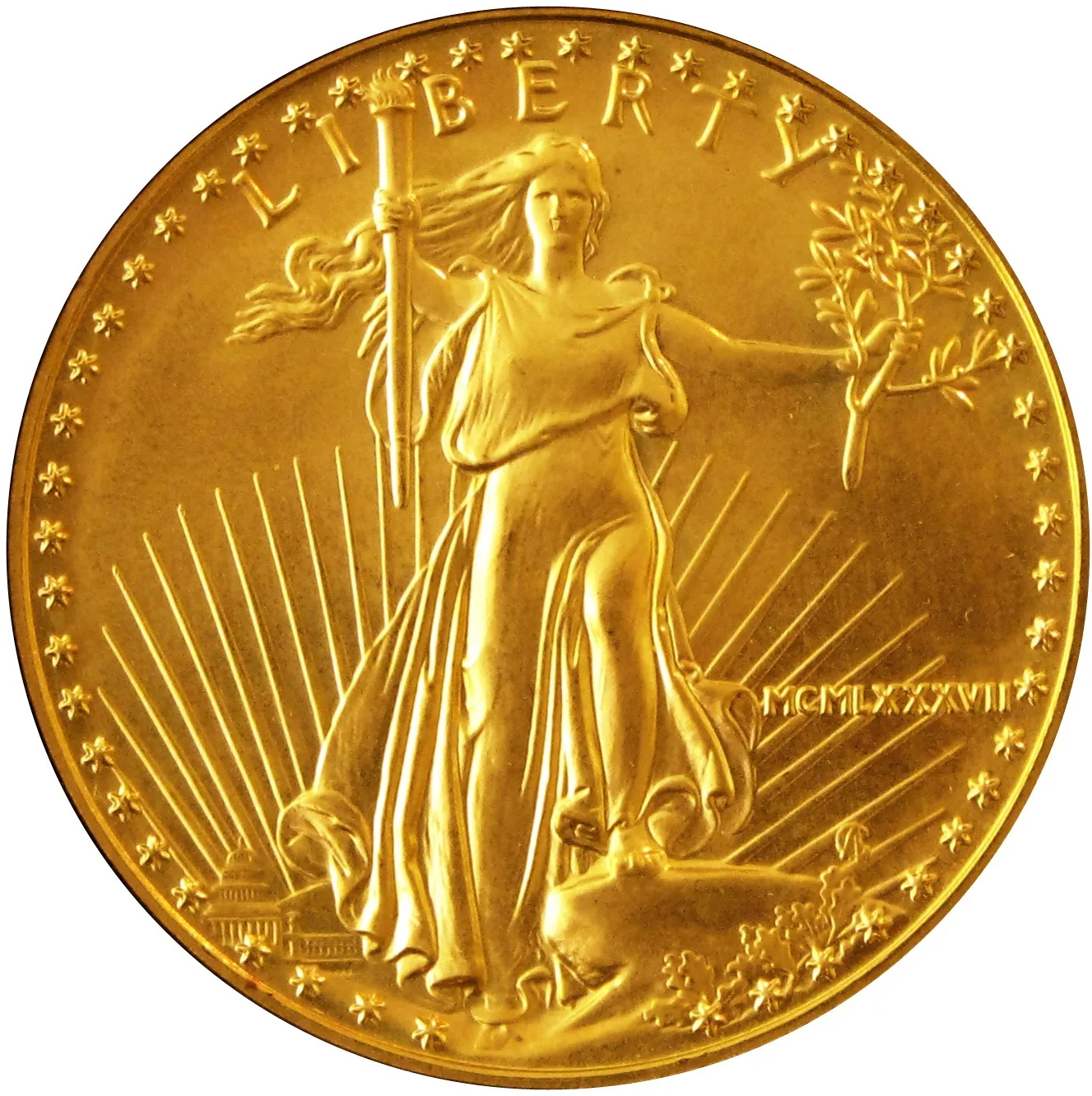
- 1987 = MCMLXXXVII
- 1988 = MCMLXXXVIII
- 1989 = MCMLXXXIX
- 1990 = MCMXC
- 1991 = MCMXCI
Beginning in 1992, the Mint switched to standard Arabic numerals (1992, 1993, and so on) for legibility. So if your Gold Eagle shows a long string of letters where the date should be, it is one of the first six years of the series — a detail that helps confirm an early, more collectible coin.
Why the Switch Happened
The Roman numerals were chosen to honor the artistic heritage of the original Saint-Gaudens design, but they proved confusing to the public and cumbersome to read at a glance. The Mint abandoned them after 1991 in favor of clear Arabic dates, making 1986–1991 a distinct, easily recognizable sub-group within the series.
Key Dates and Low-Mintage Issues
Most bullion Gold Eagles trade close to their gold value, but a number of dates — especially in the fractional sizes and among proofs and burnished issues — stand out as genuine keys. Low mintages drive these premiums.
First-Year 1986 Coins
As the inaugural year, the 1986 (MCMLXXXVI) Gold Eagles in all sizes carry first-year collector demand. The 1986 one-ounce proof, the first proof Gold Eagle ever struck, is especially sought after. First-year coins command a premium beyond their gold content and are anchors of any complete collection.
Low-Mintage Fractional Bullion
The fractional bullion eagles — half, quarter, and tenth ounce — had much lower mintages than the one-ounce coin in many years, and certain dates are genuinely scarce. Years during weak gold markets (such as parts of the 1990s and the late 2000s) saw very low fractional production, making those dates keys for size-and-date collectors. Because so few people set aside fractional bullion in pristine condition, high-grade certified examples of low-mintage fractionals can be worth multiples of their gold value.
Key Proof and Burnished Issues
The proof and burnished side contains the true rarities. Low-mintage proof years, early proofs in the smaller sizes, and the scarcer burnished issues (which were not made every year) carry strong numismatic premiums. The 2006-W burnished coins (first year of the burnished format) and various anniversary issues are particularly collectible. As with the Liberty Head Double Eagle in the classic gold world, the gap between a common date and a key date can be enormous even when the gold content is identical.
The 2021 Transition Coins
The 2021 Type 1 coins — the last struck with Busiek’s family-of-eagles reverse — are in high demand as the end of a 35-year design era. The 2021 Type 2 first-strikes also draw collector interest. Certified 2021 Type 1 and Type 2 examples, especially in proof and burnished formats, carry meaningful premiums over common-date bullion.

Famous Varieties: The 1999-W Unfinished Dies
For a modern bullion coin, the Gold Eagle has one celebrated transitional variety that every advanced collector should know — the 1999-W “Unfinished Proof Dies” eagles.
What Happened in 1999
During the surge of demand surrounding the year 2000, the Mint needed to produce extra bullion Gold Eagles to satisfy buyers. To do so, it pressed into service some reverse dies that had originally been prepared for the West Point proof program but never received the final proofing steps. Crucially, these dies already carried the “W” mint mark. The result was a small number of bullion Gold Eagles — in both the tenth-ounce and quarter-ounce sizes — that mistakenly bear the “W” mint mark normally reserved for collector coins.
Why It Matters
A standard 1999 bullion eagle has no mint mark. A 1999-W bullion eagle (with the “W” from an unfinished proof die) is a recognized error variety worth a substantial premium — often several times the value of a normal coin of the same size, and far more in high certified grades. The variety is attributed by PCGS and NGC as “1999-W Unfinished Proof Dies.” Because the premium is large, this variety is a target for alteration (adding a fake “W”), so genuine examples should always be certified.
Other Errors and Anomalies
Beyond the 1999-W, true mint errors on Gold Eagles are uncommon but not unheard of: struck-through errors, off-center strikes, and planchet flaws occasionally surface. Because gold coins are made with extreme care and high value, errors that do escape are scarce and can command strong premiums. As always, dramatic “error” gold coins offered cheaply online should be treated with suspicion until verified by a top grading service.
Physical Specifications
The Gold Eagle’s specifications have been constant since 1986, which makes precise weight-and-diameter checks one of the best defenses against counterfeits. Note that because the coin is 22-karat (not pure) gold, its total weight exceeds its pure-gold content.
Composition (All Sizes)
- Metal: 22-karat gold — 91.67% gold, with the balance silver and copper for durability.
- Edge: Reeded.
- Designers: Augustus Saint-Gaudens (obverse); Miley Busiek (Type 1 reverse) or Jennie Norris (Type 2 reverse).
Size-by-Size Specifications
- One ounce ($50): 1.0000 oz pure gold; total weight 33.931 g; diameter 32.7 mm; thickness 2.87 mm.
- Half ounce ($25): 0.5000 oz pure gold; total weight 16.966 g; diameter 27.0 mm; thickness 2.24 mm.
- Quarter ounce ($10): 0.2500 oz pure gold; total weight 8.483 g; diameter 22.0 mm; thickness 1.83 mm.
- Tenth ounce ($5): 0.1000 oz pure gold; total weight 3.393 g; diameter 16.5 mm; thickness 1.26 mm.
Each size has a precise total weight that is hard for counterfeiters to match without using real gold, because gold’s density (19.3 g/cm³) is extreme and difficult to fake in a coin of the correct dimensions. A Gold Eagle that is the right diameter but significantly off on weight — or right weight but wrong thickness — is almost certainly counterfeit. These weight-and-caliper checks are the same first-line tests that protect buyers of any precious-metal coin.
How to Grade Gold Eagles
Gold Eagles are graded on the 70-point Sheldon scale, but as modern coins struck to high standards, the meaningful range is compressed at the top. The same fundamental grading methods used across U.S. coins apply, with particular attention to contact marks, luster, and the high-relief points of Liberty’s design.
Bullion (Mint State) Grading
- MS-69: The workhorse grade for bullion eagles — nearly flawless with one or two tiny ticks under magnification. Most certified bullion Gold Eagles grade MS-69.
- MS-70: Perfect under 5x magnification with full luster and no contact marks. MS-70 commands a strong premium because the difference from MS-69 is subtle but the price gap is real, especially for fractional sizes.
- MS-68 and below: Less common for certified eagles; usually the result of heavy bag marks from bulk handling. Because the 22-karat alloy is harder than pure gold, Gold Eagles resist marks better than .999 coins, which helps them grade well.
Proof Grading
Proofs are graded PR (or PF) on the same scale, almost always with a “Deep Cameo” (DCAM) or “Ultra Cameo” designation reflecting the frosted-device-on-mirror-field contrast. PR-69 DCAM is common; PR-70 DCAM is the premium grade. For proofs, the enemies of a perfect grade are hairlines, tiny mirror disturbances, and handling marks.
Special Designations and Labels
Third-party graders offer first-strike / early-release labels, signature labels, and special holders. These can add collector value but do not change the coin’s technical grade — a “First Strike MS-70” and a regular “MS-70” are the same coin technically. Pay for the coin, not the sticker, unless you specifically collect labeled examples.
Should You Grade a Bullion Gold Eagle?
For common-date one-ounce bullion, paying to certify a coin rarely makes sense — it trades as gold. Certification pays off for the 1999-W variety, for low-mintage fractional dates where MS-70 carries a real premium, for proofs and burnished issues, and for protecting high-value purchases against counterfeits.
Bullion Value vs Numismatic Premium
Understanding the difference between a Gold Eagle’s melt value and its collector premium is the key to buying and selling intelligently — the same bullion-versus-numismatic tension collectors weigh across all U.S. gold, from the Gold Dollar to the great double eagles.
The Bullion Floor
Every Gold Eagle contains a known, precise amount of pure gold, so its value can never fall below its gold content (less a small dealer spread). At 2026 gold prices, that floor is substantial — a one-ounce eagle is “worth its weight in gold” no matter what. This melt-value floor is what makes Gold Eagles attractive to investors who simply want recognizable, liquid physical gold.
The Standard Premium
Bullion eagles trade at a premium over the gold spot price — typically 3–6% for one-ounce coins and higher for fractionals. The premium widens during shortages and demand spikes and narrows in calm markets. When you buy, you pay spot plus this premium; when you sell, you receive spot plus a smaller premium. The spread is the dealer’s margin, and it is generally tighter on the popular one-ounce coin than on fractionals.
The Numismatic Premium
Key dates, proofs, burnished coins, the 1999-W variety, low-mintage fractionals, and top-grade examples carry numismatic premiums far above gold value. A scarce proof or a certified MS-70 fractional is worth a premium because of rarity and demand, not just metal. The art of Gold Eagle collecting is knowing which coins are “just gold” and which are genuine numismatic items — a distinction driven by date, size, finish, and grade.
Stacking vs Collecting
People own Gold Eagles for two different reasons. Stackers buy common-date one-ounce bullion for the metal and ignore numismatic premiums. Collectors pursue dates, sizes, finishes, and grades — building proof sets, four-size sets, or a Type 1/Type 2 type set. Both are valid; just know which game you are playing before you pay a premium, because overpaying for a “collectible” common date is the most frequent beginner mistake.
Authentication and Counterfeit Detection
The Gold Eagle is widely counterfeited because of its popularity and high value. Sophisticated fakes — including gold-plated tungsten cores, which approximate gold’s density — do exist. Authentication discipline is essential, especially when buying from unfamiliar sellers.
Weight and Dimension Checks
The first and best test is weight: each size has a precise total weight (33.931 g for one ounce, 16.966 g for half, 8.483 g for quarter, 3.393 g for tenth). Check the diameter and thickness with calipers against the specifications above. Because gold is extremely dense, base-metal fakes almost always miss the weight or are too thick for the diameter. A coin that fails the weight-and-caliper test is a fake. These density-based checks are the same logic that protects silver buyers on coins like the Morgan Silver Dollar — matching a precious metal’s density is the counterfeiter’s hardest obstacle.
The Magnet Test
Gold is not magnetic, so a Gold Eagle should show no attraction to a strong neodymium magnet. Many cheap fakes contain ferromagnetic metals and will react. A magnet test alone cannot confirm authenticity (tungsten is also non-magnetic), but it quickly rules out a class of crude counterfeits.
Visual and Strike Quality
Genuine Gold Eagles have crisp, fully detailed designs with sharp lettering, clean fields, and the warm color of 22-karat alloy. Counterfeits often show mushy details, incorrect font shapes, weak or uneven reeding, a too-yellow or too-brassy color, or a slightly cast surface texture. Compare a suspect coin side-by-side with a known-genuine eagle under magnification, and inspect the edge for casting seams.
Conductivity and Ultrasound Testing
For serious buyers, a precious-metal verifier (such as a Sigma Metalytics device) reads electrical conductivity through the coin and can detect tungsten or base-metal cores that pass weight and dimension checks. Ultrasonic thickness testers are also used on gold bars and large coins. These tools are increasingly common at coin shops precisely because gold-plated tungsten fakes have become more convincing.
Buy Certified for Key Coins
For any high-value eagle — the 1999-W variety, scarce proofs, low-mintage fractionals, or any coin carrying a large premium — buy it certified by PCGS or NGC in a tamper-evident holder. The certification cost is trivial compared to the loss from a convincing counterfeit, and a sealed slab also protects the coin’s grade and surfaces.
Current Market Values
Gold Eagle values fall into two worlds: common coins that track the gold spot price, and key dates, varieties, and special issues that carry numismatic premiums. The figures below are approximate 2026 relationships rather than fixed dollar amounts, because the gold spot price moves daily and sets the floor for every coin.
Common-Date Bullion
Common-date bullion Gold Eagles trade at the gold spot value of their size plus a premium: roughly 3–6% over melt for the one-ounce coin, and progressively more for the half (5–8%), quarter (6–10%), and tenth ounce (8–15%). Certified MS-69 common dates add a small premium; MS-70 examples add more, especially in the fractional sizes where perfect coins are scarcer.
Key Dates and Varieties
- 1999-W Unfinished Proof Dies (1/10 oz and 1/4 oz) — several times the value of a normal coin of that size; substantially more in high certified grades.
- 1986 first-year coins — a premium over common dates, with the 1986 one-ounce proof especially desirable.
- Low-mintage fractional bullion (scarce 1990s and late-2000s dates) — multiples of gold value in MS-69/70.
- 2021 Type 1 coins — a premium as the last family-of-eagles design, particularly in proof and burnished formats.
Proofs and Burnished Issues
Proof and burnished Gold Eagles always carry a numismatic premium above bullion. Common modern proofs in PR-69/70 DCAM run a healthy premium over gold; low-mintage proofs, early proofs in small sizes, and scarce burnished years run much higher. Four-coin proof sets in original packaging are popular and trade above the sum of their gold content.
Factors Affecting Value
Beyond the gold spot price, Gold Eagle value is driven by size, finish, date, variety (especially the 1999-W), grade (MS-70/PR-70 vs 69), and the desirability of any special label. In a rising gold market even common eagles appreciate with the metal; in a falling market the keys, varieties, and special issues hold their numismatic premium better than plain bullion.
Storage, Handling, and Preservation
Although 22-karat gold is more durable than pure gold and does not tarnish, Gold Eagles still need proper handling to preserve their grade and eye appeal. Contact marks and fingerprints can permanently reduce value, especially on proofs.
Handling
Always hold eagles by the edge, never touching the faces. Fingerprints leave oils that can etch into the surface over time and are nearly impossible to remove from a proof. Wear cotton or nitrile gloves for proofs and high-grade coins, and work over a soft cloth to guard against drops — a single drop can put a rim ding on an otherwise perfect coin.
Holders and Capsules
For raw eagles, use rigid Air-Tite capsules sized to the specific coin diameter (32.7, 27.0, 22.0, or 16.5 mm) for an airtight seal that never contacts the surface. Avoid soft PVC flips, which off-gas plasticizers that can leave residue on the coin over time. For valuable coins, a PCGS or NGC slab is the best long-term protection. Keep proofs in their original government packaging when possible, but inspect periodically.
Environmental Controls
Store eagles in a cool, dry, stable environment. While gold itself does not corrode, the silver and copper in the 22-karat alloy can react with sulfur and humidity to cause faint spotting or toning over many years. Silica gel packets help control humidity, and avoiding sulfur sources (cardboard, rubber bands, certain woods) protects the surfaces. The same preservation principles apply to all classic U.S. gold, including the Saint-Gaudens Double Eagle whose Liberty design the Gold Eagle shares.
Cleaning: Don’t
Never clean a Gold Eagle. Cleaning leaves hairlines, dulls luster, and can drop a coin from a premium grade to a “details” coin worth little more than melt. Even a coin with minor spots or haze should be left alone. If a coin shows a genuine problem, consult a professional conservation service rather than attempting any home remedy.
Building a Gold Eagle Collection
The American Gold Eagle is one of the most flexible modern series to collect, with paths for every budget — from a single tenth-ounce coin to a complete certified date-size-and-finish run.
Size Set (One of Each)
A popular starter collection is one coin of each size — tenth, quarter, half, and one ounce — from a single year, ideally in matching grade. This four-coin set showcases the full family and the way the designs scale, and the Mint even sells four-coin proof sets for exactly this purpose. It is an attainable and visually satisfying goal.
Date Set (One Ounce)
Collecting one one-ounce bullion eagle per year from 1986 to the present is the most common date-set approach. Most years cost a modest premium over gold, with first-year and low-mintage dates being the main expenses. In MS-69 this is a substantial but achievable long-term project that doubles as a gold holding.
Type Set (Designs and Finishes)
A compact type set captures the major varieties: a Type 1 reverse, a Type 2 reverse, a proof, and a burnished coin. Add a Roman-numeral early date and you have told the whole design-and-finish story of the series in a handful of coins.
Proof Set Run
Collecting one proof eagle per year — in one size or all four — is a beautiful and rewarding pursuit, though it carries higher premiums than bullion. Many collectors build the one-ounce proof run and add fractional proofs over time. Original packaging and certificates add to the appeal of a proof collection.
Key-Variety Focus
Budget-conscious collectors often target the recognized keys and varieties: the 1999-W Unfinished Proof Dies coins, scarce low-mintage fractionals, the 1986 first-year proof, and the 2021 Type 1/Type 2 pair. Owning these few coins captures the series’ most important issues without buying every common date.
Budget and Buying Tips
Buy common one-ounce dates as cheap bullion — never pay a numismatic premium for a coin that is “just gold.” Buy keys, varieties, proofs, and burnished coins certified to avoid counterfeits and altered mint marks. Compare premiums across dealers, and track the gold spot price, which sets the floor under your entire collection and determines whether common eagles are a bargain or fully priced on any given day.
Frequently Asked Questions
How much is an American Gold Eagle worth?
A common-date Gold Eagle is worth its pure-gold content plus a premium — at 2026 gold prices, roughly 3–6% over melt for the one-ounce coin and progressively more for the fractional sizes. Key dates, the 1999-W variety, proofs, and burnished coins are worth substantially more: low-mintage fractionals and the 1999-W can bring multiples of their gold value in high certified grades.
Is the American Gold Eagle pure gold?
No. The Gold Eagle is struck in 22-karat gold (91.67% gold, with silver and copper added for durability) — the same "crown gold" standard used for classic U.S. gold coins. However, a one-ounce Gold Eagle still contains a full troy ounce of pure gold; the coin simply weighs about 1.09 ounces total to account for the alloy. If you want a higher-purity coin, the U.S. Mint also makes the .9999 fine American Gold Buffalo and the .9995 fine American Platinum Eagle, which completes the modern bullion eagle trio.
What sizes does the Gold Eagle come in?
Four: one ounce ($50 face value, 32.7 mm), half ounce ($25, 27.0 mm), quarter ounce ($10, 22.0 mm), and tenth ounce ($5, 16.5 mm). The reverse states the exact weight and denomination, and each size has a precise total weight, so reading the legend or weighing the coin identifies the size with certainty.
What is the difference between Type 1 and Type 2 Gold Eagles?
Type 1 (1986–2021) has Miley Busiek's "family of eagles" reverse showing a male eagle returning to a nest with a female and hatchlings. Type 2 (2021–present) has Jennie Norris's close-up portrait of a single eagle's head. The Mint switched mid-2021, so that year exists in both types. The shared Saint-Gaudens Liberty obverse was also re-engraved for Type 2.
What is the 1999-W Gold Eagle variety?
It is a recognized error in which some 1999 bullion Gold Eagles (tenth-ounce and quarter-ounce) were struck with reverse dies prepared for the West Point proof program but never finished — dies that already carried the "W" mint mark. Because standard bullion coins have no mint mark, a genuine 1999-W bullion eagle is a valuable variety worth several times a normal coin, and far more in high grades. Always buy it certified.
Where is the mint mark on a Gold Eagle?
On Type 1 coins (1986–2021) the mint mark, when present, is on the reverse; on Type 2 coins (2021 onward) it is on the obverse. Standard bullion eagles carry no mint mark at all. Proofs carry a "W" (or "P" on the earliest issues), and burnished coins since 2006 carry a "W." A mint mark always signals a collector coin worth more than plain bullion.
Why are the early Gold Eagles dated in Roman numerals?
From 1986 to 1991 the date is written in Roman numerals (1986 = MCMLXXXVI, up to 1991 = MCMXCI) as a tribute to the classic 1907 Saint-Gaudens double eagles, which used Roman numerals. The Mint switched to standard Arabic dates in 1992 because the Roman numerals confused the public and were hard to read.
Should I buy Gold Eagles for investment?
Gold Eagles are among the most liquid and recognizable gold bullion coins in the world, which makes them easy to buy and sell — but you pay a premium over spot, so they are best as a long-term gold holding rather than a short-term trade. Common-date one-ounce coins are the cheapest way to own gold per dollar; fractionals cost more per ounce; proofs and key dates are collectibles whose value depends on numismatic demand as well as gold.
How can I tell if my Gold Eagle is fake?
Start with weight, which is precise for each size (33.931 g for one ounce, down to 3.393 g for tenth ounce), and check the diameter and thickness with calipers. Gold is non-magnetic, so the coin should not stick to a strong magnet. Genuine coins have crisp details and the warm color of 22-karat alloy. Because gold-plated tungsten can fool a scale, use a conductivity tester for high-value coins or simply buy them certified by PCGS or NGC.
Is the Gold Eagle the same as the Saint-Gaudens Double Eagle?
No, though they share the same striding-Liberty obverse. The Saint-Gaudens Double Eagle (1907–1933) is a circulating $20 gold coin with a flying-eagle reverse and the legend "TWENTY DOLLARS." The American Gold Eagle (1986–present) is a modern bullion coin issued in four sizes, with a family-of-eagles or eagle-portrait reverse and a "FINE GOLD" weight statement. The reverse and the weight legend instantly tell them apart.