Chinese Coins Identification Guide: How to Read, Date, and Value Chinese Coinage
China has the longest continuous coinage tradition on earth. For roughly two thousand years — from the Qin unification in 221 BC until the last imperial castings around 1911 — ordinary Chinese money was a small round bronze coin with a square hole in the middle. It barely changed. A merchant from the Han dynasty dropped into a Qing dynasty market would have recognized the money instantly. That is why the square-hole “cash” coin is far and away the most commonly found old coin in the world, and why it turns up in American junk drawers, European estate lots, and inherited jewelry boxes more often than any other foreign coin.
The bad news is that this same longevity makes Chinese coins intimidating. There are no Arabic numerals, no Latin alphabet, and no obvious date anywhere on the coin. The good news is that a cash coin is far more systematic than it looks. Almost every one carries exactly four Chinese characters on the front, arranged in a fixed order, and those four characters do one job: they name the reign title of the emperor who authorized the coin. Learn to recognize a dozen of those reign titles and you can date most cash coins to within a few decades — often to a single emperor — without reading a word of Chinese.
This guide covers the whole span of Chinese numismatics: the ancient spade and knife money of the Zhou states, the ban liang and wu zhu of the early empires, the great cash-coin system and how to read and date it, the Manchu mint marks on the reverse of Qing coins, the machine-struck silver era of provincial dragon dollars, the Republic-era Fat Man and junk dollars, modern renminbi circulation coins, and the modern Chinese Panda bullion series. It also covers the two traps that catch almost every beginner: mistaking a decorative Chinese charm for a coin, and buying a counterfeit in a market where fakes outnumber genuine pieces on some platforms. By the end you will be able to pick up an unfamiliar Chinese coin, place it in an era, read its inscription, estimate its value in 2026, and know whether it deserves professional authentication.
Why Chinese Coins Matter to Collectors
Chinese coinage is the largest single field in world numismatics by volume, by span of years, and increasingly by money. It is also the field most likely to land in the lap of someone who never intended to collect world coins at all.
The Most Commonly Found Foreign Coin
Cash coins were cast by the billions. A single Qing provincial mint could turn out tens of millions of coins a year, and coins from the Qianlong reign (1736–1795) were still circulating in parts of China and Southeast Asia into the twentieth century. They traveled with Chinese laborers and traders to California, the Australian goldfields, Southeast Asia, and Africa; they were strung on cords and used as buttons, weights, and decorations. If you have inherited an “old coin with a square hole,” you are holding the single most-produced coin type in human history.
Two Thousand Years in One System
Very few collecting fields let you own a coin from 200 BC and a coin from AD 1900 that a contemporary would have used the same way. Chinese cash coinage does exactly that. The design language, the metal, the stringing hole, and the accounting unit all survived the fall of a dozen dynasties. Collectors who like historical depth rather than design variety find this irresistible — and unlike the ancient Roman coins that offer a comparable time span, Chinese cash remains genuinely cheap at the entry level.
A Market That Has Been Rising
The last two decades reshaped Chinese numismatics. As collecting grew inside China itself, prices for machine-struck silver — dragon dollars, Fat Man dollars, provincial rarities — rose sharply, and top pieces now bring six and seven figures at auction. Cash coins have moved far less, which is good news for beginners: the historically deepest part of the field is still the most affordable part.
An Entry Point at Almost Any Budget
A common Qing cash coin costs a few dollars. A decent Republic-era silver dollar costs a couple hundred. A one-ounce silver Panda tracks bullion. A choice provincial dragon dollar runs into the thousands, and the legendary rarities into the millions. Few fields stretch that far, and few reward patient study as directly, because in Chinese numismatics knowledge of the inscriptions is the skill.
The Great Eras of Chinese Coinage
Placing a Chinese coin in its era is the first and most powerful identification step, because each era looks completely different and follows different rules. There are four.
The Pre-Imperial Era (c. 700–221 BC)
Before unification, the warring Chinese states issued strange, distinctive bronze money shaped like the tools it replaced: spade money (bu) shaped like an agricultural blade, knife money (dao) shaped like a small dagger, and cowrie-shaped “ant-nose” money. These are unmistakable — if your piece is shaped like a tool rather than a disc, it belongs here (or, far more likely, it is a modern reproduction, since these are among the most reproduced objects in Chinese art).
The Early Imperial Era (221 BC – AD 621)
The Qin unification of 221 BC swept away regional money and imposed a single round coin with a square hole: the ban liang (“half ounce”). The Han dynasty replaced it in 118 BC with the wu zhu (“five grains”), which then ran, with interruptions, for more than seven centuries — the longest-lived coin denomination ever struck anywhere. Coins of this era carry only a weight inscription of two characters, no reign title.
The Classic Cash Era (AD 621–1911)
In AD 621 the Tang dynasty issued the Kai Yuan Tong Bao, which abandoned weight inscriptions in favor of a four-character legend and fixed the standard size at roughly 24–25 mm and 4 grams. That format — four characters, square hole, cast bronze or brass — became the template for the next 1,300 years and covers virtually every cash coin you are likely to encounter. Most surviving examples are Qing dynasty (1644–1911).
The Modern Era (1889–present)
In 1889 the Guangdong provincial mint installed British machinery and began striking coins instead of casting them. Within twenty years, milled silver dollars, subsidiary silver, and copper cash had displaced the cast coin almost everywhere. This era covers the imperial dragon dollars, Republic-era silver, the People’s Republic renminbi, and today’s Panda bullion program.
Cash Coins: The Square-Hole Coin
The cash coin is the coin most people mean when they say “old Chinese coin,” so it deserves a proper explanation of what it is and why it looks the way it does.
Cast, Not Struck
This is the single most important physical fact about cash coins, and it explains nearly every diagnostic that follows. Chinese cash was cast in molds, not struck between dies. Molten bronze or brass ran along channels into rows of coin-shaped cavities, producing a “coin tree” that was then broken apart and finished by hand. A genuine cast coin therefore shows soft, slightly rounded character edges, a faintly grainy or porous surface under magnification, and file marks on the rim where the sprue was removed. Struck coins — every Western coin you have ever handled — show sharp, crisp metal flow instead. Learning to tell cast from struck is the foundation of the whole field, and it applies directly to the broader coin identification techniques used elsewhere in numismatics.
Why the Square Hole
The hole served two purposes. Symbolically, the round coin and square hole represented the Chinese cosmological idea of a round heaven over a square earth. Practically, the hole let a mint worker slide a whole stack of freshly cast coins onto a square rod, clamp them, and file all the rims smooth at once — which is why the square shape, rather than round, mattered. In circulation, the hole let coins be strung on cords in units of one hundred or one thousand, since the individual coin was worth so little that counting them loose was impractical.
The Denomination Problem
A standard cash coin is one wen — one “cash.” That was the base unit for most of Chinese history, and for most of that history there was nothing else. There were no halves, quarters, or larger coins; you simply used more coins. A nominal string of 1,000 cash equaled one tael (liang) of silver in theory, though the real exchange rate floated constantly. Larger denominations appear only in periods of monetary crisis, most dramatically during the Xianfeng reign discussed below.
The Metal
Early cash is bronze (copper-tin). From the Ming dynasty onward, most cash is brass (copper-zinc), which is why Qing coins often have a distinctly yellow tone under their patina. Qing regulations set the alloy explicitly, and Qianlong-era coins are typically around 50–60% copper with zinc, lead, and tin making up the balance. Iron cash and lead cash exist from periods of copper shortage and are scarce. No genuine circulating cash coin was ever made of silver or gold — if you have a gold or silver “cash coin,” it is a charm, a presentation piece, or a modern fantasy.

Reading a Cash Coin: The Four Characters
This is the core skill of the entire guide. Once you know the reading order and what each character does, an unfamiliar cash coin becomes legible even if you cannot read Chinese.
The Reading Order: Top, Bottom, Right, Left
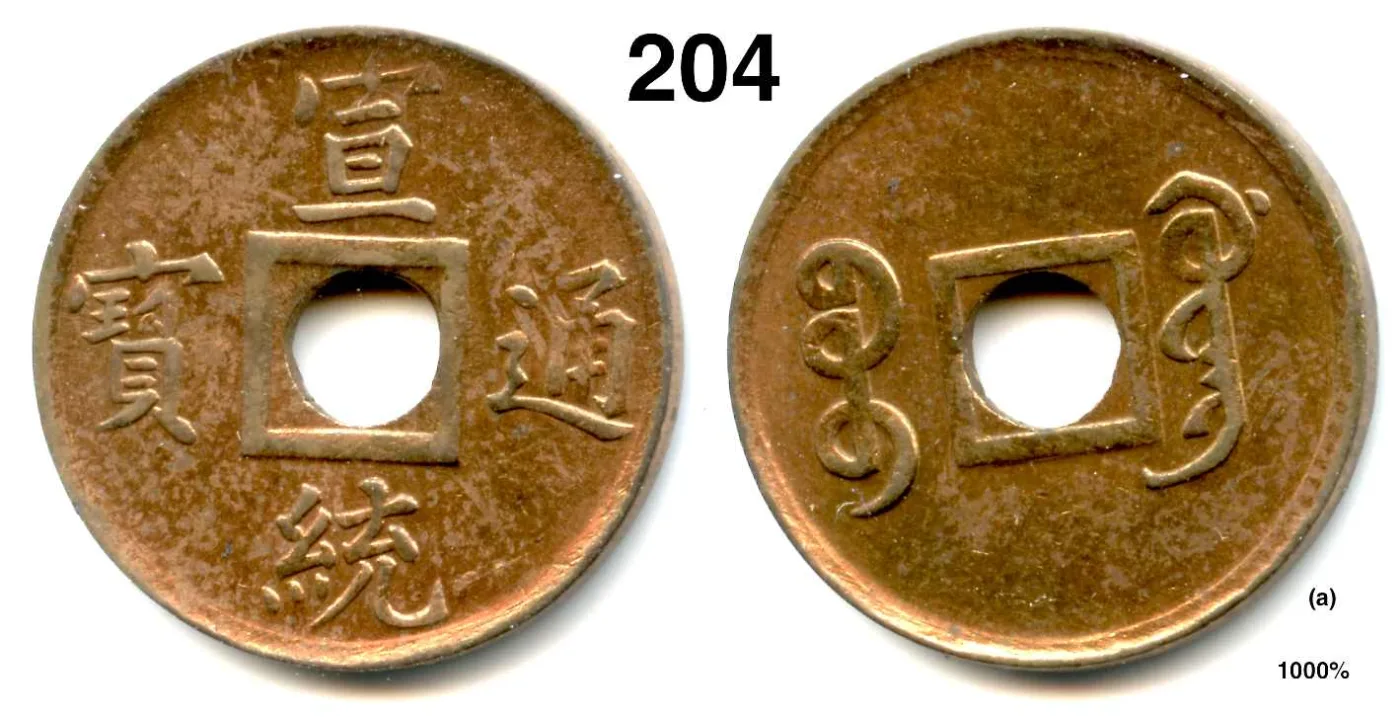
Almost every cash coin from AD 621 onward carries four characters arranged around the square hole. They are read in a fixed and slightly counterintuitive order: top first, then bottom, then right, then left. Not clockwise. Not left to right. Memorize that order and half the work is done.
A minority of coins — notably some Song dynasty issues — read clockwise instead, but for Qing coins, which is what you will almost certainly have, top-bottom-right-left is the rule.
What Each Position Means
The first two characters (top and bottom) give the reign title — the nian hao, or era name, chosen by the emperor. The last two characters (right and left) are almost always tong bao (通寶), meaning “circulating treasure.” So a coin reading Qian / Long / Tong / Bao is a “Qianlong circulating treasure” — a coin of the Qianlong reign. That is the entire formula, and it holds for the overwhelming majority of coins you will see.
Tong Bao, Yuan Bao, Zhong Bao
The two trailing characters vary slightly and the variation is meaningful. Tong bao (通寶, “circulating treasure”) is the standard and indicates a normal one-cash coin. Yuan bao (元寶, “primary treasure”) and zhong bao (重寶, “heavy treasure”) indicate higher-denomination coins, generally from crisis periods. If your coin reads zhong bao rather than tong bao, look at its size: it is probably a multiple-cash piece and potentially more interesting than a standard coin.
Script Styles
The same inscription can appear in different calligraphic styles — regular script (kaishu), seal script (zhuanshu), running script, and clerical script. Song dynasty coins are famous for “matched pairs” issued with identical inscriptions in two different scripts. Seal script is the most visually alien to Western eyes: highly stylized, symmetrical, and archaic-looking. If your characters look like abstract geometry rather than recognizable Chinese writing, you are probably looking at seal script, and often at an earlier coin.
Reign Titles and How to Date a Cash Coin
Chinese coins carry no year. Dating them means identifying the reign title and looking up its dates. Because most surviving cash is Qing dynasty, learning the ten Qing reign titles covers the great majority of coins in circulation today.
The Ten Qing Reign Titles
These are the reign titles that appear on the top and bottom characters of Qing cash coins, in chronological order, with the years each reign covered:
- Shunzhi (順治) — 1644–1661. The first Qing reign; several distinct sub-types as the new dynasty settled its coinage.
- Kangxi (康熙) — 1662–1722. Extremely common; famous for the “twenty mints” poem described below.
- Yongzheng (雍正) — 1723–1735. A short reign with relatively few mints, so scarcer than its neighbors.
- Qianlong (乾隆) — 1736–1795. The most common cash coin in existence; a 60-year reign with enormous output.
- Jiaqing (嘉慶) — 1796–1820. Common.
- Daoguang (道光) — 1821–1850. Common; quality begins to decline.
- Xianfeng (咸豐) — 1851–1861. The crisis reign; huge range of denominations and sizes.
- Tongzhi (同治) — 1862–1874. Often small, thin, and crudely cast.
- Guangxu (光緒) — 1875–1908. The last major cast issues; also the name on most dragon dollars.
- Xuantong (宣統) — 1909–1911. The final emperor, Puyi; brief and comparatively scarce in cast cash.
An Important Caution About Dating
A reign title tells you the earliest possible date, not the exact date. Cash coins of a popular reign were often cast for decades after that emperor died, and later dynasties deliberately imitated respected earlier coinage. Qianlong-style coins, in particular, were still being produced long after 1795, and were copied in Vietnam, Korea, and Japan. So “Qianlong Tong Bao” reliably means “1736 or later,” and usually means an eighteenth- or nineteenth-century coin, but it does not by itself prove the coin was cast during Qianlong’s lifetime.
Non-Chinese Coins in the Same Format
Japan, Korea, Vietnam, and the Ryukyu Kingdom all used the same square-hole format with four Chinese characters. A very common “Chinese” coin found in the West is actually the Japanese Kan’ei Tsuho (寛永通寳), cast in enormous numbers from 1626 into the 1860s. If your coin’s reign title does not match any Chinese reign, check the Japanese and Vietnamese lists — and the Korean Sangpyeong Tongbo, whose four characters never change across 259 years of casting — before concluding you have a rarity.
Manchu Mint Marks on the Reverse
Flip a Qing cash coin over and you will usually find two characters in an unfamiliar vertical script running down each side of the hole. This is Manchu, the language of the ruling dynasty, and it identifies the mint. This is the second key to attribution after the reign title.
How to Recognize Manchu
Manchu script is written vertically and looks nothing like Chinese: it flows as a continuous wavy vertical stroke with small hooks, dots, and loops branching off it. Chinese characters are boxy and discrete; Manchu is cursive and connected. If the reverse of your coin has two squiggly vertical marks rather than two boxy characters, it is a Qing coin with Manchu mint marks.
The Two Central Mints
The two most common mint marks by an enormous margin are the two Beijing metropolitan mints, both established in 1644:
- Boo-chiowan (寶泉) — the mint of the Board of Revenue. The single most common mint mark on Qing cash.
- Boo-yuwan (寶源) — the mint of the Board of Works, also in Beijing. The second most common.
The left-hand Manchu word on both is boo, meaning “treasure” — it is the equivalent of the Chinese character 寶 and appears on essentially every Qing provincial coin. The right-hand word is the mint’s own name. So in practice you are only ever reading one word, and there are a manageable number of possibilities.
Provincial Mints
Beyond Beijing, each province operated its own mint with its own Manchu name: Boo-je (Zhili), Boo-yuwan variants, Boo-su (Jiangsu), Boo-jiy (Shanxi), Boo-gung (Fujian), Boo-guwang (Guangdong), Boo-yun (Yunnan), and many more. Provincial coins are generally scarcer than the Beijing issues, and some province-and-reign combinations are genuinely rare. Xinjiang mints add a third script, using Manchu on one side of the hole and Uyghur/Turki on the other — these “red cash” coins, cast in a distinctive high-copper red alloy, are a specialty area in their own right.
The Kangxi Twenty-Mint Poem
Kangxi-era coins from provincial mints carry a single Chinese character on the reverse (not Manchu) naming the mint. Collectors traditionally memorize these twenty characters as a rhyming poem — 同福臨東江宣原蘇薊昌南河寧廣浙台桂陝雲 — and assembling a complete twenty-coin set is one of the classic beginner projects in Chinese numismatics. The set is affordable except for the last two or three mints, which are genuinely scarce and are consequently the most-faked cash coins on the market.
Ancient Chinese Coins: Spades, Knives, and Wu Zhu
Pre-Tang Chinese money is a smaller field but an important one to recognize, if only because so much of what circulates today is fake.
Spade and Knife Money
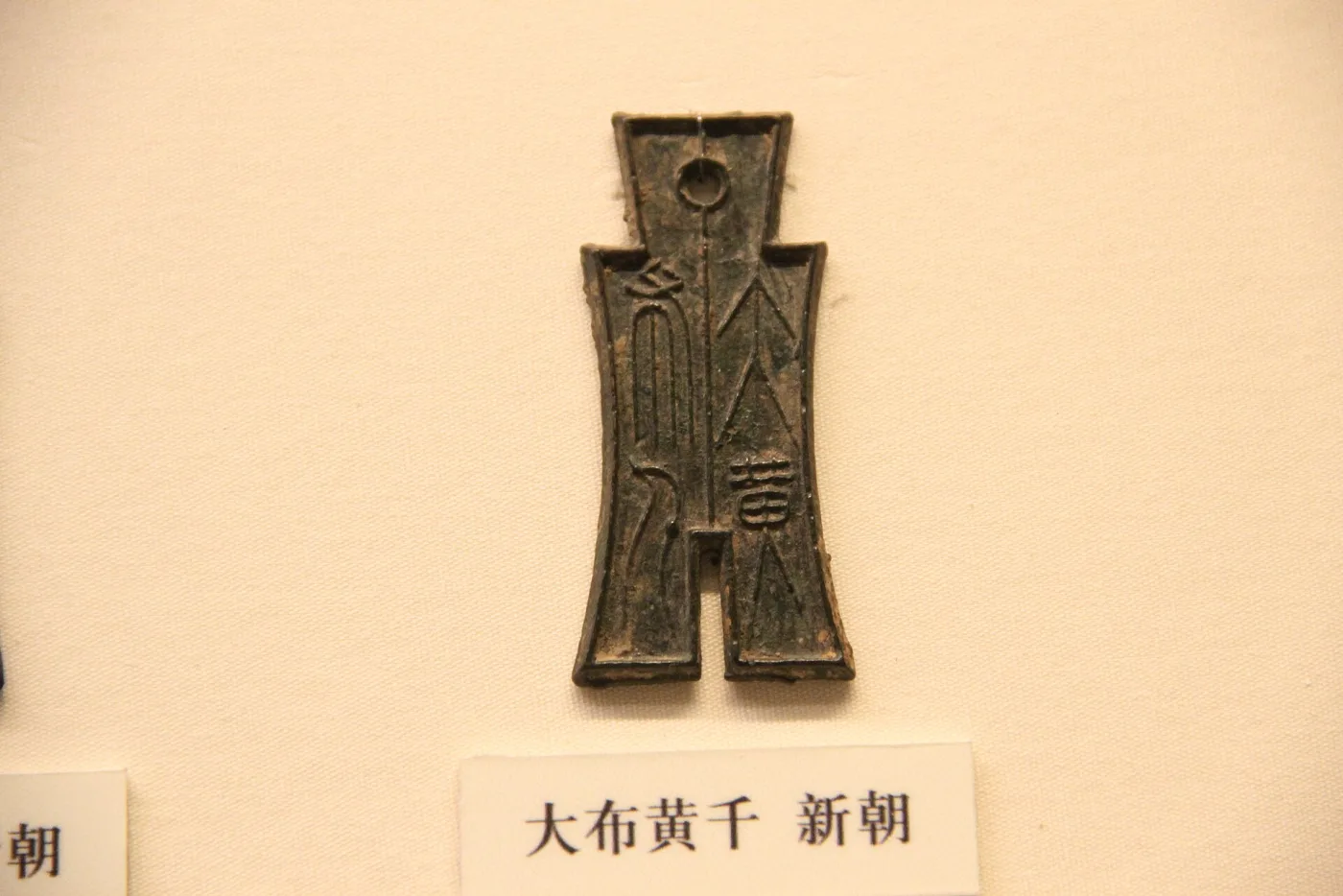
From roughly the seventh to third centuries BC, the states of the Zhou realm issued bronze money shaped like tools. Spade money resembles a flat agricultural blade with a hollow or flat handle, often 5–10 cm long. Knife money resembles a curved blade with a ring at the end of the handle, typically 13–18 cm long. Both carry inscriptions naming the issuing city or a weight. Genuine examples are heavily corroded, structurally thin, and often fragmentary, and they are expensive. The polished, chunky, evenly patinated spades and knives sold in tourist markets and online in quantity are, essentially without exception, modern reproductions.
Ban Liang and Wu Zhu
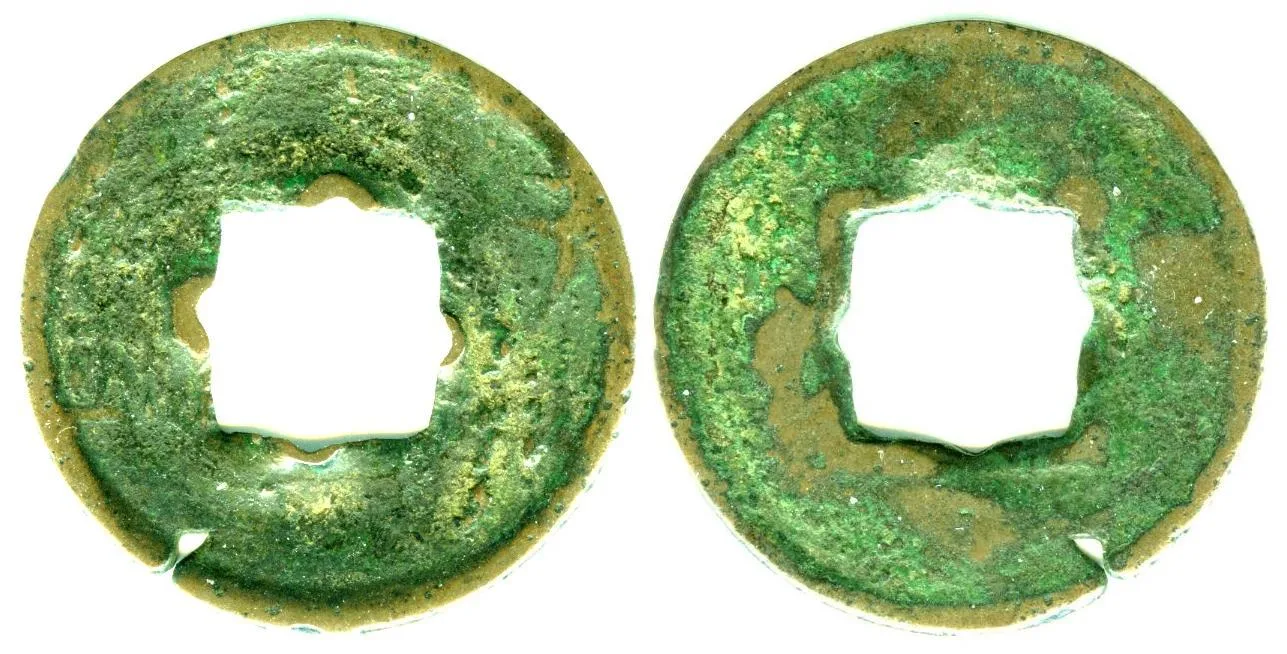
The ban liang (半兩, “half ounce”) is China’s first unified coin, introduced under the Qin in 221 BC and continuing under the early Han. It has two characters and no rim — the flan edge is plain. The wu zhu (五銖, “five grains”) replaced it in 118 BC and ran with interruptions until AD 621, making it the longest-lived coin denomination in world history.
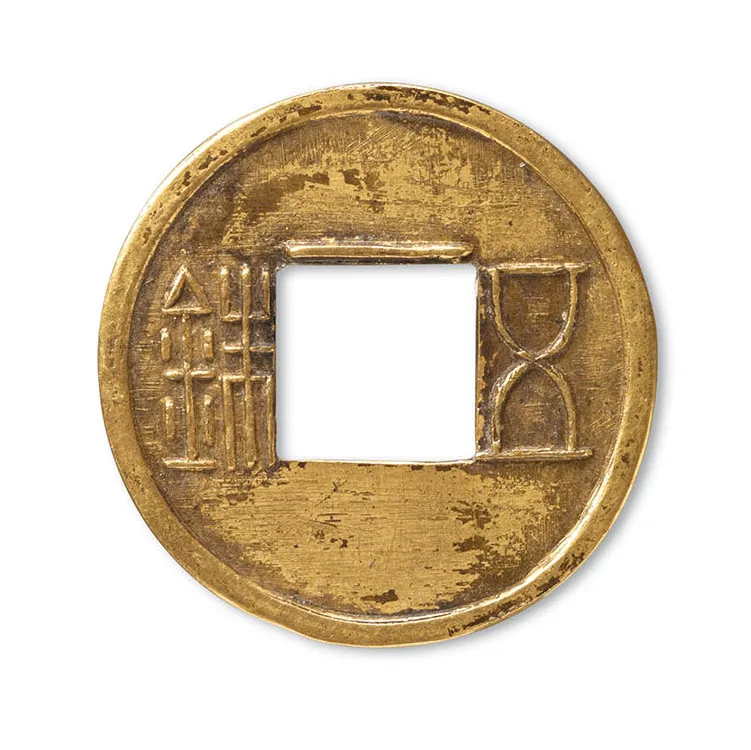
Wu zhu coins have a raised rim on the reverse and generally on the obverse, and are usually 25 mm and 3–4 grams. Both are two-character coins — if your square-hole coin has only two characters rather than four, this is where to look.
Wang Mang and the Collector’s Favorites
The brief Xin dynasty of the usurper Wang Mang (AD 9–23) produced some of the most beautiful and sought-after coinage in Chinese history, including elegant spade-shaped pieces and the famous “knife coin” with gold-inlaid characters. These are genuinely rare, genuinely valuable, and correspondingly the most enthusiastically counterfeited ancient Chinese coins. Treat any Wang Mang piece offered outside a major auction house as suspect until proven otherwise.
The Xianfeng Inflation and Large-Denomination Cash
If you have a Chinese cash coin that is noticeably large — 35 mm, 45 mm, even 60 mm across — you are almost certainly holding a Xianfeng-era piece, and it deserves separate attention.
Why the Big Coins Exist
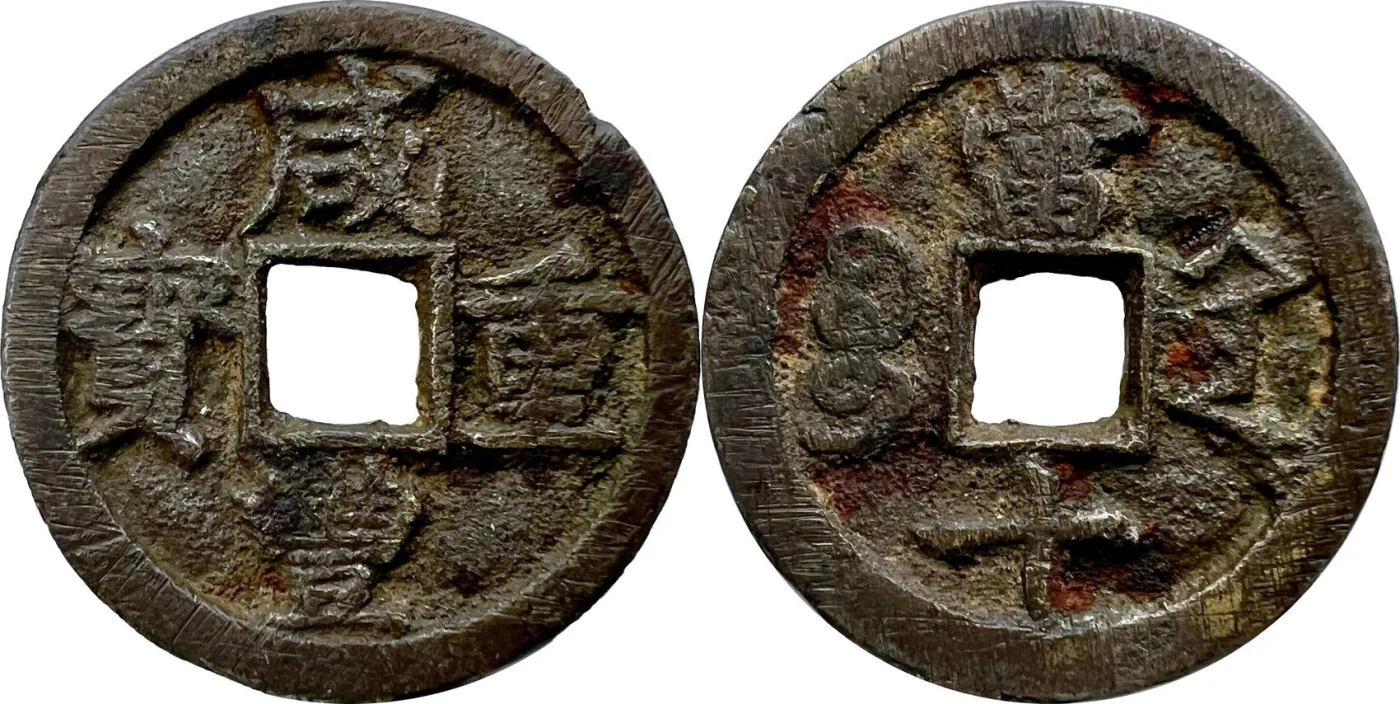
The Xianfeng reign (1851–1861) collided with the Taiping Rebellion, one of the deadliest civil wars in history, at the same moment that the empire was paying indemnities after the Opium Wars. The treasury responded the way governments always do: it debased the currency. Starting in 1853, mints issued cash coins with face values of 4, 5, 8, 10, 20, 30, 40, 50, 100, 200, 500, and 1,000 cash — while making them only slightly larger than a one-cash coin. The public rejected them, and most were withdrawn within a few years.
How to Read the Denomination
Large Xianfeng coins carry the denomination on the reverse in Chinese characters flanking the Manchu mint name, reading dang (當, “value”) followed by the number: dang shi (當十) is value ten, dang wu shi (當五十) is value fifty, dang bai (當百) is value one hundred, dang qian (當千) is value one thousand. The obverse will read Xianfeng Zhong Bao (heavy treasure) or Xianfeng Yuan Bao (primary treasure) rather than the usual tong bao, which is your first clue before you even turn the coin over.
Collector Interest
Xianfeng large cash is one of the most actively collected areas of Chinese cast coinage, precisely because the combination of mint, denomination, and metal produces hundreds of distinct varieties, many genuinely scarce. It is also, unfortunately, an area where fakes are abundant, because a fake large coin is worth far more than a fake small one.
Dragon Dollars: The Machine-Struck Silver Era
The most valuable Chinese coins most collectors will ever handle are the silver dollars of the late Qing and early Republic. The imperial ones are known universally as dragon dollars.
Why China Adopted the Dollar
For centuries China had no large silver coin of its own. Big-value silver moved as sycee — cast ingots, often boat-shaped, valued strictly by weight and purity. Foreign trade filled the gap: the Spanish colonial eight reales and its successor the Mexican peso circulated widely in the treaty ports, and the United States even created a coin specifically to compete for that business, the US Trade Dollar of 1873–1885. In 1889 Guangdong province ended the dependency by installing machinery from the Birmingham firm of Ralph Heaton & Sons and striking its own silver dollar to the same standard.
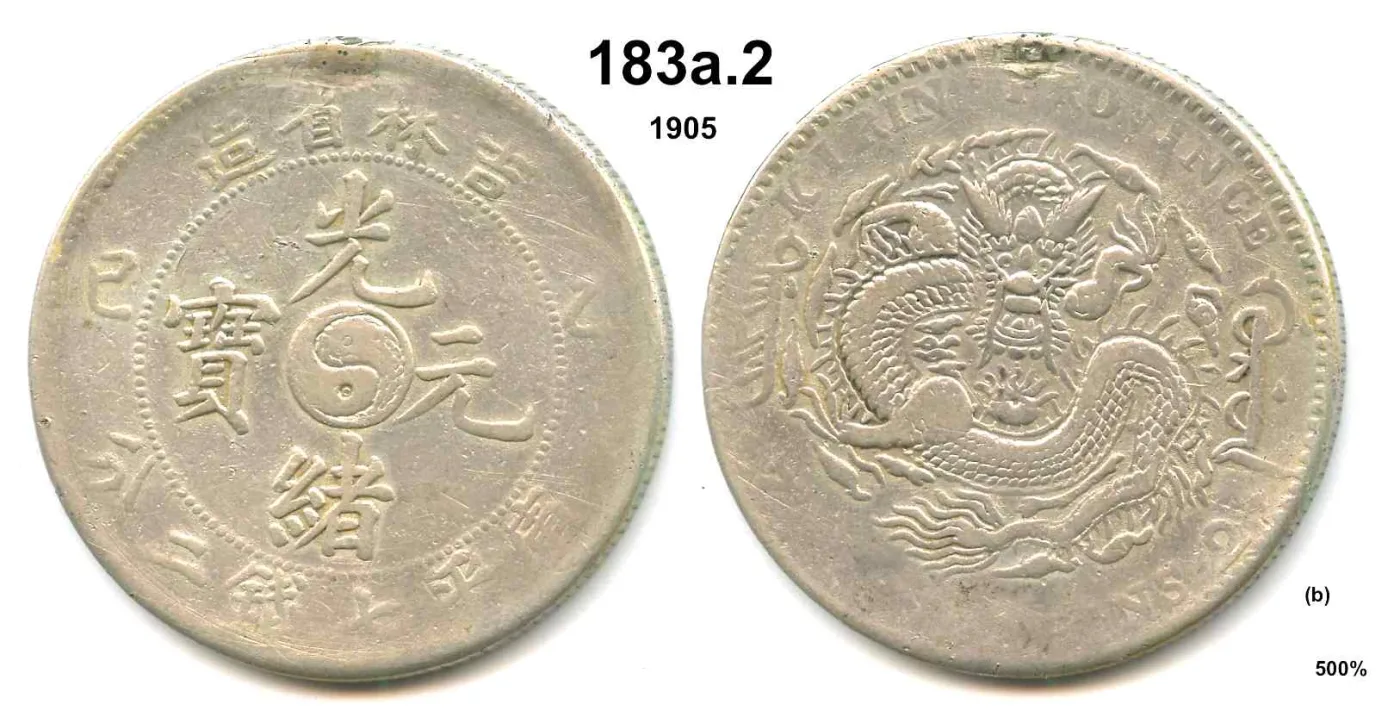
What a Dragon Dollar Looks Like
The formula spread quickly to other provinces and was strikingly consistent. One side carries a four-character reign legend (usually Guangxu Yuan Bao) with the province name in Chinese around the rim and the weight expressed in Chinese units. The other side carries a coiled dragon — the imperial emblem — encircled by the province name and denomination in English. That English lettering is a gift to Western collectors: a coin reading “KWANG-TUNG PROVINCE — 7 MACE AND 2 CANDAREENS” tells you the province and the weight without any Chinese at all.
Weight and Silver Content
7 mace 2 candareens (七錢二分) is the standard dollar weight: about 26.7 grams at roughly .900 fineness, or approximately 0.77 troy ounces of pure silver — deliberately matched to the Mexican peso so the coins would trade interchangeably. Subsidiary denominations follow the same scale: 3 mace 6 candareens (half dollar), 1 mace 4.4 candareens (20 cents), 7.2 candareens (10 cents), and 3.6 candareens (5 cents). If a “dragon dollar” weighs meaningfully less than 26 grams, that is a serious warning sign.
Provincial Varieties and Values
Nearly twenty provinces struck dragon dollars, and value varies enormously between them. Common Kwangtung and Hupeh dollars in circulated grades are the entry point to the series. Scarce provinces, short-lived types, and pattern issues run far higher, and the great rarities — certain Fengtien, Kirin, and central-government patterns — are seven-figure coins. Because the price spread within a superficially similar-looking series is so extreme, provincial attribution matters more here than in almost any other world series.
Republic Silver: Fat Man and Junk Dollars
The 1911 revolution ended the dragon dollar but not the silver dollar. Republic-era silver is more standardized, more available, and for most collectors the practical way into Chinese silver.
The Fat Man Dollar
In 1914 the new Republic issued a national silver dollar bearing the bald, heavy-jawed profile of president Yuan Shikai — a portrait that earned the coin its enduring English nickname, the Fat Man dollar. The reverse shows two crossed rice or wheat sprays with the denomination between them. Specifications are 26.4 grams at .890 fineness, about 0.755 troy ounces of pure silver.
The date appears as a Republic year, not a Western year, written in Chinese numerals in the obverse legend. Year 3 is 1914 — add 1911 to the Republic year to get the Western year, so Year 8 is 1919, Year 9 is 1920, and Year 10 is 1921. Those four years (3, 8, 9, 10) account for the overwhelming majority of Fat Man dollars, with Year 3 by far the most common. Hundreds of millions were struck, which is why this is the Chinese silver dollar most likely to turn up in a Western estate.
The Junk Dollar
From 1932 the Fat Man gave way to the junk dollar, showing the profile of Sun Yat-sen on one side and a Chinese sailing junk on the other. The 1932 (Year 21) issue adds a rising sun and three flying birds above the junk; the birds were dropped for the far more common 1933 and 1934 (Years 22 and 23) issues, reportedly because they were read as resembling Japanese aircraft during a period of Japanese aggression. Junk dollars weigh 26.7 grams at .880 fineness. The Year 21 with birds is much scarcer than the plain Years 22 and 23.
The Counterfeiting Problem
Fat Man and junk dollars are the most heavily counterfeited world coins in existence, full stop. They are produced today in vast quantities, in correct-weight silver as well as in base metal, and the better ones are genuinely deceptive. Because the coins are common, the sensible rule is simple: for anything beyond bullion-grade interest, buy certified. The same discipline applied to detecting counterfeit coins in US series applies here with the volume dialed up considerably.
Modern China: Renminbi Circulation Coins
Modern Chinese circulation coins turn up constantly in travelers’ change and inherited coin jars. They are almost never valuable, but they are easy to identify once you know the system.
The Three Units
The renminbi is divided into yuan (元), jiao (角, one tenth of a yuan), and fen (分, one hundredth). Circulating coins are 1 fen, 2 fen, 5 fen (small aluminum coins, largely obsolete), 1 jiao, 5 jiao, and 1 yuan. All carry a Western-numeral date, which makes them the easiest Chinese coins to identify: if your coin shows “1985” or “2003” in Arabic numerals, it is a modern circulation piece.
What They Are Worth
Essentially face value. The exceptions are early aluminum fen coins in uncirculated condition, a handful of low-mintage years issued only in mint sets rather than for circulation, and the 1980–1986 sets. These carry modest premiums among specialists but nothing dramatic. A modern Chinese circulation coin found in change is a curiosity, not a windfall.
Modern Commemoratives
China issues a steady stream of base-metal commemorative yuan for anniversaries, zodiac years, and events. These are legal tender, widely saved, and generally worth a small premium over face. They are distinct from the bullion program covered next.
Chinese Panda Bullion Coins
The Panda series is China’s flagship modern bullion coin and the one Chinese coin many Western collectors own without owning any other.
The Series
Gold Pandas launched in 1982, silver Pandas in 1983. The obverse always shows the Temple of Heaven in Beijing with the year; the reverse shows a giant panda in a new design every year — the defining feature of the series, and the reason it attracts date collectors rather than pure stackers. The only exception is 2001 and 2002, which share a design.
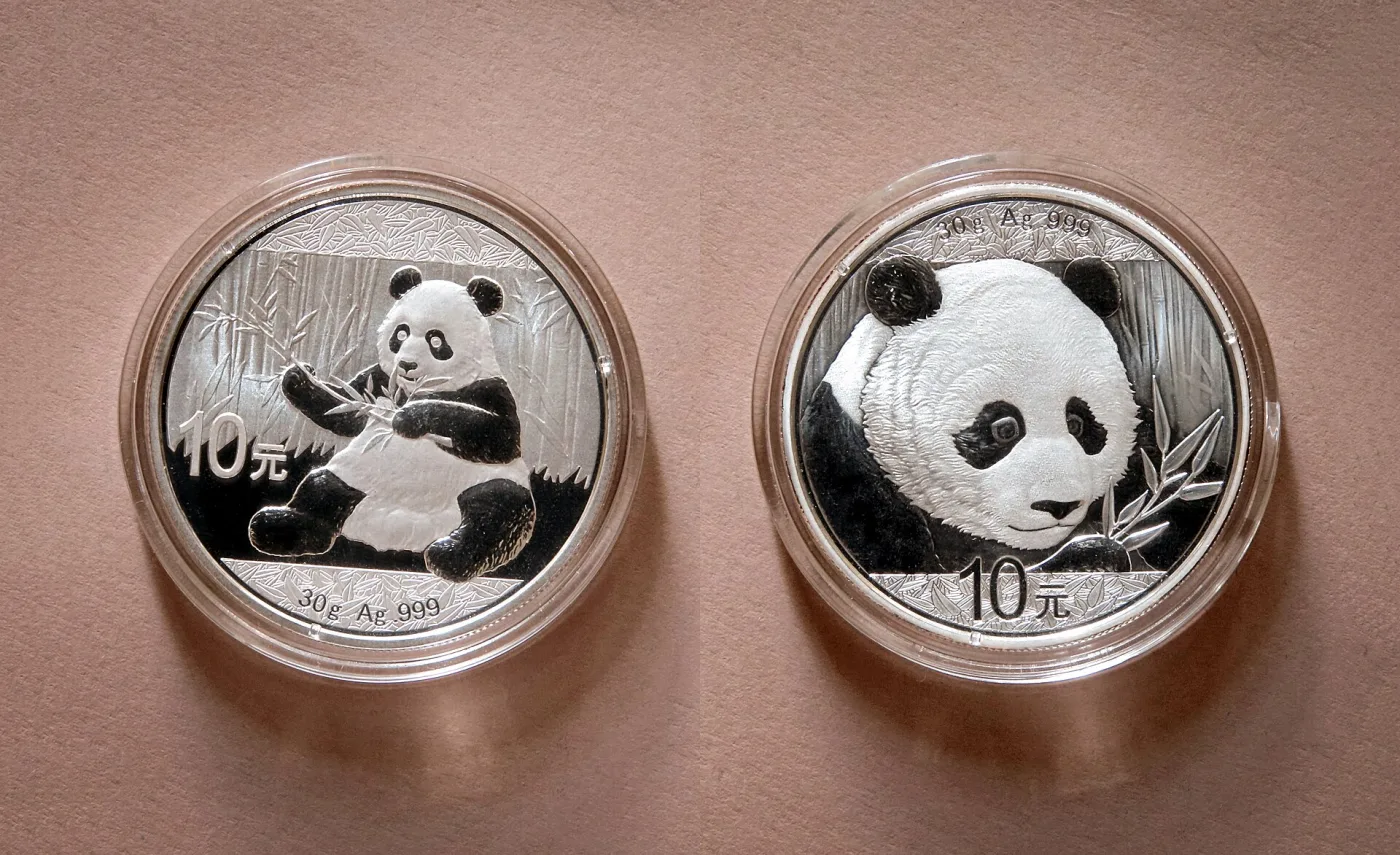
That annual change means individual dates develop their own premiums based on mintage and popularity, unlike the fixed-design American Silver Eagle.
The 2016 Metric Change
This trips up buyers constantly. Through 2015, silver Pandas were struck at one troy ounce (31.1 g) and gold Pandas at fractions of a troy ounce. From 2016 onward, China switched the whole program to metric: silver Pandas are 30 grams of .999 fine silver, and gold Pandas are 30 g, 15 g, 8 g, 3 g, and 1 g. A 2016-or-later silver Panda therefore contains slightly less silver than a one-ounce coin — about 96.5% as much — which matters when comparing prices against ounce-denominated bullion. The silver Panda carries a face value of 10 yuan.
Premiums and Key Dates
Silver Pandas generally trade at a premium over spot that is higher than most Western bullion coins, reflecting strong domestic Chinese demand. Early dates from the 1980s and 1990s, when mintages were tiny compared to today’s multi-million-coin runs, carry substantial numismatic premiums well above their metal content. The 1980s gold Pandas in particular are collected as rarities rather than bullion.
Counterfeits in the Bullion Series
Fake silver Pandas are common, including tungsten-cored and silver-plated pieces. Weight and dimension checks catch most of them, since counterfeiters rarely match both. Sealed original mint packaging and third-party certification are both worth paying for on anything above ordinary bullion value.
Chop Marks: Chinese Marks on Foreign Silver
One of the most common Chinese-related questions collectors ask is not about a Chinese coin at all: it is about the small Chinese characters punched into a Western or Latin American silver coin.
What a Chop Mark Is
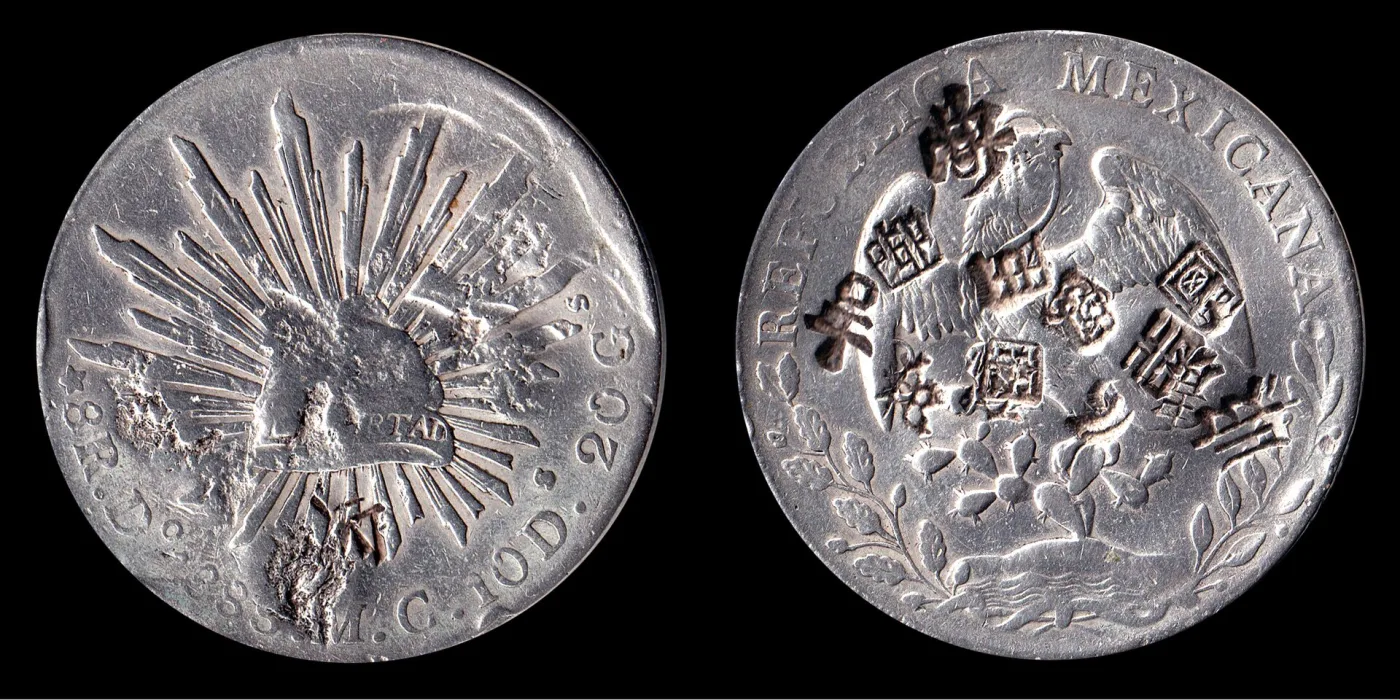
Chinese bankers and money changers did not accept foreign silver coins at face value. Each coin passing through a banking house was tested for silver content and then stamped with a small punch — a chop mark — identifying the house that had verified it. A coin that circulated for decades in the China trade may carry dozens of overlapping chops on both sides.
Which Coins Carry Them
Chop marks appear most often on Spanish colonial and Mexican eight reales, on US Trade Dollars, on British trade dollars, and on Japanese yen — the large silver coins that actually circulated in East Asian commerce. They are not damage in the ordinary sense; they are documentary evidence of a coin’s working life. On a US Trade Dollar or a piece of eight, chops typically reduce value modestly relative to an unchopped example of the same grade, but heavily and attractively chopped coins have their own dedicated collector base, and both PCGS and NGC now certify chop-marked coins with the chops noted rather than dismissing them as damage.
Fake Chops
Because chops attest to a coin’s history, they have been faked — sometimes to add romance to a genuine coin, sometimes to disguise a counterfeit’s soft details. Genuine chops displace metal, raising a small rim of pushed-up metal around the punch and disturbing the toning inside the impression in a way that matches the coin’s overall age. Chops that sit on top of the surface without displacement, or that show bright metal against an evenly toned field, are modern additions.
Charms and Amulets: The Most Common Mistake
More inherited “rare Chinese coins” turn out to be charms than turn out to be anything else. Recognizing them early saves a great deal of disappointment.
What Chinese Charms Are
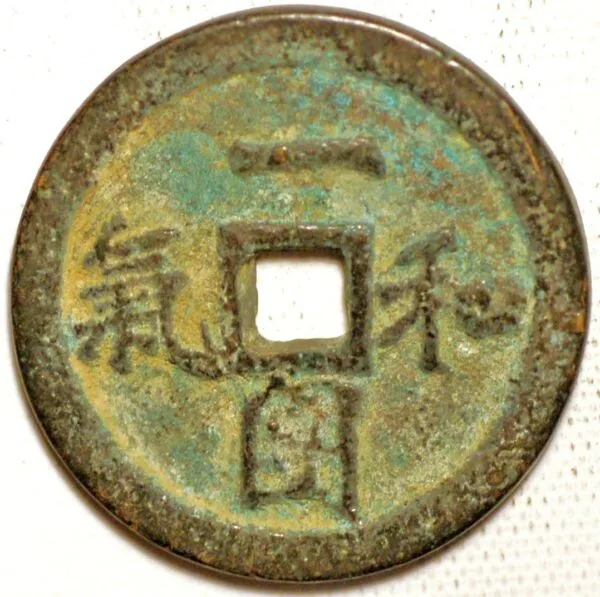
Chinese charms (yasheng qian) are coin-shaped bronze objects that were never money. They were cast for luck, protection, weddings, temple offerings, and gifts, and they have been made continuously for two thousand years — including, in large volume, right now. They imitate the round-with-square-hole form because that form was auspicious, not because they had any monetary function.
How to Tell a Charm from a Coin
- Pictures. Real cash coins carry characters, not images. If your piece shows dragons, phoenixes, zodiac animals, human figures, Bagua trigrams, swords, or the Big Dipper, it is a charm.
- Size and weight. Charms are often noticeably larger and heavier than the 24–25 mm, 3–5 g standard of a circulating cash coin.
- Auspicious phrases. Inscriptions meaning “long life and wealth,” “five sons pass the examinations,” or “peace under heaven” are charm inscriptions, not reign titles.
- Character count. Charms frequently carry more than four characters, or characters on both sides.
- Finish. Modern tourist charms are typically bright, heavy, evenly colored, and suspiciously clean, often with an artificial green “patina” applied in the recesses only.
Are Charms Worth Anything?
Genuine antique charms are legitimately collectible and some are valuable, particularly early or finely cast examples with documented types. But the great majority of charms encountered in the West are modern souvenirs worth a few dollars. The very large, elaborately decorated “coins” sold in tourist shops and inherited by the boxful fall into this category almost without exception.
Metal, Weight, and Size: What to Measure
Because Chinese coins carry no numerals, physical measurements do much of the identification work that a date would do elsewhere. Three numbers matter.
Diameter
The standard cash coin has been about 24–25 mm since AD 621. A coin meaningfully smaller (18–22 mm) is likely a late, debased Qing issue from the Tongzhi or Guangxu reigns, or a Vietnamese or private issue. A coin meaningfully larger (30 mm and up) is a multiple-denomination piece, probably Xianfeng, or a charm.
Weight
A standard cash coin runs 3–5 grams. A digital scale reading to 0.1 g is the single most useful tool in this field, and costs less than most single coins. For silver, weight is decisive: a dragon dollar should be near 26.7 g, a Fat Man dollar near 26.4 g, a junk dollar near 26.7 g. Counterfeits that get the design right very often miss the weight, because they are struck in base metal or in silver of the wrong fineness.
Metal and Patina
Genuine old bronze and brass develop patina that is part of the metal, not a coating: it grows from the surface, varies naturally across the coin, sits in high points as well as recesses, and cannot be rubbed off. Artificial patina on reproductions is applied, sits only in the recesses, appears uniformly green or black, and often flakes or wipes away at an edge. Resist the urge to clean either one — as with every other series, cleaning a coin destroys value, and on cast bronze it can strip surface detail permanently.
The Ring Test, and Why It Is Unreliable Here
Collectors of Western silver often rely on the “ping” of a dropped coin. It works reasonably well on struck silver dollars, including Fat Man and dragon dollars. It is close to useless on cast cash coins, whose porous structure damps the sound regardless of authenticity. Do not treat a dull sound on a cash coin as evidence of anything.
Step-by-Step Identification Workflow
Put the pieces together and identifying an unknown Chinese coin becomes a short, orderly process.
Step 1: Struck or Cast?
Look at the edge and the character edges under magnification. Cast (soft edges, grainy surface, file marks on the rim, a seam) means you are in the cash-coin world and the coin dates before roughly 1900. Struck (sharp detail, crisp rim, reeded or plain machine edge) means the modern era: dragon dollar, Republic silver, renminbi, or Panda.
Step 2: Round Hole, Square Hole, or No Hole?
A square hole means cash coinage. No hole with a tool shape means pre-imperial money or a reproduction of it. No hole and round means the machine-struck era. A round hole is unusual and points toward certain provincial issues or, more often, a charm or a Japanese or Korean piece.
Step 3: Count the Characters
Two characters on a square-hole coin points to ban liang or wu zhu — the early imperial era. Four characters points to the classic cash era. More than four, or any pictorial element, points to a charm.
Step 4: Read Top, Bottom, Right, Left
Take the first two characters as the reign title and match them against the Qing list above, then against the broader dynastic lists if there is no match. Confirm the last two read tong bao, yuan bao, or zhong bao. You now have an era and often an emperor.
Step 5: Turn It Over
Manchu script means Qing dynasty and gives you the mint. A single Chinese character on a Kangxi coin gives you the mint from the twenty-mint list. Denomination characters (dang shi and friends) mean a Xianfeng-era multiple. A blank reverse is common on earlier and on Vietnamese issues.
Step 6: Measure and Weigh
Confirm the coin’s diameter and weight fit the type you have identified. Mismatches are the most reliable early warning of a reproduction.
Step 7: Look It Up
Match your reading against a catalog. For cast coins that means Hartill; for machine-struck silver it means L&M and Krause numbers. Both are described in the references section below.
What Chinese Coins Are Worth in 2026
Values in Chinese numismatics span a wider range than in any other national series — from pocket change to seven figures — so realistic expectations matter. All figures below are broad 2026 retail ranges for genuine examples, not offers.
Common Cash Coins
The great majority of cash coins found in Western households are common Qing issues — Qianlong, Jiaqing, Daoguang, Guangxu, Tongzhi — from the two Beijing mints. In average circulated condition these are $1 to $5 each, and often sold in bulk lots at well under a dollar apiece. Kangxi coins run slightly higher, roughly $3 to $15 depending on mint. This is not disappointing news so much as good news: it means anyone can own real two-hundred-year-old coins.
Scarcer Cast Coins
Scarce provincial mints, early Shunzhi types, Xianfeng large denominations, Xinjiang red cash, and well-preserved pre-Qing issues run from $25 into the hundreds. Genuine ancient pieces — authentic spade and knife money, Wang Mang rarities, choice wu zhu — range from tens of dollars into five figures for the best material.
Republic and Imperial Silver
A common Fat Man dollar (Year 3, 8, 9, or 10) in circulated grades runs roughly $45 to $130, with uncirculated examples of common dates several times that. Common junk dollars are similar. Common Kwangtung and Hupeh dragon dollars in circulated grades begin around $200 to $600, with better provinces and higher grades climbing quickly into the thousands. Scarce provinces, patterns, and top-population coins reach five, six, and in a handful of cases seven figures.
Pandas and Modern Issues
Current silver Pandas track bullion plus a premium; recent 30 g issues have generally run in the $95 to $130 range depending on spot silver and dealer. Early-date silver Pandas from the 1980s and 1990s carry numismatic premiums from modest to substantial. Modern renminbi circulation coins are worth face value.
What Drives Value
For cast coins: rarity of the mint-and-reign combination, casting quality, and completeness of the characters. For machine-struck silver: province, date, variety, grade, and certification. Condition matters far less on cash coins than on silver — a worn but clearly legible Qianlong cash is a normal collectible, whereas a worn dragon dollar loses value quickly. The same broad principles set out in our coin grading guide apply, with the caveat that cast coinage is judged on legibility and surface quality rather than on high-point wear.
Counterfeits and How to Avoid Them
There is no polite way around this: Chinese numismatics has the worst counterfeit problem of any collecting field. Understanding the shape of the problem is what makes the field safe to enter.
Why the Problem Is So Large
Three factors compound. Cast coinage is inherently easy to reproduce — a mold taken from a genuine coin produces a convincing copy with equipment available anywhere. Demand inside China has grown enormously, creating a large and profitable market. And enormous quantities of genuine common coins circulate alongside fakes, which normalizes buying unattributed coins in bulk from unverified sellers.
Diagnostics for Cast Cash Coins
- Character sharpness. A mold taken from an existing coin loses detail. Fakes show mushy, slightly shrunken characters compared to genuine examples of the same type.
- Size. Cast copies shrink as the metal cools. A copy of a copy is measurably smaller than the original type standard.
- Surface. Modern casts often show tiny uniform bubbles or an unnaturally smooth, soapy surface texture.
- Patina. Applied patina concentrates in recesses, has a uniform color, and can be lifted at an edge with a wooden pick.
- Weight. Modern brass alloys differ from historical ones. Consistent weight deviation from the type standard is a red flag.
- Suspiciously good. Genuinely rare cash coins in perfect condition offered cheaply, in quantity, or in matched sets are the classic profile of a fake.
Diagnostics for Silver
For dragon, Fat Man, and junk dollars, check weight and diameter first, then edge reeding (counterfeits frequently show irregular, weak, or wrong-count reeds), then the fine detail in the dragon’s scales or the portrait’s hair. Magnet response is an instant disqualifier — silver is not magnetic. Specific gravity testing is decisive and non-destructive if you have a scale and a cup of water.
The Practical Rule
Buy cheap common cash coins freely; the downside is a few dollars. For anything above roughly $100 — any silver dollar, any claimed rarity, any ancient piece — buy it already certified by a major service, or buy from a dealer who will guarantee authenticity in writing and take a return. This is the same discipline the market has developed around every heavily faked series, and in Chinese coins it is not optional.
Grading and Certification
Third-party grading arrived late to Chinese coins but is now central to the market, especially for silver.
Grading Machine-Struck Coins
Dragon dollars, Republic silver, and Pandas are graded on the standard 70-point Sheldon scale by PCGS and NGC exactly as US coins are. Both services operate in Asia and both have specific expertise in Chinese series. For silver, certification is close to a requirement above modest values: the price difference between a certified and a raw dragon dollar reflects real authentication risk, not just marketing. Our overview of third-party grading services covers how the major services compare.
Grading Cast Coins
Cash coins are a different problem. They were never uniform to begin with, so wear-based grading makes limited sense; what matters is casting quality, completeness and clarity of the characters, surface condition, and whether the patina is original. NGC now accepts Chinese cash coins for certification, grading them in a way that accounts for casting quality alongside preservation. For common coins worth a few dollars this is uneconomic, but for scarce mints and Xianfeng rarities it has become standard.
Problem Coins
Cleaned, tooled, holed, and repaired coins are common in this field. Cash coins were routinely used as decorations and were drilled, filed, and mounted; a coin with a modern hole through the rim (as opposed to the original square hole) has lost most of its value. Recut characters — where a weak coin has been sharpened by hand to imitate a better one or a rarer type — are a specific hazard in cash coins and a common way a common coin becomes a fake rarity.
References and Online Tools
Chinese numismatics rewards reference books more than most fields, because the identification problem is fundamentally a lookup problem.
Standard Catalogs
David Hartill’s Cast Chinese Coins is the standard English-language reference for the entire cast series, and “Hartill numbers” are the common currency of attribution among Western collectors. His companion volumes cover Qing coinage and ancient issues in more depth. For machine-struck silver, the L&M numbers from Lin Gwo Ming’s catalog of Chinese silver are the standard citation, alongside Krause’s Standard Catalog of World Coins for general coverage.
Online Resources
Numista carries a large and well-photographed Chinese section with weights, diameters, and mintages. Zeno.ru hosts a deep oriental-coin database that is particularly strong on cash coins and Central Asian issues. Both PCGS and NGC publish online price guides and certification lookups covering Chinese series, and NGC’s census data is useful for judging the rarity of certified silver.
Museums and Collections
The British Museum holds one of the world’s great East Asian numismatic collections, much of it photographed online. The American Numismatic Society and the Shanghai Museum both hold major Chinese holdings with accessible catalogs. For comparison images of genuine coins — which is what fake-spotting ultimately depends on — museum photography is the most reliable free resource available.
Frequently Asked Questions
What is the Chinese coin with a square hole in the middle worth?
Usually a few dollars. The overwhelming majority of square-hole coins found outside China are common Qing dynasty cash from the eighteenth or nineteenth century, worth roughly $1 to $5 in average condition. Value rises with scarce mints, unusual reign titles, large denominations, and pre-Qing dates.
How do I find the date on a Chinese coin?
Old Chinese coins carry no date. Instead they carry a reign title — the first two of the four characters — which tells you the emperor and therefore a date range. Only modern coins from 1889 onward carry actual dates, either as a Republic year (add 1911 for the Western year) or as a Western numeral on renminbi and Panda issues.
Why do Chinese coins have a hole?
For manufacturing and for handling. The square hole let mint workers stack coins on a square rod to file the rims in bulk, and it let users string large numbers of low-value coins on a cord. The round-coin-square-hole shape also carried cosmological symbolism — a round heaven over a square earth.
Are old Chinese coins made of real gold or silver?
Circulating cash coins never were — they are bronze or brass. Silver appears in Chinese money as cast sycee ingots and, from 1889, as machine-struck dollars. A gold or silver piece in cash-coin shape is a charm, a presentation piece, or a modern fantasy item, not a circulating coin.
What is a Fat Man dollar?
The English nickname for the Chinese silver dollar of 1914–1921 bearing the portrait of president Yuan Shikai. It weighs 26.4 grams at .890 fine silver. It is the most commonly encountered Chinese silver dollar and also one of the most counterfeited coins in the world.
How can I tell if my Chinese coin is a fake?
Weigh it and measure it first — most fakes miss the type standard. Then examine the character sharpness, the surface texture, and the patina under magnification: cast copies show shrunken, mushy characters and applied rather than grown patina. For any coin worth more than about $100, professional authentication is the only reliable answer.
Is my large decorative Chinese coin with a dragon on it valuable?
Almost certainly not. Large coin-shaped bronze pieces with dragons, zodiac animals, or human figures are charms rather than coins, and the great majority sold in the West are modern souvenirs worth a few dollars. Genuine antique charms exist and some are valuable, but they are a small minority of what circulates.
Are Chinese Panda coins a good buy?
As bullion, they carry higher premiums than most Western equivalents, so they are less efficient for pure metal accumulation. As collectibles, the annually changing design gives them a genuine numismatic dimension that fixed-design bullion lacks, and early dates have appreciated well beyond metal value. Buy them for the series, not purely for the silver.
Should I clean my old Chinese coins?
No. Patina on bronze and brass is part of the coin's surface and its removal is permanent and obvious to any experienced buyer. Cleaning routinely destroys 50% or more of a coin's value and can strip cast detail outright. Dirt can be removed with distilled water and a soft brush; nothing stronger belongs anywhere near an old coin.
Where do all these coins in America come from?
Several routes. Chinese laborers and merchants carried cash coins to the American West during the nineteenth century. Servicemen brought coins back from the Pacific theater and later deployments. Coins were imported by the ton as curios, decorations, and feng shui items throughout the twentieth century. And Chinese coins circulated across Southeast Asia for centuries, so they arrive from many directions at once.