Spanish Colonial Reales Identification Guide: How to Read, Date, and Value Pieces of Eight
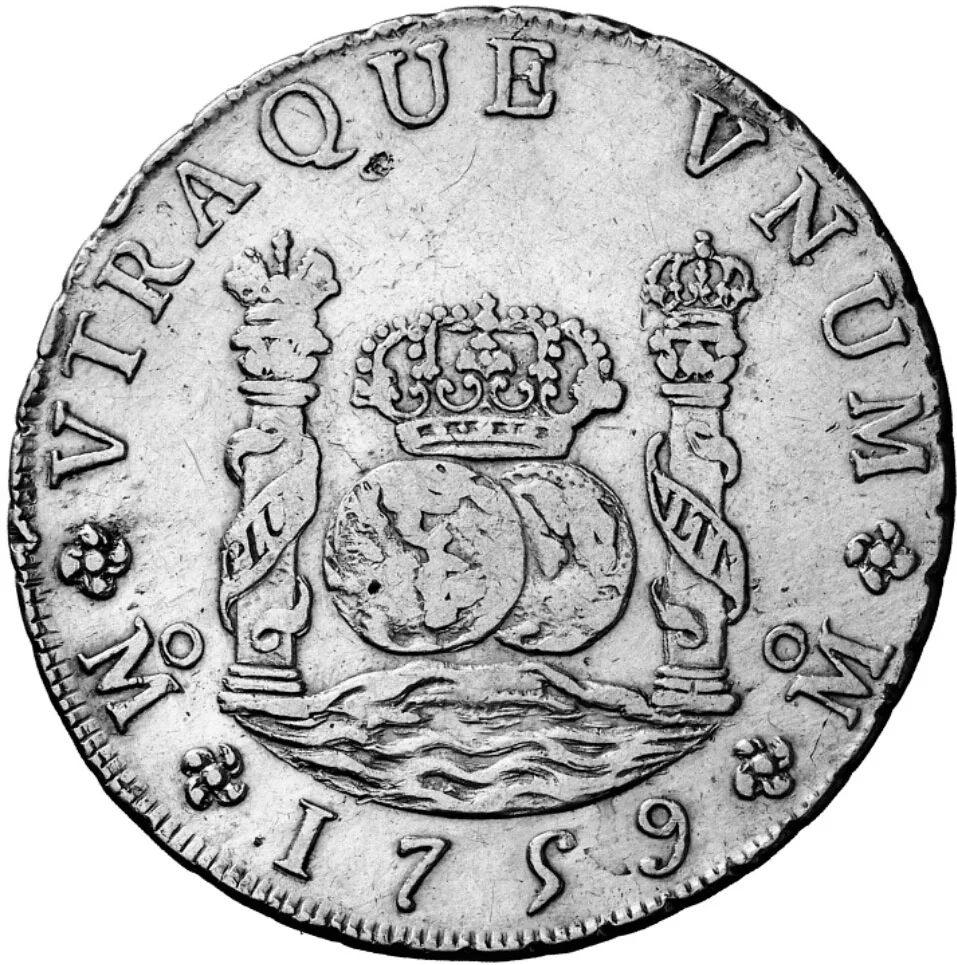
No coin has traveled farther, been counted in more languages, or shaped more of world history than the Spanish colonial real de a ocho — the eight-real “piece of eight.” For nearly three centuries this large silver coin, struck by the millions from silver dug out of the mountains of Mexico, Bolivia, and Peru, was the closest thing the early modern world had to a universal currency. It paid Chinese silk merchants and Boston shipwrights alike, it stood behind the U.S. dollar (which was legally defined against it), and it gave the world the peso, the yuan, and the phrase “two bits” for a quarter. It also gave us the cob, the pillar dollar, the portrait dollar, and the shipwreck coin — each with its own look and its own story.
The good news for a modern collector is that Spanish colonial reales are far more approachable than they look. Under all the odd Latin abbreviations and worn detail, every colonial real follows the same simple rules: it names a Spanish king in Latin, it carries a mint mark (usually a small letter or monogram) telling you where it was struck, it shows an assayer’s initial telling you who took responsibility for its silver, and its size on the classic reales scale (½, 1, 2, 4, 8) tells you its denomination and roughly its silver weight. Learn to read those four things and even a crude, worn “cob” coin becomes a legible historical document.
This guide walks the whole arc of Spanish colonial silver, from the first hammered cobs of the sixteenth century through the elegant “pillar dollars” and “portrait dollars” of the eighteenth, to the last pieces of eight struck as Spanish America broke apart into independent republics. You will learn to tell a cob from a milled coin, recognize the great colonial mints (Potosí, Lima, Mexico City, and their many branches), decode assayer initials, calculate silver melt value, spot the famous rarities (the Royal presentation cobs, the 1732 Mexico pillar dollar, dated shipwreck salvage), avoid the flood of modern fakes, and estimate realistic 2026 values. Whether you inherited a single blackened cob from a great-uncle’s foot locker or you are eyeing your first Potosí eight reales at a coin show, you will finish able to read, date, and value pieces of eight with confidence.
Why Pieces of Eight Matter to Collectors
Spanish colonial reales are a rare thing in numismatics: a series that is enormously historic, immediately recognizable, and still affordable at the entry level. Understanding why explains both their appeal and why so many turn up in unlikely American, European, and Asian collections.
The First Truly Global Coin
From roughly 1570 to 1820 the eight-real coin was the money that moved the world. Ships of the Manila galleon trade carried millions across the Pacific to buy Chinese silk and porcelain; Dutch, English, and French merchants took them across the Atlantic; they circulated as legal tender in the United States until 1857; and in 1813 the colony of New South Wales punched the centres out of 40,000 of them to create the holey dollar, Australia’s first official coinage. When Congress adopted the dollar in 1792, it defined the new coin by weight and fineness against the pillar dollar, so an early American Flowing Hair Dollar, an early Draped Bust dollar, and a Potosí eight reales are quite literally the same money. This is why colonial reales appear so often in colonial-American estates and shipwreck salvage.
Silver You Can Hold
An eight reales weighs about 27 grams at .903 to .917 fineness — roughly 0.78 troy ounce of pure silver. That gives even a common, worn cob real intrinsic value; it also makes higher-grade coins tangible pieces of Spanish American mining history, dug from the vast silver mountains of Cerro Rico at Potosí and the mines of Zacatecas and Guanajuato that also fed the great Mexican coinage.
A Field for Every Budget
Spanish colonial numismatics offers something at every level. A crude but honest cob real can be had for a few tens of dollars, a common late-portrait eight reales for a couple of hundred, and a nice Potosí or Mexico pillar dollar for the low four figures. At the top end are the “Royals” (special presentation strikes), first-year issues, rare mint/assayer combinations, and shipwreck-provenanced coins that bring five and six figures. Few areas reward a beginner as quickly or hold a specialist as long, and the coins physically connect the Old World, the New World, and Asia in a way nothing else in numismatics does.
The Great Eras of Spanish Colonial Coinage
Every colonial real belongs to one of three broad periods, and placing a coin in its era is the first and most powerful identification step, because each era looks completely different and follows different rules.
The Cob Era (c. 1536–1732)
For its first two centuries, Spanish American silver was struck by hand: a chunk of silver was clipped from a cast bar to the correct weight, laid between two dies, and hit with a hammer. The results — called cobs (from Spanish cabo de barra, “end of bar”) or macuquina — are irregular in shape, uneven in strike, and often incompletely struck at the rim. They carry the arms of Spain, a monogram or pillared cross reverse, and enough of a date, mint mark, and assayer initial to identify them when you know what to look for. Cobs are the coins of Spanish colonial romance — the coins of the treasure fleets, the pirates, and the shipwrecks.
The Pillar Dollar Era (1732–1772)
In 1732, Mexico became the first colonial mint to install screw presses and begin striking round, milled coinage. The signature type is the columnario or pillar dollar: on one side the crowned Spanish shield with king’s name in Latin, on the other the twin Pillars of Hercules flanking two hemispheres of the globe, crowned and wrapped with the famous PLVS VLTRA (“further beyond”) motto. Pillar dollars are the coins that put an end to cob coinage everywhere across Spanish America, one mint at a time, over the next four decades.
The Portrait Dollar Era (1772–1825)
In 1772 the design changed again. On the “portrait dollar” (or busto) the pillars-and-globes reverse gives way to the twin pillars framing the crowned Spanish arms, and the obverse now shows the bust of the reigning Bourbon king in profile. Portrait dollars run from Charles III through Charles IV and Ferdinand VII, ending in the 1820s as one after another of the Spanish American viceroyalties fought free of Spain and began minting their own national coins. These late portrait pieces are the most common Spanish colonial dollars found today.
The Reales System and Its Denominations
Spanish colonial silver was struck to a strict, unchanging scale, so once you know the sizes you can name the denomination of any coin at a glance.
The Silver Ladder
Silver coins were struck in denominations of ½, 1, 2, 4, and 8 reales, with each step doubling in weight and value. An eight reales weighs about 27.07 g, a four reales about 13.54 g, a two reales about 6.77 g, a one real about 3.38 g, and a half real about 1.69 g. Diameter follows the same pattern (roughly 39 mm, 32 mm, 27 mm, 21 mm, 17 mm). This is why the half real is often called a medio, the two reales became the “two bits” that gave us “shave and a haircut, two bits” for a U.S. quarter, and the eight reales is the “piece of eight” a pirate would divide with a chisel into bits.
Money of Account: Reales, Pesos, and Escudos
An eight reales silver coin was itself called a peso, a duro, a Spanish dollar, or a piece of eight — all names for the same thing. The gold coin equivalent was the escudo, struck in denominations of ½, 1, 2, 4, and 8 escudos, with the eight escudos (“doubloon”) standing to gold as the eight reales standing to silver. One gold escudo was worth two silver pesos (16 reales), and one doubloon was worth eight pesos (64 reales) — the same accounting that defined the U.S. gold-to-silver ratio in 1792.
Base-Metal Pieces
Spanish colonial mints struck almost no low-value copper coinage for the New World — small change was mostly handled by cut fractions of silver, private tokens, and later by locally struck coppers in some viceroyalties. This is why almost every genuine colonial coin in silver, no matter how humble the denomination, has some real bullion behind it.
Cobs: The Hammered Silver of the New World
Cobs are the most romantic and most misunderstood of Spanish colonial coins. Understanding what they are and how to read them makes their apparent chaos suddenly legible.
What a Cob Actually Is
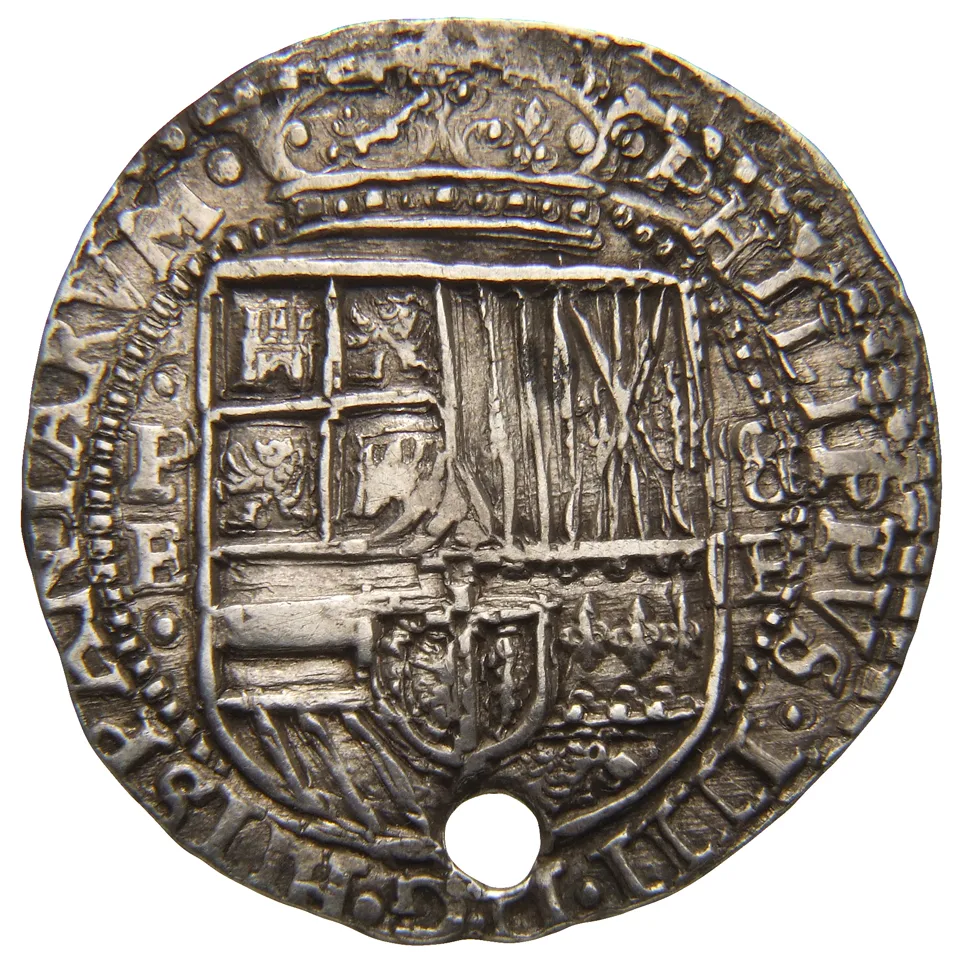
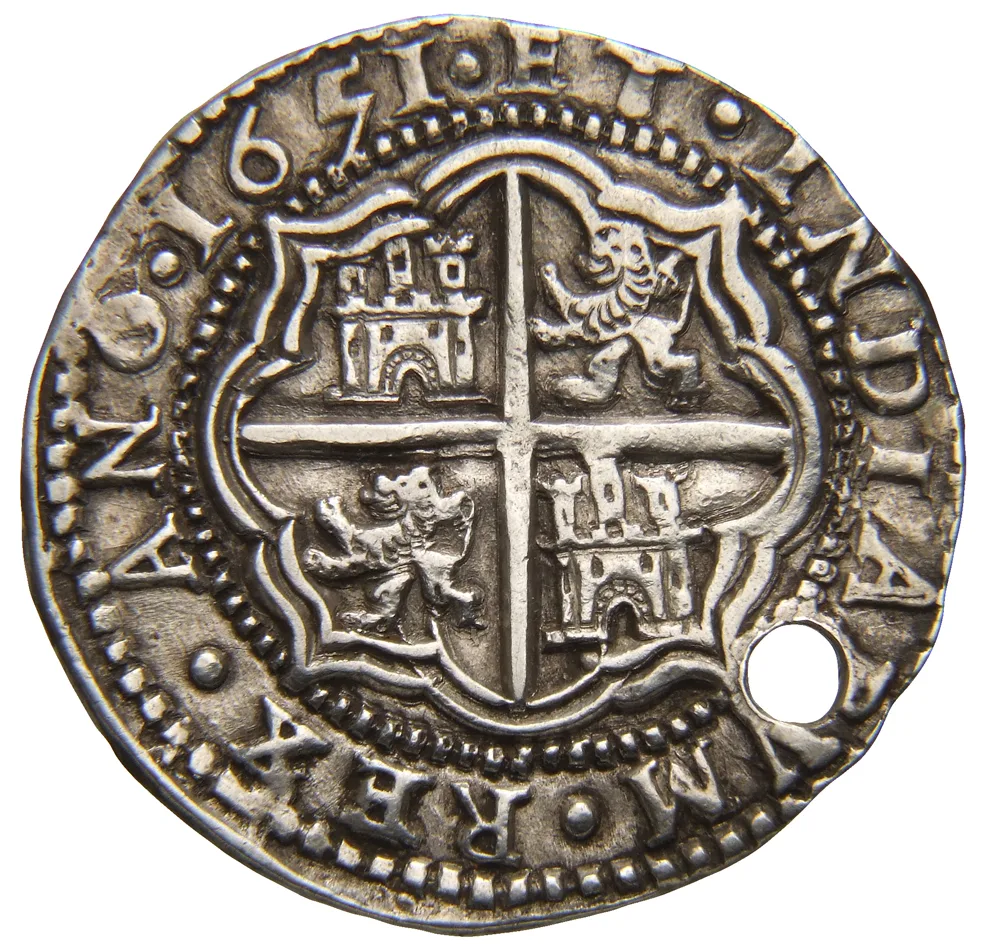
A cob was struck by cutting or clipping a lump of silver from a cast bar to the correct weight, hammering it between hand-engraved dies, and adjusting the weight with a small chisel if necessary. The result is a coin that is correct by weight but wildly irregular by shape — often oval, sometimes almost triangular, frequently with big flat “clip marks” where excess metal was trimmed away. Strike quality varies from coin to coin: one may show the date and mint mark boldly and lack the king’s name; the next may have the arms sharp and the date completely off the flan. This is normal and not a defect — cobs were made for commerce, not for admiration.
The Two Great Cob Types: Shield and Pillar
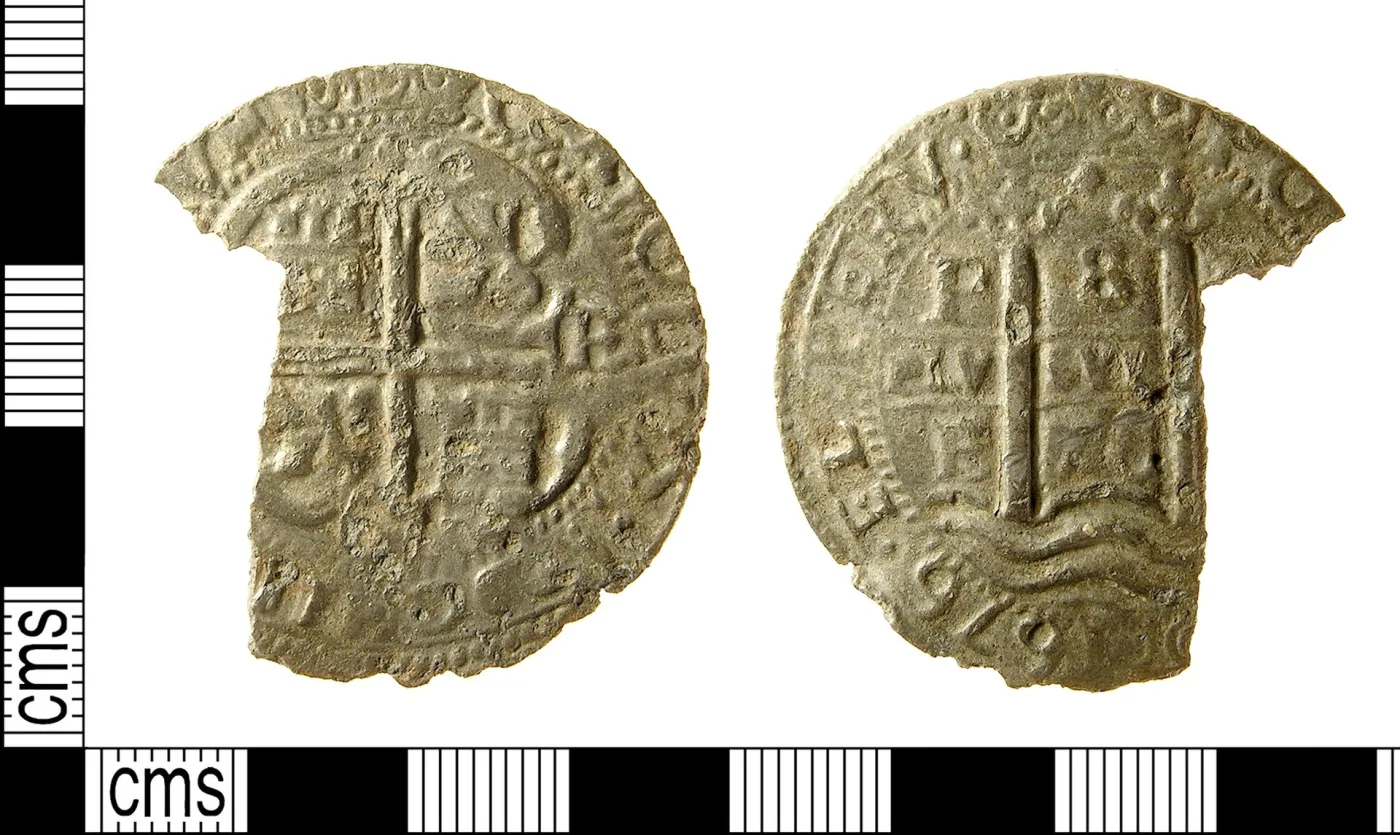
Cobs come in two great flavors. Early shield-and-cross cobs (Philip II through the mid-seventeenth century) show the quartered Habsburg shield on one side and a Jerusalem-style cross with castles and lions in the angles on the other. Later pillar-and-wave cobs (from about 1652 at Potosí onward, and elsewhere later) replace the shield with a design of two crowned pillars flanking a wave-line meant to represent the two hemispheres separated by the ocean — a direct ancestor of the milled pillar dollar’s design. Both types carry a mint mark, an assayer initial, and a date.
Reading a Cob
To identify a cob, look for four elements, and be prepared to find some but not all of them on a given coin: (1) the mint mark, usually a single letter or monogram (P for Potosí, L for Lima, M or a small “oM” for Mexico); (2) the assayer initial, a single letter or two right next to the mint mark; (3) the date, which may be a two-digit or four-digit year and is sometimes off the flan; and (4) the denomination, usually the numeral 8, 4, 2, 1, or a small dot (for ½ real). The king’s name is often partly worn or off the flan, but the date and mint mark together will place the coin in a reign.
The Potosí Scandal and the “Star of Lima”
In 1648 a great fraud at the Potosí mint (the “Great Potosí Mint Fraud”) was uncovered: assayers had been debasing the silver and pocketing the difference. The Spanish crown responded by redesigning the cobs to a new pillar-and-wave type and permanently branding the mint with the letter P or the monogram PTS. A separate famous Potosí issue — the “1659 Star of Lima” cobs — are pillar cobs from Potosí deliberately marked with a small star to identify them as products of a reformed and re-verified mint. These historical details are exactly what makes cobs so collectible: each one is a physical piece of Spanish American economic history.
The Pillar Dollar (Columnario)
The pillar dollar is one of the most beautiful and iconic coins in world numismatics, and it is where “modern-looking” Spanish colonial coinage begins.
The Design
The obverse shows the crowned quartered shield of Spain — castles for Castile, lions for León, pallets for Aragón, chains for Navarre, and a small central Bourbon inescutcheon of three fleur-de-lis — with the king’s name and titles in Latin around the edge. The reverse shows two large, crowned Pillars of Hercules straddling twin globes representing the Old and New Worlds, with the waves of the ocean between them and the scroll PLVS VLTRA (“further beyond”) wound around the columns. The date appears at the bottom of the reverse.
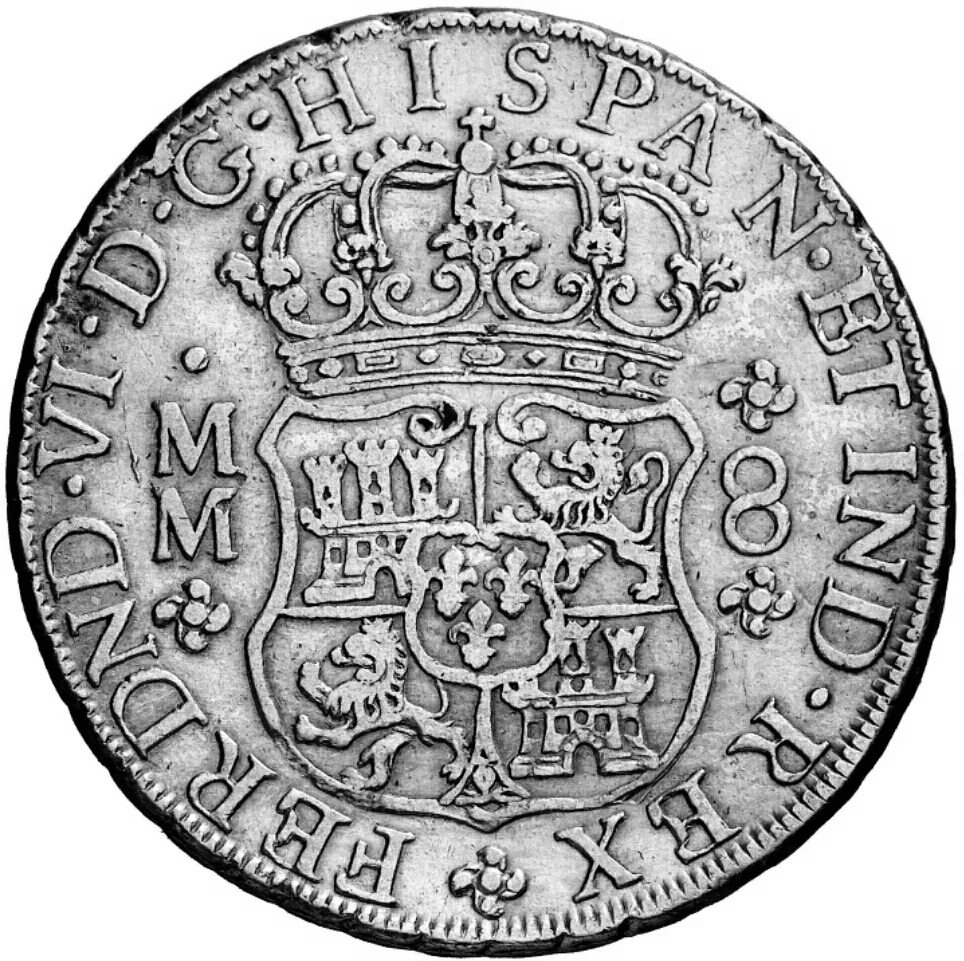
The Motto That Defined an Empire
Plus Ultra was the personal motto of Charles V, the Holy Roman Emperor who unified the Spanish crown in the sixteenth century, and it was a direct rebuke to the ancient Latin non plus ultra (“no further beyond”) supposedly inscribed on the Pillars of Hercules to warn sailors not to venture into the Atlantic. On a pillar dollar struck from silver mined thousands of miles across that ocean, the message could not be more explicit: Spain has gone further beyond. This is also the design that visually inspired the U.S. dollar sign ($) — one popular theory reads the “S” as the ribbon and the two vertical bars as the pillars themselves.
Mints Producing Pillar Dollars
Pillar dollars were struck at Mexico City (mint mark Mo, from 1732), Guatemala (G, from 1733), Lima (L or LM, from 1751), Santiago in Chile (S, from 1751), Potosí (P or PTS, from 1767), Popayán (P, from 1758), and Bogotá (NR or SF, from 1759). Each mint has its own quirks of style, and specialists collect pillar dollars by mint and by year.

The Portrait Dollar (Bust Dollar)
In 1772 Charles III reformed the coinage across the Spanish American mints and introduced the design that dominated colonial silver for the last half-century of Spanish rule.
The Design
The obverse now carries the profile bust of the reigning king, laureate and draped in the Roman manner, with his name and titles around the edge. The reverse shows the crowned shield of Spain flanked by the two crowned Pillars of Hercules (with the PLVS VLTRA scrolls preserved), with the mint mark and assayer initial to the sides. The date is on the obverse, below the bust, not below the shield — a small thing that wastes a lot of time when you are looking for it in the wrong place. The result is much cleaner and more legible than the pillar dollar, and it stands close to a modern coin in overall look.
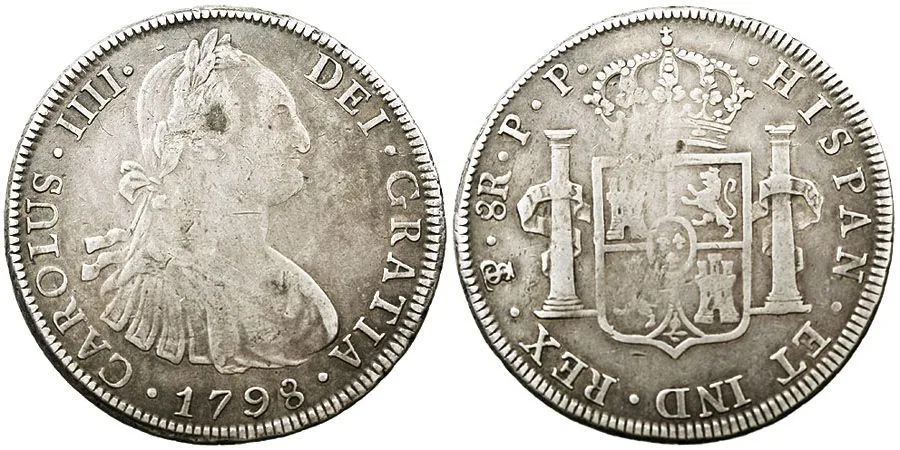
The Three Bust Kings
Portrait dollars run through three kings whose portraits are easy to tell apart with practice. Charles III (1772–1788) has a long, aristocratic face with a distinctive prominent nose and long hair drawn back in a queue. Charles IV (1788–1808) is heavier-featured, with a fuller, rounder face than his father, and his bust is often described as looking “plump.” Ferdinand VII (1808–1825, though disputed dates in some colonies) has a smaller, more youthful head, and his coins often show the political turmoil of his reign, including special “imaginary bust” issues struck in colonies loyal to him while he was in French captivity.
The 8 Reales Standard
Portrait 8 reales are the workhorse Spanish dollar of the late colonial era. Struck to 27.07 grams at .903 silver (0.7859 troy oz pure), they are the coin that circulated as legal tender in the United States until 1857 and that inspired the term “peso” for the U.S. dollar in Spanish-speaking America. They are also the coin most often chop-marked in Asia — the same treatment given to the American Trade Dollar and to the Japanese silver yen — and most often found in shipwreck hoards from the last decades of Spanish rule.
Escudos and the Gold Doubloon
Alongside the silver reales, the same mints struck a parallel gold coinage built on the escudo, and these coins carry substantial precious-metal value even today.
The Escudo Denominations
Gold was struck in ½, 1, 2, 4, and 8 escudos, mirroring the silver ladder. The eight escudos is the famous doubloon (Spanish doblon), weighing about 27.06 grams at .917 fine gold — roughly 0.7615 troy ounce of pure gold. The four escudos (“half doubloon”) weighs about 13.53 g, the two escudos (“pistole”) about 6.77 g, the one escudo about 3.38 g, and the half escudo about 1.69 g. These weights were, again, the basis for the U.S. gold coinage of 1792 — an American Capped Bust eagle and a Spanish colonial four escudos are close cousins in weight and fineness.
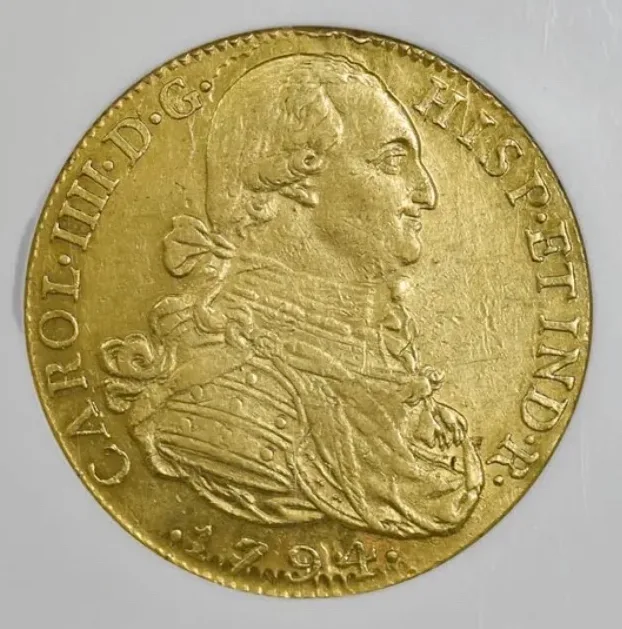
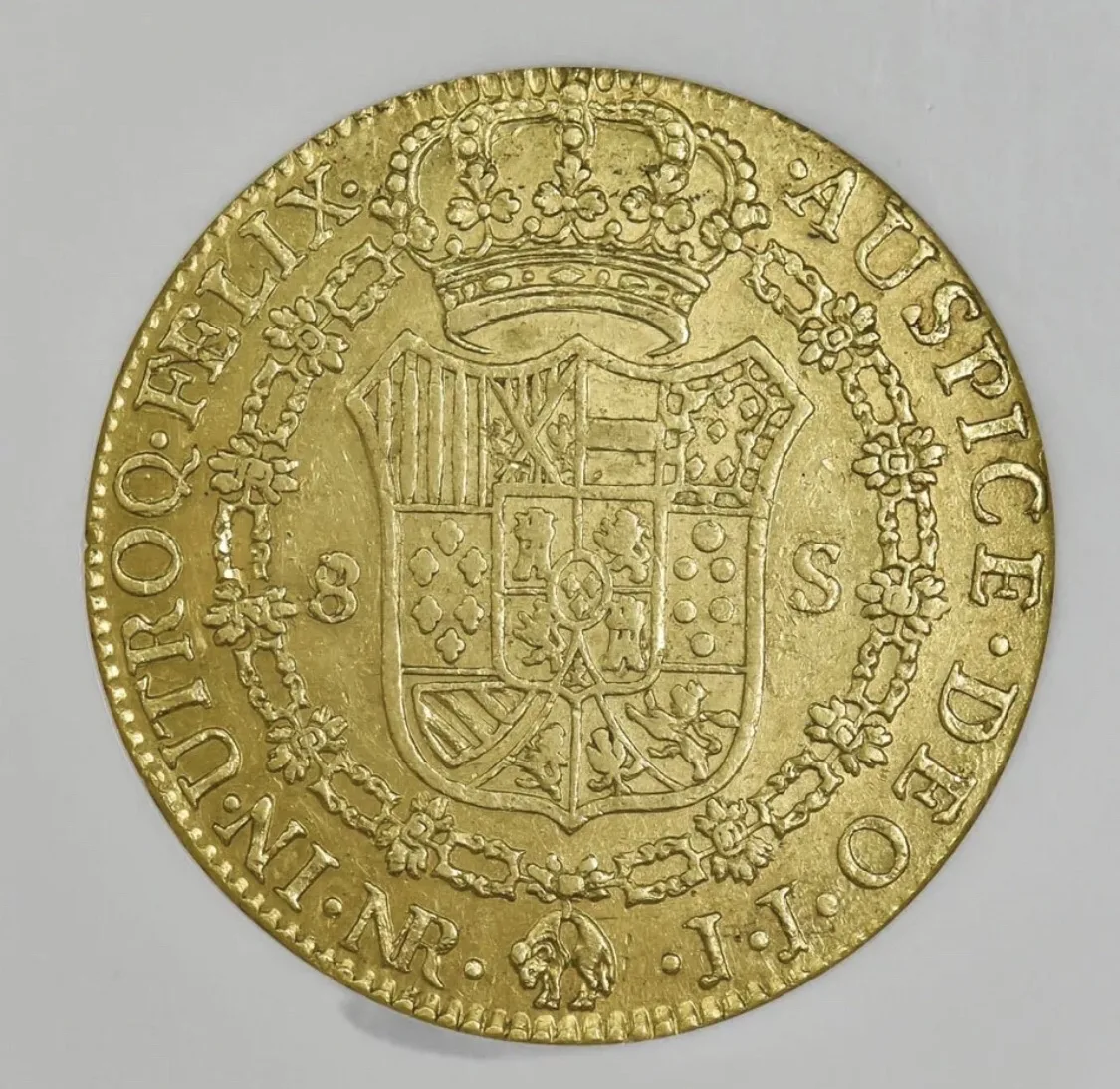
Cob Gold and Milled Gold
Gold cobs exist for the same span as silver cobs (Philip II through the milled-coinage reforms of the eighteenth century) and are far rarer and more valuable than the silver equivalents. Milled gold escudos come in the pillar style briefly and then in the portrait style, following the silver by a few years at each mint. A well-struck portrait doubloon is one of the most beautiful large gold coins of the early modern world.
The 1715 Fleet and the Doubloon Mystique
Gold cobs and gold escudos are the coins most associated with the legendary Spanish treasure fleets — especially the 1715 Fleet, which was lost off Florida in a hurricane while carrying millions of pesos and thousands of escudos back to Spain. Coins from these wrecks, when properly documented, carry substantial premiums over their base value.
The Colonial Mints: Potosí, Lima, Mexico and Beyond
Spanish colonial silver was struck at more than a dozen mints across the Americas over the three centuries of colonial rule, and each has its own character.
The Big Three
Mexico City (mint mark M or Mo, opened 1536) is the oldest and most prolific Spanish American mint, and its output shaped the whole Mexican coin tradition. Potosí in modern Bolivia (P or PTS, opened 1573) was the beating heart of Spanish silver, striking coins from silver mined at the vast Cerro Rico mountain that fed the Spanish empire for two centuries. Lima in modern Peru (L, LM, or a monogram, opened 1568) was the other major South American mint. These three account for the great majority of all colonial reales you will ever see.
The Branch Mints
The smaller Spanish American mints include Guatemala (G or NG, opened 1733), Bogotá in Colombia (NR or SF, opened 1620s for cobs, 1750s for milled), Popayán in Colombia (P or PN, mostly gold), Santiago in Chile (S or So, opened 1749), and, briefly and rarely, Guadalajara, Durango, and other Mexican provincial mints during the wars of independence. Coins from the small branch mints are almost always scarcer than the equivalent Mexico, Lima, or Potosí coins.
The Peninsular Mints
Do not overlook the mints in Spain itself, whose reales also circulated in the New World. Seville (S), Segovia (a small aqueduct monogram), Madrid (M crowned), and others struck reales throughout the colonial period; the Segovia aqueduct mark, in particular, is one of the most distinctive mint marks in world numismatics. Peninsular reales tend to be scarcer in American estate finds than their American cousins, and are worth checking for.
Reading Mint Marks and Assayer Initials
The single most useful skill on a Spanish colonial real is being able to read the little pair of letters or monograms tucked to the side of the design.
Where to Look
On a milled pillar dollar, the mint mark sits outside each pillar on the reverse, and the assayer initial (or two initials) sits at the sides of the shield on the obverse. On a portrait dollar, all three sit at the sides of the crowned shield on the reverse, and the grouping is worth getting right: the mint mark and the denomination number (8, 4, 2, 1) are stacked together on the left, and the assayer initial(s) stand alone on the right. Two coins photographed for this guide — a Potosí 1798 and a Mexico City 1792 — agree on it. On a cob, the mint mark and assayer are usually crammed together beside the shield or pillars, and often only one or both is on the flan.
Common Mint Marks at a Glance
The main colonial mint marks you will encounter are: Mo (Mexico City), P or PTS (Potosí), L, LM, or a monogram of L over M or M over L (Lima), NG or G (Guatemala), NR or SF (Santa Fe de Bogotá), PN (Popayán), and So (Santiago, Chile). Peninsular marks include M crowned (Madrid), S (Seville), and a small aqueduct (Segovia).
Assayer Initials
The assayer was the official responsible for certifying the silver content of each coin. His initial(s) are typically one or two letters (F, J, P, JP, TH, MF, and so on) that change every few years as the office changed hands. A specialist collects coins by mint, date, and assayer together, and rare assayer/date combinations can carry major premiums. Standard references list each mint’s succession of assayers by year, so a careful reading of the initials next to a date can pinpoint the exact working period of an individual official.
Silver Content and Melt Value
Every Spanish colonial silver real has real bullion behind it, and calculating melt value is one of the fastest sanity checks you can perform on any coin.
The Fineness Standards
From 1497 until 1728 the Spanish silver standard was .9306 fine (11 dineros 4 granos). In 1728 Philip V reformed the standard to .9166 fine (11 dineros). In 1772 Charles III lowered it slightly to .9028 fine, and it stayed there through the end of colonial coinage. A worn coin does not lose its fineness — it loses weight — so identify the coin, apply the standard for its date, and compute silver content from the actual weighed weight.
Silver Weight of an 8 Reales
A full-weight, unworn 8 reales contains roughly 0.78 troy ounces of pure silver (~24.4 g fine). A 4 reales contains ~0.39 oz, a 2 reales ~0.20 oz, a 1 real ~0.10 oz, and a ½ real ~0.049 oz. Worn coins will weigh less; a well-worn cob may have lost 5–10% of its original weight. This is exactly the same silver ladder that shaped so much of the world’s silver — the same reason a bag of junk silver quarters and half dollars weighs out the way it does.
Melt Value in Practice
At a spot price of around US$30 per troy ounce of silver, a full-weight 8 reales carries roughly $23 of silver alone, a 4 reales about $12, a 2 reales about $6, and a 1 real about $3. Numismatic value almost always exceeds melt for an identifiable coin, so never sell a colonial real for its silver without first checking what it might be worth to a collector. Even a heavily worn cob is generally worth several multiples of its silver as a collectible.
Reading the Latin Legends
Latin abbreviations look intimidating at first but come down to a handful of formulas that repeat across the whole colonial series.
The Standard Legend
A typical portrait dollar reads something like CAROLUS III · DEI · GRATIA · 1780 on the obverse and HISPAN · ET IND · REX · Mo · 8R · FF on the reverse. That translates as “Charles III, by the grace of God” and “King of Spain and the Indies, Mexico, 8 reales, [assayers] FF.” The pattern is [king’s name] [ordinal number] DEI GRATIA on the obverse and HISPAN ET IND REX [mint] [denomination] [assayer] on the reverse. Learn that formula and you can read almost any milled colonial real at a glance.
Common Abbreviations
Key abbreviations to know: DEI GRATIA or D·G = “by the grace of God”; HISPAN or HISP = Hispaniarum, “of the Spains”; ET IND = et Indiarum, “and of the Indies”; REX = “king”; PLVS VLTRA = “further beyond.” On cobs, look for the abbreviated form PHILIPPVS D G HISPAN ET IND REX or similar. The word order tells you nothing critical — it is the king’s name and the mint mark that matter.
Naming the King on the Coin
Because the same designs were used across multiple reigns, naming the king from name and portrait is a key attribution step.
The Habsburg Kings (Cob Era)
Philip II (1556–1598) — the coins that funded the Armada; usually shield-and-cross cobs. Philip III (1598–1621), Philip IV (1621–1665), and Charles II (1665–1700) follow, all Habsburgs. On cobs, the difference between one Philip and the next is often established from the date rather than the portrait, since these kings do not appear as portraits on their cobs at all.
The Early Bourbons
Philip V (1700–1746) is the king who reformed the coinage: shield-and-cross cobs give way to pillar cobs and then, in Mexico from 1732, to the first pillar dollars. Ferdinand VI (1746–1759) continues the pillar dollar. Both kings appear only by name on their coins, not by portrait.
The Portrait Bourbons
Charles III (1759–1788) reforms the coinage in 1772 and puts his profile on the silver — a long, sharp-nosed face. Charles IV (1788–1808) has a broader, fleshier profile. Ferdinand VII (1808–1825 in the colonies) has a smaller, more youthful head, and his coins sometimes carry the imaginary bust struck by loyalist mints during the Peninsular War. If your coin has a portrait, it is post-1772 and will be one of these three kings.
Shipwreck Coins and Chop Marks
Two special categories of Spanish colonial coin come with their own premiums and their own tell-tales.
Shipwreck (Salvage) Coins
Thousands of Spanish colonial coins have been recovered from documented wrecks: the 1622 Atocha, the 1715 Fleet, the 1733 Fleet, the El Cazador (1784), and the Vliegent Hart (1735), among many. Shipwreck coins usually show surface pitting, salt-water etching, and a characteristic grey or blackened patina. Properly documented salvage coins — with photograph, certificate, and provenance from the licensed salvor — carry a real premium over the same coin without provenance. Undocumented shipwreck claims should be treated skeptically; sellers commonly attach vague “shipwreck” language to coins with no evidence.
Chop Marks
Once a piece of eight traveled to Asia in the Manila galleon trade or via the East India companies, Chinese merchants often stamped it with a small punch (a chop mark) to attest that they had personally verified the silver. Some coins accumulated dozens of chops over decades of Asian circulation, obliterating the design entirely. Chops are not damage — they are a distinct collectible tradition, and heavily chopped coins are collected as a specialty. Chop marks alone, however, do not add value on top of an already scarce coin; a common late portrait dollar with heavy chops is usually worth less to a Western collector than a clean one.
Step-by-Step Identification Workflow
Bring the whole guide together with a repeatable workflow for any Spanish colonial coin.
- Look at the shape and strike. Round and clean → milled (pillar or portrait). Irregular and lumpy → cob.
- Weigh the coin. Compare to the reales ladder (27, 13.5, 6.8, 3.4, 1.7 g). This tells you the denomination even when the numeral is off the flan.
- Look for a portrait. Bust → 1772 or later (portrait dollar). No bust → either a pillar dollar (round, columns and globes on reverse) or a cob (irregular).
- Find the mint mark. On a milled coin, it sits beside the shield. On a cob, it is beside the shield or pillars. Match to the mint list above (Mo, P/PTS, L/LM, NG/G, NR/SF, PN, So).
- Find the assayer initial(s). Right next to the mint mark, one or two small letters.
- Find the date. On milled coins, at the bottom of the reverse (pillar dollar) or below the shield (portrait dollar). On cobs, often partial or off-flan.
- Read the king’s name. Look for PHILIPPVS, CAROLVS III, CAROLVS IIII, FERDIN VII, etc.
- Cross-reference. Combine mint, assayer, and date against a catalog such as Standard Catalog of World Coins 1601–1700 / 1701–1800 / 1801–1900 (Krause) or Calicó for peninsular Spain.
The workflow is exactly the mint-mark-plus-assayer-plus-date logic that also drives attribution of many other mint-marked coins, and it is the reason every genuine colonial coin is more identifiable than it looks.
Key Dates and Famous Rarities
Some Spanish colonial reales stand well above the norm in value and desirability. The following are the ones most likely to reward a careful look.
The First-Year Pillar Dollars
The 1732 Mexico pillar dollar, first year of milled Spanish colonial coinage, is the single most famous colonial issue and one of the most valuable common-date world coins. Even circulated examples bring four figures, and choice mint state examples have brought well into six figures. The 1732 4 reales, 2 reales, 1 real, and ½ real are all first-year rarities as well, though far less spectacular than the eight.
The Royal (Galano) Presentation Cobs
Royal or galano cobs are perfectly round, fully struck presentation pieces — cobs made carefully as gifts for the king rather than for circulation. They are extremely rare, universally desirable, and command five- and six-figure prices at auction. A “Royal Potosí cob” is one of the great collectible objects in world numismatics.
The 1652 Potosí Transition
1652 Potosí cobs, struck during the mint’s transition from the old fraudulent silver to the new pillar-and-wave design, exist in a variety of overstruck and transitional forms and are actively collected as a specialty. Some carry both old and new design elements on the same coin.
The 1808 Lima “Imaginary Bust” Ferdinand VII
When Ferdinand VII was captured by Napoleon in 1808, the Lima mint (loyal to the Bourbon cause) struck 8 reales in his name using an imaginary bust engraved from imagination since no portrait model was available. These “busto imaginario” issues are among the most historically evocative colonial pieces.
The Wars of Independence Coinage
From about 1810 to 1825, coins struck at various Mexican provincial mints (Durango, Guadalajara, Zacatecas, Chihuahua, and elsewhere) during the wars for independence are often crudely made, transitional in design, and locally scarce. Some are more valuable than any regular royal issue of the same denomination.
Grading Spanish Colonial Coins
Grading colonial reales is a specialty of its own, and the standards differ meaningfully between cobs and milled coinage.
Grading Milled Coinage
Pillar and portrait dollars are graded on the ordinary Sheldon scale used for U.S. coins — from AG-3 up through MS-70 — with the same interpretation of wear on the high points (the king’s hair, the shield details, the pillars). PCGS, NGC, and other third-party grading services encapsulate them regularly, and mint state pillar dollars are among the most sought-after world coins.
Grading Cobs
Cobs are a special case: because they were never intended to be perfectly struck, “grade” here means how much of the intended design is actually visible, not how much wear it has taken. A cob is described by strike quality (bold, full, partial, weak), date visibility (full date on flan, partial date, no date), and overall completeness (four assayer/mint elements visible, three, etc.). NGC and PCGS grade cobs, but their numerical grade always needs to be read together with the strike description — a “MS-62 Potosí cob” with the date off the flan is worth much less than an “XF-40 Potosí cob” with a full date, mint mark, and assayer.
What Pieces of Eight Are Worth in 2026
Values move with the market and with the individual coin’s condition, but the ranges below reflect realistic 2026 auction and retail prices for representative pieces.
Common Circulated Coins
A common late portrait 8 reales (Mexico or Potosí, common date and assayer, VF to XF) trades in the $150–$300 range. A common pillar 8 reales (Mexico, mid-1740s to 1760s, VF) is typically $500–$900. A common shield-and-cross or pillar cob 8 reales from Potosí with a partial date and identifiable mint runs $200–$500 in typical grades. Smaller denominations (4, 2, 1, ½ real) scale down roughly with their silver content plus a numismatic premium.
Better-Grade and Rarer Coins
A mint state late portrait 8 reales can bring $600–$1,500 for common dates, more for the scarcer ones. A 1732 pillar dollar starts around $2,500 for the lowest circulated grades and runs into six figures for choice mint state. Well-documented shipwreck salvage coins (Atocha, 1715 Fleet, El Cazador) typically add a $100–$300 premium at the low end, more for pedigreed pieces with strong provenance.
Gold Escudos
A common portrait 8 escudos doubloon in circulated grade is generally $2,000–$3,500, driven by its gold content (~$1,800 at spot). A common 2 escudos “pistole” is $500–$900. Cob gold and early milled gold are substantially rarer and priced accordingly, and any documented shipwreck gold is a specialist’s market of its own.
Rarities
A Royal (galano) cob 8 reales starts in the five figures and can pass six for choice pieces. Famous rare-year and rare-assayer combinations (Guatemala 8 reales in first years, Bogotá portrait 8 reales, and the like) can bring similar prices. Consult recent auction archives (Heritage, Sedwick, Aureo) rather than a generic guide when a coin is potentially in the four-figure range.
Counterfeits and How to Avoid Them
Spanish colonial reales are among the most heavily counterfeited coins in world numismatics, and the counterfeits fall into a few families you can learn to spot.
Cast Fakes
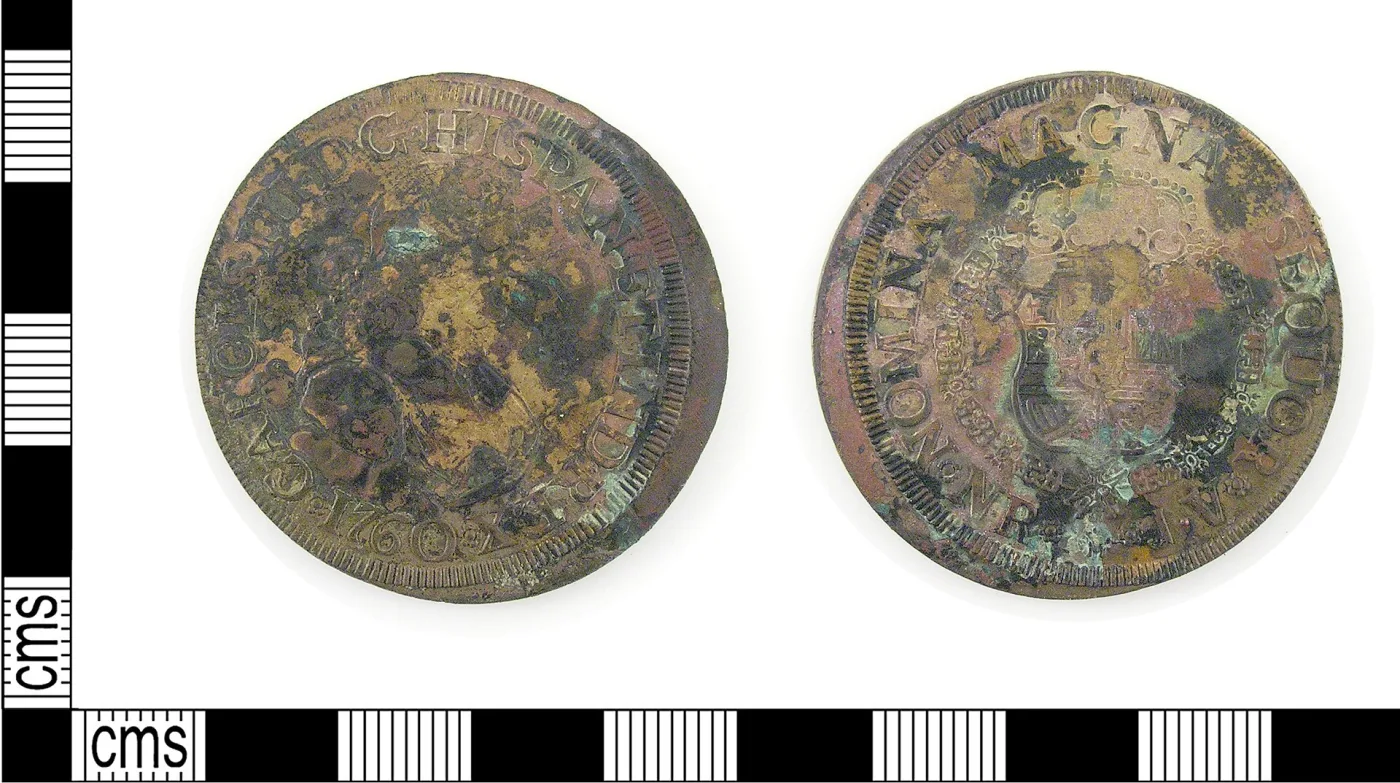
The most common modern fake is a cast copy, made from a mold taken off a genuine coin. Cast fakes usually show a soft, mushy strike, a visible seam around the edge, and a “sandy” or granular surface texture. They frequently weigh light because the mold is filled with a base-metal alloy or with debased silver. A weighing scale accurate to 0.1 g and a magnet are your first-line defenses against most cast fakes.
Modern Struck Fakes
More dangerous are modern struck copies made from copied dies, especially of the 1732 pillar dollar and the great rarities. These weigh correctly and pass casual inspection. Tells include incorrect edge design (colonial 8 reales have a specific ornamented edge that is hard to fake perfectly), too-uniform surfaces, and slightly wrong style in details that a specialist eye picks up. For any high-value pillar dollar, third-party grading or examination by an experienced dealer is essential — the same discipline that helps with any counterfeit-detection workflow.
Contemporary Counterfeits
Beware also of contemporary counterfeits: silver-plated or debased-silver copies made in the 18th or 19th century to circulate in commerce. These often have some collector value in their own right as historical objects — contemporary counterfeit pieces of eight are a recognized collecting specialty — but they are not the real coin and should be priced accordingly.
Restrikes and Fantasy Pieces
A few 20th-century restrike issues (Mexico’s official restrikes of some historical coins, for example) exist and are usually legitimate as restrikes but not as originals. Fantasy pieces — coins struck for the collector market bearing designs that never actually circulated — also exist. If a “colonial real” carries an impossible king/date combination or a mint mark that never struck in that year, it is a fantasy piece.
References and Online Tools
Attribution and pricing are much easier with the standard reference books and free online tools.
Standard Catalogs
Standard Catalog of World Coins (Krause) — the four volumes covering 1601–1700, 1701–1800, and 1801–1900 — is the workhorse general reference and lists every colonial mint/date/assayer combination with catalog values. Calicó (El Duro: Numismatica Española and follow-ups) is the authoritative Spanish-language reference for both peninsular and colonial Spanish coinage. For cobs specifically, Herman Blanton and Daniel Sedwick’s Practical Book of Cobs is the leading English-language handbook.
Free Online Tools
Numista has excellent Spanish colonial coverage with photo matching by mint and reign, and community-verified type entries. Sedwick’s auction archive is the best free source of comparable prices for cobs and shipwreck coins. PCGS CoinFacts and NGC’s World Coin Price Guide cover the major milled types. For attribution against die varieties, coinarchives.com lets you search across dozens of auction houses.
Museums and Collections
The American Numismatic Society (New York), the British Museum, and the Museo Casa de Moneda in Madrid and Potosí all have extensive Spanish colonial holdings accessible through their online catalogs. These are invaluable for confirming attributions of unusual coins.
Frequently Asked Questions
Are Spanish colonial reales legal tender anywhere today?
No. Spanish colonial coinage ceased to be legal tender in the United States in 1857 and in Spanish America as each new republic issued its own coinage in the 1820s and 1830s. Today they are pure collectibles, worth their numismatic value plus their silver content.
Is a "piece of eight" the same as a Spanish dollar?
Yes. "Piece of eight," "Spanish dollar," "peso," "duro," and real de a ocho are all the same coin: the 8-reales silver coin of the Spanish crown, roughly 27 g of ~.900 silver.
Why are cobs so ugly?
Cobs were struck by weight, not by appearance. The Spanish crown cared that a merchant received the right amount of silver, not that the coin was a work of art. The blocks of silver were clipped by hand to the correct weight and then hit with dies without preparing the flan — the modern round coin is a later invention that requires more machinery than the sixteenth- and seventeenth-century colonial mints had.
How much silver is in an 8 reales?
A full-weight, unworn 8 reales contains roughly 0.78 troy ounces (about 24.4 g) of pure silver. Standards varied slightly by era (.9306 before 1728, .9166 from 1728, .9028 from 1772), but the pure-silver content is close to the same across the whole colonial period.
What does "chop-marked" mean?
Chop marks are small punches applied by Asian merchants (mostly Chinese) to attest that they had verified the silver content of the coin. They indicate that a piece of eight circulated in East Asia at some point. Chops are collected as historical evidence, but they generally lower the value of a coin to a Western collector unless the piece is chopped so heavily as to be a distinct collectible in its own right.
What is the difference between a cob and a milled coin?
Cobs were struck by hand from irregular clipped flans, using a hammer and hand-cut dies. Milled coins were struck by machine (a screw press or later a coining press) on round, uniform flans. Cobs are older (~1536 to 1732 in Mexico, later elsewhere); milled coins replaced them one mint at a time between 1732 and 1773.
Why do I see U.S. state names counter-stamped on some 8 reales?
Because Spanish dollars circulated as legal tender in the United States until 1857, individual states and private merchants sometimes counter-stamped them for local use or for advertising. Genuine counter-stamped pieces of eight are collectible as a specialty of American exonumia. As with everything else in this series, the counter-stamp should match a documented issuer and design before you accept it as genuine.
Are pieces of eight a good investment?
They can be, but never buy any coin purely as an investment. The market for high-end pillar dollars and rare cobs has been strong for decades and shows no sign of weakening, but individual coin prices are volatile and the field rewards knowledge, not speculation. Collect what you find beautiful or historically compelling, and let value appreciation be a secondary bonus.