Indian Coins Identification Guide: How to Read, Date, and Value Indian Coinage
India has been striking coins for about two and a half thousand years, longer and more continuously than almost anywhere else on earth, and in that time its coinage has been written in Brahmi, Greek, Kharoshthi, Sanskrit, Arabic, Persian, English, Devanagari, Tamil, Bengali and a dozen other scripts, and dated in at least five different calendars. That is why an unidentified Indian coin can feel unapproachable in a way that an unidentified American or Australian coin does not. There is no single obverse convention to learn, no one date format, and no guarantee that the coin even carries a date.
What makes it tractable is that the scripts and the calendars do not overlap much. Each belongs to a fairly narrow window of Indian history, so the writing on a coin places it in time before you read a single word of it. A coin covered in Arabic script with no picture on it is almost certainly between the thirteenth and the nineteenth century. A coin with English on one side and Persian on the other belongs to the century after 1835. A coin with English and Hindi and four lions on it is from 1950 or later. Recognising the writing system is faster than recognising the coin, and it narrows the field from two thousand years to a hundred.
This guide works through the whole span: the punch-marked silver of the sixth century BC, the Greek and Kushan portrait coinages, the gold of the Guptas, the silver tanka of the Delhi Sultanate, Mughal rupees and how to date them, the frozen dates that make so many nineteenth-century coins lie about their age, the princely states and their hundreds of separate coinages, the East India Company presidencies, the uniform coinage of 1835, Victoria as Queen and then Empress, the 1911 pig rupee, the shapes that tell you a British India denomination at arm’s length, wartime silver debasement, mint marks under the Raj and under the Republic, the frozen series of 1947 to 1950, the anna series, decimalisation in 1957, the modern rupee coins, and the practical business of telling an Indian coin from a Pakistani, Nepali, Sri Lankan or Burmese one.
Why Indian Coins Are Hard to Place
Most national coinages give you a fixed frame. British coins put a monarch on the obverse and a denomination on the reverse, and have done so for centuries. United States coins carry a date in Arabic numerals in a predictable spot. Even a coinage as long-running as China’s settles into one recognisable format — a round cast disc with a square hole and four characters — for well over a thousand years, as the guide to Chinese coins describes.
Indian coinage has no such frame, because “India” in numismatic terms is not one issuing authority but a subcontinent that has at various times contained hundreds of them simultaneously. At the moment of independence in 1947 there were more than five hundred princely states inside the borders of British India, several dozen of which were still striking their own money. Two centuries earlier there were more mints operating in India than in the whole of Europe.
The Four Specific Traps
Four confusions account for most misidentified Indian coins.
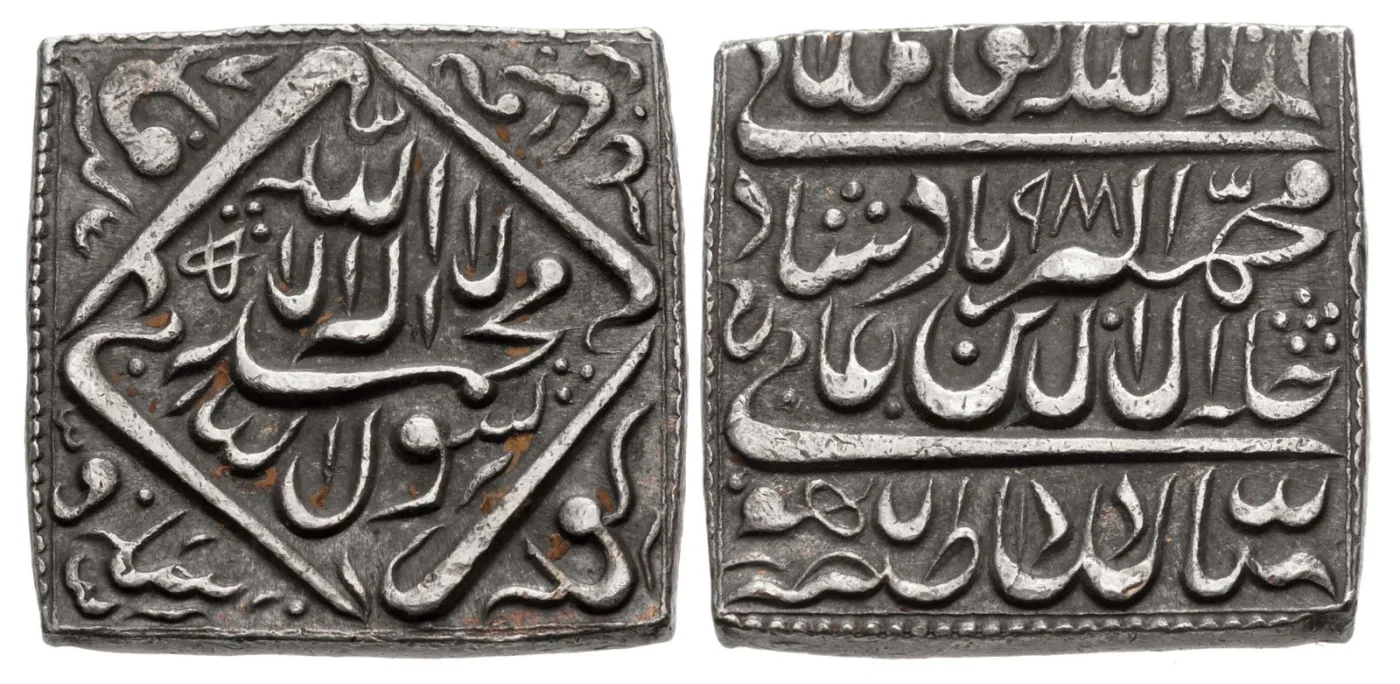
The first is the script trap. A coin whose legends are entirely in Arabic script is routinely catalogued as “Islamic” or “Arabic” or “Turkish” and set aside. A very large share of such coins in Western accumulations are Indian: Mughal, Sultanate, or princely-state issues, struck in Persian in Indian mint towns.
The second is the frozen date trap, and it is the most serious one in the whole field. From the middle of the eighteenth century, both the East India Company and many princely states struck coins in the name and with the date of a Mughal emperor who was long dead or powerless. A rupee reading AH 1202 may have been struck in 1830. The date on the coin is not a lie exactly, but it is not the year of striking, and treating it as one produces nonsense.
The third is the neighbour trap. Pakistan, Bangladesh, Nepal, Sri Lanka and Burma all used or still use a rupee, all have used Indian or Indian-derived denominations, and several used the same scripts. A “1 rupee” coin is not necessarily Indian.
The fourth runs the other way and costs people money. Because British India coins were struck in enormous numbers and travelled everywhere the Empire did, they turn up constantly in American, British and Australian accumulations, where they are binned as foreign junk. A pre-1940 British India silver rupee is a substantial piece of .917 fine silver — more silver than a US Morgan dollar has by fineness, if less by weight — and a 1939 rupee is one of the most valuable coins the Raj ever produced.
The Five-Step Identification Path
Nearly every Indian coin can be placed with five checks in this order. The rest of this guide is detail hung on that frame.
Step One: Identify the Writing System
Before reading anything, ask what alphabet you are looking at. Arabic or Persian script, Greek letters, Brahmi, Devanagari, Roman letters, or no writing at all — each answer eliminates most of Indian history. The next section turns this into a lookup table.
Step Two: Decide Whether There Is a Picture
Indian coinage divides sharply between figurative traditions and aniconic ones. Deities, kings, animals and symbols dominate the ancient and classical periods; Islamic-period coinage is almost entirely writing, by religious convention; the colonial and modern periods return to portraits and emblems. A coin with a human figure on it is either pre-thirteenth century, post-1835, or one of a small number of famous exceptions.
Step Three: Find the Date and Work Out Which Calendar It Uses
Indian coins carry dates in Hijri years, Mughal regnal years, Vikram Samvat, Saka, Fasli, and Gregorian years, sometimes two of them on the same coin. Converting them is arithmetic, not expertise, but you have to know which calendar you are in first. This is the same kind of problem posed by Japanese coins and Korean coins, where the era name has to be resolved before the number means anything.
Step Four: Weigh and Measure It
Indian denominations are defined by weight to a degree that Western ones are not, and for much of Indian history value was weight. A silver coin of about 11.6 g is a rupee or its ancestor, whatever century it is from. One of about 2.9 g is a quarter rupee. A gold coin of about 11 g is a mohur. Get a scale that reads to a tenth of a gram before you get a catalogue.
Step Five: Look for a Mint Mark or Mint Name
Islamic-period Indian coins name their mint in words. British India coins carry a tiny letter or symbol below the date. Republic coins carry a symbol below the date whose shape identifies the mint. In all three cases the mark is small, easy to miss, and frequently the difference between a common coin and a scarce one — exactly as it is with US mint marks.
The Script Tells You the Era
This is the single most useful table in Indian numismatics, and it works from across the room. Identify the writing and you have placed the coin within a few centuries before you have read a word.
- No writing at all, just small stamped symbols — punch-marked coinage, roughly 6th to 2nd century BC.
- Greek letters, often with a second script on the reverse — Indo-Greek and Bactrian, roughly 2nd to 1st century BC. The second script is Kharoshthi, which reads right to left.
- Greek-derived letters naming non-Greek gods, on gold or heavy copper — Kushan, 1st to 3rd century AD.
- Brahmi or early Sanskrit, on gold, with a king on one side and a seated goddess on the other — Gupta, 4th to 6th century AD.
- Arabic or Persian script only, no image — Delhi Sultanate, Mughal, Deccan sultanates, or princely state, roughly 1200 to 1900.
- English on one side, Persian or Nagari on the other, with a European portrait — East India Company or British India, 1835 to 1947.
- English and Devanagari together, with four lions — Republic of India, 1950 to today.
- A Tamil, Telugu, Kannada or Malayalam script — South Indian, most often a princely state such as Travancore or Mysore, or a medieval South Indian dynasty.
There are overlaps and exceptions, and the sections below cover them. But the table resolves the great majority of coins to the right chapter, and getting to the right chapter is most of the work.
The One Script Rule Worth Memorising
If a coin has Devanagari on it — the script of Hindi and Sanskrit, recognisable by the horizontal line running along the top of the letters, from which the characters hang — it is Indian, Nepali, or a princely state, and it is almost never anything else. Devanagari is the single most reliable positive indicator of Indian origin on a modern coin, and the horizontal top line makes it identifiable without knowing a single letter.
Five Calendars and How to Convert Them
Indian coins are dated in whichever era their issuer used, and several of those eras are still in use today. Each conversion is a single arithmetic step.
Hijri (AH) — the Islamic Lunar Year
Used on Sultanate, Mughal, Deccan and most princely Muslim coinages, and written in Arabic numerals of the Eastern style. Because the Islamic year is lunar and about eleven days shorter than a solar year, you cannot simply add a constant. The working formula is:
- CE ≈ AH + 622 − (AH ÷ 33)
So AH 1027 gives 1027 + 622 − 31 = 1618, and AH 1202 gives 1202 + 622 − 36 = 1788. The result straddles two Gregorian years, so express it as a pair — AH 1202 = 1787/88 — unless you have a month as well. Thirty-three Hijri years pass in about thirty-two solar ones, which is where the division comes from.
Regnal Years (RY) — Years Since Accession
Mughal coins usually carry a regnal year alongside or instead of the Hijri year, expressed as a plain number. Regnal years are only meaningful once you know the ruler and the accession year, which is why the ruler’s name has to be read first. Many Mughal coins carry both AH and RY, and the pair is a powerful check: an impossible combination is a strong sign of a modern fabrication.
Ilahi Era — Akbar’s Solar Reckoning
Akbar abandoned the Hijri year on much of his coinage in favour of a solar era counted from his own accession in 1556, known as the Ilahi or Divine era. Add 1555 or 1556 depending on the month. Jahangir restored the Hijri year, so Ilahi dates are essentially an Akbar-period marker.
Vikram Samvat (VS) — the Hindu Era
Used widely on princely-state coinage, especially in Rajputana and central India, and still the official calendar of Nepal. It runs 57 years ahead of the Gregorian:
- CE = VS − 57
So VS 1990 is 1933. A four-digit date in the 1900s or 2000s on a coin that plainly is not from that century is very often Vikram Samvat, and this is the commonest single reason a princely-state coin gets misdated by decades.
Saka and Fasli
The Saka era, India’s national calendar for civil purposes, runs 78 years behind the Gregorian, so CE = Saka + 78. It appears occasionally on South Indian and modern commemorative material. The Fasli era, a solar reckoning used in the Deccan and by Hyderabad for revenue purposes, runs roughly 590 years behind, so CE ≈ Fasli + 590. Both are far less common on coins than Hijri and Vikram Samvat, but both exist and both will mislead you badly if you assume Gregorian.
Punch-Marked Silver: India’s First Coins
India’s earliest coins owe nothing to Greece or Persia. They appear in the sixth or fifth century BC, roughly contemporary with the first Lydian electrum and the first archaic Greek silver, and they are built on a completely different principle: instead of one design struck across the whole coin by a pair of dies, several small symbols are punched separately into a blank.
What They Look Like
A punch-marked coin, or karshapana, is a piece of silver cut from a hammered sheet, so it is irregular — roughly rectangular, oval, or plain lumpy — with clipped edges where it was trimmed to weight. On one face are several distinct small stamps, each impressed with its own punch, often overlapping and running off the edge. The other face is blank or carries a few smaller marks.
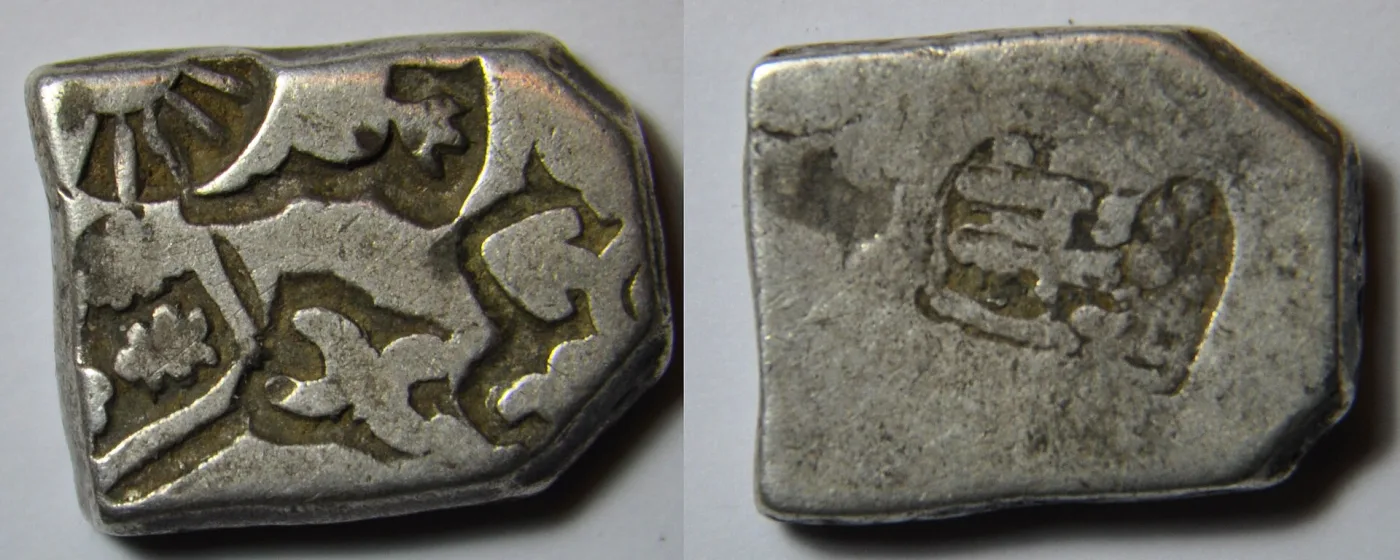
The imperial series associated with Magadha and the Mauryan empire carries five obverse punches. Two of the five are near-constant: a sun symbol and a six-armed symbol. The other three vary, and it is those three that identify the issue. More than 450 distinct symbols have been recorded and over 600 varieties catalogued.
Specifications and Testing
The weight standard is about 32 rattis, roughly 3.4 g, and that figure is the fastest authenticity check available. Purity is not high by later standards: typically 50 to 70 per cent silver, alloyed with copper and trace metals, which is why genuine examples are often grey rather than bright and why a suspiciously white “punch-marked coin” deserves scrutiny.
These are among the most affordable genuinely ancient coins on the market, and also among the most confidently faked, because the irregular shape and crude stamps are easy to imitate and hard to compare against a reference image. The standard attribution work is Gupta and Hardaker, and it is difficult to obtain; without it, attribution beyond “imperial series, Mauryan period” is not realistic for most collectors.
Greeks, Kushans, and the First Portraits
Alexander’s successors left a Greek-speaking political world on India’s northwest frontier, and its coinage is some of the finest ever struck anywhere.
Indo-Greek and Bactrian Coins
The Greco-Bactrian and Indo-Greek kings ruled in what is now Afghanistan, Pakistan and northwest India from roughly the second century BC. Their coins introduced two things to India that stayed: the struck portrait, and the bilingual legend.
The identification pattern is unmistakable. The obverse carries a realistic royal portrait and a Greek legend giving the king’s name and titles — BASILEOS SOTEROS MENANDROU, “of King Menander the Saviour”. The reverse carries a deity and the same information again in Kharoshthi, a script derived from Aramaic that reads right to left. A coin with Greek on one side and a right-to-left Indian script on the other is Indo-Greek or one of its immediate successors, and nothing else.
Indo-Greek copper introduced another lasting Indian habit: the square flan. Square and rectangular copper coins recur throughout Indian numismatics, from Indo-Greek bronzes through Mughal copper dams to the square five paise of the 1960s.
Kushan Gold and the Roman Connection
The Kushans, who ruled a vast territory from the first to the third century AD, struck a gold coinage in a unit called the dinara at about 8 g — deliberately matched to the weight of the Roman aureus, because Roman gold was flowing into India in enormous quantities to pay for pepper, spices, gems and cotton. Roman coin hoards are found in southern India to this day, and Pliny complained in print about the drain of Roman bullion eastward. If you collect ancient Roman coins, the Kushan dinara is the coin at the other end of that trade.
Kushan coins name their reverse deities in a Greek-derived script adapted for the Bactrian language, and the roll-call is remarkable: OHÞO for Oesho, a form of Shiva; MIIPO for the sun god; NANA, ARDOXÞO; and on a small number of coins of Kanishka I, BOΔΔO — Boddo, the Buddha. Those are the earliest coin portraits of the Buddha known, and they are among the most sought-after coins in the entire Indian series.
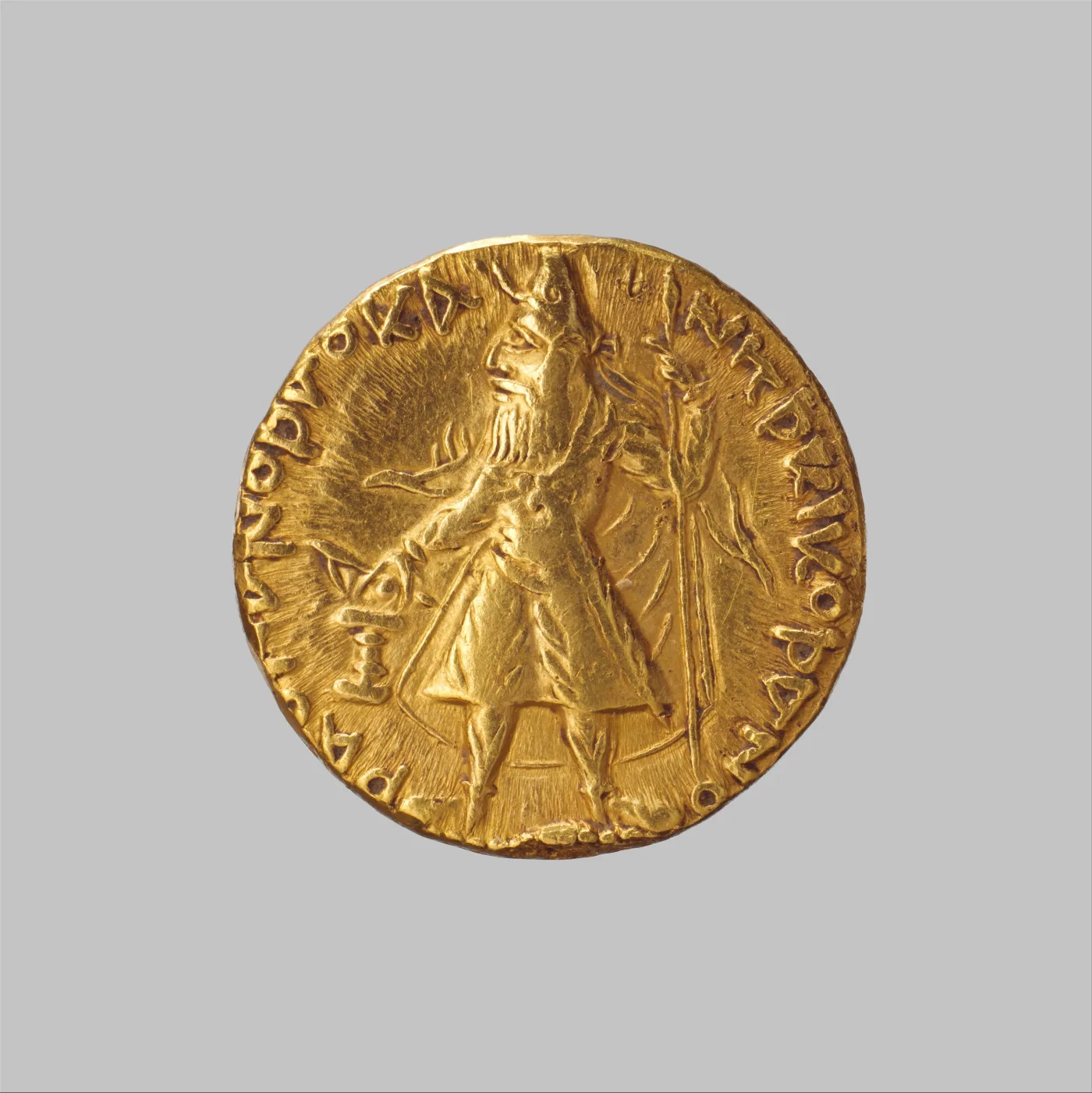
The obverse typically shows the king standing at an altar, in trousers and a heavy coat, sacrificing — not a classical pose at all. A standing, trousered, bearded king with a deity on the reverse named in oddly-spelled Greek capitals is Kushan.
Gupta Gold: The Classical Coinage
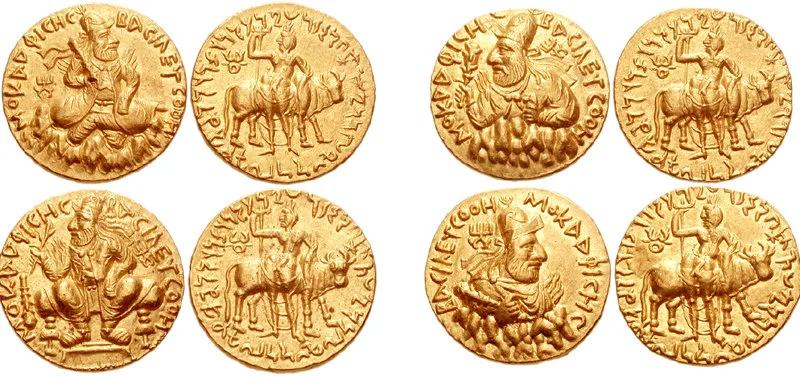
The Gupta empire, roughly 320 to 550 AD, produced what is usually considered the artistic high point of Indian coinage: a gold dinara series, following the Kushan weight standard and rising over time from about 7.8 g toward 9 g, with Sanskrit legends in Brahmi script.
The structure is consistent and makes Gupta coins genuinely enjoyable to identify. The obverse shows the king doing something. The reverse shows a seated goddess, usually Lakshmi, with a legend giving the king’s title. The activity on the obverse is the type name:
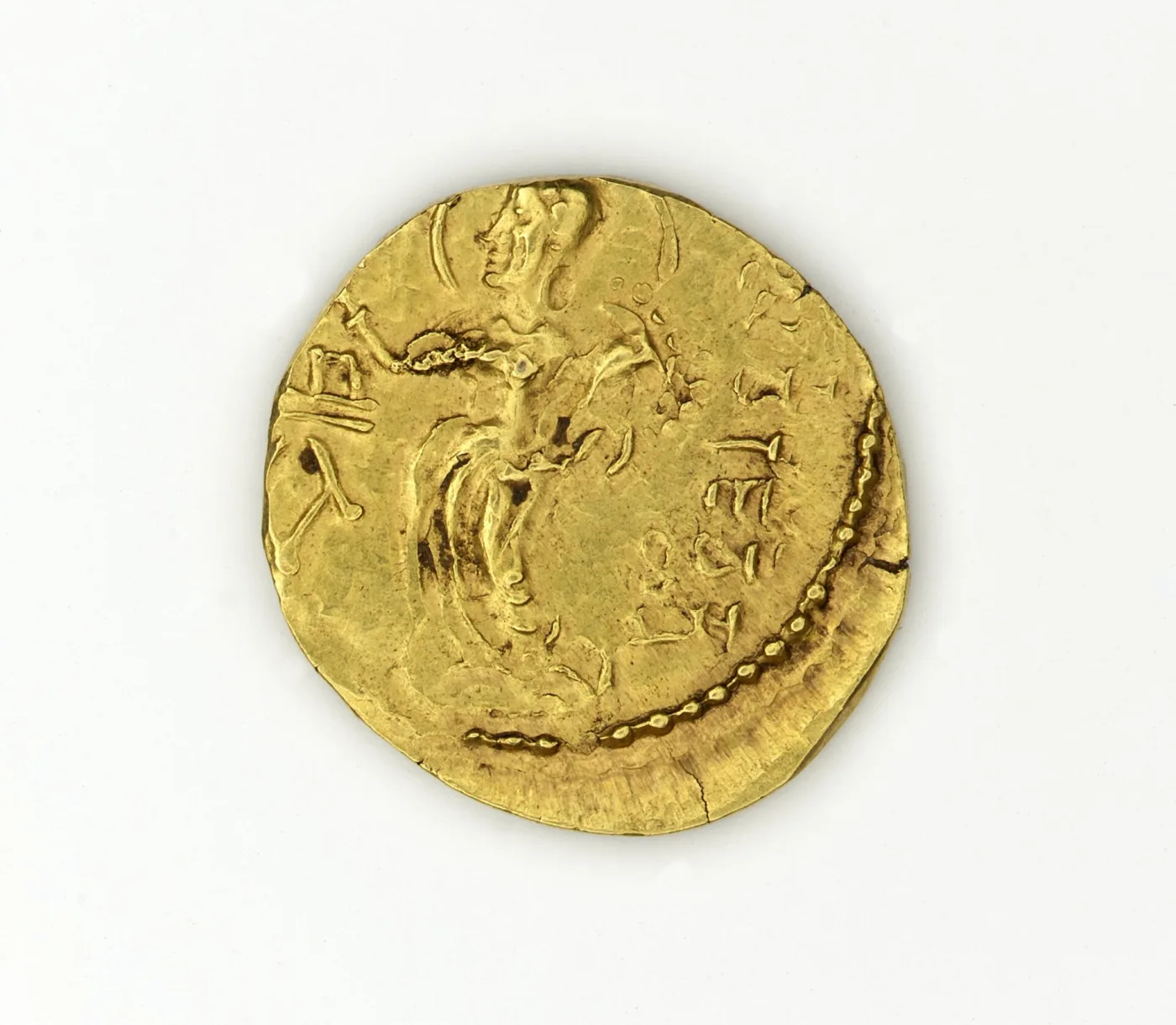
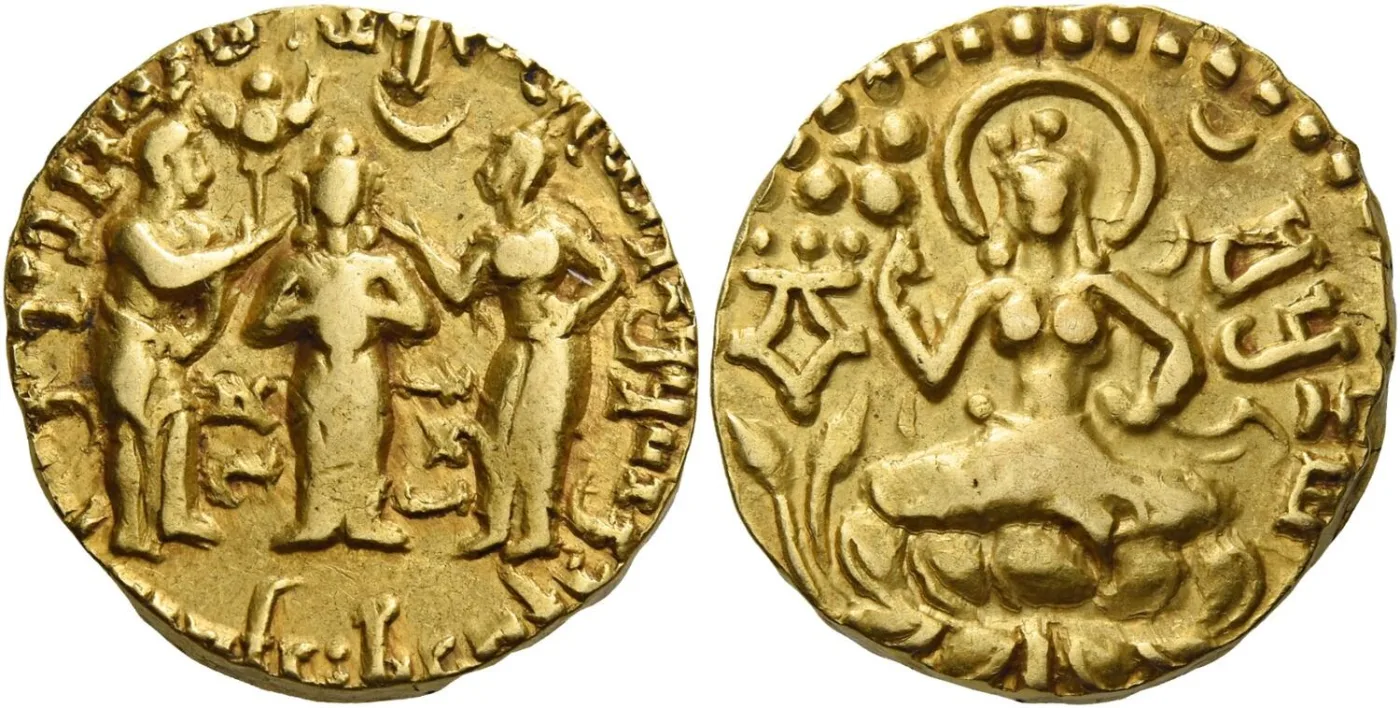
- Archer — the king standing with a bow. The commonest type by far.
- Lion-slayer and Tiger-slayer — the king shooting or trampling the animal.
- Horseman — the king mounted.
- Ashvamedha — a horse before a sacrificial post, commemorating the horse sacrifice that asserted imperial status.
- Lyrist — the king seated playing a veena. Struck for Samudragupta, and one of the few coins anywhere to show a monarch making music.
- King and Queen — Chandragupta I with Kumaradevi, naming both.
Gupta gold is expensive, heavily faked, and worth a specialist opinion before purchase. The names to know are Chandragupta I, Samudragupta, Chandragupta II, Kumaragupta I and Skandagupta, and the legends give them in Sanskrit with honorifics rather than in a form a beginner can match by eye. Weight and gold purity are the practical first filters.
The Delhi Sultanate and the Silver Tanka
From about 1200, north India came under Turkic and Afghan Muslim rule, and the coinage changed character completely. Figures disappeared. Legends became the whole design: the Islamic declaration of faith, the ruler’s name and titles, the mint, the date, arranged in Arabic script inside circles, squares and lozenges.
Iltutmish, in the early thirteenth century, standardised the silver tanka at roughly 11 g, and the billon jital for small change. That 11-gram silver unit is the direct ancestor of the rupee, and its persistence across seven centuries and half a dozen dynasties is the reason an 11.6 g silver coin is such a reliable Indian marker.
The Token Coinage of Muhammad bin Tughluq
One Sultanate episode deserves its own note because it produces coins people cannot place. Between about 1330 and 1332, Muhammad bin Tughluq issued brass and copper tokens intended to circulate at the value of silver tankas — a forced fiat currency six centuries before the idea became normal. It failed spectacularly. Because the tokens were plain inscribed metal with no secure design, households across north India produced their own, the treasury was flooded with counterfeits, and the experiment was abandoned and the tokens redeemed.
The result is a body of copper and brass coins carrying grand Persian legends about the sultan’s authority, in wildly variable quality, many of them contemporary forgeries. As with the Korean quarter-yang described in the guide to Korean coins, the period counterfeits are now a legitimate collecting area in their own right.
Mughal Coinage: Reading a Coin With No Picture
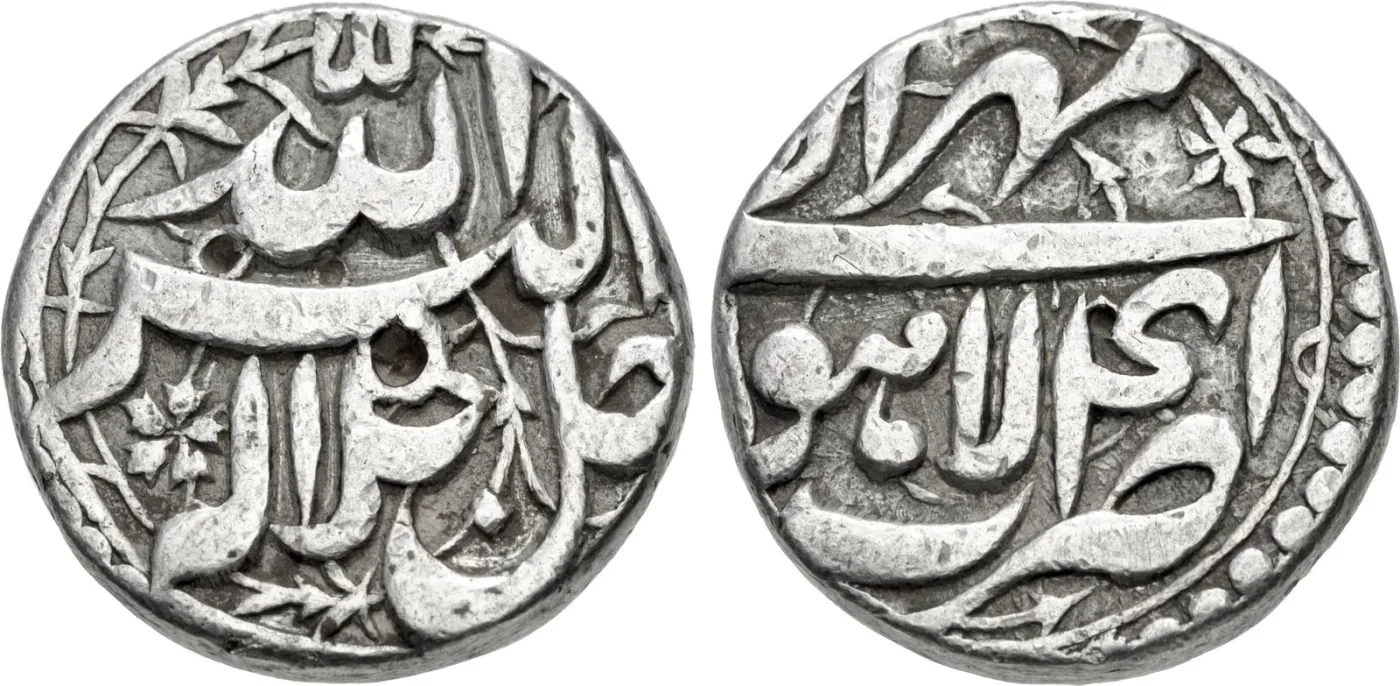
The Mughal empire, from Babur’s victory in 1526 to its formal end in 1858, produced the largest and most systematic Indian coinage before the colonial period, and the one most often found unattributed in Western collections. Mughal coins are almost always writing only, in Persian, on both faces, in a beautifully controlled calligraphy that most Western collectors cannot read.
You do not need to read Persian to place one. You need to know what four things to look for and roughly where they sit.
The Three Metals and Their Weights
- Mohur — gold, about 10.9 to 11 g.
- Rupee — silver, about 11.4 to 11.6 g.
- Dam or paisa — copper, considerably heavier for its value, often around 20 g, and frequently square.
Fractions and multiples of each exist, including presentation mohurs of extraordinary size. Weight alone will usually tell you which denomination you have, and the mohur and rupee weighing almost the same is the reason metal has to be established first.
Sher Shah Suri and the Word “Rupee”
The name comes from an interruption in Mughal rule. Sher Shah Suri, who drove Humayun out of India and ruled from 1540 to 1545, standardised a silver coin of 178 grains — about 11.53 g — at high purity and called it the rupiya. The Mughals adopted the standard when they returned, the East India Company adopted it from the Mughals, and the modern Indian, Pakistani, Sri Lankan, Nepali, Mauritian, Indonesian and Maldivian currencies all descend from that name. Few coins have left a longer linguistic trail.
What Is Written On It
A typical Mughal rupee carries, distributed across the two faces: the ruler’s name and regnal titles; a religious formula or a Persian couplet in praise of the ruler; the mint name, spelled out in words rather than abbreviated to a letter; the Hijri year; and the regnal year. More than two hundred mints operated at various times, and the mint name is often the most legible element for a non-reader because it recurs in a fixed position and can be matched against a chart of mint-name forms.
Akbar introduced the practice of putting Persian verse on coins, which his successors continued. Aurangzeb went the other way and removed the kalima, the declaration of faith, from his coinage — on the reasoning that coins pass through unclean hands — replacing it with a couplet. The presence or absence of the kalima is therefore a broad period marker.
The Two Famous Exceptions
Jahangir, who ruled from 1605 to 1627, broke the aniconic convention twice. He struck portrait coins showing himself seated, in some cases holding a wine cup — extraordinary objects by the standards of Islamic coinage. And from his thirteenth regnal year, corresponding to AH 1027, he replaced the month name on his coins with its zodiac sign, producing the celebrated zodiac mohurs and rupees: a ram, a bull, twins, a crab, a lion and so on, one for each month. The gold series is known for all twelve signs; the silver only for the first five months, struck at Ahmedabad. These are among the most famous and most valuable of all Indian coins, and correspondingly among the most faked.
Dating a Mughal Coin
Dating is where Mughal identification gets interesting, because the date on the coin frequently is not the year it was made.
The Normal Case
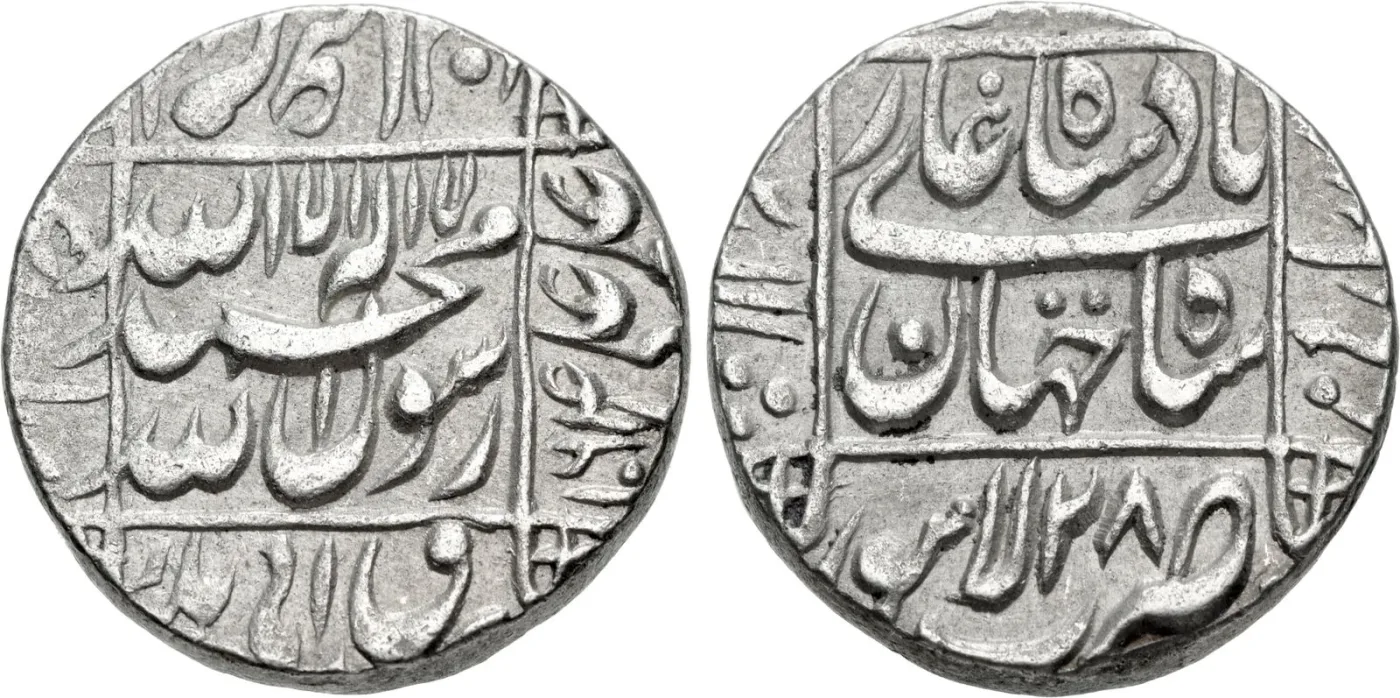
Most Mughal coins carry a Hijri year in Eastern Arabic numerals and a regnal year as a plain number. Convert the Hijri year with the formula in the calendars section, identify the ruler from the legend, add the regnal year to the accession year, and the two answers should agree within a year. When they agree, you have a solid date.
Frozen Dates and the Shah Alam II Trap
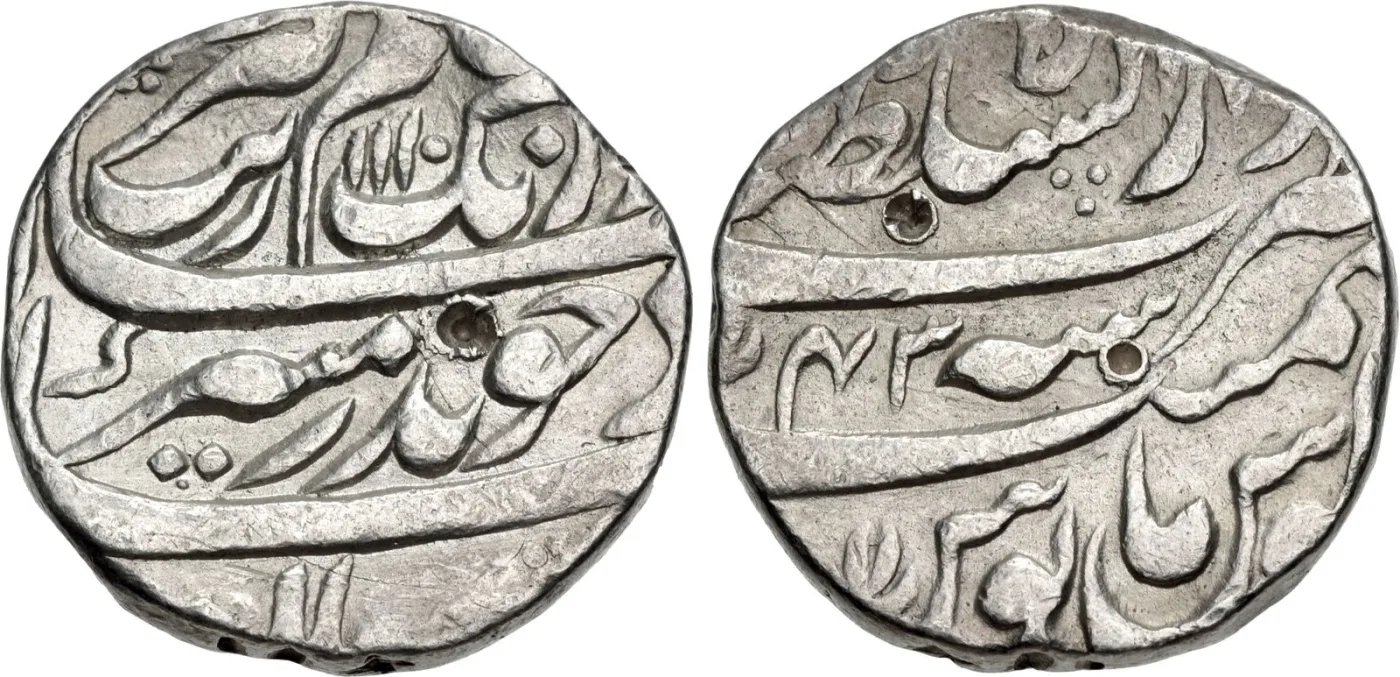
By the 1750s Mughal authority was collapsing but Mughal coin authority was not: merchants across India trusted a Mughal rupee and were suspicious of anything new. So everybody kept striking Mughal rupees. The East India Company’s presidency mints did it. So did dozens of princely states, the Marathas, and regional governors.
To keep the coins interchangeable, they froze the legend — often in the name of Shah Alam II, with a fixed Hijri year and a fixed regnal year, repeated identically for decades. The best-known combination pairs AH 1202 with regnal year 19. Coins bearing it were struck in quantity long after the year the legend names, and long after Shah Alam II had ceased to rule anything.
The practical consequences are worth stating plainly. First, a Mughal-legend rupee with an eighteenth-century date may be a nineteenth-century product of a British or princely mint. Second, the coin’s real attribution comes from stylistic details, the mint name, and small privy marks — not from the date. Third, a Mughal-style rupee is not automatically “Mughal” in the dynastic sense. This is the closest Indian equivalent to the way a Chinese cash coin’s reign title fixes its era but a Japanese Kan’ei Tsuho’s does not, a distinction drawn out in the guide to Japanese coins.
Undated and Partly Struck Coins
Hand-struck coins on irregular blanks routinely lose part of the legend off the edge, and the date is as likely to be lost as anything else. A Mughal coin with no visible date is not defective and not unusual. Attribution then rests on the ruler’s name, the mint, the calligraphic style and the weight, and a specialist can often place such a coin closely while a beginner cannot place it at all.
Princely States: Hundreds of Separate Coinages
Alongside the Mughals and then the British, Indian princely states struck their own money. Before the monetary unification of 1835 the number of issuing authorities ran into the hundreds; afterward a diminishing number retained the privilege, and several dozen were still striking coins into the twentieth century. A few continued past independence.
This is the part of Indian numismatics with the most unidentified material in circulation, because the coins are small, often crude, dated in unfamiliar eras, legended in regional scripts, and absent from general catalogues in any depth.
The States You Will Actually Encounter
- Hyderabad — the largest and richest state, ruled by the Nizams, striking gold, silver, copper and nickel into the late 1940s. Urdu legends, and on many issues the Charminar, the four-minaret gateway of Hyderabad city, which makes them among the easiest princely coins to recognise.
- Travancore — on the southwest coast, with a distinctive tiny silver and gold coinage in units called chuckram and fanam, some of the smallest struck coins in the world, plus a conch-shell emblem and Malayalam or Tamil script.
- Gwalior — ruled by the Scindias, with coins naming Madho Rao and later Jivaji Rao, usually dated in Vikram Samvat.
- Baroda — the Gaekwads, best known for the coinage of Sayaji Rao III.
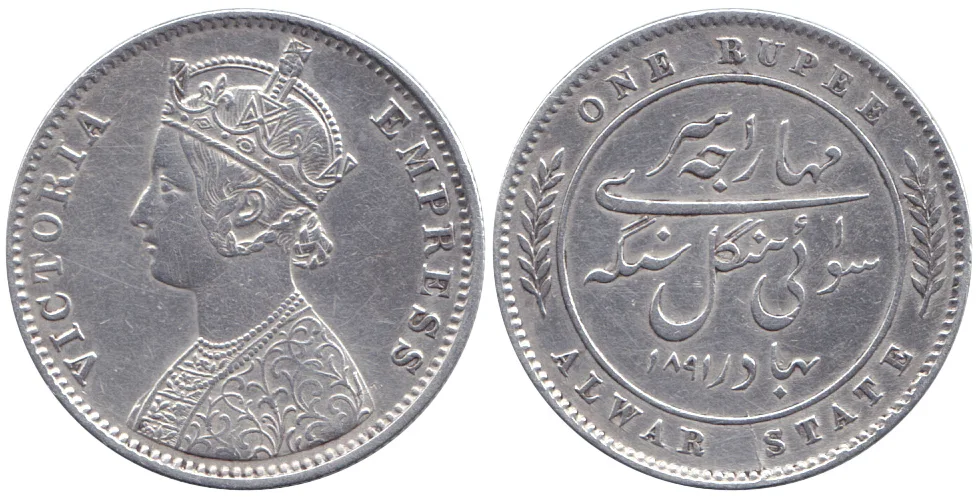
- Kutch — a unit called the kori, and a striking hybrid arrangement in which the coin names the local ruler and carries the British monarch’s imperial title, often in Devanagari. A coin reading “Victoria Empress” in Devanagari beside a Kutch ruler’s name is doing exactly what it appears to be doing.
- Mewar and the Rajputana states — Udaipur, Jaipur, Jodhpur, Bikaner, Alwar and others, many with legends referring to friendship with London, and dates in Vikram Samvat.
- Indore, Dewas, Dhar, Sailana, Junagadh and Bahawalpur — smaller issuers whose coins turn up constantly in mixed lots.
How to Approach an Unknown Princely Coin
Work in this order: metal, weight, diameter, script, any recognisable emblem, then date. Try the date as Vikram Samvat first if it is a four-digit number in the 1800s or 1900s that does not fit the coin’s apparent age, then as Hijri. Then match the emblem, because emblems are more distinctive than legends on this material — the Charminar, a conch, a katar dagger, a sun face, a trident.
Only then reach for the catalogue. The Standard Catalog of World Coins covers princely states in a compressed form that is enough for common types; anything scarce needs specialist literature or a forum with regional expertise.
The East India Company Presidencies
The Company acquired coining rights in India piecemeal, and for roughly two centuries it ran three separate currency systems out of its three presidencies — Bengal, Bombay and Madras — with different standards, different denominations and different designs. A Bengal rupee was not interchangeable with a Bombay rupee, which is precisely the problem that 1835 solved.
Mughal-Style Company Coins
Early presidency silver and gold generally imitates Mughal coinage closely: Persian legends, a Mughal emperor’s name, a frozen date, and no indication in English that a European company was involved. These are the coins most often filed as “Mughal” in Western collections. The mint names — Murshidabad, Arcot, Surat and others — and the frozen-date combinations are what separate them.
Coins That Announce the Company
From the late eighteenth century, presidency coins increasingly carry Company iconography and English legends. Look for:
- The Company’s arms and crest, most recognisably a lion holding or supporting a crown, with supporters and heraldic detail.
- The motto AUSPICIO REGIS ET SENATUS ANGLIAE — “under the auspices of the King and Parliament of England”.
- The words EAST INDIA COMPANY in plain English.
- Madras Presidency denominations that are not rupees at all: the gold pagoda, and the fanam, alongside heavy copper struck to a weight standard rather than a face value.
Madras copper of the early nineteenth century is often dated in the Christian era with English legends, making it the easiest presidency material for a Western collector to place. Bengal and Bombay took longer to Anglicise.
1835: The Uniform Coinage and the First Portrait Rupees
The Uniform Coinage Act of 1835 is the pivot of the whole colonial series. It merged the three presidency coinages into one, and defined a silver rupee of 180 troy grains at eleven-twelfths fine — that is, 11.66 g at .9167 fineness — as the sole legal tender across British India. Those numbers held, without alteration, for more than a century.
The 1835 coinage also put a European portrait on an Indian coin for the first time in the Company’s own name. The William IV rupee carries the king’s bust facing right, engraved by William Wyon of the Royal Mint, with the reverse reading EAST INDIA COMPANY above and ONE RUPEE below within a wreath under a crown, and the value repeated in Persian. Diameter 30.5 mm, weight 11.66 g.
This is the coin that gave the subcontinent a single currency, and it is the direct ancestor of every Indian rupee since. It also sits in the same commercial world as the great trade silver of the period — the Spanish colonial eight reales and the crown-sized coins that Asian merchants weighed rather than counted, a habit the guide to the US Trade Dollar traces in detail.
The 1840 Victoria Rupees
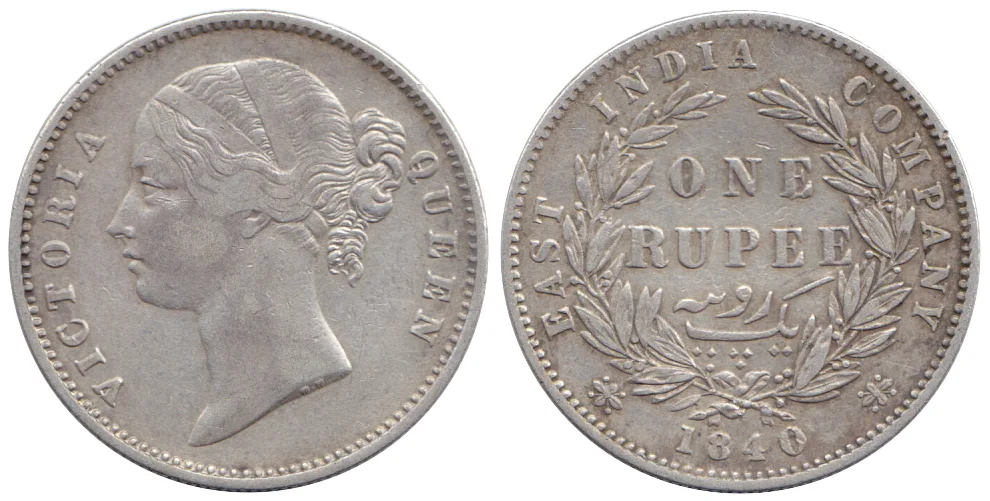
Victoria succeeded in 1837, and Company rupees carrying her young head appeared from 1840. These generated the first great variety hunt in the series: the reverse legend appears both divided by the wreath and continuous around it, and there are several distinguishable bust and lettering types. Many of these coins are dated 1840 regardless of when they were struck, which makes the varieties, not the date, the way to place them.

Victoria: Queen, Empress, and the Frozen 1862
The Indian Rebellion of 1857 ended Company rule. The Crown took direct control, and the first coinage issued under Crown authority appeared in 1862. From that point Indian coins are unambiguously British India rather than East India Company, and the obverse legend gives you a free date split.
VICTORIA QUEEN Versus VICTORIA EMPRESS
In 1876 Disraeli had Victoria proclaimed Empress of India, and instructions issued that November required VICTORIA EMPRESS to replace VICTORIA QUEEN on all coins struck on or after 1 January 1877. So:
- VICTORIA QUEEN — struck 1862 to 1876.
- VICTORIA EMPRESS — struck 1877 to 1901.
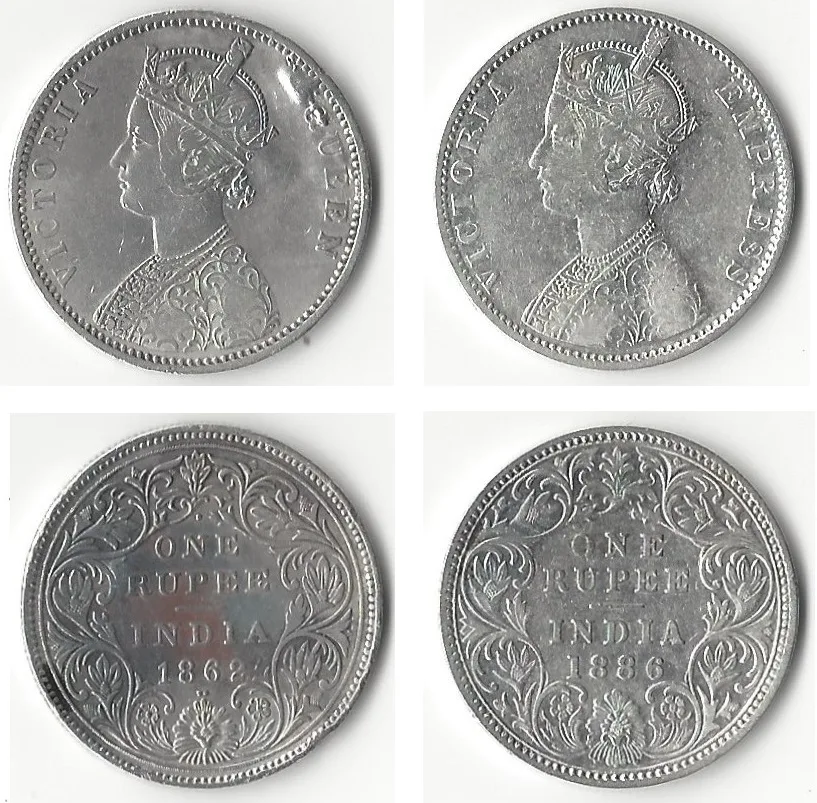
That one word dates a worn coin whose numerals are gone, which is exactly the sort of legend-based dating the guide to British coins relies on for the home coinage.
Why So Many Coins Are Dated 1862
Here is the second frozen-date problem in the series, and it catches everyone. The 1862 rupee was struck for years after 1862 with the date left unchanged, because a new date on a familiar coin invited suspicion in the bazaar. An enormous number of surviving “1862” rupees, half rupees and quarter rupees were made well after that year.
The Mint distinguished the actual year of striking with tiny privy marks — small dots placed above or below the flower in the reverse wreath, in varying numbers and positions, and on some issues a die number. Cataloguing an 1862-dated coin properly means counting those dots. Most sellers do not, which is why “1862 rupee” listings vary so wildly in price for coins that look identical at a glance.
Victoria Empress coins, from 1877 onward, carry genuine years of striking. The frozen-date era ends with the Queen legend.
Edward VII, George V, and the 1911 Pig Rupee
Edward VII’s coinage ran from 1903 to 1910 and is straightforward: crowned bust, EDWARD VII KING & EMPEROR, real dates. George V succeeded in 1910, and his first Indian coinage produced the most famous scandal in the series.
The 1911 Rupee
The new George V rupees were struck at Bombay and Calcutta and released to treasuries for issue on 12 December 1911, Durbar Day. The obverse shows the king wearing the robe and collar of the Order of the Indian Empire, and on the collar sits a small elephant. The engraving gave the animal a short trunk, short legs and a stubby tail, and it read to a great many people as a pig.
For Muslim and Hindu Indians alike, for different reasons, a pig on the coinage was intolerable, and the rumour spread faster than the coins did. Of roughly 9.4 million struck, about 700,000 had been issued when the government ordered withdrawal on 23 January 1912. The withdrawn coins and the unissued balance were melted.
The dies were recut for 1912, giving the elephant a longer trunk and clearer legs, and the revised design ran on rupees through 1922 and on fractional silver into the 1930s. The result is that the 1911 “pig rupee” is a one-year type whose survivors are the small fraction that escaped the melting pot, and it carries a substantial premium over the common George V dates. Comparing the 1911 elephant with a 1912 one side by side is the whole authentication test, and photographs of both are easy to find.
George VI, 1938 to 1947
Edward VIII abdicated before any Indian coins were struck for him, so the series runs straight from George V to George VI in 1938. George VI’s Indian coinage is the most commonly encountered British India material of all, and it is also where the metal stops being what it looks like — which the silver section takes up.
Shape Is the Denomination
This is the most useful practical section in the guide for anyone holding a handful of small British India coins, because the Indian mints did something no Western mint of the period did: they used shape as the primary denominational signal on the minor coinage. You can sort a pile of British India minors by touch, in the dark, without reading a word.
- Scalloped, with twelve notches, about 20.5 mm — ONE ANNA. Copper-nickel and 3.8 g from 1912 to 1936; nickel-brass and 3.89 g from 1942 to 1945. Nothing else in the series is scalloped.
- Square with rounded corners, about 25.3 mm across — TWO ANNAS. Copper-nickel, 5.7 g, 1918 to 1936 and again under George VI.
- Square with rounded corners, about 19.8 mm across — HALF ANNA. Nickel-brass, 2.92 g, 1942 to 1945.
- Round with a hole in the middle, about 21.3 mm — ONE PICE. Bronze, 2 g, 1943 to 1947. The hole was a wartime metal economy.
- Round bronze, large, about 25.4 mm — QUARTER ANNA, the workhorse copper of the Raj.
- Round bronze, small, about 17 mm — ONE TWELFTH ANNA, also called one pie.
- Round silver — quarter rupee at 2.92 g and 19 mm, half rupee at 5.83 g, rupee at 11.66 g and 30.5 mm.
The two square coins are the only pair that can be confused, and the difference is 5.5 mm and nearly 3 g — obvious side by side and easy on a scale.
The Denomination Ladder Itself
British India money was not decimal and not the British pounds-shillings-pence system either. It ran:
- 3 pies = 1 pice
- 4 pice = 1 anna (so 12 pies = 1 anna)
- 16 annas = 1 rupee (so 64 pice, or 192 pies, to the rupee)
Two wartime denominations sit outside the usual run and are worth knowing because both are scarce. A copper-nickel four annas was struck only from 1919 to 1921, and a copper-nickel eight annas only in 1919 and 1920 — substitutes for silver during the post-war bullion crisis. The 1920 eight annas is the scarcer of the two dates and a genuinely valuable coin.
Reading the Trilingual Value
British India reverses generally state the denomination three times: in English, in Devanagari, and in Urdu in the Persian script. A rupee reads ONE RUPEE, एक रुपया, and ایک روپیہ. If you can pick out the Devanagari, you can confirm a denomination without reading the English at all — useful on coins worn on one side.
What British India Silver Actually Contains
British India silver has three phases, and the date is the only way to tell them apart, because the coins look identical.
- 1835 to 1939 — .9167 fine (eleven-twelfths). A rupee of 11.66 g contains about 10.69 g of silver, roughly 0.344 troy ounces.
- 1940 to 1945 — .500 fine. Same 11.66 g coin, about 5.83 g of silver. Wartime silver shortage, and the same debasement decision Australia made in 1946.
- 1947 — no silver at all. The final British India rupee is pure nickel, 11.8 g and 28 mm, with a completely new reverse showing an Indian tiger. It is the only British India rupee struck for circulation with no precious metal in it.
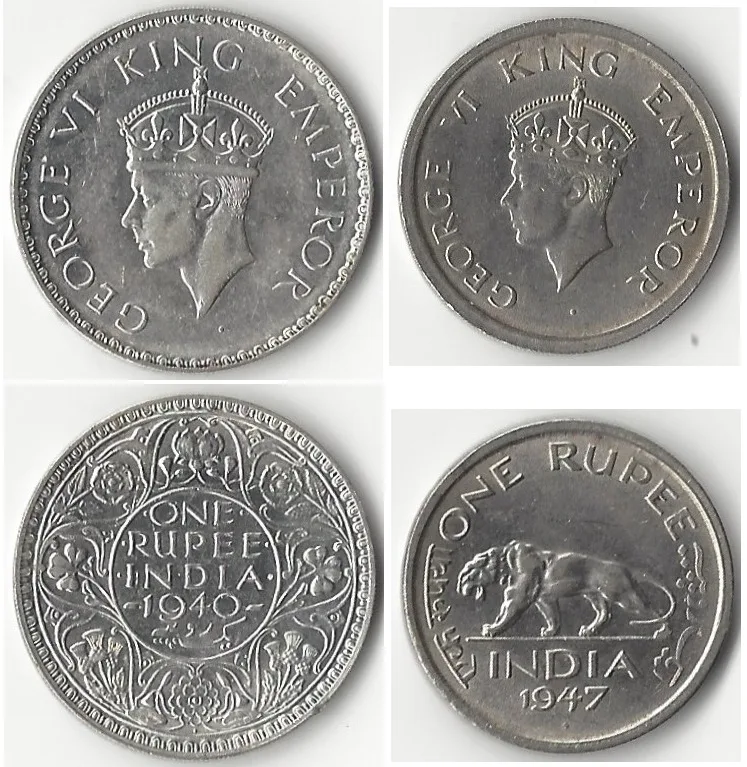
That 1940 boundary is worth internalising, because it nearly halves the melt value of a coin that looks and weighs exactly the same. A pre-1940 rupee holds about a third of a troy ounce of silver, which puts it squarely in the same category as the US 90 per cent coinage discussed in the guide to junk silver — a bullion coin that happens to be a historical artefact.
Two practical notes follow. First, weigh and check the date before selling British India silver as scrap: the .917 coins are worth appreciably more per piece. Second, reach for a magnet. Nickel is ferromagnetic and silver is not, so a British India rupee that sticks to a magnet is either the 1947 nickel issue or a base-metal fake — it is never a silver coin. That one test separates the last British India rupee from every one of its predecessors in a second, in the same spirit as the magnet test that separates iron Japanese cash from brass Chinese cash.
Mint Marks on British India Coins
British India mint marks are small symbols placed below the date, or on the George VI rupees below the lotus at the bottom of the reverse. They are easy to miss and they matter.
- No mark — Calcutta. India’s senior mint, and the default. An absent mark is information, not an absence of it.
- A dot, or a diamond — Bombay. Bombay used a small round bead on some issues and a diamond on others; on 1944 issues the mark appears as a dot above a diamond.
- A raised letter L — Lahore, which struck from 1943 to 1945 and is now in Pakistan.
- A small round dot — Pretoria, South Africa, which struck Indian coinage in 1943 and 1944 when Indian mint capacity could not keep up with wartime demand.
- A letter H — the Heaton mint in Birmingham, on some earlier issues.
The Bombay and Pretoria Problem
Both Bombay and Pretoria used a small round dot, which means shape alone does not always separate them. On the coins where both are possible, the distinction rests on the exact form and placement of the dot and on which denominations and dates each mint actually struck, so a specialist listing rather than a general catalogue is required. If you have a wartime British India coin with a plain dot, “Bombay or Pretoria” is an honest answer until you check.
Indian mints also worked in the other direction during this period. Bombay and Calcutta struck coins for other parts of the Empire, and the Bombay dots on certain Australian pennies of the 1940s are the mirror image of the arrangement described here — an Indian mint mark on an Australian coin.
The 1939 Rupee and the Other Key Dates
British India coinage was struck in vast quantities and most dates are common. A small number are not, and one of them is spectacular.
The 1939 One Rupee
The 1939 George VI rupee is the outstanding rarity of the modern Indian series. It was the last rupee struck at the old .9167 standard. When war broke out and silver prices rose, the coins were worth more melted than spent, and the great majority were withdrawn and destroyed; from 1940 the rupee was struck at .500 fine. What survives is a small residue of a coin that was never scarce when it was made.
Prices quoted in the Indian market for genuine examples run into several hundred thousand rupees, and well into seven figures for high grade. That level of value has exactly the effect you would expect: the 1939 rupee is one of the most altered and counterfeited coins in Indian numismatics, most often by reworking the final digit of a common 1938 or 1940 coin. Any 1939 rupee offered without certification should be assumed altered until proven otherwise, and the alteration tests in the guide to counterfeit detection apply directly.
The Rest of the List
- 1938 one rupee — the first George VI rupee and the other .9167 fine date. Common relative to 1939 but a substantial premium coin.
- 1911 one rupee — the pig rupee, withdrawn after about 700,000 pieces were issued.
- 1920 eight annas — the scarcer of the two years this denomination existed.
- 1947 issues — the tiger rupee, half rupee and quarter rupee, and the last coins struck for India under British authority. Not rare, but collected as a closing date by everyone who collects the series.
- Victoria Empress transitional and low-mintage fractional silver — several dates in the 1877 to 1901 run are much scarcer than the common ones, and this is where a catalogue earns its price.
The pattern is the familiar one described in the guide to key dates: what makes a coin scarce is usually not a low original mintage but something that destroyed the survivors afterward. In British India that something was almost always the melting pot.
1947 to 1950: The Frozen Series
India became independent on 15 August 1947 and a republic on 26 January 1950, but its coinage did not change on either date. The existing currency arrangements were continued as a stop-gap until 15 August 1950, and collectors call that interval the frozen series.
What was frozen was the arrangement, not the calendar. The coins circulating in independent India between 1947 and 1950 were the existing British India issues, dated 1947 and earlier, still carrying George VI’s portrait and the legend KING EMPEROR — a British monarch styled Emperor of India on the money of a country that had left the Empire. The 1947 tiger issues were the last coins struck for India under British authority, and no new Indian design appeared until 1950.
This is why a George VI coin is not evidence that a collection predates independence, and why the transition in the coinage lags the transition in the history books by three years. On the British side of the same event, the imperial title IND:IMP: disappeared from British coins after 1948, so the two coinages record the end of the Raj a year apart.
The 1950 Anna Series
The first coinage of the Republic of India appeared on 15 August 1950, three years to the day after independence. It kept the old money — sixteen annas to the rupee — and replaced everything else.
The Obverse
The king’s head gave way to the Lion Capital of Ashoka: the third-century-BC sculpture from Sarnath showing four lions back to back, of which three are visible on a coin and the fourth is hidden behind. Below it on most issues is the motto Satyameva Jayate, “truth alone triumphs”, and around or above it the country name in both scripts. Four lions on a coin means Republic of India, and the emblem has appeared on every Indian circulating coin since.
The Reverses
The reverse designs came from the same monument and from Indian agriculture:
- Corn ears — a sheaf of grain, on the higher denominations, signalling an agricultural republic.
- The bull — taken from the abacus of the Lion Capital, on the two annas.
- The galloping horse — also from the abacus, on the bronze pice.
The Continuity That Helps You Identify Them
The anna series kept the sizes, weights and shapes of the British India coins it replaced. The one anna is still scalloped with twelve notches; the two annas is still square with rounded corners. This is deliberate and practical — the coins had to keep working in the same slots and the same hands — and it means the shape table in the shapes section works on both sides of 1950. Only the designs tell you which regime struck the coin.
1957: Decimalisation and the Naya Paisa
India amended its Coinage Act in 1955 to adopt a decimal and metric system, and on 1 April 1957 the rupee was divided into 100 parts instead of 16. The new unit was named the naya paisa — “new paisa” — specifically so that nobody would confuse the new hundredth of a rupee with the old pice worth a sixty-fourth.
One, two, five and ten naye paise entered circulation on that date; twenty-five naye paise followed later in 1957 and fifty naye paise in October 1960. On 1 June 1964 the prefix was dropped and the coins became simply paise. So:
- A coin reading NAYA PAISA or NAYE PAISE is dated 1957 to 1963.
- A coin reading PAISA or PAISE without “naya” is 1964 or later.
That is a free three-word date range, and it is the single fastest way to place an Indian minor coin of the mid-century.
Shape Again Does the Work
Having used shape to distinguish denominations before decimalisation, India carried the idea straight over. Across the paise coinage you will find:
- Square — the one paisa in its aluminium form, and the five paise.
- Eight-scalloped — the two paise, and the ten paise in its later aluminium form.
- Hexagonal — the three paise, a denomination that existed only from the mid-1960s to the early 1970s and which surprises people who have never heard of it.
- Round — the twenty, twenty-five and fifty paise, and the earlier copper-nickel ten paise.
A hexagonal Indian coin is a three paise. A square aluminium one is a one or five paise. These shapes exist for the same reason as the scalloped anna: to be told apart by feel by people who could not necessarily read the legend.
The End of the Paisa
Inflation gradually made the small coins pointless. Steel replaced aluminium and cupronickel on the middle denominations from 1988, and on 30 June 2011 all coins of 25 paise and below ceased to be legal tender. Fifty paise remains legal tender but is essentially absent from circulation. This means the entire paise coinage below 50 is now demonetised, and a jar of Indian small change is a historical object rather than money.
The Modern Rupee Coins
Modern Indian circulating coinage is a rupee series: 1, 2, 5, 10 and 20 rupees. It has been redesigned often enough that several generations circulate side by side, which confuses residents as much as visitors.
The Dating Shortcut Nobody Mentions
The rupee sign ₹ was adopted in 2010 and appeared on coins from 2011. So:
- A coin bearing ₹ is dated 2011 or later.
- A coin spelling out RUPEE or RUPEES with no ₹ symbol is 2010 or earlier.
That is the cleanest single diagnostic in modern Indian numismatics, and it works even on a coin whose date is illegible.
The Current Denominations
- One rupee — ferritic stainless steel, about 3.09 g and 20 mm in the current series. Earlier generations were larger: nickel and 28 mm in the 1960s and 1970s, then cupronickel, then stainless steel at 25 mm.
- Two rupees — ferritic stainless steel, about 4.07 g and 23 mm. An earlier generation was eleven-sided, which is worth knowing because an eleven-sided Indian coin is always a two rupees.
- Five rupees — struck in cupronickel, stainless steel and nickel-brass at different points, and in more than one size, so two ₹5 coins can look and feel quite unlike each other.
- Ten rupees — bimetallic, with a nickel-silver outer ring and a nickel-brass centre, introduced in 2005 and India’s first two-metal circulating coin.
- Twenty rupees — introduced in 2019, bimetallic, 27 mm, and twelve-sided. It is the only dodecagonal Indian circulating coin and the highest denomination struck.
The 2019 series was designed by the National Institute of Design with deliberate tactile differentiation so that visually impaired users can tell the denominations apart by feel — the same design instinct that produced the scalloped anna a century earlier.
The Ten Rupee Rumour
One modern quirk deserves a mention because it produces a steady stream of questions. The Reserve Bank of India has issued the ten rupee coin in fourteen different designs, and the visible variation — different numbers of radiating lines in the centre, different layouts — fed a widespread rumour that some of them were counterfeit. Shopkeepers began refusing them. The RBI has repeatedly confirmed that all fourteen designs are legal tender, and has pointed out the obvious cause: coins last for decades, so several designs necessarily circulate at once. There is nothing wrong with a ten rupee coin that does not match the one next to it.
Commemoratives
India has struck a very large number of commemorative coins, both circulating and collector-only, from the 1964 Nehru memorial issues onward, including a long run of FAO and development-themed coins in the 1970s and 1980s and a continuing programme of anniversary issues in 5, 10, 20, 50, 100 and higher rupee denominations. Most circulating commemoratives are worth face value; the silver and gold collector issues trade on metal plus a modest premium unless the mintage was genuinely small. As with modern commemorative coins anywhere, issue price is a poor guide to secondary-market value.
Republic Mint Marks: Diamond, Star, Dot, None
Republic India mint marks are symbols rather than letters, placed below the date, and they are the single most-asked-about feature of Indian coins. Four mints operate under the Security Printing and Minting Corporation of India:
- No mark — Kolkata (Calcutta). India’s oldest mint, and as under the Raj it carries no mark. The space below the date is simply empty.
- A diamond (rhombus) — Mumbai (Bombay). Some issues use a letter B or M instead.
- A five-pointed star — Hyderabad, from about 1964 onward. Earlier Hyderabad issues used a dot inside a diamond or a split diamond, which is why a 1960s or 1970s paise coin can carry a Hyderabad mark that looks nothing like a star.
- A round dot — Noida, which opened in 1988. Any Noida-marked coin is therefore 1988 or later.
The Overseas Mints, and Why Position Matters
Between roughly 1985 and 2001, Indian demand for coins outran Indian minting capacity, and India contracted the work out to something close to ten foreign mints. Those coins carry the contractor’s mark, not an Indian one, and an unfamiliar symbol under the date on an Indian coin of that period is usually this rather than a fake. The distinctive ones:
- C — Ottawa, the Royal Canadian Mint, the same mint behind most Canadian coins.
- Mo (an o above an M) — Mexico City, the mark familiar from Mexican coins.
- An ornamental H — Birmingham, the old Heaton mint.
- MMD in an oval — Moscow.
- A five-pointed star — Seoul, South Korea. This is the trap: Seoul used a star, and so does Hyderabad.
The separation is position. Indian mint marks sit below the midpoint of the date. Several of the overseas marks, including the Seoul star and the dot used by the British mint that also struck for India, sit below the first or last digit instead. So on an Indian coin from 1985 to 2001, note where the symbol sits relative to the date, not just what shape it is, and check it against a specialist mint-mark listing. This is finer work than the letter-based system used on US coins, but the principle is identical.
Telling Indian Coins From Their Neighbours
Several countries share India’s currency name, its denominations, or its scripts, and their coins arrive mixed in with Indian ones constantly.
- Pakistan — split from British India in 1947 and inherited the same anna system, the same denominations and the Lahore mint. Pakistani coins carry a crescent and star and Urdu legends, and never the Lion Capital. The crescent is the fastest discriminator.
- Bangladesh — from 1971, with Bengali script and a national emblem featuring a water lily. Bengali is visually distinct from Devanagari: the top line is present but the letter shapes are rounder and more curled.
- Nepal — uses Devanagari and Vikram Samvat dates, so Nepali coins look convincingly Indian at a glance. Look for the crossed khukuri knives, the trident, the Nepali crown, or the words for Nepal in Devanagari. Nepal never uses the Lion Capital.
- Sri Lanka and Ceylon — rupees and cents, with Sinhala script, a lion holding a sword, and under British rule a distinct Ceylon coinage.
- Burma and Myanmar — part of British India until 1937, and its early coinage overlaps the Indian series. Later issues use Burmese script, which is unmistakably circular in construction.
- The Gulf and East Africa — the Indian rupee circulated widely in the Persian Gulf and along the East African coast well into the twentieth century, so British India coins turn up in accumulations from Muscat to Mombasa, and Gulf Rupee issues exist specifically for that trade.
The single reliable positive test for a modern Indian coin remains the Lion Capital of Ashoka: four lions back to back, three visible. No neighbouring country uses it.
Counterfeits, Cast Fakes, and Bazaar Copies
Indian coins are faked at every level of the market, and the reasons differ by period.
Cast Copies of Hand-Struck Coins
Mughal, Sultanate and princely coins were struck by hand on irregular blanks, so the irregularity that would condemn a Western machine-struck coin is normal here. That removes one of the collector’s best tools and makes cast fakes unusually effective. The tests that still work are the ones that do not depend on regularity: correct weight for the denomination, a seam or file marks around the edge, casting pimples and a granular surface, and detail that is soft in a uniform way across the whole coin rather than worn where a coin would actually wear. Gold mohurs, Jahangir zodiac coins and Gupta dinars attract the most attention and warrant the most caution.
Altered Dates on British India Silver
Because the 1939 rupee is worth a hundred times a 1938 or 1940 one, the last digit of a common rupee is a standing invitation. Look at the digits under magnification: an altered digit differs from its neighbours in depth, in font weight, in the sharpness of its serifs, and in the metal flow around it. Tooling marks, a slightly polished field around the date, and a date that sits at a marginally different height than the rest are all disqualifying.
Bazaar Replicas and “Temple” Coins
Indian markets sell enormous quantities of openly-made replica coins — East India Company rupees, “Ram Darbar” tokens showing Hindu deities and dated 1616 or 1717, brass “one anna 1818” pieces, and gilt fantasy pieces — as souvenirs, decorations and religious objects. They are not intended to deceive at the point of manufacture, but they are resold constantly as genuine. Almost every “East India Company 1616” or “1717” coin offered online is one of these, because the East India Company was not striking Indian coins with English dates in those years at all. If a coin combines a very early date with English legends, Hindu deities, and a bright brassy finish, it is a modern replica.
Contemporary Counterfeits Worth Keeping
As with the Tughluq tokens, some Indian counterfeits are historical objects. Period forgeries of princely and Mughal coins, struck locally in debased metal at the time the genuine coins circulated, are collected and catalogued. The distinction that matters is when the fake was made, not whether it is a fake.
Cleaning, Condition, and Grading
Two things about Indian coins make condition handling different from a US or European series.
First, much of the material is hand-struck, so “weak” and “worn” are not the same thing. A Mughal rupee can be mint-fresh and still missing part of its legend because the blank was smaller than the die. Grading such coins is about surface preservation and strike quality separately, not about a single wear number, and general adjectival grades apply loosely at best.
Second, Indian coins in India have historically been kept, given and displayed rather than slabbed, and a great deal of surviving material has been cleaned, lacquered, polished, holed for wear, or mounted in jewellery. Silver rupees with a suspension hole or solder trace at twelve o’clock are extremely common, because they were worn.
Do Not Clean Them
The rule is the same as everywhere and is broken more often here than almost anywhere: do not clean an Indian coin. Bright, harshly cleaned rupees are the norm in the market and sell at a discount to original ones with intact surfaces. What looks like dirt is often the toning that proves the coin has not been interfered with. The practical steps — and the far shorter list of things it is safe to do — are in the guide to coin cleaning and preservation.
When to Certify
Certification is worth its cost on a narrow band of Indian material: the 1939 rupee and other four-figure British India coins, Mughal and Gupta gold, zodiac rupees, and anything where authenticity rather than grade is the question. For common British India silver and all Republic coinage it is not economic. The trade-offs are the same ones set out in the guide to third-party grading.
What Indian Coins Are Actually Worth
Indian coin values are distorted by a very large domestic collector market and a very large volume of online misinformation, and both push expectations upward. A realistic frame:
- Republic paise and rupee coins, common dates, circulated — face value, or nothing now that the small paise are demonetised. The claims that a particular 1 rupee coin or ₹5 coin is worth lakhs are advertising for auction sites, not market data.
- British India bronze and copper-nickel minors, circulated — a few dollars each, more for high grade or scarce dates. The scalloped annas and square two annas are popular as type coins.
- British India silver, 1940–1945 — roughly bullion value for the 5.8 g of silver, plus a small collector premium.
- British India silver, pre-1940 — bullion value on about 0.34 troy ounces, plus a larger premium; Victoria-era rupees in decent grade sell well above melt.
- Mughal silver rupees, common rulers and mints — genuinely affordable, often in the tens of dollars, which makes them one of the best-value entry points into any historic coinage.
- Mughal and Gupta gold, zodiac coins, key British India dates — four to six figures, and the territory where authentication cost is trivial next to the risk.
Two structural points about the Indian market are worth knowing. Prices quoted in rupees on Indian sites are frequently asking prices on listing platforms with no completed sale behind them, so treat them as upper bounds. And because export of antiquities from India is restricted, the domestic and international markets for older material do not always clear at the same level.
Catalogues and References
No single book covers Indian coinage adequately, which is itself a fact about the field.
- Standard Catalog of World Coins (Krause) — the general starting point for British India, princely states and Republic issues, with KM numbers that everyone uses. Thin on Mughal and earlier.
- Gupta and Hardaker, Ancient Indian Silver Punchmarked Coins — the standard attribution work for punch-marked coinage, and hard to obtain.
- Stan Goron and J. P. Goenka, The Coins of the Indian Sultanates — the reference for Sultanate series.
- KM numbers plus specialist Mughal literature — Mughal attribution generally requires mint-and-ruler catalogues rather than a general work; auction archives from specialist houses are often more practical than books.
- Numista and online mint-mark listings — genuinely strong for Republic India and British India, including the symbol-position detail needed for the overseas mints.
- The RBI Monetary Museum and the SPMCIL mint publications — official specifications, designs and dates for Republic coinage, and the authority on legal tender status.
If you are starting from a box of mixed coins rather than a want list, the general guide to coin identification covers the sorting method — metal, weight, script, date, mint — that this guide applies to India specifically.
Frequently Asked Questions
How do I tell if my Indian rupee is silver?
Check the date. Rupees dated 1835 to 1939 are .9167 fine silver; 1940 to 1945 are .500 fine; the 1947 rupee is nickel with no silver at all, and it is magnetic. Republic rupees from 1950 onward are nickel, cupronickel or stainless steel and contain no silver. A silver rupee weighs 11.66 g and measures 30.5 mm.
What is my 1939 one rupee worth?
If genuine, a great deal — it is the key date of the modern Indian series. But the overwhelming majority of coins offered as 1939 rupees are 1938 or 1940 coins with the last digit altered. Examine the final digit under magnification and compare it with the other three for depth and font, and get certification before drawing conclusions or paying money.
My coin has Arabic writing and no picture. Is it Indian?
Very possibly. Mughal, Delhi Sultanate, Deccan and princely-state coins are legended in Arabic and Persian script with no images, and they are routinely misfiled as Middle Eastern. Weigh it: about 11.5 g of silver or about 11 g of gold points strongly at an Indian rupee or mohur, and the mint name written out in words will confirm it.
Why do so many Indian coins have the same date?
Because Indian mints deliberately froze dates to keep coins acceptable to merchants who distrusted novelty. Mughal-legend rupees were struck for decades with a fixed Hijri and regnal year, and British India rupees were struck for years dated 1862 or 1840. The date on such a coin identifies the type, not the year of manufacture; small privy marks in the design identify the actual year.
What does the star, diamond, or dot under the date mean?
It is the mint mark. A diamond means Mumbai, a star means Hyderabad, a round dot means Noida, and no mark at all means Kolkata. On coins from 1985 to 2001, check the symbol's position as well as its shape, because several foreign mints struck Indian coins in those years and used similar marks in different places relative to the date.
Is my 10 rupee coin fake because it looks different from another one?
No. The Reserve Bank of India has issued fourteen different designs of the ten rupee coin, all of them legal tender, and it has said so repeatedly in response to exactly this rumour. Different designs circulating together is normal for a coin that lasts decades.
Are 25 paise coins still money?
No. All coins of 25 paise and below ceased to be legal tender on 30 June 2011. Fifty paise remains legal tender but has effectively vanished from circulation. Common paise coins have no collector value beyond a few cents in high grade.
What is the scalloped Indian coin with twelve notches?
It is a one anna — copper-nickel from 1912 to 1936 under George V, nickel-brass from 1942 to 1945 under George VI, and continued in the same shape by the Republic in the 1950 anna series. Nothing else in the Indian series is scalloped with twelve notches, so the shape alone identifies the denomination.
How do I convert an Islamic date on a Mughal coin?
Use CE ≈ AH + 622 − (AH ÷ 33), because the Islamic year is lunar and shorter than a solar year. AH 1027 works out to 1618 and AH 1202 to 1787/88. Express the answer as a two-year span unless you also have a month. If the coin also carries a regnal year, check that the two agree.
Is an East India Company coin dated 1616 or 1717 genuine?
Almost certainly not. Coins with English legends, Hindu deities and very early dates are modern replicas made and sold openly in Indian markets as souvenirs and religious objects. The Company was not striking Indian coins with English dates in those years, and the combination of features is the giveaway.