
Korean Coins Identification Guide: How to Read, Date, and Value Korean Coinage
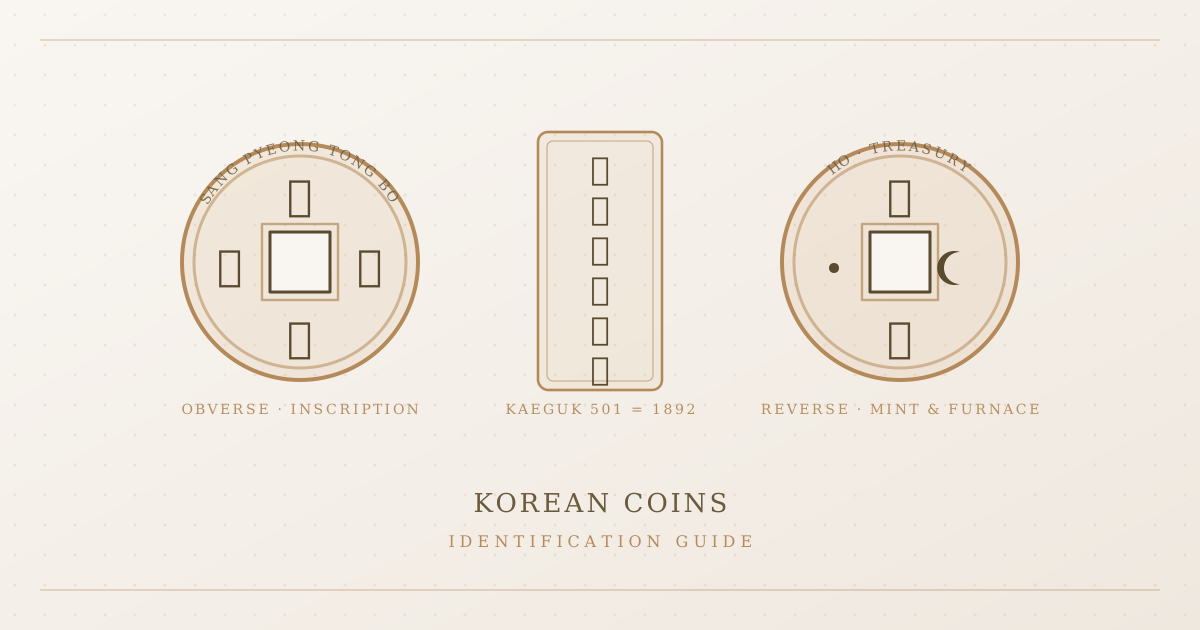
Korean coins are the most consistently misidentified coins in American collections, and the reason is almost always the same: they get filed under "Chinese." A round bronze disc with a square hole and four Chinese characters looks Chinese to anyone who has not been told otherwise, and hundreds of thousands of them came home in the duffel bags of servicemen who rotated through Korea between 1950 and the present day. They sit in coffee cans and cigar boxes across the United States, labelled wrongly, valued wrongly, and occasionally sold for a fraction of what they are worth.
The good news is that Korean coinage is unusually easy to identify once you know the two or three things that give it away. Korean cash coins carry one inscription and only one — not the dozens of reign titles you have to learn for Chinese cash. Korean machine-struck coins carry their dates in one of four numbering systems, each with a fixed arithmetic conversion you can do in your head. And there is a clean forty-year hole in the middle of the series, from 1910 to 1945, when no Korean coins were made at all, which rules out an entire span of dates in a single step.
This guide covers the whole sweep: the first Korean coins of the tenth century, the vase-shaped silver of Goryeo, the Sangpyeong Tongbo that circulated for 259 years, how to read the mint marks and furnace numbers that separate one variety from another, the disastrous 100-mun coin of 1866, the machine-struck trials of 1888, the yang and won coinages of the Korean Empire, the colonial gap, the hwan coins struck in Philadelphia in 1959, the six coins in South Korean pockets today, the modern rarities worth hundreds of times face value, and the strange star-marked coinage of North Korea. It also covers the trap that costs collectors the most money: the Korean 5 yang is the second most counterfeited world coin on NGC's list, behind only one Russian gold piece.
Table of Contents
- Why Korean Coins Get Misidentified
- The Five Eras of Korean Coinage
- Start Here: Does It Have a Square Hole?
- Sangpyeong Tongbo: The Coin You Almost Certainly Have
- Reading the Reverse: Korean Mint Marks
- Furnace Numbers and Series Marks
- Telling Korean Cash from Chinese and Japanese Cash
- Dangbaekjeon and Dangojeon: The Inflation Coins
- Goryeo Coins and Silver Vase Money
- The 1888 Machine-Struck Trials
- The Yang Series, 1892–1902
- Reading Kaeguk Dates
- Gwangmu, Yunghui, and the Korean Empire
- The Won Series, 1902–1910
- The Colonial Gap, 1910–1945
- The Hwan Coins and the Dangi Calendar
- Modern South Korean Coins: The Six Denominations
- Modern Key Dates and Rarities
- North Korean Coins and the Star System
- Counterfeits and Reproductions
- Step-by-Step Identification Workflow
- What Korean Coins Are Worth in 2026
- Grading, Certification, and Care
- References and Online Tools
- Frequently Asked Questions
Why Korean Coins Get Misidentified
Korea produced coins for roughly a thousand years, but the coinage almost never travelled. Understanding why explains both the misidentification problem and the shape of the market today.
A Coinage That Stayed Home
Unlike the Spanish, Mexican, Chinese, and Japanese silver that circulated across the Pacific and turns up in old accumulations everywhere, Korean coins were a domestic currency almost exclusively. Korea issued no true trade dollar, ran no overseas empire, and for most of the nineteenth century pursued a policy of isolation that earned it the Western nickname "the Hermit Kingdom." As a result, Korean coins entered Western hands mainly in three bursts: the diplomatic and missionary contacts of the 1880s and 1890s, the Korean War and the seven decades of American military presence that followed, and modern tourism.
The Chinese-Character Problem
Every Korean coin struck before 1945 carries its inscription in hanja — Chinese characters, used in Korea for official writing until the twentieth century. There is no Hangul on old Korean coins, no Latin lettering on most of them, and nothing that says "Korea" in a form a Western reader recognizes. To an untrained eye the result is indistinguishable from Chinese coins, which is exactly where most of them end up filed.
A Deep and Serious Home Market
Korean collectors, like Japanese collectors, drive the market for their own coinage, and the money is real. A Korean Empire 5 yang graded MS63 realized a world-record $55,000 at a Hong Kong auction in October 2023. High-grade Empire silver and gold is bid up from Seoul, not from Western dealers, and a coin that looks unremarkable in a general world-coin price guide can be worth several times the listed figure to a Korean buyer.
Cheap at the Bottom, Serious at the Top
A worn Sangpyeong Tongbo costs two or three dollars, and there are millions of them. A common variety of the Korean Empire's cupronickel small change costs ten. But the rare mint-and-furnace combinations of the cash series, the machine-struck trials of 1888, and the Empire gold run to four and five figures. Few world coinages give a beginner such an affordable entry point alongside such a steep top end.
The Five Eras of Korean Coinage
Before reading a single character, place your coin in one of five periods. Physical form alone decides the question almost every time.
Goryeo and Early Joseon (996–1633)
Cast bronze and iron coins with square holes, plus vase-shaped silver ingots. Genuine examples are scarce, museum-grade material and are heavily reproduced. Most Korean coins in this format that people own are three centuries younger than they think.
The Sangpyeong Era (1633–1891)
Cast brass and bronze cash with square holes, all carrying the same four-character inscription, distinguished from one another only by the marks on the reverse. This period produces well over ninety percent of the pre-modern Korean coins that survive in quantity.
The Transitional and Empire Era (1888–1910)
Machine-struck, Western-format coins with milled edges, dragons and phoenixes, and a value stated in Latin letters as well as hanja. This is the era of the yang and the won, and it holds nearly all the expensive Korean coins.
The Colonial Gap (1910–1945)
No Korean coins exist. Japanese coins and Bank of Chosen banknotes circulated instead. Anything presented to you as a "Korean coin dated 1925" is either a Japanese coin, a banknote, or a fantasy piece.
The Divided Era (1959–present)
South Korean hwan and won coins, machine-struck, with Hangul and Arabic numerals; North Korean aluminium coins with the Chollima statue and, on the older issues, a system of stars indicating who was allowed to spend them.
Start Here: Does It Have a Square Hole?
This one question splits the entire field in half, and it takes no knowledge of Korean at all.
If Yes: You Are in the Cash Era
A round coin with a square central hole is cast, not struck, and belongs to the period before 1892. In Korean these coins are called yeopjeon (엽전, 葉錢), literally "leaf coins," because they were cast in branching trees and snapped off the stems like leaves. Look for the file marks around the rim where the casting sprue was ground away — a genuine cast coin almost always shows them, and a modern souvenir usually does not.
If No: You Are After 1888
A struck coin with a milled or plain edge and a raised, sharply defined design belongs to the machine era. From there the date system tells you which decade, and this guide covers all four of them.
The Round-Hole Exception
Two modern South Korean coins have no hole at all, and no Korean coin in general circulation today is holed. If you have a coin with a round hole, you are almost certainly holding a Japanese 5-yen or 50-yen piece rather than anything Korean.
Sangpyeong Tongbo: The Coin You Almost Certainly Have
If you own one old Korean coin, this is it. The Sangpyeong Tongbo (常平通寶) is the single most abundant Korean coin in existence, and for two and a half centuries it was effectively the only coin Korea made.
What the Name Means
The first two characters, sangpyeong, mean "ever-normal" or "always even," and come from the Sangpyeongcheong — the Stabilization Office, a government granary agency that held grain against famine and price swings. The last two, tongbo, mean "circulating treasure," the standard East Asian term for coined money. The name therefore reads as something like "stabilization office currency."
The Dates
The Stabilization Office made a first small issue in 1633, under King Injo, that failed to take hold. In 1678, under King Sukjong, the coin was reissued for general circulation and this time it stuck. Casting continued until 1891, and the coins remained legal tender until 1908, when their value was fixed at 0.2 chon — one five-hundredth of a won.
How to Read It
The four characters surround the square hole and are read in the fixed East Asian order: top, bottom, right, left. Reading them clockwise or left to right produces nonsense. On a Sangpyeong Tongbo the reading is:
- 常 (sang) at the top
- 平 (pyeong) at the bottom
- 通 (tong) at the right
- 寶 (bo) at the left
Learn those four shapes and you can identify a Korean cash coin across a table. There is no reign title to look up, no dynasty to place, and no date anywhere on the coin.
How They Were Made
A hand-carved mother coin was pressed repeatedly into fine sand held in pear-wood frames, up to fifteen mould layers at a time, and molten brass was poured in. The result was a "coin tree" (錢樹) with dozens of coins on branching runners. Workers snapped them off and filed the edges. This is why Korean cash shows soft, slightly rounded characters rather than the crisp relief of a struck coin — and why a Sangpyeong Tongbo with knife-sharp detail should be examined carefully.
Sizes and Denominations
Four denominations exist, and diameter alone separates them:
- 1 mun — 24 to 25 mm. The everyday coin, and by far the most common.
- 2 mun — 27 to 29 mm, cast from 1679.
- 5 mun (Dangojeon) — 31 to 33 mm, from 1883.
- 100 mun (Dangbaekjeon) — 40.6 mm and 25.1 g, made for seven months in 1866–67.
Measure before you guess. A caliper reading of 32 mm turns an ordinary coin into a scarcer one, and 40 mm turns it into a historically famous one.
How Many Varieties
The Bank of Korea's collection alone once held 3,137 distinct varieties, and the total number ever produced is estimated above 5,000, many now undocumented. That number is what makes the series so absorbing: the coins are cheap, but assembling a complete run of any one mint's furnaces is genuinely difficult.
Reading the Reverse: Korean Mint Marks
Because the obverse never changes and there is no date anywhere on the coin, the reverse carries all the information. This is the most important structural difference between Korean and Chinese cash, and it is where the whole hobby lives.
The Layout
The standard Korean reverse has a mint mark above the square hole and, from 1742 onward, a furnace or series character below it. Some issues add small symbols to the left and right of the hole. A reverse with Chinese characters both above and below the hole is a strong signal that you are holding a Korean coin and not a Chinese one.
Central Government Offices
The single character above the hole abbreviates the name of the issuing body. More than fifty offices cast coins over the life of the series. The ones you will meet most often are:
- 戶 (Ho) — the Ministry of Taxation, from 1678. The commonest mark of all.
- 工 (Gong) — the Ministry of Works, from 1685.
- 兵 (Byeong) — the Ministry of Military Affairs, from 1742.
- 訓 (Hun) — the Military Training Command, from 1678.
- 統 (Tong) — the Tongyeong naval headquarters, from 1727.
- 典 (Jeon) — the central government mint, from 1833.
Provincial Offices
Provincial and regional mints used a character from the province's name:
- 京 (Gyeong) — Gyeonggi, from 1742.
- 全 (Jeon) — Jeolla, from 1682.
- 尚 (Sang) — Gyeongsang, from 1695.
- 平 (Pyeong) — Pyeongan, from 1678.
- 咸 (Ham) — Hamgyong, from 1742.
The Romanization Trap
Two entirely different mint marks both romanize as "Jeon": 全 for Jeolla province and 典 for the central government mint. They are unrelated characters and mark coins of very different scarcity. Whenever you record a Korean cash coin, note the character, not the romanization — this is the single most common cataloguing error beginners make in the series, and it is a mistake that also plagues collectors of American coin mint marks when two facilities share a letter.
A Second Trap: Pyeong Appears Twice
The character 平 is both the second character of the obverse inscription and the mint mark for Pyeongan province. Seeing it on the reverse means Pyeongan; seeing it at the bottom of the obverse means nothing except that the coin is a Sangpyeong Tongbo. Always establish which side you are looking at first.
Furnace Numbers and Series Marks
A single mint might run dozens of furnaces at once, and from 1742 the government required each to mark its output. Four numbering systems were used, sometimes side by side, and recognizing which one you are looking at is what separates a casual identification from a catalogued one.
The Thousand Character Classic
The most widely used system drew on the Thousand Character Classic, a sixth-century poem of exactly one thousand non-repeating characters used across East Asia to teach literacy. Because every child learned it in order, its characters worked as a ready-made numbering sequence that everyone could count with. The first characters run 天 (heaven), 地 (earth), 玄 (dark), 黃 (yellow), 宇, 宙, 洪, 荒, and Korean mints used roughly the first forty-four as furnace numbers. A coin marked 天 below the hole is furnace number one; 地 is number two.
The Five Elements
From 1752 some mints instead used the five elements — 金 (metal), 木 (wood), 水 (water), 火 (fire), 土 (earth) — to designate furnace groups.
Celestial Stems and Plain Numerals
A third system used the ten celestial stems of the traditional calendar, running from 甲 to 癸. A fourth simply used Chinese numerals: 一, 二, 三 and so on. Both are less common than the Thousand Character Classic but appear on specific mints.
Symbol Marks
Beyond characters, Korean reverses carry small abstract marks placed to the left or right of the hole, or occasionally above and below: a dot (a star), a circle (a sun), a crescent (a moon), and a short line. These are control marks that further subdivide a furnace's output, and they are exactly the sort of tiny distinction that turns a two-dollar coin into a fifty-dollar one for a specialist. Photograph both sides of any Korean cash coin at an angle under raking light before you decide it is common.
Script Style as a Clue
Coins from military offices were often cast in a semi-cursive script rather than the standard regular script, giving the characters a looser, more flowing look. Government-mint coins tend to be well made, yellowish brass with clear characters; privately cast pieces are cruder, darker, and often lighter in weight. Early castings show a single dot in the character 通, a clerical-script feature that later castings drop.
Telling Korean Cash from Chinese and Japanese Cash
Korea, China, Japan, Vietnam, and the Ryukyu Kingdom all used round cast coins with square holes and four-character legends. Sorting them is the most common practical problem in East Asian numismatics, and for Korea it is unusually straightforward.
Test One: Read the Inscription
This settles the question by itself in almost every case. Korean cash of the Joseon era reads 常平通寶 and nothing else. Chinese cash carries a reign title that changes with each emperor — Kangxi, Qianlong, Guangxu and dozens more. Japanese cash of the Edo period reads 寛永通寶. If the first two characters are 常平, you have a Korean coin, full stop.
Test Two: The Tongbo Rule
Joseon-era Korean coins use 通寶 (tongbo) exclusively. They never use 元寶 (wonbo) or 重寶 (jungbo), the higher-denomination endings that appear routinely on Chinese cash. Korea followed a Ming Chinese prohibition on 元寶 and simply never adopted the alternatives. So a square-hole coin whose last two characters are 元寶 or 重寶 is not a Joseon coin. The one important exception is the Goryeo-era coinage of the tenth to twelfth centuries, which predates the rule — those do use jungbo.
Test Three: Look at the Reverse
The reverse is often faster than the obverse:
- Manchu script — flowing vertical lines with wedge-shaped teeth, not blocky characters — means Qing Chinese. Never Korean.
- Chinese characters above and below the hole means Korean far more often than not.
- A blank reverse, or wave lines points to Japanese.
Test Four: Try a Magnet
Iron cash was cast in quantity in Edo-period Japan and is unusual in Korea and China, so a square-hole coin that jumps to a magnet is most likely Japanese. Korean cash is brass or bronze and will not respond, with the exception of the earliest Goryeo iron issues, which are far too rare to be the coin in your hand.
Test Five: Weigh the Big Ones
Large-diameter Chinese cash of the Xianfeng era and large Korean cash of 1866 can look similar at a glance, but the inscriptions differ completely and the Korean piece is a consistent 25.1 g at 40.6 mm. A scale and a caliper resolve the question in ten seconds.

Dangbaekjeon and Dangojeon: The Inflation Coins
Two oversized cash coins tell the story of how the Joseon monetary system collapsed, and both are worth knowing on sight because they are considerably scarcer and more interesting than the ordinary 1-mun piece.
The Dangbaekjeon (100 Mun), 1866–67
In November 1866 the regent Heungseon Daewongun ordered a coin tariffed at 100 mun to pay for the rebuilding of Gyeongbok Palace and for military preparations against Western incursion. The coin is 40.6 mm across, 2.8 mm thick, and weighs 25.1 g — unmistakable next to an ordinary 24 mm cash coin. Exactly 1,784,038 were made.
The problem was arithmetic. The coin contained only about five or six times the metal of a 1-mun piece but was ordered to pass for a hundred. Rice prices rose roughly sixfold. Production stopped on 16 June 1867 after just 172 days, and the coin was withdrawn the following year. Its failure was so complete that it left a permanent mark on the Korean language: the expression ttangjeon han pun eopda — "not one ttangjeon to my name" — still means penniless.
How to identify it: the obverse reads 常平通寶 like every other Korean cash coin, but the reverse carries four characters, 戶大當百 (Ho Dae Dang Baek) — the Ministry of Taxation mark plus "worth one hundred." A large Korean cash coin with 當百 on the reverse is a Dangbaekjeon.
The Dangojeon (5 Mun), 1883–92
Seventeen years later the government tried the same trick more modestly, issuing a 5-mun coin to fund the diplomatic missions, treaty ports, and military modernization that followed Korea's opening to foreign trade in 1876. The Dangojeon is 30 to 33 mm across and about 2 mm thick, with 當 and 五 on the reverse alongside the mint mark.
Its purchasing power was about twice that of a 1-mun coin, not five times, and the gap again produced inflation: rice prices ranged from 9 to 23.7 mun between 1886 and 1888, and textile prices nearly doubled. Resentment ran deep enough that the abolition of the Dangojeon became one of the formal demands of the peasant armies in the Donghak Revolution. It was minted until 1892 and circulated until July 1894.
Goryeo Coins and Silver Vase Money
Korea's earliest coinage is important historically and almost never encountered genuinely. Treat anything in this section as a reproduction until an expert tells you otherwise.
Geonwon Jungbo, 996
The first coins minted in Korea were cast in 996 under King Seongjong of Goryeo, in direct imitation of Tang Chinese practice. They were iron, roughly 25.9 mm and 9.4 g, and carried the inscription 乾元重寶 (Geonwon Jungbo) on the obverse.
That inscription is borrowed wholesale from a Chinese coin of 758–760, which is why the identification hinges entirely on the reverse: the Korean issue adds 東國 (Dongguk, "Eastern State"), a deliberate assertion of Goryeo sovereignty. Same obverse, different country — a good reminder that on East Asian cash the reverse frequently carries the identification.
The Sukjong Series, 1097–1107
A century later King Sukjong established a proper minting programme that produced three related families of coins, each in tongbo and jungbo versions: 東國 (Dongguk, "Eastern Country"), 海東 (Haedong, "East of the Sea"), and 三韓 (Samhan, "Three Han"). All three names are poetic terms for Korea itself, which makes them easy to spot: a square-hole coin whose first two characters name Korea rather than a reign period is a Goryeo issue.
Eunbyeong: Silver Shaped Like a Country
The most remarkable object in Korean numismatics is not a coin. From 1101, Goryeo issued the eunbyeong (銀瓶), a silver vase weighing about one geun — roughly 600 grams — formed in the outline of the Korean peninsula and stamped with a royal seal for authentication. Also called hwalgu, it was a high-denomination instrument for aristocratic transactions, valued at thousands of litres of rice, and it circulated for roughly three hundred years until 1331. Genuine examples are national-treasure material; the Bank of Korea Money Museum in Seoul displays them.
Joseon Tongbo and the False Starts
The Joseon dynasty's own attempts before 1633 mostly failed. 朝鮮通寶 (Joseon Tongbo) was first cast in 1423 under King Sejong — about 24 mm and 3.2 to 4 g, in regular script — and again in 1633 under King Injo in a heavier, official-style script with a distinctly yellow-brown colour. Between them the government experimented with jeohwa, paper currency made from mulberry bark and Korea's first legal paper money, which had disappeared by the early sixteenth century, and in 1464 King Sejo issued extraordinary arrow-shaped bronze pieces intended to serve as both money and arrowheads. Neither caught on. Korea did not have a functioning coin economy until the Sangpyeong Tongbo took hold in 1678.
The 1888 Machine-Struck Trials
Korea's first machine-struck circulating coins were made in 1888 at a new mint in Seoul, using imported German and Japanese equipment, after pattern experiments beginning in 1886. Three denominations were produced: 5 mun and 10 mun in copper, and 1 won in silver. Roughly 10,000 of the copper coins were struck, and the 5-mun piece in particular is genuinely rare on the market.
The WARN Spelling
The 1888 silver piece carries its denomination in Latin letters as WARN rather than "won" — a transliteration decision that has delighted collectors ever since and provides an instant authentication cue. A coin from this issue spelled "WON" is not from 1888.
Why They Matter
These are transitional coins in the truest sense: cast cash was still circulating alongside them, the yang system was four years away, and the Korean state was about to lose control of its own currency. They are also the first Korean coins a Western collector can date at a glance, because they carry the Kaeguk year in hanja and a recognizably modern design.
The Yang Series, 1892–1902
In 1892 Korea adopted its first decimal currency. The yang was divided into 100 fun (also written bun) or 10 jeon, with 5 yang equal to 1 hwan. Coins were struck at a new mint at Incheon, established that year, and later at Yongsan from 1900 to 1904, using Japanese machinery and technical assistance.
The Denominations
- 1 fun — brass, 23.4 mm, 3.3 g
- 5 fun — copper alloy, 27 mm, 6.9 g
- ¼ yang — cupronickel, 20.7 mm, 4.8 g
- 1 yang — .800 silver, 22.5 mm, 5.2 g
- 5 yang — .900 silver, 38 mm, 26.95 g
- 1 hwan — silver, 38 mm, 26.95 g
The 26.95 g weight on the large silver is not a coincidence. It puts the coin within a fraction of a gram of the Japanese silver yen, the Mexican peso, and the other crown-sized pieces competing in East Asian commerce — the same standard that produced the trade dollars of the period. Korea never issued a trade dollar of its own, but its largest silver was built to the trade-dollar weight.
The Legend Tells You the Regime
Yang-series coins struck before the proclamation of the Korean Empire carry 大朝鮮 (Dae Joseon, "Great Joseon"). After 1897 the legend changes to 大韓 (Daehan, "Great Han"). That two-character difference sorts the series into kingdom and empire issues without any date reading at all.
The Counterfeiting Disaster
The cupronickel ¼ yang was counterfeited on an industrial scale, both domestically and abroad, until forgeries outnumbered genuine coins in circulation. The government's response was to declare the counterfeits legal tender — a decision that stabilized nothing and destroyed public confidence in the coinage. The practical consequence for collectors today is that many "fake" ¼ yang pieces are contemporary period counterfeits with genuine historical standing, not modern forgeries, and specialists collect them deliberately.
Reading Kaeguk Dates
This is the most useful skill in Korean numismatics after recognizing the Sangpyeong inscription, and it takes about five minutes to learn.
The System
Korea's early machine-struck coins are dated in the Kaeguk (開國, "founding of the state") era, counted from the founding of the Joseon dynasty in 1392. That year is Kaeguk 1. To convert to the Western calendar, add 1391 to the Kaeguk number.
So Kaeguk 501 = 501 + 1391 = 1892. Kaeguk 504 = 1895. The arithmetic never changes.
What It Looks Like on the Coin
The date appears as a run of hanja: 開國五百一年 — literally "Kaeguk five hundred one year." The two characters 開國 open it and the character 年 (nyeon, "year") closes it. Find 年 and you have found the end of the date; everything between 國 and 年 is the number.
The Numerals
Ten characters cover every number that appears:
- 一 = 1 二 = 2 三 = 3 四 = 4 五 = 5
- 六 = 6 七 = 7 八 = 8 九 = 9 十 = 10
Add 百 for 100 and the system is complete. 五百 is five hundred; 五百一 is 501; 五百五 is 505. Because Kaeguk dating on coins runs only from 501 to 505, you will in practice only ever need the numerals one through five.
The Range
Kaeguk dates appear on Korean coins from Kaeguk 501 (1892) through Kaeguk 505 (1896), plus the 1888 trial issues. After that the Korean Empire switched to imperial era names, covered next.
Gwangmu, Yunghui, and the Korean Empire
In 1897 King Gojong proclaimed the Korean Empire (Daehan Jeguk) and took an imperial era name, exactly as Japanese and Chinese emperors did. From that point Korean coins are dated by regnal era, and there are only two eras to learn.
The Two Era Names
- 光武 Gwangmu (1897–1907) — add 1896. Gwangmu 9 = 1905.
- 隆熙 Yunghui (1907–1910) — add 1906. Yunghui 3 = 1909.
Gwangmu was Gojong's era; Yunghui belongs to his successor Sunjong, whose accession in 1907 reset the count.
The First-Year Rule
As in Japan and China, the first year of an era is not written with the numeral "one." It is written 元年 (wonnyeon), "origin year." A coin reading Gwangmu wonnyeon is Gwangmu 1, which is 1897. Beginners routinely stall on this character pair, and recognizing it once solves the problem permanently.
Putting the Three Systems Together
By the end of the Empire, Korean coins had used three date systems in eighteen years. In practice you can tell them apart instantly by their opening characters: 開國 means Kaeguk and a number in the 500s; 光武 means Gwangmu and a small number; 隆熙 means Yunghui and a number from 1 to 4. Once you have identified which of the three you are looking at, the conversion is a single addition.
The Won Series, 1902–1910
In 1902 the won replaced the yang, divided into 100 chon. This is the last independent Korean coinage, and it is the one that holds the expensive material.
Struck in Japan
Every coin of this series was made at the Osaka Mint in Japan — the same facility that struck the dragon yen and Japanese trade dollar. That is a historically loaded fact, since Korea was moving steadily into the Japanese sphere in these years, but for identification it means the coins share the finish, edge work, and general appearance of contemporary Japanese issues.
The Denominations
- ½ chon — bronze, 1906–10. The first year is 21.9 mm and 3.4 g; later years shrink to 19.1 mm and 2.1 g.
- 1 chon — bronze, 1902–10, 23.5 to 28 mm.
- 5 chon — cupronickel, struck only in 1905, 1907, and 1909. The 1909 (Yunghui 3) is very rare.
- 10 chon — .720–.800 silver, 1906–10, 17.6 mm.
- 20 chon — .800 silver, 1905–10, in a large type (1905–06) and a small type (1907–10).
- ½ won — silver, 27.5 to 30.9 mm.
- 5, 10, and 20 won — .900 gold, 4.17 g, 8.33 g, and 16.67 g respectively.
Dragon and Phoenix
The larger silver and the gold carry a dragon, the imperial emblem. On the ½ chon, 1 chon, and 5 chon the dragon was replaced by a phoenix. This is a fast way to sort a handful of small Korean Empire coins: dragon means the higher denominations, phoenix means the base metal.
The End
Japan annexed Korea in August 1910 and the coinage stopped. Coins dated Yunghui 4 (1910) are the last Korean coins struck for forty-nine years.
The Colonial Gap, 1910–1945
This section exists to save you time, because it eliminates thirty-five years of possible dates in one stroke.
Between 1910 and 1945, Korea used the Korean yen, which was equivalent to and interchangeable with the Japanese yen. The Bank of Korea was renamed the Bank of Chosen in February 1911 and issued distinctive banknotes for Korea, payable in gold and exchangeable at par with Japanese yen; until 1932 those notes also circulated in Manchuria as a matter of Japanese government policy.
But coinage was standardized across the Japanese empire, and no separate Korean coins were produced. The money in Korean pockets was Japanese: the sen and rin pieces, the small yen coins, the wartime aluminium and tin issues. If someone offers you a "Korean coin" dated in this window, one of three things is true: it is a Japanese coin found in Korea, it is a Bank of Chosen banknote rather than a coin, or it is a fantasy piece. This is also why old Korean cash coins are so often found mixed with Japanese coins — they circulated together, and the cash remained technically redeemable well into the colonial period.
The Hwan Coins and the Dangi Calendar
South Korea's first coins after liberation were not made in Korea. They were struck at the Philadelphia Mint in the United States in 1959, and they use a dating system that appears on no other coinage in the world.
The Three Denominations
- 10 hwan — brass, 19.1 mm, 2.46 g. The mugunghwa, or Rose of Sharon, Korea's national flower.
- 50 hwan — nickel-brass, 22.86 mm, 3.69 g. The geobukseon, Admiral Yi Sun-sin's armoured turtle ship.
- 100 hwan — cupronickel, 26 mm, 6.74 g. A portrait of Syngman Rhee, South Korea's first president.
The 100 hwan is the only circulation-strike South Korean coin ever to carry a portrait of a living president, and it did not last. It was withdrawn entirely in the 1962 currency reform, a casualty of the political change that had made Rhee's image unwelcome. US Mint records show 360,000 pieces struck in 1959 and a further 49,640,000 in 1960, all carrying the same date.
The Dangi Calendar: Subtract 2333
Here is the diagnostic that stops people cold. Hwan coins are dated in the Dangi (檀紀) era, counted from the mythical founding of Korea by Dangun in 2333 BC. The dates on these coins therefore read 4292, 4293, and 4294.
To convert, subtract 2333:
- 4292 − 2333 = 1959
- 4294 − 2333 = 1961
A coin with a four-digit date beginning "42" is a South Korean hwan coin, and the arithmetic gives you the year exactly. This is the fourth and last Korean date system, and every hwan coin uses it. The won coins introduced in 1966 were the first South Korean coins dated in the Gregorian calendar, and everything since has used ordinary Western years.
The 1962 Reform and Why the Designs Survived
In 1962 the hwan was replaced by the won at 10 hwan to 1 won. The 10 and 50 hwan coins were simply revalued as 1 and 5 won and kept circulating — they were the only coins in circulation until 1966. When purpose-made won coins finally appeared, the designs came with them: the Rose of Sharon moved to the 1 won and the turtle ship to the 5 won, where both remain today. If a modern South Korean 5 won looks oddly familiar next to a 1959 50 hwan, that is why.
Modern South Korean Coins: The Six Denominations
Six coins make up the modern series, and all of them are easy: Arabic numerals, Gregorian dates, and Hangul rather than hanja. The motif side is the obverse; the reverse carries the value in numerals, the year, and 한국은행 (Bank of Korea) in Hangul.
The Six
- 1 won — aluminium, 17.2 mm, 0.729 g. Rose of Sharon. Brass at 1.7 g for 1966–67 only, then aluminium from 1968 because the brass was worth more than the coin.
- 5 won — brass, 20.4 mm, 2.95 g. Turtle ship.
- 10 won — brass, 22.86 mm, 4.06 g until 2006; then copper-clad aluminium, 18 mm and 1.22 g. Dabotap Pagoda at Bulguksa temple.
- 50 won — nickel-brass, 21.6 mm, 4.16 g, from 1972. A stalk of rice, part of the international FAO coin programme.
- 100 won — cupronickel, 24 mm, 5.42 g, from 1970. Admiral Yi Sun-sin.
- 500 won — cupronickel, 26.5 mm, 7.70 g, 120 reeds, from 12 June 1982. A red-crowned crane in flight.
The 2006 Ten-Won Redesign
By the mid-2000s the old brass 10 won cost about 38 won to produce — nearly four times its face value — and was being melted for its copper. The 2006 replacement is dramatically smaller and lighter, at 18 mm and 1.22 g against 22.86 mm and 4.06 g. The two sit side by side in circulation and are easy to tell apart by size alone.
The 500 Won and the Vending Machine Fraud
Until 2000 the South Korean 500 won and the Japanese 500 yen shared identical diameter and thickness but differed in weight — and the yen was worth roughly ten times as much. Fraudsters modified 500 won coins to match the yen's weight and fed them into Japanese vending machines. Japan's response was to replace the cupronickel 500 yen with a nickel-brass version in 2000, which is the origin of the second of the three types of Japanese 500-yen coin. It is a rare case where identifying a Korean coin explains a Japanese one.
Coins That Barely Circulate
The 1 won and 5 won have been effectively out of circulation since 1992. They are still struck in small numbers for collector sets, which is why uncirculated examples of recent dates are easier to find than worn ones — the opposite of the usual pattern.
Modern Key Dates and Rarities
Modern South Korean coins are a genuine sleeper area, because a handful of ordinary-looking pieces have mintages that would make an American key date collector sit up.
The 1998 500 Won
This is the standout, and it is worth checking every 500 won coin you handle. The Bank of Korea had planned to issue roughly 56 million 500 won coins in 1998, then cancelled the order in the middle of the Asian financial crisis and the IMF bailout. Only about 8,000 were made, purely for overseas mint sets.
The result is one of the great modern rarities. Examples trade in the hundreds of thousands of won, and a complete 1998 mint set containing one sold for 1,650,000 KRW — about $1,400 — back in 2015. The coin is otherwise identical to any other 500 won: same crane, same 7.70 g. Only the date matters.
The 1981 10 Won
A mintage of just 100,000 makes this the key date of the 10 won series. Many appear to have been stored in mint bags rather than released, so circulated examples are scarcer than the mintage alone suggests.
First-Year Issues
The 1966 1, 5, and 10 won and the 1970 100 won are first-year coins with lasting collector demand. The 1966–67 brass 1 won is the only brass 1 won ever made, replaced almost immediately when the metal value overtook the face value — a two-year type hiding in plain sight.
What This Means Practically
If you have a jar of Korean change from a trip, the checks worth doing are: read every 500 won date looking for 1998; read every 10 won date looking for 1981; and set aside any 1 won that is heavy and yellow rather than light and grey, which means the 1966–67 brass type. Everything else is worth face value.
North Korean Coins and the Star System
North Korean coins are inexpensive, easy to identify, and carry one of the strangest features in world numismatics.
The Basic Coinage
The first circulating coins appeared in 1959 in denominations of 1, 5, and 10 chon, all struck in aluminium and all remarkably light: the 1 chon is 16 mm and about 0.63 g, the 5 chon 18 mm and 0.81 g, the 10 chon 20 mm and 1.0 g. The design shows the Chollima statue, the winged-horse monument in Pyongyang. A 50 chon followed in 1978 with the Chollima and a rising sun, entering circulation with the 1979 currency reform. The coins were restruck later with their original dates, and 1970 and 1974 dates also appear on the 1 and 5 chon.
Count the Stars
North Korea operated a segregated currency system, and the coins say who was allowed to spend them. Look for small stars beside the value:
- No star — for use by North Korean citizens.
- One star — for visitors from socialist countries, such as the USSR, China, and Cuba.
- Two stars — for visitors from non-socialist, capitalist countries.
The same goods sold at one price to locals, a higher one to friendly-country visitors, and a higher one again to capitalist visitors. The star markings appear on the 1959, 1970, 1974, and 1978 issues and were abandoned on later coins. Two-star pieces are the ones Western collectors most often encounter, because those were the coins tourists were given, and a matched no-star/one-star/two-star set of a single date is a genuinely interesting display item for very little money.
Juche Dating
North Korea adopted the Juche calendar in 1997, counting from Kim Il-sung's birth in 1912 as Juche 1. Coins from 2002 onward frequently carry both a Juche year and a Gregorian one — a commemorative marked JUCHE 91 is dated 2002. To convert, add 1911. This gives Korea, uniquely, five distinct coin dating systems across its history: Kaeguk, Gwangmu and Yunghui regnal years, Dangi, Gregorian, and Juche.
A Caution
North Korea has issued an enormous volume of non-circulating commemorative coins aimed squarely at foreign collectors, many produced under contract abroad. They are legitimately issued but should not be confused with money that ever circulated in the country, and their collector value rarely exceeds their issue price.
Counterfeits and Reproductions
Korean coins are counterfeited at both ends of the market, and the risks are different at each end.
The 5 Yang: Second on NGC's List
The Korea Kaeguk 501 (1892) 5 yang ranks number two on NGC's list of the twenty-five most commonly counterfeited world coins, behind only the Russia 1897 15 roubles. Three factors combine against the buyer: it is a one-year type with a mintage of just 20,000; demand from Korean and wider Asian collectors keeps values very high; and the design is simple enough that convincing counterfeit dies are comparatively easy to cut. Worse, genuine examples are themselves somewhat crudely made, so the usual "it looks too rough to be real" instinct works backwards here.
Buy this coin certified or do not buy it. That advice applies to the whole Korean Empire silver and gold series, but to the 5 yang above all. Our guide to detecting counterfeit coins covers the general diagnostics — weight, specific gravity, edge seams, and casting bubbles — that apply here.
Cast Fakes of Struck Coins
The commonest forgery method for Korean Empire coins is casting a copy from a genuine original. The tells are consistent: a faint seam around the edge, softened detail everywhere rather than in the high-wear areas only, tiny spherical pits from trapped gas, and a weight that misses the standard by more than the mint's tolerance. A digital scale accurate to 0.01 g and a caliper answer most questions about this series in under a minute.
Cash Coins: Period Copies Versus Modern Fakes
Sangpyeong Tongbo were privately cast in large numbers during their own period, often illegally. These pieces are cruder, darker, thinner, and lighter than government issues, but they are historical objects in their own right and specialists collect them. They are not what you need to worry about.
What you do need to watch for is the modern souvenir trade. Reproduction Korean cash sold at tourist sites and online is typically too heavy, too uniform, suspiciously bright, and free of the file marks around the rim that a genuine cast coin retains from being snapped off its coin tree. Genuine Goryeo coins are rare enough that any offered casually should be assumed to be a reproduction until proven otherwise.
The Period Counterfeit Exception
Remember the ¼ yang. Because the Korean government legalized counterfeit cupronickel ¼ yang pieces as tender, the contemporary forgeries of that specific coin are a legitimate collecting area with their own catalogue listings. Do not throw one away because it "fails" authentication — find out first whether it is a period piece.
Step-by-Step Identification Workflow
Run this sequence on any coin you think might be Korean. It resolves the great majority in under two minutes.
Step 1: Square Hole?
If yes, go to step 2. If no, go to step 4.
Step 2: Read the Four Characters Top, Bottom, Right, Left
If they read 常平通寶, you have a Korean Sangpyeong Tongbo. If they name a Chinese reign period, you have Chinese cash. If they read 寛永通寶, you have Japanese. If the first two characters name Korea — 東國, 海東, 三韓 — you may have a Goryeo coin and should get expert help.
Step 3: Measure, Then Photograph the Reverse
Diameter gives you the denomination: about 24 mm for 1 mun, 28 mm for 2 mun, 32 mm for 5 mun, 40.6 mm for 100 mun. Then record the mint mark above the hole and any furnace character or symbol below it. Those two marks, plus the diameter, are the entire identification.
Step 4: Find the Date and Identify Its System
For struck coins, the opening characters of the date tell you which system you are in:
- 開國 plus a number in the 500s — Kaeguk. Add 1391.
- 光武 — Gwangmu. Add 1896.
- 隆熙 — Yunghui. Add 1906.
- A four-digit number starting 42 — Dangi. Subtract 2333.
- An ordinary Western year — South Korea, 1966 or later.
- JUCHE plus a number — North Korea. Add 1911.
Step 5: Check the State Name
大朝鮮 means the Joseon kingdom, before 1897. 大韓 means the Korean Empire, 1897–1910. Hangul only means post-1945 South Korea. This cross-checks whatever the date told you.
Step 6: Weigh It
Weight confirms the metal and catches most fakes. Note the numbers that matter: 26.95 g for the large Empire silver, 25.1 g for the 100 mun, 7.70 g for a 500 won, 0.729 g for a 1 won, and roughly 0.63 g for a North Korean 1 chon.
Step 7: Decide Whether to Certify
If the coin is Empire-era silver or gold, or a cash coin with an unusual mint-and-furnace combination, stop handling it and get an opinion before you clean, sell, or store it.
What Korean Coins Are Worth in 2026
Values below are broad market ranges for reference, not appraisals. Korean material in particular can move sharply because so much of the demand comes from a single domestic market.
Cash Coins
A common circulated Sangpyeong Tongbo of an ordinary mint is worth roughly $3 to $10. Scarcer mint-and-furnace combinations run from $25 into the hundreds, and the rarest documented varieties considerably more. A genuine Dangbaekjeon typically brings $150 to $600 depending on condition, and a Dangojeon $20 to $80. Goryeo coins are four figures and up when genuine and properly attributed.
Korean Empire Coins
Base-metal fun and chon pieces in circulated grade are generally $10 to $60. Silver 10 and 20 chon run $30 to $200. The ½ won and 1 yang climb into the high hundreds in decent grade. The 5 yang is a four- to five-figure coin certified, and effectively unsaleable uncertified. Empire gold is five figures and up. Condition matters enormously here: this series is scarce in high grade because the coins circulated hard in a poor country.
Hwan and Modern Won
Circulated 1959 hwan coins are a few dollars each; uncirculated 4292-dated pieces command a premium over 4294. The 100 hwan with Rhee's portrait is the most sought after of the three. Ordinary modern won coins are worth face value, with the exceptions already listed: the 1998 500 won in the hundreds of dollars, the 1981 10 won at a strong premium, and first-year 1966 pieces modestly above face.
North Korea
Most circulation coins are $2 to $15. Two-star and one-star varieties carry a premium over no-star pieces, and complete three-variety sets sell for more than the sum of their parts.
What Drives the Numbers
Three things move Korean values more than anything else: certification, because the counterfeit risk is high; grade, because so little survived in high grade; and access to Korean buyers, because that is where the depth of the market sits. A coin sold into the Korean market through an auction house with genuine Korean expertise routinely outperforms the same coin sold to a Western generalist.
Grading, Certification, and Care
Grading Korean Coins
Both major services grade Korean material on the standard 70-point scale, and the usual coin grading principles apply. Two Korean-specific points are worth noting. First, cast cash coins are graded on different expectations than struck coins: casting softness is not wear, and the grade turns on surface preservation, completeness of the characters, and absence of casting flaws rather than on high-point friction. Second, Korean Empire coins were often weakly struck to begin with, so a coin can show full detail in one area and almost none in another without having circulated.
When Certification Is Worth It
Certification pays for itself on any Korean Empire silver or gold, on the 5 yang without exception, on high-grade hwan coins, on the 1998 500 won, and on cash coins with rare mint-and-furnace combinations that you intend to sell. It is not worth it on ordinary Sangpyeong Tongbo, common chon pieces, or modern circulation coins. Our guide to third-party grading covers how the services differ and when submission makes economic sense.
Do Not Clean Them
This applies with unusual force to Korean cash. The dark patina on a cast brass coin is part of the original cast surface, and removing it strips detail that cannot be recovered, leaving a bright orange coin that any experienced buyer identifies instantly as damaged. The same goes for Empire silver, where cleaning destroys the delicate lustre that separates a $200 coin from a $2,000 one. Distilled water and a soft brush to remove loose dirt are the limit — our guide to cleaning and preserving coins explains why every stronger method costs money.
Storage
Store cash coins individually rather than strung together; the traditional cord through the square hole abrades the rims and the coins mark each other. Use inert flips or capsules, keep humidity low, and avoid PVC, which will leave a green residue on brass that is difficult to reverse.
References and Online Tools
Print References
For cast coinage, Edgar J. Mandel's Cast Coinage of Korea is the standard English-language reference and the source of the catalogue numbers dealers quote for Sangpyeong Tongbo varieties. For machine-struck coins, the Standard Catalog of World Coins provides the KM numbers used in virtually every listing and auction description. Korean-language annual catalogues published in Seoul are the best guide to domestic price levels, which are frequently higher than Western guides suggest.
Online
Numista offers free type listings with specifications and mintages for both Koreas. The Bank of Korea Money Museum in Seoul publishes English-language pages on major types, including the eunbyeong and the Sangpyeong Tongbo, drawn from a national collection. NGC and PCGS both maintain searchable population reports and price guides for Korean coins, and NGC's counterfeit-detection resource includes the 5 yang entry that every buyer of that coin should read first.
Where to Get Help
Korean cash attribution is a specialist skill, and the specialists are generous. Collector forums with East Asian sections will usually attribute a clearly photographed reverse within a day. Photograph both sides square-on, in diffused light, with a ruler or caliper in frame, and note the weight — that is all an attributor needs. For anything you suspect is Empire silver or gold, go straight to a grading service rather than to a forum.
Frequently Asked Questions
How do I know if my coin is Korean or Chinese?
Read the four characters around the square hole in the order top, bottom, right, left. Korean cash of the Joseon era reads 常平通寶 (Sangpyeong Tongbo) and never anything else, while Chinese cash carries a reign title that changes with each emperor. Two more checks help: Manchu script on the reverse means Chinese, never Korean, and Chinese characters both above and below the square hole point strongly to Korea.
What is my Korean coin with a square hole worth?
Usually $3 to $10. Almost every square-hole Korean coin in Western hands is an ordinary Sangpyeong Tongbo, cast in the millions between 1633 and 1891. The value is in the reverse, though: an unusual mint mark or furnace character can multiply that figure many times over, so photograph the reverse before deciding it is common. Measure it too — a coin over 40 mm is a 100-mun Dangbaekjeon worth a few hundred dollars.
Why is there no date on my Korean coin?
Korean cash coins carry no date at all, by design. The obverse inscription never changed over 259 years, and dating comes entirely from the mint mark and furnace character on the reverse, which can be matched to the years a given office was casting. Only machine-struck Korean coins from 1888 onward carry an explicit date.
What does the date 4292 on my Korean coin mean?
It is 1959. Hwan coins use the Dangi calendar, counted from the legendary founding of Korea in 2333 BC, so you subtract 2333 to get the Western year. Only three dates exist in this system on coins — 4292, 4293, and 4294, or 1959 to 1961 — and all of them were struck at the Philadelphia Mint in the United States.
How do I read Kaeguk and Gwangmu dates?
Find the character 年 (nyeon, "year") at the end of the date and work backwards. If the date opens with 開國 it is Kaeguk, counted from 1392, so add 1391 — Kaeguk 501 is 1892. If it opens with 光武 it is Gwangmu, add 1896. If it opens with 隆熙 it is Yunghui, add 1906. And 元年 means year one, not a numeral you have failed to recognize.
Are Korean Empire coins with dragons valuable?
Some are very valuable and some are modest, and the difference is denomination and grade. Silver 10 and 20 chon are commonly $30 to $200; the ½ won and 1 yang reach the high hundreds; the gold runs into five figures. The 5 yang is the famous one, and it is also the second most counterfeited world coin on NGC's list, so treat any uncertified example as a fake until a grading service says otherwise.
Why can't I find a Korean coin dated in the 1920s or 1930s?
Because none exist. Japan annexed Korea in 1910, and coinage was standardized across the Japanese empire, so Japanese coins circulated in Korea until 1945 and no separate Korean coins were struck. What Korea did have were distinctive Bank of Chosen banknotes. A "Korean coin" from this period is a Japanese coin, a banknote, or a fantasy.
Is my 500 won coin worth anything?
Check the date. A 1998 500 won is one of the great modern world rarities — only about 8,000 were made after the Bank of Korea cancelled a planned 56 million issue during the IMF crisis — and examples sell for hundreds of dollars. Every other date is worth face value. The coin is otherwise unchanged since 1982: a red-crowned crane, 26.5 mm, 7.70 g.
What do the stars on my North Korean coin mean?
They record who was permitted to spend it. No star means the coin was for North Korean citizens, one star for visitors from socialist countries, and two stars for visitors from capitalist countries, each tier paying different prices for the same goods. The system ran on the 1959, 1970, 1974, and 1978 issues and was dropped afterwards. Two-star coins are the ones most often found in the West, because those were the coins handed to tourists.
Should I clean my old Korean coins?
No. Cleaning a cast brass cash coin removes part of the original cast surface along with the patina and permanently reduces both the detail and the value, and cleaning Empire silver destroys the lustre that accounts for most of the price difference between grades. Distilled water and a soft brush are the limit. The damage is obvious to any experienced buyer and cannot be undone.
Where can I sell Korean coins?
Common cash coins and modern change sell fine through ordinary dealers and online marketplaces. For anything significant — Empire silver or gold, high-grade hwan, scarce cash varieties — the strongest prices are realized where the collector base actually is, which is Korea. Get the coin certified first, then approach auction houses with genuine Korean or East Asian expertise rather than a generalist who will price it from a Western catalogue.
Ready to Start Identifying Coins?
Download the Coin Identifier app and get instant AI-powered identification for your coins. Perfect for beginners and experienced collectors alike.