Australian Coins Identification Guide: How to Read, Date, and Value Australian Coinage
Australian coins are among the easiest world coins to identify and among the easiest to misidentify, and which of those two things happens to you depends almost entirely on which side of the coin you look at first. Turn an Australian shilling obverse-up and you are looking at a British king, ringed by the same abbreviated Latin titles that appear on a British shilling, a New Zealand shilling, and a South African shilling of the same year. Nothing in that view tells you what country you are holding. Turn it over and the answer is stamped across the coin in plain English.
That single habit — read the reverse first — resolves the great majority of Australian identifications in about two seconds. What it does not resolve is everything that comes after: whether the coin is silver or a debased wartime alloy, whether the tiny dot beside the denomination is a mint mark or a speck of dirt, whether a 1930 penny in a shoebox is the most valuable circulating coin Australia ever produced or one of the thousands of altered fakes made from commoner dates, and whether a dollar coin from 2000 is worth one dollar or a thousand.
This guide covers the whole span: the cut-up Spanish dollars that were Australia’s first official currency, the gold rush coinages of Adelaide and Sydney, the branch-mint sovereigns that carried an S, an M, or a P, the pre-decimal series from 1910 to 1964 with its five monarchs and its two generations of reverse designs, the silver content that changed in 1946, the mint marks that appear and disappear across the penny series, the key dates that make a set expensive, the changeover of 14 February 1966, the six decimal coins in Australian pockets today, the varieties worth hunting in your change, the Perth Mint bullion programmes, and the practical business of telling an Australian coin from the British and New Zealand coins it was designed to resemble.
Why Australian Coins Get Misidentified
Australia was a British dominion when it began striking its own coins, and its coinage was deliberately built to be interchangeable in the hand with the British coinage it replaced. The denominations were the same — halfpenny, penny, threepence, sixpence, shilling, florin. The weights and diameters were the same. The obverse carried the same monarch, engraved from the same royal portrait models, ringed by the same Latin abbreviations. A 1936 Australian shilling and a 1936 British shilling are the same size, the same weight, the same alloy, and show the same king in the same pose.
This was a design goal, not an accident. It is also the single biggest source of misidentification, because collectors and heirs habitually look at the portrait side first. The portrait side of a pre-decimal Australian coin is close to useless for telling you what country made it.
The Three Traps
Three specific confusions account for most Australian misidentifications. The first is the Britain trap, described above: obverse-first identification lands you on a British monarch and stops there. The second is the New Zealand trap, which is worse, because New Zealand’s pre-decimal coinage used the same denominations, the same monarch, and even the same sterling silver standard in the same years; only the reverse designs differ. The third is the decimal trap, in which a modern Australian five, ten, or twenty cent coin is mistaken for a British or New Zealand coin because all three countries decimalised in the same era and all three used cupronickel discs of similar size.
There is a fourth confusion that runs the other way. Because Australian coins circulated across the Pacific and through Asia, and because Australian servicemen and travellers carried them everywhere, Australian coins turn up in American accumulations far more often than their mintages would suggest. They are frequently binned as “foreign junk” alongside genuinely low-value material, when a pre-1946 Australian florin is a substantial piece of sterling silver and a 1930 penny is worth more than most houses were in 1930.
The Four-Step Identification Path
Almost every Australian coin can be placed with four checks, performed in this order. Everything else in this guide is detail hung on this frame.
Step One: Find the Word AUSTRALIA
Every coin struck for Australia since 1910 carries either AUSTRALIA or COMMONWEALTH OF AUSTRALIA somewhere on it, in English, in ordinary Roman letters. On pre-decimal coins it is almost always on the reverse — the side with the denomination — and never on the obverse, which is reserved for the monarch and their Latin titles. On decimal coins it is on the obverse, beneath or beside the monarch’s head, because the reverse is given over to the animal or emblem.
If a coin has no such legend, it is not a Commonwealth Australian coin. It may still be Australian in the broader sense — a branch-mint sovereign, a colonial token, a holey dollar — and the sections below cover those. But the absence of the word is meaningful.
Step Two: Read the Date and Place It Either Side of 1966
Australian coins are dated in ordinary Arabic numerals, with no calendar conversion of the kind you need for Japanese coins or Korean coins. The date splits the series cleanly in two. A date of 1964 or earlier means pre-decimal: pounds, shillings, and pence. A date of 1966 or later means decimal: dollars and cents. Nothing was struck for circulation dated 1965.
That one boundary tells you which denomination ladder to use, whether silver is even possible, which monarch effigies to expect, and which catalogue section to open.
Step Three: Identify the Denomination from the Reverse
Pre-decimal denominations are spelled out in words: HALF PENNY, PENNY, THREEPENCE, SIXPENCE, SHILLING, FLORIN, CROWN. Decimal denominations are given in figures and the word CENT or CENTS, or as a dollar figure. There is no ambiguity and no abbreviation to decode.
Step Four: Check for a Mint Mark
Only then look for a mint mark, which on Australian coins is a small letter or a dot, and which is absent more often than it is present. Mint marks matter enormously on sovereigns and on certain penny and halfpenny dates, and hardly at all elsewhere. The sections on pre-decimal mint marks and sovereigns below explain where to look on each denomination, in the same spirit as the general treatment of mint marks on US coinage.
Before the Commonwealth: Holey Dollars and Dumps
For the first quarter-century of European settlement, New South Wales had almost no coin at all. Rum, promissory notes, and whatever foreign silver happened to arrive on a ship served as money, and the foreign silver kept leaving again on the next ship, because captains would accept it and colonists had nothing else to pay with. The colony’s problem was not a shortage of currency in the abstract; it was that any currency introduced immediately drained away.
Macquarie’s Solution
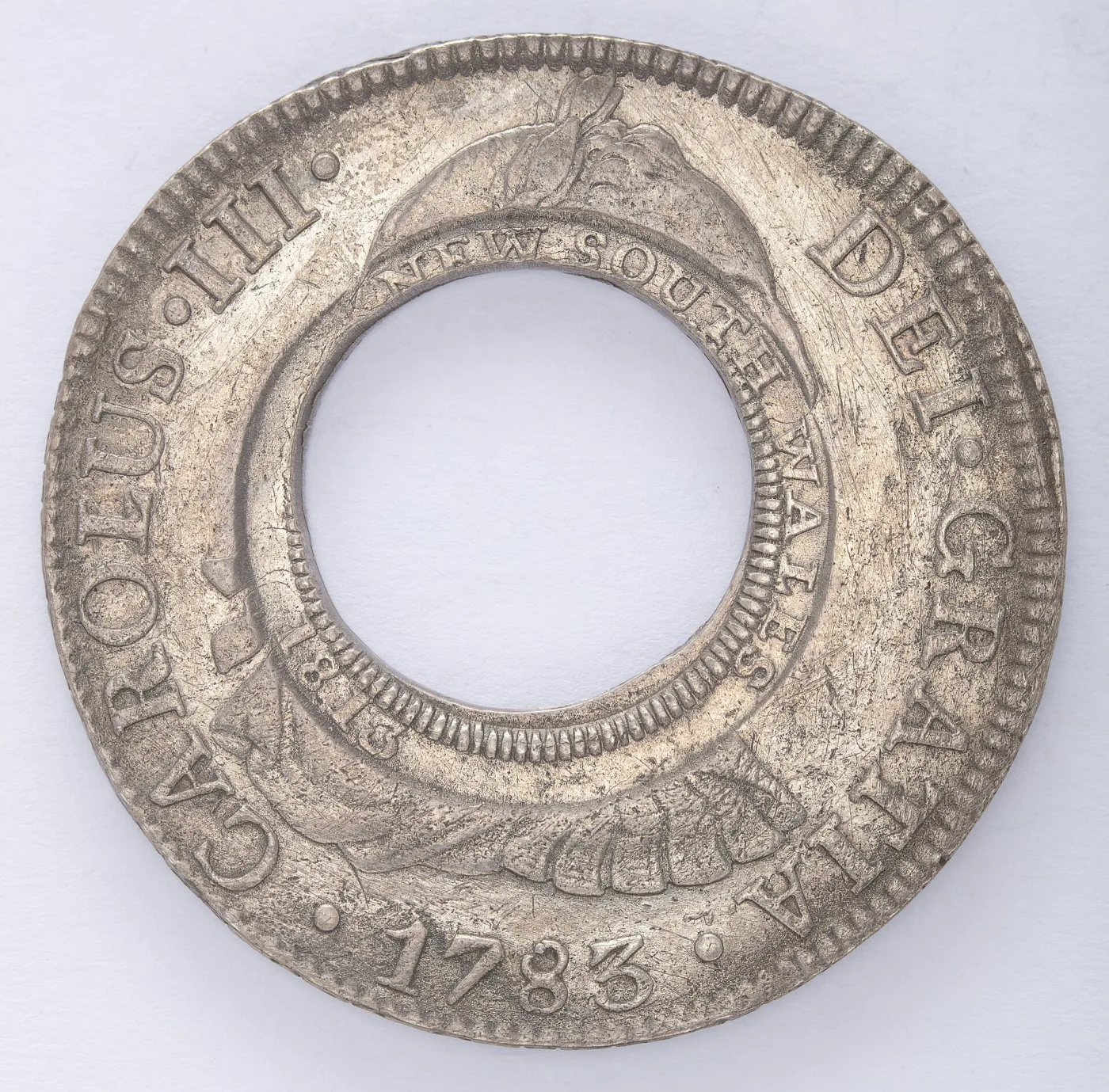
Governor Lachlan Macquarie’s answer, in 1813, was to make the coinage useless anywhere else. He had received a shipment of 40,000 Spanish silver dollars — eight-reales pieces, the standard international trade coin of the age, the same denomination covered in the guide to Spanish colonial reales — delivered on HMS Samarang. Rather than release them intact, Macquarie put a convicted forger named William Henshall to work punching the centre out of every one.
The result was two coins from each dollar. The outer ring, the holey dollar, was counterstamped NEW SOUTH WALES and a date, and valued at five shillings. The punched-out centre, the dump, was struck with a crown and a value and set at fifteen pence. Together the pair was worth six shillings and threepence, comfortably more than the five shillings the intact Spanish dollar had been worth, which was precisely the point: nobody would export a coin that was worth less abroad than at home, and a mutilated Spanish dollar was worth nothing abroad at all.
The conversion produced 39,910 holey dollars and 39,910 dumps, the shortfall from 40,000 being pieces spoiled in the process. Macquarie expected the work to take three months; it took more than a year. The coinage was demonetised within about ten years, and most of it was redeemed and melted or shipped out as bullion.
Identifying a Holey Dollar
Roughly 350 holey dollars and 1,500 dumps are believed to survive, which makes both among the most valuable coins in Australian numismatics and makes forgery a near-certainty on any unattributed example. A genuine holey dollar is a Spanish colonial eight reales — usually a Charles III or Charles IV portrait dollar from Mexico City, Lima, or Potosí — with a neatly punched central hole and counterstamped legends. The host coin’s own date, mint mark, and assayer initials remain visible on the ring, and the combination of host coin and counterstamp is what specialists use to authenticate.
Anything purporting to be a holey dollar should be assumed to be a replica until certified. Reproductions are sold openly as souvenirs, are made by punching genuine but common later Spanish or Mexican dollars, and are indistinguishable to the naked eye from photographs.
Gold Rush Money: The Adelaide Pound
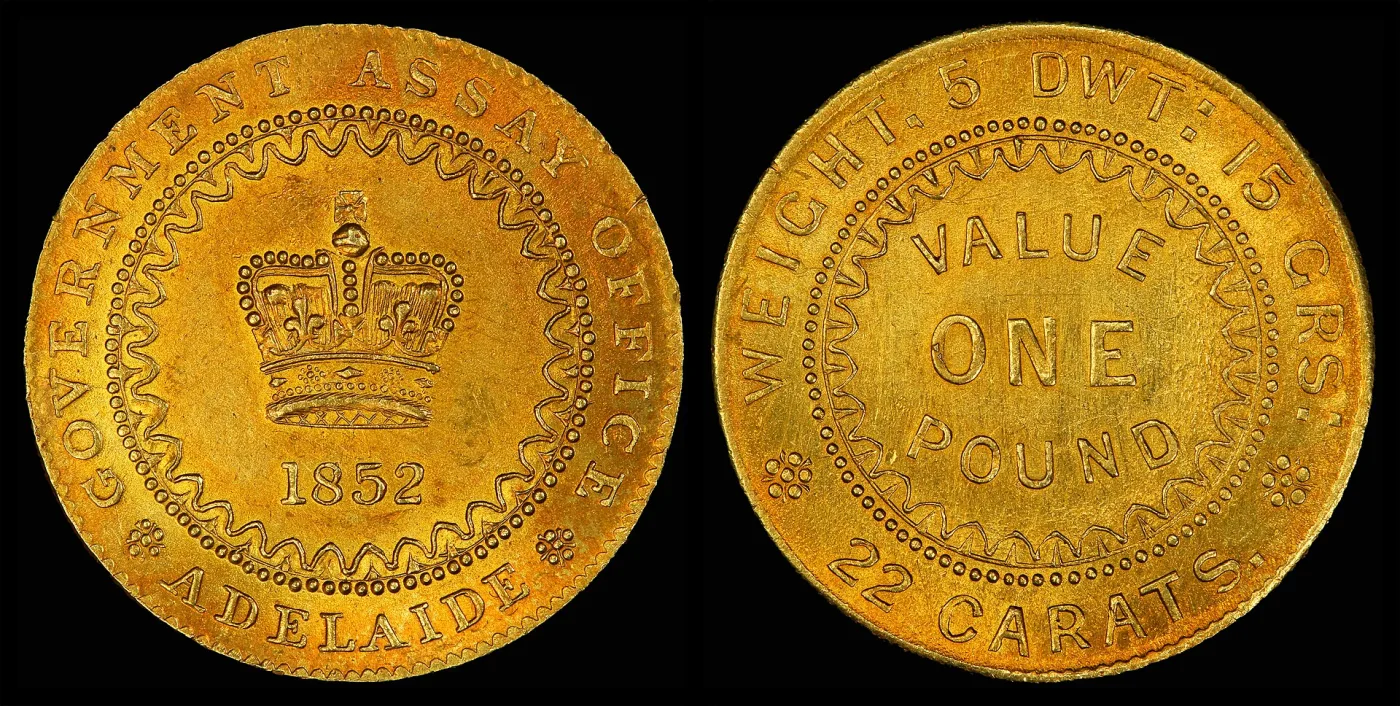
The gold discoveries at Bathurst and Mount Alexander in 1851 created a different currency crisis. South Australia had no goldfields of its own but had plenty of men who left for Victoria’s, returning with raw gold and finding nobody willing to give them coin for it. The colony passed a Bullion Act in 1852 authorising an assay office in Adelaide to turn gold into ingots and, exceeding the letter of its authority, into coins.
The result was the 1852 Adelaide Pound, Australia’s first gold coin struck from Australian gold. The first dies cracked almost immediately, and the small number of pieces struck before the crack was noticed — the Type I, identifiable by a beaded inner circle on the reverse and a vertical die crack at roughly twelve o’clock — are among the great rarities of the series, with perhaps thirty examples traced. A replacement die cut by the local engraver Joshua Payne produced the Type II, with a crenellated inner circle and larger reverse lettering, and accounts for nearly all of the roughly 24,000 pieces struck in total.
Most Adelaide Pounds were melted when the Sydney Mint opened three years later and began producing sovereigns at full imperial standard. The survivors are scarce enough that the type is effectively a rarity in any grade.
Colonial Trade Tokens
Alongside these official issues, Australian colonies were awash in private trade tokens from roughly the 1840s to the 1860s: penny and halfpenny-sized copper pieces issued by drapers, grocers, tea merchants, and hotelkeepers to plug the chronic shortage of small change. They carry the issuer’s name and town rather than a monarch, and there are several hundred distinct types. They are genuinely Australian, genuinely collectable, and often mistaken for British tokens or for damaged pennies. If a copper coin the size of a penny names a business and a town such as Melbourne, Sydney, Hobart Town, or Adelaide, and carries no royal portrait, it is almost certainly a colonial trade token.
Sovereigns and the Three Branch Mints
Australian gold made Australia a mint. The Royal Mint opened a branch in Sydney in 1855 — its first outside London — followed by Melbourne in 1872 and Perth in 1899. All three struck sovereigns and half sovereigns to full imperial standard, meaning they were legal tender throughout the empire and interchangeable with London-struck coins.
The Sydney Mint Type, 1855–1870
The earliest Sydney sovereigns did not look like British sovereigns at all. Instead of St George and the dragon, the reverse reads SYDNEY MINT above and ONE SOVEREIGN (or HALF SOVEREIGN) below, with AUSTRALIA and a crown within a wreath in the centre. This distinctive type ran until 1870 and is unmistakable: it is the only sovereign that names its mint in full on the reverse. Collectors call it the Sydney Mint type, and it commands a substantial premium over the imperial-design sovereigns that followed.
The Branch Mint Marks: S, M, and P
A Royal Proclamation of January 1871 authorised Sydney to strike sovereigns of the standard imperial design, distinguished only by a small letter. From then until the branches closed, Australian sovereigns carry:
- S — Sydney, from 1871
- M — Melbourne, from 1872
- P — Perth, from 1899
On the St George and dragon reverse the letter sits above the date in the exergue, below the ground line the horse stands on. On the shield reverse it sits below the shield. It is small, and on worn coins it is easy to miss entirely; a London sovereign of the same year carries no letter at all. The same alphabet of branch marks appears on sovereigns from Bombay, Ottawa, and Pretoria, which is why the mint mark is the first thing to check on any sovereign, as the guide to British coins sets out in more detail.
Branch-mint sovereigns were struck in enormous quantities and most dates trade close to their gold value. A handful of dates and mint combinations are genuinely rare, which makes the letter worth finding before you sell a sovereign as bullion.
1910: The First Commonwealth Coinage
The Australian colonies federated in 1901, but the new Commonwealth did not issue its own coins for another nine years. Until 1910, British coins circulated as legal tender and Australians counted in British pounds, shillings, and pence.
The first Commonwealth coins appeared in 1910: threepence, sixpence, shilling, and florin, all in sterling silver, all struck at the Royal Mint in London, all bearing the head of Edward VII. Edward died in May 1910, which means the 1910 coinage is a one-year type — there is no Australian coin of any other date showing Edward VII. Bronze followed in 1911, when the halfpenny and penny were introduced under George V.
This gives Australian collectors an unusually tidy starting point. The series has a clean first year, a single first-year monarch, and no colonial-era Commonwealth issues to complicate it. Compare this with Canadian coins, where provincial issues, Dominion issues, and Newfoundland’s separate coinage all overlap for decades.
The Pre-Decimal Denomination Ladder
Australian pre-decimal money used the British system: twelve pence to a shilling, twenty shillings to a pound. Seven denominations were struck for circulation.
- Halfpenny — bronze, about 25.5 mm, 5.67 g. Struck 1911–1964.
- Penny — bronze, about 30.8 mm, 9.45 g. Struck 1911–1964. The largest circulating bronze coin, and the one that carries the series’ great rarity.
- Threepence — silver, 16 mm, 1.41 g. The smallest Australian coin ever made, and the one most often lost.
- Sixpence — silver, 19.41 mm, 2.83 g.
- Shilling — silver, 23.5 mm, 5.65 g.
- Florin (two shillings) — silver, 28.5 mm, 11.31 g. The workhorse silver coin and the largest regular issue.
- Crown (five shillings) — silver, 38.5 mm, 28.28 g. Struck only in 1937 and 1938.
There was no pre-decimal Australian coin above the crown. The pound and half-pound existed as sovereigns and half sovereigns in gold, but these were imperial coins rather than distinctly Australian denominations, and they left circulation after the First World War.
The Specification Detail That Matters Most
Look at the sixpence, shilling, and florin again: 2.83 g at 19.41 mm, 5.65 g at 23.5 mm, and 11.31 g at 28.5 mm. Now look ahead to the decimal five, ten, and twenty cent coins: 2.83 g at 19.41 mm, 5.65 g at 23.60 mm, and 11.3 g at 28.65 mm.
They are the same coins in all but name and design. When Australia decimalised, the sixpence became the five cent, the shilling became the ten cent, and the florin became the twenty cent, at identical size and weight, so that vending machines, coin-operated telephones, and weighing scales would keep working through the changeover. Silver pre-decimals of those three denominations continued to circulate alongside their decimal successors for years afterward, which is exactly how so many of them ended up worn to nothing instead of being saved for their silver.
It is also a practical identification tool. If you have an unmarked cupronickel disc and a silver disc of exactly the same diameter, you are almost certainly holding a decimal coin and its pre-decimal ancestor.
Reading the Reverse: Arms, Kangaroos, and Rams
Australian pre-decimal reverses come in two generations, and knowing which generation you are looking at narrows the date immediately, often before you find the date itself.
First Generation, 1910–1936
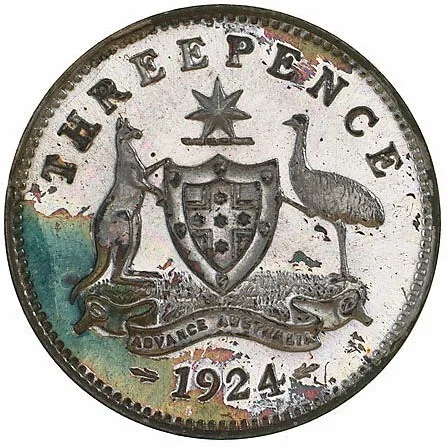
The original reverses were austere. The threepence, sixpence, shilling, and florin all carried the 1908 Commonwealth coat of arms — a shield bearing a cross and stars, supported by a kangaroo and an emu, with a seven-pointed star above — designed for coinage by W. H. J. Blakemore. Four denominations, one design, differing only in size and in the denomination legend. The halfpenny and penny had no pictorial design at all: just COMMONWEALTH OF AUSTRALIA arcing around the words ONE PENNY or HALF PENNY and the date.
If your Australian silver coin shows a coat of arms whose shield is divided by a plain cross carrying stars, you are in the 1910–1936 window. If your penny has no picture on it, same window.
Second Generation, 1938–1964
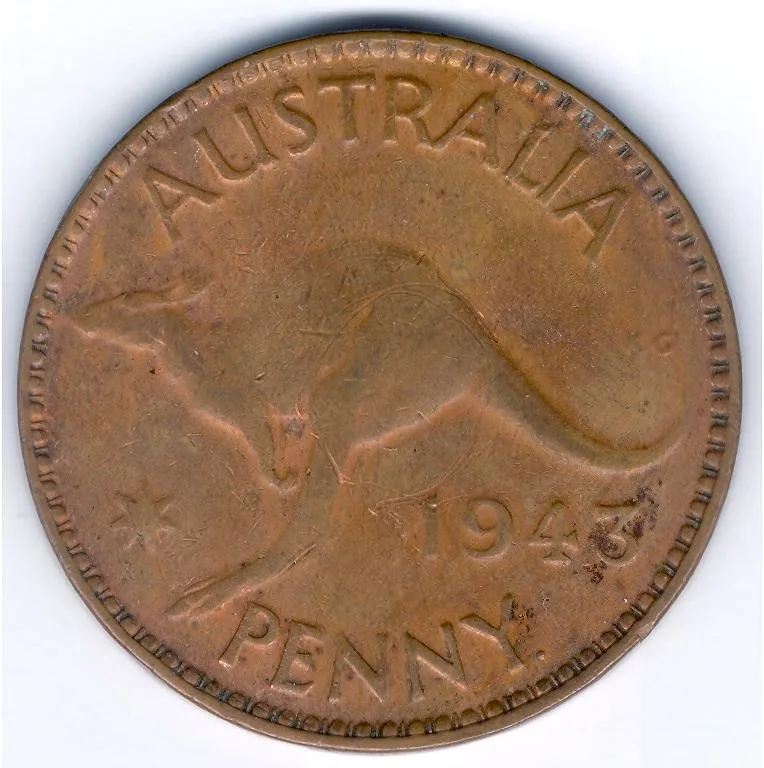
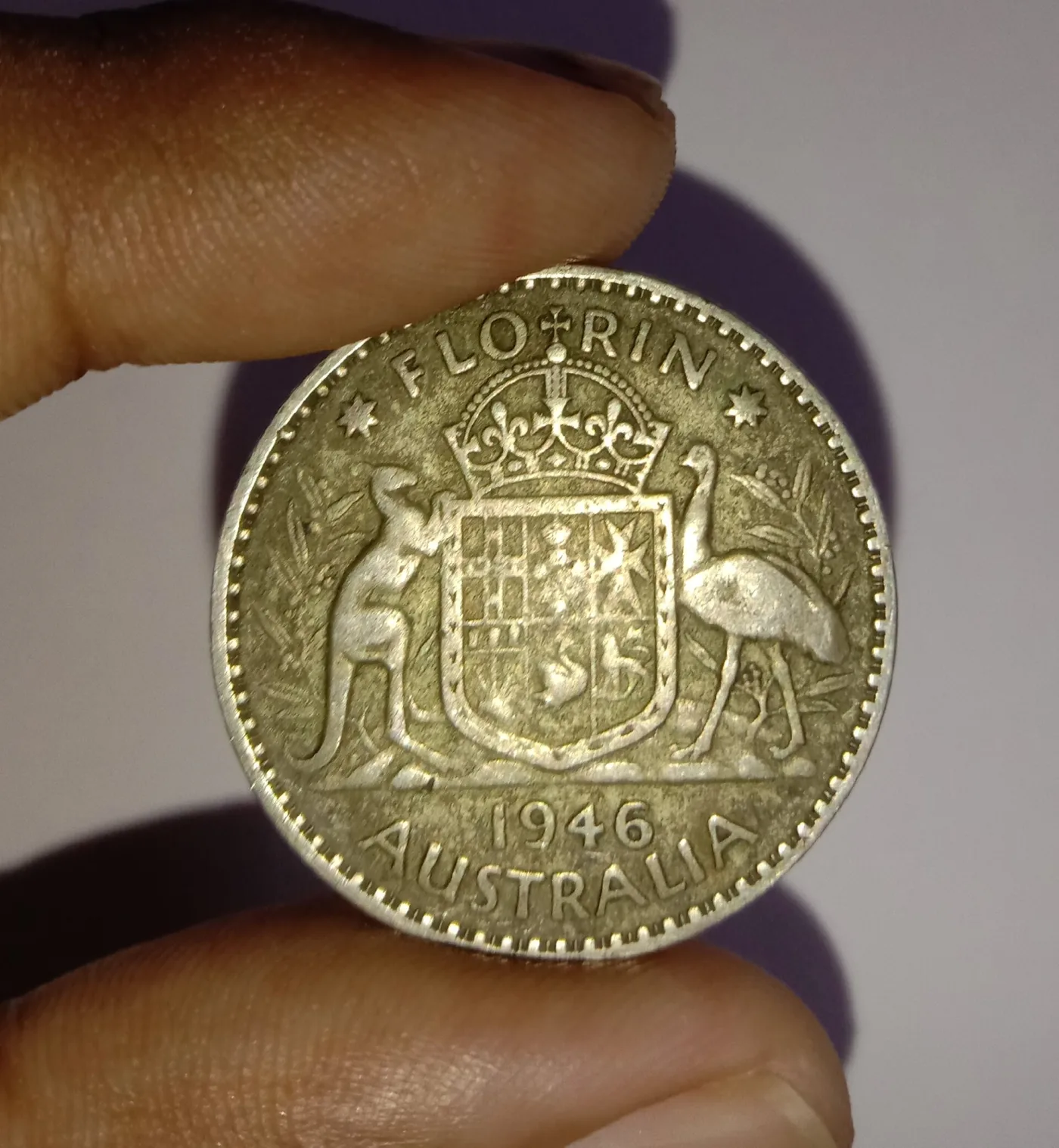
In the late 1930s every denomination except the sixpence and the crown received a new reverse from the English designer George Kruger Gray, whose initials KG appear discreetly in each design. These are the images most people picture when they think of Australian coins:
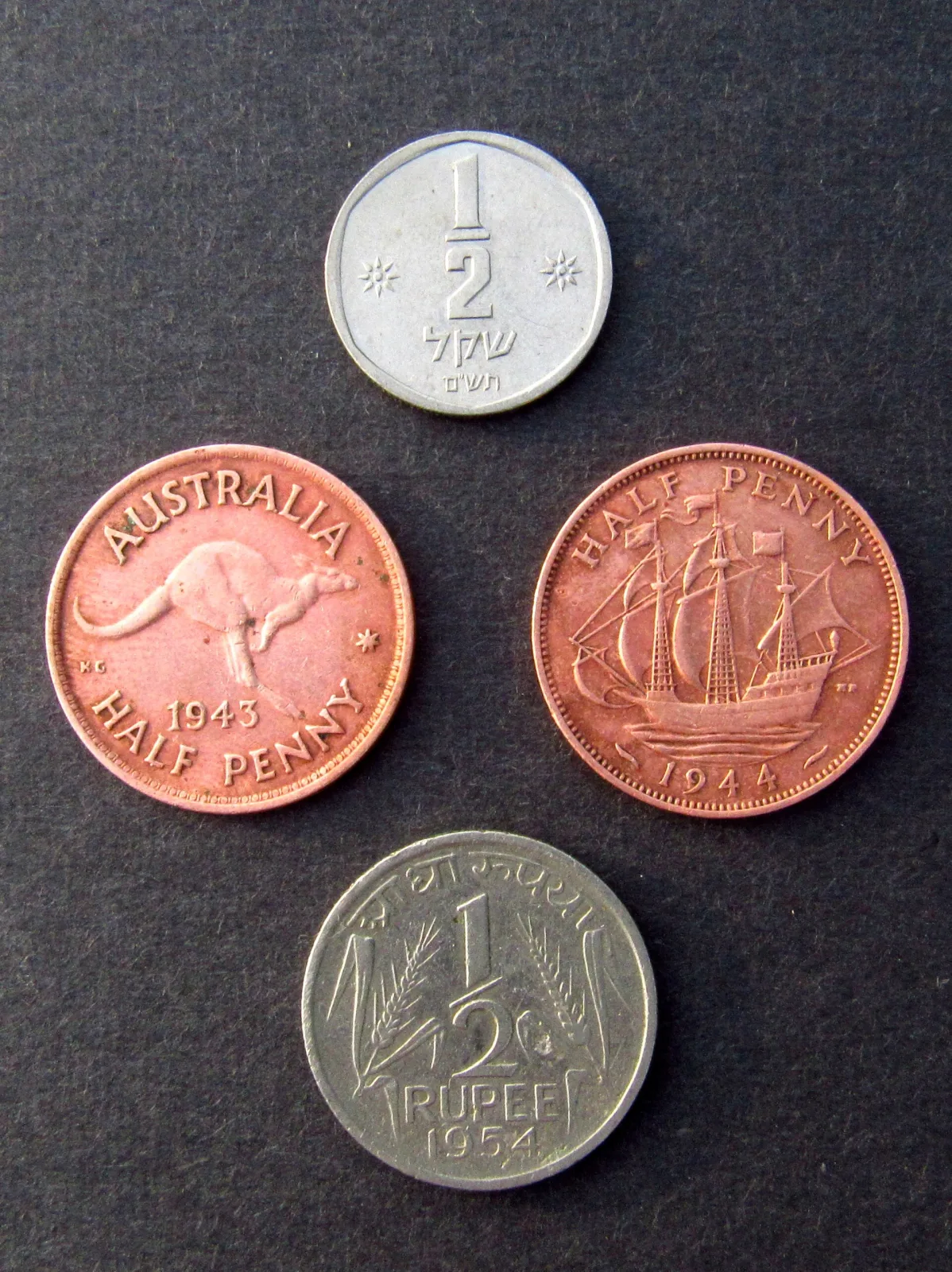
- Penny — a bounding kangaroo facing left, with the Commonwealth star, AUSTRALIA above, and PENNY below.
- Halfpenny — the same kangaroo, but facing right. The direction the animal faces is the quickest way to tell a worn halfpenny from a worn penny when the legends have gone.
- Threepence — three stalks of wheat tied with a ribbon.
- Shilling — the head of a Merino ram, modelled on a prize animal from the Sydney show, with a Commonwealth star to either side.
- Florin — the redesigned 1912 coat of arms, in which the shield is quartered into six compartments carrying the badges of the six states rather than a single cross.
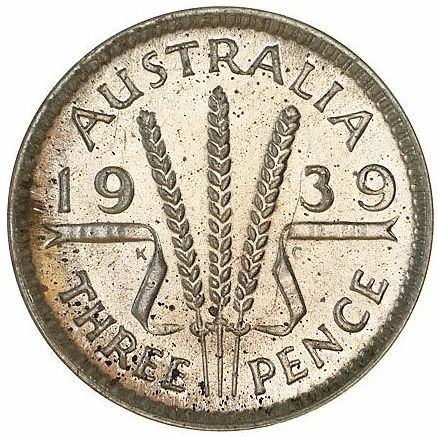
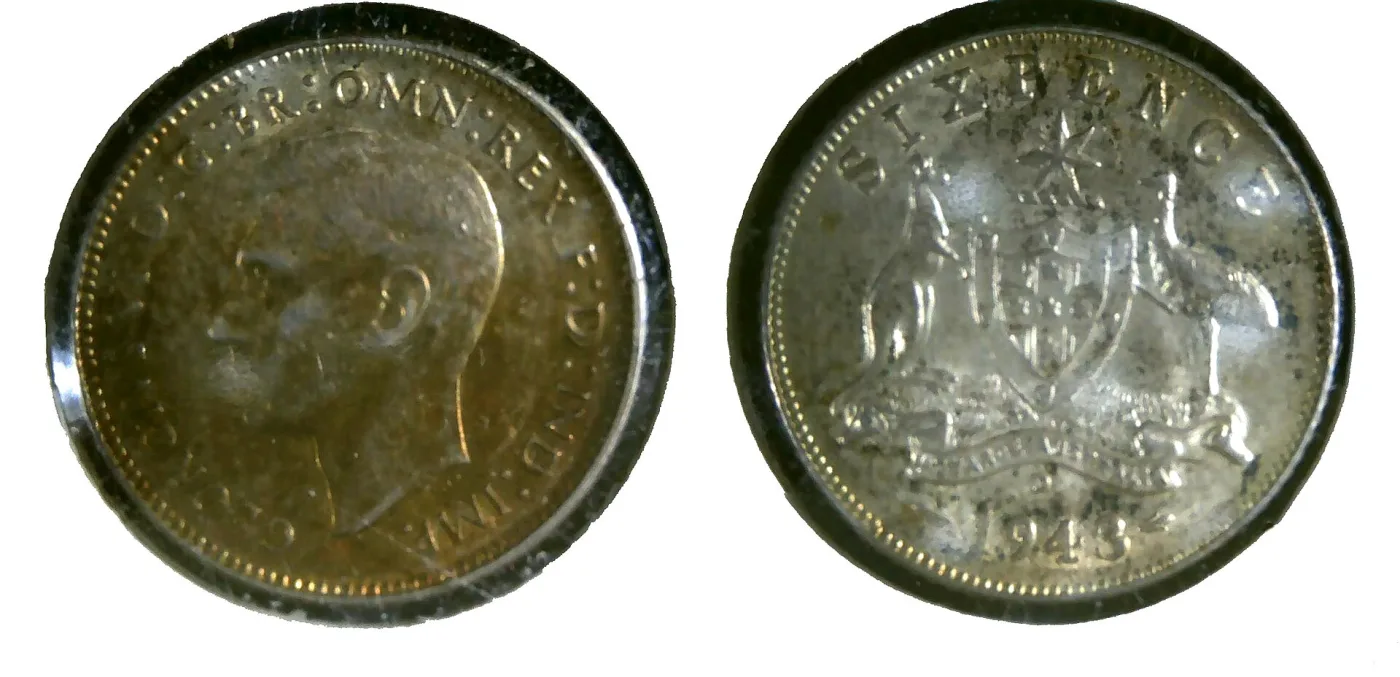
The sixpence is the exception that proves useful: it kept the 1908 arms for its entire run from 1910 to 1963. A sixpence therefore cannot be dated by its reverse design at all, and you must read the date and the monarch.
The two coats of arms are worth learning to tell apart, because the difference dates a florin instantly. The 1908 arms show a plain shield with a cross and stars. The 1912 arms show a shield divided into six sections, each with a different state emblem, within an ermine border. Six compartments means 1938 or later.
Reading the Obverse: Five Monarchs and the 1937 Gap
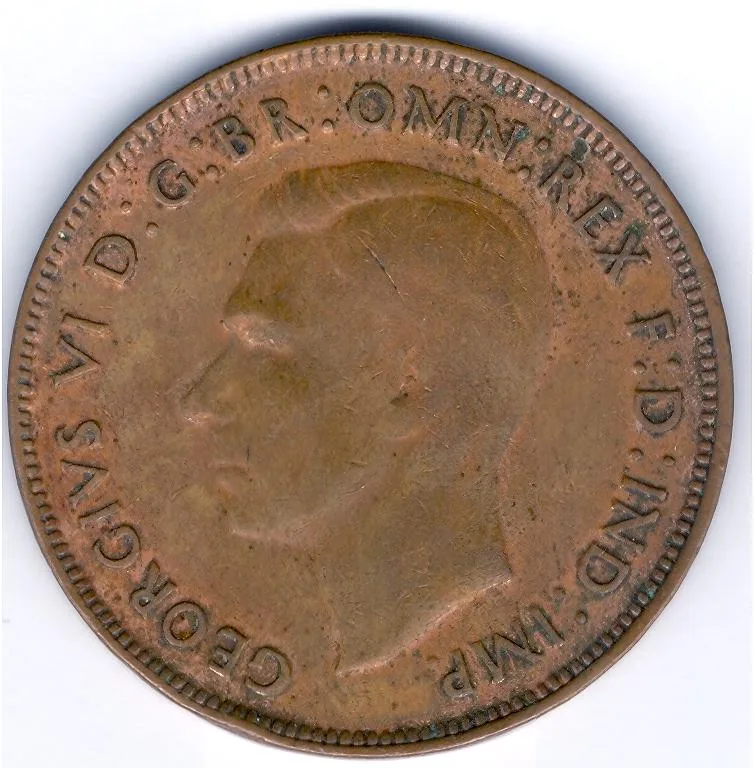
The obverse of a pre-decimal Australian coin carries the reigning monarch and a string of abbreviated Latin titles — typically the monarch’s name, D.G. for Dei Gratia (by the grace of God), BRITT:OMN:REX or similar for King of all the Britains, F.D. for Defender of the Faith, and, until 1948, IND:IMP: for Emperor of India. None of this is Australian. All of it also appears on British coins.
What it does give you is a tight date range:
- Edward VII — 1910 only, silver only.
- George V — 1911 to 1936. A bearded king facing left, crowned.
- George VI — 1938 to 1952. A bare-headed king facing left.
- Elizabeth II — 1953 to 1964 in the pre-decimal series, wearing a laurel wreath in Mary Gillick’s portrait.
The Missing King and the Missing Year
Edward VIII acceded in January 1936 and abdicated in December of the same year, before any Australian circulating coin bearing his portrait was released. Australian pattern pieces exist, but no Edward VIII coin ever entered Australian circulation. The practical consequence is a gap at 1937: the changeover of dies and the redesign of the reverses meant that the halfpenny, penny, threepence, sixpence, shilling, and florin have no circulating 1937 issue. The sole Australian coin issued for circulation with a 1937 date is the crown.
So if you are handed an Australian coin dated 1937 and it is not a crown, treat it with suspicion. And if you are assembling a date set, do not spend money looking for a 1937 penny; there is not one.
The Title That Dates a Coin to 1948 or Later
India became independent in 1947, and the words IND:IMP: were dropped from the royal titles on Commonwealth coinage from 1948 onward. On an Australian coin of George VI, the presence or absence of IND:IMP: divides the reign at 1948 without your needing to read the date at all — a useful trick on coins worn smooth in the middle but legible around the rim.

What Pre-Decimal Silver Actually Contains
Australian silver coins are not all the same, and the difference is worth real money. There is one date that splits the entire silver series.
1910–1945: Sterling, .925 Fine
From the first coinage until the end of the Second World War, the threepence, sixpence, shilling, florin, and crown were struck in sterling silver, 92.5% fine. A florin of this period weighs 11.31 g and therefore contains about 10.46 g of fine silver, roughly a third of a troy ounce. A shilling holds half that, a sixpence a quarter, a threepence an eighth.
1946–1963: Debased, .500 Fine
Australia emerged from the war heavily indebted, and in 1946 the silver standard was cut in half. From that year the same denominations were struck at 50% silver, the balance made up with copper, nickel, and zinc. The coins kept their weight and size — a 1950 florin still weighs 11.31 g — but contain only about 5.66 g of fine silver.
So a pre-1946 florin holds nearly twice the silver of a post-1946 florin of identical appearance. The date is the only thing that tells you which you have. In practice the debased coins also tone differently, developing a duller, greyer, sometimes slightly mottled surface as the base metals react, but this is a hint rather than a test; genuine toning patterns vary too much to rely on.
Silver coinage ended in 1963 for the sixpence, shilling, and florin, and in 1964 for the threepence. The bronze halfpenny and penny also ran to 1964. Nothing was struck for circulation in 1965 while the mint retooled.
Australian Coins as Bullion Silver
Worn pre-decimal Australian silver occupies the same niche in Australia that pre-1965 dimes and quarters occupy in the United States: it trades on metal content rather than collector value, at a modest premium over spot. If you have accumulated a jar of it, the sorting job is simply pre-1946 versus 1946–1963, exactly the kind of date-line sort that governs American junk silver. Do not clean it and do not sort it by appearance; sort it by date.
Mint Marks on Pre-Decimal Coins
Australian pre-decimal mint marks are inconsistent, small, and were used mainly on bronze. Silver coins of the period generally carry no mint mark at all. Where marks do appear, they are worth finding, because on several penny and halfpenny dates they separate a common coin from a scarce one.
Where the Coins Were Struck
Australian coins came from more mints than most collectors expect. The Royal Mint in London struck the earliest issues. The Heaton Mint in Birmingham struck some early pennies, marked H. Indian mints — Calcutta during the First World War and Bombay during the Second — struck bronze marked I, placed below the monarch’s head on the obverse. Domestically, the branch mints at Melbourne, Sydney, and Perth struck coin at various periods, and after 1965 the new Royal Australian Mint in Canberra took over everything.
The Dot System
Australian mints did not use letters on bronze. They used dots, placed in specific positions relative to the reverse legend, and the position rather than the presence of the dot is what identifies the mint. On the wartime bronze this settles into a workable rule:
- Melbourne — no dot at all.
- Perth — a single dot, placed after the final Y of PENNY.
- Bombay — larger dots both before and after the denomination, plus, on many issues, an I under the king’s head.
Bombay bronze also differs in its rim work: the denticles around the reverse edge are noticeably thicker and alternate between heavy and light, where Perth denticles are short and stubby. On a well-worn coin whose dots have disappeared, the denticles often survive and can carry the attribution on their own.
Earlier periods use dots differently — there are dot varieties on pennies of 1919, 1920, and the early 1930s that mark different Australian mints or different die states — and these are documented in specialist catalogues at a level of detail beyond what a general guide can usefully reproduce. The rule to take away is that a dot on an Australian penny is almost never a defect. Check it against a catalogue before dismissing it.
The 1930 Penny and the Other Key Dates
Australian pre-decimal collecting is dominated by a single coin, and it is a penny.
The 1930 Penny
The Great Depression collapsed demand for small change, and no order was placed for pennies in 1930. A small number were nevertheless struck at the Melbourne Mint — most likely to test dies dated for the coming year — and slipped into circulation. Because there was no order, there is no official mintage figure. Estimates range from about 1,500 to perhaps 3,000 struck, with something like 1,500 to 1,600 examples known today. Melbourne separately recorded six proof strikings, of which three are in private hands.
The result is Australia’s most famous coin. Even a heavily worn example, identifiable but with the design mostly gone, runs well into five figures in Australian dollars, and top-quality pieces have sold for hundreds of thousands. A proof example achieved AUD 750,000 in 2024.
Because it is famous, it is faked constantly. See the counterfeits section below; the short version is that no 1930 penny should be bought, sold, or insured without third-party certification.
The Other Dates That Matter
- 1923 halfpenny — the key to the halfpenny series, with an estimated mintage around 15,000. Usually found in low grade; high-grade examples are extremely rare and a good one sold for roughly AUD 85,000 in 2022.
- 1925 penny — mintage of just 117,000, making it the scarcest penny date after 1930.
- 1930s and teens generally — the George V pennies of 1914, 1915, 1918, 1924, and 1931 are all scarcer than their neighbours, and the 1915 and 1918 halfpennies and the 1939 halfpenny are the ones halfpenny collectors chase after 1923.
- 1934–35 Centenary florin — discussed in the next section, and the rarest florin of the series.
Everything else in the pre-decimal series is common in circulated grades. The interest shifts to condition: an ordinary 1950s penny is worth a few cents worn and a meaningful sum in full mint red, and the same logic that drives American key date collecting applies here, with the added Australian wrinkle that the humid climate destroyed most of the mint red that ever existed.
Commemorative Florins and the Two Crowns
Pre-decimal Australia issued commemorative coins sparingly — four florins and one crown type across fifty-four years — which makes each of them a recognisable event rather than a product line.
- 1927 Canberra florin — struck for the opening of Parliament House in the new capital, showing the building itself. Around two million were made, plus a small run of about 400 proofs at the Melbourne Mint. It is the most common of the commemorative florins and an easy, affordable first commemorative.
- 1934–35 Melbourne Centenary florin — struck for the centenary of Victoria and Melbourne, and bearing the double date. Originally 75,000 were struck, but 21,595 were returned unsold and melted, leaving a net mintage of 53,405. That is the smallest mintage of any Australian florin, and the coin is correspondingly the series’ rarity.
- 1951 Federation florin — fifty years of Federation, two million struck at the Melbourne Mint, and struck in the debased 50% silver of its era.
- 1954 Royal Visit florin — two million struck for the first visit to Australia by a reigning monarch.
The 1937 and 1938 Crowns
The crown was conceived to mark the accession of Edward VIII and, after his abdication, was issued instead for the coronation of George VI. It is the only Australian coin of that denomination and the largest Australian silver coin ever struck for circulation, at 38.5 mm and 28.28 g of sterling silver.
Two dates exist and they are wildly unequal: 1,008,000 in 1937 and only 101,600 in 1938. The crown did not catch on — it was large, heavy, and awkward for everyday use — and production stopped. The 1937 is a common and very collectable coin; the 1938 is ten times scarcer and priced accordingly. Anyone who owns “an Australian crown” should check which year it is before assuming it is the ordinary one.
14 February 1966: The Changeover
Australia abandoned pounds, shillings, and pence on 14 February 1966, converting to a decimal dollar divided into 100 cents. The conversion rate was set so that one pound became two dollars, which made the arithmetic straightforward for the denominations that mattered:
- One florin (two shillings) = 20 cents
- One shilling = 10 cents
- Sixpence = 5 cents
- Threepence = 2.5 cents, with no decimal equivalent, which is why the threepence simply disappeared
The new Royal Australian Mint in Canberra had opened the previous year to produce the changeover coinage, but the volumes required were beyond any single facility. The Royal Mint in London struck a large share of the 1966 five, ten, and twenty cent coins, and the Melbourne and Perth mints contributed as well. This distributed production is the direct cause of the most-hunted decimal variety in the series, described below.
Pre-decimal silver was not immediately demonetised. Sixpences, shillings, and florins continued to circulate as five, ten, and twenty cent coins because they were physically identical, and they were gradually withdrawn as the rising silver price made them worth more than face value. Bronze pennies and halfpennies had no decimal counterpart and were withdrawn quickly.
The Decimal Coins and Their Designs
The reverse designs were the work of the Australian-born goldsmith Stuart Devlin, who won the 1964 design competition with a set of native animals rendered in a spare, modern style that has aged extremely well. They remain in use today, which means a 1966 twenty cent and a coin struck sixty years later carry the same platypus.
- 1 cent — feathertail glider. Bronze, 17.65 mm, 2.60 g. 1966–1991.
- 2 cents — frill-necked lizard. Bronze, 21.59 mm, 5.20 g. 1966–1991.
- 5 cents — echidna. Cupronickel, 19.41 mm, 2.83 g, reeded edge.
- 10 cents — superb lyrebird. Cupronickel, 23.60 mm, 5.65 g, reeded edge.
- 20 cents — platypus. Cupronickel, 28.65 mm, 11.3 g, reeded edge.
- 50 cents — Commonwealth coat of arms. Round and silver in 1966; twelve-sided cupronickel, 31.65 mm across the flats and 15.55 g, from 1969.
- 1 dollar — five kangaroos, also by Devlin. Aluminium bronze, 25.00 mm, 9.00 g. From 1984.
- 2 dollars — an Aboriginal elder with the Southern Cross and a grass tree. Aluminium bronze, 20.50 mm, 6.60 g. From 1988.
The Obverse Effigies
The obverse carries the monarch, the word AUSTRALIA, and the date. Because the effigy was periodically updated, the portrait alone dates a decimal coin to within a few years:
- Arnold Machin, 1966–1984 — the Queen in the Girls of Great Britain and Ireland tiara.
- Raphael Maklouf, 1985–1998 — a crowned portrait.
- Ian Rank-Broadley, 1999–2019 — a larger, more realistic head.
- Jody Clark, from 2019 — the last Elizabeth II effigy used in Australia, and the first designed on a computer.
- King Charles III — first appearing on Australian coins in November 2023.
Note that the 1953–1964 pre-decimal Elizabeth II portrait by Mary Gillick is a fifth Queen effigy on Australian coinage, but it never appears on a decimal coin. A wreathed Queen means pre-decimal.
The Two Coins That Are the Wrong Size
Australians and visitors alike routinely confuse the five cent and the ten cent, and the one dollar and two dollar. The last pair is the notorious one: the two dollar coin is smaller than the one dollar coin, at 20.50 mm against 25.00 mm, because the higher-value coin was introduced later and made small deliberately to distinguish it by touch. It catches out almost everyone who did not grow up with it.
The 1966 Round Fifty Cent
The single most important decimal coin to be able to recognise is the 1966 round fifty cent, because it is the only Australian decimal coin ever struck in silver for circulation and because it is still occasionally found in change and coin jars.
It was struck in 80% silver, weighs 13.28 g, and is round with a plain edge. Around 36 million were made to supply the changeover. Within months the silver price had risen far enough that the coin’s metal was worth more than fifty cents, the Royal Australian Mint halted production, and the denomination vanished from the coinage entirely until it returned in 1969 in cupronickel and in the twelve-sided shape it has kept ever since.
Identification could hardly be simpler: if an Australian fifty cent coin is round, it is the 1966 silver issue. Every circulating fifty cent from 1969 onward is twelve-sided. A round fifty cent is worth its silver content at minimum — roughly a third of a troy ounce of fine silver — regardless of how worn it is, and considerably more in uncirculated condition.
Enormous numbers were pulled from circulation and hoarded, so it is not a rare coin. It is simply a silver one, in a series where nothing else is, and it is regularly spent by people who do not know that.
The Dollar and Two Dollar Coins
Australia’s decimal system launched without a dollar coin; the dollar was a banknote for the first eighteen years. Inflation eventually made a note impractical, and the one dollar coin arrived in 1984, carrying Stuart Devlin’s five kangaroos and struck in golden aluminium bronze at 25 mm and 9 g, with an interrupted milled edge. The two dollar coin followed in 1988, showing the head of an Aboriginal elder with the Southern Cross and a grass tree, in the same alloy but smaller, at 20.5 mm and 6.6 g.
Both replaced notes, and both were struck in very large numbers from the start, so ordinary dates are worth face value. Their significance for collectors is different: the dollar coin became Australia’s workhorse commemorative, receiving a new reverse design most years while the kangaroo version continued alongside it, and the two dollar coin became the platform for the coloured circulating commemoratives that now drive most casual Australian coin collecting.
It is also the dollar coin that produced Australia’s most valuable modern error, covered next.
Decimal Varieties Worth Hunting
Two varieties dominate modern Australian collecting, and both can genuinely be found by searching circulating coins.
The 2000 Dollar / Ten Cent Mule
In 2000, the Royal Australian Mint paired a dollar reverse die with an obverse die intended for the ten cent coin. A die made for a 23.60 mm coin striking a 25.00 mm blank leaves an unmistakable signature: the obverse design does not reach the edge, and the coin shows a conspicuous wide double rim on the portrait side. Because the smaller die was not centred on the larger blank, the double rim is usually visibly off-centre as well.
This is a mule — two dies that were never meant to meet, the same category of error as the famous US Sacagawea mule and the wrong-die pairings covered in the guide to error coins. It escaped quality control and entered circulation in quantity. Estimates of how many survive vary widely, from around 6,000–10,000 based on large-scale searches by collectors who have gone through millions of coins, up to perhaps 20,000 at the outer end. Circulated examples trade in the high hundreds to low thousands of Australian dollars.
To check a 2000 dollar coin, look only at the obverse. A normal coin has a single narrow rim. The mule has a broad, flat, doubled rim that looks like a coin within a coin. It takes about a second per coin once you know the look.
The 1966 Wavy Baseline Twenty Cent
Of the roughly 30 million 1966 twenty cent coins struck at the Royal Mint in London, one single die differed from the rest. On coins from that die, the baseline of the figure 2 in “20” is wavy rather than flat, with a slightly raised bulge beneath the wave and a matching indentation in the water swirl above it.
This is the easiest major variety in world numismatics to check, because the difference survives heavy wear: flat baseline, ordinary coin; wavy baseline, the variety. It is worth a substantial multiple of face value in any grade and a great deal in high grade. Every 1966 twenty cent is worth turning over.
The One and Two Cent Coins
The bronze one and two cent coins were last struck in 1991 and withdrawn from circulation from 1992, when rising copper costs and inflation made them uneconomic. Prices were rounded to the nearest five cents for cash transactions, a system Australia has used ever since.
They remain legal tender and vast quantities were melted, but vast quantities also survive in jars and childhood collections. Worn examples are worth little. Full mint-red uncirculated pieces of scarcer dates are worth collecting, and the 1966 first-year coins are perennially popular. Their real value to a beginner is as an accessible complete series: two denominations, twenty-six years, and no unobtainable rarity in the way.
Modern Commemoratives and Coloured Coins
Since the 1980s Australia has issued circulating commemoratives prolifically, and since 2012 it has issued coloured circulating commemoratives — two dollar coins with enamel or printed colour applied to part of the design. The first was a red poppy for Remembrance Day, and the format has since covered coronations, Olympic teams, military anniversaries, and conservation themes.
These are the coins most Australians actually collect. They circulate, they are found in change, and mintages for individual designs are small enough — sometimes a few hundred thousand against the tens of millions typical of a regular issue — that scarcity is real rather than manufactured. Values for the scarcer coloured two dollar coins run to many multiples of face.
A word of caution: because colour can be applied to a coin after it leaves the mint, counterfeit coloured coins exist and are made by printing onto ordinary two dollar pieces. Genuine mint colour is applied in a recessed area of the design and sits flush and evenly; aftermarket colour tends to sit proud of the surface, spill past the design boundary, or scrape off under a fingernail. Weight and diameter are unchanged either way, so the colour application itself is what you inspect.
The commemorative dollar coin series runs on a different logic: many designs, most in ordinary numbers, with the collector interest concentrated in mint-issued sets and in coins carrying privy marks — small letters such as C, S, B, M, or A applied to mark a particular mint, exhibition, or coin fair. A privy mark on a modern Australian dollar is not a mint mark in the classical sense and does not indicate where the coin was struck; it marks the occasion of issue.
Perth Mint Bullion: Kangaroo, Kookaburra, Koala, Lunar
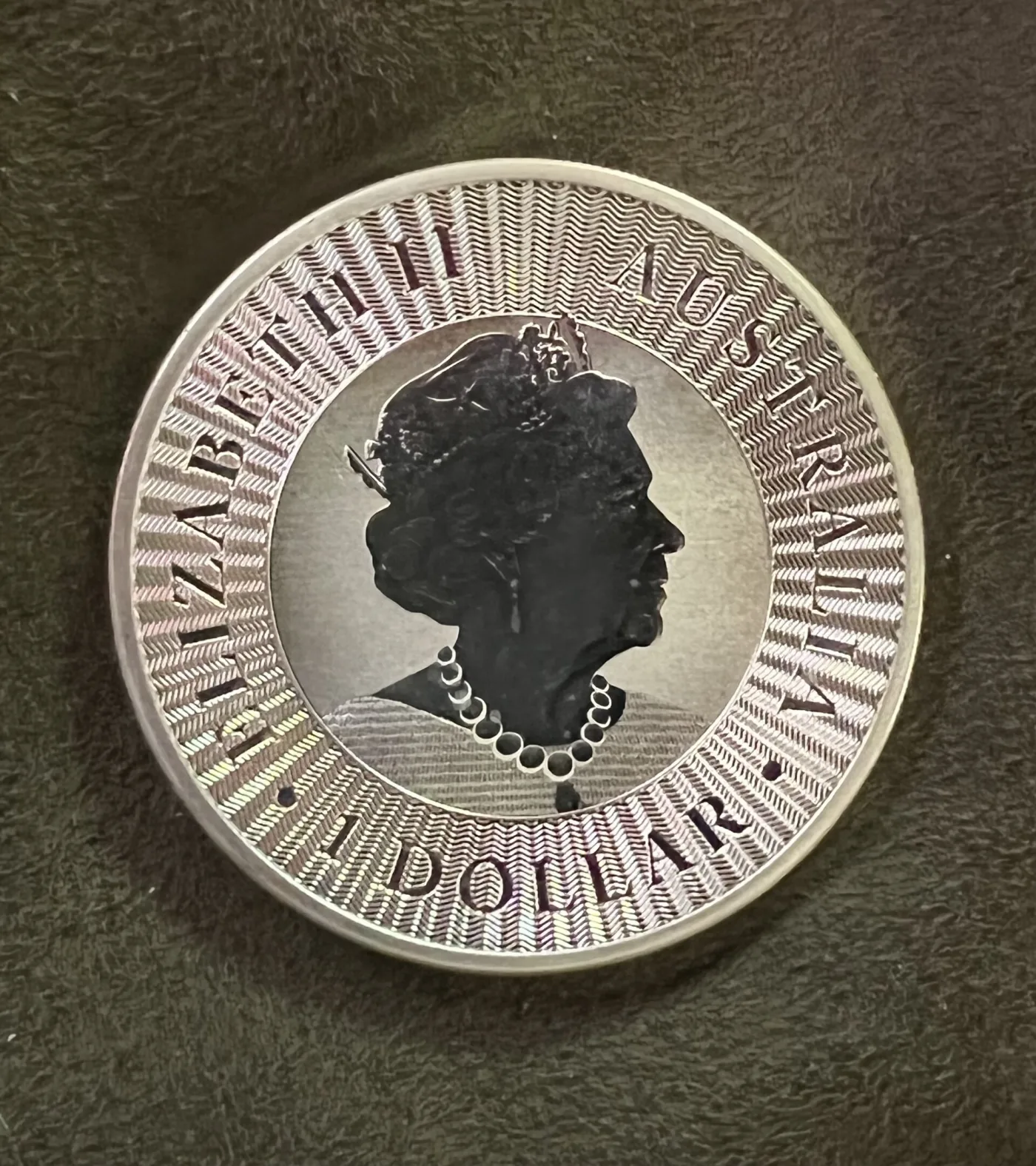
The Perth Mint, founded as a branch of the Royal Mint in 1899 and now owned by the Government of Western Australia, is one of the largest bullion producers in the world, and its coins are legal tender Australian currency even though they never circulate. They turn up constantly in collections and are frequently mistaken for circulating coins because they carry Australian denominations.
- Australian Nugget / Gold Kangaroo — launched 1986 with gold nugget designs, changed to kangaroo designs from 1990. Struck in .9999 fine gold in sizes from one-tenth ounce upward. The reverse design changes annually.
- Silver Kookaburra — launched 1990, a one-ounce silver coin with a new kookaburra design each year. It was the first of the annually-changing silver bullion series that Perth is now known for.
- Platinum Koala — issued from 1988 to 2000, and the coin whose competition in the American market helped prompt the United States to launch its own platinum bullion coin.
- Lunar Series — began in 1996, cycling through the twelve animals of the Chinese zodiac in gold and silver. The first series ran 1996–2007, and further series have followed.
The distinguishing feature of the Perth programmes, compared with the fixed designs of the American Gold Eagle or the Maple Leaf, is that the design changes every year. This creates genuine date scarcity within a bullion series: some early Kookaburra and Lunar dates carry large numismatic premiums over their metal value because mintages were low and collectors chase complete date runs. A one-ounce silver Kookaburra is never merely an ounce of silver until you have checked the year.
Perth bullion coins are marked with their weight and fineness on the reverse, carry the monarch on the obverse, and are denominated in dollars at figures far below their metal value — a one-ounce gold Kangaroo is a “100 dollar” coin. That mismatch is normal for bullion coinage and is not a sign of anything wrong.
Telling Australian Coins from Their Look-Alikes
This is where most identifications actually go wrong, so it is worth being systematic.
Australia versus Britain
The reverse settles it. A British pre-decimal coin does not name its country; it shows Britannia, a lion, a thistle-and-rose arrangement, or a heraldic design, with no country legend at all. An Australian coin says AUSTRALIA or COMMONWEALTH OF AUSTRALIA. If you find yourself looking at a king and cannot tell, you are looking at the wrong side.
Australia versus New Zealand
The harder case, because New Zealand used identical denominations, the same monarchs, and the same silver standards in the same years. New Zealand reverses are wildly different once you know them: a kiwi on the florin, a Māori warrior on the shilling, a huia bird on the sixpence, crossed patu clubs on the threepence, and a tui on the penny. New Zealand coins also carry the words NEW ZEALAND. No Australian coin shows a bird other than the emu on the arms and the lyrebird on the modern ten cent.
Australia versus South Africa and Canada
South African coins of the period carry both English and Afrikaans — SOUTH AFRICA and SUID-AFRIKA — and a springbok on the larger silver. Canadian coins name Canada and use the maple leaf, beaver, bluenose schooner, and caribou. Neither is likely to be confused with an Australian coin for more than a moment once the reverse is read.
The Decimal Look-Alikes
Modern Australian, New Zealand, and British cupronickel coins are the most commonly muddled group in a mixed change jar, because all are silvery, reeded, and portrait-obverse. Australia is the one with the echidna, lyrebird, and platypus, and the only one of the three whose fifty cent coin is twelve-sided. New Zealand’s modern coins are noticeably smaller than they used to be following its 2006 resizing. British decimal coins name their denomination in words on older issues and carry the segmented royal shield on the current series.
Grading, Cleaning, and Condition
Australian collectors traditionally use adjectival grades — Good, Fine, Very Fine, Extremely Fine, Uncirculated — rather than the 70-point numeric scale that dominates American collecting, though numeric grades from PCGS and NGC are now standard for valuable coins. The two systems map onto each other closely enough that the principles in the general coin grading guide apply directly.
What Wears First on Australian Coins
Each design has a high point that goes first, and knowing it speeds up grading enormously. On the kangaroo penny, the animal’s shoulder and thigh flatten before anything else. On the ram’s head shilling, the curl of the horn behind the ear is the first detail to go. On the wheat threepence, the individual grains blur into a smooth band. On coats-of-arms reverses, the kangaroo and emu supporters lose their detail long before the shield does. On the decimal fifty cent, the arms are so finely engraved that even lightly circulated coins look tired.
The Climate Problem
Australia’s humidity is hard on bronze. Full mint-red pennies and halfpennies are much scarcer than mintage figures suggest, because most of the surviving uncirculated bronze has toned to brown or developed spotting. This makes original red-brown and red coins disproportionately valuable and makes artificially brightened coins disproportionately common.
Which leads to the standard warning, which applies with particular force here: do not clean Australian coins. A cleaned 1930 penny loses most of its value; a cleaned common penny loses all of it. The correct handling of a corroded or dirty coin is covered in the guide to coin cleaning and preservation, and the correct answer is almost always to leave it alone and store it properly.
Counterfeits and Altered Dates
Australian coins attract three distinct kinds of forgery, and each has its own tells.
Altered Dates on Pennies
The 1930 penny is faked more often than any other Australian coin, and the usual method is not casting but date alteration: taking a common penny of a nearby date — 1933 and 1936 are the classic donors — and reworking a digit so that it reads 1930. Under magnification the altered digit shows tooling marks, an inconsistent font, wrong spacing relative to its neighbours, or a slightly different depth and surface texture from the untouched digits.
The stronger defence is die matching. Genuine 1930 pennies were struck from a small and documented set of dies, so the correct obverse and reverse die characteristics are known and catalogued, and a coin that does not match them is not genuine regardless of how convincing the date looks. In practice this means the same thing as it does for any famous rarity: buy the holder, not the coin, and treat an uncertified 1930 penny as a curiosity rather than an asset. The general principles of counterfeit detection — weight, diameter, edge, magnetism, and die comparison — all apply, and the guide to third-party grading covers how certification services handle exactly this situation.
Cast and Struck Copies of Colonial Rarities
Holey dollars, dumps, and Adelaide Pounds are copied at every level of quality, from obvious museum-shop replicas to deceptive struck forgeries. The holey dollar is the hardest case because a forger can start with a genuine Spanish colonial eight reales and add only the hole and the counterstamps, which means metal analysis and weight will not expose it. Attribution depends on expert comparison of the counterstamp punches against known genuine examples.
Modern Coloured Coin Fakes
As noted above, coloured two dollar coins are counterfeited by applying colour to ordinary circulating coins. The coin itself is genuine; the colour is not. Check whether the colour sits within a recessed area and flush with the surrounding surface, whether the boundaries are crisp, and whether it resists gentle fingernail pressure.
The Rarity That Is Usually Real
One useful counterweight: the 1966 round fifty cent is almost never faked, because it is not rare and the silver in it costs more than a forger would recover. If you find a round Australian fifty cent, the odds strongly favour it being genuine.
What Australian Coins Are Actually Worth
Sorting a mixed accumulation is quicker if you know which questions actually change the answer. In rough order of how much money is at stake:
- Is it a 1930 penny? Almost certainly not, but this is the question that would matter most. Five figures upward if genuine and certified.
- Is it a 1923 halfpenny or a 1925 penny? The next tier of pre-decimal rarity, in the thousands.
- Is it a colonial piece — holey dollar, dump, Adelaide Pound? Very high value if genuine, and very likely a replica.
- Is it silver, and is it dated before 1946? Sterling silver at 92.5% versus debased at 50%. This is a bullion question, not a rarity question, and it applies to large quantities of ordinary coins.
- Is it a round fifty cent? Silver, worth roughly a third of an ounce of it, found regularly in change jars.
- Is it a 2000 dollar coin with a doubled obverse rim? Hundreds to thousands of dollars, and checkable in a second.
- Is it a 1966 twenty cent with a wavy 2? A meaningful premium, and equally quick to check.
- Is it a 1938 crown rather than a 1937? Ten times scarcer.
- Is it a low-mintage coloured two dollar coin? Multiples of face value, and the fastest-growing area of Australian collecting.
- Is it uncirculated with original surfaces? For everything else in the series, condition is the entire story.
Everything not caught by that list — the great mass of worn pennies, common-date silver after 1946, and ordinary decimal change — is worth bullion value if silver and very little if not. That is not a disappointing answer; it is the same answer that applies to the circulating coinage of every country, and it means the sorting job is finite.
Catalogues and References
Australian numismatics is well served by specialist literature, and general world catalogues are not detailed enough for the varieties that matter.
- The Renniks Australian Coin and Banknote Values annual is the standard domestic price guide and the book Australian dealers quote from. It is the practical starting point for any Australian valuation.
- The Standard Catalog of World Coins (Krause) provides KM numbers, specifications, and mintages, and is the right reference for cross-checking an Australian coin against similar Commonwealth issues.
- The Royal Australian Mint publishes official specifications and mintage figures for decimal coinage, which is the authoritative source for anything struck since 1965.
- The Perth Mint publishes declared mintages for its bullion programmes, which is essential for judging whether a particular Kookaburra or Lunar year carries a premium.
- PCGS and NGC population reports show how many examples of each date and grade have been certified, which is the closest thing available to a survival estimate for the rarities.
For the cast and colonial material, and for the fine detail of penny dot varieties, specialist monographs and the catalogues maintained by established Australian dealers go considerably further than any general reference, and are worth consulting before spending significant money on an attribution.
Frequently Asked Questions
How do I tell if my Australian coin is silver?
Check the denomination and the date. Only the threepence, sixpence, shilling, florin, and crown were ever silver, and only in dates from 1910 to 1963 or 1964. Pennies and halfpennies are bronze and never silver, no matter how bright they look. Among decimal coins, only the 1966 round fifty cent is silver. Coins dated 1910–1945 are 92.5% silver; those dated 1946–1963 are 50%.
What is my 1930 penny worth?
If genuine, a great deal — well into five figures in Australian dollars even worn. But the overwhelming majority of coins presented as 1930 pennies are altered from other dates. Have it examined by a reputable dealer or submitted for certification before drawing any conclusions, and be sceptical of a coin whose date digits do not exactly match each other in style and depth.
Why is there no Australian coin dated 1965?
Because the pre-decimal series ended in 1964 and the decimal series began in 1966. The Royal Australian Mint spent 1965 producing the enormous stock of new decimal coins needed for the changeover, all of them dated 1966. There is nothing missing from your set.
Are one and two cent coins still legal tender?
Yes, but they were withdrawn from circulation from 1992 and cash transactions are rounded to the nearest five cents. Common dates in worn condition are worth face value at most. Uncirculated examples with full original colour are collectable.
What does the dot on my Australian penny mean?
It is a mint mark, and its position identifies the mint. A dot after the Y of PENNY indicates Perth; dots both before and after the denomination indicate Bombay; no dot generally indicates Melbourne. Various other dot positions distinguish issues of the early 1930s. A dot on an Australian penny is essentially never accidental, so check it against a catalogue.
Is my Australian coin with a hole in it a holey dollar?
Almost certainly not. Genuine holey dollars are ring-shaped pieces cut from Spanish colonial eight reales and counterstamped NEW SOUTH WALES, and only around 350 survive. A modern Australian coin with a hole in it is a coin somebody drilled. Replicas of the holey dollar are also produced and sold openly as souvenirs.
Which Australian decimal coins are worth more than face value?
The 1966 round fifty cent (silver), the 2000 dollar coin with a doubled obverse rim (the mule), the 1966 twenty cent with a wavy baseline on the 2, low-mintage coloured two dollar commemoratives, and uncirculated examples of scarce dates. Everything else in ordinary circulated condition is worth what it says on it.
Why is the Australian two dollar coin smaller than the one dollar?
Because it was introduced four years later, in 1988, and was deliberately made a different size so it could be distinguished from the dollar coin by touch. Making it smaller rather than larger also kept it convenient to carry. It confuses almost every visitor, and it is not a mistake or an error coin.
Do Australian coins have mint marks today?
Circulating coins do not. All Australian circulating coinage is struck at the Royal Australian Mint in Canberra, and there is no mint mark to look for. Small letters found on some collector dollar coins are privy marks commemorating an occasion or venue, not indications of where the coin was struck.