Ancient Greek Coins Identification Guide: How to Read, Date, and Value Greek Coins
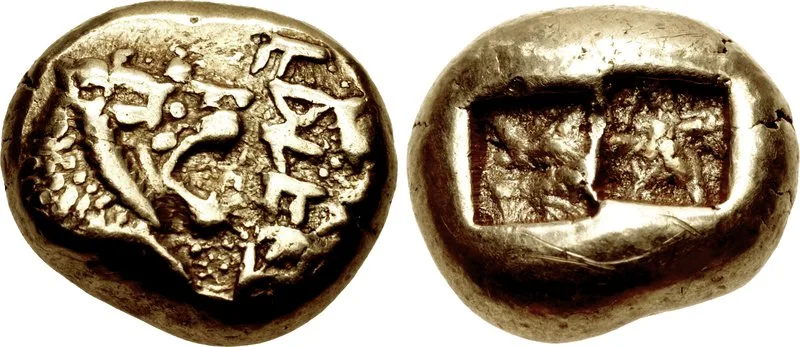
The ancient Greeks did not invent money, but they did invent the coin as a work of art. Somewhere in the kingdom of Lydia around 600 BCE, a lump of natural gold-silver alloy was stamped with a lion’s head and a value guarantee — and within a century the idea had swept the Greek world, where hundreds of independent city-states turned these little metal discs into miniature sculptures. A Greek coin can carry a portrait of Athena so alive she seems about to speak, an owl rendered in three deft strokes, a charioteer at full gallop, or a sea-nymph surrounded by leaping dolphins. Collectors have prized them for five hundred years, and Renaissance princes built cabinets around them.
Yet a first-time holder faces the same puzzle the Romans present, only harder: no dates, no denominations, and legends written in an unfamiliar alphabet — if there is any writing at all. Where a Roman coin gives you an emperor’s name in Latin, an early Greek coin may give you nothing but a turtle, a bee, or a bunch of grapes, and expect you to know which city that stands for. This is the great secret of Greek numismatics: cities spoke through symbols, not words, and learning to read those symbols is how you identify the coins.
This guide walks through the three great periods of Greek coinage and the denominations built on the drachm, the anatomy of a Greek coin, and how to read Greek legends and the crucial city “ethnic.” You will learn to identify a coin by its civic badge, to tell the Archaic, Classical, and Hellenistic styles apart at a glance, to recognize the gods and heroes on the designs, and to know the famous types — the Athenian owl, the Corinthian Pegasus, the coins of Alexander the Great — that anchor the whole field. We also cover grading ancients, what Greek coins actually cost in 2026, and how to avoid the fakes that flood the market.
Why Greek Coins Are the Art of the Ancient World
To understand Greek coinage you have to abandon the modern idea of a single national currency. Classical Greece was not a country but a patchwork of well over a thousand independent poleis — city-states — each fiercely proud, each with its own government, gods, and identity, and hundreds of them striking their own money. A coin was a civic advertisement in precious metal, carried across the Mediterranean in the purse of every trader who passed through, and the cities competed to make theirs the most beautiful and trustworthy. That competition, sustained for centuries, is why Greek coins reached an artistic height the world would not see again in coinage for two thousand years.
Money as Propaganda and Pride
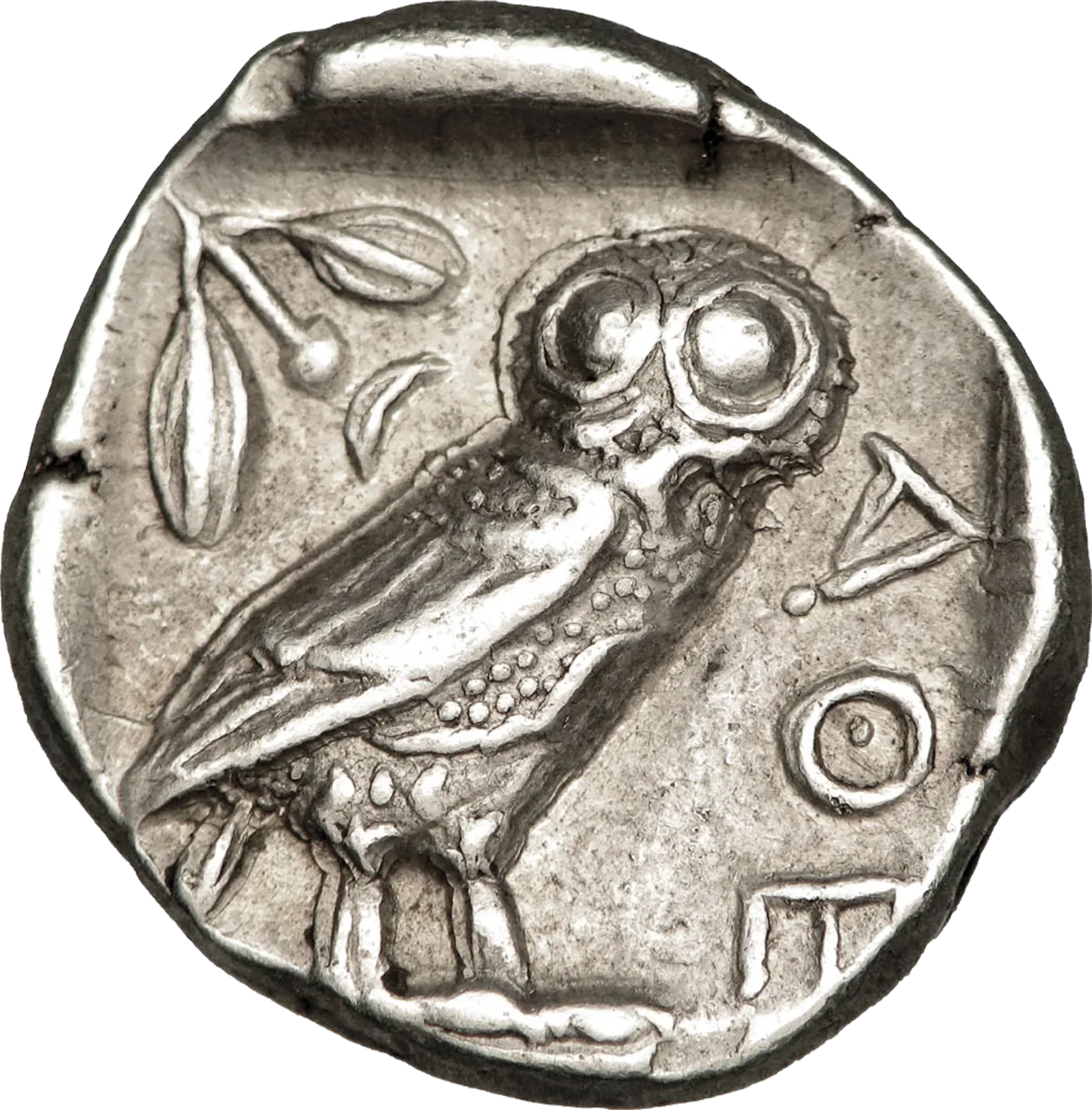
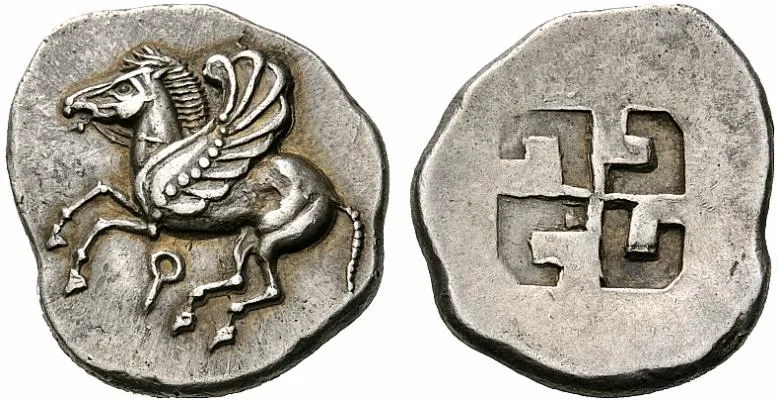
Because each city chose its own designs, a Greek coin is a compressed statement of local identity. Athens put its patron goddess Athena on one side and her owl on the other; Corinth chose the winged horse Pegasus; the island of Aegina, first of the mainland cities to strike silver, used a sea-turtle. These civic badges did the work that inscriptions do on modern coins — a merchant who could not read still knew an “owl” or a “colt” or a “turtle” by sight and trusted its weight. Reading those badges is the master key to Greek identification, and we devote a full section to them below.
Survivors in Silver and Bronze
Like Roman coins, Greek coins survive in large numbers because ancient people hoarded them, but the survival pattern differs. The great silver coins — Athenian tetradrachms, coins of Alexander — were international trade money, struck in enormous quantities and buried across three continents, so many survive and remain surprisingly affordable. Small civic bronzes are abundant and cheap. But the finest artistic issues, the large silver decadrachms of Syracuse signed by named engravers, are among the most valuable objects in all of numismatics. As with the ancient Roman coins covered in our companion guide, rarity and beauty, not age alone, set the price.
The Three Periods of Greek Coinage
Placing a coin in the right period is the first identification step, because style, technique, and subject matter changed dramatically over the six centuries that Greek coins were struck. Numismatists divide the sweep into three great periods, and learning their look lets you date a coin at a glance before you read a single letter.
The Archaic Period (c. 600–480 BCE)
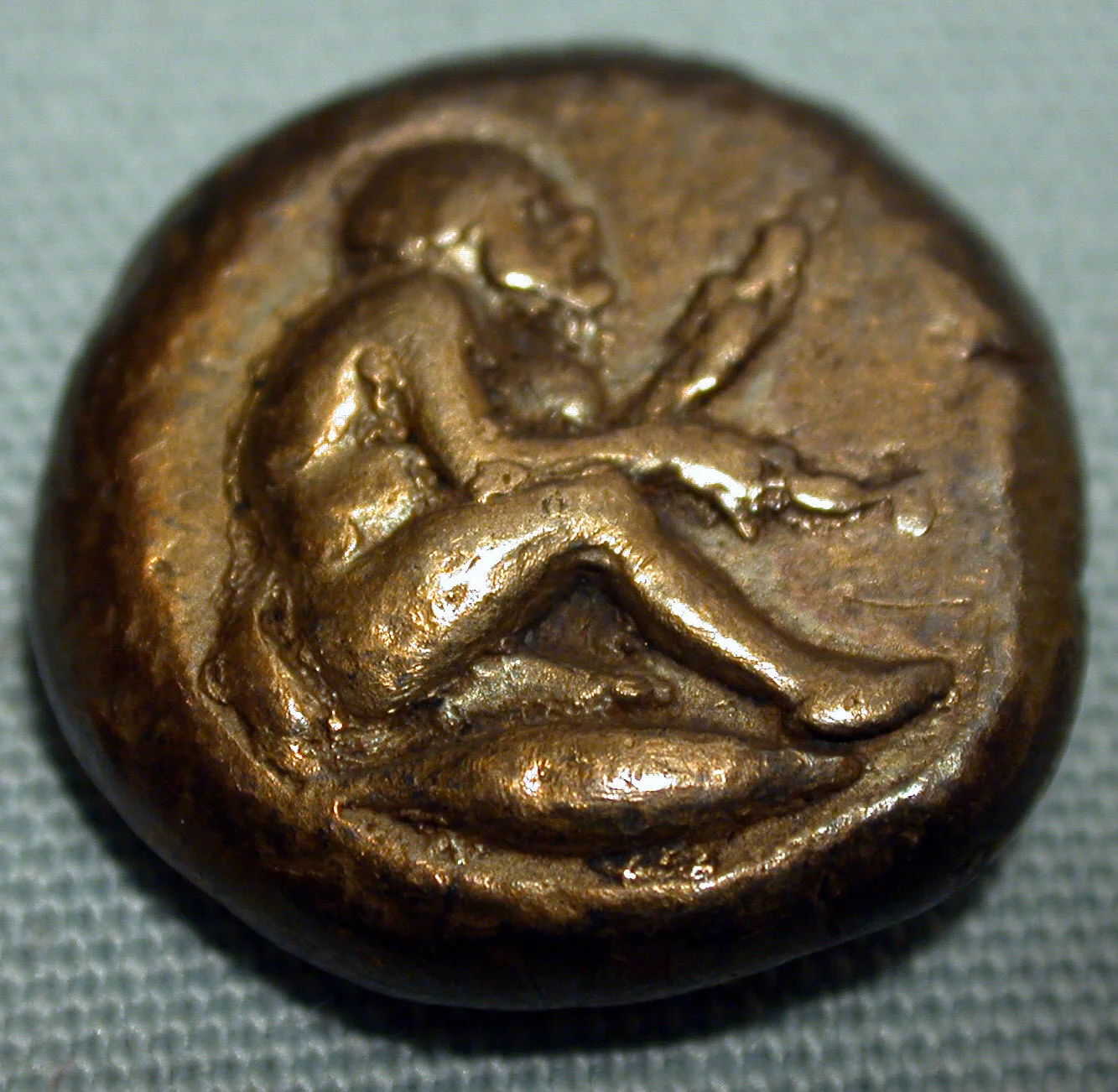
The first coins were crude by later standards but fascinating. Struck in Lydia and the Greek cities of Asia Minor, early pieces of electrum — a pale natural alloy of gold and silver — carry a design on one side only; the other bears an incuse, a rough sunken punch mark left by the tool that held the blank. Archaic figures are stiff and stylized: the eye shown frontally on a profile face, the famous “Archaic smile,” anatomy reduced to pattern. The reverse punch soon evolved into a design of its own, and by the end of the period both sides carried images. Coins of this era feel primal and are highly collectible precisely for their strangeness.
The Classical Period (c. 480–323 BCE)
The Classical period, spanning from the Persian Wars to the death of Alexander the Great, produced the greatest coin art ever made. Engravers mastered anatomy, movement, and depth; the Archaic smile relaxed into serene naturalism. Athens struck its immortal owls, the Sicilian cities produced flowing masterpieces of chariots and sea-nymphs, and named artists — Kimon and Euainetos of Syracuse — signed dies that are still studied as sculpture. This is the era of the coins most people picture when they imagine “a Greek coin,” and it is the heart of the collecting field.
The Hellenistic Period (323–31 BCE)
Alexander’s conquests shattered the old world of independent cities and replaced it with vast kingdoms ruled by his generals and their descendants. Coinage changed with it. For the first time, coins routinely bore the portrait of a living or recently dead ruler — a revolution that the Romans would inherit — and legends grew longer, naming the king in the genitive case (“of King So-and-so”). Alexander’s own coinage was struck in staggering quantity across the whole empire and long after his death, making it the most available substantial Greek silver today. The period ends with the Roman absorption of the last Hellenistic kingdom, Cleopatra’s Egypt, in 31–30 BCE.
Greek Denominations: The Drachm and Its Family
Greek coins, like Roman ones, never state their value — you read it from metal, size, and weight. The system was built around the silver drachm (literally “a handful”), subdivided and multiplied into a family of related coins. One complication makes Greek denominations trickier than Roman: cities used different weight standards, so a drachm from Athens and a drachm from Aegina weigh different amounts. Still, the core structure is consistent enough to recognize.
- Obol: The small silver unit; six obols made one drachm. Tiny fractions (half-obols, quarter-obols) exist and are astonishingly small — some the size of an apple seed.
- Drachm: The base silver coin, typically around 4 grams on the widely used Attic standard, though this varies by city.
- Didrachm (stater): A two-drachm coin, roughly 8 grams; in many regions this was called the stater and served as the main large silver piece.
- Tetradrachm: The four-drachm coin, about 17 grams, the great international trade coin and the “flagship” denomination — the Athenian owl and Alexander’s coinage are tetradrachms. Most collectors’ prize Greek silver is a tetradrachm.
- Decadrachm: The magnificent ten-drachm coin, about 43 grams, struck rarely for special occasions. The Syracusan decadrachms are the supreme masterpieces of Greek coin art.
- Gold staters: Gold was struck sparingly by most cities but poured out by Macedon under Philip II and Alexander; a gold stater weighs about 8.6 grams.
- Electrum staters: The pale-gold coins of the Archaic period and of a few later mints such as Cyzicus and Mytilene, prized and often valuable.
- Bronze (AE): Introduced in the fourth century BCE for small change, civic bronzes are the affordable entry point to the whole field, classified by diameter much like late Roman bronzes.
A practical shortcut: weigh the coin and note the metal. A silver coin near 17 grams is almost certainly a tetradrachm; near 4 grams, a drachm; a heavy silver piece over 40 grams is a decadrachm and potentially very important. Bronze coins are judged by size (in millimeters), just as Roman AE coins are.
Anatomy of a Greek Coin
Numismatists describe Greek coins with the same shared vocabulary used for all ancient coinage, and a few terms unlock every auction listing and reference entry.
The Obverse and Reverse
The obverse (front) usually carries the principal design — most often the head of a deity in the Classical period, or a ruler’s portrait in the Hellenistic — struck by the lower, fixed die (the anvil die), which was more deeply cut and better protected. The reverse (back), struck by the upper punch die the mint-worker held and hammered, carries the city’s badge or a secondary type together with the legend. On the earliest coins the reverse is merely an incuse punch; by Classical times it is a full design.
The Legend, Ethnic, and Symbols
The legend is the inscription; on Greek coins its most important element is the ethnic — the name of the issuing people or city, usually in the genitive plural (“of the Athenians,” “of the Syracusans”). Around the main type you may also find magistrate names, tiny control symbols (a club, a star, a monogram) that identify a specific issue or official, and monograms that abbreviate names. These small marks are the fingerprints that let specialists distinguish otherwise identical coins.
Flans, Dies, and Hand-Striking
Every Greek coin was struck by hand from a heated blank (flan) between two engraved dies, so the same irregularities seen on Roman coins appear here: off-center strikes, uneven flan shapes, doubling from a bouncing die, and flat areas where metal did not fill the die. Archaic and early Classical flans are often thick and globular; later flans grow broader and thinner. These traits are the signature of authentic ancient manufacture and, as with any hand-struck coin, are reassuring rather than troubling when judging genuineness.
Civic Badges: How Cities Spoke Through Symbols
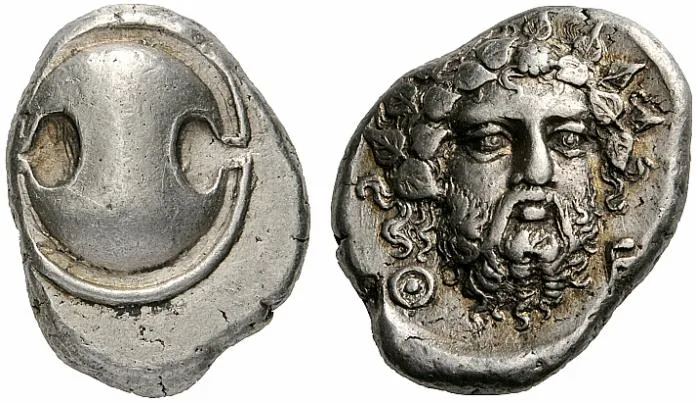
If you learn one thing about identifying Greek coins, learn this: the design usually tells you the city. In a world of limited literacy and hundreds of competing mints, each polis adopted a recognizable emblem — a god, animal, plant, or object tied to its identity, mythology, or economy — and that badge functioned as a civic logo, instantly recognizable and jealously guarded. Matching the badge to the city is the single most powerful identification technique in the field, and often you can name a coin from the picture before you read a word.
The Great Civic Badges
- Owl — Athens (sacred to Athena, whose head appears on the obverse)
- Pegasus (winged horse) — Corinth, with the head of Athena in a Corinthian helmet
- Sea-turtle — Aegina (a land-tortoise on later issues after the city’s defeat)
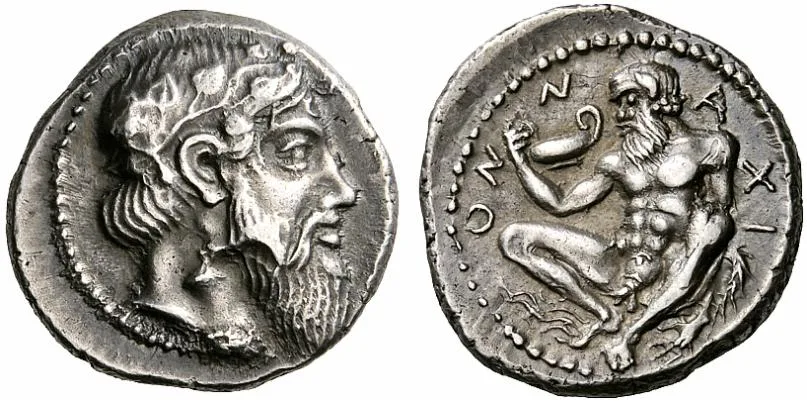
- Nymph and dolphins / racing quadriga — Syracuse
- Bee — Ephesus (with a stag, sacred to Artemis)
- Silphium plant — Cyrene (its wealth came from this now-extinct herb)
- Rose — Rhodes (a punning badge; rhodon is Greek for rose)
- Crab — Akragas (Agrigentum) in Sicily
- Man-headed bull — the river-god badge of many southern Italian cities such as Neapolis and Gela
- Grain ear — Metapontum, whose fertile fields made it rich
- Eagle and thunderbolt — Elis (for Olympian Zeus) and the Ptolemies of Egypt
- Lion — Lydia, Miletus, and numerous eastern mints
Reading a Badge You Do Not Recognize
When the badge is unfamiliar, treat it as a clue rather than an answer. Note precisely what is shown — the animal, its pose, any object it holds or stands on — and search that description in the online databases discussed below. Regional style helps too: dolphins and sea-life point to Sicily and southern Italy, elaborate frontal faces to the great Classical mints, austere geometric punches to the Archaic east. The badge plus the ethnic together almost always resolve the city, and with practice the common ones become as familiar as national flags.

How to Read Greek Legends and the Ethnic
Greek legends intimidate newcomers because of the alphabet, but the Greek script has only twenty-four letters and most are close to their Latin cousins. Learning to recognize a dozen of them turns an impenetrable inscription into a readable name — a skill that pays twice, since the same alphabet returns on the Byzantine coins struck a thousand years later. Note also that early coins may have no legend at all — the badge alone identified the city — while legends grow longer and more informative through the Classical and Hellenistic periods.
The Letters That Trip People Up
Most Greek capitals are guessable, but a handful differ from Latin in ways that cause misreadings:
- Σ (sigma) = S, but on coins it is very often written like a Latin C (the “lunate” form)
- Γ (gamma) = G, shaped like an upside-down L
- Λ (lambda) = L, an unbarred triangle like an inverted V
- Π (pi) = P, but the sound P is written Ρ (rho), which looks like Latin P
- Η (eta) = long E, shaped like Latin H
- Θ (theta) = TH, a circle with a bar
- Φ (phi) = PH/F, a circle on a vertical stroke
- Ω (omega) = long O, the familiar horseshoe shape
- Ξ (xi) = X-sound written like three stacked bars; X (chi) = the KH sound
The Ethnic: Your Anchor
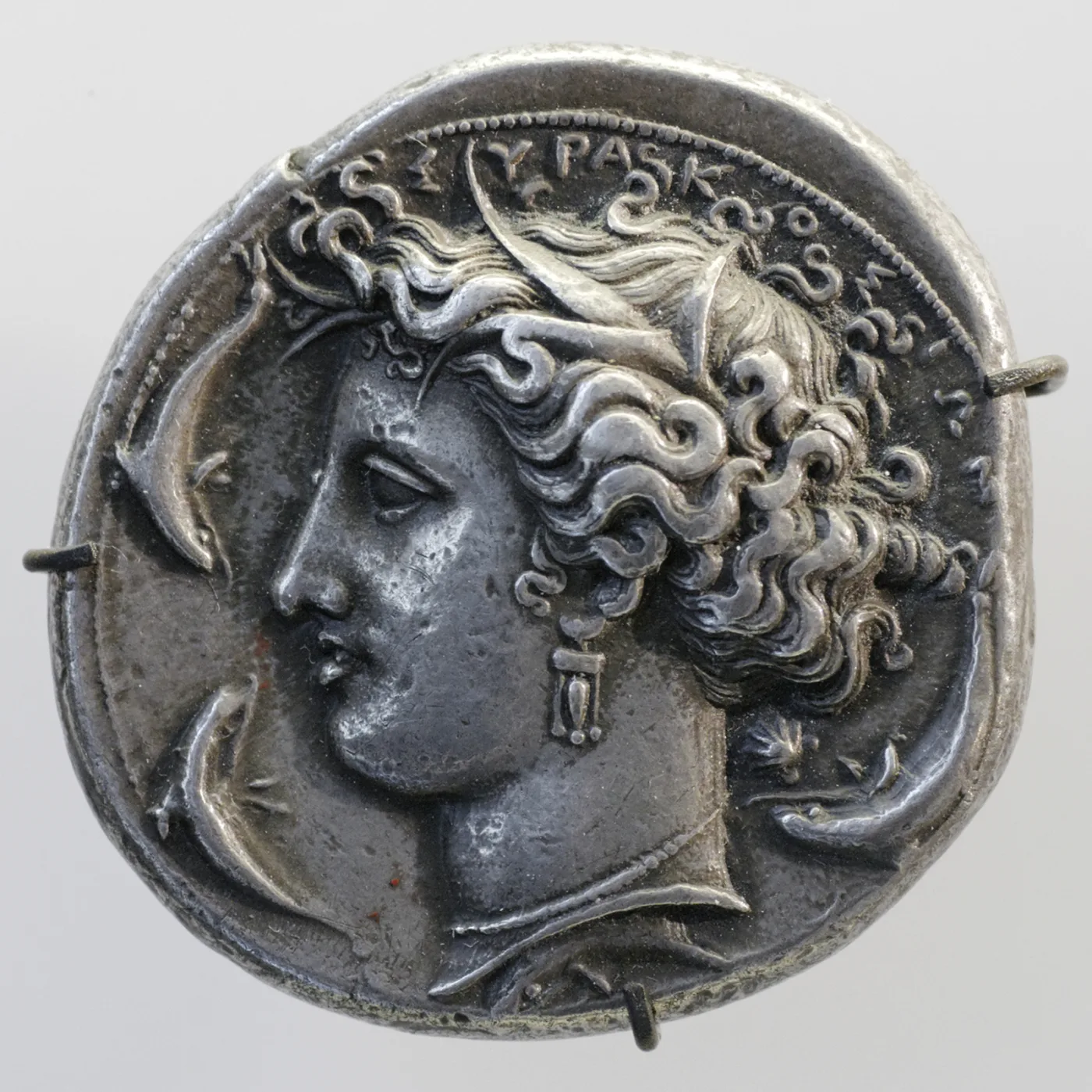
The ethnic names the issuing city or people and is usually in the genitive plural. ΑΘΕ (ATHE, for Athenaion) marks Athens; ΣΥΡΑ or ΣΥΡΑΚΟΣΙΩΝ marks Syracuse; ΚΟΡ or a koppa (an archaic Q) marks Corinth. Cities frequently abbreviated the ethnic to two or three letters in the early period and spelled it fully later. Once you locate the ethnic and transliterate even part of it, a database search usually pins the city immediately.
Magistrates and Monograms
From the Classical period onward, many coins add the name of the annual magistrate responsible for the issue, often abbreviated, and Hellenistic coins bristle with monograms — clever ligatures combining several letters into one symbol — that identify mints, officials, or issues. You need not decode every monogram to identify a coin, but noting them helps specialists place it to a precise series, much as the mint marks on later coins pin down where and when a piece was struck.
Style as a Timeline: Archaic, Classical, Hellenistic
Because Greek coins so rarely carry dates, artistic style is your calendar. The evolution of Greek art is well documented and remarkably consistent across the coin-producing world, so the look of a coin brackets its date more reliably than almost any other feature. Training your eye on style is the single most valuable skill after learning the civic badges.
Recognizing Archaic Work
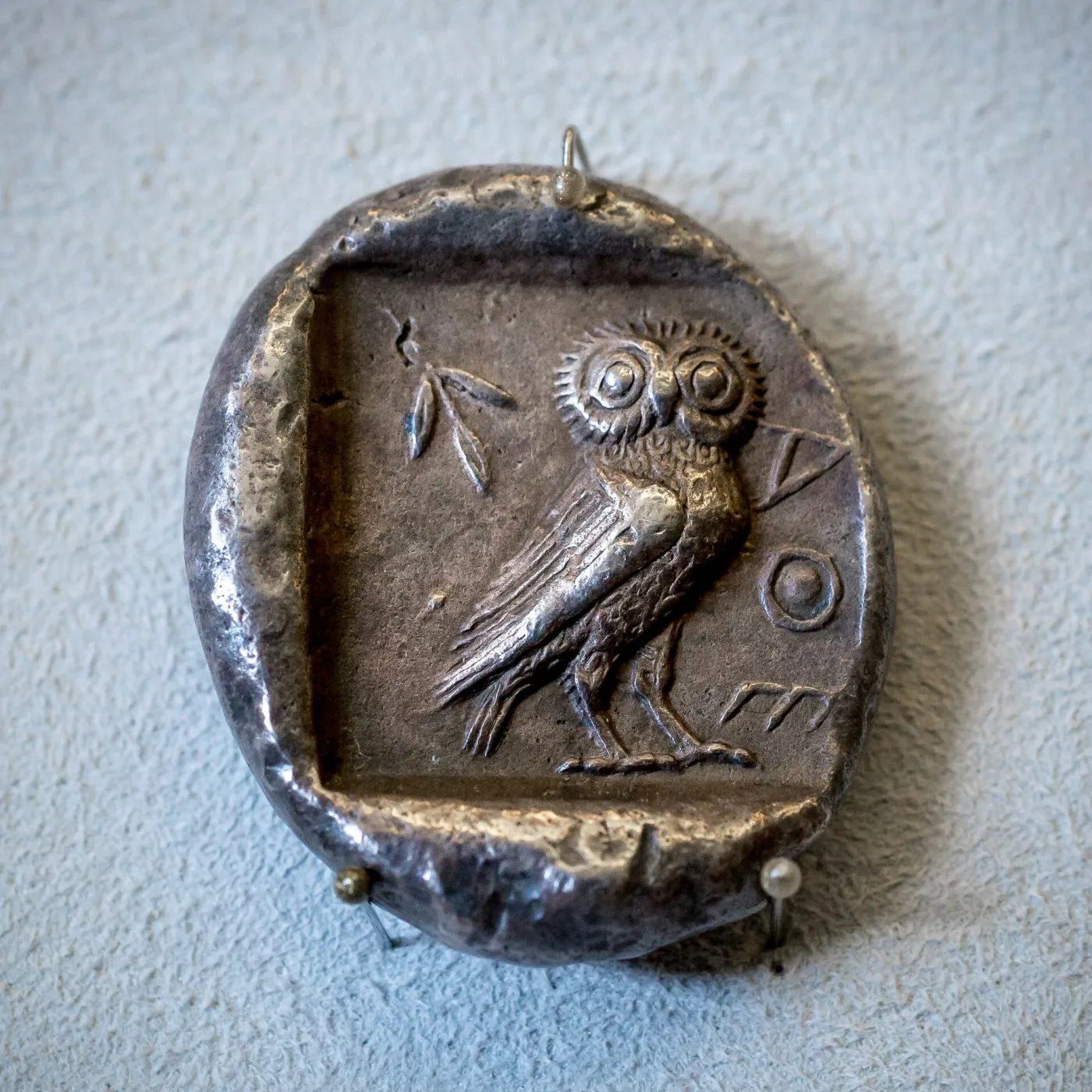
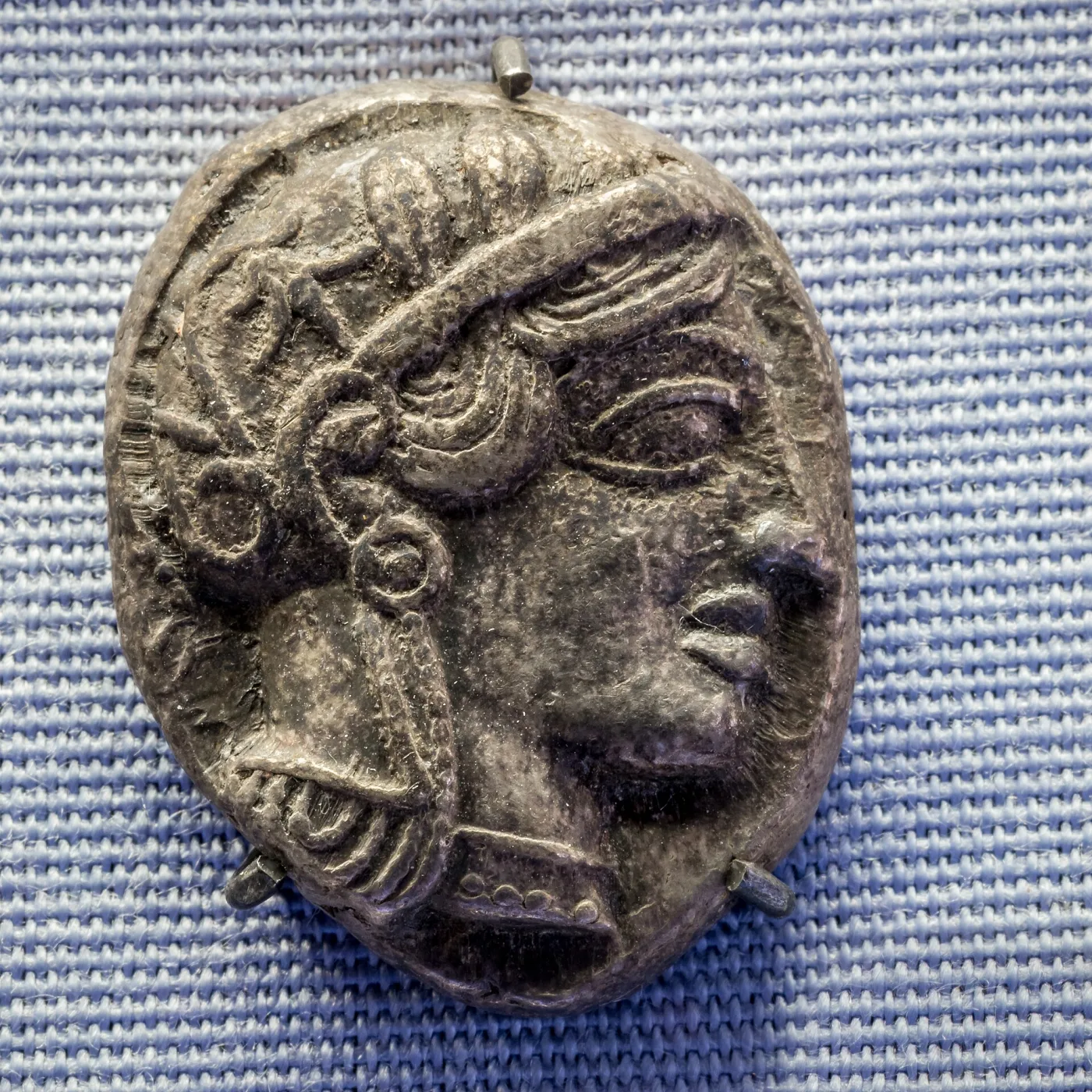
Archaic coins (before about 480 BCE) look deliberately patterned rather than lifelike. Watch for the frontal eye on a profile head, the fixed “Archaic smile,” hair rendered as rows of beads or dots, and rigid, symmetrical poses. One large exception is worth memorising before you use this rule: Athens kept the frontal eye on its owls for a century after the Archaic period ended, deliberately, so that the most trusted trade coin in the Mediterranean would go on looking like itself. On an Athenian tetradrachm the eye dates the design, not the coin. Reverses are often simple incuse squares or geometric punches. The overall impression is powerful but primitive — figures assembled from conventions rather than observed from life.
Recognizing Classical Work
Classical coins (roughly 480–323 BCE) show mastery: correct anatomy, natural three-quarter turns of the head, flowing drapery, and real movement and depth. The Sicilian mints pushed the medium to its artistic peak, engraving galloping chariots and floating sea-nymphs with a freedom that still astonishes. If a coin looks like a small Classical sculpture, it belongs here — this is the golden age and the most sought-after style.
Recognizing Hellenistic Work
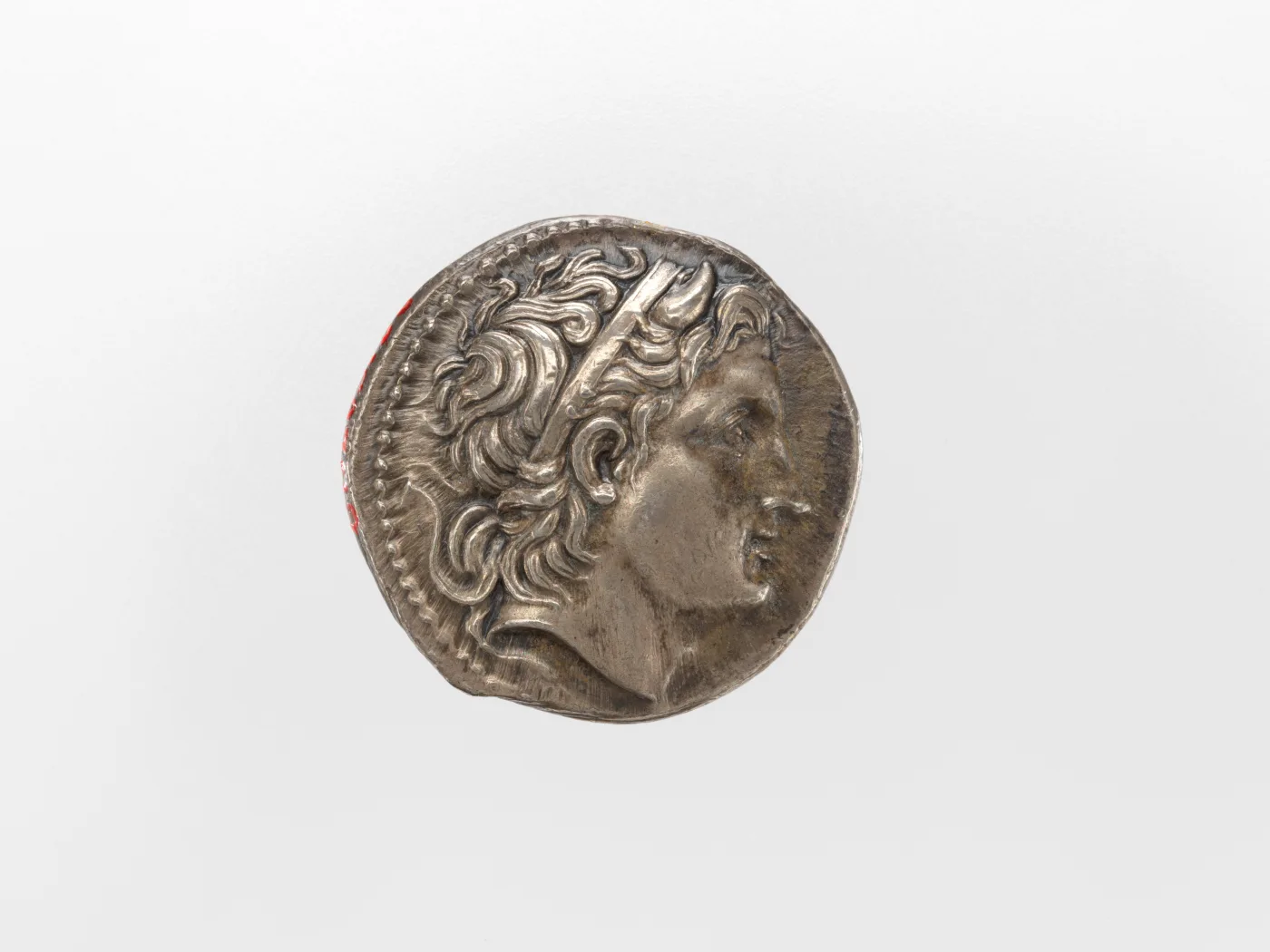
Hellenistic coins (323–31 BCE) turn toward individualized portraiture and drama. Ruler portraits aim at recognizable likeness and personality — sometimes idealized and godlike, sometimes strikingly realistic, wrinkles and all, especially on the coins of Bactria and Parthia. Flans grow broad and thin, legends grow long, and divine attributes (the horn of Ammon on Alexander, the aegis or diadem on kings) proliferate. A lifelike individual face on a broad thin flan almost always signals the Hellenistic age.
Gods, Heroes, and What the Designs Mean
The imagery on Greek coins draws on a shared mythology every Greek knew, and learning the principal gods and their attributes makes the designs readable. As on Roman coins, each deity carries recognizable props, and the god shown usually connects to the issuing city’s patron cults.
The Olympian Cast
The gods appear again and again, each identifiable by attributes: Athena in a crested helmet (Athens, Corinth, and cities that admired her); Zeus enthroned with eagle and scepter, or hurling a thunderbolt (Alexander’s coinage, Elis, the Seleucids); Apollo as a beautiful laureate youth with a lyre; Herakles wearing the lion-skin headdress, his club nearby (Macedon and the many cities claiming descent from him); Artemis with bow and quiver (Ephesus); Poseidon with his trident; Demeter and Persephone crowned with grain (the fertile cities of Sicily and southern Italy); and Nike, winged Victory, alighting with a wreath. Name the attributes and you name the god.
Nymphs, Rivers, and Local Heroes
Beyond the Olympians, cities honored their own local divinities: spring-nymphs personifying the city’s water source (Arethusa at Syracuse, her hair bound up and surrounded by dolphins), river-gods shown as man-headed bulls, and founding heroes tied to civic myth. These local types are often the true civic badge and the surest identifier, since a generic Apollo might belong to many cities but a specific named nymph belongs to one.
Reading the Whole Coin Together
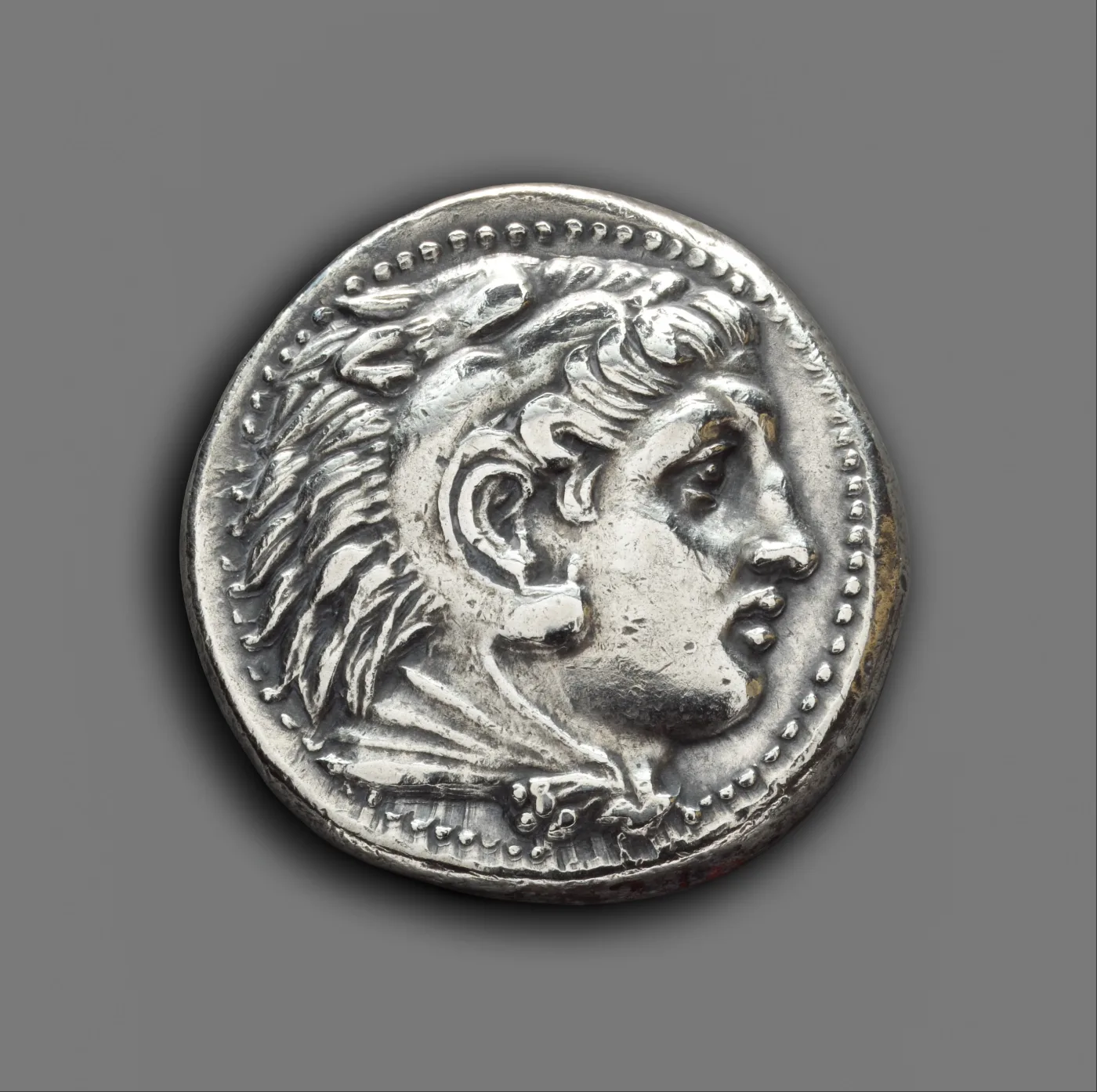
The most reliable identifications come from reading obverse and reverse as a pair. Athena plus an owl is Athens; Athena in a Corinthian helmet plus Pegasus is Corinth; the head of young Herakles in a lion-skin plus Zeus enthroned is the coinage of Alexander. The combination is almost always diagnostic even when the legend is worn away — which is exactly why the badges and gods deserve careful study before you ever reach for a reference.
Royal Portraits and the Hellenistic Kingdoms
The single greatest change in Greek coinage came after Alexander, when kings began putting their own faces on their money. For collectors this is a gift: like Roman imperial coins, Hellenistic royal coins can often be identified by naming the portrait, and the legend confirms it. Learning the major dynasties turns a large slice of the field into a portrait gallery.
The Successor Kingdoms
When Alexander died in 323 BCE, his generals (the Diadochi) carved the empire into kingdoms that struck coins for three centuries:
- The Ptolemies of Egypt — heavy coins with the diademed portrait of Ptolemy I and a bold eagle on a thunderbolt on the reverse; the dynasty ended with Cleopatra VII.
- The Seleucids of Syria and the East — a vast, varied coinage of many kings, often with Apollo seated on the omphalos as a reverse.
- The Antigonids of Macedon — successors in Alexander’s homeland, with types honoring Zeus, Pan, and Poseidon.
- The Attalids of Pergamon — known for the cistophoric tetradrachms bearing a sacred snake-basket.
- The Greco-Bactrian and Indo-Greek kings — a remote realm in Afghanistan and India whose strikingly realistic royal portraits are among the finest in all coinage, and whose bilingual Greek and Kharoshthi legends begin the story of struck portrait Indian coins.
Alexander’s Everlasting Coinage
Alexander the Great’s own coinage deserves special note because it is the most abundant substantial Greek silver a collector will meet. His standard tetradrachm shows the head of young Herakles in a lion-skin on the obverse — a portrait many ancients read as Alexander himself in heroic guise — and Zeus enthroned holding an eagle on the reverse, with the legend naming Alexander. These coins were struck at dozens of mints during his life and for two centuries afterward as a trusted international currency, so genuine examples remain attainable. The gold staters, showing Athena and a winged Nike, are more valuable but still obtainable.
Famous Greek Coins Every Collector Should Know
A handful of types dominate collector demand and serve as orientation points for the whole field, whether for their beauty, history, or availability.
The Icons of the Field
The Athenian owl tetradrachm is the most recognizable ancient Greek coin of all — Athena’s helmeted head on the obverse, her wide-eyed owl with an olive sprig and the ethnic ΑΘΕ on the reverse. Struck in immense quantities on silver from the mines at Laurion, it was the dollar of the ancient Mediterranean, and honest examples remain among the most affordable “must-have” Greek coins. The Corinthian stater with Pegasus and helmeted Athena is nearly as famous and beloved. The gold and silver of Philip II and Alexander III of Macedon financed the conquest of the known world and survive in quantity.
The Supreme Masterpieces
At the pinnacle stand the Syracusan decadrachms — the ten-drachm coins engraved by Kimon and Euainetos around 400 BCE, showing the nymph Arethusa amid dolphins and a racing four-horse chariot crowned by Nike. Widely regarded as the most beautiful coins ever struck, fine examples reach well into six figures. Other trophies include the decadrachms of Athens, the electrum staters of Cyzicus with their endless parade of types, and the artistically signed tetradrachms of Sicilian cities. These are the ancient-coin equivalents of the key-date rarities that anchor any advanced collection.
Coins of Availability
Fortunately, the field also brims with attainable classics. Alexander tetradrachms and drachms are the natural first “real” Greek silver for most collectors. Civic bronze coins of the Hellenistic cities cost a few tens of dollars and offer endless variety of gods and badges. Small silver fractions — obols and hemidrachms of dozens of cities — pack real Greek art into modest budgets. Beginning with an owl, an Alexander drachm, or a handful of civic bronzes is the time-honored way into the field.
Step-by-Step Identification Workflow
Here is the systematic process specialists use for Greek coins, adapted to the field’s reliance on badges and style. Work with a gram scale, calipers or a millimeter ruler, a 10x loupe, and strong raking light from a single lamp.
- 1. Weigh and measure. Weight in grams and diameter in millimeters suggest the denomination and metal — a ~17 g silver coin is a tetradrachm, a ~4 g piece a drachm, a heavy 40+ g silver coin a decadrachm.
- 2. Identify the metal. Gold, pale electrum, silver, or bronze. Electrum and gold immediately narrow the field of possible mints and periods.
- 3. Date the style. Archaic (stiff, frontal eye, incuse reverse), Classical (naturalistic, dynamic), or Hellenistic (portrait, broad thin flan)? This brackets the century before you read anything — with the Athenian owl as the standing exception, since its frozen archaic style outlived the Archaic period by a hundred years.
- 4. Read the badge. Identify the obverse and reverse types precisely — which god, animal, or object, and in what pose. The badge often names the city on its own.
- 5. Find and transliterate the ethnic. Locate the city name in the legend and convert the Greek letters to Latin, remembering the tricky ones (lunate sigma = C/S, Γ = G, Ρ = R).
- 6. Note magistrates, monograms, and symbols. Record any secondary names, ligatures, or control marks in the fields; these pin the exact issue.
- 7. Search the databases. Enter the type description and ethnic into online catalogs and auction archives (see the references section) to match your coin against published examples.
- 8. Record the attribution. Note the city or king, denomination, approximate date, and a catalog reference (such as a Sear or SNG number) on the coin’s holder or in your log.
With practice this loop takes only a few minutes for common types. A photograph-based AI identifier can jump-start the search — capture both sides in even light and let the model propose candidates — but the badge, style, and legend skills above are what let you confirm the answer like a numismatist instead of guessing.
Magna Graecia and the Coins of the West
One region deserves its own section because it produced some of the most beautiful and collectible Greek coins of all: Magna Graecia — “Great Greece” — the Greek colonies of southern Italy and Sicily. Settled from the eighth century BCE, these wealthy cities rivaled and often surpassed the mother cities in the art of coinage, and their issues are a field unto themselves.
The Incuse Coinages of Southern Italy
The Archaic cities of southern Italy — Metapontum, Sybaris, Croton, Caulonia — struck a remarkable and distinctive coinage in the sixth century BCE: broad, thin silver staters with the design in relief on the obverse and the same design incuse (sunken) on the reverse. A Metapontum stater shows a grain ear raised on one side and hollowed on the other. This “incuse” technique is unique to the region and instantly identifies these early western coins. Metapontum’s grain ear, Croton’s tripod, and Caulonia’s striding Apollo are the classic badges.
The Sicilian Masterpieces
Sicily was the artistic capital of Greek coinage. Beyond Syracuse’s famous decadrachms and Arethusa tetradrachms, the island’s cities produced a dazzling range: the crab and eagle of Akragas, the man-headed river-bull and victorious charioteer of Gela, the nymph and hare of Messana, and the celery-leaf badge of Selinus. Because so many of these cities were destroyed in ancient wars, their coinages are finite and eagerly collected. A Sicilian tetradrachm in good style is one of the great prizes of the hobby.
Grading Ancient Coins: A Different Language
If you come from modern coins, set the 70-point scale aside. The Sheldon numeric system explained in our coin grading guide assumes machine-made coins that all began identical, so wear alone tells the story. Hand-struck Greek coins each began unique, so ancient grading weighs several independent factors at once — and for Greek coins, artistry weighs especially heavily.
The Factors That Matter
Ancients are graded adjectivally — Good, Fine, Very Fine, Extremely Fine, up to Mint State or FDC (fleur de coin) — but the adjective is only the start. Equal weight goes to strike (centering and completeness of the impression), surface (corrosion, pitting, scratches, deposits, cleaning marks), and above all style — the artistic quality of the individual hand-engraved die. For Greek coins, style can dominate value: a Very Fine tetradrachm from a masterful die, well-centered on a clean flan, is worth far more than a technically sharper coin from a dull or crude die. NGC’s ancient service grades strike and surface separately on a 1–5 scale alongside the wear grade and awards a coveted “Fine Style” designation for exceptional artistry.
Test Cuts, Tooling, and Smoothing
Greek silver carries some field-specific quirks. Ancient bankers often gouged a test cut into a coin to check that it was solid silver rather than a plated forgery; these cuts are genuine ancient features that lower value modestly but confirm authenticity. As with Roman bronzes, the modern hazards are tooling (re-engraving details into worn metal) and smoothing (shaving rough fields), both of which slash value when disclosed and destroy trust when not. Examine expensive coins for suspiciously crisp details rising from suspiciously flat surfaces.
Raw Versus Slabbed
Most ancient coins trade raw, and many Greek specialists prefer them that way — handling a coin an Athenian citizen once spent is much of the appeal. Third-party grading through NGC Ancients adds liquidity and comfort for costly purchases and crossover collectors, but note that ancient encapsulation carries an authenticity opinion rather than the guarantee structure of modern services. For Greek coins especially, buying from an established specialist dealer matters more than the plastic.
What Greek Coins Are Worth in 2026
Greek coin prices span an enormous range, from pocket change to the price of a house, but they are far from random. As of 2026, these retail ranges hold for typical identifiable coins:
- Common civic bronzes (AE): $15–60 identifiable; $75–200 for sharp examples with green or brown patina
- Small silver fractions (obols, hemidrachms): $40–150 in collectible grades, more for scarce cities
- Alexander the Great drachms: $80–250; tetradrachms $300–900 in attractive grades
- Athenian owl tetradrachms: $400–1,200 depending on style and condition; the finest “mass” classical owls higher
- Corinthian staters: $300–900 for pleasing examples
- Hellenistic royal tetradrachms: $250–1,500 across the dynasties, with lifetime portraits and rare kings higher
- Gold staters (Philip II, Alexander): roughly $1,500–4,000 for common types, climbing with condition and rarity
- Masterpieces and rarities: signed Sicilian tetradrachms, decadrachms, and fine electrum reach five, six, and seven figures
What Actually Drives Price
Four factors dominate. Artistic quality: more than in any other series, the beauty of the die sets Greek coin value — two coins of the same city and denomination can differ tenfold on style alone. Condition and eye appeal: centering, surface, and strike matter enormously. Rarity of the city or issue: coins of small or short-lived mints command premiums, while abundant Alexanders and owls stay accessible. Provenance: a documented old-collection pedigree adds value and, increasingly, legal comfort — auction records from before 1970 are especially prized. A fresh hoard can also reshape prices overnight, much as it can for Roman coins.
Counterfeits, Copies, and How to Avoid Them
Fakes are the serious risk in Greek numismatics, and because the coins are valuable and beautiful, forgers work hard at them. The good news: a collector armed with a scale, calipers, magnification, and the standard counterfeit detection tests catches the great majority. As always, the surest protection is buying from reputable specialists.
Modern Fakes
Cast copies betray themselves with edge seams, casting bubbles, a soft mushy look, uniform graininess, and weights that miss the standard. Struck fakes from modern dies are more dangerous; the notorious high-quality forgery workshops (including the so-called “Black Sea” and Bulgarian schools) have deceived experienced collectors, which is why costly coins demand trusted sources. Tourist replicas from museum shops and Mediterranean souvenir stalls turn up constantly in inherited collections — most are crude, oversized, or made of the wrong metal, and US-made replicas should be stamped COPY under the Hobby Protection Act. Red flags that should stop a purchase: a “group” of matching rare tetradrachms, prices far below the market for the type, gold offered under bullion value, and sellers with hidden feedback shipping from known forgery regions.
Ancient Imitations Are Not Modern Fakes
As with Roman coins, some “fakes” are themselves ancient and collectible. Plated (fourrée) forgeries — a copper core clad in silver and struck, often from stolen official dies — were made in antiquity; where the plating breaks, the core shows through, and collectors value them as historical curiosities.
Countless ancient imitations of Athenian owls and Alexander coinage were struck by peoples on the fringes of the Greek world (in Egypt, Arabia, and Central Asia) to serve as trusted trade money; these “imitative” issues are a legitimate and fascinating collecting area when sold as what they are. Celtic tribes likewise copied Greek gold staters into wonderfully abstract designs.
Buy the Seller
The single best protection is provenance and expertise: established ancient-coin dealers, the major numismatic marketplaces with dealer vetting, and auction houses that guarantee authenticity for life. Community fake databases — notably the Forum Ancient Coins fake reports — let you check a suspicious coin against known forgeries. When real money is at stake, an authentication opinion from NGC Ancients or a specialist dealer is inexpensive insurance against an expensive mistake.
Attribution and References: Sear, BMC, and Online Tools
A Greek coin is fully identified when you can cite it: city or king, denomination, approximate date, and a catalog number. The Greek cataloging universe is older and more scattered than the Roman, but it is rich, and much of it is now searchable online.
The Standard References
For a single-shelf library, David Sear’s Greek Coins and Their Values (two volumes) pairs attributions with market prices and is the natural starting reference, complemented by his Greek Imperial Coins for provincial issues. Scholars rely on the vast Sylloge Nummorum Graecorum (SNG) series, which photographs major collections city by city and provides the “SNG” reference numbers used across the market. The older British Museum Catalogue (BMC) volumes remain fundamental, and specialized works cover individual cities and dynasties in depth.
Free Online Databases
Online tools have transformed Greek identification. Wildwinds organizes thousands of photographed Greek types by city and ruler and is often the fastest way to match a coin. The American Numismatic Society’s PELLA (for the coinage of Alexander and the Macedonian kings) and Pretty (PCW) and related ANS databases put major reference corpora online. Auction archives such as acsearch and CoinArchives show real transaction prices for comparable coins and are invaluable both for identification and for valuation. Between these tools, a patient beginner can attribute almost any coin with legible detail.
Join the Conversation
Greek numismatics has a famously generous community. Specialist forums and collector groups routinely identify mystery coins from photographs within hours, and study groups exist for every niche from Archaic electrum to Indo-Greek portraits. Post clear photographs of both sides along with the weight and diameter, and you will rarely wait long for an answer — or learn less than you hoped.
Frequently Asked Questions
Are ancient Greek coins rare?
It depends entirely on the coin. Great trade issues — Athenian owls, Alexander tetradrachms, common civic bronzes — survive in large numbers and remain affordable. But coins of small or short-lived cities, high-grade survivors, and the great artistic issues such as Syracusan decadrachms are genuinely rare and priced accordingly. As with all ancient coins, rarity attaches to the specific city, issue, and condition, not to "Greek coin" in general.
How do I identify a Greek coin with no writing on it?
By its imagery and style. Early Greek coins often carry no legend at all, relying on the civic badge to identify the city. Read the badge precisely (owl = Athens, Pegasus = Corinth, sea-turtle = Aegina, and so on), date the style as Archaic, Classical, or Hellenistic, and search that description in an online database such as Wildwinds. The picture is the identification; the writing, when present, merely confirms it.
Is it legal to own ancient Greek coins?
In the United States and most of Europe, yes — buying, owning, and selling ancient coins is a lawful, centuries-old trade. The legal complexity sits at the source: several Mediterranean countries claim newly found antiquities as state property, and US import restrictions cover coins from some of them. The practical guidance is the same as for Roman coins: buy from reputable dealers who stand behind the legality of their stock, keep your invoices, and prize documented provenance — it protects both your investment and the hobby.
What is the most affordable way to start collecting Greek coins?
Buy one identified, decent-grade coin from a reputable dealer and learn to read it. A silver drachm of Alexander the Great ($80–250) is the classic first "real" Greek coin, and a small group of Hellenistic civic bronzes ($15–60 each) offers wide variety on a modest budget. An Athenian owl is the iconic upgrade once you are ready. Let your interests — a city, a god, a region like Sicily — guide the collection from there.
What is the difference between Greek and Roman coins?
Greek coins were struck by hundreds of independent cities, each with its own badge and gods, and they reached their artistic peak in the Classical period; identification relies heavily on reading civic symbols and style, and legends are in Greek. Roman coins were the product of a single centralized state that named its issuer in Latin and, under the Empire, put the emperor's portrait on nearly every coin, making them identifiable by legend. In short: Greek coins ask you to read pictures, Roman coins let you read names. Many collectors enjoy both and find that skills learned in one field transfer readily to the other.
Should I clean an ancient Greek coin?
Generally no. On silver, the surface toning and on bronze the stable patina are part of the coin's value and appeal, and stripping them causes real damage — the same principle covered in our coin cleaning and preservation guide. If you acquire a dirt-encrusted bronze from an uncleaned lot, use only patient, gentle methods (distilled-water soaks, soft brushes, wooden picks under magnification) and watch for powdery green bronze disease, which needs isolation and treatment. Leave anything rare or valuable to a professional conservator.