Liberty Head Half Eagle Identification Guide: No Motto, With Motto, Key Dates, Mint Marks, and Values
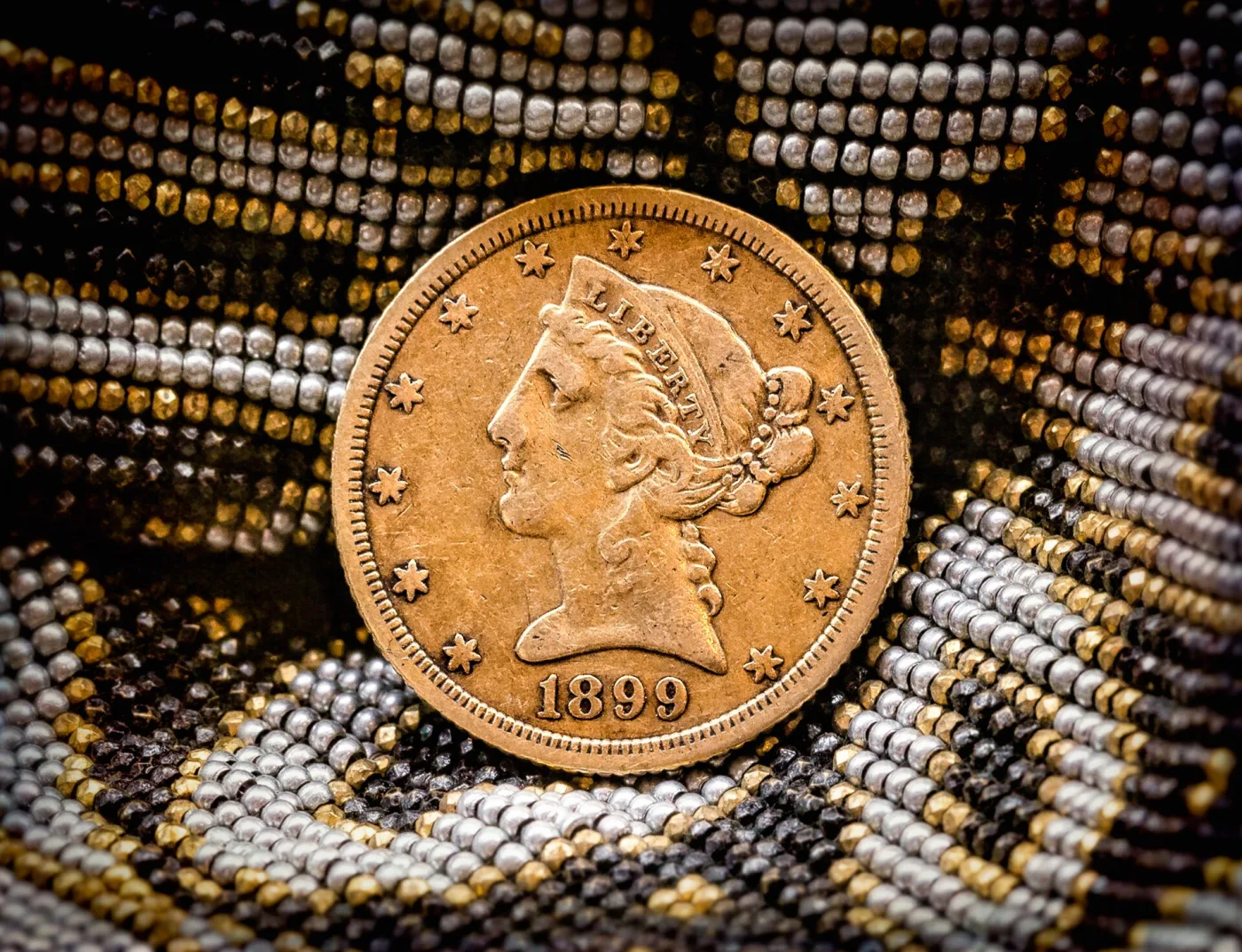
The Liberty Head Half Eagle — often called the Coronet Half Eagle — is the longest-running design in United States gold coinage, struck for almost seventy years from 1839 through 1908. Designed by Christian Gobrecht, the same Chief Engraver who created the Seated Liberty silver series, the $5 gold piece was the workhorse denomination of 19th-century American gold, produced in greater overall quantity than any other US gold coin of the era and at every branch mint that ever struck gold: Philadelphia, Charlotte, Dahlonega, New Orleans, San Francisco, Carson City, and Denver.
For collectors, the Liberty Head Half Eagle offers something no other series can match: a complete tour of 19th-century US gold-mining history. The Charlotte (C) and Dahlonega (D) mints existed almost exclusively to coin southern gold-rush production into Half Eagles and Gold Dollars, and their closure during the Civil War in 1861 makes those branch issues finite and historically significant. The series also straddles the great 1866 motto change — when IN GOD WE TRUST was added to nearly every US silver and gold coin — splitting Liberty Head Half Eagles into two major types that drive type-set collecting today.
This guide covers everything you need to identify, grade, and value Liberty Head Half Eagles: the two major types (1839-1866 No Motto and 1866-1908 With Motto); the seven mint marks (P, C, D, O, S, CC, D-Denver); the early-date keys like 1842-C Small Date, 1854-S, and 1861-D; the legendary 1864-S, 1875, and 1887 proof-only rarities; counterfeit detection in a series heavily targeted by both 19th-century period fakes and modern Chinese reproductions; and current market values heading into 2026. The same disciplined coin identification techniques used for silver classics apply directly here, with the added consideration that the bullion floor of 0.24187 troy ounces of pure gold backstops every genuine example.
History and Origins: The Coronet Design
By 1838 the United States Mint faced a problem with its existing Half Eagle. The Classic Head design, struck since 1834, was being heavily produced — yet small differences in weight and fineness invited speculation, and the engraving felt dated next to Christian Gobrecht’s new Seated Liberty silver coinage. It had replaced the heavier early Capped Bust Half Eagle only four years earlier, when the 1834 reform finally let $5 gold circulate instead of being melted for bullion. Mint Director Robert M. Patterson directed Gobrecht to prepare a new Half Eagle design that would harmonize with the silver series and bring US gold coinage into a more refined neoclassical style.
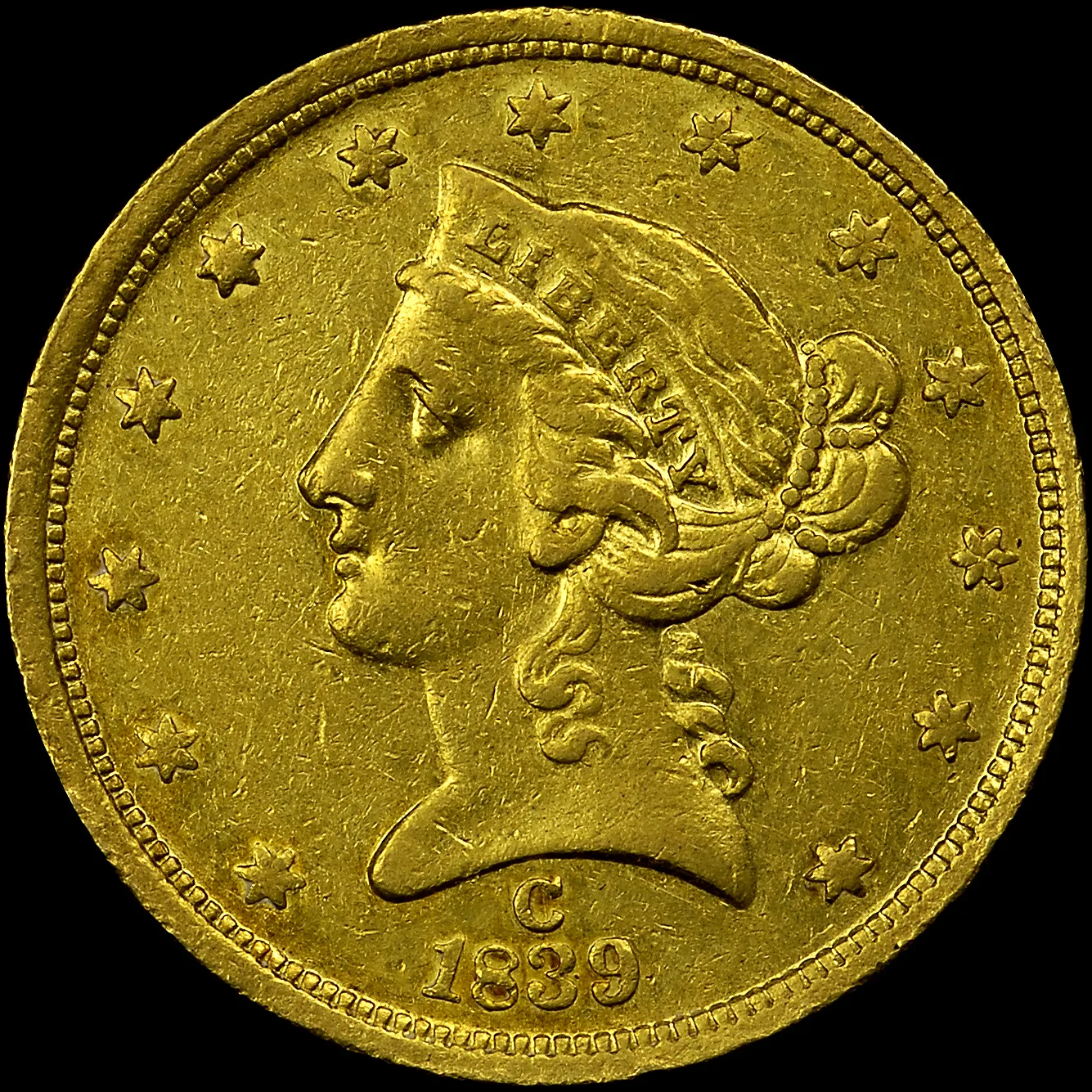
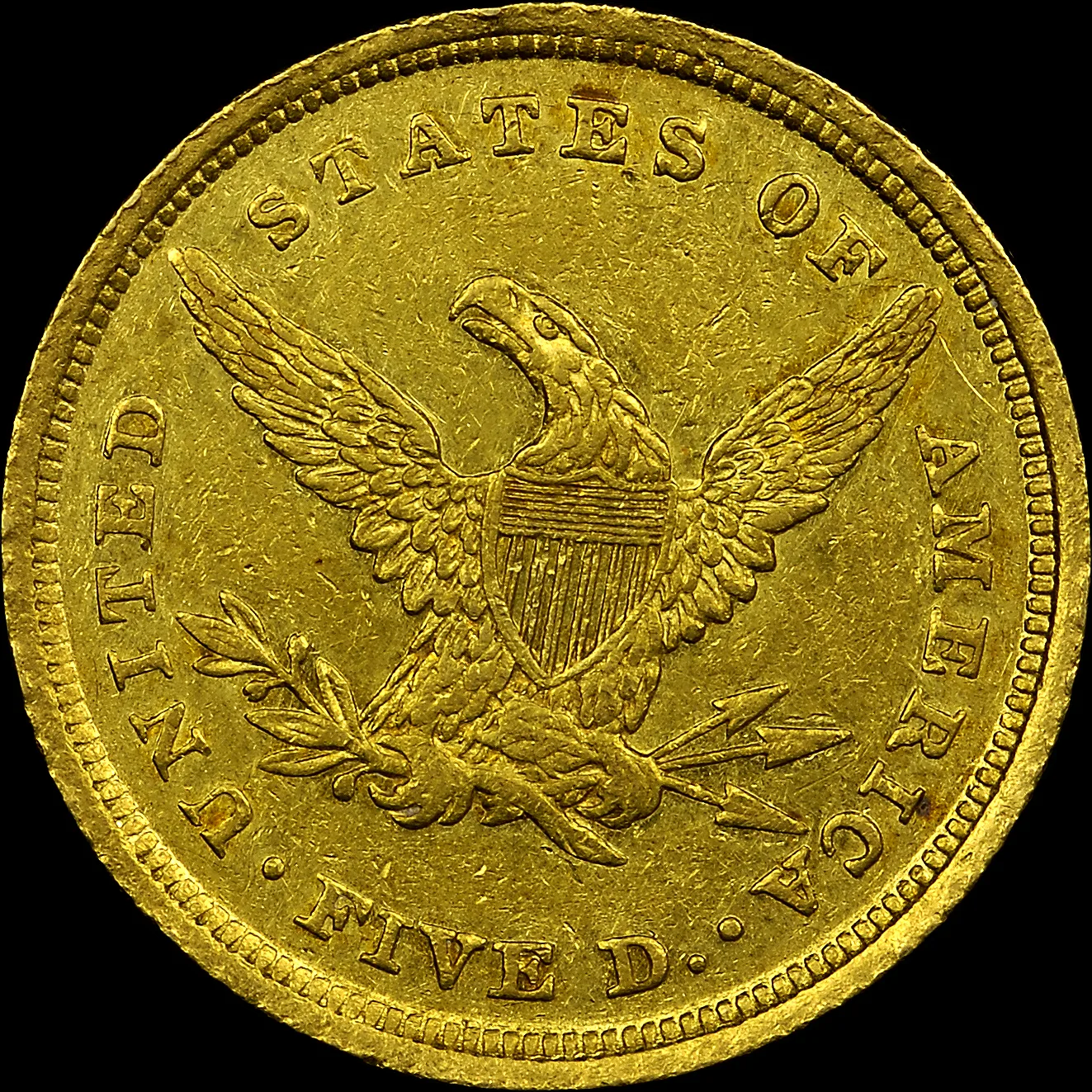
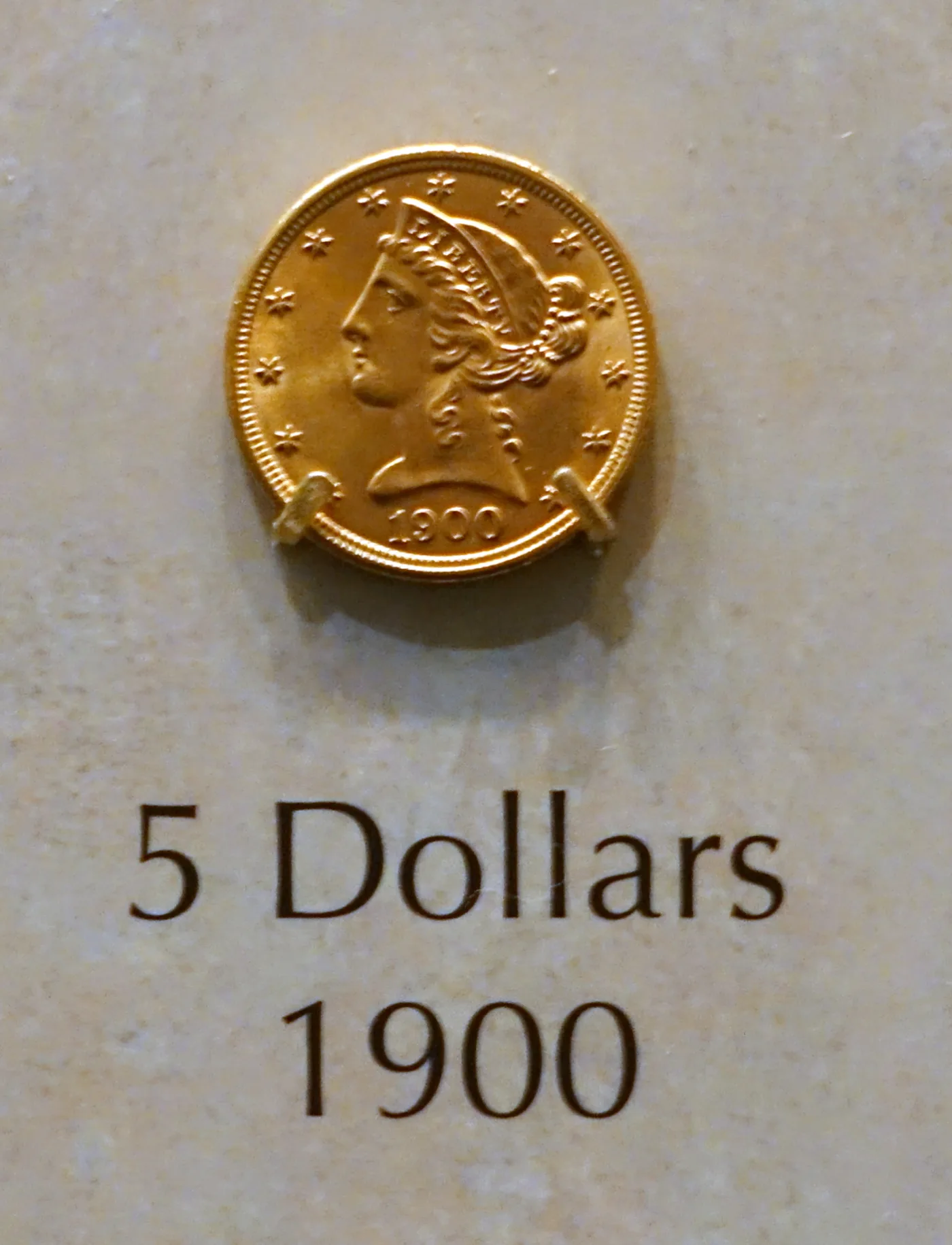
Gobrecht’s response was the Coronet Liberty bust — a left-facing portrait of Liberty with hair pulled back into a bun, wearing a coronet inscribed LIBERTY across her forehead. The reverse retained a heraldic eagle with a Union shield on its breast, holding arrows and an olive branch, with the denomination FIVE D. below. Production began at Philadelphia in 1839 with a small mintage of about 118,000 pieces in the first year.
Connection to the Larger Gold Series
The same Coronet portrait — with minor scaling adjustments — was applied across all four of Gobrecht’s gold denominations: the Liberty Head Double Eagle at $20, a Liberty Head Eagle at $10 (designed by Gobrecht in 1838, the year before the Half Eagle), the Half Eagle at $5, and the Liberty Head Quarter Eagle at $2.50. Longacre’s later Three Dollar Gold piece filled the awkward gap between the Quarter Eagle and Half Eagle from 1854 onward. The trio shared family resemblance well into the Saint-Gaudens redesign of 1907, when both the Half Eagle and Eagle were replaced by the Bela Lyon Pratt incuse Indian and the Saint-Gaudens Indian Head Eagle respectively. The matching Indian Head Quarter Eagle ($2.50) was introduced the same year and shares Pratt’s distinctive incused design.
The Branch Mint Era
The Half Eagle was the only US coin denomination struck at all seven mints that ever operated: Philadelphia (no mint mark), Charlotte (C, 1838-1861), Dahlonega (D, 1838-1861), New Orleans (O, 1839-1909 with gaps), San Francisco (S, 1854-onward), Carson City (CC, 1870-1893), and Denver (D, 1906-onward). No other denomination saw production at all of those facilities, making a complete mint-set Half Eagle collection a uniquely panoramic project in US numismatics. Charlotte and Dahlonega both opened in 1838 striking the Classic Head gold that immediately preceded this series, and their very first quarter eagles — the keys of the Classic Head Quarter Eagle series — launched the southern branch-mint gold story the half eagle would carry on.
The 1866 Motto Change
In 1866, in the wake of the Civil War-era religious revival and the legislation that added IN GOD WE TRUST to the Two Cent Piece in 1864, the Mint added the motto to a scroll above the eagle on Half Eagles, Eagles, and Double Eagles. The change splits Liberty Head Half Eagles into two collecting types: No Motto (1839-1866) and With Motto (1866-1908). The same motto transition also defined the Type 1 vs Type 2 distinction on the Double Eagle and the No Motto vs With Motto types on the Seated Liberty Dollar and Seated Liberty Half Dollar.
End of the Series
Production ended in 1908 when Theodore Roosevelt’s beautification campaign replaced the Liberty Head designs with Bela Lyon Pratt’s incuse Indian Head Half Eagle. The new design was struck through 1929, after which the Half Eagle denomination disappeared entirely from US coinage. The Liberty Head Half Eagle’s 69-year run remains the longest in American gold history.
Design Details: Gobrecht’s Liberty and Heraldic Eagle
Recognizing every element of the design is essential for type identification, grading, and counterfeit detection. Gobrecht’s composition is dense with small features that affect attribution.
Obverse (Heads Side)
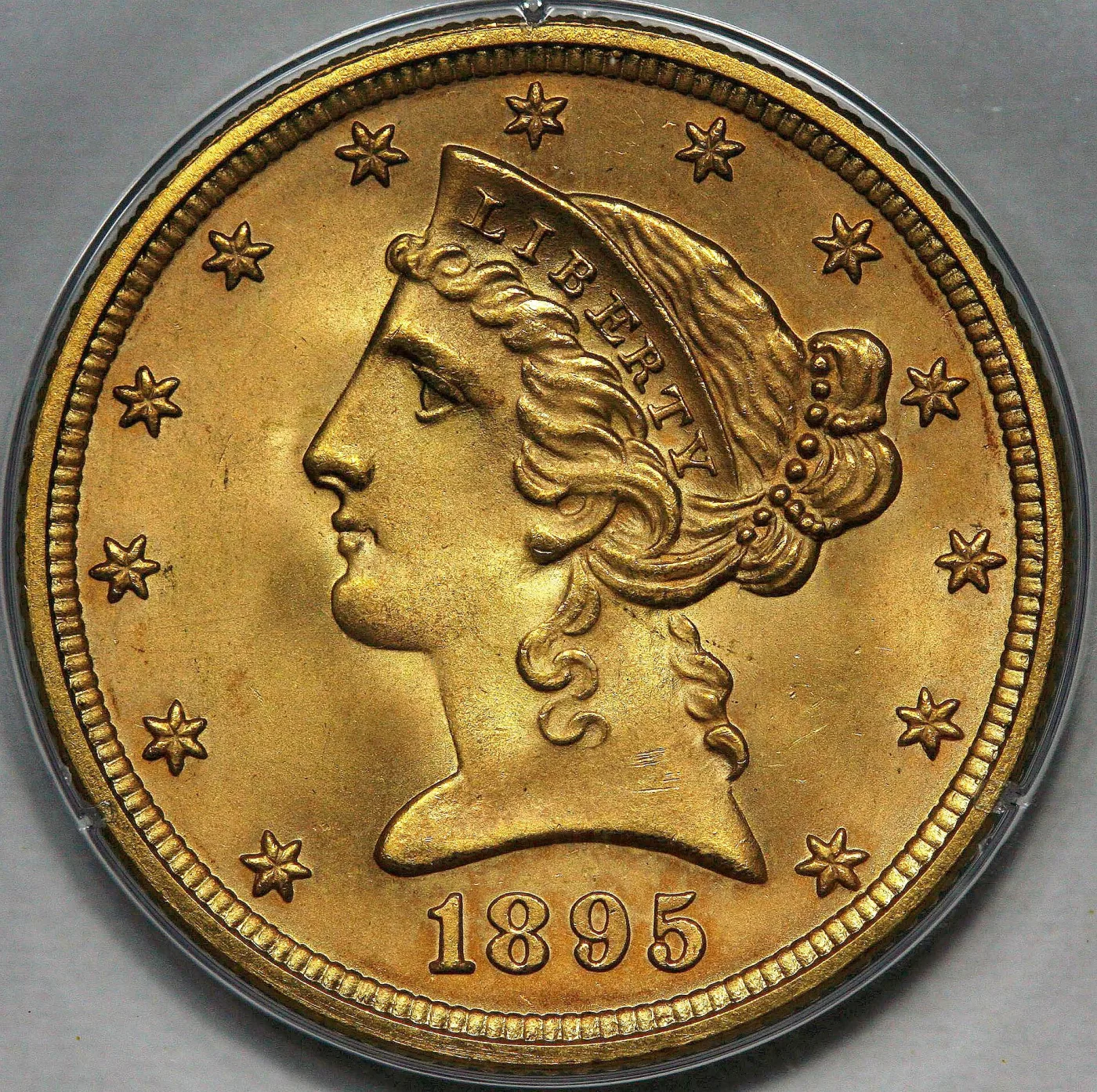
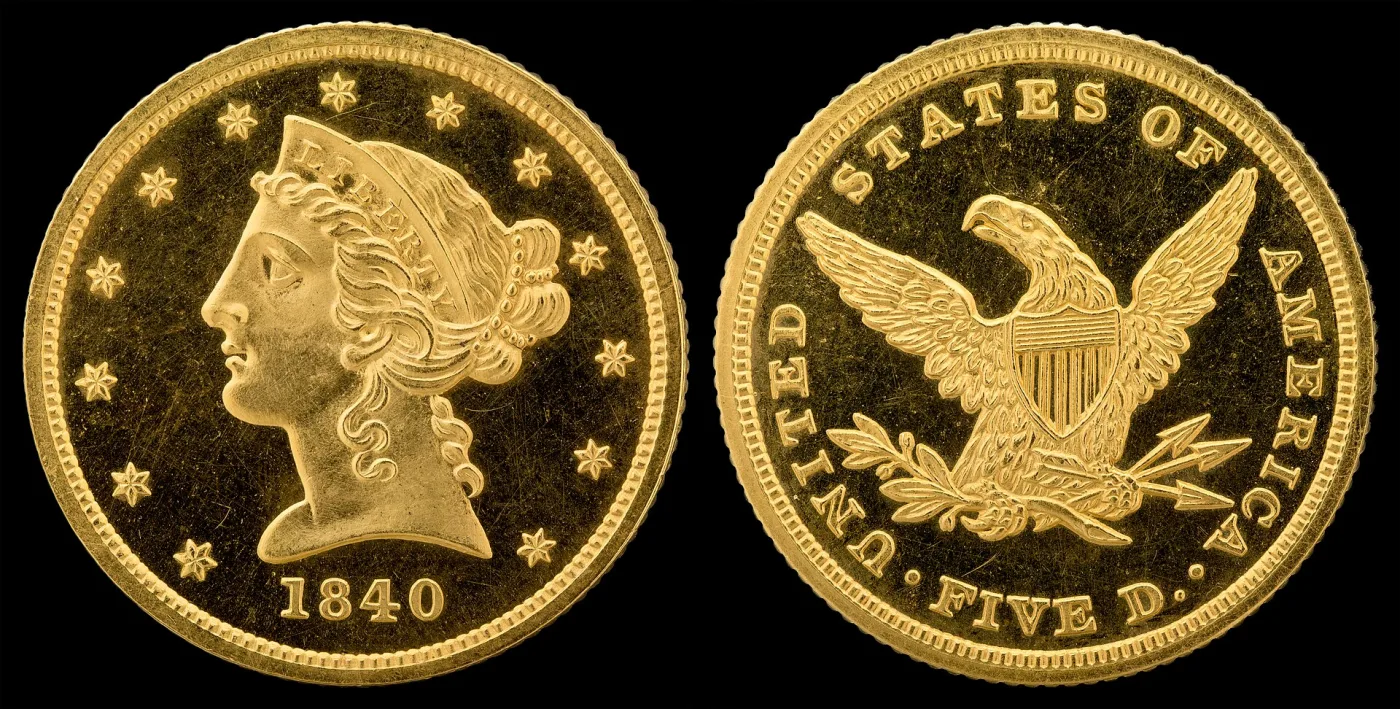
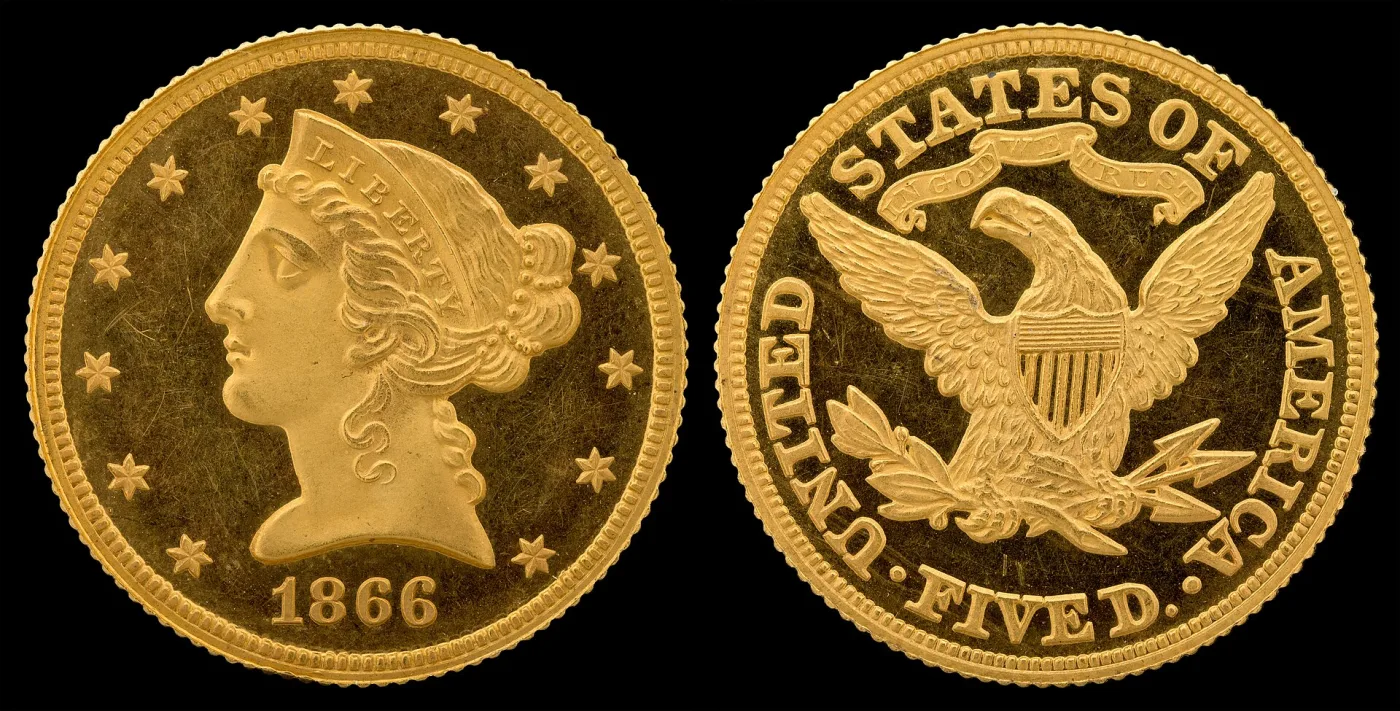
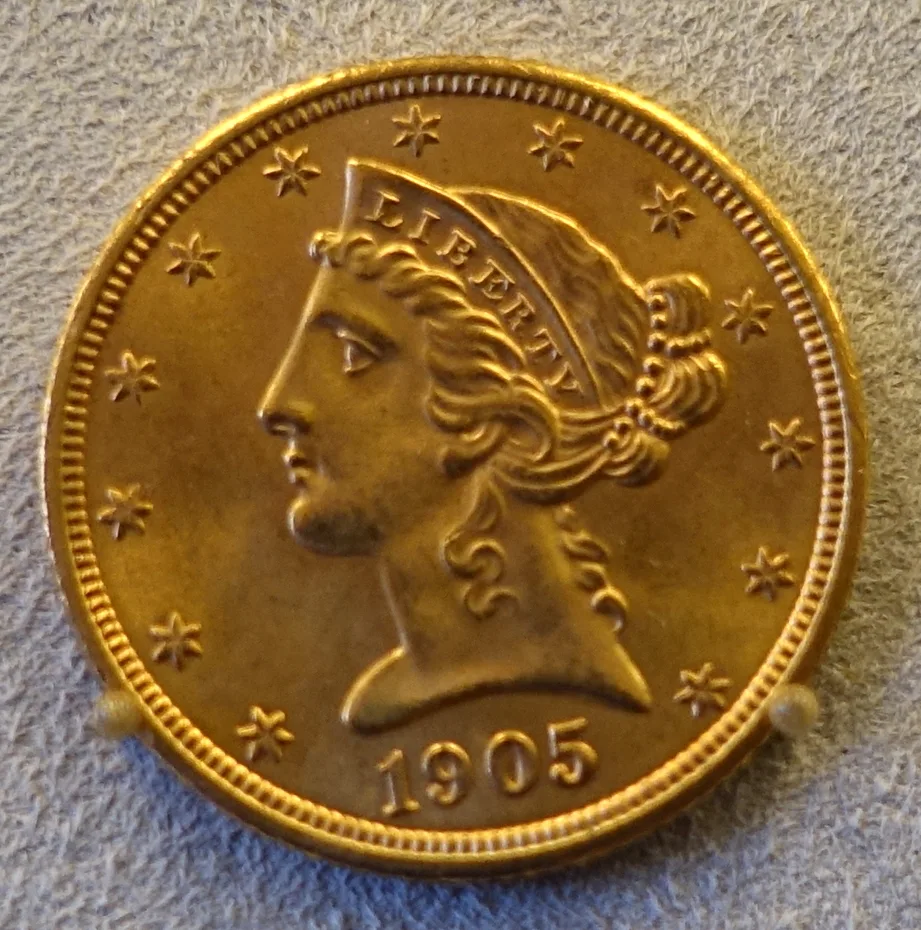
The obverse depicts a left-facing bust of Liberty with hair gathered into a bun behind the head, bound by a beaded coronet across the forehead with the word LIBERTY in raised letters. Thirteen six-pointed stars surround Liberty in an arc — typically six to the left and seven to the right (this varies in early issues), representing the original colonies. The date appears below the truncation of the bust. Hair detail flows back from the coronet toward the bun in fine, deeply-cut strands.
The LIBERTY inscription on the coronet is one of the standard grading checkpoints. Wear progression follows a predictable sequence — first the highest letters (B, E, R), then the rest of the word becomes incomplete, then the coronet itself loses outline. The same diagnostic is used on the Barber Half Dollar and the Barber Quarter, with adjustments for relief.
Reverse (Tails Side) — No Motto Type
The reverse depicts a heraldic eagle with wings spread, a Union shield on its breast, holding three arrows in its left talon and an olive branch in its right. UNITED STATES OF AMERICA arches around the upper rim, and the denomination FIVE D. appears at the bottom. The mint mark, when present, sits below the eagle and above the denomination on early branch-mint issues. Above the eagle’s head on No Motto pieces, the field is open with only a small arc — no scroll, no motto.
Reverse (Tails Side) — With Motto Type
Beginning in 1866, the reverse adds a scroll above the eagle’s head inscribed IN GOD WE TRUST. The denomination remains FIVE D. throughout the series (no analog to the Double Eagle’s TWENTY D. to TWENTY DOLLARS change). All other reverse design elements — eagle, shield, arrows, olive branch, peripheral lettering — remain unchanged. The scroll position is the single visual marker that distinguishes No Motto from With Motto Half Eagles.
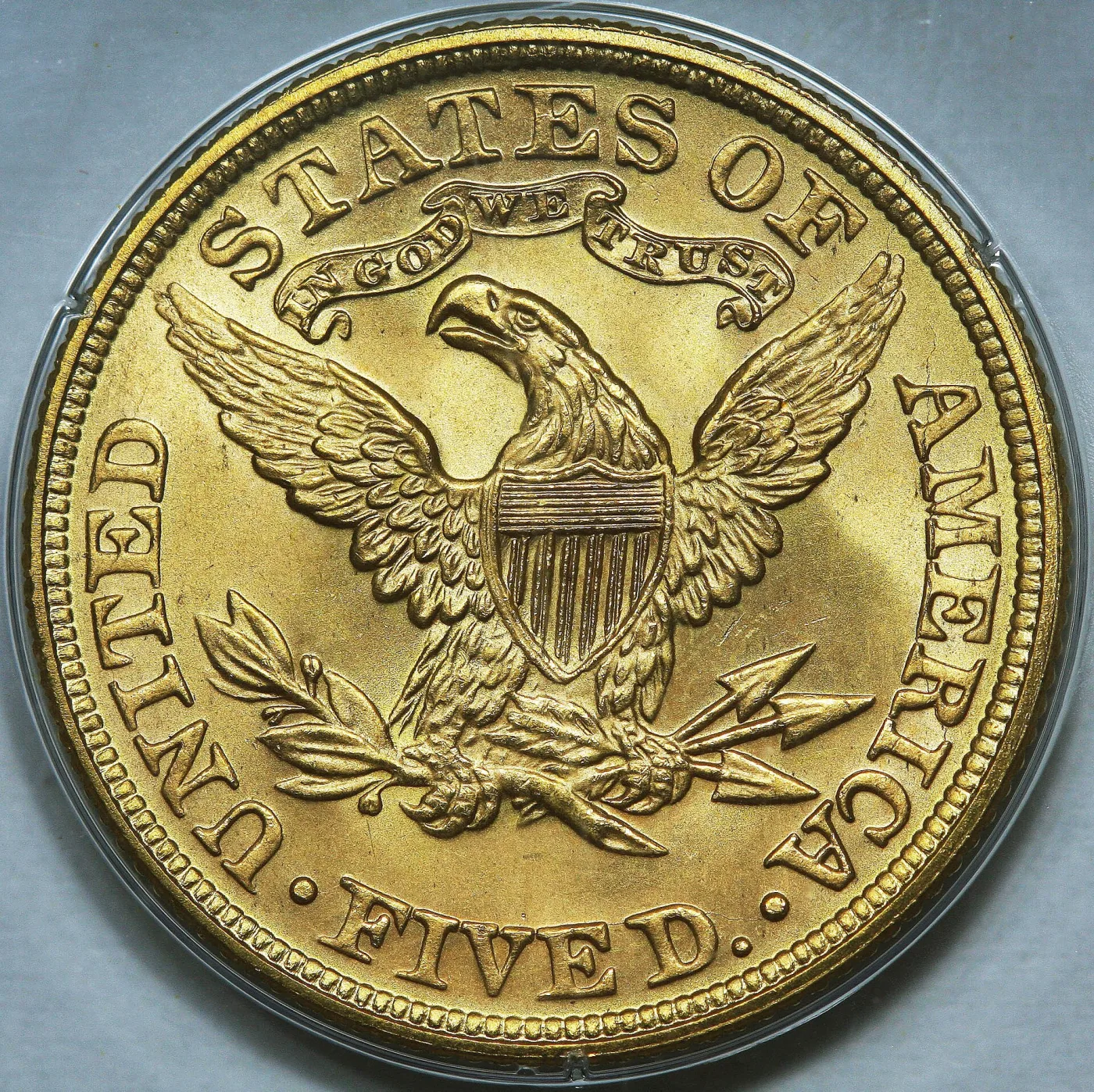
The Edge
All Liberty Head Half Eagles have a reeded edge with fine reeding. The reed count and depth are reasonably consistent across the series, and edge integrity is a key authentication checkpoint. Counterfeits often get the reeding wrong — counts off, depth inconsistent, or signs of edge tampering from collar modification.
Mint Mark Placement
The mint mark on Liberty Head Half Eagles sits on the reverse below the eagle, between the eagle’s tail and the denomination FIVE D. This placement is consistent across both No Motto and With Motto types and across all branch mints. Verify mint mark style against authoritative references — many counterfeits use the wrong font or punch style for the date in question.
The Two Major Types: No Motto and With Motto
Liberty Head Half Eagles divide into two distinct collecting types based on the presence or absence of IN GOD WE TRUST. Type identification is fundamental, and certain key dates fall entirely within one type or the other.
Type 1: No Motto (1839-1866)
The No Motto type runs from 1839 through mid-1866. The reverse field above the eagle is open — no scroll, no motto. This type encompasses the entire Charlotte and Dahlonega branch mint output, all New Orleans production through 1857, the early San Francisco issues from 1854 through 1866, the entire Civil War, and the entire pre-Reconstruction era. Many of the greatest rarities of the series fall here: the 1854-S (three known), the 1864-S, the 1842-C Small Date, the 1861-D Confederate issue, and the New Orleans 1841-O and 1842-O.
Type 2: With Motto (1866-1908)
The With Motto type runs from mid-1866 through 1908. The reverse adds the scroll with IN GOD WE TRUST above the eagle. This type includes all Carson City issues (1870-1893, with gaps), all Denver Half Eagles (1906-1908), and most of the surviving population of common-date Liberty Head Half Eagles. The proof-only 1875 and 1887 keys also fall in this type. Most material trading in the modern market is With Motto, and most type-set examples are common-date 1880s-1900s Philadelphia or San Francisco issues.
Quick Type Identification Reference
- Type 1 (No Motto): 1839 through 1866 — no scroll above eagle on reverse
- Type 2 (With Motto): 1866 through 1908 — IN GOD WE TRUST scroll above eagle
Composition and Specifications
Every Liberty Head Half Eagle from 1839 through 1908 is struck in 90% gold and 10% copper — the standard US gold alloy used from 1837 through 1933 for all production gold coinage. The same alloy carries forward to the Indian Head Half Eagle successor and to the Saint-Gaudens Double Eagle.
Note that pre-1834 Half Eagles were struck at a slightly different standard — 91.67% gold — but the Coronet Liberty Head series uses the 90% standard throughout its 69-year run, with no transitional issues.
Physical Specifications
- Composition: 90% gold, 10% copper
- Total weight: 8.359 grams (129 grains)
- Net gold weight: 7.5234 grams (0.24187 troy ounces)
- Diameter: 21.6 millimeters
- Thickness: Approximately 1.7 millimeters
- Edge: Reeded
- Face value: $5
The 0.24187 troy ounce gold content sets the bullion floor for every genuine Liberty Head Half Eagle. At 2026 gold prices, that translates to roughly $625-$650 of pure metal even in heavily worn condition — a meaningful floor that protects common-date collector outlay. By contrast, a heavily worn Mercury Dime may carry only its silver melt value, while a worn Liberty Head Half Eagle carries substantial intrinsic worth above face value regardless of date.
Production Tolerances
The Mint’s legal tolerance on the Half Eagle planchet was 0.25 grain, or about 0.016 grams. Authentic coins should weigh between 8.343 and 8.375 grams. Counterfeits frequently fall outside this range — sometimes intentionally lower to save metal, sometimes higher when struck on inappropriate planchets — and precision weight is a primary authentication tool.
Mint Marks: P, C, D, O, S, CC, D
The Liberty Head Half Eagle was struck at every US gold-coining mint: Philadelphia (no mint mark), Charlotte (C), Dahlonega (D, 1838-1861), New Orleans (O), San Francisco (S), Carson City (CC), and Denver (D, 1906-1908). Note that the D mint mark refers to Dahlonega in the early period (1838-1861) and to Denver in the late period (1906 onward) — they never overlap, but context (date and design) is needed to attribute correctly.
Philadelphia (No Mint Mark)
Philadelphia struck Half Eagles every year of the series, with mintages ranging from a few hundred proofs to over a million pieces. Common Philadelphia dates from the 1880s and 1890s are the foundation of any modern collection, available in Mint State condition near gold-melt premiums.
Charlotte (C, 1838-1861)
The Charlotte branch mint operated in Charlotte, North Carolina from 1838 through 1861, producing only gold coins from southern Appalachian gold mines. Total Charlotte Half Eagle mintage across all years was modest — about 250,000 pieces — and survival rates are low. Every Charlotte issue commands a premium; key dates like the 1842-C Small Date, 1849-C, and 1861-C are major rarities. Charlotte stopped striking coins in May 1861 when Confederate forces seized the mint; production never resumed.
Dahlonega (D, 1838-1861)
The Dahlonega branch mint operated in Dahlonega, Georgia from 1838 through 1861. Like Charlotte, it served southern gold-rush production. Dahlonega Half Eagles are slightly more common than Charlotte counterparts but still scarce in any grade. Key Dahlonega dates include the 1842-D Large Date, 1854-D, 1855-D, 1856-D, 1859-D, 1860-D, and the legendary 1861-D — the last coin struck under Confederate authority. The same Dahlonega rarities define the small Gold Dollar series.
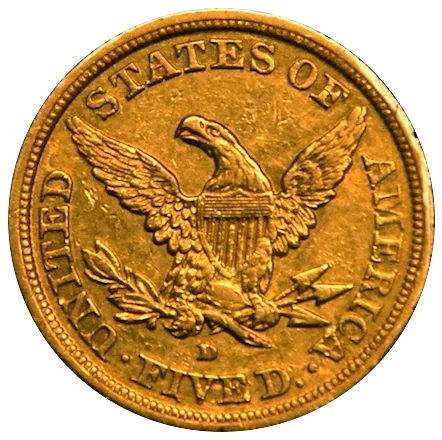
New Orleans (O, 1839-1909)
New Orleans produced Half Eagles from 1839 through 1857, then again in 1892 and 1893, with notable gaps. The O-mint pieces are scarce across all dates. Notable issues include the 1841-O (extreme rarity, about 50 known), 1842-O, 1843-O, and 1847-O.
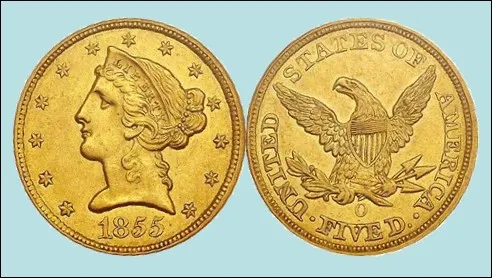
San Francisco (S, 1854-1906)
San Francisco struck Half Eagles from 1854 (first year of the branch mint) through 1906. The 1854-S is the legendary three-known rarity. Other early San Francisco issues from the late 1850s and Civil War era are scarce. From the 1870s onward, S-mint Half Eagles become more available, and the high-mintage 1880s-1900s issues are common.
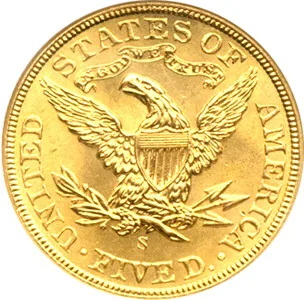
Carson City (CC, 1870-1893)
Carson City struck Half Eagles intermittently from 1870 through 1893, with frequent gaps. Mintages were modest — typically a few thousand to a few tens of thousands per year. All Carson City Half Eagles command strong premiums, and the early CC dates (1870-CC, 1871-CC, 1872-CC) are major rarities. The same disciplined collecting approach used for the Trade Dollar and the Twenty Cent Piece at Carson City applies here.
Denver (D, 1906-1908)
Denver produced Liberty Head Half Eagles for only three years before the design was retired. The 1906-D, 1907-D, and 1908-D are all available in reasonable numbers and represent the only opportunity to collect a Denver-mint Liberty Head Half Eagle (Denver Indian Head Half Eagles begin in 1909).
Key Dates and Major Rarities
The Liberty Head Half Eagle series contains some of the most significant rarities in US numismatics. The keys concentrate in three areas: the southern branch mint pieces of the 1840s-1850s, the Civil War-era San Francisco and Dahlonega issues, and the proof-only Philadelphia issues of the late 1870s and 1880s.
1842-C Small Date
The 1842-C exists in two date varieties: Small Date and Large Date. The Small Date is the much scarcer variety, with perhaps 20-25 examples known across all grades. Auction prices range from $30,000 in Fine condition to over $300,000 for choice Mint State examples. The 1842-C Large Date is also scarce but available in more numbers and at much lower prices.
1854-S Liberty Head Half Eagle
The 1854-S is the rarest regular-issue US Half Eagle. Only three examples are known. See the dedicated 1854-S section below for the full story.
1861-D Liberty Head Half Eagle
The 1861-D is the last gold coin struck at Dahlonega, produced under Confederate authority after Georgia’s secession. Mintage was approximately 1,597 pieces, with about 60-80 known to survive. Prices range from $25,000 in Very Fine to $250,000+ in Mint State. The 1861-D is the most historically significant Confederate gold issue, paralleled in mythology by the 1861-D Gold Dollar from the same mint.
1864-S Liberty Head Half Eagle
The 1864-S is a major Civil War-era rarity. Mintage was only 3,888 pieces, with about 25-35 surviving. Most are circulated; Mint State examples are extreme rarities. Prices range from $40,000 in Very Fine to over $1 million in choice MS. The 1864-S parallels the 1864-S Seated Liberty Dime as a Civil War branch mint scarcity, though the gold piece carries far higher absolute dollar weight.
1875 Liberty Head Half Eagle
The 1875 Philadelphia is a proof-only issue with a business strike mintage of just 200 pieces and a proof mintage of only 20. Combined survival is approximately 10-15 pieces. Prices begin at $200,000 and reach over $1 million for choice examples. See the Proof-Only Years section below.
1887 Liberty Head Half Eagle
The 1887 Philadelphia is proof-only — no business strikes were made. Proof mintage was just 87 pieces. About 50-60 are believed to survive across all grades. Auction prices range from $15,000 in Proof-60 to over $200,000 for Proof-67 Cameo.
1870-CC, 1878-CC, 1879-CC, 1893-CC
Several Carson City dates are major rarities. The 1870-CC (mintage 7,675, about 50 known) is the most famous, followed by the 1878-CC (mintage 9,054, condition rarity), 1879-CC, and lower-mintage Carson City years. These regularly bring $25,000 to $150,000+ depending on date and grade.
1864-D Half Eagle — Not Issued
For clarity: no 1864-D Half Eagles exist. Dahlonega closed in 1861, well before 1864. Any coin offered as “1864-D” is either a counterfeit, a mis-described 1864-S, or a modern fantasy piece. The same applies to all D-mint Half Eagles dated 1862-1905 — Dahlonega closed in 1861 and Denver did not open until 1906.

The 1854-S: One Coin, $2 Million Each
The 1854-S Liberty Head Half Eagle is the rarest regular-issue US Half Eagle and one of the rarest US coins of any denomination. Only three examples are confirmed to exist, and the most recent auction result for an 1854-S in private hands was $2.16 million.
The Mintage Story
San Francisco opened in April 1854 as the second US gold-rush branch mint, with the explicit purpose of refining and coining California placer gold. The first Half Eagles struck there in 1854 had a mintage of 268 pieces. Of those 268, only three examples have ever surfaced — one at the Smithsonian (ex-Mint Cabinet), one in the American Numismatic Society collection, and one in private hands. The remainder are believed lost to circulation and melting in the decades that followed.
Survivors and Provenance
- Smithsonian piece: Mint Cabinet specimen, transferred to the Smithsonian National Numismatic Collection
- ANS piece: Held by the American Numismatic Society
- Private piece: Sold by Heritage in 2020 for $2.16 million, graded AU-58 by PCGS
The private example traces ownership through several major collections including Eliasberg and Pittman, and remains the only specimen ever expected to come to market. Its 2020 sale set the record for the series.
Distinguishing the 1854-S
The 1854-S bears the date 1854 with an S mint mark on the reverse below the eagle. Because no genuine 1854-S has ever been encountered outside the three known examples, any 1854-S Half Eagle offered for sale outside an established auction context should be considered counterfeit until conclusively proven otherwise. The same caution applies to any major US gold rarity — the dollar amounts at stake make professional authentication absolutely essential.
The 1864-S and Civil War Era Rarities
The Civil War era produced several Half Eagle rarities tied to specific historical circumstances. The Confederate seizure of Charlotte and Dahlonega in 1861, the Union blockade’s impact on coin circulation, and the wartime export of gold all left fingerprints on the 1861-1865 production years.
1861-D and 1861-C Confederate Issues
Both the 1861-D and 1861-C were struck early in 1861, partially under United States authority and partially under Confederate authority after the southern states’ seizure of the branch mints. The exact division is debated, but both issues are commonly considered Confederate gold and command historical premiums. The 1861-D had a mintage of about 1,597, the 1861-C about 6,879. Both are major rarities with the 1861-D the more legendary of the two.
1864-S
With a mintage of 3,888 and survival of perhaps 25-35 pieces, the 1864-S is a major condition rarity. Most known examples are in low circulated grades. In 2006 a single Mint State example sold for $1.25 million, setting a record that has since been surpassed.
1865 and 1865-S
The 1865 Philadelphia (mintage 1,270 business strikes) and 1865-S (mintage 27,612) are both scarce. The 1865 is the lower-mintage piece but the 1865-S is harder to find in Mint State.
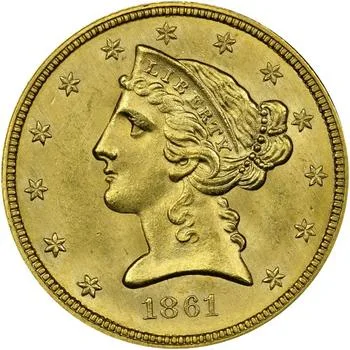
1862-S and 1863-S
Both early San Francisco Civil War issues are scarce. 1862-S had a mintage of 9,500 and 1863-S a mintage of 17,000. Both bring $15,000-$40,000 in About Uncirculated condition and substantially more in Mint State.
Proof-Only Years: 1875 and 1887
Two Philadelphia Half Eagle dates exist almost entirely as proofs, with little or no business-strike production. These represent some of the most legendary Liberty Head rarities and showcase how regular-issue rarity can develop without true low mintage — sometimes the rarity is in survival, sometimes in the production decision itself.
1875 Liberty Head Half Eagle
The 1875 had a business strike mintage of just 200 pieces — extraordinarily small for a regular-issue Philadelphia date. Proof mintage was 20 pieces. Combined survival is perhaps 10-15 pieces, with several institutional examples reducing market availability further. Auction prices begin at $200,000 in low grades and exceed $1 million for choice Proof or MS examples.
1887 Liberty Head Half Eagle
The 1887 Philadelphia was struck only as proof — no business strikes were made. Proof mintage was 87 pieces. About 50-60 survive across all grades, mostly in collector hands. The 1887 represents the unusual case where the Mint deliberately skipped business-strike production for that date. Prices range from $15,000 for impaired proofs to over $200,000 for choice Cameo proofs.
Other Notable Proof Issues
Many other Liberty Head proofs were struck — typically 20 to 200 pieces per year from 1858 onward. Pre-1858 proofs exist in only a handful of pieces. Most years from 1880-1907 saw proof mintages of 25 to 150 pieces. All Liberty Head proofs are valuable, with the 1875 and 1887 dwarfing all other dates in market significance.
Civil War and Confederate Issues
The 1861-D and 1861-C Liberty Head Half Eagles occupy a unique place in American numismatic history. Both mints were physically seized by Confederate forces in early 1861, and continued striking coins under southern authority before being closed permanently. Determining the exact Confederate vs Union portions of the 1861 mintages is impossible from surviving records.
The 1861-D Mintage Story
Dahlonega operated under US authority through Georgia’s secession on January 19, 1861, and then under Confederate authority until ceasing operations in May 1861. Records show approximately 1,597 Half Eagles were struck for the year. The traditional collector view is that most of the mintage was struck under Confederate authority — making the 1861-D Half Eagle the largest-denomination Confederate-era coin still bearing US designs.
The 1861-C Mintage
Charlotte’s situation was similar. The mint operated through North Carolina’s secession in May 1861 and briefly under Confederate authority before closing. The 1861-C Half Eagle mintage of 6,879 was split between US and Confederate periods, but the exact division is not documented. Coins are indistinguishable by die — same dies were used throughout.
Other Confederate-Era Coinage Context
The Confederate states attempted to strike their own Half Dollar in 1861 (the famous Confederate Half Dollar with only four originals known), but the Half Eagle was never restruck under Confederate dies. The same patriotic story extends to the Seated Liberty Half Dollar 1861-O issue, which was struck partially under Confederate authority at New Orleans.
Numismatic Significance
The Confederate provenance of the 1861-D and 1861-C Half Eagles makes them culturally significant beyond their numerical rarity. Many collectors treat them as Confederate gold for cataloging purposes, alongside the Confederate Half Dollar restrikes and the 1861-O Half Dollar. The numismatic premium reflects this historical weight.
Doubled Dies, Overdates, and Major Varieties
Beyond date and mint, several Liberty Head Half Eagle varieties carry substantial premiums. Variety attribution is essential for accurate valuation.
Major Date Varieties
- 1842-C Small Date / Large Date: Two distinct date styles, with Small Date the major rarity (about 20-25 known)
- 1842-D Small Date / Large Date: Similar to Charlotte; both styles exist, both scarce
- 1842 Philadelphia Small Letters / Large Letters: Reverse lettering variety
- 1843 Doubled Date: Visible doubling on the date numerals
- 1873 Closed 3 / Open 3: The same closed/open 3 transition that affects the Two Cent Piece and Three Cent Pieces
Overdates
Several overdates exist, including 1846/5, 1847/7, 1855-O/1855-O (repunched mint mark), and the well-known 1881/0 Philadelphia. Each carries a modest premium over the normal-date counterpart and is collected by variety specialists. The Bass-Dannreuther reference is the authoritative variety attribution work for the series.
Repunched Mint Marks
Repunched mint marks (RPMs) appear on multiple Liberty Head dates, particularly in the 1850s and 1860s branch-mint output. Identification requires magnification and reference to specialized literature. Most RPMs carry only minor premiums over the standard issue.
Bass-Dannreuther Variety System
Harry Bass’s lifetime study of US gold coinage culminated in the Bass-Dannreuther die marriage system, the definitive attribution guide for Liberty Head Half Eagles. Each die marriage is given a number, and major varieties are illustrated and described. Reference copies are available at major libraries and through the ANA.
Grading Liberty Head Half Eagles
Grading is critical because Half Eagles in higher Mint State grades bring multiples of lower-grade prices. Even on common-date pieces, the difference between MS-62 and MS-65 can be 5-10× in value. Professional certification by PCGS or NGC is virtually required for any meaningful purchase.
Key Grading Points
The high points that show wear first on Liberty Head Half Eagles are:
- Hair detail above the coronet: First area to show friction
- LIBERTY on the coronet: Standard wear progression — full letters in AU, partial in EF, none in VF
- Star points: Star center detail wears in EF and below
- Eagle’s neck and breast: Reverse high points
- Wing tips and leg feathers: Show friction in AU
Circulated Grades
- Good (G-4): Major design elements outlined; LIBERTY mostly worn away
- Very Good (VG-8): All major details visible but heavily worn; partial LIBERTY
- Fine (F-12): Major details clear; LIBERTY partially visible
- Very Fine (VF-20 to VF-30): Moderate wear; most of LIBERTY visible
- Extremely Fine (EF-40 to EF-45): Light wear on high points; full LIBERTY
- About Uncirculated (AU-50 to AU-58): Trace wear only on highest points; near-full mint luster
Mint State Grades
- MS-60 to MS-62: No wear but heavy bag marks; weak luster
- MS-63 (Choice BU): Few bag marks; good luster; sharp strike
- MS-64: Minor bag marks only; full luster
- MS-65 (Gem BU): Virtually no bag marks; outstanding luster; full strike
- MS-66 and above: Extremely rare for most dates; near-perfect surfaces
Proof Designations
- Proof-60 to Proof-62: Impaired proofs with hairlines or marks
- Proof-63 to Proof-65: Choice to Gem proofs with attractive surfaces
- Proof-66 and above: Superb proofs with deep mirror fields
- Cameo / Deep Cameo: Premium designation for proofs with sharp contrast between mirror fields and frosted devices
Authentication and Spotting Counterfeits
Liberty Head Half Eagles have been counterfeited extensively. 19th-century gold counterfeits exist in the form of contemporary “racketeer” pieces struck for circulation; modern Chinese counterfeits flooded the market in the 2010s and continue to appear. Professional authentication is essential for any significant purchase.
Weight and Specifications
Genuine coins weigh 8.359 grams ± 0.016 grams. Diameter is 21.6 mm. A precision scale and digital caliper are first-line authentication tools. Counterfeits frequently fail weight checks — either too light (low-gold alloy) or too heavy (gold-plated tungsten or brass cores).
Mint Mark Authentication
Many counterfeits are common-date Half Eagles with added or altered mint marks to simulate rarities. A genuine 1854-S mint mark must be in the correct location, font, size, and depth — slightly raised, with the correct curvature, in the proper alignment between the eagle’s tail and FIVE D. Comparison to authoritative reference photographs is essential. The same caution applies to Buffalo Nickel mint mark alterations on rare branch-mint dates.
Surface and Strike Quality
- Detail sharpness: Authentic strike detail is crisp; counterfeits show mushy or repetitive detail
- Luster: Genuine cartwheel luster on Mint State examples; counterfeits often show satin or matte unnatural surfaces
- Color: Authentic gold-copper alloy has warm yellow-orange tone; counterfeits often appear too red, too brassy, or too pale
- Field smoothness: Authentic fields show smooth original surface; counterfeits often have small bumps or repetitive marks from die transfer
- Edge reeding: Reed count and depth should match published standards
Third-Party Certification
For any significant purchase, only buy coins certified by PCGS or NGC. Both services authenticate, grade, and encapsulate coins with secure tamper-evident slabs. Raw (uncertified) Liberty Head Half Eagles are appropriate for common-date type purchases under $1,000, but any key date or high-grade example should be certified. Verify slab authenticity via the PCGS or NGC online certification lookup.
Specific Date-Mint Counterfeits
The most heavily counterfeited Liberty Head Half Eagles are the 1861-D, 1864-S, 1854-S, 1875, and high-grade common dates. Any of these offered uncertified should be presumed counterfeit. Even certified examples should be verified through the grading service’s online lookup against the slab cert number.
Bullion Value vs. Numismatic Premium
Every Liberty Head Half Eagle contains 0.24187 troy ounces of pure gold, which sets a hard floor on its value. At a gold spot price of $2,600 per ounce, the bullion melt value is approximately $629 per coin. This floor protects collector outlay on any genuine example regardless of date or grade.
Common Dates: Near-Bullion Pieces
Common-date Liberty Head Half Eagles — particularly 1880s-1900s Philadelphia and San Francisco issues — trade at modest premiums over melt in circulated grades. Heavily worn examples may bring 5-10% over bullion; Choice About Uncirculated to MS-62 examples may bring 20-50% over melt. These are excellent entry-point collectibles where downside is limited by metal value.
Key Dates: Numismatic Multiples
Key dates and high-grade examples trade at multiples of bullion. An 1854-S, 1861-D, or 1864-S brings $25,000 to $2,000,000+ — orders of magnitude above the $629 melt value. The same numismatic-vs-bullion dichotomy operates on the Saint-Gaudens Double Eagle series, where common 1924 pieces trade near melt while the 1933 brings $20 million.
The Gold Floor Effect
Because the gold content provides a hard value backstop, Liberty Head Half Eagles are considered hybrid bullion-numismatic instruments. When gold prices rise, common-date pieces appreciate alongside the metal. When gold prices fall, numismatic pieces hold up while bullion-grade pieces decline less aggressively because of the limited supply of any specific date-mint combination.
Current Market Values and Price Guide
Liberty Head Half Eagle market values vary enormously by date, mint, and grade. The figures below are 2026 retail estimates and should be used as starting reference points — actual sale prices vary based on eye appeal, certification, surface originality, and current gold spot price.
Common-Date Type Coins (1880-1908 Philadelphia and San Francisco)
- Very Fine (VF): $625 - $700 (near melt)
- Extremely Fine (EF): $675 - $800
- About Uncirculated (AU): $700 - $950
- MS-60 to MS-62: $900 - $1,500
- MS-63: $1,200 - $2,500
- MS-64: $2,000 - $5,000
- MS-65: $5,000 - $15,000
- MS-66+: $15,000+
Better-Date Branch Mints (Common Charlotte, Dahlonega, New Orleans)
- VF: $1,500 - $3,500
- EF: $2,500 - $6,000
- AU: $4,000 - $12,000
- MS-60 to MS-62: $10,000 - $30,000
- MS-63 and higher: $30,000 - $150,000+
Major Rarities (Approximate Auction Records)
- 1854-S: $2,160,000 (Heritage, 2020, PCGS AU-58)
- 1864-S: $1,250,000+ in choice Mint State
- 1861-D: $250,000+ in choice Mint State
- 1875: $1,000,000+ in choice grades
- 1887 Proof: $200,000+ for Proof-67 Cameo
- 1842-C Small Date: $300,000+ in choice Mint State
- 1870-CC: $150,000+ in About Uncirculated
Note: These are retail price estimates. Actual sale prices at auction vary based on eye appeal, certification, surface originality, gold spot price at sale time, and current market demand. For important purchases, reference recent auction archives from Heritage Auctions, Stack’s Bowers, and Legend Numismatics alongside standard price guides like the PCGS Price Guide and the Bass-Dannreuther reference on Liberty Head Half Eagles.
Building a Liberty Head Half Eagle Collection
The Liberty Head Half Eagle series offers entry points at multiple budget levels, from a single common-date piece near gold-melt to seven-figure rarities. Few series offer such breadth across mints, eras, and rarity levels.
Single Type Coin
The simplest collection is a single common-date Mint State example. A With Motto Type piece from the 1880s-1900s in MS-62 to MS-63 condition runs $1,200-$2,500, providing a beautiful specimen of one of the most historic US gold series.
Two-Coin Type Set
A two-coin type set captures both major design types: No Motto (1839-1866) and With Motto (1866-1908). A matched MS-62 to MS-63 pair runs $4,000-$10,000. The No Motto piece is the more challenging of the two to acquire in Mint State.
Seven-Mint Set
One example from each mint — Philadelphia, Charlotte, Dahlonega, New Orleans, San Francisco, Carson City, Denver — is a unique collecting target only possible with this denomination; collectors often pair the program with the companion Liberty Head Eagle at $10, which shares Gobrecht’s coronet design. A complete seven-mint set in circulated condition runs $15,000-$50,000 depending on grades selected. The Charlotte and Dahlonega pieces are typically the budget drivers; common Carson City dates are surprisingly affordable.
Date Set Excluding Major Rarities
A date set excluding the 1854-S, 1864-S, 1861-D, 1875, 1887, and the proof-only years is achievable in mixed VF to MS-62 condition for $150,000-$300,000. Adding the Confederate-era issues and proof-only dates pushes the budget into seven figures. A complete date-and-mint-mark set including all branch mints, all rarities, and all proof-only issues is one of the most ambitious projects in US numismatics.
Civil War Set
A Civil War-era Half Eagle set covering 1861-1865 production — 1861, 1861-C, 1861-D, 1861-S, 1862, 1862-S, 1863, 1863-S, 1864, 1864-S, 1865, 1865-S — provides extraordinary historical depth. A complete Civil War set in matched circulated grades runs $200,000-$500,000+ depending on quality.
Charlotte or Dahlonega Specialty Set
A complete Charlotte set (1838-1861) or Dahlonega set (1838-1861) is a focused collection that draws on the southern gold-rush story. Each runs $75,000-$250,000+ in matched VF to AU grades and includes major rarities like the 1842-C Small Date or 1861-D as cornerstone pieces.
Practical Tips
- Buy certified for everything significant: Even common dates benefit from PCGS or NGC certification given the dollar amounts and counterfeit risk
- Original surfaces command premiums: Cleaned coins are heavily discounted; recognize natural luster vs. dipped surfaces
- Patience pays: Many key dates appear at auction only a few times per year; build a target list and wait
- Track gold spot: The bullion floor moves with gold prices, affecting common-date values directly
- Use major auction archives: Heritage and Stack’s Bowers archives are invaluable for studying authentic examples and recent prices
- Beware key-date counterfeits: 1854-S, 1861-D, 1864-S, and 1875 offered uncertified should be presumed counterfeit
Storage and Preservation
Proper storage maintains both visual appeal and grade. Although gold is chemically stable, the soft 90% alloy is susceptible to scratches, contact marks, and surface damage that can dramatically reduce value.
What to Avoid
- Loose storage: Coins clinking against each other produce immediate bag marks. Always store individually.
- PVC holders: Older soft plastic flips and envelopes containing PVC outgas and can damage surfaces over time
- Acidic paper: Some paper envelopes contain sulfur compounds. Use acid-free, archival envelopes only
- Direct handling: Skin oils etch gold over time; handle by edges or wear cotton gloves
- Cleaning attempts: Cleaning leaves microscopic hairlines that graders detect — never clean a Liberty Head Half Eagle
- High humidity: Gold itself doesn’t oxidize, but the copper component can develop minor copper spots in extreme humidity
Recommended Storage
- PCGS or NGC slabs: Inert plastic holders providing excellent long-term protection and authentication — strongly recommended
- Air-Tite holders: Half Eagle-sized direct-fit capsules; safe for raw individual coins
- Non-PVC flips: Mylar or polyethylene flips for short-term storage and examination
- Quality albums: Capital Plastics or Dansco gold-coin albums with PVC-free pages
- Bank safe deposit box: Recommended for high-value collections; insurance considerations apply
- Climate-controlled storage: Stable temperature and low humidity for long-term collection care
Handling
Always handle Liberty Head Half Eagles by their edges. Although the coin is small, the surface area still shows fingerprints, and skin oils will eventually etch the gold. Cotton gloves are appropriate for high-value pieces. Never clean a Liberty Head — even gentle cleaning reduces value, and cleaned coins receive “Details” grades from PCGS and NGC and lose 30-50% of value compared to problem-free surfaces. If a coin needs conservation, consult NCS (Numismatic Conservation Services) rather than attempting it yourself.
Frequently Asked Questions
What is a Liberty Head Half Eagle and when was it made?
The Liberty Head Half Eagle is a 90% gold $5 United States coin produced from 1839 through 1908 — the longest-running design in US gold history. Designed by Christian Gobrecht, it features a left-facing Liberty bust with coronet on the obverse and a heraldic eagle on the reverse. The series runs across two design types (No Motto 1839-1866, With Motto 1866-1908) and was struck at every US mint that ever produced gold coins.
How do I tell which Type my Liberty Head Half Eagle is?
Examine the reverse. Type 1 (1839-1866) has no motto above the eagle. Type 2 (1866-1908) has IN GOD WE TRUST on a scroll above the eagle. The scroll's presence or absence is the single visual marker that distinguishes the two types. Date alone is not sufficient because both types were struck in 1866.
What is the rarest Liberty Head Half Eagle?
The 1854-S is the rarest regular-issue Half Eagle, with only three examples known across all collections (Smithsonian, ANS, and one in private hands). The privately-held example sold for $2.16 million in 2020. Other major rarities include the 1861-D (Confederate gold, about 60-80 known), the 1864-S (about 25-35 known), and the proof-only 1875 (about 10-15 surviving).
How much gold is in a Liberty Head Half Eagle?
Each Liberty Head Half Eagle contains 0.24187 troy ounces of pure gold (7.5234 grams) within its 8.359-gram total weight. The composition is 90% gold and 10% copper, the standard US gold alloy used from 1837 through 1933. At a gold spot price of $2,600 per ounce, the bullion melt value is approximately $629, which serves as a price floor for any genuine example.
Were Liberty Head Half Eagles struck at Charlotte and Dahlonega?
Yes — Charlotte (C, 1838-1861) and Dahlonega (D, 1838-1861) struck Half Eagles for their entire operating lives. The Half Eagle was the principal denomination of both southern branch mints, drawing from Appalachian gold-rush production. Both mints closed in 1861 after Confederate seizure and never reopened. Any "D" mint mark Half Eagle dated 1862-1905 is suspect — Dahlonega closed in 1861 and Denver did not open until 1906.
What is the difference between Charlotte (C) and Carson City (CC) mint marks?
Charlotte uses a single C and operated 1838-1861. Carson City uses a double CC and operated 1870-1893. The two mints never overlapped in time, but counterfeiters sometimes alter common-date pieces to add or modify mint marks. Always compare suspect coins to authoritative reference photographs and prefer certified examples.
How do I know if my Liberty Head Half Eagle is real?
Authentic coins weigh 8.359 grams with a 21.6-mm diameter and a fine reeded edge. The most reliable authentication is third-party certification by PCGS or NGC. For valuable examples — any Charlotte or Dahlonega piece, any Carson City piece, any key date, or any high-grade common date — only purchase certified coins from established auction houses or dealers. Counterfeits range from crude cast pieces to sophisticated modern Chinese struck copies.
Can I clean my Liberty Head Half Eagle?
No — cleaning reduces value substantially even on gold coins. Cleaning leaves hairlines visible under magnification, and harsh "dipping" removes original surface and produces unnatural color. Cleaned coins receive "Details" grades from PCGS and NGC and lose 30-50% of their value compared to problem-free original surfaces. If a coin truly needs conservation, use a professional service like NCS rather than attempting it yourself.
What are the proof-only Liberty Head Half Eagle years?
The most famous proof-only year is 1887, when no business strikes were made and only 87 proofs were produced. The 1875 had a tiny business strike mintage (200 pieces) plus 20 proofs, and is functionally treated as proof-only due to scarcity. Many other Liberty Head years saw small proof mintages (20-200 pieces per year), but only 1887 is truly proof-only in the strict sense.
Is a Liberty Head Half Eagle a good investment?
Liberty Head Half Eagles offer dual appreciation potential: gold bullion value and numismatic collector value. Common-date pieces track gold prices closely with a small premium; key dates and high-grade examples have appreciated substantially over decades regardless of gold spot. The series benefits from genuine rarity (Charlotte, Dahlonega, Civil War-era pieces), strong historical interest, and limited new supply (pre-1933 US gold is exempt from certain potential confiscation precedents). As with any collectible, collect for enjoyment first and treat investment returns as a bonus.