Two Cent Piece Identification Guide: Small Motto, Key Dates, and Values
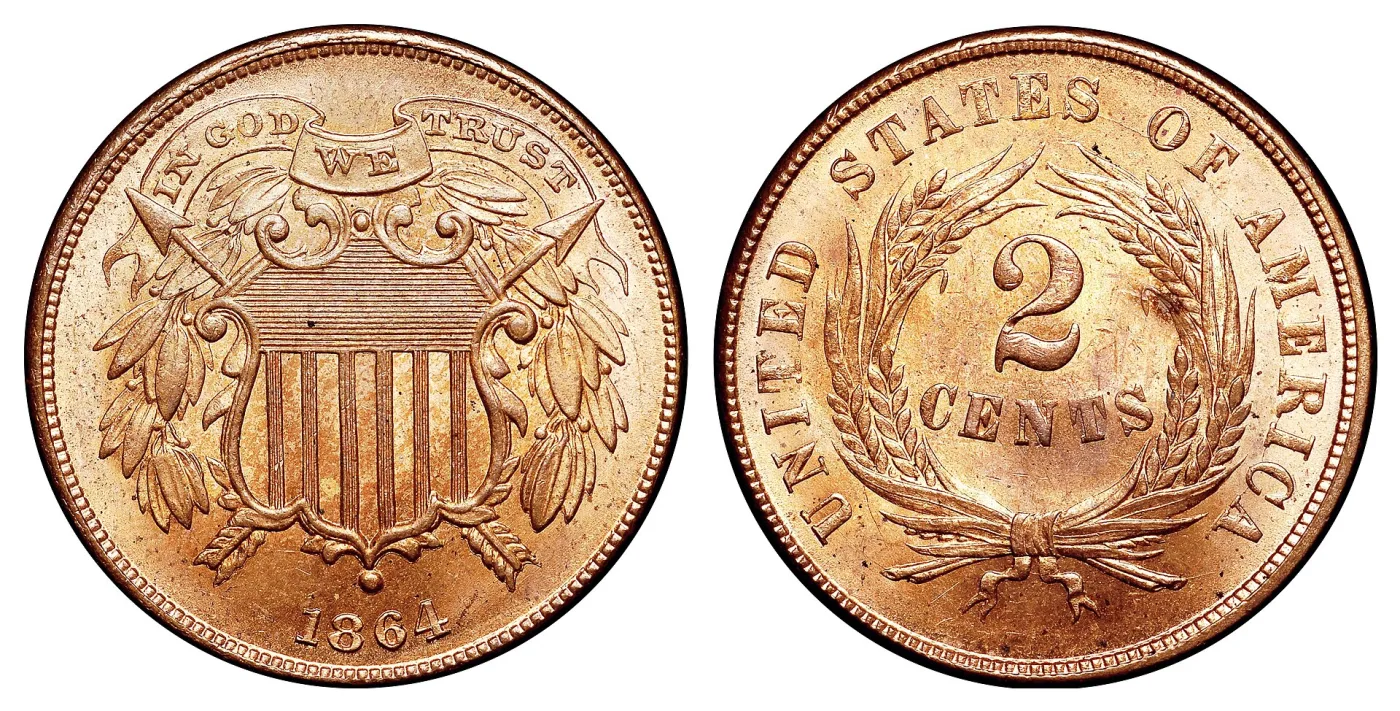
The Two Cent Piece, struck from 1864 to 1873, holds a unique place in American numismatic history as the very first United States coin to bear the motto “IN GOD WE TRUST.” Born in the dark middle years of the Civil War, when public hoarding had stripped circulating coinage from commerce, the Two Cent Piece was a practical answer to a coin shortage and a symbolic answer to a nation in spiritual crisis. Designed by Chief Engraver James Barton Longacre, the same artist behind the Flying Eagle Cent and Indian Head Cent, it lasted only ten years before changing economic conditions and competition from the new three-cent and five-cent nickel pieces rendered it obsolete.
Despite its short run, the series is rich with interesting varieties for collectors. The 1864 Small Motto is the marquee variety, dramatically scarcer than its Large Motto counterpart and sometimes confused with it by inexperienced eyes. The 1872 is the great circulation-strike key, and the 1873 is a proof-only issue that comes in both Closed 3 and Open 3 logotypes. Beyond these headline rarities, repunched dates, doubled dies, and progressive die states give the series real depth.
This guide covers everything needed to confidently identify, grade, authenticate, and value Two Cent Pieces. You will learn how to distinguish Small Motto from Large Motto at a glance, understand the bronze composition that connects this series to the Civil-War-era cent, recognize counterfeits, and price your coins accurately for the 2026 market. Whether you are completing a type set or chasing a complete date run, the Two Cent Piece offers an affordable entry point to 19th century American coinage with one of the most historically significant designs in the federal coinage system.
History and Background of the Two Cent Piece
By 1862, the Civil War had created a peculiar problem in northern commerce: hard money had vanished. Anxious citizens hoarded gold first, then silver, and finally even the copper-nickel cents introduced in 1857 to replace the bulky pure-copper Large Cent and Half Cent. Merchants resorted to private Civil War tokens, postage stamps in small mica cases, and hand-written shinplasters to make change — repeating a pattern set a generation earlier, when Hard Times Tokens had filled the same role during the Panic of 1837. The U.S. Mint needed a new coinage solution that the public would accept and that would not be hoarded the moment it was struck.
The answer arrived in two parts. The Coinage Act of April 22, 1864 reduced the cent from copper-nickel to a lighter bronze alloy, eliminating the nickel content that had made the older cents valuable enough to hoard. The same act authorized a new two cent coin in identical bronze. The two cent denomination was conceived as a quick way to put more face value into circulation per striking operation, doubling output without doubling labor.
Mint Director James Pollock
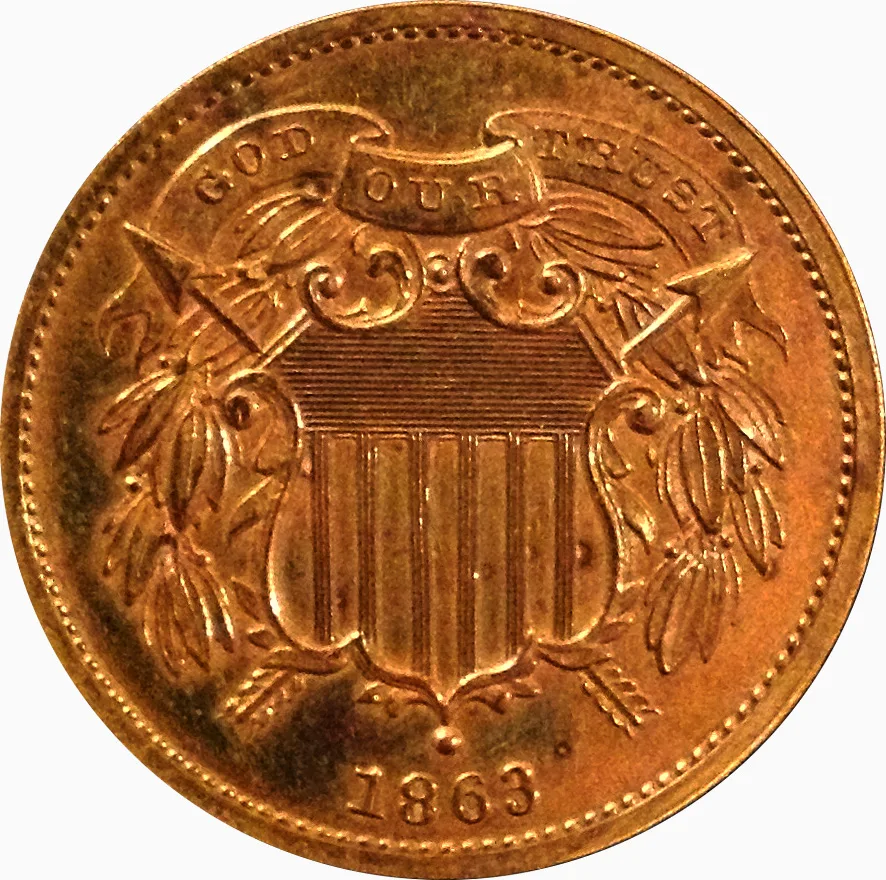
Mint Director James Pollock, a deeply religious Pennsylvania politician, was personally responsible for the inclusion of “IN GOD WE TRUST” on the coin. Pollock had been receiving letters from clergy throughout the war urging some recognition of the Almighty on U.S. coinage. In a letter to Treasury Secretary Salmon P. Chase, Pollock proposed several mottos including “GOD OUR TRUST” and “OUR TRUST IS IN GOD.” Chase ultimately approved “IN GOD WE TRUST,” which appeared first on the Two Cent Piece in 1864.
Initial Success and Decline
The Two Cent Piece launched to enormous success. The 1864 mintage of nearly 19.85 million pieces reflected pent-up demand for circulating coinage. 1865 mintage was even larger at over 13.6 million. But the introduction of the nickel three-cent piece in 1865 and the Shield Nickel in 1866 quickly displaced the Two Cent Piece in commerce. By 1870 mintage had collapsed to 861,250 pieces, and by 1872 only 65,000 were struck for circulation. The series ended in 1873 with proofs only, formally abolished by the Coinage Act of 1873 — the same legislation that ended the Half Dime and the silver Three Cent Piece, and that authorized the controversial Trade Dollar.
Design Details and Symbolism
Longacre’s Two Cent Piece design is heraldic in style, drawing on classical American iconography rather than allegorical figures. It is one of the few 19th century U.S. coins that does not feature a portrait or personification of Liberty.
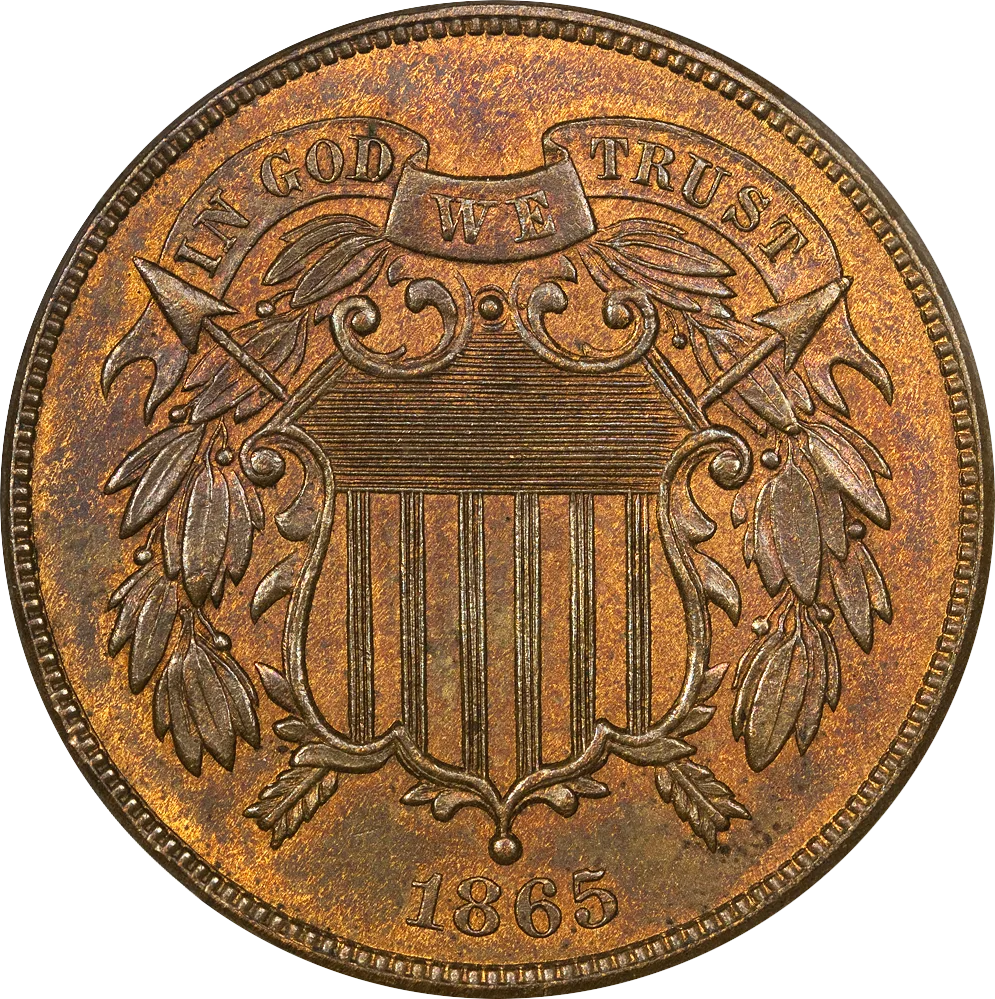
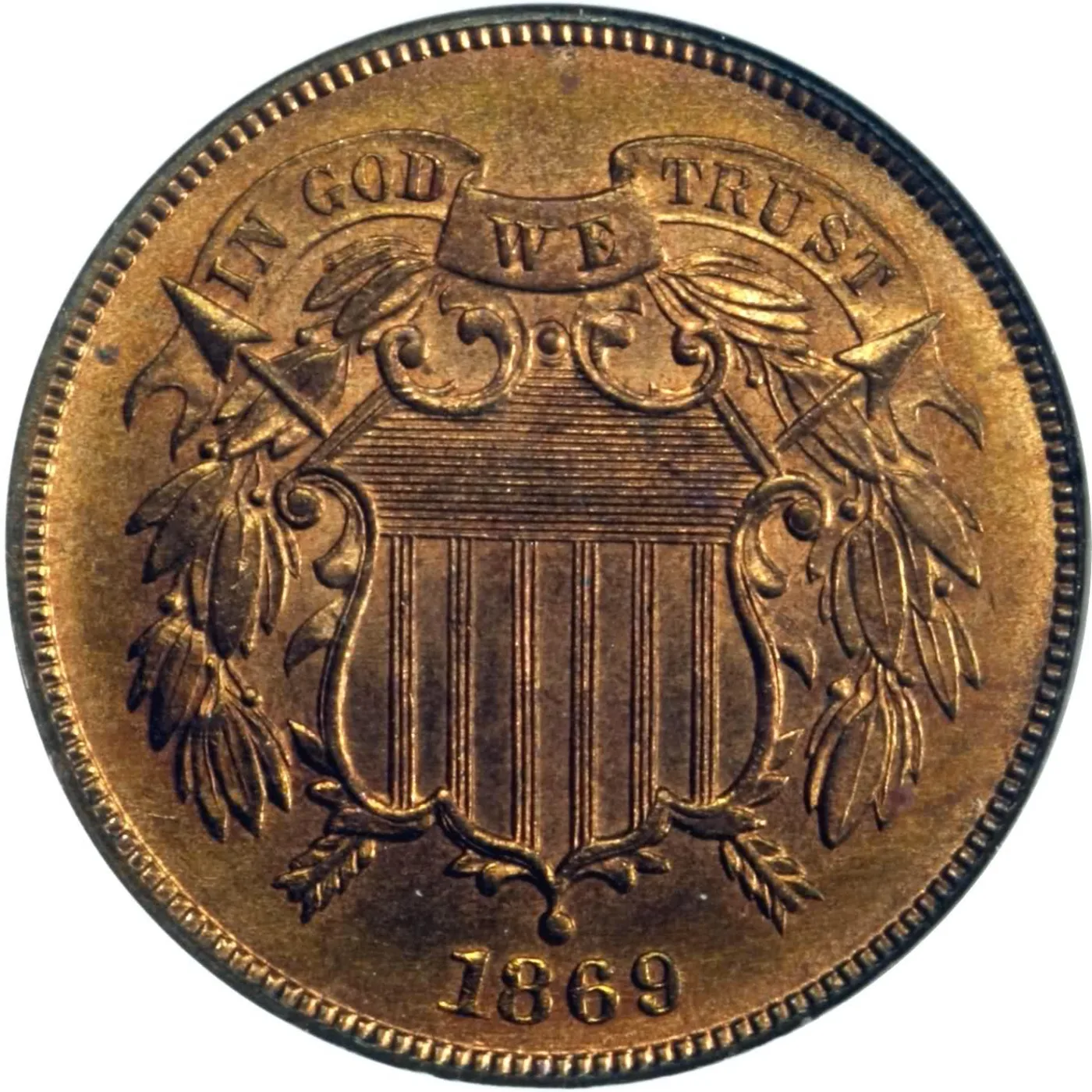
Obverse: The Union Shield
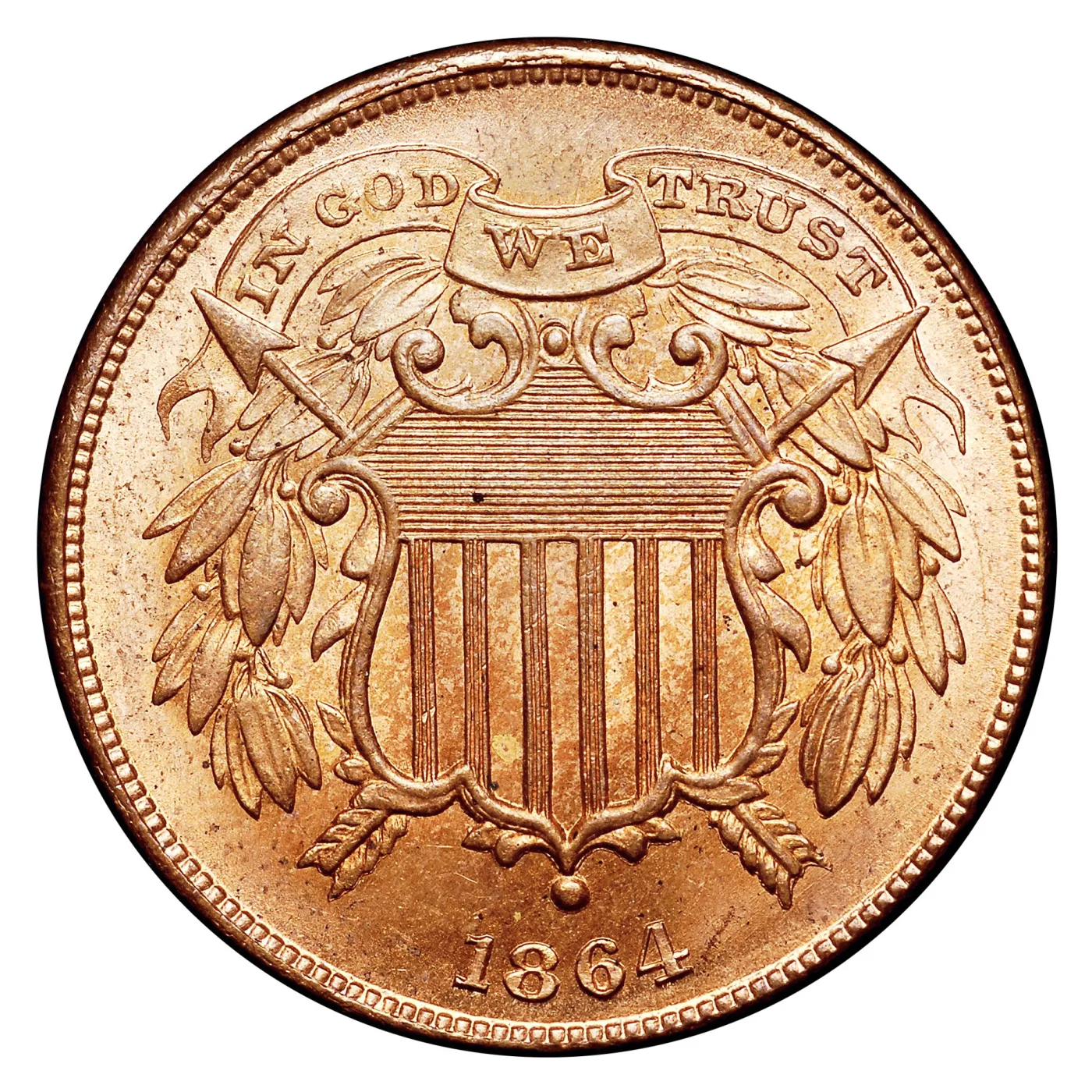
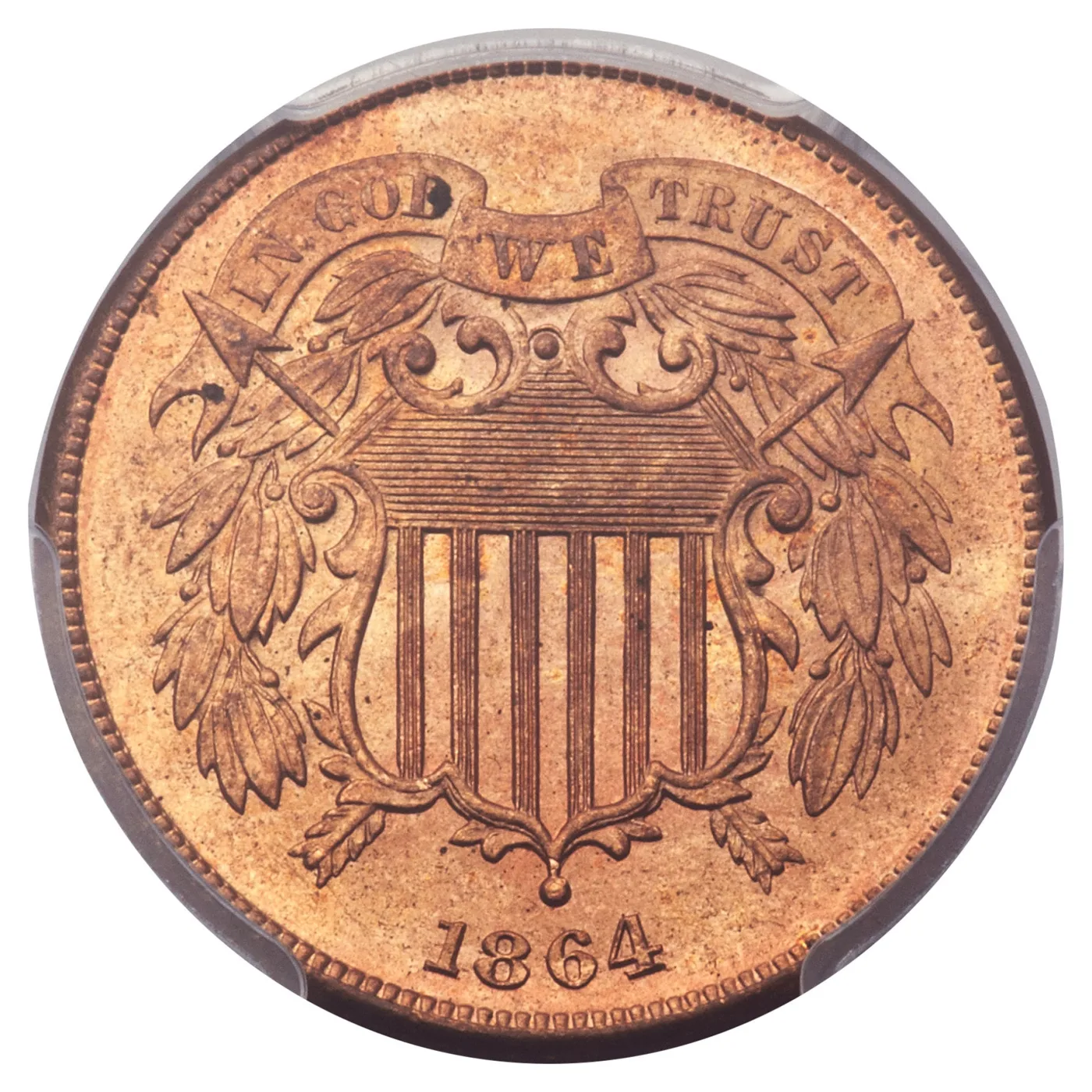
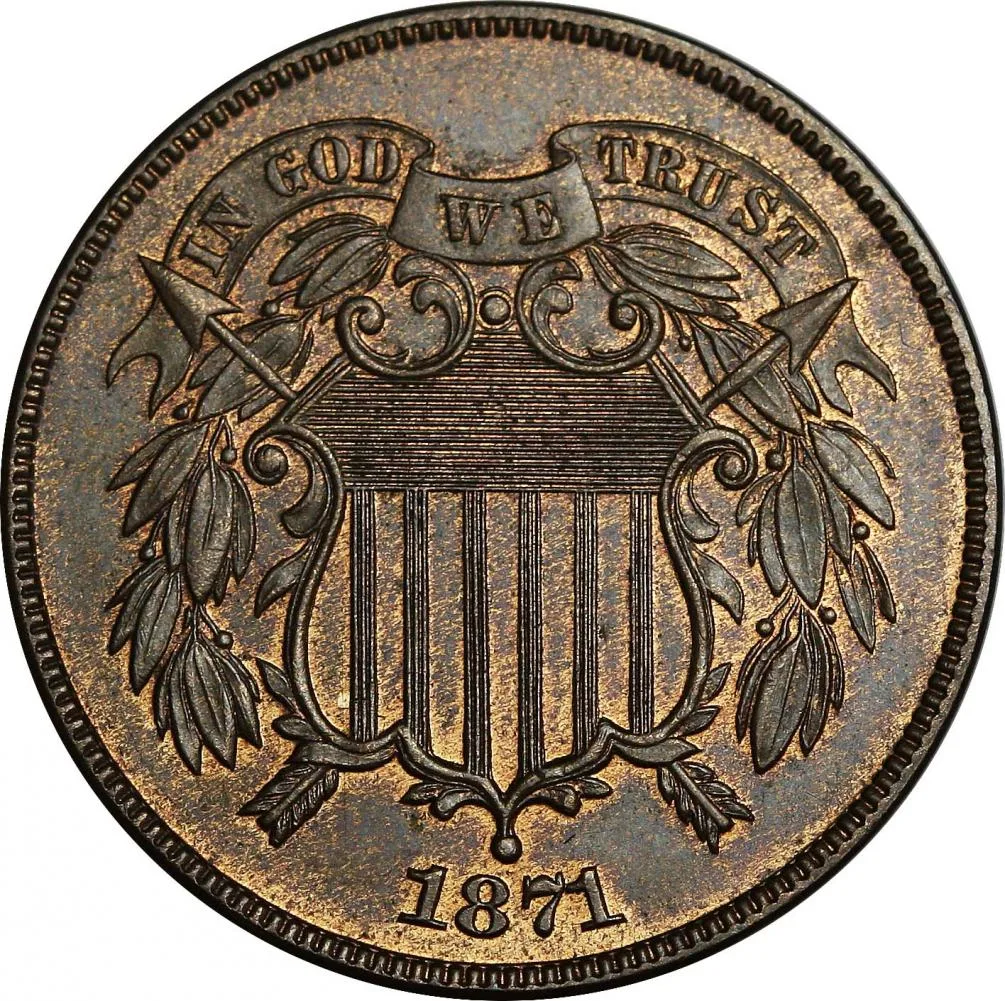
The obverse displays a Union shield (a heater-shaped shield with a horizontal chief over vertical pales) surrounded by oak leaves at the bottom and arrows behind. Two crossed arrows extend behind the shield, and a banner curves above bearing the motto “IN GOD WE TRUST.” The date appears below the shield. The shield design was used again two years later for the Shield Nickel, also designed by Longacre, with strong stylistic continuity — that coin’s reverse was then simplified partway through 1867, which is why 1867 Shield Nickels come with and without rays — and the Union shield motif returned to circulating coinage in 2010 on the reverse of the modern Lincoln Shield cent.
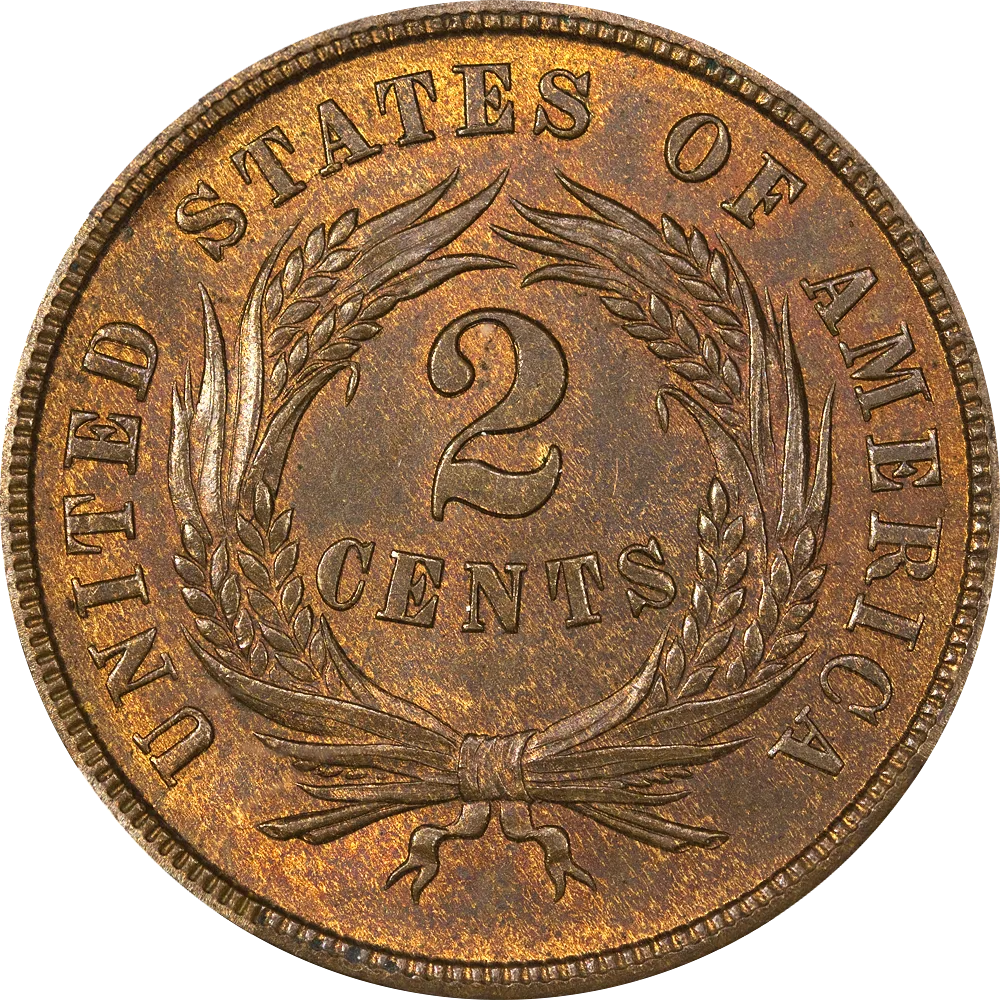
Reverse: Wheat Wreath and Denomination
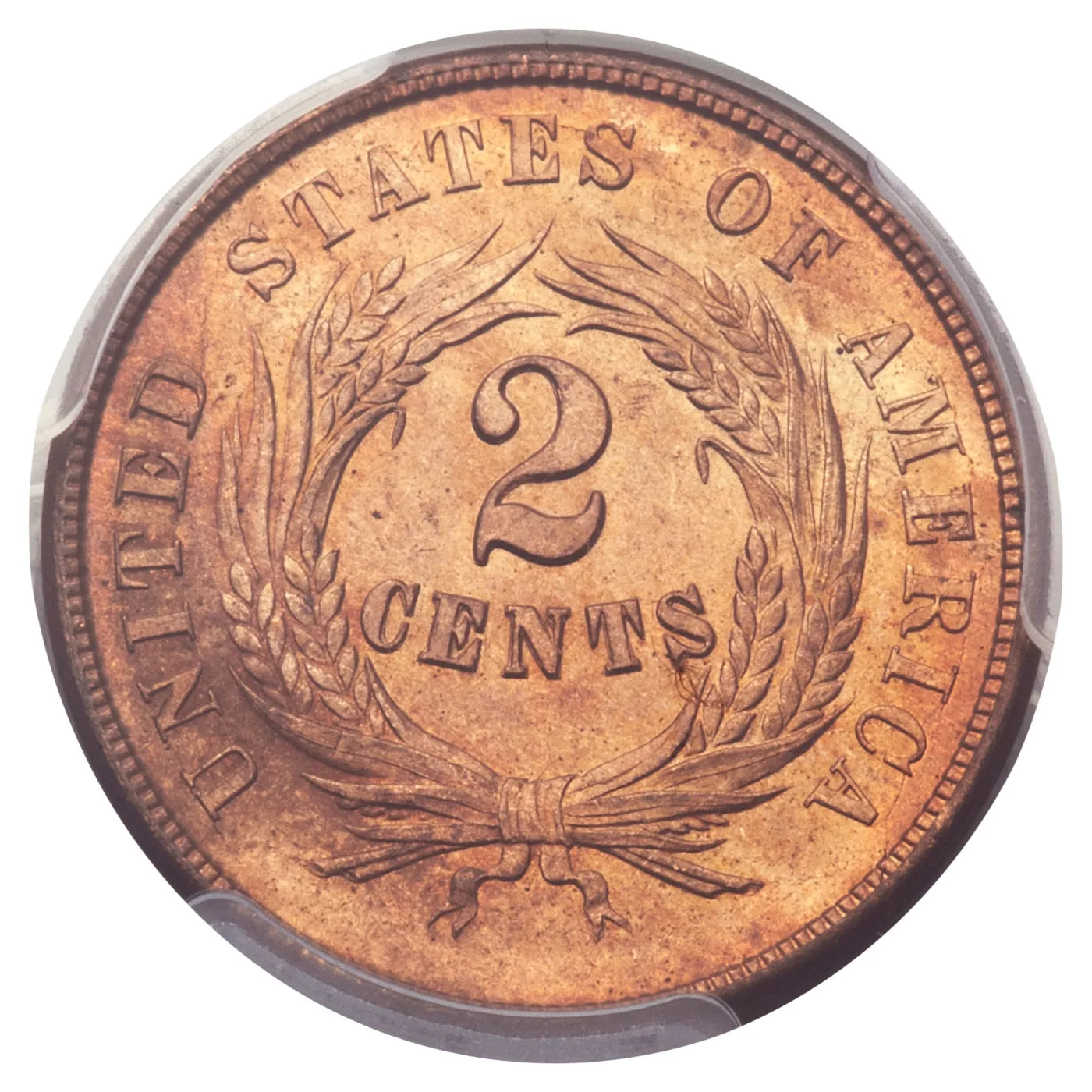
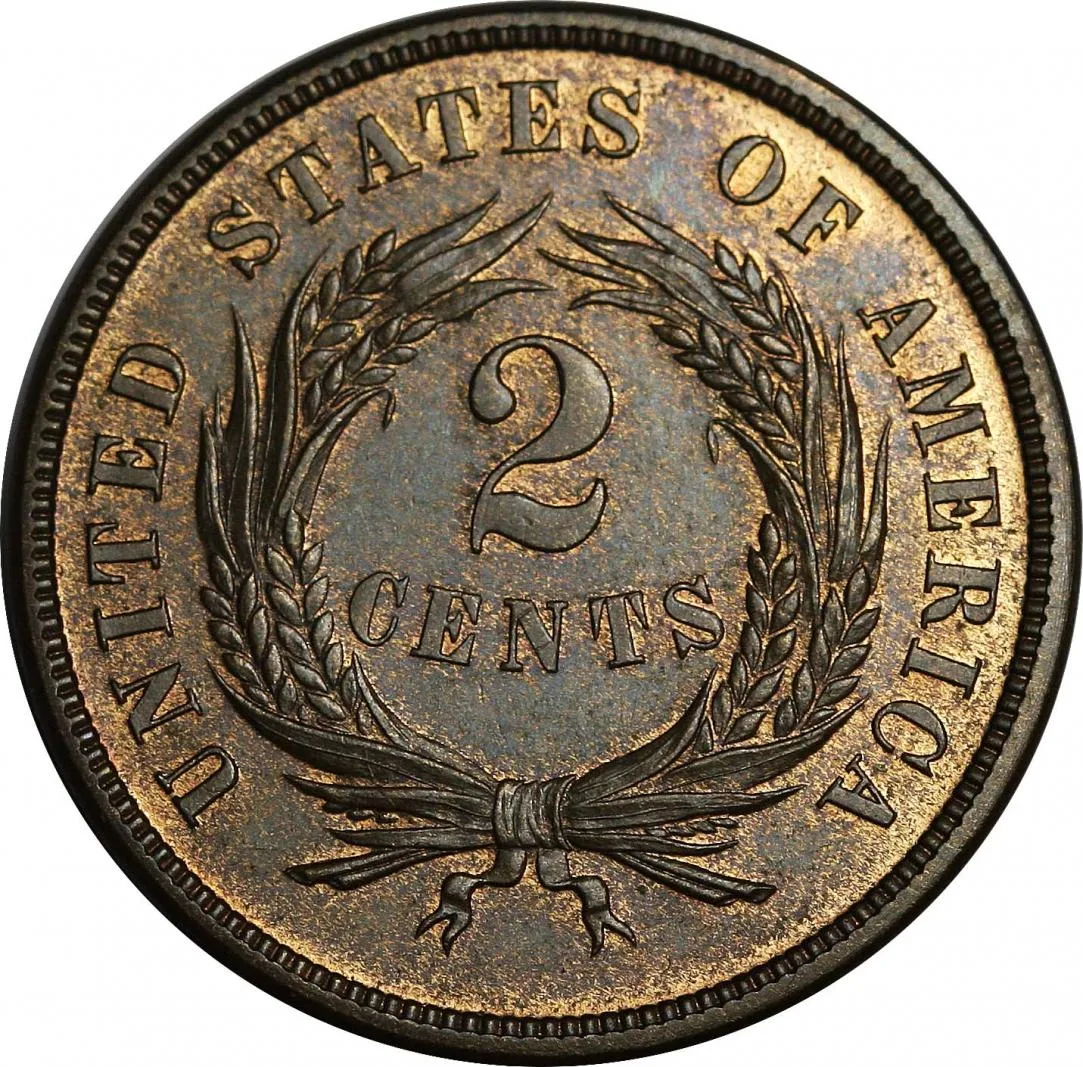
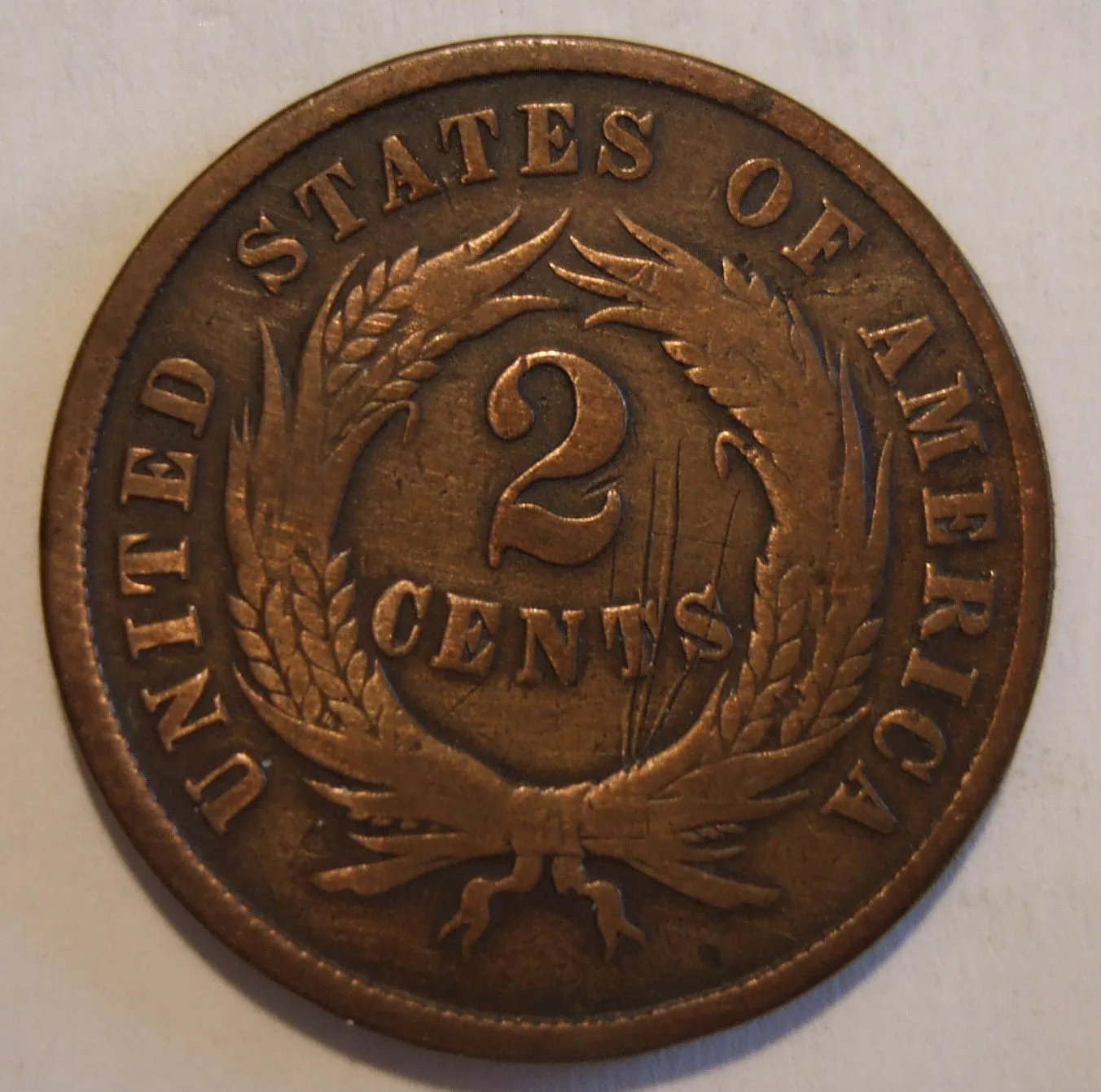
The reverse displays “2 CENTS” inside an open wheat wreath tied with a ribbon at the bottom. “UNITED STATES OF AMERICA” arcs around the upper rim. The wreath is similar in spirit to the wreath on the contemporary Indian Head cent, but the central denomination expression “2 CENTS” is unique to this coin and appears on no other U.S. denomination.
No Mint Mark
All Two Cent Pieces were struck at the Philadelphia Mint and bear no mint mark. Branch mints did not produce minor (sub-dime) coinage during this era. Any Two Cent Piece with what appears to be a mint mark is a damaged, altered, or counterfeit coin.
“In God We Trust”: A Numismatic First
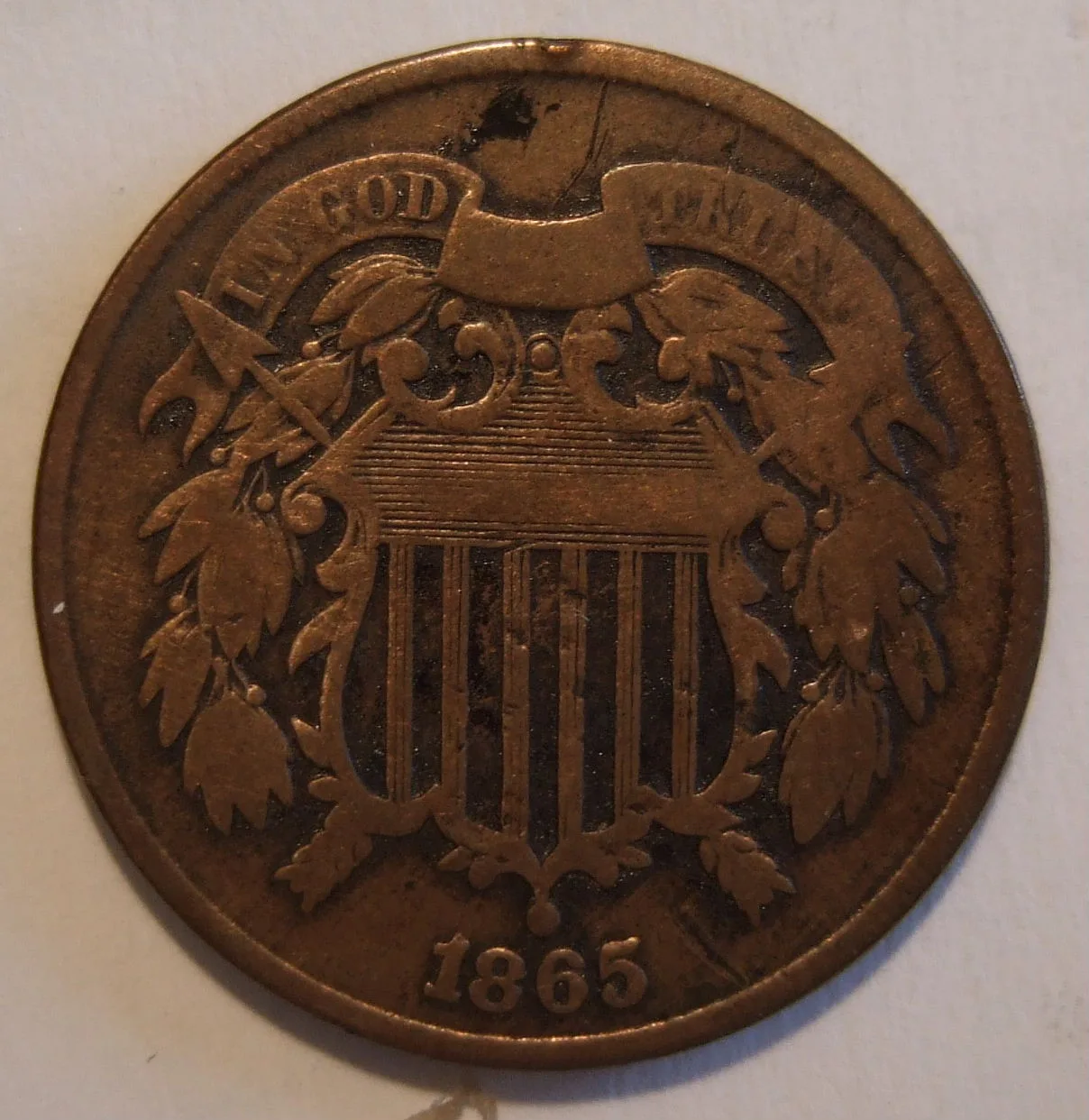
The most historically significant feature of the Two Cent Piece is the motto “IN GOD WE TRUST” arcing across the banner above the Union shield. This was the first appearance of the phrase on any United States coin, though American coins had carried mottos from the very beginning — the 1787 Fugio Cent, the first coin authorized by the United States, bore both “MIND YOUR BUSINESS” and “WE ARE ONE.”
Legislative Origin
The Coinage Act of April 22, 1864 specifically authorized the addition of a motto to the new bronze coinage but left the exact wording to the discretion of the Treasury. Pollock had drafted multiple proposals; Chase chose “IN GOD WE TRUST” largely on grounds of brevity and resonance. The phrase was extended to most other denominations over subsequent decades and became a federally mandated inscription on all U.S. coinage in 1908. It became the official national motto of the United States by Act of Congress in 1956.
Reading the Motto on Worn Coins
The motto banner is the highest point on the obverse and is usually the first area to wear. On Good condition coins the letters in WE TRUST may be partially worn smooth. On Very Good and better, the full motto should be readable. The state of the motto is one of the key grading focal points and is examined first by certifiers when assigning circulated grades.
Why the Motto Matters to Collectors
The “first to bear In God We Trust” status gives the Two Cent Piece outsized historical significance for the size of the series. Many type set collectors who would otherwise skip a short, low-denomination series include the Two Cent Piece specifically for this distinction. Demand from this audience is what keeps even common dates from being truly cheap in circulated grades.
Composition and Physical Specifications
The Two Cent Piece shares a composition and color profile with the contemporary bronze Indian Head Cent, but its larger diameter and weight give it a substantially different feel in hand.
Bronze Alloy
The Two Cent Piece is composed of 95% copper and 5% tin and zinc combined (a French bronze alloy). This is the same composition used on the Indian Head Cent from mid-1864 onward and on the Lincoln Cent from 1909 through 1942 and again from 1947 through 1962. New examples have a warm reddish-orange color (designated Red, or RD by graders) that mellows to brown (BN) over decades, with intermediate Red-Brown (RB) examples also commonly encountered.
Specifications
Diameter: 23mm. Weight: 6.22 grams. Edge: plain (no reeding). Thickness: approximately 1.6mm. The diameter is noticeably larger than the cent (19mm) and slightly larger than the modern nickel (21.21mm). A weight outside 6.22g ± 0.16g is a strong warning sign of a counterfeit or a heavily corroded coin.
Color and Toning
Like all bronze coins, Two Cent Pieces are graded for color: Red, Red-Brown, or Brown. Full Red examples retain at least 95% of their original mint orange color and command large premiums in Mint State grades. Red-Brown coins show a mix, and Brown coins have lost most or all of the original red. Sealed in proper holders, original Red coins will generally remain Red for decades; cleaned coins often show pinkish or unnaturally bright surfaces and grade only as “details.”
How to Identify a Two Cent Piece
Two Cent Pieces are unique enough in design that identification is usually straightforward, even on heavily worn examples. Several quick checks confirm authenticity.
Step 1: Verify the Obverse Design
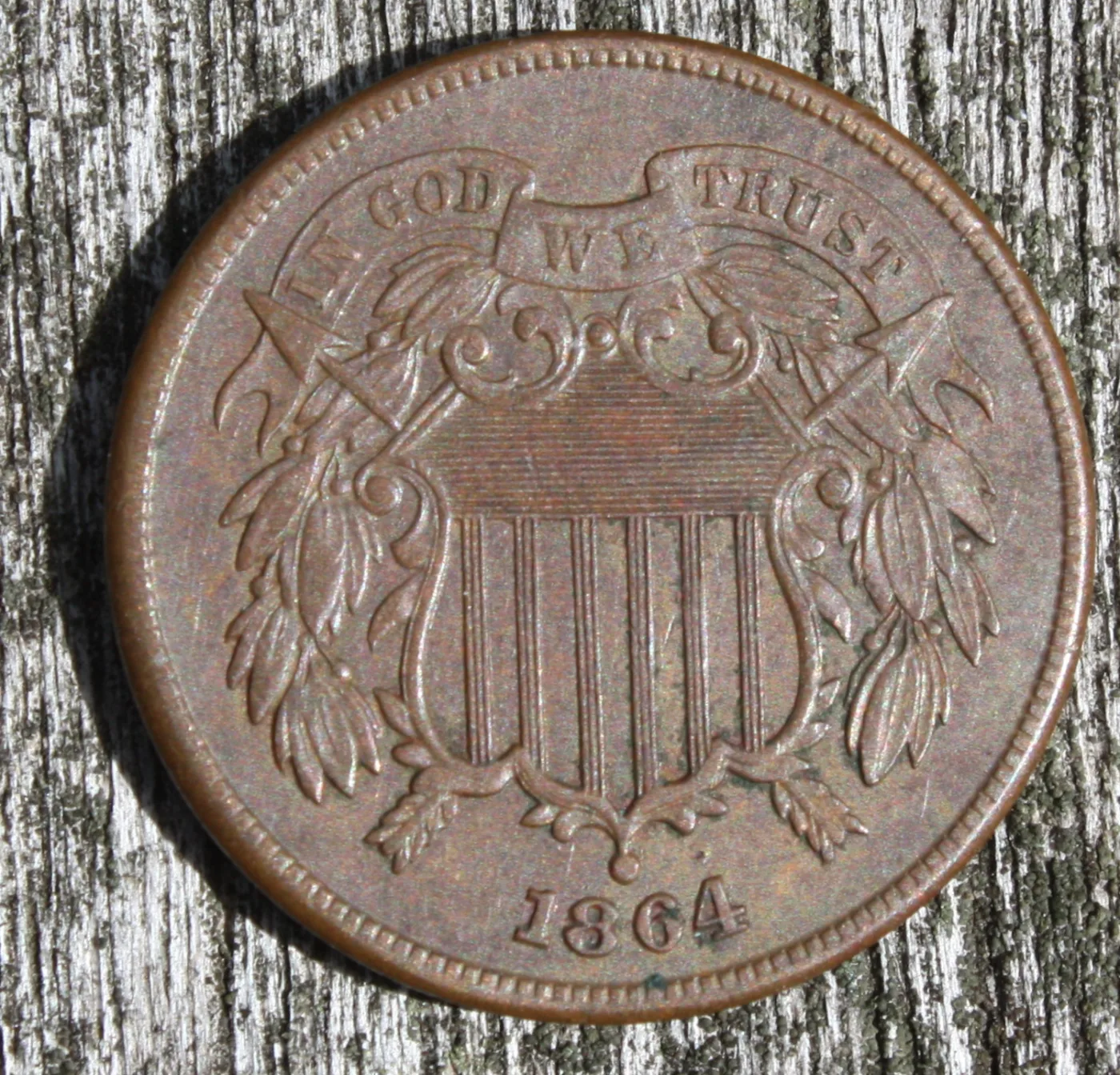
Look for a Union shield surrounded by oak leaves and crossed arrows, with a banner above bearing “IN GOD WE TRUST” and the date below. The design fills nearly the entire field. If the obverse shows a portrait, Liberty figure, or any design other than the shield, it is not a Two Cent Piece.
Step 2: Verify the Reverse Design
The reverse should display “2 CENTS” centered inside an open wheat wreath, with “UNITED STATES OF AMERICA” arcing above. Coins showing “ONE CENT,” “5 CENTS,” or any other denomination expression are not Two Cent Pieces. The “2 CENTS” wording in this exact format is unique to this denomination.
Step 3: Confirm the Date
Genuine Two Cent Pieces are dated 1864 through 1873. Any other date is impossible and indicates a counterfeit, a fantasy piece, or severe damage to the date area. Within the legitimate date range, look closely at 1864 (Small or Large Motto) and 1873 (Closed or Open 3) for variety attribution.
Step 4: Weigh and Measure
On a precise scale, a genuine coin should weigh 6.22 grams within a tolerance of about ±0.16 grams. Diameter should be 23mm. Counterfeits frequently fail these basic physical tests because matching both weight and diameter with the correct alloy is technically demanding.
Step 5: Check Color and Edge
The edge should be plain (smooth, no reeding) and a uniform brown, red-brown, or red color matching the obverse and reverse. Two-tone edges suggesting plating, or yellow-gold or gray colors, indicate problem coins. The overall color should match expected bronze tones — pinkish-orange of pure copper or the gray-white of nickel are warning signs. For broader coin identification practices, see our complete coin identification guide.
1864 Small Motto vs. Large Motto
The 1864 Two Cent Piece exists in two distinct varieties distinguished by the size and style of the lettering in “IN GOD WE TRUST.” The Small Motto is dramatically scarcer and significantly more valuable across all grades.
Small Motto Diagnostics
On the Small Motto variety, the letters of the motto are noticeably more compact and the “D” in “GOD” has a stub-like appearance. The most reliable diagnostic is the spacing and stroke width: Small Motto letters are clearly thinner, and there is more open space between adjacent letters. The “T” in “TRUST” has shorter horizontal arms. A second diagnostic is the position of the leaf below the date — on the Small Motto variety, the leaf does not touch the bottom of the second 8 of the date.
Large Motto Diagnostics
On the Large Motto variety, the letters are thicker and taller, with less open space between them. The “D” in “GOD” is a normal full-width letter. The “T” in “TRUST” has long, full horizontal arms. The leaf below the date touches the bottom of the second 8.
Mintage and Distribution
Combined 1864 mintage was 19,847,500 pieces. The Small Motto was used for early production and is estimated at no more than 5% of the total — roughly 1 million pieces. Of these, far fewer survive in collectible grades because most circulated heavily during the post-war coinage drought.
Verifying Variety on Worn Coins
On worn examples where the motto details have flattened, the leaf-and-date diagnostic becomes the most reliable test. Use 5-10x magnification and good directional lighting. If the motto is too worn to read but the leaf clearly does not touch the date, the coin is a strong candidate for Small Motto and warrants professional certification. Never pay a Small Motto premium for an unverified coin — third-party authentication is essential above $200-300 in value.
1864 Values
Large Motto in Good: $20 to $30. Fine: $30 to $45. EF: $50 to $90. AU: $100 to $175. MS-63 RB: $200 to $325. MS-65 RB: $700 to $1,200. MS-65 RD: $1,400 to $2,500. Small Motto in Good: $200 to $300. Fine: $400 to $600. EF: $900 to $1,500. AU: $1,800 to $3,000. MS-63 RB: $5,500 to $8,500. MS-65 RB: $20,000 to $35,000. Full Red Mint State Small Motto coins can exceed $50,000 in MS-65 RD and above.
Date-by-Date Analysis (1864-1873)
Each year of the Two Cent Piece series has its own characteristics, mintage profile, and price structure.
1864 (Both Mottos)
Covered above. The Large Motto is by far the most commonly encountered date in the series and the standard type-set choice.
1865
Mintage: 13,640,000. The 1865 is the second most common date and an excellent alternative for type collectors who prefer a date with no major variety complications. The 1865 also exists as a Plain 5 / Fancy 5 variety, distinguished by the shape of the 5 in the date. Plain 5 has a tall, straight knob; Fancy 5 has a curved knob and slight flair. The Fancy 5 brings modest premiums. Values track closely with 1864 Large Motto.
1866
Mintage: 3,177,000. A clear step-down from 1865 in availability. Values: Good $25, Fine $40, EF $80, AU $150, MS-63 RB $300, MS-65 RB $1,400. The 1866 is when collectors start to feel the series tightening in higher grades.
1867
Mintage: 2,938,750. Similar in availability to 1866 with similar pricing. The 1867 has a notable doubled die obverse variety (1867 DDO) showing strong doubling on the motto and date, which commands $400-$1,000 premium in mid grades.
1868
Mintage: 2,803,750. Slightly scarcer than 1867 but priced similarly in circulated grades. Mint State examples become noticeably more difficult to find with full Red color.
1869
Mintage: 1,546,500. A meaningful drop from earlier years. Values: Good $30, Fine $50, EF $100, AU $190, MS-63 RB $400, MS-65 RB $1,800. The 1869 also exists with a 1869/8 overdate that shows the foot of an 8 protruding from the lower part of the 9, valued at $300+ in circulated grades.
1870
Mintage: 861,250. The series is clearly winding down. Values: Good $40, Fine $65, EF $135, AU $250, MS-63 RB $500, MS-65 RB $2,200. Full Red examples in Mint State are scarce.
1871
Mintage: 721,250. Comparable scarcity to 1870 with similar pricing. Strike quality varies considerably in this year.
1872
Mintage: 65,000. The great key date of the circulation series. Values: Good $700, Fine $1,200, EF $2,200, AU $3,500, MS-63 RB $6,500, MS-65 RB $18,000+. The dramatic drop in mintage reflects the Mint’s recognition that the denomination was failing in commerce, with most demand instead going to the Three Cent Nickel and Shield Nickel. Authentication by PCGS or NGC is essential for any 1872 above the $300 level.
1873 (Proof Only)
No business strikes were produced in 1873. Only proofs were struck for collectors, in two distinct logotype varieties covered in the next section. The 1873 is therefore a rarity that any complete set must include.

The 1873 Closed 3 and Open 3
The 1873 is unique in the Two Cent Piece series for being struck only as proofs. It also exists in two distinct logotype varieties — Closed 3 and Open 3 — that originated from a Mint-wide change to the date logotype that year.
The Logotype Change
Early 1873 dies used a logotype with a “3” whose upper and lower curves nearly touched, easily mistaken for an 8 in worn examples. Mint Director Henry Linderman ordered a redesigned 3 with the curves more widely separated. The change affected several denominations in 1873, including the Indian Head cent, Three Cent Nickel, dime, quarter, and half dollar.
Closed 3 Diagnostics
On the Closed 3, the upper and lower terminations of the 3 are thick and curl inward toward each other, creating a small gap that can look almost closed. The overall character resembles the thicker Civil-War-era logotype style.
Open 3 Diagnostics
On the Open 3, the upper and lower terminations are thinner and clearly point outward, leaving a wider visible gap between them. The character is taller and more elegant.
Mintage and Rarity
Original 1873 proof mintage is estimated at 600 Closed 3 and 500 Open 3, though scholarly debate continues about exact figures. The two varieties are roughly equal in survival numbers today and trade at similar prices. Both are recognized restrike issues exist as well, complicating attribution.
1873 Values
Both Closed 3 and Open 3 in PR-60: $1,500 to $2,200. PR-63: $2,500 to $3,500. PR-65: $4,000 to $6,500. PR-66+: $8,000 to $15,000. Cameo and Deep Cameo designations bring substantial premiums. PR-65 Cameo can reach $10,000+ and Deep Cameo can exceed $25,000. Original red color (PR RD) doubles or triples brown values.
Proof Two Cent Pieces
Proof Two Cent Pieces were struck in small quantities every year of the series for collector sets. They are an important sub-collection within the series.
Proof Mintages by Year
Estimated proof mintages: 1864 — 100 (very rare in any motto variety); 1865 — 500+; 1866 — 725; 1867 — 625; 1868 — 600; 1869 — 600; 1870 — 1,000; 1871 — 960; 1872 — 950; 1873 Closed 3 — 600; 1873 Open 3 — 500. Survival rates range from 20% to 60% depending on year and original distribution.
Proof Diagnostics
Proof Two Cent Pieces show fully mirrored fields visible from edge to edge, sharp squared rims, and crisp design details on both obverse and reverse. The motto banner and shield details should be sharply struck. Worn or mishandled proofs lose mirror surfaces and can be confused with high-grade business strikes — always rely on PCGS or NGC certification for proofs above the $500 level.
Cameo and Deep Cameo
Some proofs show frosted devices contrasting against mirrored fields, designated Cameo (CAM) or Deep Cameo (DCAM, also called Ultra Cameo at NGC). These designations bring 50% to 300% premiums depending on year and grade. Cameo proofs are most often encountered in 1864 through 1867, before die polishing practices reduced contrast.
Color on Proofs
Like business strikes, proofs are graded RD, RB, or BN. Full Red proofs are highly prized. The mottling tendency of bronze proofs means that absolutely full Red examples in PR-65 and finer are scarce in any year of the series.
Minor Varieties and Repunched Dates
Beyond the major varieties already discussed, the Two Cent Piece series contains many minor varieties prized by specialists.
Repunched Dates
Repunched dates exist for nearly every year of the series, where the date logotype was punched into the working die more than once at slightly different positions. The most prominent is 1864 RPD (Repunched Date) showing the underdigits at multiple positions of the date numerals. Cherrypicker’s Guide attributes catalog the most significant examples, which trade at $50 to $200 premiums depending on date and prominence.
Doubled Dies
Several doubled die obverses are known for the series, the most dramatic being 1867 DDO showing strong doubling on the motto and date. Less prominent doubled dies exist for 1864, 1865, 1869, and 1871. Strong examples bring meaningful premiums in higher grades.
Die Cracks and Cuds
Late die state examples often show die cracks radiating from rim to interior or through letters. Several 1865 and 1866 dies developed major rim breaks or “cuds” creating raised blobs of metal at the rim. These die-state varieties are popular with specialists but trade at modest premiums except for the most dramatic examples.
1869/8 Overdate
The 1869/8 overdate shows clear remnants of an 8 beneath the 9 of the date. The base of the underlying 8 protrudes from the bottom of the 9, and the upper loop sometimes shows as a flag inside the 9’s loop. Authentic examples in Fine grade and better trade at $300 to $1,500 over normal 1869 prices.
Grading Two Cent Pieces
Grading Two Cent Pieces requires understanding both the standard Sheldon scale and the series-specific points of wear, plus the bronze color designations that significantly affect Mint State value.
Key Grading Focal Points
Wear shows first on the highest points of the design: the horizontal bands and stars in the shield’s chief, the leaves on the obverse, the leaves and ribbon on the reverse wreath, and the motto banner. The state of “WE TRUST” in the motto is the single most important indicator of circulated grade — this is where the design is highest and most exposed.
Grade Descriptions
Good (G-4 to G-6): Shield outline is clear with most internal detail worn smooth. WE TRUST may show only partial letters; IN GOD is usually readable. Date is readable but may be weak. Wreath outline visible; “2 CENTS” is bold.
Very Good (VG-8 to VG-10): Some shield internal detail visible. Full motto readable but weak in places. Wreath shows partial leaf detail.
Fine (F-12 to F-15): Approximately half of shield detail visible. Full motto sharp. Wreath leaves show distinct outlines and some internal detail.
Very Fine (VF-20 to VF-35): Most shield detail sharp except for the very highest points. Motto is sharp throughout. Wreath leaves show vein detail. Arrow feathers visible.
Extremely Fine (EF-40 to EF-45): All design details sharp with only slight wear on the highest points: motto letters, shield top stripes, leaf tips. Mint luster may remain in protected areas.
About Uncirculated (AU-50 to AU-58): Traces of wear only on the highest points. AU-58 examples appear nearly uncirculated with only slight friction breaks in the luster. Significant mint color may remain.
Mint State (MS-60 to MS-70): No wear. Differentiation is by surface preservation, luster quality, strike sharpness, and color. Color (RD, RB, BN) is the single biggest pricing driver for Mint State Two Cent Pieces — a Red example commonly brings 2-4x the price of a Brown example at the same numerical grade. Compare with the bronze grading approach used for the Indian Head Penny and Lincoln Wheat Penny, which use the same color designations.
Color Designations in Detail
Red (RD) requires at least 95% original mint color. Red-Brown (RB) shows 5-95% retention. Brown (BN) is 5% or less. Borderline determinations are made by graders looking at both sides; a coin must qualify on both faces to receive RD or RB. Toned examples that have developed attractive multicolor patina are typically graded RB and often command premiums over plain brown coins of similar technical grade.
Counterfeit Detection and Authentication
While Two Cent Pieces are not as heavily counterfeited as gold or premium silver coins, the 1864 Small Motto, 1869/8 overdate, and 1872 are frequent targets, and even common dates in high grade may be problem coins.
Date and Variety Alterations
The most common counterfeit method is altering an 1864 Large Motto to mimic a Small Motto by tooling individual letters. Examine the motto under 10x magnification: tooling marks appear as fine scratches around letter edges, and altered letters often have subtly wrong proportions compared to genuine Small Motto coins. The leaf-and-date diagnostic is unalterable and should always be checked.
The 1872 is sometimes faked from an altered 1871 by tooling the final digit. Look at the second numeral of the date carefully; genuine 1872s have a specific 2 shape that differs from a tooled 1.
Cast Counterfeits
Cast counterfeits exist for valuable dates. Diagnostic features include slightly fuzzy detail throughout, incorrect weight (usually too light), pitted or grainy surfaces under magnification, and visible mold seams on the plain edge. Color is often subtly wrong — too pink, too uniform, or oddly mottled.
Modern Replicas
Modern replicas are widely available, especially as souvenirs of the “first In God We Trust” coin. U.S. law since 1973 requires reproductions to be marked “COPY,” but earlier replicas may not be marked. Any coin lacking proper bronze color, weighing significantly off, or showing details that look “perfect” in a way that real circulated coins never do should be regarded with suspicion.
Professional Authentication
For any Two Cent Piece worth more than $200 to $300, professional authentication by PCGS or NGC is strongly recommended. Certified holders provide authentication, an objective grade, color designation, and tamper-evident encapsulation. The same authentication principles apply to other early bronze coinage like the Flying Eagle Cent and the early Indian Head Penny series.
Current Market Values by Date and Grade
Two Cent Piece values vary by date, variety, grade, and color. The following are typical 2026 retail ranges for properly graded coins.
Common Dates (1864 LM and 1865)
Good: $20 to $30. Very Good: $25 to $40. Fine: $30 to $50. Very Fine: $40 to $70. EF: $50 to $90. AU: $100 to $175. MS-63 BN: $130 to $200. MS-63 RB: $200 to $325. MS-63 RD: $400 to $700. MS-65 RB: $700 to $1,200. MS-65 RD: $1,400 to $2,500. MS-66 RD: $4,000+ when available.
Mid-Series Dates (1866-1869)
Good: $25 to $40. Fine: $40 to $60. EF: $80 to $150. AU: $175 to $325. MS-63 RB: $300 to $500. MS-65 RB: $1,400 to $2,500. MS-65 RD: $3,000 to $5,500.
Later Dates (1870-1871)
Good: $35 to $60. Fine: $60 to $100. EF: $135 to $250. AU: $250 to $450. MS-63 RB: $500 to $800. MS-65 RB: $2,200 to $3,800. MS-65 RD: $5,000 to $9,000.
Key Dates and Major Varieties
1864 Small Motto: $200 (Good) to $50,000+ (MS-65 RD). 1872 (key business strike): $700 (Good) to $25,000+ (MS-65 RD). 1873 Closed 3 Proof: $1,500 (PR-60) to $25,000+ (PR-66 DCAM). 1873 Open 3 Proof: similar range. 1869/8 Overdate: $250 to $5,000+ depending on grade.
Market Trends
The Two Cent Piece market is driven by type set demand for the “first In God We Trust” coin and by series specialists pursuing complete date and variety sets. Prices have been steady to slightly rising over the past decade. Premium-color (full Red) examples have outpaced Brown examples in appreciation, reflecting collector preference for original surfaces. The 1872 and 1864 Small Motto are considered “blue chip” coins of the series with consistently strong demand.
Collecting Strategies and Tips
The Two Cent Piece is one of the shortest U.S. coin series and is well suited to several collecting approaches at different budget levels.
Type Coin Collection
The simplest approach is to acquire a single representative example for a U.S. type set. An 1864 Large Motto or 1865 in EF or AU is the standard type-set choice, costing $50 to $200. Many type collectors aim for an MS-63 RB example for around $250 to $400, providing solid eye appeal at a reasonable price.
Complete Date Set
A complete date set includes 1864 LM, 1865, 1866, 1867, 1868, 1869, 1870, 1871, 1872, and 1873 (either Closed or Open 3). In mid-circulated grades excluding the 1872 and 1873, a set can be assembled for $400 to $700. Adding the 1872 in Good or VG adds $700 to $1,200, and the 1873 proof adds $1,500 to $2,500. A complete date set in collector grade is therefore achievable for $2,500 to $4,500.
Complete Variety Set
A complete variety set adds 1864 Small Motto, 1873 Closed 3 AND Open 3, and selected major repunched dates and overdates. Budget for the Small Motto pushes the project into five figures even in lower grades. A complete variety set in collector grades costs $15,000 to $25,000+.
Color-Focused Mint State Set
Specialists who want full Red Mint State examples of every common date face a long search and substantial expense. Full Red coins of the later, lower-mintage dates (1870, 1871) are scarce in MS-65 and finer regardless of price. This approach rewards patience over budget.
Proper Storage and Preservation
Bronze coins like the Two Cent Piece are particularly sensitive to environmental damage. Proper storage is essential to preserve color and surfaces.
Avoid PVC and Sulfur
Never store Two Cent Pieces in PVC-containing flips or albums. PVC releases hydrochloric acid over time, which causes a green slime on bronze surfaces that is permanent and value-destroying. Use Mylar flips, inert hard plastic capsules, or original holders from grading services. Avoid paper envelopes containing sulfur (most older brown 2x2 envelopes), which causes uneven gray-black toning and can permanently destroy original Red color.
Humidity Control
Store coins in a cool, dry environment with stable humidity below 50%. Silica gel packets in your storage area help absorb moisture. Avoid attics, basements, garages, and rooms with temperature swings. Sudden humidity changes can cause condensation that leads to spotting on bronze surfaces — and bronze spots are notoriously difficult to remove without damaging the coin.
Handling
Always hold Two Cent Pieces by their edges. Skin oils contain acids and chlorides that etch bronze within hours, leaving permanent fingerprints. Use clean cotton or nitrile gloves when handling Mint State or proof examples. Work over a soft padded surface to protect against accidental drops.
Never Clean
Cleaning a Two Cent Piece destroys both natural toning and microscopic surface detail, and cleaned coins receive “details” grades from third-party services with 30% to 70% discounts compared to original-surface examples. Even a coin that looks dark or unattractive is worth more in its natural state than after a chemical or abrasive cleaning. The same warning applies to all early U.S. bronze coins.
Frequently Asked Questions
What was the first U.S. coin to bear "In God We Trust"?
The Two Cent Piece, introduced in 1864, was the first United States coin to carry the motto "IN GOD WE TRUST." Mint Director James Pollock pushed for the inscription, and Treasury Secretary Salmon P. Chase approved the wording. The motto later spread to most other U.S. denominations and became federally mandated in 1908.
How can I tell 1864 Small Motto from Large Motto?
Look at the motto banner under 5-10x magnification. Small Motto letters are thinner and more compact, with the "D" in "GOD" appearing stub-like. The most reliable diagnostic on worn coins is the leaf below the date: on Small Motto, the leaf does not touch the bottom of the second 8 of the date; on Large Motto, the leaf touches the date. Always have suspected Small Motto coins certified before paying a premium.
Why did the Two Cent Piece fail in commerce?
Several factors contributed. The introduction of the Three Cent Nickel in 1865 and the Shield Nickel in 1866 provided alternative coinage at competing denominations. The end of the Civil War coin shortage reduced public urgency for additional small denominations. And the public never fully embraced the somewhat awkward two cent denomination, which fit no existing pricing convention. Mintage collapsed from over 19 million in 1864 to just 65,000 in 1872, and Congress abolished the denomination in 1873.
Are Two Cent Pieces made of pure copper?
No. They are made of 95% copper and 5% tin and zinc combined — a French bronze alloy. This is the same composition used for the Indian Head Cent from mid-1864 onward and for most bronze Lincoln Cents. Pure copper coins behave differently in toning and weight.
What is the rarest Two Cent Piece?
For business strikes, the 1872 is the rarest with mintage of just 65,000 pieces. For varieties, the 1864 Small Motto is dramatically scarcer than its Large Motto counterpart. For proofs, the 1864 proof is the rarest issue with estimated mintage of about 100 pieces. The 1873 proof-only year is unique because no business strikes exist.
Can I find Two Cent Pieces in circulation today?
No. Two Cent Pieces have been out of circulation for well over a century. All surviving examples are in collections, dealer inventories, or estate holdings. They are commonly available through coin dealers, auctions, and online numismatic marketplaces.
Should I clean a dark or dirty Two Cent Piece?
Never clean a Two Cent Piece. Cleaning removes original surface and natural toning, leaves microscopic scratches, and dramatically reduces the coin's value. Cleaned coins identified by grading services receive "details" grades and sell at significant discounts. Even unattractive original-surface coins are worth more than cleaned examples of the same technical grade.
What replaced the Two Cent Piece?
The Two Cent Piece was not directly replaced by another denomination — it was simply discontinued by the Coinage Act of 1873. Its functional role was taken over by the Three Cent Nickel and the bronze Indian Head Cent. The "first In God We Trust" baton passed forward as the motto was adopted on additional denominations in subsequent decades.