Gold Dollar Identification Guide: Type 1, 2, 3 Key Dates, Mint Marks, and Values
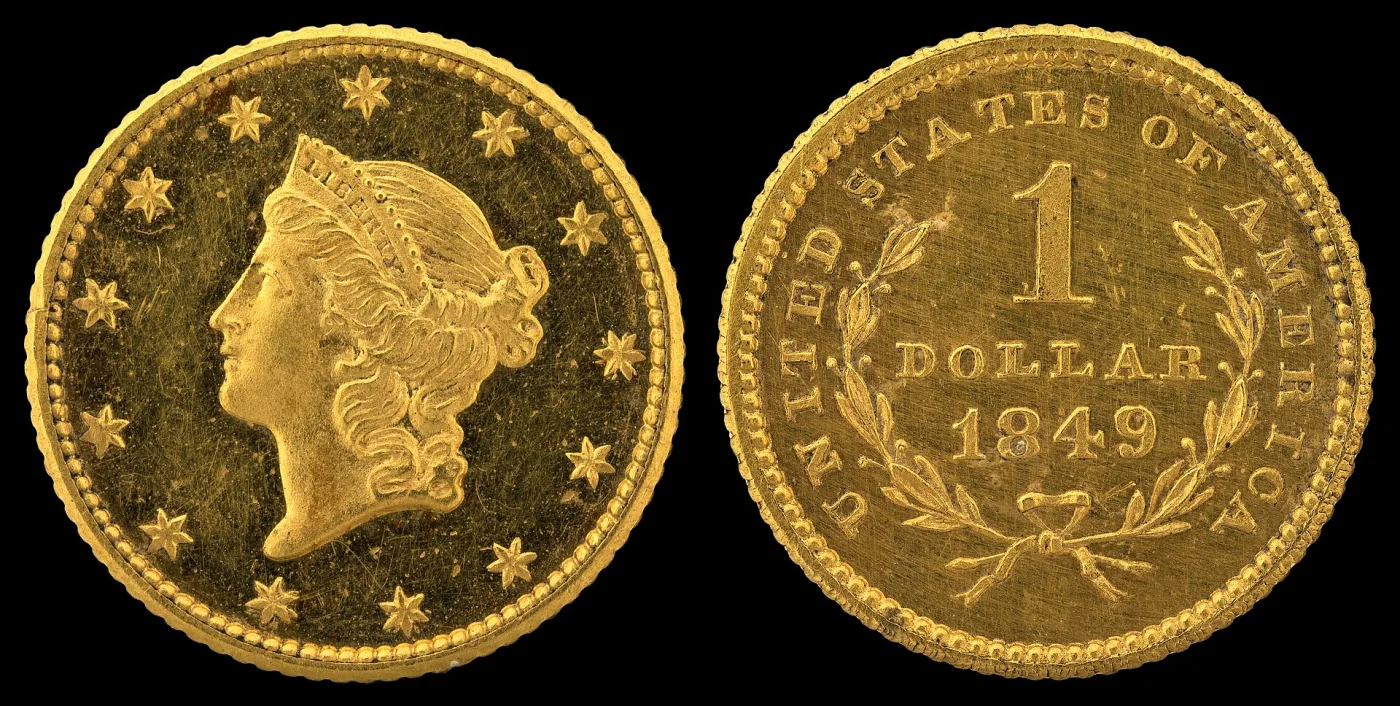
The Gold Dollar, struck from 1849 through 1889, is the smallest United States gold coin ever produced and one of the most fascinating denominations in American numismatics. Measuring just 13 millimeters across in its Type 1 form — smaller than a modern dime — and weighing only 1.672 grams of 90% gold, this tiny piece carried full one-dollar purchasing power during the California Gold Rush and was the workhorse of small-value gold transactions for four decades. Designed by Chief Engraver James B. Longacre, the same artist who later created the Flying Eagle Cent, Indian Head Penny, Two Cent Piece, Three Cent Piece, and Shield Nickel, the Gold Dollar showcases his talent for compact, intricate engraving on minuscule planchets.
The series divides cleanly into three major design types — Type 1 Liberty Head (1849-1854), Type 2 Indian Princess Small Head (1854-1856), and Type 3 Indian Princess Large Head (1856-1889) — and contains some of the most desirable Southern branch-mint rarities in all of US coinage. The 1849-C Open Wreath, 1855-D, 1856-D, and 1861-D are among the legendary rarities of the Charlotte and Dahlonega mints, and the entire series offers collectors a manageable scope with real numismatic depth. Unlike its larger gold cousins such as the Liberty Head Half Eagle, the Liberty Head Eagle, the Liberty Head Double Eagle, or the Saint-Gaudens Double Eagle, the Gold Dollar’s small size and low mintages mean that even common dates command meaningful premiums today.
This guide covers everything you need to identify, grade, and value Gold Dollars: the three design types and how to distinguish them at a glance, the major key dates and Southern mint rarities, the Charlotte (C), Dahlonega (D), New Orleans (O), and San Francisco (S) branch mints, the famous 1849 Open Wreath and Closed Wreath varieties, the proof-only and low-mintage Civil War and post-war issues, current grading standards for these tiny coins, authentication strategies, and 2026 market values. The same disciplined coin identification techniques that work on silver classics apply here — but the Gold Dollar’s diminutive size demands magnification, steady hands, and special care to evaluate properly.
History: The Gold Rush and the Birth of a Tiny Coin
The Gold Dollar was a direct child of the 1848 discovery of gold at Sutter’s Mill in California. Within a year, vast new quantities of placer gold were flooding eastward, and Congress responded with the Act of March 3, 1849, which authorized two new gold denominations: the one-dollar gold piece and the twenty-dollar Double Eagle. The Gold Dollar was conceived as a practical small-value coin that could absorb the new bullion and circulate alongside the half dime and silver dollar — though it would, in practice, struggle for acceptance because of its almost impossibly small size.
James B. Longacre, who had taken over as Chief Engraver of the Philadelphia Mint in 1844 following the death of Christian Gobrecht, was tasked with the design. Longacre was an experienced portraitist but a relatively new die engraver, and the Gold Dollar represented his first major coinage commission. He produced a small Liberty Head modeled after the classical Greek-Roman tradition, surrounded by stars and dates on the obverse, with a simple wreath enclosing the denomination “1 DOLLAR” and date on the reverse.
Why So Small?
The reason for the Gold Dollar’s tiny 13mm diameter was simple physics: at the 1849 statutory weight standard (1.672 grams of 90% gold, giving 1.5046 grams pure gold), the coin had to be approximately one dollar’s worth of gold. Striking that small amount of metal into a thicker, larger-diameter coin would have made it too thick and difficult to strike properly. The Mint chose a thin, small-diameter planchet — which created the small-coin problem that would haunt the series throughout its life.
The 1854 Redesign
By 1853, complaints about the Gold Dollar’s tiny size had reached Congress. People found the coins easy to lose, hard to handle, and frequently confused with the silver three-cent piece (the “trime”). The Act of February 21, 1853 had reduced silver coin weights, and a similar pressure built to redesign the Gold Dollar. Rather than reducing the weight, the Mint chose to thin the planchet and increase the diameter to 15mm — a partial solution that allowed the new Type 2 (Indian Princess Small Head) to enter production in 1854. The Type 2 proved difficult to strike — the high-relief headdress on the obverse opposed the date and wreath on the reverse, causing weak strikes and short die life. By 1856, the Mint redesigned again to the Type 3 Indian Princess Large Head, with shallower relief that struck cleanly and remained in production for 33 more years until the series ended in 1889.
The End of the Series
Although the Gold Dollar was produced through 1889, demand collapsed after the Civil War. Greenback paper money replaced small gold transactions, and the rise of the small silver coin made the Gold Dollar redundant. From 1863 through 1889, business-strike mintages were tiny — most years saw fewer than 10,000 pieces produced, and many were saved as gifts or jewelry blanks rather than circulated. The Act of September 26, 1890 finally ended production, sweeping away the Gold Dollar along with the three-cent nickel and the $3 gold piece in a single legislative stroke.
The Three Major Types at a Glance
Before diving into details, here is a quick reference for distinguishing the three Gold Dollar types — the single most important identification skill for this series:
Type 1 (1849-1854)
- Diameter: 13mm — the smallest US gold coin ever
- Obverse: Small Liberty Head facing left, wearing a coronet inscribed LIBERTY, surrounded by 13 stars
- Reverse: Open or closed wreath surrounding “1 DOLLAR” and the date, with “UNITED STATES OF AMERICA” around the rim
- Production: Philadelphia, Charlotte, Dahlonega, New Orleans, and (1854 only) Philadelphia produced the type
Type 2 (1854-1856)
- Diameter: 15mm — increased to ease handling
- Obverse: Indian Princess Small Head facing left, wearing a feathered headdress with LIBERTY band, “UNITED STATES OF AMERICA” around the rim
- Reverse: Agricultural wreath of corn, wheat, cotton, and tobacco surrounding “1 DOLLAR” and date
- Production: Philadelphia, Charlotte, Dahlonega, San Francisco
- Strike issue: Notorious for weak strikes, especially on the date and central devices
Type 3 (1856-1889)
- Diameter: 15mm (same as Type 2)
- Obverse: Indian Princess Large Head, lower relief, with more open headdress and clearer features
- Reverse: Same agricultural wreath design as Type 2
- Production: Philadelphia, Charlotte, Dahlonega, San Francisco — with the Southern mints ending in 1861 due to the Civil War
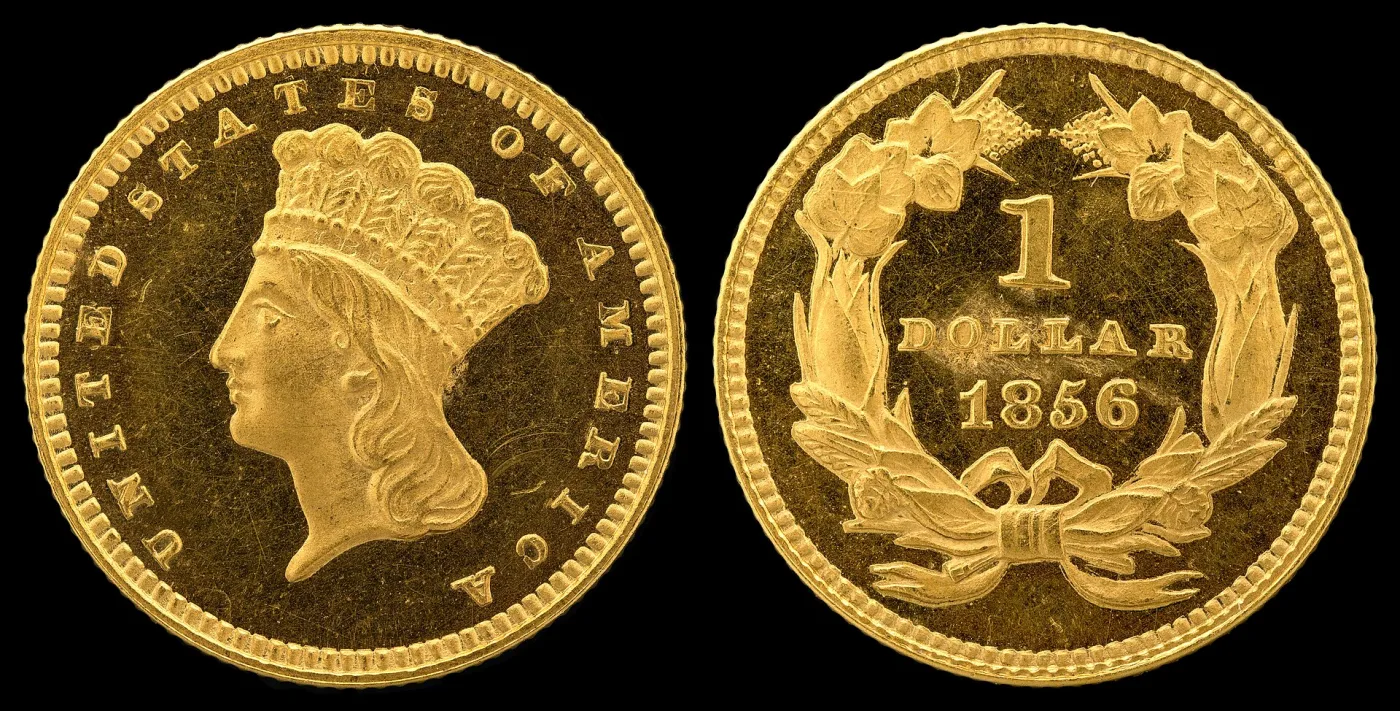
The fastest way to tell Type 2 from Type 3 is the size and clarity of the Indian Princess head. Type 2 has a noticeably smaller head with the date often weakly struck; Type 3 has a much larger, clearer head that fills more of the field, with cleaner date and lettering.
Type 1: Liberty Head (1849-1854)
The Type 1 Gold Dollar is the original 13mm design — the smallest regular-issue US coin ever struck. The obverse features a delicate Liberty Head facing left, wearing a small coronet with LIBERTY in raised letters across the band. Thirteen six-pointed stars surround the head, and the date is below. Longacre’s portrait is classical and graceful, drawing on Greek and Roman tradition rather than the more naturalistic Indian Princess of the later types.
The reverse shows “1 DOLLAR” and the date inside a wreath, with “UNITED STATES OF AMERICA” encircling the rim. The wreath comes in two distinct varieties on the 1849 issues — the Open Wreath and the Closed Wreath — which are discussed separately below.
Production and Mintages
Type 1 was produced at Philadelphia, Charlotte (C), Dahlonega (D), and New Orleans (O). Mintages varied enormously — Philadelphia produced millions of pieces in 1851 and 1853 to absorb California gold, while the Southern branches struck tiny quantities, especially in their first years.
Key Type 1 Dates
- 1849-C Open Wreath: The legendary rarity of the series. Only 5 examples known, with the finest selling for over $1 million. The Open Wreath variety at Charlotte is one of the great prizes of US numismatics.
- 1849-D: First-year Dahlonega issue, with a small mintage of 21,588 pieces. Most known examples show weak strikes typical of early Dahlonega production.
- 1850-D: Low mintage (8,382 pieces); most surviving examples are heavily worn or damaged.
- 1851-D: Mintage of 9,882; tough in any grade.
- 1854-D: Final Type 1 Dahlonega issue; mintage of 2,935 makes this one of the rarer Dahlonega dollars.
Type 1 coins from Charlotte and Dahlonega often display characteristic Southern-mint problems: weak strikes on portions of the design, scattered planchet flaws, and significant die polish or rust lines. These are not damage but native production characteristics, and graders allow for them when assessing condition.
Type 2: Indian Princess Small Head (1854-1856)
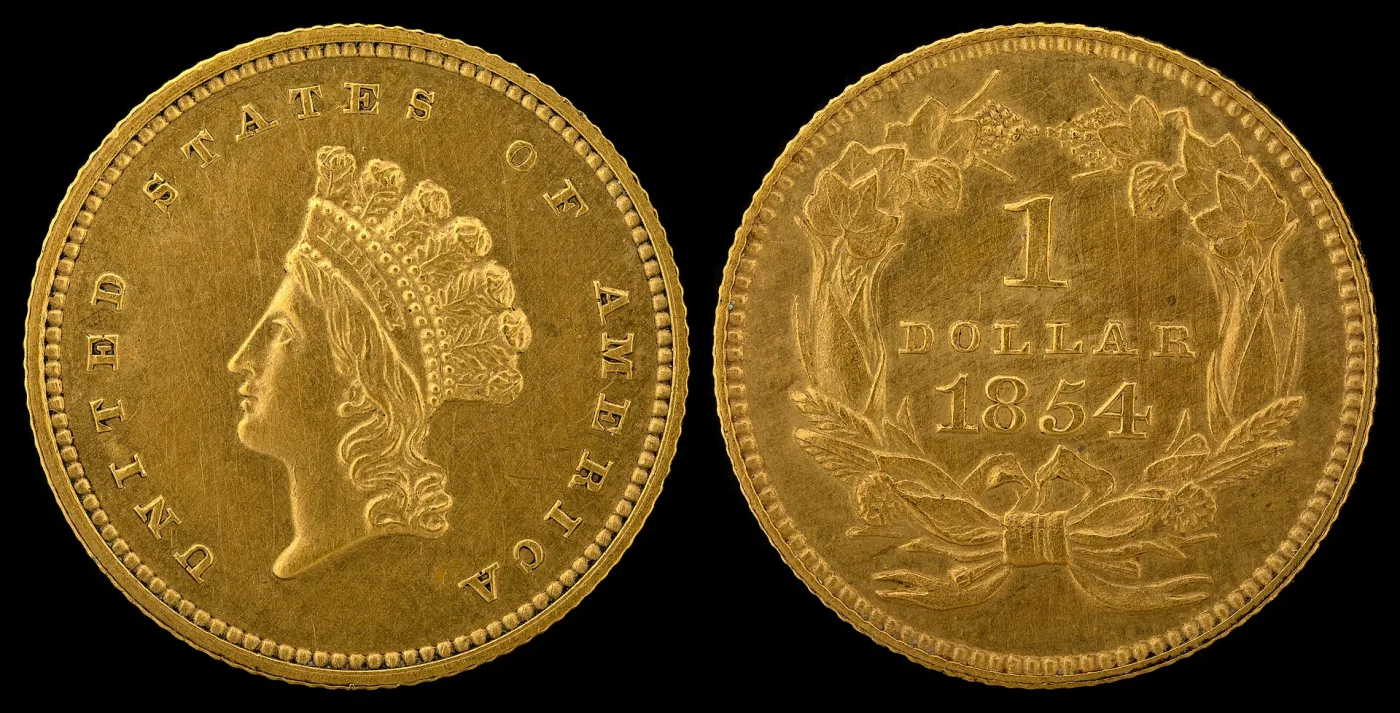
The Type 2 Gold Dollar represents Longacre’s response to public complaints about the tiny Type 1. By increasing the diameter from 13mm to 15mm while keeping the weight the same, the Mint produced a thinner but visually more substantial coin. Longacre also created an entirely new design for the larger planchet: an Indian Princess head wearing a feathered war bonnet, modeled on his earlier three-cent silver obverse style but rendered with greater detail.
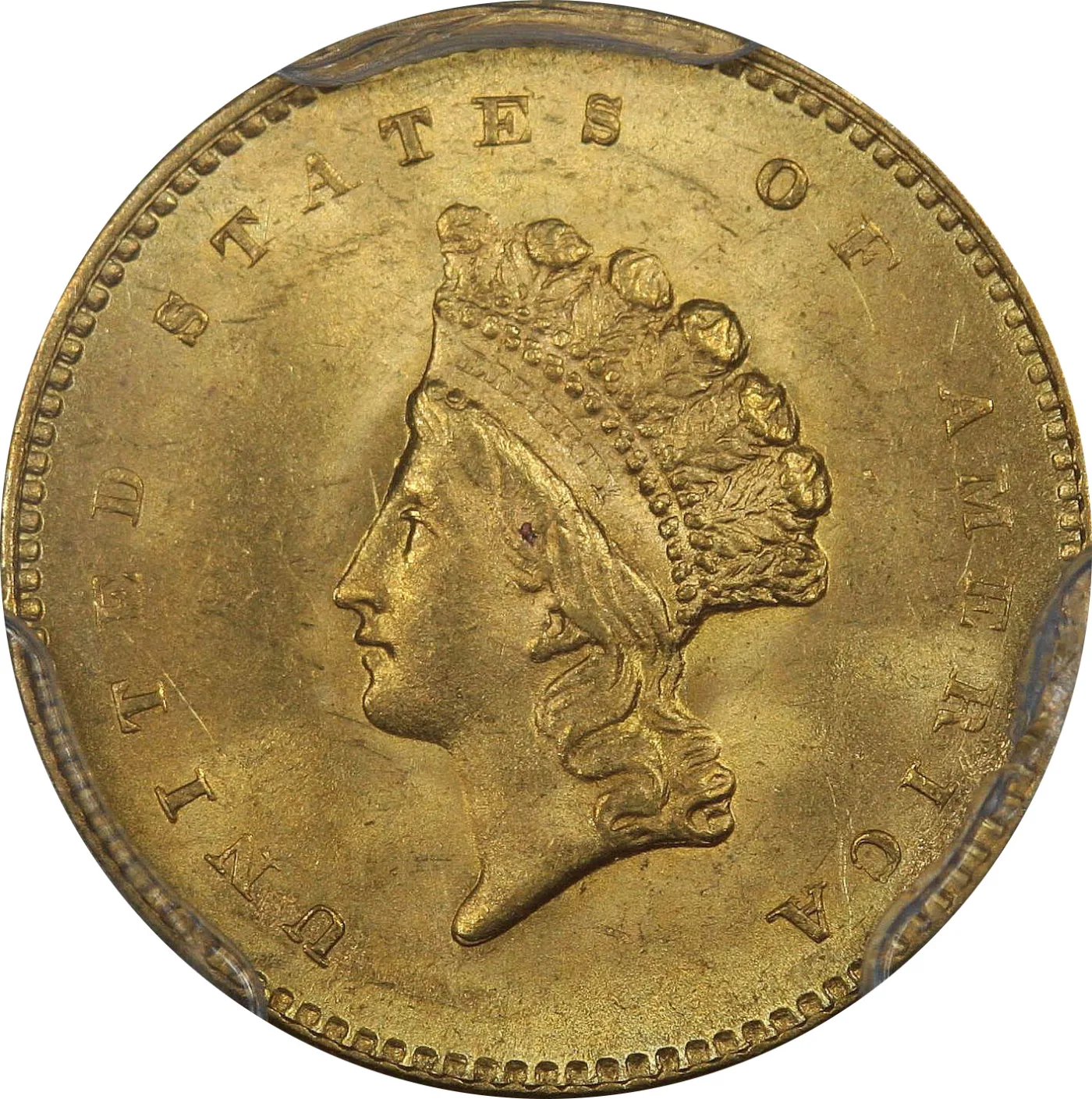
The obverse shows a small female head facing left, with flowing hair and an elaborate feathered headdress whose central band carries LIBERTY in raised letters. “UNITED STATES OF AMERICA” surrounds the head along the rim. The reverse features an agricultural wreath composed of cotton, corn, wheat, and tobacco — the four great American crops — surrounding “1 DOLLAR” and the date.
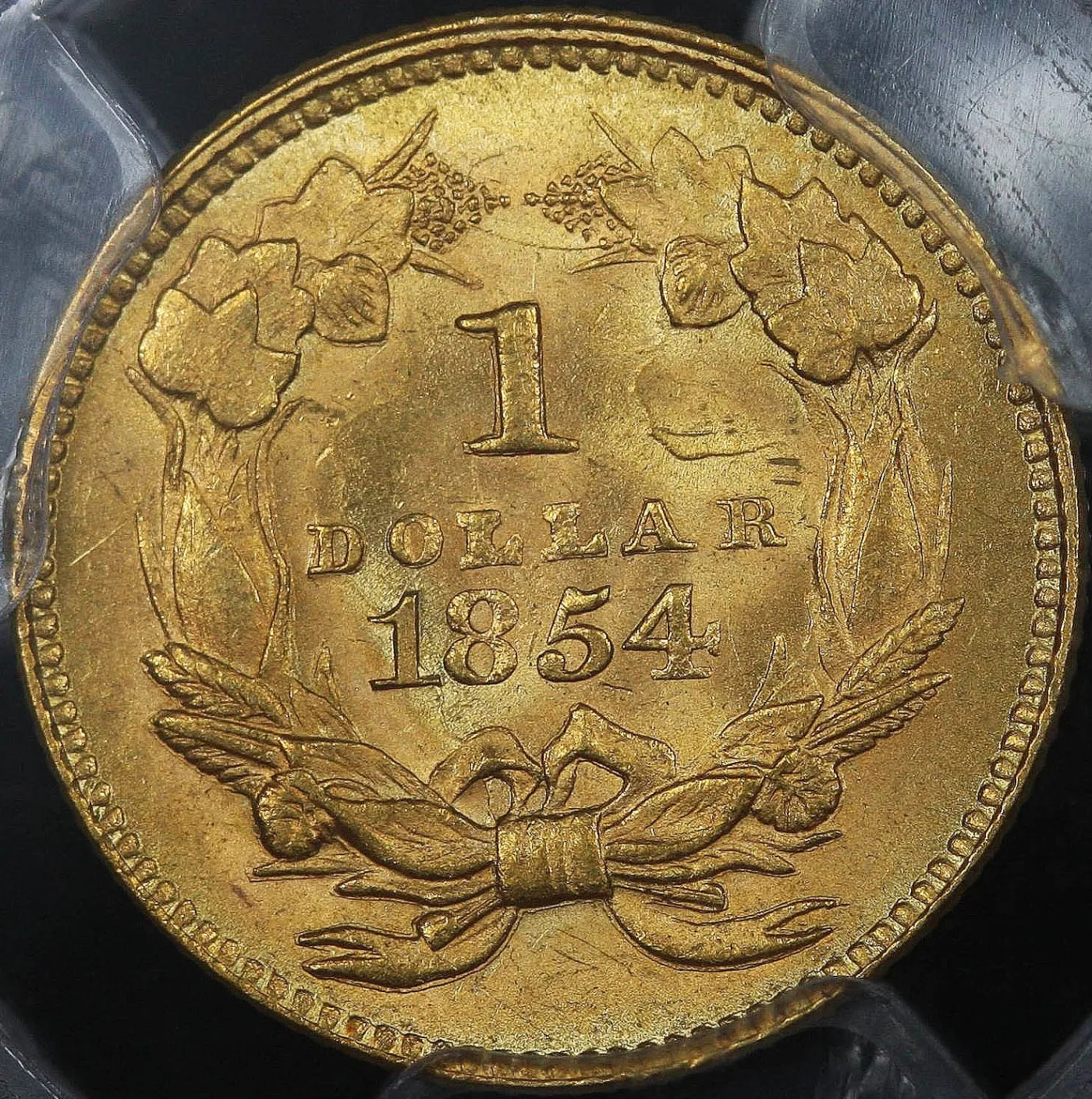
The Striking Problem
Type 2 is notorious among collectors for poor strikes. The high-relief headdress on the obverse fell directly opposite the wreath and central devices on the reverse, and the dies were unable to push enough metal into both sides simultaneously. The result was weak strikes on the date, the LIBERTY band, and the central reverse — even on Philadelphia mint-state examples. Coins with sharp, fully struck dates and clear LIBERTY bands command large premiums over typical examples.
Key Type 2 Dates
- 1854 (Philadelphia): First year of Type 2. Mintage of 783,943 pieces makes it the most common Type 2.
- 1855 (Philadelphia): Mintage of 758,269. Also common but rarely well struck.
- 1855-C: Mintage 9,803; the only Type 2 from Charlotte. Most known examples are heavily worn and weakly struck.
- 1855-D: Mintage just 1,811 pieces — among the rarest Gold Dollars and a true Dahlonega prize. Most known examples are well-worn; a Choice or Gem Mint State example is a six-figure coin.
- 1855-O: Mintage 55,000; the only Type 2 from New Orleans.
- 1856-S: Mintage 24,600; the only Type 2 from San Francisco, struck after the type was officially replaced at Philadelphia.
Because Type 2 was produced for only three years, completing a type set requires only a single example — but completing a date-and-mintmark set is a serious challenge that requires the 1855-D, one of the toughest US gold issues of the 19th century.
Type 3: Indian Princess Large Head (1856-1889)
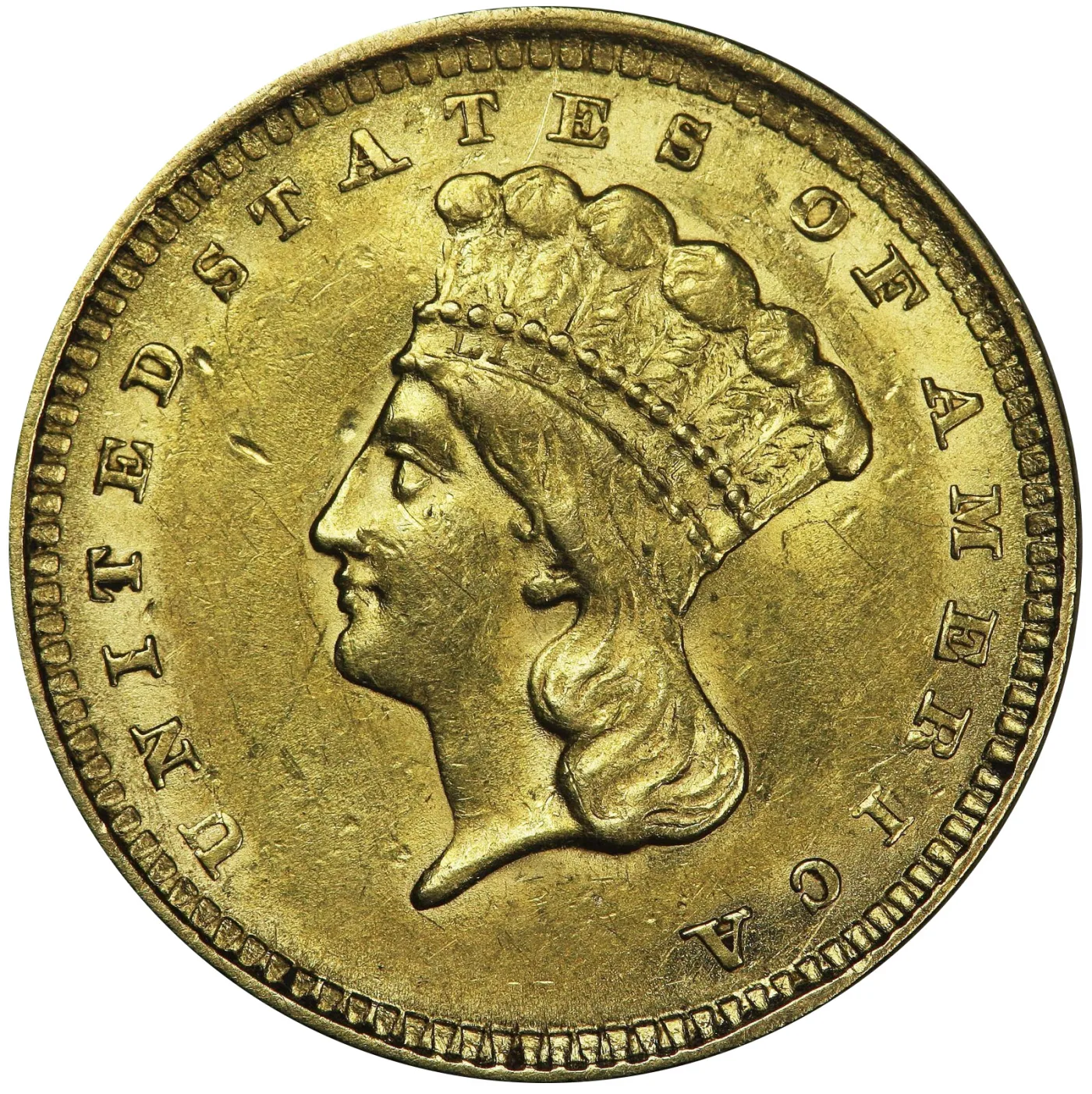
The Type 3 Gold Dollar appeared in 1856 to fix the striking problems of Type 2. Longacre lowered the relief of the Indian Princess head and enlarged it to better balance the metal flow between obverse and reverse. The result was a coin that struck cleanly, had reasonable die life, and remained essentially unchanged through 1889 — the longest-lived design in the series.
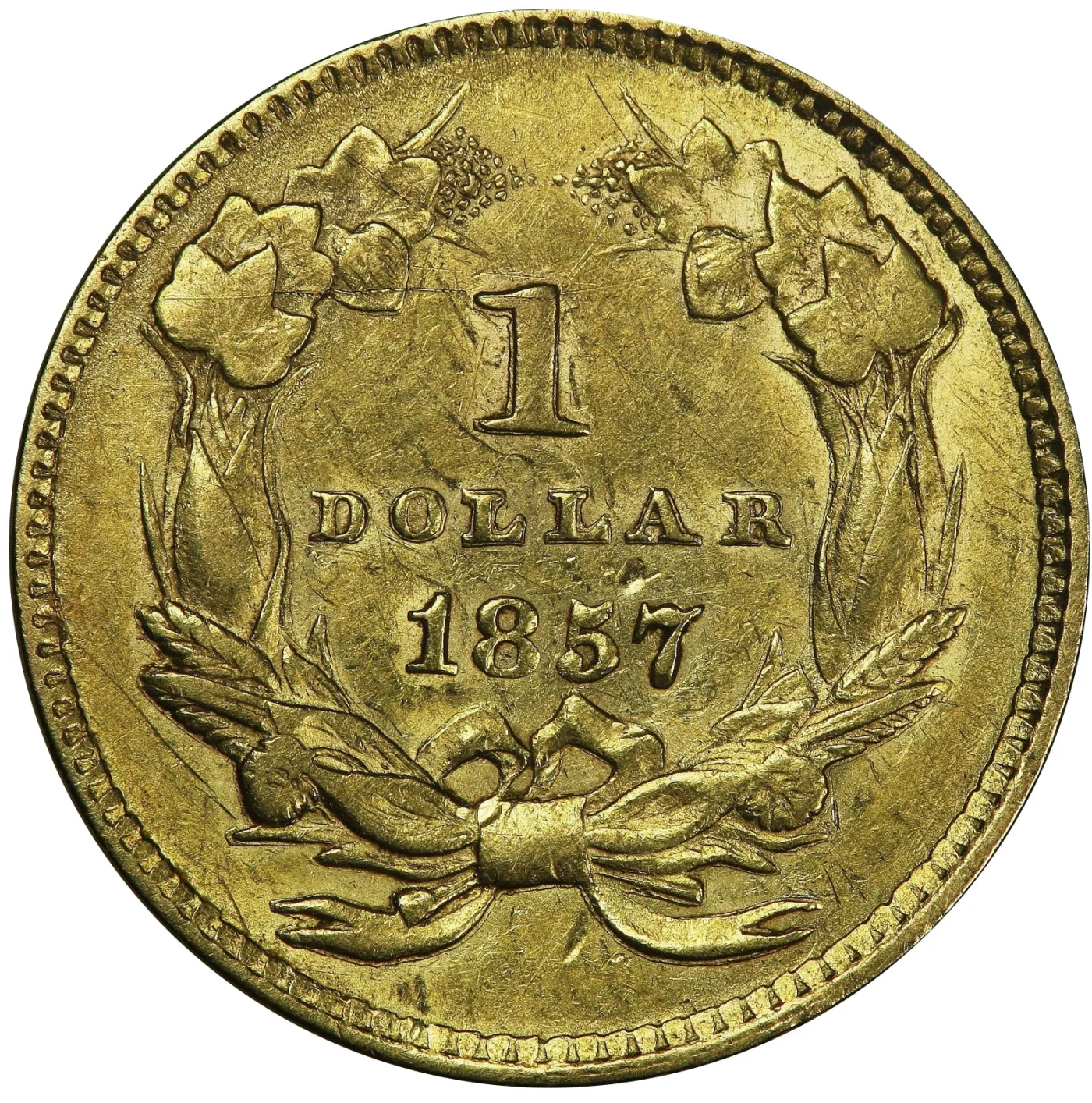
Visually, Type 3 differs from Type 2 in the size and prominence of the Indian Princess head: the Type 3 head fills more of the field, has more open and rounded features, and the headdress feathers radiate more clearly. The reverse remains identical — the agricultural wreath with cotton, corn, wheat, and tobacco. Mint marks, when present, appear below the wreath.
Production Across the Series
Type 3 was struck at Philadelphia continuously from 1856 through 1889. Charlotte and Dahlonega struck Type 3 from 1856 through 1861, when they ceased operations under Confederate occupation during the Civil War. San Francisco struck Type 3 sporadically: 1856-S, 1857-S, 1858-S, 1859-S, and 1860-S, then ceased Gold Dollar production. The Carson City mint, despite producing many other gold and silver denominations, never struck Gold Dollars.
Key Type 3 Dates
- 1856-D: Mintage 1,460 pieces — the lowest mintage of any business-strike Gold Dollar. A true Dahlonega rarity that commands strong premiums in any grade.
- 1860-D: Mintage 1,566; second-lowest mintage in the series.
- 1861-D: The famous Confederate-struck Dahlonega Dollar. Mintage is unrecorded but estimated at fewer than 1,250 pieces, all struck by the Confederate authorities after Georgia seized the mint in April 1861. A genuine 1861-D is a major collectible and a historical artifact of the Civil War.
- 1875: Business-strike mintage of just 400 pieces, plus 20 proofs. One of the lowest production years for a regular US coin.
- 1863: Business-strike mintage of just 6,200; tough in mint state.
- 1864-1872: Mintages mostly under 5,000 per year, with most surviving examples coming from saved gift specimens or proof presentation pieces.
The Type 3 series is dominated by its long tail of low-mintage post-Civil War Philadelphia issues. Collectors building a complete date-and-mintmark set must navigate years where original mintages were measured in hundreds rather than thousands.

Composition and Specifications
The Gold Dollar’s specifications were established by the Coinage Act of 1849 and remained constant throughout the series — only the planchet diameter changed when Type 2 was introduced in 1854.
Metal Composition
- Composition: 90% gold, 10% copper (alloy for hardness)
- Total weight: 1.672 grams
- Pure gold weight: 1.5046 grams (0.04837 troy ounces)
- Edge: Reeded throughout the series
Physical Dimensions
- Type 1 diameter: 13mm (the smallest US gold coin ever struck)
- Type 2 diameter: 15mm (thinner planchet, same weight)
- Type 3 diameter: 15mm (same as Type 2)
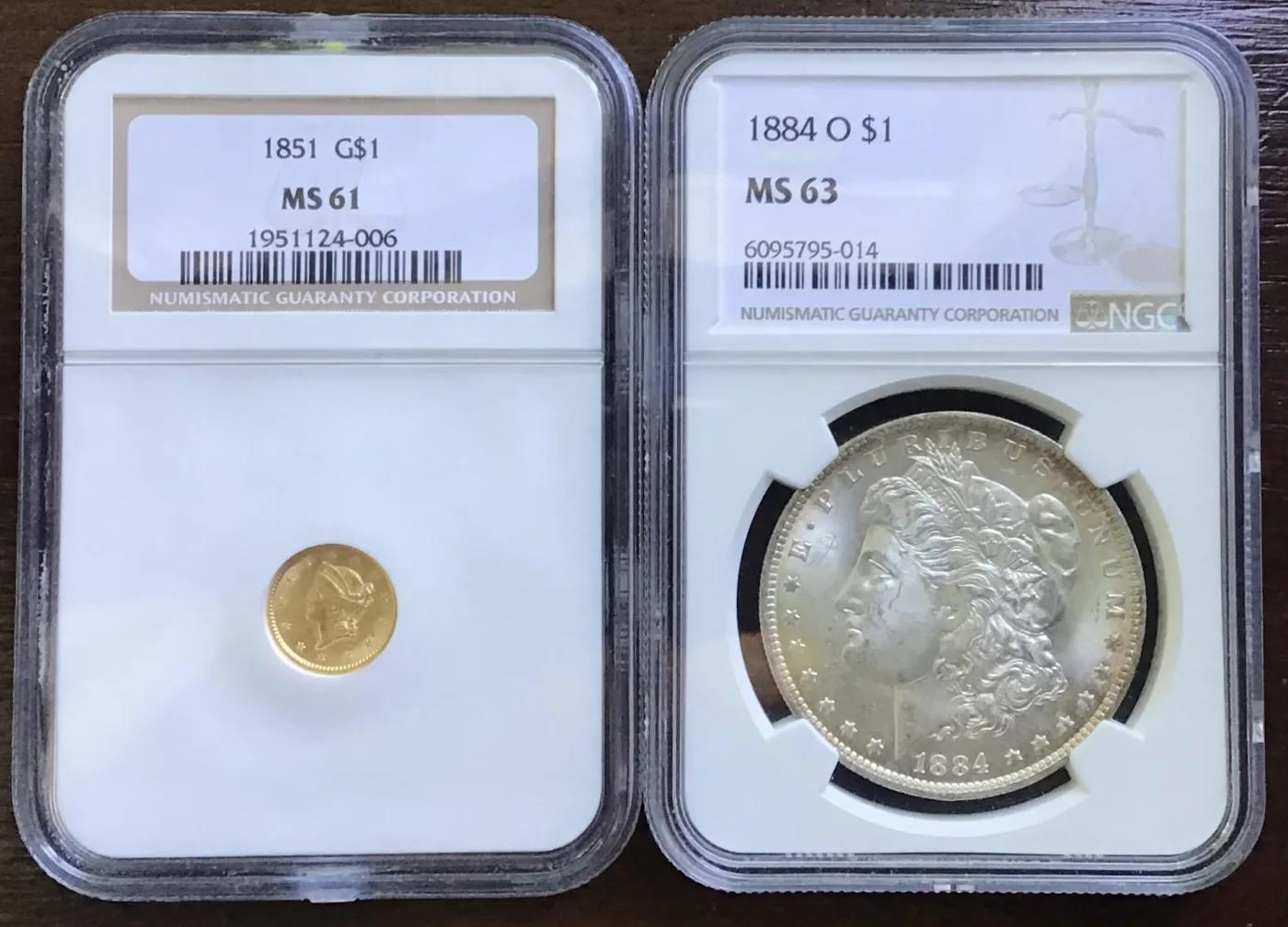
For perspective, a modern dime is 17.91mm and a modern cent is 19.05mm — even the larger 15mm Type 2 and Type 3 Gold Dollars are smaller than these familiar coins. The bullion gold content per coin is approximately one-twentieth of a Double Eagle and one-tenth of a Quarter Eagle, making the Gold Dollar’s value to collectors much more dependent on numismatic premium than on bullion content.
Mint Marks: Charlotte, Dahlonega, New Orleans, San Francisco
Gold Dollars were produced at five different mints over the life of the series, though only four ever appear with mint marks (Philadelphia bears no mint mark, as was standard practice). Mint marks appear on the reverse, below the wreath.
Philadelphia (no mint mark)
The primary producer throughout the series. All proofs were struck at Philadelphia. Mintages were highest in the early years (1849-1854) and during the brief 1881-1889 collector-driven revival.
Charlotte (C)
Active 1849 through 1860, then closed under Confederate seizure in 1861. Charlotte struck Type 1 (1849-1853 and 1855) and Type 3 (1857-1859), but never Type 2 of 1854. The Charlotte mint was small, technically unsophisticated, and produced coins with characteristic weak strikes and frequent die cracks. All Charlotte Gold Dollars are scarce; the 1849-C Open Wreath is one of the great rarities of US numismatics.
Dahlonega (D)
Active 1849 through 1861, with the famous 1861-D struck under Confederate authority. Dahlonega produced Type 1, Type 2 (only 1855-D, with 1,811 pieces struck), and Type 3 dollars. Like Charlotte, Dahlonega had limited technical capabilities, and its coins typically show weak strikes, planchet flaws, and die rust. The 1856-D (1,460 pieces) and 1861-D (estimated under 1,250 pieces) are series anchors.
Note that the Dahlonega “D” mint mark used 1849-1861 is the same letter later used by the Denver mint (which opened in 1906) — but since Gold Dollars ended in 1889, any “D” mint mark on a Gold Dollar refers to Dahlonega, never Denver. This is the same convention that applies to the early Liberty Head Double Eagle and other pre-1906 gold series.
New Orleans (O)
Struck Gold Dollars only in 1849, 1850, 1851, 1852, 1853, and 1855. New Orleans pieces are generally better struck than Charlotte or Dahlonega examples, reflecting the mint’s larger size and more sophisticated equipment.
San Francisco (S)
Struck Gold Dollars in 1854, 1856, 1857, 1858, 1859, and 1860 — then never again. San Francisco’s 1856-S is the only Type 2 from the West Coast and was struck after Philadelphia had already switched to Type 3.
The 1849 Open Wreath and Closed Wreath
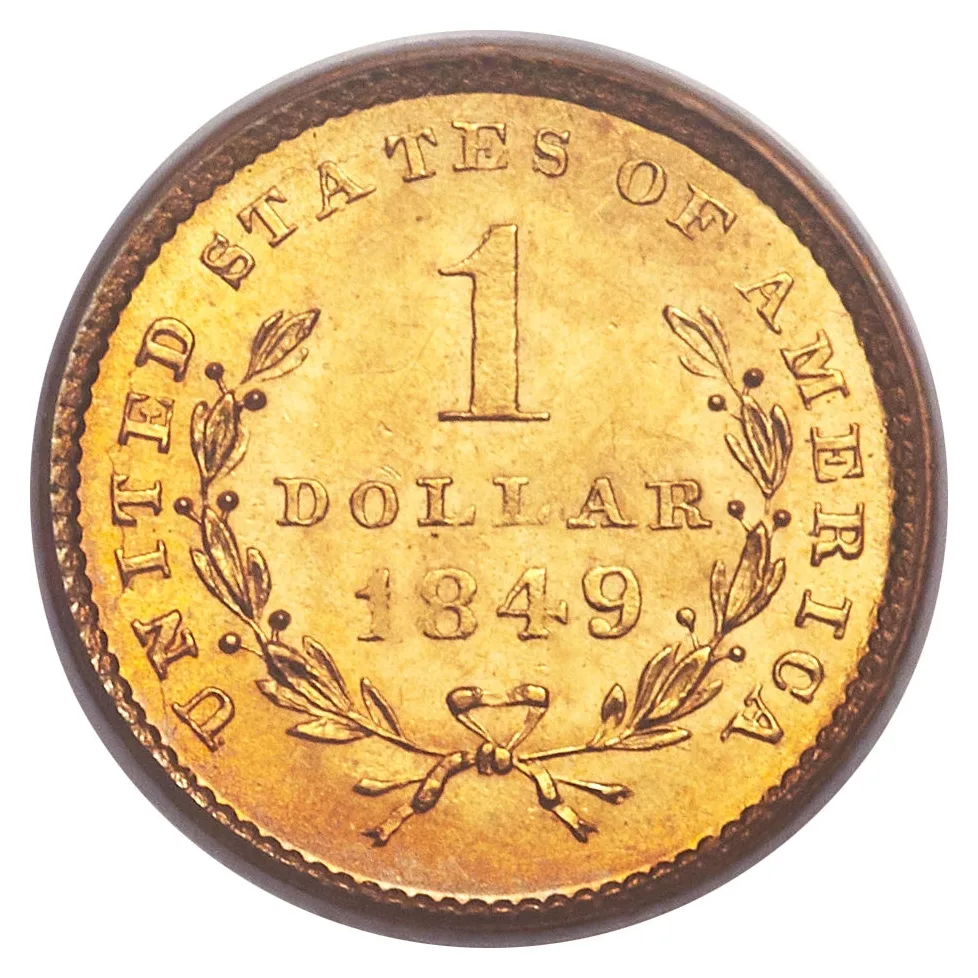
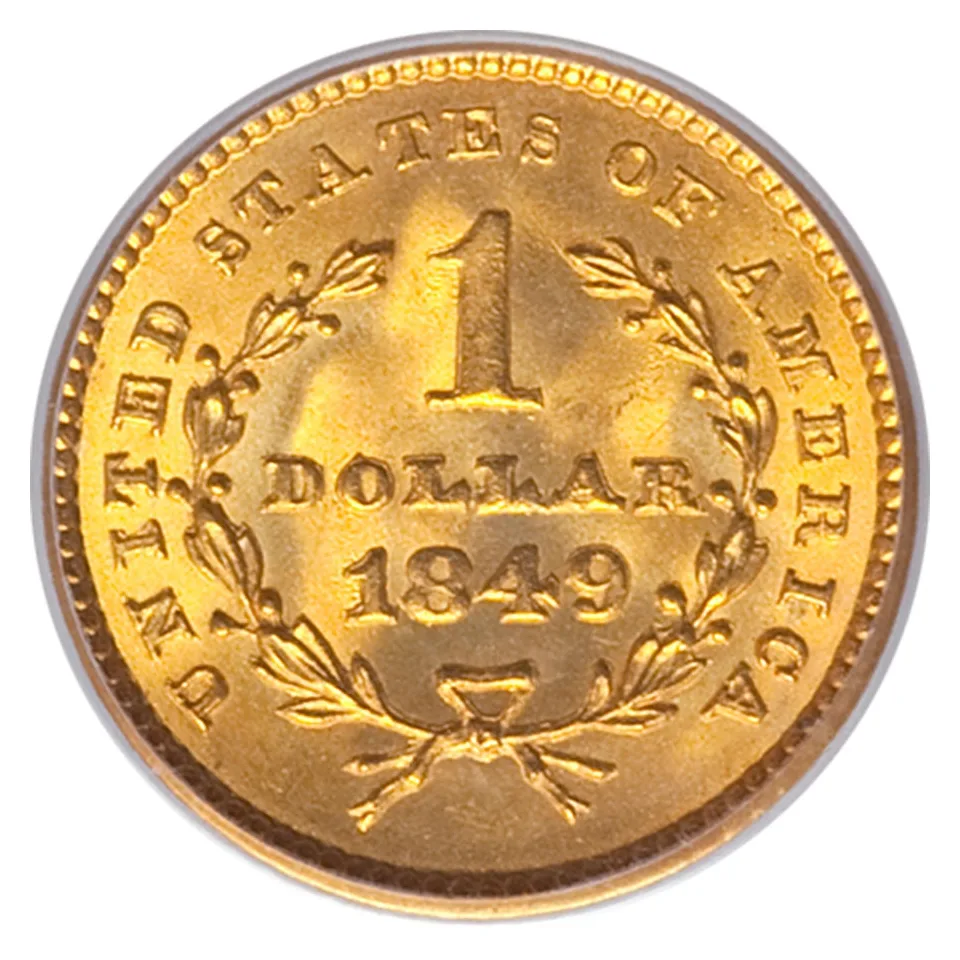
The first year of the Gold Dollar saw two distinct reverse die designs that have become one of the most studied variety pairs in US numismatics: the Open Wreath and the Closed Wreath. Telling them apart requires careful examination of the reverse wreath where it terminates near the date.
Open Wreath
On the Open Wreath, the wreath’s ends do not meet — there is a clear gap between the leaf tips at the top of the wreath, near “UNITED STATES OF AMERICA.” This was the original 1849 design, used early in production at Philadelphia and at Charlotte. The 1849-C Open Wreath is the great rarity, with only about 5 pieces confirmed.
Closed Wreath
On the Closed Wreath, the wreath’s ends nearly touch or cross slightly. This was a later modification used at Philadelphia, Dahlonega, and New Orleans in 1849 and became the standard for all subsequent Type 1 production. Most 1849 Gold Dollars you will encounter are Closed Wreath; the Open Wreath at any mint except Philadelphia is genuinely rare.
1849 Variety Summary
- 1849 (P) Open Wreath: Common; differentiated by wreath gap. Also exists with No L (no Longacre initial) and With L on the truncation.
- 1849 (P) Closed Wreath: Common; standard 1849 Philadelphia issue.
- 1849-C Open Wreath: One of the great US rarities — only 5 examples known.
- 1849-C Closed Wreath: Scarce but obtainable; the standard 1849-C variety.
- 1849-D Open Wreath: Does not exist — all 1849-D are Closed Wreath.
- 1849-O Open Wreath: Does not exist — all 1849-O are Closed Wreath.
A second 1849 variety pair concerns the “L” on the obverse: late in 1849, Longacre added his initial L to the Liberty Head’s truncation. Both No L and With L 1849 Open Wreath pieces exist; the No L is the earlier and slightly scarcer.
Key Dates and Major Rarities
The Gold Dollar series contains some of the toughest dates in 19th-century US coinage. Here is a consolidated ranking of the most important key dates across all three types:
The Great Rarities
- 1849-C Open Wreath: ~5 examples known. The finest sold for over $1.3 million. The single greatest Gold Dollar rarity.
- 1855-D (Type 2): Mintage 1,811; perhaps 30-50 examples survive in all grades. A six-figure coin in mint state.
- 1856-D (Type 3): Mintage 1,460 — the lowest regular-issue Gold Dollar mintage. Approximately 100-150 examples survive.
- 1861-D (Type 3): Confederate-struck, estimated mintage under 1,250. A genuine 1861-D is a historical artifact as well as a numismatic rarity.
- 1875: Business-strike mintage of just 400 pieces, plus 20 proofs. Most known examples are proofs or near-proof presentation strikes.
Major Scarce Dates
- 1849-D: First-year Dahlonega; 21,588 mintage but few survivors in higher grades.
- 1850-D: 8,382 mintage; rare in any grade.
- 1851-D: 9,882 mintage; scarce.
- 1853-D: 6,583 mintage; among the tougher Dahlonega dates.
- 1854-D: 2,935 mintage; final Type 1 Dahlonega.
- 1855-C (Type 2): 9,803 mintage; the only Type 2 Charlotte. Most known examples are well worn.
- 1857-D, 1858-D, 1859-D, 1860-D, 1861-D: All Type 3 Dahlonega dates have mintages under 5,000 (excepting 1857-D at 3,533). All are scarce, with the 1860-D and 1861-D being major keys.
- 1863: 6,200 mintage; rare in mint state.
- 1864-1872 Philadelphia: Most years under 5,000 mintage; tough in mint state.
- 1881-1885: Late-series collector revival; mintages of 1,500 to 12,000 per year. Often saved in high grades.
The post-1862 Philadelphia issues are notable in that many were saved as gifts and jewelry blanks rather than circulating. As a result, some scarce-by-mintage dates are actually more available in mint state than in well-worn grades — the opposite of the usual pattern.
Proof-Only and Low-Mintage Issues
Proof Gold Dollars were struck at Philadelphia in small numbers nearly every year from 1854 through 1889. Mintages ranged from about 8 pieces (early 1850s) to 1,779 pieces (1889 — the highest single-year proof mintage as collectors anticipated the end of the series). Most years saw proof mintages between 20 and 100 pieces.
Notable Proof Issues
- 1854 Type 2 Proof: Extremely rare; mintage estimated under 10 pieces.
- 1855 Type 2 Proof: Estimated 12-15 pieces struck.
- 1875 Proof: Only 20 pieces struck; survives in higher quantities than the 400-piece business strike because more were preserved by collectors.
- 1884-1889 Proofs: Larger proof mintages (200-1,779) reflect end-of-series collector demand.
Identifying a genuine proof from a prooflike business strike requires examination of fields (mirror surfaces vs satiny luster), rim squareness (sharper on proofs), and strike fullness. Third-party grading services (PCGS, NGC) authenticate and label proofs, and uncertified proofs should always be approached with care.
Doubled Dies and Notable Varieties
Beyond the major type and reverse variations, the Gold Dollar series has a number of die varieties recognized by specialists and tracked by the Winter (for Charlotte and Dahlonega) and Doering reference works.
Notable Die Varieties
- 1849 No L: Earliest 1849 Philadelphia obverse without Longacre’s initial on the truncation. Slightly scarcer than With L.
- 1849-C Open Wreath: Already covered above; the supreme variety.
- 1853-D Small D: A variant of the 1853-D with a smaller mint mark; commands a premium over the standard variety.
- 1854-D / 1853-D Overdate: Some 1854-D coins show evidence of an underlying 1853 date.
- 1856 Slanted 5 vs Upright 5: The 1856 Philadelphia Type 3 exists with a slanted “5” and an upright “5” in the date. The Slanted 5 is the earlier and slightly scarcer variety.
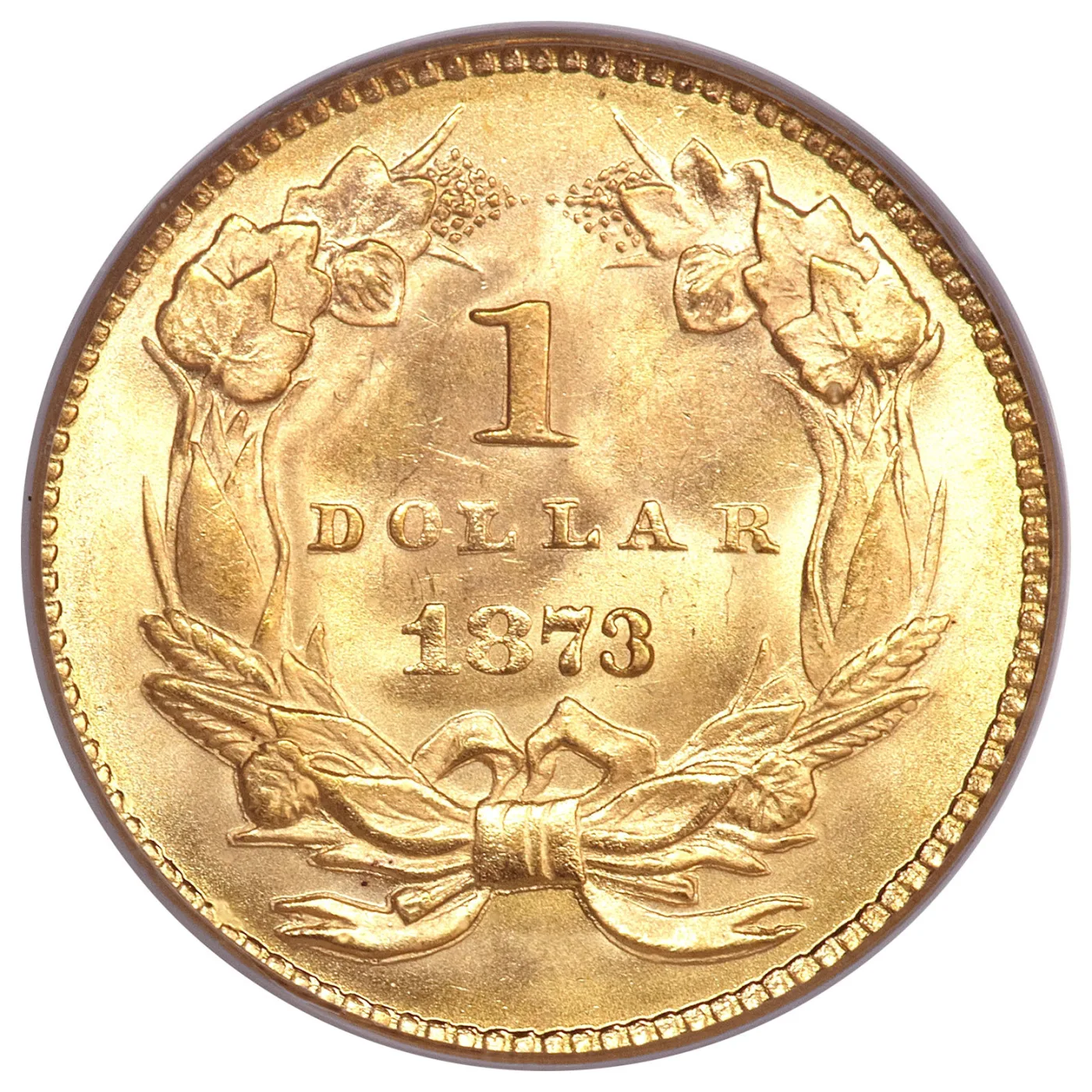
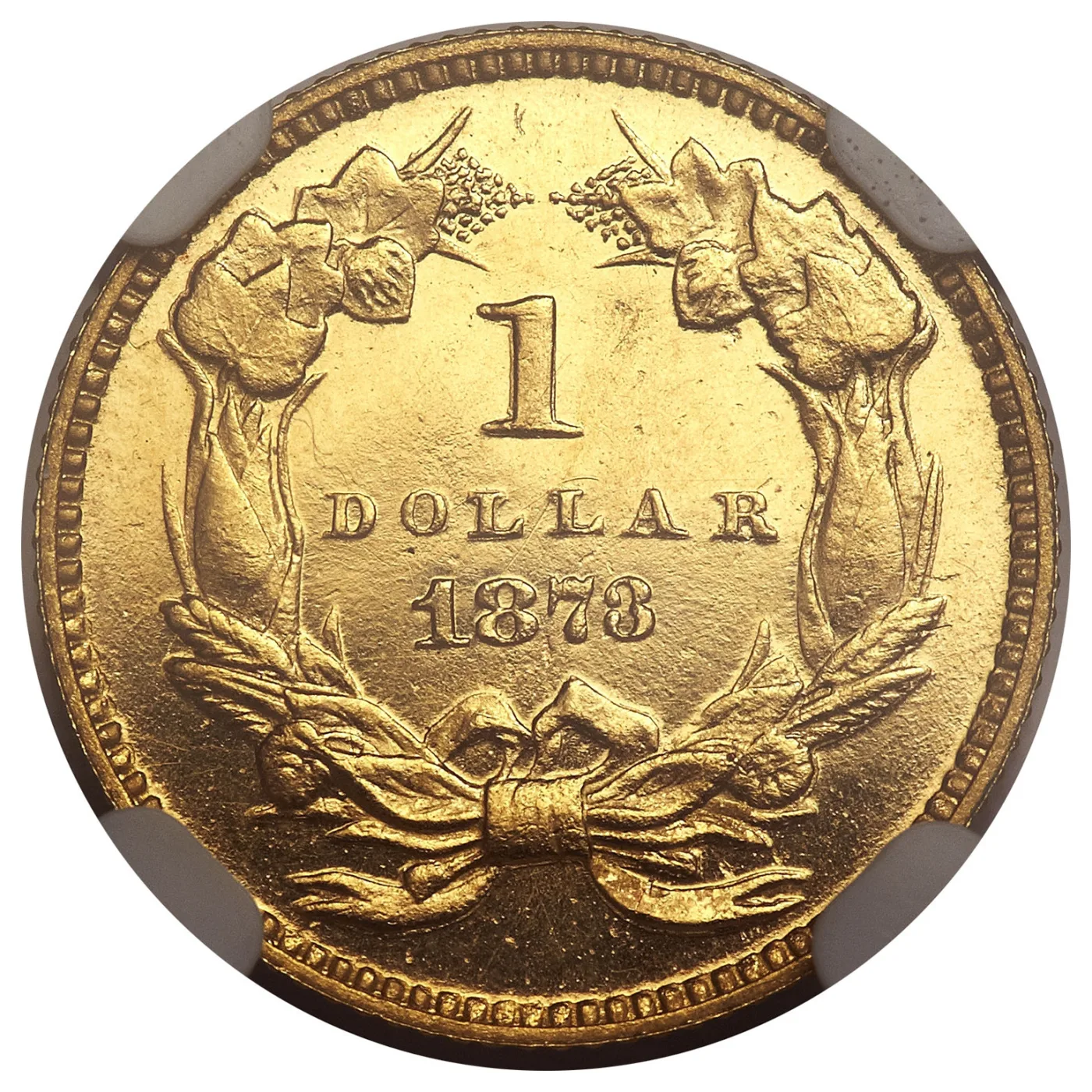
- 1873 Open 3 vs Closed 3: Two distinct varieties of the 3 in 1873, paralleling the same distinction on the Two Cent Piece, Three Cent Piece, and other 1873 issues. Open 3 is much the more common. The Closed 3 is the scarce one, but it is not proof-only: it exists as a business strike, and the 1873 Closed 3 photographed in this guide is one — frosty, satin surfaces with none of the mirrored field a proof would show.
Detailed variety attribution at the level of individual dies is the province of specialists; for most collectors, the major type and reverse distinctions covered above are the actionable identifications.
Grading Gold Dollars
Grading Gold Dollars combines standard US grading principles with several series-specific considerations driven by the coins’ small size, soft gold composition, and the chronic strike issues of Type 2.
Circulated Grades
- Good (G-4): Major features outlined; LIBERTY (Type 1) or the LIBERTY band on the headdress (Types 2 and 3) weak or partly missing; date legible.
- Fine (F-12): Hair detail beginning to appear; LIBERTY readable; wreath leaves separated.
- Very Fine (VF-20 to VF-35): Most hair detail clear; LIBERTY fully readable; wreath fully defined; light wear on highest points.
- Extremely Fine (EF-40 to EF-45): Hair sharp with only slight wear on highest points; LIBERTY bold; wreath leaves crisp.
- About Uncirculated (AU-50 to AU-58): Trace of wear on highest points only; most luster intact.
Mint State Grades
- MS-60 to MS-62: No wear but noticeable marks, often heavy luster but distracting contact marks.
- MS-63 to MS-64: Choice grades with attractive luster and moderate marks.
- MS-65 and above: Gem grades with strong luster, minimal marks, and (importantly) full strikes — particularly important for Type 2.
Strike vs Wear on Type 2
A common mistake on Type 2 Gold Dollars is grading weak strikes as wear. A Type 2 coin can be fully mint state but show flat areas on the date and central reverse because the dies couldn’t push enough metal into those areas. Look for full luster across the supposed “worn” areas — if luster is unbroken, the flatness is strike weakness, not circulation wear.
Plus Grades and CAC
For higher-grade Gold Dollars, the plus designation (e.g., MS-64+, MS-65+) and CAC (Certified Acceptance Corporation) green or gold sticker can substantially affect value. CAC-stickered examples typically command 10-30% premiums in the marketplace.
Authentication and Spotting Counterfeits
Gold Dollars are among the most counterfeited US coins because of their small size, soft gold composition, and the high premiums commanded by rare dates. Both contemporary counterfeits (struck or cast in the 19th century to circulate) and modern deceptive counterfeits (made to fool collectors) exist in significant numbers.
Authentication Checklist
- Weight: Genuine Gold Dollars weigh 1.672 grams. Cast counterfeits are often significantly under or over weight. A precision scale reading to 0.01 grams is essential.
- Diameter: Type 1 = 13mm; Types 2 and 3 = 15mm. Off-size coins are immediately suspect.
- Specific gravity: 90% gold/10% copper has specific gravity of approximately 17.2. Lower readings indicate base-metal cores.
- Edge: Genuine pieces have crisp, evenly spaced reeding. Cast counterfeits often show mushy or irregular reeding, or a visible seam from the casting mold.
- Surface texture: Genuine coins show frosty or flowing-metal luster; casts often show a pebbly or “orange peel” texture under magnification.
- Strike characteristics: Each genuine date has known die diagnostics. Major dealers and the Winter Charlotte/Dahlonega reference books document these.
Common Fakes
Modern struck counterfeits of key dates — especially the 1849-D, 1851-D, 1855-D, 1856-D, and 1861-D — are well-known to specialists. These fakes are often made by altering mint marks on common-date Philadelphia coins or by striking entirely new coins from transfer dies. The same authentication strategies that Morgan Dollar and Trade Dollar collectors apply to detect counterfeits work for Gold Dollars too, but require even more careful magnified examination because of the tiny size.
The Bottom Line on Authentication
Because Gold Dollars are so small and so frequently counterfeited, raw (uncertified) examples of key dates should be approached with great caution. PCGS or NGC certification provides authentication, grading, and a guarantee — for any Gold Dollar valued over a few hundred dollars, certification is essentially mandatory for safe trading.
Jewelry Damage and Removed Mounts
A major issue specific to Gold Dollars is that enormous numbers were mounted as jewelry — set into rings, brooches, lockets, pendants, and cufflinks throughout the late 19th and early 20th centuries. The small size, attractive gold color, and low cost (relative to larger gold coins) made them ideal for jewelry use. Many surviving Gold Dollars show evidence of mounting and subsequent removal.
Signs of Former Jewelry Use
- Edge bezels: A faint groove or solder trace around the edge indicates a former bezel mount.
- Soldered loops: Look at the top of the obverse near 12 o’clock for solder residue or smoothed metal where a loop was attached.
- Hammered fields: Some mounting techniques required hammering the coin into a setting, leaving flattened spots.
- Polishing: Jewelry use often involved polishing or buffing, which destroys original luster and shows as an unnaturally smooth, mirror-like surface inconsistent with mint flow lines.
- Plugged loops: Some removed-loop pieces had the loop attachment hole filled with new gold; these “plugs” show under magnification as a slight color or surface mismatch.
Coins with detected jewelry damage are marked “Removed Mount,” “Plugged,” or “Repaired” by PCGS and NGC and carry significant discounts (often 50-80%) compared to problem-free examples of the same date. The condition is not a deal-killer for tough dates — a problem 1855-D is still a desirable coin — but it must be priced accordingly.
Current Market Values and Price Guide
Gold Dollar values reflect a combination of bullion content (currently about $150 at $3,100/oz gold), date rarity, mint, type, and condition. Below are approximate retail values as of early 2026 for common and key dates. Actual prices vary with the gold market and auction results.
Common Date Values
- Type 1 (1849-1854) common dates, VF-20: $250-$350
- Type 1 common dates, MS-62: $400-$550
- Type 1 common dates, MS-65: $1,500-$2,500
- Type 2 (1854-1855 P), VF-20: $400-$600
- Type 2 common dates, MS-62: $2,500-$4,000
- Type 2 common dates, MS-65: $20,000-$35,000
- Type 3 (1856-1889 P) common dates, VF-20: $250-$350
- Type 3 common dates, MS-62: $350-$500
- Type 3 common dates, MS-65: $750-$1,500
Key Date Values
- 1849-C Open Wreath: $400,000 to $1,500,000+ depending on grade
- 1849-D, VF-20: $3,000-$4,500; MS-62 $25,000+
- 1851-D, VF-20: $2,500-$3,500; MS-62 $20,000+
- 1854-D, VF-20: $5,000-$7,500; MS-62 $50,000+
- 1855-D, VF-20: $12,000-$18,000; MS-62 $90,000+
- 1855-C, VF-20: $2,500-$4,000; AU $10,000+
- 1856-D, VF-20: $6,000-$8,500; MS-62 $50,000+
- 1860-D, VF-20: $3,500-$5,000; MS-62 $30,000+
- 1861-D, VF-20: $25,000-$35,000; MS-62 $125,000+
- 1875, VF-20: $4,000-$6,000; MS-62 $20,000+
Proof Gold Dollars range from about $4,000 for common Proof-63 dates to over $25,000 for rare-year or Gem proofs. Always verify current values through PCGS CoinFacts, the NGC Price Guide, or Heritage Auctions archives before buying or selling key dates.
Building a Gold Dollar Collection
Collecting Gold Dollars offers multiple approaches depending on budget and ambition, from a simple three-coin type set to the daunting complete date-and-mintmark set.
Type Set (3 Coins)
The most popular approach. Acquire one example each of Type 1, Type 2, and Type 3. The Type 2 is the most expensive of the three — even a common-date AU example runs $1,500+ because of overall scarcity. A complete attractive type set in choice mint state can be assembled for $5,000-$10,000.
Year Set (40 Coins)
One example per year of production. This is more achievable than a complete date set because it lets you choose Philadelphia for every year and avoid the Southern mint rarities. A complete year set in collector grades runs $20,000-$40,000.
Date and Mintmark Set
The complete set requires every business-strike issue from every mint — including all the Southern rarities. This is a six-figure project at minimum, with the 1849-C Open Wreath alone potentially running into seven figures. A complete set in VF-EF grades has been completed by perhaps fewer than 50 collectors in history.
Specialty Collections
- Charlotte Gold Dollar Set: All Charlotte-struck Gold Dollars (1849-C through 1859-C, except 1854 when no Charlotte production occurred). 11 coins; major project but bounded scope.
- Dahlonega Gold Dollar Set: All Dahlonega-struck dollars 1849-D through 1861-D. 13 coins including the 1861-D Confederate issue; one of the great branch-mint collecting challenges in US numismatics.
- Proof Type Set: One proof of each type (Type 2 proofs are extraordinarily rare and expensive).
Storage and Preservation
Gold Dollars require careful storage because of their small size and gold composition. While gold itself does not tarnish or oxidize like silver or copper coinage such as large cents or half cents, surface contamination, mishandling, and improper holders can still cause significant damage.
Recommended Practices
- Hold by edges only: Skin oils can cause spots and discoloration on gold surfaces. Use cotton gloves for high-value pieces.
- Use inert holders: PCGS or NGC slabs are ideal. For raw coins, use Mylar flips (never PVC plastic flips, which leach corrosive plasticizers).
- Stable environment: Avoid high humidity, temperature swings, and exposure to volatile organics (paint fumes, cleaning solvents, rubber bands).
- Never clean: Cleaning destroys luster and value. Even gentle wiping leaves hairlines visible under magnification. A “Genuine Cleaned” PCGS/NGC designation can cut value by 50% or more.
- Use 2x2 holders carefully: If using cardboard-and-mylar 2x2 holders, ensure no cardboard contact with the coin surface, and never staple through the holder near the coin.
For high-value Gold Dollars, certified slabs from PCGS or NGC are essentially mandatory — they provide authentication, grade verification, physical protection, and significantly enhance liquidity. The same preservation discipline that protects classic silver coinage like the Walking Liberty Half Dollar or Mercury Dime applies even more critically to these tiny, valuable gold pieces.
Frequently Asked Questions
What is the smallest US coin ever made?
The Type 1 Gold Dollar (1849-1854) at 13mm in diameter is the smallest US coin ever issued for circulation. It is smaller than a modern dime (17.91mm) and smaller than even the silver three-cent piece (14mm).
How can I tell a Type 1, Type 2, and Type 3 Gold Dollar apart?
Type 1 (1849-1854) has a small Liberty Head with coronet on a 13mm planchet. Type 2 (1854-1856) has an Indian Princess with small head and feathered headdress on a 15mm planchet, with weak strikes typical. Type 3 (1856-1889) is the same 15mm size as Type 2 but has a much larger, more prominent Indian Princess head with cleaner strike.
What is the rarest Gold Dollar?
The 1849-C Open Wreath, with only about 5 examples known. The finest sold for over $1.3 million at auction. The 1855-D, 1856-D, 1861-D, and 1875 are also major rarities but more available.
What is a Gold Dollar worth today?
A common-date Gold Dollar in average circulated condition is worth $250-$400, driven primarily by gold bullion content (about $150 at current gold prices) plus a numismatic premium. Key dates and high-grade examples can be worth tens of thousands to over a million dollars.
Why did the Gold Dollar end in 1889?
Demand had collapsed in the post-Civil War era. Greenback paper currency and the smaller silver coins had filled the role of small-value transactions, and the Gold Dollar was used mostly for gifts and jewelry rather than commerce. The Act of September 26, 1890 formally ended the series.
Does a "D" mint mark on a Gold Dollar mean Denver?
No. The Denver Mint opened in 1906, well after Gold Dollar production ended in 1889. Any "D" mint mark on a Gold Dollar refers to the Dahlonega, Georgia mint, which operated from 1838 to 1861.
Should I clean my Gold Dollar?
Never. Cleaning destroys original surfaces and can cut value by 50% or more. Even gentle wiping leaves hairlines visible under magnification. A coin with original surfaces — even with toning or spots — is always preferred over a cleaned example.
How can I tell if my Gold Dollar was used as jewelry?
Look for a faint groove or solder trace around the edge (former bezel), solder residue or smoothed metal near 12 o'clock (former loop), unnatural polish or mirror finish on the fields, or filled plugs where mounts were removed. These all reduce value substantially.
Are Gold Dollars a good investment?
Common dates track gold bullion value with a modest numismatic premium. Key dates and high grades have historically outperformed bullion but require expertise to buy correctly. Collectors drawn to the Gold Dollar's history but seeking a pure modern bullion alternative often add the American Gold Eagle, which revived Saint-Gaudens' Liberty for today's market, or branch out into the white metal with the American Platinum Eagle. Like any collectible, treat Gold Dollars primarily as a collecting passion rather than a pure investment.
How many Gold Dollars exist today?
Total mintage across the series was about 19.5 million pieces. Survival rates vary enormously — common dates may have 100,000+ survivors, while rarities like the 1849-C Open Wreath have only 5 known examples.