Barber Half Dollar Identification Guide: Key Dates, Mint Marks, and Values
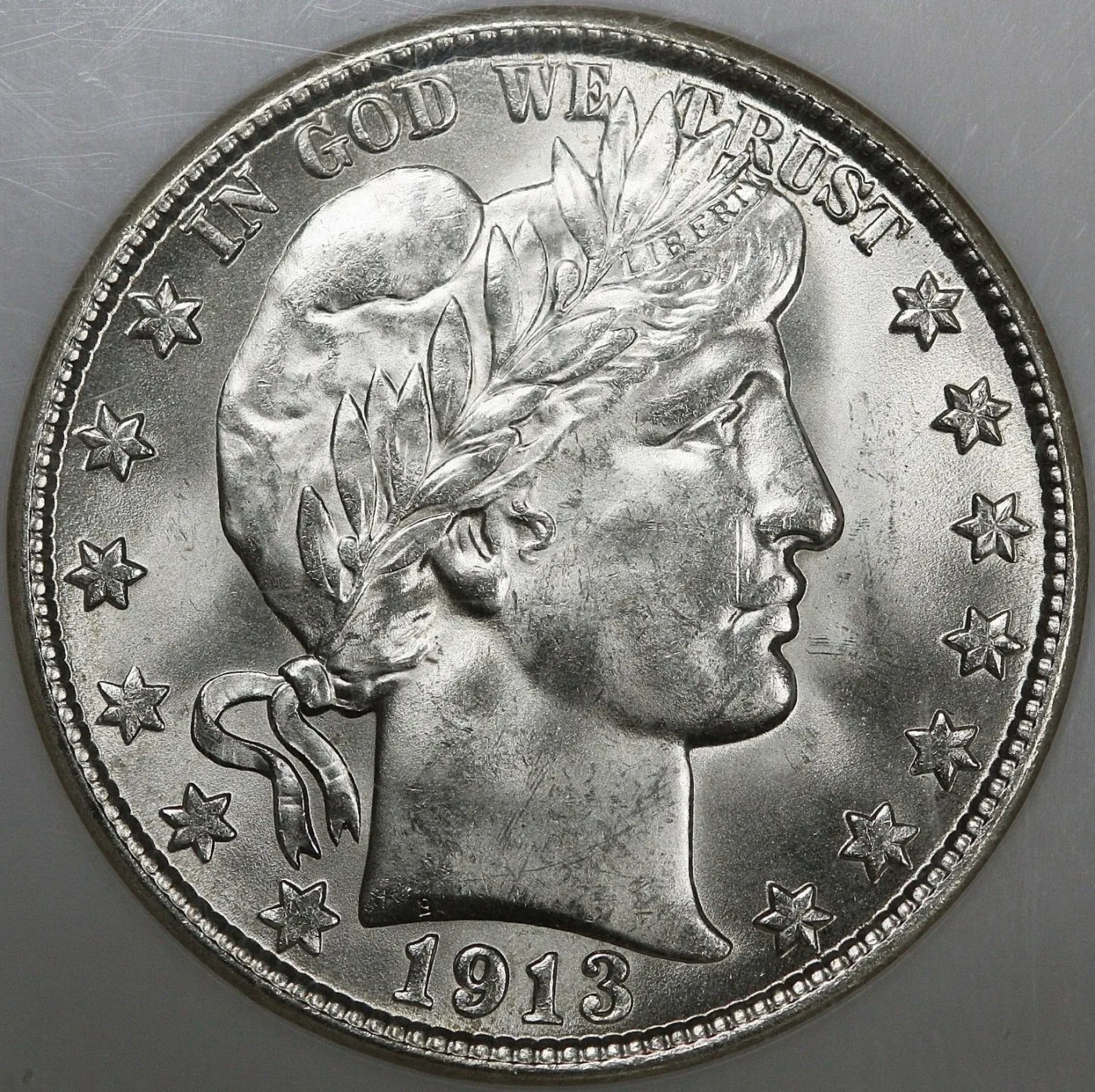
The Barber Half Dollar — formally the Liberty Head Half Dollar — is the largest of Charles E. Barber’s three silver coins of the 1890s and one of the most quietly collectable U.S. silver series. Struck from 1892 through 1915 at Philadelphia, New Orleans, San Francisco, and Denver, the Barber Half carried Liberty’s classical portrait through 24 years of American commerce before yielding to Adolph Weinman’s Walking Liberty Half Dollar in 1916. Unlike its sister denominations the Barber Dime and Barber Quarter, the Barber Half has no single coin as famous as the 1894-S dime or the 1901-S quarter — but it has multiple genuine keys, several semi-keys, and a relentlessly difficult condition rarity that makes high-grade examples some of the toughest 20th-century U.S. coins to acquire.
What sets the Barber Half apart from the dime and quarter is its sheer size and weight: 30.6 mm and 12.5 grams of 90% silver. The larger surface meant heavier wear at any given level of circulation, and most surviving Barber Halves grade Good or Very Good with full LIBERTY missing on the headband. Collectors who chase Mint State examples, especially with cameo proof contrast or sharp strikes from branch mints, find the Barber Half is a hunt — not a checkbook exercise.
This guide walks through the design, mint marks, every key and semi-key date, the famous 1892-O Micro O variety, LIBERTY-based grading, proofs, authentication, and current values across the entire 1892-1915 series. If you are new to U.S. silver coinage broadly, start with our complete coin identification guide and then return here for this series.
History and Origins of the Barber Half Dollar
By 1890 the Seated Liberty Half Dollar — a design rooted in the 1830s — had been in production for more than 50 years and was widely seen as artistically tired. The 1890 Coinage Act gave the Treasury authority to redesign any U.S. coin that had been struck for 25 years or more without further Congressional approval. Mint Director Edward O. Leech took advantage almost immediately, intending fresh designs for the dime, quarter, and half dollar.
An 1891 public competition was launched, but the terms — payment only for first place, nothing for runners-up — drew refusals from every prominent invited artist. With the contest collapsed and no time to renegotiate, Leech instructed Chief Engraver Charles E. Barber to prepare in-house designs. Barber produced a single Liberty Head obverse adapted across all three denominations, paired with a small heraldic eagle reverse on the dime and a more detailed heraldic eagle on the quarter and half dollar. The Barber coinage debuted in January 1892.
Charles E. Barber: Designer and Chief Engraver
Charles Edward Barber (1840-1917) served as Chief Engraver of the United States Mint for 38 years, from 1879 until his death. He was the son of William Barber, the previous Chief Engraver, and learned engraving in the family workshop. Charles Barber was a methodical, classically trained craftsman who often clashed with outside sculptors brought in by the Treasury — most famously Augustus Saint-Gaudens, whose ultra-high-relief gold designs Barber considered impractical for mass production. The dime, quarter, and half of 1892-1916 are his most prominent personal designs and the silver legacy of his career. He also designed the Liberty Head V Nickel (1883-1912), which paired with the Barber silver coinage to give him design credit on five denominations of circulating U.S. coinage simultaneously.
Production Timeline
Barber Half Dollars were struck from 1892 through 1915 at four mints: Philadelphia (no mint mark), New Orleans (“O”), San Francisco (“S”), and Denver (“D,” from 1906). Total mintage across the series was approximately 135 million pieces — significantly less than the dime (about 504 million) or the quarter (about 264 million), making the Barber Half the lowest-mintage of the three denominations on a relative basis. The series ended in 1915, one year earlier than the dime and quarter, because the Walking Liberty Half Dollar replaced it in 1916. Final-year 1915 production at Philadelphia was particularly small.
Historical Context
The half dollar in 1900 was a substantial denomination — equivalent to roughly $17 in 2026 dollars and representing about half a day’s wages for an unskilled worker. Halves circulated through the Panic of 1893, the Spanish-American War, the Progressive Era, and the lead-up to World War I. They saw heavy commercial use, particularly in saloons, banks, and bulk transactions where larger denominations were preferred. This explains why surviving Barber Halves are overwhelmingly low-grade: most were spent and resepent until the design became unrecognizable.
Design Elements and How to Identify a Barber Half Dollar
The Barber Half Dollar is the largest of the three Barber silver denominations and the easiest to identify on the table — its size alone separates it from the smaller Barber Quarter. Once you know the obverse and reverse details, identification is unambiguous.
Obverse (Front) Design
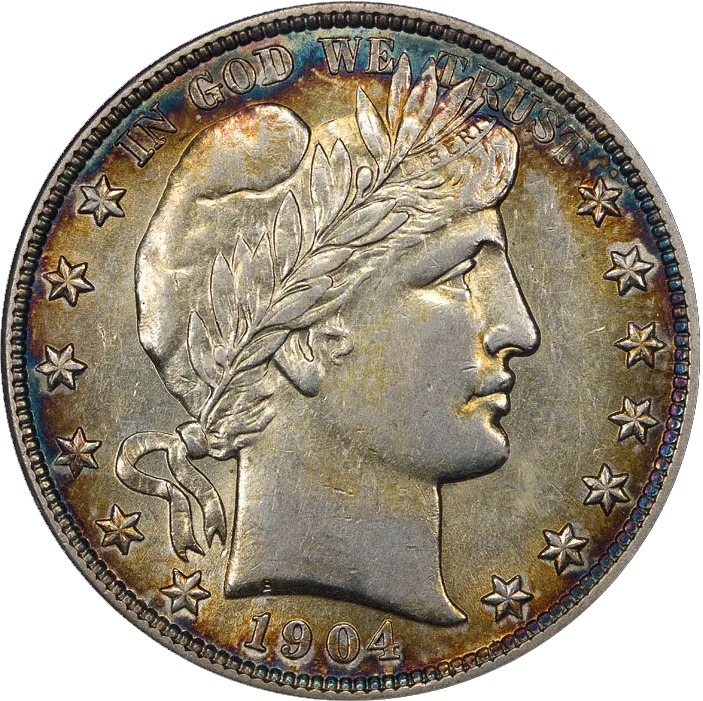
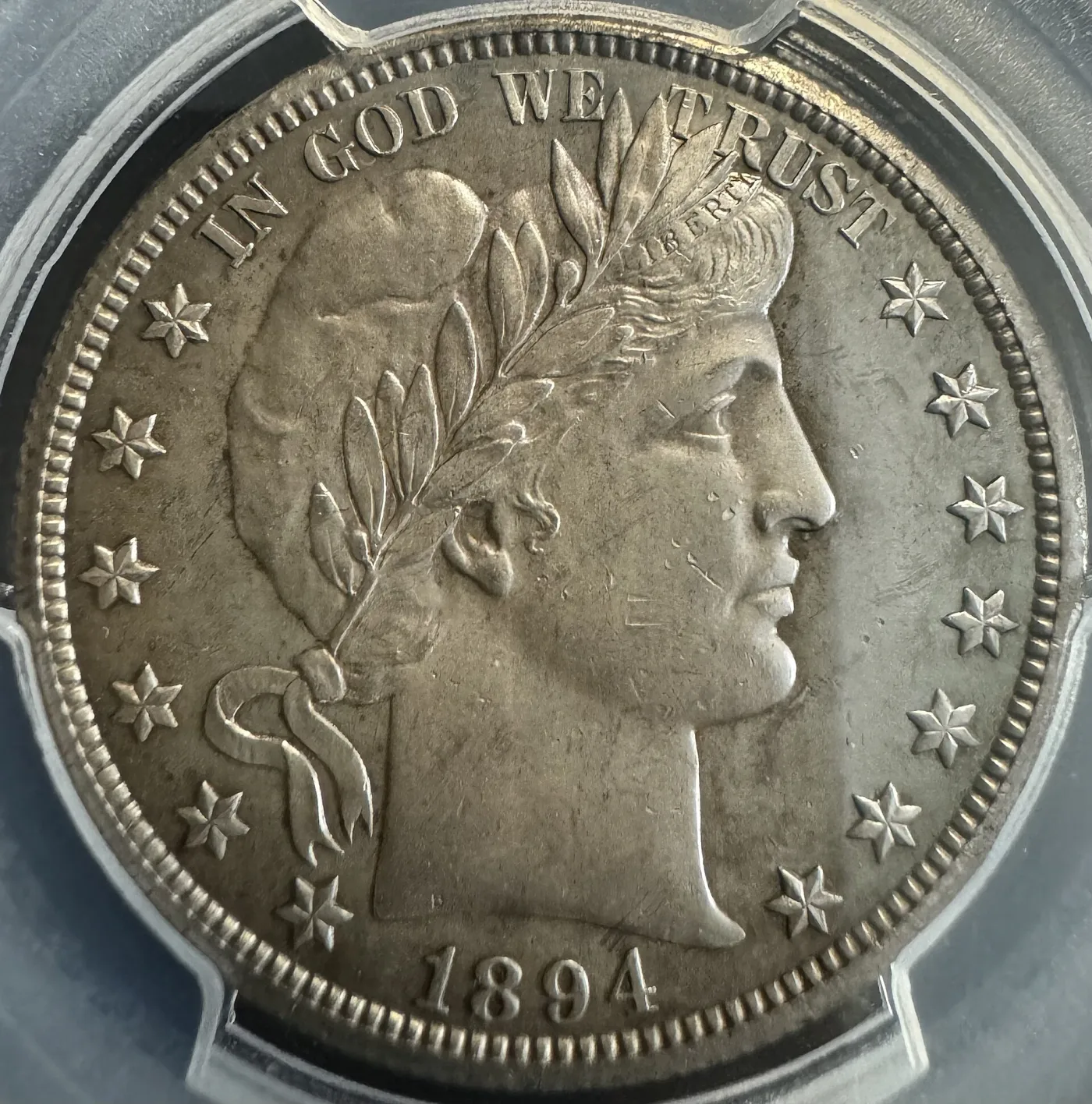
The obverse features a right-facing classical bust of Liberty wearing a Phrygian cap encircled by a laurel wreath, with a headband bearing “LIBERTY” in raised letters across the brow. The motto “IN GOD WE TRUST” is arched above Liberty’s head — as it is on the Barber Quarter, so it does not distinguish the two; the Barber Dime is the one member of the series without it. The legend “UNITED STATES OF AMERICA” arcs along the top, the date appears at the bottom, and thirteen six-pointed stars are split between the upper sides — six on the left, seven on the right. Barber’s initial “B” appears at the truncation of Liberty’s neck.
Reverse (Back) Design
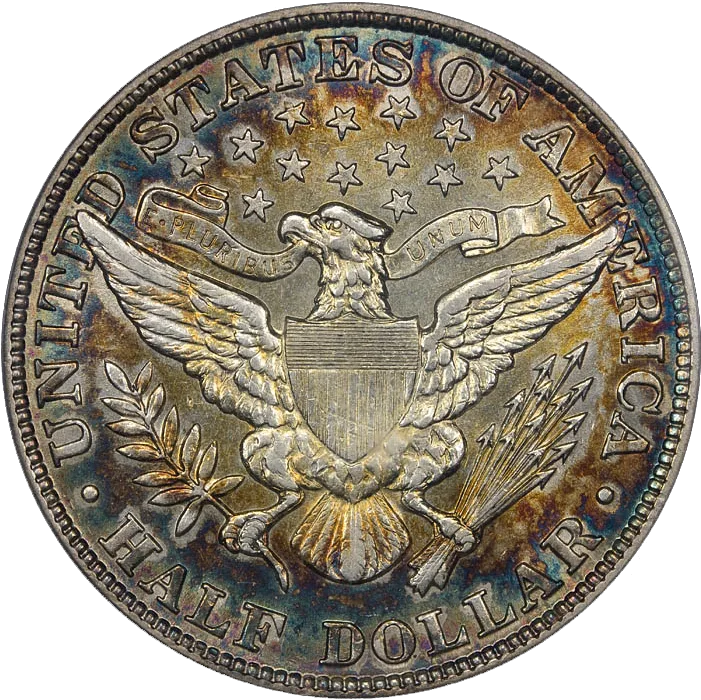
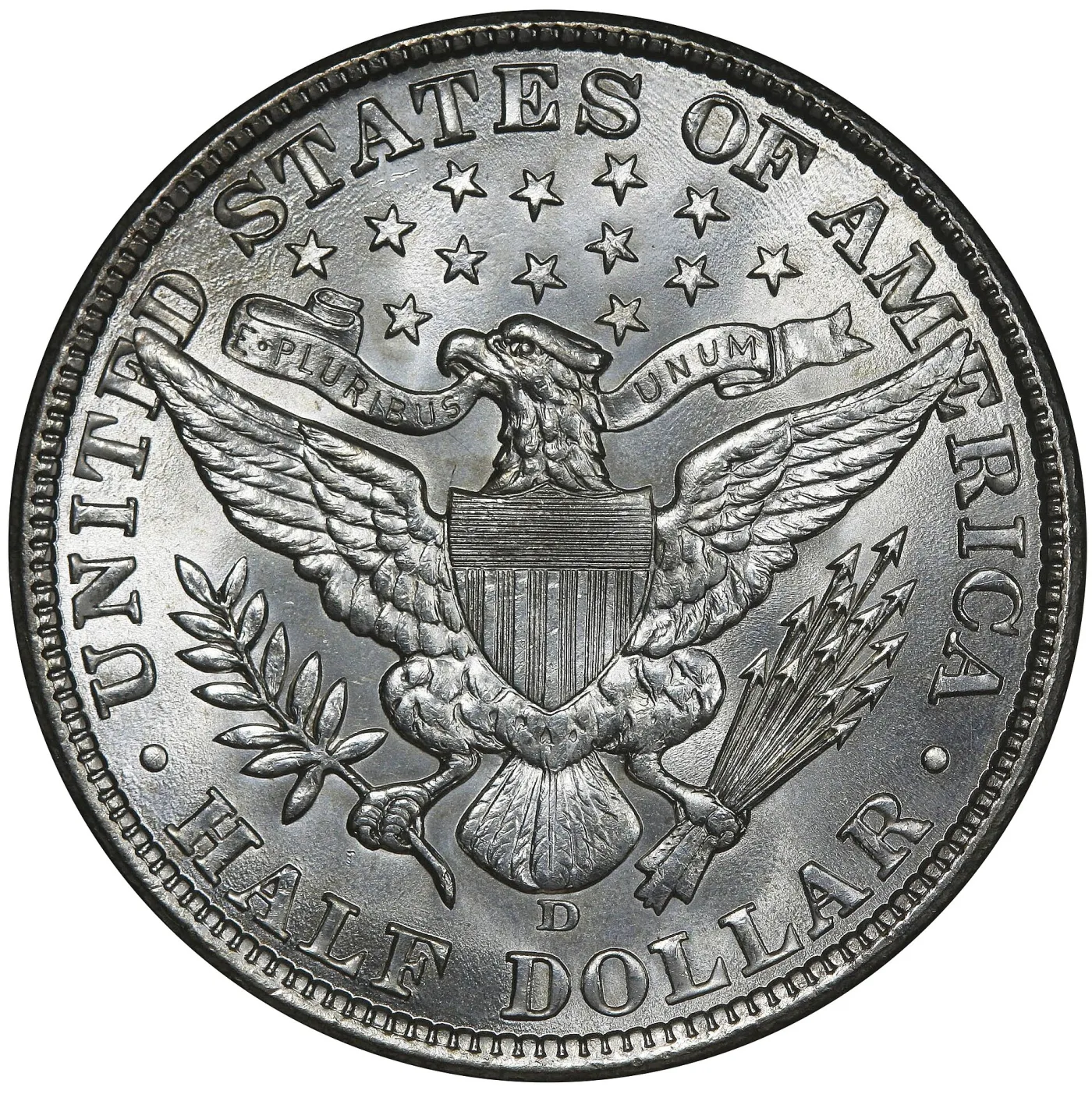
The reverse displays a heraldic eagle adapted from the Great Seal of the United States. The eagle holds an olive branch in its right talon and a bundle of arrows in its left, with a shield bearing thirteen vertical stripes across its breast. A scroll above the eagle’s head reads “E PLURIBUS UNUM,” and thirteen five-pointed stars arc above the eagle between the wing tips. The legends “UNITED STATES OF AMERICA” and “HALF DOLLAR” encircle the rim. The reverse does not display “IN GOD WE TRUST” — that motto sits on the obverse, and the Barber Quarter’s reverse omits it for the same reason.
Physical Specifications
Every Barber Half Dollar is composed of 90% silver and 10% copper, weighs exactly 12.5 grams, has a diameter of 30.6 millimeters, and features a reeded edge. These specifications match the Seated Liberty Half Dollar before it and the Walking Liberty Half Dollar that followed (and the early Franklin Half Dollar through 1964). The silver content is 0.36169 troy ounces per coin — about twice that of a Barber Quarter, so even a worn Barber Half has meaningful silver melt value beyond face.
How to Quickly Distinguish a Barber Half
If you have a large old silver coin and are not sure whether it’s a Barber Half, check four things. First, diameter — a Barber Half is 30.6 mm, larger than any quarter (24.3 mm) or modern half (30.6 mm but with different designs). Second, the obverse shows a right-facing Liberty Head with laurel wreath and “IN GOD WE TRUST” arched above. Third, the reverse shows a heraldic eagle with shield and stars (not a walking figure or a flying eagle). Fourth, the date will fall between 1892 and 1915. All four checking out confirms a Barber Half.
Mint Marks and Where to Find Them
Mint mark identification is essential because the same date from different mints can vary in value by tens or hundreds of times. The Barber Half follows the same mint mark conventions as its sister Barber denominations.
Mint Mark Location
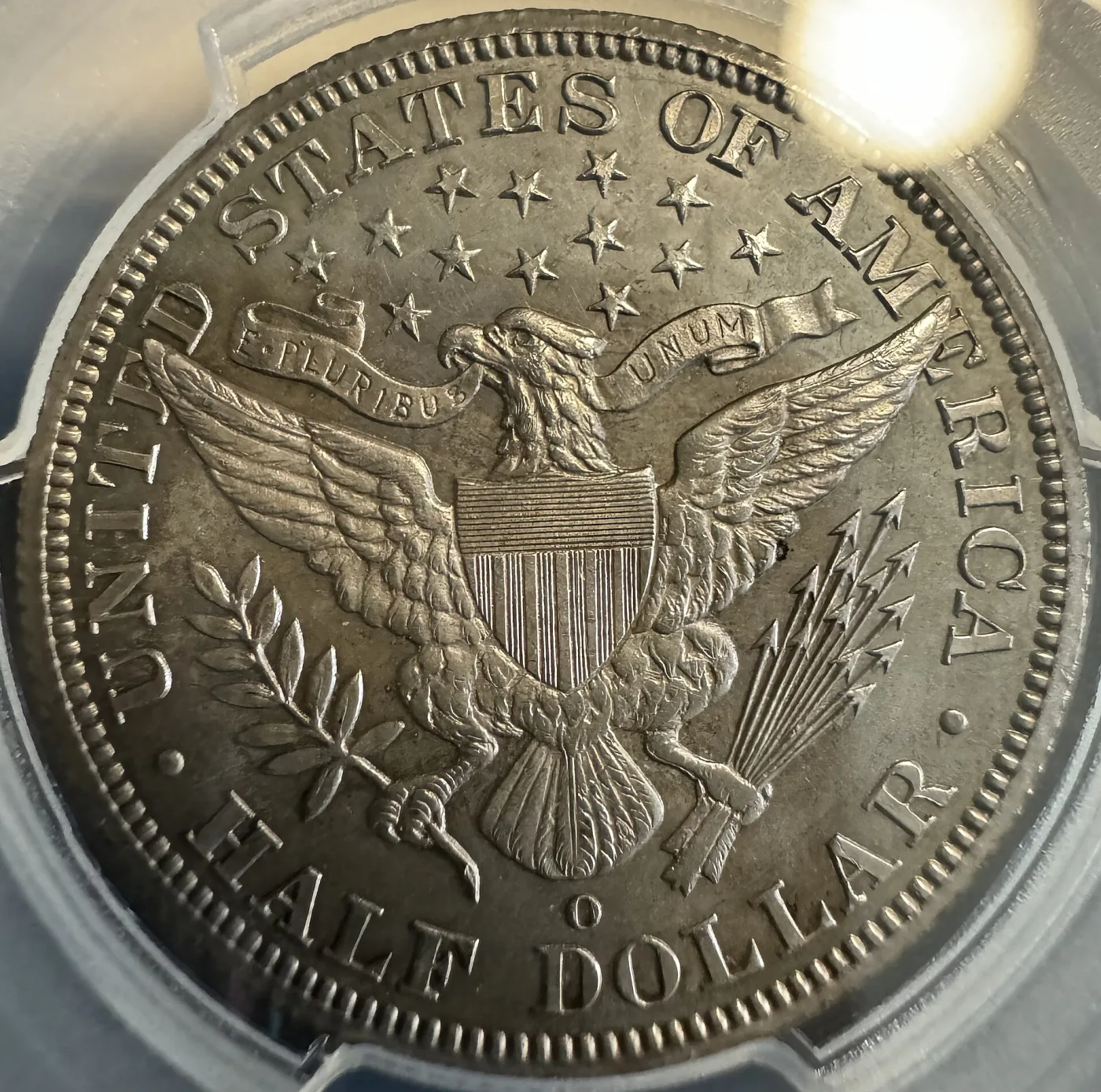
On every Barber Half Dollar, the mint mark appears on the reverse, directly below the eagle’s tail feathers and centered above the “HALF DOLLAR” legend at the bottom. The mint mark is small — 1.5 to 2.5 millimeters tall — but reliably positioned. A 5x to 10x loupe makes identification easy even on heavily circulated coins. Worn mint marks may appear as soft mounds rather than crisp letters, so look at metal contour and not just visible shape.
Philadelphia (No Mint Mark)
Philadelphia coins bear no mint mark — the space below the eagle is blank. Philadelphia produced the largest share of Barber Halves across most years, so most circulated common dates you encounter will be Philadelphia issues.
New Orleans (“O”)
New Orleans struck Barber Halves from 1892 through 1909, when the New Orleans Mint ceased production of regular U.S. coinage. Its mint mark is a small, slightly oval “O.” Several semi-keys (1892-O, 1897-O) and the famous 1892-O Micro O variety carry this mark. After 1909, no Barber Half bears the “O” mint mark.
San Francisco (“S”)
San Francisco struck Barber Halves every year of the series from 1892 through 1915. Its “S” mint mark is small and slightly curvy. San Francisco produced both common dates and several semi-keys, including the 1892-S, 1897-S, 1904-S, and 1914-S, and the rare 1915-S as the final San Francisco Barber Half.
Denver (“D”)
Denver began striking Barber Halves in 1906, the first year of significant Denver Mint silver coinage following its expansion. The “D” mint mark is bold and rounded. Denver struck Barber Halves through 1915, with no major key dates from this mint, but the 1913-D, 1914-D, and 1915-D are scarcer issues, and the 1906-D as a first-year Denver issue is collected by type specialists.
Key Dates, Semi-Keys, and the 1913-1915 Run
The Barber Half has no single rarity equal to the 1894-S Barber Dime or the 1901-S Barber Quarter. Instead, it has a cluster of low-mintage Philadelphia dates from the end of the series (1913, 1914, 1915) and several scarce branch-mint issues. Together they make a complete date-and-mintmark set genuinely difficult.
1913, 1914, 1915 Philadelphia: The Late Keys
Philadelphia mintages dropped sharply at the end of the series as the Treasury anticipated the design change. The 1913 Philadelphia Barber Half had a mintage of just 188,000 — among the lowest business strikes of the series. The 1914 Philadelphia mintage was 124,230, and the 1915 Philadelphia mintage was just 138,000. These three dates are the principal Philadelphia keys. Values run roughly $40 to $80 in G-4, $200 to $400 in F-12, $700 to $1,200 in EF-40, and $2,000 to $5,000 in MS-63 for the 1913. The 1914 runs slightly higher; the 1915 slightly lower than the 1914 because more were saved.
1892-O and 1892-S: First-Year Branch-Mint Keys
Both first-year branch issues had small mintages and are widely collected. The 1892-O (390,000 mintage) sells for $200 to $300 in G-4, $500 to $800 in F-12, $1,500 to $2,500 in EF-40, and $4,000 to $7,000 in MS-63. The 1892-S (1,029,028 mintage) is more affordable but still scarce: $150 in G, $400 in F, $1,200 in EF, $3,500 in MS-63.
1897-O and 1897-S
Both 1897 branch-mint issues are semi-keys. The 1897-O (632,000 mintage) sells for $150 in G, $500 in F, $2,000 in EF, $5,500 in MS-63. The 1897-S (933,900 mintage) runs $150 in G, $500 in F, $1,800 in EF, $5,000 in MS-63. These dates are notorious for weak strikes.
1904-S
The 1904-S (553,038 mintage) is one of the most condition-rare dates in the entire series. In G-4 it runs $80 to $120, in F-12 $400 to $700, in EF-40 $2,000 to $4,000, and in MS-63 $15,000 to $25,000+. Mint State 1904-S Barber Halves are exceptionally scarce — only a handful are graded MS-65 or higher, and finest-known examples have crossed six figures.
1913-S, 1914-S, 1915-S: Final San Francisco Halves
San Francisco struck Halves in each of the final three years, with mintages of 604,000 (1913-S), 992,000 (1914-S), and 1,604,000 (1915-S). These coins are scarcer than typical because the design was about to change and most circulated heavily. Values run $30 to $60 in G, $150 to $300 in F, $700 to $1,200 in EF, and $2,500 to $5,500 in MS-63.
Other Semi-Keys
Beyond the major keys, several mid-series dates carry meaningful premiums:
- 1893-S — mintage 740,000; $150 in G, $500 in F, $1,800 in EF, $4,500+ in MS-63.
- 1896-S — mintage 1,140,948; $90 in G, $300 in F, $1,200 in EF, $3,500+ in MS-63.
- 1901-S — mintage 847,044; $70 in G, $400 in F, $1,800 in EF, $6,500+ in MS-63.
- 1903-S — mintage 1,920,772; $40 in G, $200 in F, $900 in EF, $3,000+ in MS-63.
- 1907-S — mintage 1,250,000; $40 in G, $250 in F, $1,200 in EF, $4,500+ in MS-63.
- 1908-S — mintage 1,644,828; $30 in G, $200 in F, $850 in EF, $3,000+ in MS-63.
- 1909-S — final New Orleans-era San Francisco issue; $30 in G, $150 in F, $750 in EF, $2,500+ in MS-63.
- 1914 — Philadelphia, low mintage 124,230; among the keys above.
The 1892-O Micro O and Other Major Varieties
Barber Halves are not as variety-rich as Morgan Silver Dollar VAMs, but they have several major varieties that every collector should know.
1892-O Micro O
The 1892-O Micro O is the most famous variety in the entire Barber Half series. The “Micro O” mint mark is dramatically smaller than the normal “O” used on regular 1892-O Halves — roughly the size used on Barber Quarter dies of the same era, suggesting a quarter-die mint mark punch was accidentally used on a half-dollar reverse die. Estimated survival is fewer than 1,000 examples. Values run $4,000 to $6,000 in G-4, $10,000 to $15,000 in F-12, $25,000 to $40,000 in EF-40, and $75,000+ in MS-63. The variety is heavily counterfeited; never buy an uncertified Micro O.
1892 Type 1 vs Type 2 Reverse
Like the 1892 Barber Quarter, 1892 Halves exist in two reverse hub varieties. Type 1 (early reverse) shows the eagle’s wing covering only part of the “E” in “UNITED.” Type 2 (modified reverse, used from later 1892 onward) shows the wing extended further and covering more of the “E.” Type 1 1892-O and 1892-S Halves command 2x to 4x premiums over Type 2 in equivalent grades.
1900-O Doubled Die Reverse
A modest doubled die reverse exists on some 1900-O Halves, showing minor doubling in the eagle’s tail feathers and “UNITED STATES OF AMERICA.” Premiums run 30% to 60% over normal 1900-O coins of the same grade.
Repunched Mint Marks (RPMs)
Several Barber Half dates carry repunched mint marks, particularly New Orleans and San Francisco issues. Notable RPMs include 1892-O/O, 1894-O/O, and several 1900-O variations. These are popular with specialists and bring 15% to 50% premiums.
Die Cracks and Cuds
Like the quarter, Barber Half dies were worked hard during long branch-mint runs. Die cracks are common; major cuds (raised die-break blobs) are scarce and collectable. Significant cuds listed in the Cherrypickers’ Guide can carry 25% to 100% premiums.

The LIBERTY Headband and Grading
As with the Barber Dime and Barber Quarter, nothing matters more to circulated Barber Half grading than the LIBERTY headband across Liberty’s forehead. The seven raised letters of “LIBERTY” are the first design element to wear, and the count of visible letters anchors the grading scale from Good through Very Fine.
Grading by LIBERTY Letters Visible
- Good (G-4): LIBERTY is completely worn smooth. The headband is a flat raised band with no lettering visible.
- Very Good (VG-8): At least three letters of LIBERTY are partially visible.
- Fine (F-12): All seven letters of LIBERTY are visible, though weak or partially merged. The full word is readable.
- Very Fine (VF-20): All seven letters are bold and sharp; individual strokes are clearly separated.
- Extremely Fine (EF-40): LIBERTY is fully sharp; wear is visible only on the highest points of the cheek, hair, and wreath leaves.
Why LIBERTY Matters Most on the Half
Because Barber Halves circulated so heavily and so few survive in better-than-VG condition, the grade jumps from G-4 to VG-8 to F-12 are particularly meaningful. Even on common dates a Fine example may bring 4x to 6x the price of a Good. On semi-keys the swing is more dramatic — a 1904-S in G-4 might sell for $100, in F-12 for $500, in VF-20 for $1,200. Mastering LIBERTY-based grading is the single highest-leverage skill for Barber Half collecting.
Counterfeit Warning: Tooled LIBERTY
Because LIBERTY is so grade-critical, the most common alteration on Barber Halves is “re-engraving” or tooling the LIBERTY letters on a worn coin to push it into a higher grade. Under 10x magnification, tooled letters show unnatural sharp edges, fresh metal that differs in color from the surrounding patinated surface, and an overall wrong appearance. Third-party graders catch tooled coins reliably, which is one of many reasons to insist on PCGS or NGC certification for any meaningful purchase.
How to Grade Barber Half Dollars
Beyond LIBERTY, several other design elements inform a complete grade.
Obverse Wear Points
After LIBERTY, the next obverse wear points are Liberty’s cheek, the hair above her forehead, and the laurel leaves of the wreath. On EF-40 you may see slight flattening on the high cheek but most hair detail remains. On AU-50, faint flatness on the cheek and topmost waves with three-quarters of mint luster. On MS-60, no wear at all, though contact marks are common given the coin’s size.
Reverse Wear Points
The reverse grades primarily on the eagle’s head, the leading edge of the wings, the shield, and the central tail feathers. On VG-8 the eagle’s head is mostly merged with the field and shield stripes are barely visible. On F-12 the head is separated from the field and at least half the shield stripes are visible. On VF-20 the head feathers begin to show separation. On EF-40 all major feathers are sharp with full detail.
Mint State Grades
Mint State Barber Halves are graded primarily on contact marks, luster, and strike. The half dollar’s large surface area means contact marks are extremely common — a perfectly clean MS-65 Barber Half is genuinely scarce for any date and effectively unobtainable for several issues. MS-60 to MS-62 coins typically have heavy bag marks. MS-63 (choice) shows a few noticeable marks. MS-64 (near gem) has only light marks. MS-65 gem coins have full luster and only minute marks. MS-66 and above are exceptional and increasingly rare.
Strike Quality
Barber Halves do not have a formal strike designation like Mercury Dimes (Full Bands) or Standing Liberty Quarters (Full Head). But strike quality is a crucial value driver. A fully struck Barber Half shows every laurel leaf, full LIBERTY letters, all eagle feathers, and complete shield stripes. Weakly struck coins — common on New Orleans and some San Francisco issues, particularly the 1897-O and 1897-S — sell for less even at the same numerical grade.
Strike Differences by Mint
Philadelphia Barber Halves typically show the strongest strikes, followed by Denver, then San Francisco, with New Orleans often weakest. The 1890s New Orleans coinage is particularly known for strike weakness on the eagle’s head and shield, and this weakness is sometimes mistaken for circulation wear. When buying mid-grade coins, always compare strike, not just date and grade.
Proof Barber Half Dollars
Proof Barber Halves were struck at Philadelphia every year from 1892 through 1915. They are distinctly different coins from business strikes, with mirrored fields, sharp strikes, and frosted devices on some years.
Identifying a Proof Barber Half
Genuine proof Barber Halves show watery, mirror-like fields, perfectly squared rims, and sharply detailed devices with no flow lines or flatness. Proofs were struck twice or more with polished dies under higher pressure. Proofs were only struck at Philadelphia, so all proof Barber Halves are mint-mark-less.
Proof Mintages
Proof mintages were small — typically 600 to 1,200 coins per year for the half. The 1914 proof had a mintage of just 380, and the 1915 proof (final year) only 450. Combined with attrition over a century, high-grade proofs are legitimately scarce.
Cameo and Deep Cameo
Proof Barber Halves can show cameo contrast, where frosted devices stand out against mirrored fields. Cameo (CAM) and Deep Cameo (DCAM) proofs are dramatically more valuable than brilliant proofs. A PR-65 brilliant Barber Half might sell for $2,000 to $3,500; the same coin in PR-65 CAM could bring $5,000 to $9,000, and PR-65 DCAM $15,000 or more. Deep Cameo Barber Halves are extremely rare for most dates.
Proof Values
Proof Barber Halves run $700 to $1,500 in PR-60, $1,200 to $2,500 in PR-63, $2,000 to $4,500 in PR-65, and $7,500 to $30,000+ in PR-66 CAM or higher. The 1914 and 1915 proofs carry modest premiums over middle-year dates.
Authentication and Counterfeit Detection
Barber Halves attract counterfeiters because meaningful value is concentrated in scarce dates and varieties — particularly the 1892-O Micro O. Knowing what to watch for protects your money.
Altered Dates and Mint Marks
Common date-altering attempts target the late Philadelphia keys (1913, 1914, 1915) or branch-mint keys. A 1913 Philadelphia coin can have an “S” added to make a fake 1913-S; a common date can be altered to 1915 by retooling the last digit. Genuine mint marks were punched into the die before striking, so they are integral to the coin’s surface. Added mint marks sit on top of the surface and usually show color or texture differences under magnification. Date alterations show retooling marks under 10x.
Cast and Struck Counterfeits
Crude cast counterfeits show rounded rims, mushy details, and pitted or grainy surfaces. They typically weigh wrong — a genuine Barber Half is exactly 12.5 grams (±0.10 g tolerance). Modern struck counterfeits, often Chinese in origin, are far more sophisticated: sharper details, correct weight in some cases, and convincing patina. They still show small inaccuracies in letter spacing, star points, or feather shapes when compared side-by-side with a known genuine coin.
1892-O Micro O Fakes
The 1892-O Micro O is one of the most-faked U.S. silver coins. The most common deception is altering a normal 1892-O by tooling the “O” smaller, then artificially patinating the surface. Under magnification, altered O’s show file marks, fresh metal, and an “O” shape that differs from genuine punched Micro O letterforms. Never buy a raw 1892-O Micro O — only PCGS or NGC certified examples.
Cleaning and Problem Coins
Many Barber Halves have been harshly cleaned over the past century. Cleaned coins show hairline scratches in straight, parallel patterns or unnatural overall brightness. A coin in a PCGS or NGC “Genuine” or “Details” holder has been authenticated but found uncertifiable due to cleaning, damage, or alteration. Such coins sell for a fraction of problem-free examples. The same caution applies broadly to early U.S. silver and copper, including Buffalo Nickels and Mercury Dimes of similar vintage.
Current Market Values by Date and Mint
Values below represent approximate retail prices as of 2026. Actual prices fluctuate with silver spot and collector demand. Use these as benchmarks, not quotes.
Common Dates
Common-date Barber Halves sell for about $20 to $30 in G-4 (silver melt drives the floor), $30 to $50 in VG-8, $80 to $130 in F-12, $200 to $325 in VF-20, $400 to $650 in EF-40, $750 to $1,200 in AU-50, and $1,200 to $2,500 in MS-63. MS-65 examples of common dates run $4,000 to $9,000.
Semi-Keys
Semi-keys (1892-O, 1892-S, 1897-O, 1897-S, 1904-S in low grades, 1913-S, 1914-S, etc.) sell for $30 to $300 in G-VG, $150 to $700 in F-VF, $700 to $2,000 in AU, and $2,500 to $7,000 in MS-63. MS-65 examples are scarce and can reach $15,000 to $50,000+.
Major Keys
The 1913 Philadelphia sells for $40 in G, $250 in F, $900 in EF, $4,000+ in MS-63. The 1914 Philadelphia runs $50 in G, $325 in F, $1,200 in EF, $5,500+ in MS-63. The 1915 Philadelphia runs slightly less than the 1914. The 1904-S — the great condition rarity — sells for $80 to $120 in G-4, $400 to $700 in F-12, $2,000 to $4,000 in EF-40, and $15,000 to $25,000+ in MS-63, with MS-65 examples crossing six figures.
1892-O Micro O
The Micro O variety is in a class of its own: $4,000 to $6,000 in G-4, $10,000 to $15,000 in F-12, $25,000 to $40,000 in EF-40, and $75,000 or more in MS-63. Population is small enough that any market sale moves values noticeably.
Proofs
Proof Barber Halves sell for $700 to $1,500 in PR-60, $2,000 to $4,500 in PR-65, and $7,500 to $30,000+ in PR-66 CAM or higher. The low-mintage 1914 and 1915 proofs carry modest premiums.
Factors Affecting Value
Beyond date and grade, Barber Half values are driven by strike, original surfaces, attractive natural toning, and overall eye appeal. A “technically accurate” MS-63 with a weak strike and dipped surfaces may sell below guide, while an MS-63 with a sharp strike and original russet or rainbow toning can bring MS-65 money in the right auction. As with the Peace Dollar series, original-skin coins consistently outperform reprocessed examples.
Series Context: The Barber Trio and Beyond
Understanding where the Barber Half sits within American coinage helps frame its design and collectability.
Predecessor: Seated Liberty Half Dollar (1839-1891)
The Barber Half replaced the Seated Liberty Half Dollar designed by Christian Gobrecht. Seated Liberty Halves circulated for over 50 years across multiple sub-types — no drapery, drapery added, arrows and rays, motto added, arrows again — and represent one of the most varied 19th-century U.S. silver series. The transition to Barber’s design in 1892 closed an era of allegorical seated figures and inaugurated the era of unified obverse designs across denominations. The same Gobrecht successor relationship played out for the dollar with the Seated Liberty Dollar series.
The Barber Trio: Dime, Quarter, Half
Charles Barber’s Liberty Head design appears on three concurrent denominations: the Barber Dime (1892-1916), the Barber Quarter (1892-1916), and the Barber Half Dollar (1892-1915). The obverse portraits are essentially identical across all three denominations — only size and small peripheral details differ. The “Barber type set” of all three denominations in matching grades is one of the most popular advanced collecting goals in U.S. numismatics. Add an example of Barber’s Liberty Head V Nickel for a complete four-coin Barber circulating set.
Successor: Walking Liberty Half Dollar (1916-1947)
In 1916 the Mint replaced all three Barber denominations as part of a broader beautification of U.S. coinage. Adolph Weinman’s Walking Liberty Half Dollar replaced the Barber Half a year after the Barber Half’s final 1915 strikes. Weinman’s Mercury Dime replaced the Barber Dime, and Hermon MacNeil’s Standing Liberty Quarter replaced the Barber Quarter. Together, these three new designs are widely considered the high point of classical-style American coinage. The Walking Liberty Half itself was succeeded in 1948 by the Franklin Half Dollar, then the Kennedy Half Dollar in 1964.
The 1915-1916 Transition
Unlike the dime and quarter, where 1916 saw both Barber and successor designs struck side-by-side, the Barber Half ended in 1915 — there are no 1916 Barber Halves. The Walking Liberty Half debuted at the very end of 1916 with a single-year Philadelphia issue plus 1916-D and 1916-S branch issues. A 1915 Barber Half paired with a 1916-D Walking Liberty makes a popular “last and first” display.
Storage, Handling, and Preservation
Barber Halves are large, heavy, and 100+ year-old silver coins that have usually seen heavy handling. Proper storage protects condition and value.
Handling
Always hold Barber Halves by the edges. The LIBERTY headband and the eagle’s chest feathers are extremely susceptible to hairlines from skin oils and from incidental contact. Use cotton or nitrile gloves for any extended examination. Work over a velvet pad — a dropped half dollar from a desk to a hard floor can cause permanent rim damage given the coin’s mass.
Holders and Flips
For low-grade circulated coins, 2x2 cardboard flips with Mylar windows are inexpensive and adequate. For Fine and better examples, individual Air-Tite capsules sized 30 mm or “half dollar” size offer better protection. For any coin worth $200 or more, PCGS or NGC slabs offer the best combination of protection, authentication, and resale liquidity. Never store silver coins in PVC-based soft flips — plasticizer migration causes permanent green gunk that severely impairs value.
Environmental Controls
Silver toning is natural and often beautiful, but uncontrolled environments accelerate harmful tarnish. Store coins in a cool, dry location with stable temperature. Silica gel packets in a sealed storage box absorb excess humidity. Avoid basements, attics, and garages. Sulfur in newspaper, cardboard, and some paints accelerates tarnish dramatically and unevenly.
Cleaning: Don’t
Never clean a Barber Half. Toning is a natural protective patina on silver, and removing it exposes fresh metal, destroys original surfaces, and almost always reduces value by 50% or more. Even heavily toned Barber Halves should be left untouched. The same principle applies to all U.S. silver coinage, from the Trade Dollar to the Roosevelt Dime. If a coin has active corrosion, consult a professional conservation service (NCS is the industry standard) rather than attempting home remedies.
Building a Barber Half Dollar Collection
Barber Halves offer multiple collecting approaches, from a single type coin to ambitious complete date-and-mintmark sets. Choose the path that matches your budget and interests.
Type Collection
The easiest entry is a single Barber Half for a 19th- or 20th-century type set. Budget $80 to $130 for a Fine common date, $200 to $325 for VF, $400 to $650 for EF, and $1,200 to $2,500 for MS-63. A single gem MS-65 Barber Half for a high-grade type set runs $4,000 to $9,000.
Short Set (1892-1915 Philadelphia Only)
A complete Philadelphia-only date set (24 coins) in Fine costs roughly $3,000 to $5,000, with the late keys (1913, 1914, 1915) driving the budget. This is a popular introduction that focuses on the design’s evolution without chasing the most expensive branch-mint coins.
Complete Date-and-Mintmark Set (Business Strikes)
A complete 73-coin business-strike set in Good-VG costs roughly $20,000 to $40,000, driven by the 1892-O Micro O, the 1904-S, the late Philadelphia keys, and several semi-keys. In Fine, budget $60,000 to $100,000. In Mint State, $400,000 to $1,500,000+ depending on grade consistency. A “without varieties” set excluding the Micro O is far more accessible.
Proof Set
A complete proof Barber Half set (24 coins, 1892-1915) in PR-63 runs $40,000 to $70,000. In PR-65, $80,000 to $150,000. Cameo and Deep Cameo sets push into mid-six figures.
Variety Set
A targeted variety set including 1892 Type 1 and Type 2 reverses, the 1900-O DDR, and selected RPMs is manageable at $1,500 to $5,000 depending on grades. Adding the 1892-O Micro O — even in low grade — pushes the set toward $10,000+.
Budget Tips
Start with a common-date Fine or Very Fine for $80 to $200 to learn the design. Add semi-keys one at a time as budget permits — the semi-keys are scarce enough that prices rise faster than common dates. Prioritize problem-free coins over higher-grade problem coins. For anything above $200, insist on PCGS or NGC certification. Attend coin shows; Barber Half strike and eye-appeal differences are dramatic and difficult to assess from online photos alone.
Frequently Asked Questions
How much is a Barber Half Dollar worth?
Most common-date Barber Halves in circulated condition are worth $20 to $80 depending on grade, with their floor set by about $7 to $9 in silver melt value. Better dates and higher grades can bring hundreds to thousands of dollars, and the famous 1892-O Micro O sells for tens of thousands even in modest grades.
What is the rarest Barber Half Dollar?
The 1892-O Micro O is the rarest Barber Half by date-and-variety, with fewer than 1,000 estimated survivors. By condition rarity, the 1904-S is the toughest Mint State coin in the series, with only a handful graded MS-65 or higher. By low business-strike mintage, the 1914 Philadelphia (124,230) is the lowest of any year.
Are Barber Half Dollars made of silver?
Yes. Every Barber Half struck from 1892 through 1915 is composed of 90% silver and 10% copper, weighing 12.5 grams. The silver content (about 0.36 troy ounces) means even worn examples are worth $7 to $9 in melt value alone, well above face value.
Where is the mint mark on a Barber Half Dollar?
The mint mark appears on the reverse, directly below the eagle's tail feathers and centered above the "HALF DOLLAR" legend. Philadelphia coins have no mint mark. Look for "O" (New Orleans), "S" (San Francisco), or "D" (Denver, 1906 onward). A magnifying loupe helps because the mint mark is small and often weakly struck.
What is the 1892-O Micro O Barber Half?
The 1892-O Micro O is a famous variety with a dramatically smaller "O" mint mark than the normal 1892-O — likely from a quarter-die mint mark punch accidentally used on a half-dollar reverse die. Fewer than 1,000 are believed to survive. Even heavily worn examples sell for $4,000 to $6,000, and Mint State coins reach $75,000+. Always purchase certified by PCGS or NGC.
Does "IN GOD WE TRUST" tell a Barber Half from a Barber Quarter?
No — both carry the motto arched above Liberty's head on the obverse, and neither repeats it on the reverse. The motto only separates those two from the Barber Dime, which has "UNITED STATES OF AMERICA" across its obverse instead and no motto at all. To tell a half from a quarter, use size (30.6 mm against 24.3 mm) or read the denomination on the reverse rim.
Who designed the Barber Half Dollar?
Charles E. Barber, Chief Engraver of the United States Mint from 1879 to 1917, designed the Barber Half Dollar. His initial "B" appears on the truncation of Liberty's neck on the obverse. His Liberty Head design also appears on the Barber Dime (1892-1916) and Barber Quarter (1892-1916).
Why are high-grade Barber Halves so scarce?
Barber Halves circulated heavily in commerce as a substantial denomination — half a day's wages in 1900. Few were saved in original condition by collectors of the era. Combined with the half dollar's large surface area making it a magnet for contact marks, this means problem-free Mint State examples — especially MS-65 and higher — are condition rarities for almost every date in the series.
Should I clean my Barber Half Dollar?
No. Cleaning removes the protective toning, introduces microscopic hairlines, and typically reduces a coin's value by 50% or more. Even heavily tarnished Barber Halves should be left alone. If a coin has active corrosion, consult a professional conservation service rather than attempting cleaning yourself.
What years were Barber Half Dollars made?
Barber Halves were struck every year from 1892 through 1915. The series ended one year before the Barber Dime and Barber Quarter, which both ran through 1916. The Walking Liberty Half Dollar replaced the Barber Half in 1916.