Liberty Head Quarter Eagle Identification Guide: 1848 CAL Counterstamp, 1841 Little Princess, 1875 Key Dates, Mint Marks and Values
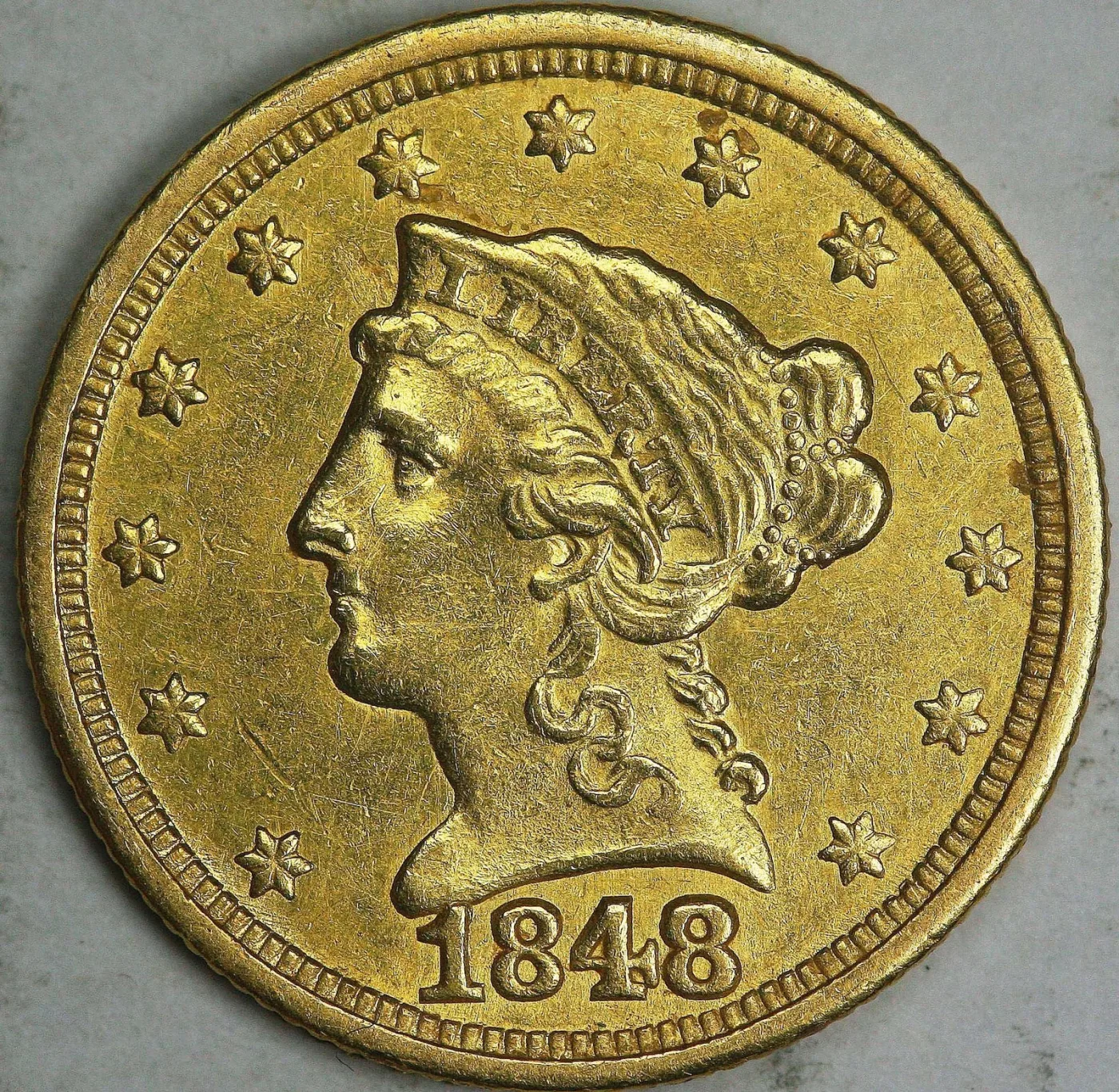
The Liberty Head Quarter Eagle — also called the Coronet Quarter Eagle — is the longest-running quarter eagle design in United States history. Struck from 1840 through 1907, the series spans 68 years of American history, from the late Jacksonian era through the Civil War, Reconstruction, the Gilded Age, and into the Theodore Roosevelt presidency. It was designed by Christian Gobrecht, the same Mint engraver responsible for the Seated Liberty series and the matching Liberty Head Half Eagle, and it shares Gobrecht’s characteristic Liberty profile with a coronet inscribed “LIBERTY.”
The Coronet Quarter Eagle is one of the most accessible classic US gold series for collectors. Common dates from the 1900s sell for modest premiums over their $2.50 face value’s bullion content, and the design appears in nearly every type set. But the series also contains some of the most legendary rarities in American numismatics: the 1848 CAL. counterstamp (the first official US commemorative coin, struck from the very first gold sent east from the California gold rush), the 1841 “Little Princess” (a proof-only date so rare that fewer than two dozen are known), the 1856-D, the 1854-S (with a mintage of 246 pieces), and the 1875 (mintage 400). The series was struck at all major US mints of the 19th century — Philadelphia, Charlotte, Dahlonega, New Orleans, and San Francisco — giving collectors of branch mint coinage rich territory to explore.
This guide covers everything you need to identify, grade, value, and authenticate Liberty Head Quarter Eagles: Gobrecht’s coronet design and its evolution, all five mints that struck the series and how to locate each mint mark, the complete date-and-mintmark lineup with mintages and rarity tiers, the famous 1848 CAL. counterstamp and how to authenticate it, the legendary 1841 Little Princess and 1875 keys, the Civil War rarities (1864 and 1865), the Dahlonega and Charlotte branch-mint history, grading the small obverse, authentication and counterfeit detection (Coronet Quarter Eagles are heavily counterfeited), jewelry damage assessment, and 2026 market values. The general coin identification principles apply, with the additional discipline that branch-mint gold demands certified-only purchase for any meaningful piece.
History: From Classic Head to Coronet
The United States had been striking quarter eagles ($2.50 gold) since 1796, but the denomination had never circulated widely. Early designs — the Capped Bust Right (1796-1807), Capped Draped Bust (1808), and Capped Head Left (1821-1834) types, and the Classic Head (1834-1839) — were struck in small numbers, though the reduced-weight Classic Head was the first to circulate meaningfully. Most quarter eagle coinage existed primarily for international trade and as a store of value.
By 1839, Mint Director Robert M. Patterson had concluded that the entire US coinage required redesign. Christian Gobrecht, the Mint’s chief engraver since 1840 (and de facto chief engraver since William Kneass’s stroke in 1835), had already produced the celebrated Gobrecht Dollar of 1836-1839 and the Seated Liberty subsidiary silver designs. Patterson commissioned Gobrecht to produce a unified gold coinage design that would harmonize with the silver. The result was the Coronet Liberty Head — adapted by Gobrecht from John Reich’s earlier Classic Head work but modernized with cleaner lines, a more refined Liberty profile, and the addition of a coronet inscribed “LIBERTY.”
Design Introduction in 1840
The Coronet Quarter Eagle was introduced in 1840 alongside the matching Liberty Head Half Eagle. The smaller gold dollar denomination would not be introduced until 1849, and the three dollar gold piece not until 1854 — but when those new denominations did arrive, they shared the visual family established by Gobrecht’s coronet. The Liberty Head Eagle ($10 gold) had been introduced in 1838 with a similar but slightly different coronet, while the Liberty Head Double Eagle ($20 gold) would follow in 1849.
68 Years of Production
The Coronet Quarter Eagle ran from 1840 to 1907 — 68 years, encompassing nine US presidents from Van Buren to Theodore Roosevelt. The design was discontinued in 1907 when Roosevelt’s coinage renaissance replaced it with Bela Lyon Pratt’s Indian Head Quarter Eagle with its revolutionary incused design. The transition was not gradual: 1907 was the last year of Coronet production, and 1908 began the Pratt era cleanly. The Coronet Quarter Eagle is therefore the immediate predecessor of the Pratt design, and many type collectors hold both side by side to appreciate the artistic shift Roosevelt commissioned.
Design Details: Obverse and Reverse
The Obverse
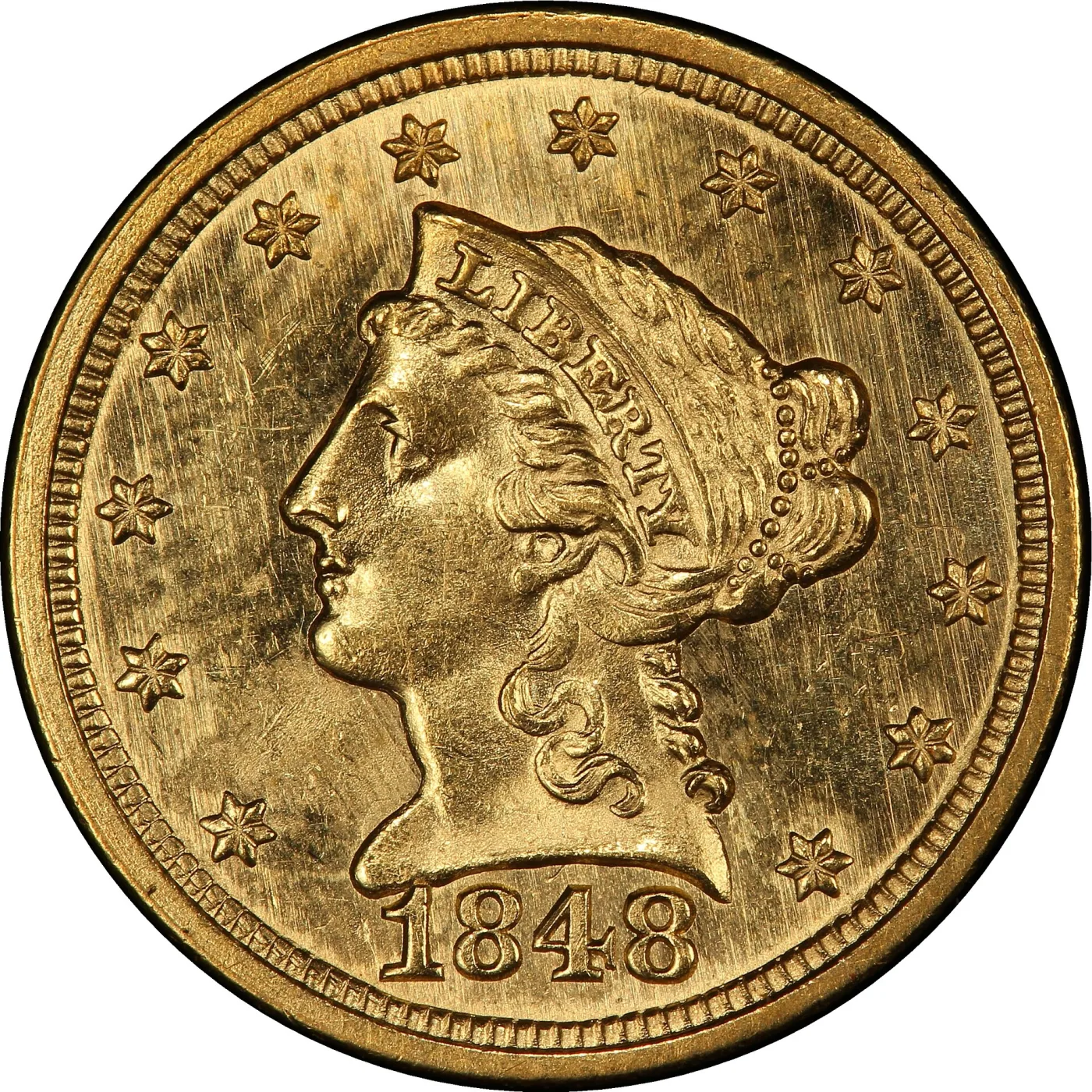
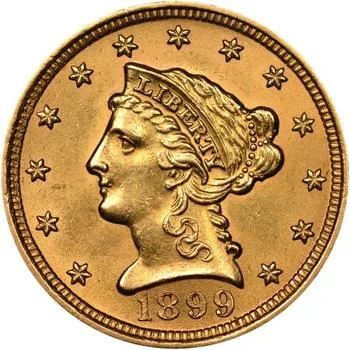
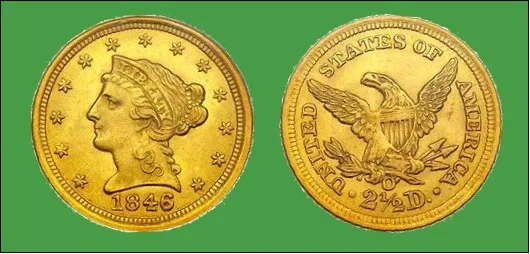
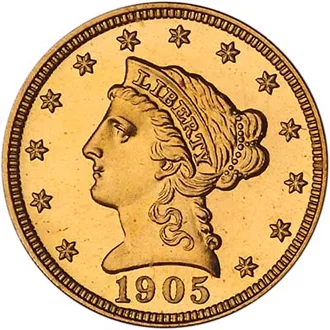
The obverse shows Liberty facing left, her hair gathered into a loose bun at the back of her head with curls falling at the neckline. She wears a coronet across her forehead inscribed with the word LIBERTY in raised letters. Thirteen six-pointed stars — six on the left, seven on the right — are arrayed around the periphery, representing the original thirteen colonies. The date sits at the bottom below Liberty’s neck truncation. The portrait is small (the coin is only 18mm) and refined, with delicate facial features that show Gobrecht’s neoclassical training.
Liberty’s hair is one of the most diagnostic design elements for grading. Look for distinct individual hair curls falling behind the ear, the well-defined bun at the back of the head, and the clear separation of strands on the crown. On worn coins, these details flatten progressively, and the grade can be assessed by counting the number of distinct hair details still visible.
The Reverse
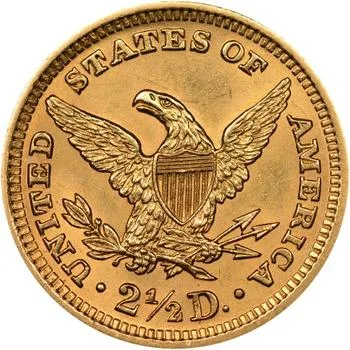
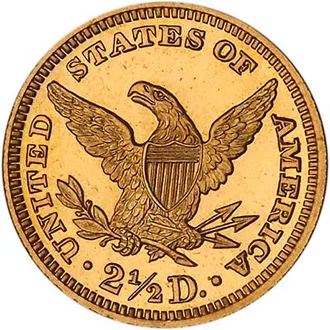
The reverse shows a heraldic eagle facing left with wings spread, holding three arrows in its right talon and an olive branch in its left. A federal shield covers the eagle’s breast with thirteen vertical stripes and a horizontal chief. UNITED STATES OF AMERICA arcs around the top periphery, and the denomination “2 1/2 D.” appears at the bottom below the eagle. The mint mark, when present, sits below the eagle and above the denomination — in the same general area as the eagle’s tail and the wreath bottom.
Unlike the Liberty Head Half Eagle and the Liberty Head Double Eagle, the Coronet Quarter Eagle never bore the motto IN GOD WE TRUST. The motto was added to most other US denominations starting in 1864 (after the Two Cent Piece debuted it) and to the Liberty Head Half Eagle in 1866, but the Quarter Eagle was considered too small to accommodate the additional text. This is an important type distinction: a Coronet Quarter Eagle with IN GOD WE TRUST is not a genuine US Mint product. The motto only appeared on Quarter Eagles starting with the 1908 Indian Head series.
The Edge
The edge is reeded with no lettering. A plain-edge Coronet Quarter Eagle is damaged — typically filed for removal from a jewelry mount, or in rare cases an unfinished piece that escaped the Mint.
Composition and Specifications
- Composition: 90% gold, 10% copper (after the 1834 Act); reduced fineness was used briefly in 1834-1837 Classic Head but does not apply to the Coronet series
- Total weight: 4.18 grams (64.5 grains)
- Pure gold content: 3.762 grams (0.12094 troy ounces)
- Diameter: 18 mm
- Edge: Reeded
- Designer: Christian Gobrecht
- Mintage years: 1840-1907 (continuous, with low-mintage years 1841, 1863, 1864, 1865, 1875, 1881, 1885, and 1886)
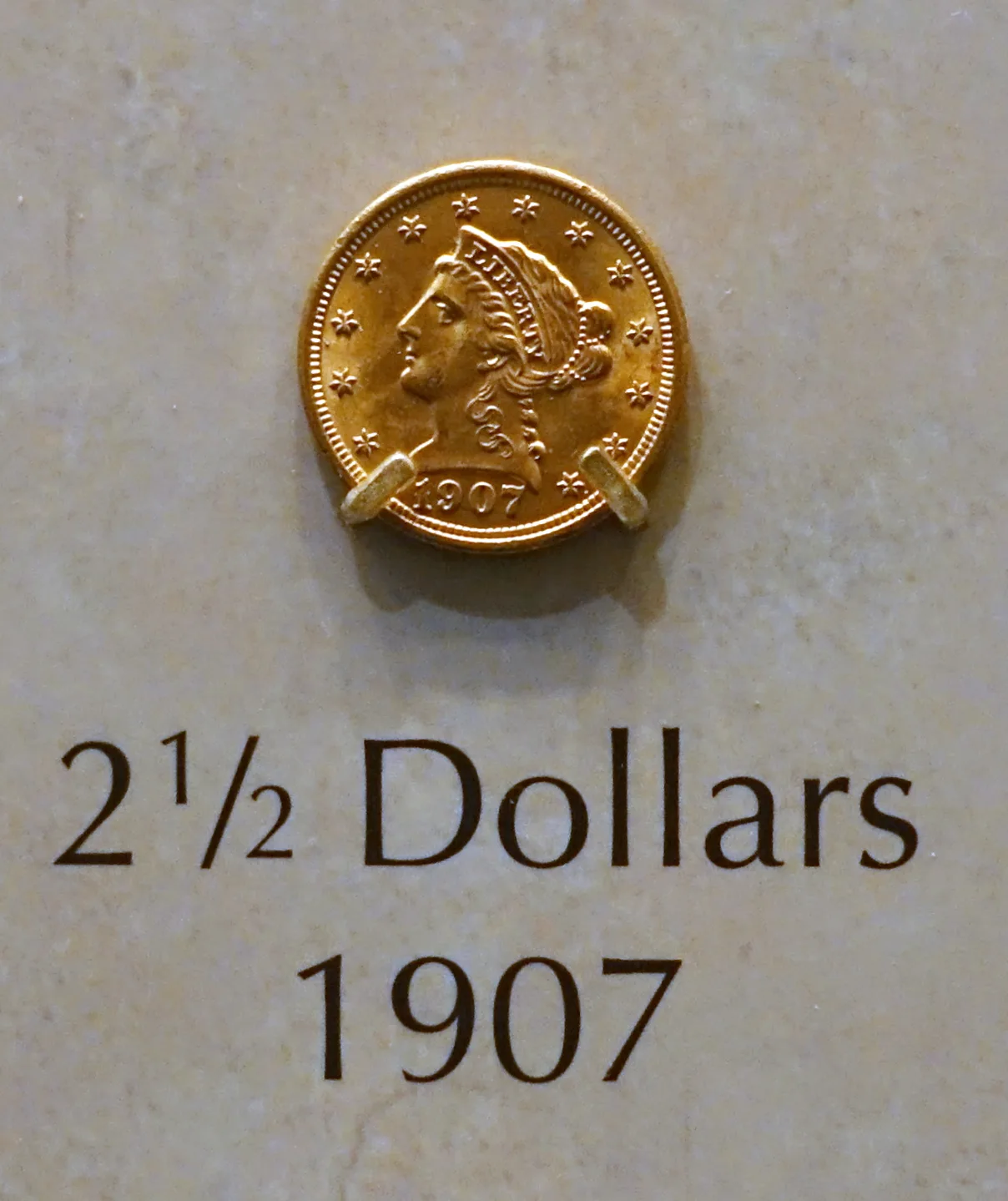
The specifications match the Pratt Indian Head Quarter Eagle that replaced this series in 1908 exactly — same weight, fineness, and diameter. The two designs are functionally interchangeable as bullion. At 2026 gold prices, the bullion content of a Coronet Quarter Eagle runs roughly $245-$260. Common dates carry numismatic premiums of 1.5x to 2x bullion in low grades, with key dates and high-grade examples climbing into five and six figures.
Mint Marks: Five Mints, Five Locations
The Liberty Head Quarter Eagle was struck at five US mints over its 68-year run, more than any other quarter eagle design and matching the Liberty Head Half Eagle’s mint diversity. Each mint mark appears below the eagle on the reverse, between the tail feathers and the denomination.
- No mint mark — Philadelphia (1840-1907): The main mint, struck Quarter Eagles every year of the series
- C — Charlotte, North Carolina (1840-1860): Southern branch mint that processed local gold from the North Carolina goldfields
- D — Dahlonega, Georgia (1840-1859): Southern branch mint that processed local gold from the Georgia goldfields; not to be confused with the Denver “D” used on the 1911-D Pratt Quarter Eagle (Dahlonega closed in 1861, Denver opened in 1906)
- O — New Orleans, Louisiana (1839-1857): Gulf Coast mint, struck Quarter Eagles in select years
- S — San Francisco, California (1854-1907): Pacific mint that opened to process gold rush bullion
The “D” Mint Mark: Dahlonega vs Denver
This is one of the most common collector confusions. Both Dahlonega (1838-1861) and Denver (1906-present) used a “D” mint mark on gold coinage. They never overlapped — Dahlonega closed in 1861 during the Civil War, and Denver did not begin striking coins until 1906. For Liberty Head Quarter Eagles dated 1840-1859, “D” means Dahlonega. The Coronet Quarter Eagle was never struck at Denver. (Denver’s first Quarter Eagle was the 1911-D Pratt Indian Head — see our separate Indian Head Quarter Eagle guide for that issue.)
Locating the Mint Mark
The mint mark sits below the eagle on the reverse, between the eagle’s tail feathers and the “2 1/2 D.” denomination. Use 5x to 10x magnification to confirm. On worn coins, especially Charlotte and Dahlonega issues with naturally weak strikes, the mint mark may be faint — but it should be present and consistent with the date.
The 1848 CAL. Counterstamp: America’s First Commemorative
One of the most extraordinary issues in all of US numismatics is the 1848 CAL. counterstamped Quarter Eagle. It is universally recognized as the first official commemorative coin of the United States — predating the Columbian Half Dollar of 1892 by 44 years.
The Story
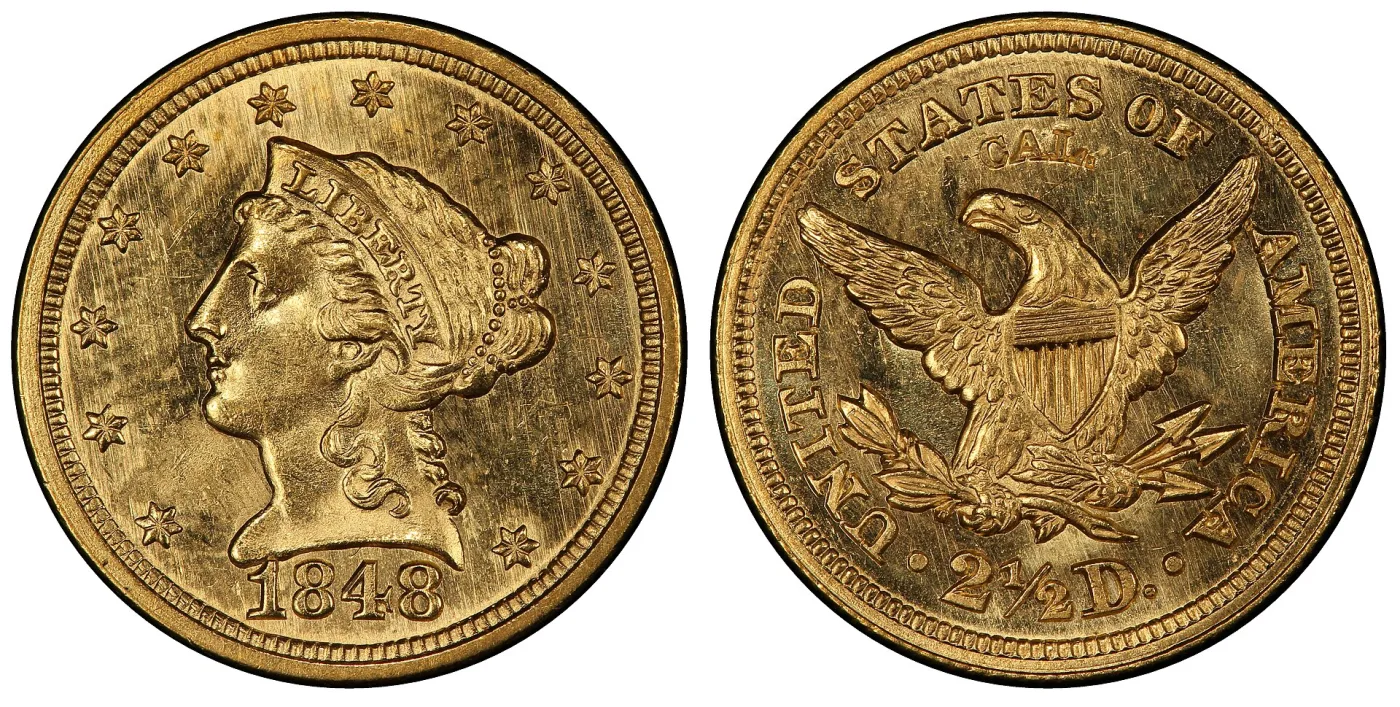
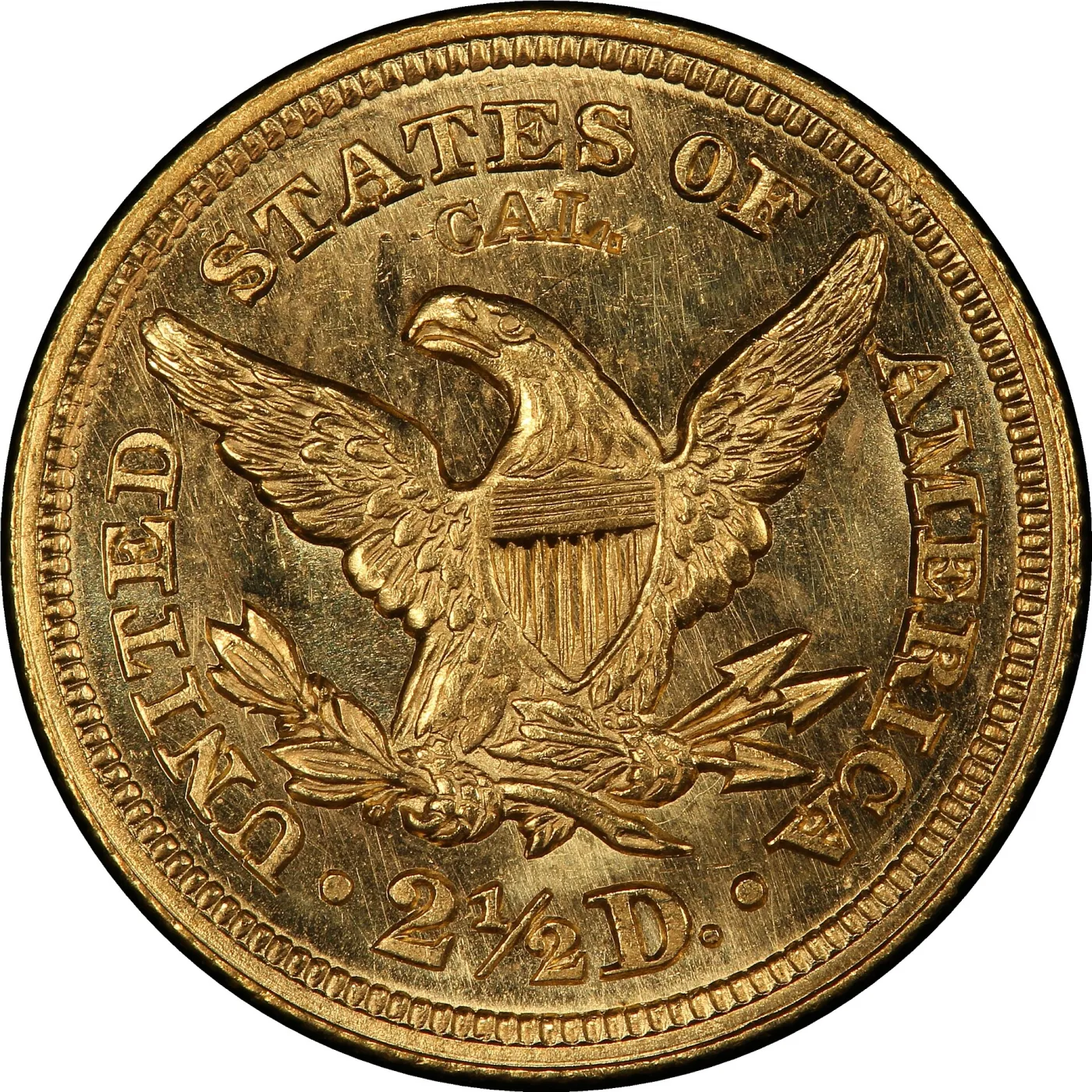
In November 1848, Colonel Richard Barnes Mason — the military governor of California — sent 230 ounces of gold dust from the newly discovered California goldfields to Secretary of War William L. Marcy in Washington. Marcy in turn forwarded the gold to the Philadelphia Mint with instructions to strike it into Quarter Eagles. The Mint produced 1,389 Quarter Eagles from this first official shipment of California gold. To distinguish these coins, Mint Director Robert Patterson ordered them counterstamped with the letters “CAL.” in the reverse field above the eagle, just above the wings.
The counterstamp was applied to the finished coins (struck from regular 1848 dies) before they left the Mint. The work was done by hand with a punch, which is why the placement and depth of the “CAL.” can vary slightly across surviving examples. All 1,389 pieces are believed to have been counterstamped; surviving population today is estimated at 200-300 across all grades.
Authentication
The 1848 CAL. is so valuable — current AU prices exceed $50,000, with MS examples bringing $200,000+ — that counterfeit counterstamps are common. Authentication requires:
- Genuine 1848 host coin: The counterstamp was applied only to legitimate 1848 Philadelphia Quarter Eagles, not Charlotte, Dahlonega, or any other date
- Counterstamp placement: “CAL.” sits above the eagle’s wings in the reverse field, with characteristic letter spacing that has been documented by PCGS and NGC reference photos
- Strike characteristics: A genuine counterstamp displaces the metal of the host coin slightly, creating a faint “raised ring” around the punched letters. Cast or applied fake counterstamps lack this metal displacement
- Certified-only purchase: No 1848 CAL. should be purchased raw under any circumstances. PCGS, NGC, or ANACS certification is mandatory
Many genuine 1848 Quarter Eagles without the CAL. counterstamp were struck the same year — those are worth about $1,500-$3,000 in AU. The 30x+ price premium of the CAL. version makes counterfeiting almost inevitable, and the literature on fake CAL. counterstamps fills entire chapters in modern counterfeit detection references.
The 1841 Little Princess
The 1841 Quarter Eagle — known to collectors as the “Little Princess” — is one of the great mysteries of US numismatics. No Mint records exist for any circulation strike Quarter Eagles in 1841. The Philadelphia Mint’s annual report listed zero quarter eagles struck that year. Yet somewhere between 15 and 20 examples are known today.
The Theory
The accepted explanation is that the 1841 Quarter Eagles were produced as proofs for collectors or VIPs, possibly as part of the Mint’s first true “proof sets” of the early 1840s. The Mint did not officially sell proof sets to the public until 1858, but it did strike small quantities of presentation-quality coins in earlier years for officials, dignitaries, and well-connected collectors. The 1841 Quarter Eagle is believed to be one of these unofficial proofs.
The Nickname
The “Little Princess” nickname dates from the late 19th century and likely refers to the small size and beauty of the date relative to its great rarity — Liberty as a “little princess” of the series. The name appears in numismatic literature from the 1880s onward and has stuck ever since.
Identification
The 1841 Little Princess shows characteristics consistent with proof striking: mirrored fields, sharp design details, fully struck stars, and squared rims. It exists in only one variety. Surviving examples are mostly in PR-55 to PR-63 grades, with a few PR-64 and PR-65 examples known. Recent auction results have brought $300,000 for PR-58 examples and over $750,000 for PR-64 examples.
What to Verify
Any 1841 Quarter Eagle requires immediate certified-only authentication. Counterfeits exist that alter genuine 1844 or 1847 Quarter Eagles’ dates. Authentication relies on diagnostic die markers documented by PCGS and NGC, the specific proof surface characteristics, and provenance research. A claimed raw 1841 Quarter Eagle is almost certainly fake.

Key Dates and Semi-Keys
The Liberty Head Quarter Eagle series contains dozens of date-and-mintmark combinations across 68 years and five mints. The following are the most significant rarities beyond the 1848 CAL. and 1841 Little Princess covered above.
1854-S — San Francisco First Year
Mintage 246 pieces. Only the first year of San Francisco Quarter Eagle production, and one of the lowest mintages in the entire US gold series. Surviving population is estimated at 12-15 examples. Auction prices for VF-EF examples typically exceed $250,000, and Mint State examples — when they appear — bring over $1 million.
1856-D — Dahlonega Key
Mintage 874 pieces. The lowest-mintage Dahlonega Quarter Eagle. Survivors number perhaps 40-60 across all grades, mostly in VF-EF condition due to circulation in the South. EF-40 examples bring $30,000-$45,000; AU-58 brings $80,000-$120,000; Mint State examples are essentially unobtainable.
1875 — Proof and Business Strike Key
Mintage 400 business strikes plus 20 proofs. The 1875 was struck in tiny numbers because gold coinage had effectively withdrawn from circulation after the Civil War’s silver-gold disruption. Both the business strike and proof are major keys. Business strike survivors number perhaps 100, with proofs around 12-15. AU prices run $30,000-$45,000; MS-63 around $80,000+.
1881 — Low Mintage
Mintage 640 business strikes plus 51 proofs. A semi-key that has been climbing in price as collectors recognize how few survive. AU-58 around $5,000-$7,500; MS-63 around $20,000.
1885 — Low Mintage
Mintage 800 business strikes plus 87 proofs. Another low-mintage date that is surprisingly tough in higher grades. AU-58 around $4,500-$6,000; MS-63 around $18,000.
1842-C Small Date
A famous Charlotte variety. The 1842-C exists with two date sizes — Small Date and Large Date. The Small Date is far rarer, with surviving population estimated at 25-35 examples. EF-40 brings $25,000-$35,000.
1846-O
Mintage 4,808 pieces. New Orleans struck Quarter Eagles in only six years, and the 1846-O is the lowest-mintage of those years that is collectible (the 1845-O was 4,000 but few survive; the 1846-O has slightly better survival). AU prices run $4,500-$6,000.
Civil War Rarities: 1864 and 1865
The Civil War (1861-1865) profoundly disrupted US gold coinage. Both Confederate and Union populations hoarded gold as a hedge against currency uncertainty, and the suspension of specie payments by the Treasury in December 1861 meant gold coins effectively withdrew from active commerce. The Mint continued striking gold for institutional and international use, but mintages collapsed.
1864 — Mintage 2,824
One of the rarest Civil War-era Quarter Eagles. AU-58 prices run $8,000-$12,000; MS-63 around $30,000+. Most surviving examples are in EF to AU grades, having been held by Mint officials or institutional collectors and never circulated.
1865 — Mintage 1,520
Even rarer than 1864. AU-58 brings $12,000-$18,000; MS-63 around $45,000+. Survival rate is poor, with most known examples in mid-grade condition.
1863 — Proof Only
The 1863 Quarter Eagle exists only as a proof, with a recorded mintage of 30 pieces. No 1863 business strikes were produced. Surviving examples number perhaps 20, and PR-63 prices exceed $100,000. The 1863 is one of only three proof-only dates in US Quarter Eagle coinage (along with the 1841 Little Princess and elements of the 1875 issue).
Civil War Quarter Eagles parallel the Civil War rarities in the Liberty Head Half Eagle and the Liberty Head Double Eagle series, which also have ultra-low mintages from 1861-1865.
Branch Mint Issues: Charlotte and Dahlonega
The Charlotte (C) and Dahlonega (D) mints existed because of the gold strikes in North Carolina and Georgia in the early 19th century. Both mints opened in 1838 and operated until the Civil War: Charlotte closed in May 1861 when Confederate forces seized it, and Dahlonega closed in June 1861 for the same reason. Neither reopened after the war. Their Quarter Eagle production spanned 1839-1860 (Charlotte) and 1839-1859 (Dahlonega).
Why Branch-Mint Gold Matters
Charlotte and Dahlonega Quarter Eagles command premiums over Philadelphia issues of the same date for two reasons: low mintages (typically 5,000-30,000 per year, sometimes lower) and historical significance as the product of the Southern gold rush era. They also tend to be more weakly struck than Philadelphia issues — the branch mints used older, less powerful presses and had less skilled die-sinkers — which means high-grade examples are rare.
Survival Rates
Branch-mint Quarter Eagles circulated heavily in the South before the Civil War and were widely melted during and after the war for the gold content. Survival rates are accordingly low: perhaps 5-10% of original mintages survive in collectible grades, compared to 15-30% for Philadelphia issues. This makes even “common” branch-mint dates surprisingly scarce.
Charlotte Highlights
Total Charlotte Quarter Eagle production was about 200,000 pieces across 1839-1860. Most years had mintages under 15,000. Notable issues include the 1842-C Small Date (covered above), the 1846-C (4,808 mintage), the 1855-C (3,677 mintage), and the 1860-C (final year, 7,469 mintage). Charlotte issues typically show characteristic strike softness on the obverse stars and Liberty’s hair, and on the reverse eagle’s wing tips.
Dahlonega Highlights
Total Dahlonega Quarter Eagle production was about 175,000 pieces across 1839-1859. Notable issues include the 1856-D key (covered above), the 1855-D (1,123 mintage — second lowest), the 1840-D (3,532), and the 1841-D (4,164). Dahlonega’s strikes are even softer than Charlotte’s — the central detail is often almost flat on otherwise high-grade coins. PCGS and NGC grade Dahlonega Quarter Eagles with technical (not strike-adjusted) grades, but the market discounts soft strikes.
Authentication for Branch Mint Issues
Counterfeit Charlotte and Dahlonega Quarter Eagles are common — perhaps the most heavily counterfeited US gold coinage. Many counterfeits are altered Philadelphia coins with the mint mark added by jewelry punches or graphic engravers. All branch-mint Quarter Eagles should be purchased only in PCGS or NGC holders.
Grading the Coronet Design
Grading Liberty Head Quarter Eagles requires attention to specific design points that wear in characteristic order.
Key Wear Points — Obverse
Wear typically appears first on Liberty’s hair above the eye, then on the hair curls at the back of the head, and finally on the bun and the cheek. The stars on the periphery wear last on the obverse — they are protected by the rim and tend to show full radial lines well into VF territory.
Key Wear Points — Reverse
The eagle’s neck feathers and wing tips wear first. Then the shield horizontal lines flatten. The wreath details on the eagle’s olive branch lose definition in lower grades. The lettering UNITED STATES OF AMERICA tends to remain crisp through EF grades because of rim protection.
Grade Definitions
- VG-8: Major design outlines clear; some hair detail visible above ear; LIBERTY readable on coronet
- F-12: All major details defined; coronet LIBERTY full; partial hair detail visible
- VF-20: Hair shows multiple curls; eagle’s wing feathers separated; full stars
- EF-40: Most hair detail clear; only slight wear on highest points; sharp star centers
- AU-50: Slight wear on Liberty’s cheek and the eagle’s neck feathers; most original luster present
- AU-58: Trace wear; nearly full luster; the popular “slider” grade before the jump to Mint State
- MS-60: No wear; heavy bag marks acceptable
- MS-63: Average bag marks; strong strike; clean fields
- MS-65 and above: Gem quality, minimal marks, full strike — scarce in this series, especially for branch mint issues
Strike Quality
Strike quality varies dramatically by mint. Philadelphia issues are typically well-struck. Charlotte and Dahlonega issues are usually weakly struck, with soft central detail even on otherwise high-grade coins. San Francisco issues from the 1850s-1870s often show prooflike fields (an early die state phenomenon) but soft eagle detail. A weakly struck Coronet Quarter Eagle is technically the same grade as a fully struck one, but the market values strong strikes at a 20-50% premium for high grades.
Authentication and Counterfeit Detection
The Liberty Head Quarter Eagle is among the most heavily counterfeited US gold coins. The 68-year run produces many dates with strong demand and modest values, making counterfeit production profitable. Lebanese counterfeits of the 1960s-1970s and Chinese counterfeits of the 2000s-present both target this series extensively.
Weight and Specific Gravity
Authentic Coronet Quarter Eagles weigh 4.18 grams (±0.04 grams tolerance). Specific gravity is approximately 17.16. A coin weighing under 4.10 or over 4.25 is suspicious. Base-metal counterfeits typically fail weight tests immediately; gold-plated tungsten counterfeits may pass weight but fail specific gravity.
Diameter
The coin should measure exactly 18.0 mm in diameter. Use a digital caliper for verification.
Edge Reeding
Authentic Coronet Quarter Eagles have a specific reed count and pattern that has been documented by reference works. Cast counterfeits often show fuzzy or uneven reeds.
Date and Mintmark Alteration
The most common counterfeit method for this series is altering a common-date coin to a rare date or adding a mint mark to a Philadelphia coin. Watch for:
- Tooling marks around the date digits or mint mark under 10x magnification
- Date or mint mark that appears slightly raised, soft, or differently colored than surrounding fields
- Discrepancy between the strike characteristics and the claimed mint (a coin claimed as Dahlonega but with sharp Philadelphia-style strike)
- Wrong die markers — every genuine date/mintmark has documented die diagnostics in PCGS, NGC, and Bass-Dannreuther references
Lebanese and Chinese Counterfeits
Lebanese counterfeits (1960s-1970s) are typically struck in genuine gold of approximately 90% fineness and pass weight tests. They are diagnosed by subtle die differences from Mint products. Chinese counterfeits (2000s-present) range from crude (failing weight and visual inspection) to sophisticated (passing weight, gold tests, and superficial visual inspection but failing detailed die-marker analysis).
Third-Party Grading
Any Coronet Quarter Eagle worth more than $500 should be in a PCGS, NGC, or ANACS holder. For branch-mint issues, the 1848 CAL., 1841 Little Princess, 1854-S, 1856-D, 1875, and all Civil War dates, certified status is essentially mandatory.
Jewelry Damage and Mount Removal
Quarter Eagles were extraordinarily popular as jewelry coins throughout the late 19th and early 20th centuries. The small 18mm size made them ideal for pendants, brooches, charm bracelets, watch fobs, and stickpins. Mid-Victorian and Edwardian jewelers especially favored the Coronet design for its delicate Liberty profile.
Common Damage Types
- Soldered loops or bezels: Most common damage — a loop attached at the 12 o’clock position
- Removed loops: A flattened or filed area at 12 o’clock with possible solder residue
- Edge filing: From bezel sizing or removal
- Polished surfaces: Bright, unnatural luster from jewelry polishing
- Engraved monograms or dates: Catastrophic for value — common on Victorian “love token” coins
A Coronet Quarter Eagle with any of these damage types will not grade at PCGS or NGC and is typically worth bullion plus a small premium ($300-$400 in 2026). The same jewelry damage concerns apply to Gold Dollars and the smaller Three Dollar Gold, which were even more often used in jewelry due to their smaller size.
Current Market Values and Price Guide
Liberty Head Quarter Eagle prices in 2026 reflect strong demand for branch-mint and key-date issues, with common dates trading at modest premiums over bullion.
Common Dates (1900-1907)
- VF-20: $385-$425
- EF-40: $425-$465
- AU-50: $465-$525
- AU-58: $525-$625
- MS-60: $625-$750
- MS-62: $800-$1,000
- MS-63: $1,100-$1,400
- MS-64: $2,200-$3,000
- MS-65: $6,500-$9,000
Better Common Dates (1878, 1888-1899)
Premiums of 10-25% over the late common dates above. The 1878, 1888, 1889, 1890, 1891, and 1892 are slightly less common than the 1900-1907 issues.
1848 CAL. Counterstamp
- VF-30: $35,000-$45,000
- EF-45: $55,000-$75,000
- AU-58: $90,000-$125,000
- MS-62: $180,000-$240,000
- MS-64: $400,000-$550,000
1841 Little Princess
- PR-55: $250,000-$300,000
- PR-60: $350,000-$450,000
- PR-63: $550,000-$700,000
- PR-64: $750,000-$1,000,000+
1854-S
- VF-30: $200,000-$275,000
- EF-45: $350,000-$450,000
- AU-55: $600,000-$850,000
- MS-62: $1,500,000+
1856-D
- VF-30: $18,000-$24,000
- EF-40: $32,000-$42,000
- AU-50: $55,000-$75,000
- AU-58: $90,000-$130,000
1875
- VF-30: $22,000-$28,000
- EF-45: $32,000-$42,000
- AU-58: $55,000-$70,000
- MS-63: $85,000-$110,000
- PR-63 (proof): $100,000-$140,000
Civil War Dates
- 1864 AU-58: $8,000-$12,000; MS-63 around $30,000+
- 1865 AU-58: $12,000-$18,000; MS-63 around $45,000+
- 1863 PR-63: $100,000+
Proof Issues (1858-1907)
Proof Quarter Eagles were struck most years from 1858 onward in small numbers (typically 50-200 per year, with some years lower). PR-63 prices typically run $5,000-$10,000 for non-key years, with PR-65 examples bringing $12,000-$25,000 and ultra-gems above $50,000. Cameo and Deep Cameo designations carry significant additional premiums.
Building a Collection
Type Set Approach
For a US type set, a single Coronet Quarter Eagle in AU-58 or MS-62 grade satisfies the slot for the denomination. Cost is $525-$1,000 depending on date and grade selection. Common dates from 1900-1907 are the typical choice. The companion Indian Head Quarter Eagle fills the post-1907 slot for collectors who want to show both designs.
Date Set: 1840-1907
A complete date set (Philadelphia only) requires 68 coins. In matched AU-58 grades, expect $50,000-$80,000 total, with the 1841 Little Princess, 1854-S, 1864, 1865, and 1875 representing the bulk of the cost. Most date set collectors omit the 1841 and accept the 1854-S as a placeholder cost issue.
Mint Set
A complete mint set — one example from each of Philadelphia, Charlotte, Dahlonega, New Orleans, and San Francisco — is achievable in matched AU grades for $5,000-$10,000 if you pick common dates from each mint. This is a popular intermediate goal.
Complete Date and Mintmark Set
The full set across all five mints and 68 years contains approximately 150 issues. Total cost in matched AU-58 grades runs $400,000-$700,000, with the great keys (1841, 1848 CAL., 1854-S, 1856-D, 1875, the Civil War rarities, and proof-only dates) accounting for most of the total. Few collectors complete the full set; most assemble subsets by mint or by decade.
Civil War Era Subset
The 1861-1865 dates form a popular five-coin subset capturing the Civil War rarities. Total cost in matched AU grades runs $35,000-$60,000 depending on whether the 1863 proof is included.
Storage and Preservation
Coronet Quarter Eagles share the storage requirements of all classic US gold but with a few series-specific considerations.
Best Practices
- PCGS or NGC holders: The best protection for any meaningful Coronet Quarter Eagle. Sealed encapsulation prevents environmental exposure and copper-spot formation
- Inert Mylar 2x2 flips: Acceptable for raw common-date coins. Avoid PVC flips — PVC degradation produces residue that bonds to gold’s copper alloy and can be very difficult to remove without damaging the surface
- Single coin tubes: Not recommended — coins rubbing against each other in tubes produce friction marks that reduce grade
- Climate control: 40-50% relative humidity, 65-72°F. Avoid attics, basements, and bathrooms. Sustained high humidity can cause “copper spots” on the surface of even high-grade pieces, particularly common dates from the 1900s
- Never clean: A cleaned Coronet Quarter Eagle will not grade at PCGS or NGC. Acid dips, polishing cloths, and ultrasonic cleaning all destroy surface luster and create hairline marks visible under magnification
The same disciplined storage approach that protects Saint-Gaudens Double Eagles and Liberty Head Double Eagles applies to the smaller denomination, with extra attention to humidity control because the higher copper-to-gold surface area ratio makes spotting more likely on this denomination.
Frequently Asked Questions
What is the difference between the Liberty Head Quarter Eagle and the Indian Head Quarter Eagle?
Different designs, both $2.50 gold and 18mm. The Liberty Head (Coronet) Quarter Eagle was designed by Christian Gobrecht and struck from 1840-1907. The Indian Head Quarter Eagle was designed by Bela Lyon Pratt and struck from 1908-1929. The Coronet shows Liberty in raised relief; the Indian Head uses Pratt's revolutionary incused (sunken) design. They are the same denomination but distinct types.
What does "CAL." on an 1848 Quarter Eagle mean?
CAL. stands for California. The counterstamp was applied at the Philadelphia Mint to 1,389 Quarter Eagles struck from the first shipment of California gold sent east by Colonel Richard Mason in November 1848. It is the first official commemorative coin of the United States.
How can I tell a real 1848 CAL. from a counterfeit?
Authentication requires PCGS, NGC, or ANACS certification. Diagnostic factors include the genuine 1848 host coin, specific counterstamp placement above the eagle's wings, metal displacement around the punch (a faint raised ring), and provenance research. No 1848 CAL. should be purchased raw under any circumstances.
What is the 1841 Little Princess?
The 1841 Quarter Eagle is a proof-only date with no Mint records of business strikes. Survivors number 15-20 across all grades. The "Little Princess" nickname dates from the late 19th century and refers to the small size of the coin relative to its great rarity. Authentication requires PCGS or NGC certification.
Were Liberty Head Quarter Eagles affected by the 1933 gold recall?
Technically yes, but in practice very few were turned in. The denomination had largely passed into collections, jewelry, and private holdings by 1933, and Treasury returns of Quarter Eagles were minimal. This is why surviving populations for common Coronet dates are healthier than for the Saint-Gaudens Double Eagle series, which suffered massive 1933 melting.
Why do Charlotte and Dahlonega Quarter Eagles look weakly struck?
Both branch mints used older, less powerful coining presses and had less experienced die-sinkers than Philadelphia. The result is characteristic strike softness on central design elements — Liberty's hair on the obverse and the eagle's wing details on the reverse. This is original Mint condition, not wear, and high-grade examples can still be Mint State despite the weak strike.
Was the Liberty Head Quarter Eagle ever struck at Denver or Carson City?
No. The Coronet series ended in 1907, before Denver (1906 opening) struck its first Quarter Eagle. Carson City never struck Quarter Eagles in any series — the Nevada mint focused on silver and the larger gold denominations. The first Denver Quarter Eagle was the 1911-D Pratt Indian Head issue.
Does the Liberty Head Quarter Eagle have proof issues?
Yes. Proofs were struck from 1840 onward in tiny numbers for collectors and dignitaries, with regular public availability starting in 1858. Mintages typically ranged from 20-200 per year. All proof Coronet Quarter Eagles are scarce; many years are very rare. Major proof types include brilliant proof (mirrored), cameo proof (with contrasted devices), and deep cameo proof (sharp device contrast against fully mirrored fields).
What's the most affordable way to own a Coronet Quarter Eagle?
The most accessible entry is a common-date Philadelphia coin from 1900-1907 in EF or AU grade. Expect to pay $425-$625. This represents nearly pure gold value with a modest numismatic premium, and the coin is a genuine 19th-century-design US gold piece. From there, collectors typically expand to branch-mint examples, then to better dates, then to keys.