Indian Head Eagle Identification Guide: Key Dates, Types, Mint Marks, and Values
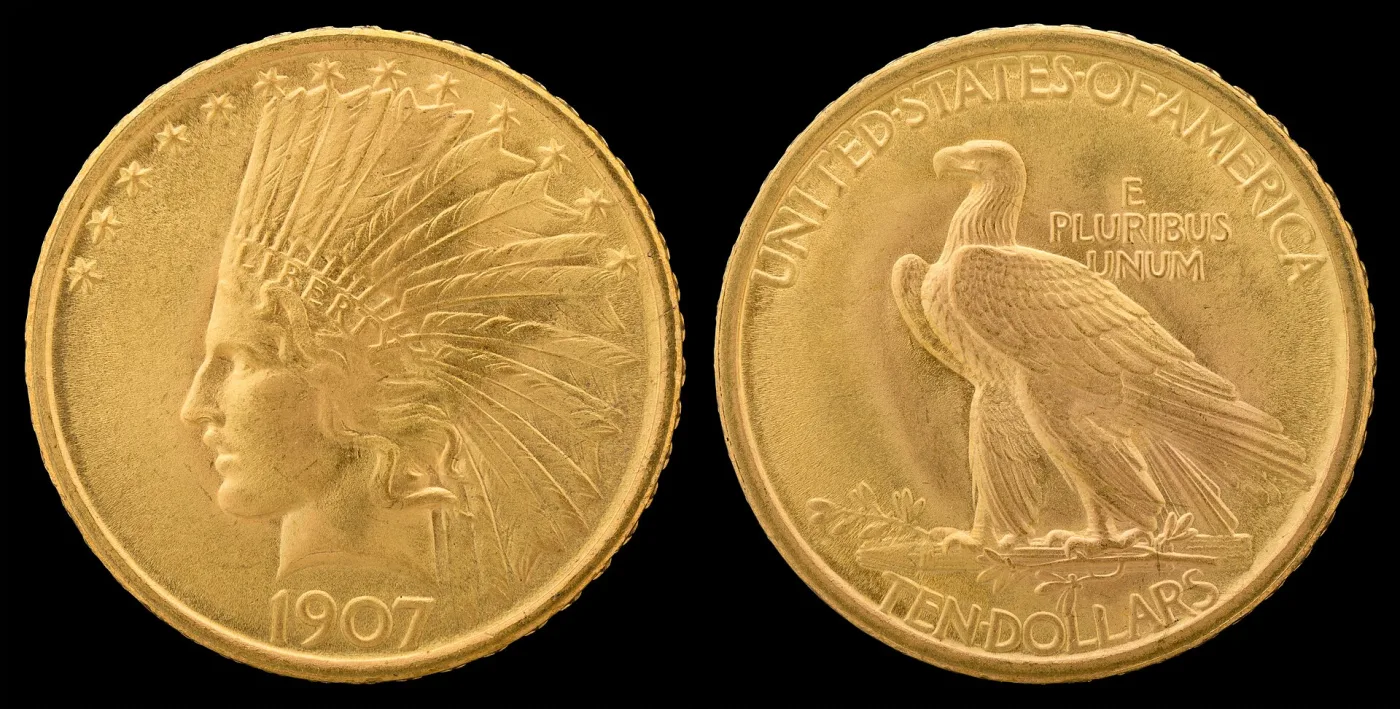
The Indian Head Eagle — the United States ten-dollar gold coin produced from 1907 through 1933 — is the lesser-known but equally artistic sibling of the famous Saint-Gaudens Double Eagle. Designed by sculptor Augustus Saint-Gaudens at the personal request of President Theodore Roosevelt, the $10 Eagle replaced the long-running Liberty Head Eagle of Christian Gobrecht — and its companion Liberty Head Half Eagle at $5 — and brought the same neoclassical artistic ambition to the half-ounce gold denomination. Where the Double Eagle depicts a striding figure of Liberty, the $10 Eagle gives America one of its most striking and most-debated obverses: a feminine head of Liberty wearing a full-feathered Indian war bonnet.
For collectors, the Indian Head Eagle occupies a sweet spot in US gold numismatics. Each coin contains 0.4838 troy ounces of pure gold — a meaningful bullion anchor at any gold price — and the series spans 26 years and three U.S. mints, with multiple major design subtypes, several legitimate rarities, and a famous 1933 issue tied to the same gold-recall story as its Double Eagle counterpart. Unlike the silver series produced in the same era such as the Walking Liberty Half Dollar or the Mercury Dime, the Indian Head Eagle carries substantial intrinsic precious-metal value, which protects buyers but also makes counterfeit awareness essential. The series is also frequently confused with Bela Lyon Pratt’s smaller incuse pair — the Indian Head Quarter Eagle ($2.50) and the Indian Head Half Eagle ($5) — all three of which share Native American imagery from the Roosevelt era, but the $10 Eagle uses Saint-Gaudens’ raised-relief Liberty in headdress while the Pratt $2.50 and $5 use a sunken-relief chief portrait.
This guide covers everything you need to identify, grade, and value Indian Head Eagles: the four major design types from the 1907 Wire Rim Periods through the 1908-1933 With Motto issues, the legendary 1933 Eagle (the rarest collectible issue), the major key dates including 1920-S and 1930-S, the Rolled Rim and Wire Rim distinctions of 1907, mint marks across Philadelphia, Denver, San Francisco, and New Orleans, current grading standards, authentication strategies, and 2026 market values. The same disciplined coin identification techniques that apply to silver classics extend directly to this gold series — with the added complication that bullion value floors common-date prices and raises stakes for accurate authentication of better dates.
History and Design: Roosevelt and Saint-Gaudens
The Indian Head Eagle was born from the same Roosevelt-Saint-Gaudens collaboration that produced the Double Eagle. In 1904, Theodore Roosevelt wrote to his Secretary of the Treasury complaining about the “atrocious hideousness” of contemporary American coinage and engaged Augustus Saint-Gaudens, the leading American sculptor of the era, to redesign every denomination. Saint-Gaudens accepted the commission despite being gravely ill with cancer, and he completed designs for both the $20 Double Eagle and the $10 Eagle before his death in August 1907 — making both gold coins among his final and most ambitious works.
Roosevelt’s original vision for the $10 Eagle was a simple feminine head of Liberty. Saint-Gaudens initially objected to adding a war bonnet — historically, Native American men wore feathered headdresses, not women — but Roosevelt insisted, writing to his Mint director: “I think it will be very attractive to put on it [Liberty] an Indian feather head-dress.” The resulting design fused classical Liberty with American Indian iconography in a way that has divided collectors and historians ever since: some find it the most beautiful American coin ever produced, others consider it historically incoherent. Either way, the design is unmistakable, and it remained essentially unchanged across all 26 years of production.
The Designer: Augustus Saint-Gaudens
Augustus Saint-Gaudens (1848-1907) was the most celebrated American sculptor of the Gilded Age. His major public works include the Robert Gould Shaw Memorial in Boston, the Sherman Monument at Central Park in New York, the Adams Memorial in Washington’s Rock Creek Cemetery, and the standing Lincoln in Chicago’s Lincoln Park. Like the Double Eagle, the $10 Eagle reflects Saint-Gaudens’s sculptural conception — treated as miniature relief sculpture rather than as engraving. The contrast with the workmanlike engraving style of Mint chief engraver Charles Barber — whose Liberty Head $10 design Saint-Gaudens’s coin replaced — could not be sharper.
The Mint’s engraving department, led by Barber, executed the production transition from Saint-Gaudens’s models into working dies. Barber’s involvement softened some of the sculptural depth in the original Saint-Gaudens designs and produced the workhorse “Rolled Rim” and subsequent issues that formed most production. The original Wire Rim 1907 examples — closest to Saint-Gaudens’s intent — remained an experimental release of just 500 coins.
Production Era and the End in 1933
Production ran from August 1907 through March 1933. The Indian Head Eagle witnessed the Panic of 1907, World War I, the Roaring Twenties, and the early Great Depression. Production ended abruptly in March 1933 when President Franklin D. Roosevelt’s Executive Order 6102 required Americans to surrender most gold coins to the Treasury. The 312,500 Eagles struck in 1933 were ordered melted along with all subsequent gold production — but unlike the Double Eagle of the same year, a small number of 1933 Indian Head Eagles were officially released into circulation before the recall took full effect, making the 1933 $10 legally collectible (in stark contrast to the legally complicated 1933 $20).
Design Details: Obverse and Reverse
Understanding every element of the Indian Head Eagle design is essential for type identification, grading, and authentication. The design carries several subtle differences across its 26-year production that distinguish the four major types.
Obverse (Heads Side)
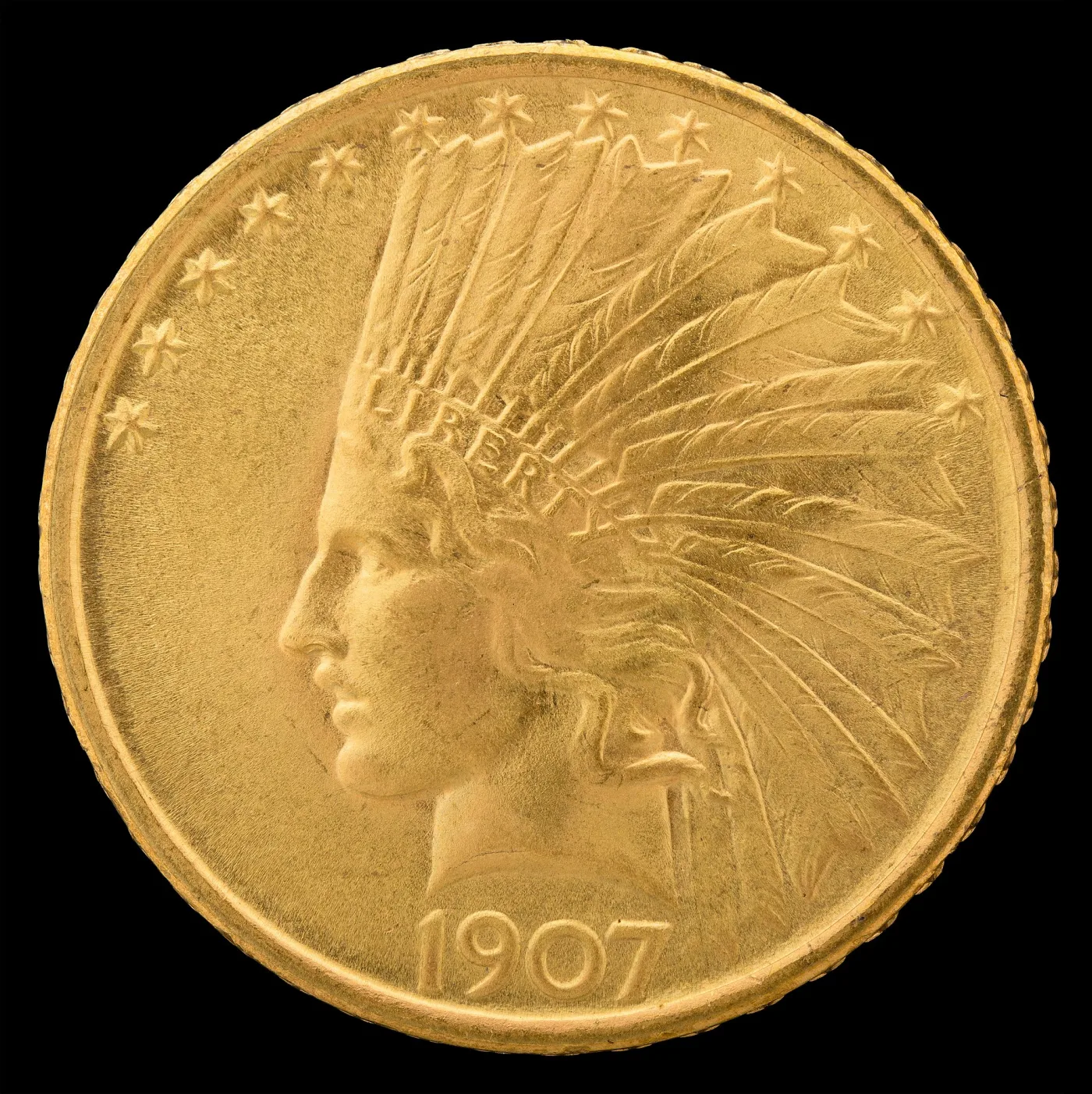
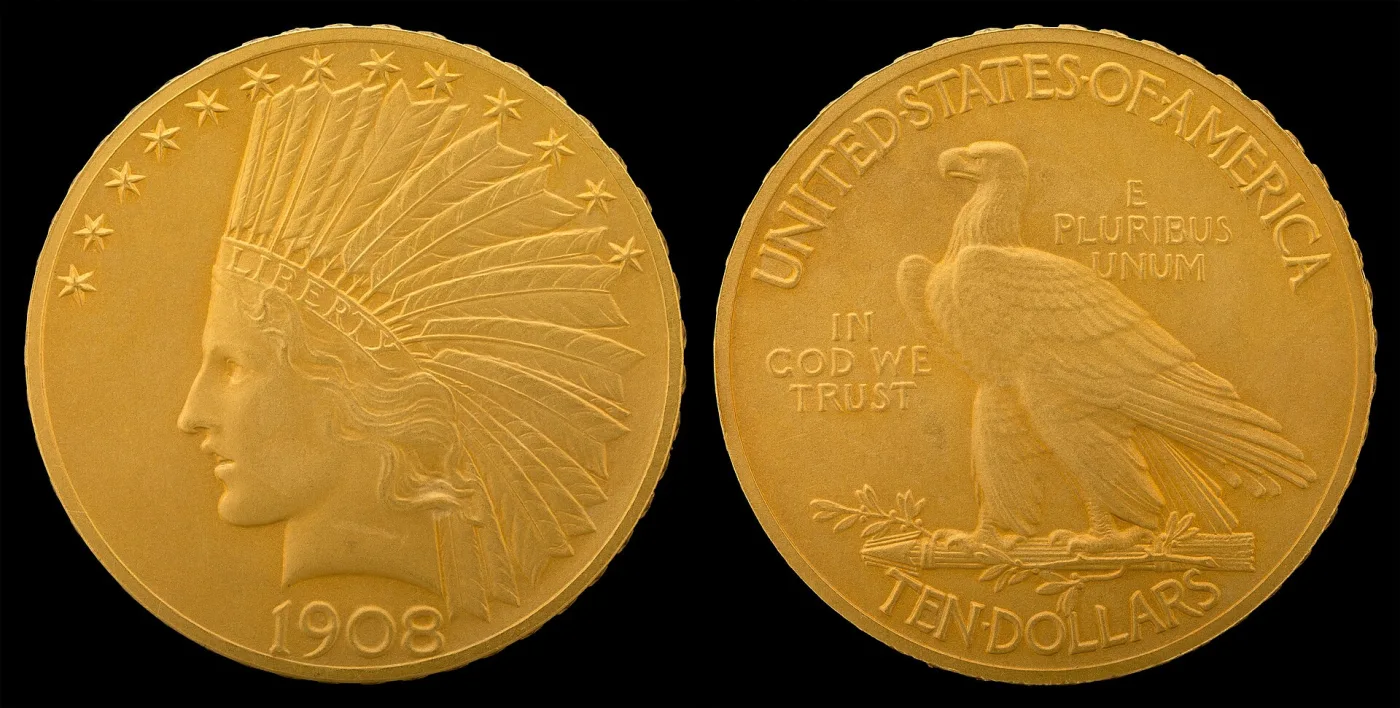
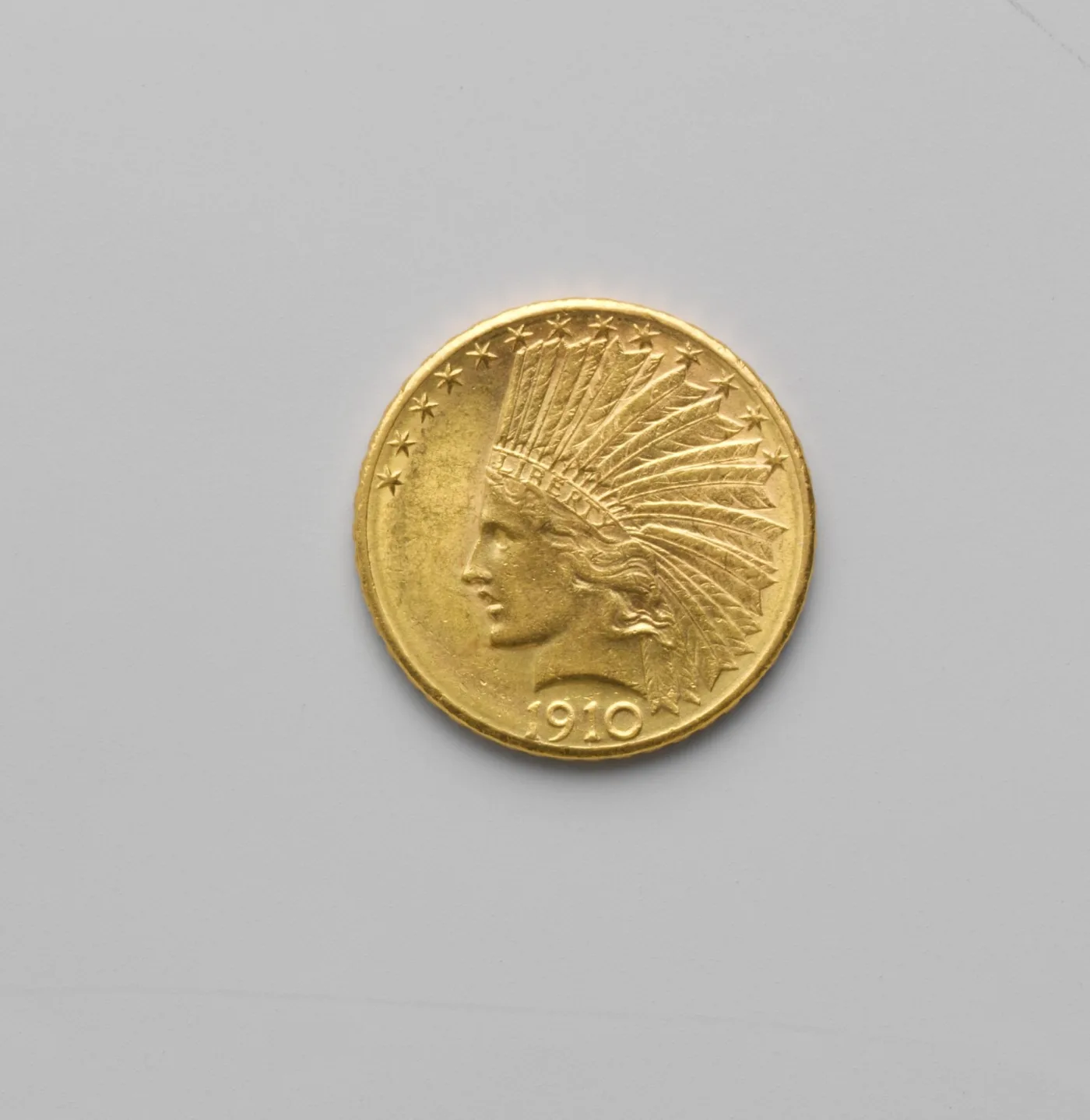
The obverse depicts a left-facing head of Liberty wearing a full-feathered Indian war bonnet. The band of the headdress is inscribed LIBERTY in raised letters. Above the head, in an arc near the upper rim, are thirteen stars representing the original colonies. Below the head appears the date. The portrait is detailed and three-dimensional, with hair flowing behind the headdress and individual feathers depicted across the upper field. The design unmistakably blends classical Liberty profile work (the facial features are entirely Greco-Roman in style) with American Indian regalia — an artistic decision that was Roosevelt’s, not Saint-Gaudens’s.
Reverse (Tails Side)
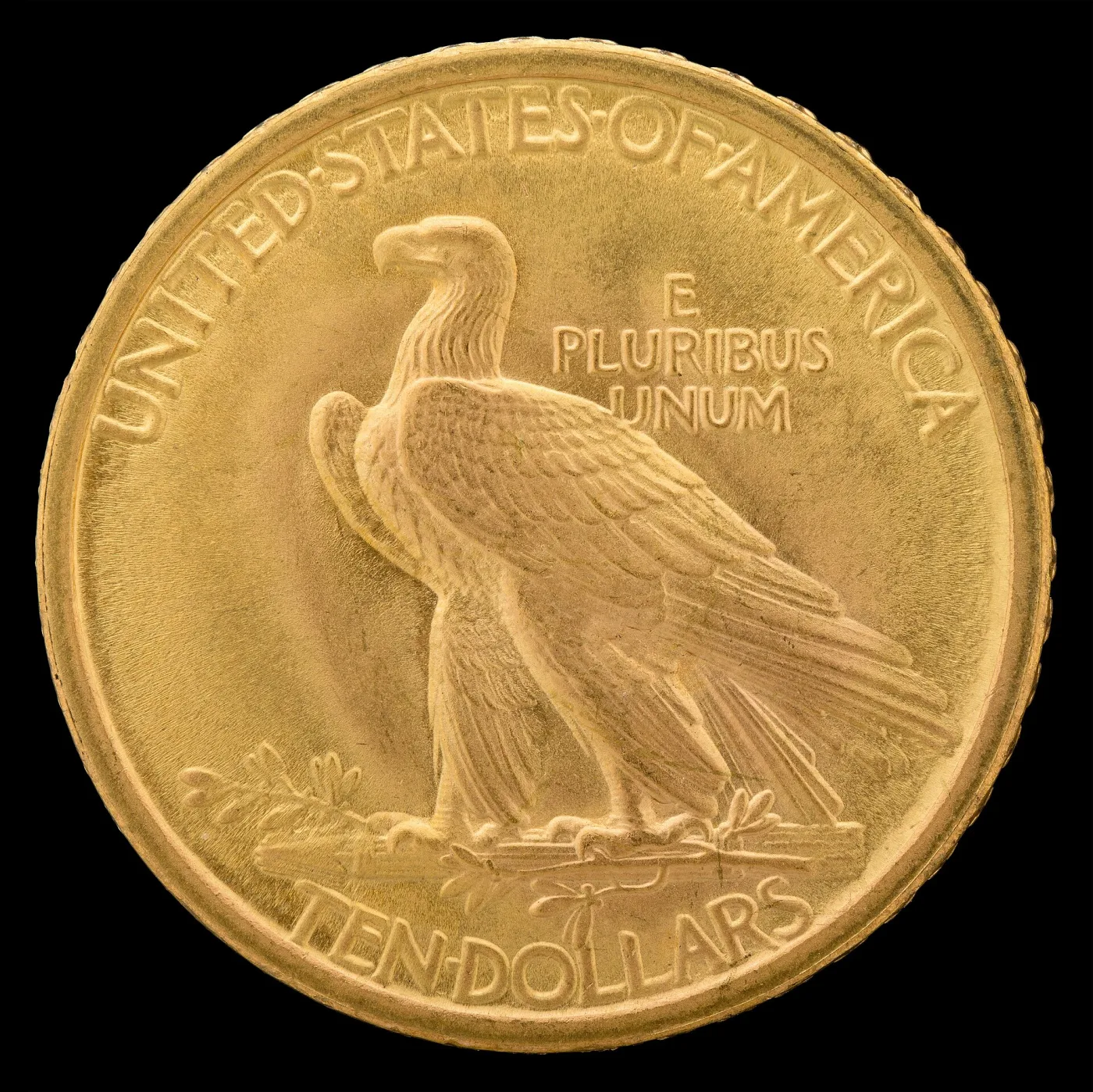
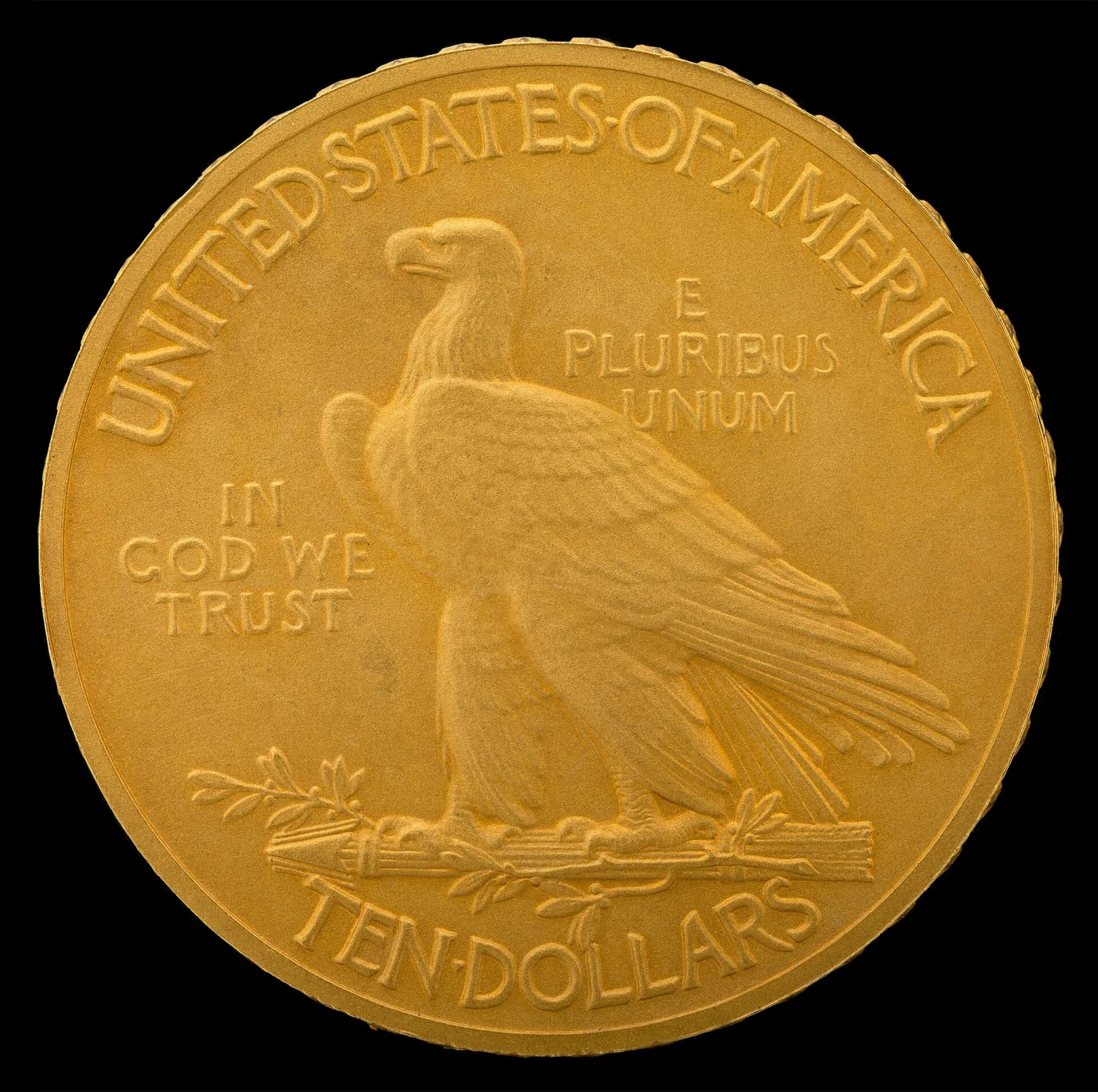
The reverse depicts a standing eagle, in profile facing left, perched on a bundle of arrows wrapped with an olive branch. The composition is taken directly from Saint-Gaudens’s design for the President of the United States’s official seal, and is one of the most carefully composed eagle figures in American coinage. The legend UNITED STATES OF AMERICA arches across the top, with the denomination TEN DOLLARS below the eagle — a value first carried, without any denomination marking at all, by the Capped Bust Eagle of 1795-1804. The motto E PLURIBUS UNUM appears in raised letters to the right of the eagle. From mid-1908 onward, the motto IN GOD WE TRUST appears to the left of the eagle.
Stars on the Edge
Unlike most US coins which have either reeded or plain edges, the Indian Head Eagle has an incused edge with stars rather than letters or reeds. The 1907 Wire Rim and Rolled Rim issues bear 46 stars on the edge representing the 46 states in the Union at issuance. Beginning in 1912, the edge was changed to 48 stars reflecting New Mexico and Arizona statehood. This 46-to-48 star edge transition is one of the diagnostic features of the series and helps date worn examples without legible obverse dates — though examining the edge requires removing the coin from its holder, which most collectors avoid.
Mint Mark Position
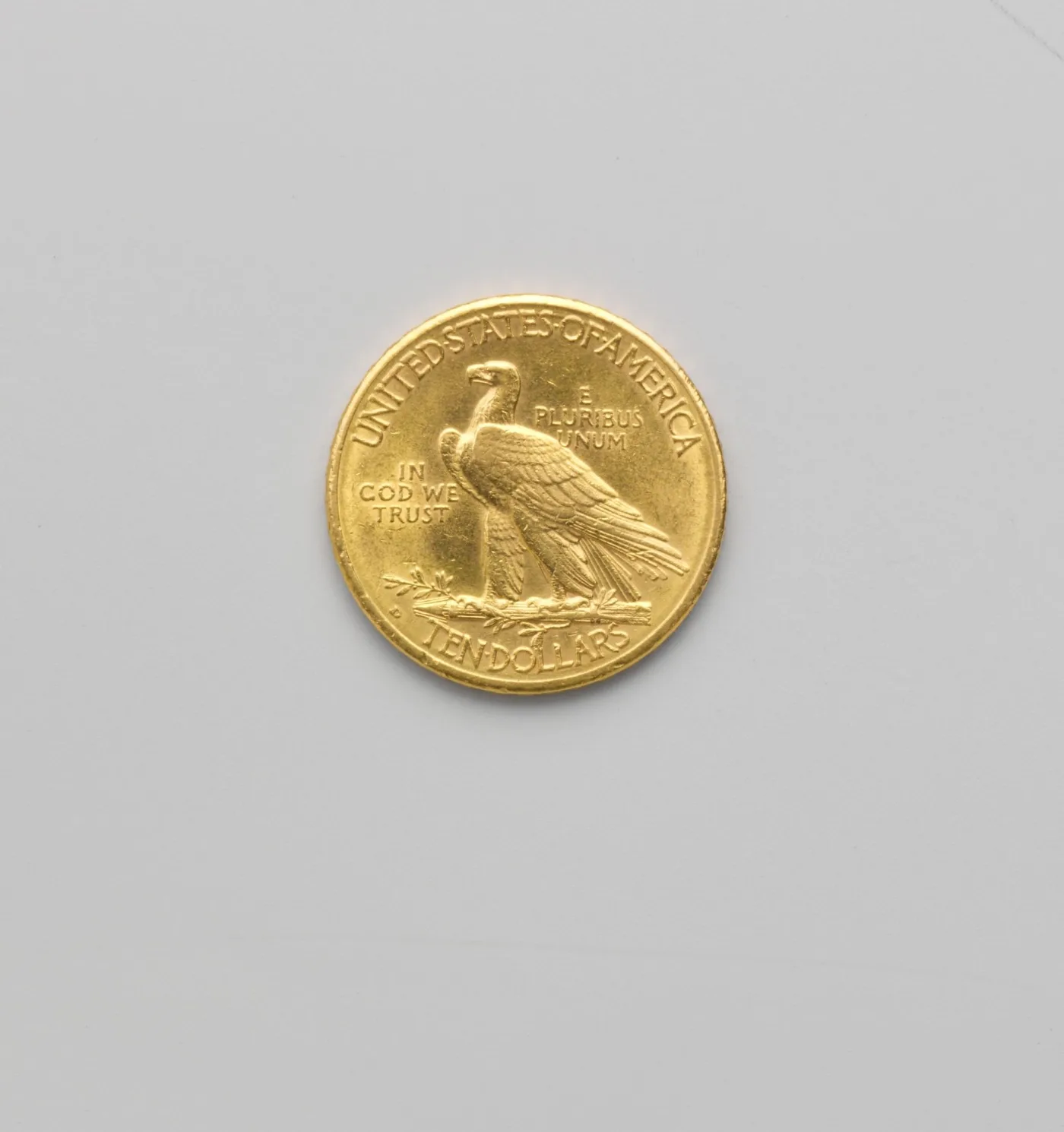
Mint marks (D for Denver, S for San Francisco, O for New Orleans) appear on the reverse at the left of the eagle, just above and to the left of the talons. The position is consistent across all branch-mint issues. Philadelphia issues bear no mint mark, as is traditional for U.S. coinage of the era.
The Four Major Types: 1907-1933
Indian Head Eagles divide into four distinct types based on rim characteristics, edge inscription, and reverse motto. Type identification is fundamental for collectors — type-set buyers pursue one example of each, and prices vary enormously between the rare 1907 experimentals and the workhorse production issues. The $20 denomination went through the same upheaval in the same year, and for the same reasons; the 1907 double eagle guide sets out how the relief experiments and the missing motto play out there.
Type 1: 1907 Wire Rim, Periods (No Motto)
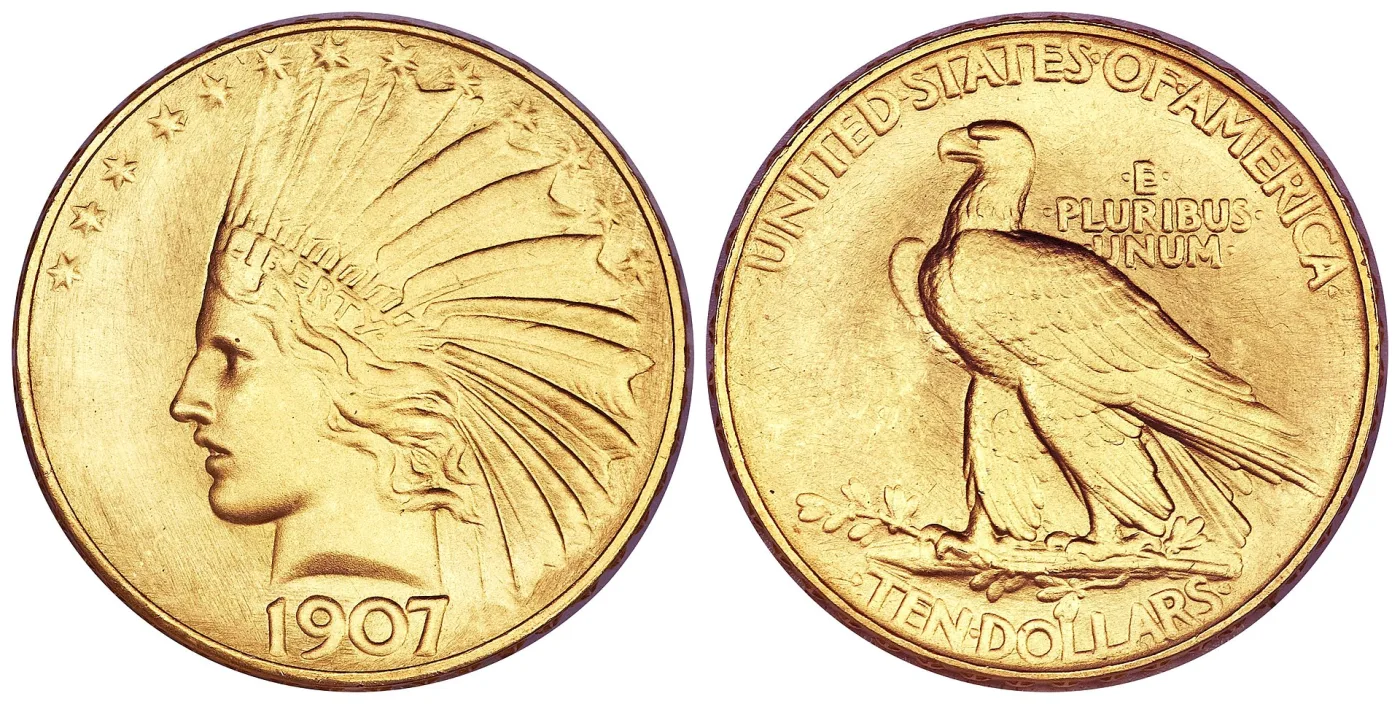
The 1907 Wire Rim Periods is the rarest and most artistically pure type. Only 500 examples were struck as experimental presentation pieces, of which roughly 400-450 are believed to survive. The “Wire Rim” refers to the knife-thin raised metal at the very edge of the coin, produced by the heavy striking pressure required to bring up Saint-Gaudens’s high relief. The “Periods” designation refers to the small dots flanking the legend E PLURIBUS UNUM on the reverse — present on this type but removed on later production issues. Wire Rim examples are essentially museum-grade pieces; auction prices for choice examples reach the mid-five to mid-six figures.
Type 2: 1907 Rolled Rim, Periods (No Motto)
The 1907 Rolled Rim Periods is the second experimental type, struck with a conventional rolled rim rather than the wire rim of Type 1. Mintage was 31,500, but most were melted at the Mint before release, leaving an estimated 50-200 examples surviving. The Rolled Rim Periods is extraordinarily rare in any grade, with choice examples bringing well into six figures at auction. Type 2 retains the periods around E PLURIBUS UNUM but uses the conventional rim that would become standard for the rest of the series.
Type 3: 1907-1908 No Periods, No Motto
Mid-1907 production saw the periods removed from around E PLURIBUS UNUM, producing the third type. This No Periods No Motto type was struck through early 1908 with mintages of 239,406 (1907 No Periods) and 33,500 (1908 No Periods at Philadelphia) plus 210,000 (1908-D No Periods at Denver). This type is the first widely available production issue. President Theodore Roosevelt personally insisted on omitting IN GOD WE TRUST from the reverse — as on the Double Eagle — because he considered placing the deity’s name on coinage to be “irreverent and close to sacrilege.”
Type 4: 1908-1933 With Motto
Public outcry and Congressional action forced restoration of IN GOD WE TRUST in mid-1908. From this point through the end of the series in 1933, every Indian Head Eagle bears the motto IN GOD WE TRUST to the left of the eagle on the reverse. The With Motto type accounts for the bulk of total mintages for the series, including all the major rarities except the 1907 experimentals and the 1908 No Motto issues. The 46-to-48 star edge transition occurred within this type in 1912 but is a minor diagnostic, not a separate type.
Quick Type Identification Reference
- Wire Rim Periods (1907): Knife-thin raised wire edge, dots flanking E PLURIBUS UNUM, no IN GOD WE TRUST — only 500 struck
- Rolled Rim Periods (1907): Conventional rim, dots flanking E PLURIBUS UNUM, no IN GOD WE TRUST — ~50-200 survive
- No Periods No Motto (1907-1908): Conventional rim, no dots around E PLURIBUS UNUM, no IN GOD WE TRUST
- With Motto (1908-1933): Conventional rim, no dots around E PLURIBUS UNUM, IN GOD WE TRUST visible left of eagle
Composition and Specifications
Every Indian Head Eagle is struck in 90% gold and 10% copper — the standard US gold alloy used from 1837 through 1933 for all production gold coinage including the Saint-Gaudens Double Eagle. The copper component provides the warm, slightly orange-tinted color characteristic of US gold and gives the coins hardness that pure gold lacks.
Physical Specifications
- Composition: 90% gold, 10% copper
- Total weight: 16.718 grams (258 grains)
- Net gold weight: 15.046 grams (0.4838 troy ounces)
- Diameter: 27.0 millimeters
- Thickness: Approximately 2.0 millimeters (Wire Rim examples slightly thicker at the edge)
- Edge: Stars (46 stars 1907-1911, 48 stars 1912-1933)
- Face value: $10
The 0.4838 troy ounce gold content is the bullion-value floor for every Indian Head Eagle. At 2026 gold prices, this means even a heavily worn common-date example is worth more than $1,250 in pure metal value alone, before any numismatic premium. This bullion floor distinguishes gold coinage from silver — a worn Barber Dime may be worth essentially only its silver value, but a worn Indian Head Eagle carries substantial intrinsic worth that protects collector outlay.
The Star Edge
The 46-star edge of the 1907-1911 issues and the 48-star edge of the 1912-1933 issues are both incused (struck inward) by a third die in the coining press at the moment of striking. The stars are evenly spaced around the entire circumference. Examining the edge is a critical authentication checkpoint — many crude counterfeits get the edge wrong, using a plain or reeded edge instead of stars. Genuine examples show neat, sharp, evenly spaced star impressions.
Key Dates and Major Rarities
The Indian Head Eagle series contains several legitimate rarities that anchor major auctions and define US gold numismatics. As with the Double Eagle, many keys emerged from the 1920s and early 1930s when much production was shipped to bank vaults as international gold reserves rather than circulated, then melted under the 1933 gold recall. The same disciplined approach to spotting key dates applies whether you’re working through this series, the Buffalo Nickel, or any classic US issue.
1907 Wire Rim, Periods
The 1907 Wire Rim Periods is the rarest collectible variety in the series. Only 500 examples were struck and roughly 400-450 survive. Auction prices range from $25,000 in heavily handled examples to over $300,000 for choice Mint State pieces. The Wire Rim is the closest production approximation to Saint-Gaudens’s original artistic vision and is highly prized by type collectors and gold specialists alike.
1907 Rolled Rim, Periods
The 1907 Rolled Rim Periods is even rarer than the Wire Rim despite a higher original mintage (31,500), because most were melted at the Mint before release. Only 50-200 examples are believed to survive. Auction prices reach $100,000-$300,000 for choice examples. The Rolled Rim is among the most challenging coins to acquire in the entire 20th-century US gold series.
1933 Indian Head Eagle
The 1933 had a mintage of 312,500, of which a small number were released into general circulation before the gold recall took full effect. An estimated 30-40 examples survive across all grades. The 1933 $10 is legally collectible — in marked contrast to the legally complicated 1933 $20 Double Eagle, of which only one example is legal to own. Prices for the 1933 $10 range from $200,000 in low circulated grades to over $1,000,000 for choice MS-65 examples.
1920-S Indian Head Eagle
The 1920-S had a mintage of 126,500 — moderate for the series — but most were melted under the 1933 gold recall, leaving an estimated 75-150 surviving examples. Survival skews to higher grades because surviving coins came largely from bank vaults rather than circulation. Prices range from $30,000 in AU grades to $250,000+ for choice MS-65 examples. The 1920-S is the second-rarest collectible date in the series after the 1933.
1930-S Indian Head Eagle
The 1930-S had a mintage of 96,000, of which an estimated 100-150 survive. Like the 1920-S, the 1930-S is a major condition rarity, with most survivors in Mint State grades due to bank vault storage. Prices range from $25,000 in AU to $150,000+ for choice MS-65. The 1930-S is consistently in demand and trades whenever offered at major auction.
1908-S With Motto
The 1908-S With Motto had a mintage of just 59,850 — the lowest of any With Motto issue. Most surviving examples are in circulated to low Mint State grades. Choice MS-63 examples bring $15,000-$25,000, with premium MS-65 pieces reaching $50,000+.
1907 Rolled Rim, No Periods
The 1907 No Periods (the third type) is the most affordable 1907 production type but still scarce in high grades. Most surviving examples are in About Uncirculated to MS-62 condition. Choice MS-64 to MS-65 examples bring $5,000-$15,000.
1911-D Indian Head Eagle
The 1911-D had a mintage of 30,100 — the lowest mintage of any business strike With Motto issue (excluding the 1907 experimental types). Most surviving examples are in low to mid Mint State. Choice MS-63 examples bring $20,000-$35,000, with strong premiums for higher grades.
1913-S Indian Head Eagle
The 1913-S had a mintage of 66,000 and is genuinely scarce in all grades. Most surviving examples grade Very Fine to About Uncirculated. Choice Mint State pieces bring $20,000-$60,000 depending on grade.
1929 Indian Head Eagle
The 1929 had a mintage of 96,000 — moderate by series standards — but most were melted in 1933, leaving an estimated 200-300 survivors. Most are in Mint State condition. Prices range from $25,000 in MS-62 to over $100,000 in MS-65.
1932 Indian Head Eagle
The 1932 had the largest production of any late-series date with a mintage of 4,463,000, and survival numbers in the thousands make it the most common late-Depression issue. Prices for 1932 examples range from $1,500 in low grades to $5,000-$15,000 in choice Mint State. The 1932 is often the choice for collectors wanting a late-series example without paying for true rarity.
The 1933 Indian Head Eagle
The 1933 Indian Head Eagle deserves its own section because — unlike the 1933 Double Eagle — it is legally collectible and represents one of the most attainable trophy coins in US gold numismatics, albeit at six-to-seven figure prices.
Production and Release
The Philadelphia Mint struck 312,500 Indian Head Eagles dated 1933, intending them for normal circulation. Production occurred in early 1933 before Executive Order 6102 in March 1933 required Americans to surrender most gold coins. Critically, a small number of 1933 $10 Eagles were officially released into circulation before the recall halted gold-coin distribution. This contrasts sharply with the 1933 Double Eagle, of which the Mint maintained no examples were ever officially released.
Why the 1933 $10 Is Legal but the 1933 $20 Is Not
The legal status difference between the 1933 $10 and the 1933 $20 turns on Mint records. For the $10 Eagle, official Mint records show that 1933-dated coins were paid out through normal channels before the recall — establishing them as legally issued United States coinage. For the $20 Double Eagle, the Mint’s position is that no coins were ever officially released, and any 1933 Double Eagle in private hands must have left the Mint through irregular channels. The Treasury Department has consistently respected this distinction: 1933 Eagles can be bought, sold, and transferred freely, while 1933 Double Eagles remain subject to government claims of ownership.
Surviving Population
Estimates of surviving 1933 Indian Head Eagles range from 30 to 40 examples across all grades, with most graded by PCGS or NGC. The PCGS Population Report and NGC Census together provide reliable estimates. Most survivors are in Mint State grades — coins that were released into circulation before the recall but quickly hoarded by collectors who recognized the date’s significance.
Recent Auction Performance
The 1933 Indian Head Eagle regularly appears at major auctions every few years. Recent realized prices include strong six-figure results for problem-free MS-63 examples and seven-figure results for the finest known MS-65+ pieces. The 1933 Eagle is one of the most consistent-performing US gold rarities, with steady appreciation over decades of collector interest.
Practical Implication for Collectors
For collectors with the means, the 1933 $10 Eagle is a legitimate trophy purchase. For most collectors, the 1933 represents the unattainable ceiling of the series — every other date can be acquired, but the 1933 sits at a price level that only a small subset of collectors can reach. Many type-set collectors substitute a 1932 (the most common late-series date) when building a comprehensive Indian Head Eagle collection.

Mint Marks: Philadelphia, Denver, San Francisco, New Orleans
Indian Head Eagles were struck at four United States mints across the series, with mint marks appearing on the reverse at the left of the eagle, just above and to the left of the talons. Always check this location carefully — counterfeiters occasionally add fake mint marks to common Philadelphia coins to manufacture key-date issues.
Philadelphia Mint (No Mint Mark)
The Philadelphia Mint produced Indian Head Eagles in every year of the series. Philadelphia issues bear no mint mark, following the traditional U.S. convention. Mintages varied from the 500 Wire Rim experimentals of 1907 to over four million for the 1932 issue. Philadelphia is the source of all 1907 type issues (Wire Rim, Rolled Rim Periods, and No Periods), and most production With Motto issues including the 1933.
Denver Mint (D Mint Mark)
The Denver Mint struck Indian Head Eagles in 1908, 1910, 1911, 1914, and 1920. The mint mark “D” appears on the reverse at the left of the eagle. Denver issues are generally scarcer than Philadelphia counterparts, and the 1911-D is the rarest of all business strike Denver issues with a mintage of just 30,100. Most Denver issues from the series saw circulation rather than vault storage, so circulated examples are encountered more often than Mint State.
San Francisco Mint (S Mint Mark)
The San Francisco Mint struck Indian Head Eagles in 1908, 1909, 1910, 1911, 1912, 1913, 1915, 1916, 1920, and 1930. The mint mark “S” appears on the reverse at the left of the eagle. San Francisco is the source of the major key dates 1908-S, 1913-S, 1920-S, and 1930-S. San Francisco mintages were generally smaller than Philadelphia’s, and the survival rate of S-mint issues from the 1920s is correspondingly low due to gold recall melting.
New Orleans Mint (O Mint Mark)
The New Orleans Mint produced Indian Head Eagles only in 1909 — a single issue, the 1909-O, with a mintage of 121,540. The mint mark “O” appears on the reverse at the left of the eagle. The 1909-O is the only New Orleans Indian Head Eagle and is therefore essential for mint-mark completists. Most survivors are in circulated to low Mint State grades. Prices range from $1,800 in VF to $10,000+ in choice MS-63.
Mint Mark Position and Authentication
- Position: Always on the reverse, at the left of the eagle, above and to the left of the talons
- Style: Small, neat letters punched into individual working dies
- Sharpness: Well-defined letters with consistent depth — examine under 10x magnification
- Counterfeit warning: Added “D” or “S” mint marks on common Philadelphia coins are a known fraud — examine for tooling marks, surface disturbance, or a mint mark that doesn’t match the era’s punch style
Doubled Dies and Notable Varieties
Beyond the major type and mint mark distinctions, the Indian Head Eagle series hosts a number of varieties that specialists actively pursue. None match the price impact of the famous 1955 Lincoln Doubled Die or the iconic 1937-D Three-Legged Buffalo, but several add meaningful premiums for cherrypickers.
1907 Wire Rim Variations
Within the 500 known Wire Rim Periods examples, specialists distinguish multiple die states and pedigreed individual coins. Major auction catalogs treat each example individually, with pedigree from famous collections (Pittman, Eliasberg, Bass) adding meaningful premiums.
1909-D / 1909-D Repunched Mint Mark
Some 1909-D Eagles show clear evidence of a repunched D mint mark — the secondary D appears as a slight ghost or shadow to one side of the primary D. The variety is uncommon and adds 25-50% premiums over normal 1909-D examples in equivalent grades.
1910-D Doubled Die
A doubled die obverse on certain 1910-D coins shows doubling on the date numerals and on portions of LIBERTY across the headdress band. The variety is uncommon and adds modest premiums for specialists.
1911-S / 1911-S Repunched Mint Mark
Several 1911-S dies show evident repunching on the S mint mark. The variety is collected by Indian Head Eagle specialists but commands only modest premiums above the date’s already substantial collector value.
Cherrypicker Tips
- Use a 10x loupe on the date numerals and LIBERTY across the headdress band for repunching or doubling
- Check the mint mark on every D, S, and O issue for repunching, doubling, or signs of tooling/addition
- Examine the edge stars for proper count (46 vs 48) and proper spacing
- Compare known Wire Rim and Rolled Rim images for the 1907 experimental types
- Reference the Cherrypickers’ Guide for current variety attribution and FS numbers
Grading Indian Head Eagles
Accurate grading is essential because Indian Head Eagle prices climb steeply with grade — even common dates vary from $1,400 in low grades (essentially bullion value plus minimal premium) to $10,000+ in choice MS-66 condition. The same fundamental grading methods that apply to other 20th-century US issues work here, with particular attention to the cheekbone and headdress feathers on the obverse, and the eagle’s wing and leg detail on the reverse.
High-Point Wear Pattern
Wear on Indian Head Eagles progresses in a specific order across the high points:
- Cheekbone: The highest point of Liberty’s face shows wear first
- Headdress band: The LIBERTY band across the top of the headdress shows letter softening next
- Feather tips: Individual feather details flatten as wear progresses
- Eagle’s wing and breast: On the reverse, the eagle’s wing feathers and breast feathers wear in parallel
- Eagle’s leg: The eagle’s left leg detail is among the last to show heavy wear
Circulated Grades
- Very Fine-20: Major design elements show clear definition; substantial wear on cheekbone and headdress band
- Extremely Fine-40: Light wear on highest points; most design detail intact
- About Uncirculated-50 to 58: Trace wear on cheekbone, feather tips, and eagle’s wing; full original luster on most surfaces
True circulated Indian Head Eagles below About Uncirculated are uncommon for many dates — like the Double Eagle, many surviving Eagles came from bank vaults rather than active circulation, and show light handling rather than heavy wear. Coins graded VF or below often suggest extensive circulation, mishandling, or environmental damage.
Mint State Grading
Mint State grading distinctions matter enormously for value, and the Indian Head Eagle series is particularly sensitive to bag marks because gold is a relatively soft metal and the coins were stored loose in canvas bags before the era of plastic flips:
- MS-60 to MS-62: No wear, but heavy bag marks; subdued luster; the entry level for Mint State
- MS-63: Moderate marks; reasonable luster; the most common Mint State grade for common dates
- MS-64: Lighter marks; good luster; pleasing eye appeal — a meaningful price step
- MS-65: Light marks only; full booming luster; strong eye appeal — a major price step
- MS-66: Exceptional preservation; minimal marks; superb luster — common dates jump 3-10x at this grade
- MS-67 and above: Genuinely rare; most issues have populations under 25 coins at this level
Strike and Luster Considerations
Indian Head Eagle luster varies by mint and year. Philadelphia issues from the 1907-1908 period typically show satin to slightly frosty luster. San Francisco issues often show booming cartwheel luster comparable to the best Morgan Dollar strikes. New Orleans 1909-O coins show distinctive satin luster. Strike sharpness is generally excellent across the series — the smaller diameter (compared to the Double Eagle) and the relatively shallow relief make full strikes the norm rather than the exception.
Authentication and Spotting Counterfeits
Indian Head Eagles are heavily counterfeited because of their substantial gold value and key-date premiums. Modern counterfeits range from crude Chinese-made copies (easy to detect) to sophisticated struck counterfeits using stolen or replica dies (very difficult to detect). The same authentication discipline as for other high-value classic series applies — but with high stakes given the dollar amounts involved on better dates.
Weight, Diameter, and Specific Gravity
- Weight: Genuine coins weigh 16.718 grams. Counterfeits made from lower-purity gold or base metals deviate measurably. A digital jewelry scale accurate to 0.01 grams is the minimum tool for serious authentication.
- Diameter: Genuine coins measure 27.0 millimeters across. Counterfeits sometimes vary by tenths of a millimeter.
- Specific gravity: Pure 90% gold has a specific gravity of approximately 17.16. Lower-purity counterfeits or gold-plated base-metal copies test outside this range. Specific gravity testing is a definitive non-destructive authentication method.
- Edge stars: The star edge (46 stars 1907-1911, 48 stars 1912-1933) must be present and properly formed. Many crude counterfeits have plain or reeded edges, or get the star count wrong.
Counterfeit Categories
Common counterfeit types include:
- Cast counterfeits: Detectable by pebbly surfaces, soft details, and incorrect weight. Largely a 20th-century problem; modern counterfeiters prefer struck copies.
- Struck counterfeits with base metal: Gold-plated tungsten or other dense metal cores. Detectable by specific gravity and by careful examination of edge integrity.
- Struck counterfeits in correct-purity gold: The most dangerous type. These coins have correct weight and metal content but were struck from unauthorized dies. Detection requires comparing die diagnostics and surface texture against authentic examples.
- Altered date or mint mark on genuine coin: Common date altered to look like 1920-S, 1930-S, 1911-D, or 1933 — examine for tool marks under 10x magnification, particularly around date and mint mark.
- “Bullion replica” coins: Souvenir or replica pieces sometimes appear on the secondary market without proper marking — examine for word “COPY” or other indicators, and reject any coin with weight or diameter outside genuine tolerances.
Cleaned and Polished Coins
Many Indian Head Eagles have been cleaned to make them look more like Mint State examples. Detection points include unnatural shine, hairline scratches under angled light, and orange-tinted or pinkish “dipped” appearance. Cleaned coins receive “Details” grades from PCGS and NGC and lose 30-50% of value compared to original-surface coins.
Using Third-Party Grading
For any Indian Head Eagle — even common dates — strongly consider purchasing already-certified examples from PCGS or NGC. The certification fee is small relative to the dollar amounts involved. For premium issues (any 1907 type, any 1908-S With Motto, any S-mint from 1913-1920, any D-mint from 1911, any 1929-1933 issue), certified examples are essentially the only safe purchase route. Established auction houses including Heritage Auctions, Stack’s Bowers, Legend Numismatics, and GreatCollections are the safest sources for higher-value pieces.
Bullion Value vs. Numismatic Premium
Indian Head Eagles occupy a useful position in coin collecting because they carry both meaningful bullion value and meaningful numismatic premiums, with a smaller intrinsic gold content than the Double Eagle that makes entry points more accessible.
The Bullion Floor
Each coin contains 0.4838 troy ounces of pure gold. At any given gold spot price, the bullion melt value is roughly: (gold spot price per ounce) × 0.4838. At $2,600 per ounce — a representative 2026 figure — the melt value is approximately $1,258. No genuine Indian Head Eagle, regardless of date or condition, sells for less than its melt value, because anyone willing to destroy the coin can recover that amount from a refiner.
Common-Date Premiums
For common dates in lower grades — typical 1910-1916, 1926, and 1932 Philadelphia coins in About Uncirculated to MS-62 condition — the typical retail premium over melt is 15-40%. Buying a common-date Indian Head Eagle at this level is essentially a way to own gold in collectible form, with a small premium for the design and historical interest. The smaller gold content (compared to the Double Eagle) means premiums are proportionally a bit higher because the fixed numismatic-collection appeal is spread over less metal.
Numismatic Premiums
For better dates, higher grades, and key issues, premiums over melt rise dramatically. A common-date MS-66 Indian Head Eagle might bring 5-10x melt; a 1908-S MS-63 might bring 10-20x melt; a 1920-S in any grade brings 25-200x melt; and a 1933 example brings hundreds of times melt. The relationship between grade, date, and premium is non-linear and rewards specialist knowledge.
Practical Buying Guidance
- If you want gold exposure: Buy common-date AU-58 to MS-62 Indian Head Eagles at minimal premium over melt
- If you want collectible gold: Step up to MS-63 to MS-65 common dates for moderate numismatic premium with genuine collector demand
- If you want true rarity: Pursue better dates and high grades, where premiums dwarf bullion value
- If you want trophy ownership: The 1933 $10 Eagle is one of the most accessible legendary US gold rarities — vastly cheaper than the 1933 $20 Double Eagle
- Avoid the middle ground unwisely: Cleaned or damaged coins lose collector value but retain melt value, so they trade close to bullion regardless of date
Current Market Values and Price Guide
Indian Head Eagle values cover an enormous range — from low thousands for common-date circulated examples to seven figures for choice 1933 issues. The prices below reflect approximate retail values as of 2026 for problem-free, original-surface coins, assuming a gold spot price of approximately $2,600 per ounce. Cleaned, damaged, or altered examples are worth substantially less, and certified premium-grade coins regularly bring prices well above these ranges.
Common Dates 1910-1916, 1926, 1932 (Philadelphia, Low Grade)
- Very Fine-20: $1,300–$1,400 (essentially melt)
- Extremely Fine-40: $1,350–$1,500
- About Uncirculated-58: $1,400–$1,600
- MS-62: $1,500–$1,900
- MS-63: $1,800–$2,400
- MS-64: $2,400–$3,500
- MS-65: $4,000–$7,500
- MS-66: $10,000–$20,000
Type Coins
- 1907 No Periods (MS-63): $3,000–$4,500
- 1907 No Periods (MS-65): $8,000–$12,000
- 1907 Wire Rim Periods (any grade): $25,000–$300,000+
- 1907 Rolled Rim Periods (any grade): $100,000–$300,000+
- 1908 No Motto (MS-63): $3,000–$4,500
- 1908 With Motto (MS-63): $2,000–$2,800
Key Dates and Major Rarities
- 1908-S With Motto (MS-63): $15,000–$22,000
- 1909-O (AU-58): $2,500–$3,500
- 1909-O (MS-63): $7,500–$11,000
- 1911-D (MS-63): $25,000–$35,000
- 1913-S (MS-62): $10,000–$18,000
- 1920-S (AU-58): $30,000–$50,000
- 1920-S (MS-63): $80,000–$140,000
- 1929 (MS-63): $25,000–$35,000
- 1930-S (MS-63): $50,000–$80,000
- 1932 (MS-63): $1,800–$2,400 (common; not a key)
- 1933 (any grade): $200,000–$1,000,000+
Note: These are retail price estimates. Actual sale prices at auction vary based on eye appeal, certification, surface originality, gold spot price at sale time, and current market demand. For important purchases, reference recent auction archives from Heritage Auctions, Stack’s Bowers, and Legend Numismatics alongside standard price guides like the PCGS Price Guide and the NGC Price Guide.
Building an Indian Head Eagle Collection
The Indian Head Eagle series offers entry points at multiple budget levels, from a single common-date type coin near gold-melt to museum-grade rarities at seven figures. The series is more accessible than the Saint-Gaudens Double Eagle because the smaller gold content lowers the bullion floor for every issue, but the rarities are correspondingly rarer in absolute survival numbers.
Single Type Coin
The simplest collection is a single common-date Mint State example, often dated 1910-1916, 1926, or 1932. Choice MS-63 to MS-65 examples are widely available for $1,800-$7,500, providing a stunning specimen of one of the most distinctive US gold coins. Many collectors stop here — a single Indian Head Eagle is sufficient to represent the series and Saint-Gaudens’s design vision for the $10 denomination.
Type Set
A four-coin type set captures all the design variations: Wire Rim Periods (functionally impossible for most collectors at $25,000+), Rolled Rim Periods (also impossible at $100,000+), No Periods No Motto, and With Motto. A more achievable two-coin set substitutes a No Periods example for the experimental 1907 types, paired with a common With Motto. The full four-coin type set requires a serious budget.
Date Set Excluding Major Rarities
A date set excluding the 1907 Wire Rim/Rolled Rim, 1908-S, 1911-D, 1920-S, 1930-S, and 1933 is achievable in MS-63 condition for $40,000-$80,000. Adding the 1908-S and 1911-D pushes the total past $100,000. Adding the 1920-S and 1930-S adds another $150,000-$250,000. The 1933 alone pushes the complete set past $500,000.
Mint Mark Set
Many collectors pursue one example from each mint that produced Indian Head Eagles: Philadelphia (no mint mark), Denver (D), San Francisco (S), and New Orleans (O — only 1909-O). Achievable for $10,000-$25,000 in choice Mint State by selecting common dates from each mint. The 1909-O is the only New Orleans Indian Head Eagle and is therefore mandatory for this approach.
Specialty Approaches
- High-grade type: MS-66 and MS-67 examples of common dates — visually stunning and steadily appreciating
- 1907 set: All available 1907 types (Wire Rim Periods, Rolled Rim Periods, and No Periods)
- San Francisco set: One example from each S-mint year — challenging because of the 1913-S, 1920-S, and 1930-S keys
- Variety set: 1909-D RPM, 1910-D Doubled Die, 1911-S RPM, and other major die varieties
- Bullion-collector hybrid: One MS-63 example per year — ignoring rarities and focused on year-by-year date completion
Practical Tips
- Buy certified for everything: Even common dates merit PCGS or NGC certification given the dollar amounts involved
- Original surfaces command premiums: Cleaned coins are heavily discounted; learn to recognize natural luster vs. dipped surfaces
- Patience pays: Many key dates appear at auction only a few times per year; build a target list and wait for the right examples
- Track gold spot: The bullion floor moves with gold prices, affecting common-date values directly
- Use major auction archives: Heritage and Stack’s Bowers archives are invaluable for studying authentic examples and recent realized prices
- Coordinate with Double Eagle collecting: Many collectors pair their Indian Head Eagle program with a Saint-Gaudens Double Eagle program — both series share the same design philosophy and 1907-1933 timeframe
Storage and Preservation
Proper storage maintains the value and visual appeal of your collection. Although gold is far more chemically stable than silver — Indian Head Eagles do not tarnish or develop the toning that affects Morgan Dollars — the soft gold-copper alloy is susceptible to scratches, contact marks, and surface damage that can dramatically reduce value.
What to Avoid
- Loose storage: Coins clinking against each other produce immediate bag marks. Always store individually.
- PVC holders: Older soft plastic flips and some envelopes contain PVC, which outgasses and produces a green sticky residue. Less harmful to gold than to silver, but still avoid.
- Acidic paper: Some paper envelopes contain sulfur compounds that can produce minor surface effects on gold. Use acid-free, archival-quality envelopes.
- Direct handling: Skin oils etch gold over time; always handle by edges or wear cotton gloves
- Cleaning attempts: Even gentle cleaning leaves microscopic hairlines that grading services detect — never clean an Indian Head Eagle
- High humidity: Although gold itself doesn’t oxidize, the copper component can develop minor spotting in extreme humidity
Recommended Storage
- PCGS or NGC slabs: Inert plastic holders that provide excellent long-term protection and authentication — strongly recommended for any Indian Head Eagle
- Air-Tite holders: $10 gold-sized direct-fit capsules; safe and excellent for individual coins
- Non-PVC flips: Mylar or polyethylene flips for short-term storage and examination
- Quality albums: Capital Plastics or Dansco gold-coin albums; ensure pages are PVC-free
- Bank safe deposit box: Recommended for high-value collections; insurance considerations apply
- Climate-controlled storage: Stable temperature and low humidity for long-term collection care
Handling
Always handle Indian Head Eagles by their edges. The headdress feathers and Liberty’s cheek show fingerprints readily, and oils from skin will eventually etch the surface. Cotton gloves are appropriate for high-value coins. Never clean an Indian Head Eagle — virtually any cleaning reduces value, and cleaned coins are easily detected by experienced graders. If a coin appears to need conservation, consult a professional service like NCS (Numismatic Conservation Services) rather than attempting it yourself.
Frequently Asked Questions
What is an Indian Head Eagle and when was it made?
The Indian Head Eagle is a 90% gold $10 United States coin produced from 1907 through 1933. Designed by sculptor Augustus Saint-Gaudens at the request of President Theodore Roosevelt, it features a left-facing head of Liberty wearing an Indian feather war bonnet on the obverse, and a standing eagle on a bundle of arrows on the reverse. The series ended when President Franklin D. Roosevelt's 1933 gold recall eliminated gold coinage for circulation.
How do I tell if my $10 Eagle is Wire Rim or Rolled Rim?
Wire Rim examples have a very thin, sharp, raised wire of metal at the very edge of the coin — the rim appears almost knife-like when viewed in profile. Rolled Rim examples have a conventional, smoothly rounded raised rim. Both Wire Rim and Rolled Rim are 1907 issues and both bear small periods (dots) flanking the legend E PLURIBUS UNUM on the reverse. The Wire Rim is rarer (500 struck) than the Rolled Rim (mintage 31,500 but most melted, leaving only 50-200 survivors).
What is the rarest Indian Head Eagle?
Excluding the 1907 experimental types (Wire Rim and Rolled Rim Periods), the 1933 Indian Head Eagle is the rarest collectible date with only 30-40 examples known. The 1933 $10 is legal to own (unlike the 1933 $20 Double Eagle), and prices range from $200,000 in low grades to over $1,000,000 for choice Mint State examples. Among the 1907 experimentals, the Rolled Rim Periods is the rarest with only 50-200 survivors despite its 31,500 mintage.
How much gold is in an Indian Head Eagle?
Each Indian Head Eagle contains 0.4838 troy ounces of pure gold (15.046 grams) within its 16.718-gram total weight. The composition is 90% gold and 10% copper, the standard US gold alloy used from 1837 through 1933. At a gold spot price of $2,600 per ounce, the bullion melt value is approximately $1,258, which serves as a price floor for any genuine example.
What is the difference between No Motto and With Motto Indian Head Eagles?
No Motto coins (1907 and early 1908) lack the inscription IN GOD WE TRUST on the reverse. With Motto coins (mid-1908 through 1933) include IN GOD WE TRUST to the left of the eagle on the reverse. President Theodore Roosevelt personally insisted on omitting the motto from the original design as he considered it irreverent to place the deity's name on coinage; public outcry and Congressional action restored the motto in mid-1908. This is the same motto controversy that affected the Saint-Gaudens Double Eagle of the same year.
Why is the 1933 $10 Eagle legal to own but the 1933 $20 is not?
The legal distinction turns on Mint records. For the 1933 $10 Eagle, official Mint records show that coins were paid out through normal channels before the 1933 gold recall took effect — establishing them as legally issued United States coinage. For the 1933 $20 Double Eagle, the Mint's official position is that no coins were ever officially released, and any 1933 Double Eagle in private hands must have left the Mint through irregular channels. Therefore, 1933 $10 Eagles can be freely bought, sold, and transferred, while 1933 $20 Double Eagles remain subject to government claims of ownership.
How much is a common-date Indian Head Eagle worth?
Common-date Indian Head Eagles (1910-1916, 1926, 1932) in About Uncirculated to MS-62 condition typically retail for $1,400-$1,900 — essentially gold melt value plus a 15-40% numismatic premium. Higher grades command escalating premiums: MS-63 around $1,800-$2,400, MS-64 around $2,400-$3,500, MS-65 around $4,000-$7,500. Prices fluctuate with gold spot price, so check current bullion levels before transacting.
How do I know if my Indian Head Eagle is real?
Authentic coins weigh 16.718 grams with a 27.0-millimeter diameter and the correct star edge (46 stars on 1907-1911 issues, 48 stars on 1912-1933 issues). The most reliable authentication is third-party certification by PCGS or NGC. For valuable examples (any 1907 experimental type, any 1908-S With Motto, any S-mint from 1913-1920, any D-mint from 1911, any 1929-1933 issue), only purchase certified coins from established auction houses. Counterfeits range from crude cast pieces to sophisticated struck copies, and the dollar amounts at stake make professional authentication essential.
Can I clean my Indian Head Eagle?
No — cleaning reduces value substantially even on gold coins. Although gold is chemically stable, cleaning leaves hairlines visible under magnification, and harsh cleaning ("dipping") removes original surface and produces unnatural color. Cleaned coins receive "Details" grades from PCGS and NGC and lose 30-50% of value compared to problem-free original surfaces. If a coin truly needs conservation, use a professional service like NCS rather than attempting it yourself.
Is an Indian Head Eagle a good investment?
Indian Head Eagles offer dual appreciation potential: gold bullion value and numismatic collector value. Common dates track gold prices closely with a modest premium; key dates and high-grade examples have appreciated substantially over decades regardless of gold spot. The series benefits from genuine rarity (gold recall meltings), strong artistic interest (the Saint-Gaudens design is widely admired), and limited new supply. The smaller bullion content compared to the Double Eagle makes entry points more accessible, which has historically supported steady collector demand. Investors who want pure modern gold exposure rather than a classic coin often turn instead to the American Gold Eagle, the U.S. Mint's flagship gold bullion coin since 1986. As with any collectible, collect for enjoyment first and treat investment returns as a bonus.