Classic Head Quarter Eagle Identification Guide: 1838-C, 1839 Branch Mint Keys, Mint Marks and Values
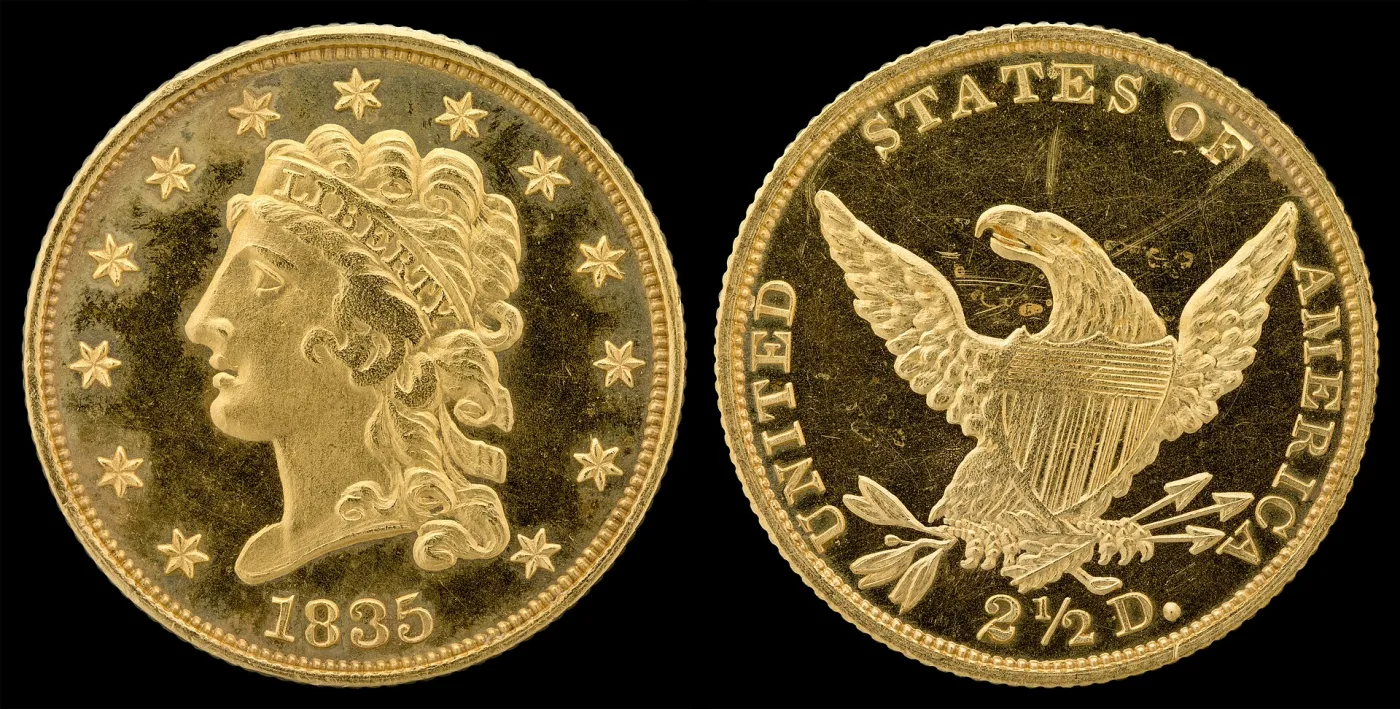
The Classic Head Quarter Eagle is one of the most historically important short-series gold coins ever struck by the United States Mint. Produced for just six years, from 1834 through 1839, this small $2.50 gold piece marks the exact moment American gold coinage transformed from a hoarded curiosity into a circulating reality. The coin that preceded it — the Capped and Liberty Head family of early quarter eagles — contained more than $2.50 worth of gold at face value, which meant nearly every one was melted or shipped abroad for bullion. The Classic Head changed that overnight by reducing the weight and fineness so the coins would finally stay in circulation.
Designed by Chief Engraver William Kneass, the Classic Head obverse shows Liberty facing left wearing a flat fillet headband inscribed “LIBERTY” — a portrait deliberately modeled on the popular Classic Head design John Reich had used on the large cent and half cent two decades earlier. The reverse abandoned the Latin motto “E PLURIBUS UNUM” that had appeared on the previous type, leaving a clean heraldic eagle and the denomination. This “No Motto” reverse is one of the quickest ways to identify the type at a glance.
For collectors, the Classic Head Quarter Eagle offers an irresistible combination: an affordable, genuinely obtainable Philadelphia type coin alongside a roster of branch-mint rarities — the first gold coins ever struck at Charlotte, Dahlonega, and New Orleans — that rank among the most coveted issues in all of American numismatics. This guide covers everything you need to identify, attribute, grade, authenticate, and value Classic Head Quarter Eagles in the 2026 market, from the common 1834 type coin to the legendary 1838-C and 1839-D branch mint keys.
History and Background
The quarter eagle — the United States $2.50 gold piece — had existed since 1796, but for its first four decades it was essentially a coin in name only. Under the gold-to-silver ratio fixed by the Coinage Act of 1792, gold was undervalued at the Mint relative to its market price. Anyone holding a quarter eagle could melt it down or export it for slightly more than its face value, so the coins vanished from commerce almost as fast as they were struck. The early Capped Bust and Capped Head quarter eagles of 1796-1834 survive today in tiny numbers precisely because the public treated them as bullion, not money.
By the early 1830s this had become a national embarrassment. The country produced gold coins that no ordinary citizen ever saw in daily trade. The discovery of significant gold deposits in the southern Appalachians — in North Carolina, Georgia, and the surrounding region — made the problem more visible, because raw American gold was being shipped abroad rather than turned into circulating American money. Congress acted with the Coinage Act of June 28, 1834, which reduced the weight and adjusted the fineness of U.S. gold coins so that their bullion value finally fell below their face value.
A New Design for a New Standard
The Mint needed a visible way to distinguish the new lighter-weight gold coins from the old heavier ones, so that banks and the public could tell at a glance which coins were legal at the new standard and which were the old, more valuable pieces. Chief Engraver William Kneass produced a new portrait — the Classic Head — and removed the motto “E PLURIBUS UNUM” from the reverse. The motto’s absence served as an instant identifier: a quarter eagle with the scroll motto was the old heavy type; a quarter eagle without it was the new reduced-weight type.
The Birth of Branch Mint Gold
The same era saw Congress authorize branch mints to convert southern gold into coin near its source. The Act of March 3, 1835 established mints at Charlotte, North Carolina; Dahlonega, Georgia; and New Orleans, Louisiana. All three opened in 1838, and all three struck their very first coins in the Classic Head Quarter Eagle and the companion half eagle series. This makes the Classic Head Quarter Eagle the foundation issue of the entire branch-mint gold story that would dominate American numismatics for the next quarter century.
Why the Weight Was Reduced in 1834
Understanding the weight reduction is the single most important piece of context for collecting this series, because it explains why pre-1834 quarter eagles are rare and post-1834 quarter eagles are obtainable.
The Bullion Problem
Before 1834, a quarter eagle weighed 4.37 grams at .9167 fineness, containing gold worth slightly more than $2.50 in the open market. The rational economic move was to melt the coins. The Coinage Act of 1834 cut the standard weight to 4.18 grams and set fineness initially at approximately .8992, later standardized to .900 in 1837. The reduced gold content meant that for the first time a quarter eagle was worth more as a coin than as metal, so it would actually circulate.
The “Old Tenor” and “New Tenor” Distinction
Contemporaries referred to the heavier pre-1834 coins as “old tenor” and the lighter post-1834 coins as “new tenor.” Banks of the period had to physically sort the two, and the distinct Classic Head design with its motto-free reverse made this sorting possible. The same reform applied across the gold denominations, which is why the Capped Bust half eagle and the eagle programs of the period went through parallel design and weight changes.
Why It Matters to Collectors Today
Because the Classic Head coins finally circulated, far more of them survive than the early quarter eagles that came before. A Philadelphia Classic Head Quarter Eagle in collectible grade is one of the most affordable ways to own a genuine pre-Civil War U.S. gold coin. At the same time, the branch-mint issues were struck in tiny quantities at frontier facilities and saw heavy local circulation, so they survive in very small numbers and command large premiums — the perfect setup for a series with both an accessible entry point and serious rarities.
Design and Symbolism
William Kneass’s Classic Head design is clean, neoclassical, and immediately recognizable. It is sometimes confusingly grouped with other “Classic Head” coins because the head itself is derived from John Reich’s earlier work, but the quarter eagle version is distinct.
Obverse: Liberty in a Fillet Headband
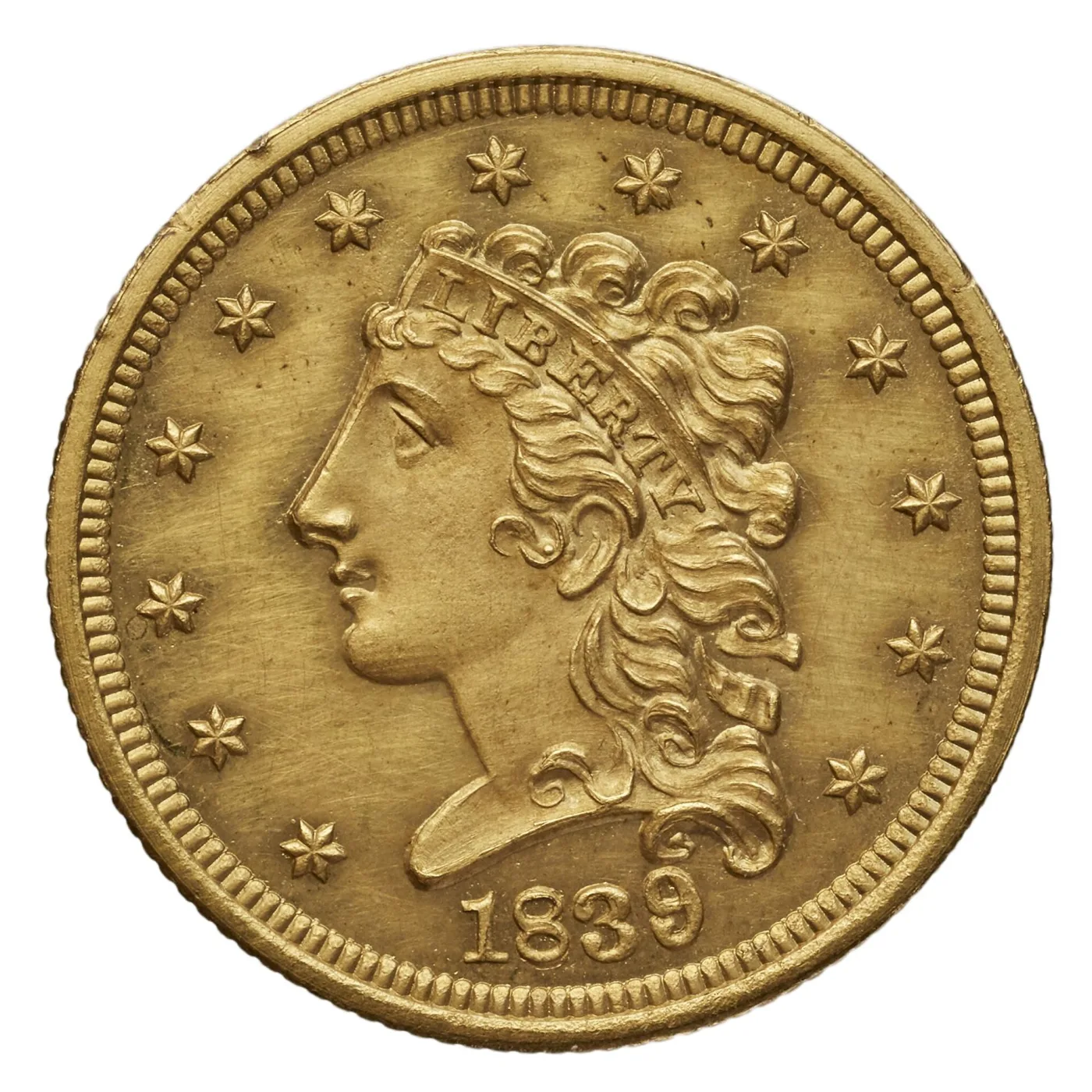
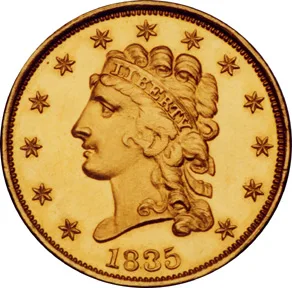
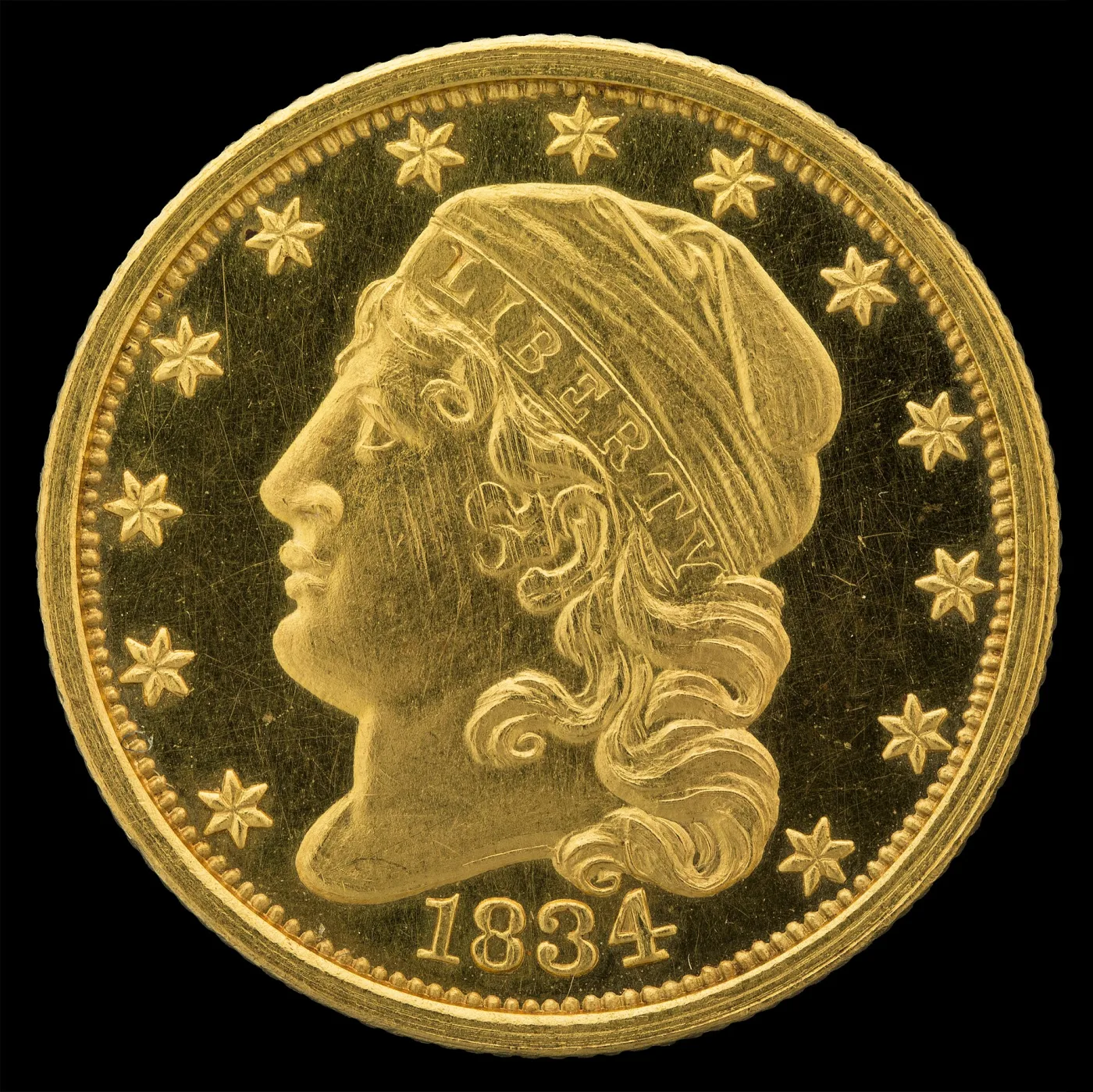
The obverse depicts the head of Liberty facing left, her hair tied up in curls and bound by a flat ribbon or fillet across the brow inscribed with the word “LIBERTY.” Unlike the earlier Capped Head type, there is no Phrygian liberty cap — the headband alone holds the inscription. Thirteen stars surround the head, representing the original colonies, and the date appears at the bottom. The portrait is full and rounded, with detailed hair curls that are an important focal point for grading.
Reverse: Heraldic Eagle, No Motto
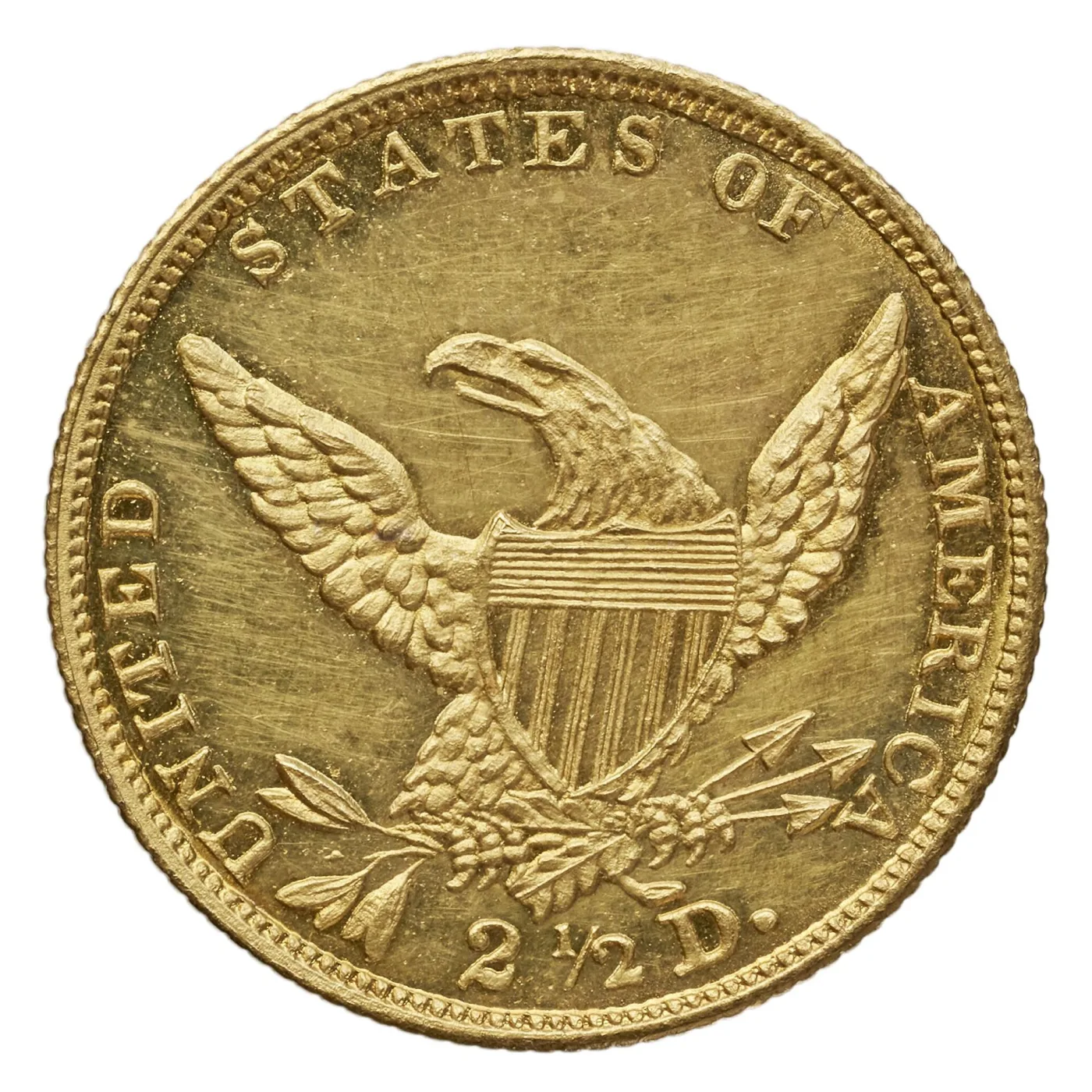
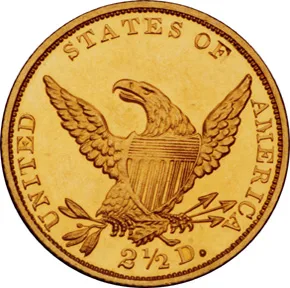
The reverse shows a heraldic eagle with wings spread, a federal shield on its breast, an olive branch and a bundle of arrows clutched in its talons. The legend “UNITED STATES OF AMERICA” arcs around the top and the denomination “2½ D.” appears at the bottom. Critically, there is no scroll bearing “E PLURIBUS UNUM” above the eagle — this is the defining feature that separates the Classic Head from the Capped Head type that preceded it. The motto would not return to the quarter eagle until well into the later Liberty Head (Coronet) series.
The Designer: William Kneass
William Kneass served as Chief Engraver of the United States Mint from 1824 until his death in 1840. The Classic Head gold series — quarter eagle and half eagle — is among his most significant work. A stroke in 1835 partially incapacitated him, after which much of the Mint’s engraving work passed to his assistant Christian Gobrecht, who would go on to design the Coronet/Liberty Head quarter eagle that replaced this type in 1840 and the famous Gobrecht Dollar.
Composition and Physical Specifications
The Classic Head Quarter Eagle is a small coin, and its precise specifications are useful both for identification and for confirming authenticity by weight.
Key Specifications
Diameter: 18.2mm (early strikes) standardized near 18mm. Weight: 4.18 grams. Edge: reeded. Composition: approximately 89.92% gold / 10.08% copper and silver alloy for 1834-1836 issues, standardized to 90% gold / 10% copper from 1837 onward. Actual gold weight: approximately 0.121 troy ounces. The coin is roughly the diameter of a modern U.S. cent but noticeably thicker and far heavier for its size because of the dense gold content.
Weight as an Authentication Tool
Because gold is so dense, a genuine Classic Head Quarter Eagle has a distinctive heft. A precise jeweler’s scale reading significantly below 4.18 grams (allowing for minor wear loss) is a red flag for a counterfeit, a coin made of lower-karat gold, or a gold-plated base-metal fake. Diameter and edge reeding should also match; many cast counterfeits show mushy or incomplete reeding.
Color and Surfaces
The alloy gives these coins a warm yellow-gold color, sometimes with a faint orange or greenish tint depending on the exact silver and copper content of the planchet. Branch mint coins, particularly Dahlonega issues, often show a deeper, slightly muddier gold tone and characteristically weak or grainy surfaces from the cruder frontier minting equipment.
How to Identify a Classic Head Quarter Eagle
Identifying a Classic Head Quarter Eagle is straightforward once you know the diagnostic features. Work through these steps in order.
Step 1: Confirm It Is a Quarter Eagle
Check the reverse denomination. A Classic Head Quarter Eagle reads “2½ D.” at the bottom. The companion half eagle of the same era reads “5 D.” If the coin reads “5 D.” you have the larger Classic Head half eagle, a closely related but separate series.
Step 2: Look for the Headband, Not a Cap
The obverse must show Liberty with a flat fillet headband inscribed “LIBERTY” across the brow — not a soft Phrygian cap. If Liberty wears a rounded cap with “LIBERTY” on a band around the cap, you are looking at the earlier Capped Head type (1821-1834), which is far rarer.
Step 3: Confirm the Motto Is Absent
Examine the area above the eagle on the reverse. On the Classic Head there is no scroll and no “E PLURIBUS UNUM.” If a scroll motto is present above the eagle, the coin is a Capped Head type, not a Classic Head.
Step 4: Check the Date
Classic Head Quarter Eagles are dated 1834 through 1839 only. Any date outside this six-year window rules out the type. An 1834-dated quarter eagle with a motto would be the rare final Capped Head issue; an 1834 without a motto is the common first Classic Head.
Step 5: Locate the Mint Mark
The mint mark, if present, appears on the obverse above the date for branch-mint issues. Philadelphia coins (1834-1839) have no mint mark. A “C” indicates Charlotte, a “D” indicates Dahlonega, and an “O” indicates New Orleans. The mint mark position above the date is unusual and is itself a useful diagnostic. For broader identification techniques across all U.S. coin types, see our complete coin identification guide.
Classic Head vs Capped Head: Telling the Types Apart
The most common point of confusion for new collectors is distinguishing the Classic Head from the Capped Head quarter eagle, because both can be dated 1834 and both are small left-facing portraits of Liberty. The distinction is critical because the values differ by orders of magnitude.
The Headgear
The Capped Head (1821-1834) shows Liberty wearing a soft, rounded Phrygian cap with “LIBERTY” inscribed on a band wrapped around the cap. The Classic Head (1834-1839) shows Liberty bare-headed except for a flat fillet ribbon across the brow, with “LIBERTY” on the ribbon. The presence or absence of the cap is the fastest visual cue.
The Reverse Motto
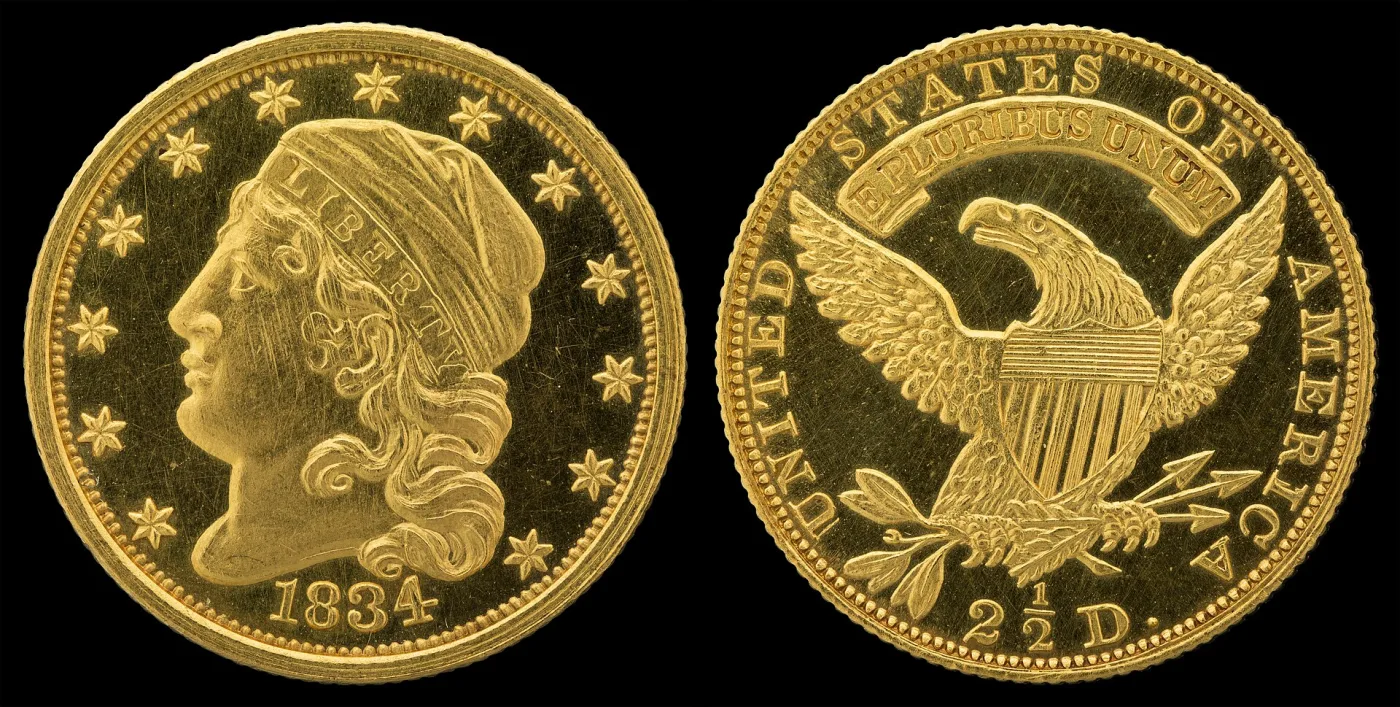
The Capped Head reverse carries the scroll motto “E PLURIBUS UNUM” above the eagle. The Classic Head reverse has no motto. This single feature is definitive and can be checked even on a worn coin where the headgear detail is unclear.
The 1834 Overlap Year
Both types exist dated 1834. The Capped Head 1834 (with motto) is a major rarity worth tens of thousands of dollars; the Classic Head 1834 (no motto) is the common type coin worth a few hundred to a few thousand dollars depending on grade. Always confirm the motto before assuming you have a common coin. The same logic applies when distinguishing closely related early types throughout the U.S. gold series, including the larger denominations like the three dollar gold piece.
Mint Marks and the New Branch Mints
The Classic Head Quarter Eagle was the inaugural coin for the southern and Gulf-coast branch mints, which gives the mint marks of this series enormous historical weight.
Philadelphia (No Mint Mark)
The Philadelphia Mint struck Classic Head Quarter Eagles every year from 1834 through 1839, with no mint mark. Philadelphia accounts for the overwhelming majority of surviving coins and provides the affordable type-coin examples that most collectors pursue.
Charlotte (C)
The Charlotte, North Carolina Mint opened in 1838 and struck only gold coins throughout its existence. Its first quarter eagle, the 1838-C, is a landmark issue — the first gold coin struck at Charlotte and a perennial key date. Charlotte continued with the 1839-C before the type ended.
Dahlonega (D)
The Dahlonega, Georgia Mint also opened in 1838 and likewise struck only gold. The 1839-D is the only Classic Head Quarter Eagle from Dahlonega — there is no 1838-D quarter eagle — which makes it a one-year, one-mint rarity and one of the most desirable coins in the series. Do not confuse the Dahlonega “D” with the much later Denver “D”; Denver did not open until 1906, decades after this type ended.
New Orleans (O)
The New Orleans, Louisiana Mint opened in 1838 and struck both gold and silver. Its single Classic Head Quarter Eagle, the 1839-O, is the most available of the branch-mint issues and is notable as the first quarter eagle struck at New Orleans and the only branch-mint Classic Head Quarter Eagle that a collector can realistically hope to own in better grades. New Orleans went on to produce later silver issues like the Seated Liberty quarter in large quantities.
Date-by-Date and Mint-by-Mint Analysis (1834-1839)
The series is short enough that a complete date-and-mint set is only nine coins, but several of those coins are formidable rarities. Here is the full roster.
1834 (Philadelphia)
Mintage: 112,234. The first Classic Head Quarter Eagle and the most common date of the series. This is the standard type-coin choice. Values: Fine $400, EF $600, AU $900, MS-62 $2,400, MS-63 $4,000.
1835 (Philadelphia)
Mintage: 131,402. The highest-mintage date of the series and very available. Values track closely with 1834. A common alternative type-coin choice.
1836 (Philadelphia)
Mintage: 547,986 — by far the largest mintage of the series. The 1836 exists in several head-style varieties (Script 8 and Block 8 logotypes among them) prized by specialists. The most available date overall in higher grades. Values: Fine $400, EF $600, AU $850, MS-62 $2,300, MS-63 $3,800.
1837 (Philadelphia)
Mintage: 45,080. Noticeably scarcer than 1834-1836 because of the lower mintage. Values: Fine $450, EF $750, AU $1,200, MS-62 $4,000, MS-63 $7,500.
1838 (Philadelphia)
Mintage: 47,030. Comparable in scarcity to 1837. The same year Charlotte struck its first quarter eagle. Values: Fine $450, EF $725, AU $1,150, MS-62 $4,000, MS-63 $7,000.
1838-C (Charlotte)
Mintage: 7,880. The first gold coin struck at the Charlotte Mint and one of the premier keys of the series. Almost always seen well circulated; Mint State examples are extreme rarities. Values: Fine $3,000, EF $6,500, AU $14,000, MS-60 $40,000+.
1839 (Philadelphia)
Mintage: 27,021. The final Philadelphia Classic Head Quarter Eagle and scarcer than the mid-1830s dates. Values: Fine $475, EF $800, AU $1,400, MS-62 $5,500.
1839-C (Charlotte)
Mintage: 18,140 (some references combine sub-varieties). A key date, more available than the 1838-C but still genuinely scarce. Several die varieties exist. Values: Fine $2,200, EF $4,500, AU $9,500, MS-60 $30,000+.
1839-D (Dahlonega)
Mintage: 13,674. The only Dahlonega quarter eagle of the type and a blue-chip rarity. Highly sought as a one-year, one-mint issue. Values: Fine $3,200, EF $7,000, AU $15,000, MS-60 $45,000+.
1839-O (New Orleans)
Mintage: 17,781 (some sources cite higher). The first New Orleans quarter eagle and the most collectible branch-mint Classic Head Quarter Eagle. Exists with several varieties including a wide and close date. The only branch-mint issue regularly available in AU and occasionally low Mint State. Values: Fine $1,400, EF $2,800, AU $5,500, MS-61 $14,000, MS-63 $30,000+.

Key Dates and Rarities
For a six-year series, the Classic Head Quarter Eagle packs an outsized number of important rarities, all of them branch-mint issues from 1838 and 1839.
1838-C — First Charlotte Gold
With a mintage of only 7,880, the 1838-C is the lowest-mintage date of the series and carries the historical distinction of being the very first gold coin struck at the Charlotte Mint. It is a cornerstone of any Charlotte-mint collection. Surviving examples are almost universally circulated and often show the weak striking characteristic of early branch-mint production.
1839-D — Only Dahlonega Quarter Eagle of the Type
The 1839-D is a one-year type from Dahlonega — there is no other Classic Head Quarter Eagle from this mint — which gives it a permanent place on the want list of type collectors, Dahlonega specialists, and gold collectors alike. Its combination of low mintage, single-year status, and frontier-mint mystique makes it the most famous coin in the series.
1839-C — Charlotte’s Second Year
While more available than the 1838-C, the 1839-C is still a major key in absolute terms and is essential to a complete branch-mint set. Numerous die varieties exist, and specialists pursue particular die marriages.
1839-O — The Obtainable Branch Mint Coin
The 1839-O is the relief valve of the series: a genuine branch-mint Classic Head Quarter Eagle that a determined collector can actually acquire in a respectable grade. It is the natural choice for a collector who wants one branch-mint example to represent the type without paying five figures.
Why Branch Mint Coins Survive in Such Small Numbers
The branch mints struck these coins for local commerce in gold-mining regions where coins circulated hard and were frequently melted, lost, or exported. There were no collectors saving them at the source. As a result, even the “available” branch issues survive in mere hundreds, and the keys in far fewer.
Major Varieties and Die Marriages
Classic Head Quarter Eagles were struck from hand-prepared dies, and a number of varieties are recognized and collected. While the series does not have a single dominant variety system the way the early Capped Bust quarters have the Browning numbers, several specific varieties matter for value.
1834 Head Styles
The 1834 exists with subtle differences in the portrait and in the size and placement of the stars. None command dramatic premiums, but specialists distinguish them.
1836 Script 8 and Block 8
The 1836 date logotype appears in two distinct styles of the numeral 8: a “Script 8” with a more ornate, rounded form, and a “Block 8” with a squarer appearance. Both are collectible, and the relative scarcity of each shifts pricing modestly. There are also head-style differences (Head of 1835 vs Head of 1837) within the 1836 production.
1839-O Date Varieties
The 1839-O is known with several date configurations, including a “Wide Date” and a “Close Date,” as well as differences in the mint mark size (Large O and Small O). These varieties carry meaningful premiums among New Orleans specialists, and the Large O over Small O is particularly sought.
Repunched Dates and Mint Marks
Repunched dates and repunched mint marks exist across several branch-mint issues, reflecting the hand-punching of date and mint mark elements into the working dies. These are cataloged in specialist references and trade at premiums when clearly attributable. As with other hand-struck early coinage such as the Draped Bust dollar, careful examination under magnification is rewarded.
Proof Classic Head Quarter Eagles
Proof Classic Head Quarter Eagles exist but are exceedingly rare — among the rarest proof coins in all of American numismatics.
Extreme Rarity
Proofs were struck only at Philadelphia and only in the tiniest numbers, almost certainly as special presentation pieces rather than for sale to collectors, since organized proof-set sales to the public did not begin until 1858. Surviving proof Classic Head Quarter Eagles of any date number in the low single digits to low double digits at most, and several dates may not survive in proof at all.
Identifying a Proof
Genuine proofs show fully mirrored fields, sharp squared-off rims, and crisp design detail from carefully prepared dies and planchets struck with extra pressure. Because the survival population is so small and the stakes so high, any coin represented as a proof Classic Head Quarter Eagle should be authenticated by PCGS or NGC and ideally backed by published auction provenance.
Market Position
When a genuine proof appears at auction, it is a major numismatic event and typically sells for well into six figures. For the vast majority of collectors, proofs of this type are a topic of study rather than acquisition, and the focus remains on the business-strike issues.
Grading Classic Head Quarter Eagles
Grading this type requires understanding both the standard Sheldon scale and the specific high points where the design first shows wear. Branch-mint coins add the complication of weak strikes that can be mistaken for wear.
Key Grading Focal Points
On the obverse, wear shows first on the highest points: the curls of Liberty’s hair above and behind the ear, the cheek, and the tips of the headband. The word “LIBERTY” on the headband is an important indicator — fully sharp letters point to higher grades, while weakness or partial letters indicate either wear or a soft strike. On the reverse, check the eagle’s neck feathers, the tips of the wings, the shield lines, and the claws.
Strike vs Wear on Branch Mint Coins
Charlotte and Dahlonega coins were frequently struck from worn dies on imperfect planchets, so they can show softness in the centers that has nothing to do with circulation wear. Distinguishing a weak strike from honest wear is the single hardest part of grading branch-mint gold and is a major reason these coins should be graded by professionals. A weakly struck but unworn coin can still be Mint State; learning to read luster in the protected areas is essential.
Grade Descriptions
Very Fine (VF-20 to VF-35): Moderate even wear. About half of the hair detail remains; LIBERTY is complete but soft. Eagle shows most major feather groups.
Extremely Fine (EF-40 to EF-45): Light wear on the high points only. Most hair curls are distinct; LIBERTY is sharp. Traces of mint luster may survive in protected areas. This is a popular and obtainable grade for the type.
About Uncirculated (AU-50 to AU-58): Only slight friction on the highest points — the topmost hair curls and the eagle’s wing tips. AU-58 examples retain most of their luster and appear nearly uncirculated. AU is the practical ceiling for many branch-mint issues.
Mint State (MS-60 to MS-65+): No wear. Differentiated by surface marks, luster quality, and strike. Genuine Mint State Philadelphia coins exist with patience; Mint State branch-mint coins are condition rarities, and an MS-63 or finer 1838-C or 1839-D is a trophy. For a full explanation of the numerical grades and what each level means, see our coin grading guide.
Counterfeit Detection and Authentication
Classic Head Quarter Eagles, especially the branch-mint keys, are among the most frequently counterfeited U.S. gold coins. The combination of high value and small size makes them attractive targets for both cast fakes and altered coins.
Added and Altered Mint Marks
The most dangerous counterfeits are common Philadelphia coins with an added “C,” “D,” or “O” mint mark to imitate a branch-mint rarity, or genuine but lower-value branch coins with altered dates. Examine the mint mark area above the date under 10x to 20x magnification: added mint marks show tooling marks, incorrect font, wrong position, or a slightly different surface texture and luster than the surrounding field. Always compare against authenticated reference photographs of genuine die-mint mark combinations.
Cast and Struck Counterfeits
Cast counterfeits show telltale signs: slightly soft or rounded detail, a grainy or pebbly surface texture under magnification, incorrect (usually low) weight, mushy or filed edge reeding, and sometimes a visible seam on the edge. Modern struck counterfeits from false dies can be more deceptive but often have subtle errors in the design details, the star positions, or the date logotype that do not match any genuine die.
Weight and Specifications Check
A genuine coin weighs 4.18 grams (less a small amount for wear). Significant underweight indicates a fake or a coin of incorrect fineness. Verify the diameter and the reeded edge as well. These physical checks are quick and rule out a large fraction of crude counterfeits, the same way they help authenticate other small gold issues such as the gold dollar.
Professional Authentication Is Essential
For any branch-mint Classic Head Quarter Eagle, and for any Philadelphia coin in Mint State, professional authentication and grading by PCGS or NGC is strongly recommended. The price difference between a genuine 1839-D and a clever fake is tens of thousands of dollars, and certified encapsulation provides authentication, an objective grade, and tamper-evident protection. Never buy a four- or five-figure branch-mint coin raw unless you are an expert who can attribute the exact die marriage yourself.
Current Market Values by Date and Grade
Classic Head Quarter Eagle values are driven by date, mint, grade, and strike quality. The gap between common Philadelphia type coins and branch-mint keys is enormous. The following are typical 2026 retail ranges for properly certified coins; raw coins and problem coins (cleaned, damaged, or “details” graded) sell at significant discounts.
Common Philadelphia Type Coins (1834, 1835, 1836)
Very Fine: $400 to $500. Extremely Fine: $550 to $700. About Uncirculated: $800 to $1,400. MS-62: $2,300 to $2,800. MS-63: $3,800 to $5,000. MS-64 and finer: $7,000 to $20,000+.
Scarcer Philadelphia Dates (1837, 1838, 1839)
Very Fine: $450 to $550. Extremely Fine: $700 to $900. About Uncirculated: $1,150 to $1,600. MS-62: $4,000 to $5,500. MS-63: $7,000 to $9,000.
Charlotte Keys (1838-C, 1839-C)
1838-C: Fine $3,000, EF $6,500, AU $14,000, low Mint State $40,000 and up. 1839-C: Fine $2,200, EF $4,500, AU $9,500, low Mint State $30,000 and up.
Dahlonega Key (1839-D)
Fine $3,200, EF $7,000, AU $15,000, low Mint State $45,000 and up. As a one-year, one-mint type, the 1839-D commands strong demand at every grade level.
New Orleans (1839-O)
Fine $1,400, EF $2,800, AU $5,500, MS-61 $14,000, MS-63 $30,000 and up. Premium varieties (Large O, Wide Date) add to these figures.
Market Trends
The Classic Head Quarter Eagle market has been firm, with strong, steady demand for the branch-mint keys from gold and branch-mint specialists, and broad demand for nice Philadelphia type coins from collectors who want a single representative example. Original, never-cleaned coins with good eye appeal bring substantial premiums over the typical “details”-graded survivors that dominate the population. Underlying gold bullion prices also provide a floor under the common-date coins. As with all gold, premiums and spreads move with the broader precious-metals market.
Collecting Strategies and Tips
The Classic Head Quarter Eagle supports several collecting approaches at very different budget levels, which is part of its enduring appeal.
Type Coin Collection
The most popular approach is to acquire a single nice Philadelphia coin (1834, 1835, or 1836) to represent the type in a U.S. gold type set or a complete quarter eagle type set alongside the later Indian Head quarter eagle and Liberty Head quarter eagle. In EF to AU, this can be done for $600 to $1,400; in MS-62 to MS-63, budget $2,300 to $5,000.
Complete Date Set
A complete date set of the six Philadelphia dates (1834-1839) is an achievable and rewarding goal in circulated grades, typically requiring $3,000 to $7,000 depending on grade, with the 1837, 1838, and 1839 being the harder dates to locate in nice condition.
Complete Date-and-Mint Set
The full nine-coin set including all four branch-mint issues (1838-C, 1839-C, 1839-D, 1839-O) is a serious, long-term, five-to-six-figure undertaking that ranks among the most prestigious goals in the series. Most collectors who attempt it acquire the Philadelphia coins first and add the branch-mint keys opportunistically as budget and availability allow.
Branch Mint Focus
Some collectors specialize in the gold of a single branch mint — all the Charlotte gold, or all the Dahlonega gold — in which case the Classic Head Quarter Eagle provides the foundational first-year issue. This is a popular and historically rich way to collect.
Buy the Coin, Not the Holder
Because strike quality varies so much on this type, two coins in the same numerical grade can look very different. Prioritize eye appeal, original surfaces, and strike sharpness. A well-struck, original AU-58 is often more desirable than a weakly struck, baggy MS-61. Always buy certified coins for the branch-mint issues, and learn to read the population reports to understand true rarity by grade.
Proper Storage and Preservation
Gold is chemically stable and does not tone or corrode the way silver and copper do, but Classic Head Quarter Eagles still require proper care to protect their surfaces and value.
Avoid PVC and Physical Contact
Never store gold coins in PVC-containing flips, which can leave a sticky green residue over time. Use inert Mylar flips, hard plastic capsules, or certified-grading-service holders. Although gold resists chemical damage, the soft metal scratches easily, so minimizing handling and contact with other coins is essential to preserve grade.
Handling
Always hold coins by their edges over a soft surface. Gold is softer than silver, so fingerprints, hairlines, and contact marks reduce eye appeal and value, particularly on Mint State examples. Wear clean cotton or nitrile gloves when handling uncertified pieces.
Never Clean
Cleaning a gold coin leaves hairline scratches and an unnatural brightness that experienced graders and the major services immediately detect. A cleaned Classic Head Quarter Eagle receives a “details” grade and sells at a steep discount — often 30% to 60% below an equivalent original coin. Even a coin that looks dull or has dirt in the recesses is worth far more left untouched than cleaned. The same warning applies to all early U.S. gold.
Environment and Security
Store in a cool, dry, stable environment, and given the high value of these coins, use a quality safe or a bank safe-deposit box. Maintain an inventory with photographs and certification numbers for insurance purposes, and consider a numismatic insurance policy for a collection of any significant value.
Frequently Asked Questions
What is a Classic Head Quarter Eagle?
It is the United States $2.50 gold coin struck from 1834 to 1839, designed by Chief Engraver William Kneass. It features Liberty wearing a flat fillet headband on the obverse and a heraldic eagle with no motto on the reverse. It was introduced with a reduced weight so that, for the first time, U.S. gold coins would circulate rather than be melted for bullion.
How do I tell a Classic Head from a Capped Head quarter eagle?
Check two things. First, the headgear: the Classic Head wears a flat headband, while the Capped Head wears a soft Phrygian cap. Second, the reverse motto: the Classic Head has no "E PLURIBUS UNUM" scroll above the eagle, while the Capped Head does. The motto check is definitive even on worn coins. Both types exist dated 1834, so always confirm before assuming you have the common type.
Why does the reverse have no motto?
The motto "E PLURIBUS UNUM" was deliberately removed in 1834 to give the new reduced-weight gold coins a quick visual identifier that distinguished them from the older, heavier coins. Banks and the public could tell the "new tenor" lighter coins from the "old tenor" heavier coins at a glance.
What are the key dates?
All four branch-mint issues are keys: the 1838-C (first Charlotte gold, lowest mintage at 7,880), the 1839-C, the 1839-D (the only Dahlonega quarter eagle of the type), and the 1839-O (the most obtainable branch-mint coin). The 1839-D and 1838-C are the most famous and valuable.
How much is a Classic Head Quarter Eagle worth?
Common Philadelphia dates run roughly $400 in Very Fine to several thousand dollars in Mint State. Branch-mint keys range from a few thousand dollars in circulated grades to tens of thousands in Mint State, with the 1838-C and 1839-D the most valuable. Exact value depends on date, mint, grade, strike, and originality.
Where is the mint mark located?
On branch-mint coins, the mint mark appears on the obverse above the date — an unusual position. "C" is Charlotte, "D" is Dahlonega (not Denver, which did not exist until 1906), and "O" is New Orleans. Philadelphia coins have no mint mark.
Is the gold in these coins worth a lot by weight?
Each coin contains about 0.121 troy ounces of gold, so the melt value is modest relative to the numismatic value. For all but the most worn or damaged common coins, the collector value far exceeds the bullion value, so these should never be sold for melt.
Should I clean a dull or dirty Classic Head Quarter Eagle?
Never. Cleaning gold leaves hairline scratches and an unnatural surface that graders detect immediately, resulting in a "details" grade and a 30% to 60% loss in value. Original, even if dull, is always worth more than cleaned. Leave any cleaning or conservation decision to professional services.
Can I still find these in circulation?
No. The Classic Head Quarter Eagle left circulation well over a century ago. All surviving examples are in collections, dealer inventories, or estate holdings, and are acquired through coin dealers, auctions, and the numismatic marketplace.