Liberty Head Eagle Identification Guide: Types, Key Dates, Mint Marks, and Values
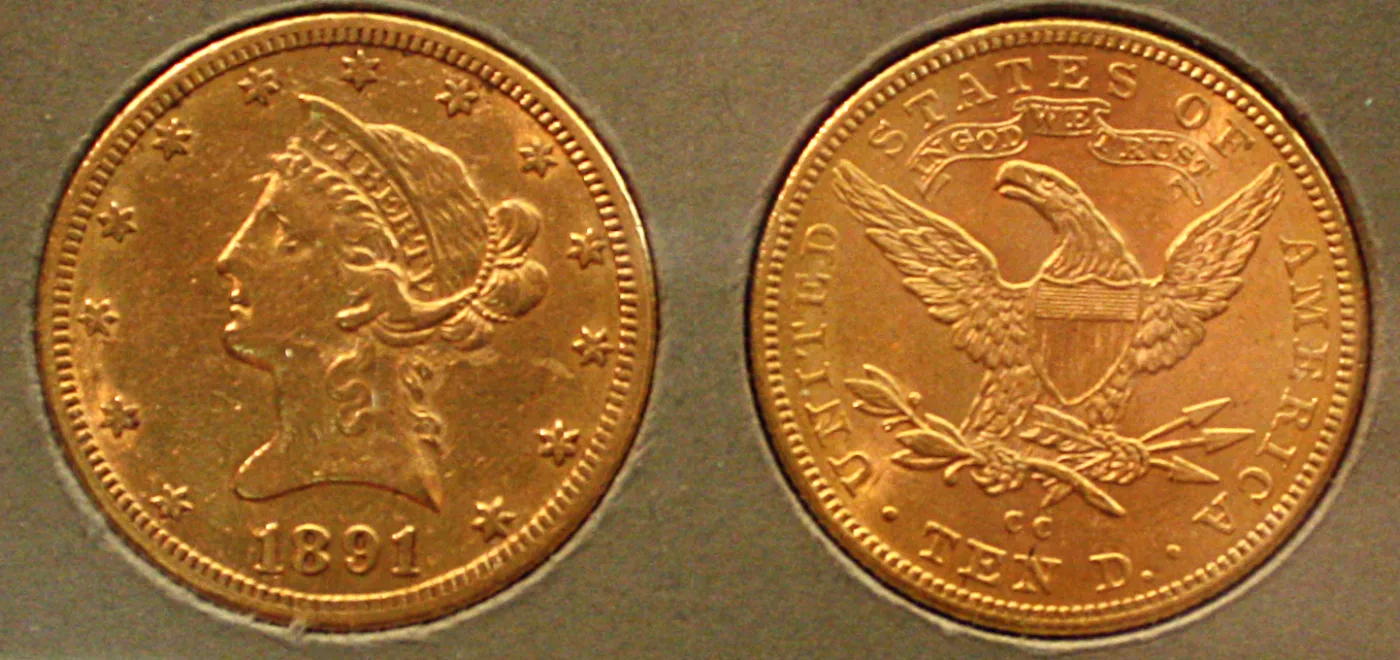
The Liberty Head Eagle — the United States ten-dollar gold coin produced from 1838 through 1907 — is one of the longest-running and most historically important series in all of American numismatics. Designed by Mint Chief Engraver Christian Gobrecht, this “Coronet” or “Coronet Head” $10 gold piece served the nation through the California Gold Rush, the Civil War, the great silver-and-gold debates of the 1870s and 1890s, and the dawn of the 20th century, before being replaced in 1907 by Augustus Saint-Gaudens’s Indian Head Eagle. Across nearly seventy years and five United States mints, the series produced hundreds of distinct date-and-mintmark combinations, a deep roster of legitimate rarities, and one of the richest fields for specialist collecting in the entire U.S. gold canon.
For collectors, the Liberty Head Eagle offers something the shorter 20th-century gold series cannot: genuine scale. Each coin contains 0.4838 troy ounces of pure gold — the same bullion anchor as its Saint-Gaudens successor — yet the series spans the antebellum era through the Gilded Age, with Southern branch-mint coinage from the Dahlonega and Charlotte tradition, scarce Carson City issues, and Civil War-era rarities that rank among the toughest coins in the American series. Like the companion Liberty Head Half Eagle at $5 and the Liberty Head Double Eagle at $20, the $10 Eagle shares Gobrecht’s coronet portrait and a heraldic eagle reverse, making it instantly recognizable to anyone familiar with classic U.S. gold.
This guide covers everything you need to identify, grade, and value Liberty Head Eagles: the two major types (No Motto, 1838-1866, and With Motto, 1866-1907), the rare first-year 1838 and 1839 head-style varieties, the Civil War and Reconstruction key dates, the legendary 1875 and 1864-S, the Carson City and New Orleans branch issues, mint marks across Philadelphia, New Orleans, San Francisco, Carson City, and Denver, current grading standards, authentication strategies, and 2026 market values. The same disciplined coin identification techniques that apply to silver classics extend directly to this gold series — with the added complication that bullion value floors common-date prices and raises the stakes for accurate authentication of better dates.
History and Design: Gobrecht’s Coronet
The Liberty Head Eagle was introduced in 1838 to replace the Capped Bust (Turban Head) Eagle, a denomination that had been suspended entirely since 1804. Its $5 counterpart, the Capped Bust Half Eagle, had been struck without interruption across the same early decades before the 1834 reform reshaped the gold series. When gold coinage of the $10 denomination resumed, the Mint turned to Christian Gobrecht, whose neoclassical Liberty head had already defined the look of mid-century American silver. The same coronet-crowned Liberty portrait would soon appear across the gold series, unifying the $2.50, $5, $10, and $20 denominations under a single artistic vision.
The timing was significant. The $10 Eagle resumed just as the nation stood on the brink of the great gold discoveries — first in the Southern Appalachians, then the transformative California strike of 1848-1849. By the time the Gold Dollar and Double Eagle denominations were added in 1849-1850 to absorb the flood of California metal, the Liberty Head Eagle was already an established workhorse of American commerce and international trade.
The Designer: Christian Gobrecht
Christian Gobrecht (1785-1844) was the third Chief Engraver of the United States Mint and one of the most influential figures in 19th-century American coin design. His Seated Liberty figure defined silver coinage from the half dime through the dollar for decades — the same artistic lineage visible on the Seated Liberty Dollar and the Seated Liberty Quarter. For gold, Gobrecht produced the coronet Liberty head that would grace the Eagle for nearly seventy years — far longer than the designer himself lived. The portrait’s longevity is a testament to its balanced, dignified classicism, even as critics later found it conservative compared to the sculptural ambition of the Saint-Gaudens era.
The Motto Change of 1866
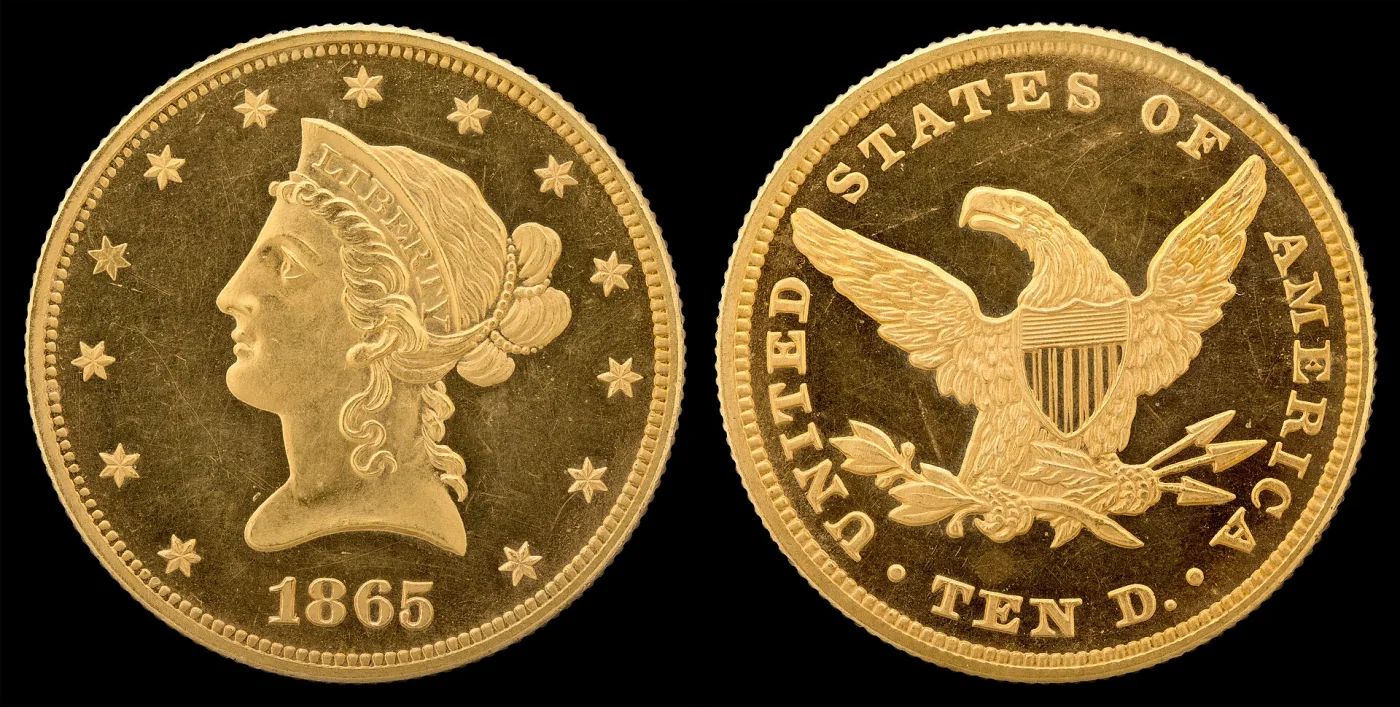
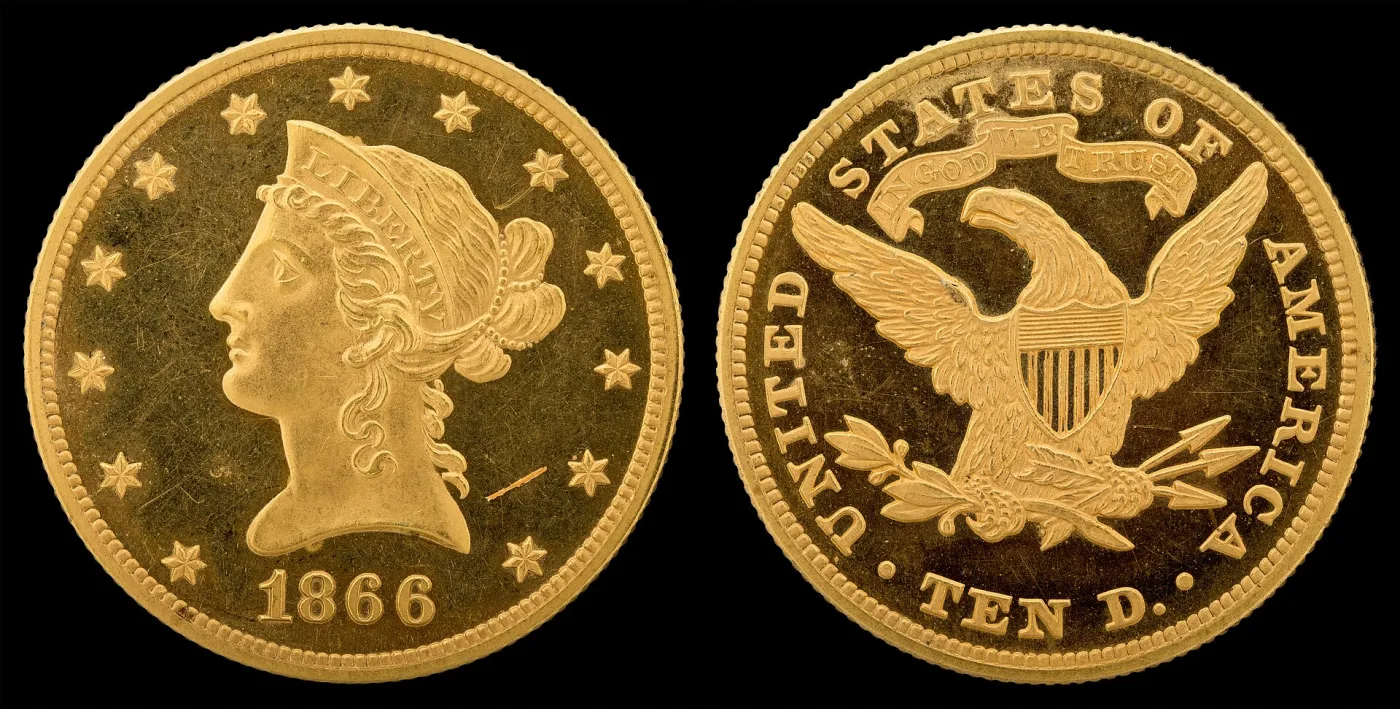
The single most important design event in the series came in 1866, when the motto IN GOD WE TRUST was added to the reverse above the eagle. This change followed the same Civil War-era religious sentiment that introduced the motto on the Two Cent Piece in 1864. The addition divides the entire series into two collectible types — No Motto (1838-1866) and With Motto (1866-1907) — and is the first thing any collector checks when identifying a Liberty Head Eagle.
Production Era and the End in 1907
Production ran from 1838 through 1907, ending when President Theodore Roosevelt’s coinage renaissance replaced Gobrecht’s coronet with Saint-Gaudens’s Indian Head design. The final 1907 Liberty Head Eagles overlapped with the first Indian Head Eagles, making 1907 a transition year prized by type collectors. Across the full run, the series witnessed nearly every major event in 19th-century American history, and its surviving coins carry that history in their dates and mint marks.
Design Details: Obverse and Reverse
Understanding every element of the Liberty Head Eagle design is essential for type identification, grading, and authentication. The design carries several subtle differences across its near-seventy-year production that distinguish the head styles and the two major motto types.
Obverse (Heads Side)
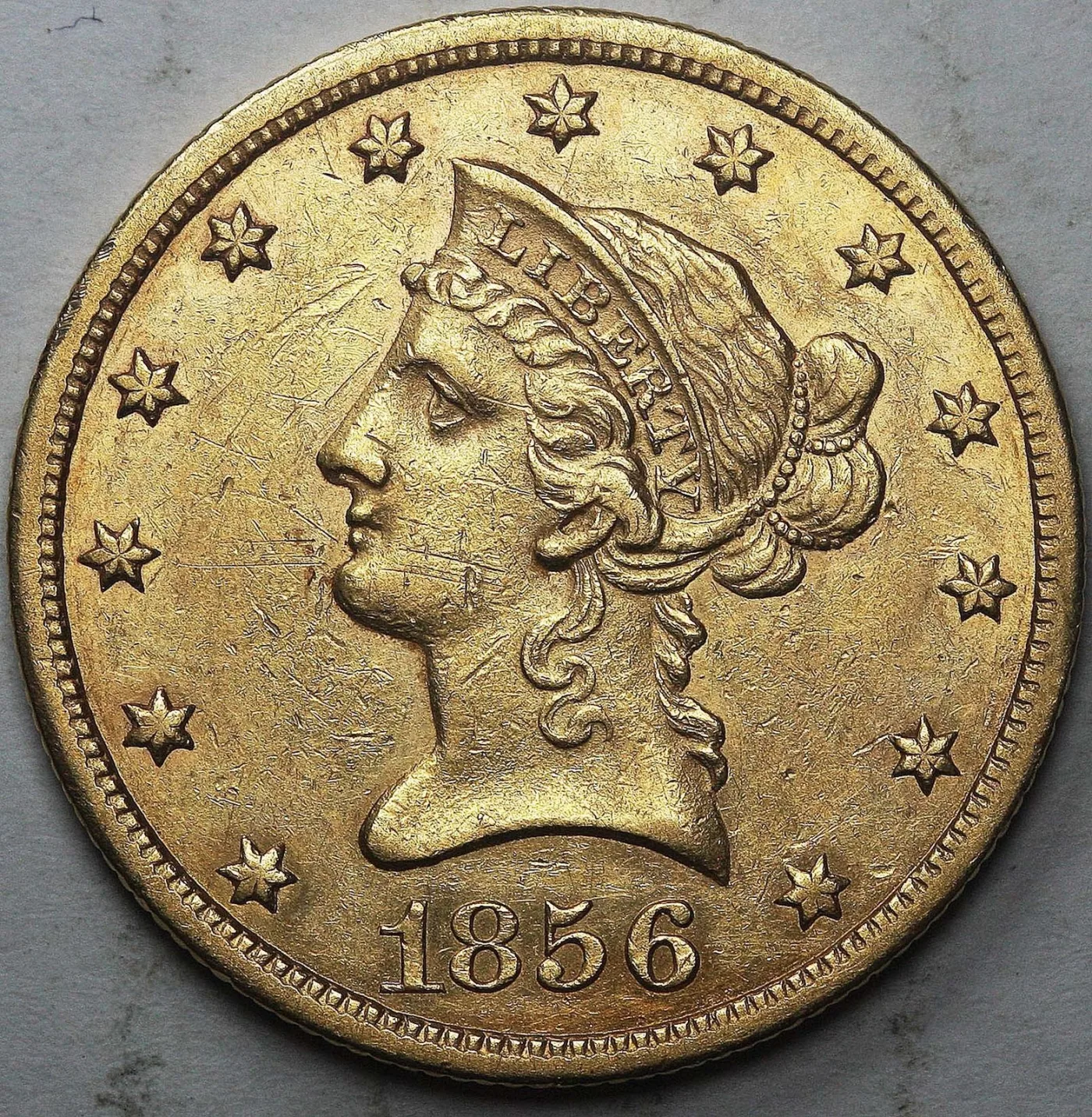
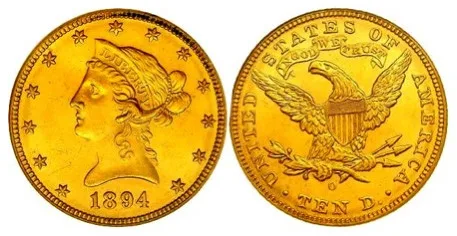
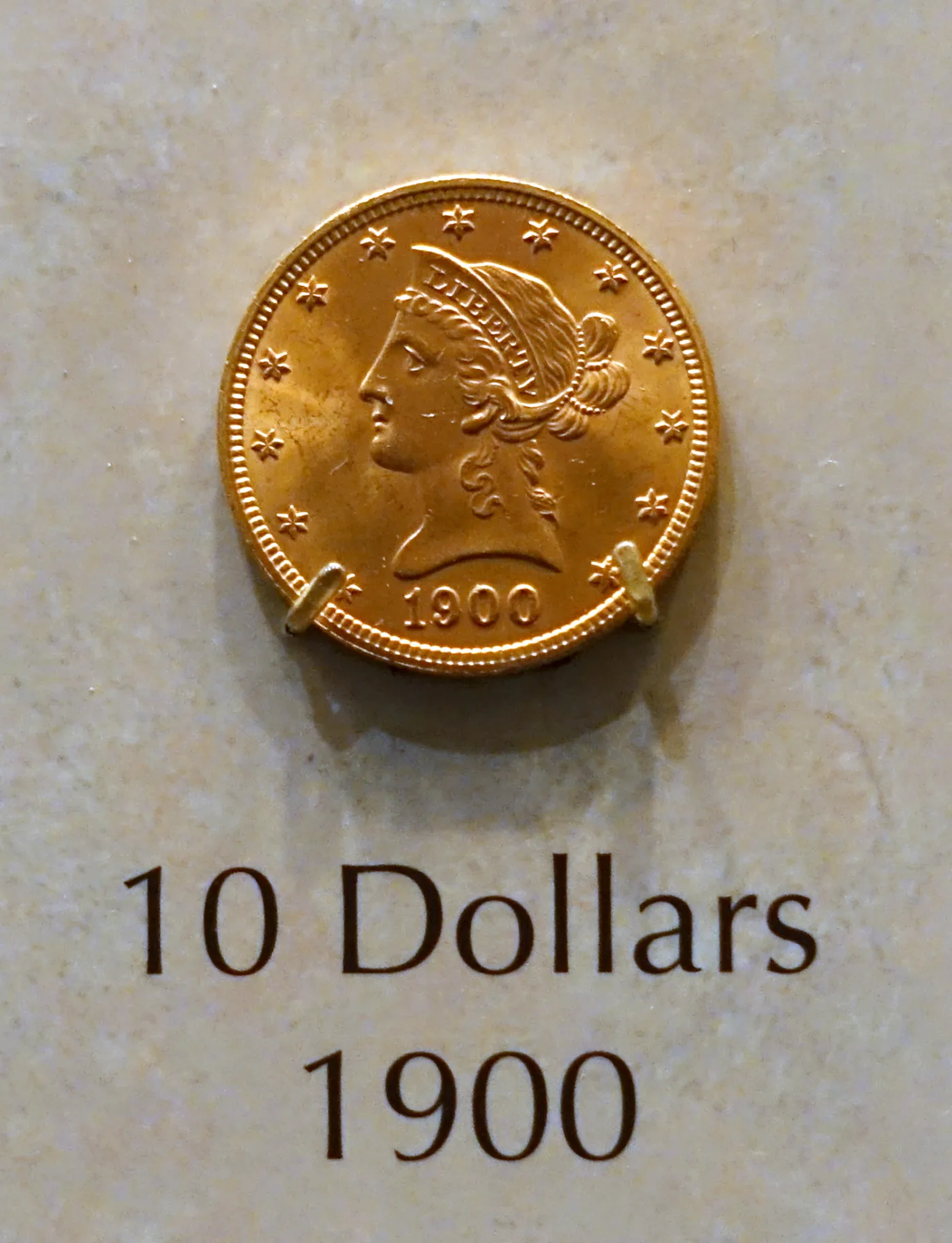
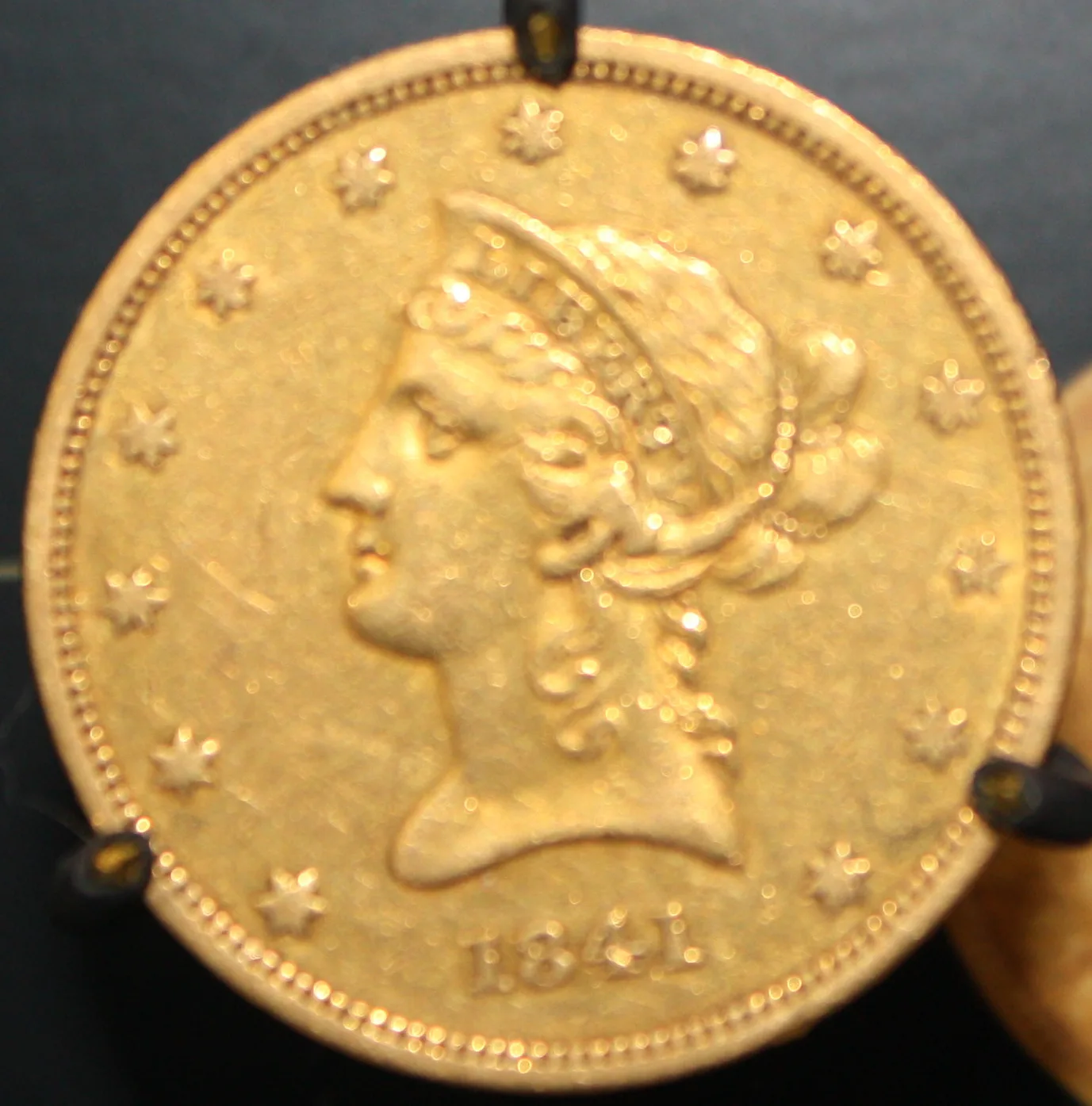
The obverse depicts a left-facing head of Liberty wearing a coronet inscribed LIBERTY in raised letters. Liberty’s hair is gathered into a bun at the back of the head, secured with beads, and the coronet rests across her brow. Thirteen stars representing the original colonies arc around the periphery, and the date appears at the bottom. The portrait is restrained and classical — a profile in the Greco-Roman tradition rather than the sculptural relief of the later Saint-Gaudens coinage.
Reverse (Tails Side)
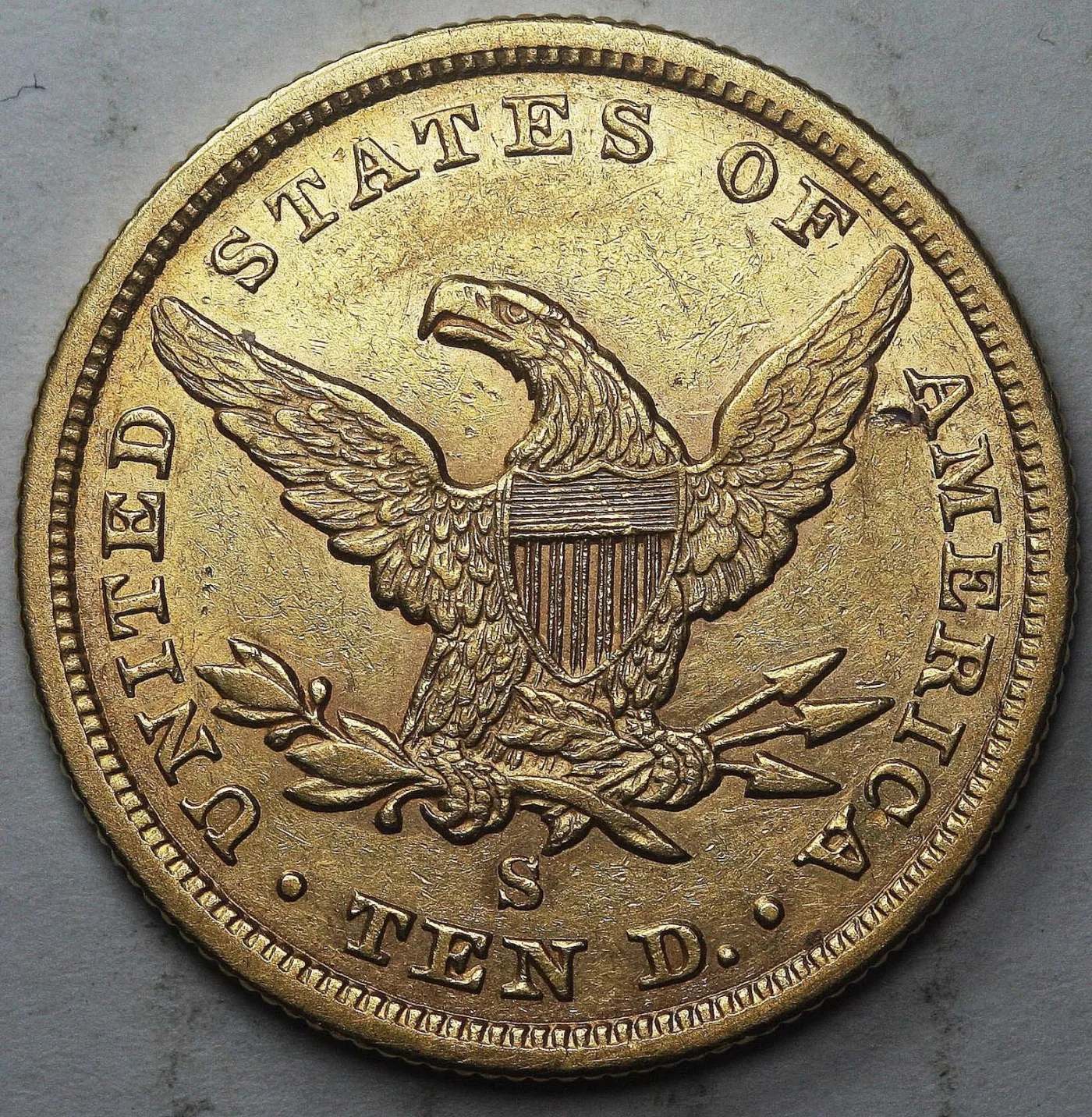
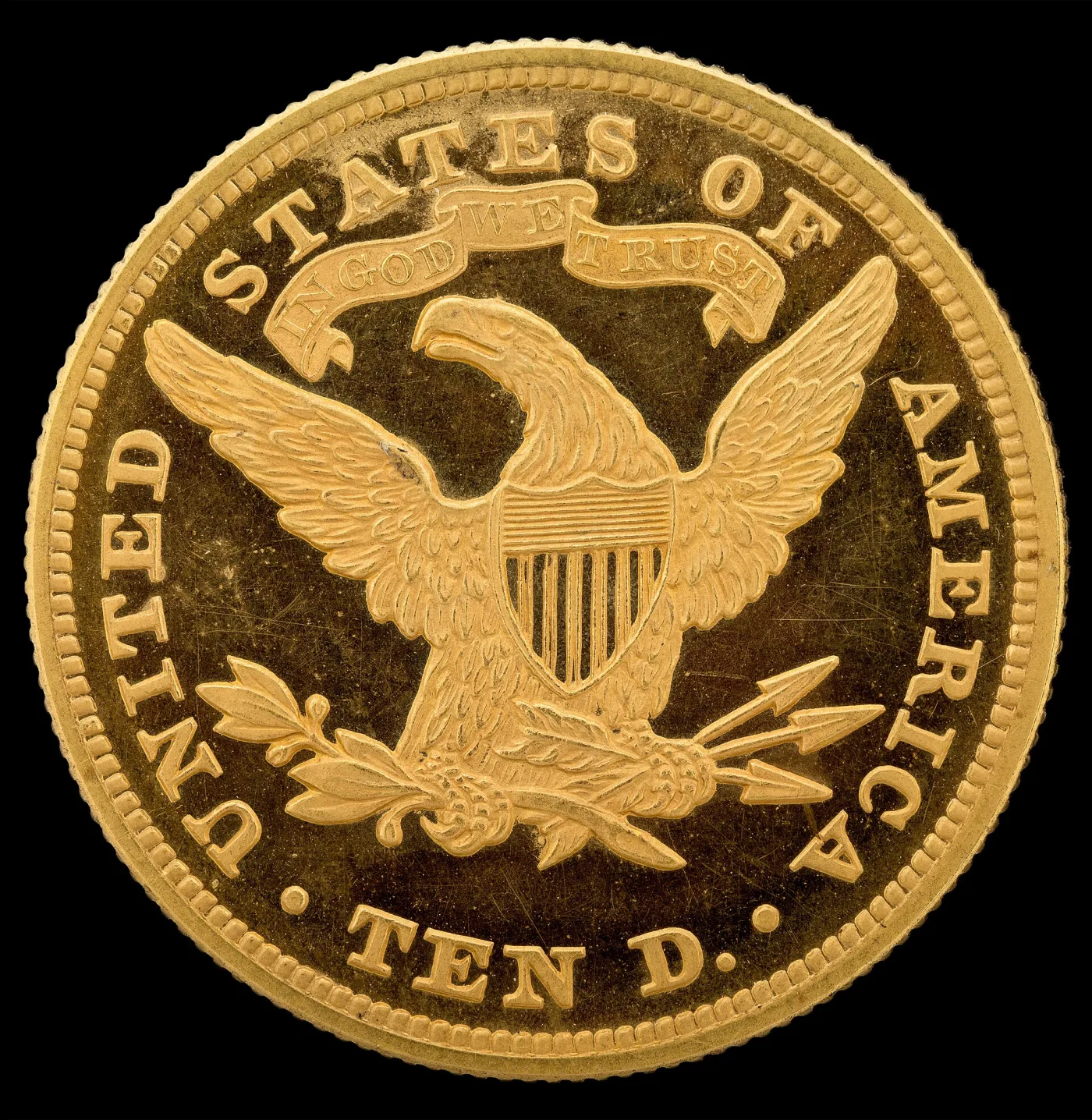
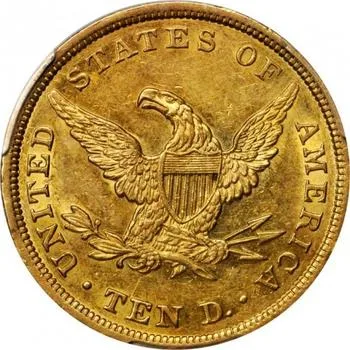
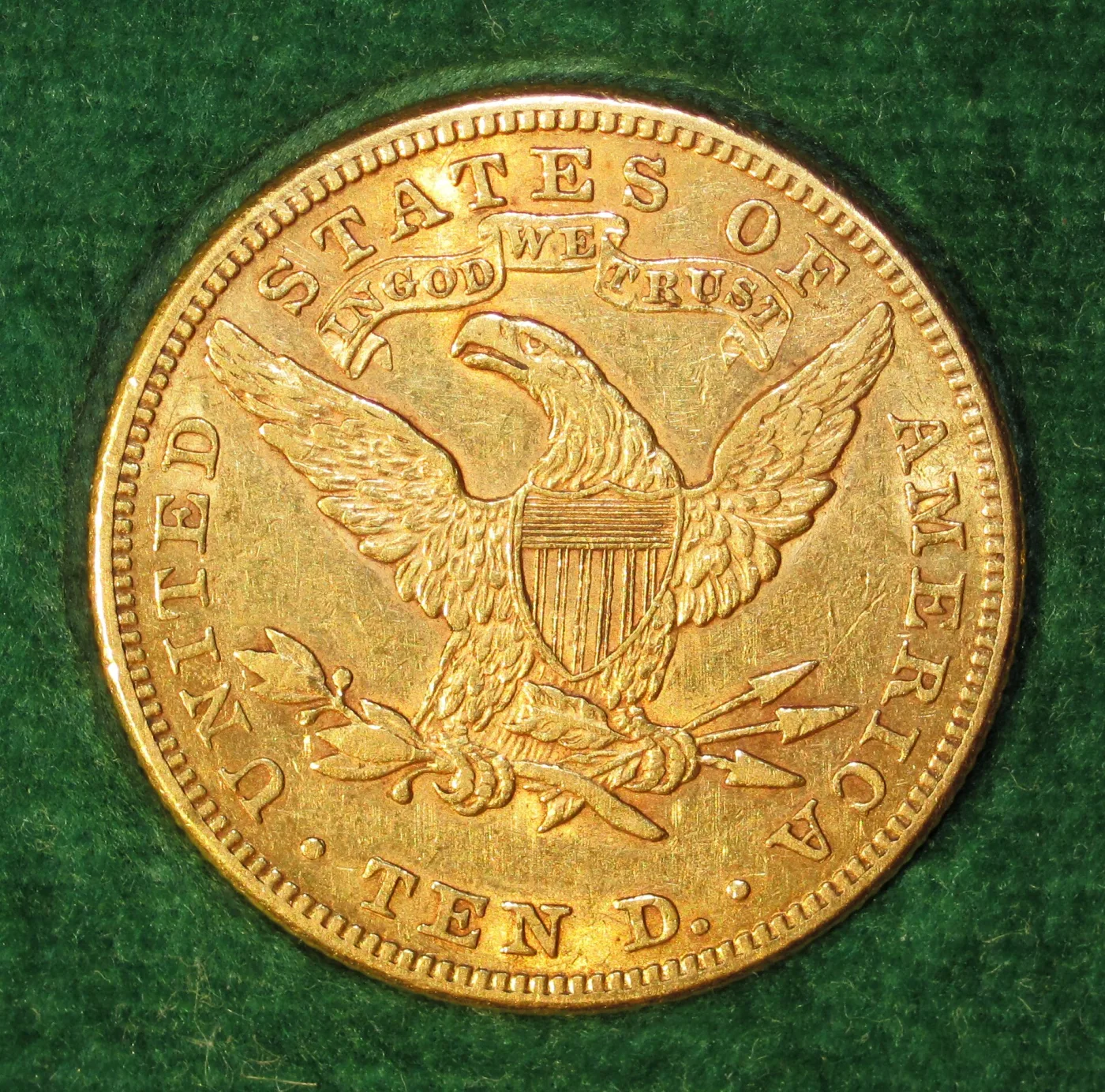
The reverse depicts a heraldic eagle with a Union shield on its breast, holding an olive branch in one talon and a bundle of arrows in the other. The legend UNITED STATES OF AMERICA arches across the top, with the denomination TEN D. below the eagle. On No Motto coins (1838-1866), the field above the eagle is plain. On With Motto coins (1866-1907), a small scroll bearing IN GOD WE TRUST appears above the eagle, between the eagle’s head and the rim. This scroll is the single fastest way to identify which of the two major types you hold.
Edge and Reeding
Unlike the star-edge Indian Head Eagle that followed, the Liberty Head Eagle has a conventional reeded edge. The reeding is fine and even on genuine examples. Crude counterfeits often get the reeding wrong — uneven, too coarse, or with a visible seam where two halves of a cast copy were joined.
Mint Mark Position
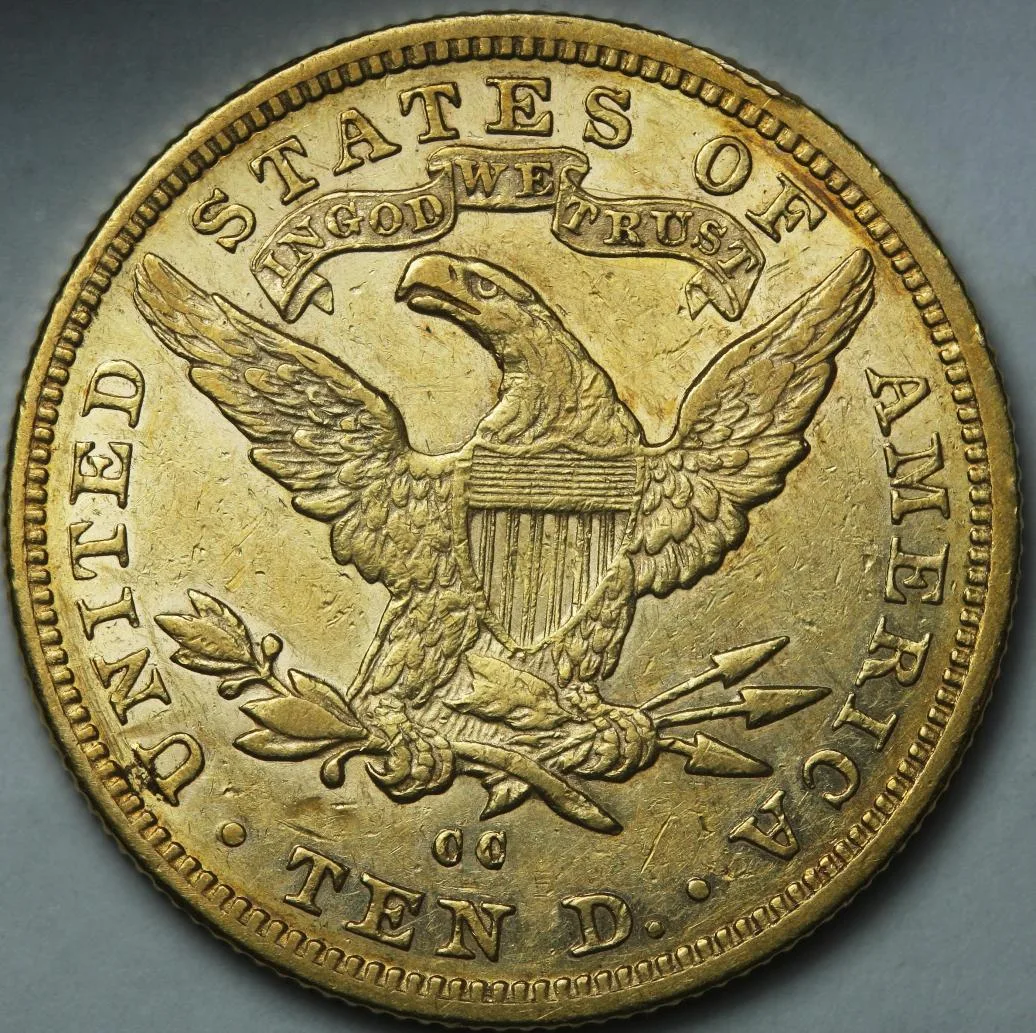
Mint marks appear on the reverse, below the eagle, between the tail feathers and the denomination TEN D. The letters used are O (New Orleans), S (San Francisco), CC (Carson City), and D (Denver, only in 1906-1907). Philadelphia issues bear no mint mark. Always examine this location under magnification — the mint mark determines whether an otherwise common date is a major rarity.
The Two Major Types and Head Varieties
Liberty Head Eagles divide cleanly into two major types based on the reverse motto, but the first two years of issue (1838-1839) also feature collectible head-style varieties on the obverse. Type identification is fundamental for collectors — type-set buyers pursue one example of each major type, and the early head varieties carry meaningful premiums.
Type 1: No Motto (1838-1866)
The No Motto type spans the resumption of $10 gold coinage in 1838 — a denomination that had lain dormant since the early Capped Bust Eagle was suspended in 1804 — through the middle of 1866. The reverse field above the eagle is plain, with no scroll or motto. This type includes all the antebellum issues, the California Gold Rush coinage, and the Civil War rarities — making it the more historically charged of the two types and home to several of the most valuable dates in the entire series. No Motto Eagles are scarcer overall than With Motto issues and are highly sought by type and date collectors alike.
Type 2: With Motto (1866-1907)
The With Motto type runs from mid-1866 through the end of the series in 1907. A small scroll bearing IN GOD WE TRUST appears above the eagle on the reverse. This type accounts for the bulk of total mintages and includes the more available later-date issues that many collectors use for type representation. The With Motto type also includes the Carson City issues of the 1870s-1890s and a number of scarce San Francisco and New Orleans dates.
1838 and 1839 Head Varieties
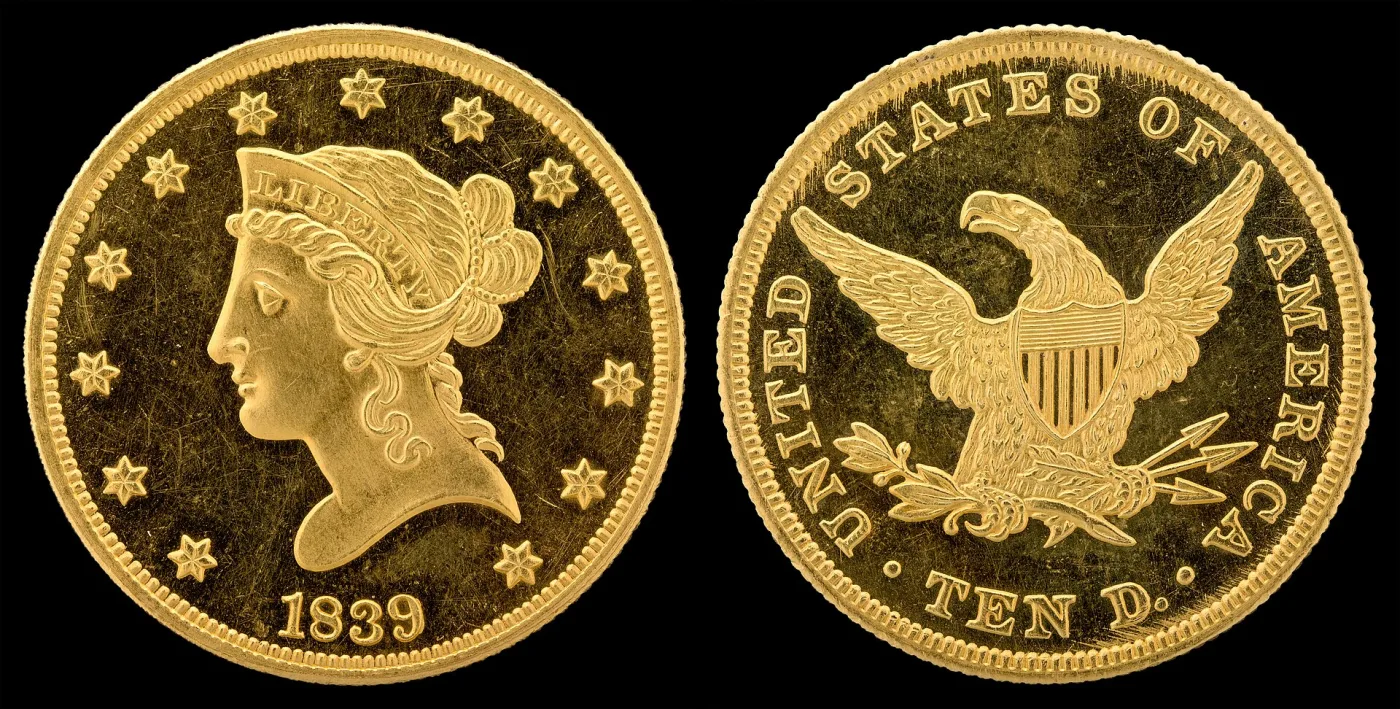
The first two years feature distinct obverse portraits that specialists treat as separate sub-types:
- 1838 Head of 1838: The first-year portrait, with a distinctive truncated bust and the date positioned differently from later issues. A scarce one-year type.
- 1839 Head of 1838 (Type of 1838, “Large Letters”): The 1838-style head continued into early 1839, creating a scarce two-year sub-type.
- 1839 Head of 1840 (Type of 1840, “Small Letters”): Mid-1839 introduced the modified portrait that would be standard for the rest of the series. The transition makes 1839 a two-variety year prized by specialists.
Quick Type Identification Reference
- No Motto (1838-1866): Plain field above eagle on the reverse — no scroll, no IN GOD WE TRUST
- With Motto (1866-1907): Small scroll reading IN GOD WE TRUST sits above the eagle’s head
- Head of 1838: First-portrait obverse on 1838 and early 1839 coins — examine the bust truncation and date placement
- Head of 1840: Modified portrait used from mid-1839 onward — the standard type for the rest of the run
Composition and Specifications
Every Liberty Head Eagle struck from 1838 onward is composed of 90% gold and 10% copper — the standard U.S. gold alloy established by the Coinage Act of 1837 and used through 1933 for all production gold including the Saint-Gaudens Double Eagle. The copper component gives the warm, slightly orange tone characteristic of classic U.S. gold and provides hardness that pure gold lacks.
Physical Specifications
- Composition: 90% gold, 10% copper
- Total weight: 16.718 grams (258 grains)
- Net gold weight: 15.046 grams (0.4838 troy ounces)
- Diameter: 27.0 millimeters (after 1840; earliest 1838-1840 issues are very slightly larger)
- Thickness: Approximately 2.0 millimeters
- Edge: Reeded
- Face value: $10
The 0.4838 troy ounce gold content is the bullion-value floor for every Liberty Head Eagle. At 2026 gold prices, this means even a heavily worn common-date example is worth well over $1,250 in pure metal value alone, before any numismatic premium. This bullion floor distinguishes gold coinage from silver — a worn Seated Liberty Quarter may be worth essentially only its silver value, but a worn Liberty Head Eagle carries substantial intrinsic worth that protects collector outlay.
Brief Diameter Note
The very earliest Liberty Head Eagles of 1838-1840 were struck at a marginally larger diameter before the specifications were standardized at 27.0 millimeters. The difference is slight and rarely affects identification, but specialists studying the earliest issues should be aware of it. For all practical purposes, the 27.0-millimeter, 16.718-gram standard applies to the overwhelming majority of the series.
Key Dates and Major Rarities
The Liberty Head Eagle series contains a deep roster of legitimate rarities spanning seven decades. As with the Double Eagle, many keys emerged from low mintages, branch-mint scarcity, and the wholesale melting of gold coinage under the 1933 gold recall. The same disciplined approach to spotting key dates applies whether you’re working through this series, the Buffalo Nickel, or any classic U.S. issue.
1838 Eagle
The first-year 1838 (Head of 1838) had a mintage of 7,200 and is the foundational rarity of the series. It is highly sought as both a first-year-of-issue and a scarce one-year head type. Choice examples bring strong five-figure to six-figure prices depending on grade, and Mint State pieces are exceptionally rare.
1839 Head of 1838
The 1839 Head of 1838 (“Large Letters,” Type of 1838) is the scarcer of the two 1839 varieties, representing the brief carryover of the first-year portrait into 1839. It is a key issue for type and variety collectors and commands substantial premiums over the more available Head of 1840 variety of the same year.
1858 Eagle
The 1858 Philadelphia Eagle had a tiny mintage of just 2,521 — the lowest business-strike mintage of any Philadelphia Liberty Head Eagle. It is a genuine rarity in all grades, with most survivors in circulated condition. Choice examples reach well into five and six figures, and the 1858 is a cornerstone date for serious collectors of the No Motto type.
1864-S Eagle
The 1864-S is one of the great Civil War rarities of the series, with a mintage of just 2,500 and very few survivors. The San Francisco Mint struck this issue during the Civil War, and most circulated heavily in the Western economy. High-grade examples are virtually unobtainable, and even worn pieces command strong five-figure to six-figure prices.
1875 Eagle
The 1875 Philadelphia Eagle is the lowest-mintage business strike of the entire series, with just 100 circulation pieces struck (plus 20 proofs). It is among the rarest collectible dates in all of U.S. gold, with only a handful of survivors known across both business strikes and proofs. When an 1875 Eagle appears at auction, it commands six- to seven-figure prices and headlines the sale.
1873 Eagle
The 1873 Philadelphia (Closed 3) had a mintage of just 800 business strikes and is a major rarity, particularly in higher grades. It is a key date for date collectors and one of the toughest With Motto-era Philadelphia issues to locate problem-free.
1920-S and 1930-S Comparison Note
Collectors sometimes confuse the Liberty Head Eagle keys with the famous 1920-S and 1930-S keys — but those belong to the Indian Head Eagle series, not the Liberty Head series, which ended in 1907. The Liberty Head Eagle has no 1920 or 1930 issues at all. Be careful when comparing price guides that list both $10 series, and always confirm whether a “key date” reference applies to the Liberty Head or the Indian Head Eagle.
1907 Liberty Head Eagle
The final-year 1907 Liberty Head Eagle is the last gasp of Gobrecht’s seventy-year design and overlaps with the first Saint-Gaudens Indian Head Eagles. It is relatively available and popular as a type and transition-year coin, with choice Mint State examples readily found. The 1907 is an excellent affordable representative of the With Motto type for collectors who want a single Liberty Head Eagle.
Civil War and Carson City Issues
The Liberty Head Eagle is unusual among U.S. gold series in that it spans the entire Civil War and the rise of the Western branch mints, producing a body of historically resonant coinage found in few other denominations.
Civil War-Era Rarities
During the Civil War (1861-1865), gold largely vanished from circulation in the North and traded at a premium against paper greenbacks. Philadelphia and San Francisco continued striking Eagles, but mintages and survival rates plummeted for many dates. The 1864-S, 1863, 1865-S, and several other Civil War-era issues are now major rarities. The New Orleans Mint, seized by Confederate authorities in 1861, struck a small number of 1861-O Eagles under uncertain authority — coins that carry both numismatic and historical fascination.
The Carson City Mint
The Carson City Mint (mint mark CC) opened in 1870 to coin the silver and gold of the Comstock Lode. It struck Liberty Head Eagles intermittently from 1870 through 1893, and Carson City Eagles are among the most popular of all branch-mint gold. Low mintages, heavy Western circulation, and the romance of the Old West combine to make CC Eagles command strong premiums. The 1870-CC (first year), 1879-CC, and 1883-CC are particularly scarce, and high-grade Carson City Eagles of any date are condition rarities.
New Orleans and the Southern Tradition
The New Orleans Mint (mint mark O) struck Liberty Head Eagles from 1841 onward, producing a long run of Southern gold that connects to the same regional minting tradition as the Charlotte and Dahlonega facilities profiled in the Gold Dollar guide. New Orleans Eagles include several scarce early dates and the historically charged 1861-O. The mint closed for gold coinage during and after the Civil War, reopened later, and produced its final Eagles in 1906.

Mint Marks: Five Mints Explained
Liberty Head Eagles were struck at five United States mints across the series, with mint marks appearing on the reverse below the eagle, between the tail feathers and the denomination TEN D. Always check this location carefully — counterfeiters occasionally add fake mint marks to common Philadelphia coins to manufacture key-date issues.
Philadelphia Mint (No Mint Mark)
The Philadelphia Mint produced Liberty Head Eagles in nearly every year of the series. Philadelphia issues bear no mint mark, following the traditional U.S. convention. Philadelphia is the source of the foundational rarities including the 1858, the 1875 (lowest mintage in the series), the 1873, and the first-year 1838. It also produced the bulk of available later-date With Motto issues.
New Orleans Mint (O Mint Mark)
The New Orleans Mint struck Eagles from 1841 through 1906 (with a long Civil War-era gap). The “O” mint mark appears below the eagle. New Orleans issues include several scarce antebellum dates and the historically significant 1861-O, struck during the transition of the mint to Confederate and then state control. Most New Orleans Eagles saw heavy circulation, so high-grade survivors are scarce.
San Francisco Mint (S Mint Mark)
The San Francisco Mint struck Eagles from 1854 onward, coining the gold of the California fields and the Western economy. The “S” mint mark appears below the eagle. San Francisco is the source of major Civil War rarities including the 1864-S, as well as many scarce 1860s-1870s dates. San Francisco mintages were often modest and survival rates low, making S-mint Eagles a rich field for date specialists.
Carson City Mint (CC Mint Mark)
The Carson City Mint struck Eagles intermittently from 1870 through 1893. The “CC” mint mark appears below the eagle. Carson City Eagles are among the most popular branch-mint gold coins, prized for low mintages and Old West history. The 1870-CC, 1879-CC, and 1883-CC are particularly scarce, and Carson City Eagles in Mint State are genuine condition rarities.
Denver Mint (D Mint Mark)
The Denver Mint struck Liberty Head Eagles only in 1906 and 1907, at the very end of the series. The “D” mint mark appears below the eagle. These two-year Denver issues are relatively available and popular as the only Denver-minted coins of the Liberty Head type. Do not confuse the Denver “D” with the Dahlonega “D” used on smaller gold denominations decades earlier — the Dahlonega Mint never struck the $10 Eagle.
Mint Mark Position and Authentication
- Position: Always on the reverse, below the eagle, between the tail feathers and TEN D.
- Letters used: O, S, CC, and D (1906-1907 only); Philadelphia has no mint mark
- Sharpness: Well-defined letters with consistent depth — examine under 10x magnification
- Counterfeit warning: Added “CC,” “O,” or “S” mint marks on common Philadelphia coins are a known fraud — examine for tooling marks, surface disturbance, or a mint mark that doesn’t match the era’s punch style
Overdates and Notable Varieties
Beyond the major type, head-style, and mint mark distinctions, the Liberty Head Eagle series hosts a number of overdates and die varieties that specialists actively pursue. None match the price impact of the famous 1955 Lincoln Doubled Die, but several add meaningful premiums for cherrypickers.
1839/8 Overdate
Certain 1839 Eagles show clear evidence of an underlying 8 beneath the final 9 in the date — an overdate created when an 1838-dated die was repunched for 1839 use. The overdate is collected alongside the 1839 head varieties and adds premiums for specialists who can attribute it under magnification.
1873 Closed 3 and Open 3
Like several 1873-dated U.S. coins, the Liberty Head Eagle exists in Closed 3 and Open 3 varieties, reflecting a mid-year change to the shape of the numeral 3 in the date. The Closed 3 is the scarcer and more valuable variety for the Philadelphia issue.
Repunched Dates and Mint Marks
A number of branch-mint Eagles show repunched dates or repunched mint marks, where the secondary punch appears as a ghost or shadow alongside the primary device. These varieties are collected by series specialists and add modest premiums above the date’s normal value.
Cherrypicker Tips
- Use a 10x loupe on the date numerals to check for overdates and repunching, especially on 1839 and early 1840s issues
- Check the mint mark on every O, S, CC, and D issue for repunching, doubling, or signs of tooling/addition
- Examine the 3 in 1873 for Closed vs Open variety attribution
- Compare head styles carefully on 1838-1839 coins to separate Head of 1838 from Head of 1840
- Reference the Cherrypickers’ Guide for current variety attribution and FS numbers
Grading Liberty Head Eagles
Accurate grading is essential because Liberty Head Eagle prices climb steeply with grade — even common dates vary from roughly $1,300 in low grades (essentially bullion value plus minimal premium) to many thousands in choice Mint State condition. The same fundamental grading methods that apply to other 19th-century U.S. issues work here, with particular attention to Liberty’s hair and coronet on the obverse, and the eagle’s neck and wing detail on the reverse.
High-Point Wear Pattern
Wear on Liberty Head Eagles progresses in a specific order across the high points:
- Hair above the eye and over the ear: The highest points of Liberty’s hair show wear first
- Coronet: The LIBERTY band and the upper edge of the coronet soften next
- Hair bun: The gathered hair and beads at the back of the head flatten as wear progresses
- Eagle’s neck and shield: On the reverse, the eagle’s neck feathers and the top of the shield wear in parallel
- Eagle’s wing tips and talons: Among the last areas to show heavy wear
Circulated Grades
- Very Fine-20: Major design elements show clear definition; substantial wear on hair and coronet
- Extremely Fine-40: Light wear on highest points; most design detail intact, LIBERTY fully legible
- About Uncirculated-50 to 58: Trace wear on hair, coronet, and eagle’s neck; substantial original luster remaining
Because the series circulated heavily in the 19th century, well-worn examples (VF and below) are common for many dates, in contrast to the largely vault-stored 20th-century gold. For scarce dates, even a clean VF or EF example can be a significant find.
Mint State Grading
Mint State grading distinctions matter enormously for value, and the series is particularly sensitive to bag marks because gold is a relatively soft metal and the coins were stored loose in bags before the era of plastic flips:
- MS-60 to MS-62: No wear, but heavy bag marks; subdued luster; the entry level for Mint State
- MS-63: Moderate marks; reasonable luster; the most common Mint State grade for available dates
- MS-64: Lighter marks; good luster; pleasing eye appeal — a meaningful price step
- MS-65: Light marks only; full luster; strong eye appeal — a major price step, and genuinely scarce for most dates
- MS-66 and above: Exceptional preservation; very rare for almost every date in this 19th-century series
Strike and Luster Considerations
Liberty Head Eagle luster varies by mint and era. Philadelphia issues typically show frosty to satin luster. San Francisco and Carson City issues can show booming cartwheel luster comparable to the best Morgan Dollar strikes when well preserved. Branch-mint coins sometimes show softer strikes, particularly on the eagle’s neck and the hair detail — distinguish a soft strike from genuine wear by checking whether the surrounding fields retain full luster.
Authentication and Spotting Counterfeits
Liberty Head Eagles are heavily counterfeited because of their substantial gold value and key-date premiums. Modern counterfeits range from crude cast copies (easy to detect) to sophisticated struck counterfeits using stolen or replica dies (very difficult to detect). The same authentication discipline as for other high-value classic series applies — but with high stakes given the dollar amounts involved on better dates.
Weight, Diameter, and Specific Gravity
- Weight: Genuine coins weigh 16.718 grams. Counterfeits made from lower-purity gold or base metals deviate measurably. A digital jewelry scale accurate to 0.01 grams is the minimum tool for serious authentication.
- Diameter: Genuine coins measure 27.0 millimeters across (1838-1840 issues very slightly larger). Counterfeits sometimes vary by tenths of a millimeter.
- Specific gravity: Pure 90% gold has a specific gravity of approximately 17.16. Lower-purity counterfeits or gold-plated base-metal copies test outside this range. Specific gravity testing is a definitive non-destructive authentication method.
- Reeded edge: The reeding should be fine and even. Crude counterfeits show uneven reeding, a casting seam, or a plain edge.
Counterfeit Categories
Common counterfeit types include:
- Cast counterfeits: Detectable by pebbly surfaces, soft details, casting seams, and incorrect weight. Largely a 20th-century problem; modern counterfeiters prefer struck copies.
- Struck counterfeits with base metal: Gold-plated tungsten or other dense metal cores. Detectable by specific gravity and by careful examination of edge integrity.
- Struck counterfeits in correct-purity gold: The most dangerous type. These coins have correct weight and metal content but were struck from unauthorized dies. Detection requires comparing die diagnostics and surface texture against authentic examples.
- Altered date or mint mark on genuine coin: Common date altered to look like 1858, 1875, 1864-S, or a scarce CC issue — examine for tool marks under 10x magnification, particularly around date and mint mark.
- Added Carson City mint marks: Because CC issues command large premiums, fraudulent “CC” mint marks added to common Philadelphia or San Francisco coins are a known problem — scrutinize the mint mark area closely.
Cleaned and Polished Coins
Many Liberty Head Eagles have been cleaned to make them look more like Mint State examples. Detection points include unnatural shine, hairline scratches under angled light, and orange-tinted or pinkish “dipped” appearance. Cleaned coins receive “Details” grades from PCGS and NGC and lose 30-50% of value compared to original-surface coins.
Using Third-Party Grading
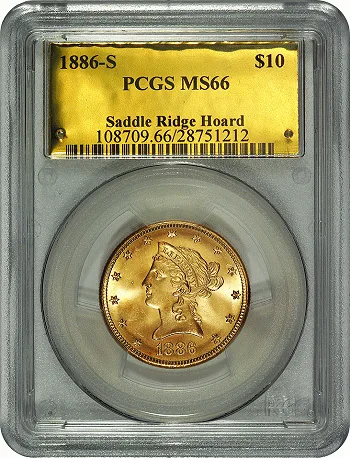
For any Liberty Head Eagle — even common dates — strongly consider purchasing already-certified examples from PCGS or NGC. The certification fee is small relative to the dollar amounts involved. For premium issues (any 1838-1839 head variety, the 1858, 1875, 1873, any Civil War-era S-mint, and any Carson City issue), certified examples are essentially the only safe purchase route. Established auction houses including Heritage Auctions, Stack’s Bowers, Legend Numismatics, and GreatCollections are the safest sources for higher-value pieces.
Bullion Value vs. Numismatic Premium
Liberty Head Eagles occupy a useful position in coin collecting because they carry both meaningful bullion value and meaningful numismatic premiums, with a span of seventy years that offers entry points at almost every budget level.
The Bullion Floor
Each coin contains 0.4838 troy ounces of pure gold. At any given gold spot price, the bullion melt value is roughly: (gold spot price per ounce) × 0.4838. At $2,600 per ounce — a representative 2026 figure — the melt value is approximately $1,258. No genuine Liberty Head Eagle, regardless of date or condition, sells for less than its melt value, because anyone willing to destroy the coin can recover that amount from a refiner.
Common-Date Premiums
For common dates in lower grades — typical 1880s-1900s Philadelphia and San Francisco coins in About Uncirculated to MS-62 condition — the typical retail premium over melt is 10-40%. Buying a common-date Liberty Head Eagle at this level is essentially a way to own gold in collectible form, with a small premium for the design and historical interest.
Numismatic Premiums
For better dates, higher grades, and key issues, premiums over melt rise dramatically. A common-date MS-65 Liberty Head Eagle might bring 5-15x melt; a scarce Carson City issue brings 10-50x melt; and a true rarity like the 1875 or 1858 brings hundreds to thousands of times melt. The relationship between grade, date, and premium is non-linear and rewards specialist knowledge — the same dynamic that governs the Liberty Head Half Eagle series.
Practical Buying Guidance
- If you want gold exposure: Buy common-date AU-58 to MS-62 Liberty Head Eagles at minimal premium over melt
- If you want collectible gold: Step up to MS-63 to MS-64 common dates for moderate numismatic premium with genuine collector demand
- If you want history: Pursue a Carson City or Civil War-era issue, where scarcity and story combine
- If you want true rarity: Pursue the 1858, 1875, 1864-S, and early head varieties, where premiums dwarf bullion value
- Avoid the middle ground unwisely: Cleaned or damaged coins lose collector value but retain melt value, so they trade close to bullion regardless of date
Current Market Values and Price Guide
Liberty Head Eagle values cover an enormous range — from low thousands for common-date circulated examples to seven figures for the 1875. The prices below reflect approximate retail values as of 2026 for problem-free, original-surface coins, assuming a gold spot price of approximately $2,600 per ounce. Cleaned, damaged, or altered examples are worth substantially less, and certified premium-grade coins regularly bring prices well above these ranges.
Common Dates (1880s-1900s Philadelphia/San Francisco, With Motto)
- Very Fine-20: $1,300–$1,400 (essentially melt)
- Extremely Fine-40: $1,350–$1,500
- About Uncirculated-58: $1,400–$1,650
- MS-62: $1,600–$2,200
- MS-63: $2,200–$3,500
- MS-64: $3,500–$7,000
- MS-65: $9,000–$20,000+
Type Coins
- No Motto common date (EF-40): $1,800–$3,000
- No Motto common date (AU-58): $3,000–$6,000
- With Motto 1907 (MS-63): $2,200–$3,500
- With Motto 1907 (MS-65): $9,000–$18,000
Key Dates and Major Rarities
- 1838 Head of 1838 (VF-EF): $8,000–$20,000+
- 1839 Head of 1838 (VF-EF): $4,000–$12,000+
- 1858 (VF-EF): $25,000–$60,000+
- 1864-S (VF-EF): $25,000–$75,000+
- 1873 Closed 3 (VF-EF): $6,000–$15,000+
- 1875 (any grade): $150,000–$1,000,000+
- 1870-CC (VF-EF): $25,000–$60,000+
- 1879-CC (VF-EF): $12,000–$35,000+
- 1861-O (VF-EF): $4,000–$10,000+
- Common Carson City date (EF-AU): $3,000–$8,000
Note: These are retail price estimates. Actual sale prices at auction vary based on eye appeal, certification, surface originality, gold spot price at sale time, and current market demand. For important purchases, reference recent auction archives from Heritage Auctions, Stack’s Bowers, and Legend Numismatics alongside standard price guides like the PCGS Price Guide and the NGC Price Guide.
Building a Liberty Head Eagle Collection
The Liberty Head Eagle series offers entry points at multiple budget levels, from a single common-date type coin near gold-melt to museum-grade rarities at seven figures. The series is far broader than the shorter Indian Head Eagle run, with hundreds of date-and-mintmark combinations to pursue.
Single Type Coin
The simplest collection is a single common-date Mint State example — often a With Motto issue from the 1890s-1900s, or the popular final-year 1907. Choice MS-63 to MS-64 examples are widely available for $2,200-$7,000, providing a handsome representative of Gobrecht’s seventy-year design. Many collectors stop here, satisfied with one example of this historic gold series.
Two-Type Set
A two-coin type set captures the major design divide: one No Motto example (1838-1866) and one With Motto example (1866-1907). The No Motto coin is the scarcer and more expensive of the two, so most collectors pair an affordable circulated No Motto issue with a Mint State With Motto coin. This compact set tells the central story of the series.
Mint Mark Set
Many collectors pursue one example from each mint that produced Liberty Head Eagles: Philadelphia (no mint mark), New Orleans (O), San Francisco (S), Carson City (CC), and Denver (D). The Carson City coin is the key challenge and the centerpiece of the set, while the 1906-1907 Denver issues round it out affordably. This five-coin approach is one of the most rewarding ways to collect the series.
Date Set Excluding Major Rarities
A date set of the more available With Motto issues from the 1880s-1900s is achievable in Mint State at moderate cost. Extending the set into the scarce 1860s-1870s dates, the Carson City issues, and the key rarities transforms it into a lifetime pursuit measured in five and six figures — and the 1875 alone makes a truly complete set the province of only the most advanced collectors.
Specialty Approaches
- Carson City set: One example from each CC year (1870-1893) — a popular and challenging Western-gold pursuit
- Civil War set: Eagles dated 1861-1865 from Philadelphia and San Francisco — historically resonant and genuinely scarce
- No Motto type set: Focused on the 1838-1866 antebellum and Civil War issues
- Head variety set: The 1838 Head of 1838, 1839 Head of 1838, and 1839 Head of 1840 first-issue varieties
- High-grade type: MS-65 and finer examples of common dates — visually stunning and steadily appreciating
Practical Tips
- Buy certified for everything: Even common dates merit PCGS or NGC certification given the dollar amounts involved
- Original surfaces command premiums: Cleaned coins are heavily discounted; learn to recognize natural luster vs. dipped surfaces
- Patience pays: Many key dates appear at auction only a few times per year; build a target list and wait for the right examples
- Track gold spot: The bullion floor moves with gold prices, affecting common-date values directly
- Use major auction archives: Heritage and Stack’s Bowers archives are invaluable for studying authentic examples and recent realized prices
- Coordinate with related series: Many collectors pair their Eagle program with the Liberty Head Half Eagle and Liberty Head Double Eagle, which share the same coronet design philosophy
Storage and Preservation
Proper storage maintains the value and visual appeal of your collection. Although gold is far more chemically stable than silver — Liberty Head Eagles do not tarnish or develop the toning that affects Morgan Dollars — the soft gold-copper alloy is susceptible to scratches, contact marks, and surface damage that can dramatically reduce value.
What to Avoid
- Loose storage: Coins clinking against each other produce immediate bag marks. Always store individually.
- PVC holders: Older soft plastic flips and some envelopes contain PVC, which outgasses and produces a green sticky residue. Less harmful to gold than to silver, but still avoid.
- Acidic paper: Some paper envelopes contain sulfur compounds that can produce minor surface effects on gold. Use acid-free, archival-quality envelopes.
- Direct handling: Skin oils etch gold over time; always handle by edges or wear cotton gloves
- Cleaning attempts: Even gentle cleaning leaves microscopic hairlines that grading services detect — never clean a Liberty Head Eagle
- High humidity: Although gold itself doesn’t oxidize, the copper component can develop minor spotting in extreme humidity
Recommended Storage
- PCGS or NGC slabs: Inert plastic holders that provide excellent long-term protection and authentication — strongly recommended for any Liberty Head Eagle
- Air-Tite holders: $10 gold-sized direct-fit capsules; safe and excellent for individual coins
- Non-PVC flips: Mylar or polyethylene flips for short-term storage and examination
- Quality albums: Capital Plastics or Dansco gold-coin albums; ensure pages are PVC-free
- Bank safe deposit box: Recommended for high-value collections; insurance considerations apply
- Climate-controlled storage: Stable temperature and low humidity for long-term collection care
Handling
Always handle Liberty Head Eagles by their edges. Liberty’s cheek and the eagle’s breast show fingerprints readily, and oils from skin will eventually etch the surface. Cotton gloves are appropriate for high-value coins. Never clean a Liberty Head Eagle — virtually any cleaning reduces value, and cleaned coins are easily detected by experienced graders. If a coin appears to need conservation, consult a professional service like NCS (Numismatic Conservation Services) rather than attempting it yourself.
Frequently Asked Questions
What is a Liberty Head Eagle and when was it made?
The Liberty Head Eagle is a 90% gold $10 United States coin produced from 1838 through 1907. Designed by Mint Chief Engraver Christian Gobrecht, it features a left-facing coronet-crowned head of Liberty on the obverse and a heraldic eagle with a shield on the reverse. It is also called the Coronet or Coronet Head Eagle. The series ended in 1907 when it was replaced by Augustus Saint-Gaudens's Indian Head Eagle.
How do I tell a No Motto from a With Motto Liberty Head Eagle?
Look at the reverse above the eagle. No Motto coins (1838-1866) have a plain field above the eagle with no scroll. With Motto coins (1866-1907) have a small scroll bearing IN GOD WE TRUST above the eagle's head. This single feature divides the series into its two major collectible types and is the first thing to check when identifying any Liberty Head Eagle.
What is the rarest Liberty Head Eagle?
The 1875 Philadelphia Eagle is the rarest collectible date, with just 100 business strikes (plus 20 proofs) struck and only a handful surviving. When it appears at auction it commands six- to seven-figure prices. Other major rarities include the 1858 (mintage 2,521), the Civil War 1864-S (mintage 2,500), and the early head varieties of 1838-1839.
How much gold is in a Liberty Head Eagle?
Each Liberty Head Eagle contains 0.4838 troy ounces of pure gold (15.046 grams) within its 16.718-gram total weight. The composition is 90% gold and 10% copper, the standard U.S. gold alloy used from 1837 through 1933. At a gold spot price of $2,600 per ounce, the bullion melt value is approximately $1,258, which serves as a price floor for any genuine example.
What does the "CC" mint mark mean on a Liberty Head Eagle?
The "CC" mint mark indicates the coin was struck at the Carson City Mint in Nevada, which coined gold and silver from the Comstock Lode. Carson City Eagles were struck intermittently from 1870 to 1893 and are among the most popular branch-mint gold coins, prized for low mintages and Old West history. The mint mark appears on the reverse below the eagle. Be aware that fraudulent "CC" mint marks are sometimes added to common coins, so scarce CC issues should be purchased certified.
Is the Liberty Head Eagle the same as the Indian Head Eagle?
No. Both are $10 gold coins with the same gold content, but they are different series. The Liberty Head (Coronet) Eagle by Christian Gobrecht was struck from 1838 to 1907 and shows a coronet-crowned Liberty head. The Indian Head Eagle by Augustus Saint-Gaudens replaced it and was struck from 1907 to 1933, showing Liberty in an Indian war bonnet. The Liberty Head series has no 1920 or 1930 issues — those famous keys belong to the Indian Head series.
How much is a common-date Liberty Head Eagle worth?
Common-date Liberty Head Eagles from the 1880s-1900s in About Uncirculated to MS-62 condition typically retail for $1,400-$2,200 — essentially gold melt value plus a modest numismatic premium. Higher grades command escalating premiums: MS-63 around $2,200-$3,500, MS-64 around $3,500-$7,000, and MS-65 from $9,000 upward. Prices fluctuate with gold spot price, so check current bullion levels before transacting.
How do I know if my Liberty Head Eagle is real?
Authentic coins weigh 16.718 grams with a 27.0-millimeter diameter and a fine, even reeded edge. The most reliable authentication is third-party certification by PCGS or NGC. For valuable examples (any 1838-1839 head variety, the 1858, 1875, 1873, any Civil War-era S-mint, and any Carson City issue), only purchase certified coins from established auction houses. Counterfeits range from crude cast pieces to sophisticated struck copies, and the dollar amounts at stake make professional authentication essential.
Can I clean my Liberty Head Eagle?
No — cleaning reduces value substantially even on gold coins. Although gold is chemically stable, cleaning leaves hairlines visible under magnification, and harsh cleaning ("dipping") removes original surface and produces unnatural color. Cleaned coins receive "Details" grades from PCGS and NGC and lose 30-50% of value compared to problem-free original surfaces. If a coin truly needs conservation, use a professional service like NCS rather than attempting it yourself.
Is a Liberty Head Eagle a good investment?
Liberty Head Eagles offer dual appreciation potential: gold bullion value and numismatic collector value. Common dates track gold prices closely with a modest premium; key dates, Carson City issues, and high-grade examples have appreciated substantially over decades regardless of gold spot. The series benefits from genuine 19th-century rarity, deep historical interest spanning the Civil War and the Old West, and limited new supply. As with any collectible, collect for enjoyment first and treat investment returns as a bonus.