Indian Head Quarter Eagle Identification Guide: 1911-D Key Date, Bela Lyon Pratt's Incused Design, Mint Marks and Values
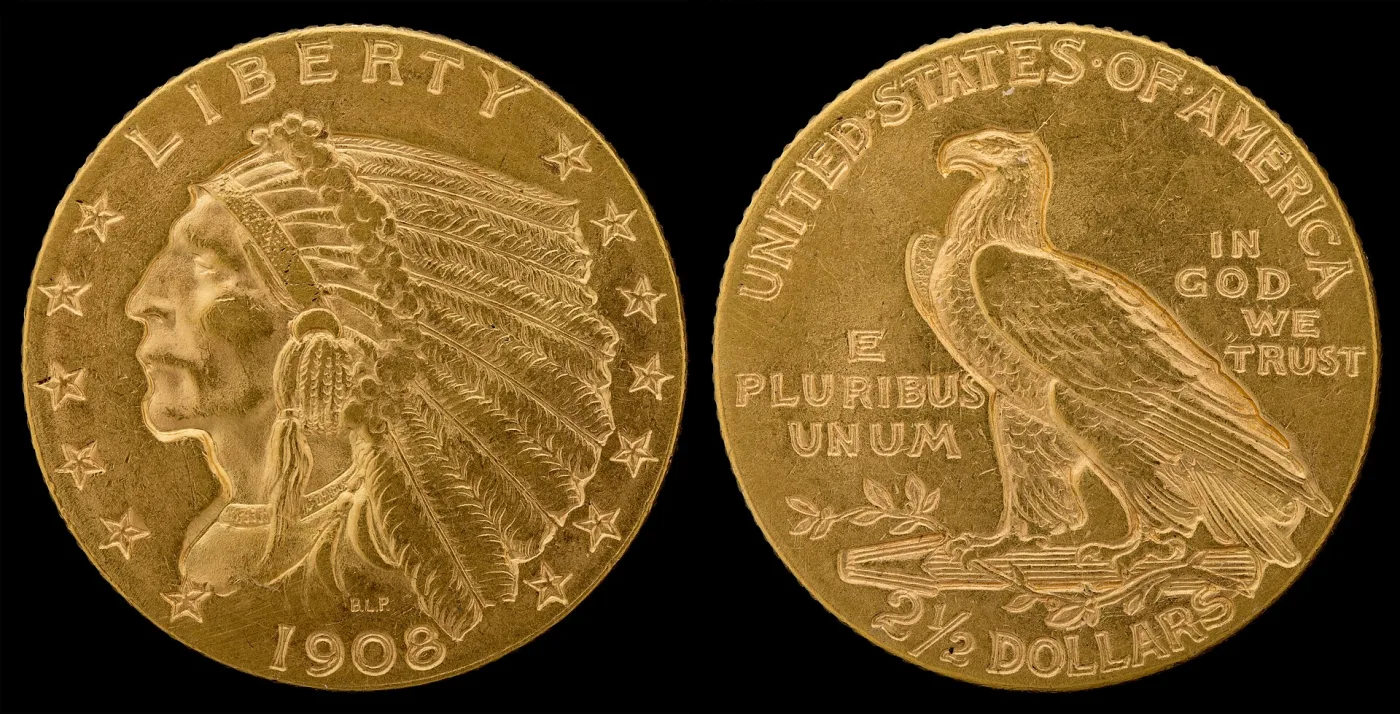
The Indian Head Quarter Eagle, struck from 1908 through 1929, is one of the most visually arresting and technically unusual coins in all of United States numismatics. It is the only US circulating coin — along with its sister design, the Indian Head Half Eagle — to use an “incused” design, where the figures of Liberty and the eagle are sunk below the field of the coin rather than rising above it. The result is a coin that looks unlike any other in your hand: the surface of the coin is the highest point, and the design lies in shallow relief beneath, almost like a low intaglio engraving in metal. For collectors raised on the conventional raised relief of Saint-Gaudens, Morgan, or Liberty Head designs, the Pratt Indian Head Quarter Eagle is a strange and wonderful object.
The series was designed by Bela Lyon Pratt, a Boston sculptor and pupil of Augustus Saint-Gaudens, at the personal request of President Theodore Roosevelt’s friend Dr. William Sturgis Bigelow. Roosevelt wanted to continue the coinage renaissance he had launched with the Saint-Gaudens Double Eagle and the Indian Head Eagle, and Bigelow proposed Pratt for the smaller gold denominations. The Pratt design replaced the Liberty Head Quarter Eagle (Coronet type) that had been struck since 1840, ending a 68-year run of the Christian Gobrecht design. Together with the matching Indian Head Half Eagle — Pratt’s $5 incuse companion that replaced the Liberty Head Half Eagle the same year — the 1908 Pratt designs completed Roosevelt’s transformation of US gold coinage — and they would become the last circulating quarter eagle and half eagle designs the United States ever produced.
This guide covers everything you need to identify, grade, value, and authenticate Indian Head Quarter Eagles: Pratt’s incused design and how it differs from every other US coin, the controversy and conspiracy theories the design provoked at release, the two mints that produced the denomination (Philadelphia and Denver), all fifteen date-and-mintmark combinations with mintages and rarity, the legendary 1911-D key date and its Strong D versus Weak D varieties, the 1914 Philadelphia and 1914-D semi-keys, grading the incused design (which has unique wear patterns), authentication and counterfeit detection (Pratt Quarter Eagles are among the most heavily counterfeited US gold coins), and 2026 market values. The general coin identification principles apply, but the incused relief demands a different grading and authentication eye than any other US series.
History: Roosevelt’s Coinage Renaissance and Bela Lyon Pratt
By 1907, Theodore Roosevelt had become personally invested in remaking US coinage. He famously called the country’s circulating coins “atrociously hideous” and recruited Augustus Saint-Gaudens to redesign the gold denominations. Saint-Gaudens produced the Double Eagle and the Indian Head Eagle before his death in August 1907, but the quarter eagle and half eagle had been left untouched — both still bore the Liberty Head Coronet design that Christian Gobrecht had created in 1840.
Saint-Gaudens had also been working on quarter eagle and half eagle designs when he died, but they were incomplete. Rather than complete them himself, the Mint considered several artists. Dr. William Sturgis Bigelow — a wealthy Boston physician, art collector, and Roosevelt’s friend — proposed Bela Lyon Pratt for the work. Pratt was a respected Boston sculptor who had studied under Saint-Gaudens at the Art Students League in New York and had taught at the Boston Museum School. He had no coinage experience, but Bigelow personally underwrote the project and provided strong recommendations to Roosevelt.
Bigelow’s Idea: The Incused Design
The truly novel element — the incused (sunken) relief — was Bigelow’s idea, not Pratt’s. Bigelow had spent time in Japan studying Japanese art and believed that traditional Japanese metalwork techniques, where designs were sometimes cut below the surface rather than raised above it, could produce a coin that would wear better in circulation because the high points (the field) would protect the design. He convinced Pratt to design the quarter eagle and half eagle in this incused style, and the Mint engraver Charles E. Barber — initially skeptical — agreed to execute the dies.
Release in November 1908
The Pratt Quarter Eagle was released in November 1908 to immediate controversy. The traditional numismatic press reacted with bewilderment and hostility: collectors had never seen anything like it, and many believed the coin was “unfinished” or that the design had been struck weakly. Even more bizarre objections followed — see the dedicated controversy section below. But the coin proceeded into circulation and remained in production at Philadelphia and Denver until 1929, when the Depression suspended production. Like all US gold, the denomination ended permanently in 1933 when Roosevelt (Franklin, not Theodore) ordered the recall of gold coinage.
The Incused Design: What “Sunken Relief” Actually Means
The key conceptual point: on a normal coin, the field (the flat background) is the lowest point on the surface, and the design (Liberty’s face, the eagle, etc.) rises above the field. When the coin wears in circulation, the highest points wear first — Liberty’s cheek, the eagle’s breast — gradually flattening the design until only outlines remain.
On an incused coin, this is reversed. The field is the highest point on the surface. The design is engraved below the field — sunken into the metal like a stamp pressed downward rather than upward. When the coin wears in circulation, the field wears, not the design. In theory, this means the design remains crisp far longer than on raised-relief coins.
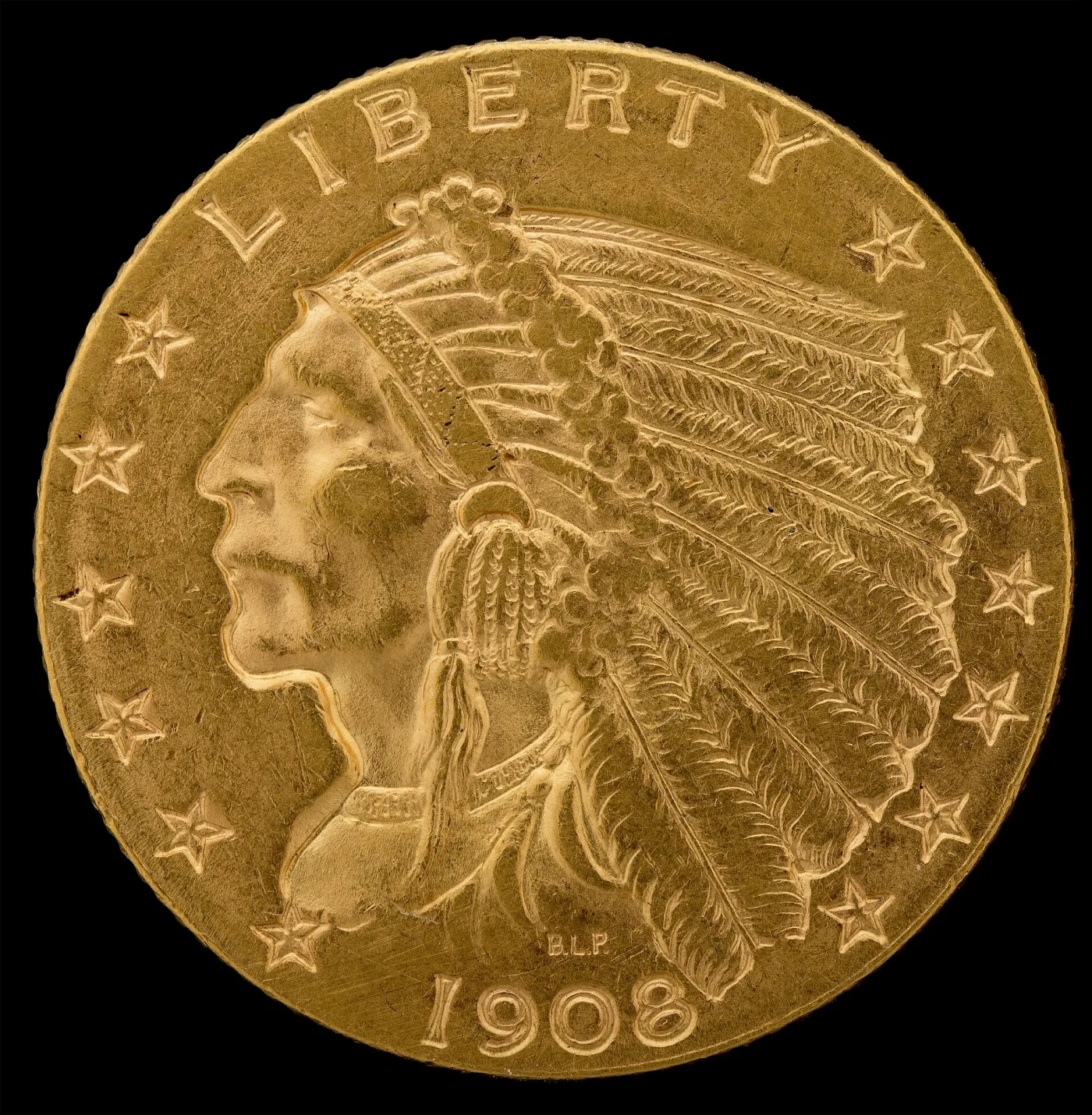
In practice, the theory was only partially correct. The incused design did protect the central details better than traditional relief, but it created a new problem: dirt and grime accumulate in the recessed areas of the design and are very difficult to remove. Many circulated Pratt Quarter Eagles look “dirty” or “grimy” not because they are genuinely soiled but because the incused design traps debris. This is one of the most common reasons collectors mistakenly try to clean these coins, which is always a mistake.
How to Recognize an Incused Coin Instantly
Hold the coin in good light and tilt it. On a raised-relief coin, the shadows fall to one side of each design element because the element rises above the surface. On an incused coin, the shadows fall inside each design element because the element is sunk below the surface. The visual effect is unmistakable once you have seen it — the design appears almost engraved into the coin rather than struck onto it.
Other Incused US Coins
Only two US circulating coin designs use the incused technique: the Indian Head Quarter Eagle (1908-1929) and the Indian Head Half Eagle (1908-1929). The Indian Head Eagle ($10 gold) is not incused — that is Saint-Gaudens’ design with the Liberty figure in raised relief. The Quarter Eagle and Half Eagle are the only two. No other US denomination, before or since, has used the technique.
Design Details: Obverse and Reverse
The Obverse
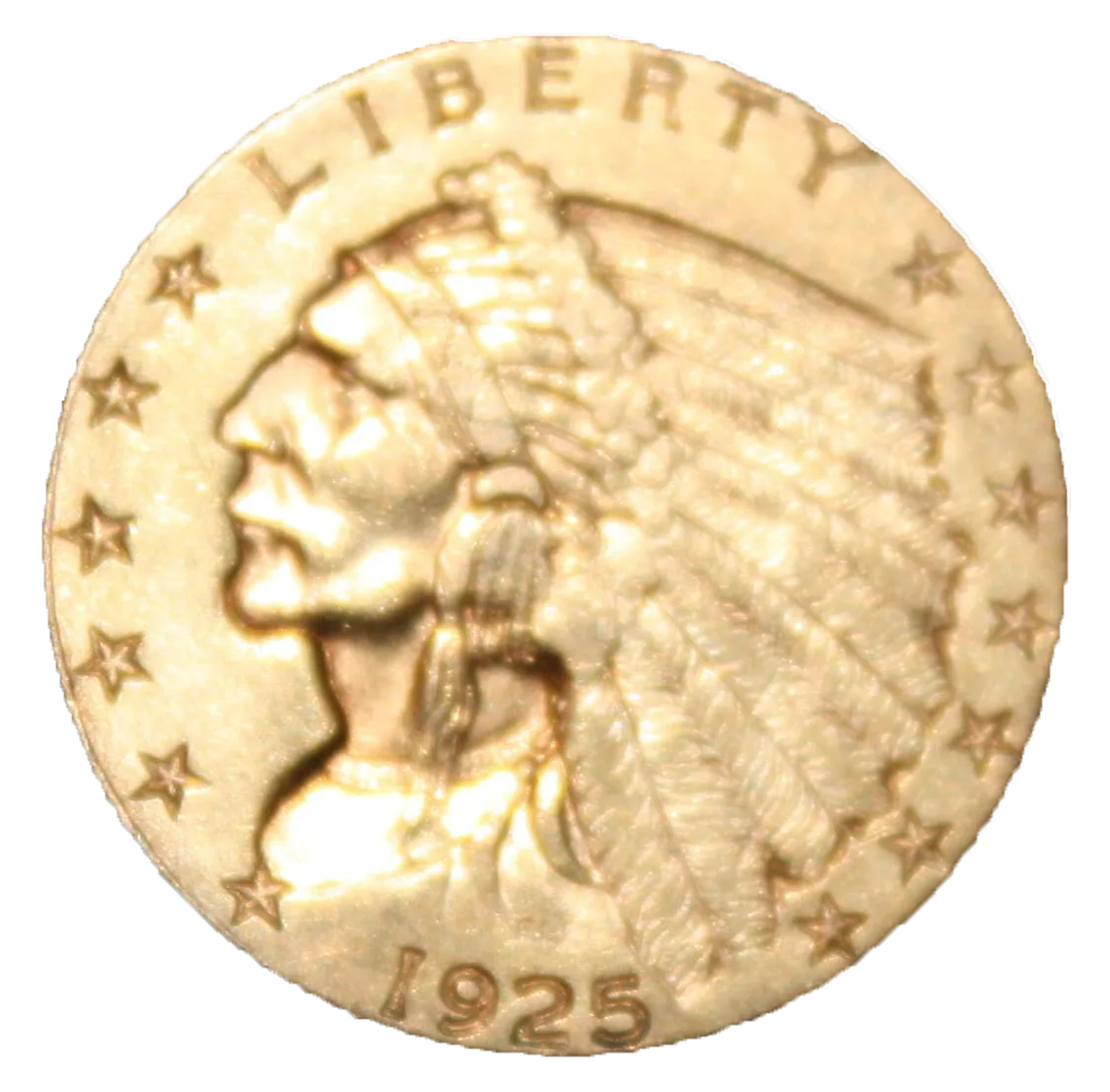
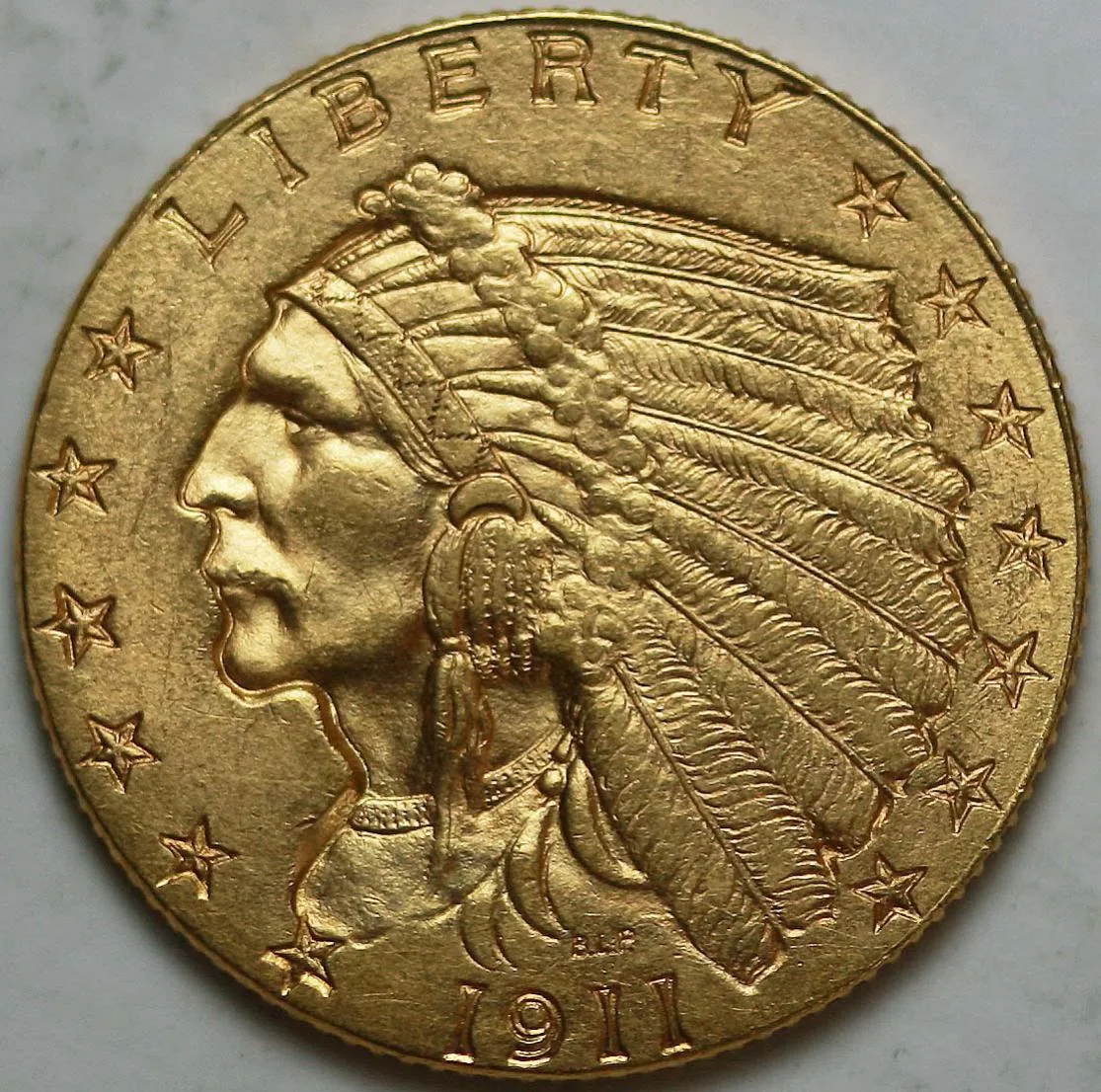
The obverse shows the head of a Native American chief facing left, wearing an elaborate feathered war bonnet that fills the upper half of the coin. The word LIBERTY arcs across the top above the headdress, and the date sits at the bottom. Thirteen six-pointed stars — six on the left, seven on the right — are arrayed around the periphery, representing the original thirteen colonies. The chief’s profile is realistic and dignified, with detailed features visible at the eye, brow, and lips. The headdress shows individual feathers with barbs and tie-bands.
An important historical note: Pratt used a real photograph as his model. The source has been debated for over a century, but the most likely candidate is a photograph of an unnamed Native American chief (sometimes identified as a Lakota man) taken in the 1890s. Pratt did not use Iron Tail, Two Moons, or John Big Tree — the three chiefs sometimes credited as Buffalo Nickel models for James Earle Fraser’s design. The Pratt Quarter Eagle chief is a distinct figure.
The Reverse
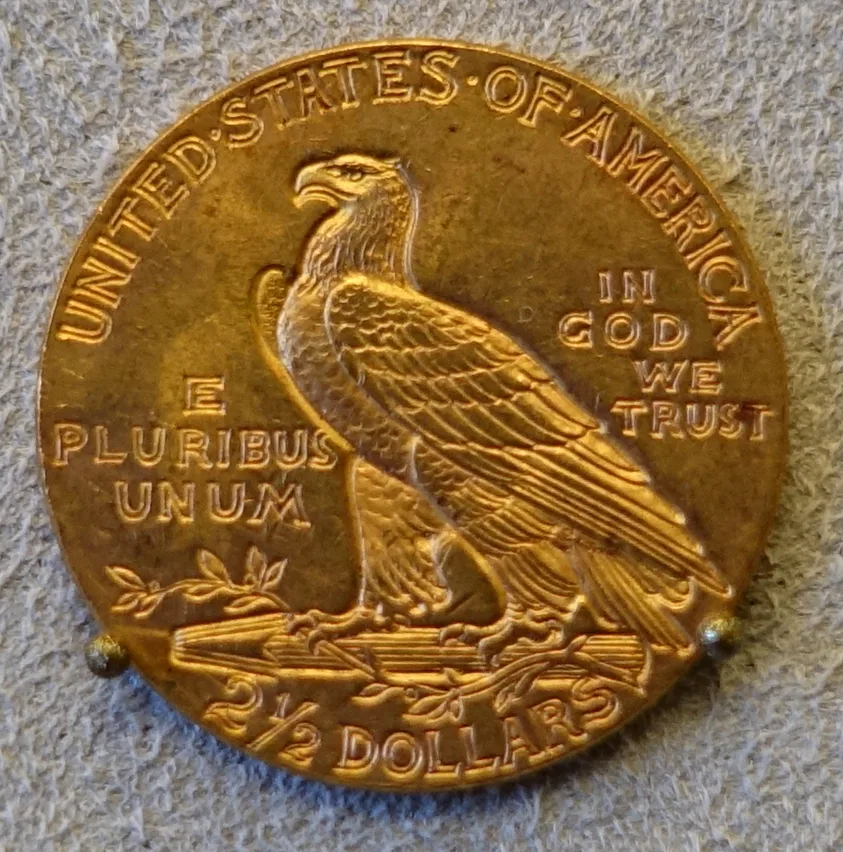
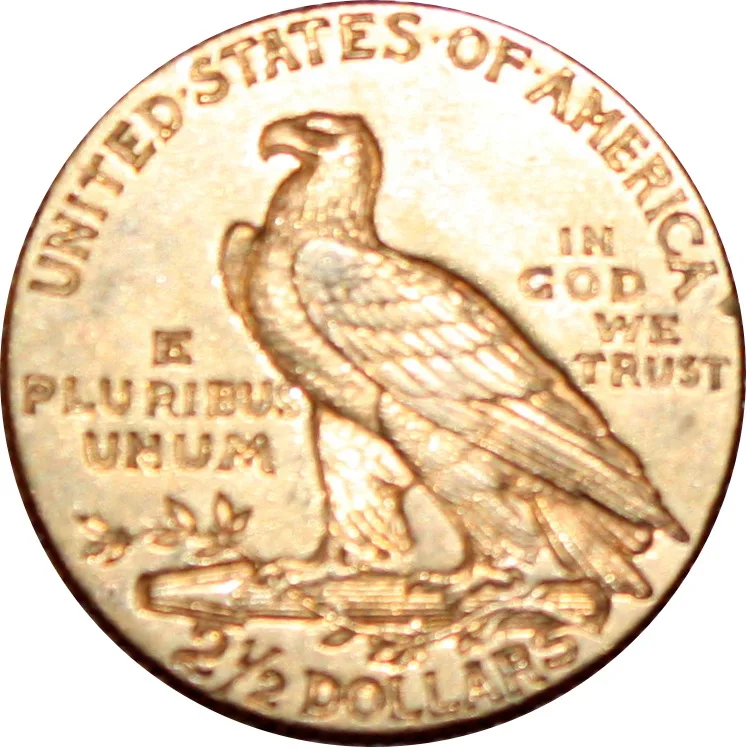
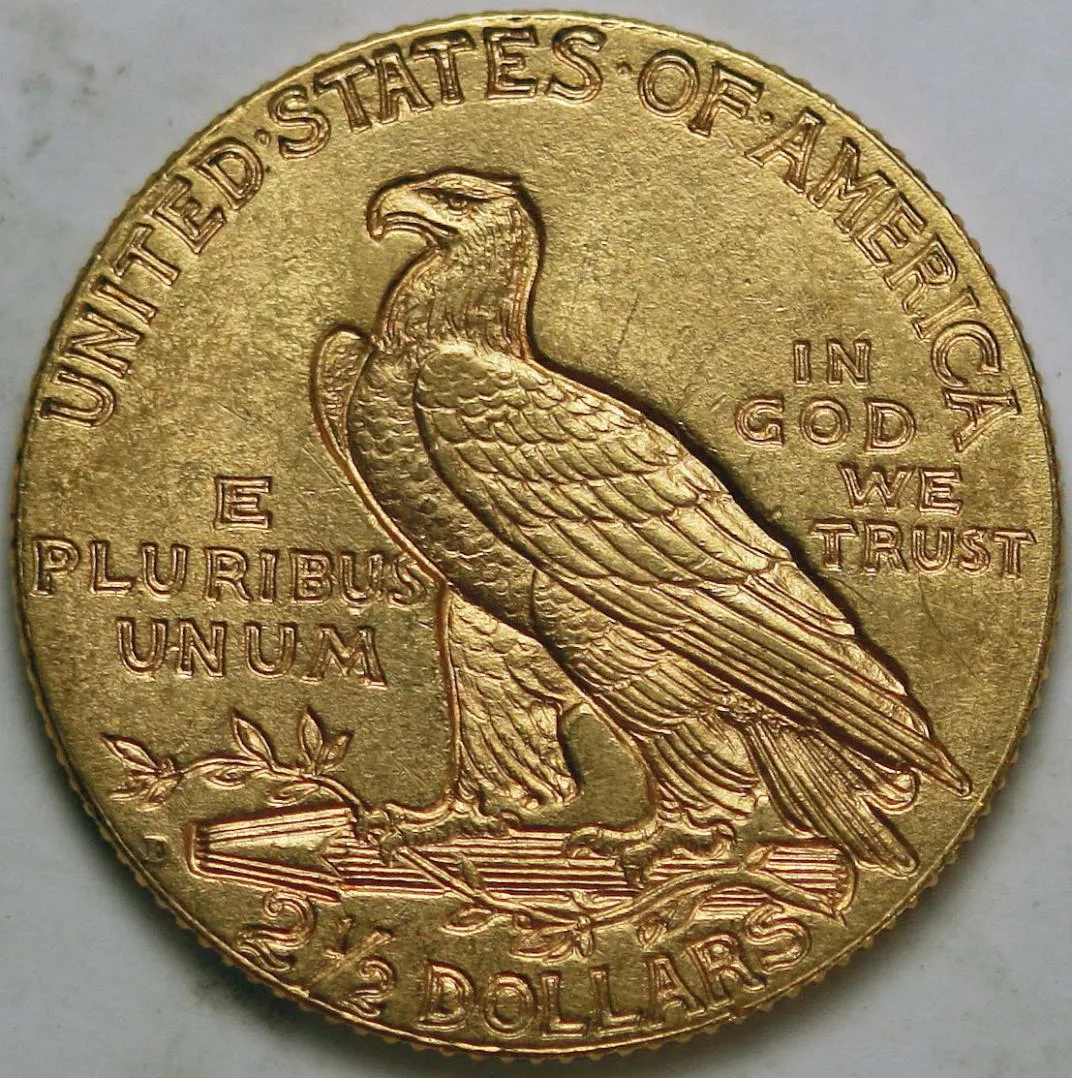
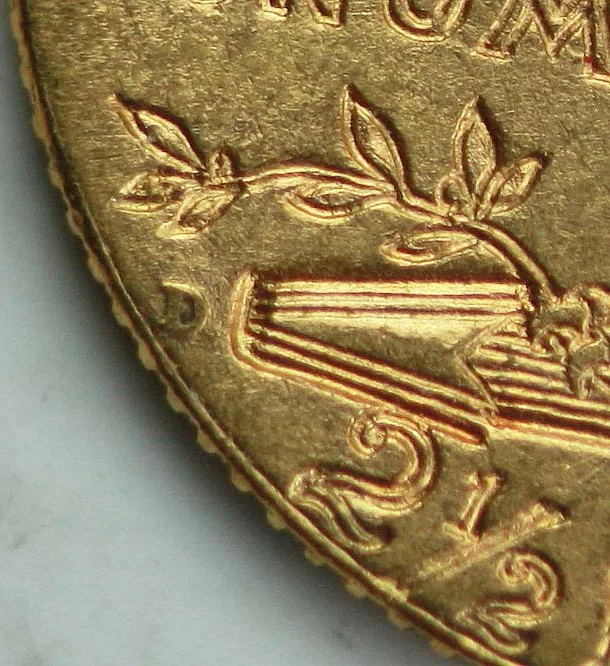
The reverse shows a standing eagle on a bundle of arrows with an olive branch, facing left, with wings folded. UNITED STATES OF AMERICA arcs above, E PLURIBUS UNUM appears in the field to the left of the eagle, IN GOD WE TRUST appears in the field to the right, and the denomination “2 ½ DOLLARS” appears at the bottom. The mint mark, when present, appears to the left of the arrow bundle, just above the denomination. The reverse design is closely modeled on Saint-Gaudens’ Indian Head Eagle reverse — Pratt explicitly used Saint-Gaudens’ standing eagle as his template, modifying it slightly for the smaller denomination.
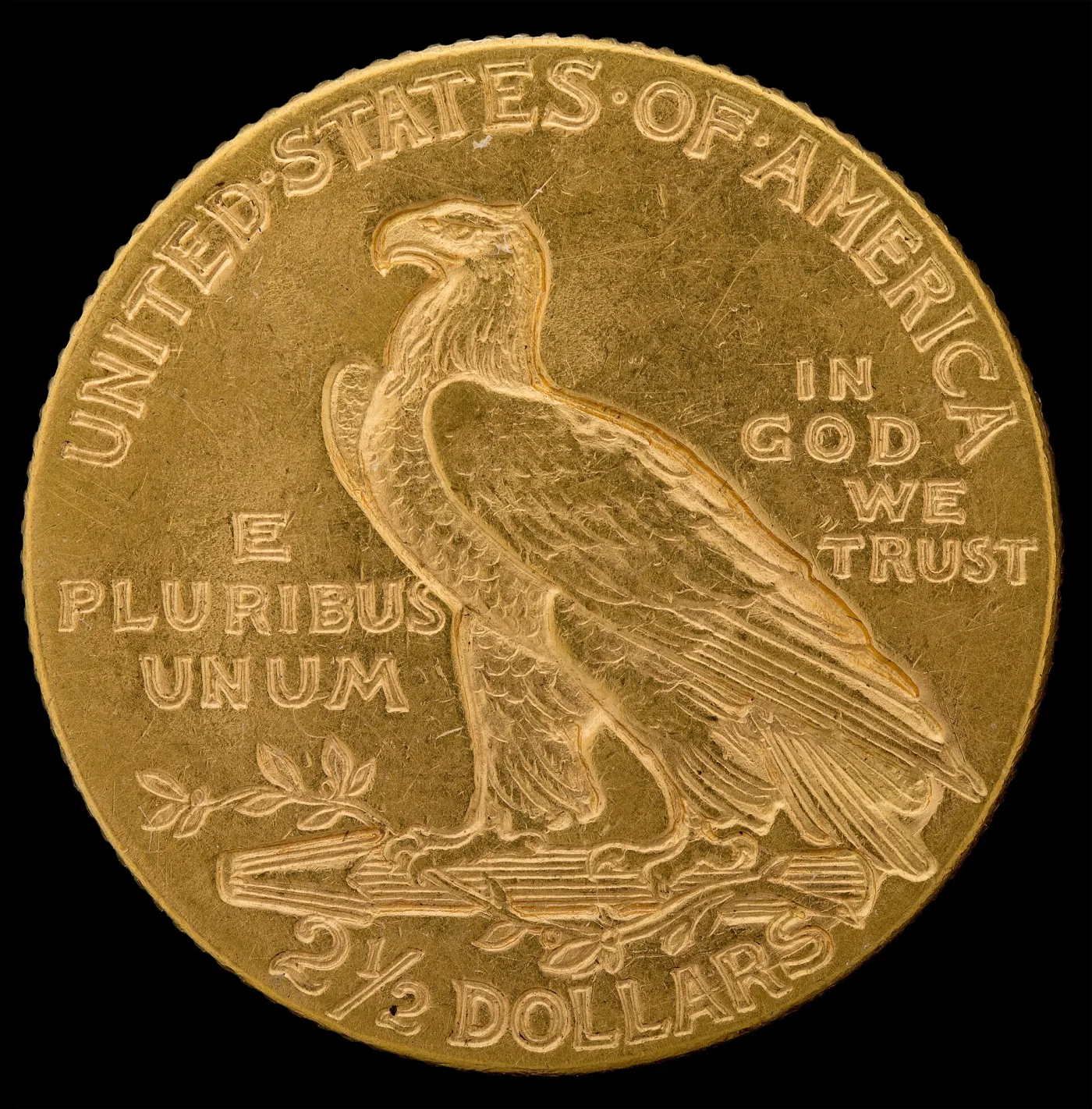
IN GOD WE TRUST appears from the very first 1908 Pratt Quarter Eagle. Unlike the Saint-Gaudens Double Eagle, which famously omitted the motto from 1907-1908 at Roosevelt’s insistence before Congress mandated its restoration, the Pratt Quarter Eagle carries the motto from day one — Roosevelt’s anti-motto campaign had ended by 1908 when the Pratt design was introduced.
The Edge
The edge is reeded with no lettering. A Pratt Quarter Eagle with a plain edge is damaged — typically filed for removal from a mount.
Composition and Specifications
- Composition: 90% gold, 10% copper
- Total weight: 4.18 grams (64.5 grains)
- Pure gold content: 3.762 grams (0.12094 troy ounces)
- Diameter: 18 mm
- Edge: Reeded
- Designer: Bela Lyon Pratt (concept by William Sturgis Bigelow)
- Mintage years: 1908, 1909, 1910, 1911, 1912, 1913, 1914, 1915, 1925, 1926, 1927, 1928, 1929
Note the production gap: no Pratt Quarter Eagles were struck from 1916 through 1924. World War I disrupted gold coin production generally, and the smaller denominations were suspended longer than the eagles and double eagles. Production resumed in 1925 and continued through 1929, then ended permanently. At 2026 gold prices, the bullion content of a Pratt Quarter Eagle runs roughly $245-$260 — but no genuine, problem-free Pratt Quarter Eagle is worth its melt value alone. Even the most common dates carry a numismatic premium of at least 1.5x bullion in lower grades.
Mint Marks: Philadelphia and Denver
Pratt Quarter Eagles were struck at only two mints, making the series simpler to collect by mint than the Liberty Head Half Eagle (which used seven mints) or the Gold Dollar (four mints).
- No mint mark — Philadelphia (1908-1915, 1925-1929): The main mint, produced the series in twelve years
- D — Denver (1911, 1914, 1925, 1926, 1927, 1929): Six years of production, including the famous 1911-D
San Francisco and New Orleans did not produce Pratt Quarter Eagles. Carson City had closed in 1893 and never struck the Pratt design. Denver was the only branch mint to participate.
Locating the Mint Mark
The mint mark sits in an unusual location: on the reverse to the left of the arrow bundle, immediately above and to the left of the denomination “2 ½ DOLLARS.” This is not the standard mint mark position used elsewhere in US coinage of the era. Many beginning collectors miss it on first inspection because they look for it below the eagle or in the field on the right. Use 5x to 10x magnification and direct lighting to locate the small “D” — it is sometimes weakly struck (see the 1911-D Weak D variety below).
The Pratt Controversy: Hygiene, Hoodoo, and Hoarding
The Pratt Quarter Eagle and Half Eagle provoked some of the strangest objections in US coinage history when they were released in November 1908.
The “Sanitation” Argument
One persistent criticism, voiced by collector S. H. Chapman and others, was that the recessed design would collect dirt, germs, and disease. Chapman argued in print that the coins were a public health hazard because the sunken design areas would harbor bacteria that could not be cleaned. He compared them unfavorably to traditional relief coins, which he claimed “polished themselves” in normal handling. The argument was specious — copper-gold alloy is naturally antibacterial, and circulating coins of all designs have always carried trace dirt — but it was widely repeated in the numismatic press.
The “Voodoo” or “Hoodoo” Objection
A stranger objection came from believers in superstition. Some collectors and members of the public argued that the sunken design was an “evil omen” or “unlucky” because the figures appeared to be “trapped” or “imprisoned” below the surface of the coin. This was sometimes called the “hoodoo” or “Indian curse” objection in period writings. It seems absurd today, but it was real enough that the Mint received complaints on these grounds in 1908 and 1909.
The Hoarding Response
The actual market response was muted. Pratt Quarter Eagles entered circulation in 1908 and circulated normally in the West and South. They did not circulate widely in the Northeast because gold coinage generally was used less there, but this was not specific to the Pratt design. There was no significant hoarding in the early years. Hoarding came later, after the Federal Reserve Act of 1913 and especially during World War I, when gold coinage began withdrawing from circulation generally. By 1933, virtually all surviving Pratt Quarter Eagles were in private hands as either coin collections or jewelry, and the Roosevelt gold recall produced minimal returns of this denomination.

Key Dates and Semi-Keys
The Indian Head Quarter Eagle is one of the easier classic US gold series to complete by date and mintmark — only 15 issues to assemble, with no proof-only years and no truly unobtainable rarities like the unique 1870-S Three Dollar Gold. But within the series, certain dates stand sharply above the rest.
1911-D — The Series Key
Mintage 55,680 pieces (Strong D and Weak D combined). The 1911-D is by a wide margin the key date of the series. Surviving population is estimated at 5,000-7,000 across all grades, with most in VF-EF condition. See the dedicated section below for Strong D vs Weak D varieties.
1914 — Philadelphia Semi-Key
Mintage 240,000 pieces — sounds healthy, but the survival rate is poor and demand is strong. The 1914-P is a meaningful semi-key in higher grades. AU-58 prices run around $700-$900, and Mint State examples climb sharply: MS-63 around $3,500, MS-64 around $7,500, MS-65 above $20,000.
1914-D — Denver Semi-Key
Mintage 448,000. Surprisingly, the 1914-D is somewhat more common than the 1914-P in mid grades, but the Strong D / Weak D distinction also exists in 1914 (less critical than for 1911) and well-struck examples carry premiums. AU-58 around $650-$800, MS-63 around $2,800, MS-65 around $15,000.
1909 — Lower Mintage
Mintage 441,760. A semi-scarce date that is often overlooked. Mint State examples are surprisingly difficult: MS-65 prices reach $10,000+.
1908 — First Year
Mintage 564,821. The first-year issue of any new design carries collector demand. The 1908 is generally easier to find in Mint State than 1909 due to first-year saving by collectors. MS-63 around $1,400, MS-65 around $9,000.
Common Dates
The 1925-D, 1926, 1927, 1928, and 1929 are the most common dates in the series, all with mintages above 500,000 and high survival rates. AU-58 runs $475-$575 across these dates, and MS-63 around $900-$1,100. These are the dates most often encountered and are the typical entry point for collectors.
The 1911-D: Strong D vs Weak D
The 1911-D is famous for two reasons: it is the lowest-mintage date in the series, and it exhibits a critical Strong D vs Weak D variety distinction that profoundly affects value.
Why the Mint Mark Varies
The Denver Mint used multiple working dies for the 1911 production run, and the “D” mint mark punch was applied with varying force across these dies. Some dies received a deep, clear “D” punch that struck up boldly on the coin (Strong D). Other dies received a shallow, faint punch that produced a mint mark barely visible on the finished coin (Weak D). Both are genuine 1911-D Quarter Eagles, but they look different and carry very different values.
Strong D
On a Strong D, the “D” mint mark is clearly visible to the unaided eye, with sharp serifs and a fully formed shape. It is unambiguous: there is a D, and it is centered properly to the left of the arrow bundle. Strong D 1911-D Quarter Eagles are the standard, more valuable variety. Premiums over Weak D run roughly 30-50% in most grades.
Weak D
On a Weak D, the “D” mint mark is faint, sometimes nearly invisible without magnification. Inexperienced collectors sometimes mistake Weak D 1911-D coins for 1911 Philadelphia (no mint mark) issues — a costly mistake, since the 1911-P had a much higher mintage and is worth far less. The Weak D is still a 1911-D and still valuable, but it commands a discount to the Strong D.
How to Authenticate the Distinction
Look at the area to the left of the arrow bundle under 10x magnification with raking light. A Strong D shows clear, sharp letter outlines. A Weak D shows softer outlines but still a complete D shape — not just a dot or smudge. If the mark is completely absent, the coin is a 1911-P, not a Weak D 1911-D. Authentication by PCGS, NGC, or ANACS is strongly recommended for any 1911-D, especially Weak D examples that could be mistaken for 1911-P (or vice versa).
2026 Market Values
- 1911-D Strong D, VF-30: $4,000-$4,500
- 1911-D Strong D, EF-45: $5,500-$6,500
- 1911-D Strong D, AU-58: $8,000-$10,000
- 1911-D Strong D, MS-62: $14,000-$17,000
- 1911-D Strong D, MS-64: $30,000-$40,000
- 1911-D Strong D, MS-65: $80,000-$120,000
- 1911-D Weak D, AU-58: $5,500-$7,000
- 1911-D Weak D, MS-62: $10,000-$13,000
Grading the Incused Design
Grading the Pratt Quarter Eagle requires re-orienting your eye. Because the design is incused, traditional wear patterns are inverted: the highest points of the coin (and thus the first to show wear) are the field surfaces around the design, not the design elements themselves. This makes Pratt Quarter Eagles notoriously difficult to grade for newcomers.
Key Wear Points
Obverse: The first wear shows on the cheekbone of the chief and the highest feathers of the war bonnet — but wait, these are incused areas. How do they wear? In practice, they do wear because circulating coins rub against other coins and surfaces, and the slight rim of the recessed design becomes flattened. Additionally, the field around the design (which is the actual high point of the coin) wears, gradually reducing the depth difference between field and design.
Reverse: The eagle’s breast and wing tops (incused) wear first, along with the field surrounding the eagle. The arrow bundle and olive branch lose detail before the eagle’s body details.
Grade Definitions for Incused Coins
- VF-20: Major design outlines clear, but headdress feathers blend together and chief’s face shows softening; field shows wear but is still distinct
- EF-40: Most headdress feather details visible, chief’s hair and brow distinct, eagle’s wing detail clear; light wear on cheek and eagle’s breast
- AU-50: Slight wear on highest design points; original luster covers most of the field
- AU-58: Trace wear; significant original luster; the most popular grade because the next jump to Mint State carries major price premium
- MS-60: No wear; heavy bag marks may be present
- MS-63: Average bag marks, strong luster, good strike
- MS-65 and above: Gem quality, minimal marks, full strike, strong eye appeal — quite scarce in this series
Strike Quality
Strike varies considerably across dates and mints. Philadelphia 1908-1915 issues are generally well-struck. The 1925-1929 Philadelphia issues sometimes show softness on the headdress feathers. Denver issues, especially 1911-D and 1914-D, often show weak central detail and weak mint marks. A weakly struck Pratt Quarter Eagle is technically the same grade as a fully struck one (the wear is identical), but a strong strike commands a market premium.
Authentication and Counterfeit Detection
The Indian Head Quarter Eagle is one of the most counterfeited US gold coins. Several factors drive this: the small size, moderate value, the simplicity of the incused design (which is paradoxically easier to fake than raised relief), and the heavy demand for the 1911-D and 1914 keys. Lebanese counterfeits of the mid-20th century are particularly common, and Chinese counterfeits have appeared more recently.
Weight and Specific Gravity
Authentic Pratt Quarter Eagles weigh 4.18 grams (±0.04 grams tolerance from mint). A coin weighing less than 4.10 or more than 4.25 is suspicious. Specific gravity should be approximately 17.16. A precision scale and water displacement test will rule out base-metal counterfeits immediately.
Diameter
The coin should measure exactly 18.0 mm in diameter. Counterfeits sometimes run slightly oversized or undersized. A digital caliper measurement is conclusive.
Edge Reeding
Authentic Pratt Quarter Eagles have a specific reed count and reed pattern that is documented by PCGS and NGC. Cast counterfeits often have fuzzy or uneven reeds, and struck counterfeits sometimes have the wrong reed count. Compare the edge to a known authentic example under magnification.
Incused Design Sharpness
Authentic incused designs have crisp, sharp edges where the design meets the field. The depth is consistent across all incused elements. Counterfeit incused designs often show fuzzy edges, inconsistent depth, or evidence of cast porosity within the recessed areas. Examine the design under 10x with raking light: authentic recessed areas show clean, sharp walls; counterfeits show rounded or porous walls.
Lebanese Counterfeits
The so-called “Lebanese” gold counterfeits of the 1960s-1970s are the most common Pratt Quarter Eagle fakes. They are struck in genuine gold (often 90% fineness) and pass weight and specific gravity tests. Their diagnostic markers are typically subtle die differences from authentic Mint issues — slightly different star positions, slightly mismatched lettering, or differences in the chief’s facial features. Reference works by Bill Fivaz, Jeff Oxman, and the PCGS/NGC counterfeit detection guides illustrate the diagnostic markers in detail.
Third-Party Grading
Any Pratt Quarter Eagle worth more than $1,000 should be in a PCGS, NGC, or ANACS holder. The certification cost is trivial compared to the counterfeit risk. For 1911-D, 1914, and 1914-D especially, certified status is essentially mandatory.
Jewelry Damage and Mount Removal
Quarter Eagles were extremely popular in jewelry throughout the early 20th century — particularly in the 1910s and 1920s, when the Pratt design was current. They were mounted as pendants, watch fobs, charms, brooches, and pins. The small size (18mm) made them an ideal jewelry coin, and the incused design was particularly attractive to jewelers because the high field provided a smooth bezel surface.
Common Damage Types
- Soldered loops or bezels: Most common damage — a loop attached at 12 o’clock for pendant wear
- Removed loops: A telltale flattened or filed area at 12 o’clock, sometimes with solder traces
- Edge filing: Filing on the edge from bezel removal or from initial bezel sizing
- Polished surfaces: Bright, unnatural luster from jewelry polishing — particularly damaging to the field of an incused coin
- Engraved monograms: Period jewelers sometimes engraved initials or dates onto the field, devastating numismatic value
A Pratt Quarter Eagle with any of these damage types will not grade at PCGS or NGC and is typically worth bullion plus a small premium ($300-$400 in 2026). Examine the rim at 12 o’clock and the field surface carefully under magnification. The field of an incused coin is the most likely surface to show jewelry-related damage because it is the highest point.
Current Market Values and Price Guide
Indian Head Quarter Eagle prices in 2026 reflect strong collector demand and stable gold prices.
Common Dates (1925-D, 1926, 1927, 1928, 1929)
- VF-20: $400-$450
- EF-40: $450-$500
- AU-50: $500-$575
- AU-58: $575-$700
- MS-60: $700-$850
- MS-62: $900-$1,100
- MS-63: $1,200-$1,500
- MS-64: $2,400-$3,200
- MS-65: $7,500-$11,000
Better Dates (1908, 1909, 1910, 1912, 1913, 1915)
Premiums of 10-30% over common dates in lower grades, climbing to 50-150% premiums in MS-65 and above. The 1909 and 1915 are the two most underrated dates in the series for Mint State quality.
1911-D Strong D
- VF-30: $4,000-$4,500
- EF-45: $5,500-$6,500
- AU-58: $8,000-$10,000
- MS-62: $14,000-$17,000
- MS-64: $30,000-$40,000
- MS-65: $80,000-$120,000
1911-D Weak D
- EF-45: $3,500-$4,500
- AU-58: $5,500-$7,000
- MS-62: $10,000-$13,000
- MS-64: $22,000-$30,000
1914
- AU-58: $700-$900
- MS-63: $3,000-$3,500
- MS-64: $7,000-$8,500
- MS-65: $20,000-$28,000
1914-D
- AU-58: $650-$800
- MS-63: $2,500-$3,000
- MS-64: $6,500-$8,000
- MS-65: $14,000-$18,000
Proof Issues
Matte and sandblast proofs were struck at Philadelphia from 1908-1915. Mintages are tiny — 236 in 1908, 139 in 1909, 682 in 1910, 191 in 1911, 197 in 1912, 165 in 1913, 117 in 1914, and 100 in 1915. All Pratt Quarter Eagle proofs are rare and command strong premiums. PR-63 prices typically run $8,000-$15,000 depending on year and surface (matte vs sandblast), with PR-65 examples bringing $25,000-$60,000+ and ultra-gems above $100,000.
Building a Collection
Type Set Approach
For a US type set, a single Pratt Quarter Eagle in AU-58 or MS-62 grade satisfies the slot for the denomination. Cost is $575-$1,100 depending on date and grade selection. Common dates from 1925-1929 are the typical choice. Collectors building a complete quarter eagle type set add this Pratt issue to the earlier Liberty Head (Coronet) type and the still-earlier Classic Head Quarter Eagle of 1834-1839, the first $2.50 piece light enough to circulate.
Short Set: 1908-1915
The first nine dates of the series (1908, 1909, 1910, 1911, 1911-D, 1912, 1913, 1914, 1914-D, 1915) form a “short set” that captures the original production era before the WWI suspension. This includes the 1911-D key. Total cost in matched AU-58 grades runs $13,000-$17,000.
Complete Date and Mintmark Set
All 15 issues (12 Philadelphia + 3 Denver, treating 1911-D Strong/Weak as a single date) is achievable. In matched AU-58 grades, expect $14,000-$18,000 total. In matched MS-62 grades, expect $25,000-$35,000. Adding both 1911-D varieties pushes totals higher.
Full Variety Set
Adding the Strong D and Weak D 1911-D distinctions, plus matte and sandblast proofs of all years, is a significant undertaking — easily $200,000+ in mid grades. Most collectors stop at the date-and-mintmark level.
Storage and Preservation
Pratt Quarter Eagles have unique storage considerations because of the incused design. The recessed areas can trap dust, lint, and chemical contaminants more readily than raised-relief coins. Proper storage prevents this.
Best Practices
- PCGS or NGC holders: The best protection for any meaningful Pratt Quarter Eagle. Sealed encapsulation prevents dust accumulation in recessed areas.
- Inert Mylar 2x2 flips: Acceptable for raw common-date coins. Avoid PVC flips, which leach chemicals that can damage gold’s surface and accumulate in incused recesses.
- Single coin tubes: Not recommended — coins rubbing against each other in tubes will accelerate field wear, which is the most critical surface on an incused coin.
- Climate control: 40-50% relative humidity, 65-72°F. Avoid attics, basements, and bathrooms.
- Never clean: Particularly important for incused coins. Any attempt to clean dirt from the recessed design will leave hairline marks that destroy numismatic value. PCGS and NGC will body-bag (refuse to grade) any coin showing cleaning evidence.
The same disciplined storage approach that protects Saint-Gaudens Double Eagles and Liberty Head Double Eagles applies here, with the added attention to keeping the recessed design free of accumulated contaminants.
Frequently Asked Questions
What does "incused" mean exactly?
"Incused" means the design is sunk below the surface of the coin rather than rising above it. The field (background) is the highest point on the coin, and Liberty's face, the eagle, and the lettering are all engraved beneath the field. Only two US circulating coin designs are incused: the Indian Head Quarter Eagle and the Indian Head Half Eagle (both 1908-1929).
Who designed the Indian Head Quarter Eagle?
The sculptor was Bela Lyon Pratt of Boston, a student of Augustus Saint-Gaudens. The incused concept came from Dr. William Sturgis Bigelow, a Boston physician and friend of Theodore Roosevelt who had studied Japanese metalwork. Pratt executed the design at Bigelow's recommendation and with Roosevelt's approval.
How can I tell a 1911-D Strong D from a Weak D?
Examine the area to the left of the arrow bundle on the reverse under 10x magnification with raking light. A Strong D shows a clear, sharply defined "D" with crisp serifs visible to the unaided eye. A Weak D shows a faint, soft "D" — still a complete letter shape, but barely visible without magnification. If no mark is present at all, the coin is a 1911-P (no mint mark), not a 1911-D Weak D.
Why are the coins called "Indian Head" if the figure is a chief?
"Indian Head" was the standard 19th- and early 20th-century terminology for any US coin depicting a Native American figure, whether male chief or female Liberty wearing a headdress. The Pratt design depicts a Native American male chief, but the series name follows the convention used for the Indian Head Penny, the Indian Head Eagle, and other "Indian Head" designs of the era. By modern standards "Native American Chief Quarter Eagle" would be more accurate, but the historical name is what numismatic literature has used for over a century.
Why no 1916-1924 issues?
Production was suspended during and after World War I as gold coinage was withdrawn from active commerce. Smaller gold denominations were the first to be suspended and the last to resume. The Pratt Quarter Eagle resumed at Philadelphia in 1925 and ran through 1929 before being permanently discontinued by the 1933 gold recall.
Were Pratt Quarter Eagles affected by the 1933 gold recall?
Yes, technically — but in practice, almost no Pratt Quarter Eagles were turned in. The denomination had largely been collected or used in jewelry by 1933, and the Treasury's recall returns of Quarter Eagles were minimal. This is why surviving populations are relatively healthy for most dates compared to the Saint-Gaudens Double Eagle, which suffered massive melting after 1933.
Are matte proofs the same as business strikes that look matte?
No. True matte proofs were specifically struck on polished planchets with proof dies that had been treated to produce a granular, non-reflective surface. They are distinguishable from circulation strikes by sharper rims, fuller strike, and characteristic matte fields. Some 1908-1909 proofs are matte; 1909-1910 are typically Roman finish (a satiny matte); 1911-1915 are typically sandblast (a coarser matte). All are scarce and demand certified-only purchase.
What's the difference between this coin and the Indian Head Eagle?
Different denominations and different designs. The Indian Head Eagle is a $10 gold coin (27mm) designed by Augustus Saint-Gaudens with Liberty wearing an Indian headdress in raised relief. The Indian Head Quarter Eagle is a $2.50 gold coin (18mm) designed by Bela Lyon Pratt with a Native American chief profile in incused (sunken) relief. They are the same era but different artists, different denominations, and use opposite relief techniques.
Is the Pratt design considered art?
Yes, the design is widely admired today by both collectors and numismatic historians. It is recognized as one of the most innovative US coin designs of the 20th century, alongside the Saint-Gaudens Double Eagle, the Indian Head Eagle, the Mercury Dime, and the Walking Liberty Half Dollar. The incused technique was never repeated in US coinage, making the Pratt Quarter Eagle and Half Eagle a unique chapter in American numismatic art.