Three Dollar Gold Identification Guide: 1854-D, 1870-S, 1875, 1876 Key Dates, Mint Marks, and Values
The Three Dollar Gold Piece, struck from 1854 through 1889, is one of the most curious denominations in United States coinage — a coin that probably should never have existed at all. Born of a single political compromise tied to a postage rate change, the $3 gold piece spent thirty-six years in production despite never finding a real role in commerce, never circulating widely outside the South and West, and never being struck in meaningful quantities after the Civil War. Yet for collectors today, this oddball denomination is one of the most coveted classic US gold series: a complete date-and-mintmark set is genuinely difficult, every issue has meaningful collector value, and the series contains one of the absolute legends of American numismatics — the unique 1870-S, of which only one example is known to exist outside the cornerstone of the San Francisco Mint building.
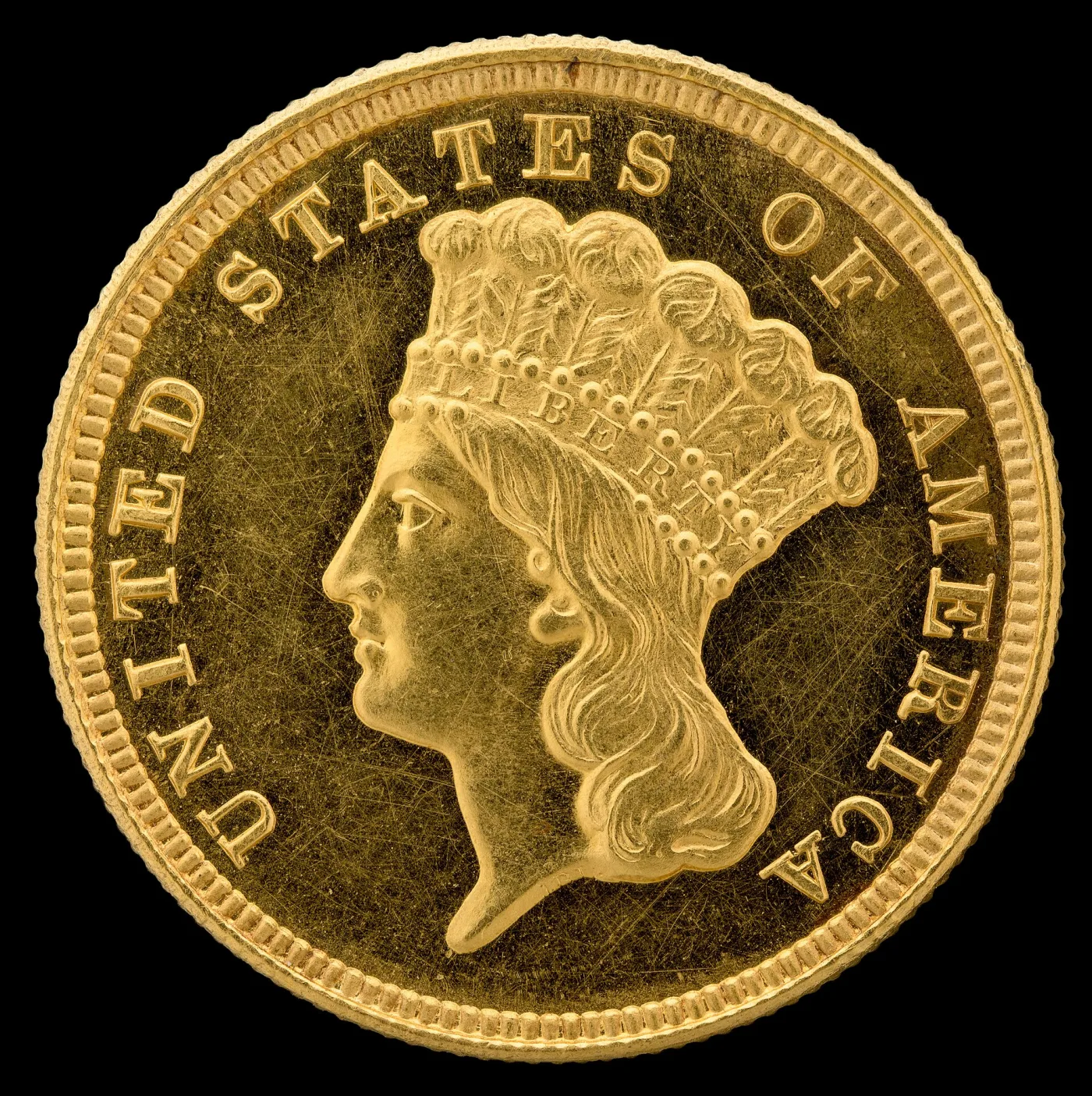
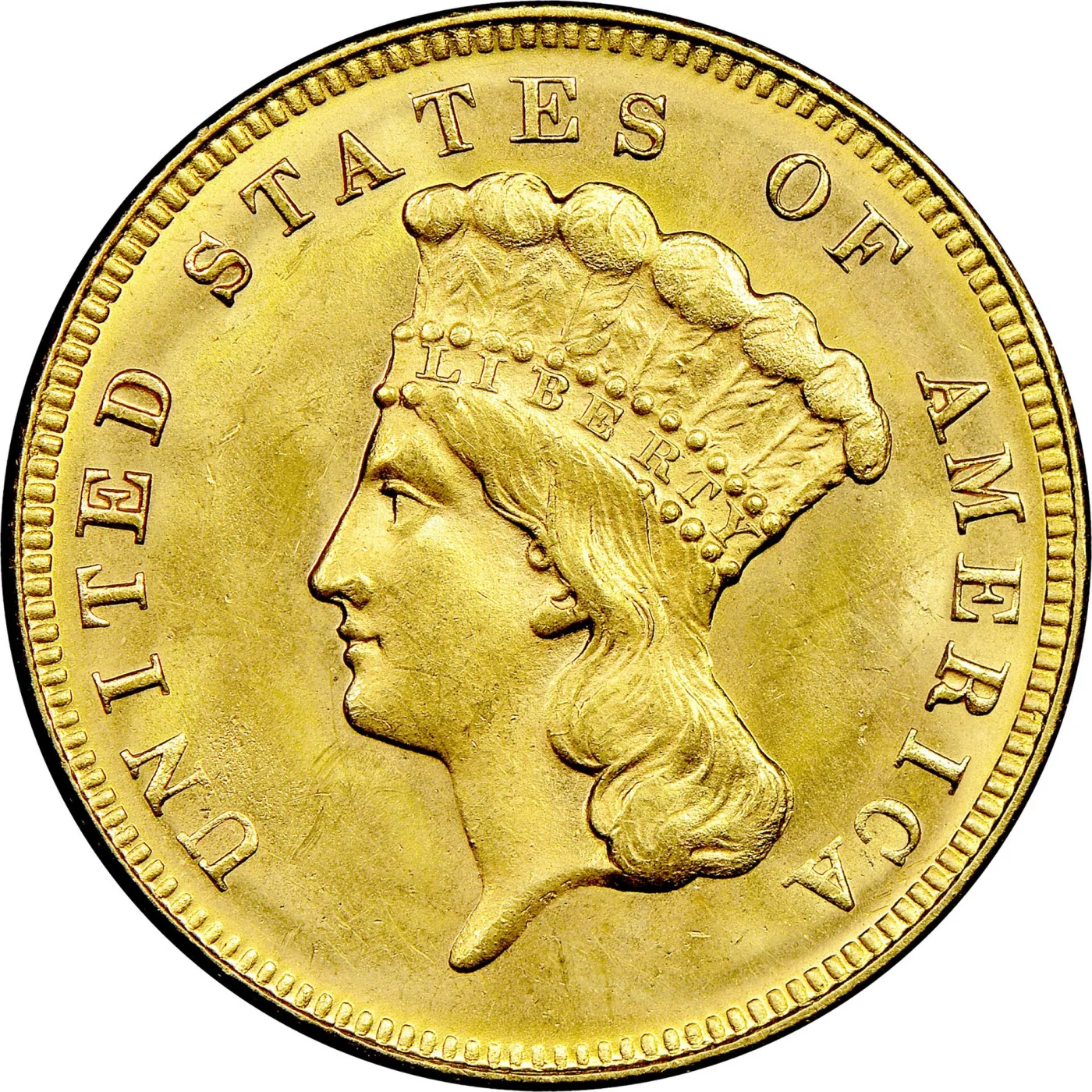
Designed by James B. Longacre — the same Chief Engraver who created the Gold Dollar, the Flying Eagle Cent, the Indian Head Penny, the Two Cent Piece, the Three Cent Piece, and the Shield Nickel — the Three Dollar Gold piece features a distinctive Indian Princess head wearing a tall feathered headdress on the obverse, with an agricultural wreath enclosing the denomination “3 DOLLARS” and date on the reverse. The design is closely related to the Type 2 and Type 3 Gold Dollar, but the larger 20.5mm planchet allowed Longacre to use higher relief and more detail, producing some of the most artistically distinctive gold coins of the era.
This guide covers everything you need to identify, grade, and value Three Dollar Gold pieces: the design and how Longacre solved the strike problems that plagued the Type 2 Gold Dollar, the four mints that produced the denomination (Philadelphia, Dahlonega, New Orleans, and San Francisco), every meaningful key date including the 1854-D, 1854-O, 1865, 1873 Open 3 vs Closed 3, 1875 and 1876 proof-only issues, and the unique 1870-S, the 1873 Open 3 oddity, current grading standards, authentication strategies, and 2026 market values. The same disciplined coin identification techniques that apply to silver classics carry over here, but with the added discipline that gold coins demand: precise weight checks, edge examination, and a careful eye for jewelry damage and removed mounts.
History: The Strange Birth of the $3 Gold Piece
The Three Dollar Gold piece was created by the Act of February 21, 1853 — the same legislation that reduced silver coin weights and authorized the silver three-cent piece’s redesign. The justification offered to Congress was that the new three-cent first-class postage rate (also enacted in 1851 and reduced again in 1853) made a $3 coin convenient for buying sheets of 100 stamps, and that the denomination would also be useful for exchanging for rolls of 100 silver three-cent pieces. Both rationales were thin. Buying postage in $3 lots was not actually common, and the silver three-cent piece never circulated in volume.
The real political motive was protection of the gold-mining interests in the Carolinas, Georgia, and California. The Treasury was sitting on growing gold reserves from California, and the Mint had political incentives to monetize that gold into circulating coinage. A new gold denomination — even an awkward one — meant more gold being struck into coins at the Charlotte, Dahlonega, and (newly opened) San Francisco branch mints. James Guthrie, Secretary of the Treasury at the time, supported the new coin as a way to use up gold bullion that otherwise sat idle.
Why It Failed in Commerce
From the start, the Three Dollar Gold piece struggled. It was easily confused with the contemporary Liberty Head Quarter Eagle ($2.50) by inattentive merchants, especially worn examples where the “3” on the reverse could be mistaken for a “2.” At 20.5mm, it was only marginally larger than the 18mm Quarter Eagle, and the obverse designs (Indian Princess vs. Liberty with coronet) were visually similar enough that mistakes happened. Banks and merchants increasingly refused to handle them, and by 1860 mintages had collapsed. After 1865, business strikes were typically under 5,000 pieces per year, with several years having mintages below 1,000. The series limped along on collector demand and bullion exchange until the Act of September 26, 1890 abolished it along with the Gold Dollar, the silver three-cent piece, and several pattern denominations.
The Hoarding Problem
Even when Three Dollar pieces were struck in modest numbers, most never reached circulation. Civil War-era hoarding pulled gold coins out of commerce by 1862, and they did not return to circulation in the East until 1879 — fourteen years during which gold coins generally traded at a premium to greenbacks. Three Dollar pieces struck during this period went mostly into bank vaults, jewelry, or numismatic collections. As a result, while mintages are low, surviving populations in higher grades are often surprisingly intact — many issues are scarce in well-worn condition because the pieces simply never circulated.
Design: Longacre’s Indian Princess and Agricultural Wreath
James B. Longacre designed the Three Dollar Gold piece in late 1853 and early 1854. The design draws from the same Indian Princess motif Longacre used on the Type 2 and Type 3 Gold Dollars, but with substantially more room to work with on the larger 20.5mm planchet.
The Obverse
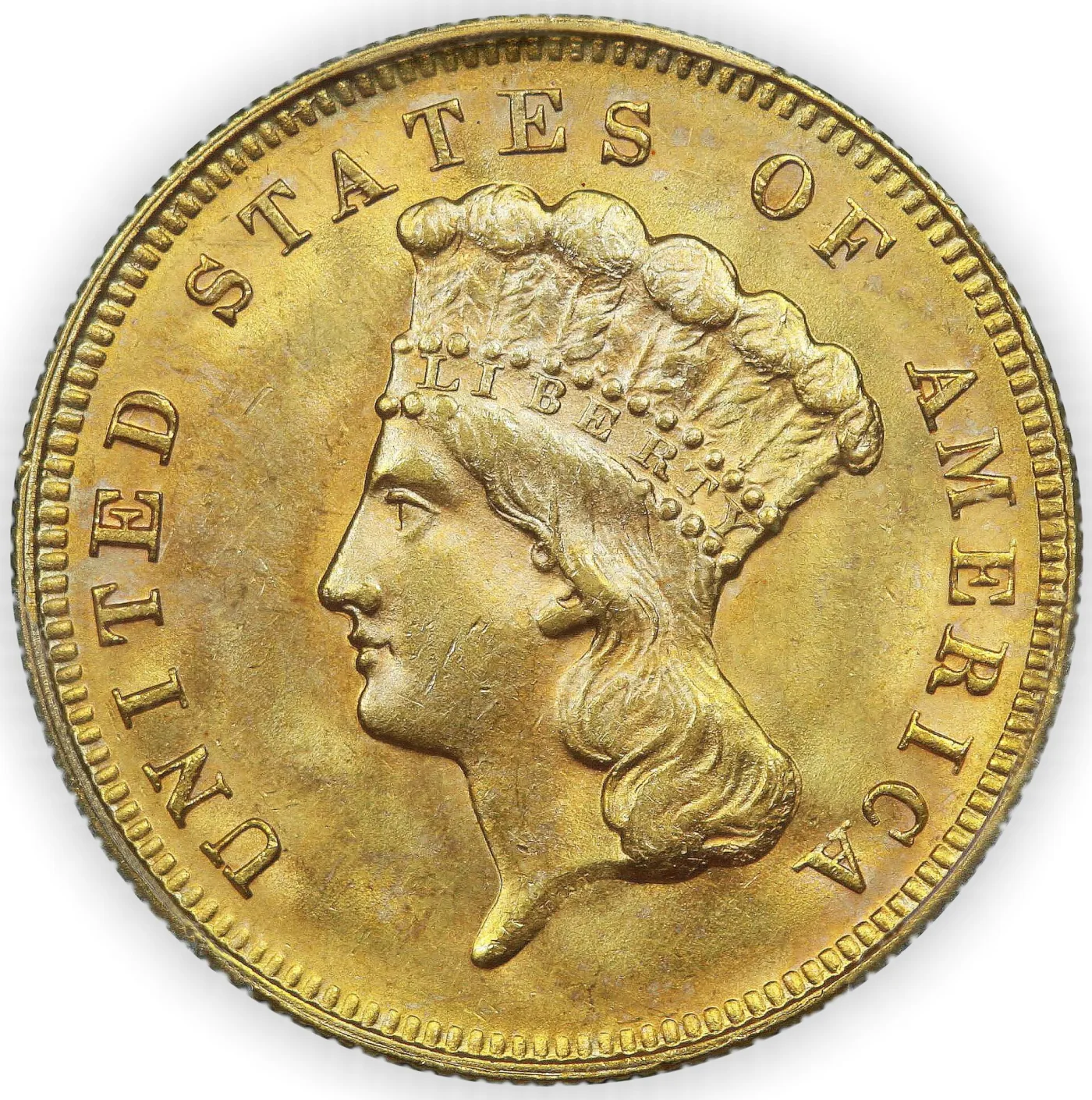
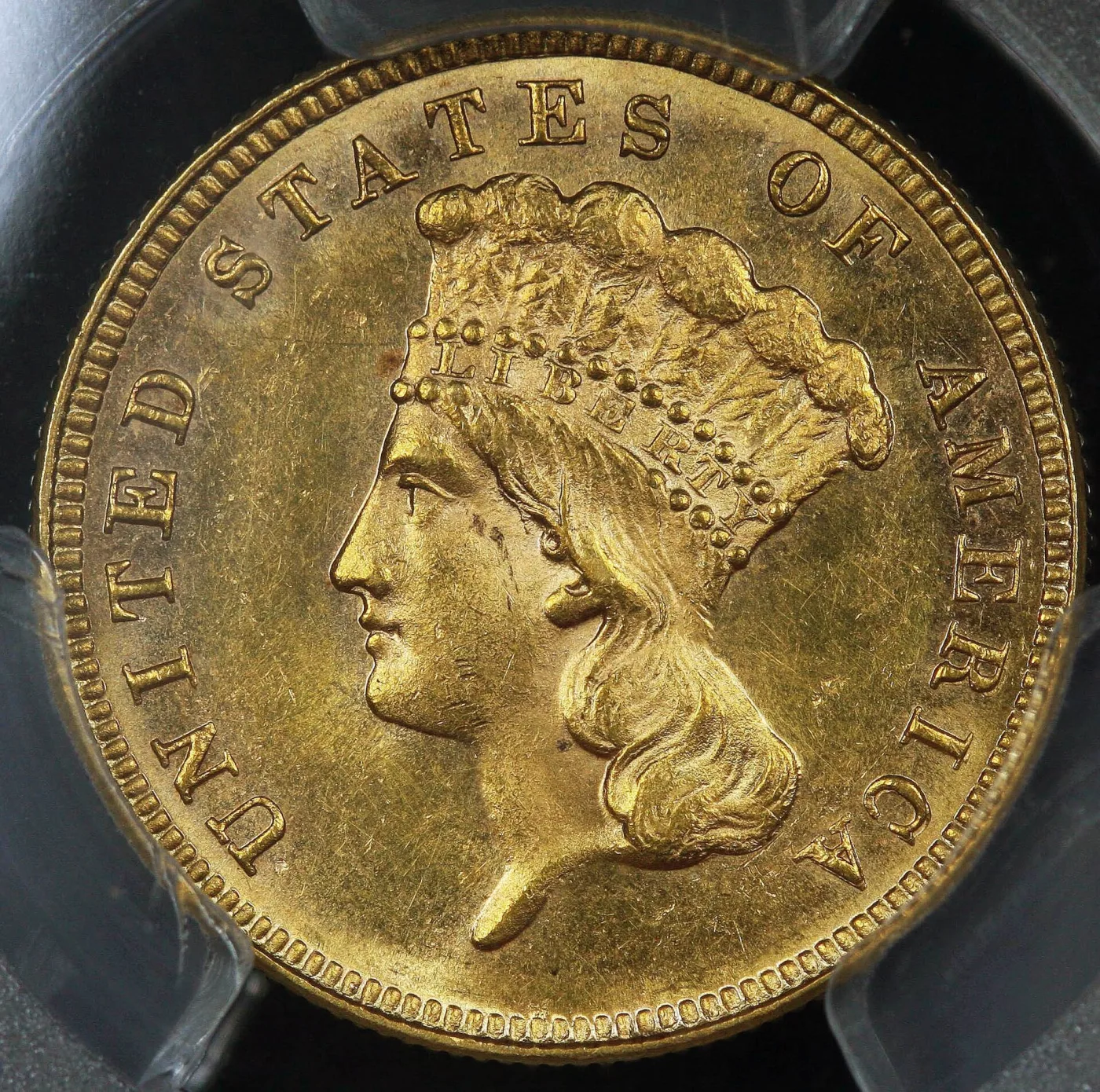
The obverse shows the Indian Princess facing left, wearing a tall feathered headdress with a band reading LIBERTY across the front. UNITED STATES OF AMERICA encircles the rim. Unlike the cramped Type 2 Gold Dollar — where the high-relief headdress caused strike problems opposing the wreath on the reverse — the Three Dollar’s larger planchet allowed Longacre to balance the relief properly. The headdress is tall, ornate, and detailed, with individual feather barbs typically clearly defined on well-struck examples. The Princess’s face shows clear features: a distinct nose, lips, an eye with eyelashes, and individual strands of hair flowing back from the brow.
The headdress is the most distinctive identifier of the Three Dollar Gold piece. While Liberty appears on virtually every other US gold denomination of the era, only the Three Dollar shows her in this dramatic plumed headdress at this size and clarity. If you encounter a roughly quarter-sized gold coin (between the Quarter Eagle and Half Eagle in diameter) with this design, it is almost certainly a Three Dollar Gold piece.
The Reverse
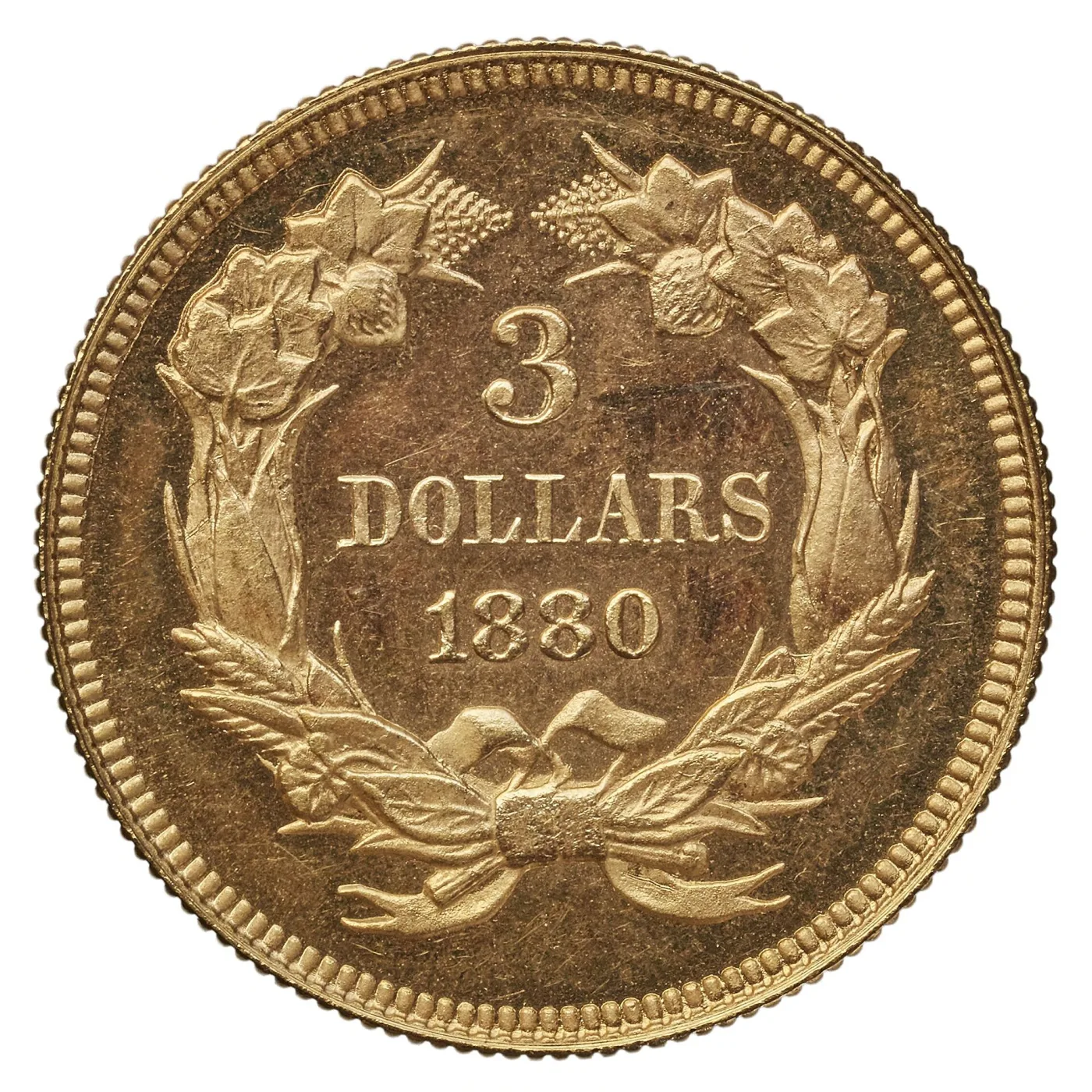
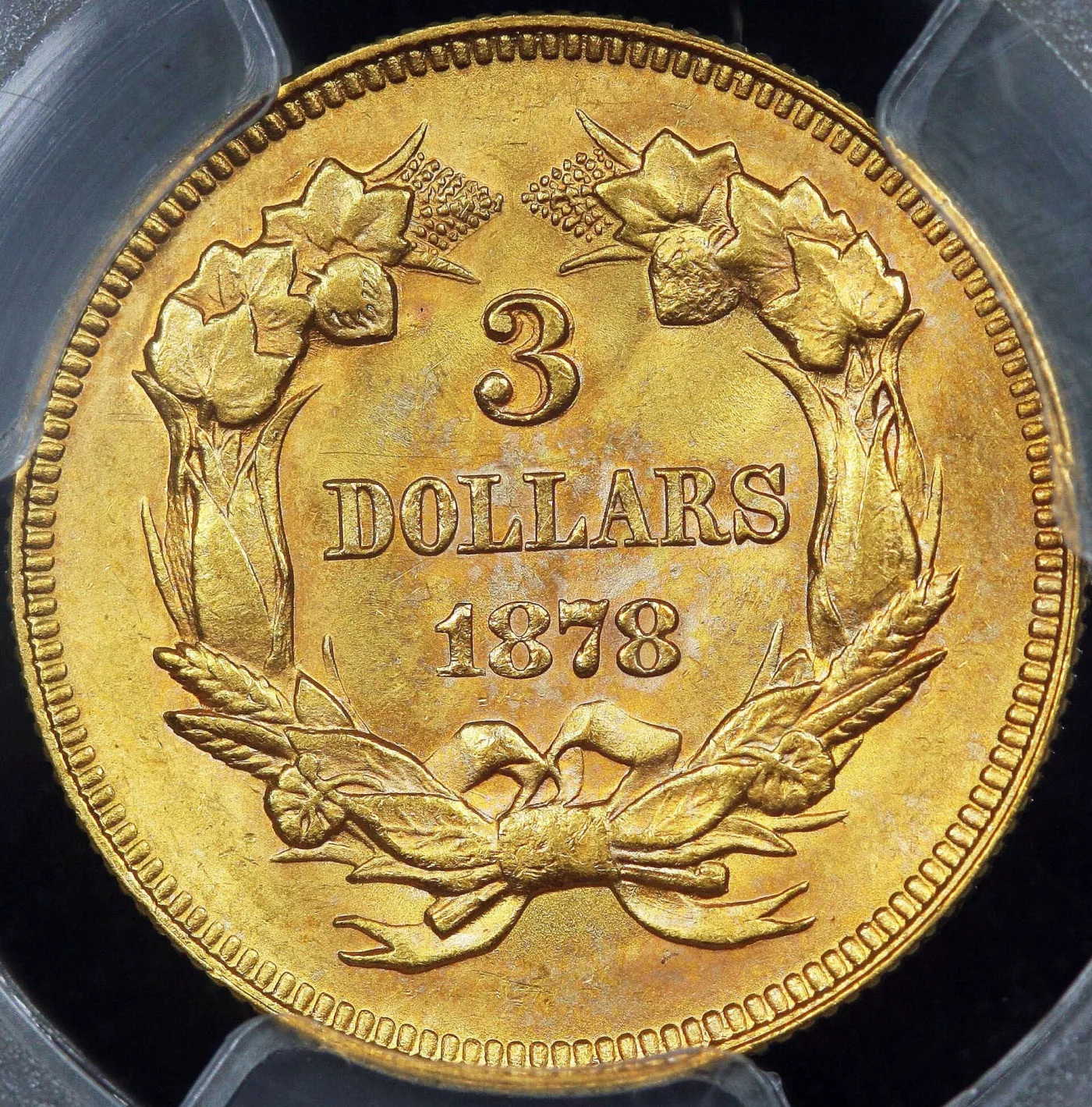
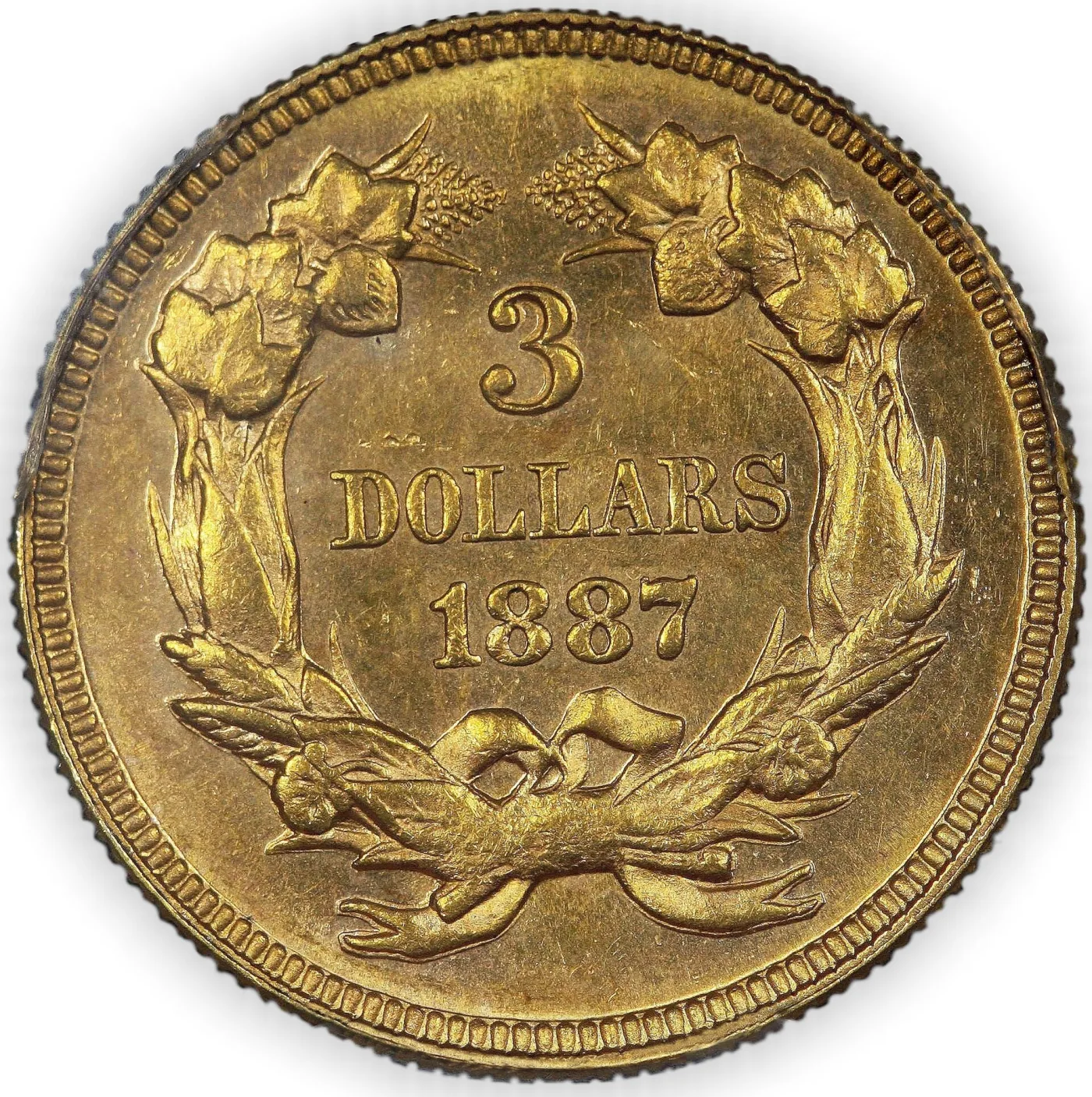
The reverse features an agricultural wreath of corn, wheat, cotton, and tobacco — the four staple crops of antebellum America — surrounding the denomination “3 DOLLARS” stacked above the date. The wreath is the same general design Longacre used on the Gold Dollar Type 2/3 reverse, but enlarged. The denomination is spelled out as “3 DOLLARS” rather than expressed numerically alone, which helps distinguish worn Three Dollar pieces from worn Quarter Eagles or Half Eagles.
One quirk of the reverse: the date is positioned inside the wreath at the bottom, not on the obverse. This places the date and the denomination together, which is unusual among US gold coinage but consistent with Longacre’s wreath-reverse designs.
The Edge
The edge is reeded. There is no lettered edge or plain edge variant. If you find a Three Dollar Gold piece with a plain edge, it has been damaged — typically filed down to remove a mount or polished to disguise wear.
Composition and Specifications
The Three Dollar Gold piece has the same fineness as other US gold coins of its era: 90% gold, 10% copper. Specifications were fixed for the entire 36-year production run, never changing.
- Composition: 90% gold, 10% copper
- Total weight: 5.015 grams (77.4 grains)
- Pure gold content: 4.5135 grams (0.14512 troy ounces)
- Diameter: 20.5 mm
- Edge: Reeded
- Designer: James B. Longacre
At 2026 gold prices, the melt value of a Three Dollar Gold piece runs around $300-$320 depending on spot, but no Three Dollar is worth its melt value alone — every date and mintmark commands a meaningful collector premium above bullion. The lowest-grade common-date examples (1854 Philadelphia, 1874, 1878) typically trade at 1.5x to 2x bullion in well-worn condition.
Mint Marks: Philadelphia, Dahlonega, New Orleans, San Francisco
Three Dollar Gold pieces were struck at four mints. The mint mark, when present, appears on the reverse below the wreath knot at the bottom of the coin.
- No mint mark — Philadelphia (1854-1889): The main mint, produced the series every year
- D — Dahlonega, Georgia (1854 only): Only year of production, just 1,120 pieces struck
- O — New Orleans, Louisiana (1854 only): Only year of production, 24,000 pieces struck
- S — San Francisco, California (1855, 1856, 1857, 1860, 1870): Sporadic production, with the 1870-S being unique
Charlotte (C) — despite producing other gold denominations — never struck Three Dollar Gold pieces. This makes the series simpler to collect by mint than the Liberty Head Half Eagle or Gold Dollar, both of which were struck at Charlotte. Note that the Carson City Mint, although operating from 1870 onward, never produced Three Dollar Gold pieces either — by the time CC opened, the denomination’s mintages were already collapsing and there was no demand, in contrast to the Liberty Head Eagle, which Carson City struck throughout the 1870s and 1880s.
Locating the Mint Mark
The mint mark is small and tucked just below the wreath bow at the bottom of the reverse, between the bow and the rim. On worn coins it can be difficult to spot — use 10x magnification and good directional lighting. A missing or very weak mint mark on a high-value branch-mint candidate (1854-D especially) demands authentication by PCGS, NGC, or ANACS.
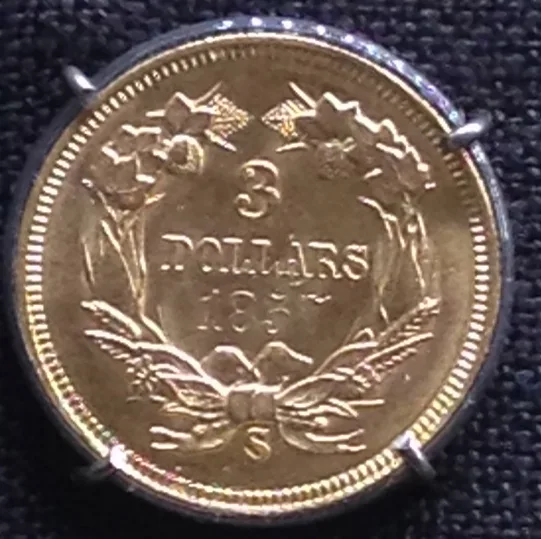
The 1854 First-Year Issues and Branch Mints
1854 is the only year all four mints produced Three Dollar Gold pieces, and the first-year issues carry special significance.
1854 Philadelphia
The 1854-P had a relatively healthy mintage of 138,618 pieces — by far the highest of any year in the series. It is the most common Three Dollar Gold piece and the typical “type coin” used to represent the denomination. Most surviving examples are in EF to AU grades, with Mint State examples available but pricier.
A subtle first-year variety exists: the 1854 Philadelphia issue has the word “DOLLARS” in smaller, narrower letters than later dates, and from 1855 the lettering was enlarged. That makes it a one-year type within the series, sometimes designated “Small DOLLARS” by specialists. Read this as a Philadelphia diagnostic rather than a property of the date — the 1854-D photographed below carries visibly wider, bolder DOLLARS, so “the 1854 has small DOLLARS” does not hold across the branch mints.
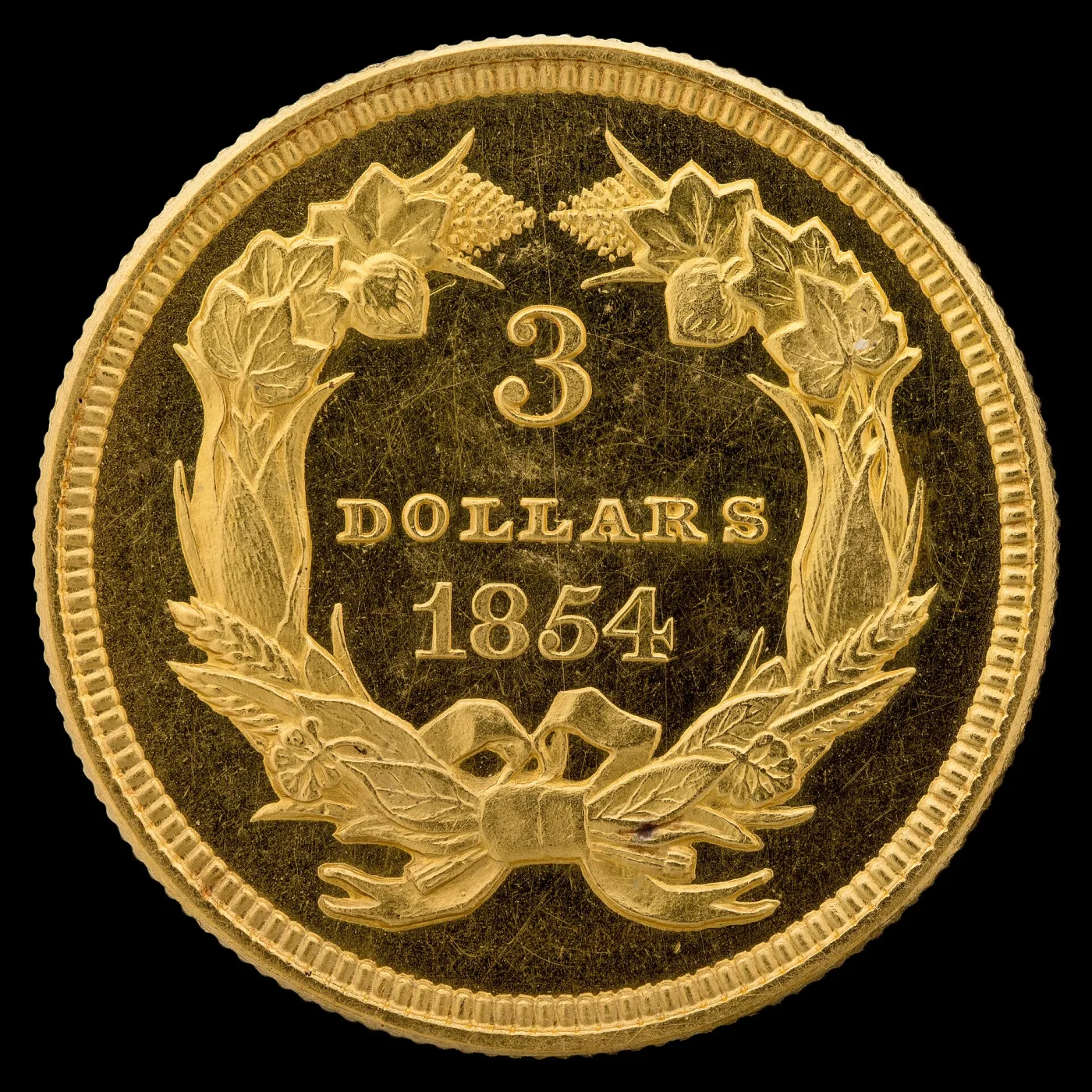
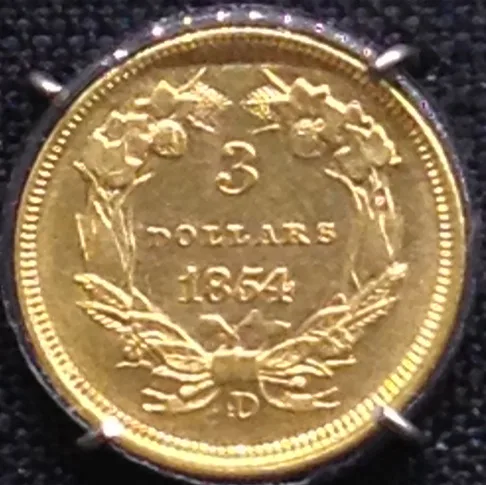
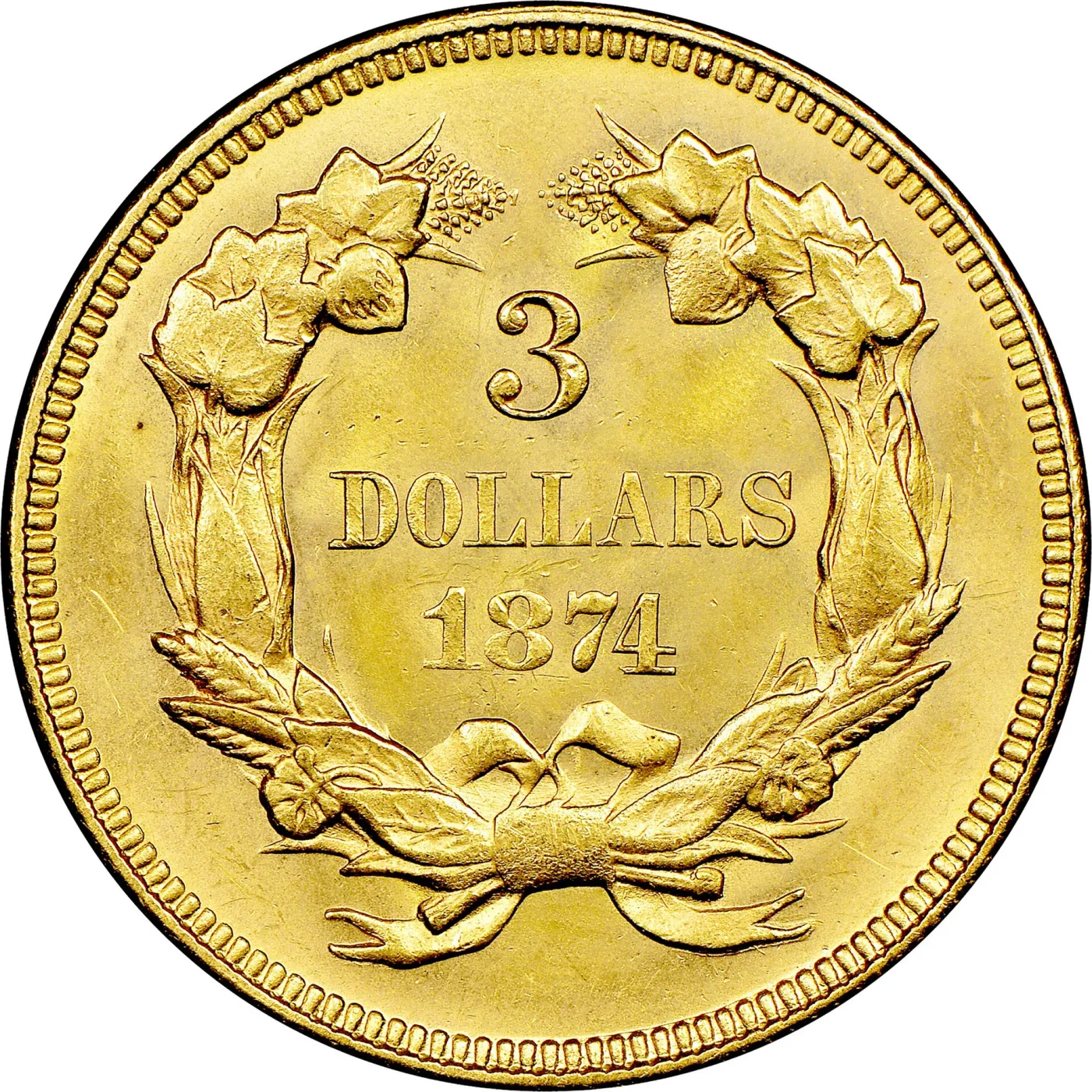
1854-D (Dahlonega)
The 1854-D had a mintage of only 1,120 pieces and is one of the great rarities of US gold coinage. It is the only Three Dollar Gold piece struck at Dahlonega. Surviving examples are estimated at fewer than 250, with most in VF-EF grades — Mint State examples are exceedingly rare and bring six figures. The 1854-D shows the typical Dahlonega weak strike at the centers, and the mint mark “D” is sometimes weakly impressed.
Authentication is critical. The 1854-D is one of the most counterfeited US gold coins, and altered Philadelphia coins (with a fake “D” added) appear regularly. Any 1854-D outside a major third-party holder should be regarded with suspicion until certified.
1854-O (New Orleans)
The 1854-O had a mintage of 24,000 pieces — substantially higher than the Dahlonega issue but still scarce. Most surviving examples are in VF to EF grades, and Mint State examples are quite rare. The 1854-O typically shows a sharper strike than the 1854-D but is still well below Philadelphia quality. As with all early branch-mint gold, weak central detail is normal and not a deduction.
Like the 1854-D, the 1854-O is the only Three Dollar piece from New Orleans. The denomination was apparently judged unsuccessful at New Orleans after the first year and was never struck there again.

1873 Open 3 vs Closed 3
In 1873, the Philadelphia Mint logotype for the “3” digit was modified mid-year. Early-year strikes used a “Closed 3” — where the upper and lower lobes of the digit nearly touch the center serif, making the 3 look almost like an 8 in worn condition. Later in the year, after complaints that the Closed 3 was difficult to read, the Mint modified the logotype to an “Open 3” where the lobes are clearly separated.
For the Three Dollar series, both the Closed 3 and Open 3 exist, but the Closed 3 is the substantially rarer of the two. Most surviving 1873 Three Dollar pieces are Open 3 — the Closed 3 is believed to have been a small early-year production. The same Closed 3 / Open 3 distinction appears on the Two Cent Piece, the Three Cent Piece, the Half Dime, the Seated Liberty Dime, the Seated Liberty Quarter, and the Seated Liberty Half Dollar, since the logotype change affected all denominations produced in 1873.
Beyond the date logotype itself, the 1873 Three Dollar is unusual because it was struck primarily as proofs — business strikes were minimal that year and the regular-issue mintage is unclear in the records. Most certified 1873 Three Dollar pieces are proof restrikes or original proofs, with a tiny number of business-strike Closed 3 examples known. The proof 1873s are themselves valuable; the business-strike Closed 3 is essentially uncollectable for most collectors.
Key Dates and Major Rarities
Almost every Three Dollar Gold piece is a key date by modern standards — even the most common years had mintages a fraction of what is considered scarce in other denominations. But within the series, certain dates stand out.
1854-D — Major Rarity
Mintage 1,120. The only Dahlonega Three Dollar. EF-40: ~$15,000-$20,000. AU-50: ~$25,000-$35,000. MS-60: $80,000+. MS-62 and above: six figures.
1865 — Civil War Rarity
Mintage 1,140 business strikes plus 25 proofs. One of the lowest mintages of the series and a Civil War-era hoarding date. EF: $4,000-$5,000. AU: $7,500-$10,000. MS-60: $20,000+.
1870-S — Unique
Believed to be unique. Only one example outside the San Francisco Mint cornerstone is known. See the dedicated section below.
1873 Closed 3 (Business Strike) — Major Rarity
Believed to be unique or nearly so as a business strike. Most 1873 Closed 3 Three Dollar pieces are proofs. A business-strike Closed 3 would bring well into six figures if authenticated.
1875 — Proof-Only
Mintage 20 proofs (no business strikes). One of the most famous proof-only US coins. PR-60: $150,000+. PR-65+: $500,000+. The 1875 is more valuable than most date-and-mintmark combinations in any US series.
1876 — Proof-Only
Mintage 45 proofs (no business strikes). Less rare than 1875 but still a major key. PR-60: $60,000+. PR-65+: $150,000+.
1881 — Low Business Mintage
Business-strike mintage just 500 plus 54 proofs. EF: $3,500-$4,500. AU: $6,000-$8,000. MS-60: $15,000+.
1885 — Low Business Mintage
Mintage 801 business strikes plus 109 proofs. EF: $3,000-$4,000. AU: $5,500-$7,500. MS-60: $14,000+.
Common Dates
The “common” dates — 1854 Philadelphia, 1855, 1856, 1857, 1874, 1878 — all had mintages of at least 41,000 (1856 was 26,010, still scarce by general numismatic standards). These are the dates most often encountered and form the entry point for most collectors. AU-50 examples typically run $1,500-$2,500 depending on date.
The Unique 1870-S
The 1870-S Three Dollar Gold piece is one of the most famous coins in American numismatics — and one of the strangest stories. According to surviving Mint records, only two were struck: one was placed inside the cornerstone of the new San Francisco Mint building when it was laid in May 1870 (where it presumably still sits), and the other was struck for the Mint’s coin collection. The cornerstone coin has never been recovered. The collection coin disappeared from Mint hands in the 1870s.
One example surfaced in the 1907 sale of William H. Woodin’s collection, identified as the 1870-S Three Dollar. It has passed through several major collections since — Eliasberg, Bass, and others — and most recently sold in 2020 for $5.5 million. It is believed to be the only example of the 1870-S Three Dollar in private hands, and is thus effectively unique unless the cornerstone is ever opened.
The coin’s distinguishing features include the “S” mint mark below the wreath and certain die characteristics that have been documented by major researchers. Any “1870-S Three Dollar Gold” not provenance-traced to this one specific coin is — without exception — a fake or an altered piece. The 1870-S in private hands is one of the most carefully documented coins in American collecting history.
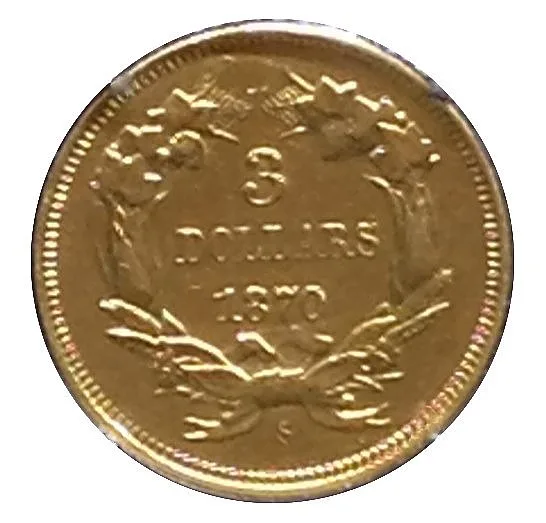
For collectors, the 1870-S is not a coin you acquire; it is a coin you appreciate from a distance. But it illustrates an important principle: the Three Dollar Gold series, despite its modest mintages and lukewarm circulation history, contains some of the most extraordinary rarities in US numismatics.
Proof-Only and Proof-Restrike Issues
Three Dollar Gold proofs were struck nearly every year of the series, with mintages typically in the 20-100 range. Two years — 1875 and 1876 — were proof-only with no business strikes produced. Several others had business-strike mintages so low that proofs are nearly as common as circulation strikes.
Three Dollar proofs are distinguished by mirror-like reflective fields, sharp squared rims, and full strike on every detail of the headdress and wreath. The contrast between frosted devices and watery fields is often dramatic, producing what collectors call “cameo” proofs. The cameo effect was particularly strong on Three Dollar proofs from the late 1860s through 1880s.
Proof Restrikes
Some 1873 and earlier-date proofs were restruck at the Mint during the 1870s and 1880s for collectors. These restrikes are generally considered authentic Mint products but command lower premiums than original-year proofs. PCGS and NGC distinguish restrikes where die characteristics permit identification.
Branch Mint Proofs
True branch mint proofs of Three Dollar Gold pieces are extraordinarily rare — only a handful are known from any San Francisco issue. Any claimed branch-mint proof must be certified by a major third-party grader.
Grading Three Dollar Gold Pieces
Grading Three Dollar Gold pieces follows the standard Sheldon 70-point scale but with attention to certain wear points specific to the design.
Key Wear Points
Obverse: The first wear points are the headdress feathers (especially the central, tallest feathers above the brow), the hair details above the LIBERTY band, the cheek, and the curls of hair behind the ear. The LIBERTY band itself, with its tiny letters, is one of the last details to remain fully sharp.
Reverse: The first wear shows on the wreath leaves at the top of the agricultural wreath, the corn ears, and the wheat awns. The bow knot at the bottom of the wreath is also a key wear point. The “3” and “DOLLARS” lettering remain sharp longer than the wreath details.
Grade Definitions
- VF-20: Major wreath details visible but blended together; LIBERTY band complete; obverse hair shows wear but feather outlines clear
- EF-40: Most wreath leaves and headdress feathers distinct; light wear on highest points; LIBERTY band sharp
- AU-50: Slight wear on headdress and wreath; original luster covers most of the surface
- MS-60: No wear; may have heavy bag marks or weak strike
- MS-63: Strong luster, average bag marks, generally well-struck
- MS-65 and above: Gem quality, minimal marks, strong eye appeal, full strike
Strike Considerations
Strike weakness is endemic to Three Dollar Gold pieces, especially the Dahlonega and New Orleans 1854 issues. The high-relief headdress opposing the wreath wreath knot on the reverse means weak strikes are common — particularly on the central headdress feathers and the wreath bow. A weak strike does not necessarily lower the technical grade but does affect market value. Always look for the “FS” (Full Strike) designation on certified examples.
Authentication and Spotting Counterfeits
Three Dollar Gold pieces are among the most heavily counterfeited US gold coins. The combination of moderate size, high value, and relatively simple design has attracted counterfeiters for over a century.
Weight and Specific Gravity
Authentic Three Dollar Gold pieces weigh 5.015 grams. A coin that weighs significantly less is likely a counterfeit or has been damaged. Specific gravity should be approximately 17.16 — substantially higher than any base-metal counterfeit. A simple scale and water displacement test can rule out non-gold fakes immediately.
Edge Examination
The edge should show clear, even reeding with no signs of solder, file marks, or seam lines. Cast counterfeits often show a faint mold line on the edge, and removed-mount examples typically show file marks or a polished area where the mount was attached.
Altered Mint Marks
The 1854-D is the most commonly altered Three Dollar — typically a Philadelphia coin with a fake “D” added under the wreath. Look for evidence of tooling, mismatched font characteristics, or unusual mint mark placement. The genuine D mint mark on the 1854-D has a specific, slightly italicized character that is documented by major researchers.
Cast and Struck Counterfeits
Modern cast counterfeits show fuzzy detail, mushy lettering, and porous surfaces. Struck counterfeits — particularly the so-called “Lebanese” gold counterfeits of the mid-20th century — are more sophisticated and may pass casual inspection. Diagnostic die characteristics for each Mint State Three Dollar are documented in Bowers’ reference work; comparing your coin to published die photos is the best non-certified authentication.
Third-Party Grading
Any Three Dollar Gold piece worth more than $1,000 should be in a PCGS, NGC, or ANACS holder before purchase. The certification cost is trivial compared to the risk of a counterfeit, and the holders carry guarantees. For high-value rarities like the 1854-D, 1865, 1881, 1885, or proof-only 1875/1876, certified status is essentially mandatory.
Jewelry Damage and Removed Mounts
Throughout the 19th and early 20th centuries, Three Dollar Gold pieces were popular as watch fobs, brooches, and pendants. The small size, distinctive design, and gold content made them attractive jewelry pieces. As a result, a very high percentage of surviving Three Dollar Gold pieces show some form of jewelry damage.
Common Damage Types
- Soldered loops: A loop soldered to the top of the obverse or reverse
- Removed loops: A flat area where a loop was once soldered, often visible as a smoother patch with file marks
- Pinholes: Small holes drilled through the rim for pin attachments
- Polished surfaces: Bright, unnatural luster from polishing for jewelry display
- Edge file marks: Wear or filing on the edge from setting in a bezel
A Three Dollar Gold piece with any of these damage types will not grade at PCGS or NGC and is typically worth only bullion plus a small premium. Always examine the rim at the 12 o’clock position carefully — even a well-restored mount removal often leaves traces visible under magnification.
Current Market Values and Price Guide
The Three Dollar Gold market in 2026 reflects strong demand for classic US gold and limited supply. Common-date prices have been firm, and rarities have appreciated meaningfully over the past decade.
Common Dates (1854-P, 1855, 1856, 1857, 1874, 1878)
- VF-20: $900-$1,100
- EF-40: $1,200-$1,500
- AU-50: $1,500-$2,000
- AU-58: $2,000-$2,800
- MS-60: $2,800-$3,800
- MS-62: $3,800-$5,500
- MS-63: $6,000-$9,000
- MS-64: $10,000-$15,000
- MS-65: $25,000-$40,000
Better Dates (1858, 1860, 1860-S, 1861, 1862, 1863, 1867, 1868, 1869, 1882, 1883, 1884, 1886, 1887, 1888, 1889)
Generally 50-100% premiums over common-date prices in the same grade, with variation depending on specific date scarcity.
Major Key Dates
- 1854-D: EF $15,000+, AU $25,000+, MS rare and $80,000+
- 1854-O: EF $3,500-$4,500, AU $6,000-$9,000, MS $20,000+
- 1865: EF $4,000-$5,000, AU $7,500-$10,000, MS $20,000+
- 1875 Proof-Only: PR-60 $150,000+, PR-65 $500,000+
- 1876 Proof-Only: PR-60 $60,000+, PR-65 $150,000+
- 1881: EF $3,500+, AU $6,000+, MS $15,000+
- 1885: EF $3,000+, AU $5,500+, MS $14,000+
Proofs
Proof Three Dollar Gold pieces from the 1860s-1880s typically range from $4,000-$8,000 for PR-60 examples, $8,000-$15,000 for PR-63, $20,000-$40,000 for PR-65, and $50,000+ for Cameo and Deep Cameo gems. Specific dates and original mintages affect pricing significantly.
Building a Three Dollar Collection
Three Dollar Gold collecting is one of the most rewarding pursuits in classic US gold because the series is genuinely difficult — a complete date set is achievable but expensive, and a complete date-and-mintmark set is essentially impossible without acquiring the unique 1870-S.
Type Set Approach
The simplest entry is a single representative Three Dollar Gold piece for a type set — typically an 1854-P, 1874, or 1878 in AU or low-MS condition. This requires roughly $1,500-$3,500 and gives the collector exposure to the denomination.
Common Date Set
Acquiring the six common dates (1854-P, 1855, 1856, 1857, 1874, 1878) in matching AU-50 to AU-58 grades makes for an impressive display set, with a total cost in the $10,000-$15,000 range. The 1857 and 1860 are sometimes added as semi-key dates that round out the early Philadelphia issues.
Branch Mint Set
The two non-S branch mints — 1854-D and 1854-O — combined with one or more San Francisco issues (1855-S, 1856-S, 1857-S, 1860-S) form a “branch mint” set that highlights the geographic diversity of the series. This is an expensive undertaking; the 1854-D alone runs $15,000+ in any collectible grade.
Date Set Goal
A complete date set (one of every year 1854-1889, excluding the unique 1870-S) is achievable for a determined collector with a long timeline and a budget of $50,000-$100,000+ depending on grade preferences. The 1865, 1875, 1876, 1881, and 1885 are the major financial hurdles in such a set.
Storage and Preservation
Three Dollar Gold pieces, like all 90% gold US coins, are relatively robust but still benefit from proper storage. Gold does not tarnish, but the 10% copper alloy can develop spots in humid environments or from skin oils.
Best Practices
- PCGS or NGC holders: The single best protection. Encapsulated coins are sealed against humidity, handling, and atmospheric contaminants.
- Mylar 2x2 flips: For raw coins, inert Mylar flips with cardboard frames are acceptable. Avoid PVC flips, which leach harmful chemicals.
- Coin albums: Avoid albums with sliding plastic windows, which can scratch the coin’s surface. If you use an album, choose one with non-PVC pages designed for gold.
- Climate control: Store at moderate humidity (40-50%) and temperature. Avoid attics, basements, and bathrooms.
- Never clean: Cleaning destroys numismatic value. Even gold, which is chemically inert, develops a “skin” of toning that grading services treat as part of the coin’s surface.
Frequently Asked Questions
Why was the Three Dollar Gold piece created?
The official justification was to make stamp purchases convenient — three-cent first-class postage rates meant a $3 coin could buy 100 stamps. The real motive was to give Southern and Western gold mining interests a new denomination to monetize their bullion. The denomination never found a practical role in commerce.
How can I tell a Three Dollar Gold piece from a Quarter Eagle?
The Three Dollar has the Indian Princess head with a tall feathered headdress on the obverse and an agricultural wreath enclosing "3 DOLLARS" on the reverse. The contemporary Liberty Head Quarter Eagle ($2.50) has a Liberty head with a coronet inscribed LIBERTY and a heraldic eagle reverse. The Three Dollar is also slightly larger (20.5mm vs 18mm) and heavier (5.015g vs 4.18g).
Is the 1870-S available to buy?
In practical terms, no. Only one example is known in private hands, and it last sold in 2020 for $5.5 million. The other believed-struck example sits in the cornerstone of the San Francisco Mint building and has never been recovered.
What is the difference between Open 3 and Closed 3 on 1873?
The "3" digit logotype was changed mid-year in 1873. Early strikes have a "Closed 3" where the upper and lower lobes of the digit nearly touch, making the 3 look almost like an 8. Later strikes have an "Open 3" with clearly separated lobes. The Closed 3 is much rarer in business-strike Three Dollar coinage and is essentially unobtainable as a circulation strike — most 1873 Closed 3 Three Dollars are proofs.
Are Three Dollar Gold pieces a good investment?
Three Dollar Gold pieces have historically appreciated above bullion gold, and rarities have outpaced common dates. The series is well-loved by classic gold collectors and has limited supply due to low mintages and jewelry losses. Like all collectibles, value depends on quality, condition, and market timing — but the series has shown long-term strength.
What makes the 1875 so valuable if it's just a proof?
The 1875 was struck only as proofs (20 known), with no business strikes produced. It is a "proof-only" date in a series where most years had at least some business-strike production. The combination of extreme rarity (only 20 ever struck, fewer surviving) and the series' overall collector demand makes the 1875 one of the most valuable US gold coins by date.
Can the coin in the San Francisco Mint cornerstone be recovered?
Theoretically yes, but the cornerstone has never been opened and the building is still in active use. The 1870-S Three Dollar inside the cornerstone, along with other 1870 issues placed there, would presumably be recovered if the building were ever demolished or substantially renovated. As of 2026, no plans exist to do so.