Indian Head Half Eagle Identification Guide: Key Dates, Mint Marks, Incuse Design, and Values
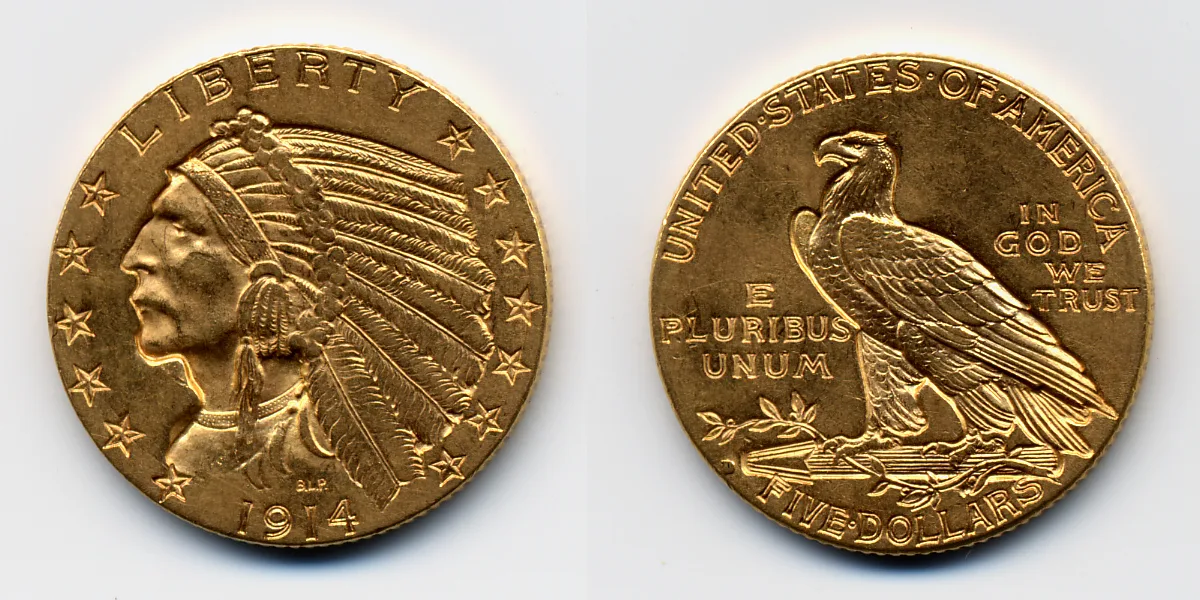
The Indian Head Half Eagle — the United States five-dollar gold coin produced from 1908 through 1929 — is one of the most artistically radical coins in American history. Designed by Boston sculptor Bela Lyon Pratt at the direct invitation of President Theodore Roosevelt, this $5 gold piece is famous for a feature unique among regular-issue US coinage: its design is incused, meaning the imagery is sunken below the field rather than raised above it. Where every other US coin shows a raised portrait standing proud of the surface, the Indian Head Half Eagle shows a Native American chief whose feathered war bonnet, profile, and the surrounding lettering are all cut into the coin. Together with its smaller companion the Indian Head Quarter Eagle, this $5 piece forms the only pair of incuse-design coins ever issued for circulation by the United States Mint.
The Pratt Half Eagle replaced the long-running Liberty Head Half Eagle designed by Christian Gobrecht — itself the heir to the earliest Capped Bust Half Eagle that launched US gold coinage in 1795 — and it ran alongside Augustus Saint-Gaudens’s contemporary high-relief gold series — the Indian Head Eagle ($10) and the Saint-Gaudens Double Eagle ($20). Where Saint-Gaudens pushed sculpture upward off the coin’s surface, Pratt pushed his portrait downward into it — a bold experiment that drew immediate controversy. Critics worried the recessed design would trap dirt and disease germs (a serious public-health argument in 1908), would not stack properly in bank vaults, and would wear unevenly. Champions praised the medallic depth and the unmistakable American Indian portrait. The debate never fully died, but the design survived 22 years of production and remains one of the most distinctive issues in US numismatics.
This guide covers everything you need to identify, grade, and value Indian Head Half Eagles: the incuse design that separates Pratt’s work from every other US series, the key dates including the legendary 1909-O and the final-year 1929, mint marks across Philadelphia, Denver, San Francisco, New Orleans, and Charlotte (the last C-mint gold), grading challenges unique to incuse coins, authentication strategies for one of the most heavily counterfeited US gold series, and 2026 market values. The same disciplined coin identification techniques that apply across US numismatics extend here — but the incuse design changes how wear, luster, and counterfeiting all present, so close attention to series-specific diagnostics is essential.
History and Design: Roosevelt and Pratt
The Indian Head Half Eagle was born from the same Roosevelt-era artistic revolution that produced the Saint-Gaudens gold coins, but with a different sculptor and a radically different approach. After Augustus Saint-Gaudens died in 1907 with the $10 and $20 redesigns essentially complete, President Theodore Roosevelt’s attention turned to the smaller gold denominations — the $5 Half Eagle and the $2.50 Quarter Eagle. Roosevelt wanted these smaller coins redesigned with the same artistic seriousness Saint-Gaudens had brought to the larger denominations.
Roosevelt’s personal physician and longtime friend William Sturgis Bigelow, a Boston Brahmin and art collector, suggested an unusual solution: rather than continuing with raised relief — which had caused enormous production problems with the Saint-Gaudens Double Eagle — try an incuse design inspired by ancient Egyptian and Greek sunken-relief work. Bigelow proposed his friend, Boston sculptor Bela Lyon Pratt, for the commission. Roosevelt approved enthusiastically. The result was the only incuse circulating coinage in US history.
The Designer: Bela Lyon Pratt
Bela Lyon Pratt (1867-1917) was a New England sculptor trained at Yale’s School of Fine Arts and the École des Beaux-Arts in Paris, where he studied alongside contemporaries who would shape early 20th-century American sculpture. By 1907, Pratt was a respected instructor at the Boston Museum School and had completed public commissions including the figures of Art and Science at the Library of Congress. Unlike Saint-Gaudens, Pratt was not a famous national figure when he received the gold coin commission — Roosevelt and Bigelow chose him specifically for his command of incuse and medallic technique.
Pratt’s design for the $5 (and the matching $2.50 Indian Head Quarter Eagle) was based on a photograph of a real Native American chief — long thought to be a Plains chief but more recently believed to be a composite portrait. The realism of Pratt’s portrait stands in stark contrast to the romanticized “Liberty in headdress” of Saint-Gaudens’s $10 design. Pratt’s chief is a portrait of a man; Saint-Gaudens’s Liberty is an allegory wearing borrowed regalia.
The Public Controversy
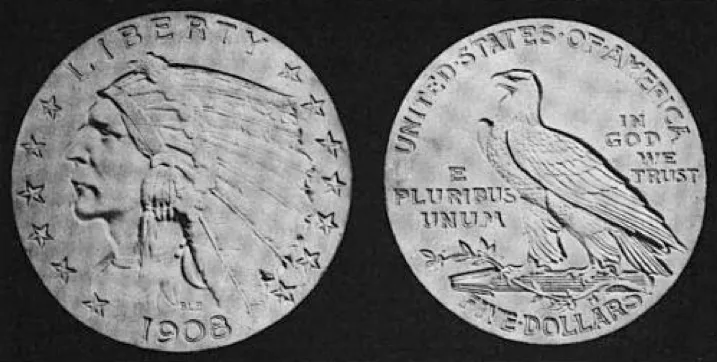
When the new Half Eagles entered circulation in late 1908, public reaction was immediate and divided. Numismatist S.H. Chapman wrote a furious open letter to Roosevelt arguing that the incuse design would “trap dirt and disease germs” and would not stack properly. He claimed the recessed fields would suffer accelerated wear, ruin coin scales used by banks, and damage the dignity of US coinage. Roosevelt’s response, drafted with Bigelow’s input, defended the design as artistically superior and dismissed the hygiene concerns as exaggerated.
Time vindicated the design technically — the coins stacked fine, didn’t trap meaningful dirt, and wore at conventional rates — but the controversy left a permanent mark on the series. Production continued through 1929 but was never expanded to other denominations. After the gold recall ended US gold coinage in 1933, no later US coin has ever revived the incuse approach for circulation.
Production Era and End in 1929
Production ran from late 1908 through 1916, then resumed only briefly in 1929 — a notable gap that distinguishes this series from the continuously produced Indian Head Eagle and Saint-Gaudens Double Eagle. World War I disruptions, gold stockpiling, and reduced commercial demand for $5 gold coins all contributed to the long suspension. The 1929 issue had a mintage of only 662,000, and most were melted under Executive Order 6102 in 1933 — making the 1929 the single most important date in the series after the 1909-O.
The Incuse Design Explained
Understanding the incuse design is essential to identifying, grading, and authenticating the Indian Head Half Eagle. Incuse design is the single feature that most affects how this series differs from every other US gold coin — including coins that look superficially similar, like the raised-relief Indian Head Eagle.
What “Incuse” Means
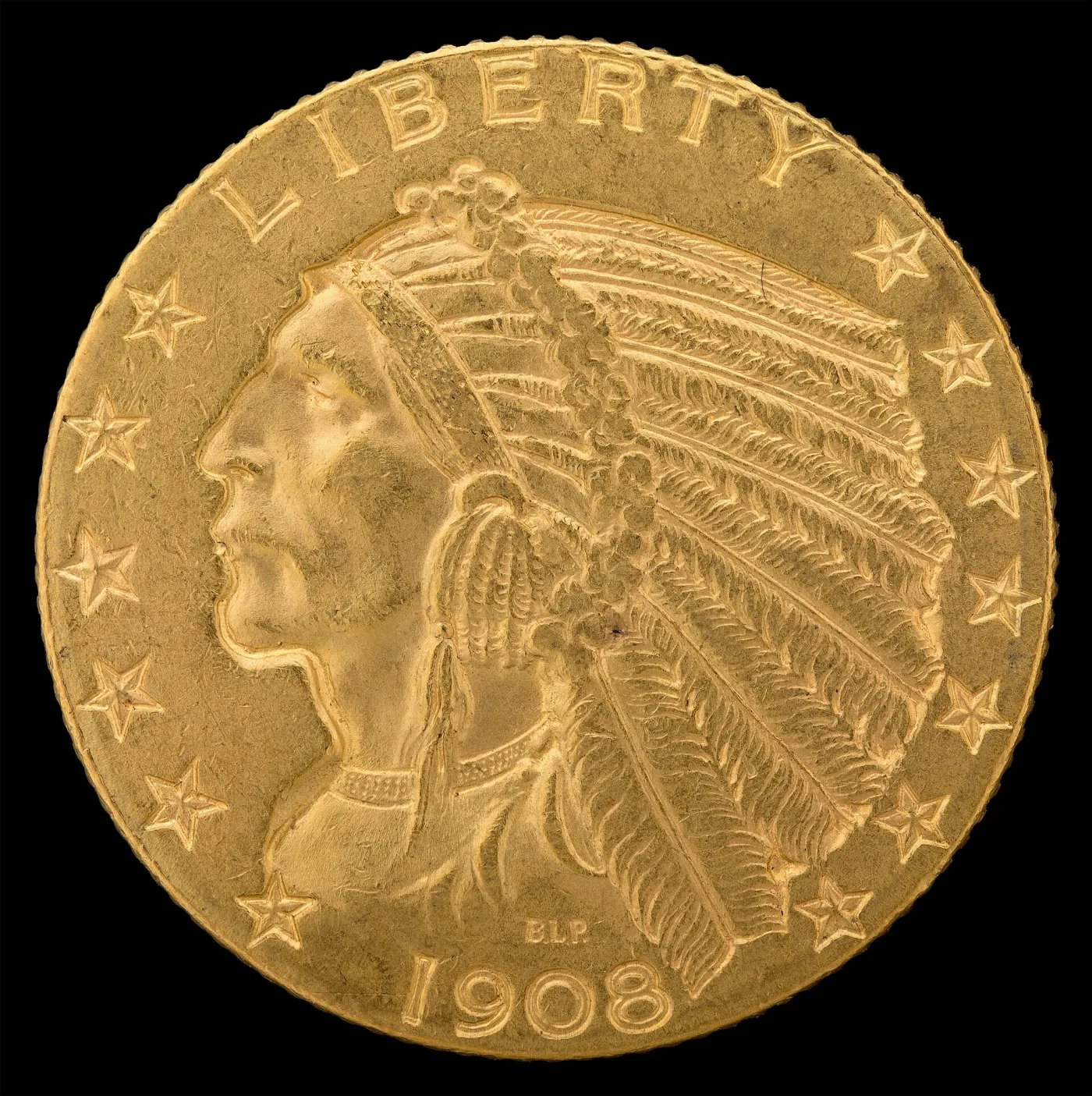
On a conventional coin, the design is raised above the surrounding field. The portrait, lettering, and devices stand proud of the surface, and the field is the recessed background. On an incuse coin, that relationship is inverted: the field is the high surface of the coin, and the design is sunken below it. Run your fingernail across a Morgan Dollar’s portrait of Liberty and the nail catches on the raised relief; run your fingernail across a Pratt Half Eagle’s Indian chief and the nail travels smoothly across the high flat field, dipping into the recessed lettering and feathers.
Why Incuse Was Used
Pratt and his backers chose incuse for several reasons. Ancient Egyptian sunken relief, which had inspired Bigelow, offered a different aesthetic from European raised relief. Incuse design protects high points from circulation wear because the highest part of the coin is the surrounding field rather than the portrait — in theory, the design stays sharper longer. Incuse also avoided the production difficulties that plagued the Saint-Gaudens Double Eagle, where extreme high relief required multiple strikes per coin and never struck up properly.
The Wear Paradox
In practice, the wear-protection theory only partly held. Incuse coins do not show conventional “high-point” wear (because there are no raised high points to wear), but the high flat field shows wear evenly across the entire coin surface, gradually flattening the differences between the design’s depth levels. Worn incuse coins look flat rather than worn, and grading is correspondingly difficult — there’s no single high point to evaluate. This makes the Pratt Half Eagle one of the harder series to grade accurately by eye.
Visual Identification Test
- Run a fingernail across the design: Smooth across a Pratt Half Eagle (incuse); catches on raised features of all other US coins
- Look at the coin at an angle: The chief’s portrait appears as a depression, not as a raised bust
- Examine lettering: The legend UNITED STATES OF AMERICA and the date are recessed into the field, with letters appearing as depressions rather than raised marks
- Stacking test: Two Pratt Half Eagles stack face-to-face with their flat fields meeting; raised-relief coins would not
Design Details: Obverse and Reverse
Pratt’s design is consistent across the entire 1908-1929 series with no major type changes. Both sides use full incuse relief and an unbordered rim.
Obverse (Heads Side)
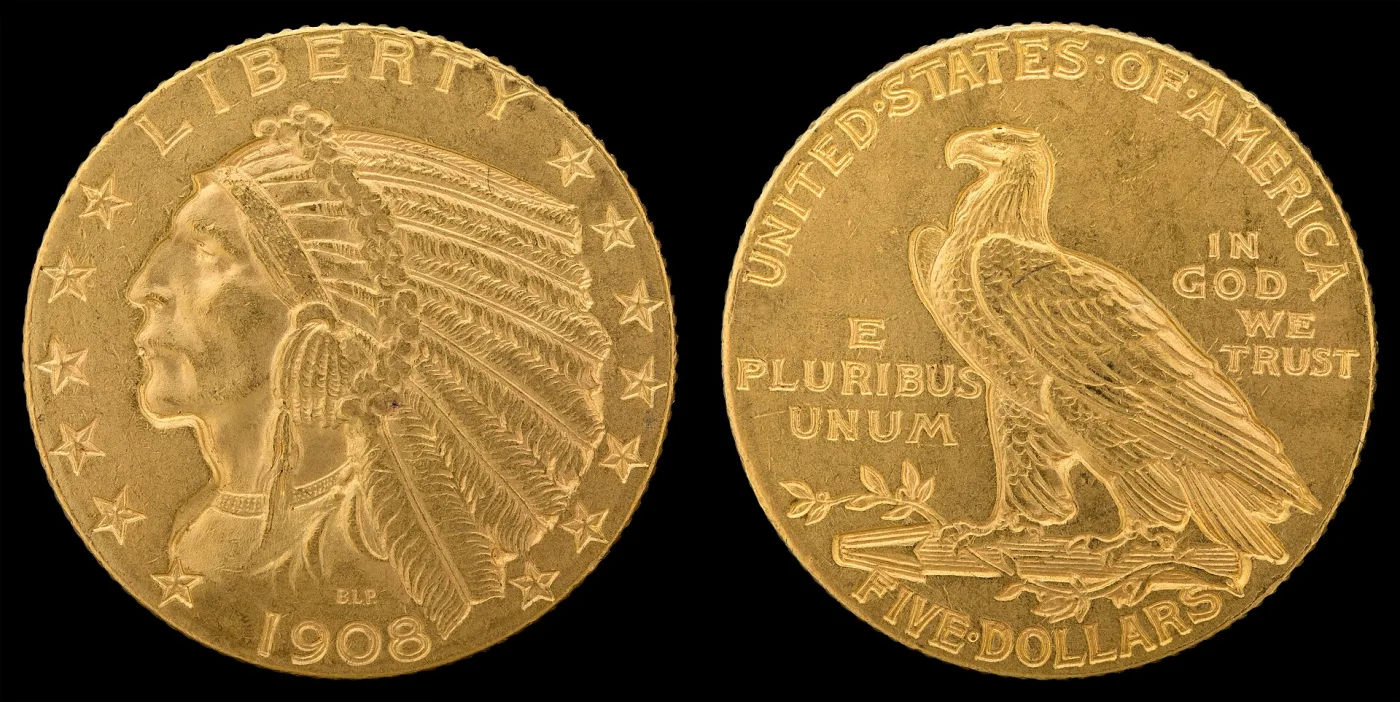
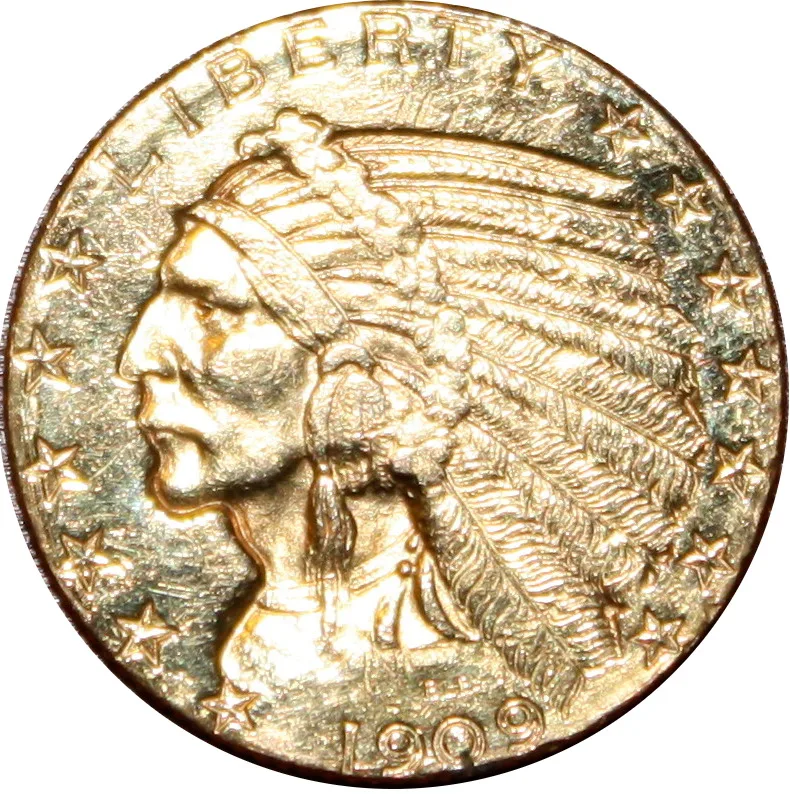
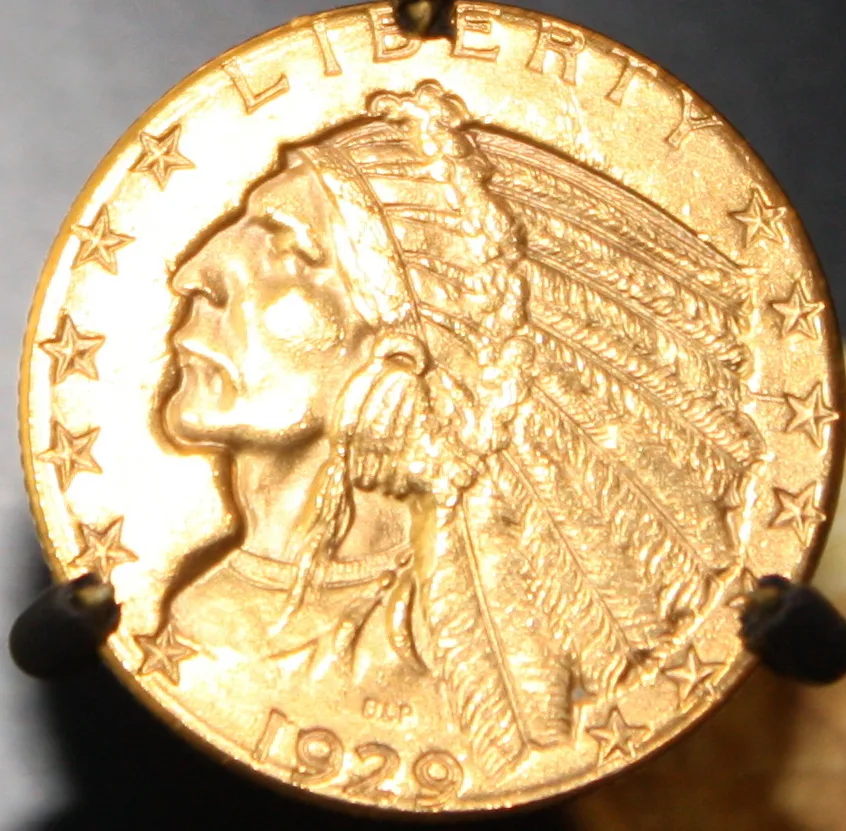
The obverse depicts a Native American chief facing left, wearing a full feathered war bonnet. The portrait is a realistic, sober representation rather than an idealized one — the chief’s face shows defined cheekbones, a strong nose, and weathered character. Above the head, in an arc near the rim, are thirteen stars representing the original colonies (six on the left, seven on the right). Below the chief appears the date. The legend LIBERTY arcs above the headdress in incuse letters. Every element — portrait, stars, lettering, date — is recessed below the high field.
Reverse (Tails Side)
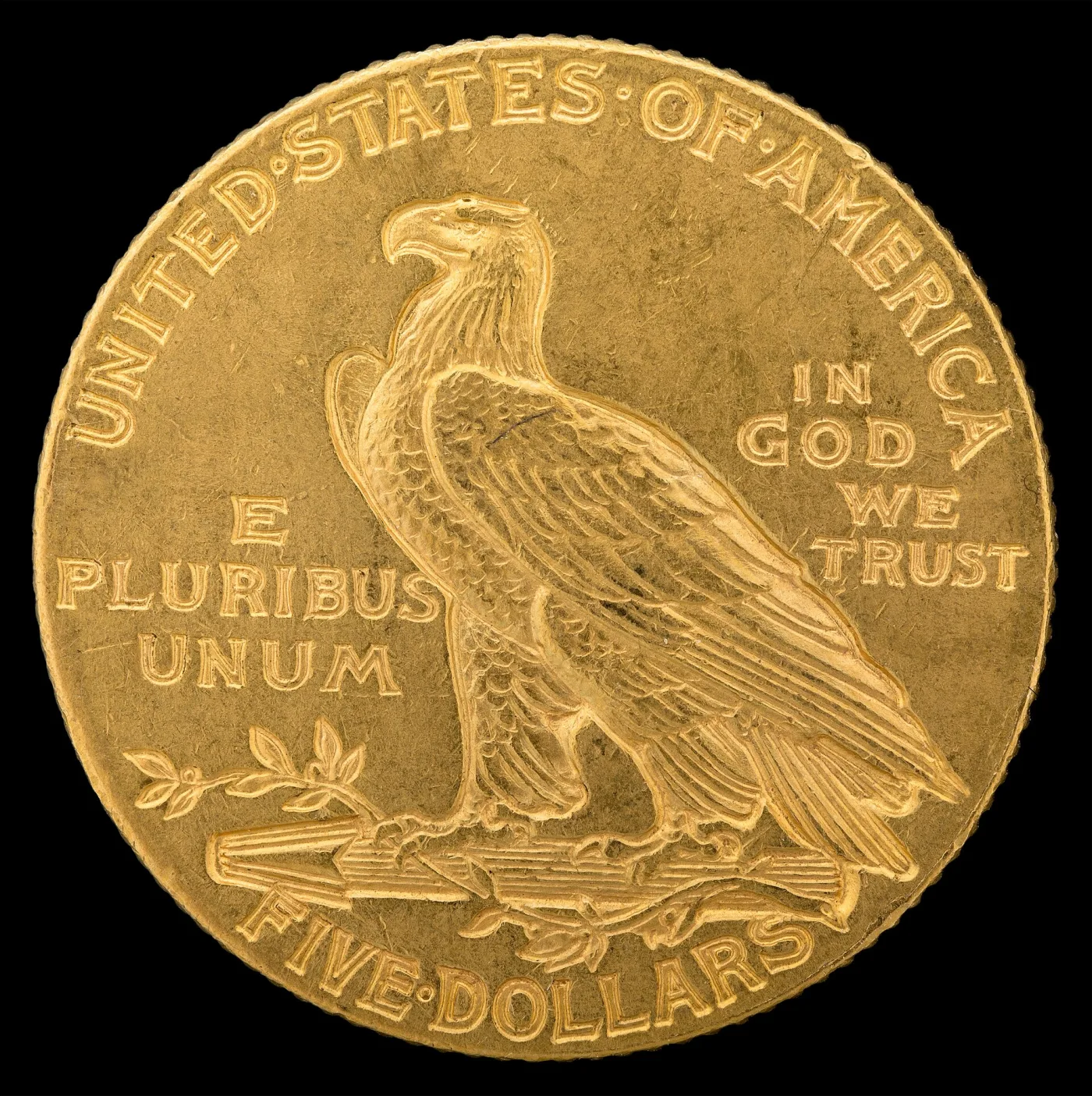
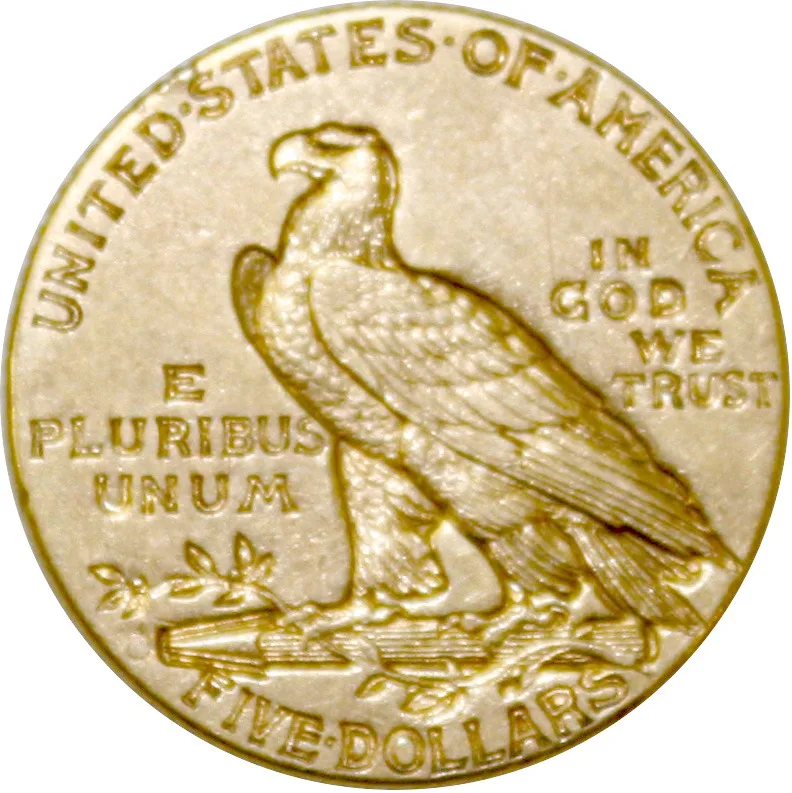
The reverse depicts a standing American eagle with closed wings, in profile facing left, perched on a bundle of arrows wrapped with an olive branch. The legend UNITED STATES OF AMERICA arcs across the top in incuse letters. The denomination FIVE DOLLARS appears at the bottom. The motto E PLURIBUS UNUM appears to the right of the eagle, and IN GOD WE TRUST appears to the left of the eagle in all years (unlike the No Motto / With Motto split that affected the Saint-Gaudens designs in 1907-1908). The eagle composition is broadly similar to the eagle on the Indian Head Eagle, reflecting common iconographic conventions of the Roosevelt-era redesigns — the same olive-branch-and-arrows motif that later anchored the heraldic reverse of the modern American Silver Eagle.
Mint Mark Position
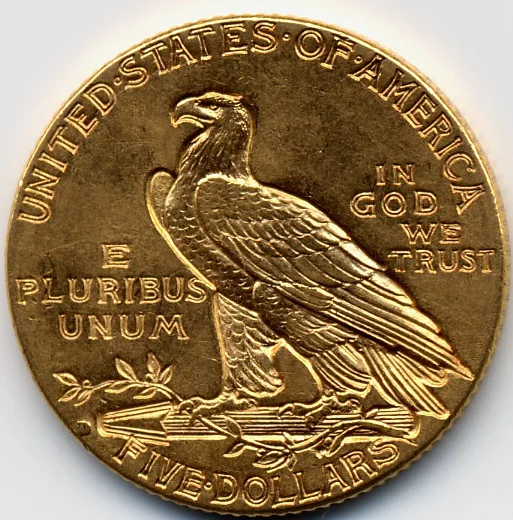
Mint marks (D for Denver, S for San Francisco, O for New Orleans) appear on the reverse to the left of the arrowhead point, low on the left side of the coin. The position is consistent across all branch-mint issues. Philadelphia issues bear no mint mark. The mint mark itself is incused into the die like the rest of the design, but examining its position and style is essential for authentication.
The Unbordered Rim
Unlike conventional US coins which have a raised rim surrounding the design, the Pratt Half Eagle has a flat rim flush with the field. This unbordered edge was another departure from convention and made the coins more susceptible to edge nicks and dings during handling. Examination of rim integrity is part of grading these coins — a clean, undamaged flat rim is a positive signal for high grade.
Edge
The edge of the Indian Head Half Eagle is plain (smooth, with no reeding, lettering, or stars). This is unlike the Indian Head Eagle’s star edge and unlike the reeded edges of most US silver and copper-nickel coinage. The plain edge is itself a diagnostic feature — counterfeits sometimes get this wrong by applying reeding or other edge treatment.
Composition and Specifications
Every Indian Head Half Eagle is struck in 90% gold and 10% copper — the standard US gold alloy used from 1837 through 1933. This is the same alloy used in the Saint-Gaudens Double Eagle, the Indian Head Eagle, the matching Indian Head Quarter Eagle, and the Gold Dollar. The copper component gives the coins their characteristic warm orange-tinted gold color.
Physical Specifications
- Composition: 90% gold, 10% copper
- Total weight: 8.359 grams (129 grains)
- Net gold weight: 7.523 grams (0.24187 troy ounces)
- Diameter: 21.6 millimeters
- Thickness: Approximately 1.6 millimeters
- Edge: Plain (no reeding, lettering, or stars)
- Face value: $5
The 0.24187 troy ounce gold content is the bullion-value floor for every Indian Head Half Eagle. At a 2026 gold spot price of $2,600 per ounce, the melt value is approximately $629. This bullion floor protects collector outlay on common-date examples and ensures that no genuine Indian Head Half Eagle sells for substantially less than its metal value. The smaller gold content compared to the Indian Head Eagle ($1,258 melt at the same gold price) makes the Pratt Half Eagle a more accessible entry point for collectors wanting classic US gold without committing to a full half-ounce of metal.
Why Specifications Matter for Authentication
Weight and diameter are first-line authentication tests. Counterfeits made from gold of incorrect purity, or from gold-plated base metal, will fail one or both. A digital jewelry scale accurate to 0.01 grams is the minimum equipment for serious authentication of any classic gold coin. Counterfeit Indian Head Half Eagles often deviate by tenths of a gram or by a tenth of a millimeter in diameter — small but measurable differences that reveal the fake.
Key Dates and Major Rarities
The Indian Head Half Eagle series is relatively short (1908-1916 and 1929) and contains a manageable number of issues, but several dates command strong premiums due to low mintage, low survival rate, or condition rarity. The same approach to spotting key dates applies whether you’re working through this series, the Buffalo Nickel, or any classic US issue — but the gold recall of 1933 imposed an extra layer of mortality on this series, melting much of the surviving production.
1909-O Indian Head Half Eagle
The 1909-O is the undisputed king of the series — and the only New Orleans Half Eagle of the Indian Head type. The 1909-O had a mintage of 34,200, of which an estimated 5,000-7,000 survive across all grades. The 1909-O is also the last gold coin ever struck at the New Orleans Mint, which closed permanently in 1909. Prices range from $1,500 in VF to $25,000+ in MS-63, with the finest known examples (MS-65 and above) bringing six figures. The 1909-O is essential for any serious collector of the series.
1929 Indian Head Half Eagle
The 1929 had a mintage of 662,000 — the largest single-year mintage of any Pratt Half Eagle — but is one of the great late-series rarities because most were melted under the 1933 gold recall. An estimated 1,000-1,500 examples survive across all grades, virtually all in Mint State (since the 1929 production was never released into general circulation before the recall and was held mostly in bank vaults). Prices range from $25,000 in MS-62 to $80,000-$150,000 in choice MS-64 to MS-65. The 1929 is the second-rarest collectible date in the series.
1911-D Indian Head Half Eagle
The 1911-D had a mintage of just 72,500 — the lowest mintage of any business-strike date in the series excluding the 1909-O. Most surviving examples grade Very Fine to About Uncirculated; Mint State 1911-D coins are particularly scarce. Prices range from $1,000 in VF to $15,000 in MS-63 and $40,000+ in MS-65. The 1911-D shares the distinction of being a key Denver-mint gold coin alongside the 1911-D Indian Head Quarter Eagle.
1909-D Indian Head Half Eagle
The 1909-D had a mintage of 3,423,560 — by far the largest of any Pratt Half Eagle — but is included here as a key variety: certain 1909-D dies show a clear D/D repunched mint mark, where the secondary D appears slightly to the left of the primary D. Normal 1909-D coins are common ($700-$2,000 in MS-63); repunched mint mark examples bring 25-50% premiums.
1909-S Indian Head Half Eagle
The 1909-S had a mintage of 297,200 — moderate by series standards — but most surviving examples are in circulated grades. Mint State coins are scarce. Prices range from $700 in VF to $7,500 in MS-63 and $25,000+ in MS-65.
1908-S Indian Head Half Eagle
The 1908-S had a mintage of just 82,000 — making it a low-mintage key alongside the 1911-D. Most surviving examples grade About Uncirculated to MS-62, with higher Mint State grades quite scarce. Prices range from $1,500 in VF to $12,000 in MS-63 and $35,000+ in MS-65.
1914-S Indian Head Half Eagle
The 1914-S had a mintage of 263,000 and is generally available in circulated grades but a condition rarity in Mint State. MS-63 examples bring $3,500-$5,000 and MS-65 examples bring $20,000+.
1908 No Motto Concept (Does Not Exist)
Unlike the Indian Head Eagle and Saint-Gaudens Double Eagle which exist in No Motto and With Motto types, the Indian Head Half Eagle was designed from the outset with IN GOD WE TRUST on the reverse. No legitimate No Motto variety exists for this series, and any coin offered as such is either a damaged genuine piece or a counterfeit. The 1908 first-year issue carries the motto.
Late-Date Survival Patterns
One key insight for collectors: survival of late-series dates (1913-1916 and especially 1929) skews heavily toward Mint State because production was largely consumed by bank vault storage rather than active circulation. Worn examples of these dates are scarcer than Mint State ones in some grade ranges — an unusual pattern that distinguishes the Pratt Half Eagle from circulated series like the Mercury Dime or Buffalo Nickel where survival skews to circulated grades.
The 1909-O Indian Head Half Eagle
The 1909-O deserves its own section because it is both the major key of the series and the final gold coin ever struck at the historic New Orleans Mint.
The Last New Orleans Gold Coin
The New Orleans Mint, opened in 1838, struck gold and silver coinage for decades and produced some of the most collectible US coins of the 19th and early 20th centuries. By 1909, however, the New Orleans Mint’s role had diminished; the facility was closed permanently in 1909, with the 1909-O Indian Head Half Eagle being the final gold strike before closure. The 1909-O is therefore not just a series key but a historical endpoint — the last “O” mint mark on a US gold coin.
Production and Survival
The 1909-O had a mintage of 34,200, struck early in 1909 before the facility shut down. Surviving population is estimated at 5,000-7,000 across all grades, which is substantial for a key date but very low relative to mintage of other series keys. Most survivors grade in the Extremely Fine to About Uncirculated range — the coins did circulate, but only briefly before being recognized as a key date and removed by collectors. Mint State 1909-O coins are genuinely scarce; MS-63 and higher examples are seriously rare.
Counterfeit Risk
The 1909-O is one of the most heavily counterfeited US gold coins. Common counterfeits include: 1909 (no mint mark) Philadelphia coins with added O mint marks; 1909-D coins altered to look like 1909-O; cast and struck counterfeits in correct-weight gold; and base-metal copies with gold plating. Never purchase a raw 1909-O. Always insist on PCGS or NGC certification from an established dealer or auction house.
Authentication Diagnostics
Genuine 1909-O coins show specific die diagnostics including: the O mint mark with a slight tilt characteristic of the New Orleans dies; particular die-crack patterns on certain die marriages; consistent strike characteristics across the cheek and headdress. Specialists rely on these diagnostics for raw-coin authentication. For most collectors, the safer path is certification.
Recent Auction Performance
Recent realized prices include $1,800-$3,500 for VF-EF examples, $7,500-$15,000 for AU-58 to MS-62 examples, $25,000-$45,000 for MS-63, and $75,000-$150,000+ for choice MS-64 and MS-65. The 1909-O regularly appears at major Heritage Auctions and Stack’s Bowers sales and provides good benchmark pricing.

Mint Marks: Philadelphia, Denver, San Francisco, New Orleans
Indian Head Half Eagles were struck at four United States mints during the 1908-1929 production run. Mint marks appear on the reverse to the left of the eagle, low on the left side of the coin, near the arrowhead point. Mint mark position and style are key authentication diagnostics — counterfeiters frequently add fake mint marks to common Philadelphia coins to manufacture key-date rarities.
Philadelphia Mint (No Mint Mark)
The Philadelphia Mint produced Indian Head Half Eagles in 1908, 1909, 1910, 1911, 1912, 1913, 1914, 1915, and 1929. Philadelphia issues bear no mint mark. Mintages varied widely, from 627,060 in 1908 to 240,000 in 1915 and 662,000 in 1929. Philadelphia issues are the most commonly encountered for most years and provide most type-coin candidates for collectors.
Denver Mint (D Mint Mark)
The Denver Mint struck Indian Head Half Eagles in 1909, 1910, and 1911. The mint mark “D” appears on the reverse to the left of the arrowhead, below the eagle. Denver issues include the very common 1909-D (3.42 million mintage), the moderately scarce 1910-D (193,600 mintage), and the major key 1911-D (just 72,500 mintage). Denver D mint marks are typically small and neatly placed; examine carefully for tooling marks suggesting added mint marks on altered coins.
San Francisco Mint (S Mint Mark)
The San Francisco Mint struck Indian Head Half Eagles in 1908, 1909, 1910, 1911, 1912, 1913, 1914, 1915, and 1916. The mint mark “S” appears in the same position as the D. San Francisco mintages were generally moderate, and S-mint issues from 1913-1916 are condition rarities in Mint State due to limited bank-vault preservation.
New Orleans Mint (O Mint Mark)
The New Orleans Mint produced Indian Head Half Eagles only in 1909 — a single issue, the 1909-O, with a mintage of 34,200. The mint mark “O” appears in the standard reverse position. The 1909-O is the only New Orleans Indian Head Half Eagle and the final gold coin from the New Orleans Mint. Authentication of 1909-O coins requires particular care given the prevalence of altered Philadelphia and Denver coins masquerading as the New Orleans issue.
Mint Mark Position and Authentication
- Position: Reverse, to the left of the arrowhead point, low on the left side of the coin
- Style: Small incused letters cut into the working die
- Depth: Mint marks should show the same incuse depth as surrounding lettering — added mint marks often show inconsistent depth or surface disturbance
- Critical for 1909-O: Verify under 10x magnification and prefer PCGS/NGC certified examples
Doubled Dies and Notable Varieties
Beyond the major date and mint mark distinctions, the Indian Head Half Eagle series hosts several die varieties that specialists pursue. None match the price impact of the 1955 Lincoln Doubled Die or the 1937-D Three-Legged Buffalo, but several add meaningful premiums for cherrypickers.
1909-D / 1909-D Repunched Mint Mark
The 1909-D D/D repunched mint mark is the most famous variety in the series. The secondary D mint mark appears as a shadow slightly to the left of the primary D — visible under 10x magnification. This variety adds 25-50% premiums over normal 1909-D coins in equivalent grades. The variety is listed in the Cherrypickers’ Guide with an FS attribution.
1908-D / 1908-D Repunched Mint Mark
Note: 1908-D Indian Head Half Eagles do not exist — Denver did not strike Pratt $5 coins in 1908. Coins sold as “1908-D Indian Head Half Eagle” are either misidentified Liberty Head Half Eagles (which Denver did strike in 1908) or outright counterfeits. This is a common identification pitfall worth knowing.
1911-S / 1911-S Repunched Mint Mark
Certain 1911-S dies show a repunched S mint mark with the secondary S faintly visible below the primary. The variety is uncommon and adds modest premiums for series specialists.
Die Crack Varieties
Several dates show notable die cracks that specialists collect — particularly through portions of LIBERTY on the obverse and through the eagle’s wing on the reverse. These die-state varieties add minor premiums for collectors building die-state runs.
Matte Proofs
The Mint produced matte proofs of the Indian Head Half Eagle in 1908, 1909, 1910, and 1911. Matte proof coins were struck on specially prepared planchets with sandblasted dies, producing a distinctive grainy surface very different from circulation strikes. Mintages were tiny — generally 50-250 coins per year — and surviving populations are correspondingly small. Matte proof Half Eagles command substantial premiums; 1908 examples bring $25,000-$50,000+ in problem-free condition. Authentication is particularly challenging because matte proofs lack the cartwheel luster of business strikes; certified examples are the only safe purchase.
Cherrypicker Tips
- Use a 10x loupe on every mint mark for repunching, doubling, or signs of tooling/addition
- Examine the date numerals on every coin for doubled die obverse
- Check matte proof candidates carefully: grainy uniform texture across both sides, sharp design definition, no cartwheel luster
- Reject any “1908-D” Indian Head Half Eagle — these don’t exist
- Reference the Cherrypickers’ Guide for current variety attribution and FS numbers
Grading Incuse Half Eagles
Grading Indian Head Half Eagles is genuinely harder than grading conventional raised-relief coinage because the incuse design changes how wear appears. The same fundamental grading approach applies — examine high points, assess luster, count bag marks, evaluate eye appeal — but the high points are inverted (the flat field is high) and the wear patterns are unusual.
The Incuse Wear Pattern
On a conventional coin, wear appears first on the highest raised points of the design — the cheekbone on a portrait, the eagle’s breast on a reverse. On the incuse Pratt Half Eagle, those features are recessed and protected; wear instead appears on the high flat field of the coin. As the field wears, the apparent depth of the design decreases, and the portrait gradually loses definition not because it has worn down but because the surrounding metal has worn away from above it.
What to Look For
- Cheekbone of the chief: Although technically recessed, the cheekbone area shows wear as the surrounding field flattens — examine for loss of definition
- Headdress feathers: Individual feather details lose sharpness as wear progresses
- LIBERTY arc: Letters show loss of definition with circulation
- Field surfaces: Original mint luster persists on uncirculated coins; wear flattens the field’s reflective properties
- Eagle’s wing and breast: Reverse high points (the feather detail) show wear in parallel with obverse
- Rim integrity: The unbordered rim shows nicks and dings readily; clean rims signal high grade
Circulated Grades
- Very Fine-20: Major design elements clearly visible but with substantial loss of detail; field shows even wear; portrait recognizable but flat
- Extremely Fine-40: Most design detail intact; light wear visible across the field; feather details mostly preserved
- About Uncirculated-50 to 58: Trace wear on the cheekbone area and feather tips; nearly full original luster on most surfaces
Mint State Grading
Mint State Indian Head Half Eagles are particularly tricky to grade because the incuse field gathers bag marks immediately and the unbordered rim is exposed to edge damage. Marks read more harshly on this series than on raised-relief coins because the eye expects to see a clean field but instead encounters scattered contact marks.
- MS-60 to MS-62: No wear, but heavy field marks; subdued luster; the entry level for Mint State
- MS-63: Moderate field marks; reasonable luster; the most common Mint State grade
- MS-64: Lighter field marks; good luster; meaningful price step
- MS-65: Light marks only; full booming luster; strong eye appeal — major price step
- MS-66: Exceptional preservation; minimal marks; superb luster — populations under 100 coins for most dates
- MS-67 and above: Genuinely rare; many issues have populations under 10 coins at this level
Strike and Luster
Strike sharpness on Pratt Half Eagles is generally excellent — the smaller diameter and the incuse design make full strikes the norm. Luster varies by mint: Philadelphia coins typically show satin to slightly frosty luster; San Francisco coins often show booming cartwheel luster comparable to better Morgan Dollar strikes; Denver coins fall between. The 1909-O shows distinctive satin luster typical of New Orleans gold production.
Authentication and Spotting Counterfeits
Indian Head Half Eagles are among the most counterfeited US gold coins, especially the 1909-O. The combination of strong collector demand, substantial gold value, and an unusual incuse design that complicates visual evaluation creates ideal conditions for fakes. The same authentication discipline as for other classic gold series applies, with several Pratt-specific diagnostics layered on top.
Weight, Diameter, and Specific Gravity
- Weight: Genuine coins weigh 8.359 grams. Counterfeits made from lower-purity gold or base metals deviate measurably. A digital jewelry scale accurate to 0.01 grams is the minimum tool.
- Diameter: Genuine coins measure 21.6 millimeters. Counterfeits sometimes vary by tenths of a millimeter.
- Specific gravity: Pure 90% gold has specific gravity of approximately 17.16. Lower-purity counterfeits test outside this range. Specific gravity testing is a definitive non-destructive authentication method.
- Edge: Plain (smooth) edge with no reeding, stars, or lettering. Reeded-edge counterfeits are common from less skilled forgers.
Incuse-Specific Diagnostics
Beyond standard authentication, several diagnostics apply only to incuse coinage:
- Depth uniformity: All incuse elements (portrait, lettering, mint mark) should show consistent recession below the field. Inconsistent depth suggests tooling or alteration.
- Field surface: The high field should show consistent original surface texture across the entire coin. Patches of altered texture suggest tooling.
- Mint mark integration: The mint mark should show the same depth and edge sharpness as surrounding incuse design. Added mint marks show different surface characteristics.
- Rim sharpness: The unbordered rim should be cleanly defined, perpendicular to the face. Soft or rounded rims suggest cast counterfeits.
Counterfeit Categories
- Cast counterfeits: Detectable by pebbly surfaces, soft details, and incorrect weight. Common but easily detected.
- Struck counterfeits in base metal with gold plating: Detectable by specific gravity and edge examination. Tungsten-core gold-plated fakes are the most dangerous of this category.
- Struck counterfeits in correct-purity gold: The hardest type. Detection requires die diagnostic comparison against authentic examples.
- Altered date or mint mark on genuine coin: 1909 Philadelphia altered to 1909-O is the classic example. Examine under 10x magnification for tool marks around mint mark.
- Tooled or repaired coins: Genuine coins with detail re-engraved to upgrade apparent grade. The flat field of incuse coinage actually makes tooling somewhat harder to hide here than on raised-relief coins.
Cleaned and Polished Coins
Cleaning is a major issue for Indian Head Half Eagles because the smooth high field is easy to polish and the resulting unnatural shine is easy to confuse with mint luster. Detection points include: unnatural reflective sheen on the field; hairline scratches under angled light; orange-pinkish color from acid dipping. Cleaned coins receive “Details” grades from PCGS and NGC and lose 30-50% of value compared to original-surface coins.
Using Third-Party Grading
For any Indian Head Half Eagle — and especially for the 1909-O, 1911-D, 1929, and any matte proof — strongly consider purchasing already-certified examples from PCGS or NGC. The certification fee is small relative to the dollar amounts involved. Established auction houses including Heritage Auctions, Stack’s Bowers, Legend Numismatics, and GreatCollections are the safest sources for higher-value pieces.
Bullion Value vs. Numismatic Premium
Indian Head Half Eagles occupy an attractive position in coin collecting because they carry both meaningful bullion value and meaningful numismatic premiums, with a smaller intrinsic gold content than the larger denominations that makes entry points genuinely accessible.
The Bullion Floor
Each coin contains 0.24187 troy ounces of pure gold. At any given gold spot price, the bullion melt value is roughly: (gold spot price per ounce) × 0.24187. At $2,600 per ounce — a representative 2026 figure — the melt value is approximately $629. No genuine Indian Head Half Eagle sells for less than its melt value, because anyone willing to destroy the coin can recover that amount from a refiner.
Common-Date Premiums
For common dates in lower grades — typical 1908, 1909, 1910, 1912, 1913 Philadelphia coins in About Uncirculated to MS-62 condition — the typical retail premium over melt is 20-60%. Buying a common-date Pratt Half Eagle at this level provides classic US gold ownership in collectible form with a small premium for the design and historical interest.
Numismatic Premiums
For better dates, higher grades, and key issues, premiums over melt rise dramatically. A common-date MS-65 Indian Head Half Eagle might bring 8-15x melt; a 1911-D MS-63 might bring 25x melt; a 1909-O in any grade brings 5-200x melt; and the 1929 brings 50-200x melt. The relationship between grade, date, and premium rewards specialist knowledge.
Practical Buying Guidance
- If you want gold exposure: Buy common-date AU-58 to MS-62 Indian Head Half Eagles at minimal premium over melt
- If you want collectible gold: Step up to MS-63 to MS-65 common dates for moderate numismatic premium
- If you want true rarity: Pursue the 1909-O, 1911-D, 1929, and high-grade S-mint dates
- If you want a matched gold pair: Collect alongside the matching Indian Head Quarter Eagle — together they form the only incuse pair
- Avoid the middle ground unwisely: Cleaned or damaged coins trade close to bullion regardless of date
Current Market Values and Price Guide
Indian Head Half Eagle values range from low hundreds for common-date circulated examples to six figures for choice 1909-O, 1929, and 1911-D examples. The prices below reflect approximate retail values as of 2026 for problem-free, original-surface coins, assuming a gold spot price of approximately $2,600 per ounce. Cleaned, damaged, or altered examples are worth substantially less, and certified premium-grade coins regularly bring prices well above these ranges.
Common Dates (Philadelphia 1908-1915 except keys)
- Very Fine-20: $650–$720 (essentially melt)
- Extremely Fine-40: $700–$800
- About Uncirculated-58: $800–$1,000
- MS-62: $1,000–$1,500
- MS-63: $1,500–$2,200
- MS-64: $2,500–$4,500
- MS-65: $7,500–$15,000
- MS-66: $25,000–$50,000+
Type Coins
- 1908 first-year (MS-63): $1,500–$2,200
- 1908 first-year (MS-65): $7,500–$12,000
- 1908 Matte Proof: $25,000–$50,000+
- 1909 (MS-63): $1,500–$2,200
- 1929 last-year (any MS grade): $25,000–$150,000
Key Dates and Major Rarities
- 1909-O (VF-20): $1,500–$2,000
- 1909-O (AU-58): $7,500–$12,000
- 1909-O (MS-63): $25,000–$40,000
- 1909-O (MS-65): $100,000–$200,000+
- 1909-S (MS-63): $5,500–$8,000
- 1909-D/D RPM (MS-63): $1,000–$2,000
- 1911-D (VF-20): $1,000–$1,400
- 1911-D (MS-63): $12,000–$18,000
- 1911-D (MS-65): $40,000–$80,000
- 1908-S (MS-63): $9,000–$13,000
- 1914-S (MS-63): $3,500–$5,500
- 1929 (MS-62): $25,000–$35,000
- 1929 (MS-64): $55,000–$80,000
- 1929 (MS-65): $100,000–$150,000+
Note: These are retail price estimates. Actual sale prices at auction vary based on eye appeal, certification, surface originality, gold spot price at sale time, and current market demand. For important purchases, reference recent auction archives from Heritage Auctions, Stack’s Bowers, and Legend Numismatics alongside standard price guides like the PCGS Price Guide and the NGC Price Guide.
Building an Indian Head Half Eagle Collection
The Indian Head Half Eagle series offers entry points at multiple budget levels and several attractive collection structures. The series is shorter than most US classic series — only 24 distinct date/mint combinations — making complete date sets achievable for committed collectors.
Single Type Coin
The simplest collection is a single common-date Mint State example, often dated 1908, 1909, 1910, 1912, or 1913. Choice MS-63 to MS-65 examples are widely available for $1,500-$15,000, providing a stunning specimen of the only incuse US circulating gold coin. A single Indian Head Half Eagle conveys the entire artistic concept of the series.
Matched Incuse Pair
Many collectors pair an Indian Head Half Eagle with its smaller companion the Indian Head Quarter Eagle to form a complete representation of Pratt’s incuse design across both denominations. A matched MS-63 pair runs $2,500-$4,000 and provides an elegant two-coin set covering the only incuse US coinage.
Date Set Excluding Major Rarities
A date set excluding the 1909-O, 1911-D, and 1929 is achievable in MS-63 condition for $25,000-$45,000. Adding the 1911-D pushes the total past $50,000. Adding the 1909-O depends entirely on grade chosen — an AU-58 1909-O might add $10,000, while an MS-63 adds $30,000+. Adding the 1929 adds $25,000-$80,000+ depending on grade. The complete date set in choice Mint State requires a six-figure budget.
Mint Mark Set
A mint mark set covers one example from each mint that produced Pratt Half Eagles: Philadelphia (no mint mark), Denver (D), San Francisco (S), and New Orleans (O — only 1909-O). Achievable for $15,000-$30,000 in choice Mint State by selecting common dates from each branch mint. The 1909-O is essential for the mint mark approach.
Specialty Approaches
- High-grade type: MS-66 and MS-67 examples of common dates — visually stunning but expensive
- Matte proof set: One example each of 1908, 1909, 1910, and 1911 matte proofs — a serious budget commitment at $100,000+
- San Francisco set: One example from each S-mint year — manageable in circulated grades
- Variety set: 1909-D RPM, 1911-S RPM, major die crack varieties
- Bullion-collector hybrid: One AU-58 to MS-62 example per year, ignoring rarities
Practical Tips
- Buy certified for everything: Even common dates merit PCGS or NGC certification
- Original surfaces command premiums: Cleaned coins are heavily discounted; the incuse field is especially vulnerable to polishing
- Verify 1909-O carefully: Never purchase raw 1909-O coins; this is the most counterfeited issue
- Patience pays: The 1929 appears at auction only a few times per year
- Track gold spot: The bullion floor moves with gold prices, affecting common-date values directly
- Coordinate with companion series: Many collectors pair Pratt $5 collecting with the matching Quarter Eagle and the contemporary Indian Head Eagle
Storage and Preservation
Proper storage maintains the value and visual appeal of your collection. Although gold is far more chemically stable than silver — Indian Head Half Eagles do not tarnish or develop the toning that affects Morgan Dollars — the soft gold-copper alloy is susceptible to scratches, contact marks, and edge damage. The unbordered flat rim is particularly vulnerable.
What to Avoid
- Loose storage: Coins clinking against each other produce immediate field marks. Always store individually.
- PVC holders: Older soft plastic flips and some envelopes contain PVC, which outgasses and produces residue. Less harmful to gold than to silver, but still avoid.
- Direct handling: Skin oils etch gold over time; always handle by edges or wear cotton gloves
- Cleaning attempts: Even gentle cleaning leaves microscopic hairlines that grading services detect — never clean an Indian Head Half Eagle
- Pressure on flat rim: The unbordered rim takes damage easily; avoid stacking coins or applying any pressure to the edge
Recommended Storage
- PCGS or NGC slabs: Inert plastic holders providing excellent protection and authentication — strongly recommended
- Air-Tite holders: $5 gold-sized direct-fit capsules; safe for individual coins
- Non-PVC flips: Mylar or polyethylene flips for short-term storage
- Quality albums: Capital Plastics or Dansco gold-coin albums; ensure pages are PVC-free
- Bank safe deposit box: Recommended for high-value collections
- Climate-controlled storage: Stable temperature and low humidity for long-term care
Handling
Always handle Indian Head Half Eagles by their edges. The flat field shows fingerprints readily, and oils from skin will eventually etch the surface. Cotton gloves are appropriate for high-value coins. Never clean an Indian Head Half Eagle — virtually any cleaning reduces value, and cleaned coins are easily detected by experienced graders. If a coin appears to need conservation, consult a professional service like NCS (Numismatic Conservation Services) rather than attempting it yourself.
Frequently Asked Questions
What is an Indian Head Half Eagle and when was it made?
The Indian Head Half Eagle is a 90% gold $5 United States coin produced from 1908 through 1929. Designed by Boston sculptor Bela Lyon Pratt at the request of President Theodore Roosevelt, it features a Native American chief in a feathered war bonnet on the obverse and a standing eagle on the reverse. Its defining feature is the incuse design — the imagery is sunken below the field rather than raised above it, making the Pratt Half Eagle (along with the matching $2.50 Quarter Eagle) the only incuse circulating coinage in US history.
What does "incuse" mean on a coin?
Incuse means the design is sunken into the coin's surface rather than raised above it. On a conventional coin like a Morgan Dollar, you can feel the raised portrait with your fingernail; on an incuse coin like the Pratt Half Eagle, your fingernail glides smoothly across the high flat field and dips into the recessed design. Incuse was inspired by ancient Egyptian and Greek sunken-relief techniques and was championed by Boston physician William Sturgis Bigelow, who suggested sculptor Bela Lyon Pratt for the commission.
What is the rarest Indian Head Half Eagle?
The 1909-O Indian Head Half Eagle is the rarest collectible date in the series and the last gold coin struck at the New Orleans Mint. Mintage was 34,200 with an estimated 5,000-7,000 survivors. Prices range from $1,500 in low circulated grades to $200,000+ for choice MS-65 examples. The 1929 is the second-rarest, with about 1,000-1,500 survivors from a 662,000 mintage — most were melted under the 1933 gold recall. The 1911-D (mintage 72,500) is the third major key.
How much gold is in an Indian Head Half Eagle?
Each Indian Head Half Eagle contains 0.24187 troy ounces of pure gold (7.523 grams) within its 8.359-gram total weight. The composition is 90% gold and 10% copper, the standard US gold alloy used from 1837 through 1933. At a gold spot price of $2,600 per ounce, the bullion melt value is approximately $629, which serves as a price floor for any genuine example.
How do I tell a Pratt Half Eagle from an Indian Head Eagle?
The Indian Head Half Eagle ($5, designed by Pratt) and the Indian Head Eagle ($10, designed by Saint-Gaudens) are frequently confused because both feature Native American imagery from the Roosevelt era. The key differences: (1) the $5 Pratt design is incuse (sunken into the field), while the $10 Saint-Gaudens design is raised relief; (2) the $5 depicts a male Native American chief in a war bonnet, while the $10 depicts a feminine head of Liberty wearing an Indian headdress; (3) the $5 is smaller (21.6 mm vs 27.0 mm); (4) the $5 has a plain edge, while the $10 has stars on the edge.
Why does the 1909-O matter so much?
The 1909-O is both a major series key (mintage 34,200) and a historical endpoint — the last gold coin ever struck at the New Orleans Mint, which closed permanently in 1909. This dual significance creates strong collector demand. Combined with widespread counterfeiting (1909 Philadelphia coins are routinely altered to look like 1909-O coins), the 1909-O commands substantial premiums and requires PCGS or NGC certification for safe purchase.
Are there No Motto Pratt Half Eagles like the Saint-Gaudens issues?
No. Unlike the Indian Head Eagle and Saint-Gaudens Double Eagle, which exist in No Motto (1907) and With Motto (1908+) types, the Indian Head Half Eagle was designed from the outset with IN GOD WE TRUST on the reverse. All Pratt Half Eagles from 1908 through 1929 bear the motto. Any coin offered as a "No Motto Pratt Half Eagle" is either damaged, altered, or counterfeit.
Why is the 1929 so scarce despite a 662,000 mintage?
Most 1929 Indian Head Half Eagles never entered general circulation. Production occurred in 1929 but the coins were largely held in bank vaults rather than released. After Executive Order 6102 required surrender of most gold in 1933, virtually all stored 1929 Half Eagles were melted, leaving only about 1,000-1,500 survivors. Surviving examples are almost exclusively in Mint State because they came from vault storage rather than circulation — a survival pattern very different from earlier dates in the series.
How do I know if my Indian Head Half Eagle is real?
Authentic coins weigh 8.359 grams with a 21.6-millimeter diameter and a plain (smooth) edge. The design must be properly incuse with uniform depth across all elements. The most reliable authentication is third-party certification by PCGS or NGC. For valuable examples (any 1909-O, 1911-D, 1929, or matte proof), only purchase certified coins from established auction houses. Counterfeits range from crude cast pieces to sophisticated struck copies with correct weight and metal content but unauthorized dies.
Can I clean my Indian Head Half Eagle?
No — cleaning reduces value substantially even on gold coins. The flat field of the incuse design is particularly vulnerable to polishing, which produces an unnatural reflective sheen easily detected by experienced graders. Cleaned coins receive "Details" grades from PCGS and NGC and lose 30-50% of value compared to problem-free original surfaces. If a coin truly needs conservation, use a professional service like NCS rather than attempting it yourself.
Is an Indian Head Half Eagle a good investment?
Indian Head Half Eagles offer dual appreciation potential: gold bullion value and numismatic collector value. Common dates track gold prices closely with a modest premium; key dates and high-grade examples have appreciated substantially over decades regardless of gold spot. The series benefits from genuine rarity (1933 gold-recall meltings), strong artistic interest (the only incuse US circulating coinage), and limited new supply. The smaller bullion content compared to the $10 and $20 gold coins makes entry points accessible. As with any collectible, collect for enjoyment first and treat investment returns as a bonus.