Seated Liberty Half Dollar Identification Guide: Types, Key Dates, and Values
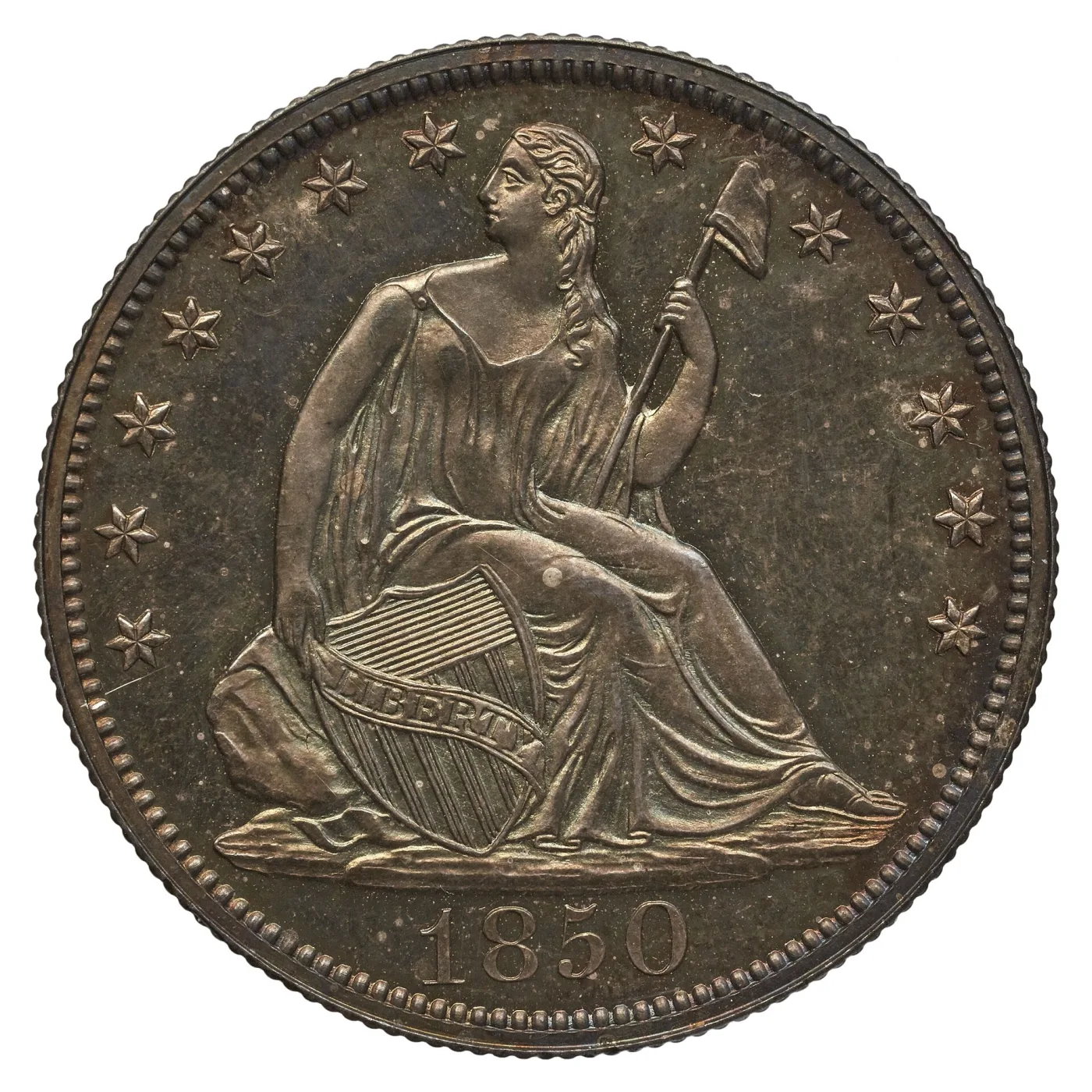
The Seated Liberty Half Dollar — produced from 1839 through 1891 — spans more than half a century of dramatic American history, from the Panic of 1837 through the Civil War, the silver crisis of the 1870s, and into the closing years of the 19th century. Designed by Christian Gobrecht and modeled on his Seated Liberty Dollar of 1836, this half dollar is one of the most type-rich classic American coins: across 53 years of production it took on six identifiable major sub-types (No Drapery, Drapery, Arrows and Rays, Arrows, With Motto, and the final no-arrows With Motto continuation), passed through five different mints (Philadelphia, New Orleans, San Francisco, Carson City, and briefly the unofficial branch operations), and produced legendary rarities like the 1878-S and 1873-CC No Arrows that today bring six-figure prices.
What makes Seated Liberty Halves so collectable is the combination of approachability and depth. Common dates in well-circulated condition trade for $30-$60, putting an authentic 19th-century US silver coin within reach of any collector. At the same time, the series contains absolute rarities, branch-mint condition keys, and dozens of die varieties (Wiley-Bugert numbers, repunched dates, doubled dies) that occupy specialists for a lifetime. Carson City Seated Halves carry the romance of the silver-frontier West, and the 1853 Arrows-and-Rays is one of the most visually distinctive single-year designs in all of American coinage.
This guide covers everything you need to identify, attribute, grade, and value Seated Liberty Halves: Christian Gobrecht’s design lineage, the six major sub-types and how to tell them apart at a glance, mint marks and the famous Carson City branch, the legendary 1853 weight-reduction Arrows and Rays issue, the With Motto transition of 1866, every key date from 1839-O No Drapery through the 1878-S finale, the Wiley-Bugert variety system, grading by Liberty’s gown and shield detail, authentication strategies, current market values, and practical collecting paths. The same fundamental coin identification techniques that apply to other classic US silver series apply here, with several Seated-Liberty-specific quirks you must know.
History: Gobrecht’s Seated Liberty Across Six Decades
The Seated Liberty Half Dollar arrived in 1839 to replace the long-running Capped Bust Half Dollar, which had served the country since 1807. The transition was part of a broader Mint program under Chief Engraver Christian Gobrecht to unify the design language of US silver coinage. Gobrecht had introduced the Seated Liberty motif on the silver dollar in 1836, and over the next several years it propagated to the half dime, dime, quarter, and finally the half dollar. By the early 1840s, every US silver denomination from 5 cents to 100 cents wore essentially the same Liberty figure — a visual coherence the Mint had never before achieved.
The half dollar’s 53-year run was anything but quiet. Production swelled before the Civil War as silver coinage circulated heavily across an expanding nation, then collapsed during the war as silver coins were hoarded and disappeared from circulation entirely in many regions. The Mint Act of 1853 reduced the silver weight of subsidiary coinage to keep silver coins from being exported as bullion — producing the famous Arrows and Rays one-year type. The Coinage Act of 1873 added the motto IN GOD WE TRUST and made minor adjustments to weight, producing the brief 1873-1874 Arrows sub-type, and two years later Congress authorized the ill-fated Twenty Cent Piece that was rejected by the public almost as quickly as it appeared. Production declined in the 1880s as the Bland-Allison Act diverted Mint silver to the new Morgan Dollar program, leaving many late-date Seated Halves with surprisingly low mintages. The series ended in 1891 and was replaced in 1892 by the Barber Half Dollar.
The Designer: Christian Gobrecht
Christian Gobrecht (1785-1844) was a Pennsylvania-born engraver who became Chief Engraver of the US Mint in 1840 after years as Assistant Engraver. His Seated Liberty design — a full-figure allegorical Liberty seated on a rock, steadying a Union shield with her right hand and holding a pole topped with a Phrygian liberty cap in her left — drew from neoclassical and British coinage traditions, particularly the figure of Britannia. The design first appeared on the 1836 Gobrecht Dollar pattern series and the limited 1836-1839 Gobrecht Dollar issues, then propagated outward to every silver denomination. Gobrecht died in 1844, only five years into the half dollar series, but his Liberty figure remained essentially unchanged through 1891 — a 55-year design run that no other US engraver would match.
The half dollar specifically inherited Gobrecht’s lineage from the Seated Liberty Dollar. The two coins share the same Liberty figure, the same heraldic eagle reverse, and the same evolutionary history — both received the With Motto modification in 1866, both saw arrows-at-date weight markers, and both featured prominently in the Carson City branch mint program of the 1870s.
Design: Liberty Seated on a Rock
Knowing every element of the Seated Liberty design is essential for accurate grading, sub-type identification, and authentication.
Obverse (Heads Side)
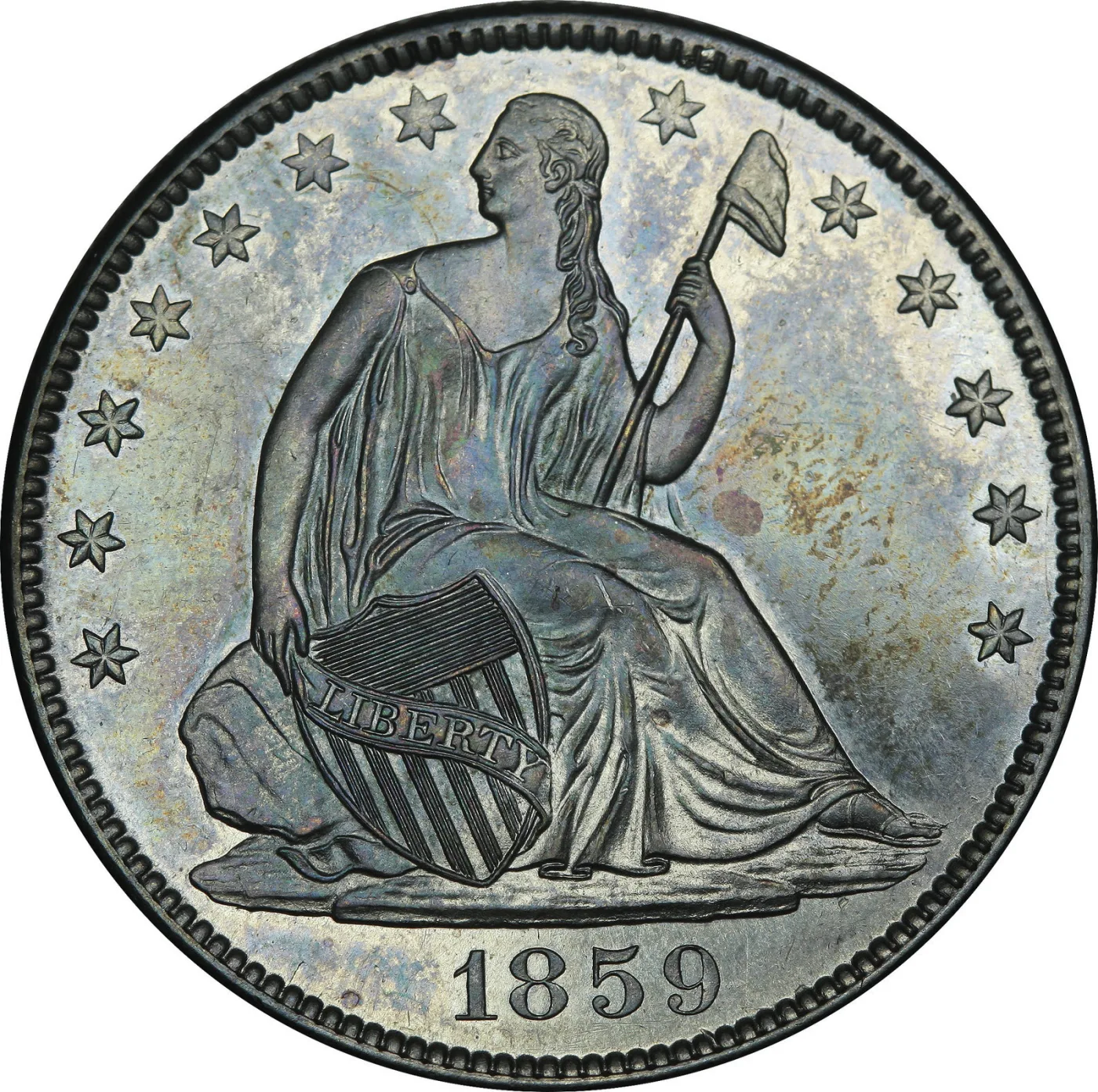
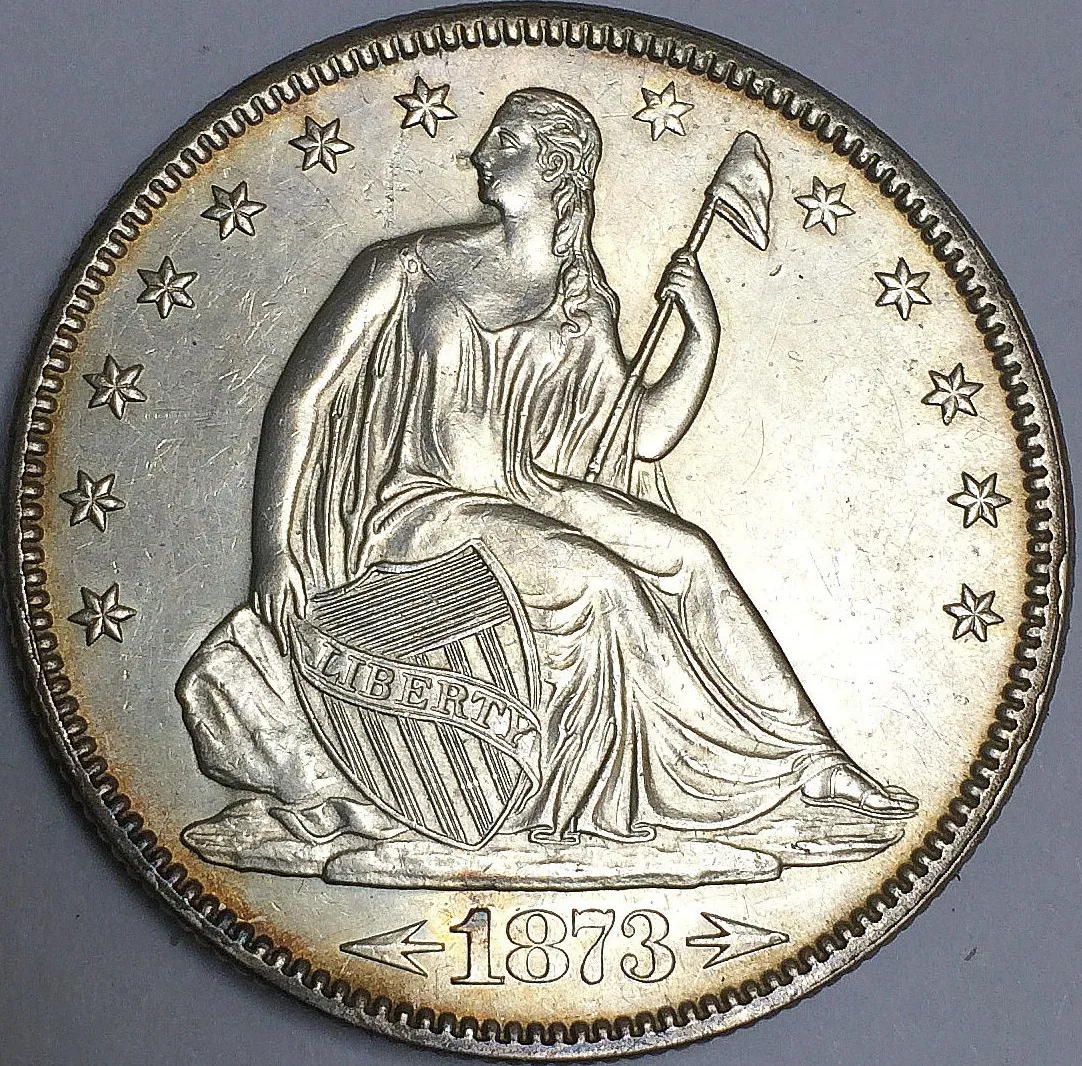
The obverse depicts Liberty seated on a rock, her head turned in profile to the viewer’s left and her body three-quarters toward the viewer. She wears a flowing classical gown. Her right hand rests on a Union shield bearing the inscription LIBERTY on a ribbon across the top of the shield. Her left hand holds a pole topped with a Phrygian liberty cap (the cap on a pole is an ancient Roman symbol of manumitted slaves, adopted as a republican symbol). Thirteen six-pointed stars surround Liberty for the original colonies, present from the first year of the series in 1839. The date appears in the exergue beneath the rock.
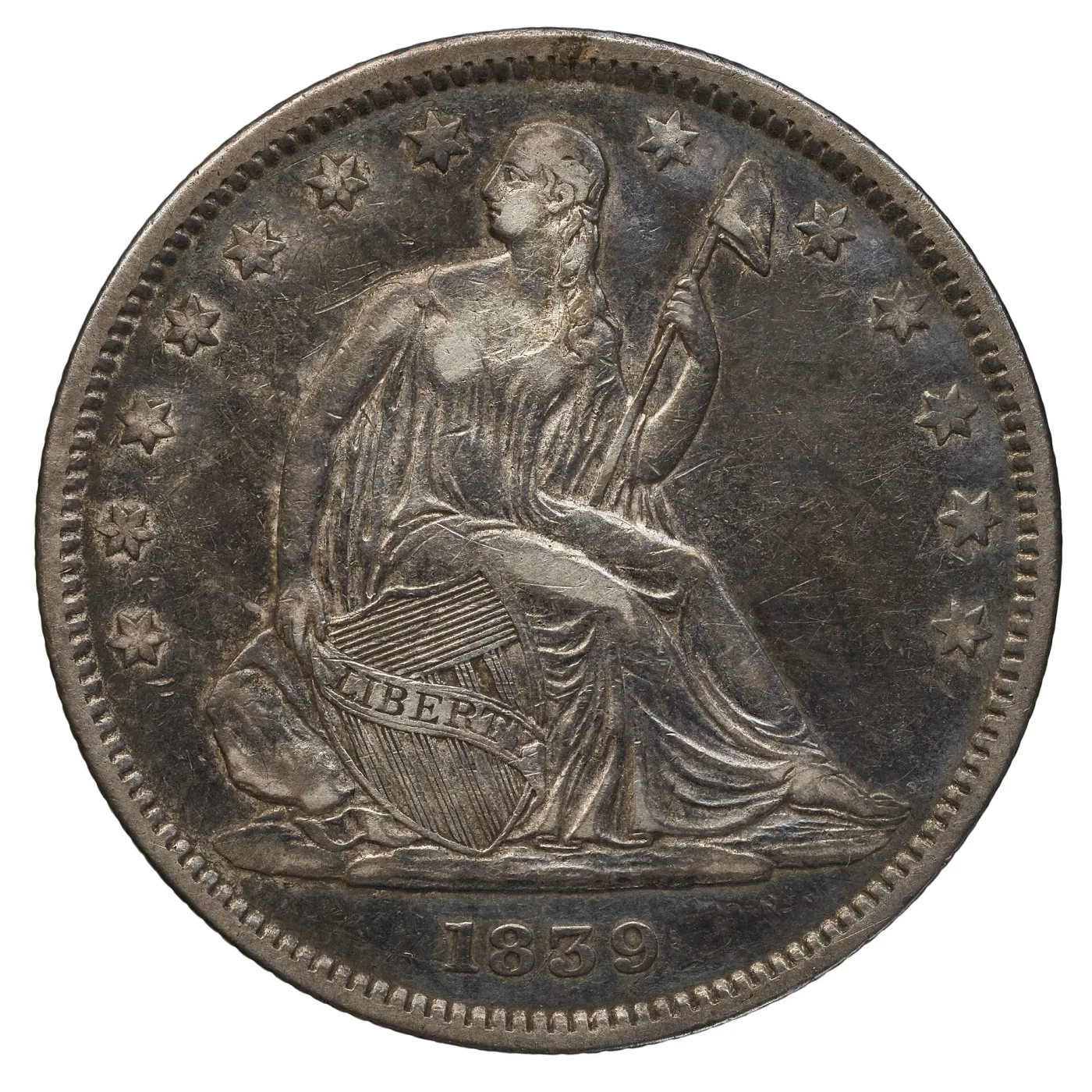
Critical sub-type-defining details on the obverse: the presence or absence of drapery from Liberty’s elbow (No Drapery 1839 only vs Drapery 1839+), arrows beside the date (1853 only with rays, 1854-1855 without rays, 1873-1874 second arrows), and the rays around the eagle on the reverse (1853 only).
Reverse (Tails Side)
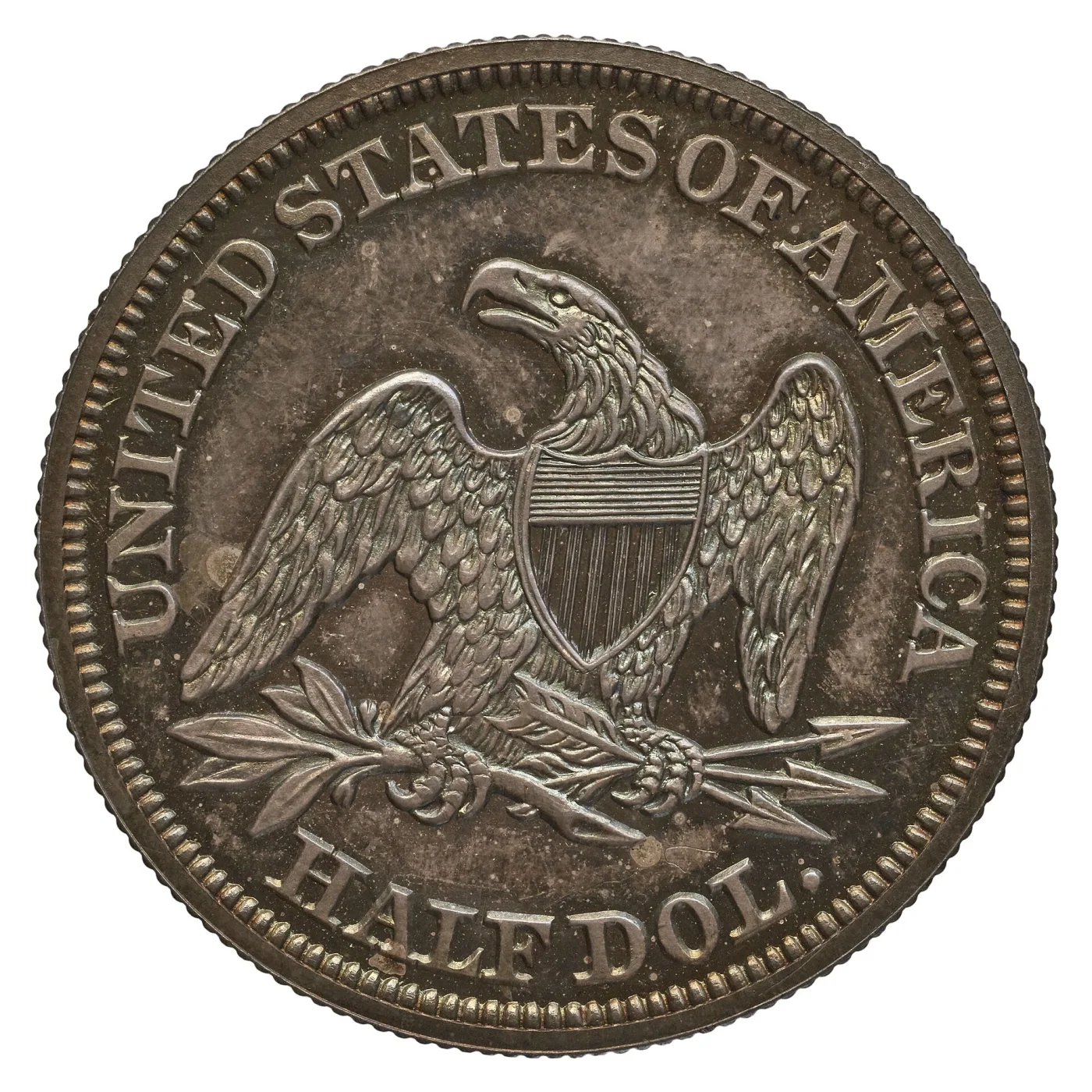
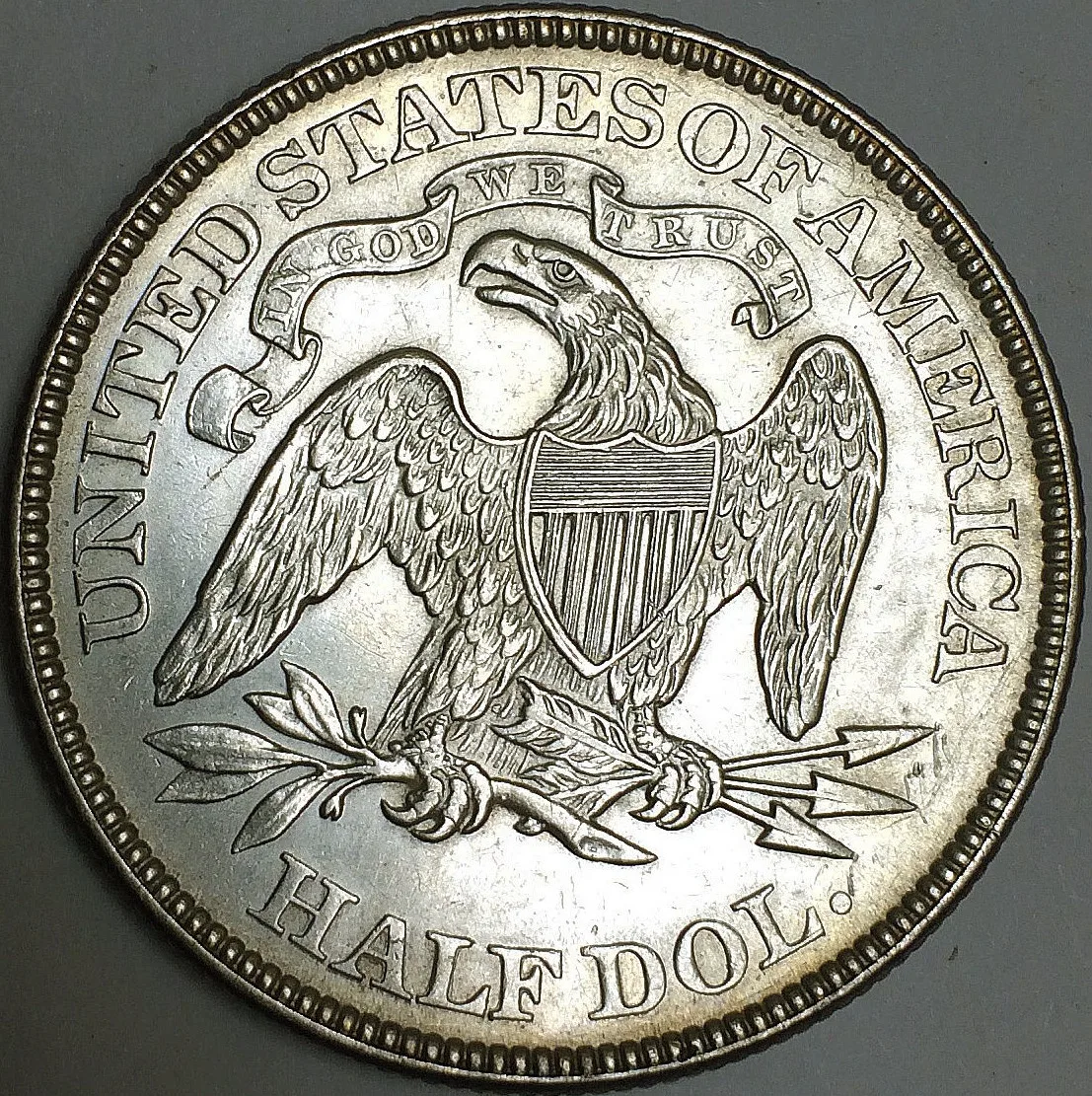
The reverse shows a heraldic eagle with a Union shield on its breast, holding three arrows in its left talon and an olive branch in its right talon. The legend UNITED STATES OF AMERICA arches around the top, and the denomination HALF DOL. appears at the bottom. Mint marks (when present) appear on the reverse below the eagle, between the eagle’s talons and the denomination. From 1866 onward, the reverse adds a scroll above the eagle with the motto IN GOD WE TRUST — a critical sub-type marker.
The eagle design is essentially unchanged from the late Capped Bust Half Dollar reeded-edge era and would carry, with modifications, through the entire Seated Liberty silver program. The shield horizontal lines, the eagle’s wing feathers, and the leaf detail in the olive branch are all key grading reference points.
Edge
All Seated Liberty Half Dollars feature a reeded edge — vertical grooves applied during striking by the close-collar steam press that the Mint had adopted in the 1830s. There is no lettered-edge variety in this series, in contrast to the early Capped Bust Half Dollar which used the lettered edge until 1836. A worn or damaged edge can indicate a counterfeit or a coin that has been mounted in jewelry.
The Six Major Sub-Types
Identifying the sub-type is the first step in attributing a Seated Liberty Half Dollar. The series is unusual in that the same basic design carried five distinct modifications across its 53-year run, and each modification creates a separate type for collectors who pursue type sets.
Type 1: No Drapery (1839 only)
The very first Seated Liberty Halves of 1839 lacked drapery from Liberty’s right elbow. This omission was quickly noticed and corrected: by mid-1839 the master die was retouched to add a small fold of drapery beneath the elbow. The 1839 No Drapery is therefore a one-year sub-type, scarce in any grade and rare in higher grades. Total mintage of the No Drapery sub-type was approximately 1.97 million, but most were heavily circulated. Identification: examine Liberty’s right elbow — if no drapery hangs from beneath it (just bare arm), the coin is the No Drapery type.
Type 2: Drapery, No Motto, No Arrows (1839-1853, 1856-1866)
The standard Seated Liberty Half Dollar after the 1839 retouch and before the 1853 Mint Act change. This is the longest-running sub-type by years and the most common to encounter. Identification: drapery at elbow, no arrows beside date, no motto above eagle. Weight is the original 13.36 g (0.900 silver).
Type 3: Arrows and Rays (1853 only)
The 1853 issues feature arrows at either side of the date and rays radiating around the eagle on the reverse — both visual markers of the Mint Act of 1853 weight reduction (from 13.36 g to 12.44 g). This sub-type was struck only at Philadelphia and New Orleans in 1853. The rays were considered visually cluttered and were dropped after one year. Identification: arrows at date PLUS rays around eagle = 1853 only. This is one of the most visually distinctive single-year US coins ever produced.
Type 4: Arrows, No Rays (1854-1855)
For 1854 and 1855, the rays were removed but the arrows at the date were retained as continuing visual indicators of the reduced weight standard. Mints: Philadelphia, New Orleans, and San Francisco (1855-S only). Identification: arrows at date, no rays around eagle.
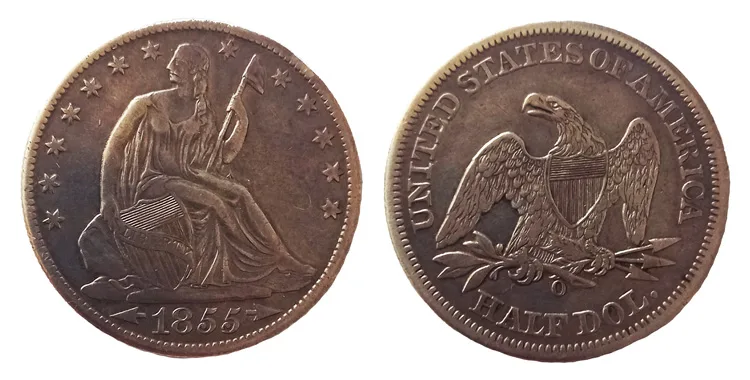
Type 5: No Arrows, No Motto (1856-1866)
From 1856, the arrows were dropped and the design returned to its original Drapery format — but at the new lighter weight. This sub-type ran until the addition of the motto in 1866. Identification: drapery at elbow, no arrows, no motto. Visually identical to Type 2 except for weight (12.44 g vs 13.36 g). Authentication: the weight difference is the most reliable distinguisher when the date is unclear.
Type 6: With Motto, No Arrows (1866-1873, 1875-1891)
Beginning in 1866, the motto IN GOD WE TRUST was added on a scroll above the eagle, in response to the religious sentiment heightened by the Civil War. This is the long final-period sub-type. Identification: scroll with IN GOD WE TRUST above eagle. The 1866 transition year exists in both With Motto and No Motto versions — the 1866 No Motto is a famous rarity (only one confirmed example known, in the proof category).
Type 7: With Motto, With Arrows (1873-1874)
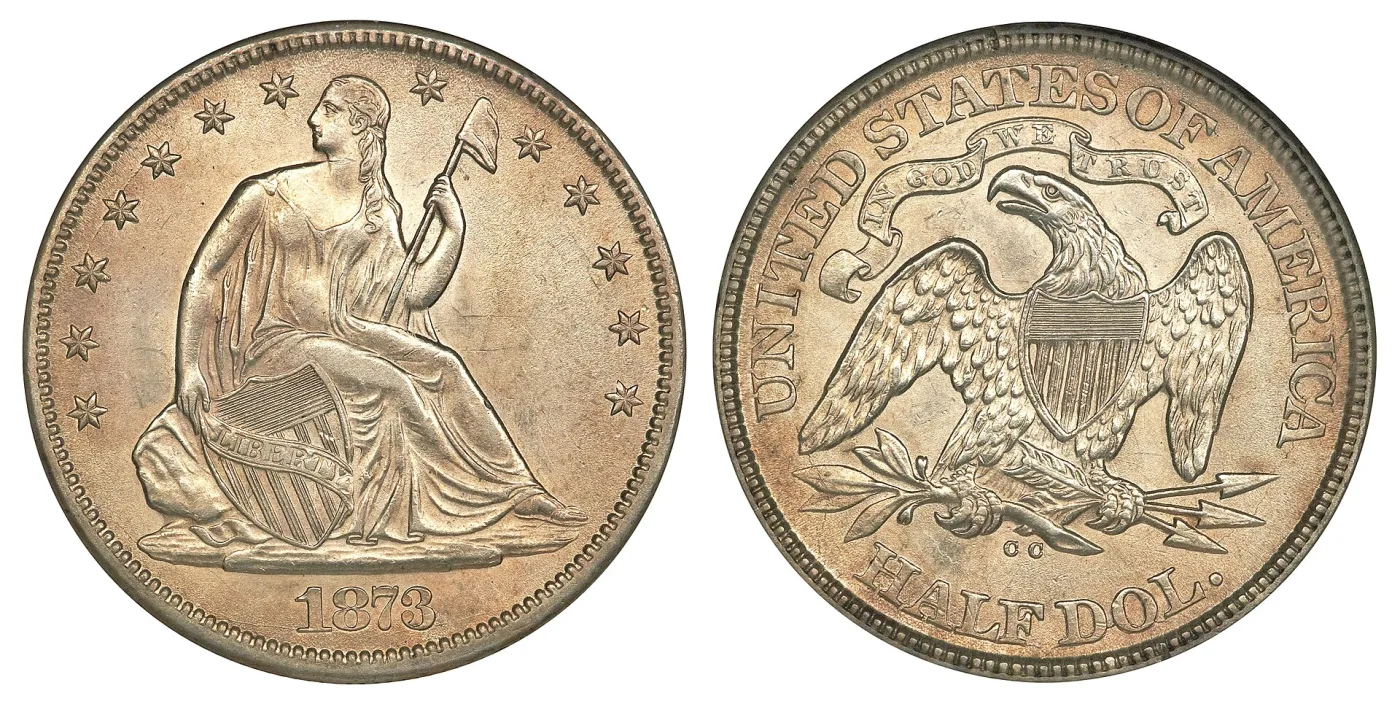
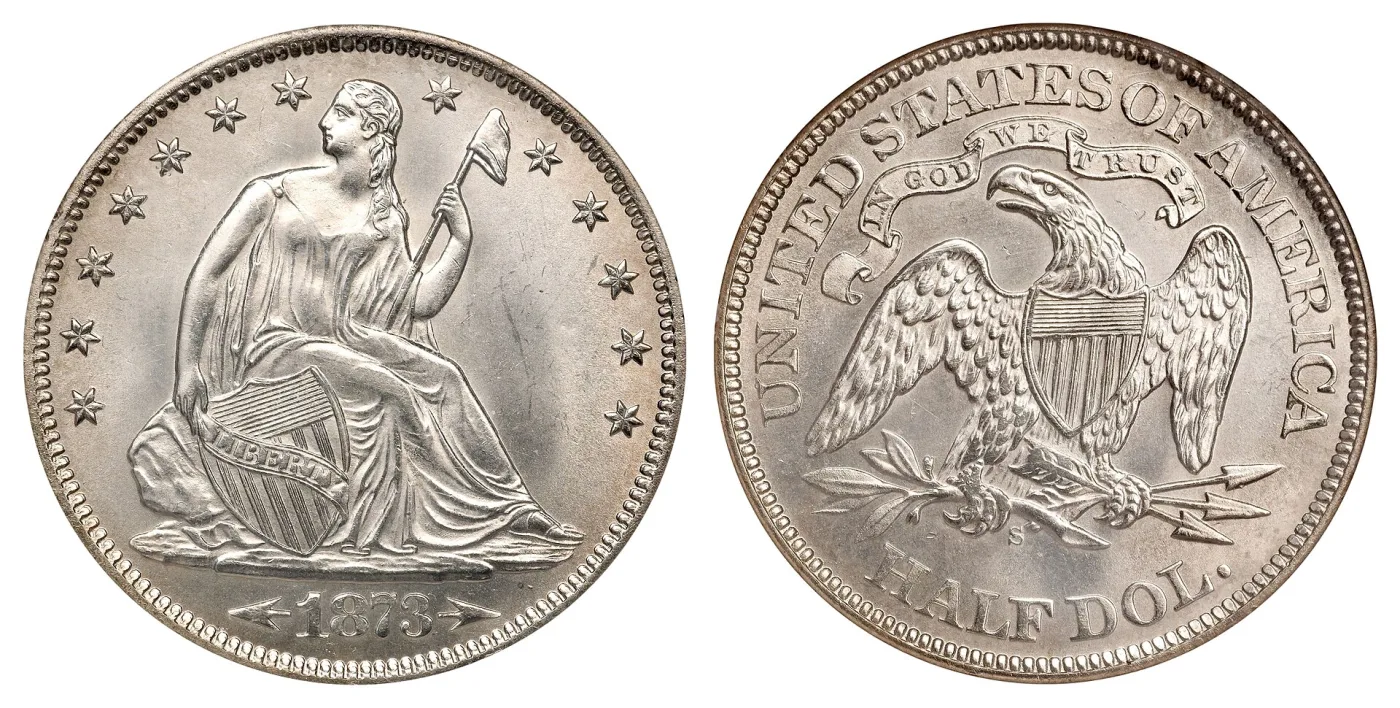
The Coinage Act of 1873 made minor weight adjustments and the Mint added arrows at the date for 1873-1874 to mark the change (from 12.44 g to 12.50 g — a tiny increase). After 1874, the arrows were again dropped while the motto was retained. Identification: arrows at date AND motto above eagle. The 1873-CC With Arrows and 1874-CC are key Carson City issues from this period.
Composition and Specifications
Knowing the metal content and weight is essential for both authentication and bullion-floor valuation. The Seated Liberty Half Dollar standard changed three times across the series.
Weight Variations
- 1839-1853 (early): 13.36 g, 30 mm, 0.900 silver. Same standard as the late Capped Bust reeded-edge issue.
- 1853-1873 (post-Act of 1853): 12.44 g, 30 mm, 0.900 silver. Reduced to prevent silver export.
- 1873-1891 (post-Act of 1873): 12.50 g, 30 mm, 0.900 silver. Slight increase. Commonly called “metric” weight because the Mint was attempting limited metric standardization.
Silver Content
A pre-1853 Seated Liberty Half contains 0.3866 troy ounces of pure silver. A post-1853 issue contains 0.3600 troy ounces. A post-1873 issue contains 0.3617 troy ounces. At a silver spot price of $30/oz, the bullion floor ranges from $10.80 to $11.60. No problem-free Seated Liberty Half should ever sell for less than its melt value, even in cull condition.
Weight as Authentication Tool
Use a jeweler’s scale accurate to 0.01 grams. Tolerance is ± 0.10 g for genuine pieces. The most diagnostic use of weight is distinguishing pre-1853 (heavy 13.36 g) from post-1853 (light 12.44 g) issues when the date or arrows-marker is unclear due to wear. A “no arrows” coin that weighs 13.36 g must be Type 2 (1839-1853), while one that weighs 12.44 g must be Type 5 (1856-1866). This is the same authentication logic that applies across the Seated Liberty Dollar series.
Mint Marks: Philadelphia, New Orleans, San Francisco, Carson City
Seated Liberty Half Dollars were struck at four mints across the series. Mint mark identification is essential for both attribution and valuation — branch-mint pieces often command large premiums over Philadelphia issues of the same date.
Mint Mark Locations
- Philadelphia (no mint mark): Main mint. No mint mark on any issue. Largest mintages.
- New Orleans (O): 1839-O through 1861-O, then briefly resumed for select dates after Reconstruction. Mint mark on reverse, below eagle, between talons and HALF DOL.
- San Francisco (S): 1855-S onward. Mint mark on reverse, below eagle.
- Carson City (CC): 1870-CC through 1878-CC. Mint mark on reverse, below eagle. Famous Western branch mint issues.
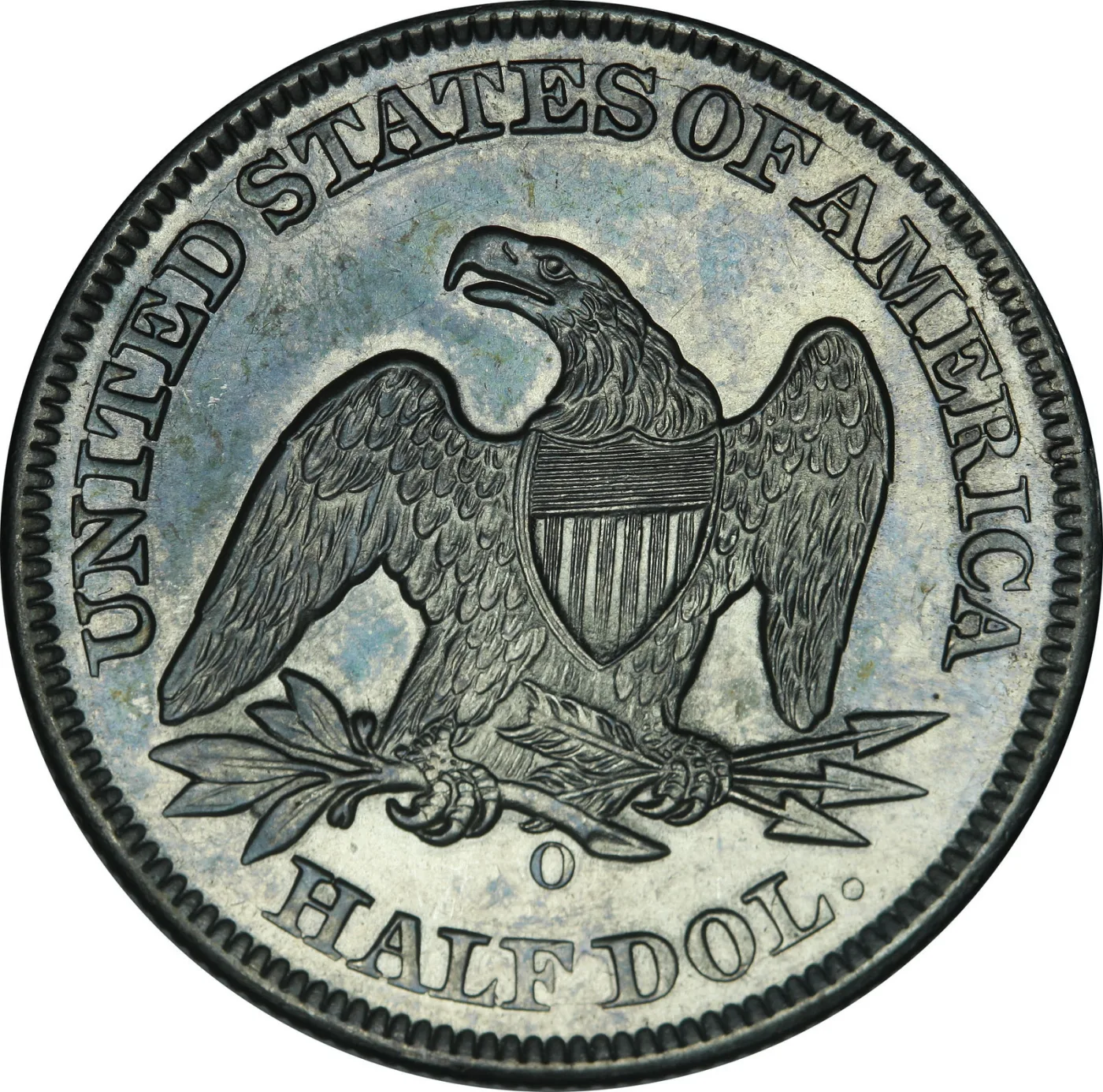
The 1839-O Drapery — A Famous First
The 1839-O is the very first half dollar produced by the New Orleans branch mint. Mintage was 178,976 — small for a circulation strike but adequate for collectibility. The 1839-O is both a first-year-of-mint piece and a first-year-of-type piece (when collected as the early Drapery sub-type) — a first-year status it shares with the original Flowing Hair Half Dollar of 1794 that launched the denomination decades earlier. Values: $400-$600 in F-12, $5,000+ in MS-63. Authentication is critical because counterfeit O mint marks have been added to common-date Philadelphia coins.
Branch Mint Premiums
Branch-mint issues generally carry premiums over Philadelphia for the same date and grade because mintages were lower and survival rates poorer (less collector preservation in frontier locations). The premium ratio varies dramatically: a common-date Philadelphia 1858 might bring $40 in F-12 while the 1858-O brings $50 (modest premium), but a Philadelphia 1873 brings $100 while the 1873-CC brings $1,500+ (massive premium). Always check both date AND mint mark before pricing.
The 1853 Arrows and Rays — A One-Year Design
The 1853 Arrows and Rays Seated Liberty Half Dollar deserves its own discussion because it is one of the most visually distinctive and historically significant single-year designs in all of American coinage.
Why the Mint Made the Change
By the early 1850s, the gold rush was flooding the American economy with new gold while silver remained scarce and increasingly valuable on world markets. US silver coins at the original 13.36 g standard contained more silver than their face value, making it profitable to export them as bullion. Silver coins literally disappeared from circulation. The Mint Act of February 21, 1853 reduced the silver weight of all subsidiary silver coinage (everything below the dollar) to keep coins in domestic circulation. The half dollar dropped from 13.36 g to 12.44 g — a 6.9% weight reduction.
The Visual Markers
To distinguish reduced-weight coins from older heavy-weight pieces (which were being recalled and melted), the Mint added two visual markers:
- Arrows at date: Small horizontal arrows at either side of the date, their heads pointing outward toward the rim in the exergue.
- Rays around eagle: Sharp triangular rays radiating outward from around the eagle on the reverse, between the eagle and the surrounding lettering.
Both markers appear only on 1853 issues. The rays were considered visually busy and crowded the design — they were removed for 1854. The arrows were retained for 1854-1855 as a continuing weight indicator, then also dropped.
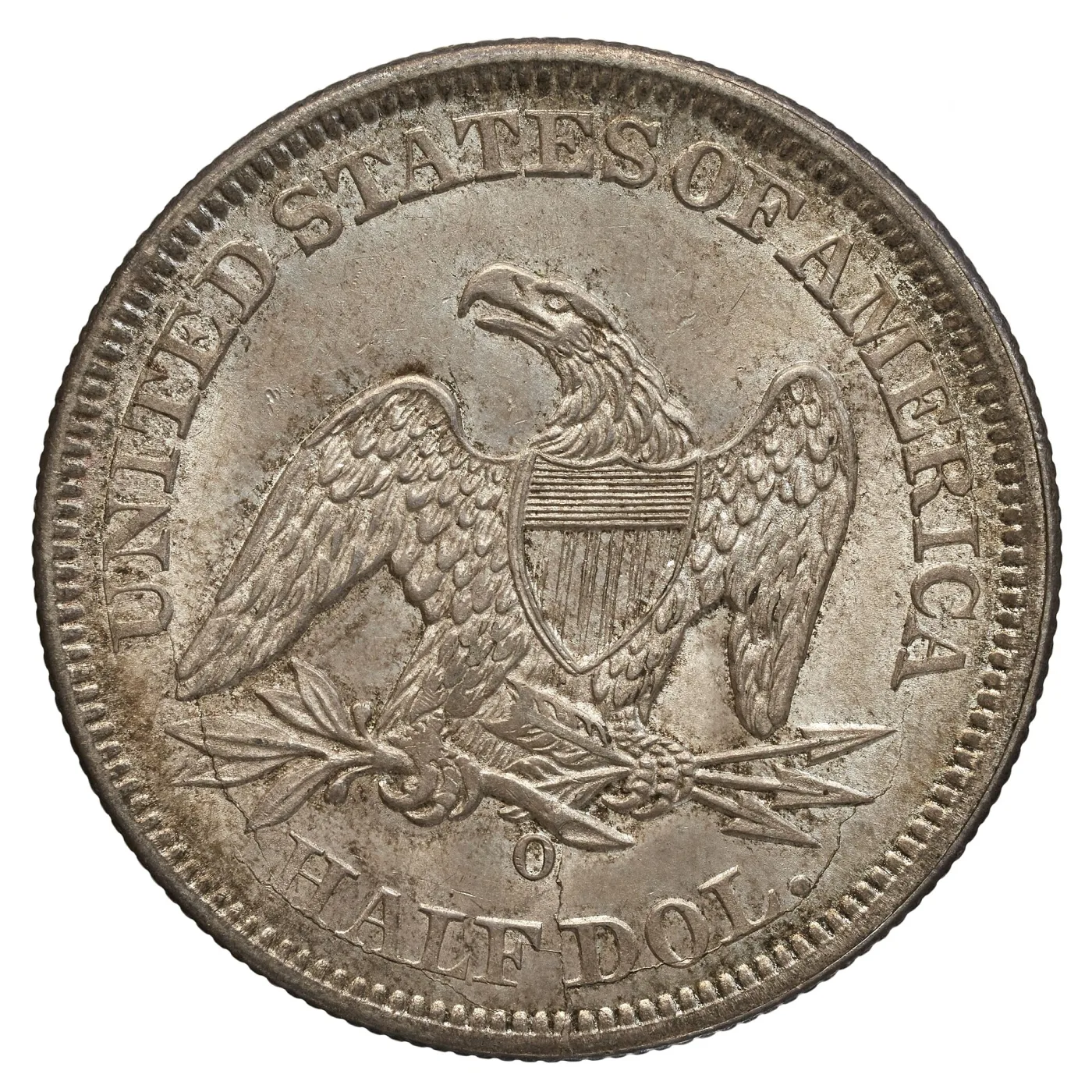
1853 Mintages and Values
The 1853 Arrows and Rays was struck at Philadelphia (3,532,708 mintage) and New Orleans (1,328,000 mintage). The 1853-O is the more challenging of the two but neither is rare. Both are essential for any type set of US silver. Values: 1853 (P) F-12 $50, MS-63 $1,500. 1853-O F-12 $60, MS-63 $2,500. The 1853-O is also famous for an extreme rarity: the 1853-O No Arrows is one of the great American rarities (only four examples known), distinguishing it from the standard 1853-O Arrows and Rays.
Collecting the 1853 Type
For collectors building a US silver type set, an 1853 Arrows and Rays half dollar is a “must-have” that captures both the visual drama of the rays and the historical weight of the Mint Act of 1853. A pleasing F-12 example for $50-$70 is a great value relative to the historical significance.

The With Motto Transition of 1866
The second major design transition in the Seated Liberty Half Dollar series was the addition of the motto IN GOD WE TRUST in 1866. This change reflected religious sentiment heightened by the Civil War — the same impulse that had previously added the motto to the two-cent piece in 1864.
Mint and Motto
The Mint Act of March 3, 1865 authorized the addition of the motto to silver coinage. Implementation began in 1866. On the half dollar, the motto appears on a scroll above the eagle, between the eagle’s head and the denticles. The scroll has banner-like ribbon ends curling on either side. The font is small but should be sharp and clearly readable on any coin grading Fine or higher.
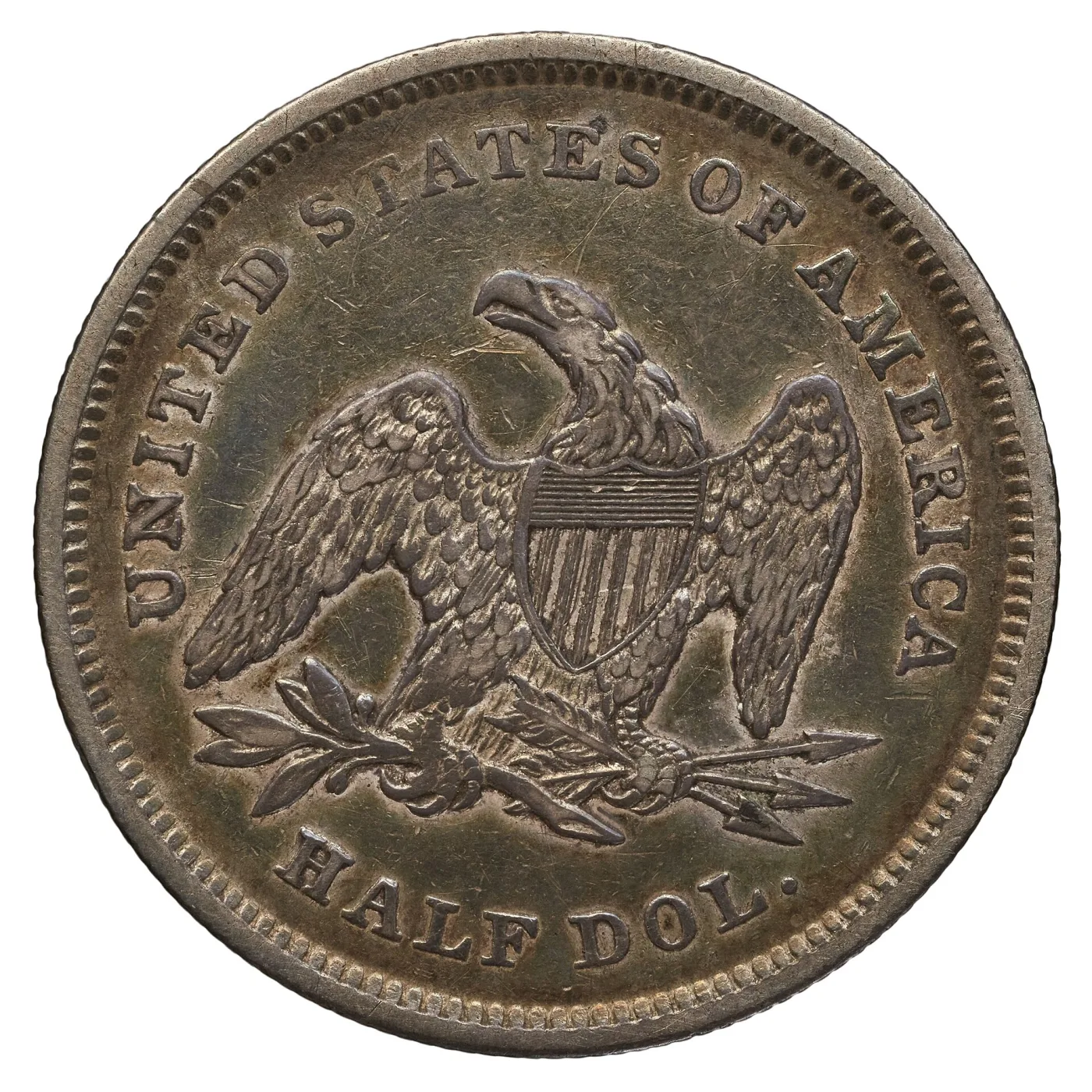
The 1866 No Motto Rarity
One 1866 No Motto half dollar is known — a unique pattern or proof piece struck before the motto dies were ready. It last sold publicly for $1.2 million. It is essentially impossible to encounter in commerce, but recognizing it as a famous rarity is part of series knowledge. The same year produced an 1866 No Motto Seated Liberty quarter and dollar (also unique).
Motto and Hub Variations
From 1866 onward, the motto’s exact font and ribbon shape evolved subtly across hub generations. Specialists track these as Wiley-Bugert sub-varieties. For most collectors, the With Motto vs No Motto distinction is sufficient and the hub sub-varieties are an optional deeper dive.
Key Dates and Major Rarities
While most Seated Liberty Halves are common in circulated grades, several dates and varieties are conditional rarities or absolute rarities. Knowing the key dates protects you from passing up a treasure or overpaying for a common piece sold as scarce.
1853-O No Arrows
One of the great American rarities. Only four examples are known. The 1853-O No Arrows was struck briefly at New Orleans before the new Arrows and Rays dies arrived. Auction records exceed $400,000 in any grade. Authentication: must be confirmed by PCGS or NGC; private sales should be considered fakes until proven otherwise.
1855-S
The first year of San Francisco half dollar production. Mintage was 129,950 — low for a branch-mint first-year. Values: $700-$1,200 in F-12, $25,000+ in MS-63. The 1855-S is a recognized condition rarity in higher grades.
1866 No Motto
Unique. One example known, last sold over $1 million. Functionally a museum piece — relevant to collectors only as a famous rarity to recognize.
1870-CC — First Year Carson City
The 1870-CC is the first half dollar struck at the Carson City branch mint. Mintage was 54,617 — low and historically significant. Values: $2,000-$3,500 in F-12, $50,000+ in MS-63. A condition rarity above VF — most surviving examples are heavily worn.
1873-CC No Arrows
Mintage was only 122,500, struck before the Coinage Act of 1873 added arrows mid-year. Values: $1,200-$2,000 in F-12, $30,000+ in MS-63. Extremely rare in grades above EF. A key date for any Carson City Seated Liberty collection.
1874-CC
Mintage was 59,000 — the lowest Carson City Seated Half mintage. Values: $2,500-$4,000 in F-12, $50,000+ in MS-63. One of the great Carson City rarities across all denominations.
1878-S — The Final-Era Rarity
Mintage was only 12,000 — the second-lowest mintage of any Seated Liberty Half (after the unique 1866 No Motto). The 1878-S is one of the legendary American 19th-century half dollar rarities. Values: $30,000-$50,000 in F-12, $200,000+ in MS-63. Authentication is essential — every 1878-S should be slabbed by PCGS, NGC, or ANACS.
1879-1890 Low Mintages
From 1879 through 1890, Bland-Allison Act silver was diverted to Morgan Dollar production, leaving Seated Half mintages tiny (often under 10,000 business strikes per year). The 1879, 1880, 1881, 1882, 1883, 1884, 1885, 1886, 1887, 1888, 1889, and 1890 are all condition rarities. Most surviving examples are in higher grades because the few struck were largely saved by collectors. Values typically $300-$500 in EF-40, $2,000-$5,000 in MS-63 for these “common” late-date pieces.
Carson City Seated Halves
The Carson City branch mint operated from 1870 through 1893 in the heart of the Comstock Lode silver mining country in Nevada. Carson City Seated Liberty Halves are among the most romantic and collected branch-mint issues of any US series, on par with Carson City Morgan Dollars, Trade Dollars, and Seated Liberty Dollars.
Carson City Date List
- 1870-CC: 54,617 mintage. First-year, key date.
- 1871-CC: 153,950 mintage. Second-year, scarce.
- 1872-CC: 257,000 mintage. Most available CC date but still scarce.
- 1873-CC No Arrows: 122,500 mintage. Key.
- 1873-CC With Arrows: 214,560 mintage. Scarce, less than No Arrows.
- 1874-CC: 59,000 mintage. Key.
- 1875-CC: 1,008,000 mintage. Most common CC.
- 1876-CC: 1,956,000 mintage. Most common CC.
- 1877-CC: 1,420,000 mintage. Available.
- 1878-CC: 62,000 mintage. Final-year, scarce.
Identifying Carson City Authenticity
Counterfeit CC mint marks have been added to Philadelphia coins since at least the 1950s. Authentication strategy:
- Mint mark style: Genuine CC mint marks have a specific font that varies subtly by year. Compare against verified CC examples.
- Field around mint mark: Tooling marks, displaced metal, or a different surface finish around the CC suggests a fake mark added to a genuine Philadelphia coin.
- Mint mark depth: Genuine CC marks are sharp and properly seated; added marks often look shallow or poorly positioned.
- Slabbing: For any CC half priced over $300, prefer PCGS, NGC, or ANACS slabs.
Wiley-Bugert Varieties and Die Marriages
Like the Capped Bust Half Dollar series with its Overton numbers, Seated Liberty Halves have a die-marriage attribution system. The reference is Wiley-Bugert, “The Complete Guide to Liberty Seated Half Dollars” (commonly cited as W-B numbers). The system catalogues hundreds of die marriages across the 53-year series.
Why Varieties Matter Less Than Overton
For most Seated Liberty Halves, varieties matter less than they do for Capped Bust Halves. Most W-B varieties are roughly equal in value within a date. Variety collecting is a specialist pursuit rather than the mainstream collecting path. The exceptions are:
- Doubled dies: Several dates have doubled-die obverses or reverses worth premiums.
- Repunched dates: Several dates show clearly repunched numerals worth modest premiums.
- 1846 6/Horizontal 6: A famous error variety where the 6 was punched horizontally first then corrected. Values $200+ in F-12.
- 1844-O Doubled Date: Strong doubling visible on the date. $200+ in F-12.
- 1847/6: Overdate variety. Scarce. $1,500+ in F-12.
- 1855/4: Overdate visible on the 4 underdigit. Premium variety.
Attribution Approach
For variety attribution, use a 10x or higher loupe and good lighting. Examine the date for repunching, the mint mark for repunching, the design for doubling. Compare against the W-B reference plates for confirmation. Most attributions are obvious once you know what to look for.
Grading Seated Liberty Halves
Grading uses the standard 70-point Sheldon scale with several series-specific reference points. Liberty’s gown, the shield, and the eagle’s wing feathers are the primary grading focal areas.
Circulated Grades
- Good-4 (G-4): Liberty’s outline visible. LIBERTY on shield ribbon worn but partially readable. Date legible. Eagle outlined but flat. Stars flat.
- Very Good-8 (VG-8): LIBERTY on shield 50%+ readable. Some gown detail at base. Eagle wing tips show separation from body.
- Fine-12 (F-12): All letters in LIBERTY readable but worn. Gown shows folds. Eagle wing feathers begin to show separation.
- Very Fine-20 (VF-20): LIBERTY sharp. Most gown detail visible. Shield horizontal stripes partially visible. Eagle feathers show good detail.
- Extremely Fine-40 (EF-40): Full gown detail. Sharp LIBERTY. Most shield stripes visible. Eagle feathers sharp on most areas.
- About Uncirculated-50 (AU-50): Trace of wear on Liberty’s knee, breast, and the eagle’s neck and breast. Most luster present.
Mint State Grades
- MS-60: No wear, but heavy bag marks, possible weak strike, dull luster.
- MS-63: Choice — moderate marks, decent luster, attractive eye appeal.
- MS-65: Gem — minimal marks, full luster, sharp strike, no major distractions.
- MS-67+: Near-perfect. Very few examples. Premium pricing.
The LIBERTY Test
The LIBERTY ribbon on the shield is the primary grading anchor. By G-4, partial letters readable. By F-12, all letters readable but worn. By VF-20, sharp. By EF-40, all letters sharp with shield ribbon detail intact. This is the same logic that applies to Barber Half Dollar grading where LIBERTY on Liberty’s headband is the anchor — the principle of graduated visibility on a focal element is universal across classic US silver.
Strike vs Wear
Many Seated Halves were struck weakly, especially branch-mint issues. A weak strike is not the same as wear. Examine Liberty’s knee, breast, and the eagle’s center for friction (wear) vs simply soft strike (no wear). Lustrous fields with weak design = uncirculated; flat-lustered fields with friction on high points = circulated.
Authentication and Spotting Counterfeits
Seated Liberty Halves attract counterfeiters because of their high-value rarities (1878-S, 1874-CC, 1870-CC, 1873-CC No Arrows) and added-mint-mark fakes (CC and O marks added to common Philadelphia coins).
Physical Tests
- Weight: 13.36 g (1839-1853), 12.44 g (1853-1873), or 12.50 g (1873-1891), ± 0.10 g.
- Diameter: 30 mm uniform.
- Magnetism: Silver is non-magnetic. A magnetic coin is fake.
- Specific gravity: Genuine 0.900 silver = 10.4. Significant deviation is suspicious.
Mint Mark Authentication
Added mint marks are the most common form of Seated Half fakery. Strategy:
- Surface around mint mark: Should match the surrounding field exactly. Tooling marks, raised metal, or a depression around the mint mark indicates a mark added to a Philadelphia coin.
- Mint mark font: Compare the exact letter shape against verified examples for that year. Mint mark fonts evolved subtly by year.
- Mint mark seating: Genuine marks are punched cleanly into the die and appear sharply at the same depth as surrounding design. Added marks often look shallow or unevenly seated.
- Slabbing: For any branch-mint piece priced over $300, prefer PCGS, NGC, ANACS, or ICG slabs.
Cast and Struck Counterfeits
- Cast counterfeits: Fuzzy lettering, granular surfaces, soft details. Increasingly rare as struck counterfeits dominate.
- Struck counterfeits: Made from transfer dies. Sharp design but slightly off in tiny details. Compare design elements against verified examples.
- Modern Chinese fakes: Available online. Often correct weight (silver-clad) but wrong design details. Always cross-check against PCGS CoinFacts photos.
Current Market Values and Price Guide
Values vary widely by date, mint, type, and grade. The figures below reflect retail pricing as of 2026 and should be confirmed against current auction records before any major purchase. Wholesale and dealer-buy prices typically run 30-50% below retail.
Common Dates (Most 1840s-1860s Philadelphia, 1875-1877 Philadelphia)
- Good-4: $30-$50
- Fine-12: $50-$80
- Very Fine-20: $80-$140
- Extremely Fine-40: $150-$250
- AU-50: $250-$400
- MS-63: $700-$1,500
- MS-65: $3,000-$8,000
Type Coins (Premium for Sub-Type Representation)
- 1839 No Drapery F-12: $300-$450
- 1853 Arrows and Rays F-12: $50-$70 (P), $60-$90 (O)
- 1854-1855 Arrows F-12: $50-$80
- 1873-1874 With Motto, With Arrows F-12: $60-$100
Branch Mint Premiums
- 1839-O F-12: $400-$600
- 1855-S F-12: $700-$1,200
- 1870-CC F-12: $2,000-$3,500
- 1871-CC F-12: $700-$1,000
- 1873-CC No Arrows F-12: $1,200-$2,000
- 1874-CC F-12: $2,500-$4,000
- 1878-CC F-12: $1,000-$1,500
Major Rarities
- 1853-O No Arrows: $400,000+ in any grade. Four known.
- 1866 No Motto: $1 million+. Unique.
- 1878-S: $30,000+ F-12; $200,000+ MS-63.
Late-Date Low Mintage Pieces (1879-1890)
- EF-40: $300-$500
- AU-50: $400-$600
- MS-63: $1,500-$3,500
Bullion Floor
Even cull condition Seated Liberty Halves carry a bullion floor of approximately $10-$12 (at $30/oz silver). Damaged, holed, or heavily polished examples often trade near melt plus a small numismatic premium. Never sell a Seated Liberty Half below melt — and never pay melt for a clean Good-condition piece, which should always carry a $20-$30 numismatic premium minimum.
Building a Seated Liberty Half Dollar Collection
Seated Liberty Halves offer multiple collecting paths from beginner type sets to deep specialist variety pursuits.
Type Set (6-7 Coins)
The most popular entry-level approach. One example of each major sub-type: No Drapery (1839), Drapery No Motto No Arrows, Arrows and Rays (1853), Arrows No Rays (1854-1855), No Arrows No Motto (1856-1866), With Motto (post-1866), and optionally With Motto With Arrows (1873-1874). Total budget in middle circulated grades: $1,000-$2,000. This pairs naturally with type sets of Seated Liberty Dollars, Capped Bust Halves, and Walking Liberty Halves to build a portrait of US silver design evolution.
Date Set (~50 Years)
One coin per year from 1839 through 1891. Most years are affordable in Good through Fine; the 1855-S, 1878-S, and the late 1879-1890 dates require larger budgets. Total budget for a complete date set in average circulated condition: $15,000-$30,000. A serious commitment but very achievable for a patient collector over several years.
Carson City Set (10 Coins)
One coin from each of the ten Carson City years (1870-CC through 1878-CC, including both 1873-CC varieties). A focused and historically rich subset. Budget in modest circulated grades: $8,000-$15,000. The 1870-CC, 1873-CC No Arrows, and 1874-CC are the budget drivers. This pairs beautifully with Carson City Morgan Dollar and Trade Dollar sets for a comprehensive Carson City collection.
Date and Mint Set (~125 Coins)
One coin for every date-and-mint combination across the series. The deepest mainstream pursuit. Total budget: $50,000+ for circulated, $500,000+ for Mint State. A lifetime project.
Where to Buy
Major auction houses (Heritage, Stack’s Bowers) handle the highest-value pieces. Specialist dealers in Liberty Seated material are the best source for variety material and mid-range branch mints. Coin shows offer hands-on examination — invaluable for mint mark authentication. Online marketplaces work for slabbed common-date material but require caution for raw branch-mint coins.
Storage and Preservation
Seated Liberty Halves have already survived 130-180 years; your job is to ensure they survive another 130 years. Silver tarnishes; PVC contamination is permanent. The principles below apply broadly to early American silver, with parallels to Seated Liberty Dollar and other 19th-century silver preservation.
Holders
- Slabs (PCGS/NGC/ANACS/ICG): Best long-term storage. Inert plastic, sealed environment, third-party-graded.
- Inert Mylar flips: Acceptable for raw coins. Avoid PVC flips at all costs.
- Cardboard 2x2 holders: Acceptable short-term but cardboard releases sulfur over time.
- Coin albums: Use only albums with inert plastic pockets, never PVC vinyl.
Environment
- Humidity: Below 50% RH. Silica gel desiccant in storage area.
- Temperature: Stable, room temperature. Avoid temperature swings that cause condensation.
- Light: Dark storage. UV light can affect toning patterns.
- Air: Filtered or sealed. Ambient sulfur compounds tarnish silver.
Cleaning — Don’t
Never clean a Seated Liberty Half. Cleaning destroys numismatic value, often reducing a coin’s price by 50-80%. Original toning, even when dark or splotchy, is part of the coin’s history and is valued by collectors. If a coin is severely contaminated (PVC residue, for example), professional conservation by NCS (Numismatic Conservation Services) is the only acceptable intervention — never DIY cleaning.
Frequently Asked Questions
How can I tell a Seated Liberty Half Dollar from a Capped Bust Half Dollar?
Look at the obverse. The Seated Liberty design shows a full-figure Liberty seated on a rock holding a shield and pole. The Capped Bust design shows a bust portrait of Liberty wearing a soft cloth cap. The transition occurred in 1839 — both designs exist for that year.
What's the difference between the 1853 Arrows and Rays and the 1854-1855 Arrows?
The 1853 has both arrows at the date AND rays around the eagle on the reverse. The 1854 and 1855 have arrows at the date but no rays. The rays were dropped after one year because they were considered visually busy.
Why does the With Motto type start in 1866?
The Mint Act of 1865 authorized the addition of IN GOD WE TRUST to silver coinage in response to religious sentiment heightened by the Civil War. Implementation began in 1866. The same change affected the quarter and dollar simultaneously.
Are all 1853 Seated Liberty Halves Arrows and Rays?
Almost all. The 1853-O No Arrows is one of the great American rarities (only four examples known) — a brief experimental striking before the Arrows and Rays dies arrived. Any 1853-O without arrows should be authenticated by PCGS or NGC.
How do I authenticate a Carson City (CC) mint mark?
Compare the CC font and seating against verified examples. Look for tooling marks, raised metal, or surface disturbance around the mint mark — these indicate a CC mark added to a Philadelphia coin. For any CC half priced over $300, prefer PCGS, NGC, or ANACS slabs.
Should I clean a tarnished Seated Liberty Half?
No. Cleaning destroys numismatic value. Original toning is desired by collectors, even when dark. If contamination requires intervention, use professional conservation (NCS) only.
What is the most valuable Seated Liberty Half Dollar?
The 1866 No Motto is unique and last sold for over $1 million. The 1853-O No Arrows is next, with auction records over $400,000. Among regular-issue pieces, the 1878-S is the leader, with MS-63 examples bringing $200,000+.
Are common Seated Liberty Halves a good investment?
As bullion, yes — they always carry their silver value. As numismatic investments, common dates have appreciated steadily but not spectacularly. Branch-mint pieces and key dates have outperformed common dates significantly. For most collectors, the value is in the collection itself, not as financial speculation.