Three Cent Piece Identification Guide: Silver Trime, Nickel Three-Cent, Key Dates, and Values
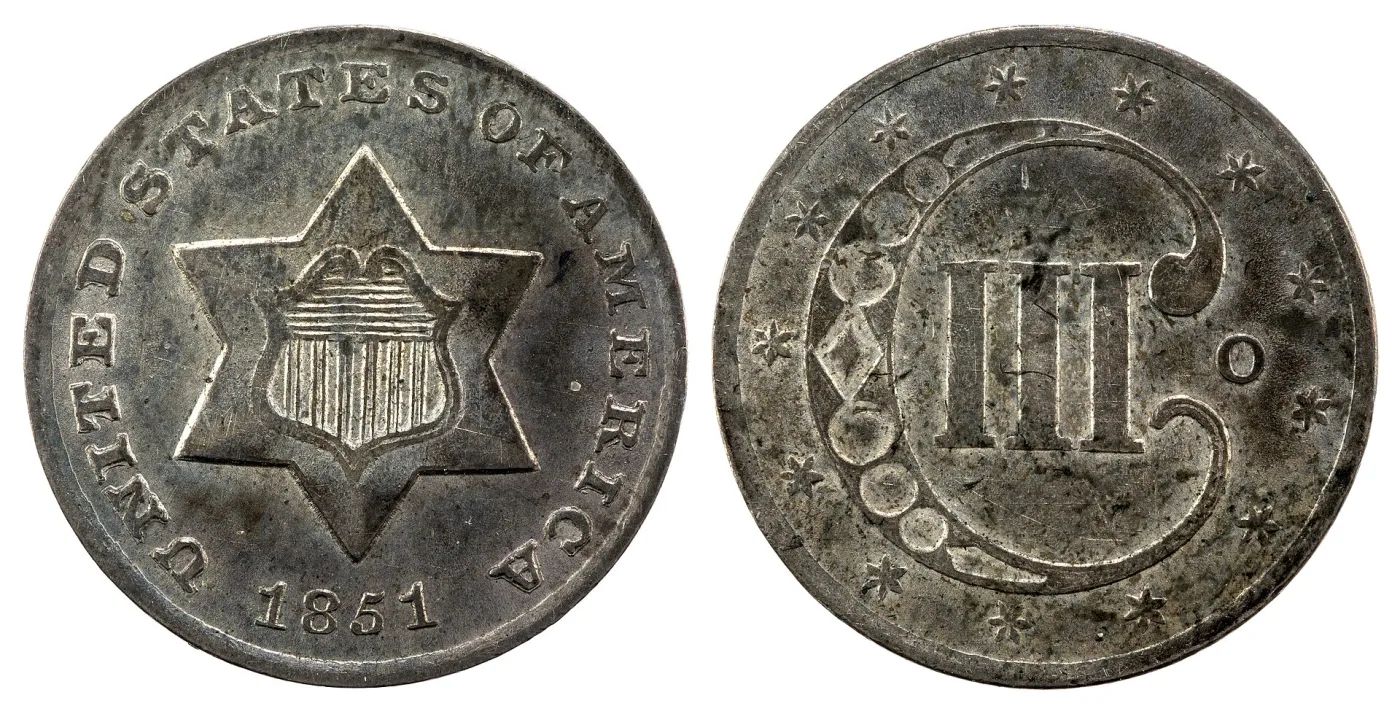
The Three Cent Piece is one of the most unusual denominations in United States coinage history — a coin born from a postage rate, struck in two completely different metals, and produced over a span of nearly four decades by two distinct designs that share nothing but their face value. The first version, the silver Three Cent Piece nicknamed the “trime,” was the smallest and lightest U.S. silver coin ever struck for circulation, designed by Chief Engraver James Barton Longacre — the same engraver behind the equally tiny Gold Dollar introduced two years earlier — and produced from 1851 through 1873. The second version, the copper-nickel Three Cent Piece, ran from 1865 through 1889 and shared its alloy with the contemporary Shield Nickel and later the Liberty Head V Nickel.
Both versions tell stories of practical Mint problem-solving in the mid-19th century. The silver trime answered the 1851 reduction of the first-class postage rate from five cents to three cents, giving the public a coin that exactly matched a stamp. The nickel three-cent piece answered the Civil War coin shortage and the public’s reluctance to handle the small, easily-lost trime. For modern collectors, the Three Cent series offers two affordable type coins, several genuinely rare key dates, complex Type 1 / Type 2 / Type 3 sub-varieties on the silver pieces, and proof-only issues at the end of the nickel series that have always commanded strong premiums.
This guide covers everything needed to identify, attribute, grade, authenticate, and value Three Cent Pieces in the 2026 market. You will learn how to distinguish the three sub-types of the silver trime by counting outline lines and stars, recognize the proof-only 1877 and 1878 nickel three-cents, separate genuine 1873 Closed 3 from Open 3, detect common counterfeits, and price your coins accurately. Whether you are completing a U.S. type set, chasing a complete date run, or just trying to identify a tiny silver coin pulled from an estate, this guide is the comprehensive reference for one of America’s strangest and most fascinating denominations.
History and Background of the Three Cent Piece
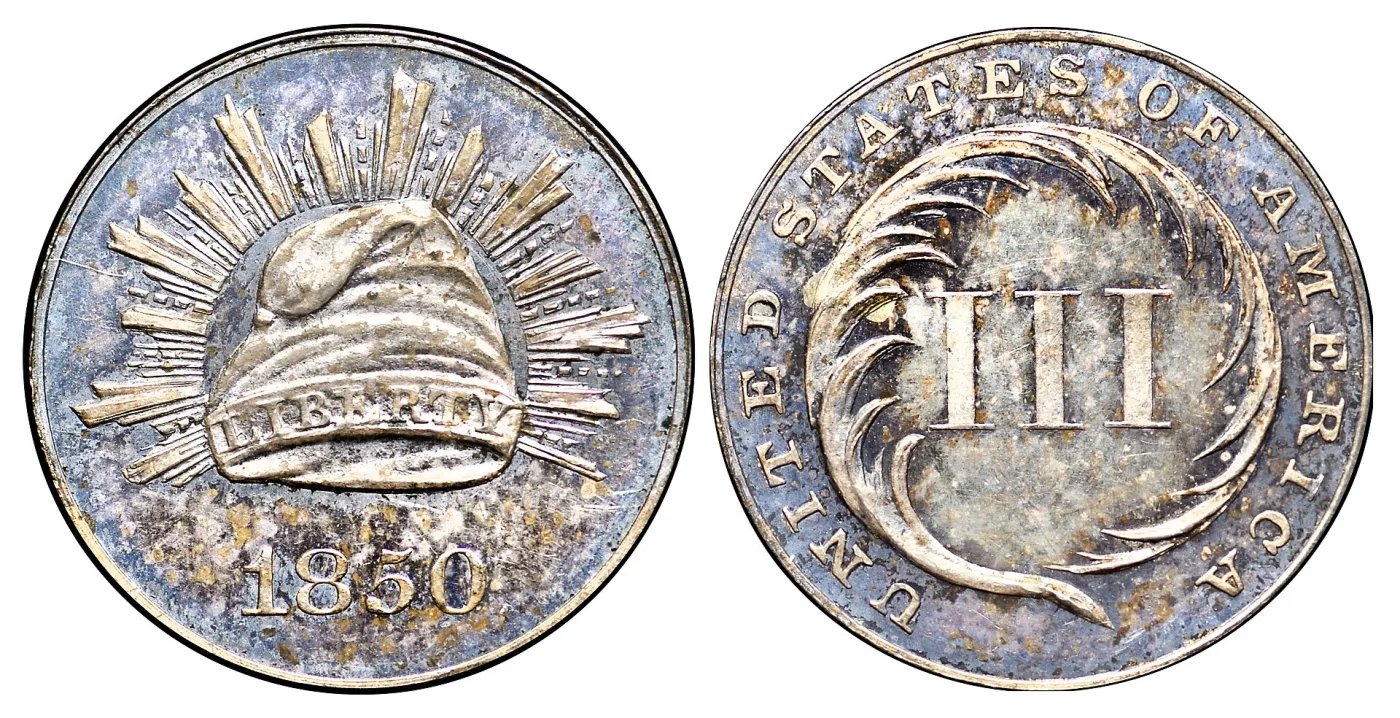
The Three Cent Piece was introduced by the Act of March 3, 1851, which simultaneously reduced first-class postage from five cents to three cents and authorized a new silver coin of matching face value. The legislative logic was direct: a person buying a stamp could now hand the postmaster a single coin instead of receiving two cents in change from a half-dime. The Mint had pushed for the new denomination to relieve the chronic shortage of subsidiary silver in commerce, where Spanish colonial coins still circulated and small change was perpetually scarce.
By the time the silver trime entered its final years, the Civil War had created an entirely new coinage crisis. Hard money disappeared from circulation as anxious citizens hoarded gold, silver, and even the copper-nickel cents introduced in 1857 to replace the heavy pure-copper Large Cent and Half Cent. Merchants bridged the gap with privately struck Civil War tokens, and the Mint responded with the bronze cent and the Two Cent Piece in 1864, then with two new copper-nickel coins in quick succession: the nickel Three Cent Piece in 1865 and the Shield Nickel in 1866. The new three-cent piece was deliberately larger and more substantial than the trime to address public complaints that the silver coin was too small to handle.
The Postage Connection
The original 1851 trime was so closely tied to postage that it was sometimes called the “fish-scale” or simply the “three cent silver” by contemporary newspapers. When postage rates were raised again later in the century, the practical justification for the denomination weakened, but by then the coin had become entrenched in commerce as small change.
End of Both Versions
The silver Three Cent Piece was abolished by the Coinage Act of 1873, the same legislation that ended the half-dime, ended the standard silver dollar, and authorized the controversial Trade Dollar. The nickel Three Cent Piece survived longer but lost its functional role as the dime, half-dime replacement, and other denominations filled the small-change role. Mintage collapsed from millions in the 1860s to mere thousands by the 1880s, and Congress finally abolished the denomination in 1890.
The Two Versions: Silver Trime and Nickel Three-Cent
One of the most common sources of confusion for new collectors is that the United States struck two completely separate Three Cent coins simultaneously between 1865 and 1873. They share nothing but their face value and the period of their overlap.
Silver Trime (1851-1873)
The silver Three Cent Piece, universally called the “trime” by collectors, is dramatically smaller than any other U.S. silver coin. Its 14mm diameter is smaller than a modern dime (17.91mm) and barely larger than the head of a finishing nail. Composition was 75% silver / 25% copper from 1851 to 1853, then changed to 90% silver / 10% copper from 1854 to 1873 to align with other subsidiary silver. The total run produced about 42 million pieces, with the bulk struck in the first three years.
Nickel Three-Cent (1865-1889)
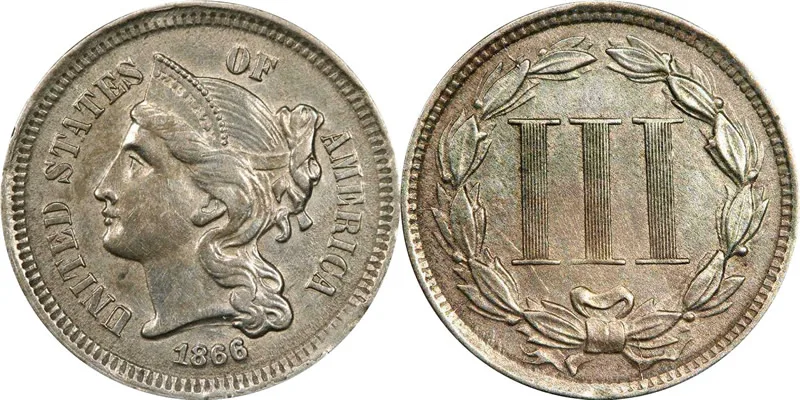
The nickel Three Cent Piece is composed of 75% copper and 25% nickel — the same alloy used for the Shield Nickel and most subsequent five-cent pieces. At 17.9mm diameter and 1.94 grams, it is approximately the size and weight of a modern dime. The design is entirely different from the trime: a Liberty Head obverse and a Roman numeral III inside a wreath on the reverse. Total mintage across the series approached 32 million pieces, with most struck before 1875.
Why Two Coins for One Denomination?
The nickel three-cent was not intended to replace the trime — it was an emergency wartime coinage measure to put more circulating money into commerce when silver had vanished from circulation. The two coins ran in parallel for nine years (1865-1873), with the trime increasingly used only by Treasury for fractional accounting and the nickel piece dominating actual commerce. Once silver returned to circulation after the war and the Coinage Act of 1873 cleaned up the federal coinage system, the redundant trime was eliminated.
Silver Trime Design and Symbolism
James Barton Longacre’s silver trime is the most stripped-down design in 19th century American coinage. Its tiny diameter forced an austere, minimalist approach.
Obverse: Six-Pointed Star with Shield
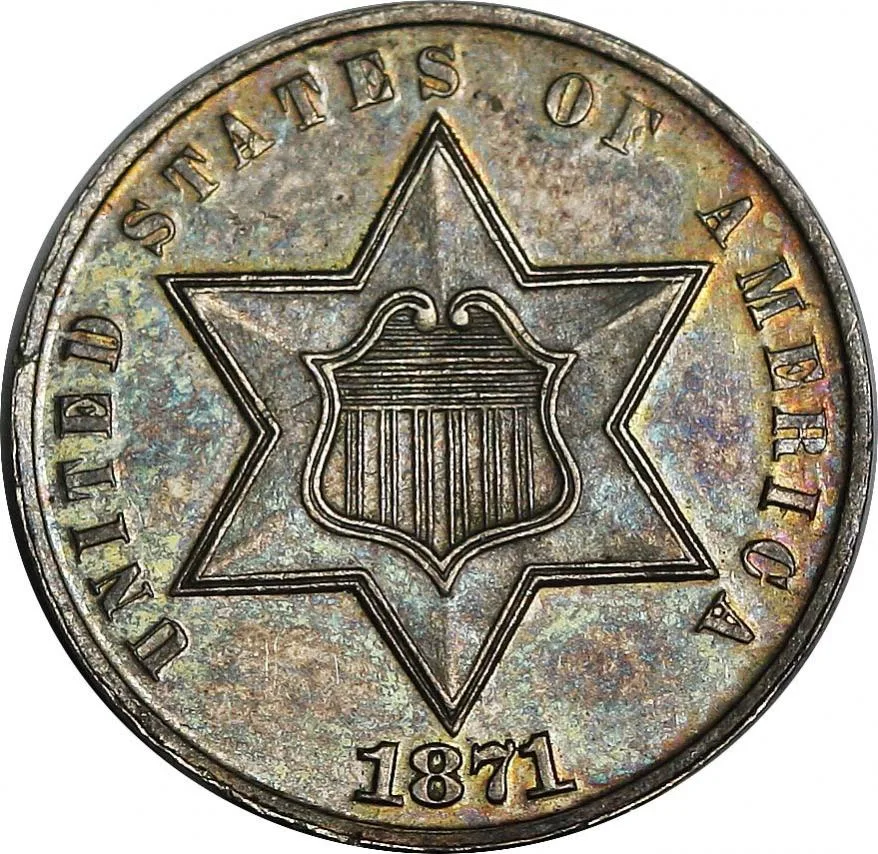
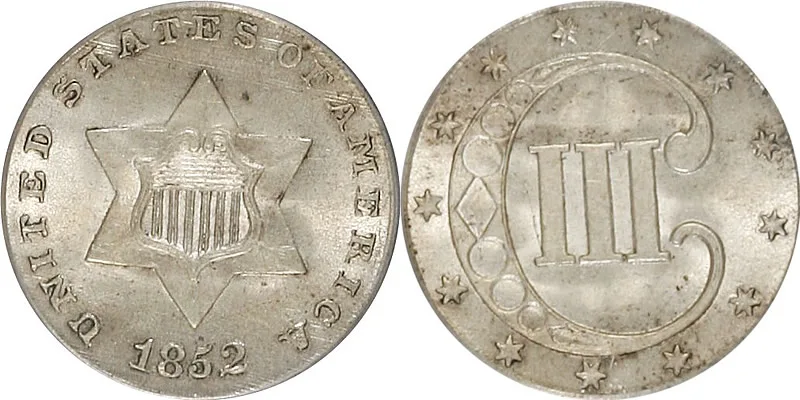
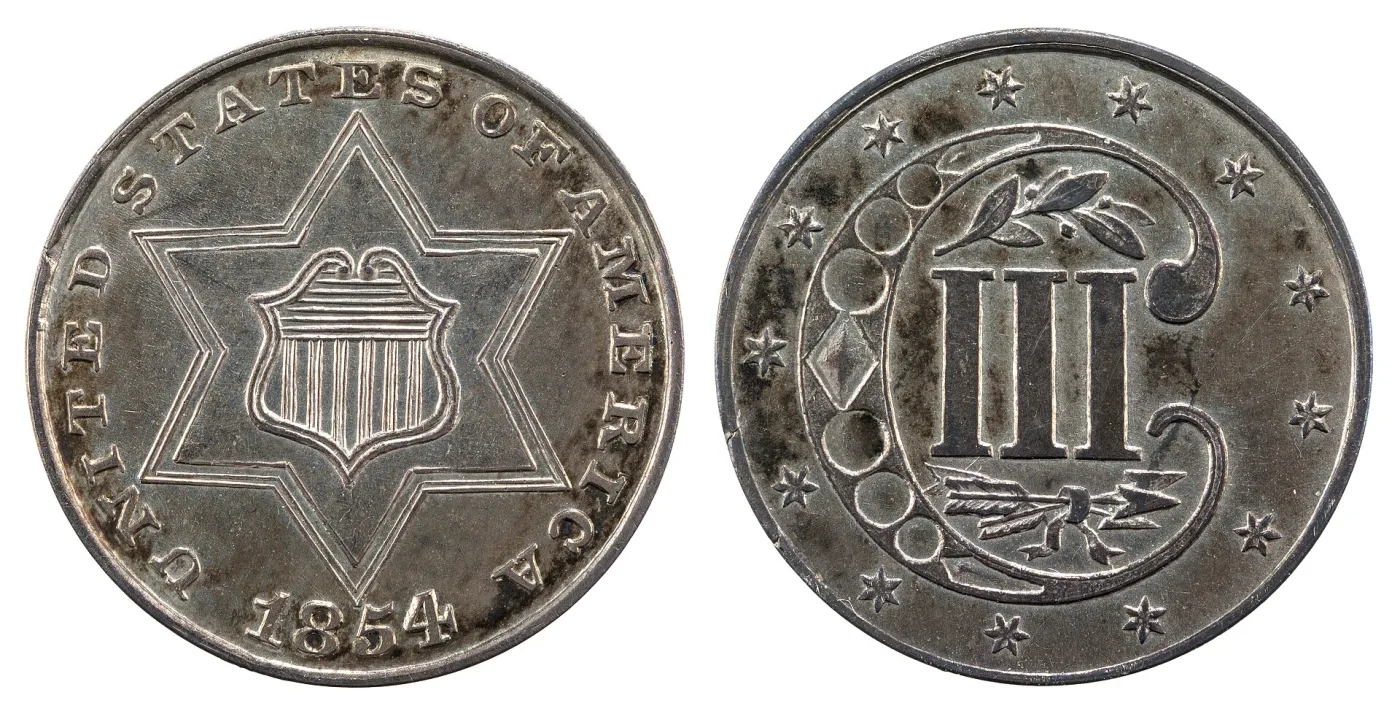
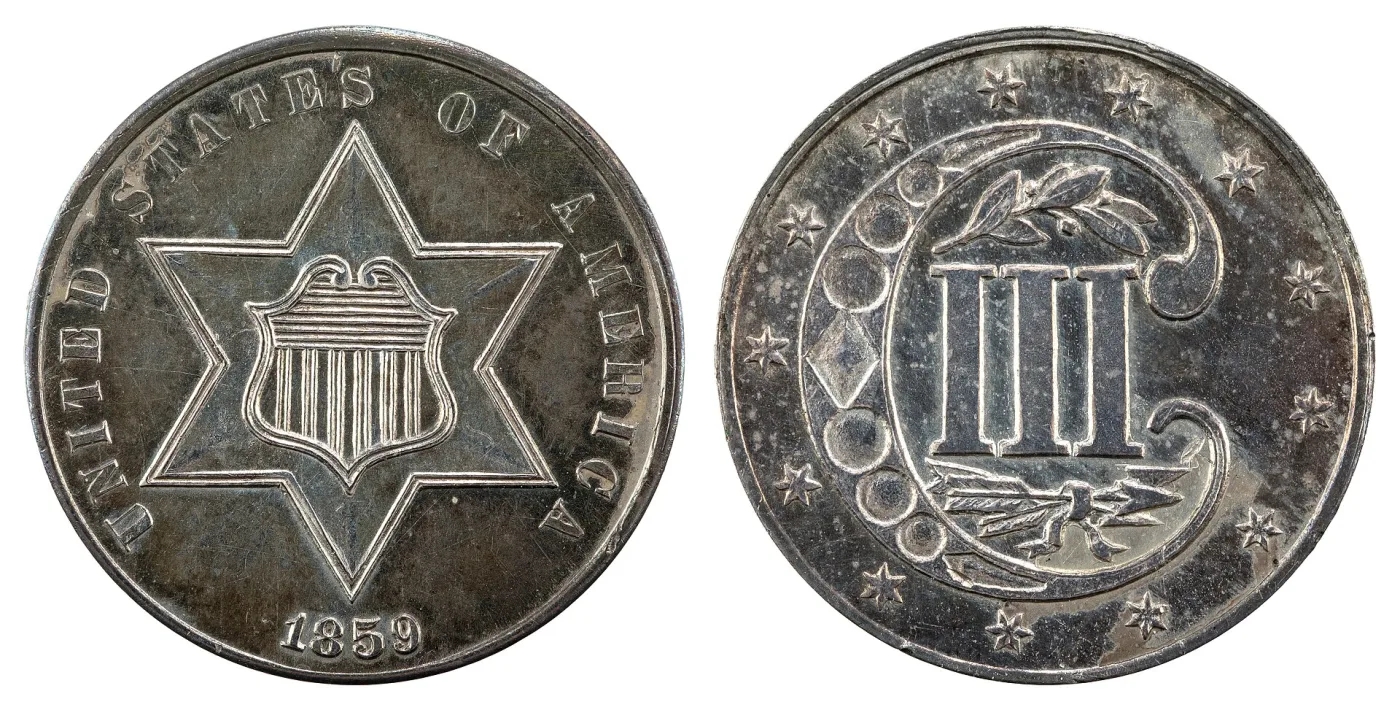
The obverse displays a six-pointed star (a hexagram, sometimes called a Star of David) with a federal shield superimposed at its center. “UNITED STATES OF AMERICA” arcs around the upper rim, and the date appears below. The star design was unique in U.S. coinage and was chosen partly for its visual simplicity at small scale and partly for its associative symbolism — the points of the star can be read as representing the original states or as a heraldic device.
Reverse: Roman Numeral III in Ornamented C
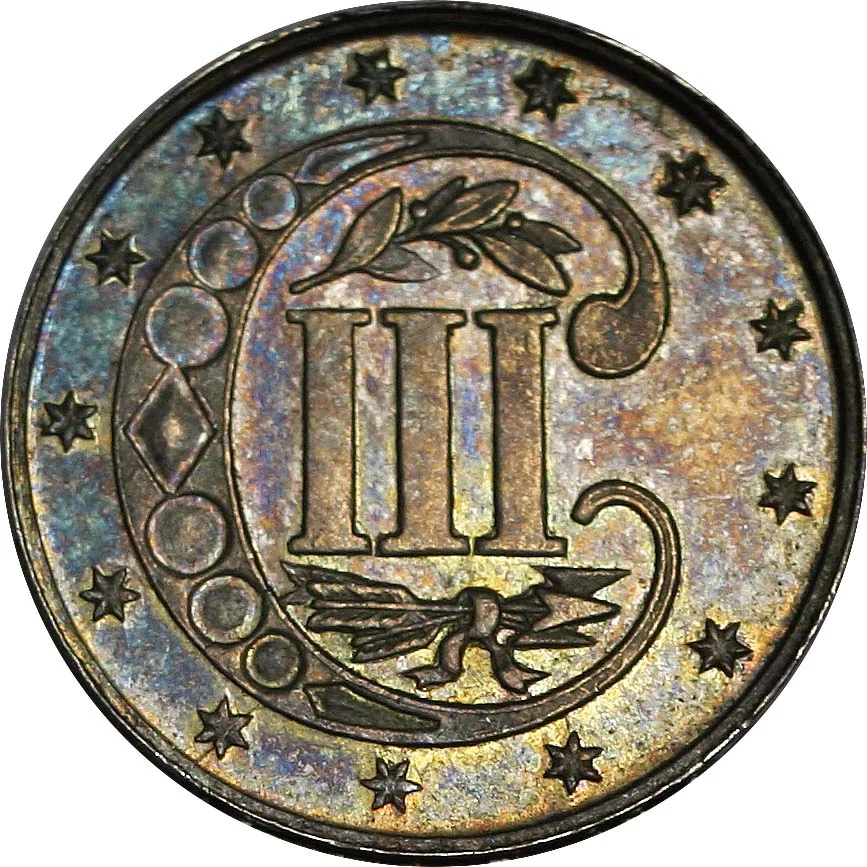
The reverse displays a stylized Roman numeral III enclosed in an ornamented capital letter C (representing “cents”). The C is surrounded by thirteen tiny stars representing the original colonies. There is no other text or design on the reverse — no “UNITED STATES OF AMERICA,” no denomination spelled out, only the Roman numeral and the encircling C with stars.
Three Sub-Types
Within the silver trime series, three distinct sub-types exist, distinguished primarily by the number of outline lines around the star and by the stars on the reverse. These sub-types are covered in detail in their own section below. The Type 1 (1851-1853) is the most common and the standard type-set example.
No Mint Mark Except 1851-O
All silver Three Cent Pieces were struck at the Philadelphia Mint and bear no mint mark, with the single exception of the 1851-O, struck at the New Orleans Mint. The 1851-O is the only U.S. silver coin smaller than a dime ever produced at a branch mint, and it carries a noticeable premium over the Philadelphia issue.
Nickel Three-Cent Design and Symbolism
The nickel Three Cent Piece is also a Longacre design and shares stylistic DNA with his other 1860s work, including the Two Cent Piece and the Shield Nickel — whose reverse ran into the same hard-alloy striking problems and was simplified in 1867, leaving two different 1867 reverses to tell apart.
Obverse: Liberty Head Left
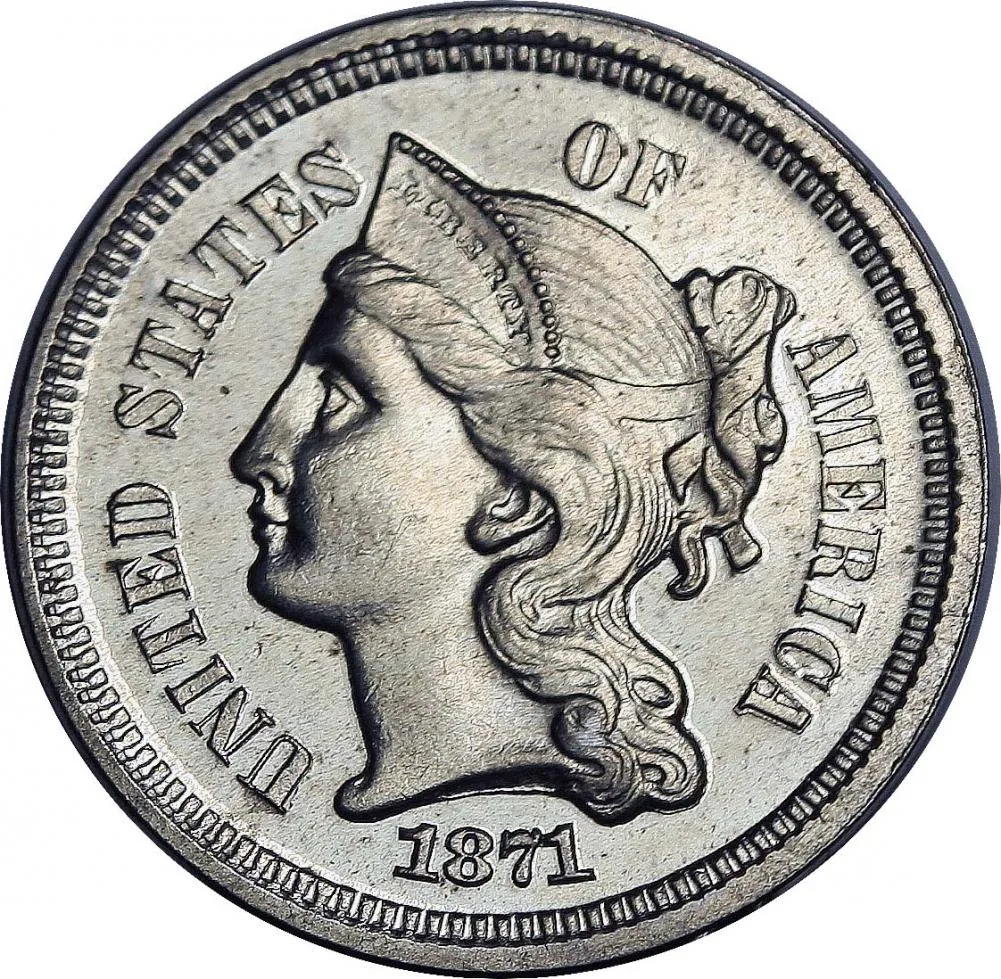
The obverse shows a left-facing portrait of Liberty wearing a coronet inscribed “LIBERTY.” Hair flows back from her face in long, sculpted waves. “UNITED STATES OF AMERICA” arcs around the upper rim, and the date appears below. The portrait is similar in spirit to the head used on Longacre’s gold dollar and Three Dollar Gold piece, but adapted for a smaller copper-nickel canvas.
Reverse: Roman Numeral III in Wreath
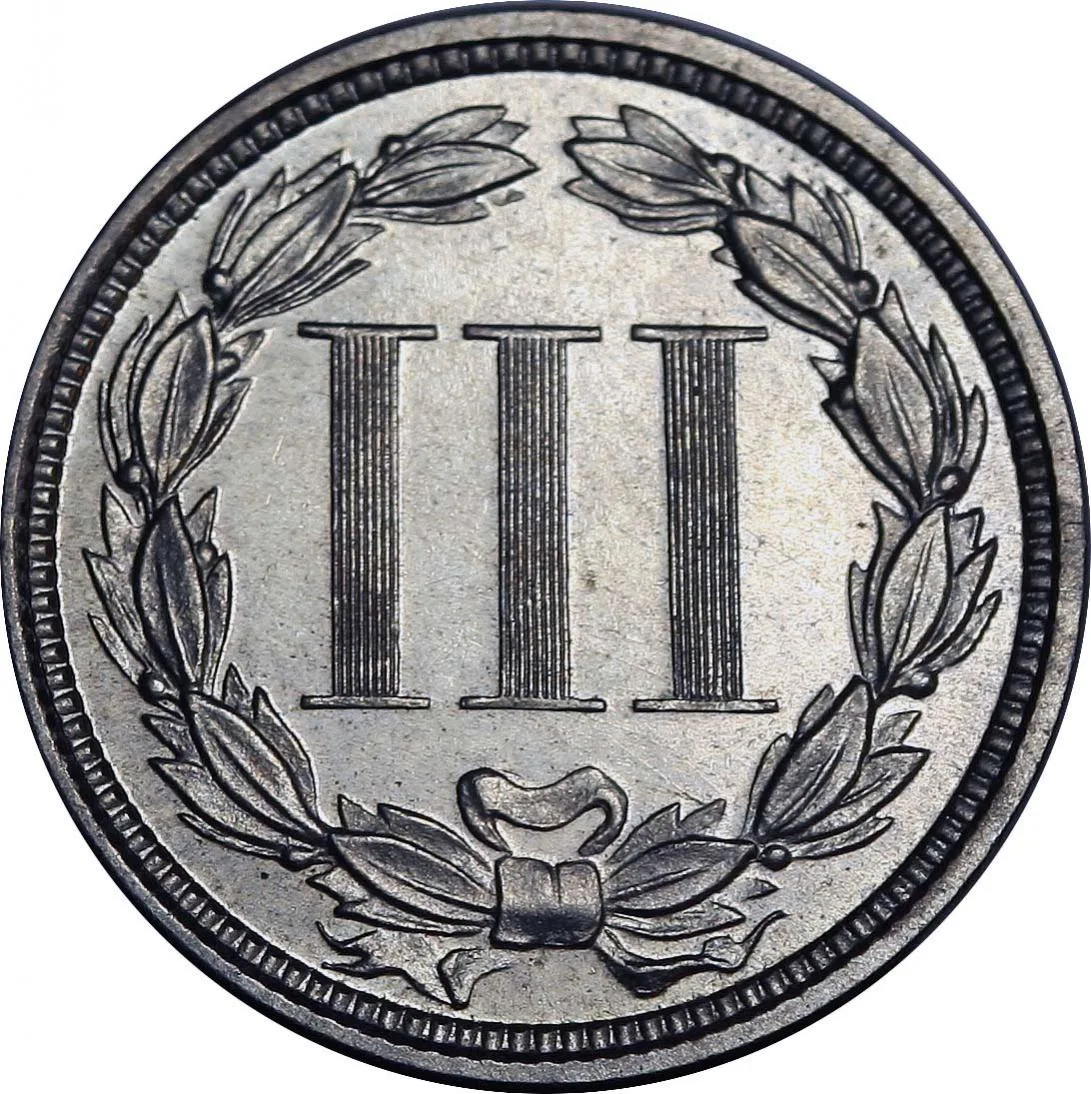
The reverse displays a Roman numeral III centered in an open wreath of laurel and olive leaves tied with a ribbon at the bottom. There is no denomination spelled out and no text other than the numeral. The wreath design is similar in style to the wreath used on the contemporary Indian Head Cent.
No Mint Mark
All nickel Three Cent Pieces were struck at the Philadelphia Mint and bear no mint mark. Branch mints did not produce minor copper-nickel coinage in this era. Any nickel three-cent piece with what appears to be a mint mark is damaged, altered, or counterfeit.
Composition and Physical Specifications
The two versions of the Three Cent Piece could hardly be more different in physical character. Side by side, they look like coins of completely different denominations rather than the same face value.
Silver Trime Specifications
Diameter: 14mm. Weight: 0.80 grams (1851-1853) or 0.75 grams (1854-1873). Edge: plain. Composition: 75% silver / 25% copper (1851-1853), then 90% silver / 10% copper (1854-1873). The 1854 change in composition reduced silver content slightly to align with the contemporary half-dime, dime, and other subsidiary silver pieces. At under one gram, the trime is the lightest U.S. coin ever struck for circulation.
Nickel Three-Cent Specifications
Diameter: 17.9mm. Weight: 1.94 grams. Edge: plain. Composition: 75% copper / 25% nickel — identical to the contemporary Shield Nickel and to most modern five-cent pieces. The thickness is approximately 1.4mm. The coin is essentially dime-sized but distinctly thicker and heavier than the silver trime.
Color and Toning
Silver trimes tone in the patterns typical of subsidiary silver: light gold, rainbow halos, gunmetal blue, and eventually deep gray or black. Original mint white examples are scarce and command premiums. Nickel Three Cent Pieces tone in the muted gray-tan range typical of copper-nickel alloy. Brilliant proof examples can show light champagne or pale yellow toning that adds eye appeal.
How to Identify a Three Cent Piece
The two versions of the Three Cent Piece are easy to distinguish from one another and from all other U.S. coins once you know what to look for.
Step 1: Estimate Size and Weight
Hold the suspected coin in your palm. If it is dramatically smaller than a dime — about the diameter of an eraser on a pencil — and feels almost weightless, it is almost certainly a silver trime. If it is approximately dime-sized but feels distinctly heavier and thicker, it is likely a nickel three-cent. Use a precise scale to confirm: trimes weigh under 1 gram, nickel three-cents weigh just under 2 grams.
Step 2: Check the Color and Surface
A silver coin will show silver-white or natural toning (gold, blue, gray patina). A copper-nickel coin shows a duller gray-tan tone with no warm undertones. Test with a magnet if uncertain — neither metal is magnetic, but a strong magnet test rules out clad or steel impostors.
Step 3: Read the Designs
Silver trime: six-pointed star on obverse with shield in center; Roman numeral III inside an ornamented C on reverse. Nickel three-cent: Liberty Head facing left with coronet on obverse; Roman numeral III in a wreath on reverse. The Roman numeral III on the reverse is the universal identifier for the denomination — no other U.S. coin uses it as the primary expression of value.
Step 4: Confirm the Date
Silver trimes are dated 1851 through 1873. Nickel three-cents are dated 1865 through 1889. Any date outside these ranges is impossible and indicates a counterfeit, fantasy piece, or severe damage. For 1865-1873 dates, the design tells you immediately which version you have.
Step 5: Look for the Mint Mark
The only Three Cent Piece with a mint mark is the 1851-O silver trime, which shows a small “O” on the reverse to the right of the C. Every other Three Cent Piece is from Philadelphia and bears no mint mark. For broader coin identification techniques, see our complete coin identification guide.
Silver Trime Type 1, Type 2, and Type 3
The silver Three Cent Piece exists in three sub-types distinguished by changes to the obverse star outlines and the reverse star configuration. Correct attribution is essential for accurate valuation.
Type 1 (1851-1853)
Type 1 has a single line outlining the six-pointed star on the obverse. The star is “plain” with no extra decoration. The reverse shows the C surrounded by thirteen plain stars with no extra rays or ornamentation. Type 1 is the most common type, with combined mintage exceeding 36 million pieces over three years. Composition is the original 75% silver. The 1851-O falls in this type.
Type 2 (1854-1858)
Type 2 has three lines outlining the star on the obverse, creating a more decorative appearance. An olive sprig was added above the III on the reverse, and a bundle of arrows was added below. The composition shifted to 90% silver in 1854 to align with other subsidiary silver. Type 2 is the scarcest of the three sub-types because mintages dropped sharply during this period — combined mintage was under 4 million pieces over five years.
Type 3 (1859-1873)
Type 3 returned to two lines outlining the star, simplifying the Type 2 design while retaining the olive sprig and arrows on the reverse. The change was driven by die-life issues with the elaborate Type 2 design. Type 3 covers the longest run (15 years) but mintages were small — combined output was under 2 million pieces, with most years producing under 500,000 coins. Type 3 dates from 1863 onward are particularly scarce in circulation grades because most production was reserved for Treasury rather than commerce.
How to Tell the Types Apart
The most reliable diagnostic is to examine the outline of the obverse star under 5-10x magnification. Type 1 shows a single thin line following the star’s outline. Type 2 shows three parallel lines (though on worn examples this may compress to two). Type 3 shows two clear lines. The reverse provides backup confirmation: Type 1 has no olive sprig or arrows around the III, while Type 2 and Type 3 both have these added elements. Date alone does not reliably distinguish Type 2 from Type 3 because the reverse changes are subtle.
Type Premiums
Type 2 commands the highest premium of the three sub-types because of its low overall mintage and short five-year run. A Type 2 in EF can run $150-$300 versus $50-$100 for a comparable Type 1. Type 3 examples are also scarcer than Type 1 in higher grades and command modest premiums in MS-63 and finer.
Silver Trime Date-by-Date Analysis (1851-1873)
Each year of the silver trime series has its own production characteristics and price profile. The Type 1 dates dominate availability; the Type 2 and Type 3 dates increasingly become specialty coins.
1851 and 1851-O
Mintage: Philadelphia 5,447,400; New Orleans 720,000. The 1851-O is the only branch-mint trime ever struck. Values: 1851 Good $25, Fine $40, EF $80, AU $150, MS-63 $300. 1851-O Good $50, Fine $90, EF $200, AU $400, MS-63 $850.
1852 and 1853
Mintage: 1852 — 18,663,500 (the highest of the series); 1853 — 11,400,000. These are the most common dates and the standard Type 1 type-set choices. Values track closely with 1851 Philadelphia.
1854-1858 (Type 2)
1854: 671,000. 1855: 139,000 (the great Type 2 key). 1856: 1,458,000. 1857: 1,042,000. 1858: 1,604,000. The 1855 with its mintage of just 139,000 is the rarest business-strike date of the entire silver trime series. Values: 1855 Good $90, Fine $180, EF $400, AU $700, MS-63 $1,800. Other Type 2 dates Good $40, Fine $70, EF $150, AU $275, MS-63 $700.
1859-1862 (Early Type 3)
1859: 365,000. 1860: 287,000. 1861: 498,000. 1862: 343,000. These dates are scarcer than Type 1 dates but available with patience. Values: Good $35, Fine $60, EF $120, AU $200, MS-63 $475.
1863-1873 (Late Type 3)
Mintages collapsed dramatically: 1863 — 21,000; 1864 — 12,000; 1865 — 8,000; 1866 — 22,000; 1867 — 4,000; 1868 — 3,500; 1869 — 4,500; 1870 — 3,000; 1871 — 3,400; 1872 — 1,000; 1873 — proof only (600). These are nominally circulation strikes but most examples were reserved for collectors and entered commerce only briefly. Most years are difficult to find in any grade. Values: any date 1863-1872 typically runs $700 to $2,000 in mid grades, with the proof-only 1873 being a separate category covered below.

Nickel Three-Cent Date-by-Date Analysis (1865-1889)
The nickel Three Cent Piece had a long run with three distinct mintage phases: heavy production from 1865-1869, moderate production through the 1870s, and proof-only or near-proof-only issues in the 1880s.
1865-1869 (High Mintage Years)
1865: 11,382,000 — the highest mintage of the series and the standard type-set date. 1866: 4,801,000. 1867: 3,915,000. 1868: 3,252,000. 1869: 1,604,000. Values for 1865-1868 in mid grades: Good $15, Fine $20, EF $40, AU $70, MS-63 $175. The 1869 is slightly scarcer but priced similarly.
1870-1876 (Declining Years)
1870: 1,335,000. 1871: 604,000. 1872: 862,000. 1873 Closed 3 and Open 3: combined 1,173,000. 1874: 790,000. 1875: 228,000. 1876: 162,000. Values: 1870-1874 Good $20, Fine $30, EF $60, AU $110, MS-63 $250. 1875 and 1876 Good $30, Fine $50, EF $100, AU $175, MS-63 $400.
1877 and 1878 (Proof Only)
No business strikes were produced in 1877 or 1878. Both years are proof-only with very small mintages: 1877 estimated 510, 1878 estimated 2,350. The 1877 is the most famous key of the series and was struck only in proof for inclusion in collector sets. Values: 1877 PR-63 $4,500, PR-65 $7,500, PR-66 $12,000+. 1878 PR-63 $1,000, PR-65 $1,800, PR-66 $3,200.
1879-1889 (Late Series)
Business strike mintages in the 1880s were tiny: 1879 — 38,000; 1880 — 21,000; 1881 — 1,077,000 (an anomaly — the largest mintage of the decade); 1882 — 22,200; 1883 — 4,000; 1884 — 1,700; 1885 — 1,000; 1886 — proof only; 1887 — 5,001; 1887/6 overdate; 1888 — 36,501; 1889 — 18,125. Most of these are scarce in circulated grades because most examples went directly into Treasury vaults or collector cabinets. Values: 1879-1880 Good $80, Fine $130, EF $200, AU $325, MS-63 $625. 1882-1885 Good $400, Fine $600, EF $900, AU $1,300, MS-63 $2,500. 1886 (proof only) PR-63 $700, PR-65 $1,400. 1887-1889 Good $100, Fine $175, EF $275, AU $400, MS-63 $750.
The 1873 Closed 3 and Open 3 (Nickel)
1873 is unique in the nickel Three Cent series for existing in two distinct logotype varieties — Closed 3 and Open 3 — that originated from a Mint-wide change to the date logotype that year.
The Logotype Change
Early 1873 dies used a logotype with a “3” whose upper and lower curves nearly touched, creating a numeral that could be mistaken for an 8 in worn examples. Mint Director Henry Linderman ordered a redesigned 3 with the curves more widely separated. The change affected several denominations in 1873, including the Indian Head cent, the Two Cent Piece, the silver trime, dime, quarter, and half dollar.
Closed 3 Diagnostics
On the Closed 3, the upper and lower terminations of the 3 are thick and curl inward toward each other, leaving only a small gap that can look almost closed. The character has the heavier appearance of pre-1873 logotypes.
Open 3 Diagnostics
On the Open 3, the upper and lower terminations are thinner and clearly point outward, leaving a wider visible gap between them. The character is taller and more elegant in proportion.
Mintage and Values
Combined 1873 mintage was 1,173,000 with the two varieties roughly equal in survival numbers today. Values: both varieties Good $20, Fine $30, EF $60, AU $110, MS-63 $275. Premiums for one variety over the other are minimal in most grades, but Closed 3 examples in MS-65 and finer are noticeably scarcer than Open 3.
Proof Three Cent Pieces
Both versions of the Three Cent Piece were struck in proof for collector sets throughout their respective series. Proof issues are an important sub-collection.
Silver Trime Proofs
Silver trime proofs were struck in tiny numbers from 1854 onward, with most years producing under 500 examples. The 1873 is proof-only with mintage of approximately 600 pieces. Proof trimes show fully mirrored fields and sharply struck designs, but the small flan size makes high-end proofs difficult to find without contact marks. Values: PR-63 $400-$800; PR-65 $900-$2,500 depending on year. The 1873 proof-only commands $1,500 to $4,000 across grades.
Nickel Three-Cent Proofs
Nickel Three Cent Piece proof mintages range from approximately 600 in early years to over 4,000 in some 1880s issues. The proof-only 1877 and 1878 are the headline issues. Other proof dates are widely available. Cameo and Deep Cameo designations exist and command 50% to 200% premiums depending on year and grade.
Cameo and Deep Cameo
Some proofs show frosted devices contrasting against mirrored fields, designated Cameo (CAM) or Deep Cameo (DCAM, also called Ultra Cameo at NGC). For nickel three-cents, Cameo proofs are most often found in the 1880s issues. For silver trimes, Cameo designation is rare because the small design elements provide limited surface for frosting.
Minor Varieties, Repunched Dates, and Overdates
Both Three Cent Piece series contain numerous minor varieties prized by specialists.
1862/1 Silver Trime Overdate
The 1862/1 silver trime shows clear remnants of a 1 beneath the 2 of the date. The base of the underlying 1 protrudes from the bottom of the 2, visible under 5-10x magnification. Cherrypicker’s Guide attributes this as a major variety. Values: $50 to $200 premium over normal 1862 in mid grades.
1887/6 Nickel Three-Cent Overdate
The 1887/6 overdate shows clear remnants of a 6 beneath the 7 of the date. This is a recognized major variety and can be found in both proof and business strike forms. Values: business strike Good $200, MS-63 $1,200; proof PR-63 $1,500.
Repunched Dates
Repunched dates exist for many years of both series, where the date logotype was punched into the working die more than once at slightly different positions. The most prominent silver trime RPDs are found in the 1851 and 1852 dates. Nickel three-cent RPDs include several in the 1865-1869 high-mintage years. Cherrypicker’s Guide attributes catalog the most significant examples, which trade at $25 to $100 premiums in higher grades.
Doubled Dies
Several doubled die obverses are known for both series. Notable examples include 1858 silver trime DDO and 1873 nickel three-cent DDO. Strong examples bring meaningful premiums in higher grades but are rarely encountered in dealer inventories — most discoveries are made by specialists cherrypicking through dealer stocks.
Die Cracks and Cuds
Late die state examples often show die cracks radiating from rim to interior or through letters. Cuds (raised blobs of metal at the rim from a major die break) are uncommon on both series due to short die life and tight Mint quality control. They trade at modest premiums except for the most dramatic examples.
Grading Three Cent Pieces
Grading Three Cent Pieces requires understanding both the standard Sheldon scale and the series-specific points of wear, which differ substantially between the silver trime and the nickel three-cent.
Silver Trime Key Grading Focal Points
Wear shows first on the highest points of the design: the central shield on the obverse, the points of the star, and the Roman numeral III and surrounding C on the reverse. The state of the shield’s vertical stripes is the single most important indicator of circulated grade — these are the highest points and the first to flatten. Grade descriptions are similar to other small silver coinage.
Nickel Three-Cent Key Grading Focal Points
Wear shows first on Liberty’s hair detail and the coronet inscription, and on the highest points of the wreath leaves on the reverse. The state of “LIBERTY” on the coronet is critical — fully readable LIBERTY indicates Fine or better; partially readable indicates Good to VG. The III on the reverse should remain bold even in low grades.
Grade Descriptions
Good (G-4 to G-6): Outline of design clear with internal detail mostly worn smooth. On trimes, the shield outline is visible but stripes are blurred. On nickel three-cents, LIBERTY is partial or weak.
Very Good (VG-8 to VG-10): Some internal detail visible. On trimes, partial shield stripes are visible. On nickel three-cents, LIBERTY is fully readable but soft.
Fine (F-12 to F-15): Approximately half of design detail visible. Shield stripes on trimes are clear. LIBERTY is sharp on nickel pieces. Wreath leaves show distinct outlines and some internal detail.
Very Fine (VF-20 to VF-35): Most design detail sharp except for the very highest points. All design elements are clearly defined.
Extremely Fine (EF-40 to EF-45): All design details sharp with only slight wear on the highest points: shield stripes on trimes, hair detail on nickel pieces. Mint luster may remain in protected areas.
About Uncirculated (AU-50 to AU-58): Traces of wear only on the highest points. AU-58 examples appear nearly uncirculated with only slight friction breaks in the luster.
Mint State (MS-60 to MS-70): No wear. Differentiation is by surface preservation, luster quality, and strike sharpness. Strike quality is a major issue for silver trimes — many Mint State examples show weakness on the central shield from inadequate die pressure on the small flan. Look for sharply struck shield stripes when paying premium prices for Mint State trimes. Compare with the grading approach used for the Shield Nickel and Liberty Head V Nickel, which use similar copper-nickel grading principles.
Counterfeit Detection and Authentication
While Three Cent Pieces are not as heavily counterfeited as gold or premium silver coins, the 1851-O, 1855, 1877, 1878, and the late silver trime dates are frequent targets, and even common dates in high grade may be problem coins.
Date Alterations
The most common counterfeit method on silver trimes is altering a common 1851 Philadelphia to mimic a scarce 1851-O by adding a tooled “O” mint mark to the reverse. Examine the area to the right of the C under 10x magnification: tooling marks appear as fine scratches around the added letter, and the O often has subtly wrong proportions or position compared to genuine 1851-O coins. Always compare against known authentic photos.
For the nickel series, the 1877 is sometimes faked from an altered 1872 or 1875 by tooling the final digits. Compare the second numeral of the date carefully against authentic examples.
Cast Counterfeits
Cast counterfeits exist for valuable dates of both series. Diagnostic features include slightly fuzzy detail throughout, incorrect weight (usually too light), pitted or grainy surfaces under magnification, and visible mold seams on the plain edge. Color is often subtly wrong — too gray, too uniform, or oddly mottled.
Modern Replicas
Modern silver-plated brass and nickel-plated zinc replicas of trimes and nickel three-cents are widely sold as souvenirs and for educational use. U.S. law since 1973 requires reproductions to be marked “COPY,” but earlier replicas may not be marked. Any coin lacking proper silver or nickel color, weighing significantly off, or showing details that look “perfect” in a way that real circulated coins never do should be regarded with suspicion.
Professional Authentication
For any silver trime worth more than $200 to $300 or any nickel Three Cent Piece worth more than $300 to $400, professional authentication by PCGS or NGC is strongly recommended. Certified holders provide authentication, an objective grade, and tamper-evident encapsulation. The same authentication principles apply to other small silver coinage and to early copper-nickel coins like the Flying Eagle Cent.
Current Market Values by Date and Grade
Three Cent Piece values vary by version, type, date, and grade. The following are typical 2026 retail ranges for properly graded coins.
Silver Trime Common Dates (1851 P, 1852, 1853)
Good: $25 to $35. Very Good: $30 to $45. Fine: $40 to $60. Very Fine: $50 to $75. EF: $80 to $130. AU: $150 to $250. MS-63: $300 to $500. MS-65: $700 to $1,400.
Silver Trime Type 2 Dates (1854-1858)
1855 (key date): Good $90, Fine $180, EF $400, AU $700, MS-63 $1,800, MS-65 $4,500. Other Type 2 dates: Good $40, Fine $70, EF $150, AU $275, MS-63 $700, MS-65 $1,800.
Silver Trime Type 3 Dates (1859-1873)
Early Type 3 (1859-1862): Good $35, Fine $60, EF $120, AU $200, MS-63 $475, MS-65 $1,200. Late Type 3 (1863-1872): typically $700 to $2,500 across mid grades; condition rarities can exceed $5,000 in MS-65.
Nickel Three-Cent Common Dates (1865-1873)
Good: $15 to $25. Fine: $20 to $35. EF: $40 to $80. AU: $70 to $130. MS-63: $175 to $300. MS-65: $400 to $900.
Nickel Three-Cent Mid-Series (1874-1881)
Good: $20 to $40. Fine: $30 to $60. EF: $60 to $120. AU: $110 to $200. MS-63: $250 to $475. MS-65: $700 to $1,500. The 1881 is anomalously common; other dates in this range are scarcer.
Nickel Three-Cent Late Series (1882-1889)
Most dates: Good $80 to $400, MS-63 $625 to $2,500. The 1885 is the toughest business-strike key with mintage of only 1,000 pieces.
Key Dates and Major Varieties
1851-O silver trime: $50 to $850+ across grades. 1855 silver trime: $90 to $4,500+. 1877 nickel proof-only: $4,500 to $12,000+. 1878 nickel proof-only: $1,000 to $3,200. 1885 nickel: $400 to $2,500. 1862/1 trime overdate: $50-$200 premium. 1887/6 nickel overdate: $200 to $1,500.
Market Trends
Both Three Cent Piece markets have been steady to slightly rising over the past decade. Type set demand drives common-date prices, while specialist demand drives the keys. Silver trimes have seen particularly strong demand for Type 2 examples as the small Type 2 mintage becomes better understood by general collectors. Nickel three-cent proofs have appreciated steadily as the 1877 and 1878 anchor any complete proof-only collection.
Collecting Strategies and Tips
Three Cent Pieces support several collecting approaches at different budget levels, and the existence of two completely different versions makes the denomination unusually flexible.
Type Coin Collection
The most common approach is to acquire one example of each major type for a U.S. type set: a Type 1 silver trime (1851-1853), a Type 2 silver trime (1854-1858), a Type 3 silver trime (1859-1862), and a nickel three-cent (1865-1876). In EF or AU grades, the four-coin type set can be assembled for $400 to $800. In MS-63 RB or BU equivalents, budget $1,500 to $3,000.
Complete Date Set — Silver Trime
A complete date set of silver trimes (1851 P, 1851-O, 1852, 1853, 1854, 1855, 1856, 1857, 1858, 1859, 1860, 1861, 1862, 1863, 1864, 1865, 1866, 1867, 1868, 1869, 1870, 1871, 1872, 1873) is genuinely difficult because of the late-date scarcity. In mixed grades excluding the late dates, $2,000 to $4,000. Complete with all late dates in any grade, $15,000 to $30,000+.
Complete Date Set — Nickel Three-Cent
A complete date set of nickel three-cents (1865-1889) including both 1873 varieties is more achievable. In mixed circulated grades excluding 1877 and 1885, $1,500 to $3,000. Adding the 1877 proof and 1885 business strike adds $5,000 to $10,000. A complete date set in collector grade is therefore achievable for $7,000 to $13,000.
Variety and Cherrypicking
Both series reward cherrypicking. Repunched dates, overdates, and doubled dies are scattered throughout dealer stocks of common-date material. With patience, attribution knowledge, and a 10x loupe, finds in the $50 to $500 value range can be made for the cost of a common-date coin. The Cherrypicker’s Guide is the essential reference.
Proof-Only Strategy
Some collectors pursue only the proof-only issues from each series — the 1873 silver trime, the 1873-1873 proof nickel three-cents, and especially the 1877 and 1878 proof-only nickel keys. This focused approach yields a small but historically meaningful collection that can be displayed in a single page and that anchors any future U.S. type or proof set.
Proper Storage and Preservation
Both versions of the Three Cent Piece have specific storage requirements. The silver trime is particularly delicate due to its tiny size and fineness.
Avoid PVC and Sulfur
Never store Three Cent Pieces in PVC-containing flips or albums. PVC releases hydrochloric acid over time, which causes a green slime on silver and copper-nickel surfaces that is permanent and value-destroying. Use Mylar flips, inert hard plastic capsules, or original holders from grading services. Avoid paper envelopes containing sulfur (most older brown 2x2 envelopes), which causes uneven gray-black toning and can permanently destroy original surfaces.
Humidity Control
Store coins in a cool, dry environment with stable humidity below 50%. Silica gel packets in your storage area help absorb moisture. Avoid attics, basements, garages, and rooms with temperature swings. Sudden humidity changes can cause condensation that leads to spotting on silver and corrosion on copper-nickel.
Handling — Especially Trimes
Always hold Three Cent Pieces by their edges, but be especially careful with silver trimes — at 14mm they are easy to drop, lose, or accidentally squeeze too tightly. Use clean cotton or nitrile gloves when handling Mint State or proof examples. Work over a soft padded surface, and consider working over a tray with raised edges to catch a dropped trime before it reaches the floor.
Never Clean
Cleaning a Three Cent Piece destroys both natural toning and microscopic surface detail, and cleaned coins receive “details” grades from third-party services with 30% to 70% discounts compared to original-surface examples. Even a coin that looks dark or unattractive is worth more in its natural state than after a chemical or abrasive cleaning. The same warning applies to all early U.S. silver and copper-nickel coins.
Frequently Asked Questions
What is a "trime"?
"Trime" is the universal collector nickname for the silver Three Cent Piece struck from 1851 to 1873. The term combines "three" with the suffix used for "dime" and was in use within months of the coin's introduction. It distinguishes the silver three-cent from the later copper-nickel three-cent, which is usually called a "nickel three-cent" or "three-cent nickel" but never a trime.
Why are there two different Three Cent Pieces?
The silver trime (1851-1873) was introduced to match the new three-cent first-class postage rate. The nickel three-cent (1865-1889) was introduced as a Civil War coinage measure when silver had vanished from circulation. The two coins ran in parallel for nine years (1865-1873), then the trime was abolished by the Coinage Act of 1873. The nickel piece survived until 1890.
How can I tell Type 1, Type 2, and Type 3 silver trimes apart?
Examine the outline of the obverse star under 5-10x magnification. Type 1 (1851-1853) shows a single line outlining the star. Type 2 (1854-1858) shows three parallel lines. Type 3 (1859-1873) shows two clear lines. Type 1 also lacks the olive sprig and arrows that surround the III on the reverse of Type 2 and Type 3.
What is the rarest silver trime?
For business strikes, the 1855 is the rarest with mintage of 139,000 pieces. For circulation strikes available to collectors, the late Type 3 dates 1867 (mintage 4,000) and 1872 (mintage 1,000) are dramatically rarer than 1855 in survival but trade in roughly the same value range due to lower demand. The 1873 is proof-only and is therefore a separate category.
What is the rarest nickel Three Cent Piece?
The 1877 is the most famous key with proof-only mintage of approximately 510 pieces. The 1885 has the lowest business-strike mintage at 1,000 pieces. The 1878 proof-only is also a key date despite its higher mintage of 2,350. Among non-proof-only dates, the 1882-1884 issues are all very scarce in any grade.
Are Three Cent Pieces silver or nickel?
Both. The 1851-1873 issues are 75% silver (1851-1853) or 90% silver (1854-1873). The 1865-1889 issues are 75% copper / 25% nickel — the same alloy as the contemporary Shield Nickel. The 1865-1873 overlap years contain both kinds of Three Cent Piece, distinguished by size, weight, color, and design.
Can I find Three Cent Pieces in circulation today?
No. Both versions have been out of circulation for well over a century. All surviving examples are in collections, dealer inventories, or estate holdings. They are commonly available through coin dealers, auctions, and online numismatic marketplaces.
Should I clean a dark or dirty Three Cent Piece?
Never clean a Three Cent Piece. Cleaning removes original surface and natural toning, leaves microscopic scratches, and dramatically reduces the coin's value. Cleaned coins identified by grading services receive "details" grades and sell at significant discounts. Even unattractive original-surface coins are worth more than cleaned examples of the same technical grade.
What replaced the Three Cent Piece?
Neither version was directly replaced. The trime's role was already partly filled by the nickel three-cent before 1873, and after 1890 the three-cent denomination simply disappeared from U.S. coinage. Postage rate changes had reduced the practical justification for the denomination, and the dime, nickel, and cent absorbed its small-change function.