Twenty Cent Piece Identification Guide: 1876-CC, Key Dates, Mint Marks, and Values
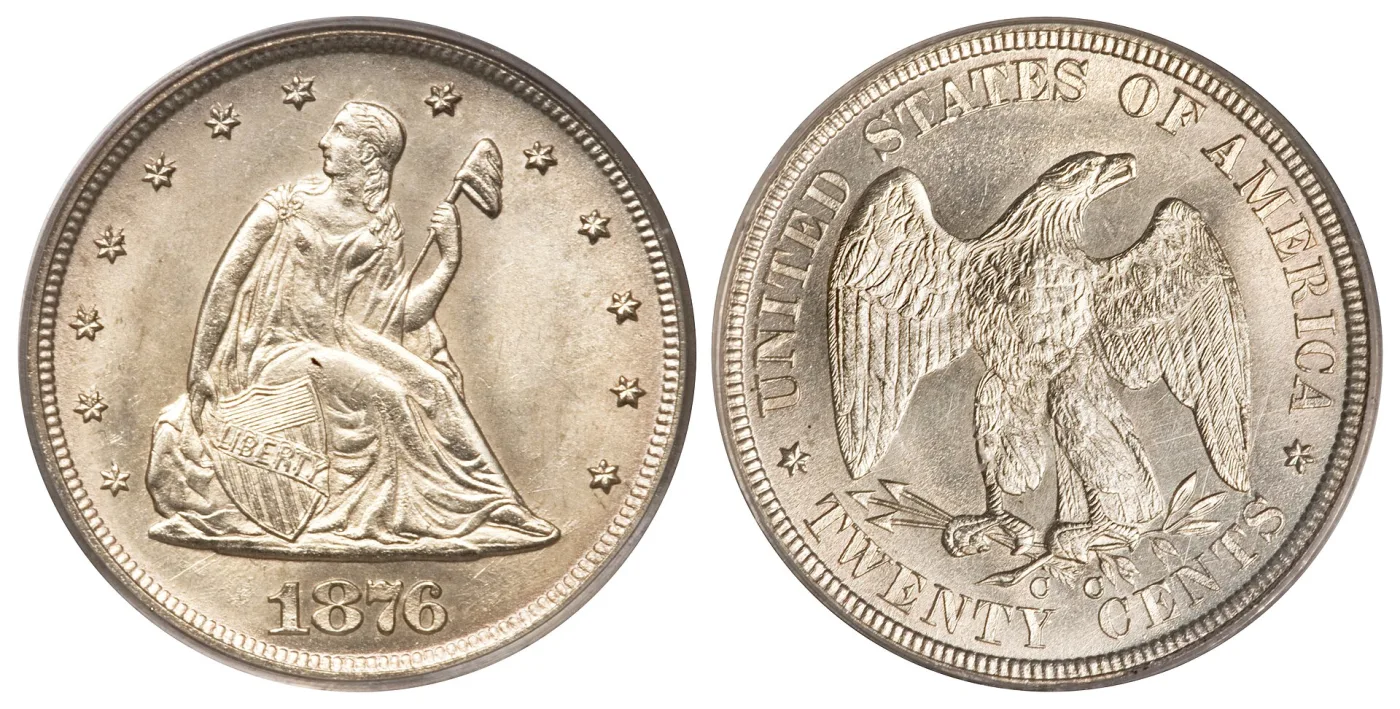
The Twenty Cent Piece is one of the shortest-lived and most controversial denominations in United States coinage history. Struck for circulation only in 1875 and 1876 — and only as proofs in 1877 and 1878 — the entire series spans just four years and a single design. The coin was a commercial failure from the moment it entered circulation, dismissed by the public as too similar to the contemporary Seated Liberty Half Dollar and quarter, mocked by editorial cartoonists, and abolished by Congress almost as quickly as it had been authorized.
Yet for the modern collector, the Twenty Cent Piece is one of the most appealing short-set series in American numismatics. The four business-strike issues — 1875, 1875-S, 1875-CC, and 1876 — plus the legendary 1876-CC rarity and the proof-only 1877 and 1878 issues, form a complete and coherent set that can be displayed in a single page of any standard album. The series contains one of the great rarities of U.S. silver coinage in the 1876-CC, several genuinely scarce dates, a single design with no major sub-types to confuse new collectors, and a price ladder that runs from a few hundred dollars for a common 1875-S all the way to seven-figure auction results for the 1876-CC.
This guide covers everything needed to identify, attribute, grade, authenticate, and value Twenty Cent Pieces in the 2026 market. You will learn how William Barber’s Liberty Seated obverse differs from the Christian Gobrecht versions on the dime through dollar, how to distinguish a Twenty Cent Piece from the contemporary Trade Dollar and Seated Liberty quarter at a glance, how to read the smooth (plain) edge that uniquely identifies this denomination, how to authenticate a 1876-CC against the many altered-mintmark counterfeits in circulation, and how to price every issue accurately. Whether you are completing a U.S. type set, building a four-coin business-strike date run, or chasing the elusive 1876-CC, this guide is the comprehensive 2026 reference for one of the strangest experiments the United States Mint ever attempted.
History and Background of the Twenty Cent Piece
The Twenty Cent Piece was authorized by the Act of March 3, 1875, the same legislative session that produced several of the late nineteenth century’s most consequential coinage decisions. The denomination was the brainchild of Senator John Percival Jones of Nevada, a silver-mining baron who saw the new coin as a way to expand demand for Western silver and, simultaneously, to address a peculiar problem of small change in the trans-Mississippi West, where the Spanish colonial real had been displaced from circulation only a generation earlier.
In the West of 1875, the smallest paper currency in regular use was the quarter dollar’s silver counterpart in commerce, but Western states had a chronic shortage of small-change coins below the quarter — there were few half-dimes (the half-dime had been abolished by the Coinage Act of 1873) and few dimes circulating freely. Customers tendering a quarter for a fifteen-cent purchase frequently received only a dime in change, since merchants commonly rounded the missing five cents up rather than down. The Twenty Cent Piece was meant to provide a coin that, combined with a nickel, would make exact change for fifteen-cent and twenty-five-cent transactions and reduce the rounding losses that disproportionately affected working customers in mining and agricultural communities.
The Mint’s Reluctance
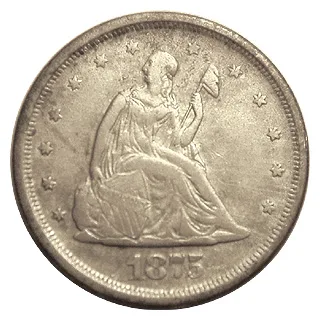
Mint Director Henry Linderman was openly skeptical of the new denomination from the beginning. He believed the coin would be confused with the quarter and refused to authorize a substantially different design. The compromise was William Barber’s Liberty Seated obverse, identical in style to the contemporary half dollar and quarter, paired with a heraldic eagle reverse that resembled the Trade Dollar’s reverse rather than the Seated coinage’s standard reverse. The denomination was rendered as “TWENTY CENTS” rather than as a numeral, and the edge was made plain (smooth) rather than reeded — these two features were the principal physical differences from the quarter.
Authorization and First Strikes
Production began at all three operating mints — Philadelphia, San Francisco, and Carson City — in the spring of 1875. The Philadelphia issue was modest; the San Francisco issue was the largest of the entire series; the Carson City issue was small but immediately important to local Nevada commerce. By summer, the new coins were circulating throughout the West and tentatively appearing in Eastern commerce.
Public Rejection
The public rejected the denomination almost immediately. Customers and merchants confused the Twenty Cent Piece with the quarter, especially in low light or when handling several coins by feel. Editorial cartoonists ridiculed the coin. By late 1875 the Mint was already considering abandoning the program, and the 1876 mintage was sharply curtailed. By 1877, no business strikes were produced at all — only small proof issues for collectors. The denomination was officially abolished by the Act of May 2, 1878.
Why the Twenty Cent Piece Failed
Understanding why the Twenty Cent Piece failed in commerce illuminates several diagnostic features of the coin and explains why it has the survival profile and key-date structure that modern collectors encounter.
Confusion with the Quarter
The Twenty Cent Piece was 22mm in diameter against the quarter’s 24.3mm — a difference of just 2.3mm, or less than a tenth of an inch. By weight, the Twenty Cent Piece was 5.0 grams against the quarter’s 6.25 grams, a difference real but not obvious in pocket handling. Both coins were 90% silver. Both shared the same Liberty Seated obverse. The principal day-to-day diagnostic — the plain edge versus the reeded edge of the quarter — required a deliberate inspection that few merchants or customers bothered to perform.
Redundant Function
The original justification for the denomination — making exact change for fifteen-cent transactions — assumed that fifteen-cent prices were common enough to require their own coin. In practice, by 1875 most retail transactions had moved to multiples of five cents or to dollar-fraction prices that were easily made up with a quarter and a nickel. A Twenty Cent Piece plus a nickel exactly equalled a quarter, but so did just a quarter — and the quarter was already in every drawer.
Western Silver Politics
The denomination’s political origin in the silver-mining West made it suspect in Eastern commercial circles, where many bankers and merchants viewed any new silver coin as part of a broader inflationary scheme. The same political dynamic that produced the controversial Trade Dollar produced the Twenty Cent Piece, and the two coins shared in the public’s growing distrust of late-nineteenth-century federal silver policy.
Implications for Collectors
The combination of public rejection and rapid abolition produced a series with extremely small mintages outside of the 1875-S, very high survival rates among proofs (most never circulated), and the famous 1876-CC rarity (most of which was melted under Mint orders). Counterfeits, altered mint marks, and date alterations are all important authentication issues precisely because of these tiny mintages.
Design and Symbolism
William Barber’s Twenty Cent Piece design draws heavily on the existing Seated Liberty coinage but introduces several distinctive features that set it apart.
Obverse: Liberty Seated
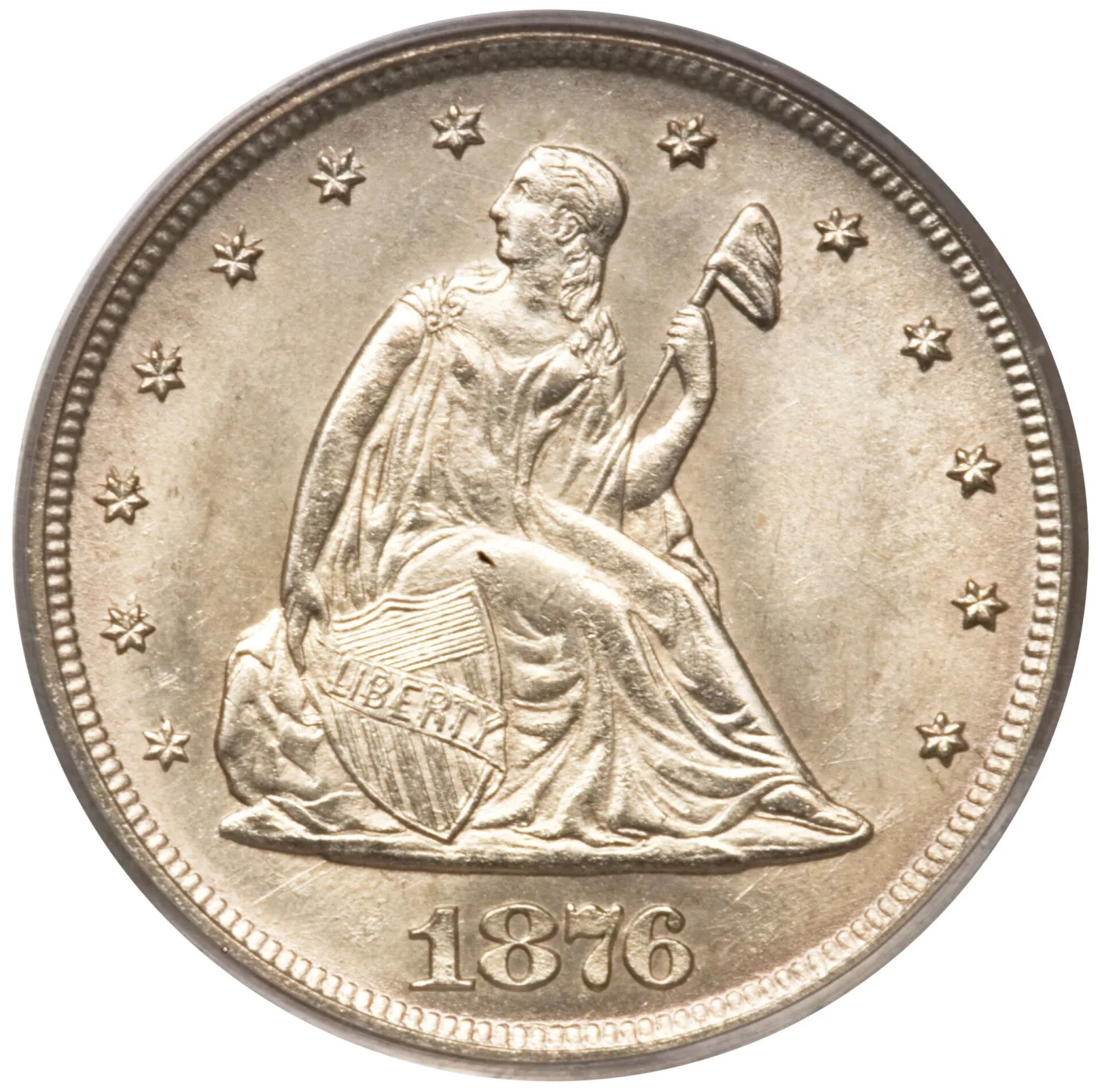
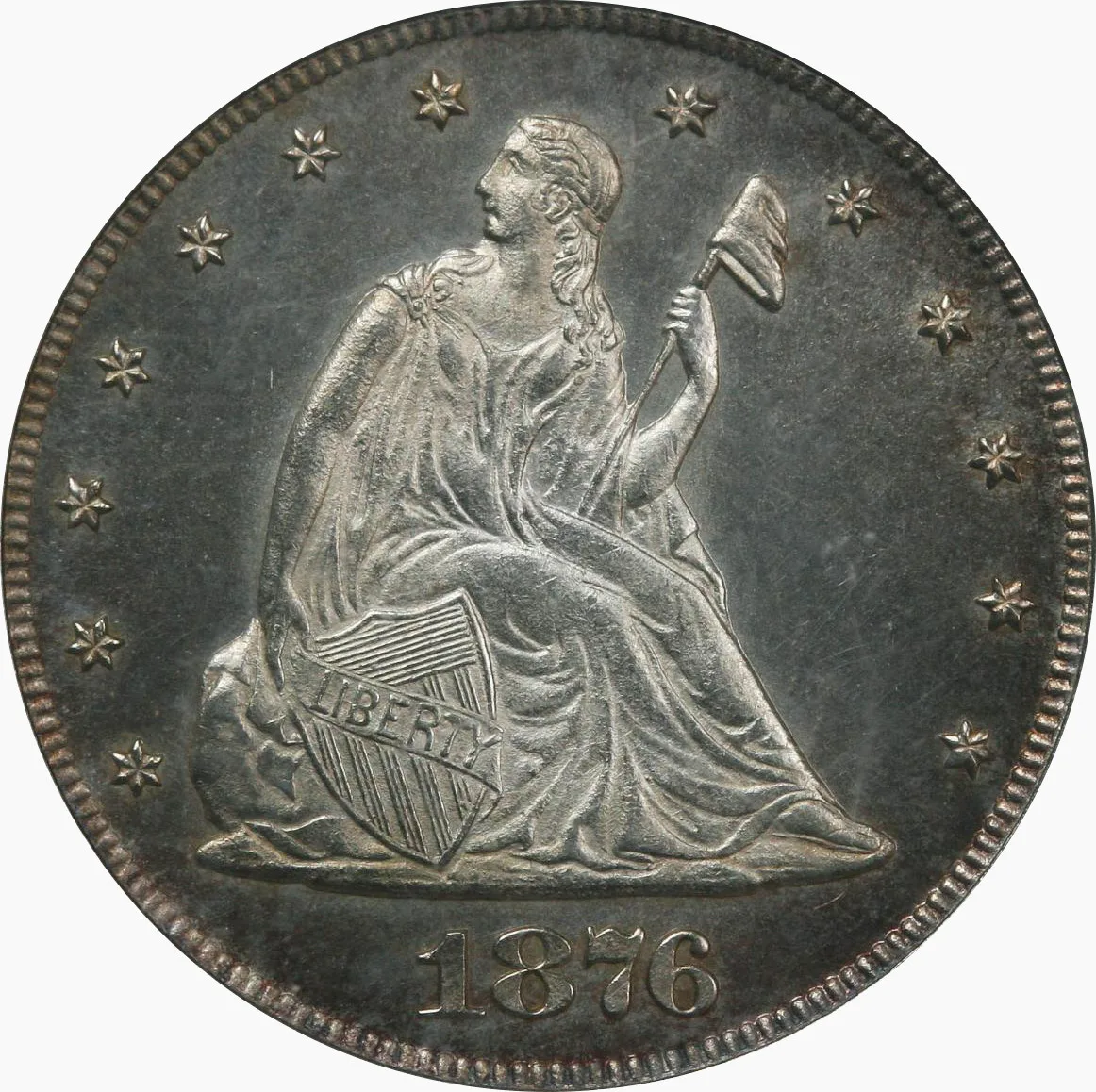
The obverse depicts Liberty seated on a rock, holding a Liberty pole topped with a Phrygian cap in her left hand and a federal shield with her right. The shield is inscribed “LIBERTY” on a curved scroll. Thirteen stars surround Liberty, representing the original colonies. The date appears at the bottom. The design is essentially the Christian Gobrecht obverse used on the dime, quarter, half dollar, and dollar throughout the era, slightly recut by Barber for the smaller flan.
Reverse: Heraldic Eagle
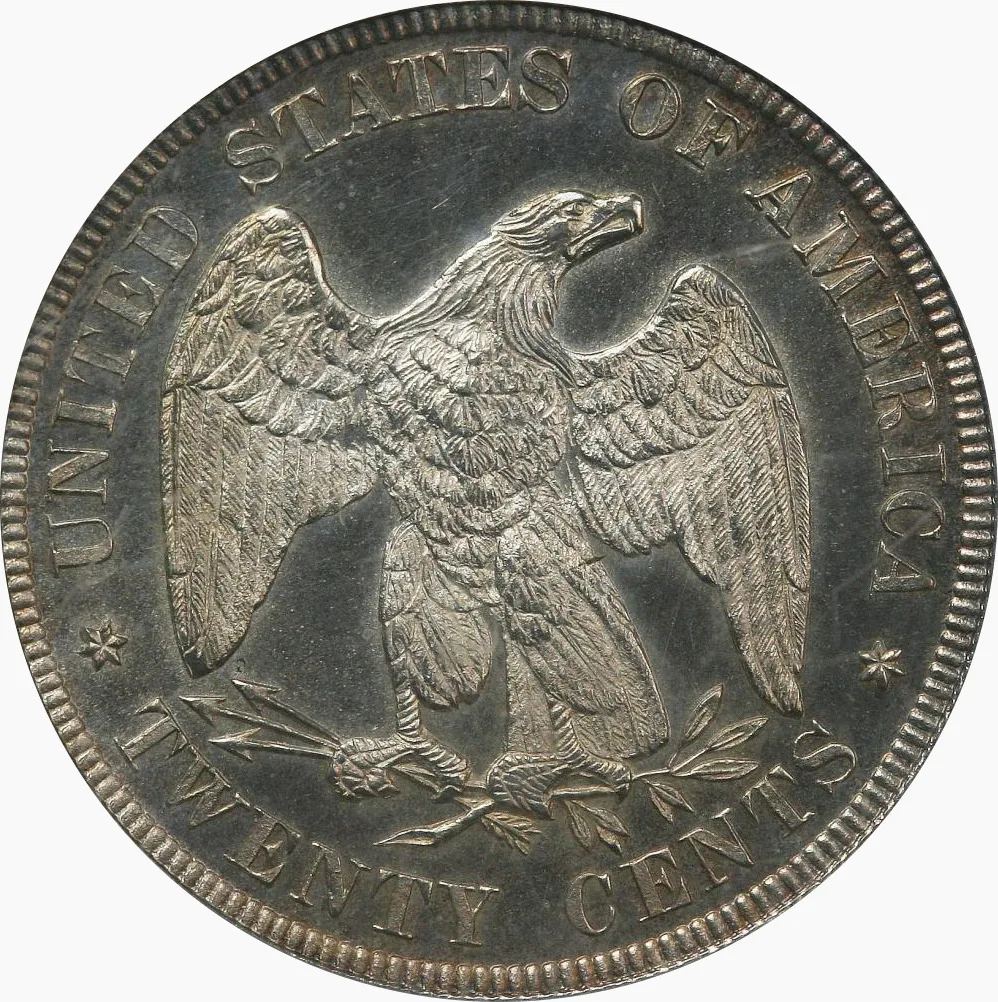
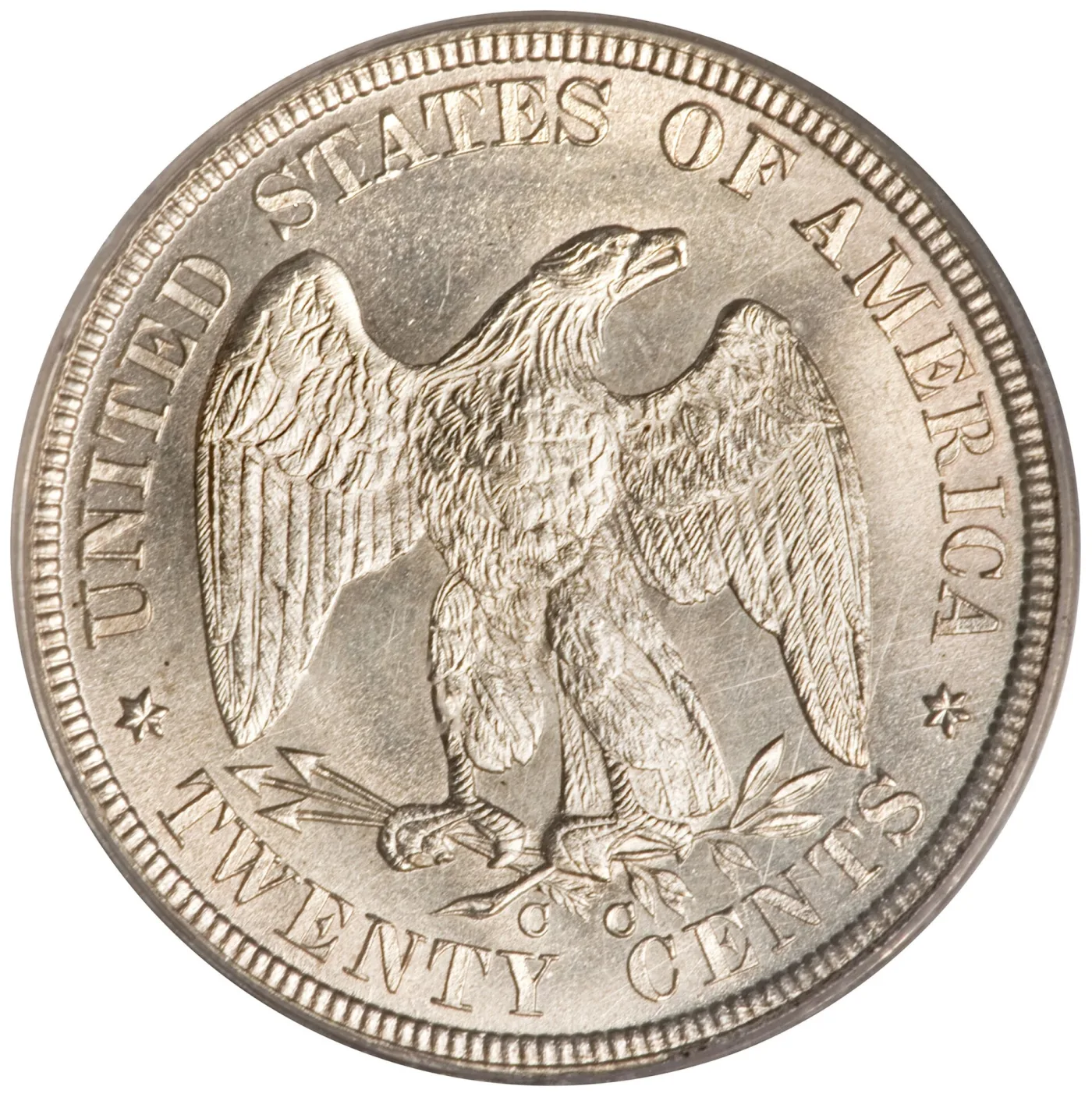
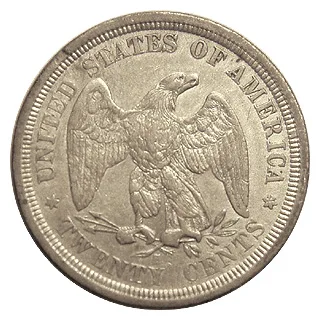
The reverse displays a heraldic eagle facing left, wings spread, holding three arrows in the right talon and an olive branch in the left. The denomination “TWENTY CENTS” appears in the lower portion of the reverse — uniquely spelled out in words rather than as a numeral. “UNITED STATES OF AMERICA” arcs around the upper rim. A single six-pointed star sits in the field on each side of the eagle, roughly level with the wingtips, filling the gap between the ends of the legend above and the denomination below; there are no rays. The reverse is reminiscent of the contemporary Trade Dollar reverse, which was also a William Barber design.
Edge: Plain (Smooth)
The Twenty Cent Piece has a plain (unreeded, smooth) edge. This is the single most diagnostic feature for distinguishing it from the contemporary Seated Liberty quarter, which has a reeded edge. The plain edge was a deliberate Mint choice intended to provide tactile differentiation, but it was inadequate to overcome the visual similarity of the two denominations in commerce.
Mint Mark Position
Mint marks for branch-mint issues appear on the reverse, below the eagle and centered above the gap between “TWENTY” and “CENTS” — not out at the start of the legend. This is a different position from contemporary Seated coinage and is one of the diagnostic features for authentication. The mint mark is small and can be soft or partially absent on weakly struck examples.
Composition and Physical Specifications
The Twenty Cent Piece’s specifications were carefully calibrated to fit between the dime and the quarter on weight basis while respecting the standard 90% silver alloy used across all U.S. silver coinage of the period.
Specifications Summary
Diameter: 22.0mm. Weight: 5.0 grams. Edge: plain (unreeded). Composition: 90% silver / 10% copper. Net silver content: 0.1447 troy ounces (4.5 grams). Designer: William Barber. Thickness works out at roughly 1.3mm, and it is worth being clear that this is not a diagnostic: spread 5.0 grams of 90% silver across a 22.0mm disc and 6.25 grams across a 24.3mm one and the two come out within a tenth of a millimetre of each other. The quarter’s extra weight went into diameter, not thickness, which is part of why the two coins felt so alike in a pocket. Your fingers can use the plain edge; they cannot use the profile.
Why the Plain Edge?
The plain edge was the only major physical concession to the quarter-confusion problem. Reeded edges were standard on subsidiary silver as a deterrent against shaving (the practice of scraping silver from coin edges). The Mint was willing to accept a small theoretical shaving risk on the Twenty Cent Piece in exchange for a tactile diagnostic. In practice, the plain edge was difficult to detect through fabric pockets or when handling stacked coins, and it did little to reduce confusion with the reeded quarter.
Toning and Surface Characteristics
Twenty Cent Pieces tone in the patterns typical of subsidiary silver: light gold halos, rainbow toning around the rim, gunmetal blue, and eventually deep gray on long-stored examples. The 1875-S issue, struck in large numbers and widely circulated in the West, frequently shows attractive original toning with gold and blue around peripheries. Original mint white examples are scarce and command premiums for type-coin demand.
Strike Quality
Strike quality varies dramatically across the series. The 1875 Philadelphia and 1875-CC are usually well struck. The 1875-S is the most commonly weakly struck issue, with frequent flatness on the eagle’s central feathers and on Liberty’s head. The 1876 Philadelphia is typically sharp, reflecting the small mintage and careful production. The proof-only 1877 and 1878 are exceptionally sharp on all design elements, as expected of proof issues from this era.
How to Identify a Twenty Cent Piece
Identifying a Twenty Cent Piece is straightforward once you know what to look for, but the visual similarity to the Seated quarter trips up many new collectors and even some experienced dealers when scanning a tray of mixed silver.
Step 1: Read the Reverse
The reverse is the fastest diagnostic. If the coin shows a heraldic eagle with wings spread and the words “TWENTY CENTS” spelled out below, it is a Twenty Cent Piece. If the reverse instead shows “QUAR. DOL.” or “QUARTER DOLLAR,” it is a quarter. The Seated dime shows “ONE DIME” in a wreath with no eagle. The Seated half dollar shows a heraldic eagle but reads “HALF DOL.” The Seated dollar shows a heraldic eagle and reads “ONE DOL.” Reading the reverse denomination is the single most reliable identifier.
Step 2: Check the Edge
Hold the coin with the edge toward you and look at it under good light. A smooth (plain) edge confirms a Twenty Cent Piece. A reeded edge with parallel ridges confirms a quarter, half dollar, or dollar. The plain edge is unique among Seated silver denominations of this size and serves as a backup confirmation when the reverse is worn or obscured.
Step 3: Confirm the Date
Twenty Cent Pieces are dated 1875, 1876, 1877, or 1878 only. Any other date is impossible. The four-year date range is one of the easiest to memorize of any U.S. coin series. If you have a Liberty Seated coin with the words “TWENTY CENTS” on the reverse but a date outside 1875-1878, it is a counterfeit, fantasy piece, or severely altered.
Step 4: Locate the Mint Mark
If the coin is an 1875 or 1876, examine the reverse directly below the eagle’s tail, in the field above the space between “TWENTY” and “CENTS.” A “CC” indicates Carson City, an “S” indicates San Francisco, and the absence of a mint mark indicates Philadelphia. The 1877 and 1878 issues are proof-only Philadelphia issues with no mint mark.
Step 5: Verify Weight and Diameter
For a high-value coin or any suspected counterfeit, confirm the specifications: 22.0mm diameter and 5.0 grams weight. A coin substantially off these specifications is almost certainly counterfeit or damaged. A weight of 6.0 grams or more suggests a mistakenly identified quarter; a weight under 4.5 grams suggests a cast counterfeit. For broader coin identification techniques across all U.S. series, see our complete coin identification guide.
Telling It Apart from a Quarter
Because the Twenty Cent Piece’s failure in commerce was driven by visual confusion with the Seated quarter, modern collectors who handle large lots of mixed Seated silver often face the same confusion in reverse — failing to recognize a Twenty Cent Piece pulled from a quarter tray.
Side-by-Side Diagnostic Differences
Diameter: 22.0mm (Twenty Cent) vs. 24.3mm (Quarter) — visible side by side. Weight: 5.0g vs. 6.25g — distinguishable on a calibrated scale. Edge: plain vs. reeded — definitive when checked. Reverse legend: “TWENTY CENTS” vs. “QUAR. DOL.” — definitive. Mint mark position: below the eagle’s tail, above the gap between “TWENTY” and “CENTS” (Twenty Cent) vs. below the eagle and above “QUAR. DOL.” (Quarter, on those issues that bear mint marks).
Quick-Sort Method for Mixed Lots
Experienced dealers and advanced collectors who handle mixed Seated silver use the following sort method: stack the coins by feel for plain versus reeded edges. The Twenty Cent Pieces will almost always be the only plain-edge Seated silver coins in a given lot. Confirm each plain-edge candidate by reading the reverse legend. This method is faster than reading legends on every coin and is reliable because the plain edge is unique among Seated silver of this size range. Compare with the quick-sort method useful for the Trade Dollar, where chop marks and the unique reverse make recognition equally fast.
Common Misidentifications
The most common misidentification is in the reverse direction: a worn 1875 or 1876 Twenty Cent Piece with the reverse legend partially worn away can be mistaken for a Seated quarter. Always confirm with the edge inspection. The second-most-common misidentification is mistaking a counterfeit Twenty Cent Piece (often a quarter altered to add the “TWENTY CENTS” legend) for a genuine specimen. The mint mark position and the precise lettering style are diagnostic.
Mint Marks and Branch Mint Production
The Twenty Cent Piece was struck at three mints during 1875 and at two mints during 1876, with proof-only issues from Philadelphia in 1877 and 1878.
Philadelphia (No Mint Mark)
Philadelphia produced the new denomination in all four years. The 1875 mintage was 38,500 business strikes plus approximately 1,200 proofs. The 1876 mintage collapsed to 14,640 business strikes plus 1,150 proofs as the program wound down. The 1877 and 1878 issues were proof-only with mintages of approximately 510 and 600 respectively.
Carson City (CC Mint Mark)
Carson City was the natural home for the Twenty Cent Piece given the denomination’s Western silver-mining political origin. The 1875-CC mintage was 133,290 — a substantial figure for a Carson City branch-mint issue of any denomination. The 1876-CC mintage was 10,000 — and this is where the famous rarity comes in. Most of the 1876-CC mintage was melted at the Mint before release, leaving probably fewer than 20 examples in collector hands today. The 1876-CC is one of the great rarities of U.S. silver coinage. Carson City production parallels the experience of other CC-mint issues including the Seated Liberty Dollar.
San Francisco (S Mint Mark)
San Francisco produced only the 1875-S issue with a mintage of 1,155,000 — by far the largest mintage of the entire series and the source of the bulk of surviving Twenty Cent Pieces. The 1875-S is the standard type-coin choice and the most commonly available date in all grades from Good to Mint State. There is no 1876-S; San Francisco did not produce Twenty Cent Pieces in the second year.
Total Mintage Summary
Philadelphia 1875: 38,500. Philadelphia 1876: 14,640. Philadelphia 1877 (proof only): 510. Philadelphia 1878 (proof only): 600. Carson City 1875-CC: 133,290. Carson City 1876-CC: 10,000 (most melted). San Francisco 1875-S: 1,155,000. Total business strikes: approximately 1,351,430. Total proofs: approximately 2,260. The 1875-S alone accounts for over 85% of total business-strike production.
Date-by-Date Analysis (1875-1878)
The compressed timeline of the series — only four dates with seven distinct date-mintmark combinations — makes a complete date-by-date analysis manageable in a way that few other U.S. series allow.
1875 (Philadelphia)
Mintage: 38,500 business strikes, 1,200 proofs. Survival: scarce in all grades; common-date material from this issue is limited compared to the 1875-S. Strike quality: usually well struck with sharp Liberty and full eagle feather detail. Values: Good $200, Fine $325, EF $475, AU $700, MS-63 $1,400, MS-65 $3,500. Proof: PR-63 $2,200, PR-65 $4,500.
1875-S (San Francisco)
Mintage: 1,155,000 business strikes only. Survival: by far the most common issue in all grades. Strike quality: variable; many examples show flatness on Liberty’s head, the eagle’s central feathers, or both. Look for sharp examples with full feather detail and crisp shield stripes. Values: Good $130, Fine $200, EF $325, AU $475, MS-63 $1,000, MS-65 $2,500. The 1875-S is the standard type-coin choice and is the only Twenty Cent Piece available in quantity at every grade level.
1875-CC (Carson City)
Mintage: 133,290 business strikes only. Survival: scarce but accessible. Strike quality: typically good with sharp design detail. Values: Good $375, Fine $550, EF $850, AU $1,250, MS-63 $2,800, MS-65 $7,500. The 1875-CC is the only readily collectible Carson City Twenty Cent Piece (the 1876-CC being the great rarity) and is therefore the natural CC-mint type-coin choice for the series.
1876 (Philadelphia)
Mintage: 14,640 business strikes, 1,150 proofs. Survival: scarce in all grades; mintage was less than half of the 1875 Philadelphia. Strike quality: usually sharp. Values: Good $250, Fine $400, EF $625, AU $900, MS-63 $1,800, MS-65 $4,500. Proof: PR-63 $2,200, PR-65 $4,500.
1876-CC (Carson City) — The Great Rarity
Mintage: 10,000 business strikes — but most were melted at the Mint before release. Surviving examples: probably fewer than 20 known in all grades, with most concentrated in MS-60 to MS-65. The 1876-CC is one of the legendary rarities of U.S. silver coinage. Values: any genuine example $200,000+; recent auction results for high-grade examples have exceeded $1,000,000. See the dedicated section below.
1877 (Philadelphia, Proof Only)
Mintage: 510 proofs only. No business strikes were produced. Survival: most examples survive in proof condition, often with cameo or near-cameo contrast. Values: PR-63 $4,500, PR-65 $8,500, PR-66 $14,000, PR-67 $25,000+. Cameo and Deep Cameo designations command 30%-100% premiums.
1878 (Philadelphia, Proof Only)
Mintage: 600 proofs only. No business strikes were produced. Survival: as with 1877, most examples survive in proof condition. The 1878 was the final year of the series and the last year any Twenty Cent Pieces were struck for any purpose. Values: PR-63 $4,200, PR-65 $7,800, PR-66 $13,000, PR-67 $22,000+.

The 1876-CC: King of the Series
The 1876-CC Twenty Cent Piece is one of the most celebrated rarities in all of United States numismatics, comparable in stature to the 1894-S Barber Dime, the 1804 Silver Dollar, and the 1913 Liberty Head V Nickel. The story of its rarity is essentially a story of bureaucratic timing.
The Mintage and the Melting
Carson City struck 10,000 Twenty Cent Pieces dated 1876 in the spring of that year. By the time the coins were ready for release in mid-1876, the public’s rejection of the denomination was already obvious to Mint officials. Director Henry Linderman ordered the entire 1876-CC delivery held at the Carson City Mint pending further instructions, and within weeks the order arrived: melt the entire delivery and re-coin the silver as half dollars and dollars. A small number of 1876-CC pieces had already been distributed to Mint officials, dignitaries, and a handful of local Nevada residents — and these are the only 1876-CC Twenty Cent Pieces that survive today.
Surviving Population
The exact number of surviving 1876-CC pieces is uncertain but is generally estimated at fewer than 20. PCGS and NGC together have certified perhaps 12-15 distinct examples (some likely resubmissions of the same coins). Most surviving examples are in Mint State grades, MS-60 to MS-65, reflecting the fact that the small distribution went to officials who immediately put the coins into collections rather than into circulation. A handful of circulated examples exist, but these are generally suspected of being recently-circulated Mint State pieces rather than coins that ever served in commerce.
Famous Auction Results
1876-CC Twenty Cent Pieces appear at major auction roughly once or twice per decade, and each appearance produces a major numismatic event. Recent results: a PCGS MS-65 example sold for $1,440,000 at Heritage in 2013; a PCGS MS-66 sold for $660,000 in 2015; an NGC MS-64 brought $315,000 in 2019. Prices have generally trended upward over the past two decades as the population estimates have remained stable while collector demand has grown.
Authentication Stakes
Given the seven-figure value of high-grade examples, the 1876-CC is one of the most heavily counterfeited U.S. silver coins. The most common counterfeit method is altering a genuine 1876 Philadelphia (mintage 14,640, value in low thousands) to add a “CC” mint mark on the reverse. Tooling marks around the added mint mark, incorrect letter spacing, and incorrect mint mark proportions are diagnostic. Any 1876-CC offered for sale should be in a current PCGS or NGC holder. Raw examples should be regarded with extreme suspicion regardless of the offered price.
Proof Twenty Cent Pieces
Proof Twenty Cent Pieces were struck at Philadelphia in all four years of the series. The 1877 and 1878 issues are proof-only and are the most desirable proof dates.
1875 and 1876 Proofs
The 1875 proof was struck for collectors and for inclusion in the silver proof sets of the year. Mintage: approximately 1,200. The 1876 proof was struck for the same purposes; mintage approximately 1,150. Both issues are considered standard proof type coins for the series, and prices in PR-63 to PR-65 are competitive with each other. Cameo and Deep Cameo designations exist but are uncommon, especially for the 1875.
1877 and 1878 Proofs
The 1877 and 1878 issues are proof-only — no business strikes exist. The 1877 has the smaller mintage (approximately 510) and is the more desirable of the two. The 1878 has a slightly higher mintage (approximately 600) and trades at modest discounts to the 1877. Both issues survive almost exclusively in PR-63 to PR-66 grades, reflecting the careful collector preservation of the small original distribution. Cameo proofs are more common for these issues than for the 1875 and 1876.
Cameo and Deep Cameo
Some proofs show frosted devices (Liberty, the eagle, the inscriptions) contrasting against deeply mirrored fields. PCGS designates these Cameo (CAM) and Deep Cameo (DCAM); NGC uses Cameo and Ultra Cameo. The designation requires meaningful contrast on both sides of the coin. For Twenty Cent Piece proofs, Cameo designation typically adds 30%-50% to the price; Deep Cameo can add 50%-150%. The same designation system applies to other Seated proof issues including Shield Nickel proofs of the same era.
Proof Diagnostics
Genuine proofs show fully mirrored fields, sharply defined design elements with full design detail at every point, and squared-off rims with no taper. Wire rims (a thin raised line at the edge) are common on genuine proofs and are not a defect. Business strikes that have been polished to imitate proofs lack the squared rims and show flow lines under magnification rather than the smooth mirror surface of a true proof.
Doubled Dies, Repunched Mint Marks, and Minor Varieties
Despite the brevity of the series, several varieties are known and recognized by Cherrypicker’s Guide and the major attribution services.
1875-S Doubled Die Reverse
An 1875-S doubled die reverse is known with doubling visible on “TWENTY CENTS” and on the eagle’s wing feathers. Strong examples are uncommon but trade at a 50%-100% premium over normal 1875-S in the same grade. The variety is most easily identified under 5-10x magnification.
1875-CC Repunched Mint Mark
The 1875-CC exists in several minor RPMs (repunched mint marks) where the “CC” was punched into the working die more than once at slightly different positions. The most prominent RPM shows clear secondary outlines around the CC. Premiums are modest, typically 20%-50% over normal 1875-CC.
1876 Doubled Date
A 1876 Philadelphia doubled date is known where the date logotype was punched into the working die more than once. The doubling is most visible on the digit 6 and on the upper portions of the 87. The variety is uncommon and trades at a 30%-75% premium when authenticated.
Why So Few Varieties?
The Twenty Cent Piece series produced relatively few major varieties for two reasons. First, the short production run meant that fewer dies were used than in long-running series like the Morgan Dollar or Indian Head Cent. Second, the careful Mint quality control on a politically controversial denomination meant that defective dies were retired more aggressively than was common in the period. Compare with the rich variety landscape of the contemporaneous Morgan Silver Dollar series, where hundreds of VAM varieties exist.
Grading Twenty Cent Pieces
Grading Twenty Cent Pieces follows standard Sheldon-scale principles applied to the Liberty Seated obverse and the heraldic eagle reverse, with several series-specific points of wear.
Key Grading Focal Points
On the obverse, wear shows first on the highest points: Liberty’s head, breast, and knee, and the central portion of the shield. The state of “LIBERTY” on the shield scroll is critical — fully readable LIBERTY indicates Fine or better. On the reverse, wear shows first on the eagle’s head and on the central wing feathers and the central tail feathers.
Grade Descriptions
Good (G-4 to G-6): Liberty’s outline clear with most internal detail worn smooth. LIBERTY on shield scroll is partial or weak. Eagle’s outline clear with most feather detail worn.
Very Good (VG-8 to VG-10): Some internal detail visible on Liberty. LIBERTY is fully readable. Eagle’s outline clear with some feather detail visible.
Fine (F-12 to F-15): Approximately half of design detail visible. LIBERTY is sharp. Eagle’s wing feathers show distinct outlines and some internal feather divisions.
Very Fine (VF-20 to VF-35): Most design detail sharp except for the very highest points. Liberty’s head shows clear hair detail. Eagle’s feathers are well defined throughout.
Extremely Fine (EF-40 to EF-45): All design details sharp with only slight wear on the highest points: Liberty’s knee and breast, eagle’s head and central feathers. Mint luster may remain in protected areas.
About Uncirculated (AU-50 to AU-58): Traces of wear only on the highest points. AU-58 examples appear nearly uncirculated with only slight friction breaks in the luster.
Mint State (MS-60 to MS-70): No wear. Differentiation is by surface preservation, luster quality, and strike sharpness. Strike quality is a major issue for the 1875-S in particular. The grading approach mirrors that used for the contemporary Seated Liberty Half Dollar and other Seated silver coinage.
Strike Considerations
Many Mint State Twenty Cent Pieces, especially 1875-S examples, show strike weakness on the eagle’s head, central feathers, or on Liberty’s head. A premium MS-65 should show full feather detail, full hair detail on Liberty, and full shield stripe definition. Coins with strike weakness in these areas trade at discounts to fully struck examples of the same technical grade.
Counterfeit Detection and Authentication
The 1876-CC is one of the most heavily counterfeited U.S. silver coins, but the entire Twenty Cent Piece series is targeted by counterfeiters because of small mintages, high values, and the visual similarity to the much more common Seated quarter.
Altered Mint Marks (Most Common)
The most common counterfeit method is altering a genuine 1876 Philadelphia (mintage 14,640, retail value $250-$1,800) to add a “CC” mint mark on the reverse, creating a fake 1876-CC (genuine value $200,000+). Diagnostic features: tooling marks around the added mint mark, incorrect mint mark proportions or letter spacing compared to the 1875-CC, evidence of metal flow disturbance, and surface texture differences in the area surrounding the added mark. Authentic 1876-CC mint marks have specific shape and position characteristics that have been thoroughly documented by PCGS and NGC.
Quarter Alterations
Some counterfeits are produced by altering the reverse of a Seated quarter to read “TWENTY CENTS” instead of “QUAR. DOL.” This is a more elaborate counterfeit and is rarer, but examples appear occasionally. The edge inspection is the simplest defense — these counterfeits typically retain the reeded edge of the original quarter, which is impossible on a genuine Twenty Cent Piece. Lettering style and position diagnostics also reveal these alterations under magnification.
Cast Counterfeits
Cast counterfeits exist for valuable dates of the series, especially the 1876-CC, 1877, and 1878. Diagnostic features include slightly fuzzy detail throughout, incorrect weight (usually too light by 0.2-0.5 grams), pitted or grainy surfaces under magnification, and visible mold seams on the edge.
Modern Replicas
Modern silver-plated and base-metal replicas of Twenty Cent Pieces, especially the 1876-CC, are sold as souvenirs and for educational use. U.S. law since 1973 requires reproductions to be marked “COPY,” but earlier replicas may not be marked. Any coin lacking proper silver color, weighing significantly off, or showing details that look “perfect” in a way that real circulated coins never do should be regarded with suspicion.
Professional Authentication Required
For any 1876-CC offered for sale, regardless of the offered price, professional authentication by PCGS or NGC is mandatory rather than recommended. For the 1875 Philadelphia, 1875-CC, 1876 Philadelphia, 1877, and 1878 in higher grades or in raw form, professional authentication is strongly recommended. The same authentication discipline applies to all key-date Carson City silver including the Seated Liberty Dollar series.
Current Market Values by Date and Grade
Twenty Cent Piece values in 2026 reflect a mature market with strong type-coin demand for common dates and intense specialist competition for the keys.
1875-S (Common Date)
Good: $130 to $175. Very Good: $150 to $200. Fine: $200 to $275. Very Fine: $275 to $400. EF: $325 to $475. AU: $475 to $650. MS-60: $700 to $900. MS-63: $1,000 to $1,400. MS-65: $2,500 to $3,500. MS-66: $5,000 to $8,000. The 1875-S is the standard type-coin choice and is the most common date in every grade.
1875 Philadelphia
Good: $200 to $275. Fine: $325 to $450. EF: $475 to $625. AU: $700 to $900. MS-63: $1,400 to $1,900. MS-65: $3,500 to $5,500. Proof: PR-63 $2,200, PR-65 $4,500, PR-66 $7,500, Cameo PR-65 $6,000.
1875-CC Carson City
Good: $375 to $500. Fine: $550 to $750. EF: $850 to $1,150. AU: $1,250 to $1,650. MS-63: $2,800 to $3,800. MS-65: $7,500 to $11,000. The 1875-CC is the natural Carson City type-coin choice given that the 1876-CC is essentially uncollectable.
1876 Philadelphia
Good: $250 to $350. Fine: $400 to $550. EF: $625 to $850. AU: $900 to $1,250. MS-63: $1,800 to $2,500. MS-65: $4,500 to $7,000. Proof: PR-63 $2,200, PR-65 $4,500, PR-66 $7,500.
1876-CC Carson City
Any genuine example: $200,000 minimum, with high-grade examples reaching $500,000 to $1,500,000+ at auction. Recent results: PCGS MS-65 $1,440,000 (2013); PCGS MS-66 $660,000 (2015); NGC MS-64 $315,000 (2019). Prices vary by auction venue, market timing, and provenance.
1877 Proof Only
PR-60: $3,500 to $4,200. PR-63: $4,500 to $5,500. PR-65: $8,500 to $11,000. PR-66: $14,000 to $18,000. PR-67: $25,000 to $40,000+. Cameo and Deep Cameo designations add 30%-100%.
1878 Proof Only
PR-60: $3,200 to $4,000. PR-63: $4,200 to $5,200. PR-65: $7,800 to $10,000. PR-66: $13,000 to $17,000. PR-67: $22,000 to $35,000+. Cameo and Deep Cameo designations add 30%-100%.
Market Trends
The Twenty Cent Piece market has been steady to slightly rising over the past decade. Type-coin demand for the 1875-S has remained strong, supported by U.S. type-set collectors. The 1876-CC has seen the strongest appreciation in absolute dollar terms, with high-grade examples consistently setting new auction records on each appearance. The proof-only 1877 and 1878 have appreciated steadily as proof-set collectors compete for the small surviving population.
Collecting Strategies and Tips
The Twenty Cent Piece’s compressed timeline supports several collecting strategies, each suited to different budgets and goals.
Type Coin Acquisition
The simplest strategy is to acquire a single Twenty Cent Piece for a U.S. type set. The 1875-S is the standard type-coin choice in any grade from EF through MS-65. Budget: $325 (EF) to $2,500 (MS-65) for an attractive original-surface example. The 1875-S is the only Twenty Cent Piece available in quantity at every grade level and is the only date where buyers have meaningful choice in selecting their coin.
Four-Coin Business Strike Set
Excluding the 1876-CC, the four business-strike issues — 1875, 1875-S, 1875-CC, and 1876 — form a manageable set. In matched VF/EF grades, budget approximately $1,500 to $2,500. In matched MS-63 grades, approximately $7,000 to $9,000. In matched MS-65 grades, approximately $17,000 to $25,000. This four-coin set is one of the most popular “short-set” approaches in U.S. numismatics.
Six-Coin Set Including Proofs
Adding the proof-only 1877 and 1878 expands the set to six coins. In matched mid-grade (VF/EF for business strikes, PR-63 for proofs): approximately $11,000 to $14,000. In premium grades (MS-65 / PR-65): approximately $35,000 to $50,000.
Complete Date Set Including 1876-CC
Including the 1876-CC requires a substantial budget — minimum $200,000 and typically $500,000 to $1,500,000 depending on the grade chosen for the CC. This is a complete-set strategy reserved for serious specialists. Many advanced collectors choose to assemble the six-coin set excluding the 1876-CC and treat the great rarity as an aspirational separate target.
Variety Cherrypicking
The series rewards modest cherrypicking effort on the 1875-S DDR, 1875-CC RPMs, and 1876 doubled date. Premiums are modest but recognizable, and the time spent examining 1875-S inventories under magnification can yield finds. The Cherrypicker’s Guide is the essential reference. Compare with the more extensive cherrypicking landscape of the Buffalo Nickel series, which has a similarly compressed but more variety-rich production history.
Condition Census Approach
For collectors with substantial budgets, the condition census approach focuses on acquiring the finest known or near-finest known example of each issue. The 1876-CC condition census is publicly tracked by PCGS and NGC. The 1877 and 1878 proofs in PR-67 Cameo or Deep Cameo are condition rarities. The 1875-S in MS-67 is a condition rarity. The condition-census approach can produce a six-coin set worth several hundred thousand dollars without ever including the 1876-CC.
Proper Storage and Preservation
Twenty Cent Pieces have specific storage requirements driven by their 90% silver composition and the high value of even common dates.
Avoid PVC and Sulfur
Never store Twenty Cent Pieces in PVC-containing flips or albums. PVC releases hydrochloric acid over time, causing a green slime on silver surfaces that is permanent and value-destroying. Use Mylar flips, inert hard plastic capsules, or original holders from grading services. Avoid paper envelopes containing sulfur (most older brown 2x2 envelopes), which causes uneven gray-black toning and can permanently destroy original surfaces.
Humidity and Temperature
Store coins in a cool, dry environment with stable humidity below 50% and stable temperature. Silica gel packets in your storage area help absorb moisture. Avoid attics, basements, garages, and rooms with temperature swings. Humidity changes cause condensation that leads to spotting on silver and accelerated toning that can become unsightly.
Handling
Always hold Twenty Cent Pieces by their edges. Use clean cotton or nitrile gloves when handling Mint State or proof examples. Work over a soft padded surface — at 22mm and 5 grams, a Twenty Cent Piece is small enough to bounce or roll if dropped, and surface marks from a single drop can substantially reduce value.
Slabbed vs Raw Storage
For any Twenty Cent Piece worth more than $500-$1,000, professional grading and slabbed storage is strongly recommended. The slab provides authentication, an objective grade, tamper-evident encapsulation, and physical protection. For the 1876-CC, 1877 proof, and 1878 proof, slabbing is essentially mandatory for any market participation. For common-date 1875-S in lower grades, raw storage in good Mylar flips is acceptable.
Never Clean
Cleaning a Twenty Cent Piece destroys both natural toning and microscopic surface detail, and cleaned coins receive “details” grades from third-party services with 30%-70% discounts compared to original-surface examples. Even a coin that looks dark or unattractive is worth more in its natural state than after a chemical or abrasive cleaning. The same warning applies to all Seated silver coinage.
Frequently Asked Questions
Why was the Twenty Cent Piece made for only four years?
The Twenty Cent Piece was rejected by the public almost immediately after its 1875 introduction because it was too easily confused with the Seated Liberty quarter. Mintages collapsed in 1876, and the 1877 and 1878 issues were proof-only. Congress officially abolished the denomination by the Act of May 2, 1878.
What is the easiest way to tell a Twenty Cent Piece from a quarter?
Read the reverse legend: "TWENTY CENTS" identifies the Twenty Cent Piece, "QUAR. DOL." identifies the quarter. As a backup, check the edge: the Twenty Cent Piece has a plain (smooth) edge, the quarter has a reeded edge with parallel ridges. The edge inspection is definitive.
What is the most valuable Twenty Cent Piece?
The 1876-CC is the great rarity of the series, with fewer than 20 known surviving examples. High-grade examples have sold for $500,000 to $1,500,000+ at major auctions. Even circulated 1876-CC examples bring $200,000+ when authenticated.
How many Twenty Cent Pieces were ever made?
Total business strikes: approximately 1,351,430 across four issues (1875, 1875-S, 1875-CC, 1876, and the original 1876-CC mintage of 10,000 most of which was melted). Total proofs: approximately 2,260 across all four years. The 1875-S accounts for over 85% of business-strike production.
Why is the edge plain (smooth) instead of reeded?
The plain edge was a deliberate Mint design choice intended to provide a tactile difference from the reeded-edge quarter, helping people distinguish the two denominations by feel. In practice, the plain edge was inadequate to overcome the visual similarity of the two coins, and the public continued to confuse them.
Are 1877 and 1878 Twenty Cent Pieces business strikes or proofs?
Both 1877 and 1878 are proof-only issues. No business strikes were produced in either year. Mintages were small: approximately 510 proofs in 1877 and 600 proofs in 1878. Both issues survive almost exclusively in proof condition with strong eye appeal.
Who designed the Twenty Cent Piece?
William Barber, Chief Engraver of the United States Mint from 1869 to 1879, designed the Twenty Cent Piece. The Liberty Seated obverse was adapted from Christian Gobrecht's existing design used on the dime, quarter, half dollar, and dollar. The heraldic eagle reverse is similar to Barber's Trade Dollar reverse from the same era.
Can I find a Twenty Cent Piece in circulation today?
No. The denomination has been out of circulation for nearly 150 years. All surviving examples are in collections, dealer inventories, or estate holdings. Twenty Cent Pieces are commonly available through coin dealers, auctions, and online numismatic marketplaces, but the 1876-CC, 1877 proof, and 1878 proof are scarce on the market and command strong premiums when offered.
How much silver is in a Twenty Cent Piece?
Each Twenty Cent Piece contains 0.1447 troy ounces of pure silver (4.5 grams of silver in the 5.0-gram total weight). At current silver prices, the melt value is a small fraction of even the lowest-grade Twenty Cent Piece, so silver content is essentially never the basis for valuation — every issue is worth more as a collector coin than as silver bullion.
Should I clean a dark or dirty Twenty Cent Piece?
Never clean a Twenty Cent Piece. Cleaning removes original surface and natural toning, leaves microscopic scratches, and dramatically reduces the coin's value. Cleaned coins identified by grading services receive "details" grades and sell at significant discounts. Even unattractive original-surface coins are worth more than cleaned examples of the same technical grade.