Saint-Gaudens Double Eagle Identification Guide: Key Dates, High Relief, and Values
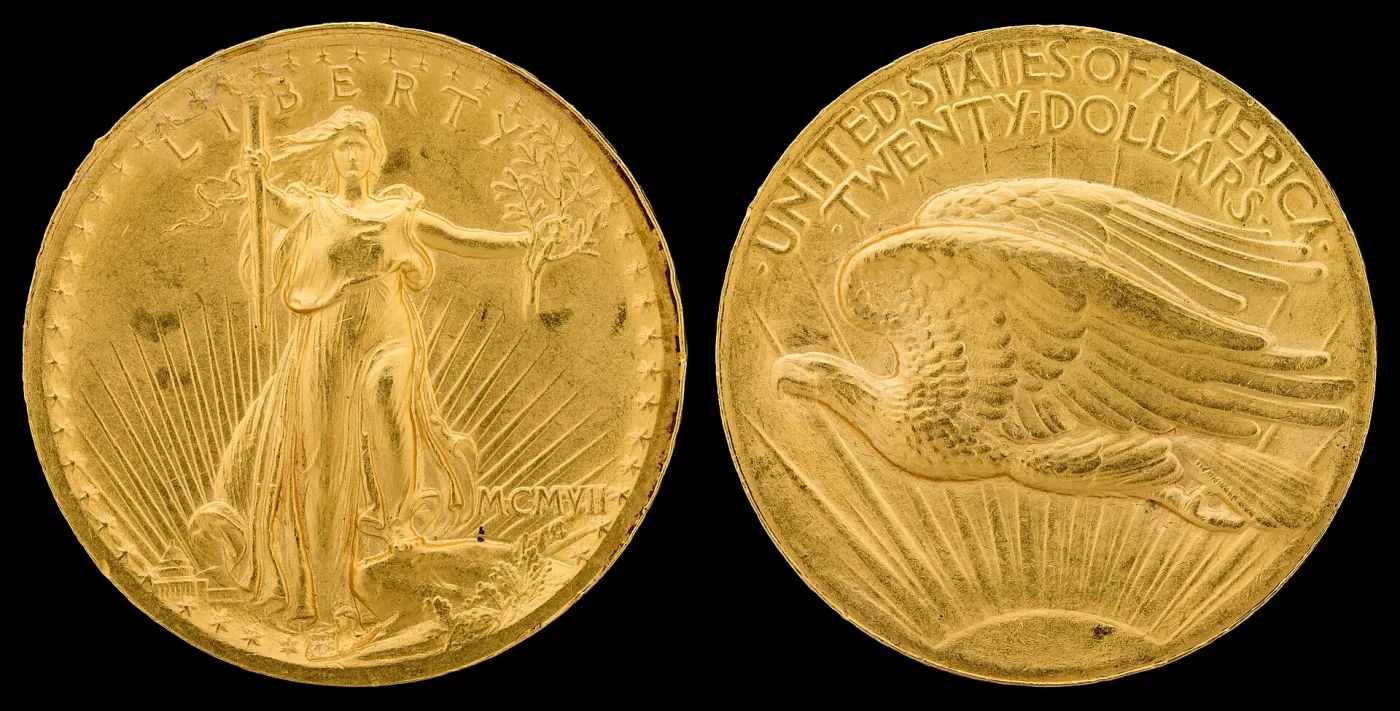
The Saint-Gaudens Double Eagle — produced from 1907 through 1933 — is widely considered the most beautiful coin ever struck by the United States Mint, and arguably the most beautiful gold coin in the entire history of Western numismatics. Designed by sculptor Augustus Saint-Gaudens at the personal request of President Theodore Roosevelt, the $20 gold piece replaced the long-running Liberty Head Double Eagle — and, alongside it, the venerable Liberty Head Half Eagle at $5 (later succeeded by Bela Lyon Pratt’s incuse Indian Head Half Eagle in 1908) — ushering in a brief golden age of American coin design that paralleled the artistic renaissance Roosevelt championed across all denominations.
For collectors, the series sits at a unique intersection of art, history, and bullion value. Each coin contains 0.9675 troy ounces of pure gold — a substantial precious-metal anchor — while the design itself, struck on a 34-millimeter, 33.4-gram planchet, captures Liberty striding forward from the Capitol with a torch and olive branch on the obverse, and a magnificent flying eagle over a rising sun on the reverse. Unlike the silver issues that preceded and followed it, such as the Morgan Silver Dollar, Peace Dollar, Walking Liberty Half Dollar, or the modern one-ounce American Silver Eagle, the Saint-Gaudens series exists at gold-standard scale: collector premiums on top of bullion, with key dates that bring six and seven figures even in problem-free circulated grades.
This guide covers everything you need to identify, grade, and value Saint-Gaudens Double Eagles: the four major design types from 1907 Ultra High Relief through the 1908-1933 With Motto issues, the rare and historic 1933 that sold for $18.9 million, the elusive 1927-D, 1920-S, and 1921, mint marks across Philadelphia, Denver, and San Francisco, key dates and condition rarities, professional grading standards, authentication strategies for spotting modern counterfeits, and current market values heading into 2026. The same disciplined coin identification techniques that apply to silver classics extend directly to gold — with the additional complication that the bullion melt value floor protects against losses but also raises the stakes for accurate authentication.
History and Design: Roosevelt and Saint-Gaudens
The Saint-Gaudens Double Eagle was born from a presidential vision. In 1904, Theodore Roosevelt wrote to his Secretary of the Treasury complaining about the “atrocious hideousness” of contemporary American coinage and proposing a complete redesign of every denomination. Roosevelt personally engaged Augustus Saint-Gaudens, the most celebrated American sculptor of the era, to design new coins inspired by the high-relief gold issues of ancient Greece — particularly the coinage of Alexander the Great’s empire.
Saint-Gaudens accepted the commission despite being gravely ill with cancer. He completed the designs for both the Double Eagle and the $10 Indian Head Eagle before his death in August 1907 — making the Double Eagle one of the artist’s final and most ambitious works. The first coins struck in 1907 were the Ultra High Relief experimental pieces (only 22-24 known examples), followed by the High Relief production issues (12,367 minted), and finally the Low Relief Arabic numerals issues that would form the bulk of subsequent production.
The Designer: Augustus Saint-Gaudens
Augustus Saint-Gaudens (1848-1907) was the most famous American sculptor of the Gilded Age. His major public works include the Robert Gould Shaw Memorial in Boston, the Sherman Monument at the southeast corner of Central Park in New York, the Adams Memorial in Washington’s Rock Creek Cemetery, and the standing Lincoln in Chicago’s Lincoln Park. Saint-Gaudens approached coinage as miniature sculpture rather than as engraving, and his design for the Double Eagle reflects that sculptural conception — with deep relief, classical drapery, and dynamic composition that engravers like Charles Barber would never have attempted.
The Mint’s chief engraver Charles Barber, whose Liberty Head designs Saint-Gaudens’s coin would replace, opposed the project bitterly. Barber argued — correctly, as it turned out — that Saint-Gaudens’s high relief could not be struck efficiently in production. The Ultra High Relief required nine to eleven blows from the dies to bring up the design fully, making it commercially impossible. Barber eventually modified the design to a workable Low Relief format, and from 1907 forward through 1933 the production coinage used Barber’s flattened version of Saint-Gaudens’s vision.
Production Era and the End in 1933
Production ran from late 1907 through early 1933. The Saint-Gaudens Double Eagle witnessed the Panic of 1907, World War I, the Roaring Twenties, the 1929 stock market crash, and the early Great Depression. Production ended abruptly in March 1933 when President Franklin D. Roosevelt’s Executive Order 6102 required Americans to surrender most gold coins to the Treasury at $20.67 per ounce. The 445,500 Double Eagles struck in 1933 were ordered melted, and ownership of any 1933 Double Eagle was illegal until decades of litigation finally established certain pieces as legal tender — making the 1933 the most expensive coin ever sold at auction.
Design Details: Obverse and Reverse
Knowing every element of the Saint-Gaudens Double Eagle design is essential for grading, type identification, and authentication. The design carries multiple subtle changes across its 26-year production that separate the four major types.
Obverse (Heads Side)
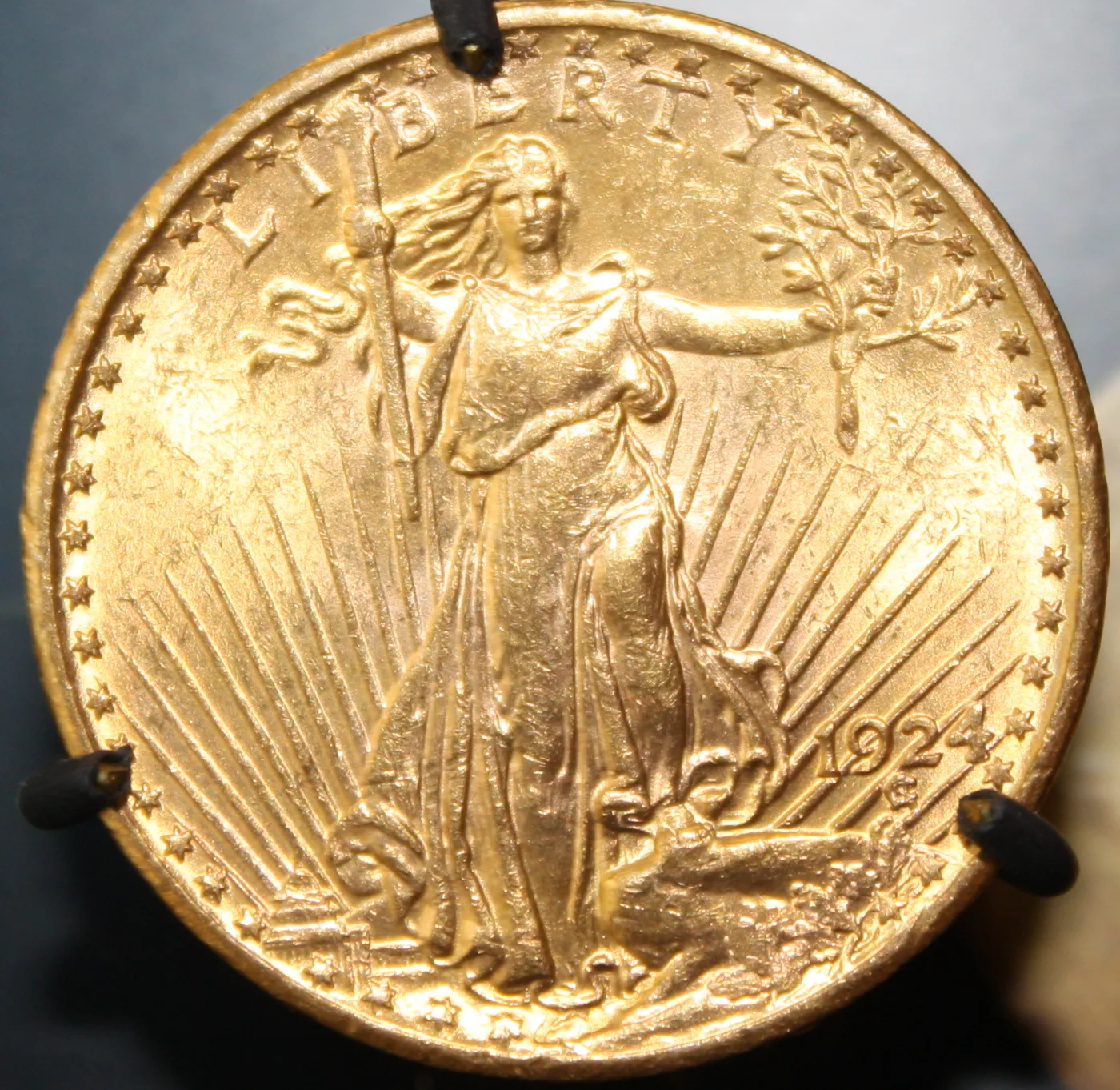
The obverse depicts Liberty striding forward from a small Capitol building at the lower left. She holds a flaming torch raised in her right hand symbolizing enlightenment, and an olive branch lowered in her left hand symbolizing peace. Her flowing classical gown ripples with motion, and her hair streams behind her. Sun rays emanate from behind the Capitol, suggesting dawn breaking over the nation. The word LIBERTY arches across the top of the coin, with the date appearing at the lower right.
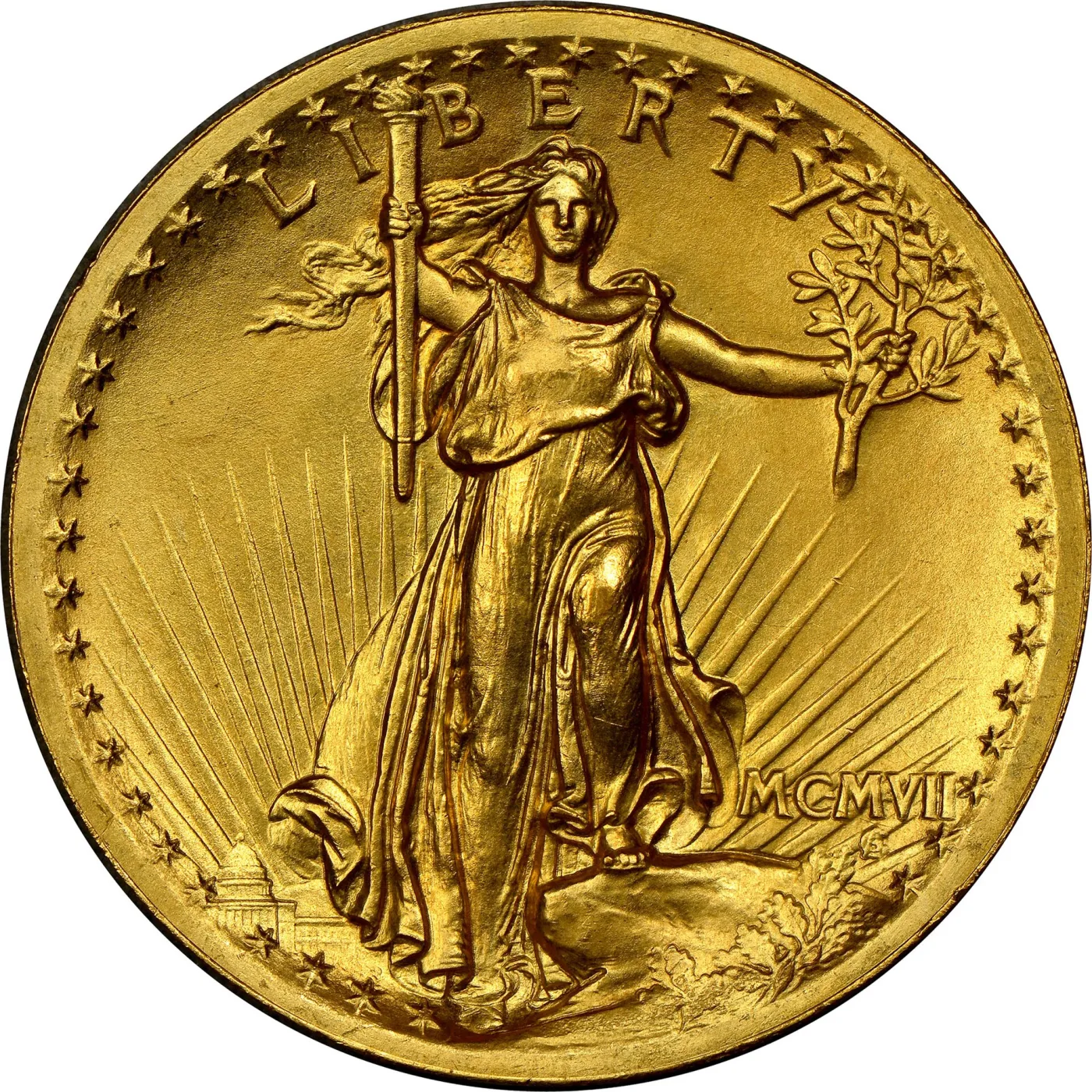
The 46 stars surrounding Liberty represent the 46 states in the Union when the coin debuted in 1907. Beginning in 1912, two additional stars were added — bringing the total to 48 — to represent New Mexico and Arizona, which had achieved statehood. This 46-star to 48-star transition is one of the subtle diagnostic features of the series and helps date worn examples without legible dates.
Reverse (Tails Side)
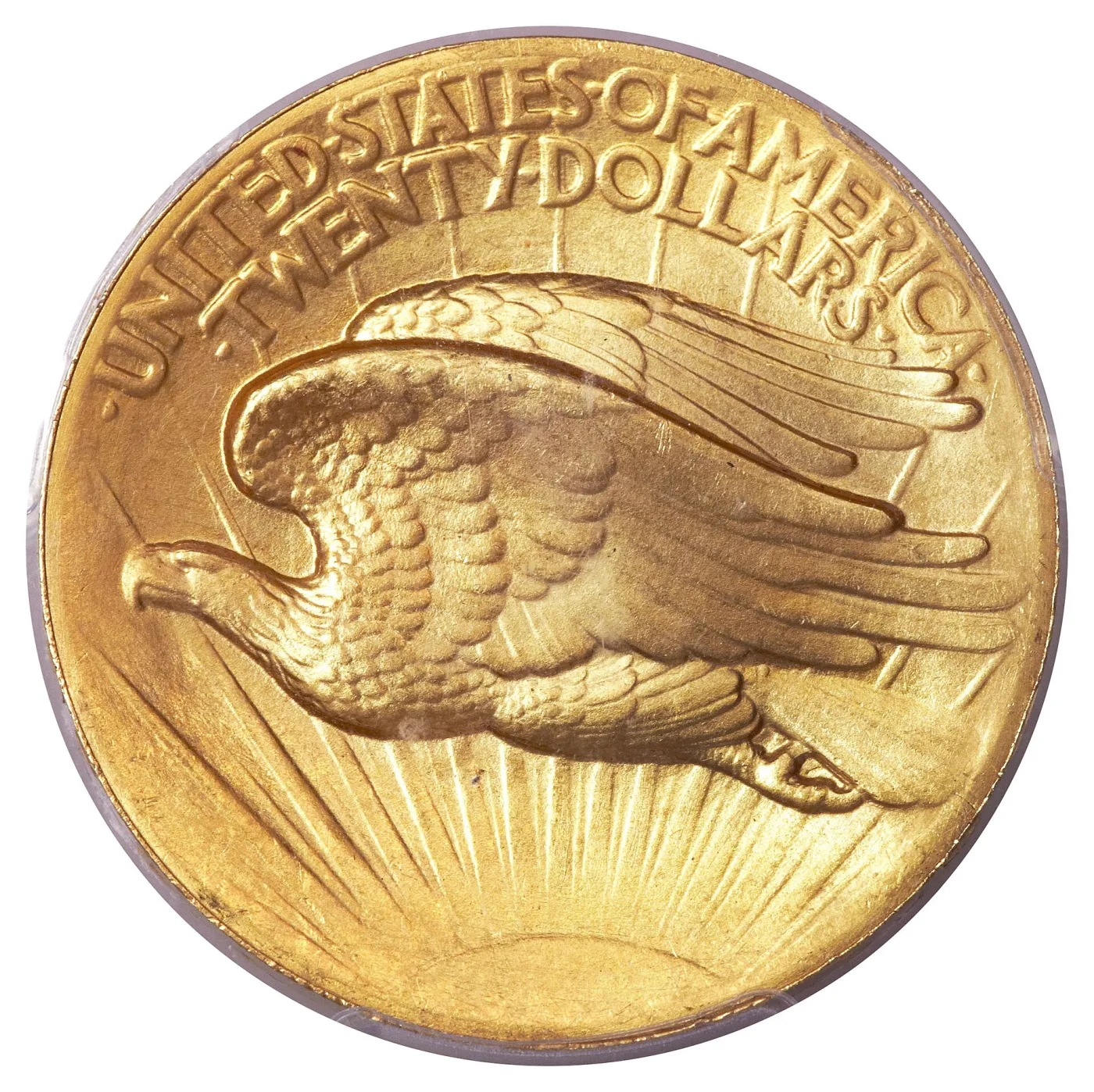
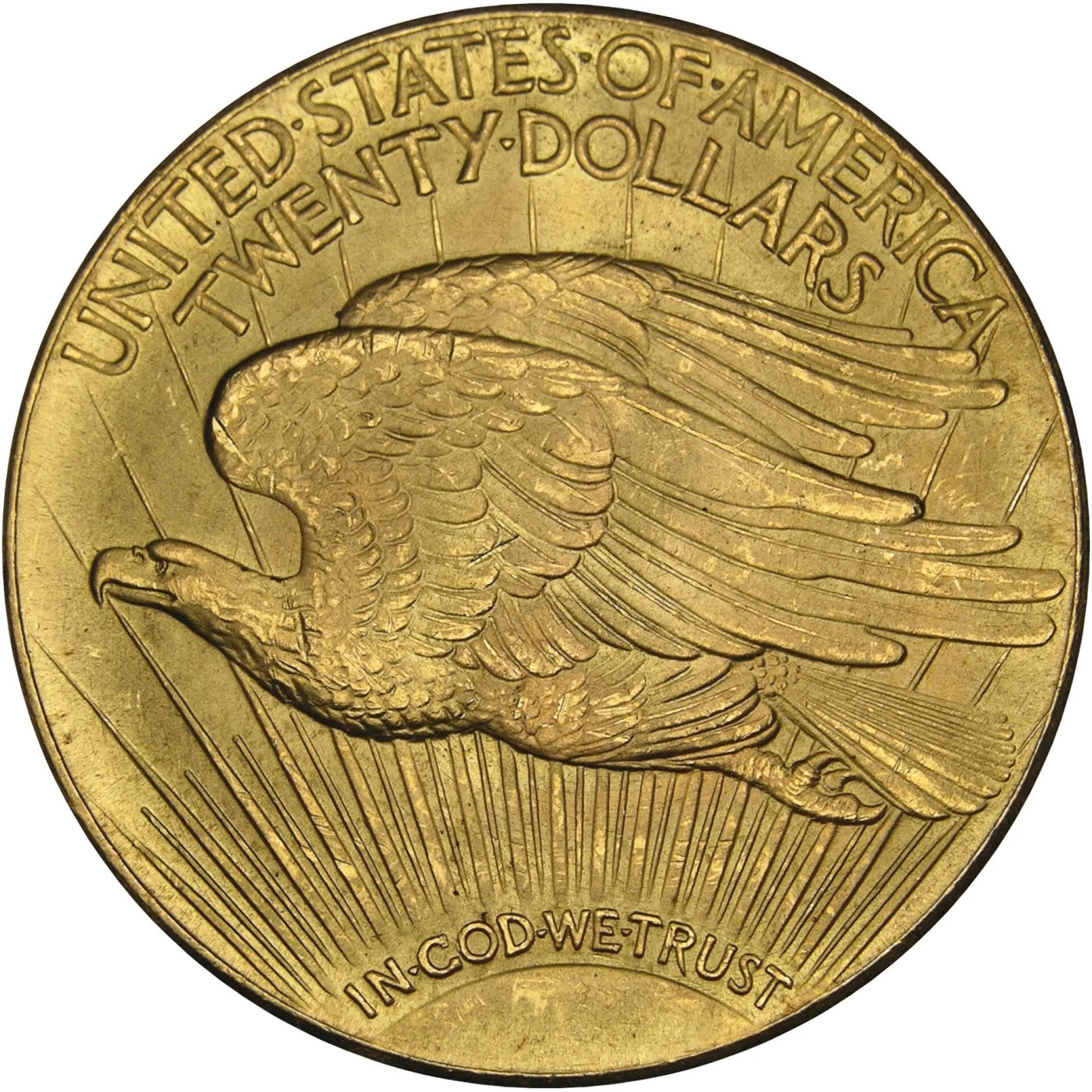
The reverse features a magnificent eagle in flight, soaring left over a rising sun whose rays radiate upward across the lower half of the coin. The legend UNITED STATES OF AMERICA arches across the top, with the denomination TWENTY DOLLARS in a second arc directly beneath it, above the eagle. From 1908 onward, the motto IN GOD WE TRUST appears on the rising sun rays. The reverse design is one of the most artistically successful eagle compositions in American coinage — Saint-Gaudens deliberately rejected the heraldic eagle convention of earlier US gold coinage in favor of a naturalistic flying bird.
The Edge: Lettered, Not Reeded
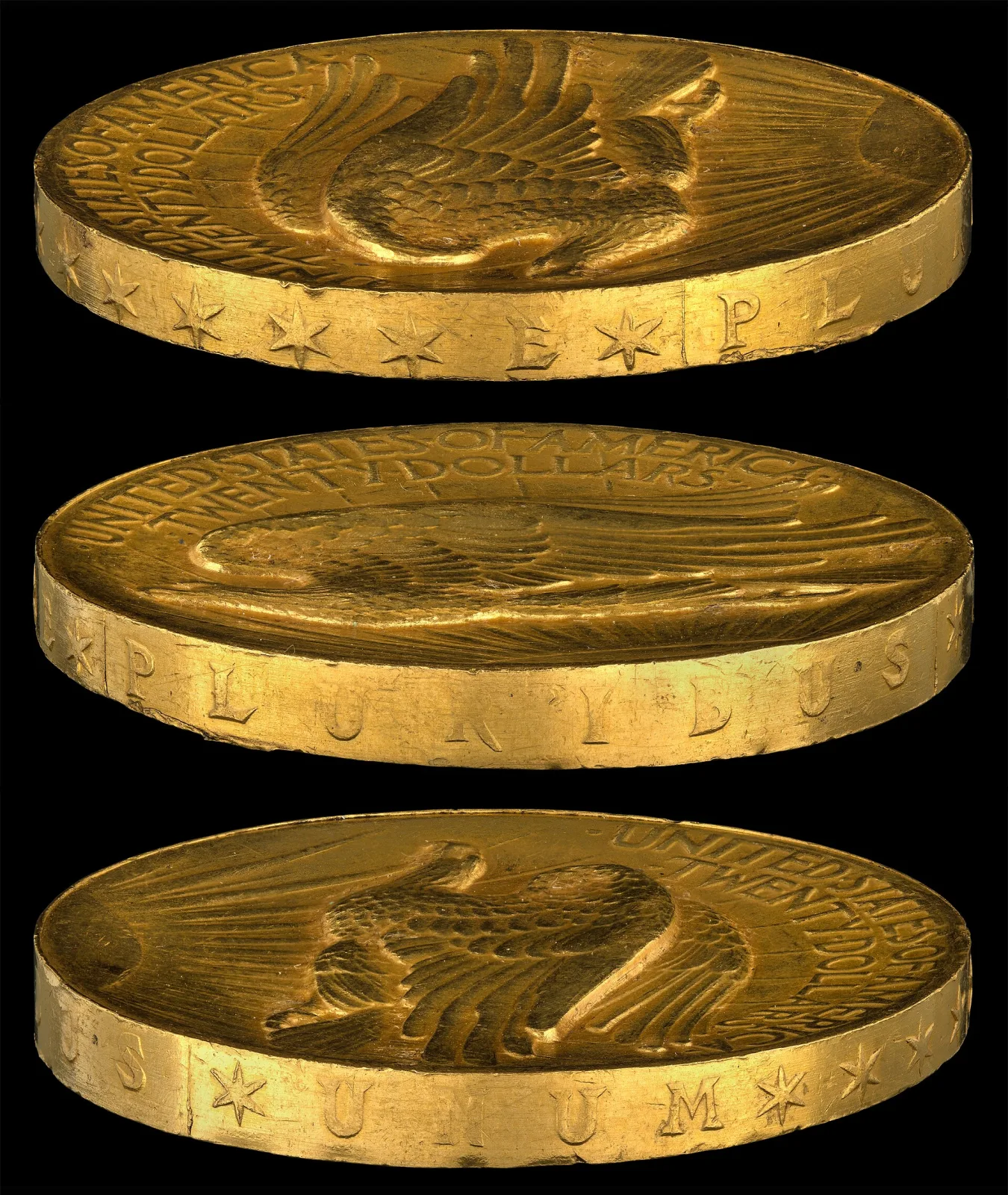
Unlike most US coins which have either reeded or plain edges, the Saint-Gaudens Double Eagle has an incused lettered edge reading E PLURIBUS UNUM separated by stars. The 1907 Ultra High Relief and High Relief use 13 stars on the edge; from 1908 onward, the edge uses 13 stars but with subtly different positioning. The lettered edge is a critical authentication feature — modern counterfeits frequently get the edge wrong, which is why detecting fake coins always includes a careful edge and seam inspection.
The Four Major Types: 1907-1933
Saint-Gaudens Double Eagles divide into four distinct types based on relief and reverse details. Type identification is fundamental — type-set collectors pursue one example of each, and prices vary enormously between types.
Type 1: 1907 Ultra High Relief (Roman Numerals)
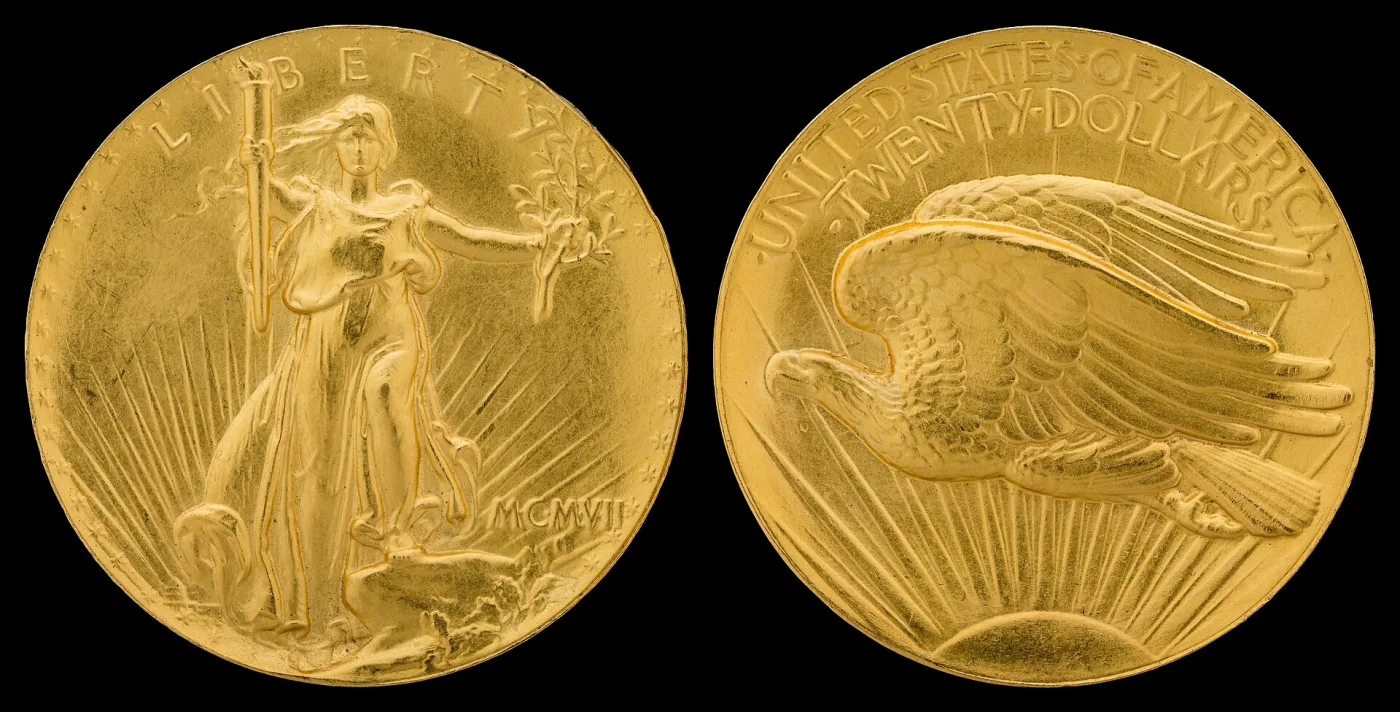
The Ultra High Relief is the rarest and most beautiful type. Only 22-24 examples are known, all struck as experimental pieces in late 1907. The date appears in Roman numerals as MCMVII, the relief is dramatically deep (the coin is noticeably thicker than a normal Double Eagle), and the design shows extraordinary three-dimensional sculptural quality. Every example is essentially museum-grade. Auction prices routinely reach the high seven figures when examples become available — typically once per decade or less.
Type 2: 1907 High Relief (Roman Numerals)
The High Relief production type was struck from December 1907 with a mintage of 12,367. The date again appears in Roman numerals (MCMVII), the relief is dramatic but reduced from the Ultra High Relief, and the rims are wire-thin. These coins required multiple strikes to bring up the design and proved commercially impractical, leading to the switch to Low Relief in late 1907. High Relief examples are highly prized by collectors and bring strong five-figure prices in any grade, with choice Mint State examples reaching six figures. Because the Liberty Head design also ran throughout 1907, that single year produced several very different twenty-dollar pieces — our guide to telling the 1907 double eagles apart works through them in order.
Type 3: 1907-1908 No Motto, Arabic Numerals
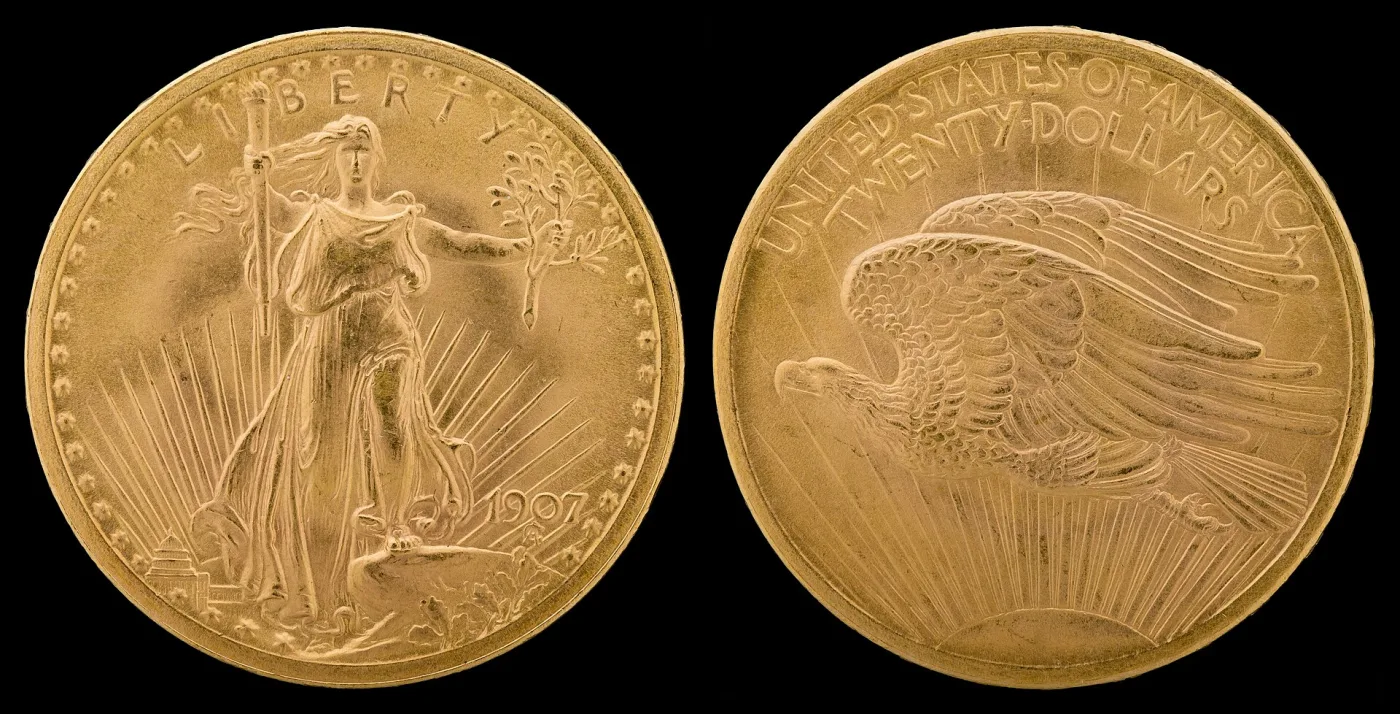
The Low Relief production type debuted in late 1907 with Arabic-numeral dating (1907 rather than MCMVII) and significantly flattened relief that allowed efficient single-blow striking. The reverse for 1907 and early 1908 issues bears no motto — IN GOD WE TRUST is absent. President Roosevelt had personally insisted on omitting the motto because he considered placing the deity’s name on coinage to be “irreverent and close to sacrilege.” Public outcry and Congressional action forced restoration of the motto in mid-1908.
Type 4: 1908-1933 With Motto, Arabic Numerals
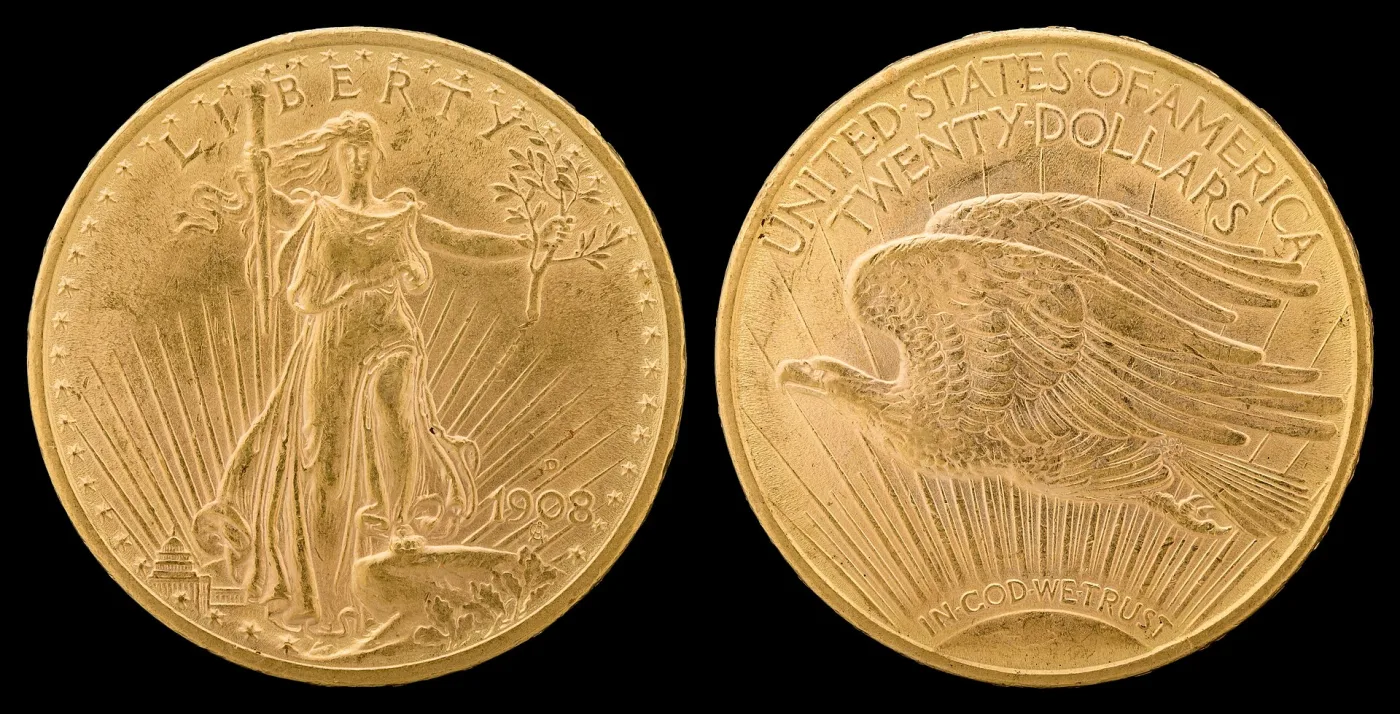
Beginning mid-1908, the motto IN GOD WE TRUST was added to the reverse on the sun rays beneath the eagle. This With Motto type continued essentially unchanged through 1933, with only the 46-to-48 star transition in 1912 marking a minor design evolution. Most Saint-Gaudens Double Eagles encountered in the market belong to this type, and the bulk of the series’s mintages by year falls here.
Quick Type Identification Reference
- Ultra High Relief: Date MCMVII, very thick coin, extremely deep relief, knife-thin rims — only 22-24 known
- High Relief: Date MCMVII, deep relief but thinner than UHR, wire rims — 12,367 mintage
- No Motto: Arabic-numeral date 1907 or early 1908, no IN GOD WE TRUST on reverse
- With Motto: Arabic-numeral date 1908-1933, IN GOD WE TRUST visible on sun rays beneath eagle
Composition and Specifications
Every Saint-Gaudens Double Eagle is struck in 90% gold and 10% copper — the standard US gold alloy used from 1837 through 1933 for all production gold coinage. The copper content gives the coins their characteristic warm, slightly orange-tinted color and provides hardness that pure gold lacks.
Physical Specifications
- Composition: 90% gold, 10% copper
- Total weight: 33.436 grams (516 grains)
- Net gold weight: 30.0926 grams (0.9675 troy ounces)
- Diameter: 34.0 millimeters
- Thickness: Approximately 2.4 millimeters (Ultra High Relief noticeably thicker)
- Edge: Lettered E PLURIBUS UNUM with stars
- Face value: $20
The 0.9675 troy ounce gold content is the bullion-value floor for every Saint-Gaudens Double Eagle. At 2026 gold prices, this means even a heavily worn common-date example is worth well over $2,500 in pure metal value alone, before any numismatic premium. This bullion floor distinguishes gold coinage from silver — a worn Mercury Dime may be worth only its silver value, but a worn Saint-Gaudens carries substantial intrinsic worth that protects collector outlay.
The Edge Lettering
The edge inscription reads * * E * PLURIBUS * UNUM * * * with 13 stars (representing the 13 original colonies) interspersed with the Latin motto. The lettering is incused (struck inward), produced by a third die in the coining press at the moment of striking. Three different edge collars exist across the series: the 1907 Ultra High Relief, the 1907 High Relief, and the standard 1907-1933 Low Relief. Edge details are a critical authentication checkpoint.
Key Dates and Major Rarities
The Saint-Gaudens series contains a remarkable concentration of rarities — coins that anchor major auction events and define US gold numismatics. Most key dates emerged from the 1920s and early 1930s, when much production was actually shipped to bank vaults as international gold reserves rather than circulated, and many were later melted under the 1933 gold recall. The same disciplined approach to spotting key dates applies whether you’re working through this series, the Buffalo Nickel, or any classic US issue.
1933 Saint-Gaudens Double Eagle
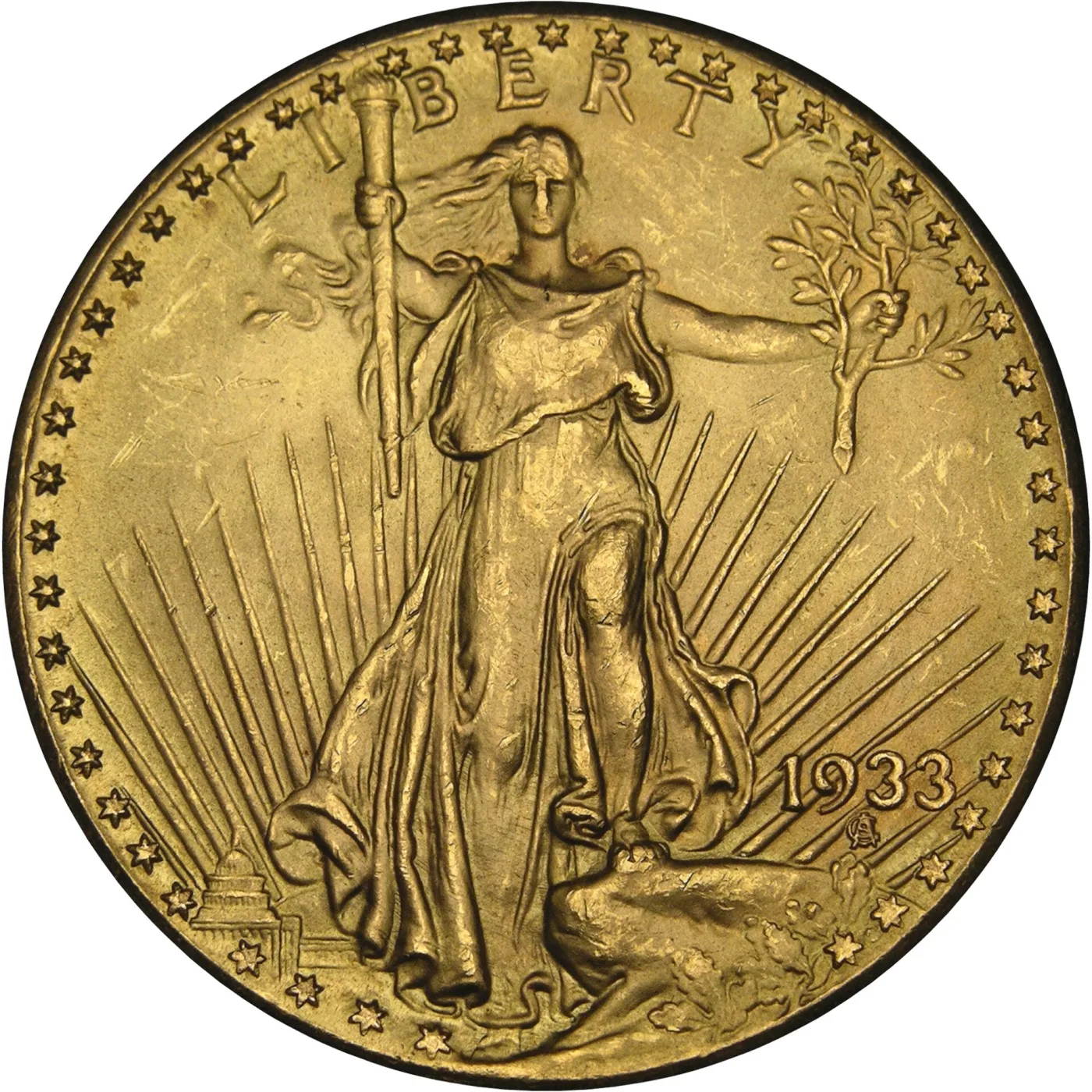
The 1933 is the most legendary US coin of the 20th century. Although 445,500 were struck in early 1933, none were officially released into circulation, and all were ordered melted under the gold recall. A small number escaped the Mint illegally — exact count debated but probably around 20 examples. Most have been recovered and destroyed by the government over the past 80 years. Only one example is currently legal to own privately: a single coin sold at auction in 2002 for $7.6 million, then resold in 2021 for $18.9 million — the highest price ever paid for a coin at public auction.
1927-D Saint-Gaudens Double Eagle
The 1927-D is the rarest collectible Saint-Gaudens (excluding the 1933). Of the 180,000 struck at the Denver Mint, only about 12-15 examples are known to survive — most of the issue was melted under the gold recall. Genuine 1927-D Double Eagles bring two-to-three million dollars at auction in choice condition. The 1927-D consistently ranks among the most valuable regular-issue 20th-century US coins.
1921 Saint-Gaudens Double Eagle
The 1921 had a mintage of 528,500 — moderately substantial for the series — but again most were melted in 1933, leaving an estimated 150-200 surviving examples. The 1921 is one of the major condition rarities of the series, with prices ranging from $50,000 in low circulated grades to over $400,000 in choice Mint State.
1920-S Saint-Gaudens Double Eagle
The 1920-S had a mintage of 558,000 but suffered the same fate as the 1921 — most were melted, leaving fewer than 200 known survivors. Prices range from $25,000 in low circulated grades to $300,000+ for choice MS-65 examples. The 1920-S, along with the 1921, defines the “Roaring Twenties rarities” of the series.
1929-1932 Issues
Every Saint-Gaudens dated 1929 through 1932 is a major rarity due to the Great Depression-era mintages and subsequent meltings. Specifically: 1929 (1,779,750 mintage, ~1,800 surviving), 1930-S (74,000 mintage, ~75 surviving), 1931 (2,938,250 mintage, ~150 surviving), 1931-D (106,500 mintage, ~125 surviving), and 1932 (1,101,750 mintage, ~125 surviving). All of these bring strong five-to-six-figure prices in any grade. The mintage numbers are misleading — what matters is what survived the gold recall.
1907 Ultra High Relief
The 1907 Ultra High Relief stands apart as the rarest and most artistically important type. Only 22-24 examples are known. Auction prices reach $2-4 million for choice examples; the Smithsonian Institution holds two specimens, and most other examples are in major private collections or museum institutions.
1908-S No Motto
The 1908-S is a key date among early issues with a mintage of 22,000 — the lowest of any Low Relief issue from 1907-1908. Most surviving examples are in circulated to low Mint State grades. Choice MS-63 examples bring $15,000-$25,000.
1913-S Saint-Gaudens Double Eagle
The 1913-S had a mintage of 34,000 and is genuinely scarce in all grades. Most surviving examples grade Very Fine to About Uncirculated. Choice Mint State pieces bring $20,000-$50,000.
The Legendary 1933 Double Eagle
The 1933 Saint-Gaudens Double Eagle deserves its own section because it is unlike any other coin in US numismatics. The story spans Mint records, government chases across decades, federal lawsuits, and ultimately the highest-ever auction price paid for any coin.
The Production and the Recall
In early 1933, the Philadelphia Mint struck 445,500 Double Eagles dated 1933, intending them for normal circulation. Before any were officially released, President Franklin D. Roosevelt issued Executive Order 6102 in March 1933, requiring Americans to surrender most gold coins. The 1933 Double Eagles were ordered held and ultimately melted in 1934 along with millions of other coins. The Mint’s official position was that no 1933 Double Eagles were ever legally released, and therefore none could legally be owned.
Coins That Escaped
Despite the official position, a small number of 1933 Double Eagles left the Mint through irregular channels — almost certainly via the Philadelphia Mint cashier George McCann, who allegedly substituted earlier-date Double Eagles for 1933s that he then sold to local Philadelphia coin dealer Israel Switt. Switt sold an estimated 19-20 examples through the late 1930s and early 1940s. The Secret Service began recovering these in 1944 after one was offered at public auction, and over the following decades most were tracked down and confiscated for destruction.
The Farouk Coin and the 2002 Auction
One 1933 Double Eagle was legally exported in 1944 to King Farouk of Egypt under a US government export license — the only legal export of a 1933 the government ever issued, granted by mistake. After Farouk’s overthrow in 1952, the coin disappeared and resurfaced in 1996 when British dealer Stephen Fenton was arrested for offering it in a New York hotel sting. Years of litigation produced a settlement in 2001: the coin would be sold at auction, with proceeds split between the government and Fenton, and the buyer would pay an additional $20 to the Treasury to officially “monetize” the coin and make it legal tender. In 2002, this single coin sold at Sotheby’s for $7,590,020.
The 2021 Sale at $18.9 Million
The same coin — the only 1933 Double Eagle legal for private ownership — was resold at Sotheby’s in June 2021 for $18,872,250, the highest auction price ever paid for any coin in any series. The sale established the 1933 Double Eagle as the most valuable single coin in numismatic history, surpassing the 1794 Flowing Hair Dollar that had previously held the record.
The Switt Family Coins
In 2003, a separate cache of ten 1933 Double Eagles surfaced in the family of Israel Switt — turned over by his daughter Joan Langbord to the Treasury for authentication. The government refused to return them, and over a decade of litigation followed. The Supreme Court declined to hear the case in 2017, leaving the government’s position intact: these ten coins are property of the United States and remain at Fort Knox.
Practical Implication for Collectors
For all practical purposes, the 1933 Double Eagle is uncollectible. The single private-ownership example is unlikely to come to market for decades, if ever. Any 1933-dated Double Eagle offered for sale outside this single coin should be presumed counterfeit until proven otherwise. The federal government continues to investigate and seize any 1933 examples that surface.

Mint Marks: Philadelphia, Denver, San Francisco
Saint-Gaudens Double Eagles were struck at three United States mints, with mint marks appearing on the obverse just above the date at the lower right of the coin. Always check this location carefully — counterfeiters occasionally add fake mint marks to common Philadelphia coins to manufacture key-date issues.
Philadelphia Mint (No Mint Mark)
The Philadelphia Mint produced Saint-Gaudens Double Eagles every year from 1907 through 1933 except 1925. Philadelphia issues bear no mint mark. Mintages varied dramatically across the series — from the 22-24 Ultra High Relief experimentals to multi-million-coin years in the late 1920s. Philadelphia is the source of the Ultra High Relief, the High Relief, the No Motto issues, and most production With Motto issues.
Denver Mint (D Mint Mark)
The Denver Mint struck Saint-Gaudens Double Eagles in 1908, 1910, 1911, 1913-1915, 1922-1925, 1927, and 1931. The mint mark “D” appears on the obverse above the date. Denver is the source of the legendary 1927-D rarity. Most Denver issues from the 1920s onward survived in low numbers due to Great Depression-era melting.
San Francisco Mint (S Mint Mark)
The San Francisco Mint struck Saint-Gaudens Double Eagles in 1908-1922 and 1924-1930. The mint mark “S” appears on the obverse above the date. San Francisco is the source of the 1908-S, 1913-S, 1920-S, and 1930-S keys. San Francisco mintages were generally smaller than Philadelphia’s, and the survival rate of S-mint issues from the late 1910s and 1920s is correspondingly low.
Mint Mark Position and Authentication
- Position: Always on the obverse, in the lower right field above the date
- Style: Small, neat letters punched into individual working dies
- Sharpness: Well-defined letters with consistent depth — examine under 10x magnification
- Counterfeit warning: Added “D” or “S” mint marks on common Philadelphia coins are a known fraud — examine for tooling marks, surface disturbance, or a mint mark that doesn’t match the era’s punch style
Doubled Dies and Notable Varieties
Beyond the major type and mint mark distinctions, the Saint-Gaudens series hosts a number of varieties that specialists actively pursue. None match the price impact of the famous 1955 Lincoln Doubled Die or the iconic 1937-D Three-Legged Buffalo, but several add meaningful premiums.
1907 Ultra High Relief Variants
Within the 22-24 known Ultra High Relief examples, specialists distinguish lettered-edge experimentals, plain-edge proofs, and the unique inverted-edge piece. Each variant has its own die characteristics and pedigree, and major auction catalogs treat each example individually.
1907 High Relief: Wire Rim vs. Flat Rim
Two rim varieties exist for the 1907 High Relief: the Wire Rim (also called Knife Rim) shows a thin, sharp, raised wire of metal forced up by the heavy striking pressure, while the Flat Rim shows a more conventional, broader rim. Both are collected, with Wire Rim examples slightly more common but neither variety is rare relative to the other.
1909/8 Overdate
Some 1909 Philadelphia Double Eagles show clear evidence of an underlying 8 beneath the 9 in the date — a classic overdate created when 1908 dies were repurposed and overpunched with the 1909 date. The 1909/8 overdate brings premiums of 25-50% over normal 1909 examples in equivalent grades.
1909-D Doubled Liberty
A doubled die obverse on certain 1909-D coins shows clear doubling on the word LIBERTY across the upper rim. The variety is uncommon and adds modest premiums.
1924 Doubled Date
Several 1924 Philadelphia dies show evident doubling on the date numerals, particularly the 4. The variety is collected by specialists but commands only modest premiums.
Cherrypicker Tips
- Use a 10x loupe on the date numerals and LIBERTY across the top for repunching or doubling
- Check the mint mark on every D and S issue for repunching, doubling, or signs of tooling/addition
- Examine the edge lettering for compression artifacts and proper star positioning
- Compare known Wire Rim and Flat Rim images for the 1907 High Relief
- Reference the Cherrypickers’ Guide for current variety attribution and FS numbers
Grading Saint-Gaudens Double Eagles
Accurate grading is essential because Saint-Gaudens prices climb steeply with grade — even common dates can vary from $2,500 in low grades (essentially bullion value) to $20,000+ in choice MS-65 condition. The same fundamental grading methods that apply to other 20th-century US issues work here, with particular attention to Liberty’s breast, knee, and flowing gown details.
High-Point Wear Pattern
Wear on Saint-Gaudens Double Eagles progresses in a specific order across the high points:
- Liberty’s breast and knee show wear first — these are the highest points of the obverse design
- Liberty’s hair and forehead next show flattening
- Eagle’s breast and wing on the reverse wear in parallel
- Sun rays at the bottom of the reverse are typically the last details to show heavy wear
Circulated Grades
- Very Fine-20: Major design elements show clear definition; substantial wear on Liberty’s breast and knee
- Extremely Fine-40: Light wear on highest points; most design detail intact
- About Uncirculated-50 to 58: Trace wear on Liberty’s breast, knee, and hair; full original luster on most surfaces
True circulated Saint-Gaudens Double Eagles below About Uncirculated are uncommon — many surviving coins came from bank vaults rather than active circulation, and most show light handling rather than heavy wear. Coins graded VF or below often suggest extensive circulation, mishandling, or environmental damage.
Mint State Grading
Mint State grading distinctions matter enormously for value, and the Saint-Gaudens series is particularly sensitive to bag marks because gold is a relatively soft metal:
- MS-60 to MS-62: No wear, but heavy bag marks; subdued luster; the entry level for Mint State
- MS-63: Moderate marks; reasonable luster; the most common Mint State grade for common dates
- MS-64: Lighter marks; good luster; pleasing eye appeal — a meaningful price step
- MS-65: Light marks only; full booming luster; strong eye appeal — a major price step
- MS-66: Exceptional preservation; minimal marks; superb luster — common dates jump in price 3-10x at this grade
- MS-67 and above: Genuinely rare; many issues have populations under 50 coins at this level
Strike and Luster Considerations
Saint-Gaudens Double Eagle luster varies by mint and year. Philadelphia issues from the 1907-1908 period typically show satin to slightly frosty luster. San Francisco issues often show booming cartwheel luster comparable to the best Morgan Dollar strikes. Late-date Philadelphia issues from 1925-1928 often show subdued luster. Strike sharpness is generally excellent across the series — Saint-Gaudens dies were well-prepared and the soft gold takes detail readily.
Authentication and Spotting Counterfeits
Saint-Gaudens Double Eagles are heavily counterfeited because of their high gold value and key-date premiums. Modern counterfeits range from crude Chinese-made copies (easy to detect) to sophisticated struck counterfeits using stolen or replica dies (very difficult to detect). The same authentication discipline as for other high-value classic series applies — but with even higher stakes given the dollar amounts involved.
Weight, Diameter, and Specific Gravity
- Weight: Genuine coins weigh 33.436 grams. Counterfeits made from lower-purity gold or base metals deviate measurably. A digital jewelry scale accurate to 0.01 grams is the minimum tool for serious authentication.
- Diameter: Genuine coins measure 34.0 millimeters across. Counterfeits sometimes vary by tenths of a millimeter.
- Specific gravity: Pure 90% gold has a specific gravity of approximately 17.16. Lower-purity counterfeits or gold-plated base-metal copies test outside this range. Specific gravity testing is a definitive non-destructive authentication method.
- Edge lettering: The E PLURIBUS UNUM with stars must be present and properly formed. Many crude counterfeits have plain or reeded edges.
Counterfeit Categories
Common counterfeit types include:
- Cast counterfeits: Detectable by pebbly surfaces, soft details, and incorrect weight. Largely a 20th-century problem; modern counterfeiters prefer struck copies.
- Struck counterfeits with base metal: Gold-plated tungsten or other dense metal cores. Detectable by specific gravity and by careful examination of edge integrity.
- Struck counterfeits in correct-purity gold: The most dangerous type. These coins have correct weight and metal content but were struck from unauthorized dies. Detection requires comparing die diagnostics and surface texture against authentic examples.
- Altered date or mint mark on genuine coin: Common date altered to look like 1927-D, 1921, or other key — examine for tool marks under 10x magnification, particularly around date and mint mark.
- 1933 fakes: Given the legal status and seven-figure value, any 1933 offered should be presumed counterfeit. The federal government will seize examples in any case.
Cleaned and Polished Coins
Many Saint-Gaudens Double Eagles have been cleaned, often to make them look more like Mint State examples. Detection points include unnatural shine, hairline scratches under angled light, and orange-tinted or pinkish “dipped” appearance. Cleaned coins receive “Details” grades from PCGS and NGC and lose 30-50% of value compared to original-surface coins.
Using Third-Party Grading
For any Saint-Gaudens Double Eagle — even common dates — purchase already-certified examples from PCGS or NGC. The certification fee is minimal relative to the dollar amounts involved. For premium issues (any pre-1908 No Motto, any S-mint from 1920-1930, any D-mint from 1922-1931, any High Relief or Ultra High Relief), certified examples are essentially the only safe purchase route. Established auction houses including Heritage Auctions, Stack’s Bowers, Legend Numismatics, and GreatCollections are the safest sources for higher-value pieces.
Bullion Value vs. Numismatic Premium
Saint-Gaudens Double Eagles occupy a unique position in coin collecting because they carry both substantial bullion value and substantial numismatic premiums. Understanding the relationship between the two is essential for buying intelligently.
The Bullion Floor
Each coin contains 0.9675 troy ounces of pure gold. At any given gold spot price, the bullion melt value is roughly: (gold spot price per ounce) × 0.9675. At $2,600 per ounce — a representative 2026 figure — the melt value is approximately $2,515. No genuine Saint-Gaudens, regardless of date or condition, can sell for less than its melt value, because anyone willing to destroy the coin can recover that amount from a refiner.
Common-Date Premiums
For common dates in lower grades — typical 1922-1928 Philadelphia coins in About Uncirculated to MS-62 condition — the typical retail premium over melt is 10-30%. Buying a common-date Saint-Gaudens at this level is essentially a way to own gold in collectible form, with a small premium for the design and historical interest. Bullion-focused buyers often prefer modern American Gold Eagles — or the .9995 fine American Platinum Eagle — for purer bullion exposure, but Saint-Gaudens carry genuine numismatic interest that modern bullion does not.
Numismatic Premiums
For better dates, higher grades, and key issues, premiums over melt rise dramatically. A common-date MS-66 Saint-Gaudens might bring 5-10x melt; a 1908-S MS-63 might bring 8-15x melt; a 1927-D in any grade brings hundreds of times melt; and the 1933 example brings literally hundreds of thousands of times melt. The relationship between grade, date, and premium is non-linear and rewards specialist knowledge.
Practical Buying Guidance
- If you want gold exposure: Buy common-date AU-58 to MS-62 Saint-Gaudens at minimal premium over melt
- If you want collectible gold: Step up to MS-63 to MS-65 common dates for moderate numismatic premium with genuine collector demand
- If you want true rarity: Pursue better dates and high grades, where premiums dwarf bullion value
- Avoid the middle ground unwisely: Cleaned or damaged coins lose collector value but retain melt value, so they trade close to bullion regardless of date
Current Market Values and Price Guide
Saint-Gaudens Double Eagle values cover an enormous range — from low thousands for common-date circulated examples to eight figures for the 1933. The prices below reflect approximate retail values as of 2026 for problem-free, original-surface coins, assuming a gold spot price of approximately $2,600 per ounce. Cleaned, damaged, or altered examples are worth substantially less, and certified premium-grade coins regularly bring prices well above these ranges.
Common Dates 1908-1928 (Philadelphia, Low Grade)
- Very Fine-20: $2,600–$2,800 (essentially melt)
- Extremely Fine-40: $2,650–$2,900
- About Uncirculated-58: $2,700–$3,000
- MS-62: $2,800–$3,300
- MS-63: $3,000–$3,800
- MS-64: $3,500–$5,500
- MS-65: $5,500–$10,000
- MS-66: $15,000–$25,000
Type Coins
- 1907 No Motto (MS-63): $4,000–$6,000
- 1907 No Motto (MS-65): $9,000–$15,000
- 1907 High Relief Wire Rim (AU-58): $25,000–$35,000
- 1907 High Relief Wire Rim (MS-63): $35,000–$50,000
- 1907 High Relief Wire Rim (MS-65): $60,000–$100,000
- 1907 Ultra High Relief (any grade): $2,000,000+ at auction
Key Dates and Major Rarities
- 1908-S (MS-63): $15,000–$22,000
- 1909/8 (AU-58): $2,800–$3,500
- 1913-S (MS-62): $5,000–$8,000
- 1920-S (AU-58): $25,000–$40,000
- 1920-S (MS-63): $80,000–$140,000
- 1921 (AU-58): $50,000–$80,000
- 1921 (MS-63): $150,000–$250,000
- 1927-D (any grade): $1,500,000–$3,000,000
- 1929 (MS-63): $20,000–$30,000
- 1930-S (MS-63): $250,000–$400,000
- 1931 (MS-63): $25,000–$40,000
- 1931-D (MS-63): $30,000–$50,000
- 1932 (MS-63): $30,000–$50,000
- 1933 (legal example): $18,872,250 (2021 sale)
Note: These are retail price estimates. Actual sale prices at auction vary based on eye appeal, certification, surface originality, gold spot price at sale time, and current market demand. For important purchases, reference recent auction archives from Heritage Auctions, Stack’s Bowers, and Legend Numismatics alongside standard price guides.
Building a Saint-Gaudens Double Eagle Collection
The Saint-Gaudens Double Eagle series offers entry points at multiple budget levels, from a single common-date type coin near gold-melt to museum-grade rarities at seven figures. The series is more challenging to collect comprehensively than 20th-century silver series like the Mercury Dime or Walking Liberty Half Dollar, but its artistic and historical importance rewards collectors at every level.
Single Type Coin
The simplest collection is a single common-date Mint State example, often dated 1908, 1922, 1924, 1925, 1927, or 1928. Choice MS-63 to MS-65 examples are widely available for $3,000-$10,000, providing a stunning specimen of one of the most beautiful US coins ever made. Many collectors stop here — a single Saint-Gaudens is sufficient to represent the series and Saint-Gaudens’s design genius.
Type Set
A four-coin type set captures all the design variations: Ultra High Relief (functionally impossible for most collectors), High Relief, No Motto, and With Motto. A more achievable three-coin set substitutes a common High Relief for the Ultra High Relief, paired with a No Motto and a With Motto. The High Relief alone runs $25,000-$50,000+, which puts even this modest type set out of reach for many collectors.
Date Set Excluding Major Rarities
A date set excluding the 1907 Ultra High Relief, 1927-D, 1933, 1930-S, 1920-S, and 1921 is achievable in MS-63 condition for $200,000-$400,000. Adding the 1920-S and 1921 doubles the budget. Adding the 1930-S, 1931, 1931-D, and 1932 pushes total cost into seven figures.
Mint Mark Set
Many collectors pursue one example from each mint that produced Saint-Gaudens Double Eagles: Philadelphia (no mint mark), Denver (D), and San Francisco (S). Achievable for $10,000-$30,000 in choice Mint State by selecting common dates from each mint.
Specialty Approaches
- High-grade type: MS-66 and MS-67 examples of common dates — visually stunning and steadily appreciating
- 1907 set: All major 1907 varieties (High Relief Wire Rim, High Relief Flat Rim, No Motto Low Relief)
- Late-date Depression set: 1929, 1930-S, 1931, 1931-D, 1932 — extremely difficult and expensive but historically compelling
- Variety set: 1909/8 overdate, 1909-D Doubled Liberty, and other major die varieties
- Bullion-collector hybrid: One MS-63 example per year — ignoring rarities and focused on year-by-year date completion
Practical Tips
- Buy certified for everything: Even common dates merit PCGS or NGC certification given the dollar amounts involved
- Original surfaces command premiums: Cleaned coins are heavily discounted; learn to recognize natural luster vs. dipped surfaces
- Patience pays: Many key dates appear at auction only a few times per year; build a target list and wait for the right examples
- Track gold spot: The bullion floor moves with gold prices, affecting common-date values directly
- Use major auction archives: Heritage and Stack’s Bowers archives are invaluable for studying authentic examples and recent realized prices
- Beware the 1933: Any 1933 offered for sale is virtually certain to be either counterfeit or government-seized
Storage and Preservation
Proper storage maintains the value and visual appeal of your collection. Although gold is far more chemically stable than silver — Saint-Gaudens Double Eagles do not tarnish or develop the toning that affects Morgan Dollars — the soft gold-copper alloy is susceptible to scratches, contact marks, and surface damage that can dramatically reduce value.
What to Avoid
- Loose storage: Coins clinking against each other produce immediate bag marks. Always store individually.
- PVC holders: Older soft plastic flips and some envelopes contain PVC, which outgasses and produces a green sticky residue. Less harmful to gold than to silver, but still avoid.
- Acidic paper: Some paper envelopes contain sulfur compounds that can produce minor surface effects on gold. Use acid-free, archival-quality envelopes.
- Direct handling: Skin oils etch gold over time; always handle by edges or wear cotton gloves
- Cleaning attempts: Even gentle cleaning leaves microscopic hairlines that grading services detect — never clean a Saint-Gaudens
- High humidity: Although gold itself doesn’t oxidize, the copper component can develop minor spotting in extreme humidity
Recommended Storage
- PCGS or NGC slabs: Inert plastic holders that provide excellent long-term protection and authentication — strongly recommended for any Saint-Gaudens
- Air-Tite holders: $20 gold-sized direct-fit capsules; safe and excellent for individual coins
- Non-PVC flips: Mylar or polyethylene flips for short-term storage and examination
- Quality albums: Capital Plastics or Dansco gold-coin albums; ensure pages are PVC-free
- Bank safe deposit box: Recommended for high-value collections; insurance considerations apply
- Climate-controlled storage: Stable temperature and low humidity for long-term collection care
Handling
Always handle Saint-Gaudens Double Eagles by their edges. The large surface area shows fingerprints readily, and oils from skin will eventually etch the surface. Cotton gloves are appropriate for high-value coins. Never clean a Saint-Gaudens — virtually any cleaning reduces value, and cleaned coins are easily detected by experienced graders. If a coin appears to need conservation, consult a professional service like NCS (Numismatic Conservation Services) rather than attempting it yourself.
Frequently Asked Questions
What is a Saint-Gaudens Double Eagle and when was it made?
The Saint-Gaudens Double Eagle is a 90% gold $20 United States coin produced from 1907 through 1933. Designed by sculptor Augustus Saint-Gaudens at the request of President Theodore Roosevelt, it features Liberty striding forward with a torch and olive branch on the obverse, and a flying eagle over a rising sun on the reverse. The series ended when President Franklin D. Roosevelt's 1933 gold recall eliminated gold coinage for circulation.
How do I tell if my Double Eagle is High Relief or Low Relief?
High Relief examples are dated MCMVII (Roman numerals) and have noticeably deeper, more sculptural design with thinner, knife-like rims. Low Relief examples are dated in Arabic numerals (1907, 1908, etc.) and have flatter design and conventional rims. The difference is unmistakable when you handle both side by side. Only 1907-dated coins exist in High Relief; from 1908 onward, all coins are Low Relief.
What is the rarest Saint-Gaudens Double Eagle?
The 1933 Saint-Gaudens Double Eagle is the rarest and most legendary. Although 445,500 were struck, virtually all were melted under the 1933 gold recall. Only one example is currently legal for private ownership, and it sold at Sotheby's in 2021 for $18,872,250 — the highest auction price ever paid for any coin. Excluding the 1933, the 1927-D is the rarest collectible Saint-Gaudens with only 12-15 known examples.
How much gold is in a Saint-Gaudens Double Eagle?
Each Saint-Gaudens Double Eagle contains 0.9675 troy ounces of pure gold (30.0926 grams) within its 33.436-gram total weight. The composition is 90% gold and 10% copper, the standard US gold alloy used from 1837 through 1933. At a gold spot price of $2,600 per ounce, the bullion melt value is approximately $2,515, which serves as a price floor for any genuine example.
What is the difference between No Motto and With Motto Saint-Gaudens?
No Motto coins (1907 and early 1908) lack the inscription IN GOD WE TRUST on the reverse. With Motto coins (mid-1908 through 1933) include IN GOD WE TRUST on the sun rays beneath the eagle. President Theodore Roosevelt personally insisted on omitting the motto from the original design as he considered it irreverent to place the deity's name on coinage; public outcry and Congressional action restored the motto in mid-1908.
Why are 1929-1932 Saint-Gaudens Double Eagles so rare?
Although 1929-1932 mintages were relatively substantial (millions for some years), most coins from these years were never released into general circulation. They sat in Mint and bank vaults until the 1933 gold recall, when virtually all were melted. Survivors are estimated at 75-1,800 examples per year, making every 1929-1932 issue a major rarity despite their nominal mintages. The lesson: mintage figures don't tell the survival story for early-1930s gold.
How much is a common-date Saint-Gaudens Double Eagle worth?
Common-date Saint-Gaudens Double Eagles in About Uncirculated to MS-62 condition typically retail for $2,700-$3,300 — essentially gold melt value plus a 10-30% numismatic premium. Higher grades command escalating premiums: MS-63 around $3,000-$3,800, MS-64 around $3,500-$5,500, MS-65 around $5,500-$10,000. Prices fluctuate with gold spot price, so check current bullion levels before transacting.
How do I know if my Saint-Gaudens is real?
Authentic coins weigh 33.436 grams with a 34.0-millimeter diameter and the correct E PLURIBUS UNUM lettered edge. The most reliable authentication is third-party certification by PCGS or NGC. For valuable examples (any pre-1908 issue, any S-mint from 1920-1930, any D-mint from 1922-1931, any High Relief), only purchase certified coins from established auction houses. Counterfeits range from crude cast pieces to sophisticated struck copies, and the dollar amounts at stake make professional authentication essential.
Can I clean my Saint-Gaudens Double Eagle?
No — cleaning reduces value substantially even on gold coins. Although gold is chemically stable, cleaning leaves hairlines visible under magnification, and harsh cleaning ("dipping") removes original surface and produces unnatural color. Cleaned coins receive "Details" grades from PCGS and NGC and lose 30-50% of value compared to problem-free original surfaces. If a coin truly needs conservation, use a professional service like NCS rather than attempting it yourself.
Is a Saint-Gaudens Double Eagle a good investment?
Saint-Gaudens Double Eagles offer dual appreciation potential: gold bullion value and numismatic collector value. Common dates track gold prices closely with a small premium; key dates and high-grade examples have appreciated substantially over decades regardless of gold spot. The series benefits from genuine rarity (gold recall meltings), strong artistic interest (the Saint-Gaudens design is universally admired), and limited new supply. As with any collectible, collect for enjoyment first and treat investment returns as a bonus.