Seated Liberty Dollar Identification Guide: Key Dates, Mint Marks, and Values
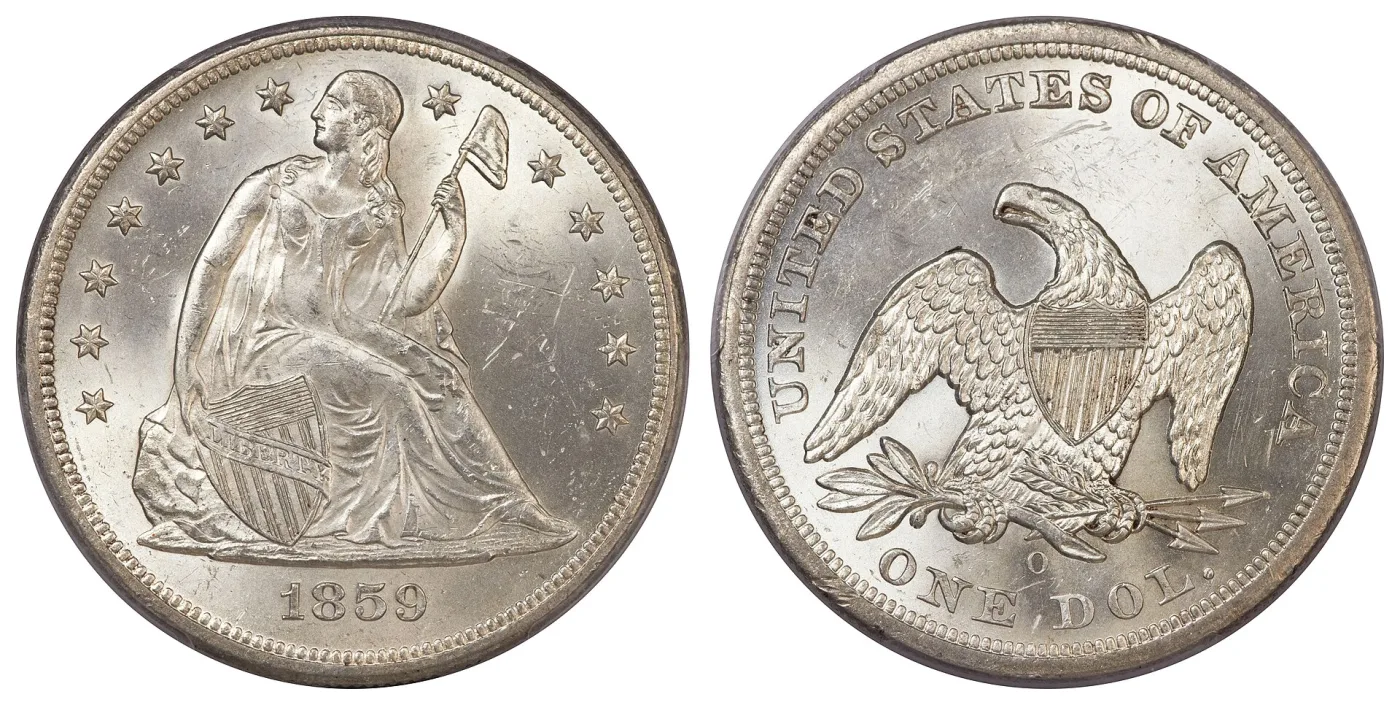
The Seated Liberty Dollar — produced from 1840 through 1873 — stands as one of the most historically rich and visually elegant silver dollars in United States coinage. Designed by Christian Gobrecht, who also created the celebrated Gobrecht Dollars of 1836-1839 that immediately preceded it, the series captures America in transition: from the antebellum republic through the Civil War and into Reconstruction. With a diameter of 38.1 millimeters and a weight of 26.73 grams of 90% silver, the Seated Liberty Dollar shares the same physical proportions as the later Morgan Silver Dollar, Peace Dollar, and modern Eisenhower Dollar.
For collectors, this series is genuine 19th-century classical American coinage. Mintages were modest by later standards — many issues number in the low tens of thousands — and survival rates are correspondingly low. The series contains some of the rarest and most legendary coins in US numismatics, including the unique 1870-S (only nine known), the proof-only 1851 and 1852 restrikes, and the elusive 1873-CC from the brand-new Carson City Mint. Even common dates carry meaningful premiums in any grade due to the silver content and historical interest.
This guide covers everything you need to identify, grade, and value Seated Liberty Dollars: Gobrecht’s design and its evolution, the critical 1866 transition from No Motto to With Motto reverse, mint marks across Philadelphia, New Orleans, San Francisco, and Carson City, the legendary key dates, grading standards including the all-important LIBERTY shield detail, authentication strategies for spotting altered dates and counterfeits, current market values, and practical advice on building a collection. The same fundamental coin identification techniques covered for other classic series apply directly to the Seated Liberty Dollar — and the Liberty figure on the obverse echoes the same designer’s work that influenced the Barber Dime and Barber Quarter Liberty heads decades later.
History and Design: Gobrecht’s Vision
The Seated Liberty Dollar emerged from a remarkable period of design reform at the United States Mint. After silver dollar production had been suspended in 1804 (the famous “King of American Coins” 1804 dollars are actually presentation pieces struck decades later), the Mint experimented with revival in 1836 through 1839 with the Gobrecht Dollar — a stunning pattern-issue series featuring Christian Gobrecht’s flying eagle reverse and seated Liberty obverse. When regular dollar production finally resumed in 1840, Gobrecht’s seated Liberty motif carried forward, but a new, more conventional heraldic eagle reverse replaced the flying eagle that some critics had compared to a duck.
Production began at the Philadelphia Mint in 1840 and continued without interruption until 1873, when the Coinage Act of that year (the so-called “Crime of ’73”) demonetized silver and ended the Seated Liberty Dollar series in favor of the export-only Trade Dollar aimed at the China trade. During its 33-year run, the series witnessed the California Gold Rush, the entire Civil War, the assassinations of Lincoln, the rise of Reconstruction, and the founding of the Carson City and Denver Mints. No other US silver dollar series spans such a transformative period of American history.
The Designer: Christian Gobrecht
Christian Gobrecht served as Chief Engraver of the United States Mint from 1840 until his death in 1844. Before assuming the chief role, he had worked as an assistant engraver and freelance artist, contributing designs and pattern work that would shape American coinage for decades. The Seated Liberty figure he created became the dominant motif on US silver coinage from 1836 through 1891, appearing on dollars, half dollars, quarters, dimes, and half dimes — making Gobrecht’s design language arguably the most pervasive in 19th-century American coinage. Gobrecht inherited his hub work from John Reich, whose Capped Bust Half Dollar design (1807-1839) preceded the Seated Liberty era and laid the groundwork for the engraving conventions Gobrecht refined.
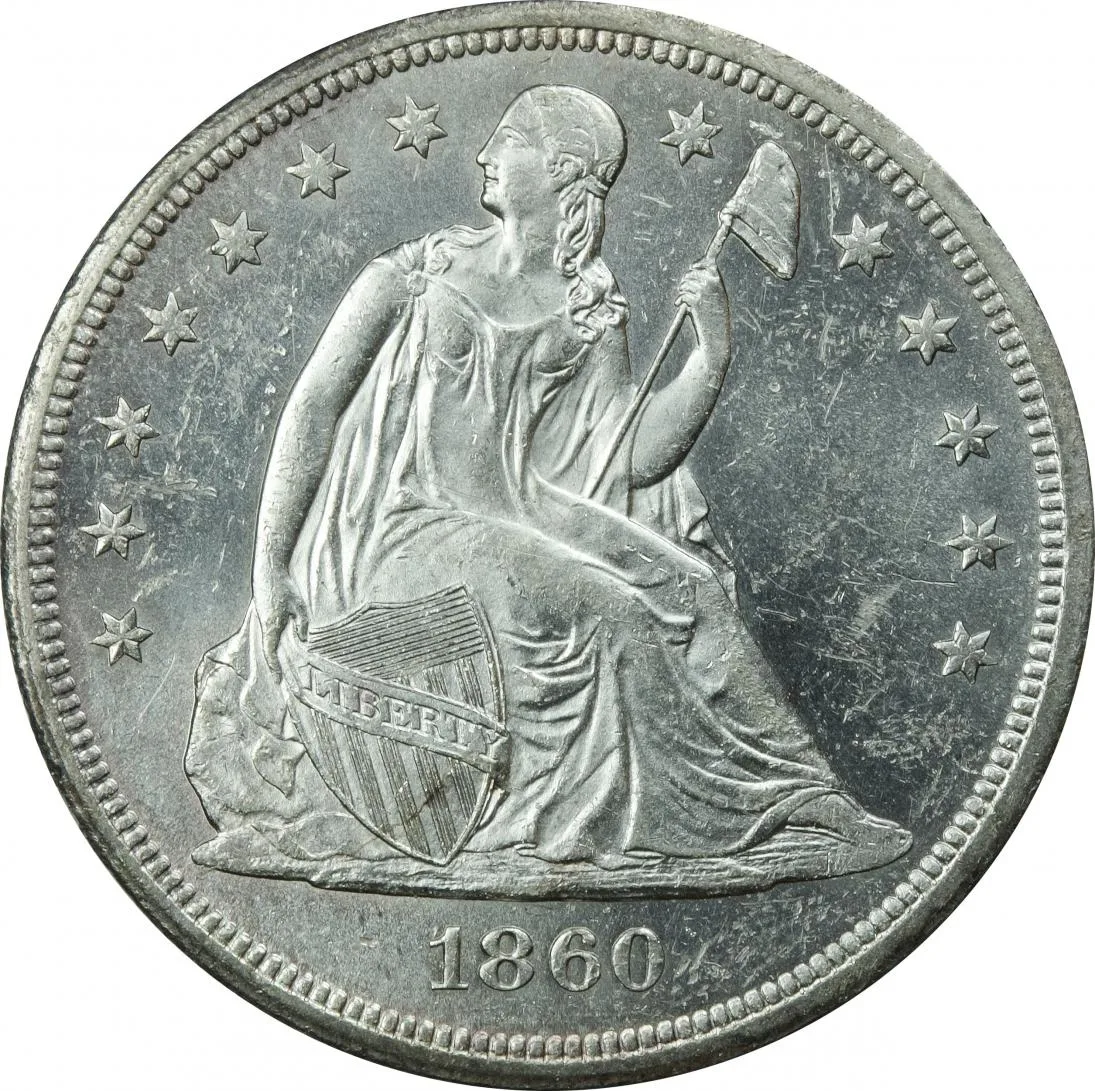
Gobrecht based his Liberty figure on classical sculpture, particularly Britannia personifications and Greco-Roman seated goddess types. Liberty holds a Phrygian cap (the cap of freedom) on a pole in her left hand and rests her right hand on a shield bearing thirteen vertical stripes representing the original colonies. The composition echoes both ancient seated deities and contemporary 19th-century allegorical art, giving the coin a timeless, classical feel that distinguishes it from the more naturalistic Morgan Dollar Liberty head that succeeded it.
Design Details: Obverse and Reverse
Knowing every element of the Seated Liberty Dollar design is essential for accurate grading, variety attribution, and authentication. Wear progresses through specific high points in a predictable order, and every diagnostic feature on the coin carries weight in determining value.
Obverse (Heads Side)
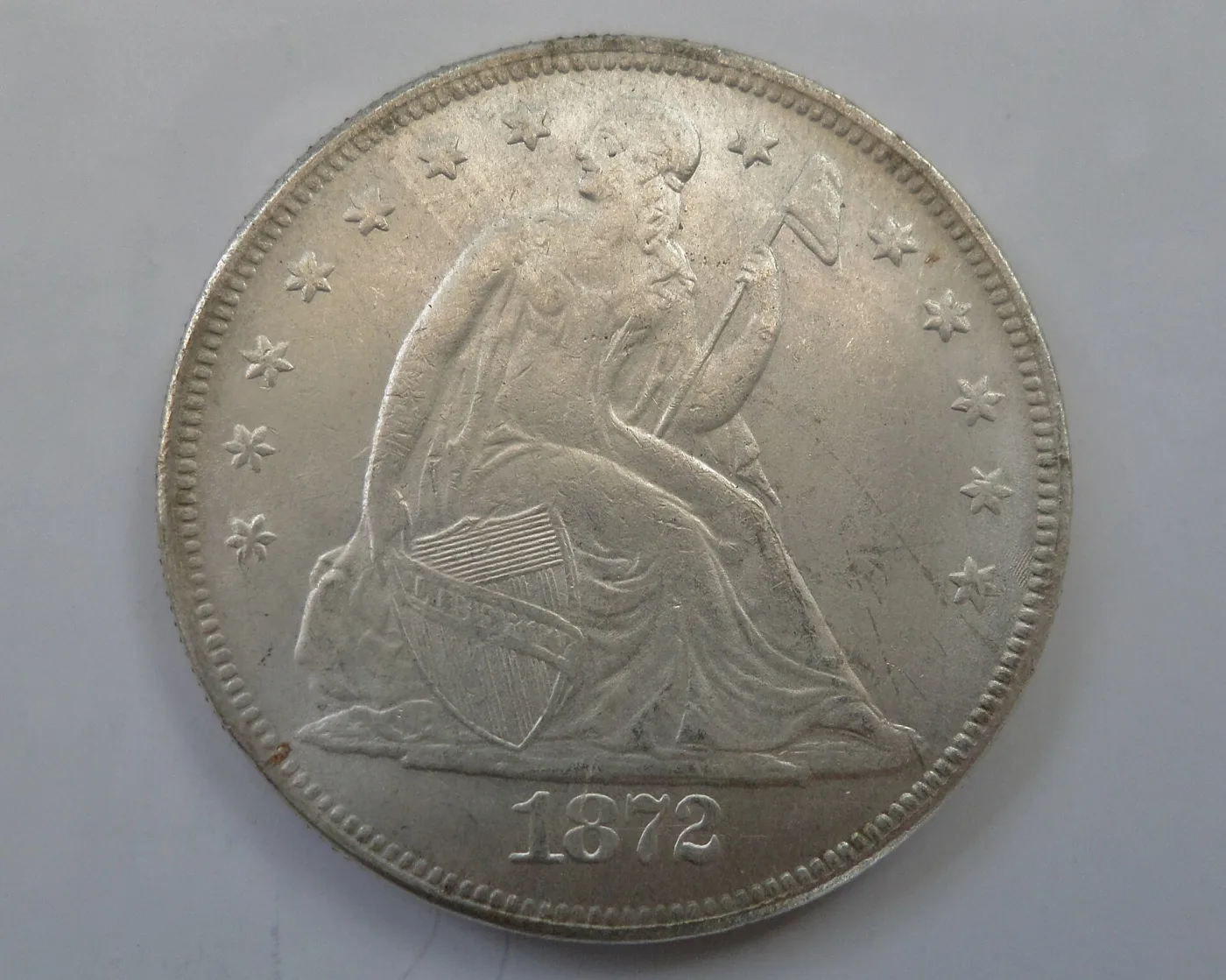
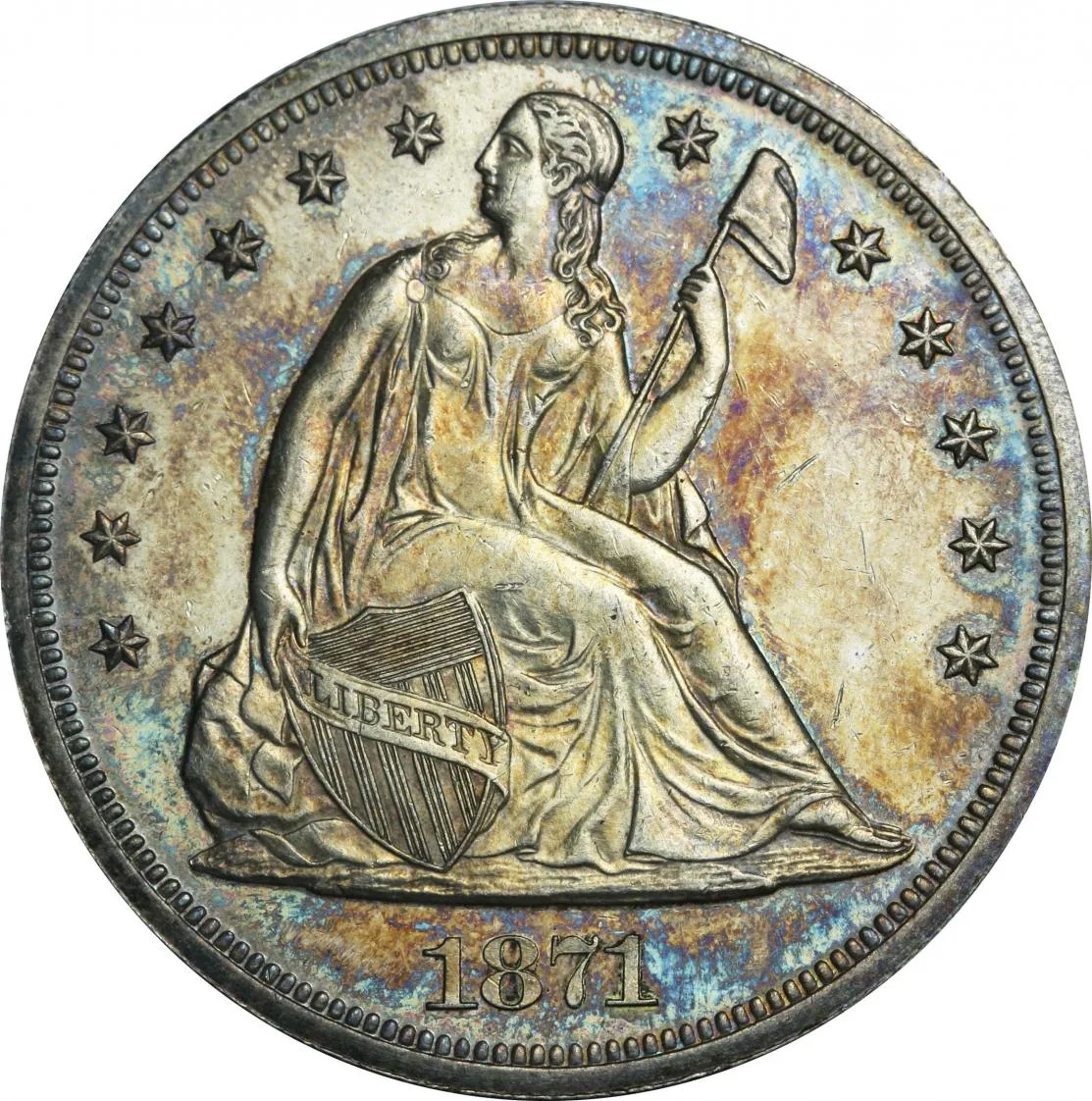
The obverse features Liberty seated on a rock, facing left. Her right arm is extended and rests on a Union shield bearing thirteen vertical stripes; the word LIBERTY appears horizontally across the shield. Her left hand grasps a pole topped with a Phrygian cap — the classical symbol of freedom. Liberty wears a flowing classical gown with deep folds, and her hair is gathered in a bun. Thirteen stars arch around the upper portion of the coin, representing the original colonies. The date appears at the bottom, below Liberty’s feet.
The high points most vulnerable to wear are Liberty’s head and bun, the breast (top of the gown), the right knee, and her right hand resting on the shield. The shield itself is a critical grading reference: the word LIBERTY must remain fully visible across the shield to qualify for circulated grades above Good-4.
Reverse (Tails Side) — No Motto (1840-1865)
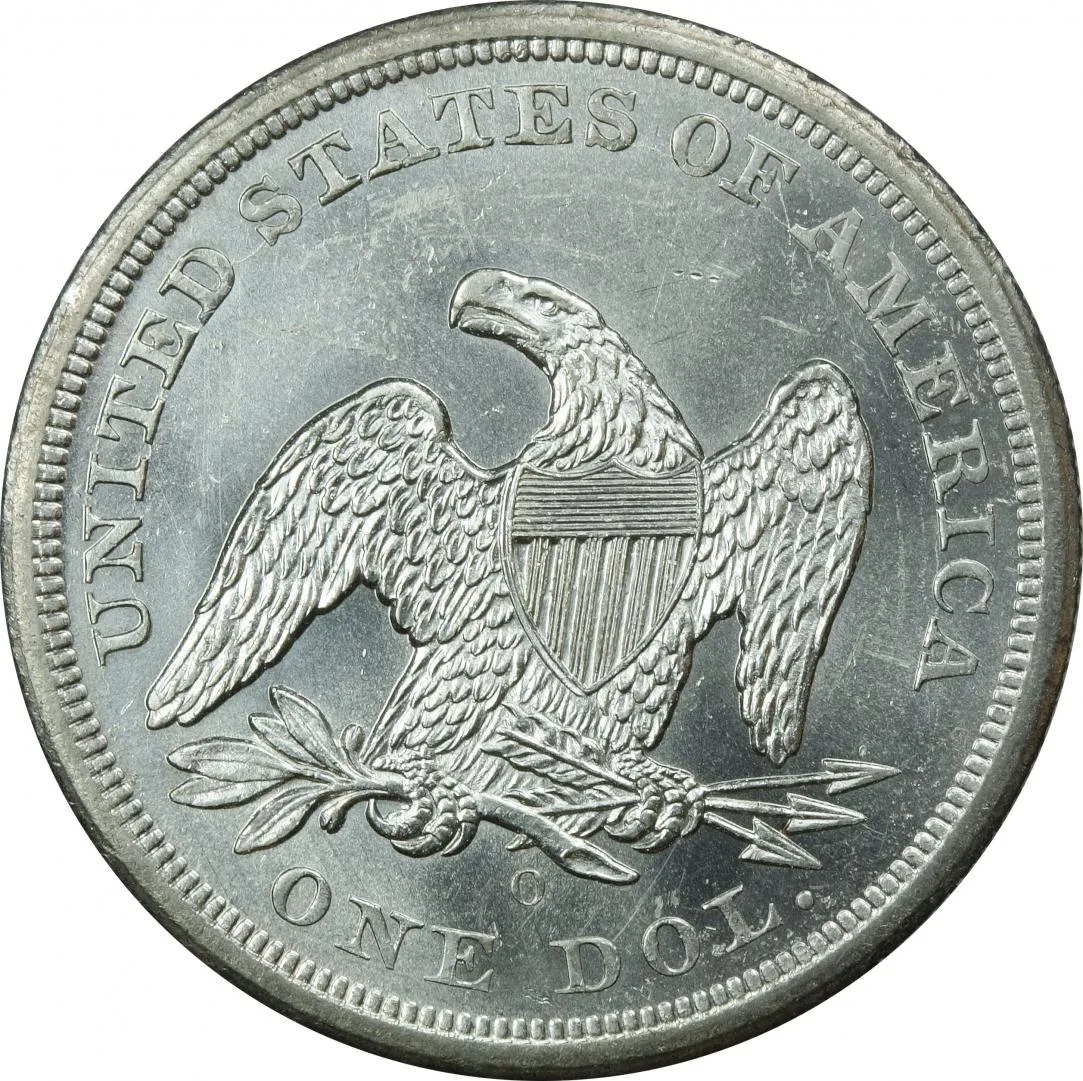
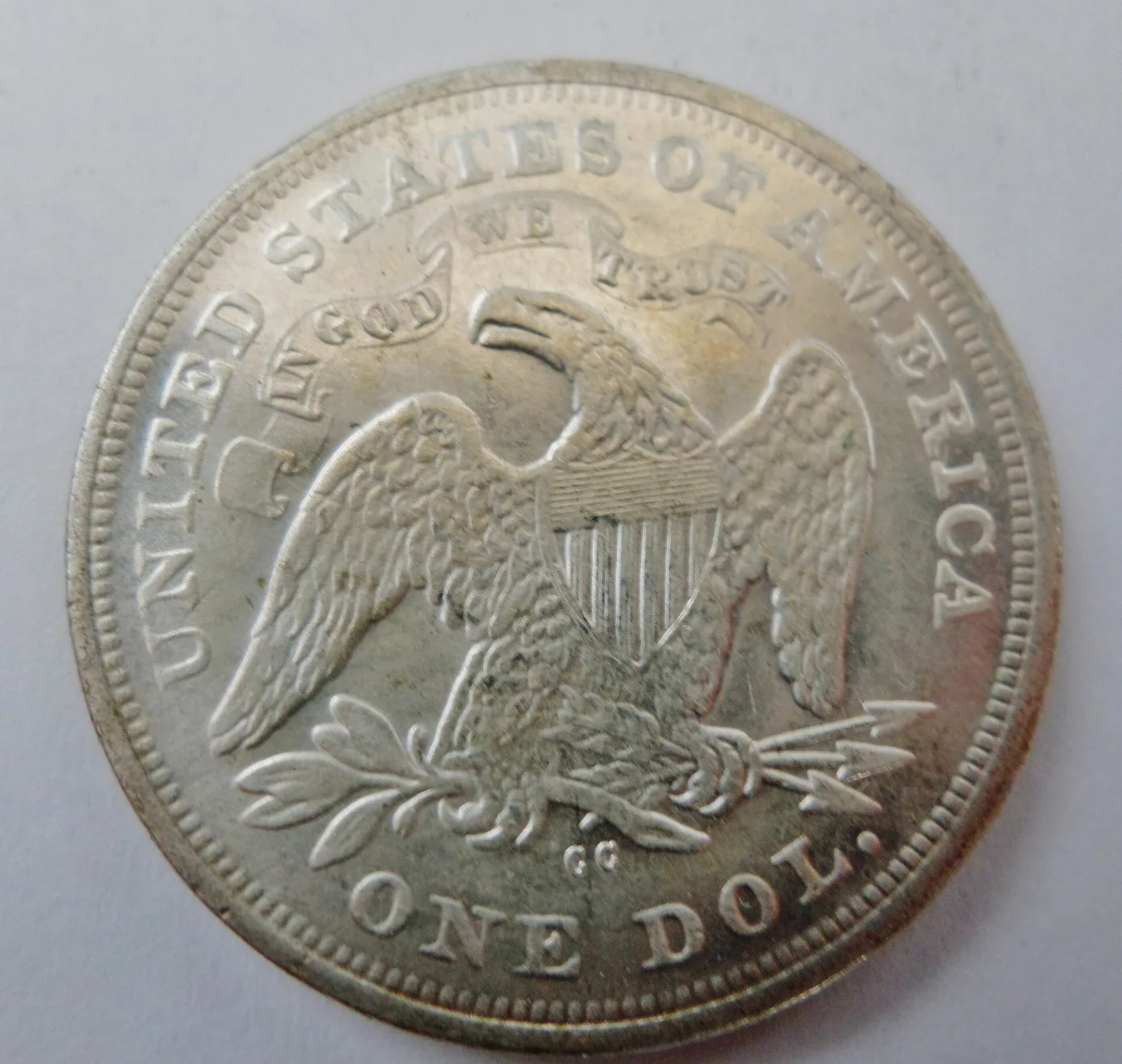
The original reverse features a heraldic eagle with wings spread, holding three arrows in its right talon and an olive branch in its left talon. A Union shield rests on the eagle’s breast. The legend UNITED STATES OF AMERICA arches across the top, and the denomination ONE DOL. appears at the bottom. There is no motto above the eagle. This reverse is found on all dollars dated 1840 through 1865 (and the 1851 and 1852 restrikes, which use the same hub).
Reverse (Tails Side) — With Motto (1866-1873)
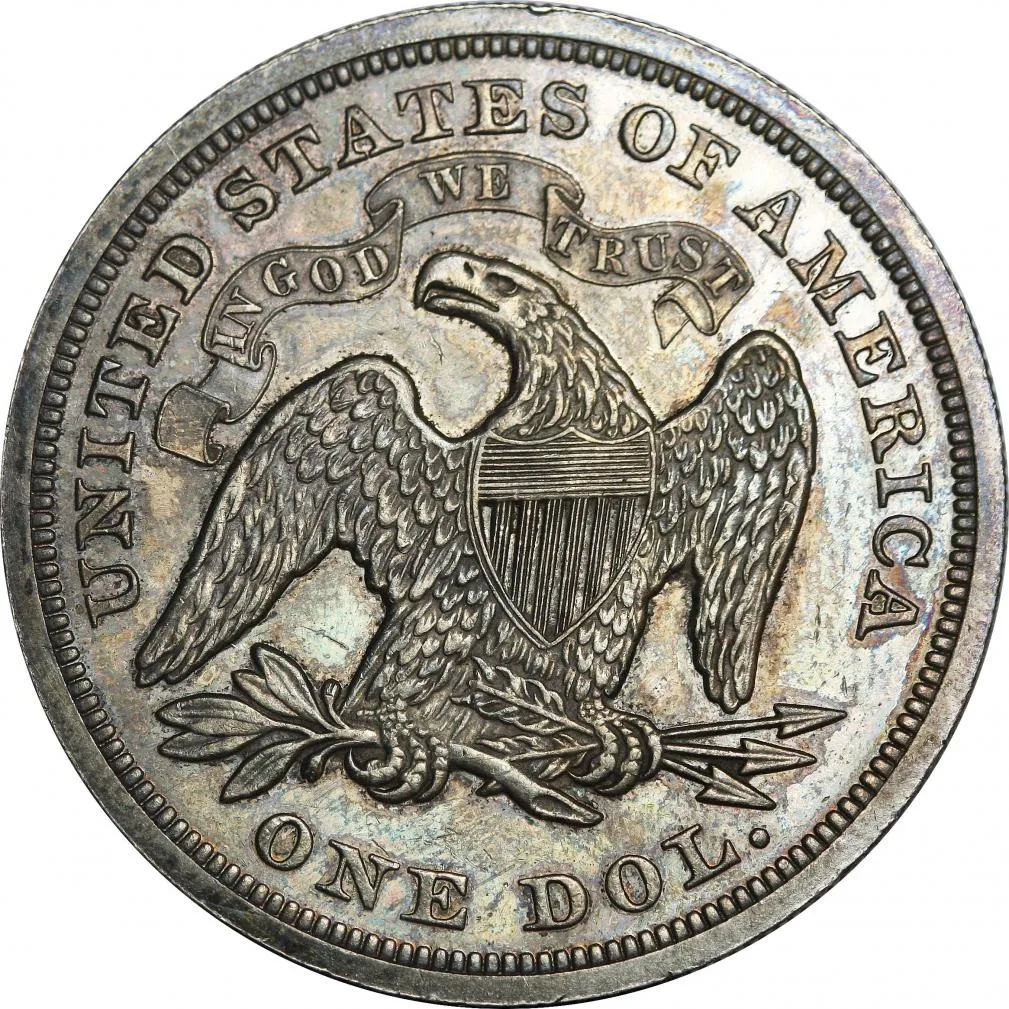
Beginning in 1866, the motto IN GOD WE TRUST was added on a banner above the eagle’s head. This change followed Civil War-era legislation pushed by Treasury Secretary Salmon P. Chase to acknowledge divine guidance during the war. The motto banner is the single most reliable way to date undated or worn examples of post-1866 issues — its presence guarantees the coin was struck in 1866 or later.
No Motto vs. With Motto: The 1866 Transition
The single most important type distinction in the Seated Liberty Dollar series is the 1866 transition from the No Motto reverse to the With Motto reverse. This is not a minor variety — it is a fundamental type division, and many type-set collectors pursue one example of each.
No Motto (1840-1865)
All Seated Liberty Dollars dated 1840 through 1865 use the No Motto reverse. The eagle’s head sits in open field with no banner above. This 26-year run includes most of the No Motto rarities: the 1851 (proof-only restrike), 1852 (proof-only restrike), 1854 (low mintage 33,140), 1855, 1856, 1858 (proof-only), and the New Orleans key dates of 1859-O and 1860-O.
With Motto (1866-1873)
The With Motto reverse was used for all production from 1866 through the series end in 1873. The IN GOD WE TRUST banner above the eagle’s head is unmistakable even in worn condition, making type identification trivial. The With Motto era contains the legendary 1870-S (only nine known), the proof-only 1873-S, and the famed 1873-CC, the rarest Carson City silver dollar.
Identifying the Two Types at a Glance
- No Motto: Open space above the eagle’s head with no inscription. Date 1840-1865.
- With Motto: Banner reading IN GOD WE TRUST directly above the eagle’s head. Date 1866-1873.
- Quick check: If the date is illegible, the presence or absence of the motto banner alone tells you which type you have.
One transitional curiosity: the famously rare 1866 No Motto pattern dollar (only two known) was struck before the motto was added to working dies — these are pattern pieces, not regular issues, and command six-figure prices when they appear.
Composition and Specifications
Every Seated Liberty Dollar is struck in 90% silver and 10% copper — the standard US silver alloy used from 1837 through 1964 for dimes, quarters, halves, and dollars. The same silver content powers the Mercury Dime, Walking Liberty Half Dollar, and other classic silver coinage.
Physical Specifications
- Composition: 90% silver, 10% copper
- Weight: 26.73 grams (412.5 grains)
- Diameter: 38.1 millimeters
- Edge: Reeded
- Net silver weight: 24.057 grams (0.7734 troy ounces)
These specifications match the later Morgan and Peace Dollars, which is no accident — when Congress restored silver dollar production with the Bland-Allison Act of 1878 (creating the Morgan Dollar), they reused the existing dollar specifications. A Seated Liberty Dollar, a Morgan, a Peace, and a 90% silver Eisenhower-era piece all weigh the same and contain the same silver content.
Edge and Strike
All Seated Liberty Dollars have a reeded edge with approximately 189 reeds. The reeding count varies slightly between dies but is generally consistent across the series. Strike quality varies considerably by mint and year. Philadelphia and Carson City strikes are typically sharper than New Orleans issues, with San Francisco production showing more variation.
Key Dates and Major Rarities
The Seated Liberty Dollar series contains an exceptional concentration of legendary rarities — coins that anchor major auction sales and define US numismatic history. The same disciplined approach to spotting key dates applies whether you’re looking at this series, the Buffalo Nickel, or any classic US issue.
1870-S Seated Liberty Dollar
The 1870-S is the standout rarity of the entire series. Only nine examples are known to exist, and the issue itself is unrecorded in official Mint records — surviving examples are believed to have been struck for ceremonial purposes, possibly placed in the cornerstone of the new San Francisco Mint building. When examples appear at auction (rarely), they sell for seven figures. The 1870-S is one of the legendary “dollar coin” rarities of US numismatics.
1873-CC Seated Liberty Dollar
The 1873-CC is the rarest regular-issue Carson City silver dollar of any series. Mintage was just 2,300 pieces, and survivors are estimated at fewer than 150 examples in all grades combined. Carson City would soon strike the legendary 1876-CC Twenty Cent Piece, an even rarer Nevada issue with fewer than 20 known. The Carson City Mint had only opened in 1870 — the same year it struck the legendary 1870-CC Liberty Head Double Eagle, the king of Carson City gold rarities — and the 1873-CC Seated Liberty Dollar was struck during the final year of Seated Liberty Dollar production before the Coinage Act of 1873 ended the series. Even worn examples bring strong four-to-five-figure prices.
1851 (Original) Seated Liberty Dollar
The 1851 Philadelphia issue had a recorded mintage of just 1,300 — the lowest production figure for any business strike in the series. Only a handful are believed genuine “originals” (struck in 1851); the vast majority of 1851-dated dollars on the market are restrikes produced years later in proof format. Original 1851 business strikes are exceptionally rare and command low-to-mid five-figure prices in any grade.
1852 (Original) Seated Liberty Dollar
Similarly to 1851, the 1852 Philadelphia issue had a recorded mintage of just 1,100. Original business strikes are rare, with most 1852-dated dollars being proof restrikes from the late 1850s and 1860s. Originals routinely bring four-to-five-figure prices and require careful authentication.
1854 Seated Liberty Dollar
With a mintage of 33,140, the 1854 is a key date in any genuine date-and-mintmark set. Survivors are scarce in all grades, and the issue is particularly difficult to find in choice circulated or Mint State condition. Expect mid-three to low-four-figure prices for problem-free examples.
1855 Seated Liberty Dollar
The 1855 Philadelphia issue had a mintage of just 26,000 — the second-lowest business strike mintage in the series. Like the 1854, surviving examples are scarce and bring strong premiums in any condition.
1856 Seated Liberty Dollar
With 63,500 struck, the 1856 is more available than 1854 or 1855 but still a semi-key. Most surviving examples are in low-to-mid circulated grades, with Mint State pieces rare and expensive.
1858 Proof-Only Issue
No business strikes were produced in 1858 — only proofs were struck for collectors, with mintage estimates of approximately 80 pieces. Surviving examples are rare and bring five-figure prices in any grade. This is one of the most desirable proof-only issues in 19th-century American numismatics.
1859-O and 1860-O Seated Liberty Dollars
The New Orleans Mint produced relatively significant mintages of 360,000 (1859-O) and 515,000 (1860-O), making these the most affordable mint-marked examples. Many were melted or exported, however, and surviving Mint State examples are uncommon. These are the practical New Orleans options for most collectors.
1872-CC and 1871-CC Seated Liberty Dollars
The Carson City Mint produced Seated Liberty Dollars only in 1870, 1871, 1872, and 1873. The 1871-CC (1,376 mintage) and 1872-CC (3,150 mintage) are both significant rarities, with surviving examples bringing strong five-figure prices in choice grades.
The 1851 and 1852 Proof-Only Restrikes
One of the most interesting numismatic puzzles in the series concerns the 1851 and 1852 restrikes — proof coins dated 1851 or 1852 but actually struck years later, likely between 1858 and 1875. The Mint produced these restrikes to satisfy collector demand for the rare original dates, using working dies that had been preserved.
How Restrikes Differ from Originals
The originals were struck on standard business-strike planchets and typically circulated, leaving most known survivors in worn condition. The restrikes were proof-finish coins with mirrored fields and frosted devices, struck on carefully prepared planchets and never released into circulation. Several diagnostic differences allow specialists to distinguish them:
- Surface finish: Restrikes show mirror-like proof fields; originals show satin business-strike surfaces
- Strike sharpness: Restrikes display razor-sharp design detail; originals often show typical Philadelphia 1851-1852 strike weakness
- Die state: Restrike dies often show evidence of cracks, rust, or repairs that postdate the original 1851 and 1852 production
- Edge and rim: Restrike rims are typically squared and pristine; original rims show production-era characteristics
Authentication Importance
Because original 1851 and 1852 dollars command substantially higher prices than the proof restrikes, accurate attribution is critical. Most authenticators and major auction houses require third-party certification (PCGS or NGC) for either type, and any unattributed 1851 or 1852 dollar should be presumed a restrike until proven otherwise. The price difference can run into five figures.

Mint Marks: Philadelphia, New Orleans, San Francisco, Carson City
Seated Liberty Dollars were struck at four United States mints, with mint marks appearing on the reverse just below the eagle, between the eagle’s tail feathers and the legend ONE DOL. Position is consistent across all years and mints. Always check this location carefully — counterfeiters occasionally add fake mint marks to common Philadelphia coins to create premium-looking branch-mint issues.
Philadelphia Mint (No Mint Mark)
The Philadelphia Mint produced Seated Liberty Dollars every year from 1840 through 1873, and Philadelphia issues bear no mint mark. Mintages varied dramatically: from over 1.7 million in 1872 down to just 1,100 in 1852 (original). Philadelphia produced all proof issues for the series, including the famous 1858 proof-only and the 1851-1852 restrikes.
New Orleans Mint (O Mint Mark)
The New Orleans Mint struck Seated Liberty Dollars in 1846, 1850, 1859, and 1860. The mint mark “O” appears between the eagle’s tail and the denomination. Production ceased after 1860 due to the Civil War, and New Orleans never struck Seated Liberty Dollars after the Confederacy seized the facility in 1861. The 1846-O is genuinely scarce; the 1859-O and 1860-O are more available.
San Francisco Mint (S Mint Mark)
The San Francisco Mint produced Seated Liberty Dollars in 1859, 1870, 1872, and 1873. The legendary 1870-S is the great rarity of the entire series, while the 1872-S and 1859-S are scarce. The 1873-S is a numismatic curiosity: 700 were officially struck and delivered, but no specimens are known to exist today, making it one of the great mysteries of US coinage.
Carson City Mint (CC Mint Mark)
The Carson City Mint opened in 1870 to process silver from the Comstock Lode, and it struck Seated Liberty Dollars only in 1870, 1871, 1872, and 1873. Every Carson City Seated Liberty Dollar is rare — none had mintages over 12,500. The 1873-CC is the rarest at 2,300 mintage, but the 1871-CC (1,376 mintage) is even scarcer in surviving examples. Genuine “CC” mint marks are smaller and more compact than the later Carson City marks seen on Morgan Dollars.
Mint Mark Appearance and Authentication
- Position: Always on the reverse, below the eagle, between the tail feathers and the denomination
- Style: Era-appropriate: 19th-century mint marks are smaller and more delicate than 20th-century examples
- Sharpness: Punched into individual working dies; well-defined letters with consistent depth
- Counterfeit warning: Added “CC” mint marks on common Philadelphia coins are a known fraud — examine for tooling marks under 10x magnification
Doubled Dies and Notable Varieties
Beyond the major type and mint mark distinctions, the Seated Liberty Dollar series hosts a number of die varieties that specialists actively pursue. None match the price gravity of the famous 1955 Lincoln Doubled Die, but several add meaningful premiums.
1842 Repunched Date
Some 1842 Philadelphia coins show clear repunching of the date, with secondary digits visible beneath the primary impression. The variety is uncommon but not rare and brings modest premiums in higher grades.
1846-O Tall vs. Short Date
Two date positions exist for the 1846-O: a tall date with the digits reaching higher into the field, and a short date positioned more closely to the rock. Both are scarce, with the tall date slightly less common.
1847 Doubled Date
Several 1847 dies show evident doubling on the date numerals, particularly the 7. The variety is collected by specialists but commands only modest premiums.
1859-O Repunched Mint Mark
Some 1859-O coins show clear repunching of the O mint mark, with a secondary O visible below or to the side of the primary mark. Specialists pursue this variety actively, and choice examples bring premiums.
1872 Doubled Liberty
A doubled die obverse on certain 1872 Philadelphia coins shows clear doubling on the word LIBERTY across the shield. The variety is uncommon and adds modest premiums in all grades.
Cherrypicker Tips
- Use a 10x loupe on the date numerals and shield LIBERTY for repunching or doubling
- Check the mint mark on every branch-mint coin for repunching or doubling
- Compare die states for cracks, rust, or rim breaks — late die-state coins can be more interesting and scarcer
- Reference the Cherrypickers’ Guide for current variety attribution and FS numbers
- Watch for “Type II” reverses on certain 1860 issues with subtle hub differences
Grading Seated Liberty Dollars
Accurate grading is essential because price gradients are steep across the entire grade scale — from Good-4 through Mint State, every grade jump can mean significant value differences. The same fundamental grading methods that apply to other 19th-century US silver coins work here, with particular attention to the LIBERTY shield and Liberty’s head and bun.
The LIBERTY Shield Standard
As with the Barber series that succeeded it, the word LIBERTY across the shield is the primary grading reference for circulated Seated Liberty Dollars. The letters wear away in a predictable sequence as the coin sees more circulation:
- About Good-3: LIBERTY mostly worn away; only fragments visible
- Good-4: Full LIBERTY discernible but very worn; some letters partial
- Very Good-8: All letters visible but several partial
- Fine-12: All letters fully visible but worn
- Very Fine-20 to 35: LIBERTY sharp; major design features show definition
- Extremely Fine-40 to 45: Sharp LIBERTY; light wear on highest points
- About Uncirculated-50 to 58: Trace wear on Liberty’s head, knee, and breast
High-Point Wear Pattern
Wear on Seated Liberty Dollars progresses in a specific order across the high points of Liberty’s figure:
- Liberty’s head and bun show wear first, with hair detail flattening
- Right knee and the top of the gown next show wear
- Right hand and arm resting on the shield show flattening
- Eagle’s breast and head on the reverse wear in parallel
- Eagle’s wing tips are last to show heavy wear
Mint State Grading
Mint State Seated Liberty Dollars are scarce, and grading distinctions matter enormously for value:
- MS-60 to MS-62: No wear, but heavy bag marks; subdued luster
- MS-63: Moderate marks; reasonable luster; the most common Mint State grade
- MS-64: Lighter marks; good luster; pleasing eye appeal
- MS-65: Light marks only; full luster; strong eye appeal — a major price step
- MS-66 and above: Genuinely rare; many issues have populations under 50 coins
Strike and Luster Considerations
Seated Liberty Dollar luster is satin to slightly frosty, never the booming cartwheel of Morgan Dollars. Don’t penalize the series for lacking Morgan-style luster — that’s not how mid-19th-century silver dollars were made. Strike quality varies by mint: Philadelphia and Carson City strikes are typically sharper than New Orleans issues, with San Francisco production showing more variation.
Authentication and Spotting Counterfeits
Seated Liberty Dollars are heavily counterfeited, both contemporary 19th-century counterfeits (still circulated when discovered) and modern reproductions. The high silver content, classic design, and key-date premiums make this series an attractive target. Apply the same authentication discipline as for other high-value classic series.
Altered Dates and Mint Marks
The most common Seated Liberty Dollar fraud involves altering common dates to scarce ones. Specific fraud patterns include:
- 1851 and 1852 alterations: Common dates altered to look like 1851 or 1852 by tooling the third or fourth digit
- Added “CC” mint marks: Carson City premiums make this one of the most common alterations — examine the mint mark area for tool marks under 10x magnification
- Altered “O” to “S”: Less common but occasionally seen on key date branch-mint coins
- “1870-S” creations: Given the seven-figure value of genuine examples, any 1870-S claim should be approached with extreme skepticism — buy only certified examples from major auction houses
Cast and Struck Counterfeits
Modern counterfeits range from crude cast pieces (easy to detect) to deceptive struck counterfeits made from transfer dies. Detection points include:
- Weight: Genuine coins weigh 26.73 grams — counterfeits often deviate
- Specific gravity: Pure silver has different density than counterfeit alloys (silver-plated copper, lead, base metal)
- Edge reeding: Genuine reeding is sharp and uniform; cast counterfeits show rounded or irregular reeds
- Surface texture: Cast counterfeits show pebbly or grainy surfaces under magnification; struck counterfeits may show transfer-die artifacts
- Detail sharpness: Genuine strikes show crisp internal detail; counterfeits often soften finer features
Cleaned and Polished Coins
Many Seated Liberty Dollars in circulation today have been cleaned, often inexpertly. Detection points include unnatural shine, hairline scratches under angled light, and a pinkish or orange “dipped” appearance. Cleaned coins receive “Details” grades from PCGS and NGC and lose 30-60% of value compared to original-surface coins.
Using Third-Party Grading
For any Seated Liberty Dollar worth more than $200 — which is most of the series — purchase already-certified examples from PCGS or NGC. The certification fee is small relative to the protection it provides. For premium issues (1854, 1855, 1856, all branch-mint coins, all proof-only issues, key-date Carson City), certified examples are essentially the only safe purchase route.
Current Market Values and Price Guide
Seated Liberty Dollar values cover an enormous range — from a few hundred dollars for common-date circulated examples to seven figures for the 1870-S. The prices below reflect approximate retail values as of 2026 for problem-free, original-surface coins. Cleaned, damaged, or altered examples are worth substantially less, and certified premium-grade coins regularly bring prices well above these ranges.
Common No Motto Dates (1840-1865 Philadelphia)
- Good-4: $300–$450
- Very Fine-20: $450–$650
- Extremely Fine-40: $650–$950
- About Uncirculated-50: $1,200–$2,000
- MS-63: $3,500–$6,500
- MS-65: $15,000–$30,000
Common With Motto Dates (1866-1873 Philadelphia)
- Good-4: $325–$475
- Very Fine-20: $475–$700
- Extremely Fine-40: $700–$1,000
- About Uncirculated-50: $1,300–$2,200
- MS-63: $3,800–$7,000
- MS-65: $16,000–$32,000
Key Dates and Rarities
- 1854 (Fine-12): $1,400–$2,200
- 1855 (Fine-12): $1,800–$2,800
- 1856 (Fine-12): $700–$1,100
- 1858 Proof (PR-63): $30,000–$50,000
- 1851 Original (VF-20): $25,000–$45,000
- 1851 Restrike Proof (PR-63): $20,000–$35,000
- 1852 Original (VF-20): $35,000–$60,000
- 1873-CC (Fine-12): $7,500–$12,000
- 1873-CC (EF-40): $20,000–$35,000
- 1871-CC (Fine-12): $4,500–$7,500
- 1872-CC (Fine-12): $2,500–$4,000
- 1870-S (any grade): $1,000,000+ at auction
Branch Mint Issues
- 1846-O (Fine-12): $400–$600
- 1850-O (Fine-12): $700–$1,100
- 1859-O (Fine-12): $400–$600
- 1860-O (Fine-12): $400–$600
- 1859-S (VF-20): $1,400–$2,200
- 1872-S (VF-20): $1,200–$2,000
Note: These are retail price estimates. Actual sale prices at auction vary based on eye appeal, certification, surface originality, and current market demand. For important purchases, reference recent auction archives from Heritage Auctions, Stack’s Bowers, and Legend Numismatics alongside standard price guides.
Building a Seated Liberty Dollar Collection
The Seated Liberty Dollar series is one of the most challenging — and most rewarding — silver dollar series to collect. With 33 years of production, four mints, two major types, and several legendary rarities, the series offers entry points at multiple budget levels but reaches genuinely museum-grade prices at the top end. Far more challenging than the modern Eisenhower series and substantially older than the Morgan Dollar that succeeded it.
Type Set
The simplest collection is a two-coin type set: one No Motto example (1840-1865) and one With Motto example (1866-1873). This can be assembled in Very Fine condition for $1,000-$1,500 total, or in choice Extremely Fine for $1,500-$2,500. A type set captures the fundamental design distinction without requiring rare-date pursuit.
Date Set (Excluding Major Rarities)
A complete date set excluding the 1870-S, original 1851/1852, and proof-only issues is achievable in Fine to Very Fine grades for $20,000-$40,000 over a multi-year collecting effort. Adding the proof-only 1858 and either an 1851 or 1852 restrike pushes the total into six figures.
Mint Mark Set
Many collectors pursue one example from each mint that produced Seated Liberty Dollars: Philadelphia (no mint mark), New Orleans (O), San Francisco (S), and Carson City (CC). Achievable for a few thousand dollars by selecting the most affordable date from each mint, though Carson City alone can cost $2,500+ for the most affordable date (1872-CC) in low circulated grade.
Specialty Approaches
- Civil War set: One coin per year from 1861-1865, capturing dollars struck during the war
- Carson City specialist: All four CC dates (1870, 1871, 1872, 1873) — challenging but achievable for serious collectors
- Proof set: Proof Seated Liberty Dollars from 1840 onward; complete sets are rare and expensive
- Variety set: Repunched dates, doubled dies, and major die-state varieties
- High-grade type: MS-65+ examples of both types — visually stunning but extremely costly
Practical Tips
- Buy certified for everything: Even common dates merit certification given the prevalence of cleaning and counterfeits
- Original surfaces command premiums: Cleaned coins are heavily discounted; learn to recognize natural toning vs. dipped surfaces
- Patience pays: Many issues appear at auction only a few times per year; build a target list and wait for the right examples
- Study the LIBERTY shield: This single feature determines circulated grade — train your eye on it
- Compare CC mint marks: Genuine 19th-century CC marks differ subtly from later Morgan-era CC marks; learn the era-specific style
- Use major auction archives: Heritage and Stack’s Bowers archives are invaluable for studying authentic examples
Storage and Preservation
Proper storage maintains the value and visual appeal of your collection. The high silver content of Seated Liberty Dollars makes them particularly susceptible to environmental toning, and improper storage can cause damage that significantly reduces value.
What to Avoid
- PVC holders: Older soft plastic flips and some envelopes contain PVC, which outgasses a green sticky residue that etches into silver surfaces. Use only “non-PVC” or “Mylar” labeled holders.
- Acidic paper: Some paper envelopes contain sulfur compounds that accelerate toning. Use acid-free, archival-quality envelopes.
- Rubber bands: Rubber contains sulfur and produces dark, irreversible spotting on silver. Never store rubber near coins.
- Cotton wadding: Some traditional cotton storage materials contain residual processing chemicals. Use only inert museum-grade materials.
- High humidity: Moisture accelerates oxidation. Keep humidity below 50% with desiccants if necessary.
- Wood drawers: Most wood emits acidic vapors that tone silver. Line wood storage with inert materials.
Recommended Storage
- PCGS or NGC slabs: Inert plastic holders that provide excellent long-term protection and authentication — highly recommended for any Seated Liberty Dollar
- Air-Tite holders: Dollar-sized direct-fit capsules; safe and excellent for individual coins
- Non-PVC flips: Mylar or polyethylene flips for safe short-term storage and examination
- Quality albums: Dansco Seated Dollar albums; ensure pages are PVC-free
- Climate-controlled storage: Stable temperature and low humidity for long-term collection care
Handling
Always handle Seated Liberty Dollars by their edges. The large surface area shows fingerprints readily, and oils from skin will eventually etch the surface and produce permanent fingerprints. Cotton gloves are appropriate for high-value coins. Never clean a Seated Liberty Dollar — virtually any cleaning reduces value, and cleaned coins are easily detected by experienced graders. If a coin appears to need conservation, consult a professional service like NCS (Numismatic Conservation Services) rather than attempting it yourself.
Frequently Asked Questions
What is a Seated Liberty Dollar and when was it made?
The Seated Liberty Dollar is a 90% silver United States dollar coin produced from 1840 through 1873. Designed by Christian Gobrecht, it features Liberty seated on a rock with a Phrygian cap on a pole and a Union shield on the obverse, and a heraldic eagle on the reverse. The series spans the antebellum era, the Civil War, and Reconstruction, ending when the Coinage Act of 1873 demonetized silver dollars.
How do I tell a No Motto from a With Motto Seated Liberty Dollar?
Look at the reverse above the eagle's head. If there is empty space with no inscription, the coin is a No Motto type (struck 1840-1865). If there is a banner reading IN GOD WE TRUST directly above the eagle, the coin is a With Motto type (struck 1866-1873). The motto banner is unmistakable even in worn condition.
What is the rarest Seated Liberty Dollar?
The 1870-S is the rarest Seated Liberty Dollar, with only nine known examples. The issue is unrecorded in official Mint records — surviving coins are believed to have been struck for ceremonial purposes, possibly placed in the cornerstone of the new San Francisco Mint building. When examples appear at auction, they bring seven-figure prices.
Are 1851 and 1852 Seated Liberty Dollars valuable?
Yes — both originals and proof restrikes are valuable. Original 1851 (mintage 1,300) and 1852 (mintage 1,100) business strikes are among the rarest coins in the series, bringing five-figure prices in any grade. Proof restrikes of these dates were produced in the late 1850s through 1870s for collectors and bring four-to-five-figure prices. Authentication and certification are critical since most 1851 and 1852 dollars on the market are restrikes, not originals.
What is the 1873-CC Seated Liberty Dollar?
The 1873-CC is the rarest regular-issue Carson City silver dollar of any series. Mintage was 2,300 pieces, with surviving examples estimated at fewer than 150. The 1873-CC was struck during the final year of Seated Liberty Dollar production, just before the Coinage Act of 1873 ended the series. Even worn examples bring strong four-to-five-figure prices.
How much silver is in a Seated Liberty Dollar?
Each Seated Liberty Dollar contains 24.057 grams of silver (0.7734 troy ounces) within its 26.73-gram total weight. The composition is 90% silver and 10% copper, the standard US silver alloy used from 1837 through 1964. This is the same silver content as later Morgan and Peace Dollars.
Why are there four mint marks on Seated Liberty Dollars?
Seated Liberty Dollars were struck at four mints during the series: Philadelphia (no mint mark, 1840-1873), New Orleans (O mint mark, 1846-1860), San Francisco (S mint mark, 1859-1873), and Carson City (CC mint mark, 1870-1873). New Orleans production ceased after 1860 due to the Civil War. San Francisco and Carson City joined later as the western mints came online to process Comstock Lode silver.
How do I grade my Seated Liberty Dollar?
The single most important grading reference is the word LIBERTY across Liberty's shield. Full LIBERTY visibility is required for grades above Good-4. Beyond LIBERTY, examine the high points of Liberty's head, breast, knee, and right hand for wear, plus the eagle's breast and head on the reverse. Mint State coins should have no wear and varying degrees of bag marks and luster preservation. For accurate grading and value, submit to PCGS or NGC.
Can I clean a Seated Liberty Dollar to improve its appearance?
No — cleaning reduces value substantially. Even gentle cleaning leaves hairlines visible under magnification, and harsh cleaning ("dipping") removes original surface and produces unnatural color. Cleaned coins receive "Details" grades from PCGS and NGC and lose 30-60% of value compared to problem-free original surfaces. If a coin truly needs conservation, use a professional service like NCS rather than attempting it yourself.
Is a Seated Liberty Dollar collection a good investment?
Quality Seated Liberty Dollars have appreciated steadily over decades, particularly key dates and high-grade examples. The series benefits from genuine rarity (low mintages, low survival rates), strong historical interest, and limited new supply. However, common-date pieces have appreciated more modestly, and condition rarities are subject to grading-service population dynamics. As with any collectible, collect for enjoyment first and treat investment returns as a bonus.