Dollar Coins With Women on Them: Which One Do You Have?
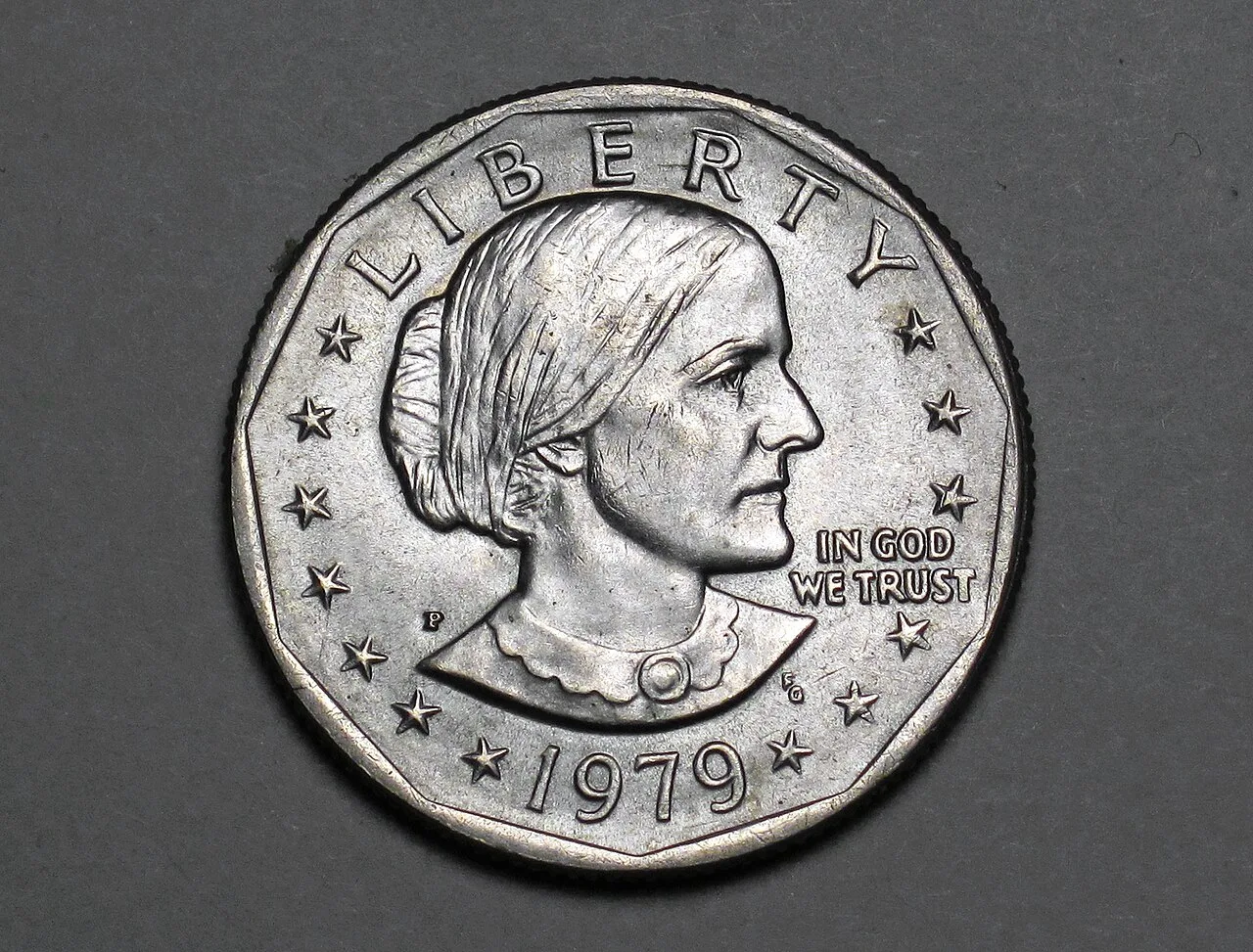
Search for “dollar coins with women on them” and you are probably holding one of two coins: a silver-colored small dollar with a woman in profile, or a golden one with a young woman carrying a baby. Those are the Susan B. Anthony and Sacagawea dollars, and between them they account for nearly every woman-faced dollar you will meet in change. But they are not the only dollars with a woman on them. Congress has put real women on commemorative silver dollars, and the big silver dollars your grandparents kept show Liberty, an imagined woman for whom real women sat as models.
This guide sorts all of them so you can name the coin in your hand, and points you to the full guide for each one.
The quick answer
Three questions settle most coins: what color is it, how big is it, and is the woman a named person or Liberty?
| Coin | Years | Woman shown | Real or Liberty | Size and color |
|---|---|---|---|---|
| Susan B. Anthony dollar | 1979–1981, 1999 | Susan B. Anthony | Real | 26.5 mm, silver-colored |
| Sacagawea / Native American dollar | 2000–present | Sacagawea, with her son | Real | 26.5 mm, golden |
| Special Olympics silver dollar | 1995 | Eunice Kennedy Shriver | Real, and living when struck | 38.1 mm, silver |
| Dolley Madison silver dollar | 1999 | Dolley Madison | Real | 38.1 mm, silver |
| Women’s Suffrage Centennial dollar | 2020 | Three unnamed women | Symbolic | 38.1 mm, silver |
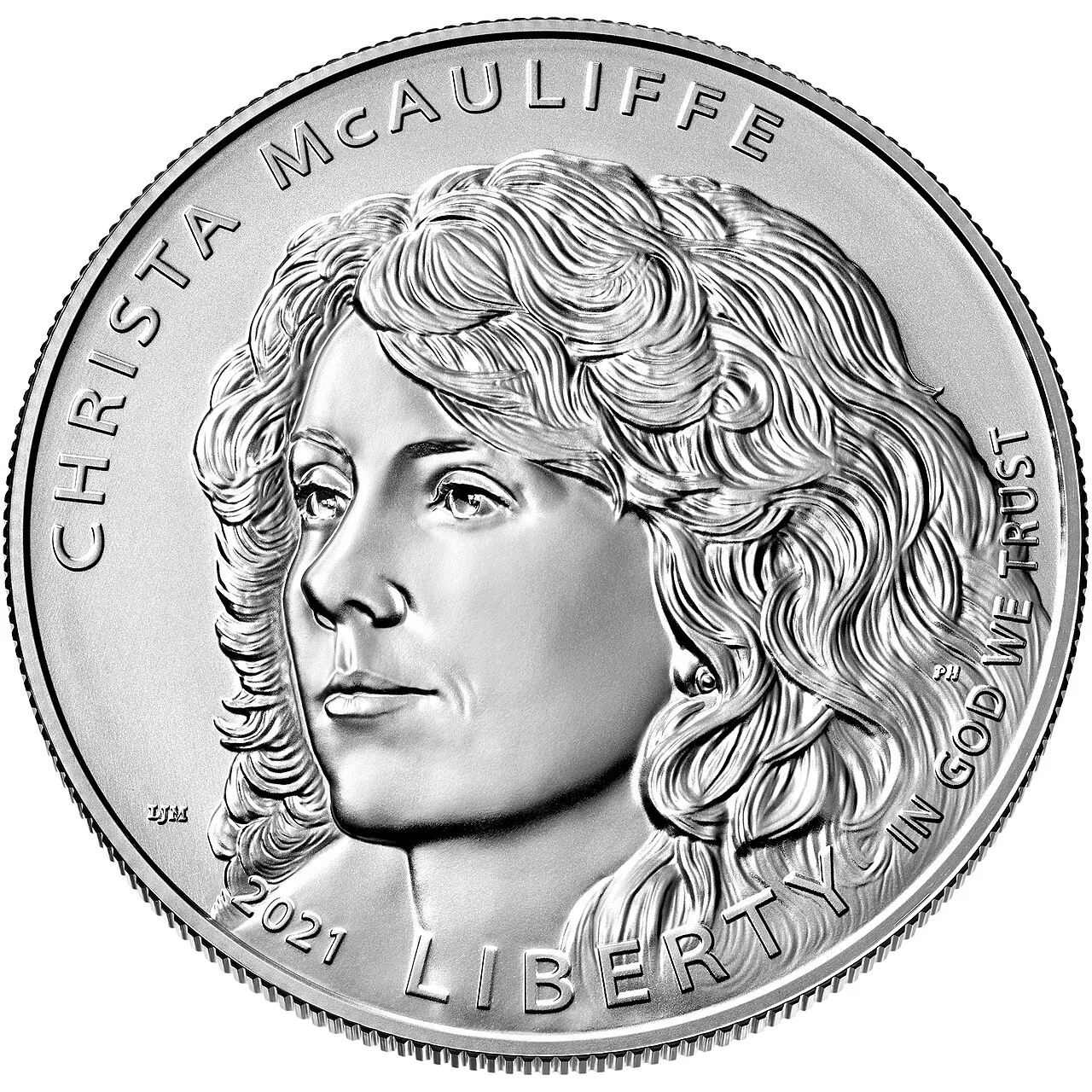
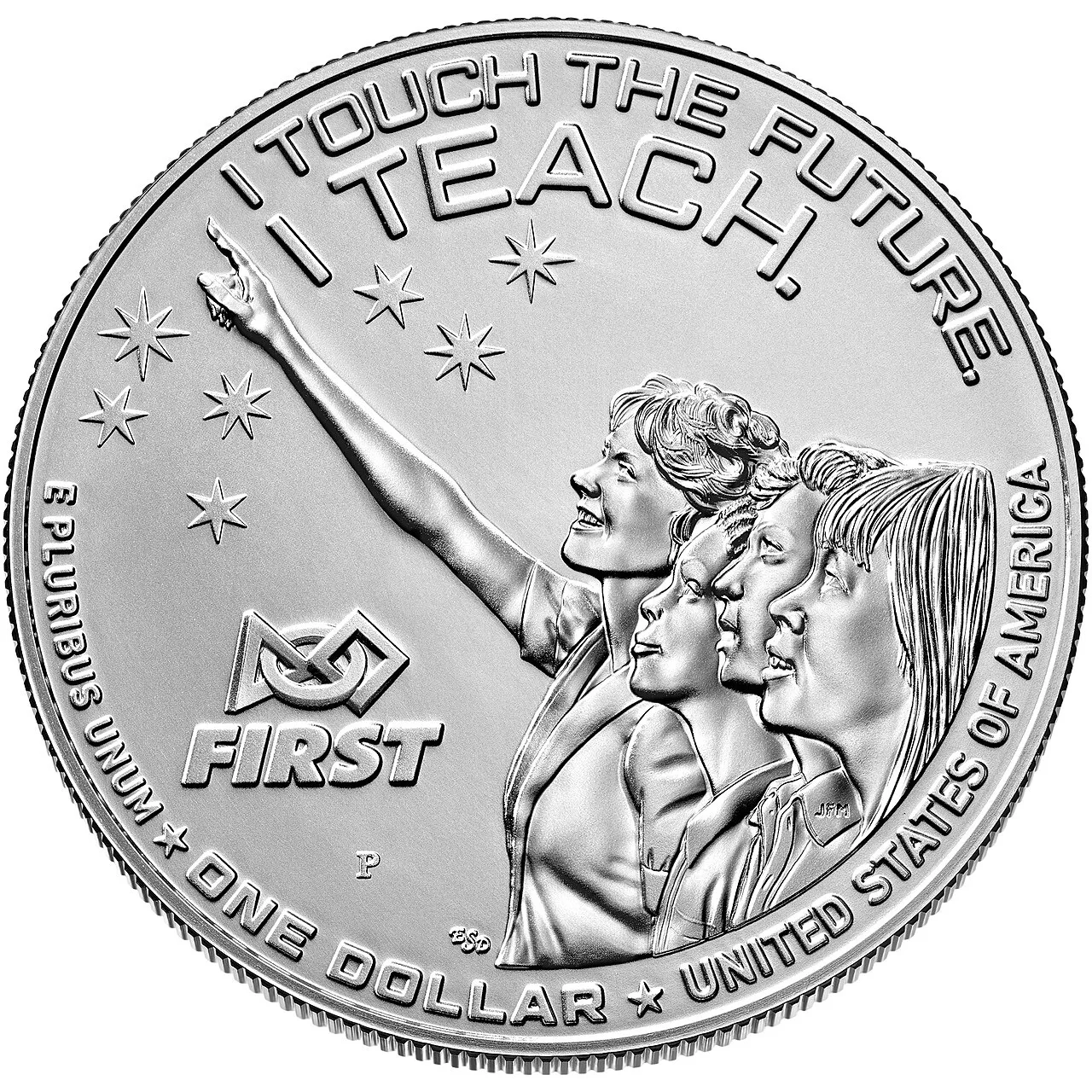
| Christa McAuliffe silver dollar | 2021 | Christa McAuliffe | Real | 38.1 mm, silver |
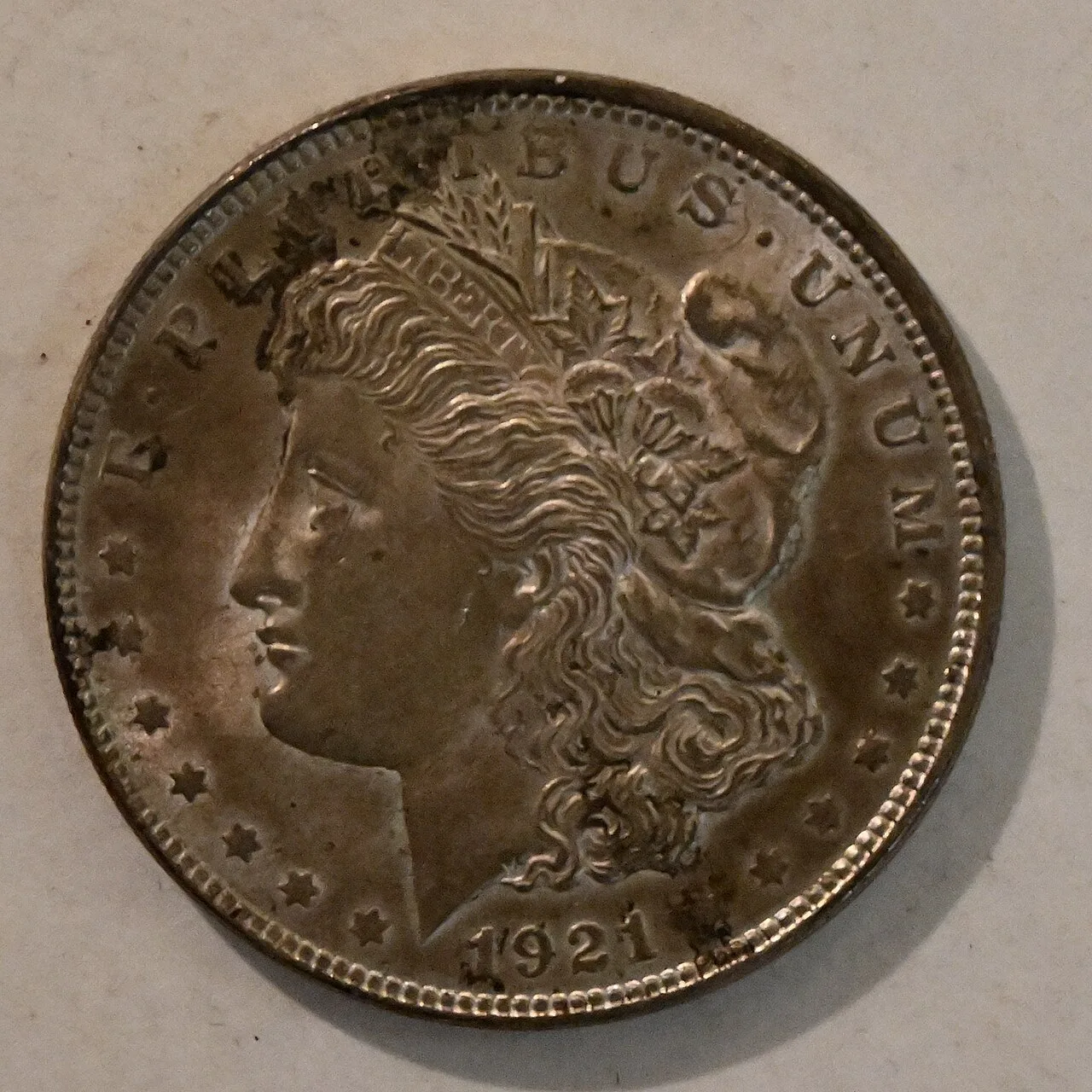
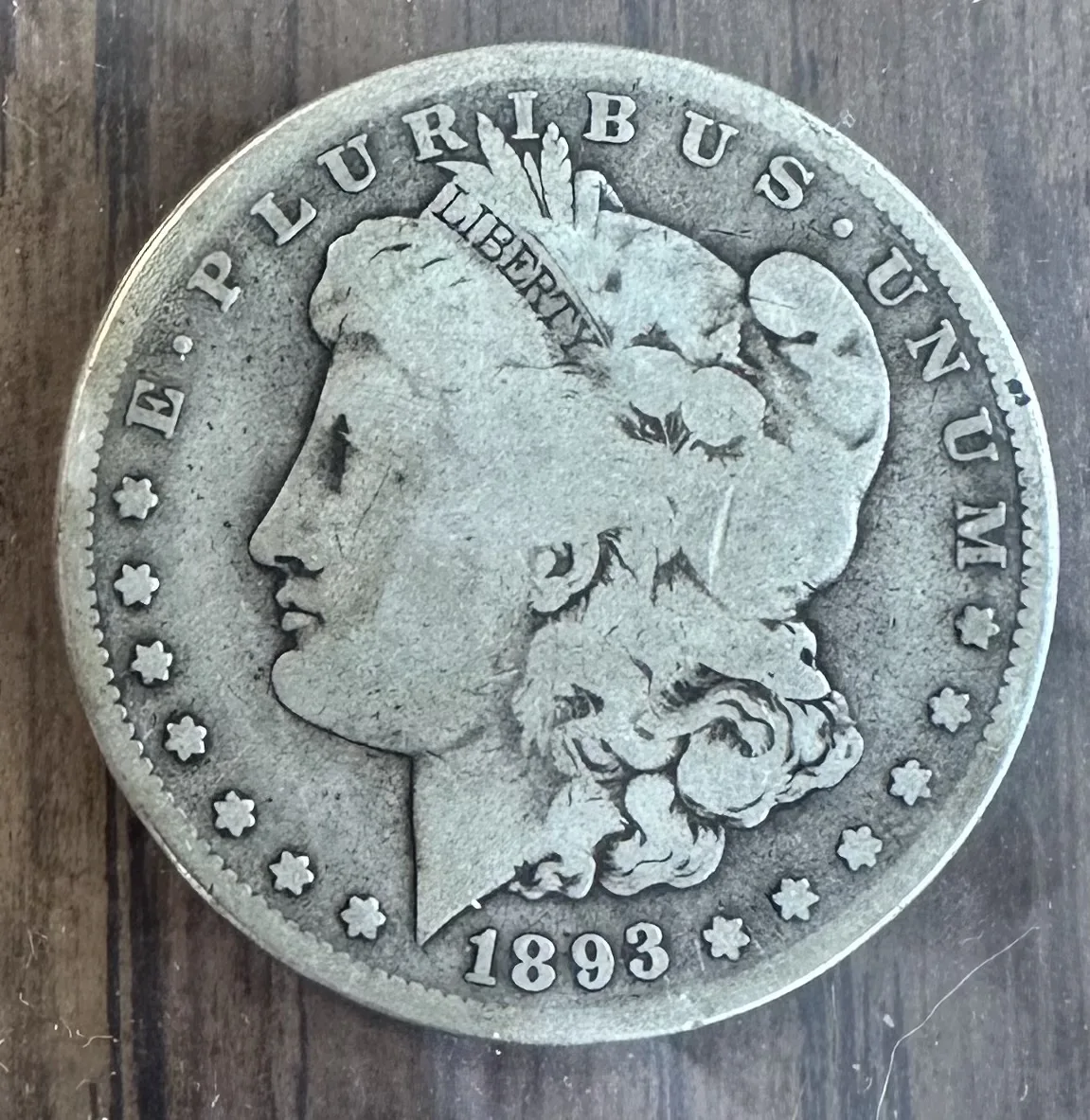
| Morgan dollar | 1878–1904, 1921 | Liberty | Allegory | 38.1 mm, silver |
| Peace dollar | 1921–1928, 1934–1935 | Liberty | Allegory | 38.1 mm, silver |
If your coin is small and goes in a vending machine, it is one of the first two. If it is big, heavy and silver, read the commemorative and Liberty sections below.
Real women versus Lady Liberty
For most of American coinage the woman on the coin was Liberty, a symbol and not a portrait. She appears on the Flowing Hair, Draped Bust, Gobrecht, Seated Liberty, Morgan and Peace dollars, and on the small gold dollars. None of those women is a named person, which is why a coin reading LIBERTY across the headband or in the field is not a “woman honored on a coin” in the way the Anthony dollar is.
The first real woman on any US coin was Queen Isabella of Spain, on the 1893 Isabella quarter. It was a commemorative, sold at the World’s Columbian Exposition in Chicago at the request of the fair’s Board of Lady Managers, and the US Mint, PCGS and CoinWeek all describe it as the first US coin to show an actual woman rather than an allegory. It is a quarter, though, not a dollar. The first real woman on a dollar, and on any coin made for everyday circulation, came 86 years later.
Susan B. Anthony dollar (1979–1981, 1999)
The Susan B. Anthony dollar was struck from 1979 to 1981 and again in 1999. The US Mint calls it the first time a woman appeared on a circulating US coin, and Coin World describes it as the first circulating coin to depict an actual woman instead of an allegorical figure. Frank Gasparro designed it; Anthony faces right in a plain, close-cropped profile, and the reverse borrows the Apollo 11 eagle landing on the Moon from the Eisenhower dollar it replaced.
How to recognize it:
- Silver color. The coin is copper-nickel clad over a copper core, so it looks like a quarter. It contains no silver.
- Reeded edge, like a quarter’s.
- An eleven-sided border inside the round rim. The Mint’s 1978 announcement said it would let the coin be told apart by touch as well as sight.
- 26.5 mm and 8.1 grams, only a couple of millimeters wider than a quarter. That closeness is why the public rejected it.
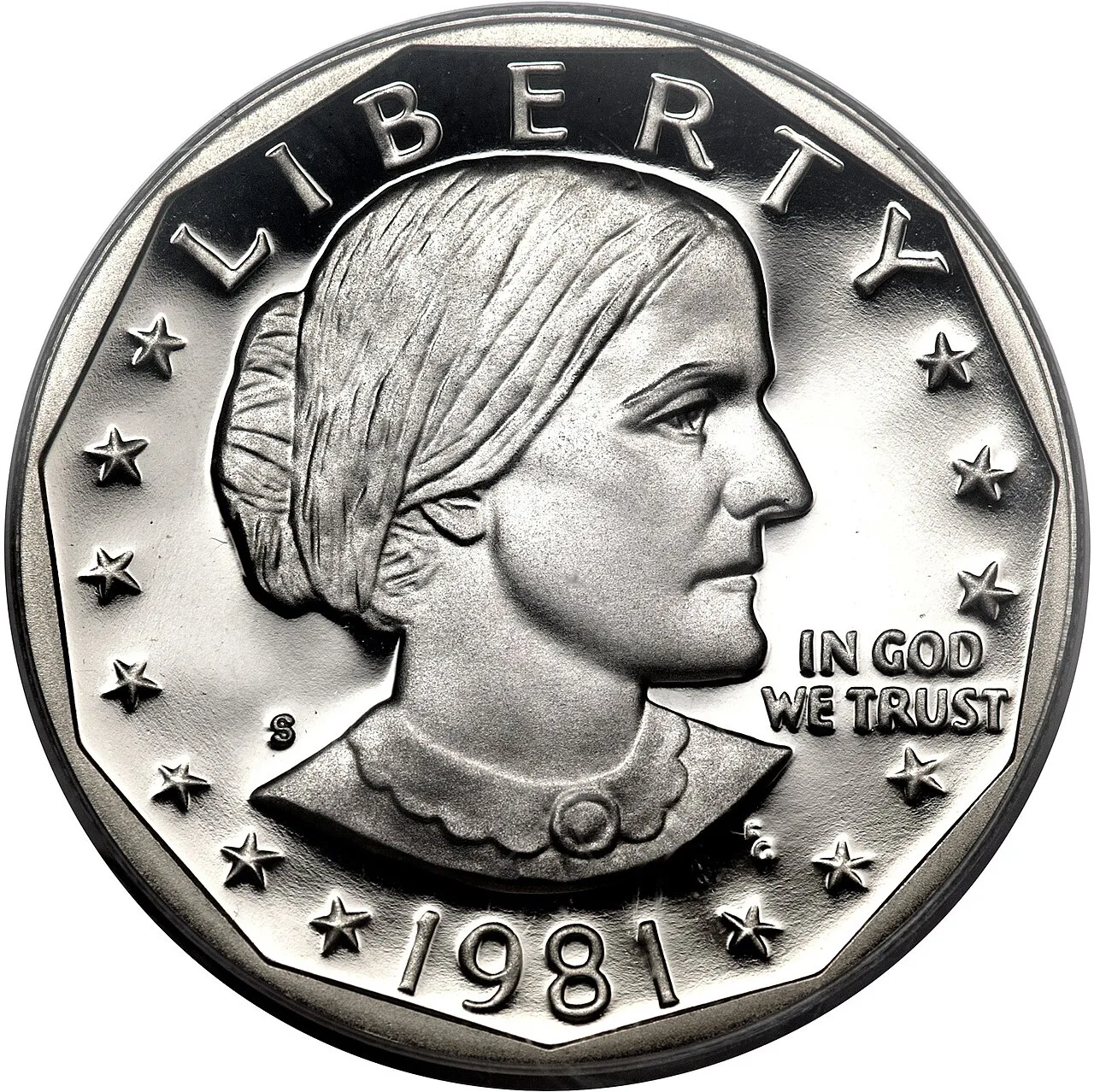
The 1981 coins were struck for collector sets and not released for circulation, so a 1981 Anthony in change came out of a broken-up set. The full date and variety list, including the valuable 1979-P Wide Rim, is in the Susan B. Anthony dollar guide.
Sacagawea and Native American dollars (2000–present)
The Sacagawea dollar arrived in 2000 at exactly the same size and weight as the Anthony, but in a golden manganese-brass alloy so it could not be confused with a quarter. The sculptor Glenna Goodacre designed the obverse. Nobody knows what Sacagawea looked like, so Goodacre used a model: according to the US Mint, Randy’L He-dow Teton, a present-day Shoshone college student. Sacagawea is shown in three-quarter view, looking out at the holder, with her infant son Jean Baptiste on her back.
Since 2009 the coin has been the Native American $1. The Mint kept the Sacagawea obverse and changes the reverse every year, and moved the date, mint mark and E PLURIBUS UNUM onto a lettered edge. So a golden dollar with no date on its face is a 2009-or-later coin, and the date is on the rim.
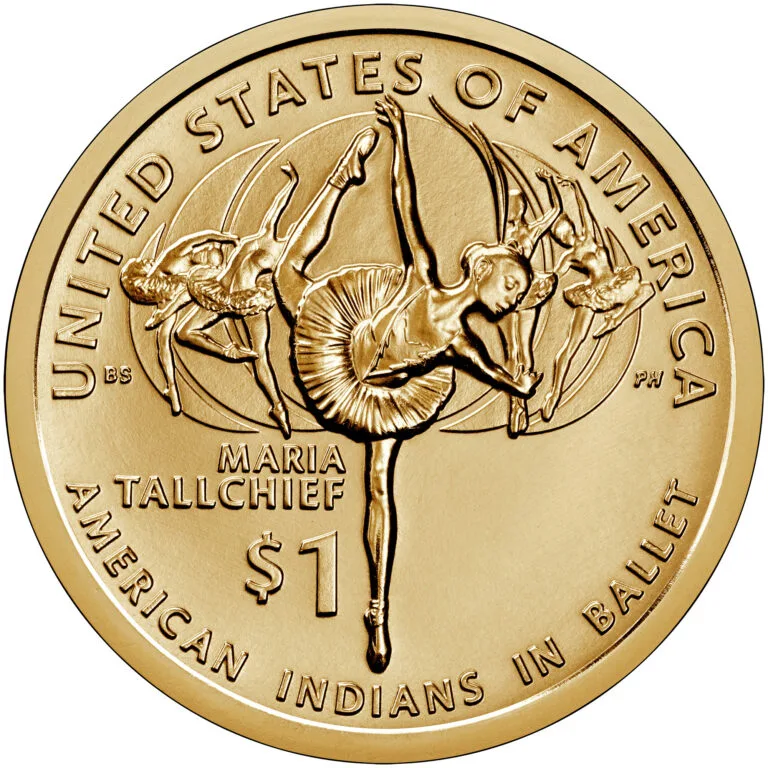
Some of those reverses honor women too. The 2023 reverse shows the Osage ballerina Maria Tallchief, whom the US Mint calls America’s first major prima ballerina, with four fellow Oklahoma ballerinas behind her. The 2025 reverse shows Mary Kawena Pukui, the Native Hawaiian scholar, and the 2026 design shows Polly Cooper of the Oneida sharing her nation’s gift of corn with General Washington. A golden dollar can therefore show a woman on both sides.
Telling the two small dollars apart
| Feature | Susan B. Anthony | Sacagawea / Native American |
|---|---|---|
| Color | Silver (copper-nickel) | Golden (manganese brass) |
| Edge | Reeded | Plain 2000–2008; lettered from 2009 |
| Portrait | Profile, facing right | Three-quarter view, baby on back |
| Reverse | Eagle landing on the Moon | Soaring eagle 2000–2008; new design yearly from 2009 |
| Date | On the obverse | Obverse to 2008; on the edge from 2009 |
| Diameter / weight | 26.5 mm / 8.1 g | 26.5 mm / 8.1 g |
The Sacagawea’s golden color tones to brown, so a dark, worn golden dollar is still a Sacagawea. The varieties worth checking, including the 2000-P “Cheerios” dollar, are covered in the Sacagawea dollar guide.

Commemorative silver dollars that honor women
Commemorative dollars are sold by the Mint to collectors at a premium, never released into circulation, and struck at the large 38.1 mm silver-dollar size. Four of the modern ones put women at the center.
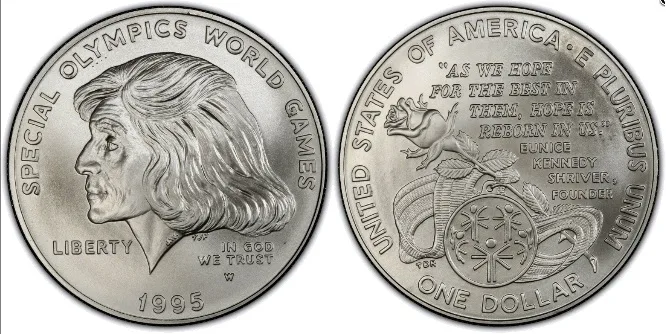
1995 Special Olympics World Games. The obverse is a portrait of Eunice Kennedy Shriver, who founded the Special Olympics; the reverse shows a Special Olympics medal, a rose and a quotation from her. The US Mint and PCGS both describe it as the first US coin to portray a living woman.
1999 Dolley Madison. Marking 150 years since her death, this was the first US coin to honor a First Lady and the first designed by Tiffany & Co. Her portrait, based on Gilbert Stuart’s painting, is framed by cape jasmine blossoms; the reverse shows the portico of Montpelier, the Madison home.
2020 Women’s Suffrage Centennial. Christina Hess designed this one for the hundredth anniversary of the Nineteenth Amendment. The obverse shows three overlapping profiles of women in hats from different decades of the movement, the front one in an art deco cloche wearing a button with the ratification year. The reverse drops the date “2020” into a ballot box marked VOTES FOR WOMEN. It is struck in .999 fine silver.
2021 Christa McAuliffe. The obverse portrait, by Laurie Musser, is taken from a 1985 NASA photograph of McAuliffe training for the Challenger mission. The reverse shows her teaching three students under seven stars, one for each person lost on Challenger, with her words “I touch the future. I teach.”
For the rest of the modern program, and for how to read commemorative mint marks and finishes, see the modern commemorative coins guide.
The real women behind Lady Liberty
Liberty is not a portrait, but on the two most collected silver dollars she has a face that came from somebody.
Morgan dollar. George T. Morgan’s Liberty has long been credited to Anna Willess Williams, a Philadelphia teacher recommended to him by the painter Thomas Eakins. The attribution is less certain than it is usually told: the researcher Roger W. Burdette has argued that the matter will probably never be settled, and Williams herself declined to talk about it, calling it an incident of her youth. The fair way to put it is that Williams is the traditional model.
Peace dollar. Here there is no doubt about who sat. Anthony de Francisci’s wife, Teresa, posed for the Peace dollar’s Liberty in their Manhattan apartment in 1921, and both Coin World and the American Numismatic Association tell the story. Sources also agree that the finished head is a composite rather than an exact likeness. Teresa de Francisci’s own summary was that whatever her husband got from life, he got from her.
Neither coin names its model, so both remain Liberty dollars. They are, however, the honest answer when someone asks which big old silver dollar has a real woman’s face on it.
Is your dollar worth more than face value?
Most of these coins are worth exactly what they look like.
- Anthony and Sacagawea dollars from circulation are worth one dollar. Hundreds of millions were made. The exceptions are named varieties and errors, which the individual guides list.
- Morgan and Peace dollars are 90% silver and are always worth at least their metal, whatever their date or condition.
- Commemorative silver dollars trade mainly on their silver content plus a modest collector premium, more for the lower-mintage issues and for original Mint packaging.
Before you sell any of them, check the date and mint mark against the full guide for that coin, and do not clean it: cleaning strips the original surface and lowers the grade a buyer will give it.
Frequently Asked Questions
Which US dollar coins have a woman on them?
Two circulating small dollars show real women: the Susan B. Anthony dollar (1979-1981 and 1999) and the Sacagawea dollar (2000 onward, kept as the obverse of the Native American $1 coins since 2009). Several commemorative silver dollars honor named women, among them Eunice Kennedy Shriver (1995), Dolley Madison (1999) and Christa McAuliffe (2021), and the 2020 Women's Suffrage Centennial dollar shows three unnamed women. Most older silver dollars, including the Morgan and Peace dollars, show Liberty, an allegorical woman rather than a real person.
Was Susan B. Anthony the first real woman on a US coin?
Not on any coin. The 1893 Isabella quarter, a commemorative sold at the World's Columbian Exposition, was the first US coin to show a real woman. Susan B. Anthony was the first real woman on a circulating US coin, and the first on a dollar coin.
How do I tell a Susan B. Anthony dollar from a Sacagawea dollar?
Look at the color first. The Susan B. Anthony dollar is silver-colored copper-nickel with a reeded edge and shows Anthony in profile. The Sacagawea dollar is golden manganese brass and shows Sacagawea looking out at you with her baby son on her back. Both are 26.5 mm across and weigh 8.1 grams.
Who was the model for the woman on the Morgan dollar?
Tradition names Anna Willess Williams, a Philadelphia teacher, as George T. Morgan's model. Researchers have questioned it, and the coin shows Liberty rather than a portrait of her. The Peace dollar's Liberty was modeled on Teresa de Francisci, the wife of its designer, Anthony de Francisci.
Who was the first living woman on a US coin?
Eunice Kennedy Shriver, founder of the Special Olympics, whose portrait is on the obverse of the 1995 Special Olympics World Games commemorative silver dollar.
Is a dollar coin with a woman on it worth more than a dollar?
Usually not. Circulated Susan B. Anthony and Sacagawea dollars were struck by the hundreds of millions and are worth face value. Silver commemoratives and the Morgan and Peace dollars are worth at least their silver content. Specific varieties, such as the 1979-P Wide Rim Anthony and the 2000-P Cheerios Sacagawea, carry real premiums and are covered in the guides to each coin.