Peace Dollar Identification Guide: Key Dates, Mint Marks, and Values
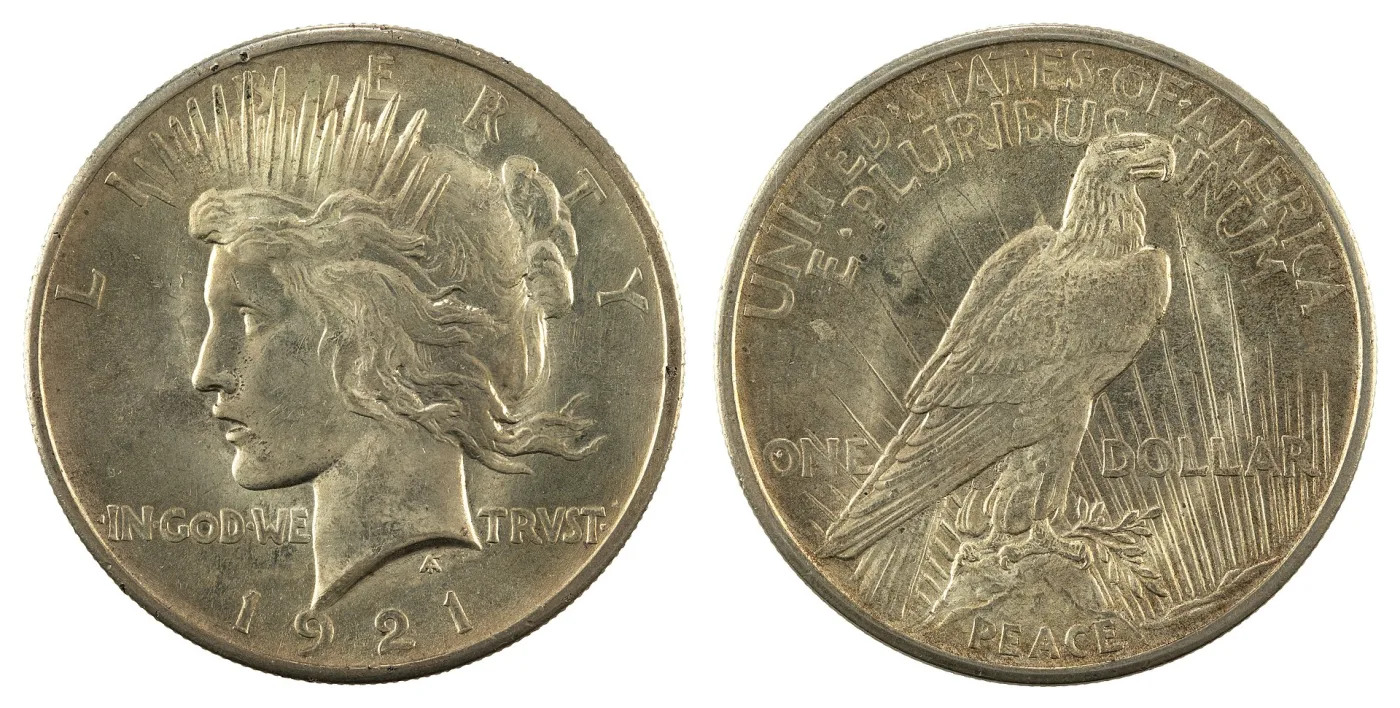
The Peace Dollar stands as one of the most beautiful and historically significant coins in American numismatics. Designed by Anthony de Francisci and minted from 1921 to 1935, it was created to commemorate the end of World War I. With its radiant portrait of Lady Liberty wearing a spiked crown and a bald eagle perched on a rock above the word “PEACE,” this silver dollar captures a nation’s hope for lasting peace. Whether you found a Peace Dollar in a family collection or purchased one at a coin show, understanding how to identify, grade, and value these coins is essential for every collector.
Peace Dollars contain 0.77344 troy ounces of pure silver (90% silver, 10% copper) and weigh 26.73 grams with a diameter of 38.1 millimeters. The series spans 24 different date-and-mintmark combinations across three U.S. Mint facilities: Philadelphia, Denver, and San Francisco. Values range from around $30 for common circulated dates to over $100,000 for top-condition rarities. This guide walks you through everything you need to know to identify Peace Dollars accurately, spot key dates and varieties, understand grading, and determine fair market values.
If you are new to coin identification, the Peace Dollar is an excellent series to study because it combines accessible entry points with genuinely rare coins that challenge even advanced numismatists.
History and Origins of the Peace Dollar
The Peace Dollar emerged from a national desire to mark the end of the Great War. By 1920, numismatists and civic leaders were calling for a new silver dollar design that would symbolize America’s victory and hopes for peace. The American Numismatic Association formally petitioned the U.S. Mint, and Treasury officials agreed to hold a design competition among leading sculptors.
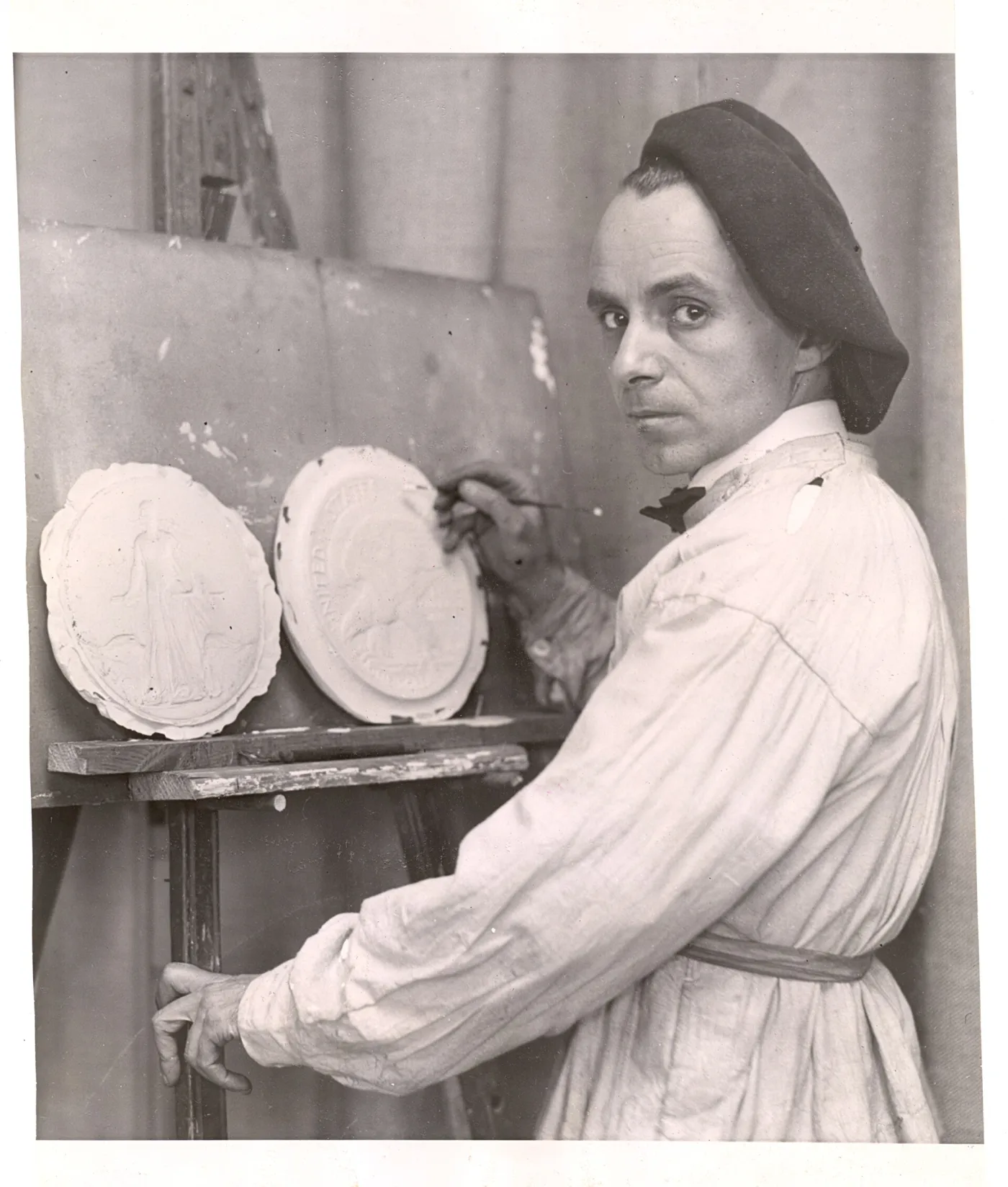
Anthony de Francisci, an Italian-born American sculptor, won the competition in late 1921. His design featured a portrait of Liberty inspired by his wife Teresa, wearing a radiant crown meant to evoke the Statue of Liberty. The reverse depicted a bald eagle at rest atop a mountain, clutching an olive branch, with the word “PEACE” inscribed on the rock below. The rays of a rising sun behind the eagle symbolized a new dawn of peace.
Production Timeline
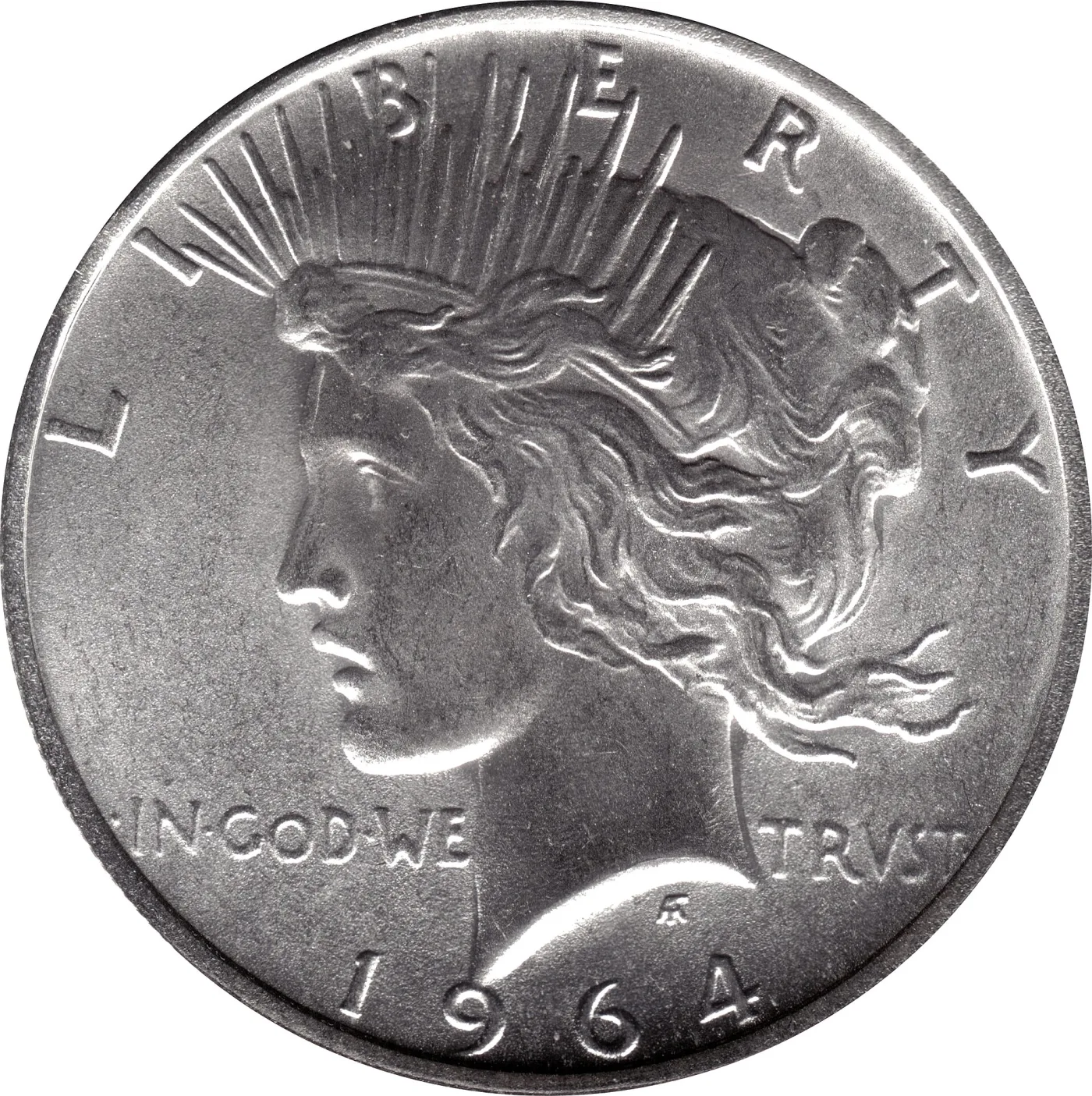
The first Peace Dollars were struck in December 1921 in high relief, a format that proved difficult for mass production. Beginning in January 1922, the Mint switched to a lower-relief version that could be struck more efficiently. Production continued through 1928, paused during the early years of the Great Depression, and resumed briefly in 1934 and 1935 before the series was discontinued. Congress authorized 316,076 Peace Dollars to be struck in 1964, but all were melted before release, making the 1964-D Peace Dollar one of the great “phantom” coins of American numismatics.
The Morgan Dollar Connection
The Peace Dollar directly succeeded the Morgan Silver Dollar, which had been minted from 1878 to 1904 and again in 1921. In fact, both the final Morgan Dollars and the first Peace Dollars were produced in 1921, making that year a transition point that collectors find especially compelling. Together with the earlier Seated Liberty Dollar that the Morgan replaced in 1878, these three series form the core of classic United States silver dollar coinage. Understanding all three together gives you a complete picture of American silver dollar coinage from the antebellum era through the early 20th centuries. For a broader view of silver coinage from this period, the Walking Liberty Half Dollar, designed by the same sculptor who created the Mercury Dime, offers another essential chapter in the story, and the Franklin Half Dollar that followed carried the 90% silver tradition into the post-war era.
Design Elements and How to Identify a Peace Dollar
Identifying a Peace Dollar is straightforward once you know what to look for. The coin’s design is distinct from other U.S. silver dollars and features several recognizable elements on both sides.
Obverse (Front) Design
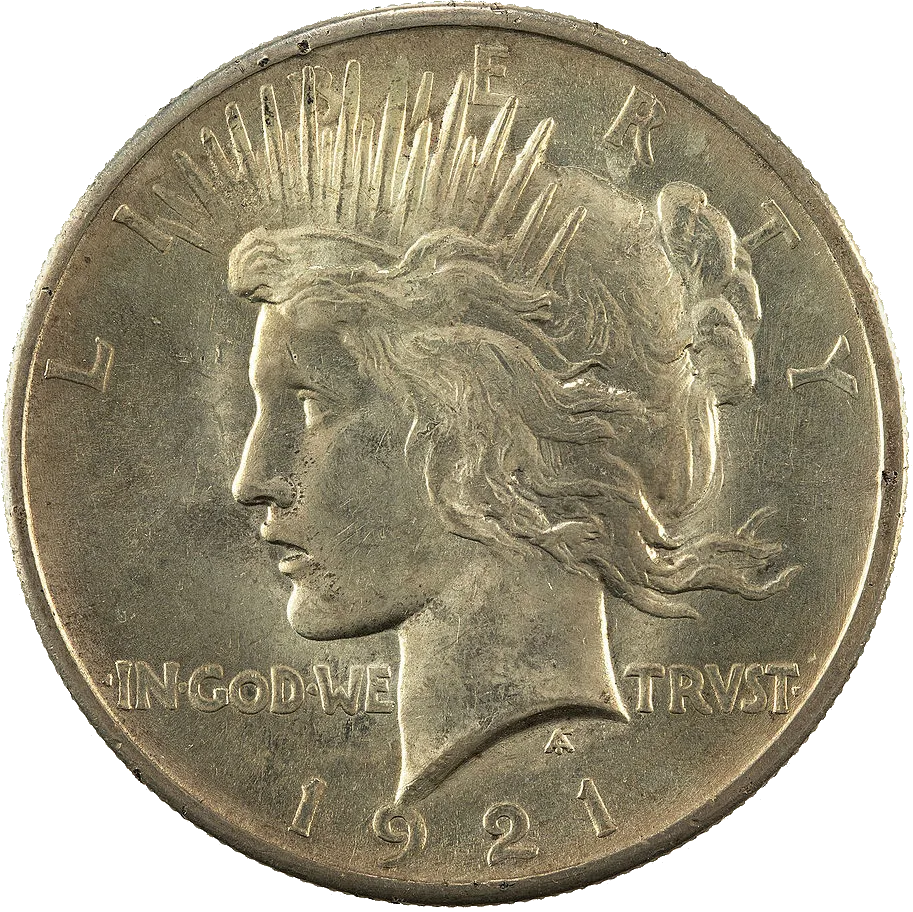
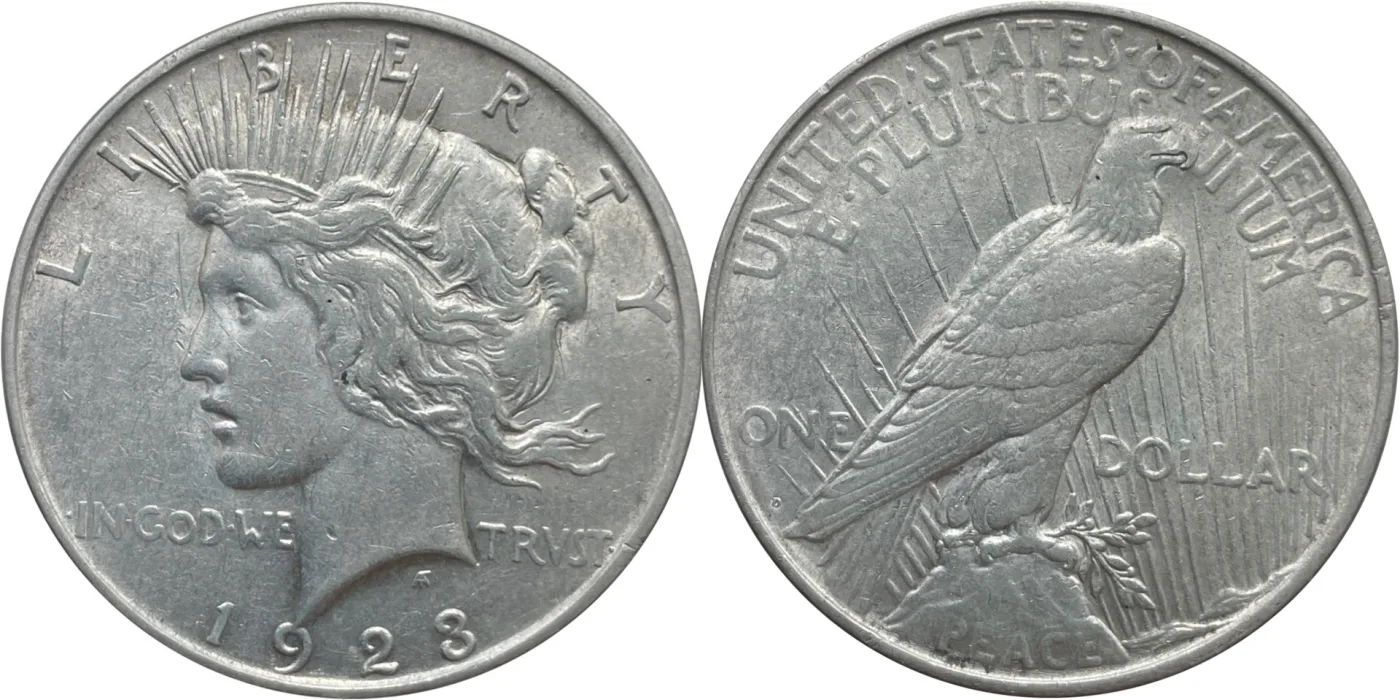
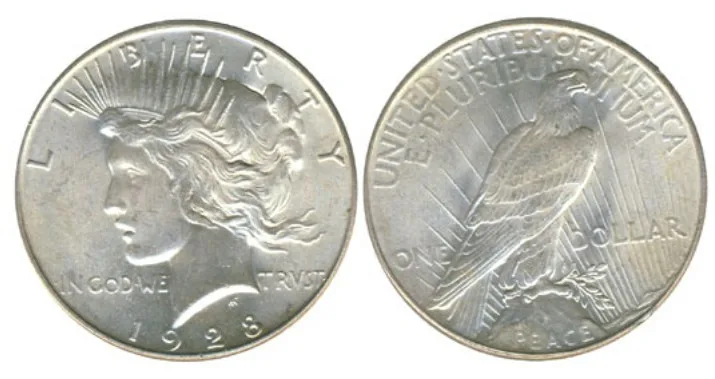
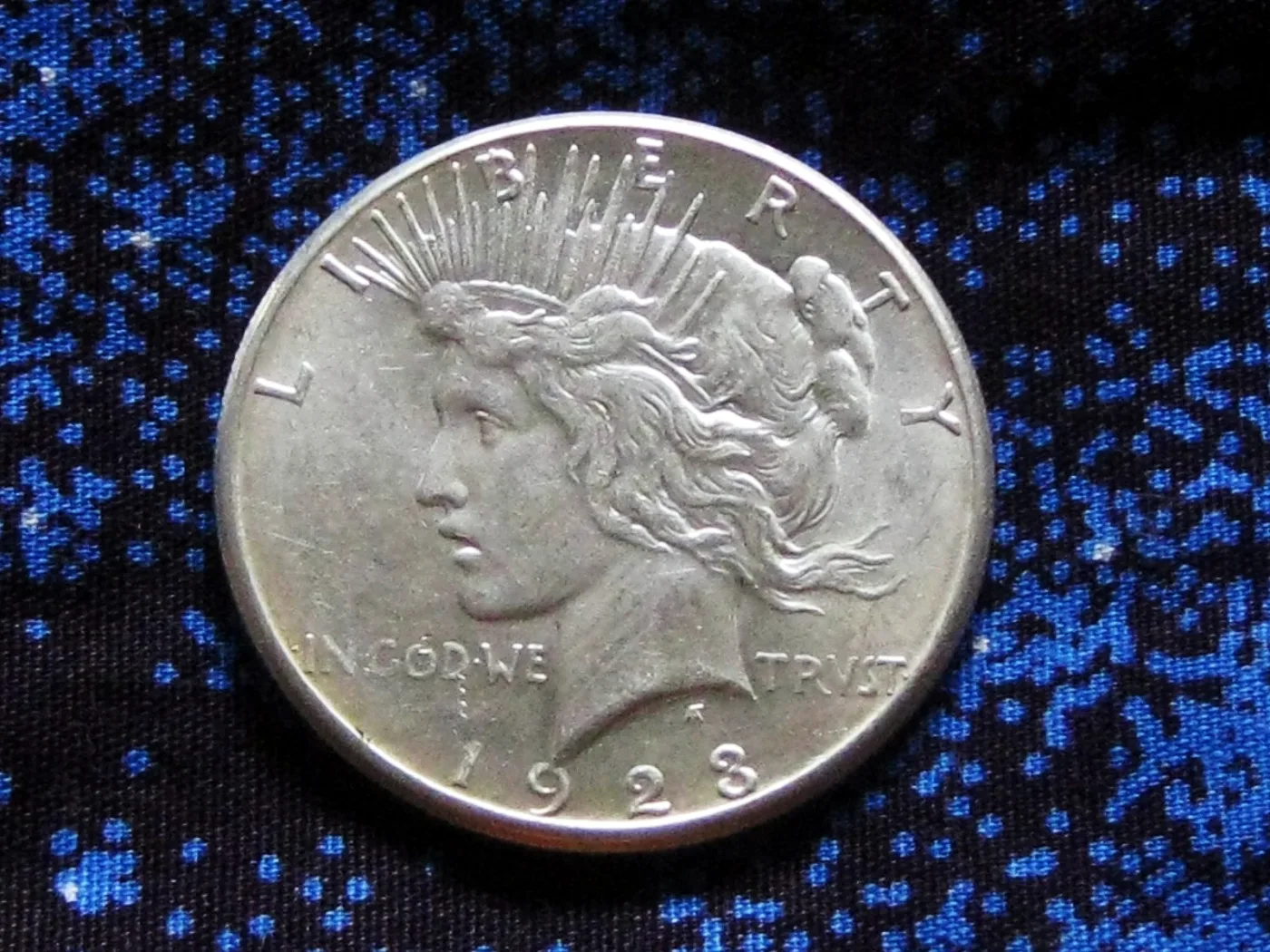
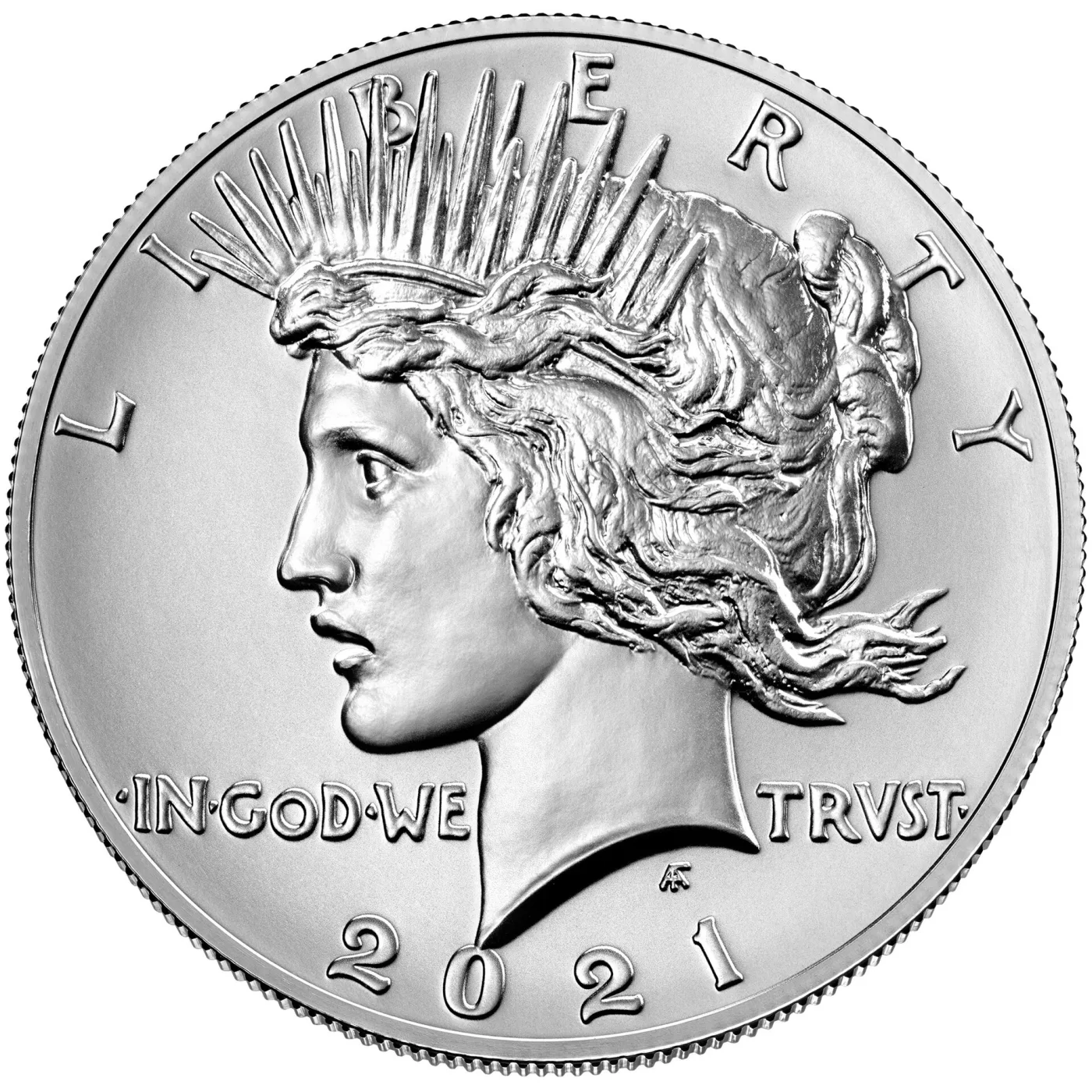
The obverse shows a left-facing portrait of Lady Liberty wearing a radiant crown with pointed rays extending upward. Her hair flows in wavy strands behind her head. The word “LIBERTY” appears across the top of the coin, “IN GOD WE TRUST” is inscribed below and to the left of Liberty’s neck, and the date appears at the bottom. The overall impression is one of classical beauty combined with Art Deco sensibility.
Reverse (Back) Design
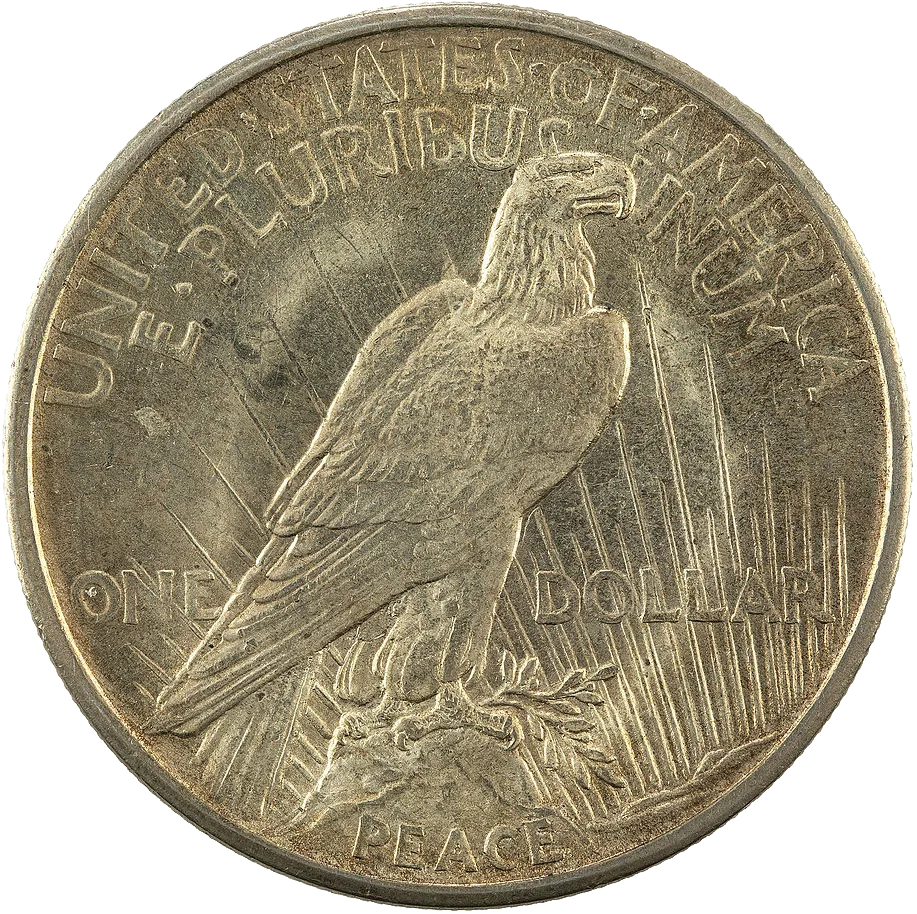
The reverse features a bald eagle perched on a rock, facing right, with folded wings. The eagle grasps an olive branch in its talons. Below the rock, the word “PEACE” is inscribed in small letters. “UNITED STATES OF AMERICA” arcs across the top, “E PLURIBUS UNUM” appears below it, and “ONE DOLLAR” is at the bottom. The rays of a rising sun extend from behind the eagle, and the mint mark (if present) appears on the reverse near the eagle’s tail feathers.
Physical Specifications
Every Peace Dollar shares these standard specifications: a weight of 26.73 grams, a diameter of 38.1 millimeters (1.5 inches), a reeded edge with 189 reeds, and a composition of 90% silver and 10% copper. These specifications are identical to the Morgan Dollar, which means the two series share the same silver content of 0.77344 troy ounces per coin.
1921 High Relief vs. Low Relief: Understanding the Difference
One of the most important distinctions in the Peace Dollar series is between the 1921 high-relief issue and the standard low-relief coins produced from 1922 onward. The 1921 Peace Dollar is the only year struck in high relief, and this single characteristic makes it one of the most sought-after type coins in all of American numismatics.
What Makes the 1921 Special
The original 1921 design featured dramatically raised surfaces, giving the coin a medal-like quality. Liberty’s portrait stands out sharply from the field, the crown rays are deeply sculpted, and every detail of the eagle’s feathers on the reverse is crisply rendered. This level of relief required significantly higher striking pressure, which caused rapid die wear and breakage. The Philadelphia Mint produced 1,006,473 high-relief Peace Dollars in 1921 before switching to the modified low-relief design.
How to Tell Them Apart
The high-relief 1921 is easy to distinguish from later dates. Hold the coin at eye level and examine the profile: on a high-relief coin, Liberty’s features rise noticeably above the field, and the lettering has a three-dimensional quality. The rays on her crown are thicker and more pronounced. On the reverse, the eagle’s feathers show greater depth and definition. Low-relief coins (1922-1935) appear flatter by comparison, with design elements that blend more smoothly into the field. The 1921 also typically shows a satin-like luster different from the frosty or brilliant luster seen on later issues.
The Lost 1922 High Relief
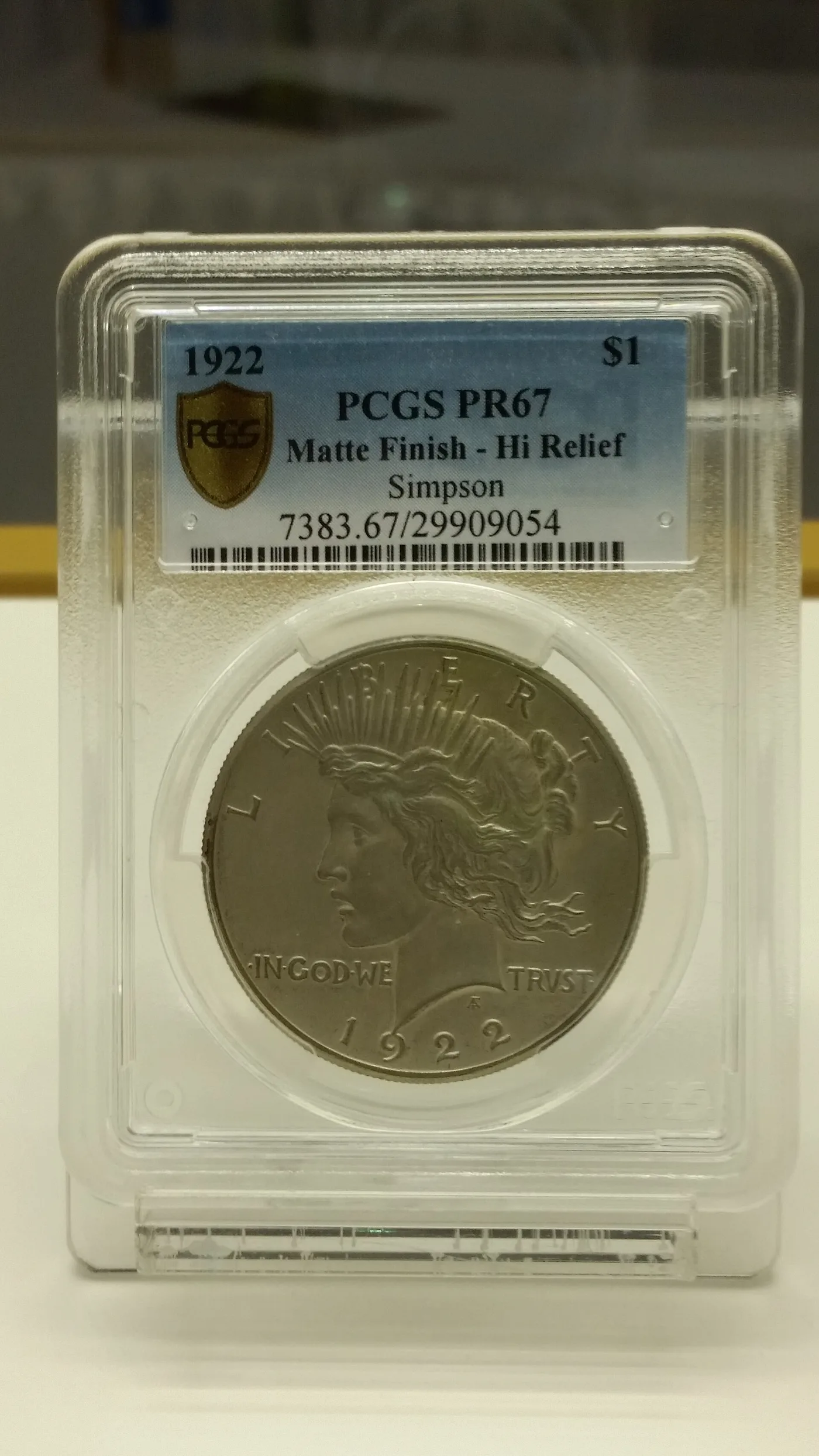
Approximately 35,000 high-relief 1922 Peace Dollars were struck early that year before the Mint officially adopted the low-relief design. Nearly all were melted due to persistent die breakage problems. A small number of 1922 High Relief Matte Proof specimens survive, with only 10 to 20 known examples. These are among the rarest and most valuable Peace Dollars, with auction records exceeding $300,000 for top-grade examples.
Mint Marks and Where to Find Them
Peace Dollars were struck at three U.S. Mint facilities, each identified by a small letter (or lack thereof) on the reverse of the coin. Finding and reading the mint mark is one of the first steps in identifying any Peace Dollar, as it directly affects the coin’s rarity and value.
Mint Mark Locations
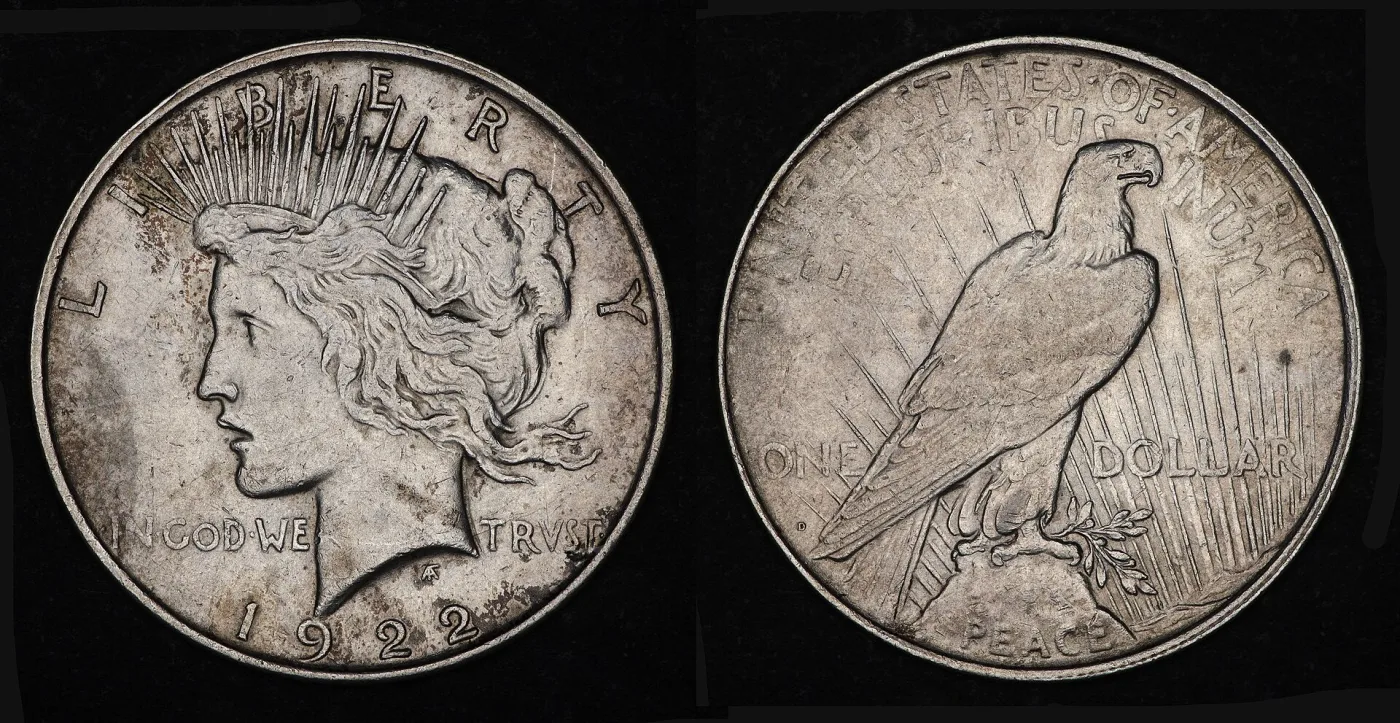
The mint mark on a Peace Dollar is located on the reverse, near the bottom of the coin. Specifically, look at the tip of the eagle’s tail feathers and then slightly to the left and below the word “ONE.” The mint mark is a small letter positioned between the eagle’s tail and the “O” in “ONE.” On some well-worn coins, the mint mark can be difficult to read, so use a magnifying glass or loupe for examination.
The Three Mints
Philadelphia (no mint mark): The Philadelphia Mint produced Peace Dollars every year of the series from 1921 to 1935 (except 1929-1933). Philadelphia coins carry no mint mark. Because Philadelphia generally had the highest mintages, many Philadelphia issues are among the most affordable in the series.
Denver (D): The Denver Mint struck Peace Dollars in 1922, 1923, 1926, 1927, 1934, and 1935. Denver issues are marked with a small “D.” Several Denver dates, particularly the 1927-D and the 1934-D, are notable for their low mintages or important die varieties.
San Francisco (S): The San Francisco Mint produced Peace Dollars in 1922, 1923, 1924, 1925, 1926, 1927, 1928, 1934, and 1935. San Francisco coins bear a small “S.” The San Francisco facility produced some of the most condition-rare coins in the series, with the 1925-S being the legendary “condition key” of the entire Peace Dollar series.

Key Dates and Rarities
Not all Peace Dollars are created equal. Certain date-and-mintmark combinations are significantly rarer than others, either because of low mintage figures, high melt rates, or scarcity in upper grades. Here are the essential key dates every collector should know.
1921 (High Relief)
Mintage: 1,006,473. As the only high-relief year and the first year of issue, the 1921 commands a premium in every grade. Common circulated examples sell for $100 to $200, while Mint State coins range from $250 to over $4,000 depending on grade. The finest known examples graded MS-67 have sold for over $130,000 at auction.
1928 Philadelphia
Mintage: 360,649. The 1928 is the undisputed key date of the Peace Dollar series by mintage. It was struck only at the Philadelphia Mint with the lowest mintage of any regular-issue Peace Dollar. Circulated examples in VG-VF condition sell for $300 to $500, while Mint State examples can reach $1,000 to $5,000 or more. In MS-65 and above, the 1928 becomes extremely rare and valuable.
1934-S
Mintage: 1,011,000. While the mintage is not particularly low, the 1934-S is rare in Mint State because most examples entered circulation immediately. An MS-65 example can command $20,000 to $50,000, and a gem MS-66 once sold for over $135,000. This is one of the great condition rarities in American numismatics.
1927-D
Mintage: 1,268,900. The 1927-D is scarce in all grades and particularly rare in Mint State. Many were weakly struck, compounding the difficulty of finding attractive examples. MS-64 coins typically sell for $500 to $1,500, with MS-65 examples commanding substantially more.
1925-S
Mintage: 1,610,000. The 1925-S is widely recognized as the condition key of the entire series. While available in lower circulated grades, the jump from MS-64 to MS-65 represents one of the largest price increases in all of U.S. numismatics. An MS-64 might sell for $500, while an MS-65 can reach $15,000 or more.
1935-S
Mintage: 1,964,000. As the final San Francisco issue, the 1935-S is the last coin in the original Peace Dollar series. It is scarce in MS-65 and above, with well-struck examples being particularly desirable.
Other Semi-Key Dates
Several additional dates deserve attention: the 1927-S (mintage 866,000), 1924-S (mintage 1,728,000), and 1926-D (mintage 2,348,700) are all semi-key dates that carry premiums above common issues, especially in higher grades. The 1922 Philadelphia, while common overall with a mintage of over 51 million, includes the rare high-relief matte proof variety mentioned earlier.
Notable Die Varieties and VAMs
Like Morgan Dollars, Peace Dollars have their own system of die variety classification known as VAMs (Van Allen-Mallis varieties). While the Peace Dollar VAM catalog is smaller than the Morgan series, several varieties are highly collectible and carry significant premiums.
Understanding VAM Classification
VAM numbers identify specific combinations of obverse and reverse dies based on minute differences in the design. These differences include doubled lettering, repunched dates and mint marks, die cracks, die polish lines, and other features visible under magnification. The Top 50 Peace Dollar VAMs represent the most significant and collected varieties.
1922-D “Ear Ring” (VAM-2)
One of the most popular Peace Dollar varieties, the “Ear Ring” shows a die gouge that creates what appears to be an earring on Liberty’s ear. This variety is easy to spot with a basic loupe and commands premiums of $50 to $200 in circulated grades, with gem Mint State examples reaching $3,000 or more.
1922 “Whisker Jaw” (VAM-1A)
This variety shows die polishing lines on Liberty’s jaw that resemble whiskers. It is one of the most commonly encountered Peace Dollar varieties and a popular entry point for VAM collectors. Premiums are modest in circulated grades but increase substantially in Mint State.
1934-D Doubled Die Obverse (VAM-3/VAM-4)
Often called the “King of Peace Dollar Varieties,” the 1934-D DDO shows clear doubling on “IN GOD WE TRUST” and other obverse elements. This is one of the most valuable Peace Dollar varieties, with MS-66 examples selling for over $13,500 at auction. Even circulated examples carry significant premiums over normal 1934-D coins.
1923 Whisker Cheek (VAM-1A)
Similar to the 1922 Whisker Jaw, this variety shows die polishing lines on Liberty’s cheek. Given the enormous mintage of the 1923 Philadelphia issue (over 30 million), this variety is relatively available but still commands collector premiums.
Repunched Mint Marks
Several Peace Dollar dates show repunched mint marks (RPMs), where the mint mark was punched into the die more than once at slightly different positions. Notable RPMs include the 1922-S, 1923-S, and 1926-S. These varieties typically command modest premiums of 20% to 50% above normal prices.
Error Coins and Misstrike Varieties
Mint errors on Peace Dollars are scarce compared to modern coins because quality control at the three mints was relatively stringent during this era. However, the errors that do exist are highly prized by specialists and can command dramatic premiums.
Off-Center Strikes
Off-center Peace Dollars are rare and valuable. Even a modest 5% off-center strike can add significant value, while dramatic off-center errors (15% or more) can sell for $3,000 to $40,000 depending on the degree and the date. The most valuable off-center strikes are those that still show the full date and mint mark.
Struck-Through Errors
Occasionally a foreign object (grease, cloth, wire, or other debris) became trapped between the die and the planchet during striking, creating an impression of the object on the finished coin. Struck-through errors on Peace Dollars are uncommon and can add $200 to $2,000 or more to a coin’s value depending on the size and visibility of the error.
Double Strikes
True double strikes, where the coin was struck twice by the dies with some rotation or displacement between strikes, are extremely rare on Peace Dollars. Confirmed examples can sell for $5,000 to $20,000. Be careful not to confuse machine doubling (a common and relatively minor die deterioration effect) with a true double strike.
Clipped Planchets
Clipped planchet errors occur when the blank is cut improperly, leaving a curved section missing from the edge of the coin. Minor clips may add $100 to $300 in value, while large or multiple clips can command $500 to $2,000 or more.
Die Cracks and Cuds
As dies wore from use, they developed cracks that appear as raised lines on the finished coin. When a piece of the die breaks away near the rim, it creates a “cud” - a raised, featureless blob at the edge. Die cracks add modest value ($10 to $50), while prominent cuds can add $100 to $500 or more.
How to Grade Peace Dollars
Grading is the process of evaluating a coin’s condition on the Sheldon scale from 1 (barely identifiable) to 70 (absolutely perfect). For Peace Dollars, understanding the key wear points is essential for accurate grading. As with other coin types covered in our general coin identification guide, consistent lighting and magnification are important for reliable grading.
Key Wear Points on the Obverse
The first areas to show wear on a Peace Dollar’s obverse are Liberty’s hair above her ear, the hair over her forehead, and the cheekbone. On a coin grading About Uncirculated (AU-50 to AU-58), you will see slight friction on these high points while the rest of the coin retains full mint luster. As the grade decreases through Extremely Fine (EF-40/45) and Very Fine (VF-20 to VF-35), the hair strands begin to merge and the crown rays lose definition.
Key Wear Points on the Reverse
On the reverse, the eagle’s wing tips, the feathers on the eagle’s breast, and the top of the eagle’s head are the first areas to show wear. The word “PEACE” on the rock below the eagle can also weaken with circulation, though this is sometimes a strike issue rather than wear. The rays behind the eagle tend to hold detail longer than the eagle itself.
Grading Circulated Peace Dollars
Good (G-4 to G-6): Liberty’s portrait is fully outlined but most hair detail is worn smooth. The date and “LIBERTY” are readable but may be weak. On the reverse, the eagle is a flat silhouette with minimal feather detail.
Very Good (VG-8 to VG-10): Some hair strands begin to show near the edges of Liberty’s portrait. Crown rays are visible but not sharply defined. The eagle shows some wing feather separation.
Fine (F-12 to F-15): Approximately half of the hair detail is visible. Crown rays are distinct but may show wear at their tips. The eagle’s breast feathers show moderate detail.
Very Fine (VF-20 to VF-35): Most hair strands are visible though some areas above the ear remain flat. Crown rays are sharp. The eagle’s feathers are well defined with light wear on the highest points.
Extremely Fine (EF-40 to EF-45): All hair strands are visible with only light wear on the highest points. Crown rays are sharp and distinct. Light wear shows on the eagle’s breast and wing tips.
About Uncirculated (AU-50 to AU-58): Only traces of wear visible on the very highest points. Most mint luster remains, particularly in protected areas. These coins are often collected as affordable alternatives to Mint State examples.
Grading Mint State Peace Dollars
Mint State Peace Dollars (MS-60 to MS-70) are graded primarily on the basis of luster, strike quality, surface preservation, and eye appeal. Contact marks (bag marks) are common because these heavy silver coins were stored and shipped in canvas bags. An MS-60 coin has no wear but may show abundant contact marks, while an MS-65 coin has only minor marks not readily visible to the unaided eye. MS-67 and higher grades are extremely rare for most Peace Dollar dates.
Authentication: Detecting Counterfeits
Counterfeit Peace Dollars exist in both contemporary (made to spend) and modern (made to deceive collectors) forms. Knowing what to look for can protect you from costly mistakes.
Common Counterfeit Types
The most frequently counterfeited Peace Dollars are the 1928 Philadelphia (due to its high value), the 1921 high relief, and various key-date San Francisco issues. Cast counterfeits are made by pouring molten metal into a mold taken from a genuine coin, while die-struck counterfeits are produced using hand-engraved dies. Modern Chinese counterfeits have become increasingly sophisticated in recent years.
Weight and Dimensions Test
A genuine Peace Dollar weighs exactly 26.73 grams (within manufacturing tolerances of about 0.2 grams). The diameter should be 38.1 mm and the thickness approximately 2.4 mm. Inexpensive digital scales and calipers accurate to 0.01 grams and 0.1 mm are sufficient for this basic test. If a coin falls outside these parameters, it warrants further investigation.
Visual Inspection Points
Look for mushy or weak details (common in cast fakes), wrong surface texture (grainy instead of smooth), incorrect luster (too shiny or too dull), and problems with the reeding (edge grooves). On a genuine Peace Dollar the reeding is crisp and uniform — even in depth, evenly spaced, square to the edge — and counterfeits often show uneven or blurred reeds. That evenness is the useful test. The reed count itself is a catalogue specification rather than something to verify by eye, and a coin should not be rejected on a count alone.
The Ping Test
Silver coins produce a distinctive high-pitched ring when balanced on a fingertip and lightly tapped. This sound, caused by silver’s acoustic properties, is noticeably different from the dull thud of base metals. While not conclusive by itself, a failed ping test is a strong warning sign.
Professional Authentication
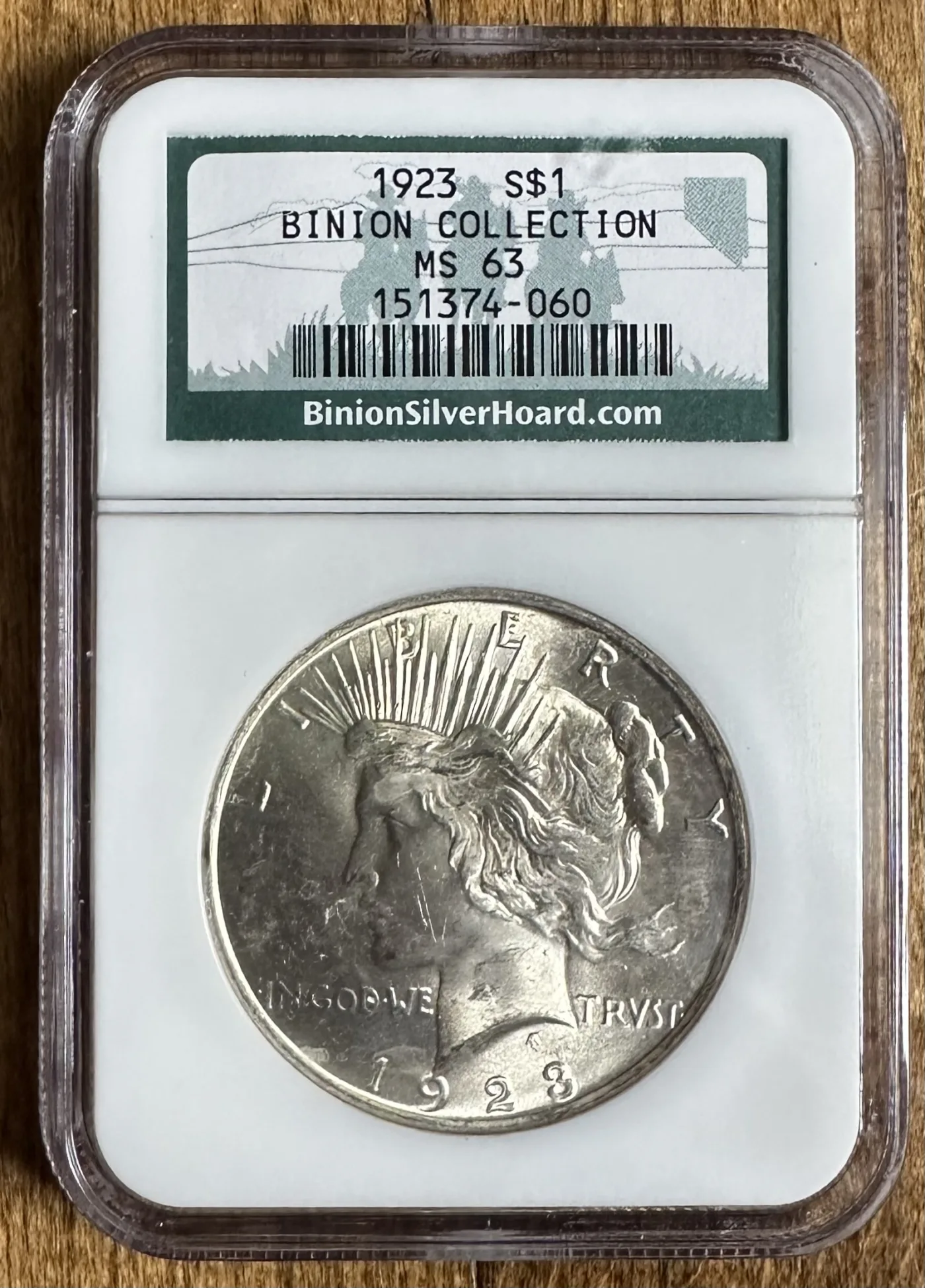
For high-value Peace Dollars, professional authentication through services like PCGS or NGC is strongly recommended. Third-party grading provides both authentication and an expert grade assessment, with the coin encapsulated in a tamper-evident holder. The cost of certification (typically $20 to $50 for regular service) is a worthwhile investment for any coin worth several hundred dollars or more.
Current Market Values by Date and Mint
Peace Dollar values vary significantly based on date, mint mark, grade, and overall market conditions. The base melt value of any Peace Dollar is approximately $25 to $30 based on silver spot prices, but collector premiums can push prices far above melt. The following ranges represent typical retail values in common circulated and Mint State grades.
Common Dates (VF-20 to MS-63)
The most common Peace Dollars include the 1922-P, 1922-D, 1922-S, 1923-P, 1923-S, 1924-P, 1925-P, and 1926-P. These coins typically sell for $30 to $45 in VF-20, $40 to $60 in AU-50, and $50 to $100 in MS-63. The 1922 Philadelphia, with a mintage of over 51 million coins, is the most common date in the series and the most affordable entry point for collectors.
Semi-Key Dates
Semi-key dates include the 1924-S, 1926-S, 1926-D, 1927-S, and 1935. These coins carry modest premiums over common dates, typically selling for $35 to $60 in VF, $60 to $120 in AU, and $100 to $400 in MS-63. Values increase sharply in MS-65 and above.
Key Dates
The principal key dates are the 1921 (high relief), 1928-P, 1934-S, 1925-S (in high grades), and 1927-D. The 1928 commands $300 to $500 in VF, $500 to $900 in AU, and $1,000 to $5,000 in MS-63 to MS-65. The 1921 high relief sells for $100 to $200 in VF, $200 to $350 in AU, and $300 to $4,000+ in Mint State depending on grade.
Factors Affecting Value
Beyond date and grade, several factors influence Peace Dollar values. Strike quality matters enormously: a sharply struck coin can command a 20-50% premium over a weakly struck example of the same date and grade. Luster quality, toning (natural vs. artificial), and overall eye appeal also affect prices. Coins certified by PCGS or NGC typically sell for premiums over raw (uncertified) coins of equivalent quality, due to the assurance of authenticity and grade consistency.
Condition Rarities and the Condition Census
A condition rarity is a coin that is common in lower grades but extremely scarce in higher grades. The Peace Dollar series contains several notable condition rarities that challenge collectors seeking the finest known examples.
The 1925-S: Ultimate Condition Key
The 1925-S Peace Dollar is the most famous condition rarity in the series. While readily available in grades up to MS-63, the population drops dramatically at MS-64 and becomes vanishingly small at MS-65. This scarcity is attributed to weak strikes (the San Francisco Mint was known for softer strikes) and heavy bag marks from rough handling. The price differential between MS-64 (around $500) and MS-65 ($15,000+) is one of the most dramatic in all of U.S. numismatics.
The 1934-S: Gem Rarity
While the 1934-S has a mintage just over one million, virtually the entire production entered circulation, leaving very few Mint State survivors. An MS-65 1934-S Peace Dollar is a major rarity, and MS-66 examples are nearly unobtainable. This makes the 1934-S one of the most condition-sensitive dates in the series, similar to how certain Indian Head Pennies are common in low grades but extraordinarily rare in gem condition.
Other Condition Rarities
The 1927-D, 1927-S, 1924-S, and 1935-S are all significantly scarcer in upper Mint State grades than their mintage figures would suggest. For collectors building a complete set in MS-65 or higher, these dates represent the primary obstacles to completion.
Storage, Handling, and Preservation
Proper storage is essential for maintaining the value and beauty of your Peace Dollar collection. Silver coins are susceptible to tarnishing, environmental damage, and surface contamination from improper handling.
Handling Guidelines
Always hold coins by their edges, never touching the obverse or reverse surfaces. Oils from your skin can leave permanent fingerprints that reduce a coin’s grade and value. Wear clean cotton or nitrile gloves when examining valuable coins. Work over a soft surface (a folded towel works well) in case a coin is dropped.
Storage Options
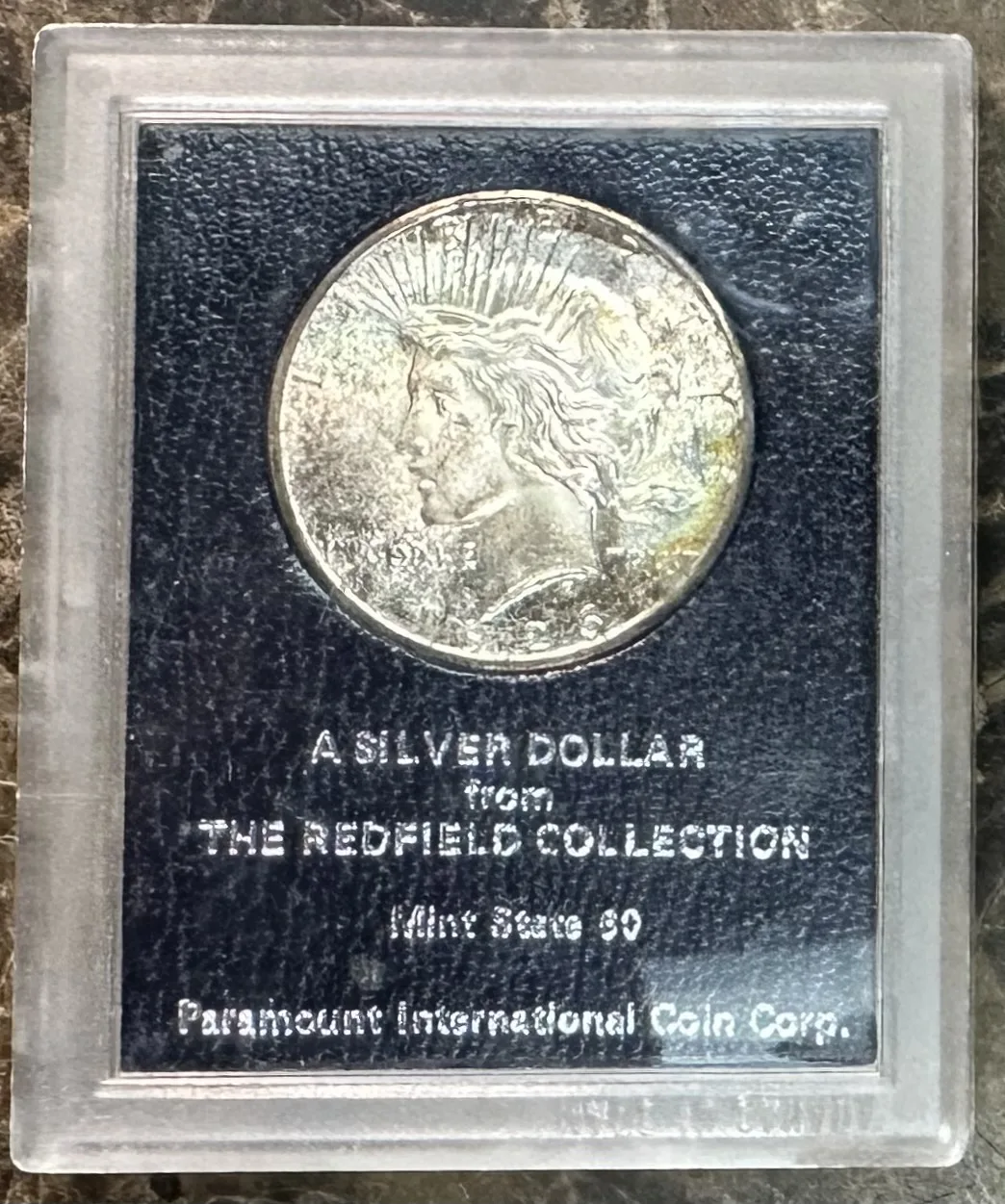
For individual coins, 2x2 cardboard holders with Mylar windows are an affordable and effective option. For more valuable coins, airtight capsules (available in 38mm size for Peace Dollars) provide superior protection. Never use PVC-based holders (soft vinyl flips), as PVC breaks down over time and deposits a green, oily residue on coins that can cause permanent damage.
Environmental Considerations
Store coins in a cool, dry environment with stable temperature and humidity. Avoid basements, attics, and garages where temperature swings and moisture can accelerate tarnishing. A safe deposit box or a quality home safe provides good environmental protection. Include silica gel packets in your storage area to absorb excess moisture.
Cleaning: Just Don’t
Never clean a Peace Dollar. Cleaning removes the natural surface patina (toning) that develops over time and leaves microscopic scratches visible under magnification. A cleaned coin can lose 50% or more of its value compared to an original, untouched example. Even coins that appear dirty or tarnished should be left as-is. Professional conservation services can address severe environmental damage without the destructive effects of amateur cleaning. The same principle applies to all collectible coins, whether you are handling Peace Dollars, Buffalo Nickels, or any other series.
Building a Peace Dollar Collection
The Peace Dollar series offers several collecting approaches depending on your budget and goals. With only 24 regular date-and-mintmark combinations, a complete set is an achievable goal for most collectors.
Date Set (24 Coins)
The classic approach is to assemble one coin for each date and mint mark combination. In circulated grades (VF to AU), a complete set can be built for roughly $2,500 to $5,000, with the 1928 being the most expensive single purchase. In MS-63, budget approximately $5,000 to $15,000 for the set, and in MS-65, expect to spend $50,000 or more due to the condition rarities discussed above.
Type Set
A type set requires just two coins: a 1921 high-relief example and one low-relief coin from 1922-1935. This approach lets you represent the entire series with minimal investment while owning the most important variety distinction. A two-coin type set in AU condition can be assembled for under $300.
Year Set
A year set includes one coin per year (regardless of mint mark), requiring 11 coins for 1921-1928 and 1934-1935. This is a more affordable alternative to the full date set while still covering every year of production.
VAM Collecting
For advanced collectors, assembling a collection of the Top 50 Peace Dollar VAMs provides a challenging and rewarding pursuit. This approach requires studying die varieties in detail and developing a sharp eye for subtle differences. Many VAM collectors focus on a single date, such as the 1922, which offers the most variety listings.
Budget Tips
Start with the most common dates to learn the series, then upgrade to key dates as your knowledge and budget grow. Buy the best grade you can afford for each date rather than filling holes quickly with low-grade coins. Attend coin shows where dealers often offer quantity discounts on Peace Dollars. Consider PCGS or NGC certified coins for key dates to ensure authenticity and accurate grading.
Modern Reissues: 2021 and 2023 Peace Dollars
In 2021, the U.S. Mint reissued the Peace Dollar as part of the centennial celebration of the original design. These modern issues differ from the originals in several important ways.
2021 Centennial Peace Dollar
The 2021 Peace Dollar was struck in .999 fine silver (not the original .900 silver composition) at the Philadelphia Mint. It features the original de Francisci design in high relief, honoring the 1921 original. The coin carries a “P” mint mark (unlike the original 1921, which has no mint mark) and an edge inscription reading “2021 100TH ANNIVERSARY.” Mintage was limited, and these coins remain popular with both Peace Dollar collectors and modern commemorative enthusiasts.
2023 Peace Dollar
The Mint produced additional Peace Dollar issues in 2023, further expanding the modern series. These coins maintain the .999 fine silver composition and feature the classic design elements while carrying contemporary dates and mint marks.
2026 Semiquincentennial Issue
For the 250th anniversary of American independence, the U.S. Mint will issue 2026 Peace Dollars bearing a dual date of 1776-2026 and a Liberty Bell “250” privy mark. This marks the first time a dual date has appeared on the Peace Dollar design, making these coins especially notable for collectors.
Collecting Modern Peace Dollars
Modern Peace Dollar reissues are distinct from the original 1921-1935 series in composition, weight, and mintage. Most collectors treat them as a separate category rather than extensions of the original series. However, they make excellent companion pieces for a Peace Dollar collection and serve as affordable examples of the iconic design for newer collectors.
Frequently Asked Questions
How much is a Peace Dollar worth?
Common-date Peace Dollars in circulated condition (VF to AU) typically sell for $30 to $60, depending on the date and silver spot price. Key dates like the 1928, 1921 high relief, and 1934-S command significant premiums, ranging from $100 to over $100,000 in top grades. The base melt value of any Peace Dollar is approximately $25 to $30 based on its silver content of 0.77344 troy ounces.
What is the rarest Peace Dollar?
The rarest regular-issue Peace Dollar by mintage is the 1928 Philadelphia with only 360,649 coins struck. However, the 1922 High Relief Matte Proof is the rarest variety overall, with only 10 to 20 known survivors and auction prices exceeding $300,000.
Are all 1921 Peace Dollars high relief?
Yes. All 1921 Peace Dollars were struck in high relief. The low-relief design was not introduced until 1922. This makes 1921 the only year of the high-relief design and an essential type coin for any Peace Dollar collection.
Where is the mint mark on a Peace Dollar?
The mint mark is on the reverse (back) of the coin, near the bottom. It is positioned to the left of the eagle's tail feathers, just below and between the "O" and "N" of "ONE." Philadelphia coins have no mint mark, Denver coins show a "D," and San Francisco coins show an "S."
Should I clean my Peace Dollar?
No. Cleaning a coin removes the natural patina and creates microscopic scratches that significantly reduce its collector value. Even coins with heavy toning or surface dirt should be left untouched. If a coin has severe environmental damage, consult a professional conservation service rather than attempting to clean it yourself.
How can I tell if my Peace Dollar is real?
Check the weight (should be 26.73 grams) and the diameter (38.1 mm), and look at the edge reeding for evenness rather than counting it - the catalogue figure is 189 reeds. Examine the design details under magnification for sharpness and correct style. Perform the "ping test" by listening for the characteristic silver ring. For high-value coins, submit them to PCGS or NGC for professional authentication.
What is a VAM variety?
VAM (Van Allen-Mallis) refers to a cataloging system for die varieties on Morgan and Peace Dollars. Each VAM number identifies a specific pair of obverse and reverse dies with distinctive characteristics like doubled lettering, repunched dates, or die cracks. The Top 50 Peace Dollar VAMs represent the most significant and collected varieties in the series.