Draped Bust Dollar Identification Guide: Small Eagle, Heraldic Eagle, 1804 Key Date, and Values
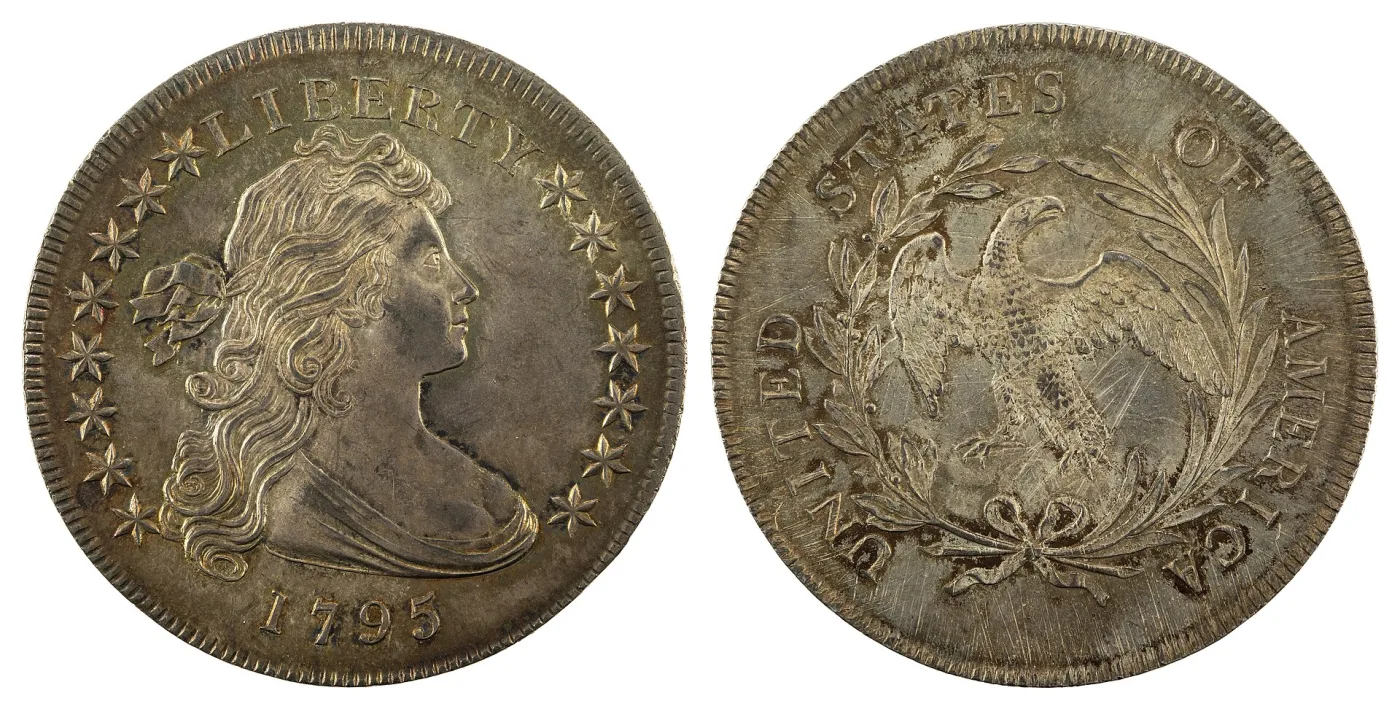
The Draped Bust Dollar — struck from 1795 to 1804 — is one of the most historically significant series in all of American numismatics. It was the second silver dollar design produced by the United States Mint, succeeding the short-lived Flowing Hair Dollar of 1794-1795. The series carries Robert Scot’s celebrated Draped Bust portrait of Liberty on the obverse and pairs it with two very different reverses: the naturalistic Small Eagle (1795-1798) and the heraldic eagle adapted from the Great Seal of the United States (1798-1804). At the end of the series sits the most famous American coin ever struck — the legendary 1804 Dollar, “The King of American Coins,” of which only fifteen specimens are known.
This guide walks through every aspect of identifying, attributing, grading, and valuing Draped Bust Dollars. You will learn how to distinguish the Small Eagle from the Heraldic Eagle reverses, count obverse stars correctly, identify Bowers-Borckardt (BB) die varieties, recognize the three classes of the 1804 dollar, spot contemporary and modern counterfeits, and accurately price coins in every grade level — from a well-worn 1798 Heraldic Eagle worth a few thousand dollars to a Class I 1804 valued in the millions.
Whether you own a circulated Draped Bust Dollar that has been in the family for generations, are evaluating a coin offered at a regional show, or are studying the series for the first time, this guide provides the working knowledge needed to handle these early American silver dollars with confidence.
History: The Second US Silver Dollar
The Coinage Act of 1792 authorized the United States to strike silver dollars at the new Philadelphia Mint, fixing their weight at 416 grains of standard silver (.8924 fine). The first design, the Flowing Hair Dollar by Robert Scot, was produced in 1794 and 1795 but received heavy criticism for what contemporaries called Liberty’s “wild” and unkempt appearance. Mint Director Henry William DeSaussure, who replaced David Rittenhouse in mid-1795, prioritized two reforms: striking gold coinage and redesigning the silver dollar. The result was the Draped Bust portrait, introduced on the dollar in October 1795.
The new design was reportedly based on a drawing by the artist Gilbert Stuart — the same Stuart who painted the famous portrait of George Washington used on the modern dollar bill. The model is traditionally said to have been Ann Willing Bingham, a prominent Philadelphia socialite considered one of the great beauties of the early Republic, although no contemporary documentation positively confirms her identity. Whatever the source, Scot’s engraving of Stuart’s drawing produced a much softer, more elegant Liberty than the Flowing Hair, with carefully arranged hair, a ribbon, and a drape across the bust.
The Draped Bust portrait proved so successful it spread quickly across the entire US Mint output. It appeared on the half cent, large cent, half dime, dime, quarter, and half dollar during the late 1790s and early 1800s — making the design the unifying visual identity of pre-1807 federal coinage. The tiny Draped Bust half cent of 1800-1808 carries this same portrait at its smallest scale.
The End of Silver Dollar Production in 1804
Although coins dated 1803 represent the last regular issue of the series, the Mint actually struck silver dollars into 1804 using leftover dies of earlier dates. President Jefferson formally suspended silver dollar coinage on March 31, 1804, after Mint Director Elias Boudinot complained that newly minted American dollars were being shipped to the West Indies and exchanged for Mexican 8-reales coins of slightly higher silver content, producing no benefit for US commerce. Silver dollar production then ceased for thirty years — until the Gobrecht and Seated Liberty series resumed in 1836 and 1840.
Design: The Draped Bust of Liberty
Understanding every element of the Draped Bust design is essential for accurate grading and variety identification. The design changed in subtle but important ways across the series.
Obverse (Heads Side)
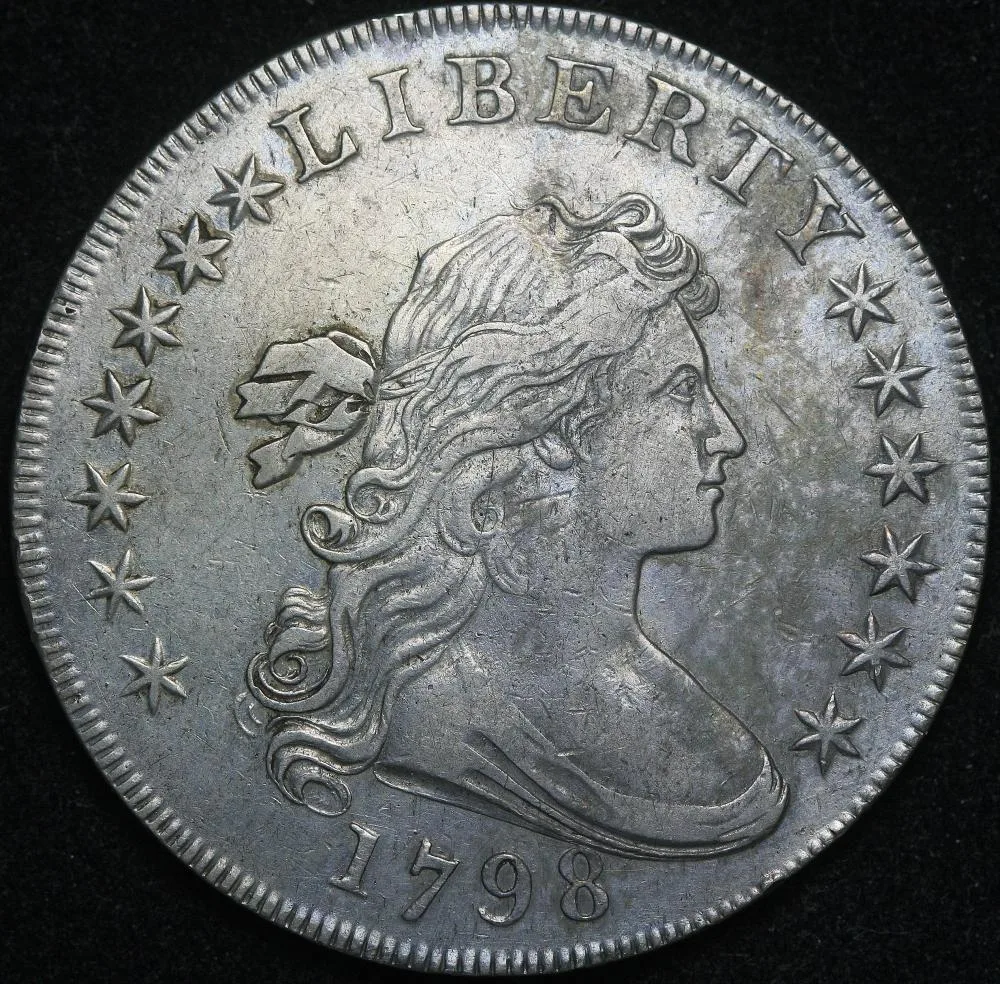
The obverse depicts Liberty facing right, her hair falling in loose waves down her back and tied with a ribbon. A drape of fabric crosses her bust. The legend LIBERTY arches across the top, the date appears below the bust truncation, and stars surround the portrait in the field. The 1795 and 1796 issues both carry fifteen stars, eight left of the bust and seven right, representing the fifteen states then in the Union. Tennessee was admitted in June 1796, but the sixteenth star does not appear until the 1797 dies; the count then dropped back to thirteen in 1798 to represent the original colonies — a permanent convention thereafter.
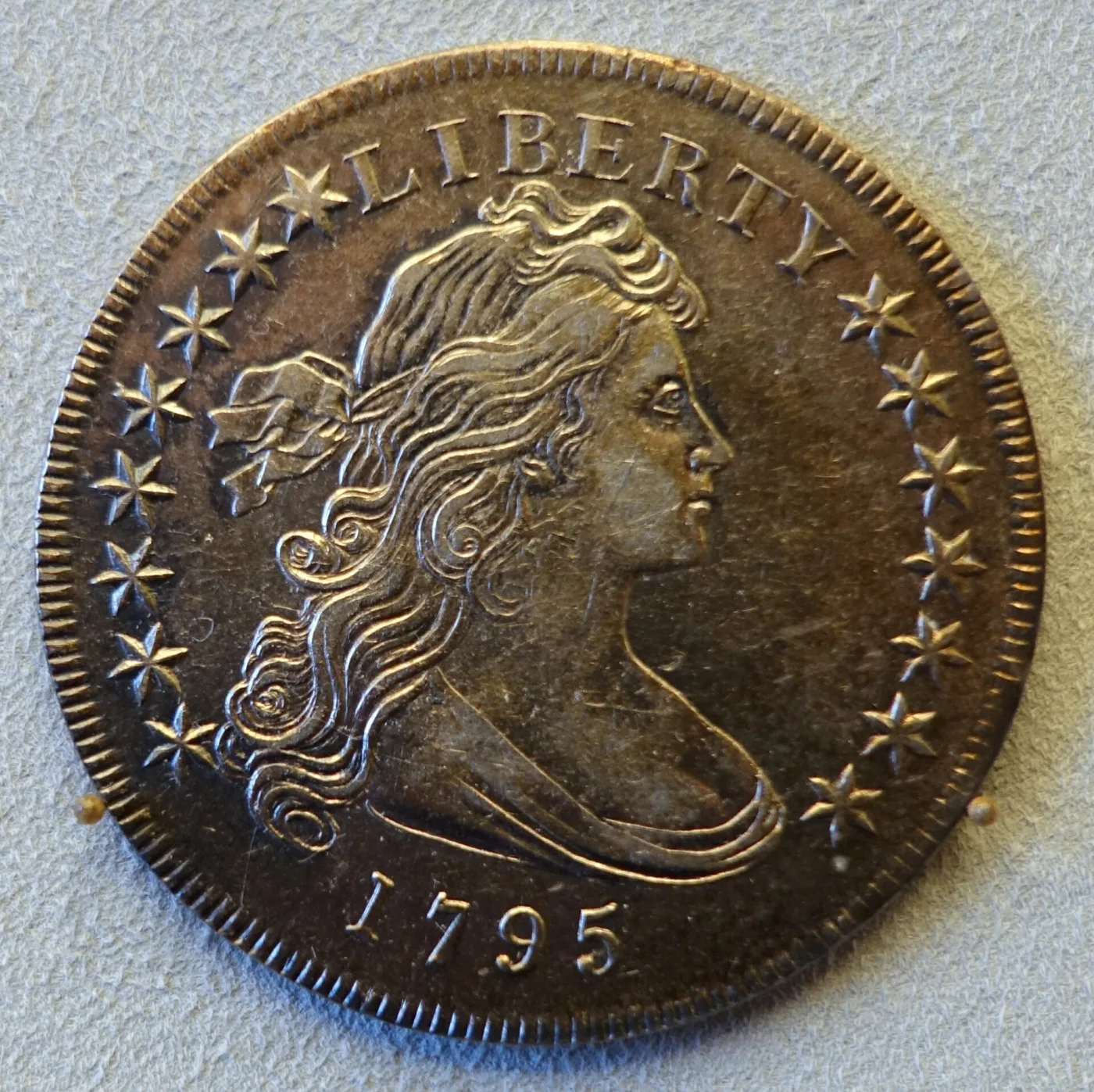
No designer’s initials appear on the coin. The portrait is in the so-called “Stuart” style — elegant, classical, and decidedly aristocratic compared to the rougher Flowing Hair.
Reverse — Type 1: Small Eagle (1795-1798)
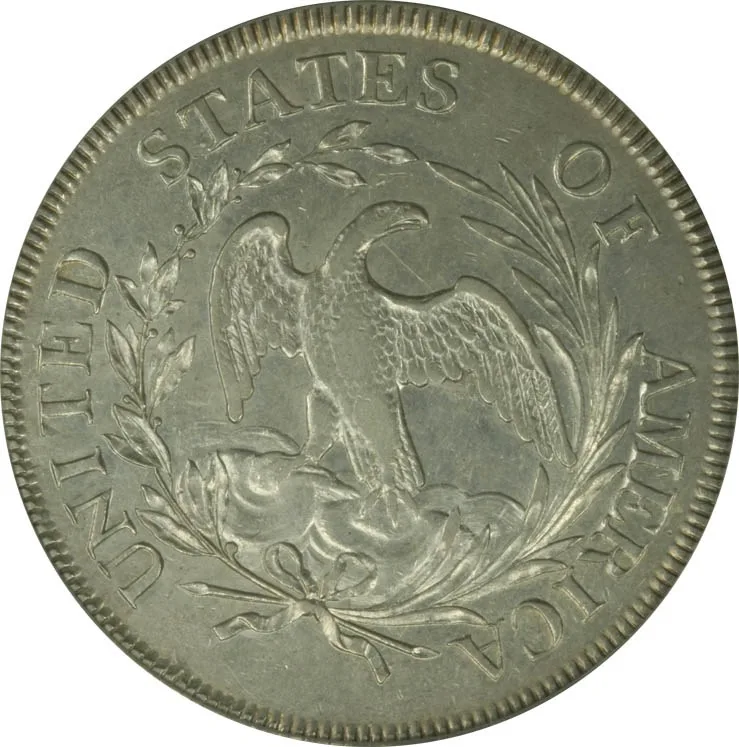
The first reverse shows a naturalistic, slender bald eagle with wings spread, perched on a cloud bank, surrounded by an open palm-and-olive wreath. The legend UNITED STATES OF AMERICA arches around the perimeter. The eagle’s body and pose are biological rather than heraldic — this is a real bird, not a coat-of-arms emblem. There is no denomination on the coin; value was understood from size and weight alone. Reverse star count varies: some Small Eagle dollars have a single star at the upper right of the wreath; others have no star or two stars. Edge lettering reads HUNDRED CENTS ONE DOLLAR OR UNIT.
Reverse — Type 2: Heraldic Eagle (1798-1804)
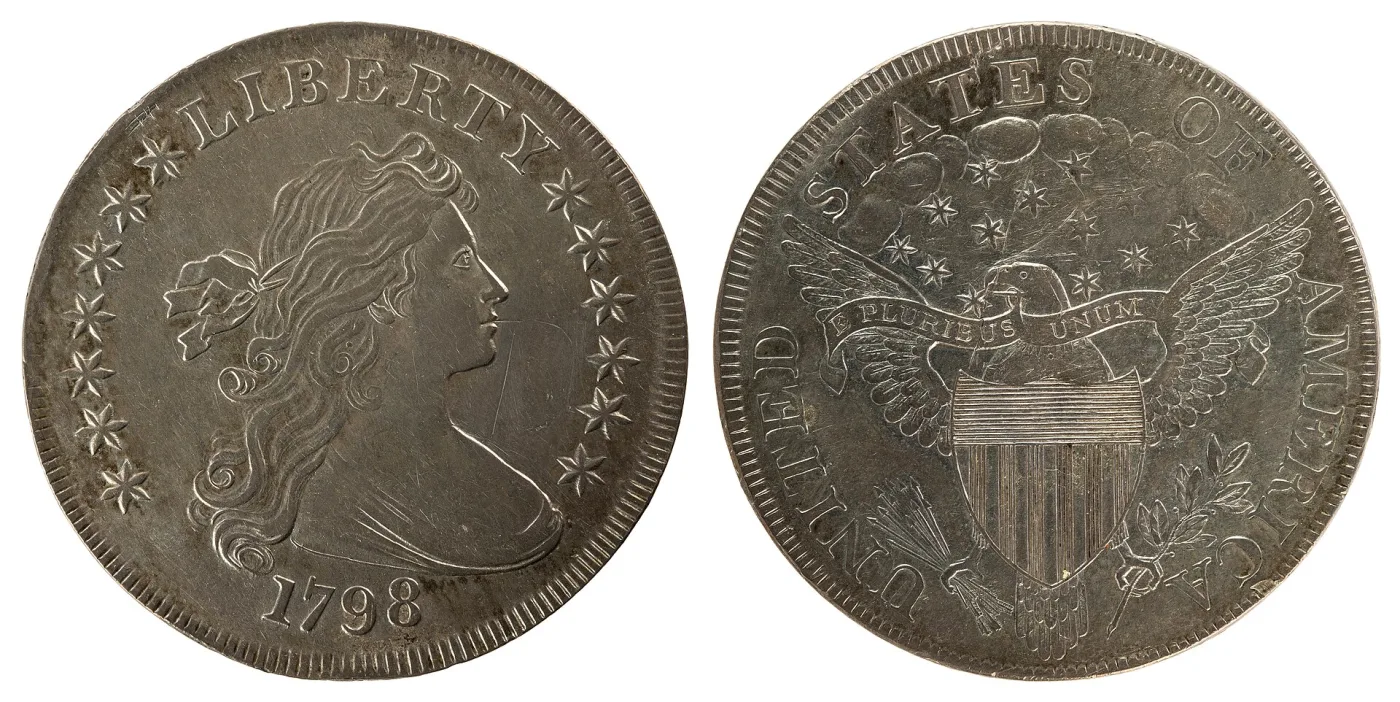
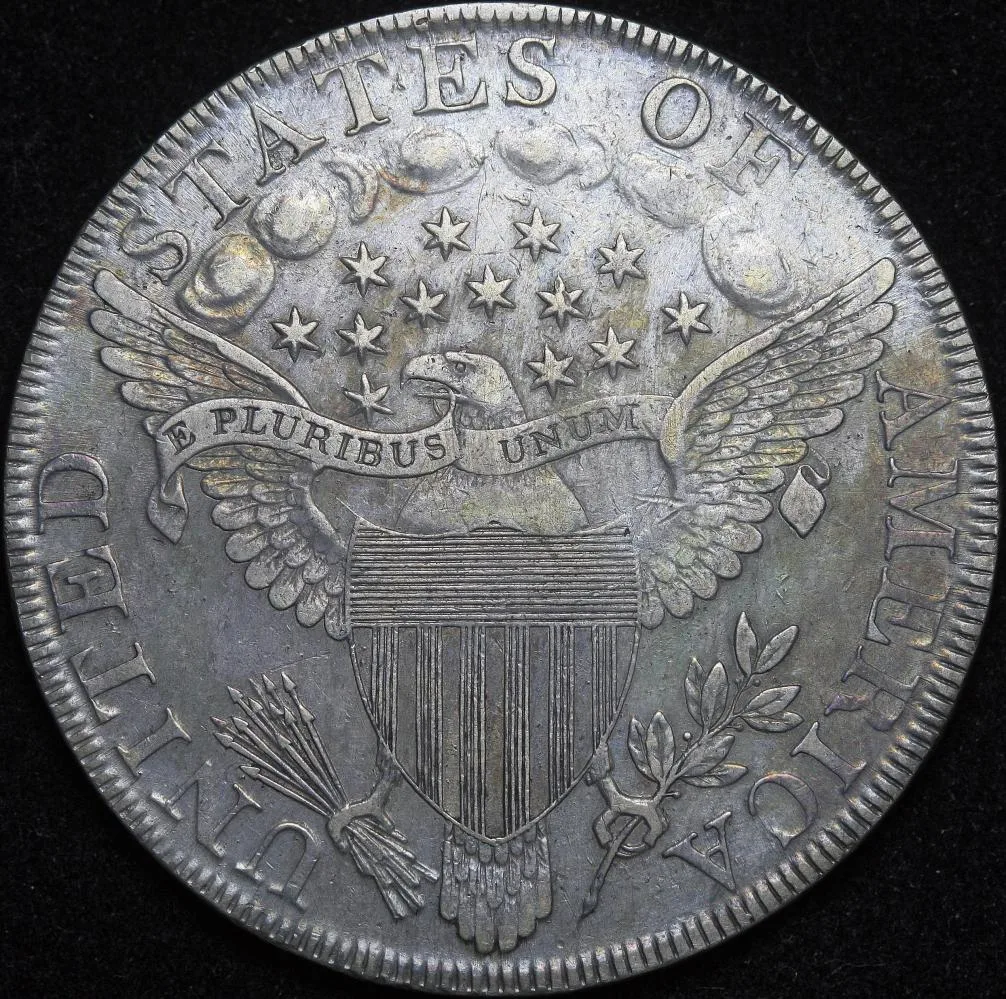
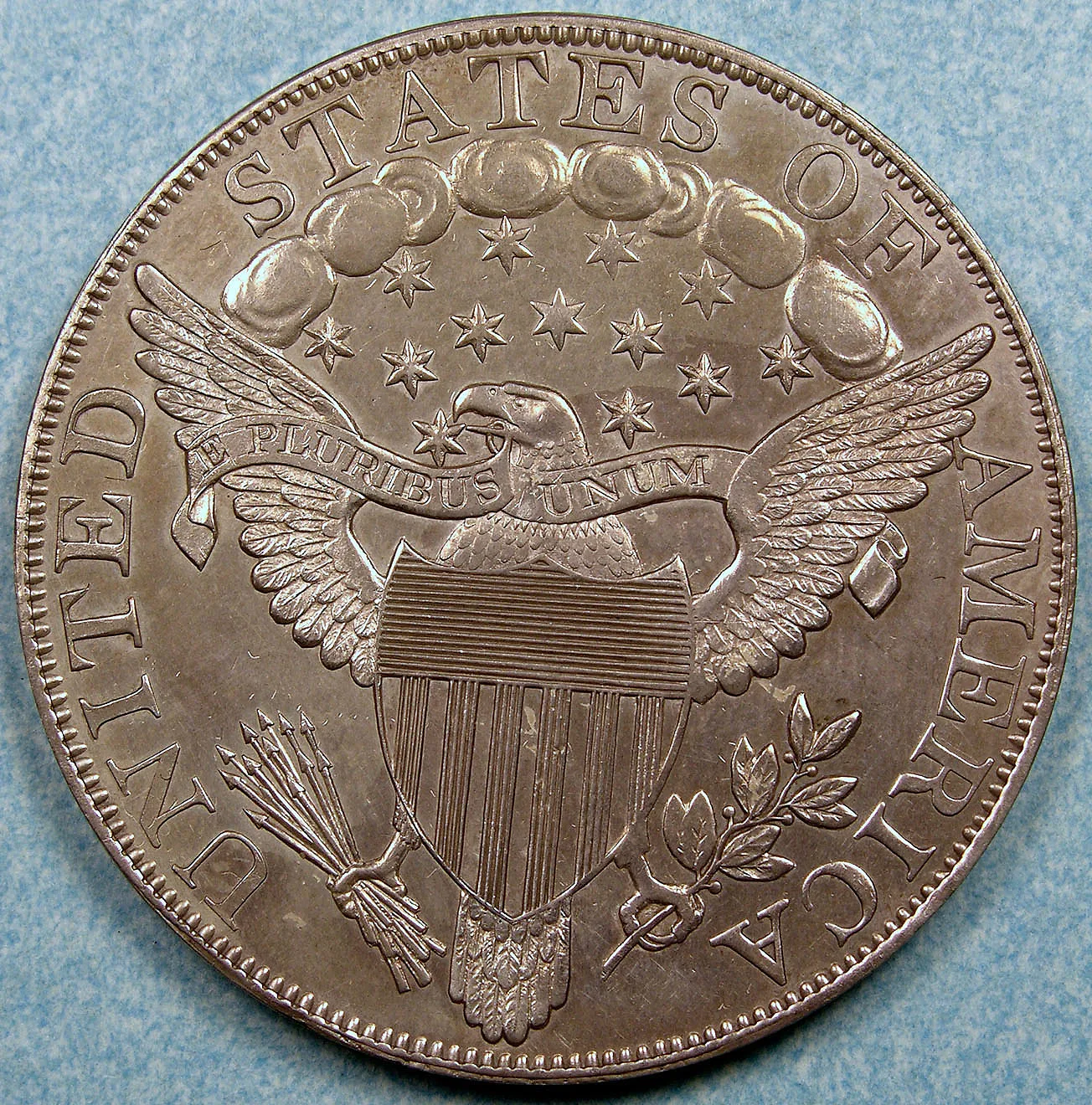
In 1798 the reverse was changed to a heraldic eagle adapted from the Great Seal of the United States. The eagle has a shield on its breast, a bundle of arrows in its right talon, and an olive branch in its left, with the motto E PLURIBUS UNUM on a banner across its beak and a constellation of thirteen stars and clouds above that. Check the talons carefully, because this is where the coin departs from its model: the Great Seal puts the olive branch in the eagle’s right talon and the arrows in its left, and this reverse has them the other way round. The eagle faces you, so its right talon is the one on your left — the side holding the arrows. The legend UNITED STATES OF AMERICA wraps around the rim. As with the Small Eagle, there is no expressed denomination. Edge lettering is the same: HUNDRED CENTS ONE DOLLAR OR UNIT.
Photographed under the same lights at the National Numismatic Collection, three years apart, the two types answer the question side by side:
Edge
All regular-issue Draped Bust Dollars from 1795 to 1804 have lettered edges reading HUNDRED CENTS ONE DOLLAR OR UNIT, applied with a Castaing machine before striking. The lettering may run in either direction (head-side-up or tail-side-up) depending on how the planchet entered the press. Smooth, reeded, or plain edges on any Draped Bust Dollar are an immediate red flag for counterfeits or alterations — except for the famous Class II 1804 restrikes (covered later).
Composition and Specifications
Knowing the metal content and physical specs is essential for authentication and for understanding how these coins were used.
Specifications
- Composition: .8924 silver, .1076 copper (the original US standard, lower than the later .900 standard).
- Weight: 26.96 grams (416 grains).
- Diameter: 39-40 mm (variable on early hand-finished planchets).
- Edge: HUNDRED CENTS ONE DOLLAR OR UNIT.
- Net silver weight: approximately 24.06 grams (0.774 troy oz of pure silver).
Why Composition Matters for Authentication
An authentic Draped Bust Dollar will weigh very close to 26.96 grams. Worn coins lose perhaps 0.5 to 1 gram across two centuries of circulation, but anything dropping below 25.5 grams is suspicious. Specific gravity should fall between 10.3 and 10.4. Coins markedly heavier or lighter, or showing the wrong color (a yellowish or pinkish tone instead of clean silver), should be tested before any purchase. The .8924 alloy gives genuine examples a slightly warmer tone than the colder .900 fine silver of post-1837 federal coinage.
The Small Eagle Reverse (1795-1798)
Draped Bust Dollars with the Small Eagle reverse were struck in 1795, 1796, 1797, and 1798. Mintages are tiny by modern standards, and survival rates are even smaller. Most surviving Small Eagle dollars are in the VG to Fine range. Choice or better examples are genuinely rare and command strong premiums regardless of date.
1795 Draped Bust, Small Eagle
The first year of issue. Probably 42,738 pieces were struck of the new design — although mintage records of the period are imprecise because they conflated Flowing Hair and Draped Bust strikings under the calendar year. The 1795 Draped Bust is distinguishable from the Flowing Hair by the obverse portrait (draped, ribbon-tied hair vs. wildly flowing hair) and by the wreath style on the reverse (palm-and-olive vs. simple wreath). Two main BB varieties exist (BB-51 and BB-52). The 1795 is the rarest Small Eagle date in higher grades.
1796 Draped Bust, Small Eagle
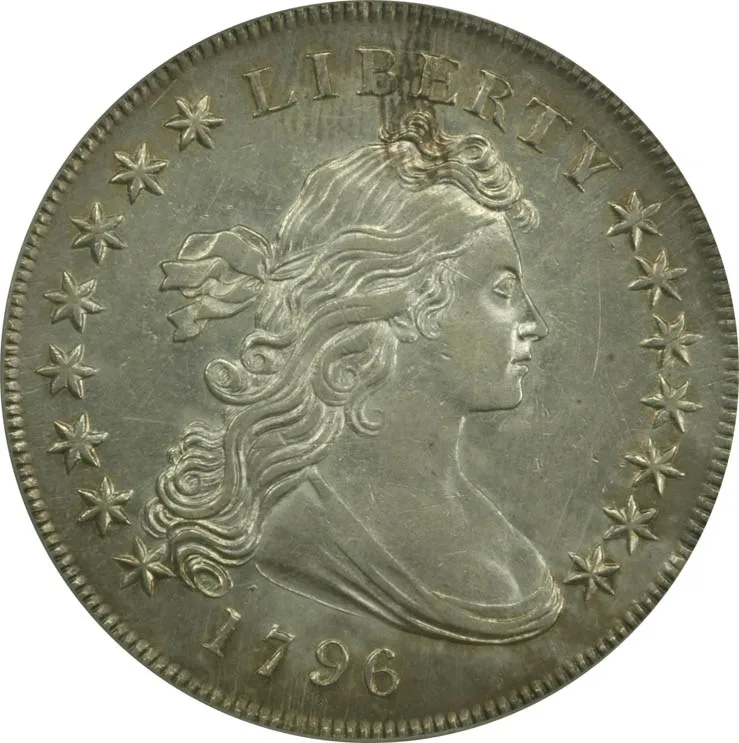
Approximately 79,920 pieces. Three BB varieties are recognized (BB-61 through BB-66 series), with the Large Date / Large Letters and Small Date / Small Letters being the two main subtypes a typical collector encounters. The 1796 is the most common Small Eagle date but still scarce in any grade.
Both sides of one 1796, which is the cheapest way to learn what the type is supposed to look like:
1797 Draped Bust, Small Eagle
Mintage 7,776 pieces — the lowest of the Small Eagle dates. Three main varieties exist defined by star count: 1797 10x6 Stars (10 left, 6 right; BB-71), 1797 9x7 Stars Large Letters (BB-73), and 1797 9x7 Stars Small Letters (BB-72). The 9x7 Small Letters is the rarest and most desirable.
1798 Draped Bust, Small Eagle
The final year of the Small Eagle reverse. Two main varieties: 1798 13 Stars (BB-81) and 1798 15 Stars (BB-82). Both are quite rare. The 1798 Small Eagle is one of the more important transitional issues in the series and is highly sought after.
The Heraldic Eagle Reverse (1798-1804)
The Heraldic Eagle reverse was introduced mid-1798 and continued through the end of the series. Mintages climb sharply compared to the Small Eagle years, making Heraldic Eagle dollars the more affordable entry point for collectors who want a Draped Bust Dollar in their type set.
1798 Draped Bust, Heraldic Eagle
The most common date for the type. Heraldic Eagle 1798s appear in roughly thirty BB varieties, far too many to enumerate. The most commonly encountered are BB-94, BB-104, BB-122, and BB-123. Distinguishing the 1798 Heraldic Eagle is straightforward: heraldic eagle reverse, 13 stars on the obverse, and bold date.
The commonest date of the type, lit hard against black so the fields read as flat and the devices as raised:
1799 Draped Bust, Heraldic Eagle
The single-highest mintage year of the entire series — approximately 423,515 pieces — and consequently the most affordable Draped Bust Dollar. Multiple varieties exist, including the famous 1799/8 overdate (BB-141, BB-142) where a 9 was punched over an 8 in the date. The 1799 Irregular Date 15 Reverse Stars is another scarce variety. The 1799 is the “type coin” most commonly chosen for collections.
1800 Draped Bust, Heraldic Eagle
Mintage approximately 220,920 pieces. Common varieties include the 1800 Dotted Date (BB-192, with raised dots in the field from die rust), the 1800 AMERICAI (BB-191, a die crack appearing to add an I after AMERICA), and the 1800 12 Arrows and 13 Arrows reverse varieties. The Dotted Date and AMERICAI are popular with variety collectors.
1801 Draped Bust, Heraldic Eagle
Mintage 54,454 pieces — a sharp drop. Varieties are fewer (BB-211 through BB-214). The 1801 is one of the scarcer regular-issue Heraldic Eagle dates and noticeably more expensive than the 1798-1800.
1802 Draped Bust, Heraldic Eagle
Mintage 41,650 pieces. The major varieties are 1802/1 Narrow Date, 1802/1 Wide Date, and 1802 Normal Date. The 1802/1 overdates are easy to spot because the 1 underdigit is clearly visible beneath the 2. Proof-only 1802 restrikes also exist, struck circa 1858-1860 from rusted dies — these are great rarities.
1803 Draped Bust, Heraldic Eagle
The last regular issue. Mintage 66,064 pieces. Two main varieties: 1803 Large 3 and 1803 Small 3. Like the 1802, proof-only 1803 restrikes were made circa 1858-1860.

Reading the Obverse Star Count
Obverse star count is one of the most important identification points on Draped Bust Dollars. It changes across the series in ways that matter for both attribution and value.
1795-1797: Varying Counts
Early dollars carry fifteen, sixteen, or — most commonly — a split of stars between the left and right fields. Through 1796 the arrangement is 8 stars left + 7 right, fifteen in all. Sixteen stars arrive with the 1797 dies, in two arrangements — 9x7 and 10x6 — as the Mint adjusted to political reality after Tennessee’s admission, before abandoning the growing count altogether in 1798.
1798 Transition
1798 marks the permanent adoption of thirteen stars on the obverse, representing the original thirteen colonies — a convention that would persist on every US silver coin through 1916 (Mercury Dime, Standing Liberty Quarter, and Walking Liberty Half all carry thirteen obverse stars in homage). A few 1798 dies carry fifteen stars from leftover hubs (BB-82) — these are rare and command premiums.
1799-1804: Thirteen Stars Standard
All 1799-1804 dollars use 7+6 = 13 stars on the obverse. Reverse stars are 13 in clouds with one anomaly: certain 1799 dies show 15 reverse stars due to a die-engraving error.
Bowers-Borckardt (BB) Die Varieties
The standard reference for Draped Bust Dollar die varieties is The Encyclopedia of United States Silver Dollars 1794-1804 by Q. David Bowers and Mark Borckardt (commonly cited as Bowers-Borckardt, abbreviated BB). The BB numbering system is the variety attribution standard used by PCGS, NGC, and the major auction houses.
How BB Numbers Work
Each BB number identifies a specific obverse die / reverse die combination. For example, 1799 BB-156 refers to the marriage of obverse 12 and reverse N for the 1799 date. Dies wore quickly in the early Mint, so any given date may have a dozen or more BB combinations — far more than the few major design varieties most collectors track.
Why BB Numbers Matter
For ordinary collectors, BB numbers matter less than major design varieties (Small vs. Heraldic Eagle, star count, overdates). For specialists, BB numbers can mean enormous price differences — a common BB-156 1799 might sell for $2,500 in VF, while a rare BB-167 1799 of the same grade could bring $15,000 or more. If you are buying a high-value Draped Bust Dollar, always request the BB attribution from the seller and verify it against the certification holder.
Counterstamped and Edge-Inverted Coins
Many surviving Draped Bust Dollars carry contemporary counterstamps from merchants, banks, or government inspectors — initials, anchors, eagles, dates. Original counterstamps generally do not reduce value much and may add interest to advanced collectors. Modern counterstamps (post-1900) are damage and reduce value.
Year-by-Year Mintages and Identification
The table below summarizes the regular issues of the series. Note that 1804-dated dollars were not struck in 1804 — the small mintage of approximately 19,570 dollars produced in 1804 used dies dated 1803.
- 1795 Small Eagle: ~42,738 pieces (estimated, conflated with Flowing Hair output).
- 1796 Small Eagle: ~79,920 pieces.
- 1797 Small Eagle: ~7,776 pieces — lowest of the Small Eagle dates.
- 1798 Small Eagle: Included in 1798 total mintage of ~327,536. Small Eagle dies used early in the year only.
- 1798 Heraldic Eagle: Bulk of the 1798 mintage.
- 1799: 423,515 pieces — highest single-year mintage.
- 1800: 220,920 pieces.
- 1801: 54,454 pieces.
- 1802: 41,650 pieces.
- 1803: 66,064 pieces.
- 1804 (struck from 1803 dies): ~19,570 pieces — none survive identifiable as 1804 strikes.
Quick Identification Workflow
- Confirm it’s a Draped Bust: Liberty’s hair is drape-tied with ribbon, not wildly flowing.
- Determine the reverse: Small naturalistic eagle on clouds = Type 1 (1795-1798); heraldic eagle with shield = Type 2 (1798-1804).
- Read the date: Look carefully for overdates (1799/8, 1802/1) and varieties like Dotted Date or AMERICAI.
- Count stars: Note left-right split. 13 stars total is normal after 1798; deviations are varieties.
- Check the edge: HUNDRED CENTS ONE DOLLAR OR UNIT — if absent or different, suspect a counterfeit.
- Confirm weight and diameter: 26.96 grams nominal, 39-40 mm.
The 1804 Dollar: King of American Coins
No coin in the entire US series carries more mystique than the 1804 Draped Bust Dollar. Just fifteen specimens are known. The rarest US silver coin offered at public auction has sold for over $7.6 million. The 1804 dollar is the centerpiece of the Smithsonian’s National Numismatic Collection and the prize of any private collection lucky enough to hold one.
Why No 1804-Dated Dollars Were Struck in 1804
The Mint struck approximately 19,570 silver dollars during calendar year 1804, but used leftover dies dated 1803. Production ceased that March. No coin dated 1804 was made in 1804. Every “1804 Dollar” in existence was struck later — for entirely separate reasons.
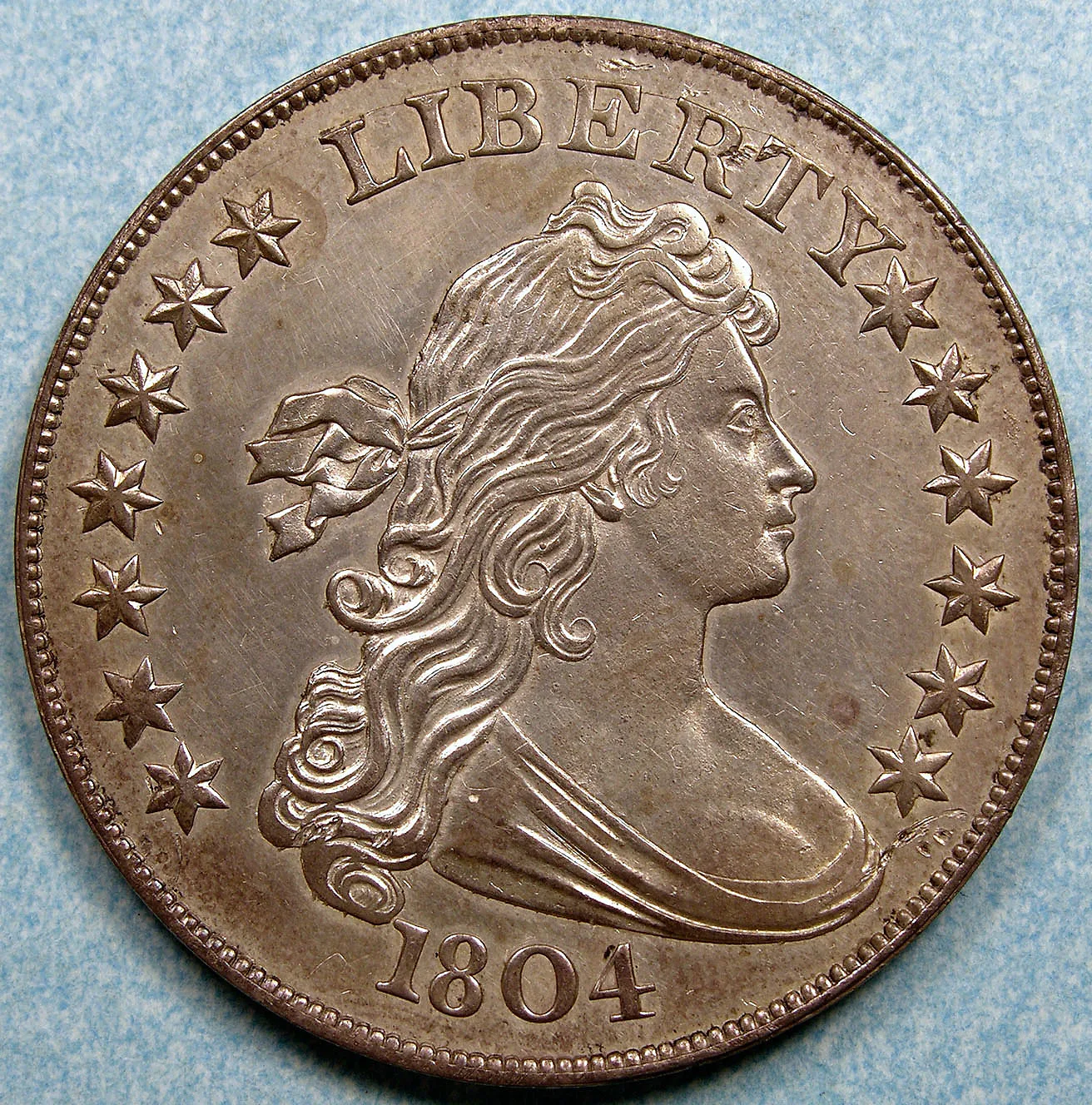
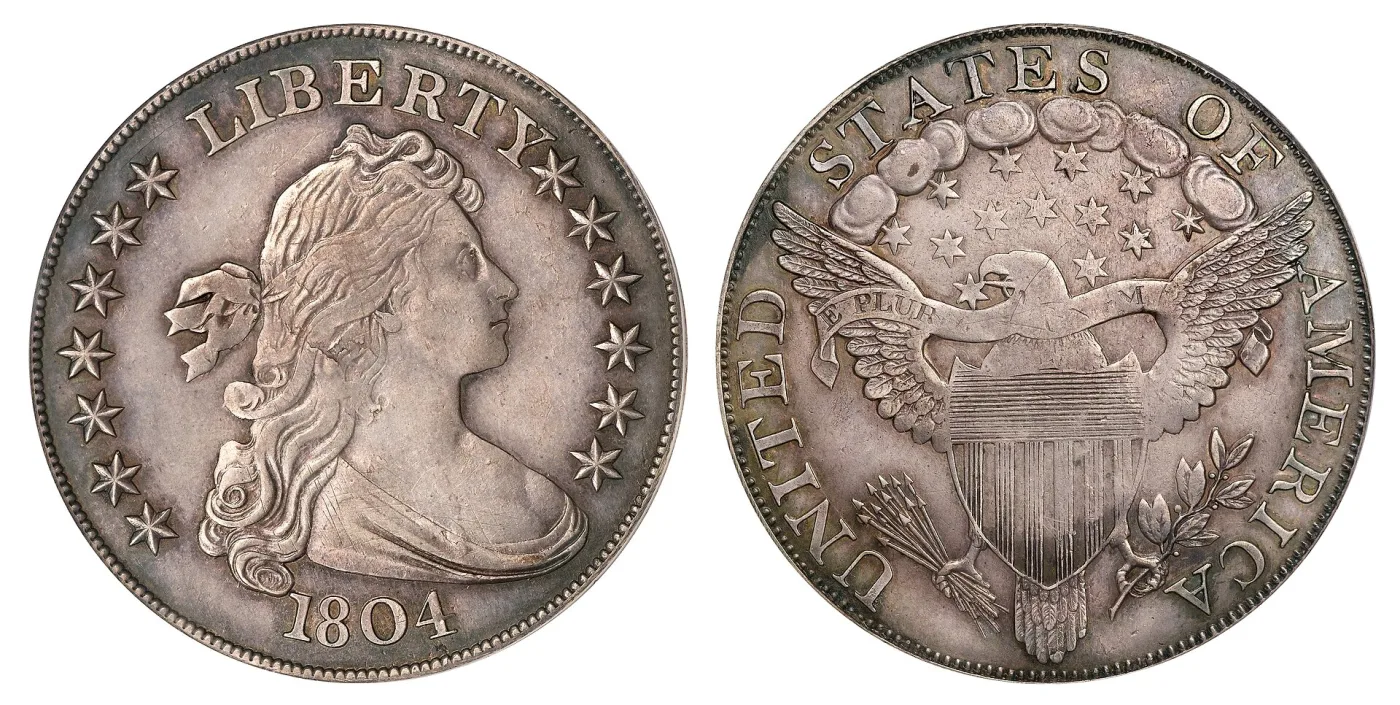
Class I: The Original 1834 Diplomatic Strikes (8 known)
In 1834-1835 the State Department, planning diplomatic gifts for Asian rulers (the King of Siam, the Sultan of Muscat, and others), asked the Mint to prepare presentation sets of US coinage. The Mint reasoned — incorrectly, but plausibly given the 1804 production records — that the last silver dollars struck before discontinuation were dated 1804. New 1804-dated obverse dies were cut and a handful of dollars produced for the proof sets. These same diplomatic sets are also why the rare 1804 “Plain 4” Capped Bust Eagle exists — the Mint cut fresh 1804-dated dies for the $10 gold piece at the same time. These are the “Class I” 1804 dollars. Eight are known to exist; provenance is unbroken for nearly all.
One of the eight Class I originals, photographed in the National Numismatic Collection:
Class II: The 1858 Mint Restrike (1 known)
In 1858 Mint employees, recognizing the collector demand for the 1804 dollar, struck additional examples. The single confirmed Class II example has a plain (non-lettered) edge and resides in the Smithsonian. It is unique. Other Class II strikes were destroyed when the Mint Director discovered the unauthorized restriking.
Class III: The 1859-1860 Restrikes with Lettered Edge (6 known)
Subsequent Mint employees, more careful than their predecessors, edge-lettered Class III strikes using contemporary collars to make them more closely resemble Class I originals. Six Class III examples are known. Class III pieces typically have die rust evidence on the reverse and slightly different surface texture than Class I originals.
Distinguishing the Three Classes
For an authenticated specialist, the diagnostics are: Class I shows fresh dies and matching strike characteristics of the early 1830s; Class II has a plain edge; Class III has a lettered edge but later die state. Photographs of every known specimen are catalogued in the Bowers-Borckardt reference, the Heritage and Stack’s-Bowers auction archives, and the published works of Eric P. Newman.
What to Do If You Think You Have One
You almost certainly do not. Every one of the fifteen 1804 dollars is accounted for in collections, museums, or major auction archives. If you have an 1804-dated dollar, it is overwhelmingly likely to be a contemporary or modern counterfeit — typically an altered date from an 1801 or 1802 coin. Submit any candidate to PCGS or NGC immediately. The chance of a sixteenth specimen surfacing is statistically negligible but not zero, and a genuine example would be a major numismatic event.
Grading Draped Bust Dollars
Draped Bust Dollars are difficult to grade because they were struck on hand-prepared planchets with relatively crude collars and presses. Adjustment marks (file marks made to bring overweight planchets down to standard), planchet flaws, and weak strikes are common even on coins that never circulated.
Key Wear Points
Wear shows first on Liberty’s bust line, the high points of her hair, and the eagle’s breast and wing feathers on the reverse. Specific checkpoints:
- Liberty’s hair: The high curls just behind the forehead are the first to flatten. A clear separation of curls is the difference between AU and XF.
- Bust line: The drape across Liberty’s chest shows wear early.
- Reverse eagle’s breast: Feather detail on the eagle’s chest (both types) goes first. Heraldic eagle shield stripes lose definition next.
- Stars: Star centers should show radial lines in higher grades; flattened stars indicate VG or below.
Grade Estimates by Detail
- AG-3 (About Good): Outline of design visible; rim worn into legend.
- G-4 (Good): LIBERTY worn but readable; date clear; major design outline complete.
- VG-8 (Very Good): Some hair detail visible; eagle feathers blended.
- F-12 (Fine): Hair curls show partial separation; eagle breast shows partial feathers.
- VF-20 (Very Fine): Most hair detail clear; some eagle feathers separated.
- XF-40 (Extremely Fine): Sharp hair detail; eagle feathers mostly distinct; light high-point wear.
- AU-50 (About Uncirculated): Trace wear only on high points; underlying luster present.
- MS-60+ (Mint State): No wear; full luster (may have planchet flaws or weakness from strike but no rubbing).
Adjustment Marks and Planchet Issues
Many original Draped Bust Dollars carry file-like adjustment marks where Mint workers reduced overweight planchets to spec before striking. These are not damage — they are a manufacturing artifact and are accepted by PCGS and NGC on holdered coins. Heavy or distracting adjustment marks reduce eye appeal and value, but they do not warrant a “details” grade or rejection.
Striking Weakness vs. Wear
Distinguishing strike weakness from wear is critical. Weakly struck areas retain their original luster and surface texture — they were simply never fully impressed by the die. Worn areas show flattening and friction. On Draped Bust Dollars, weak strikes are common on the central reverse stars and the top of Liberty’s hair. A coin with a weak strike is still Mint State if luster is intact; calling it AU because of “missing” detail is a common amateur error.
Authentication and Counterfeit Detection
Draped Bust Dollars are among the most counterfeited US coins. Both contemporary (period) counterfeits and modern (post-1900) fakes exist in significant numbers. Authentication is essential before any meaningful purchase.
Contemporary Counterfeits
Period counterfeits were typically struck or cast in base metal (copper, brass, German silver) and silvered. They circulate freely in collector channels and have their own following. Diagnostics include wrong weight, wrong specific gravity, soft details that fail to match known die varieties, and incorrect edge lettering. A coin that “doesn’t match” any BB variety is almost always a counterfeit.
Modern Counterfeits
Modern (Chinese-origin) counterfeits became prevalent in the 2000s and now flood eBay, estate sales, and inexperienced dealer tables. Diagnostics:
- Wrong weight (typically light, 23-25 grams).
- Wrong color (too bright, too yellow, or pinkish).
- Pebbled or “soapy” surface texture from cast manufacture.
- Wrong edge lettering or missing edge lettering.
- Mushy or “blobby” details that don’t match BB die work.
- Die marks that don’t correspond to any known die marriage.
Altered-Date Counterfeits
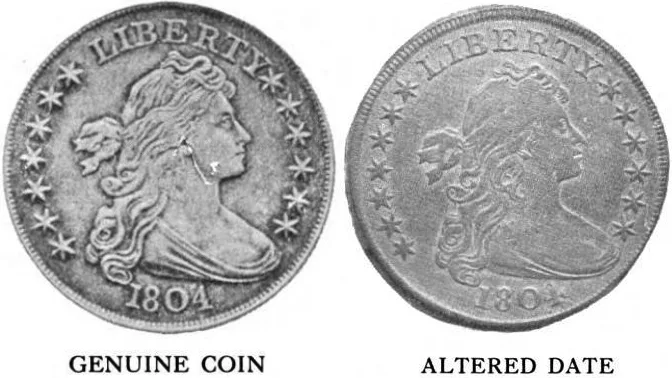
Some “1804” dollars are 1801, 1802, or 1803 coins with the final digit altered. Diagnostics include tool marks around the altered digit, wrong digit style, and field disturbance. The 1801 (with a 1 changed to a 4) is the most common base.
Always Submit High-Value Coins to PCGS or NGC
For any Draped Bust Dollar valued over $2,000, certification by PCGS or NGC is essential. Both services authenticate, grade, and slab coins for resale. Raw (uncertified) Draped Bust Dollars trade at substantial discounts relative to certified examples. The cost of grading (typically $50-$200 depending on declared value) is small compared to the value protection it provides.
Current Market Values and Price Guide
The following ranges are approximate retail values for problem-free, certified coins as of 2026. Auction results, BB variety, eye appeal, and CAC stickers can move values up or down significantly.
Small Eagle Dollars (1795-1798)
- 1795 Draped Bust, Small Eagle: G $4,000; F $9,000; XF $35,000; AU $70,000; MS-62 $200,000+.
- 1796 Small Eagle: G $3,500; F $8,000; XF $28,000; AU $55,000; MS-62 $150,000+.
- 1797 Small Eagle: G $3,500-$5,000 depending on variety; F $9,000-$13,000; XF $32,000+; AU $65,000+.
- 1798 Small Eagle: G $4,500; F $10,000; XF $35,000; AU $70,000+.
Heraldic Eagle Dollars (1798-1803)
- 1798 Heraldic Eagle: G $1,500; F $2,800; XF $7,000; AU $14,000; MS-62 $45,000+.
- 1799 (common BB): G $1,400; F $2,500; XF $6,500; AU $12,000; MS-62 $40,000+.
- 1799/8 Overdate: Add 20-40% over normal 1799 values.
- 1800: G $1,500; F $2,800; XF $7,500; AU $14,000; MS-62 $45,000+.
- 1800 AMERICAI: Add 50-100% over normal 1800.
- 1801: G $1,700; F $3,200; XF $9,000; AU $17,000; MS-62 $55,000+.
- 1802: G $1,700; F $3,200; XF $9,000; AU $17,000.
- 1802/1 Overdate: Modest premium over Normal Date.
- 1803: G $1,700; F $3,300; XF $9,500; AU $18,000.
The 1804 Dollar
- Class I: $4-10 million at auction depending on grade and provenance. The 1804 Sultan of Muscat specimen sold for $7.68 million in 2021.
- Class II: Smithsonian only — not for sale at any price.
- Class III: $2-4 million at auction.
Proof-Only Restrikes (1801, 1802, 1803)
Mid-19th-century proof restrikes of 1801, 1802, and 1803 dollars exist in very small numbers (one to a handful of each). When offered, they trade in the $100,000 to $500,000+ range depending on date and grade.
Building a Draped Bust Dollar Collection
Several collecting approaches are possible depending on budget, interest, and patience.
Type Set (2 coins)
A “complete” type collection requires just two coins: one Small Eagle and one Heraldic Eagle. For most collectors, a 1798 Heraldic Eagle (the affordable Type 2) and a 1798 or 1796 Small Eagle (Type 1) make the most sense. Budget: $5,000-$25,000 in respectable circulated grades depending on grade and specific dates chosen. This is the most popular approach.
Date Set (10 coins, excluding 1804)
Every regular-issue date and reverse type: 1795, 1796, 1797, 1798 SE, 1798 HE, 1799, 1800, 1801, 1802, 1803. A respectable circulated date set is possible for $25,000-$75,000. Adding higher grades or major BB varieties drives cost dramatically higher.
BB Variety Specialist
Pursuing every known BB variety is a lifetime project. There are over a hundred recognized BB die marriages across the series. Specialists target one date at a time — for example, building a complete 1799 BB set — and trade up through decades.
Comparison to Other Early Silver
Collectors who enjoy early American silver typically branch out to Capped Bust Half Dollars, the Capped Bust Dime (1809-1837), the Seated Liberty Dollar series that followed in 1840, and the celebrated Trade Dollar of 1873-1885. The Draped Bust Dollar sits at the foundation of US silver dollar collecting and is generally the first or second purchase of a serious early-dollar collector.
Storage and Preservation
Draped Bust Dollars have survived two centuries; preserving them another two requires sensible storage.
Holders
Use inert holders: PVC-free flips, Mylar 2x2s, or — best — PCGS / NGC slabs. Avoid any holder that smells of plastic softener. PVC contamination produces green slime that eats into the silver and is very difficult to remove without professional conservation.
Environment
Store in a cool, dry environment with stable humidity below 50%. Silica gel packs in the storage box help. Avoid storing near wood (which off-gasses acids), rubber, or sulfur-bearing materials. Sulfur is the primary cause of silver tarnish and is present in wool, rubber bands, and many fabrics.
Handling
Hold only by the edge, ideally with clean cotton gloves. Skin oils contain salts and acids that etch silver surfaces over time. Never wipe a Draped Bust Dollar — the slightest cleaning destroys numismatic value. Original toning, even dark, is preferred to a cleaned-bright surface.
Conservation
If a coin has active PVC contamination or unsightly residue, professional conservation services (NCS, the conservation arm of NGC) can remove harmful substances without leaving cleaning evidence. Never attempt home cleaning with dips, polishes, or abrasive cloths.
Frequently Asked Questions
How can I tell a Draped Bust Dollar from a Flowing Hair Dollar?
The portrait. Flowing Hair (1794-1795) shows Liberty with wild, untamed hair flowing freely behind. Draped Bust (1795-1804) shows Liberty with hair carefully arranged, tied with a ribbon, and a drape across her bust. Both can be dated 1795 — that year alone saw both designs. The reverse helps too: Flowing Hair has a simple, sparse wreath surrounding the eagle; Draped Bust uses a richer palm-and-olive wreath (Small Eagle) or the heraldic eagle (Type 2).
Is my Draped Bust Dollar worth anything?
Yes — every authentic Draped Bust Dollar is worth at least $1,000, even in low circulated grade. Heavily damaged or holed coins still bring $500+ for their historical significance and silver content. Higher grades and rarer dates run into five, six, and seven figures.
What's the easiest Draped Bust Dollar to acquire?
The 1798 Heraldic Eagle or 1799 — both have higher mintages and more survivors than other dates. A problem-free Good-to-Very-Good example can be acquired for $1,400-$1,800 from reputable dealers.
Why is the 1804 dollar so valuable?
Because only fifteen are known, every one is accounted for, and the coin was created specifically as a presentation rarity for diplomatic gifts. It combines extreme rarity with a unique history involving the State Department, the King of Siam, the Sultan of Muscat, and three decades of secret Mint restriking. The provenance of every known specimen is publicly traceable through major auction houses.
Are Draped Bust Dollar restrikes worth anything?
The mid-19th-century proof restrikes of 1801, 1802, and 1803 are extraordinarily rare and valuable — six-figure coins. Modern "Draped Bust Dollar" replicas, copies, and reproductions are worth nothing numismatically and should be marked COPY under the Hobby Protection Act. Many are not so marked, however, which makes counterfeit detection essential.
Should I clean my Draped Bust Dollar?
Absolutely not. Cleaning destroys most of the value of any Draped Bust Dollar. Original surfaces, even with dark toning or light haze, are dramatically preferred to "bright" cleaned surfaces. If a coin has problematic contamination (PVC residue, for instance), submit it to NCS for professional conservation — never attempt home cleaning.
What's the smallest Draped Bust Dollar collection that makes sense?
One Small Eagle (typically 1798 or 1796) and one Heraldic Eagle (typically 1798 or 1799). This two-coin type set captures both major design types and forms the foundation of most early-dollar collections.
Can the Coin Identifier app help me identify a Draped Bust Dollar?
Yes. The app's AI can identify the design type, estimate the grade, and flag obvious counterfeits from photographs. For high-value coins, always confirm with PCGS or NGC certification — no app can replace physical examination by certified experts for a coin in this price range.