Susan B. Anthony Dollar Identification Guide: Wide Rim, Key Dates, and Values
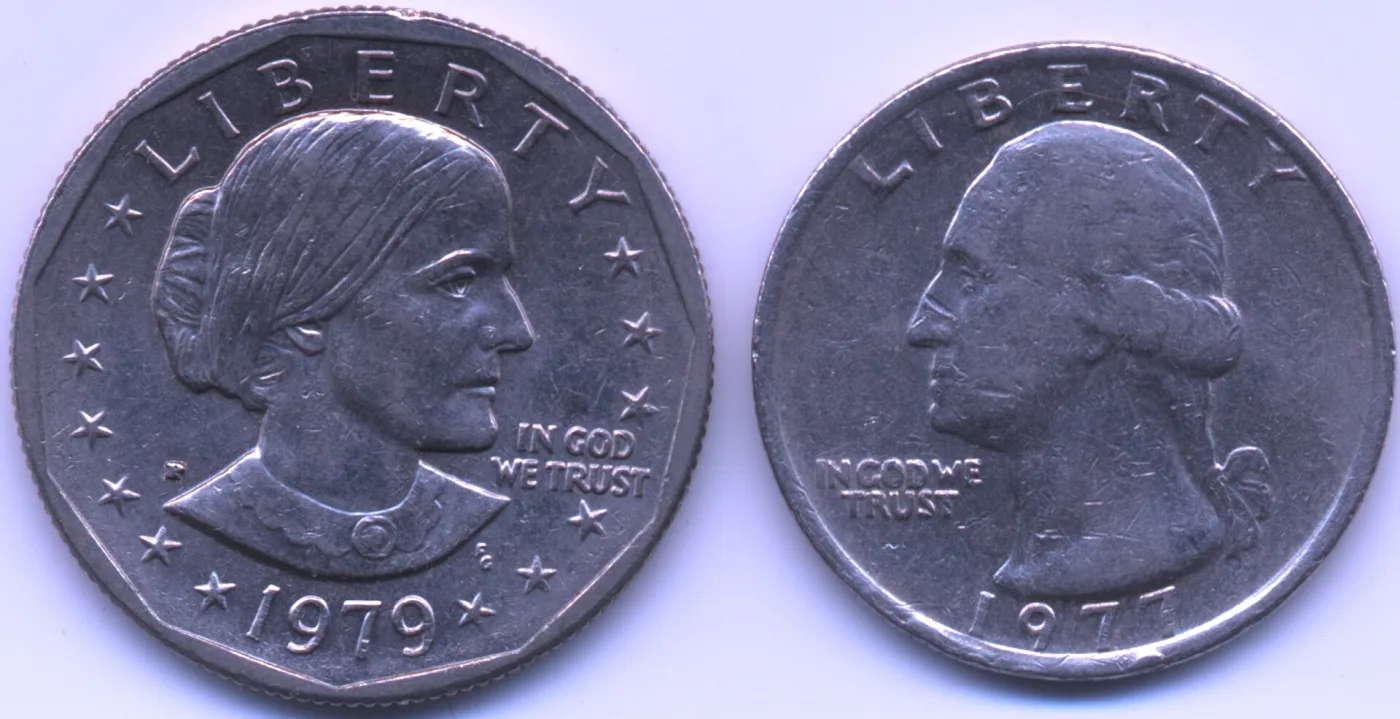
The Susan B. Anthony Dollar — the small clad dollar struck in 1979, 1980, 1981, and again in 1999 — is one of the most maligned and misunderstood coins in modern US history. Often dismissed as the “failed dollar” or confused with a Washington Quarter at the cash register, the SBA is nonetheless one of the most historically significant US coins: the first circulating US coin to depict a real, named woman, and the immediate ancestor of every dollar coin that followed, including the Sacagawea and Presidential series. Its short, troubled production run produced surprisingly few coins relative to demand, and several issues — the 1979-P Wide Rim, the 1979-S and 1981-S Type 2 proofs, and the entire 1981 business strike run — carry real numismatic value today.
This guide walks through every aspect of identifying, attributing, grading, and valuing Susan B. Anthony Dollars. You’ll learn how to distinguish the famous Wide Rim from the Narrow Rim, the Type 1 from the Type 2 proof mint marks, why 1981 SBAs are scarcer than they look, how the 1999 revival fits into the series, and how to authenticate problem coins and avoid common pitfalls.
Whether you’ve pulled an SBA from a roll, inherited a Mint set, or are assembling a complete date-and-variety run, this guide provides the working knowledge needed to identify any Susan B. Anthony Dollar with confidence — and to spot the few sleepers in this often-overlooked series.
History: Why the Dollar Got Small
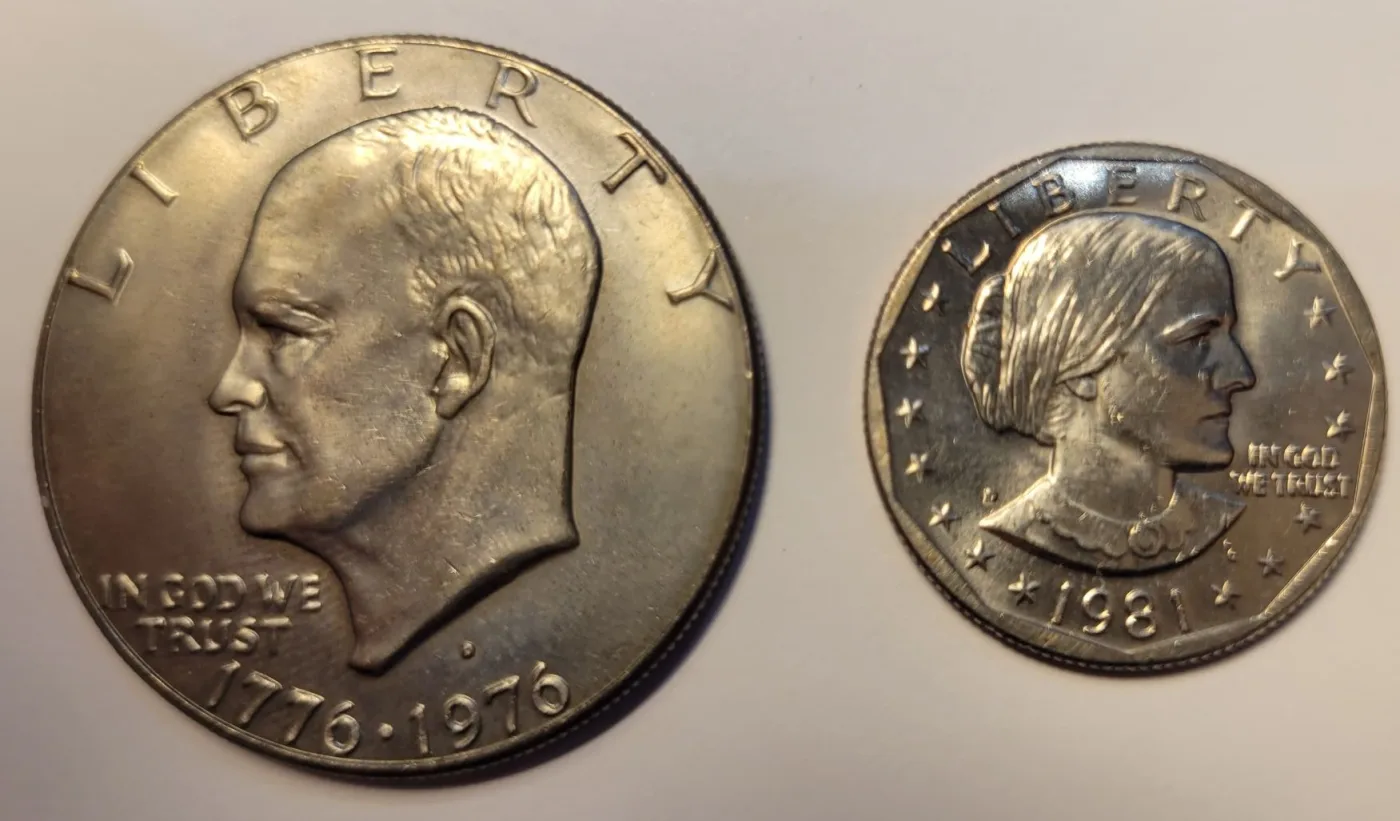
By the early 1970s, the US Mint had a problem. The Eisenhower Dollar, introduced in 1971, was a massive 38.1 mm coin weighing 22.68 grams — too large and too heavy for daily commerce. Vending machine operators, casinos, and mass-transit authorities all complained that the Ike was impractical. Yet a dollar coin remained desirable to the Treasury: paper dollars wear out in about 18 months, while a coin can last 30 years, and the long-term savings to taxpayers run into hundreds of millions.
In 1976, the Research Triangle Institute completed a major study for the Treasury that recommended a smaller, lighter dollar coin. The Mint developed a coin slightly larger than a quarter — 26.5 mm in diameter, with a distinctive 11-sided (hendecagonal) inner border to help vending machines and the visually impaired distinguish it from the quarter. The result was authorized by the Susan B. Anthony Dollar Coin Act of 1978 and entered circulation on July 2, 1979.
Choosing Susan B. Anthony
The original Mint proposals featured an allegorical Liberty figure, but Treasury Secretary W. Michael Blumenthal and members of Congress — notably Representative Mary Rose Oakar of Ohio — pushed for a real woman, citing the upcoming centennial of women’s suffrage. Susan Brownell Anthony (1820-1906), the Quaker abolitionist and suffragist, was selected over Eleanor Roosevelt, Abigail Adams, and several other candidates. The SBA was the first US circulating coin to depict a real, named woman; previous “Liberty” portraits had been allegorical (the Walking Liberty, the Mercury Dime’s Winged Liberty) or, in the case of the Sacagawea Dollar, would come twenty years later.
Production History
The Mint struck SBAs heavily in 1979 — over 750 million pieces from Philadelphia, Denver, and San Francisco combined — anticipating widespread circulation. When the coin failed to catch on, production dropped sharply in 1980 and was largely halted after 1981. Most 1980 and especially 1981 SBAs went directly into Treasury vaults, where they sat for years. In 1999, when Sacagawea Dollar production was delayed, the Treasury briefly resumed SBA production to meet vending and transit demand, striking 41 million more before retiring the design permanently. The total mintage across all dates is roughly 920 million coins.
Design: Susan B. Anthony and Apollo 11
Both the obverse and reverse were designed by Frank Gasparro, the Mint’s Chief Engraver from 1965 to 1981 and the designer of the Lincoln Memorial Cent reverse and the reverse of the Kennedy Half Dollar.
Obverse (Heads Side)
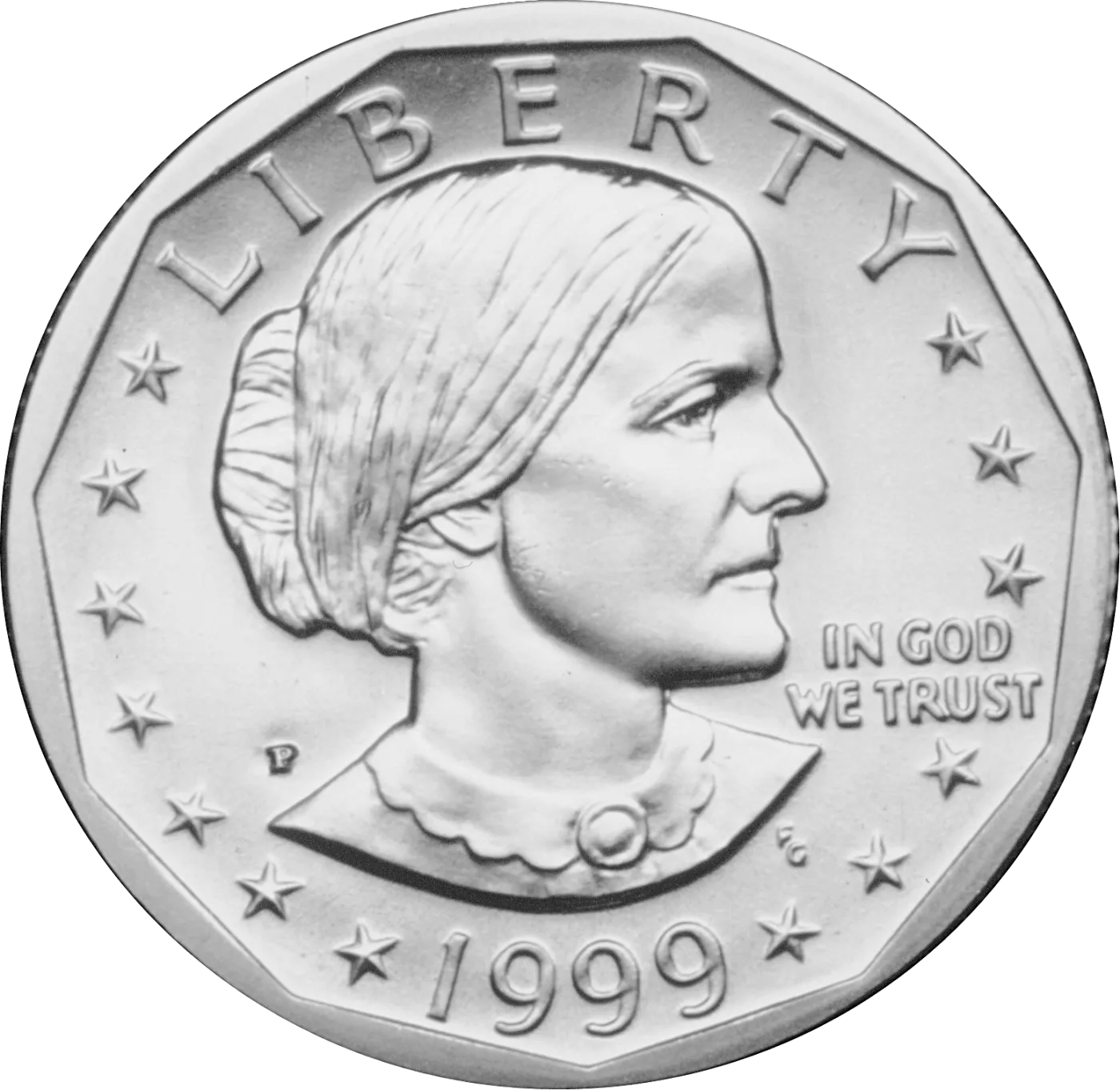
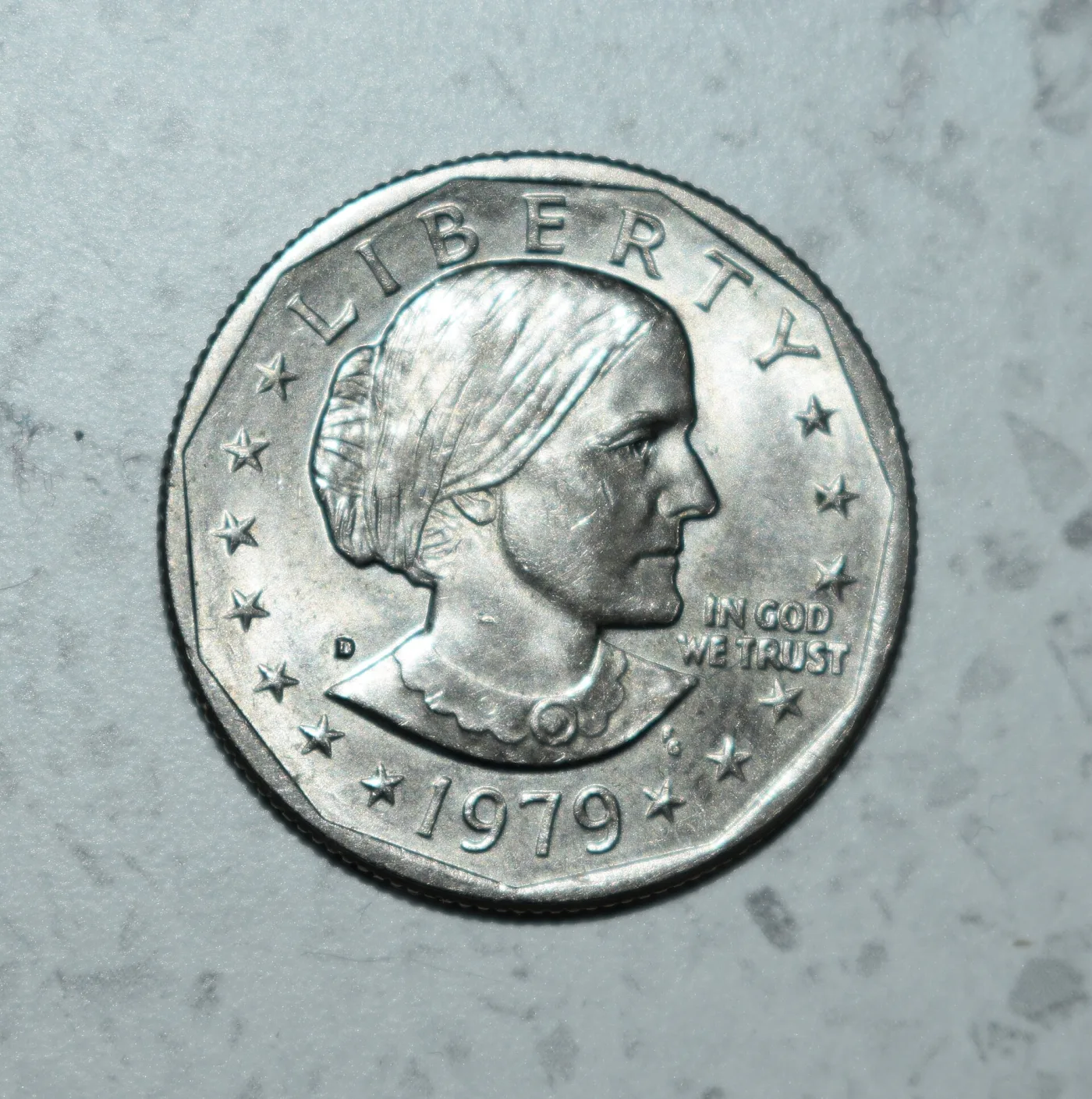
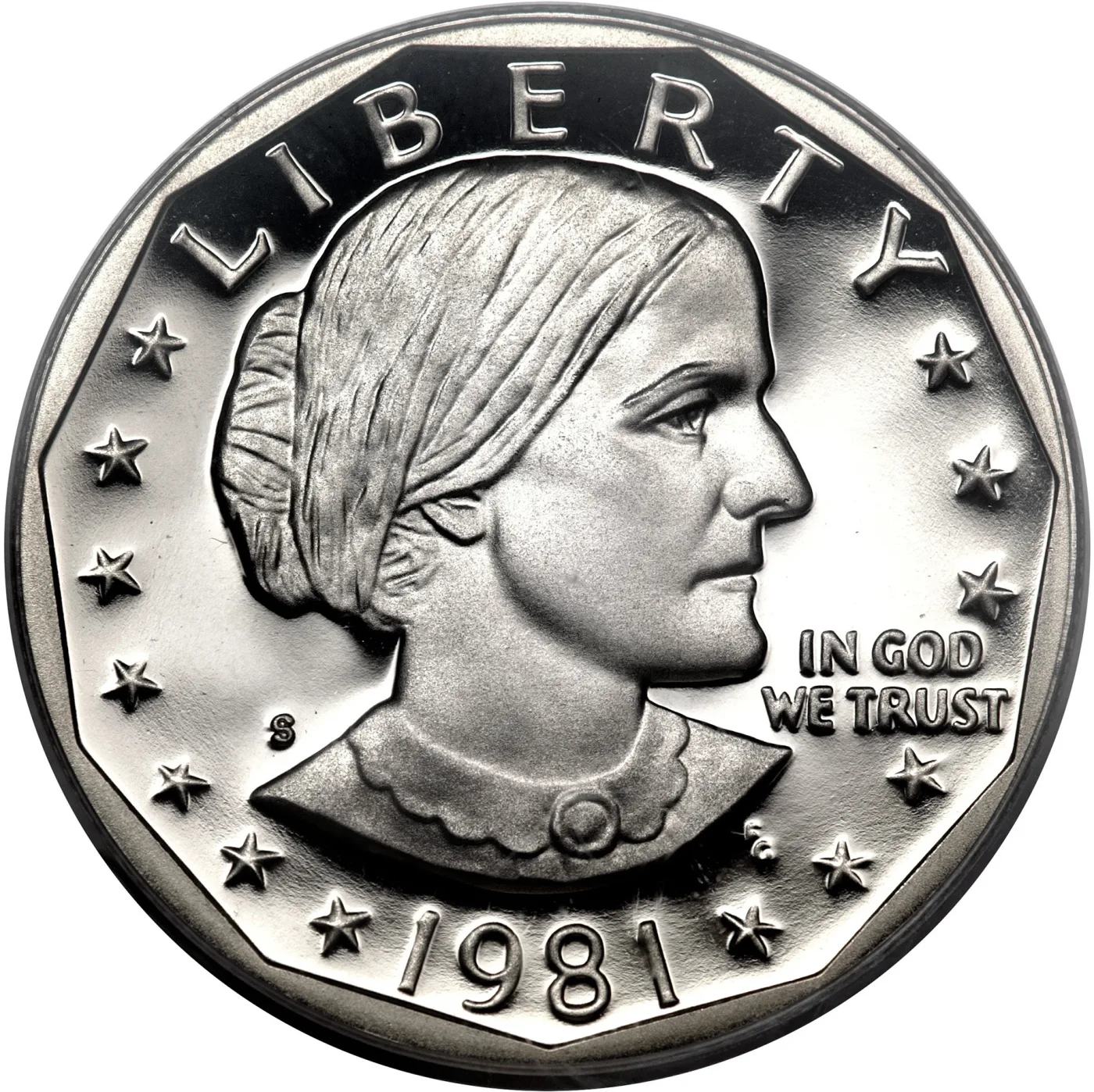
Susan B. Anthony is shown in profile facing right, wearing her characteristic high collar and hair gathered in a tight bun at the nape of her neck. The portrait is based on photographs from her late middle age. The legend LIBERTY arches above and the date appears below. The motto IN GOD WE TRUST appears in the right field, in front of her face — the left field is where the mint mark goes. Thirteen six-pointed stars surround the portrait — seven to the left and six to the right — and an 11-sided (hendecagonal) inner border encloses the portrait. The mint mark (P, D, S, or none on early 1979-P) sits in the field to the left of Anthony’s shoulder.
Reverse (Tails Side)
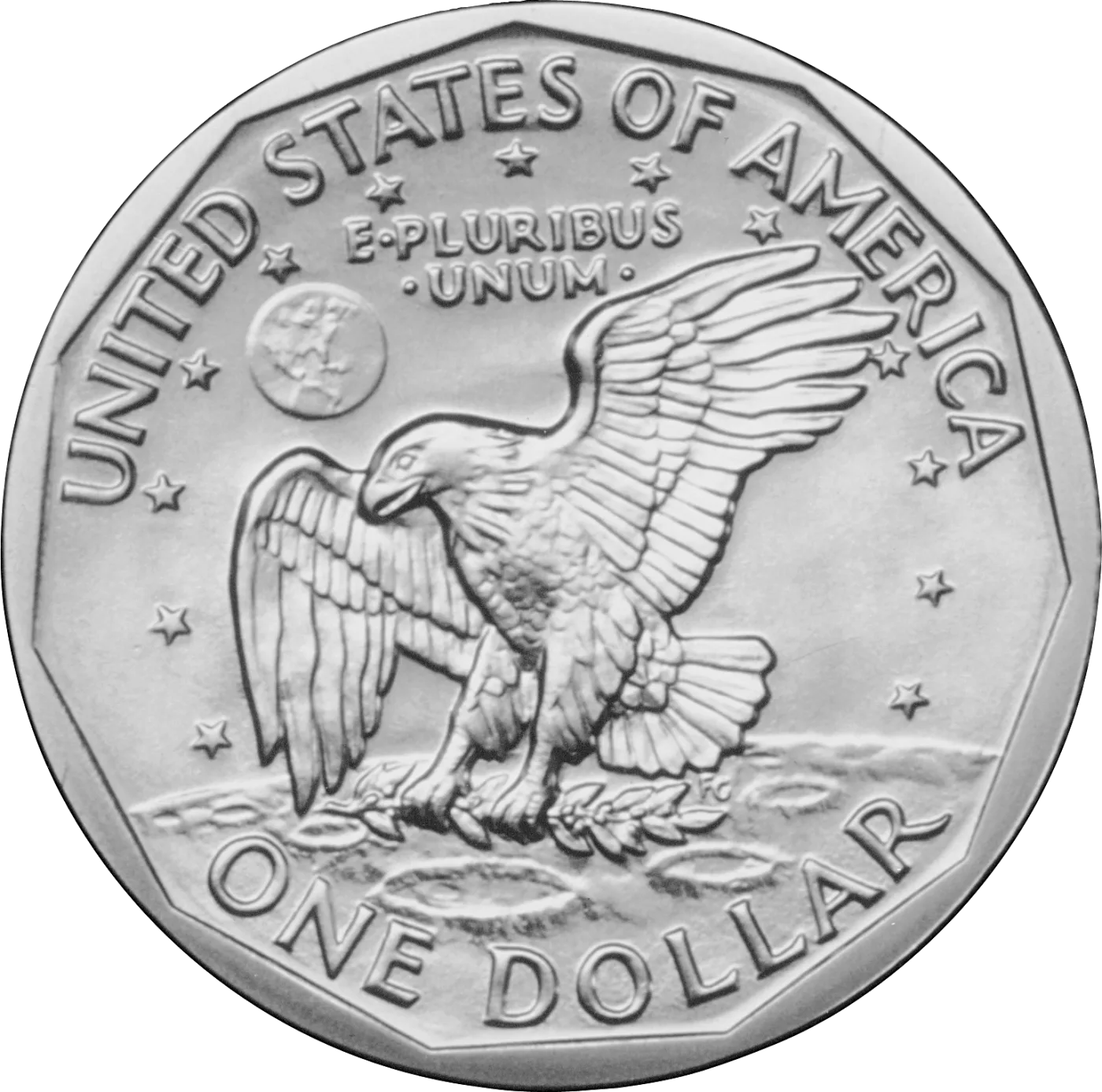
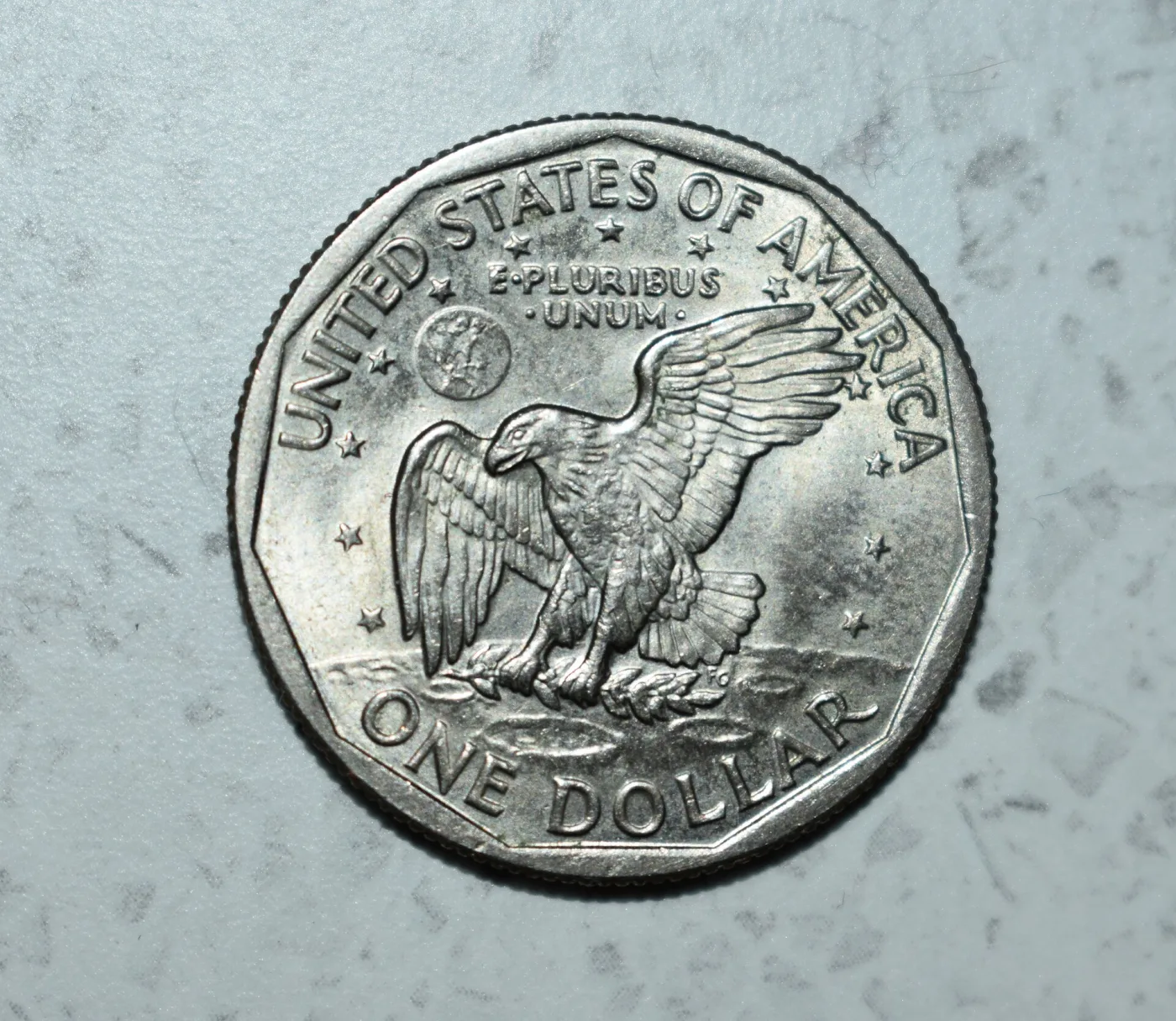
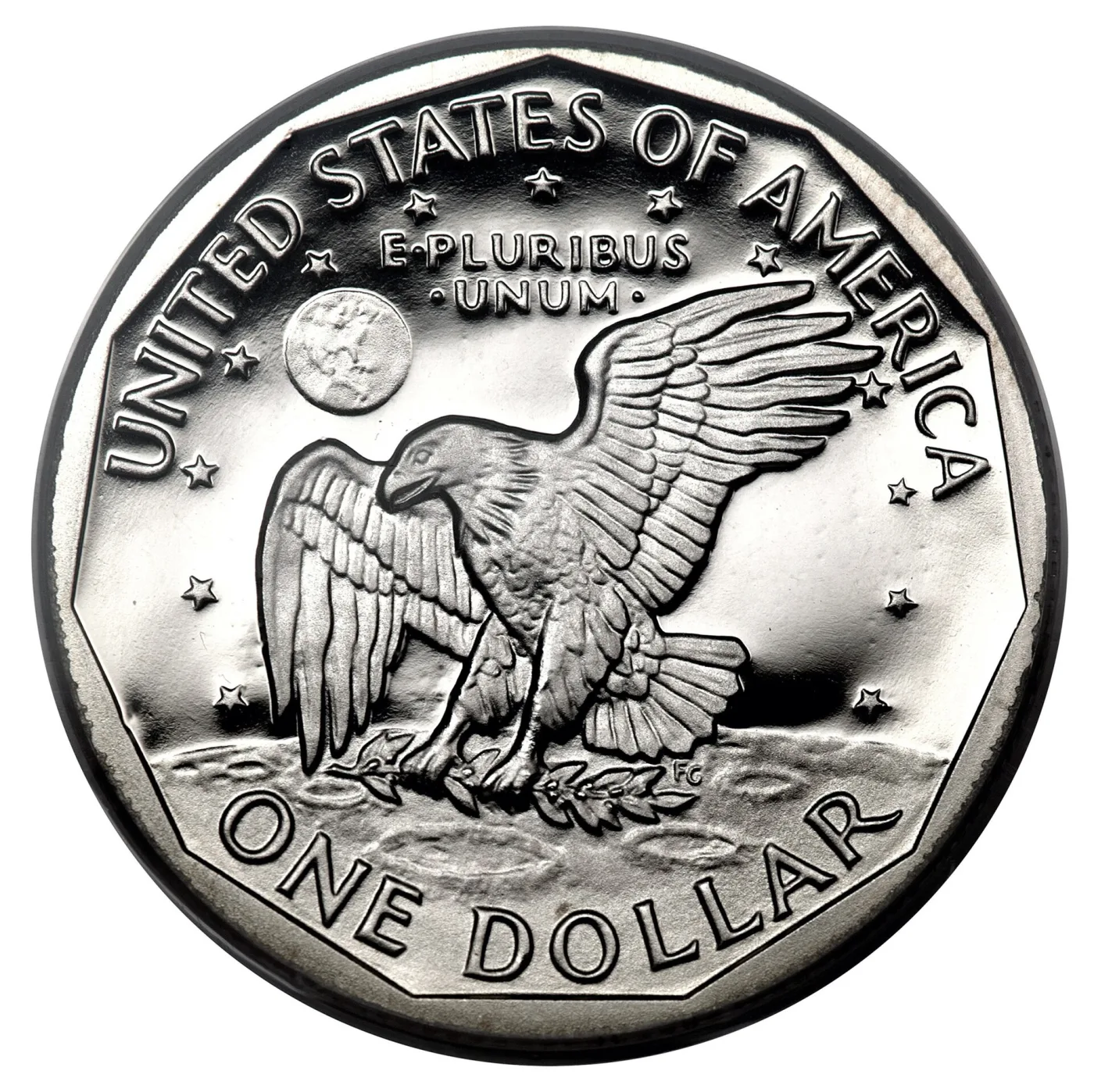
The reverse reproduces the Apollo 11 mission insignia: an American bald eagle in flight clutching an olive branch, descending toward the surface of the Moon. The Earth appears in the upper-left background. Thirteen stars represent the original colonies, with the legends UNITED STATES OF AMERICA arching above and ONE DOLLAR below. The motto E PLURIBUS UNUM appears in the upper field. An 11-sided inner border mirrors the obverse. This is the same eagle Gasparro originally designed for the Eisenhower Dollar reverse — the design was deliberately reused to honor the Apollo 11 mission a second time.
Edge
The SBA has a reeded edge — 133 reeds — identical in appearance to the Washington Quarter’s edge. This proved to be one of the coin’s biggest practical problems: combined with the similar size (26.5 mm vs the quarter’s 24.3 mm) and silver-clad color, the SBA was constantly mistaken for a quarter despite the 11-sided inner border.
The 11-Sided Border
The hendecagonal (11-sided) inner border appears on both the obverse and reverse. It was intended to be the SBA’s distinguishing tactile feature — visible by sight and detectable by touch — but the border is incused within the round outer rim, not on the edge itself, so it provided little practical differentiation. Subsequent dollar coin designs (Sacagawea, Presidential) abandoned the 11-sided border and instead changed the alloy color to gold-toned manganese brass.
Composition and Specifications
- Composition: Copper-nickel clad — outer layers of 75% copper and 25% nickel bonded to a pure copper core.
- Diameter: 26.5 mm.
- Thickness: 2.00 mm.
- Weight: 8.1 grams.
- Edge: Reeded (133 reeds).
- Inner border: 11-sided (hendecagonal) on both obverse and reverse.
No Silver SBAs Were Issued for Circulation
Unlike the Eisenhower Dollar, which had 40% silver collector versions struck at San Francisco, no silver Susan B. Anthony Dollars were ever produced. Every SBA — business strike or proof — is the standard copper-nickel clad alloy. Sellers offering “silver Susan B. Anthony Dollars” are either misrepresenting silver-plated regular coins, fantasy pieces, or pure fraud.
Specifications vs the Washington Quarter
The SBA’s similarity to the Washington Quarter caused most of its circulation problems. Compare: SBA 26.5 mm, 8.1 g, reeded edge, silver-clad; Quarter 24.3 mm, 5.67 g, reeded edge, silver-clad. The two-millimeter diameter difference is barely perceptible in a stack of coins at a cash register or in a vending machine.
Mint Marks and Production
Susan B. Anthony Dollars were struck at three mints. Mint mark identification is essential for both attribution and value.
Mint Mark Locations
- Philadelphia (P): The 1979-P initially carried no mint mark, following pre-1980 Philadelphia convention. Starting with 1979 dies prepared late in the year, a P was added to the field to the left of Anthony’s shoulder. Coins from 1980, 1981, and 1999 carry the P. Philadelphia was the first US Mint facility to use the P mint mark on coinage smaller than a dollar, beginning with the SBA in 1979 — a milestone in mint mark policy.
- Denver (D): Mark to the left of Anthony’s shoulder on every Denver issue.
- San Francisco (S): Both proof and business strikes carry the S. S-mint business strikes exist only for 1979 and 1980. All 1981-S and 1999-S issues are proofs only.
Year-by-Year Mintages
- 1979-P: 360,222,000 — the heaviest single mintage of the series.
- 1979-D: 288,015,744.
- 1979-S: 109,576,000 business strikes plus 3,677,175 proofs.
- 1980-P: 27,610,000 — sharp drop as failure was recognized.
- 1980-D: 41,628,708.
- 1980-S: 20,422,000 business strikes plus 3,554,806 proofs.
- 1981-P: 3,000,000 — Mint set only.
- 1981-D: 3,250,000 — Mint set only.
- 1981-S: 3,492,000 Mint set business strikes plus 4,063,083 proofs.
- 1999-P: 29,592,000.
- 1999-D: 11,776,000.
- 1999-P proof: 750,000.
Why 1981 SBAs Were Mint-Set Only
By 1981, the Treasury had recognized circulation failure but was required to use 1981-dated dies for at least three million coins per Mint set issued. The 1981 P, D, and S business strikes were therefore produced solely for that year’s annual Uncirculated Mint Set — none were released into circulation through normal channels. As a result, 1981 SBAs are scarcer than their roughly three-million mintage suggests: surviving coins exist almost entirely in their original Mint set packaging or as recently broken-out singles.
The 1979-P Wide Rim vs Narrow Rim
The single most important variety in the SBA series is the 1979-P Wide Rim — sometimes called the “Near Date” — which can be worth dozens of times more than a common 1979-P.
The Two Varieties Explained
Early 1979-P dies were produced with the date set well clear of the rim, leaving a wide gap between the bottom of the date and the edge of the coin. This is the Narrow Rim or “Far Date” — by far the more common variety, accounting for the vast majority of the 360 million 1979-P mintage. Sometime in 1979 the Mint adjusted the master die so the date sits much closer to the rim, and the rim itself appears thicker and wider. This is the Wide Rim or “Near Date.”
How to Identify a Wide Rim
- Examine the date: On a Wide Rim, the date sits noticeably close to the rim — the gap is about half the height of the digits. On a Narrow Rim, the date is well clear of the rim with a gap roughly equal to the height of the digits.
- Look at the rim itself: The Wide Rim has a visibly thicker, more pronounced raised rim around the obverse. Side-by-side comparison makes this obvious.
- Cross-reference both: Both features must be present. A coin with a close date but normal rim, or vice versa, is not a Wide Rim — it’s likely a die variety or rotation.
Value
Common 1979-P Narrow Rim coins are worth face value to about $2 in MS-65. The 1979-P Wide Rim is worth $25-$50 in circulated grades, $75-$150 in MS-63, $200-$400 in MS-65, and $500-$1,000+ in MS-66 and higher. PCGS and NGC both attribute the variety on their holders. The Wide Rim is the single SBA every collector should check for in any 1979-P they encounter.
Is There a 1979-D or 1979-S Wide Rim?
No. The Wide Rim variety exists only on 1979-P coins. The Denver and San Francisco mints used dies of the Narrow Rim style throughout 1979 production. Sellers offering “1979-D Wide Rim” or “1979-S Wide Rim” coins are mistaken.
Type 1 and Type 2 Mint Marks (1979-S and 1981-S)
The second major variety category in the SBA series concerns the appearance of the S mint mark on San Francisco proofs of 1979 and 1981. These varieties are crucial for proof collectors and can produce dramatic value differences.
1979-S Type 1 vs Type 2 (Proof Only)
- Type 1 (“Filled S” or “Blob S”): The early 1979-S proof S is blurry, filled-in, and roughly blob-shaped, resulting from worn or improperly prepared mint mark punches carried over from earlier proof coinage. This is the more common Type. Roughly 90% of 1979-S proofs are Type 1.
- Type 2 (“Clear S”): Later in 1979, the Mint introduced fresh S punches producing a clean, well-defined S with open loops and clear serifs. About 10% of 1979-S proofs are Type 2.
1981-S Type 1 vs Type 2 (Proof Only)
The pattern repeats in 1981: early proofs use the worn “Filled S” (Type 1) and later proofs use the cleaner “Clear S” (Type 2). The 1981-S Type 2 is rarer than its 1979 counterpart — only about 600,000 are estimated, roughly 15% of the proof mintage.
Identification Pointers
Type 1 S looks like a smudged figure-8 or a blob — the curves of the S are filled, the serifs are lost, and the overall outline is rounded and indistinct. Type 2 S has open curves, sharp serifs, and clean transitions; it looks like a typeset capital S. Compare side by side under 5× magnification. Note that the Type 2 distinction applies only to S mint marks; P and D mint marks did not undergo equivalent punch changes.
Values
- 1979-S Type 1: $8-$15 in PR-69.
- 1979-S Type 2: $75-$120 in PR-69 DCAM; $300-$500 in PR-70 DCAM.
- 1981-S Type 1: $10-$20 in PR-69.
- 1981-S Type 2: $200-$400 in PR-69 DCAM; $800-$1,500 in PR-70 DCAM.
Always demand professional certification (PCGS, NGC, or ANACS) with the Type designation on the holder. Self-attributed coins lose most of their premium in the secondary market.
The 1981 Proof-Only Issues
Although the entire 1981 SBA series is technically “non-circulating” (Mint set only), the year carries several layers of scarcity worth understanding.
The Three 1981 Business Strikes
1981-P, 1981-D, and 1981-S business strikes were produced solely for inclusion in the 1981 US Mint Annual Uncirculated Coin Set. Mintages of roughly 3 million per mint reflect the number of sets sold that year, not the number of coins released into circulation. Original sets sold for $11 in 1981; today an original sealed 1981 Mint set retails for $20-$35, with the individual SBAs broken out at $5-$15 each in MS-65 to MS-66.
Why 1981 SBAs Are Undervalued
Modern collectors often overlook 1981 SBAs because the headline mintage looks “modern.” But the coin never entered circulation, never reached most cash registers, and exists in fewer hands than the much larger 1979 and 1980 issues. Well-struck 1981 examples in MS-66 and finer routinely realize $30-$80 — multiples of comparable 1979 issues.
The 1981 Mint Set Pricing Strategy
Buying the original 1981 US Mint Set (sealed government packaging, blue envelope) often costs less than buying the individual broken-out coins certified, especially for the P and D issues. Many advanced collectors prefer to acquire 1981 SBAs in original Mint set packaging precisely for this reason.

The 1999 Revival
After eighteen years of dormancy, the Susan B. Anthony Dollar was briefly revived in 1999 — an unusual second life that produced a small but important final chapter in the series.
Why 1999?
The Treasury had been planning the Sacagawea Dollar’s 2000 introduction since 1997. But the Federal Reserve’s existing SBA reserves were running low after years of supplying vending machines, transit authorities, and the US Postal Service, and Sacagawea production would not begin in time to meet demand. To bridge the gap, Congress authorized one final SBA production year in 1999. The Treasury struck 29.6 million at Philadelphia and 11.8 million at Denver, plus 750,000 proofs at Philadelphia (not San Francisco — a unique departure for SBA proof production).
How to Identify 1999 SBAs
The 1999 issues use the same design as 1979-1981, but several diagnostic features distinguish them:
- Date: 1999 obviously.
- Strike quality: 1999 SBAs are noticeably sharper than 1979-1981 issues. Modern die-preparation technology produced bolder details on Anthony’s hair and the eagle’s feathers.
- 1999-P proof: The only SBA proof struck at Philadelphia. All other proofs in the series come from San Francisco.
Values
- 1999-P: $3-$8 in MS-65; $25-$50 in MS-67.
- 1999-D: $4-$10 in MS-65; $35-$70 in MS-67.
- 1999-P Proof: $15-$30 in PR-69 DCAM; $75-$150 in PR-70 DCAM.
Key Dates and Varieties
Although the SBA series is short — just four dates of issue — several key dates and varieties command real premiums.
Top Variety Issues
- 1979-P Wide Rim: $25-$1,000+ by grade. The single most important SBA variety.
- 1981-S Type 2 Proof: $200-$1,500 by grade. The series’ rarest proof.
- 1979-S Type 2 Proof: $75-$500 by grade.
- 1981-S Type 1 Proof: $10-$50 by grade.
Best Conventional Dates
- 1981-P, 1981-D: Mint set only — $5-$80 by grade.
- 1981-S Business Strike (Mint set): $8-$40 by grade.
- 1999-D: Lowest 1999 mintage — $4-$70 by grade.
- 1980-S Business Strike: $2-$15 by grade.
Cherry-Picking the Wide Rim
The 1979-P Wide Rim is the single best cherry-pick opportunity in modern US numismatics. Rolls of 1979-P SBAs still surface in bank-wrapped form, and Wide Rim coins remain unattributed in many. Examining every 1979-P you encounter — looking specifically at date-to-rim spacing — can produce a $50-$200 coin from face-value sources. Similar opportunity exists for the proof Type 2 varieties when buying raw 1979-S and 1981-S proofs at flea markets or estate sales.
Errors and Die Varieties
The SBA series produced a number of minor errors, though no spectacular variety of the magnitude of the 1955 Doubled Die Lincoln Cent or the 1942/1 Mercury Dime.
Wrong Planchet Errors
A small number of SBAs were struck on Susan B. Anthony Dollar planchets that had first been struck as Washington Quarters or vice versa. These “wrong planchet” or “double-denomination” errors are rare and valuable — typically $500-$3,000 depending on the specifics.
Off-Center Strikes
Off-center SBAs exist in small numbers, typically from 10% to 50% off-center. Values: $50-$300 depending on the percentage off-center and whether the date is visible.
Doubled Die Obverse
Minor doubled-die varieties exist for both 1979-P and 1979-D, visible primarily in the lettering of LIBERTY and IN GOD WE TRUST. None are major doubled dies on the order of the famous 1955 Lincoln. Values: $20-$75 by grade.
Clipped Planchets and Broadstrikes
Curved clips (where the planchet was cut overlapping a previous strike’s hole) and broadstrikes (where the collar failed and the planchet expanded) both exist in modest numbers. Values: $30-$150.
Mule Errors
No SBA mules are known. The only famous modern dollar mule is the 2000-P Sacagawea / Washington Quarter mule discussed in our Sacagawea Dollar guide.
Grading Susan B. Anthony Dollars
Like all modern clad coins, SBAs are graded on the Sheldon scale (1-70). Most survivors fall in the MS-60 to MS-65 range; truly gem (MS-66+) coins are scarcer than mintage figures suggest because bag handling at the Mint was rough on the soft copper-nickel surfaces.
Key Grade Points
- MS-60 to MS-62: Uncirculated but with abundant bag marks, contact marks, especially on Anthony’s cheek and on the eagle’s body. Most 1979 and 1980 business strikes fall here.
- MS-63 to MS-64: Reduced contact marks, still some on high points. Typical Mint set quality.
- MS-65: The gem threshold. Few contact marks, full luster. Premium for most dates.
- MS-66 to MS-67: Genuinely scarce. Strong premium for all dates, particularly 1980 and 1981 issues.
- MS-68: Rare for any business strike. Premium of 10-50× MS-65.
- PR-69 DCAM: The expected grade for any modern proof.
- PR-70 DCAM: Genuine perfection. Critical for 1979-S Type 2 and especially 1981-S Type 2 values.
The Anthony Cheek Problem
Susan B. Anthony’s cheek is large, flat, and prominent — and it is the first place contact marks show. A single notable mark on the cheek can drop an MS-66 candidate to MS-64. Examine the cheek carefully under angled light when grading or buying.
Strike Quality
Well-struck SBAs show full detail in Anthony’s hair (particularly the strands above the temple), full feathers on the eagle’s body, and full lunar craters on the moon’s surface. The 1981-P and 1981-D Mint set issues are often the best-struck of the series. The 1999 issues benefit from modern die preparation and rival 1981 for strike quality.
Authentication and Spotting Fakes
SBAs are low-value enough that counterfeiting is rare, but several altered-coin and misrepresentation scenarios are worth knowing.
Altered Mint Marks
The most common alteration: a 1979-P with the P added or removed to create a “no mint mark 1979” or to fake the no-mint 1979-P transition variety. Genuine no-mint 1979-P coins exist from very early in the year before the P punch was implemented; they are not separately valued as a variety. An altered coin shows tooling marks under magnification.
Polished Wide Rim Imitations
Some sellers polish a Narrow Rim’s outer rim to make it appear thicker, then advertise it as a Wide Rim. The result is unnatural — a Wide Rim has crisp, struck-up rim metal, while a polished Narrow Rim has tool marks and uneven surface. Always require professional attribution for high-grade Wide Rim purchases.
Fake Type 2 Proofs
Type 1 proofs are sometimes touched up or photographed deceptively to imply Type 2 sharpness. Demand a PCGS or NGC slab with “Type 2” notation. Raw “Type 2” proofs from non-experts are usually misattributions.
Plated “Silver” SBAs
Genuine SBAs are copper-nickel clad — never silver. “Silver Susan B. Anthony Dollars” advertised on auction sites are silver-plated regular coins, plated post-Mint. The weight test confirms it: a real SBA is 8.10 g; a plated coin retains that weight; a fantasy “solid silver” SBA would weigh about 9.0 g and is essentially nonexistent because no such coin was ever struck.
The Magnet Test
Copper-nickel SBAs are non-magnetic. A magnetic coin claiming to be an SBA is a fake.
Why the SBA Failed to Circulate
The Susan B. Anthony Dollar’s failure to enter widespread circulation has become a numismatic case study. Several factors combined to doom the coin:
Quarter Confusion
The single biggest problem: at 26.5 mm diameter, reeded edge, and silver-clad color, the SBA was visually almost indistinguishable from a Washington Quarter in a cash drawer or in change. Cashiers regularly handed SBAs as quarters and lost three-quarters of a dollar per error. The 11-sided inner border that was supposed to differentiate the coin was not visible at typical handling distance. The same dimensional similarity confused vending machines initially calibrated for quarters.
The Persistent Dollar Bill
As long as the dollar bill remains legal tender — as it has continuously since 1862 — Americans prefer paper for everyday transactions. The Treasury has periodically proposed retiring the bill to force coin adoption, but has never followed through. Without retirement of the bill, no dollar coin has ever circulated successfully in the modern US — not the Eisenhower, not the SBA, not the Sacagawea, not the Presidential Dollars.
Treasury Vault Hoarding
By 1981, hundreds of millions of SBAs sat unused in Federal Reserve and Treasury vaults. Banks stopped ordering them because customers refused to accept them. The vending and transit industries that had requested a small dollar coin in the first place provided steady but modest demand, but it was nowhere near enough to absorb 1979-1980 production levels.
The Sacagawea Solution (Partly)
The Sacagawea Dollar’s golden manganese-brass alloy in 2000 was specifically designed to solve the quarter-confusion problem. It worked: cashiers can instantly distinguish a Sacagawea from a quarter by color. But the Sacagawea still failed to circulate, for the simple reason that the dollar bill remained in production. The lesson the SBA taught — that color, not size, is the critical differentiator — was learned. The lesson it could not teach was that no dollar coin will circulate while the dollar bill exists.
Current Market Values and Price Guide
These are approximate 2026 retail values for problem-free certified coins. Raw coins typically trade at 60-75% of these prices.
Business Strikes (Circulation Issues)
- 1979-P Narrow Rim: Face to $2 in MS-65; $10-$25 in MS-67.
- 1979-P Wide Rim: $25-$50 circulated; $200-$400 in MS-65; $500-$1,000+ in MS-66.
- 1979-D: Face to $2 in MS-65; $10-$30 in MS-67.
- 1979-S Business: $1-$5 in MS-65; $20-$50 in MS-67.
- 1980-P: $1-$3 in MS-65; $25-$60 in MS-67.
- 1980-D: $1-$3 in MS-65; $25-$60 in MS-67.
- 1980-S Business: $2-$8 in MS-65; $30-$75 in MS-67.
- 1981-P (Mint set): $5-$15 in MS-65; $30-$80 in MS-67.
- 1981-D (Mint set): $5-$15 in MS-65; $35-$90 in MS-67.
- 1981-S Business (Mint set): $8-$25 in MS-65; $40-$100 in MS-67.
- 1999-P: $3-$8 in MS-65; $25-$50 in MS-67.
- 1999-D: $4-$10 in MS-65; $35-$70 in MS-67.
Proof Issues
- 1979-S Type 1: $5-$15 in PR-69 DCAM.
- 1979-S Type 2: $75-$120 in PR-69 DCAM; $300-$500 in PR-70 DCAM.
- 1980-S Proof: $5-$15 in PR-69 DCAM.
- 1981-S Type 1: $10-$20 in PR-69 DCAM.
- 1981-S Type 2: $200-$400 in PR-69 DCAM; $800-$1,500 in PR-70 DCAM.
- 1999-P Proof: $15-$30 in PR-69 DCAM; $75-$150 in PR-70 DCAM.
Bullion Floor
None. The coin contains no precious metal. Numismatic value is everything.
Building a Susan B. Anthony Dollar Collection
The SBA series is one of the most affordable and approachable modern US sets — a complete date and mint mark collection runs just 11 coins (1979-P, 1979-D, 1979-S, 1980-P, 1980-D, 1980-S, 1981-P, 1981-D, 1981-S, 1999-P, 1999-D), plus four S proofs and the 1999-P proof for a 16-coin set including proofs.
Approach Strategies
- Type Set: One representative SBA. Costs face value.
- Date and Mint Set (business strikes): 11 coins. Can be assembled in MS-65 for under $100.
- Date, Mint, and Proof Set: Adds 5 proofs. Total cost in PR-69 DCAM: $50-$120.
- Variety Set: Adds 1979-P Wide Rim, 1979-S Type 2, 1981-S Type 2. Total cost in mid-grade: $400-$1,500.
- Top-Grade Registry Set: All issues in MS-67 and PR-70 DCAM. $3,000-$8,000.
Where to Buy
SBAs are widely available from Heritage, Stack’s Bowers, GreatCollections, eBay, and at most coin shows. Original 1981 US Mint Sets remain the cheapest path to high-grade 1981 SBAs. For high-grade Wide Rim coins and Type 2 proofs, stick to PCGS or NGC slabs with the variety designation.
Set Registry Participation
Both PCGS and NGC operate set registries for SBA Dollar collectors. The registries are smaller and less competitive than Morgan or Walking Liberty registries, making top-rank achievement more accessible. Compare with the much-more-expensive Morgan Dollar and Walking Liberty Half Dollar registries.
Storage and Preservation
Copper-nickel clad is reasonably stable but does tarnish, spot, and develop fingerprints. Storage matters for any coin you hope to grade MS-65 or above.
Best Practices
- Sealed inert holders: PCGS, NGC, or Mylar 2x2 flips. Avoid PVC flips, which leach plasticizers and produce green slime over years.
- Low humidity: Below 50% RH. Use silica gel packets and replace them annually.
- Stable temperature: 60-70°F. Avoid attics, basements, and any space with cyclical temperature swings.
- Avoid contact: Never touch the coin’s surface with bare fingers. Hold by the edge or wear cotton gloves. Fingerprints etch into copper-nickel surfaces over months.
- Avoid cleaning: Cleaning destroys numismatic value almost universally. Original surfaces are always preferred, even if toned or spotted.
The Original Mint Set Strategy
For 1981 SBAs particularly, keeping the original US Mint Annual Uncirculated Coin Set in its sealed government packaging is often the best long-term storage strategy. The Mylar inserts are inert and the cardboard outer envelope protects against light. Opening the set starts the patina clock and removes the original Mint provenance.
Frequently Asked Questions
Is my Susan B. Anthony Dollar silver?
No. Every Susan B. Anthony Dollar — business strike or proof — is copper-nickel clad (75% copper / 25% nickel outer layers bonded to a pure copper core). No silver SBAs were ever issued. The coin's silvery color comes from the nickel surface layer.
What is my 1979 SBA worth?
Almost certainly face value if it's a 1979-P Narrow Rim, 1979-D, or 1979-S business strike — combined mintage exceeded 750 million coins. To be worth more, your 1979-P must be a Wide Rim (date close to rim, thicker rim), in which case it's worth $25-$1,000+ depending on grade. Check every 1979-P you encounter.
How do I tell a 1979-P Wide Rim from a Narrow Rim?
Look at the gap between the bottom of the "1979" date and the rim. On a Wide Rim, the date sits close to the rim with a gap roughly half the height of the digits. On a Narrow Rim, the gap is roughly equal to the height of the digits. The Wide Rim also has a visibly thicker raised rim.
Why does my 1981 SBA look uncirculated?
Because it almost certainly is. 1981 SBAs were struck for Mint sets only and never released into circulation through normal banking channels. If you have a circulated 1981 SBA, it most likely came from a broken-up Mint set that someone spent. The original Mint set packaging keeps these coins in pristine condition.
Is the 1999 SBA the same as the original?
Yes — same design by Frank Gasparro, same copper-nickel clad composition, same diameter and weight. The only differences are the date (1999) and the fact that the 1999 proof was struck at Philadelphia rather than San Francisco — a unique departure for SBA proof production.
What's the rarest Susan B. Anthony Dollar?
In terms of mintage, the 1999-P proof at 750,000 pieces is the lowest-mintage SBA. In terms of variety rarity, the 1981-S Type 2 proof is the rarest of the major attributed varieties, with an estimated 600,000 pieces. The 1979-P Wide Rim is far more famous and more sought after but has higher absolute mintage.
Should I clean my SBA?
No. Cleaning removes original mint luster and almost always damages numismatic value. Toned or spotted original surfaces are always preferable to "improved" cleaned surfaces. PCGS and NGC will not certify cleaned coins at full grade.
Why was the SBA replaced with the Sacagawea?
The SBA's failure to circulate was attributed primarily to its visual similarity to the Washington Quarter. The Sacagawea's gold-toned manganese-brass alloy was specifically chosen to solve that problem. However, the dollar bill's continued legal tender status has meant that the Sacagawea has also failed to enter widespread circulation — proving that the SBA's failure was as much about the dollar bill as about the quarter confusion.