Eisenhower Dollar Identification Guide: Key Dates, Bicentennial Varieties, and Values
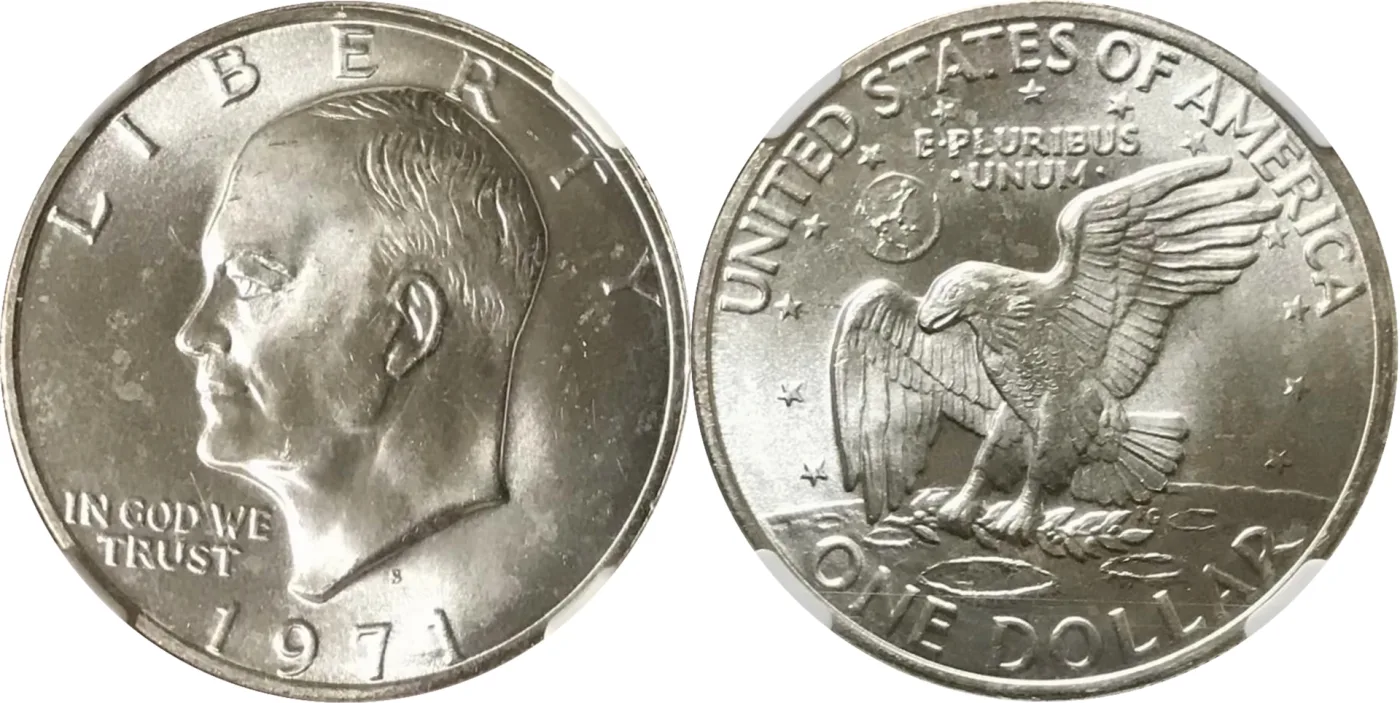
The Eisenhower Dollar — affectionately nicknamed the “Ike” — is the last large-format dollar coin struck for general circulation in United States history. Produced from 1971 through 1978, the series honors the thirty-fourth president and Supreme Allied Commander Dwight D. Eisenhower, with a reverse design celebrating the Apollo 11 lunar landing of 1969. At 38.1 millimeters across and weighing in at 22.68 grams in clad, the Ike Dollar carries the same physical heft as the classic Seated Liberty Dollar, Morgan Silver Dollar, and Peace Dollar that preceded it — a deliberate choice meant to evoke the silver dollars of America’s past.
For collectors, Eisenhower Dollars offer a remarkably affordable entry point into a complete modern series. Most dates can be acquired in pristine condition for under $20, and a complete date-and-mintmark set in circulated grades is achievable for less than the cost of a single key-date Walking Liberty Half Dollar. Yet the series rewards close attention: the 1972 reverse Type varieties (Type 1, Type 2, and Type 3), the FS-901 doubled-die Bicentennial, the 40% silver collector issues, and the Friendly Eagle Variety on early 1971-D coins all create genuine specialist interest at modest premiums.
This guide walks you through everything you need to identify, grade, and value Eisenhower Dollars: the historical context behind the design, the clad and 40% silver compositions, the critical 1972 Type varieties, the 1976 Bicentennial Types, doubled dies and other notable varieties, mint marks across Philadelphia, Denver, and San Francisco, grading standards including the elusive MS-67 grade, authentication tips, current market values, and practical advice for assembling a collection. The same analytical framework used here applies broadly across modern US coinage — many of these coin identification techniques work equally well for the Kennedy Half Dollar and other modern series.
History and Design: Frank Gasparro’s Ike Dollar
The Eisenhower Dollar’s existence reflects two converging forces of the late 1960s: the death of a beloved president and a concerted lobbying effort to revive the dollar coin. Dwight D. Eisenhower passed away on March 28, 1969, and within weeks Congress began discussing a memorial coin. Simultaneously, Nevada gambling interests had been pushing for a new dollar coin to replace the silver dollars they used as casino tokens — supplies of pre-1935 Peace and Morgan Dollars were dwindling, and casinos needed a reliable substitute.
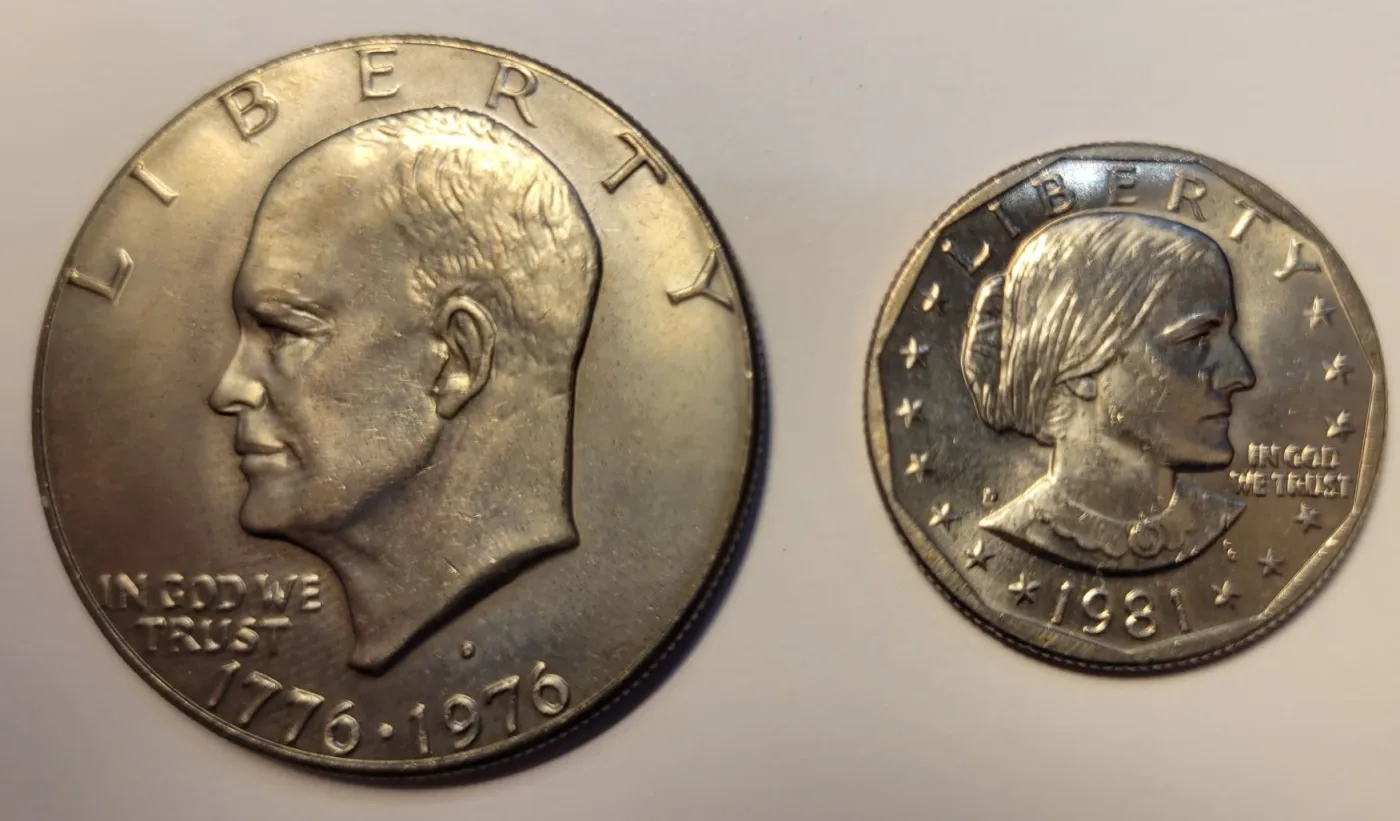
The Coinage Act of December 31, 1970 authorized the Eisenhower Dollar, mandating a copper-nickel clad version for circulation and a 40% silver version for collectors. The act also specified that the reverse should commemorate the Apollo 11 mission, which had landed humans on the moon during Eisenhower’s lifetime — a fitting tribute to a president who had championed the American space program through the founding of NASA in 1958. Production began in 1971 and continued through 1978, ending only when the smaller Susan B. Anthony Dollar took over as the new circulating dollar coin — itself replaced in 2000 by the manganese-brass Sacagawea Dollar. Eisenhower himself returned to the denomination in 2015 as the 34th coin in the Presidential Dollar series.
The Designer: Frank Gasparro
Frank Gasparro served as Chief Engraver of the United States Mint from 1965 to 1981 — a tenure that made him one of the most prolific designers of modern American coinage. He is best known for the reverse of the Lincoln Memorial Cent (used from 1959 through 2008), the obverse of the Kennedy Half Dollar, and the entire Susan B. Anthony Dollar. The Eisenhower Dollar represents one of his finest portrait works, capturing the general-turned-president with the dignity and resolve appropriate to a five-star general and two-term commander in chief.
For the reverse, Gasparro adapted the Apollo 11 mission insignia, which had been designed by astronaut Michael Collins. The original insignia depicted an eagle landing on the lunar surface with an olive branch in its talons — a powerful symbol of peaceful exploration. Gasparro translated this concept into bas-relief, adapting the artwork for the technical demands of striking a large-diameter coin while preserving the iconography that had defined the Apollo program.
Design Details: Obverse and Reverse
Knowing every element of the Eisenhower Dollar design is essential for accurate grading, variety attribution, and identifying the various Type subtypes that distinguish 1972 issues and Bicentennial reverses.
Obverse (Heads Side)
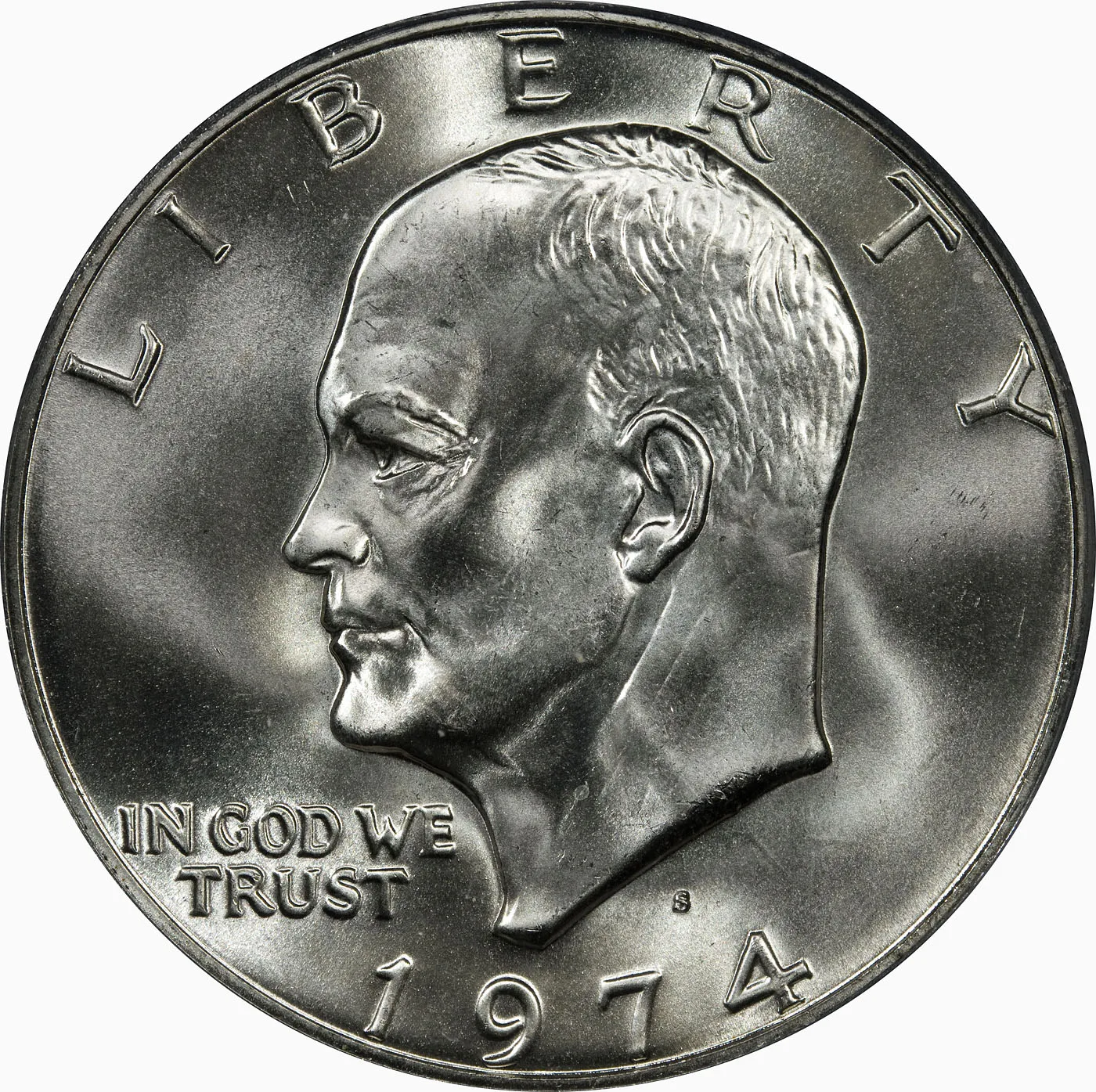
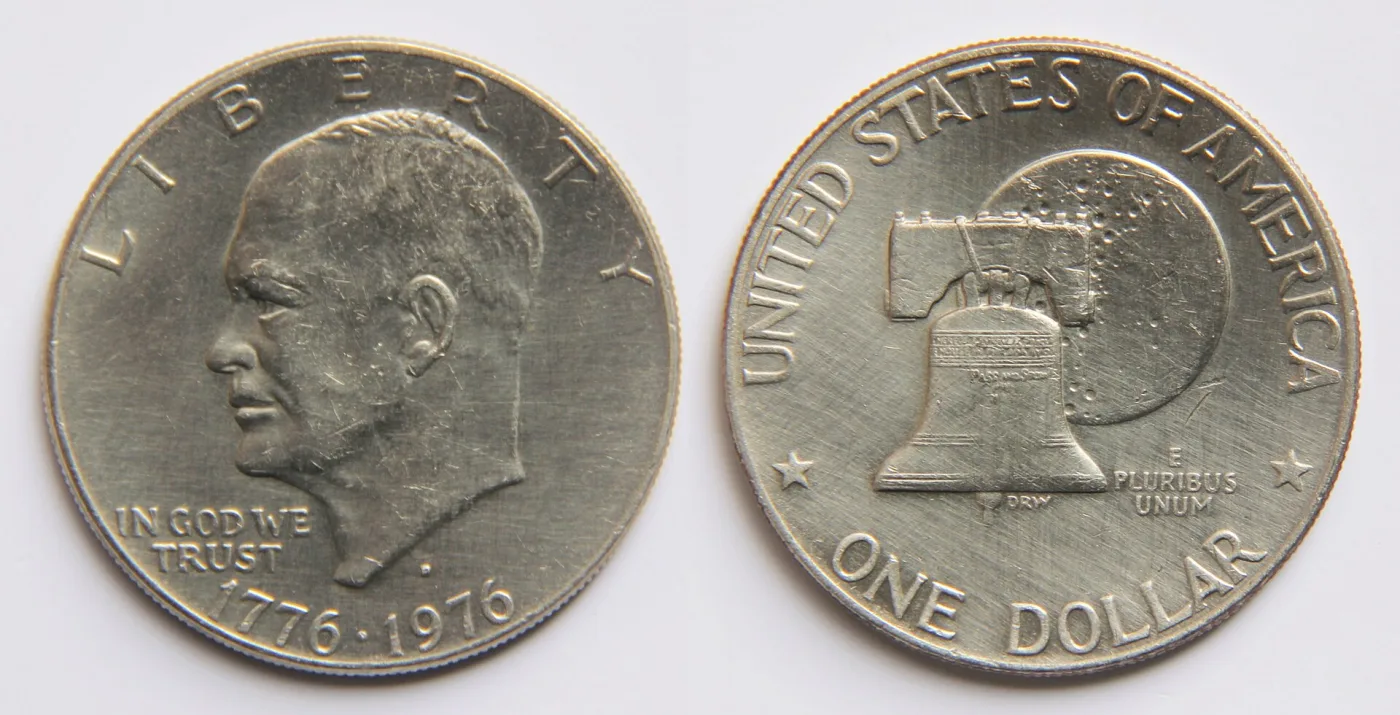
The obverse features a left-facing portrait of Dwight D. Eisenhower, depicted in his later civilian years rather than his military prime. The portrait shows clear detail of his characteristic high forehead, the slight downturn of his expression, and his suit coat with collar visible at the bottom of the bust. The word LIBERTY arches across the top of the coin, and IN GOD WE TRUST appears in two lines to the left of the portrait. The date sits below the bust at the bottom of the coin, with Gasparro’s initials FG visible at the truncation of the bust on most well-struck examples.
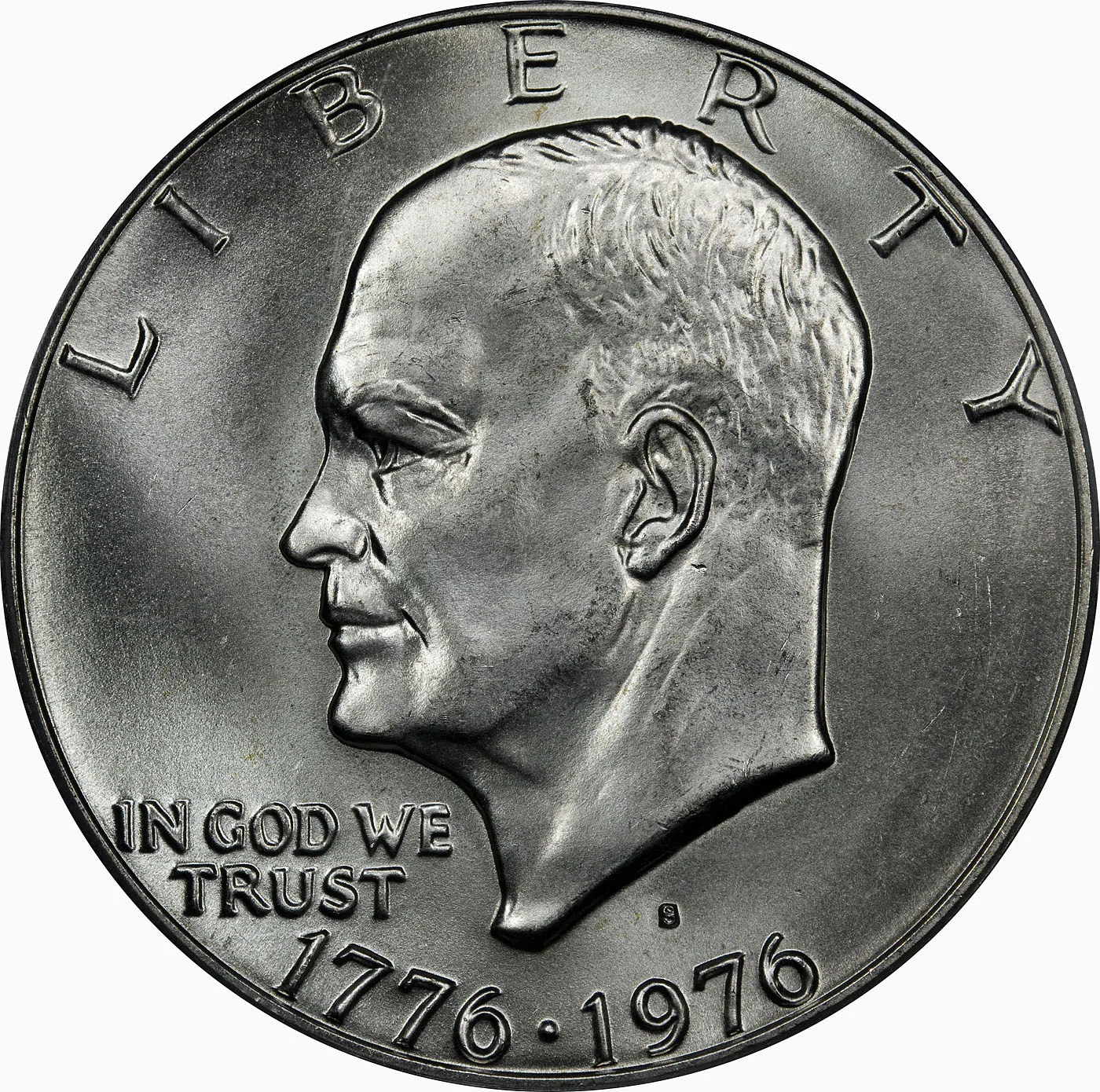
On Bicentennial issues struck in 1975 and 1976, the date reads 1776-1976 in dual-date format — no coins were struck with a 1975 date alone, even though production began in that year. All other years show only the single year of issue.
Reverse (Tails Side) — Standard 1971–1974, 1977–1978
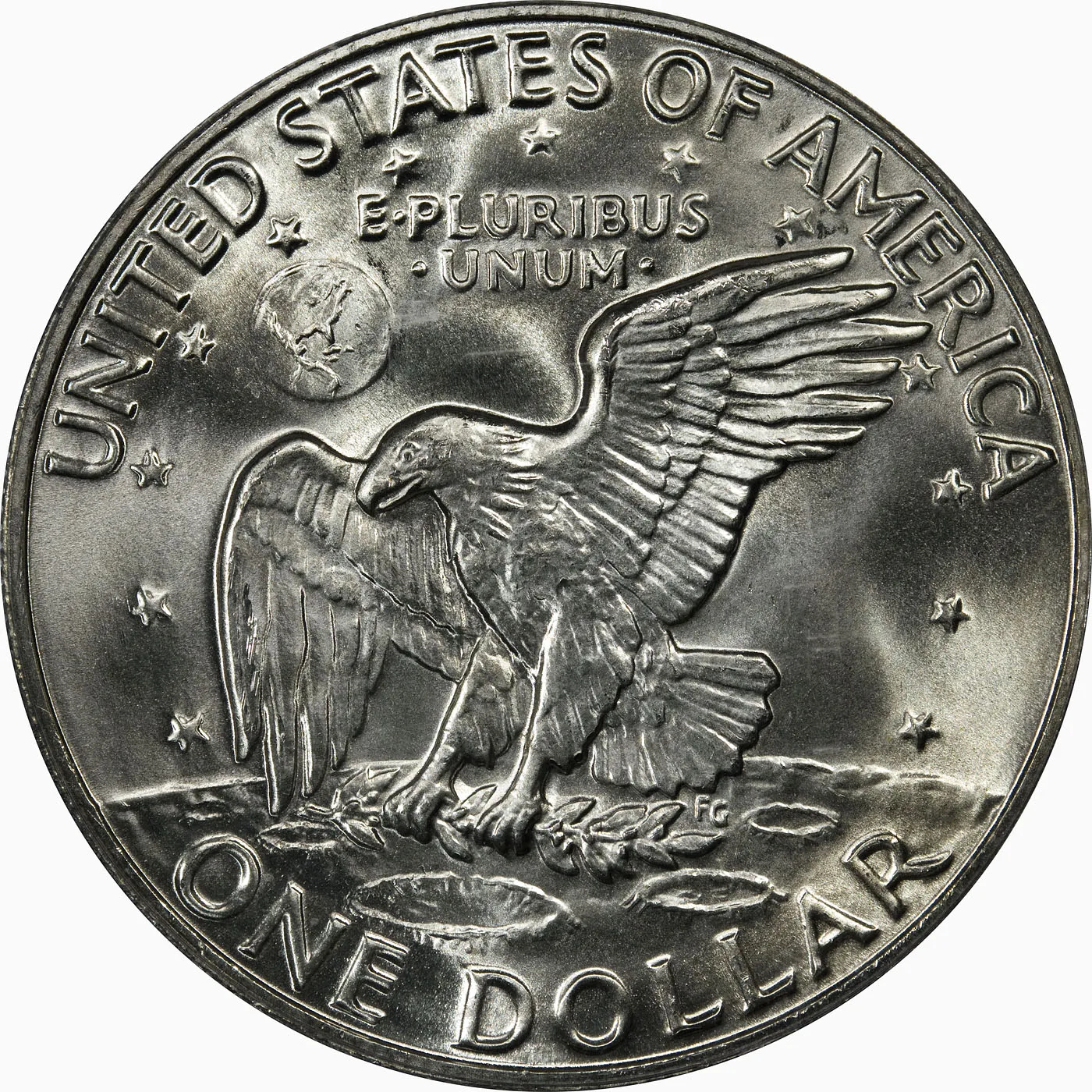
The standard reverse features an American eagle landing on the lunar surface with an olive branch in its talons. Earth appears as a small disc above the eagle’s head, with several small stars in the surrounding sky. The legend UNITED STATES OF AMERICA arches across the top, with E PLURIBUS UNUM appearing in tiny letters just above the eagle’s head. The denomination ONE DOLLAR appears at the bottom of the coin.
This design was used for circulation strikes from 1971 through 1974 and again from 1977 through 1978. The 1976 issues use an entirely different reverse — the Liberty Bell and Moon design — and 1975 saw no coins struck with that date.
Reverse (Tails Side) — Bicentennial 1776–1976
The Bicentennial reverse, designed by Dennis R. Williams (who won a national design competition while still a college student), features the Liberty Bell superimposed against the moon. The legend UNITED STATES OF AMERICA arches across the top with ONE DOLLAR at the bottom, and the designer’s initials DRW appear discreetly to the right of the bell. The Bicentennial reverse comes in two distinct lettering varieties — Type 1 and Type 2 — discussed in detail below.
Composition: Clad vs. 40% Silver
The Eisenhower Dollar exists in two distinct compositions, and identifying which version you have is essential to determining value. The same composition-distinction skills used here apply directly to the silver-vs-clad transition in the Roosevelt Dime and Washington Quarter series.
Copper-Nickel Clad (Circulation Strikes)
All Eisenhower Dollars made for general circulation are copper-nickel clad — the same composition used for modern dimes, quarters, and half dollars after 1965. The coin consists of an inner core of pure copper sandwiched between outer layers of 75% copper / 25% nickel alloy (the same alloy as a Jefferson Nickel). The total weight is 22.68 grams, and the edge displays the characteristic copper-colored “sandwich” stripe that betrays the clad construction.
Clad Eisenhower Dollars were struck at the Philadelphia Mint (no mint mark) and the Denver Mint (D mint mark) for circulation, and at the San Francisco Mint (S mint mark) for proof issues only.
40% Silver (Collector Issues Only)
Alongside the clad circulating coinage, the Mint produced 40% silver versions exclusively for collectors. These were sold directly to the public in two formats: the “Brown Ike” (a proof in a brown box) and the “Blue Ike” (an uncirculated specimen in blue cellophane). The 40% silver composition consists of an outer layer of 80% silver / 20% copper bonded to an inner core of 21% silver / 79% copper, yielding an overall silver content of approximately 9.84 grams per coin (about 0.3162 troy ounces).
40% silver Ikes were struck only at the San Francisco Mint and bear an S mint mark. They were produced for the years 1971, 1972, 1973, 1974, and 1976 (Bicentennial). After 1976, all 40% silver production ended, and the 1977 and 1978 issues exist only in clad. No business-strike silver Ikes ever reached general circulation.
Identifying Silver vs. Clad at a Glance
Three quick tests reliably distinguish silver from clad Eisenhower Dollars:
- Edge color: Clad coins show a clear copper stripe along the edge; silver coins show a uniform silver-white edge with no copper visible.
- Mint mark: Only S mint mark coins (San Francisco) can be silver. Any P (or no mint mark) and any D Eisenhower Dollar is automatically clad.
- Date and packaging: Silver issues exist only for 1971-S, 1972-S, 1973-S, 1974-S, and 1776-1976-S. If your coin is marked S in any other year, or the year is 1977/1978, it is a clad proof.
The 1972 Reverse Types: Type 1, 2, and 3
The single most important variety distinction in the entire Eisenhower Dollar series is the three reverse types of the 1972 Philadelphia (no mint mark) clad issue. All three were produced in the same year, and the value gap between them is substantial. Identifying the correct Type is essential to any 1972 Ike evaluation.
The distinction comes down to the appearance of Earth above the eagle on the reverse, particularly the placement and shape of the Florida peninsula and the Caribbean islands.
1972 Type 1: Low Relief, Round Earth
Type 1 features a low-relief Earth with no clear continental detail. Florida appears as a small bump pointing slightly southwest, and the Caribbean islands below it are barely visible. This was the original 1972 reverse hub and was used for the bulk of Philadelphia 1972 production. Type 1 is by far the most common 1972 variety and typically trades at face value to small premiums in circulated grades.
1972 Type 2: High Relief, No Florida Detail
Type 2 features a noticeably higher-relief Earth, but with one critical detail missing: the Caribbean islands south of Florida are not visible at all. Florida itself points more directly south, and the entire Earth has a more spherical, three-dimensional appearance. Type 2 is the rarest of the three 1972 varieties and was created by accidentally using a proof-style reverse die at the Philadelphia Mint. Mintage estimates suggest only a few hundred thousand examples exist, making this a genuine semi-key date.
1972 Type 3: High Relief with Florida and Islands
Type 3 features the same high-relief Earth as Type 2, but with proper Caribbean island detail visible south of Florida. This was the corrected reverse used for late 1972 production after the Mint identified the Type 2 issue. Type 3 is more common than Type 2 but scarcer than Type 1, and commands modest premiums in higher grades.
Identifying the Three Types at a Glance
The simplest way to attribute a 1972 Eisenhower Dollar:
- Type 1: Flat, low-relief Earth; Florida is a small bump; Caribbean barely visible
- Type 2: High-relief globe-like Earth; no Caribbean islands south of Florida
- Type 3: High-relief globe-like Earth; Caribbean islands clearly visible south of Florida
Only the 1972 Philadelphia (no mint mark) issue exists in all three Types. The 1972-D and 1972-S exist only in their own respective designs and don’t require Type identification. Use a 5x or 10x loupe — the differences are obvious once you know what to look for, but easy to miss at first glance.

The 1776–1976 Bicentennial Dollar
The Bicentennial Eisenhower Dollar was part of a three-coin commemorative program that also included Bicentennial Quarters and Half Dollars. All three carry the dual date 1776-1976 on the obverse and unique reverse designs selected through a national design competition. No regular-date 1975 or 1976 dollars exist — every 1975 and 1976 production run carries the dual-date Bicentennial obverse.
Bicentennial Type 1: Bold Lettering
The Type 1 Bicentennial reverse features bold, slab-serif block lettering for the legend UNITED STATES OF AMERICA and ONE DOLLAR. This was the original lettering style and was used for the earliest Bicentennial production at all three mints. Type 1 is generally more common than Type 2 in clad circulation strikes for the Philadelphia and Denver mints.
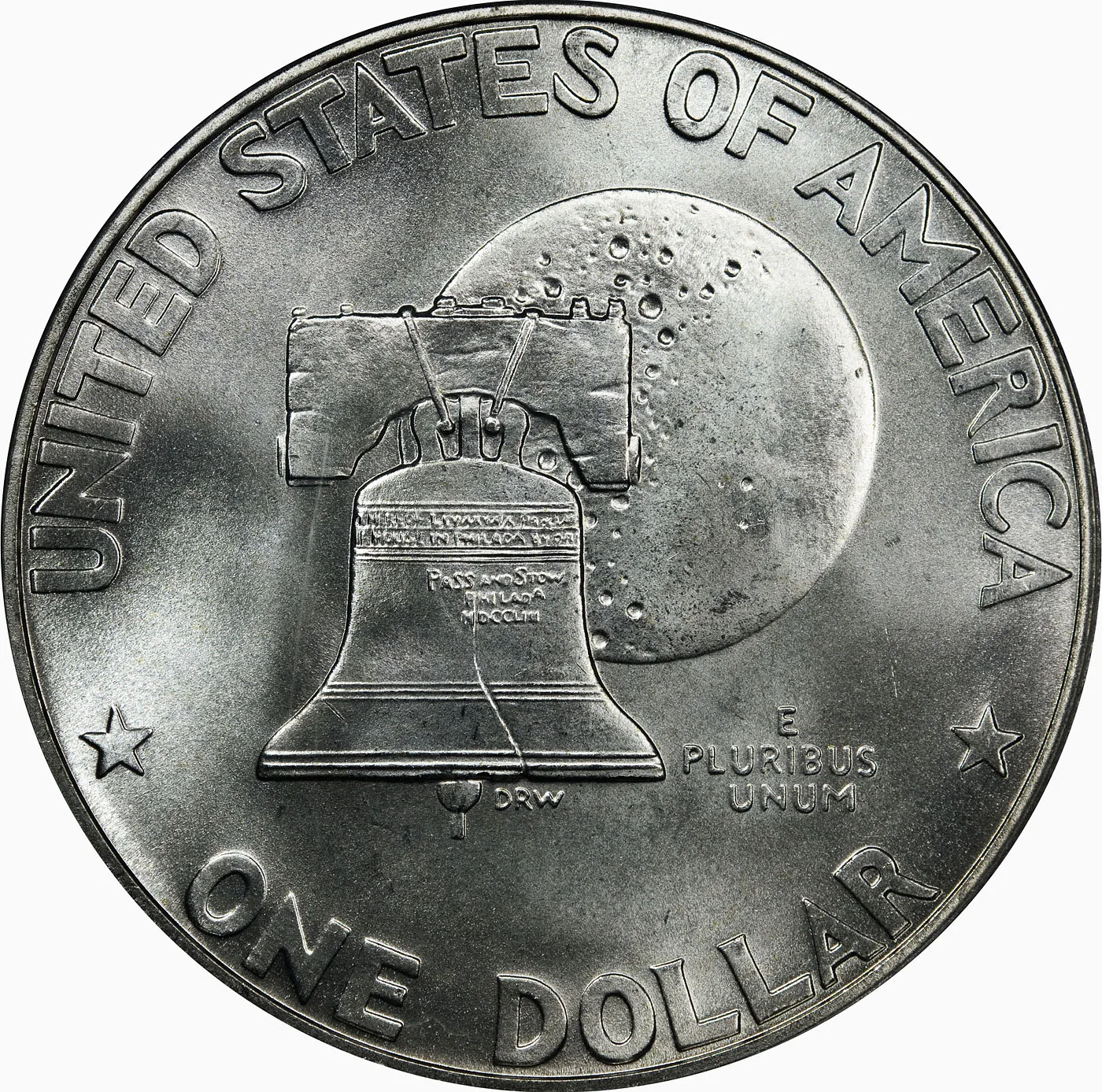
Bicentennial Type 2: Sharp, Refined Lettering
The Type 2 reverse features lettering with thinner, sharper, more refined serifs and slightly smaller letter heights overall. The Mint switched to Type 2 lettering during 1976 production, partly to address strike quality concerns. Type 2 is found on the proof and uncirculated 40% silver issues, the proof clad issues, and a substantial portion of late-1976 clad business strikes.
Identifying Type 1 vs. Type 2
The fastest way to distinguish them:
- Type 1: Letters in UNITED STATES OF AMERICA are thick and blocky, with broad, flat serifs
- Type 2: Letters are thinner and more elegant, with tapered, sharper serifs; appears more refined overall
- Quick check: Compare the thickness of the vertical strokes in the letter T — Type 1 strokes are noticeably thicker than Type 2
Both Types exist for both clad and 40% silver Bicentennial issues, but distribution varies. Consult a recent variety reference if you suspect a scarce combination such as a 40% silver Type 1 — these can carry small but meaningful premiums.
Key Dates and Semi-Keys
The Eisenhower Dollar series is short and the key dates are modest by classic-series standards, but a handful of issues stand out for collectors. The same disciplined approach to spotting key dates applies whether you’re looking at Ike Dollars, the Buffalo Nickel series, or any other US coin run.
1972 Type 2 (Philadelphia)
The 1972 Type 2, with its high-relief globe and missing Caribbean islands, is the standout key of the entire Ike series. Surviving examples are uncommon, and the variety commands four-figure prices in pristine Mint State 65 or higher. Even circulated examples carry strong premiums — typically $50 to $150 for problem-free coins in mid-grades.
1971-S Silver (Brown and Blue Ike)
The 1971-S is the first 40% silver issue and was produced in two formats: the Brown Ike proof (4,265,234 mintage) and the Blue Ike uncirculated (6,868,530 mintage). While not particularly scarce in raw form, the 1971-S commands meaningful premiums in high grades — Brown Ike proofs in PR-69 Deep Cameo regularly trade for hundreds of dollars, and pristine MS-67+ Blue Ikes can reach four figures.
1973 (Philadelphia and Denver)
Unlike most years, the 1973-P and 1973-D Eisenhower Dollars were not released for general circulation. Both were issued exclusively in mint sets sold to collectors, with mintages of 2,000,056 (Philadelphia) and 2,000,000 (Denver) — by far the lowest business-strike mintages in the series. This makes 1973 the lowest-mintage year for circulation-style Ikes and a genuine key for collectors building a complete date-and-mintmark set in original packaging.
1976-S Silver Bicentennial Type 1
The 1976-S Silver Type 1 is significantly scarcer than the Type 2 silver issue. While both exist in proof and uncirculated formats, the Type 1 silver Ike is the harder of the two to find, especially in pristine condition. PR-69 Deep Cameo Type 1 silver Bicentennials regularly bring hundreds of dollars at auction.
FS-901 1976-D Bicentennial Doubled Die Obverse
The FS-901 (Cherrypickers’ First Star) is one of the most famous Eisenhower Dollar varieties: a doubled die obverse on certain 1976-D Type 2 Bicentennial coins. The doubling shows clearly on Eisenhower’s eye, ear, and the lettering of LIBERTY. Premiums are substantial in higher grades — typical examples bring $100 to $300, with pristine Mint State coins reaching well into four figures.
1971-D Friendly Eagle Variety (FS-901)
Sometimes called the “Friendly Eagle” or “Reverse of 1972,” this 1971-D variety features a softer, gentler-looking eagle expression caused by hub differences. Demand among Ike specialists has driven premiums up over the past decade, with pristine examples regularly bringing several hundred dollars.
Common Date Overview
The remaining issues — most of 1971, 1971-D, 1972-D, 1972-S Silver, 1974, 1974-D, the bulk of 1976 Bicentennials, 1977, 1977-D, 1978, and 1978-D — are common in all grades and trade at face value to small premiums for circulated pieces. These make excellent starting points for new collectors.
Doubled Dies and Notable Varieties
Beyond the major Type distinctions, the Eisenhower Dollar series hosts a handful of doubled dies and other die varieties that specialists actively pursue. None command the prices of the famous 1955 Lincoln Doubled Die, but several add meaningful premiums and scratch the variety-collecting itch.
1972-D RDV-006 / Type B Reverse
Some 1972-D coins were struck with a slightly different reverse hub showing distinct globe characteristics — a Denver echo of the Philadelphia Type variation. The variety is subtle and requires close comparison of the Earth’s relief and the surrounding stars to confirm. Premiums are modest but real among Ike specialists.
1974-D DDO
A doubled die obverse on certain 1974-D coins shows clear doubling in LIBERTY and Eisenhower’s profile. The variety is uncommon but not rare, with mid-grade examples bringing $25 to $75 over standard 1974-D values.
1976 No-S Proof Silver
While not a doubled die, the legendary 1976 No-S proof silver Bicentennial — coins struck in proof format but missing the S mint mark — represents a major modern-coin rarity in the same vein as the famous 1975 No-S Roosevelt Dime. Authenticated examples are extraordinarily rare and command five-figure prices when they appear.
Cherrypicker Tips
For collectors who enjoy variety hunting, several practical tips apply:
- Use a 10x loupe on the obverse legend and Eisenhower’s eye/ear area for doubled dies
- Check Earth’s relief on every 1972-P to attribute the correct Type
- Compare lettering thickness on every Bicentennial to determine Type 1 vs Type 2
- Look for repunched mint marks on D and S issues — minor RPMs exist for several years
- Reference the Cherrypickers’ Guide for current variety attribution and FS numbers
Mint Marks: Philadelphia, Denver, and San Francisco
Eisenhower Dollars were struck at three United States mints during their eight-year production run. Mint marks appear on the obverse just below the truncation of Eisenhower’s bust, slightly above the date. Always check this location carefully — counterfeiters occasionally add fake mint marks to common-date coins to create premium-looking issues.
Philadelphia Mint (No Mint Mark)
The Philadelphia Mint produced clad business strikes with no mint mark for 1971, 1972 (all three Types), 1974, 1976 (Bicentennial Types 1 and 2), 1977, and 1978. The 1973-P was issued only in mint sets — never released for general circulation. Philadelphia did not strike any 40% silver Eisenhower Dollars.
Denver Mint (D Mint Mark)
The Denver Mint produced clad business strikes with the D mint mark for the same years as Philadelphia: 1971-D, 1972-D, 1974-D, 1976-D (Types 1 and 2), 1977-D, and 1978-D. Like Philadelphia, the 1973-D was issued only in mint sets. Denver did not strike any 40% silver Eisenhower Dollars.
San Francisco Mint (S Mint Mark)
The San Francisco Mint had the most varied production: clad proofs every year, plus 40% silver business strikes (“Blue Ikes”) and 40% silver proofs (“Brown Ikes”) for 1971, 1972, 1973, 1974, and 1976 Bicentennial. After 1976, San Francisco produced only clad proofs. The S mint mark identifies all silver Eisenhower Dollars and all proof issues.
Mint Mark Appearance Tips
Authentic Eisenhower Dollar mint marks share specific characteristics:
- Sharp edges: Mint marks were punched into individual working dies, producing crisp, well-defined letters
- Consistent depth: The mint mark should sit at the same depth as surrounding design elements
- Position: Always below the bust truncation, slightly above and to the left of the date
- Style: The D and S use the same Mint-standard letter forms as contemporary coins of all denominations
Grading Eisenhower Dollars
Accurate grading is essential because Mint State price gaps are surprisingly significant for a modern series — particularly between MS-65 and MS-67. The same fundamental grading methods that apply to other US coins work here, with attention to the specific wear and contact-mark patterns characteristic of the large Ike planchet.
Why Mint State Grading Matters Most
Because Eisenhower Dollars are a modern series, virtually no examples are found in worn circulated grades worth grading professionally. Most collector activity happens in Mint State, where the difference between MS-63, MS-65, and MS-67 can mean tens to thousands of dollars per coin. Strike quality, contact marks, and luster are the three primary factors graders weigh.
The Bag Mark Problem
Eisenhower Dollars were stored, shipped, and distributed in heavy canvas mint bags containing 1,000 coins each. The combined weight (over 50 pounds per bag) crushed the coins against each other during transport, producing characteristic bag marks — small contact nicks and abrasions on the obverse cheek and reverse fields. Almost every Ike Dollar shows some bag marks; truly mark-free coins are scarce in any grade.
The most heavily marked areas are:
- Obverse cheek and forehead: The high relief of Eisenhower’s profile attracts the most contact
- Reverse Earth and surrounding fields: The smooth open fields show every nick
- Eagle’s wings: The high points of the eagle pick up abrasions
Strike Quality and Luster
Strike quality varies significantly between mints and years. Philadelphia and San Francisco coins generally show stronger strikes than Denver issues, particularly for 1971 and 1972 production. Look for:
- Sharp eyebrow and eye detail on Eisenhower’s portrait
- Crisp feather detail on the eagle’s wings (standard reverse)
- Distinct lunar crater texture on the moon below the eagle
- Full crack detail in the Liberty Bell (Bicentennial reverse)
Original Mint luster on Ike Dollars is satin-like rather than the booming cartwheel luster of Morgan Dollars. Don’t penalize an Ike for lacking Morgan-style luster — that’s not how this series was made.
Grading Scale Overview
Mint State 60–62 (MS-60 to MS-62): No wear, but heavy bag marks evident on cheek and fields. Luster is typically subdued or impaired. This is where most uncertified Ikes from circulation end up.
Mint State 63 (MS-63): Moderate bag marks visible without magnification. Reasonable luster. Most uncirculated mint set Ikes grade MS-63 to MS-64.
Mint State 64 (MS-64): Lighter bag marks, good luster, generally pleasing eye appeal. Many premium uncirculated Blue Ikes grade MS-64.
Mint State 65 (MS-65): Light bag marks only, particularly on the cheek; full satin luster; strong overall eye appeal. A meaningful step up in price for most issues.
Mint State 66 (MS-66): Very minor bag marks; pristine luster; sharp strike. Genuinely scarce for most dates.
Mint State 67 (MS-67): Nearly mark-free surfaces; exceptional eye appeal. Quite rare for most issues — many dates have populations under 100 coins at this grade.
Proof 65–70 (PR-65 to PR-70): Proofs are graded on similar criteria but emphasize hairlines, contact, and cameo contrast rather than bag marks. Cameo and Deep Cameo designations significantly affect value.
Authentication and Spotting Counterfeits
Eisenhower Dollars are not heavily counterfeited compared with classic series, primarily because most issues are too inexpensive to justify the effort. However, certain rarities — particularly the 1972 Type 2, the FS-901 1976-D doubled die, and key 40% silver issues — do attract fraudsters. Apply the same authentication discipline used for higher-end coins like the Walking Liberty Half Dollar.
Altered Dates and Types
The most common Eisenhower Dollar fraud involves altering common 1972 Type 1 coins to appear as Type 2 by enhancing the relief of Earth or removing apparent Caribbean islands. Authentic Type 2 coins show the high relief as part of the original strike — uniform with the surrounding design and free of tool marks. Examine Earth carefully under 10x magnification:
- Look for tool marks adjacent to or on Earth’s surface
- Check that the relief is consistent with surrounding design elements
- Verify that the metal flow lines around Earth match the surrounding fields
- Compare against verified Type 2 reference images
Counterfeit Silver Versions
Because 40% silver Ikes carry premiums over clad versions, fraudsters occasionally electroplate or polish clad coins to mimic silver appearance. Authentication tests:
- Edge inspection: Real 40% silver Ikes show a uniform silver edge with no copper stripe
- Mint mark check: Only S mint mark coins from 1971-1974 and 1776-1976 can legitimately be silver
- Weight verification: Real silver Ikes weigh 24.59 grams; clad weighs 22.68 grams. A precise scale catches plated fakes
- Specific gravity: Silver has different density than copper — testing labs can confirm composition
Cleaned and Polished Coins
Many Eisenhower Dollars have been cleaned by previous owners — often inexpertly — to remove tarnish or improve appearance. Cleaned coins are detected by:
- Unnatural shine or “whizzed” appearance under angled light
- Hairline scratches visible under 5x or 10x magnification
- Pinkish or orange “dipped” coloration
- Loss of original satin luster character
Cleaned Eisenhower Dollars are graded “Details” by PCGS and NGC and lose 30-60% of their value compared to problem-free original coins. For high-value Ikes (1972 Type 2, FS-901 doubled die, key silver issues), always purchase certified examples.
Using Third-Party Grading Services
For any Eisenhower Dollar worth more than $50, consider purchasing already-certified examples from PCGS or NGC. The certification fee is small relative to the protection it provides, and certified high-grade Ikes are far easier to resell than raw coins. Both services maintain Variety Plus or VarietyPlus services that authenticate the major Type and doubled-die varieties at modest extra cost.
Current Market Values and Price Guide
Eisenhower Dollar values span a wide range — from face value for common circulated coins to mid-four-figures for the 1972 Type 2 in pristine MS-67. The prices below reflect approximate retail values as of 2026 for problem-free, original-surface coins. Cleaned, damaged, or altered examples are worth substantially less.
Common Clad Dates (1971, 1971-D, 1974, 1974-D, 1977, 1977-D, 1978, 1978-D)
- Circulated: Face value to $2
- MS-63: $5–$10
- MS-65: $20–$40
- MS-66: $60–$150
- MS-67: $300–$1,500+ (varies dramatically by date)
1972 Reverse Type Varieties (Philadelphia)
- 1972 Type 1 (MS-65): $20–$35
- 1972 Type 2 (MS-65): $200–$400
- 1972 Type 2 (MS-66): $600–$1,200
- 1972 Type 2 (MS-67): $3,500–$6,500
- 1972 Type 3 (MS-65): $40–$75
1973-P and 1973-D (Mint Set Only)
- MS-63 in original packaging: $10–$15
- MS-65: $25–$50
- MS-66: $100–$250
- MS-67: $700–$2,000
40% Silver Issues (Brown Ike Proofs)
- 1971-S Silver PR-67: $20–$35
- 1971-S Silver PR-69 DCAM: $300–$500
- 1972-S Silver PR-69 DCAM: $50–$90
- 1973-S Silver PR-69 DCAM: $40–$70
- 1974-S Silver PR-69 DCAM: $30–$60
- 1776-1976-S Silver Type 1 PR-69 DCAM: $200–$400
- 1776-1976-S Silver Type 2 PR-69 DCAM: $35–$60
40% Silver Uncirculated (Blue Ikes)
- 1971-S Silver MS-65: $15–$25
- 1971-S Silver MS-67: $200–$400
- 1972-S Silver MS-67: $80–$150
- 1976-S Silver Type 1 MS-67: $100–$200
- 1976-S Silver Type 2 MS-67: $40–$70
Notable Varieties
- FS-901 1976-D Type 2 DDO MS-65: $150–$300
- FS-901 1976-D Type 2 DDO MS-66: $700–$1,500
- 1971-D Friendly Eagle MS-65: $75–$150
- 1971-D Friendly Eagle MS-66: $300–$600
Note: These are retail price estimates. Actual sale prices at auction vary based on eye appeal, certification, surface originality, and current market demand. For important purchases, reference recent auction archives from Heritage Auctions, Stack’s Bowers, or the Ike Group’s specialist sales alongside standard price guides.
Building an Eisenhower Dollar Collection
The Eisenhower Dollar series rewards collectors at every budget level. With only thirty-two distinct date-and-mintmark-and-type combinations across the entire series, it is one of the most achievable modern series for a complete collection. The keys are far less out of reach than the rarities of larger series like the Buffalo Nickel or the early Mercury Dime.
Type Set
The simplest collection is a five-coin type set: one clad standard reverse, one clad Bicentennial Type 1, one clad Bicentennial Type 2, one 40% silver standard reverse, and one 40% silver Bicentennial. This can be assembled in pristine Mint State or Proof for under $100 total — an outstanding value for a complete representation of the series.
Date Set
A complete date-and-mintmark set of all clad business strikes is achievable in MS-63 to MS-65 grades for $200 to $500, with the bulk of the cost concentrated in the 1972 Type 2 and the 1976-D FS-901 if pursued. Adding the 40% silver issues adds another $100 to $300 for a complete proof and uncirculated silver run.
Specialty Approaches
- Variety set: Focus on the 1972 Types, Bicentennial Types, FS-901 doubled die, and Friendly Eagle
- High-grade type: Pursue MS-67 examples of each major variety — challenging and expensive but visually stunning
- Proof set: Complete the clad and silver proof runs for 1971 through 1978, including PR-69 Deep Cameo specimens
- Original packaging: Collect Brown Ikes, Blue Ikes, and mint sets in their original government packaging
- Casino-quality: Some collectors specifically seek bag-marked circulated examples that actually saw casino use
Practical Tips
- Start with original mint sets: Inexpensive, plentiful, and a great way to acquire high-grade examples
- Buy certified for keys: 1972 Type 2, FS-901, and high-grade silver Ikes should always be PCGS or NGC certified
- Watch for cleaning: Many circulated Ikes were cleaned by collectors; original surfaces command meaningful premiums in MS-65+
- Study Earth: The Earth on the standard reverse is the single best variety-attribution feature — train your eye on it
- Compare lettering: For Bicentennials, get good at distinguishing Type 1 from Type 2 lettering at a glance
Storage and Preservation
Proper storage maintains the value and visual appeal of your collection. Even modern coins can be damaged by improper storage materials, and the large surface area of an Eisenhower Dollar makes any damage immediately apparent.
What to Avoid
- PVC holders: Older soft plastic flips and some envelopes contain PVC, which outgasses a green sticky residue that etches into both clad and silver surfaces. Use only “non-PVC” or “Mylar” labeled holders.
- Acidic paper: Some paper envelopes contain sulfur compounds that accelerate toning. Use acid-free, archival-quality envelopes.
- Original Brown Ike boxes (long-term): The cardboard and inserts in original government packaging contain materials that can produce toning over multi-decade timeframes. For long-term storage of pristine examples, transfer to inert holders.
- Rubber bands: Rubber contains sulfur and produces dark, irreversible spotting on silver Ikes. Never store rubber near coins.
- High humidity: Moisture accelerates oxidation. Keep humidity below 50%.
Recommended Storage
- PCGS or NGC slabs: Inert plastic holders that provide excellent long-term protection and authentication
- Air-Tite holders: Dollar-sized direct-fit capsules; safe, attractive, and excellent for individual coins
- Non-PVC flips: Mylar or polyethylene flips for safe short-term storage and examination
- Quality albums: Dansco and Whitman make Ike-specific albums; ensure pages are PVC-free
- Original government packaging: Acceptable for moderate-term storage; transfer to inert holders for premium specimens
Handling
Always handle Eisenhower Dollars by their edges. The large surface area shows fingerprints far more readily than smaller coins, and oils from skin will eventually etch the surface. Cotton gloves are appropriate for high-value coins. Never clean an Ike — virtually any cleaning reduces value, and dipped or polished coins are easily detected by experienced graders. If a coin appears to need conservation, consult a professional rather than attempting it yourself.
Frequently Asked Questions
What is an Eisenhower Dollar and when was it made?
The Eisenhower Dollar is a large-format United States dollar coin produced from 1971 through 1978. Designed by Frank Gasparro, it features a portrait of President Dwight D. Eisenhower on the obverse and an Apollo 11–inspired eagle landing on the moon on the reverse (1971-1974, 1977-1978) or a Liberty Bell with moon on the Bicentennial reverse (1776-1976). It was the last large dollar coin struck for general circulation.
Are Eisenhower Dollars made of silver?
Most are not. All circulating Eisenhower Dollars are copper-nickel clad — the same composition as modern dimes, quarters, and half dollars. Only the special collector issues struck at the San Francisco Mint (S mint mark) for 1971, 1972, 1973, 1974, and 1776-1976 are 40% silver, and these were never released for circulation. They were sold directly to collectors as Brown Ike proofs and Blue Ike uncirculated specimens.
How do I tell if my Eisenhower Dollar is silver or clad?
Look at the edge: clad coins show a distinct copper-colored stripe sandwiched between the outer layers, while 40% silver coins show a uniform silver-white edge with no copper visible. Also check the mint mark — only S mint mark coins from 1971 through 1976 Bicentennial can legitimately be silver. Any P (no mint mark), any D, or any 1977/1978 issue is automatically clad.
What is the 1972 Type 2 reverse and why is it valuable?
The 1972 Type 2 is one of three reverse varieties used on 1972 Philadelphia Eisenhower Dollars. It features a high-relief Earth missing the Caribbean islands south of Florida, created by the accidental use of a proof-style reverse die for circulation strikes. Mintage is estimated at only a few hundred thousand pieces, making it a genuine semi-key. Pristine MS-67 examples regularly sell for several thousand dollars.
What's the difference between Type 1 and Type 2 Bicentennial Ikes?
The Type 1 Bicentennial reverse uses bold, blocky lettering with thick serifs. The Type 2 reverse uses thinner, sharper, more refined lettering. Both Types exist in clad and 40% silver formats, with distribution varying by mint and finish. The 1976-S Silver Type 1 is significantly scarcer than the Type 2 silver issue and commands meaningful premiums.
Why are 1973-P and 1973-D so much scarcer than other dates?
The 1973-P and 1973-D Eisenhower Dollars were struck only for inclusion in mint sets sold to collectors — never released for general circulation. Mintages were approximately 2 million per mint, by far the lowest in the series. As a result, most 1973 Ikes are MS-63 to MS-65 quality, but high-grade MS-66 and MS-67 examples are scarce and command real premiums.
What is the FS-901 doubled die and how do I identify it?
The FS-901 is a famous doubled die obverse on certain 1976-D Type 2 Bicentennial Eisenhower Dollars. The doubling shows clearly on Eisenhower's eye, ear, and the lettering of LIBERTY. Use a 10x loupe to examine these areas — genuine FS-901 doubling is bold and unmistakable. Premiums range from $100-$300 in lower grades to over $1,500 in pristine MS-66.
Can I find Eisenhower Dollars in circulation today?
Rarely. Eisenhower Dollars never circulated widely — the public found them too large and heavy for everyday use, and most went directly into bank vaults, casino tills, or collector hoards. Some still appear in bank-roll searches or at coin shops in bulk lots, but spending and receiving them at random in commerce is uncommon. Estate sales, coin shows, and online auctions are now the primary sources.
Why was the Eisenhower Dollar discontinued in 1978?
The large size and weight of the Ike made it impractical for vending machines and everyday transactions, and most circulating supply ended up in casino use rather than general commerce. Congress authorized the smaller Susan B. Anthony Dollar in 1978, which entered production in 1979. The Anthony Dollar's design was also created by Frank Gasparro — making him the designer of two consecutive dollar coin series, before the golden-colored Sacagawea Dollar finally replaced both designs in 2000.
Is an Eisenhower Dollar collection a good investment?
For most issues, no — common-date Ikes have appreciated only modestly over the past several decades, and many trade near melt value for clad and bullion value for silver. However, high-grade pristine examples (MS-67), key varieties (1972 Type 2, FS-901, Friendly Eagle), and pristine 40% silver proofs have shown meaningful appreciation. As with any collectible, past performance does not guarantee future returns; collect for enjoyment first, investment second.