Sacagawea Dollar Identification Guide: Reverses, Key Dates, and Values
The Sacagawea Dollar — the manganese-brass “golden dollar” first struck in 2000 — replaced the unloved Eisenhower and Susan B. Anthony designs and brought a small revolution to American coinage. It was the first US circulating coin to depict a Native American woman, the first to feature a real person originally identified by name on the obverse, and the first to use the distinctive golden-colored alloy that has defined dollar coins ever since. Across more than two decades of issue, the series has carried two major reverses (Soaring Eagle 2000-2008 and the rotating Native American $1 series from 2009 onward) and has produced several of the most valuable modern US error and variety coins.
This guide walks through every aspect of identifying, attributing, grading, and valuing Sacagawea Dollars. You’ll learn how to distinguish the Soaring Eagle from the Native American reverses, find the right mint mark, recognize the famous Cheerios Dollar, the Wounded Eagle, the 2000-W $10 gold pattern, edge-lettering varieties, mule errors, and accurately price your coins at today’s market.
Whether you pulled a Sacagawea out of pocket change or are building a complete date-and-reverse type set, this guide will give you the working knowledge needed to identify any Sacagawea Dollar with confidence — and to know which ones are worth far more than face value.
History: The Search for a Workable Dollar
By the mid-1990s, the United States had spent two decades trying — and largely failing — to circulate a small-diameter dollar coin. The Susan B. Anthony Dollar of 1979-1981 and 1999 had been a notorious flop: roughly the same size, weight, and color as the Washington Quarter, it confused cashiers and consumers alike and disappeared into bank vaults almost as fast as it was struck. Congress wanted another try, but this time with a coin that looked unmistakably different from the quarter.
The United States Dollar Coin Act of 1997 directed the Mint to design a new dollar coin distinguishable from the quarter by both color and edge. The Treasury established a Dollar Coin Design Advisory Committee in 1998 that, after public comment, recommended a coin honoring Sacagawea, the young Lemhi Shoshone woman who guided the Lewis and Clark Expedition of 1804-1806. Sacagawea was an inspired choice — she was a real historical figure, a Native American, and a woman, all firsts for circulating US coinage in this combination.
The first coins were struck in late 1999 and released for circulation on January 27, 2000. To launch the new coin, the US Mint partnered with Walmart and General Mills in unprecedented promotional campaigns — most famously the Cheerios Dollar promotion, which placed 5,500 specially struck Sacagaweas into Cheerios cereal boxes. Despite the marketing, the coin met the same fate as the Susan B. Anthony: the public preferred dollar bills, and the Sacagawea slowly drifted into circulation purgatory. Mintage was massive in 2000 (over 1.2 billion coins), modest in 2001, and tiny from 2002 onward.
The Native American $1 Coin Act of 2007
In 2007 Congress passed the Native American $1 Coin Act, which kept the Sacagawea obverse but replaced the Soaring Eagle reverse with a rotating annual reverse honoring Native American contributions to US history. Starting in 2009, each year’s reverse depicts a different theme — agriculture, the Iroquois Confederacy’s contribution to American government, the Wampanoag Treaty of 1621, and so on. The series continues to the present, struck mostly for collectors rather than for circulation.
The Designers: Glenna Goodacre and Thomas Rogers
The obverse was sculpted by Glenna Goodacre (1939-2020), a renowned Texas sculptor best known for the Vietnam Women’s Memorial in Washington, D.C. Goodacre had no surviving image of Sacagawea to work from — no contemporary portrait exists — and she chose to model the figure on Randy’L He-dow Teton, a Shoshone-Bannock-Cree college student who posed for the design. The choice was both pragmatic and symbolic: a living Shoshone face for a Shoshone woman who could not be photographed in life.
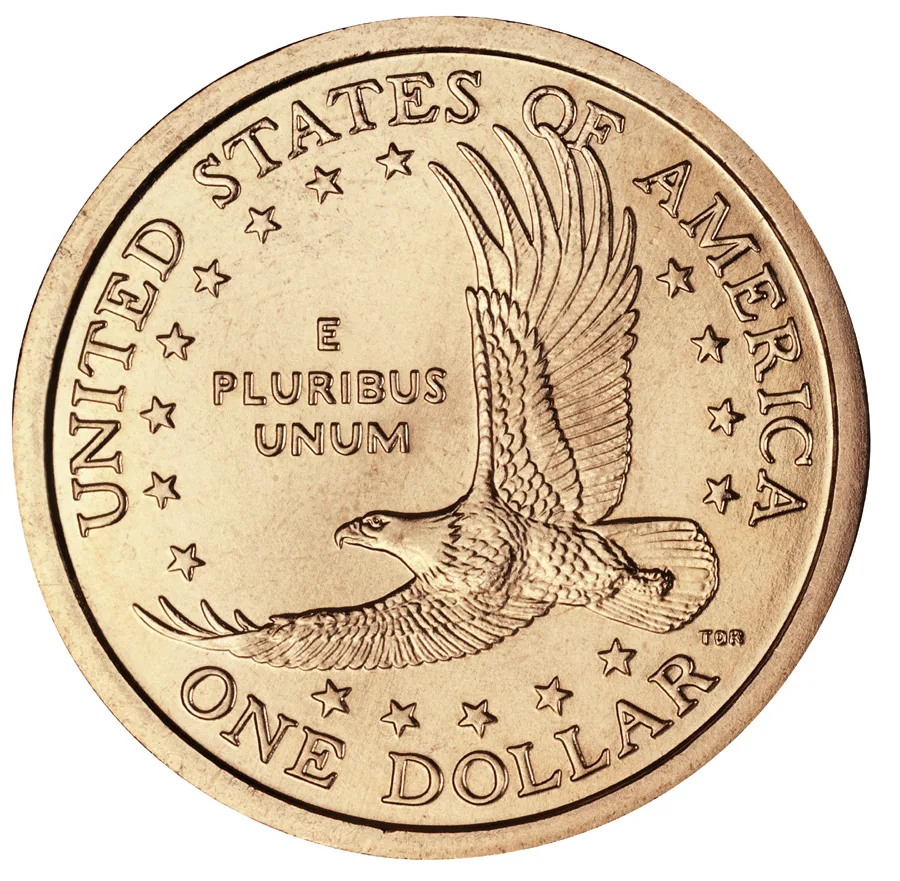
The original Soaring Eagle reverse was designed by Thomas D. Rogers Sr., a longtime US Mint sculptor-engraver who also worked on the Jefferson Nickel 2003 redesign work and many commemoratives. The eagle in flight surrounded by 17 stars references the number of states in the Union when Lewis and Clark set out in 1804.
Design: Sacagawea and Her Son
Knowing every element of the Sacagawea design is essential for accurate grading, variety identification, and authentication.
Obverse (Heads Side)
The obverse depicts Sacagawea in three-quarter profile facing right, her son Jean Baptiste Charbonneau strapped to her back in a traditional Shoshone cradleboard carrier. She is shown as a young woman — Sacagawea was approximately 16 to 18 years old during the expedition. The legend LIBERTY arches above, and the date appears below. The Mint Mark (P, D, or S) sits to the right of the date. IN GOD WE TRUST appears in the left field. The designer’s initials GG appear at the truncation of Sacagawea’s shoulder.
Reverse (Tails Side, 2000-2008)
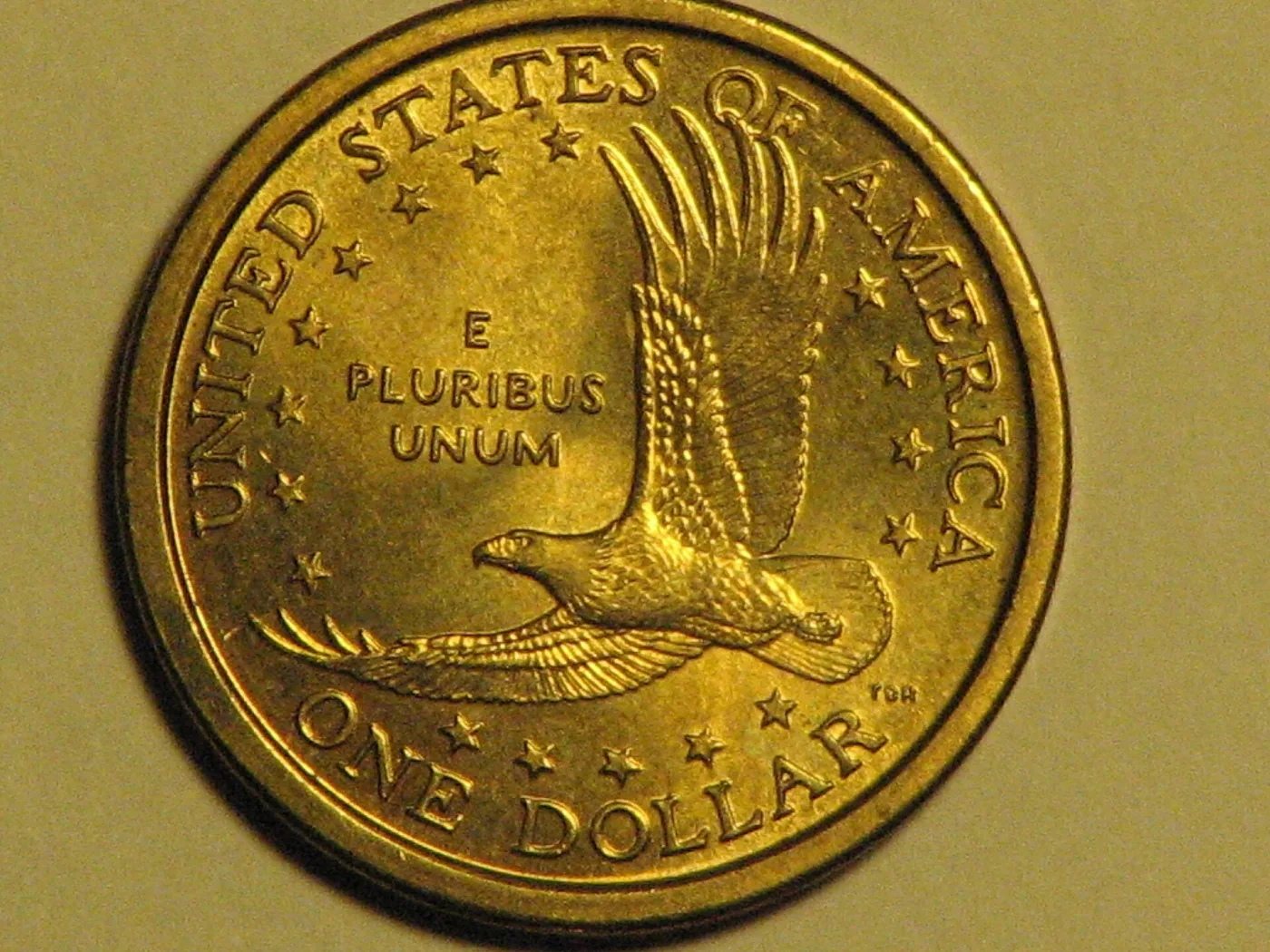
The original reverse — used for nine years — depicts an American bald eagle in flight, surrounded by 17 stars representing the states in the Union in 1804. The legends UNITED STATES OF AMERICA and ONE DOLLAR appear above and below. E PLURIBUS UNUM floats below the eagle. The designer’s initials TDR appear below the eagle’s left wing. The reverse mintmark is not used — mint mark is on the obverse for this series.
Reverse (Tails Side, 2009-Present)
Beginning in 2009, the reverse changes each year and shows a different design honoring Native American history and contributions. The legends UNITED STATES OF AMERICA and $1 appear, but E PLURIBUS UNUM, the date, and the mint mark were moved to the edge of the coin (incused edge lettering). Each year’s theme is described in detail in the Native American section below.
Edge
From 2000 to 2008, the Sacagawea Dollar has a plain (smooth) edge — unlike the reeded edge of quarters, dimes, and halves. Starting in 2009 the edge carries incused (sunken) inscriptions: E PLURIBUS UNUM, the date, and the mint mark. This edge change is critical for both identification and error-coin collecting, as we will see.
Composition and Specifications
Knowing the metal content and physical specs is essential for authentication and for understanding why the coin looks gold but is not.
The Manganese Brass Alloy
- Composition: 88.5% copper, 6% zinc, 3.5% manganese, 2% nickel.
- Diameter: 26.5 mm.
- Thickness: 2.00 mm.
- Weight: 8.1 grams.
- Edge (2000-2008): Plain.
- Edge (2009-present): Incused lettering (date, mint mark, E PLURIBUS UNUM).
- Core: Pure copper.
- Clad layer: The manganese-brass alloy bonded to a copper core, producing a clad coin (not a solid alloy).
Why It Looks Gold But Isn’t
The manganese-brass outer layer was specifically engineered to give the coin a golden appearance distinct from the silvery clad of quarters and dimes. The coin contains absolutely no gold. Manganese is the critical ingredient — it darkens the brass to a richer golden color and helps the coin tarnish to an attractive coppery-rose patina rather than to the green oxidation typical of brass coins. Bullion value is essentially zero; melt value is well under face. The coin trades on numismatic, not metal, value.
Tarnishing Behavior
Sacagawea Dollars are well-known for darkening rapidly. Even uncirculated rolls left in plastic tubes will develop spotting and patina within months. Some collectors find the dark patina attractive; others prefer original brass color. The Mint addressed early tarnishing complaints in 2001 with a slight surface treatment change, but spotting remains common. This behavior is also helpful for authentication — a perfectly bright coin that should be 15+ years old has almost certainly been cleaned.
The Soaring Eagle Reverse (2000-2008)
The Thomas Rogers Soaring Eagle reverse ran for nine years and is the most commonly encountered Sacagawea Dollar reverse. Mintages varied wildly by year as the Mint adjusted production to actual circulation demand.
Year-by-Year Mintages (Business Strikes)
- 2000-P: 767,140,000 — the high-mintage launch year.
- 2000-D: 518,916,000 — also massive launch-year output.
- 2001-P: 62,468,000 — sharp drop as circulation failure was recognized.
- 2001-D: 70,939,500.
- 2002-P: 3,865,610 — first low-mintage year.
- 2002-D: 3,732,000.
- 2003-2008: All Philadelphia and Denver issues struck only for Mint sets and collector rolls, typically 3-3.5 million pieces per mint per year. No 2003-2008 Sacagaweas entered general circulation through normal channels.
Identification Pointers
All Soaring Eagle reverses share Rogers’s distinctive eagle silhouette: wings spread, body angled gently downward as if banking. The 17 stars are arranged in a rough arc above the eagle. E PLURIBUS UNUM is on the reverse. The edge is plain. If the edge has lettering, the coin is 2009 or later — not a Soaring Eagle.
Why Most 2003-2008 Coins Are Worth More Than Face
Because the Mint did not release 2003-2008 business strikes into circulation, they reach the market only through broken-up Mint rolls and bags. Even common 2007-P uncirculated examples sell for $2-$4 because the supply chain is collector-only. Always check the date — a 2005 or 2007 Sacagawea is worth keeping, while a 2000-P is worth face unless it has a specific variety attribute.
The Native American $1 Series (2009-Present)
The Native American $1 Coin Act of 2007 reshaped the series. Sacagawea remains on the obverse, but the reverse rotates annually and the edge now carries incused lettering. The thematic series honors a different aspect of Native American contributions each year.
Year-by-Year Reverse Themes
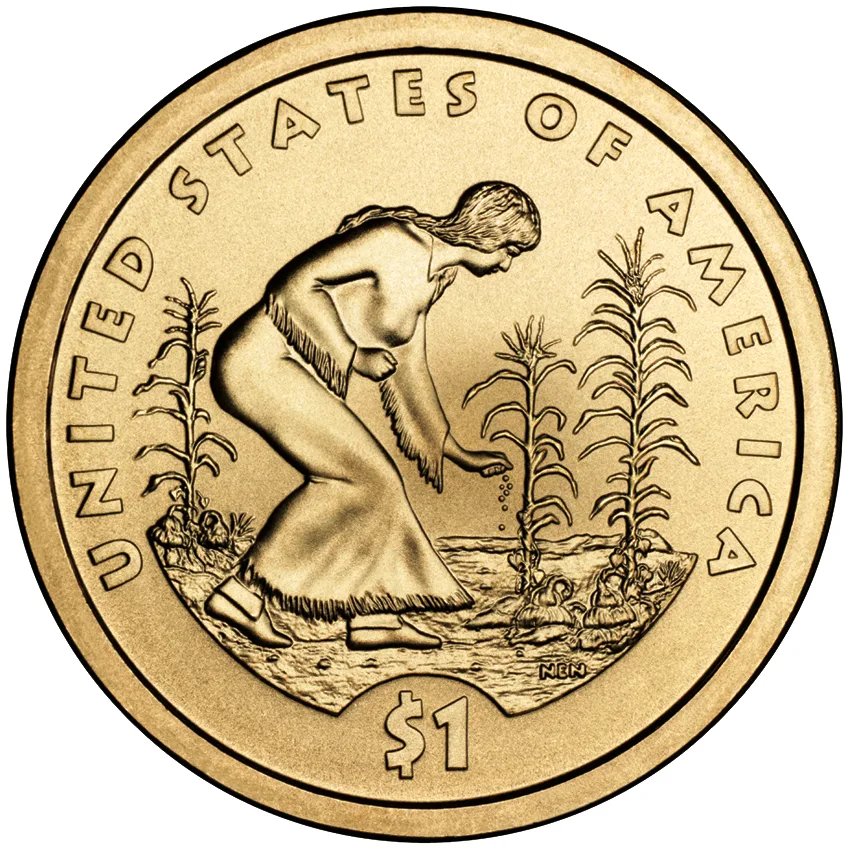
- 2009 — Spread of Three Sisters Agriculture: A Native American woman planting seeds amid the “Three Sisters” (corn, beans, squash). Designer: Norman E. Nemeth.
- 2010 — Government — Great Tree of Peace: A Hiawatha Belt with five arrows symbolizing the Iroquois Confederacy. Designer: Thomas Cleveland.
- 2011 — Wampanoag Treaty of 1621: Hands of Supreme Sachem Ousamequin Massasoit and Governor John Carver, with a peace pipe. Designer: Richard Masters.
- 2012 — Trade Routes of the 17th Century: A horse and Native American profile in the sky representing trade. Designer: Thomas Cleveland.
- 2013 — Treaty with the Delawares (1778): A turkey, howling wolf, and turtle representing the Delaware (Lenape) clans. Designer: Susan Gamble.
- 2014 — Native Hospitality: A Native American offering provisions to Lewis and Clark. Designer: Chris Costello.
- 2015 — Mohawk Ironworkers: A Mohawk high-steel ironworker on a girder, honoring those who built skyscrapers. Designer: Ronald D. Sanders.
- 2016 — Code Talkers: Two helmets representing WWI and WWII Code Talkers. Designer: Thomas D. Rogers Sr.
- 2017 — Sequoyah: Cherokee scholar Sequoyah writing his syllabary. Designer: Chris Costello.
- 2018 — Jim Thorpe: The Olympic athlete in motion. Designer: Michael Gaudioso.
- 2019 — American Indians in the Space Program: Mary Golda Ross’s profile, an astronaut, and equations. Designer: Emily Damstra.
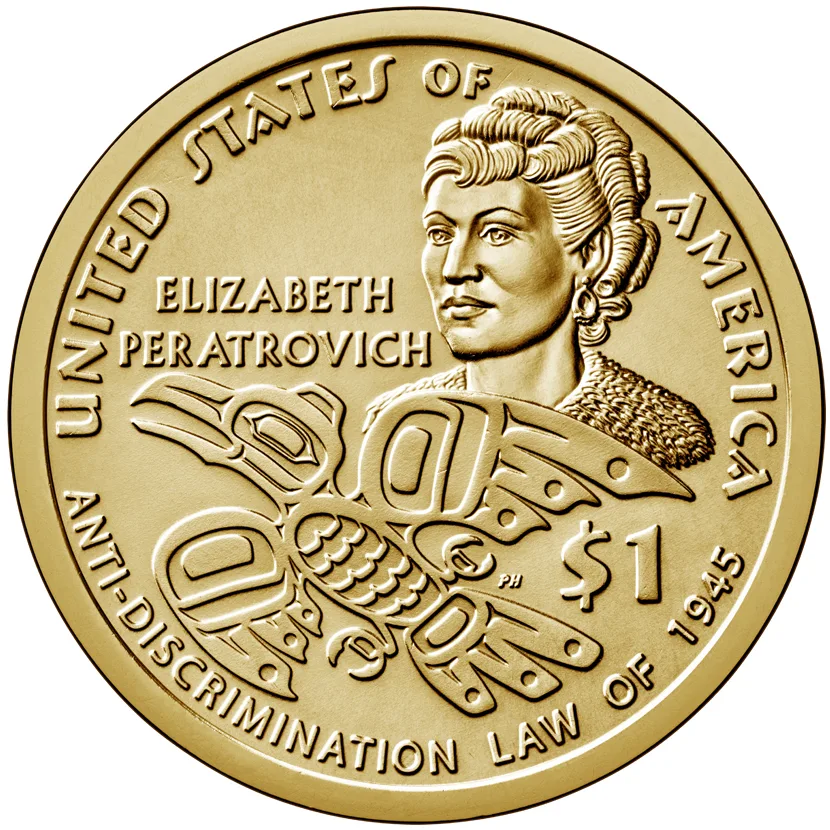
- 2020 — Elizabeth Peratrovich and Anti-Discrimination Law: The Tlingit civil rights leader. Designer: Benjamin Sowards.
- 2021 — Military Service: Native American soldiers in all five branches. Designer: Donna Weaver.
- 2022 — Ely S. Parker: The Seneca Union Army officer and Commissioner of Indian Affairs. Designer: Thomas Hipschen.
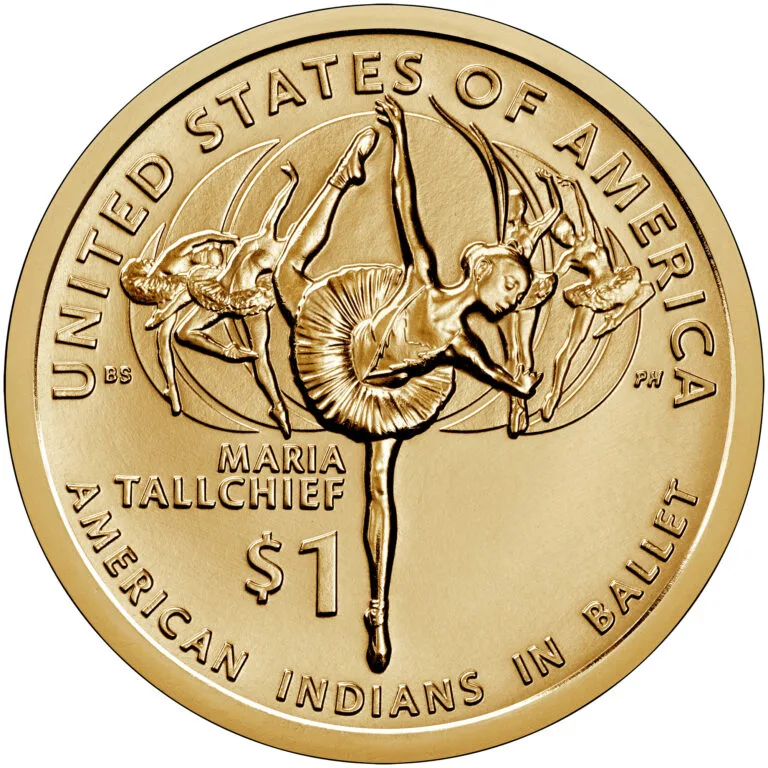
- 2023 — Maria Tallchief and American Indians in Ballet: The Osage prima ballerina. Designer: Beth Zaiken.
- 2024 — Indian Citizenship Act of 1924: A Native American man casting a ballot. Designer: Donna Weaver.
- 2025 — Charles Curtis: The Kaw Nation US Vice President. Designer: Ron Sanders.
- 2026 — Indian Reorganization Act (proposed): Theme finalized for the 2026 reverse.
Mintage Pattern
Native American $1 Coins are essentially collector-only issues. Annual mintages from 2012 onward have ranged from 1.5 million to 3 million per mint, with the bulk going to Mint sets and bags. Some quantities are released to Federal Reserve banks for distribution through transit authorities and casinos, but most Americans will never see one in change. This collector-only distribution means every well-preserved Native American $1 Coin commands a small premium over face.

Mint Marks and Production
Sacagawea Dollars were struck at three mints across the series. Mint mark identification is essential for both attribution and valuation.
Mint Mark Locations
- Philadelphia (P): Marked on every issue (rare for Philadelphia — most P-mint US coins of this era omit the mint mark). Mark sits to the right of the date on the obverse.
- Denver (D): Mark right of date on obverse.
- San Francisco (S): Proofs only, struck 2000-present. Found in annual Proof Sets and Silver Proof Sets. No silver Sacagawea Dollars were struck — the proofs share the same manganese-brass alloy as business strikes.
- West Point (W): One unique pattern issue only — the 2000-W $10 gold Sacagawea (see below).
Edge Lettering and Mint Mark Position (2009+)
Starting in 2009, the date and mint mark were moved from the obverse to the edge of the coin, in incused (sunken) lettering. The order on the edge reads E PLURIBUS UNUM, the date, and then the mint mark. This edge-lettering process is done after the coin is struck, in a separate edge-lettering machine — and this is where most of the famous error coins originate.

The 2000-P Cheerios Dollar
The Cheerios Dollar is the most famous variety in the Sacagawea series and one of the most valuable modern US coins. The story is part marketing campaign and part numismatic detective work.
The Cheerios Promotion
To promote the launch of the new dollar coin, the US Mint partnered with General Mills in late 1999 on a Cheerios cereal box promotion. 5,500 special boxes contained a 2000-P Sacagawea Dollar; one in every 4,400 boxes also contained a $1 Lincoln cent (not relevant here). Collectors and the public alike pulled the coins out of boxes; for years afterward, they were assumed to be ordinary 2000-P coins.
The Pattern Reverse Discovery
In 2005, numismatist Tom DeLorey examined a Cheerios Dollar and noticed that the reverse eagle’s tail feathers were sharply detailed — markedly different from regular 2000-P coins. Subsequent research established that the Cheerios coins had been struck with an early pattern reverse die showing the eagle’s tail feathers as enhanced and detailed, before the Mint chose a slightly simpler final design for circulation production. The Cheerios coins are, in effect, pattern coins distributed through a cereal promotion.
How to Identify a Cheerios Dollar
The diagnostic feature is the eagle’s tail feathers. On a regular 2000-P Sacagawea, the tail feathers appear as relatively flat lines. On a Cheerios Dollar, the tail feathers are deeply detailed with strong central spines and pronounced barbs. Compare side-by-side with a known regular coin to see the contrast.
Values
An attributed Cheerios Dollar in MS-65 regularly sells for $2,500-$5,000. MS-67 examples have reached $10,000+. Even worn examples, if attributable, sell for $1,000+. PCGS, NGC, and ANACS all attribute the variety; an unattributed coin is much harder to sell at premium prices, so professional grading and attribution are essential for high-value examples. Of the 5,500 Cheerios coins originally placed, no one knows exactly how many have been preserved — fewer than 100 are confirmed in third-party holders today.
The Wounded Eagle and Presentation Strikes
The Wounded Eagle (also called the “Speared Eagle”) is a 2000-P variety in which a vertical die crack or raised die line appears to pass through the eagle’s body, creating the visual impression of a spear piercing the eagle. The variety is well-documented and listed in the major catalogues.
Identifying the Wounded Eagle
Look at the eagle’s lower body. A genuine Wounded Eagle shows a raised line running from the eagle’s belly down through the lower body and tail feathers. The line is a die crack on the reverse die, not damage to the coin. In high grade the line appears bold and sharp; in worn grades it may be visible but soft.
Value
Wounded Eagles in MS-65 sell for $200-$500; MS-66 and finer can reach $1,000-$2,000. Lower grades typically bring $50-$150.
Glenna Goodacre Presentation Coins
In 2000 the Mint paid sculptor Glenna Goodacre $5,000 for her design work — in 5,000 specially burnished 2000-P Sacagawea Dollars. These Goodacre Presentation coins are visually distinguishable from regular 2000-P coins by their satin, slightly prooflike finish and exceptional strike quality. PCGS and NGC attribute genuine Goodacre coins, often with the “SP” (Specimen) designation rather than MS. SP-68 to SP-70 examples are typical. Values: SP-68 $300-$500, SP-69 $600-$1,000, SP-70 $2,000+.
The 2000-W $10 Gold Pattern
Twelve 2000-W Sacagawea Dollars were struck in solid 22-karat gold at West Point — not for circulation, but as a unique trial issue. The coins weigh about 16.7 grams and contain roughly half a Troy ounce of gold. They were intended as a Mint test piece; the proposal to issue them officially as gold $10 coins never advanced beyond pattern stage.
The Space Shuttle Connection
In a curious historical footnote, the twelve gold Sacagaweas were carried aboard the Space Shuttle Columbia during STS-93 in July 1999 — the same mission commanded by Eileen Collins, the first woman to command a Space Shuttle mission. The coins thus traveled to space before their design was even officially released for circulation. After the mission, the Mint placed them in storage at Fort Knox, where they remain today. They have never been sold to the public, and ownership is restricted to the US government.
Identification
If you ever encounter a “2000-W Sacagawea in gold” in the market, it is almost certainly a counterfeit or a privately gold-plated regular coin. The genuine 2000-W gold pieces are not legally salable and are held by the Mint. Counterfeits are sometimes sold to unwary buyers as the “real thing.” A real 2000-W Sacagawea would weigh about 16.7 g; a gold-plated manganese-brass coin weighs 8.1 g.
The 2000-P Sacagawea / Washington Quarter Mule
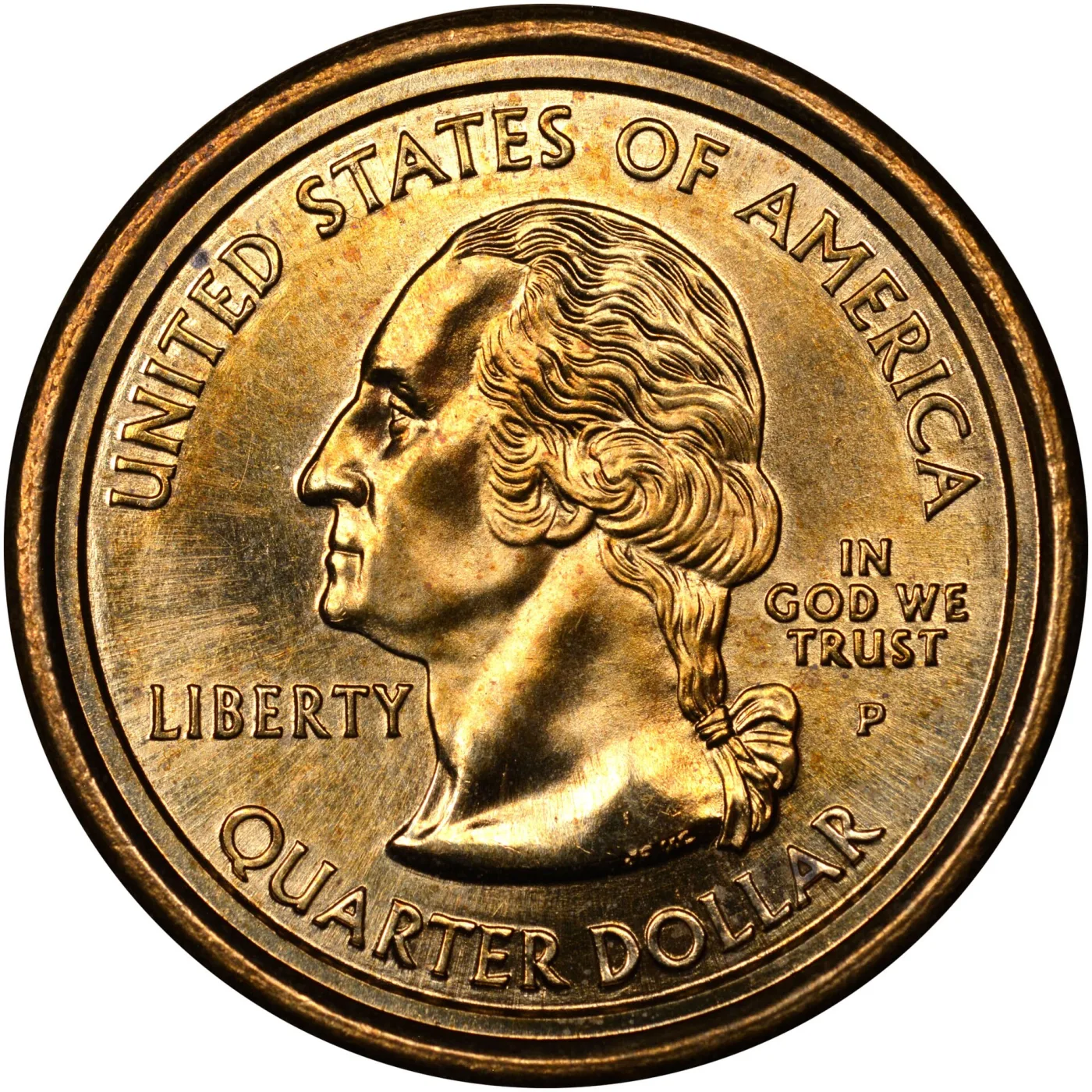
One of the rarest and most valuable modern US error coins is the 2000-P Sacagawea Dollar / Washington State Quarter mule — a coin struck with a Sacagawea Dollar reverse die and a State Quarter obverse die. The obverse in question is the Washington portrait shared by all fifty state quarters, not the quarter honouring the state of Washington — the mismatch is between denominations, not between states. A mule is a coin struck with mismatched obverse and reverse dies that were never intended to be paired.
How the Error Happened
The Sacagawea Dollar planchet (26.5 mm) and the Washington Quarter obverse die both fit the same physical press setup, allowing the misassembly. In early 2000, Mint workers accidentally mounted a State Quarter obverse die in a press loaded with Sacagawea Dollar planchets. A small number of mule coins were produced before the error was discovered.
Identification
The mule has the obverse of a Washington State Quarter (George Washington’s profile, the legend UNITED STATES OF AMERICA, the date 2000, and LIBERTY) but is struck on the manganese-brass planchet of a Sacagawea Dollar (golden color, 26.5 mm diameter, plain edge). The reverse is the Sacagawea Soaring Eagle. The coin is unmistakable — there is no other way to produce a Washington-quarter obverse on a golden manganese-brass planchet.
Value
About 19 examples are confirmed and certified. Sales are rare — typical auction realizations run $75,000-$200,000 depending on grade. A finest-known example in MS-66 sold for $192,000 at Heritage in 2018. This is one of the highest-value modern US error coins, comparable to the famous 1943 copper Lincoln cent.
Edge Lettering Errors (2007+)
The 2007 introduction of edge lettering on Presidential Dollars created an entirely new category of error coin, and the same edge-lettering process applies to Native American $1 coins from 2009 onward.
Missing Edge Lettering
If a Native American $1 Coin skips the edge-lettering station, it leaves the Mint with a plain edge — no date, mint mark, or motto. These “smooth edge” coins are easily confused with the older Soaring Eagle issues, but the reverse design will be from 2009 or later, immediately distinguishing them. Values range from $50-$200 for common years, higher for rarer designs.
Doubled Edge Lettering
If a coin passes through the edge-lettering machine twice, it picks up two overlapping sets of edge inscriptions. Identification requires careful examination of the edge. Values: $50-$150.
Weak or Missing Lettering Segments
Partial edge lettering (where some characters are weak or missing while others are full) is more common and less valuable, typically $10-$30.
Wrong-Year or Misaligned Lettering
Rare cases of edge-lettering machines using a die from the wrong year exist; these are scarcer and more valuable when authenticated. Always check the obverse date against the edge date — they must match.
Key Dates and Modern Varieties
Although Sacagawea Dollars are modern coins, several dates and varieties command real premiums.
Top Variety / Error Issues
- 2000-P Cheerios Dollar: $1,000-$10,000+ depending on grade.
- 2000-P Washington Quarter Mule: $75,000-$200,000.
- 2000-P Goodacre Presentation: $300-$2,000.
- 2000-P Wounded Eagle: $50-$2,000.
- 2007+ Plain Edge Errors: $50-$200.
- 2009 Missing Edge Lettering: $50-$150.
Best Conventional Dates
- 2002-P and 2002-D: First low-mintage year; uncirculated rolls run $80-$150.
- 2003-2008 P and D issues: Collector-only releases. Uncirculated singles run $3-$8; rolls $80-$150.
- 2011+ Native American $1 issues: Most years are 2.5-3 million mintage per mint, common in collector grade but never seen in circulation.
Proof Issues
San Francisco proofs from 2000 onward sell for $5-$15 individually in PR-68 to PR-70. Silver proofs do not exist — all Sacagawea proofs use the standard manganese-brass alloy. Compare this to the silver-proof versions available for the Roosevelt Dime, Kennedy Half Dollar, and Washington Quarter.
Grading Sacagawea Dollars
Like all modern US coins, Sacagawea Dollars are graded on the Sheldon scale (1-70) but realistically span only the upper end: most surviving coins are mint-state, and grades below MS-60 are unusual unless the coin has spent years in circulation.
Key Grade Points
- MS-60 to MS-62: Uncirculated but with noticeable bag marks, contact marks, or fingerprints. Many big-mintage 2000-P/D coins fall here.
- MS-63 to MS-64: Cleaner surfaces, modest marks. Typical roll-grade quality.
- MS-65 to MS-66: The “gem” range. Few contact marks, full luster, no spotting. Most preserved Sacagaweas with effort can reach MS-65.
- MS-67 to MS-68: Top-quality coins. Critical for Cheerios Dollar valuations.
- MS-69 to MS-70: Essentially perfect coins. More common on proofs than business strikes.
The Spot Problem
Manganese-brass spots are the curse of the Sacagawea collector. Even bag-stored uncirculated coins develop carbon spots over time, and a spot in the wrong place can pull a coin from MS-67 down to MS-64. When buying, examine high-resolution images carefully — a spot on Sacagawea’s cheek matters far more than one in the field. The same patina problem applies, in muted form, to manganese-brass Presidential Dollars and to some Eisenhower Dollar issues.
Strike Quality
Look for full feather detail in Sacagawea’s hair, full detail on Jean Baptiste’s face in the cradleboard, and full strike on the eagle’s tail feathers (Soaring Eagle reverse). The 2000-P series in particular suffers from weakness on the eagle’s tail feathers — the famous Cheerios Dollar diagnostic is essentially a comparison of strike quality.
Authentication and Spotting Fakes
Most Sacagawea Dollars are too low-value to counterfeit, but a few categories attract fakery worth watching for.
Gold-Plated Regular Coins
Some sellers offer “gold Sacagawea Dollars” that are nothing more than regular manganese-brass coins gold-plated. Real gold coins (2000-W) are not legally sold. A gold-plated coin weighs 8.1 g; a real gold coin weighs 16.7 g. The plating is usually thin and wears at high points within months.
Fake Cheerios Dollars
The Cheerios premium has motivated some sellers to misattribute regular 2000-P coins as Cheerios. The diagnostic is the eagle’s tail feathers. Always demand professional certification (PCGS, NGC, ANACS) with the variety attribution noted on the holder — an “MS-65” without “Cheerios” notation is not a Cheerios coin even if the seller claims it.
Fake Mules
The Washington Mule’s six-figure value motivates fakery. Genuine examples are certified by PCGS or NGC and have full provenance traces. Never buy a raw mule. The number of confirmed examples (about 19) is small enough that auction records can be traced.
Altered Edge Lettering
Some “missing edge” coins have been deliberately filed or sanded smooth. Authentic missing-edge errors have crisp, original edges — no file marks, no metal flow disturbance. Examine the edge under magnification.
The Magnet Test (Authentication)
Real manganese-brass Sacagawea Dollars are non-magnetic. A magnetic coin is not authentic. (This contrasts with the 1943 steel cent, which is highly magnetic.)
Current Market Values and Price Guide
These are approximate 2026 retail values for problem-free, certified coins. Raw coins typically trade at 60-75% of these prices.
Regular Business Strikes
- 2000-P / 2000-D: Face to $2 in MS-65; $5-$15 in MS-67.
- 2001-P / 2001-D: $2-$4 in MS-65; $15-$30 in MS-67.
- 2002-P / 2002-D: $5-$10 in MS-65; $30-$60 in MS-67.
- 2003-2008 P / D: $3-$8 each in MS-65; $25-$75 in MS-67.
- 2009-Present Native American: $2-$5 in MS-65; $15-$40 in MS-67.
Proof Issues
- 2000-S to present: $5-$10 in PR-68; $15-$30 in PR-70.
Major Varieties
- 2000-P Cheerios: $1,000-$10,000 by grade.
- 2000-P Wounded Eagle: $50-$2,000 by grade.
- 2000-P Goodacre Presentation: $300-$2,000 by grade.
- 2000-P / Washington Quarter Mule: $75,000-$200,000.
- 2007+ Missing Edge Lettering: $50-$200.
Bullion Floor
None. The coin contains no precious metal. Manganese-brass has industrial value of pennies. Numismatic value is everything.
Building a Sacagawea Dollar Collection
The Sacagawea series is approachable and rewarding for beginners. A complete date-and-mint-mark set through 2008 (Soaring Eagle) requires 18 coins (9 years × 2 mints, plus 9 proofs). Adding the Native American $1 series brings the total to 50+ coins through 2025 — a substantial but achievable collection.
Approach Strategies
- Type Set: One Soaring Eagle, one Native American. Cheapest entry point.
- Date and Mint Set: 2000 through latest year, P and D. Mid-cost.
- Date, Mint, and Proof Set: Adds S proofs. Higher cost.
- Variety Set: Adds Wounded Eagle, Goodacre Presentation, Cheerios. Expensive but exciting.
- Errors: Edge-lettering and mule errors. Specialized and competitive.
Where to Buy
Modern dollar coins are widely available from Heritage, Stack’s Bowers, GreatCollections, and eBay. Mint roll boxes (25 coins) are often the cheapest way to acquire many years in MS-63 to MS-65. For certified high-grade or variety coins, stick to PCGS or NGC slabs.
Set Registry Participation
PCGS and NGC operate set registries for Sacagawea Dollar collectors. The Sacagawea / Native American Dollar registries are popular and competitive. Building a top-25 set in MS-67/MS-68 is achievable with patience and modest investment compared to classic series like the Morgan Dollar.
Storage and Preservation
Manganese-brass is uniquely prone to spotting, so storage matters more for Sacagaweas than for many other modern coins.
Best Practices
- Sealed inert holders: PCGS, NGC, or Mylar 2x2 flips. Avoid PVC flips.
- Low humidity: Below 50% RH. Use silica gel packets and replace them annually.
- Stable temperature: 60-70°F. Avoid attics and basements.
- Avoid contact: Never touch the coin’s surface with bare fingers. Hold by the edge or wear cotton gloves.
- Avoid cleaning: Once a Sacagawea has developed patina, cleaning it almost always destroys its numismatic value. Authentic dark patina is preferable to “improved” surfaces.
The Mint Set Sealed-Pack Strategy
Many collectors keep Mint-issue Sacagaweas in their original sealed government packaging. The Mylar inserts in US Mint Annual Uncirculated Coin Sets provide adequate protection for routine storage. Opening the pack starts the patina clock.
Frequently Asked Questions
Is my Sacagawea Dollar gold?
No. The coin's golden appearance comes from the manganese-brass alloy (88.5% copper, 6% zinc, 3.5% manganese, 2% nickel). The coin contains no gold whatsoever, except for the twelve 2000-W pattern pieces held by the Mint at Fort Knox.
What is my 2000 Sacagawea worth?
Almost certainly face value ($1). Mintages for 2000 were over 1.2 billion. To be worth more, your coin must be a documented variety: Cheerios Dollar (tail feather details), Wounded Eagle (line through belly), Goodacre Presentation (satin finish), or Washington Mule. Standard 2000-P/D coins in worn condition are worth $1; in MS-65 perhaps $2.
Why did the Sacagawea Dollar fail to circulate?
The same reason the Susan B. Anthony failed: as long as the dollar bill remains legal tender, Americans prefer paper for everyday transactions. Dollar coins are heavier and bulkier than bills and cashiers find them confusing. Without retiring the dollar bill — which Congress has never done — no dollar coin has ever circulated successfully in the modern US.
How is the Sacagawea different from the Susan B. Anthony?
Same diameter (26.5 mm) but golden color (manganese-brass vs. clad), plain edge through 2008 (vs. reeded), and entirely different obverse and reverse designs. Cashiers can distinguish a Sacagawea from a quarter by color; the Susan B. Anthony's silver color caused constant confusion.
Are Native American $1 Coins worth more than Sacagaweas?
Slightly. Native American $1 Coins (2009+) are essentially collector-only releases, so even common dates trade at $2-$3 in uncirculated grade. The thematic reverses also attract specialty collectors.
How do I tell a real Cheerios Dollar?
Examine the eagle's tail feathers under good light. Detailed barbs and prominent central spines = Cheerios. Flat or simple tail feathers = regular 2000-P. Always confirm with professional certification before paying premium prices. PCGS, NGC, and ANACS attribute the variety.
Should I clean my Sacagawea Dollar?
No. Manganese-brass patina is part of the coin's natural history. Cleaning removes original surfaces and almost always damages numismatic value. If your coin has spotted, leave it alone — collectors price patina'd coins fairly, and a coin with original spotting is worth more than the same coin cleaned bright.
Are Sacagawea Dollars still being made?
Yes, but only for collectors. Each year's Native American $1 reverse continues, with mintages of 2-3 million coins per mint. None are released into general circulation through normal banking channels.