Flowing Hair Dollar Identification Guide: 1794 First Silver Dollar, 1795 Varieties, Bowers-Borckardt Attribution, and Values
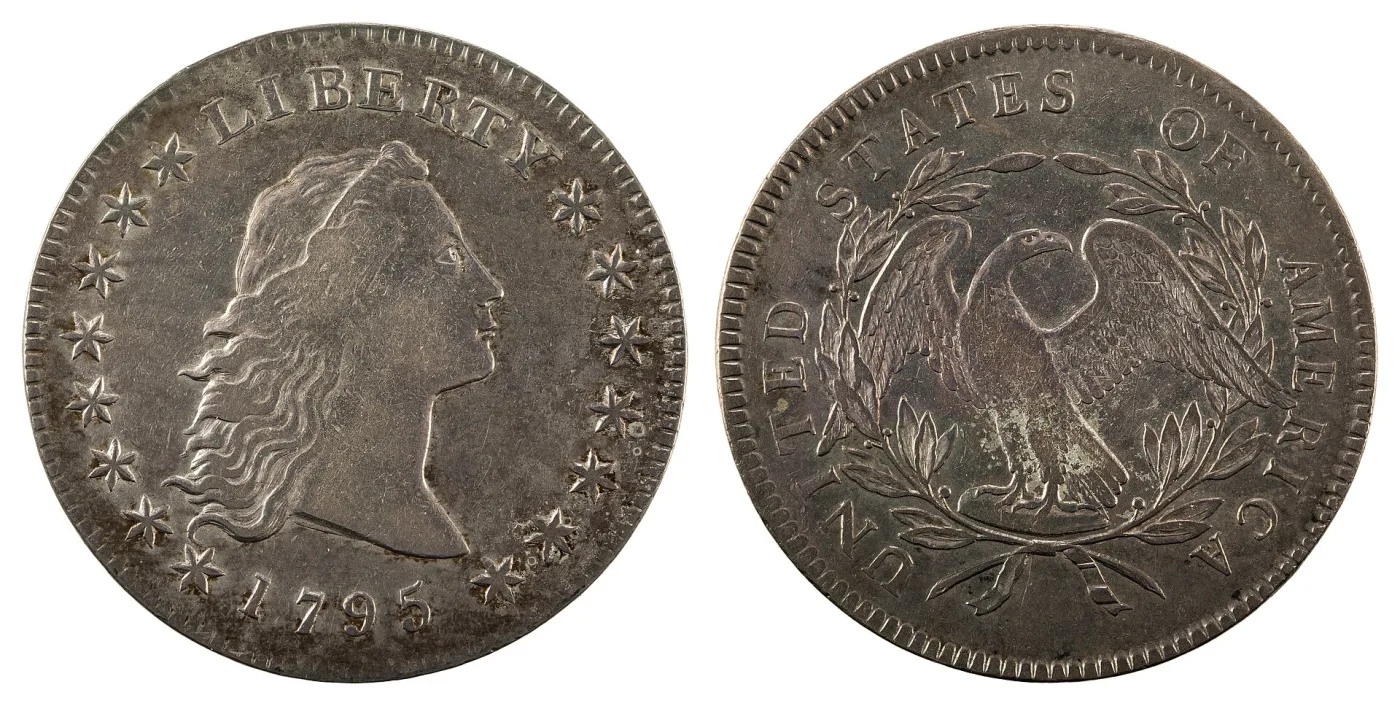
The Flowing Hair Dollar — struck in 1794 and 1795 — is the first silver dollar ever produced by the United States Mint and the founding coin of the entire American silver dollar series. Designed by chief engraver Robert Scot, it shows Liberty with wild, untamed hair flowing freely behind her, paired with a small naturalistic eagle inside a sparse open wreath on the reverse. Only about 1,758 pieces were struck on October 15, 1794, and perhaps 130 to 150 of those survive today in any grade. The famous Neil-Carter-Contursi 1794 specimen, considered the finest known, sold for $10,016,875 in 2013 — at the time the highest price ever paid for any coin. In 2022, the same coin re-sold for $12 million, reaffirming the Flowing Hair Dollar’s place at the apex of American numismatics.
This guide walks through every aspect of identifying, attributing, grading, and valuing Flowing Hair Dollars. You will learn how to distinguish the 1794 from the 1795 issue, recognize the Head of 1794 versus Head of 1795 obverse hubs used on 1795-dated coins, attribute Bowers-Borckardt (BB) die varieties, identify silver plug planchets, count obverse and reverse stars correctly, separate two-leaves from three-leaves reverses, detect contemporary and modern counterfeits, and accurately price coins in every grade from a well-worn G-4 1795 to a Specimen-66 1794.
Whether you are evaluating a family heirloom, considering a major purchase, or simply studying America’s foundational silver coin, this guide provides the working knowledge necessary to handle Flowing Hair Dollars with the seriousness they deserve. These are not coins to buy raw, on impulse, or without certification — but they are coins every serious early-American specialist eventually owns or aspires to own.
History: America’s First Silver Dollar
The Coinage Act of April 2, 1792 authorized the United States Mint and specified the silver dollar as the foundation of the new American monetary system, weighing 416 grains of standard silver at .8924 fineness. The legislation set the dollar as the unit of account around which all smaller denominations were to be reckoned. Yet the actual production of silver dollars proved far more difficult than the law anticipated. The new Philadelphia Mint, located at Seventh and Filbert Streets, lacked a press large enough to strike a coin of the dollar’s size and weight. Mint Director David Rittenhouse had to commission a custom press from outside suppliers and wait nearly two and a half years before silver dollar coinage could begin.
On October 15, 1794, the Mint finally struck approximately 2,000 silver dollars, of which 1,758 passed inspection and were released into circulation. The remaining pieces were considered substandard — many were weakly struck on the left side because the press was undersized for the job — and were melted. Of the 1,758 released, perhaps 130 to 150 survive today. Director Rittenhouse personally retained the finest examples as presentation pieces; several of these are the source of the great specimen-grade survivors that command eight-figure prices at auction.
The 1795 production resumed and continued in larger volume, with approximately 160,295 Flowing Hair Dollars struck before the design was replaced mid-year by Robert Scot’s new Draped Bust Dollar. By October 1795 the Flowing Hair was history — a design that lasted barely a year on the silver dollar but that, more than any other coin, marks the birth of the American silver coinage tradition.
Why the Design Was Replaced So Quickly
Contemporary critics found Liberty’s wild flowing hair undignified — too suggestive of a windswept peasant rather than the classical goddess they expected. Mint Director Henry William DeSaussure, who replaced Rittenhouse mid-1795, made redesigning the silver dollar one of his first priorities. The result was the Draped Bust portrait, based on a drawing by Gilbert Stuart, which depicted Liberty in a much softer, more classical pose with carefully arranged hair and a drape across her bust. The Flowing Hair design briefly continued on the half cent, the Flowing Hair Half Dime, and the Flowing Hair Half Dollar through 1795 before being replaced everywhere by the Draped Bust — the same portrait that would define the Draped Bust Half Dime of 1796-1805 and the Draped Bust Half Dollar of 1796-1807.
Design: Robert Scot’s Flowing Hair Liberty
Understanding every element of the Flowing Hair design is essential for accurate attribution and counterfeit detection. The design was Scot’s first major work as Chief Engraver and shows both his ambition and the limitations of late-eighteenth-century American die-cutting.
Obverse (Heads Side)
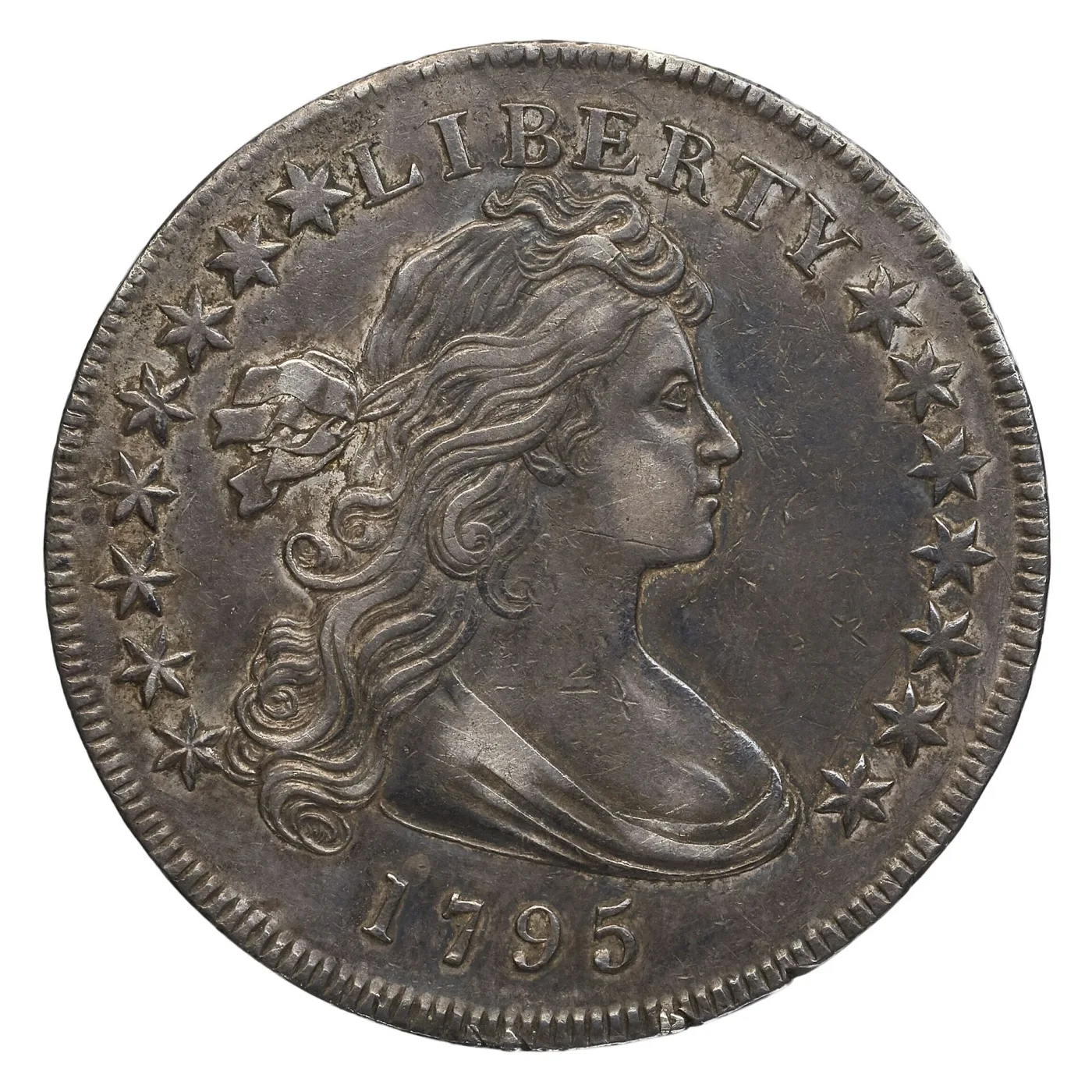
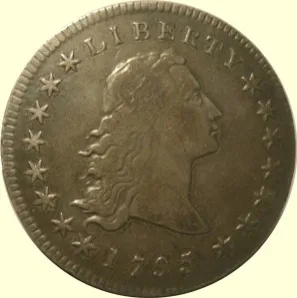
The obverse shows Liberty facing right, her hair flowing wildly behind her in long, uncombed strands. There is no ribbon, no drape, no classical fillet — just hair and a bare neck. The legend LIBERTY arches across the top above her head, the date appears below the bust truncation, and stars surround the portrait in the field. The 1794 issue carries fifteen stars representing the fifteen states then in the Union (after Vermont and Kentucky had joined). The 1795 issue continued with fifteen stars on most varieties, though a few late-1795 dies show varying counts as the Mint experimented with the addition of Tennessee.
No designer’s initials appear on the coin. The portrait is sometimes described as the “windswept Liberty” or “Goddess of the Storm” by collectors — terms that capture the dramatic, almost theatrical character of the design.
Reverse (Tails Side)
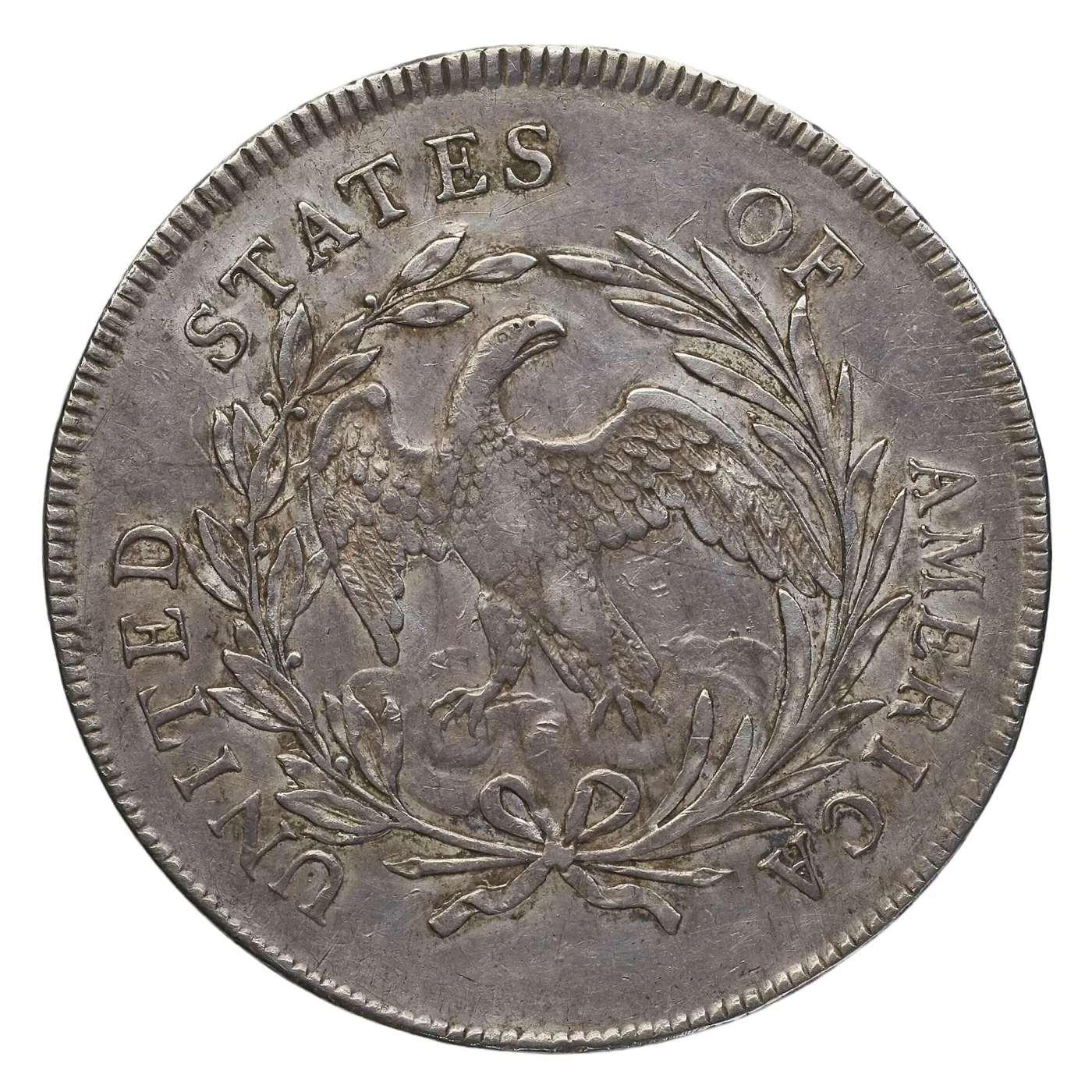
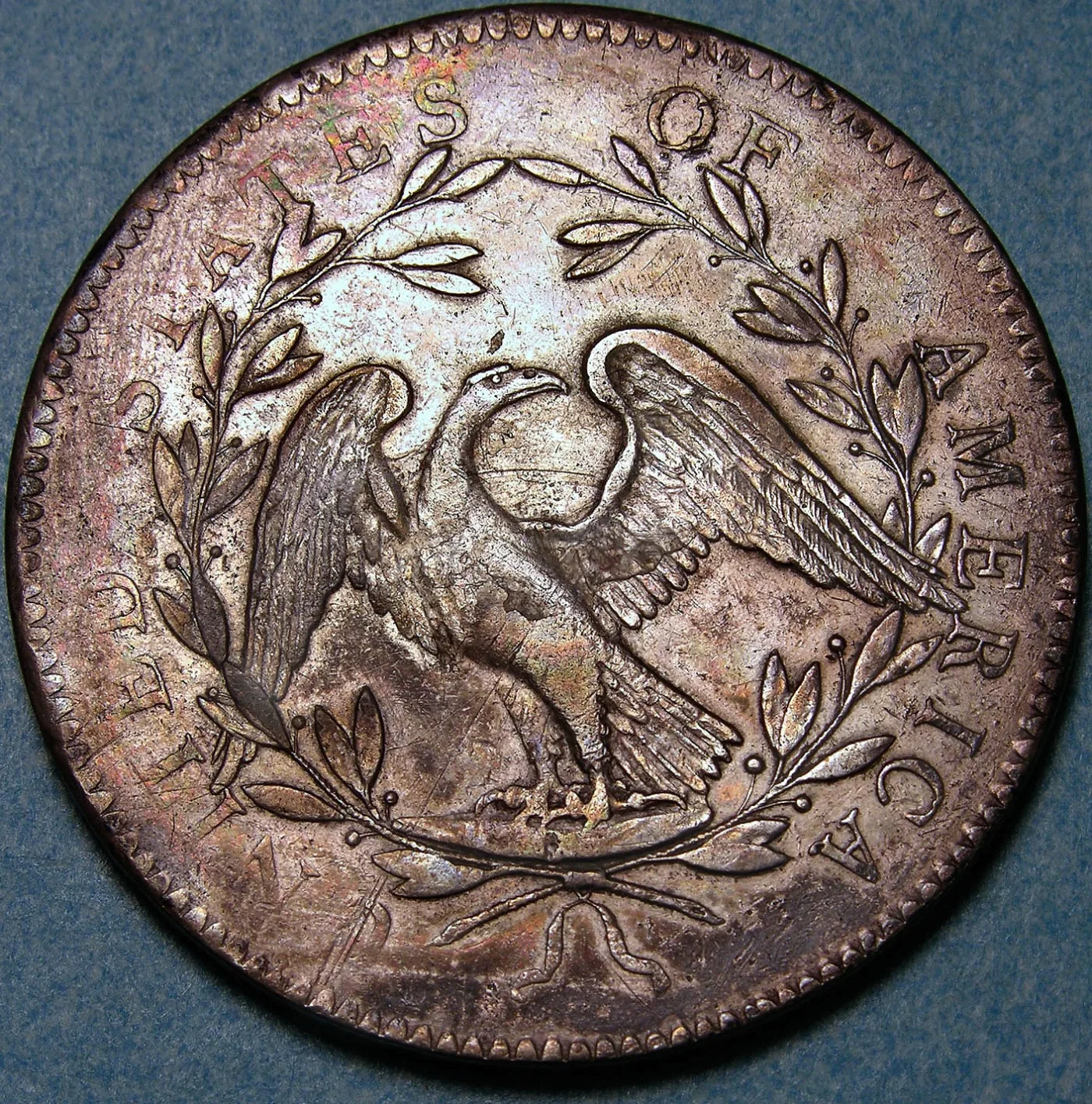
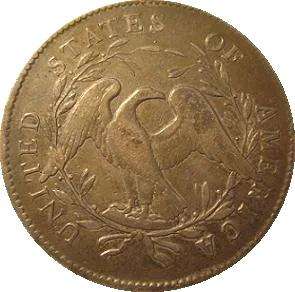
The reverse depicts a small naturalistic bald eagle with wings partially spread, standing on a rock or perch, surrounded by a laurel wreath formed of two separate branches that cross at the bottom and are tied there with a ribbon bow, their tips stopping short of each other at the top — which is what leaves the wreath open. The legend UNITED STATES OF AMERICA arches around the perimeter. The eagle is depicted as a real bird in a believable pose — not the heraldic shield-bearing eagle of the later Draped Bust Heraldic Eagle reverse. There is no denomination expressed anywhere on the coin; value was understood from the size, weight, and lettered edge alone.
Edge
The edge carries the lettering HUNDRED CENTS ONE DOLLAR OR UNIT, with decorative ornaments (leaves and lyres) between the words. The lettering was applied with a Castaing machine before striking, so the orientation may run in either direction (head-side-up or tail-side-up) depending on how the planchet entered the press. The edge is a critical authentication checkpoint — any Flowing Hair Dollar with a smooth, reeded, or plain edge is either a counterfeit or a damaged piece with the edge lettering removed.
Composition and Specifications
Knowing the metal content and physical specs is essential for both authentication and for understanding why the coins were struck and circulated as they were.
Specifications
- Composition: .8924 silver, .1076 copper (the original US standard authorized by the 1792 Coinage Act, lower than the later .900 fine standard).
- Weight: 26.96 grams (416 grains of standard silver).
- Diameter: 39-40 mm (variable on early hand-finished planchets).
- Edge: HUNDRED CENTS ONE DOLLAR OR UNIT with decorative ornaments.
- Net silver weight: approximately 24.06 grams (0.774 troy oz pure silver).
Why the .8924 Standard?
The Coinage Act fixed the silver alloy at 1485 parts silver to 179 parts copper, working out to .8924 fine. The choice was deliberate: it matched, as closely as the math allowed, the silver content of the Spanish 8-reales coin that already circulated widely in the American economy. The intent was to make the US dollar exchange one-for-one with the Spanish dollar struck in Mexico — the Spanish colonial pillar and portrait dollars that were themselves defined against the milled real de a ocho standard. In practice the new American coins ran very slightly heavier in pure silver, which led many to be exported and melted in the Caribbean for their bullion premium — one reason silver dollar mintages stayed small even after the Flowing Hair gave way to the Draped Bust.
Why Composition Matters for Authentication
An authentic Flowing Hair Dollar will weigh very close to 26.96 grams. Worn coins may lose 0.5 to 1.5 grams over more than two centuries of circulation, but anything dropping below 25.0 grams is suspicious. Specific gravity should fall between 10.3 and 10.4. The .8924 alloy gives genuine examples a slightly warmer, more golden tone than the colder .900 silver of post-1837 federal coinage. Coins markedly off these specs, or showing a yellowish, pinkish, or unnaturally bright cast, demand professional testing before any purchase.
The 1794 Issue: Birth of the Silver Dollar
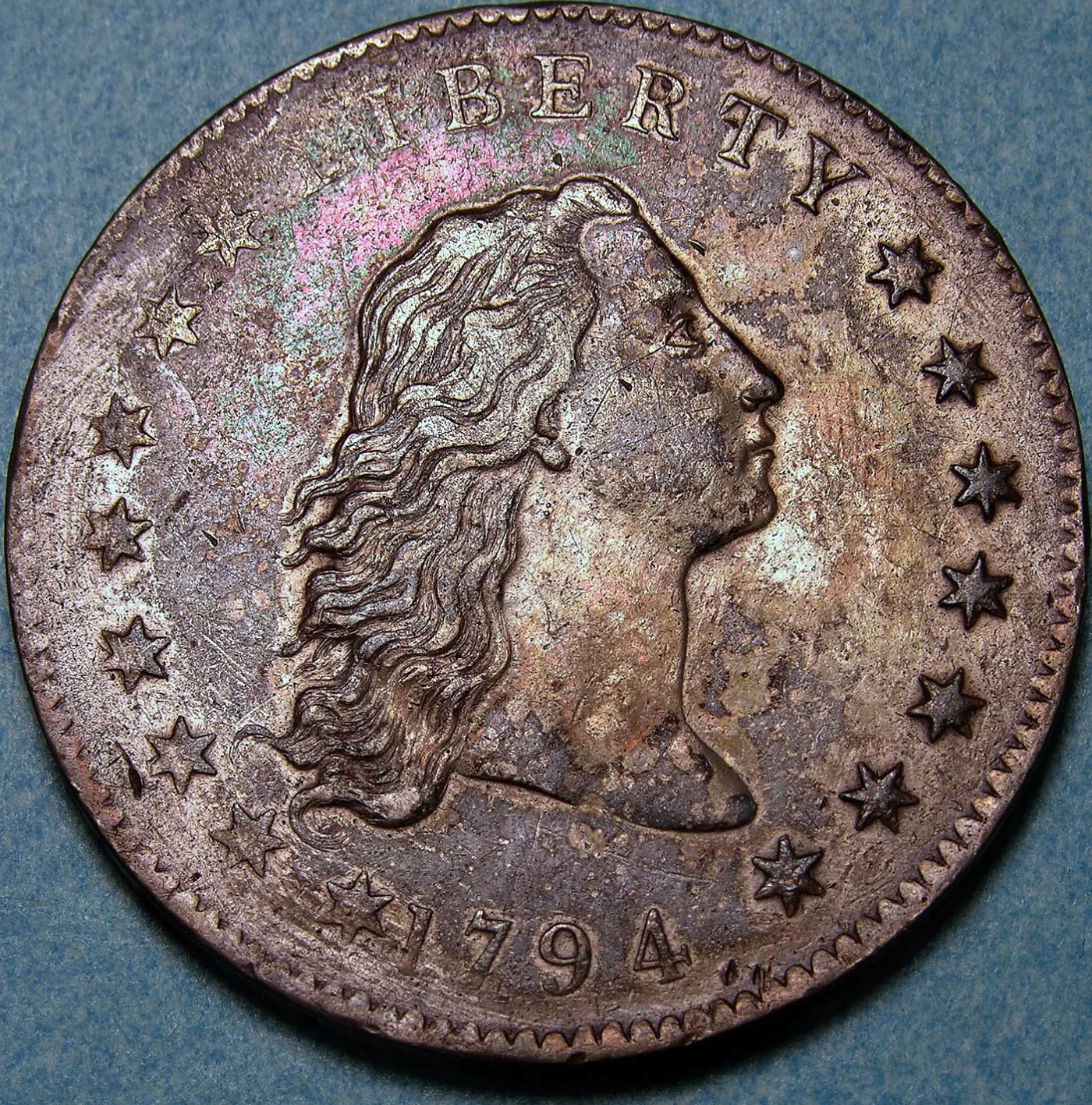
The 1794 Flowing Hair Dollar is the single most important silver coin in the entire American series. Only one obverse die and one reverse die were ever used, producing the unique die marriage now catalogued as BB-1, B-1. Every genuine 1794 dollar in existence comes from this single die pair. Approximately 1,758 pieces entered circulation; 130 to 150 are believed to survive.
Identification of the 1794
The 1794 is identified by:
- Date: 1794 in the lower obverse below the bust truncation.
- Stars: Fifteen stars on the obverse, distributed 8 left + 7 right.
- Reverse: Small eagle surrounded by an open wreath of two laurel branches with two leaves at the lower right and three leaves at the lower left, joined at the bottom.
- Strike: The single working press was undersized; virtually every genuine 1794 shows characteristic weakness on the left side of the obverse (Liberty’s hair and the date) and the corresponding right side of the reverse (eagle’s tail and wreath).
- Adjustment marks: Heavy file-like marks across the obverse or reverse are common and expected on genuine pieces — they were made by Mint workers reducing overweight planchets to spec before striking.
- Edge: HUNDRED CENTS ONE DOLLAR OR UNIT.
The Characteristic 1794 Weakness
Because the press at the Philadelphia Mint was too small for the dollar planchet, the dies were never fully impressed at the periphery. Liberty’s hair on the left, the leftmost stars, and the date often appear weak even on otherwise high-grade specimens. On the reverse, the corresponding right-side periphery (the wreath, the eagle’s right wing tip, and parts of the legend) shows similar weakness. This is not wear — it is strike weakness, and it is diagnostic of an authentic 1794. A 1794 that shows full strike on every periphery is almost certainly a counterfeit.
Survivors and Population
PCGS and NGC together have certified roughly 120 to 140 genuine 1794 dollars across all grades. Approximately a dozen are in mint state (MS-60 or higher). The finest known is the Neil-Carter-Contursi specimen, graded Specimen-66 by PCGS — the famous coin that sold for $10 million in 2013 and is widely considered the first silver dollar ever struck by the United States Mint, possibly the very first piece off the new press as a presentation specimen for Director Rittenhouse himself.
The 1795 Issue: Heads, Leaves, and Varieties
The 1795 Flowing Hair Dollar resumed production in earnest, with approximately 160,295 pieces struck before the design changed to the Draped Bust later in the year. Where 1794 has just one die marriage, 1795 has many — the standard reference catalogues over twenty distinct BB varieties. The 1795 is by far the more available date and is the only Flowing Hair Dollar most collectors will ever own.
Head of 1794 vs Head of 1795
One of the most important attributions on 1795 dollars is whether the obverse uses the Head of 1794 hub or the Head of 1795 hub. Early 1795 strikings used leftover Head of 1794 obverse dies. Mid-year, Scot prepared a new Head of 1795 hub with subtly different portrait features — slightly higher relief, different hair detail, and a marginally different facial profile. The Head of 1794 strikings of 1795 are notably scarcer than the Head of 1795 strikings and command significant premiums. Standard references attribute the head style on a die-by-die basis.
Two Leaves vs Three Leaves Reverse
The 1795 reverse exists in two main configurations distinguished by the number of leaves under each wing of the eagle: Two Leaves (two leaves under each wing) and Three Leaves (three leaves under each wing). Both varieties are recognized by PCGS and NGC and are typically attributed on the slab. Two Leaves is the more common variety; Three Leaves is scarcer and commands a modest premium in most grades.
Silver Plug Varieties
A small number of 1795 dollars (and a handful of 1794 examples) were struck on planchets containing a small silver plug — a circular piece of pure silver inserted into the center of an underweight planchet before striking, to bring the coin up to the legal weight standard. The plug is visible as a slightly different-colored disc, usually about 8 mm in diameter, in the central obverse and reverse. Silver plug 1795 dollars are great rarities and command premiums of two to five times comparable non-plug examples. The 1794 silver plug variety is unique and resides in the Smithsonian.
Identification Workflow for 1795
- Confirm Flowing Hair design: Wild flowing hair, no drape, no ribbon.
- Read the date: 1795 below the bust.
- Check the head style: Compare to reference photographs of Head of 1794 vs Head of 1795 hubs.
- Count leaves under each wing on the reverse: Two Leaves or Three Leaves.
- Check for a silver plug: Look for a circular disc of slightly different metal in the center of either side.
- Examine edge lettering: HUNDRED CENTS ONE DOLLAR OR UNIT.
- Confirm weight and diameter: 26.96 grams nominal, 39-40 mm.

Bowers-Borckardt (BB) Die Varieties
The standard reference for Flowing Hair Dollar die varieties is The Encyclopedia of United States Silver Dollars 1794-1804 by Q. David Bowers and Mark Borckardt (commonly cited as Bowers-Borckardt, abbreviated BB). The BB numbering system is the variety attribution standard used by PCGS, NGC, the major auction houses (Heritage, Stack’s Bowers), and virtually all serious collectors. An older Haseltine “B” numbering system exists in parallel and is sometimes cited; the BB and B numbers can usually be cross-referenced.
1794 BB-1
The unique die marriage of the 1794. Obverse: Head of 1794, fifteen stars, date 1794. Reverse: Small eagle on perch, open wreath, with the eagle’s tail pointing toward the U in UNITED. Every genuine 1794 Flowing Hair Dollar is BB-1; there is no other 1794 die marriage.
1795 BB-11 (B-1) — Two Leaves, Head of 1794
The earliest 1795 die marriage, using the Head of 1794 obverse hub paired with a Two Leaves reverse. Scarce in all grades and the most desirable 1795 variety for type collectors who want the early-state portrait.
1795 BB-21 (B-2) — Three Leaves, Head of 1795
A major Three Leaves variety pairing the new Head of 1795 obverse with a Three Leaves reverse. Common in lower grades; scarce in AU and above.
1795 BB-27 — Two Leaves, Silver Plug
One of the rare silver plug varieties. The visible plug is approximately 8 mm in diameter and gives the coin its distinctive look. A small number are known across both two leaves and three leaves reverses.
1795 BB-51, BB-52 — Late-State Dies, Often Confused with Draped Bust
The very last Flowing Hair dies, struck in mid-1795 just before the Draped Bust transition. Both BB-51 and BB-52 are scarce and represent the design’s swan song. Don’t confuse them with the early 1795 Draped Bust dollars (the design change happened mid-year and both designs share calendar year 1795).
Why BB Numbers Matter
For ordinary collectors building a type set, BB numbers matter less than the major design varieties (Head of 1794/Head of 1795, Two Leaves/Three Leaves, Silver Plug/no Plug). For specialists, BB numbers can mean enormous price differences — a common BB-21 1795 in VF might sell for $4,500, while a rare BB-11 of the same grade could bring $10,000+. If you are buying a high-value Flowing Hair Dollar, always request the BB attribution from the seller and verify it against the certification holder. A BB-attributed coin in a PCGS or NGC slab is the gold standard.
The Silver Plug Planchets
The silver plug planchets are one of the most fascinating chapters in early Mint history. They reflect the Mint’s struggle to produce dollars that met the legal weight standard despite primitive planchet-rolling equipment that produced strips of inconsistent thickness.
Why the Plugs Were Used
The Coinage Act required every silver dollar to weigh exactly 416 grains. Planchets cut from strips that ran slightly thin would be light by perhaps 5 to 15 grains — outside the legal tolerance. Rather than melt the underweight planchet and start over, Mint workers drilled a small hole in the center, inserted a plug of pure silver of the correct compensating weight, and struck the coin normally. The plug fused with the planchet under die pressure and emerged as a slightly different-colored circular disc in the finished coin’s center.
How to Identify a Silver Plug
The plug appears as a circular disc, typically 7-9 mm in diameter, in the very center of both the obverse and reverse. It is most visible in higher grades where the original surface is preserved. The plug’s color is slightly whiter and brighter than the surrounding alloy because the plug is pure silver while the surrounding metal is .8924 silver / .1076 copper. On worn or toned coins, the plug may show as a faint outline rather than a sharp color contrast.
Authentication of Silver Plugs
Modern counterfeiters have begun adding fake silver plugs to ordinary 1795 dollars to inflate their value. Genuine silver plug examples show diagnostics that include: a slight raised or depressed edge around the plug from striking pressure; consistent plug positioning on both sides of the coin (because the plug runs all the way through the planchet); and correct overall weight that matches the legal standard. Any “silver plug” 1795 should be submitted to PCGS or NGC for authentication; the silver plug attribution is one that the major services research carefully before noting on the slab.
Star Count and Obverse Diagnostics
Star count on the obverse is a critical identification point on early American silver dollars. The Flowing Hair Dollar carries fifteen obverse stars across both dates, but the arrangement and exact spacing varies by die.
Standard 8+7 Arrangement
The standard configuration is eight stars to the left of Liberty’s head and seven to the right, totaling fifteen — representing the fifteen states then in the Union (the original thirteen colonies plus Vermont, admitted 1791, and Kentucky, admitted 1792). This 8+7 split is universal on the 1794 (BB-1) and on most 1795 dies.
Variant Counts
A few late-1795 dies show fifteen stars in a different arrangement, or in rare cases additional star punches in the field from die preparation errors. Tennessee was admitted in 1796, so no Flowing Hair Dollar can show the sixteen-star configuration briefly used on the early Draped Bust pieces. Star counts deviating from fifteen on a Flowing Hair Dollar are an immediate red flag for either a counterfeit or a misidentification.
Star Centers and Grade
Star centers — the radial lines visible inside each star — are useful grading checkpoints. In high grades (XF and above), most star centers should show partial or full radial lines. In Fine to Very Fine, perhaps half the stars show radial lines. In Good, the stars appear as flat outlines without internal detail. Differential wear across stars (some sharp, some flat) usually indicates strike weakness rather than circulation wear, especially on the 1794 where the undersized press left certain stars softly impressed.
Grading Flowing Hair Dollars
Grading Flowing Hair Dollars is among the most difficult tasks in American numismatics. The coins were struck on hand-prepared planchets with primitive equipment, so strike weakness, adjustment marks, planchet flaws, and uneven surfaces are common even on uncirculated examples. Distinguishing original surface from wear, and strike weakness from circulation wear, takes practice.
Key Wear Points
Wear shows first on the high points: Liberty’s cheek and the high curls of her hair on the obverse; the eagle’s breast and the high feathers on the reverse. Specific checkpoints:
- Liberty’s cheek: The smoothest area is the cheek; light friction shows here first as a slight loss of original surface texture.
- Liberty’s hair: The high strands flowing back from the forehead and temple lose definition early. A complete absence of hair detail in this area indicates VG or below.
- Stars: Star centers flatten with wear.
- Eagle’s breast and head: The smoothest reverse area; feather detail goes first.
- Wreath leaves: Sharp leaf detail in high grades; merged outlines in low grades.
Grade Estimates by Detail
- AG-3 (About Good): Outline of design visible; rim worn into legend; LIBERTY partly legible.
- G-4 (Good): LIBERTY worn but readable; date clear; major design outline complete.
- VG-8 (Very Good): Some hair strands visible; eagle feathers blended.
- F-12 (Fine): Hair strands show partial separation; eagle breast shows partial feathers.
- VF-20 (Very Fine): Most hair strands clear; some eagle feathers separated.
- XF-40 (Extremely Fine): Sharp hair detail; eagle feathers mostly distinct; light high-point wear.
- AU-50 (About Uncirculated): Trace wear only on highest points; underlying luster present in protected areas.
- MS-60+ (Mint State): No wear at all; original surface preserved (may have planchet flaws, adjustment marks, or strike weakness but no rubbing).
Adjustment Marks Are Acceptable
Heavy file-like adjustment marks are normal on Flowing Hair Dollars — they are a manufacturing artifact, not damage. PCGS and NGC will straight-grade coins with even very heavy adjustment marks; the marks reduce eye appeal and may lower the grade by a point or two but do not warrant a “details” designation or rejection. This is one of the most common mistakes amateur graders make: calling a perfectly genuine coin “damaged” because it carries the file marks every other early dollar from the same era also carries.
Strike Weakness vs Wear
Distinguishing strike weakness from circulation wear is critical, especially on the 1794. Weakly struck areas retain their original luster and surface texture — they were simply never fully impressed by the die. Worn areas show flattening and friction with a different surface character. On the 1794, weak strikes on the left side of the obverse and right side of the reverse are universal and expected; a coin showing such weakness can still grade Mint State if luster is intact in the surrounding fields. Calling a 1794 AU because of “missing” left-side detail is a common and costly amateur error.
Authentication and Counterfeit Detection
Flowing Hair Dollars — especially the 1794 — are among the most counterfeited US coins. Both contemporary (period) counterfeits and modern (post-1900) fakes exist in significant numbers. Because so few genuine pieces survive, any candidate Flowing Hair Dollar should be assumed counterfeit until proven otherwise by PCGS or NGC.
Contemporary Counterfeits
Period counterfeits were typically struck or cast in base metal (copper, brass, German silver) and silvered. They circulate in collector channels and have their own following. Diagnostics include wrong weight, wrong specific gravity, soft details that fail to match any known die marriage, and incorrect edge lettering. A Flowing Hair Dollar that doesn’t match any BB variety is almost always a contemporary counterfeit.
Modern Counterfeits
Modern (typically Chinese-origin) counterfeits became prevalent in the 2000s and now flood eBay, estate sales, and inexperienced dealer tables. Common diagnostics:
- Wrong weight (typically light, 23-25 grams; occasionally heavy, 28+ grams).
- Wrong color (too bright, too yellow, or pinkish).
- Pebbled, “soapy,” or porous surface texture from cast manufacture.
- Wrong or missing edge lettering, or edge lettering that looks too sharp and “modern.”
- Mushy or “blobby” details that don’t match Robert Scot’s die work.
- Die marks (rim cuds, die cracks, repunched stars) that don’t correspond to any known die marriage.
- Too-perfect strikes on coins that should show characteristic 1794 left-side weakness.
Altered Date Counterfeits
Some “1794” dollars are 1795 coins with the final digit altered from 5 to 4. Diagnostics include tool marks around the altered digit, wrong digit style (the 4 doesn’t match the 4 on genuine 1794s), and field disturbance around the date. Because the 1794 is so much more valuable than the 1795, this is one of the most common alterations attempted. Genuine 1794s also use the unique BB-1 reverse die; any alleged 1794 paired with a 1795 reverse die is automatically a fake.
Always Submit to PCGS or NGC
For any Flowing Hair Dollar — even a heavily worn 1795 in Good condition that might be worth “only” $2,000 — certification by PCGS or NGC is essential. Both services authenticate, grade, and slab coins for resale. Raw (uncertified) Flowing Hair Dollars trade at substantial discounts relative to certified examples, often 30-50% less. The cost of grading (typically $100-$300 depending on declared value) is small compared to the protection it provides — and essential for any future sale.
Current Market Values and Price Guide
The following ranges are approximate retail values for problem-free, certified coins as of 2026. Auction results, BB variety, eye appeal, CAC stickers, and provenance can move values up or down significantly. The 1794 is in a class by itself; the 1795 is far more affordable but still a high-five to six-figure coin in upper grades.
1794 Flowing Hair Dollar
- G-4: $90,000-$120,000 (rarely offered in this grade).
- VG-8: $140,000-$180,000.
- F-12: $200,000-$280,000.
- VF-20: $350,000-$500,000.
- XF-40: $700,000-$1,100,000.
- AU-50: $1,400,000-$2,000,000.
- MS-60: $3,000,000-$5,000,000.
- MS-63 and above: $5,000,000-$10,000,000+.
- Specimen-66 (Neil-Carter-Contursi): sold for $10,016,875 in 2013 and $12 million in 2022.
1795 Flowing Hair Dollar (Common Varieties)
- G-4: $1,800-$2,500.
- VG-8: $2,800-$3,800.
- F-12: $4,500-$6,500.
- VF-20: $7,500-$11,000.
- XF-40: $16,000-$24,000.
- AU-50: $30,000-$45,000.
- MS-60: $60,000-$90,000.
- MS-63: $150,000-$250,000.
- MS-65 and above: $500,000-$1,500,000+.
Variety Premiums (1795)
- Head of 1794 (BB-11): Add 50-100% over common variety prices in the same grade.
- Three Leaves: Add 10-25% over Two Leaves prices in the same grade.
- Silver Plug: Add 100-300% over equivalent non-plug examples; the premium is highest in upper grades where the plug is clearly visible.
Problem Coins and Details Grades
Coins with cleaning, scratches, environmental damage, holes, or repairs grade “Details” by PCGS and NGC and trade at substantial discounts to problem-free examples. A “Cleaned” XF Details 1795 might bring 50-70% of straight-graded XF money; a holed 1795 perhaps 30-40%. Even a heavily damaged genuine 1794 is still a four-figure (and often five-figure) coin because of the historical significance of the issue.
Famous Specimens and Auction Records
The Flowing Hair Dollar series includes some of the most celebrated specimens in all of American numismatics. Tracing their provenance is part of the joy of studying the series.
The Neil-Carter-Contursi 1794 (Specimen-66)
Widely considered the first silver dollar ever struck by the United States Mint, the Neil-Carter-Contursi specimen has a chain of ownership including B. Max Mehl, Will W. Neil, Amon Carter Jr., Steven Contursi (who set the $10 million record in 2013), Bruce Morelan, and most recently a private collector who paid $12 million in 2022. The coin shows prooflike surfaces and exceptional strike — features that distinguish it from circulation strikings and support the theory that it was a presentation piece struck specifically for Mint Director David Rittenhouse.
The Lord St Oswald 1794
One of two 1794 dollars discovered in the collection of the Lord St Oswald estate in England in 1964, having been purchased from the Mint by an English visitor in the 1790s and untouched since. Both specimens are gem mint state and are among the finest known. The discovery added two unknown examples to the population overnight and remains one of the most romantic find stories in numismatics.
The 1795 Silver Plug Population
Approximately a dozen 1795 silver plug dollars are known across various BB die marriages. The finest known, graded MS-65 by PCGS, sold for $2.82 million in 2015. Mid-grade silver plug examples (VF to AU) trade in the $50,000-$200,000 range when offered.
Auction Resources
The Heritage Auctions and Stack’s Bowers archives are the best public databases of Flowing Hair Dollar sale prices and provenance research. Many of the famous specimens are illustrated and described in the Bowers-Borckardt reference and in published works by Eric P. Newman and Q. David Bowers.
Building a Flowing Hair Dollar Collection
Several collecting approaches are possible depending on budget and patience.
Type Set (One Coin)
The most popular approach: acquire a single Flowing Hair Dollar to represent the type in a comprehensive early-dollar or 19th-century silver collection. Most collectors target a 1795 in Fine or Very Fine, which can be acquired for $4,500-$11,000 and serves as a respectable type representative. Budget collectors choose a Good or Very Good 1795 for $1,800-$3,800; advanced collectors aim for XF or AU. The 1794 is reserved for collectors building the very finest early-dollar sets.
Date Set (Two Coins)
A complete date set requires both a 1794 and a 1795 — total investment from approximately $100,000 (a worn 1794 plus a Fine 1795) to many millions for high-grade examples. Most date-set collectors never complete the set because of the 1794’s cost; those who do are among the elite of American numismatics.
Variety Specialist
Pursuing every known BB die marriage is a lifetime project. There are over twenty recognized 1795 BB varieties, ranging from common (BB-21, BB-22) to extremely rare (BB-11, BB-27 silver plug). Specialists target one BB at a time and trade up through decades. A complete BB collection of 1795 alone would represent an enormous achievement.
Comparison to Other Early Silver
Collectors who enjoy Flowing Hair Dollars typically branch out to the Draped Bust Dollar series that followed in October 1795, the Capped Bust Half Dollar (1807-1839), the Seated Liberty Dollar that resumed in 1840, and the celebrated Trade Dollar of 1873-1885. For collectors who prefer smaller-denomination early silver, the Capped Bust Dime and Capped Bust Quarter series offer similar variety challenges at far lower prices. The Flowing Hair Dollar sits at the very foundation of all American silver coinage and is the natural first-or-last purchase of a serious early-dollar collector.
Storage and Preservation
Flowing Hair Dollars have survived more than two centuries; preserving them for another two requires sensible storage. Every certified Flowing Hair Dollar should remain in its slab unless there is a compelling conservation reason to remove it.
Holders
If somehow holding raw, use inert holders: PVC-free flips, Mylar 2x2s, or — best — PCGS or NGC slabs. Avoid any holder that smells of plastic softener. PVC contamination produces green slime that eats into the silver and is very difficult to remove without professional conservation. Even brief contact with PVC-bearing material can cause permanent damage on a coin this important.
Environment
Store in a cool, dry environment with stable humidity below 50%. Silica gel packs in the storage box help. Avoid storing near wood (which off-gasses acids), rubber, or sulfur-bearing materials. Sulfur is the primary cause of silver tarnish and is present in wool, rubber bands, cardboard, and many fabrics. A safe deposit box wrapped in an inert plastic bag with silica gel is the standard for high-value Flowing Hair Dollars.
Handling
Hold only by the edge, ideally with clean cotton or nitrile gloves. Skin oils contain salts and acids that etch silver surfaces. Never wipe a Flowing Hair Dollar. Even the gentlest cleaning destroys numismatic value — a clean-bright surface on a Flowing Hair Dollar is worth a fraction of an originally toned example. Original surfaces, even dark or heavily toned, are dramatically preferred to “improved” surfaces.
Conservation
If a coin has active PVC contamination or unsightly residue, professional conservation services (NCS, the conservation arm of NGC) can remove harmful substances without leaving cleaning evidence. Never attempt home cleaning with dips, polishes, or abrasive cloths — these will destroy more value in five seconds than two centuries of circulation accumulated.
Frequently Asked Questions
How can I tell a Flowing Hair Dollar from a Draped Bust Dollar?
The portrait. Flowing Hair (1794-1795) shows Liberty with wild, untamed hair flowing freely behind, no ribbon and no drape. Draped Bust (1795-1804) shows Liberty with hair carefully arranged, tied with a ribbon, and a drape across her bust. Both designs can be dated 1795 because the changeover happened mid-year. The reverse helps too: Flowing Hair uses a sparse open wreath of two simple branches; Draped Bust uses a richer palm-and-olive wreath (Small Eagle) or the heraldic eagle (Type 2).
Is my Flowing Hair Dollar worth anything?
Yes — every authentic Flowing Hair Dollar is worth thousands of dollars even in low circulated grade. A worn 1795 in Good condition starts around $1,800; a worn 1794 starts around $90,000. Even heavily damaged or holed coins still bring substantial money for their historical significance. The first question to settle is authenticity: submit any candidate to PCGS or NGC before celebrating or selling.
Why is the 1794 so much more valuable than the 1795?
Rarity. Only 1,758 1794 dollars were released and perhaps 130-150 survive in any grade. The 1795 mintage was approximately 160,295 pieces and many thousands survive. The 1794 is also the very first US silver dollar — the founding coin of the entire American silver dollar series — and that historical significance multiplies its value far beyond what rarity alone would dictate.
What is a "silver plug" Flowing Hair Dollar?
A planchet that was underweight had a small plug of pure silver inserted into the center to bring it up to the legal weight standard. The plug fused under die pressure during striking and appears as a slightly different-colored circular disc, about 7-9 mm across, in the center of both sides. Silver plug examples are great rarities — fewer than 30 are known across both dates — and command premiums of two to five times non-plug examples.
What are adjustment marks and do they reduce value?
Adjustment marks are file-like marks made by Mint workers reducing overweight planchets to the legal weight standard before striking. They are normal on Flowing Hair Dollars and are not considered damage. PCGS and NGC straight-grade coins with even heavy adjustment marks. Marks may reduce eye appeal and lower the grade by a point or two but do not warrant a "details" grade. They are part of the coin's manufacturing history.
Should I clean my Flowing Hair Dollar?
Absolutely not. Cleaning destroys most of the value of any Flowing Hair Dollar. Original surfaces, even with dark toning or haze, are dramatically preferred to "bright" cleaned surfaces. If a coin has problematic contamination (PVC residue, for instance), submit it to NCS for professional conservation — never attempt home cleaning.
Where can I sell a Flowing Hair Dollar?
The best venues for high-value Flowing Hair Dollars are the major numismatic auction houses: Heritage Auctions, Stack's Bowers Galleries, and Legend Rare Coin Auctions. All three have extensive experience with early dollars and command the strongest realized prices. For lower-value 1795 examples, established early-dollar dealers (members of the Professional Numismatists Guild) are also a strong option. Avoid pawn shops, eBay (unless you are an experienced seller with high feedback), and "we buy gold" walk-in shops — these venues consistently pay 30-50% below market for early dollars.
Can the Coin Identifier app help me identify a Flowing Hair Dollar?
Yes. The app's AI can identify the design type, estimate the grade, and flag obvious counterfeits from photographs. For high-value coins like the Flowing Hair Dollar, always confirm with PCGS or NGC certification — no app can replace physical examination by certified experts for a coin in this price range. Use the app for initial triage and educational purposes; use certified grading services for final authentication and resale preparation.