Gobrecht Dollar Identification Guide: Die Alignment, Originals vs Restrikes, and Values
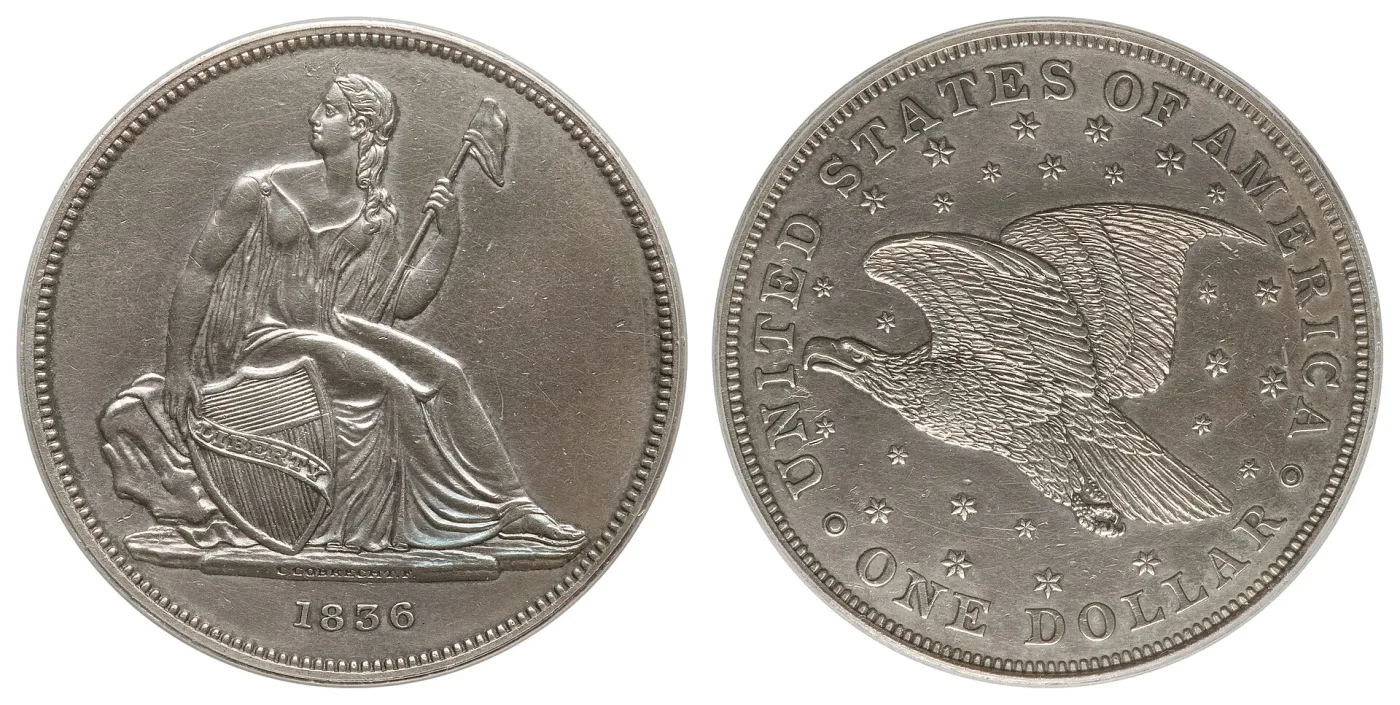
The Gobrecht Dollar is one of the most beautiful and historically pivotal coins in the entire United States series. Struck in tiny numbers between 1836 and 1839, it was the first silver dollar produced by the U.S. Mint since 1804, and it introduced the seated figure of Liberty and the soaring eagle that would define American silver coinage for the next fifty years. Named for its engraver, Christian Gobrecht, these dollars sit at the exact crossroads between the early Draped Bust Dollar era and the long-running Seated Liberty Dollar that followed.
For collectors, the Gobrecht Dollar is simultaneously a work of art, a rarity, and a puzzle. Fewer than 2,000 examples were struck as so-called “originals,” and the Mint produced additional “restrikes” decades later to satisfy collector demand — creating one of the most studied and debated original-versus-restrike distinctions in American numismatics. Telling the two apart requires understanding die alignment, the position of Gobrecht’s signature, the eagle’s orientation, and the reeding of the edge. Get those wrong and you can misjudge a coin’s value by tens of thousands of dollars.
This guide walks through the complete Gobrecht Dollar story: how the design came to be, the differences between the name-on-base, name-below-base, and name-in-field varieties, how to read die alignment to separate originals from restrikes, how to grade and authenticate these coins, and what they are worth today. If you are new to U.S. coins, start with our general coin identification guide, then return here to explore one of the true cornerstones of the American silver dollar.
History and Origins of the Gobrecht Dollar
By the mid-1830s, the United States had not struck a silver dollar for regular release in more than thirty years. Production of the Draped Bust Dollar had effectively halted after 1803 (the famous 1804-dated dollars were struck decades later as diplomatic gifts), and the denomination simply disappeared from American commerce. Mint Director Robert Maskell Patterson wanted to revive the silver dollar — and he wanted it to be a showpiece that reflected the artistic ambitions of a modernizing Mint equipped with new steam-powered coining presses.
Patterson envisioned a design in the neoclassical British tradition: a seated, allegorical figure of Liberty on the obverse, in the manner of the seated Britannia on English coinage, paired with a naturalistic flying eagle on the reverse. To realize this vision he turned to two of the finest artists available — Thomas Sully, who sketched the seated Liberty concept, and Titian Peale, who drew the flying eagle. The job of translating those drawings into working dies fell to the Mint’s newly hired second engraver, Christian Gobrecht.
A Coin Born of New Technology
The Gobrecht Dollar was among the first U.S. coins struck on the Mint’s new close-collar steam presses, which produced sharper detail, more consistent diameters, and the precise reeded edges that earlier screw-press coinage could not reliably achieve. The result was a coin of unprecedented beauty and technical quality for its era — proof-like surfaces, intricate detail in Liberty’s drapery, and a lifelike eagle in flight. These were as much pattern pieces and presentation coins as they were circulating money.
Limited Circulation
Although a small number of Gobrecht Dollars did enter circulation, most were treated from the outset as special strikings. The 1836 and 1839 issues are generally considered the circulating types, while many examples were struck with proof-like care. Because so few were made, the Gobrecht Dollar never functioned as everyday money the way the later Seated Liberty Dollar would. It was, in effect, a transitional and experimental coinage that bridged a thirty-three-year gap in silver dollar production.
The Bridge Between Two Eras
Chronologically and artistically, the Gobrecht Dollar fills the space between the Flowing Hair Dollar and Draped Bust Dollar of the 1790s and early 1800s, and the Seated Liberty Dollar that began full production in 1840. The seated Liberty obverse Gobrecht engraved would go on to appear, with modifications, on the half dime, dime, quarter, half dollar, and dollar — making him one of the most influential figures in the history of U.S. coin design.
Christian Gobrecht: The Engraver
Christian Gobrecht (1785-1844) was a skilled engraver and inventor who joined the United States Mint as second engraver in 1836 and rose to become Chief Engraver in 1840, a position he held until his death. Before joining the Mint he had built a reputation as a banknote and medal engraver, and he held patents for mechanical devices including a medal-ruling machine. His technical precision is evident throughout the dollar that bears his name.
His Role in the Design
It is important to understand that Gobrecht did not originate the design concept — Thomas Sully conceived the seated Liberty and Titian Peale drew the eagle. Gobrecht’s contribution was the masterful engraving that turned those artistic sketches into functional, strikeable dies. This collaborative process was typical of major Mint designs of the period, but Gobrecht’s name became permanently attached to the coin because, on the first issues, he signed it.
The Signature Controversy
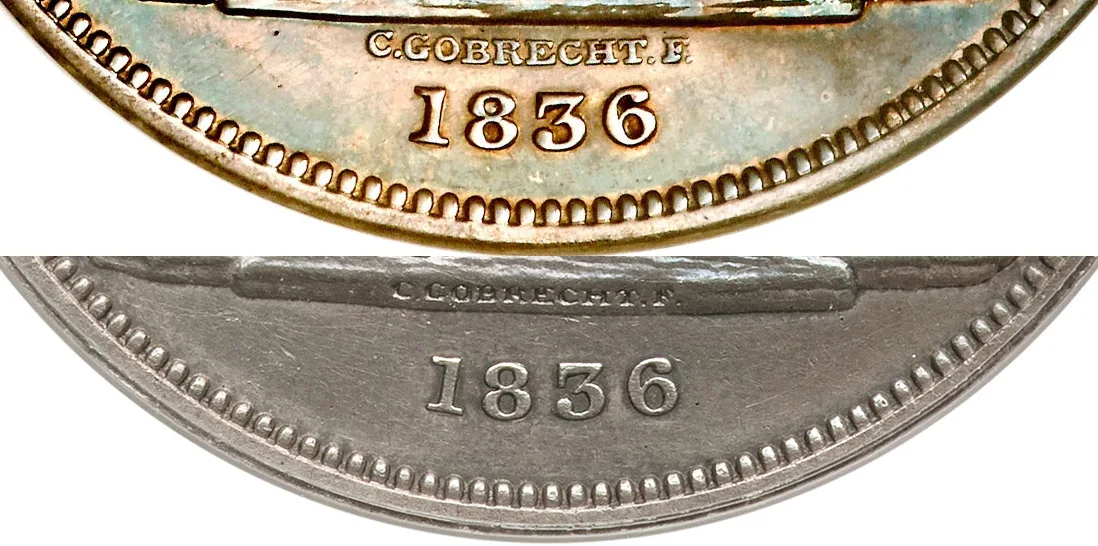
On the earliest 1836 dollars, Gobrecht boldly signed his full name “C. GOBRECHT F.” (the “F” for the Latin fecit, meaning “made it”) prominently in the field above the date. This was unusually conspicuous for an engraver’s signature, and it reportedly drew criticism for being too self-aggrandizing. In response, the signature was moved to a more modest position on the base supporting Liberty, reading simply “C. GOBRECHT F.” These signature placements are now one of the primary ways collectors classify the different Gobrecht Dollar varieties.
A Lasting Legacy
Gobrecht’s seated Liberty design proved so successful that it became the workhorse motif of mid-19th-century American silver coinage. Every Seated Liberty half dime, dime, quarter, half dollar, and dollar descends directly from his Gobrecht Dollar obverse. Few engravers in U.S. history have left so broad a mark on the nation’s money, which is part of why the Gobrecht Dollar commands such reverence among serious collectors.
Design Elements and How to Identify the Coin
The Gobrecht Dollar is unlike any other U.S. silver dollar in appearance. Once you have seen one, it is unmistakable — but knowing the specific design elements helps you confirm an identification and distinguish genuine pieces from later imitations.
Obverse (Front) Design
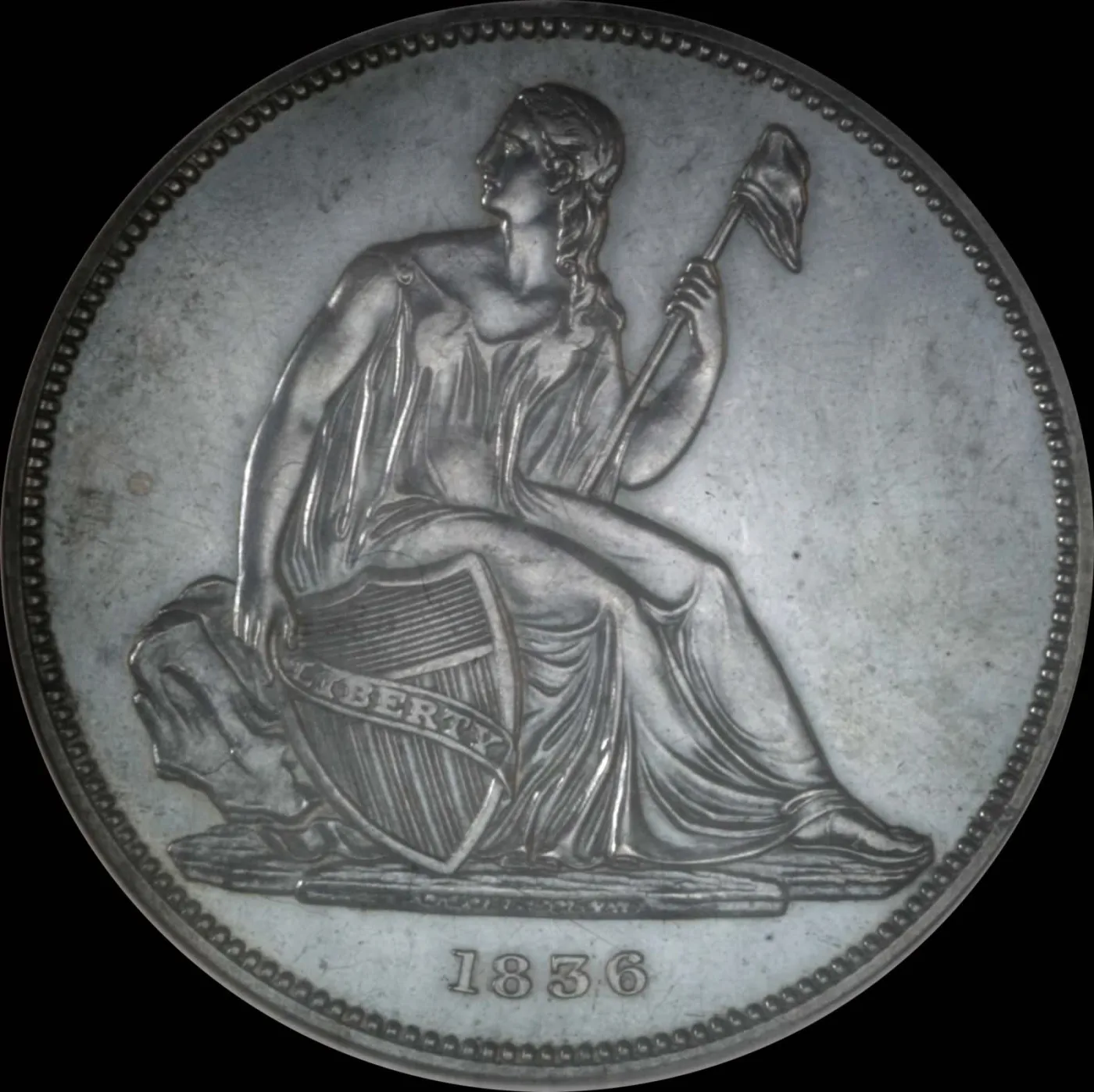
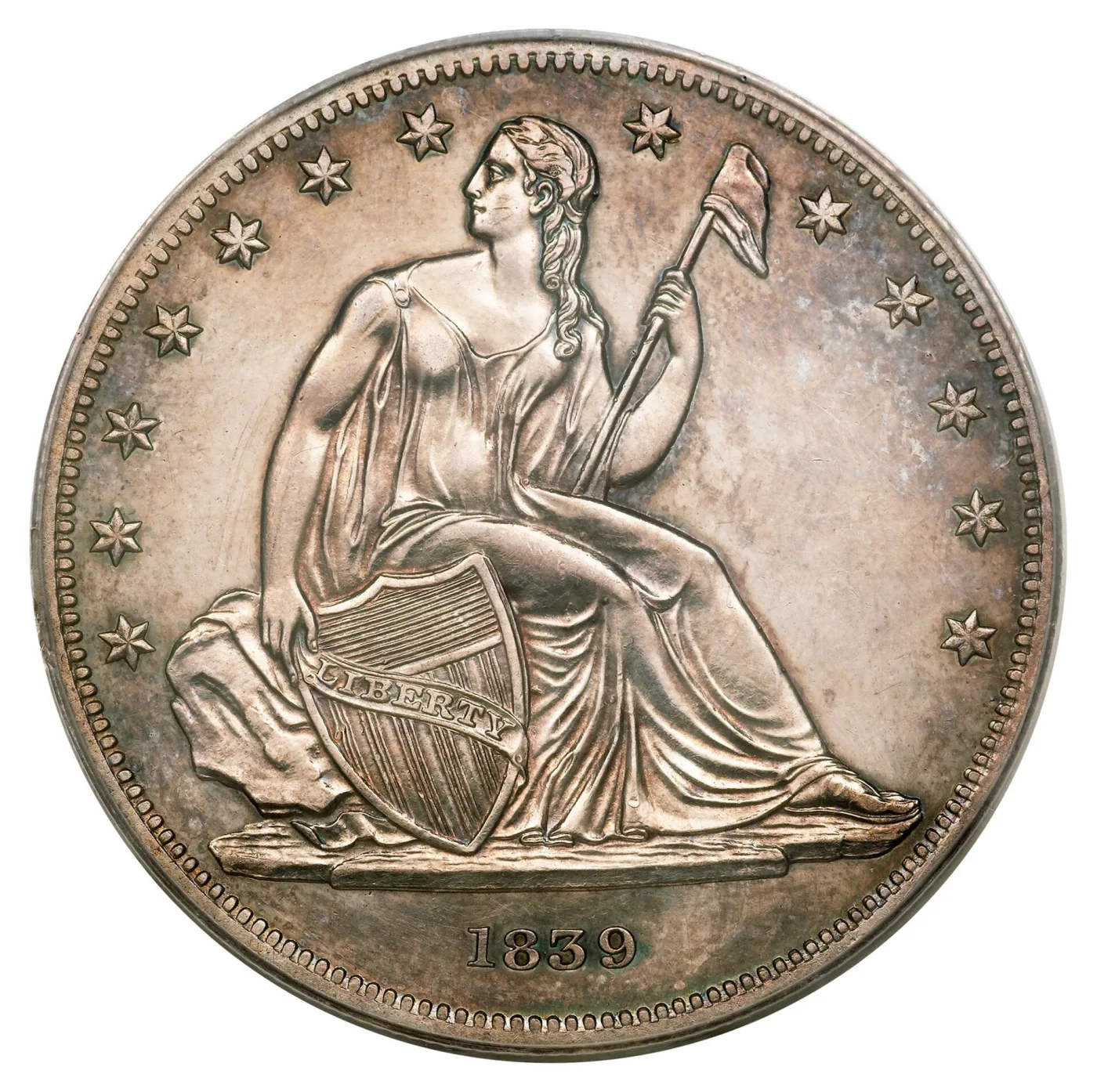
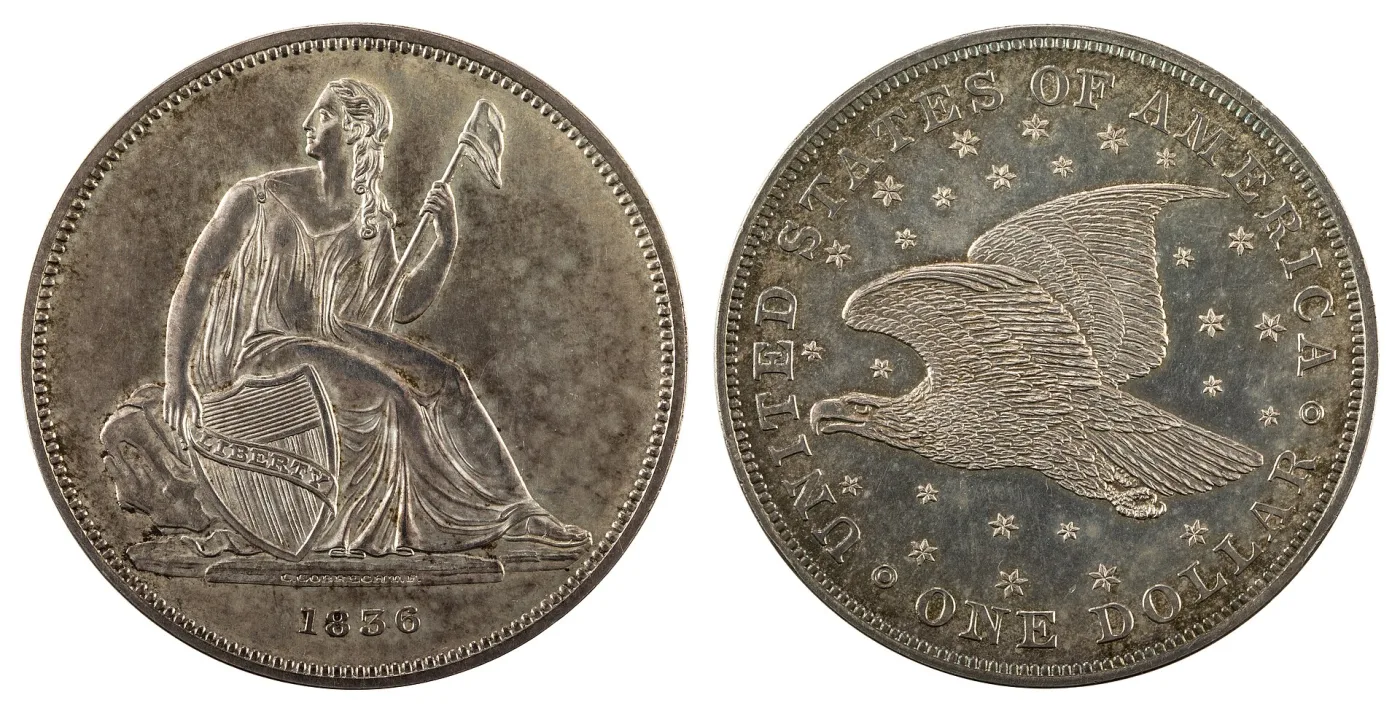
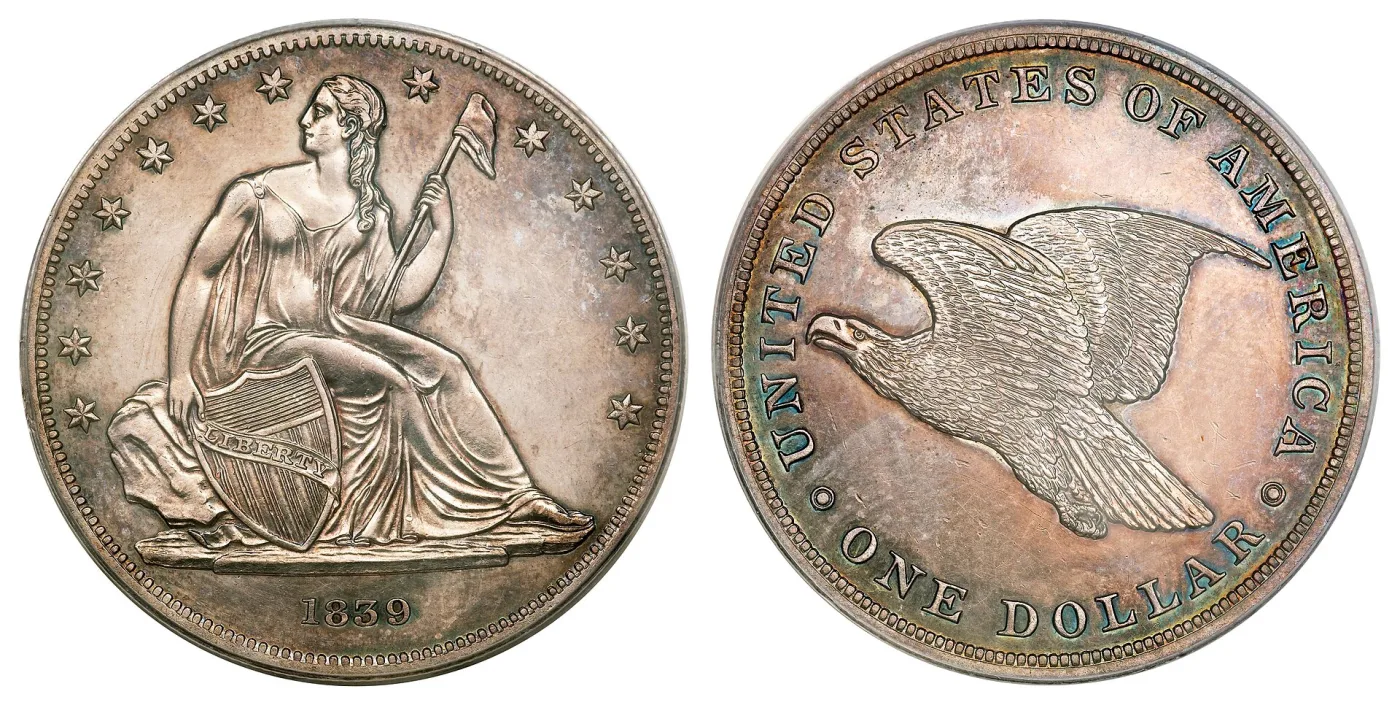
The obverse features Liberty seated on a rock, facing left. She holds a pole topped with a liberty cap in her left hand and steadies a shield inscribed “LIBERTY” with her right. The figure is graceful, flowing, and naturalistic — a dramatic departure from the bust portraits of earlier dollars. The date appears at the bottom. On most issues there are no stars on the obverse (the “starless obverse” of 1836), while other issues add a field of 13 stars surrounding Liberty.
Reverse (Back) Design
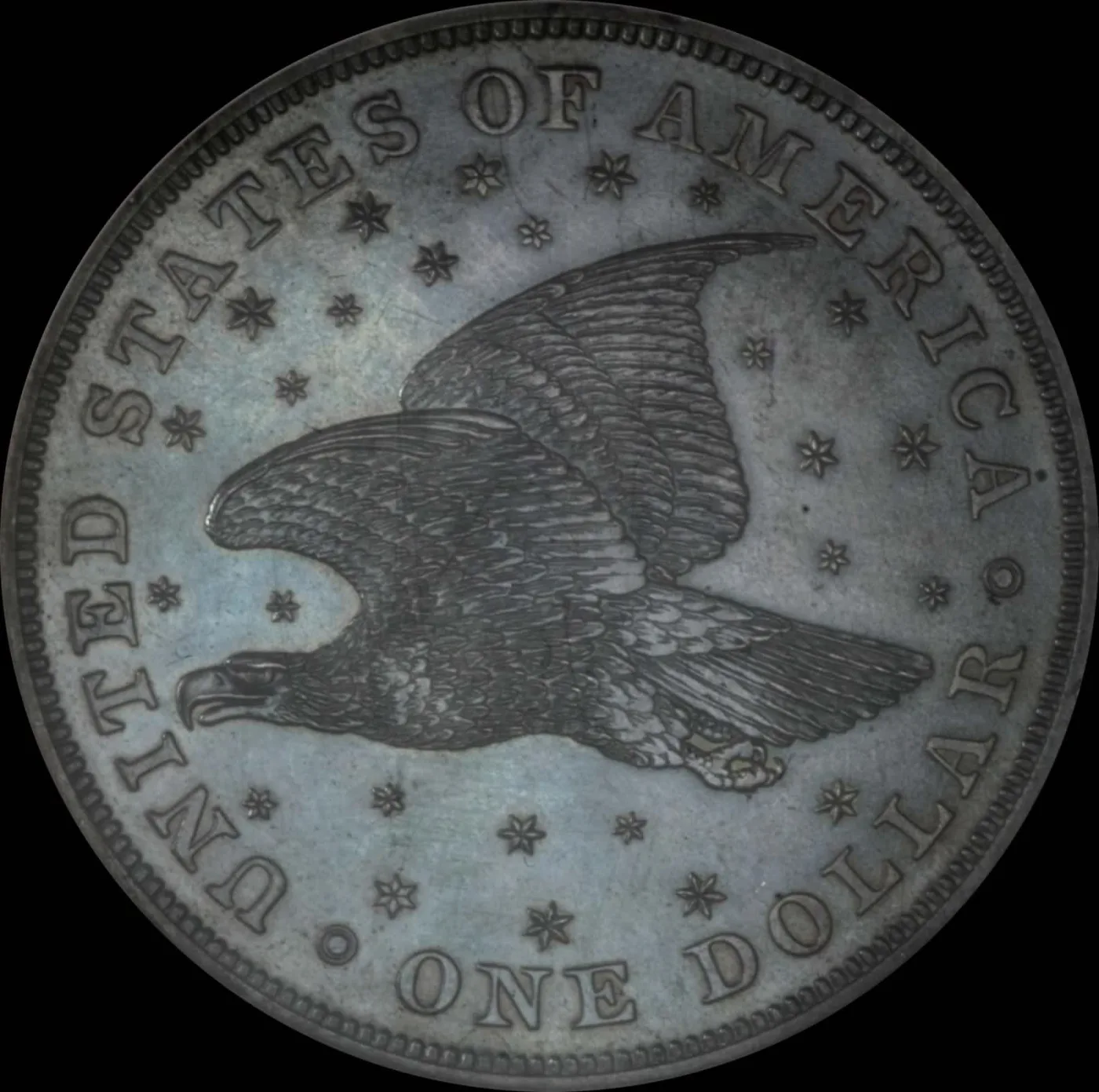
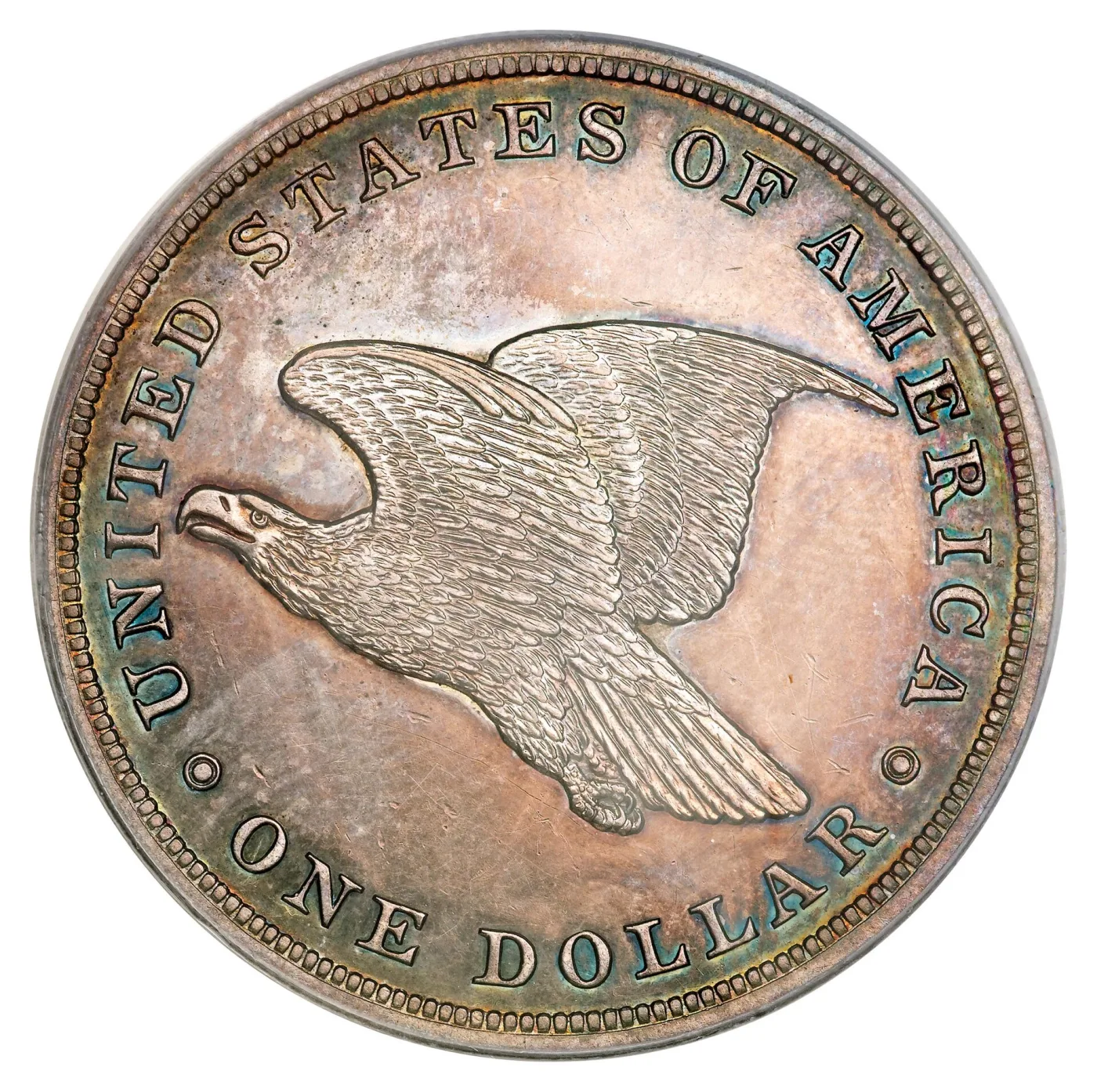
The reverse is the coin’s most celebrated feature: a majestic eagle in full flight, wings spread, soaring upward and to the left across an open field. On the original starry-reverse issues, the eagle flies amid a field of 26 stars representing the states. The inscription “UNITED STATES OF AMERICA” arcs around the top and “ONE DOLLAR” appears at the bottom. The flying eagle was so admired that a version of it was later revived for the small-cent Flying Eagle Cent of 1856-1858.
Physical Specifications
Gobrecht Dollars were struck in the pre-1837 standard and the post-1837 standard depending on issue. The 1836 originals were struck at 416 grains (.8924 fineness, the old standard), while later strikings used the 412.5-grain, .900 fineness standard adopted in 1837 for subsequent silver coinage. The diameter is approximately 38.1 millimeters, comparable to the later Seated Liberty Dollar. The edge is reeded. These specifications, combined with the distinctive seated-Liberty-and-flying-eagle design, make the coin easy to distinguish from any other denomination.
How to Quickly Recognize a Gobrecht Dollar
If you see a large silver dollar-sized coin with a seated Liberty on the obverse and a flying eagle on the reverse, dated between 1836 and 1839, you are looking at a Gobrecht Dollar (or a copy of one). The later Seated Liberty Dollar has the same seated obverse but a completely different reverse — a heraldic eagle with a shield, perched rather than flying. The flying eagle reverse is the single most reliable identifier of a genuine Gobrecht type.
The Gobrecht Signature: On Base, Below Base, In Field
The placement of Christian Gobrecht’s signature is one of the foundational ways collectors classify these dollars, and it directly affects rarity and value. There are three principal signature positions, and learning to spot them under magnification is an essential identification skill.
Name in Field (C. GOBRECHT F. above the date)
On the earliest 1836 strikings, Gobrecht’s name appears boldly in the obverse field, just above the date, reading “C. GOBRECHT F.” This is the rarest signature placement and the most sought-after by specialists. Because the conspicuous signature drew criticism, only a small number were struck this way before the design was modified.
Name on Base (C. GOBRECHT F. on the rock)
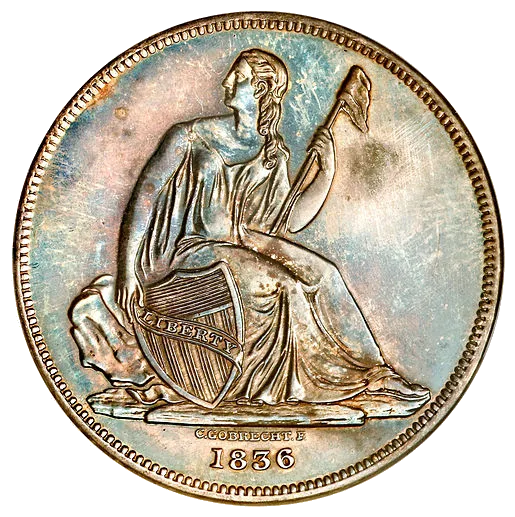
The most familiar variety places the signature on the base — the rock or ledge on which Liberty sits — reading “C. GOBRECHT F.” This is the standard placement seen on the majority of 1836 dollars and is the type most collectors encounter. The lettering is small and requires a loupe to read clearly on worn examples.
Name Below Base (C. GOBRECHT F. beneath the base line)
On certain issues the signature was repositioned slightly, appearing below the base line rather than on the base itself. This subtle distinction matters to specialists and variety collectors and is documented in the reference literature. Careful comparison to published photographs is the only reliable way to confirm a below-base attribution.
Why Signature Position Matters
Signature placement interacts with date, star configuration, and die alignment to define each cataloged variety. Two coins that look identical at a glance may differ substantially in value because of where the signature sits and how it combines with the other diagnostic features. Always examine the signature position as part of a complete identification, never in isolation.

Die Alignment: The Key to Originals vs Restrikes
If there is one technical concept every Gobrecht Dollar collector must master, it is die alignment — the relationship between the orientation of the obverse and reverse dies. Die alignment is the single most powerful tool for separating original strikings from later restrikes, and it can be checked in seconds once you understand it.
What Die Alignment Means
When you hold a coin and rotate it from front to back along its vertical axis, the orientation of the reverse design relative to the obverse tells you how the dies were set in the press. U.S. coins are normally struck in “coin alignment,” meaning the reverse appears upside down when you flip the coin top-to-bottom. Gobrecht Dollars were struck in several different alignments over the years, and those alignments correlate strongly with whether a coin is an original or a restrike.
The Four Die Alignments
Numismatists describe four die alignments for Gobrecht Dollars, traditionally labeled with Roman numerals:
- Die Alignment I: Reverse rotated so the eagle flies “onward and upward” with the head of Liberty opposite ONE DOLLAR. Associated primarily with certain original strikings.
- Die Alignment II: Eagle flying level (horizontally) with the coin in medal alignment. Associated with restrikes.
- Die Alignment III: Another rotation associated with restrikes, with the eagle oriented differently relative to the obverse.
- Die Alignment IV: Eagle flying “onward and level” in coin alignment, generally associated with original 1836 and 1839 circulation strikes.
Eagle Flying “Level” vs “Upward”
A practical shortcut many collectors use: examine whether the eagle appears to fly level (horizontally) or upward (at an angle) relative to the obverse when the coin is held in normal coin orientation. On genuine originals struck for circulation, the eagle typically flies onward and slightly upward in a specific relationship to Liberty’s position. On many restrikes, the alignment was set so the eagle flies level. This is a simplification of a nuanced subject, but it captures the practical test specialists apply.
Why You Cannot Skip This Step
Because originals and restrikes can be visually identical in design, die alignment is frequently the deciding factor in attribution. A coin attributed and priced as an original but exhibiting a restrike alignment is either misattributed or potentially problematic. For any significant Gobrecht Dollar purchase, insist on professional certification by PCGS or NGC, where the die alignment and original/restrike status are part of the attribution on the holder.
Major Types and Dates (1836-1839)
Gobrecht Dollars span just four dates, but within those years lies a surprising amount of variety driven by signature position, star configurations, and die alignment. Here is how the issues break down.
1836 Name in Field
The earliest type, with Gobrecht’s signature in the obverse field above the date, paired with the starry-reverse flying eagle. The rarest and most coveted of the signature varieties, struck in very limited numbers before the design was revised.
1836 Name on Base
The classic and most available Gobrecht Dollar, with the signature relocated to the base beneath Liberty and a plain (starless) obverse paired with the 26-star reverse. This is the type most collectors target when they want a representative Gobrecht Dollar. Both original strikings and later restrikes exist for this type, making die alignment analysis essential.
1838 Stars Obverse
The 1838 issue adds 13 stars around Liberty on the obverse and pairs them with a starless (plain) reverse field. The 1838 is a transitional design moving toward the configuration that would become standard on the Seated Liberty Dollar. Most 1838 Gobrecht Dollars are considered restrikes; genuine originals are exceedingly rare.
1839 Stars Obverse
The 1839 also features stars on the obverse and a plain reverse, and it is considered one of the circulating issues alongside the 1836. The 1839 originals were struck for circulation in small numbers, while restrikes were produced later. Die alignment is the key to distinguishing them.
The Star Configurations Summarized
A simple way to remember the progression: the 1836 issues generally have a plain obverse and a starry reverse, while the 1838 and 1839 issues reverse that arrangement with a starry obverse and a plain reverse. This evolution mirrors the design refinement that ultimately produced the stars-obverse, no-stars-reverse layout of the early Seated Liberty coinage.
Originals vs Restrikes Explained
No aspect of Gobrecht Dollar collecting generates more discussion than the original-versus-restrike question. Understanding it is essential before spending serious money on one of these coins.
What “Original” Means
“Original” Gobrecht Dollars are those struck during the 1836-1839 period for their intended purpose — as presentation pieces, patterns, or limited circulation coinage. The 1836 name-on-base and the 1839 stars-obverse issues include the bulk of genuine original strikings, produced contemporaneously with the date on the coin.
What “Restrike” Means
“Restrikes” are examples produced later — primarily during the late 1850s and the 1860s — by the Mint to satisfy demand from collectors and dealers who wanted these beautiful and already-rare dollars. The Mint reused the original dies (sometimes in different pairings and alignments) to strike additional pieces years after the dates they bear. Restrikes are genuine U.S. Mint products and are highly collectible in their own right, but they are generally less valuable than verified originals.
How Collectors Tell Them Apart
Three diagnostics do most of the work:
- Die alignment: As described above, originals and restrikes were struck in different die orientations. This is the primary test.
- Die state and rust: Restrikes were struck from dies that had aged, sometimes showing die rust, cracks, or deterioration not present on the earlier original strikings.
- Edge and reeding: Certain restrikes show differences in reeding count or edge characteristics that specialists use as confirmation.
Why It Affects Value So Much
A verified 1836 original in high grade can command a substantial premium over a restrike of the same date and design, precisely because originals were the coins actually made in the 1830s. That said, demand for any genuine Gobrecht Dollar is strong, and even restrikes sell for five figures in nice condition. Because the distinction is technical and consequential, originals and restrikes should always be attributed by PCGS or NGC rather than by an untrained eye.
Mintage, Rarity, and Survival
Gobrecht Dollars are genuinely rare across all types. Understanding the approximate numbers helps set realistic expectations for availability and price.
Approximate Mintage Figures
The best-documented mintage is the December 1836 striking of 1,000 name-on-base dollars in the old standard, followed by an additional 600 pieces struck in early 1837 (but dated 1836) in the new standard. The 1839 issue saw roughly 300 circulation strikes. The 1838 originals are believed to number only a handful of pieces. Restrike quantities are not precisely documented but are thought to be modest. In total, across originals and restrikes combined, only a few thousand Gobrecht Dollars of all types are believed to exist.
Survival Rates
Because many Gobrecht Dollars were treasured from the day they were struck and never circulated, a relatively high proportion survive in collectible grades compared to ordinary circulating coinage of the era. Even so, the absolute numbers are tiny. The total surviving population across all dates and varieties is estimated in the low thousands, with high-grade proof-like examples being especially scarce.
The Rarity Hierarchy
Among the types, the 1836 name-in-field and the genuine 1838 originals are the rarest, followed by the 1839 originals. The 1836 name-on-base — both originals and restrikes — is the most attainable, which is why it serves as the “type coin” most collectors pursue. Even the most available Gobrecht Dollar, however, is far rarer than common dates of the later Seated Liberty Dollar series.
Condition Census Coins
The finest known Gobrecht Dollars — superb proof-like gems certified by PCGS and NGC — are tracked individually by specialists. These condition-census coins appear at auction infrequently and can command six-figure prices, reflecting both their rarity and their status as some of the most beautiful coins the U.S. Mint has ever produced.
How to Grade Gobrecht Dollars
Grading Gobrecht Dollars combines standard circulated-grade wear analysis with the special considerations that apply to proof and proof-like coinage. Because so many examples were struck with proof-like care, surface quality and reflectivity matter as much as wear.
Circulated Grades
- Good to Very Good (G-4 to VG-8): Heavy, even wear. Liberty’s figure is outlined but flat; major drapery folds gone; the eagle’s wing feathers largely merged. The signature may be partially worn away.
- Fine to Very Fine (F-12 to VF-20): Moderate wear. Some drapery detail in Liberty’s gown returns; the eagle shows partial feather separation; LIBERTY on the shield is partly readable.
- Extremely Fine (EF-40): Light wear on the highest points only. Most drapery and feather detail present; the signature is clear under magnification.
- About Uncirculated (AU-50 to AU-58): Only a trace of friction on Liberty’s knee, breast, and the eagle’s wing tips. Much original reflectivity remains.
Mint State and Proof Grades
Many Gobrecht Dollars are graded as proofs (PR) because of their mirror-like fields and sharp strikes. A coin graded PR-63 shows full reflectivity with scattered contact marks; PR-64 has fewer marks and strong eye appeal; PR-65 and above are gems with deep mirrors and minimal imperfections. Distinguishing a true proof from a prooflike business strike is a job for professional graders, as the two can look similar to the untrained eye.
Key Grading Points
The high points that wear first are Liberty’s knee, breast, and the head, along with the eagle’s breast and the leading edges of the wings. On the reverse, the central body of the eagle and the tops of the wings show friction earliest. Because the design is so detailed, even minor wear is readily visible against the proof-like fields, which is why eye appeal and surface preservation weigh heavily in the final grade.
Why Professional Grading Is Essential
Given the original-versus-restrike complexity, the proof-versus-business-strike question, and the high values involved, Gobrecht Dollars should always be purchased certified by PCGS or NGC. The holder records not just the numerical grade but the variety, die alignment, and original/restrike attribution — information that is difficult and risky to determine independently.
Authentication and Counterfeit Detection
Because Gobrecht Dollars are valuable and famous, they have attracted counterfeiters and “improvers” for well over a century. Authentication is non-negotiable for any meaningful purchase.
Cast and Struck Counterfeits
Both cast copies and more sophisticated struck counterfeits of Gobrecht Dollars exist. Cast fakes typically show a grainy or pebbly surface, soft details, and seams on the edge. Struck counterfeits are harder to detect but often display incorrect weight, slightly wrong diameter, mushy lettering, or die characteristics that do not match any genuine die marriage. Modern Chinese counterfeits can be deceptively good and are a real hazard in the raw-coin market.
Electrotypes and Replicas
19th- and 20th-century electrotype copies were made for study and display, and modern souvenir replicas are widely sold. Genuine replicas are usually marked “COPY” under the Hobby Protection Act, but unmarked older electrotypes can fool the inexperienced. An electrotype typically consists of two thin metal shells joined at the edge, often detectable by weight, a visible edge seam, or a non-silver core.
Altered and “Improved” Coins
Some genuine coins have been tooled, re-engraved, or had surfaces artificially enhanced to imitate proof reflectivity or to strengthen worn details. Re-engraving of the signature or the eagle’s feathers is a known problem. Under magnification, tooling shows disturbed metal, unnatural luster breaks, and lines that cut across rather than flow with the original design.
Diagnostic Tools
A calibrated scale (0.01 g resolution), digital calipers, and a 10x to 20x loupe are the baseline tools. Genuine post-1837 Gobrecht Dollars should weigh close to 26.73 grams (412.5 grains); the 1836 old-standard pieces are slightly heavier. The same weight-and-measure discipline used to authenticate a Morgan Silver Dollar or Trade Dollar applies here — but given the stakes, instrument checks should only ever supplement, not replace, professional certification.
Always Buy Certified
The bottom line: never buy a raw Gobrecht Dollar of significant value. The combination of high prices, the original/restrike puzzle, and a long history of fakes makes PCGS or NGC certification absolutely essential. A genuine coin in a genuine holder protects both your money and your collection.
Current Market Values by Type
Gobrecht Dollar values are high across the board — there is no “common” or face-value example. The figures below are approximate retail and auction ranges as of 2026 and vary considerably with grade, eye appeal, die alignment, and original/restrike status.
1836 Name on Base (most available type)
In circulated grades (VF to EF), expect roughly $9,000 to $18,000. In AU, $18,000 to $30,000. Proof and proof-like Mint State examples (PR-62 to PR-64) run $25,000 to $60,000, with gem PR-65 and finer coins reaching $75,000 to $150,000+. Verified originals command premiums over restrikes of the same grade.
1836 Name in Field (rarest signature variety)
This scarce early type commands strong premiums. High-grade examples can bring $60,000 to $200,000+ at auction depending on quality and pedigree, reflecting both its rarity and its status as the first signature placement.
1838 Stars Obverse
Mostly restrikes, with values typically in the $30,000 to $90,000 range for proof examples, and substantially more for the rare genuine originals. Eye appeal and reflectivity heavily influence price.
1839 Stars Obverse
Circulated originals run roughly $12,000 to $25,000; AU examples $25,000 to $45,000; and proof or proof-like coins $40,000 to $120,000+ depending on grade and original/restrike status.
Factors Affecting Value
Beyond date and type, the most important value drivers are: verified original versus restrike status (originals command premiums), grade and surface quality (proof-like reflectivity adds value), eye appeal and toning, and pedigree (coins from famous collections sell for more). Problem coins — cleaned, tooled, or repaired examples in “Details” holders — trade at steep discounts to problem-free pieces.
Legacy and the Seated Liberty Connection
The Gobrecht Dollar’s importance extends far beyond its tiny mintage. Its design choices shaped American coinage for the rest of the 19th century.
The Seated Liberty Dynasty
Gobrecht’s seated Liberty obverse became the template for an entire family of coins. The Seated Liberty Dollar (1840-1873) adopted the obverse almost directly while replacing the flying eagle with a perched heraldic eagle. The same seated figure appeared on the Seated Liberty half dime, dime, quarter, and half dollar — making Gobrecht’s design one of the most widely used in U.S. history.
The Flying Eagle Revival
The soaring eagle that made the Gobrecht Dollar famous did not disappear when the seated reverse took over the dollar denomination. Chief Engraver James Longacre revived a version of the flying eagle for the small-cent Flying Eagle Cent of 1856-1858, directly inspired by Gobrecht and Peale’s original. That eagle motif thus bridges two very different denominations separated by twenty years.
A Touchstone for Collectors
Today the Gobrecht Dollar occupies a special place in American numismatics. It is simultaneously a pattern, a rarity, a design landmark, and one of the most beautiful coins the Mint ever produced. For collectors of the silver dollar series, owning a Gobrecht Dollar represents the link between the earliest Flowing Hair and Draped Bust dollars and the long Seated Liberty era — a single coin that ties the whole story together.
Storage, Handling, and Preservation
Gobrecht Dollars are high-value, proof-like coins whose surfaces are extremely sensitive. Preservation discipline is as important as authentication.
Handling
Always hold a Gobrecht Dollar by its edges, ideally with clean cotton or nitrile gloves, and work over a soft surface to prevent damage from accidental drops. Never touch the proof-like fields with bare fingers — fingerprints on mirrored surfaces are nearly impossible to remove without destroying value. For certified coins, the simplest preservation strategy is to leave them in their PCGS or NGC holders.
Holders and Storage
Because virtually every collectible Gobrecht Dollar is certified, the encapsulating slab is the primary protection. Store slabs in dedicated boxes away from light, heat, and humidity. For the rare raw piece, use an inert, archival-quality holder — never PVC-based soft flips, whose plasticizers cause permanent green corrosion. The same anti-PVC rule that protects a Peace Dollar applies with even greater force to a five- or six-figure Gobrecht Dollar.
Environmental Controls
Keep coins in a cool, dry, stable environment. Use silica gel to control humidity and replace it periodically. Avoid sulfur sources — certain paper, cardboard, rubber bands, and adhesives — which accelerate toning on silver. Sudden temperature and humidity swings promote condensation and spotting, so basements and attics are poor choices for storage.
Cleaning: Absolutely Never
Never clean a Gobrecht Dollar under any circumstances. Cleaning destroys the proof-like surfaces and original toning that account for much of the coin’s value, and a cleaned Gobrecht Dollar can lose half or more of its worth instantly. Even if a coin appears tarnished, leave it alone. If active corrosion is present, consult a professional conservation service such as NCS rather than attempting any home treatment.
Collecting Gobrecht Dollars
Few collectors assemble a complete Gobrecht Dollar set — the cost and rarity make it a pursuit for the most advanced and well-funded numismatists. But there are several realistic ways to engage with these landmark coins.
The Single Type Coin
The most common collecting goal is to acquire one representative Gobrecht Dollar — usually the 1836 name-on-base — as a type coin to anchor a silver dollar collection. Budget at least five figures for an acceptable circulated example, and considerably more for proof-like and Mint State pieces.
The Date and Variety Set
A more ambitious goal is to collect one of each date (1836, 1838, 1839) or one of each signature placement (in field, on base, below base). This is a major undertaking requiring substantial funding and patience, as the rarer varieties appear at auction only occasionally.
Originals vs Restrikes as a Theme
Some specialists collect Gobrecht Dollars specifically to illustrate the original-versus-restrike distinction, acquiring matched examples to study die alignment and die-state differences side by side. This is an educational and historically rich way to approach the series.
Where the Gobrecht Dollar Fits
Within a broader silver dollar collection, the Gobrecht Dollar is the crucial bridge between the early dollars and the Seated Liberty era. Collectors building a dollar type set will place it between the Draped Bust Dollar and the Seated Liberty Dollar. Its rarity means it is often the last and most expensive piece acquired for such a set.
Practical Buying Advice
Buy the coin, then the holder, then the pedigree — but always buy certified. Work with established dealers and major auction houses that specialize in early type coinage. Insist on PCGS or NGC certification with the original/restrike and die-alignment attribution clearly noted. Take your time; quality examples are worth waiting for, and there is no such thing as a “bargain” Gobrecht Dollar from an unknown seller.
Frequently Asked Questions
What is a Gobrecht Dollar?
A Gobrecht Dollar is a United States silver dollar struck between 1836 and 1839, named for its engraver Christian Gobrecht. It features a seated Liberty on the obverse and a flying eagle on the reverse, and it was the first U.S. silver dollar produced since 1804. It served as the design bridge to the long-running Seated Liberty Dollar.
How much is a Gobrecht Dollar worth?
Gobrecht Dollars are all valuable, with no common or face-value examples. The most available type, the 1836 name-on-base, ranges from roughly $9,000 in circulated grades to $150,000+ for gem proofs. Rarer varieties such as the 1836 name-in-field can bring $200,000 or more at auction. Value depends heavily on grade, die alignment, and original versus restrike status.
What is the difference between an original and a restrike Gobrecht Dollar?
Originals were struck during the 1836-1839 period for their intended use. Restrikes were produced later (mainly the late 1850s and 1860s) by the Mint to satisfy collector demand, using the original dies in different alignments. Both are genuine Mint products, but verified originals generally command higher prices. Die alignment is the primary tool used to tell them apart.
What is die alignment and why does it matter?
Die alignment describes the orientation of the reverse die relative to the obverse die. Gobrecht Dollars were struck in four documented alignments, and these correlate with whether a coin is an original or a restrike. Because originals and restrikes can look identical, die alignment is often the deciding factor in attribution and therefore in value.
Who designed the Gobrecht Dollar?
The design concept came from Thomas Sully (seated Liberty) and Titian Peale (flying eagle), while Christian Gobrecht engraved the working dies. Because Gobrecht signed the early issues, the coin carries his name. His seated Liberty design went on to appear on the half dime, dime, quarter, half dollar, and Seated Liberty Dollar.
Where is the signature on a Gobrecht Dollar?
There are three signature placements. On the earliest 1836 coins it appears in the field above the date ("name in field"). On most 1836 coins it sits on the base or rock beneath Liberty ("name on base"). On some issues it appears just below the base line ("name below base"). The placement is a key part of the coin's variety attribution.
Are Gobrecht Dollars rare?
Yes. Only a few thousand Gobrecht Dollars of all types and dates are believed to exist across originals and restrikes combined. The 1836 name-in-field and genuine 1838 originals are the rarest; the 1836 name-on-base is the most attainable. Even the most available type is far rarer than common Seated Liberty or Morgan dollars.
How can I tell if my Gobrecht Dollar is real?
Because counterfeits, electrotypes, and altered coins are common, authentication should always be done by PCGS or NGC. As preliminary checks, a genuine post-1837 example weighs close to 26.73 grams and measures about 38.1 mm, with sharp, well-defined detail and no edge seams. Any suspected fake or any significant purchase must be professionally certified.
What is the flying eagle on the reverse?
The reverse depicts an eagle in full flight, soaring upward across an open field — on the 1836 issues, amid a field of 26 stars representing the states. The design was drawn by Titian Peale and is considered one of the most beautiful eagle motifs in U.S. coinage. A version of it was later revived for the Flying Eagle Cent of 1856-1858.
Should I clean my Gobrecht Dollar?
No, never. Cleaning destroys the proof-like surfaces and original toning that give these coins much of their value, and a cleaned example can lose half or more of its worth. Leave even tarnished coins alone, and consult a professional conservation service only if active corrosion is present.
How does the Gobrecht Dollar relate to the Seated Liberty Dollar?
The Gobrecht Dollar introduced the seated Liberty obverse that the Seated Liberty Dollar (1840-1873) then adopted almost directly, replacing the flying eagle with a perched heraldic eagle. The Gobrecht Dollar is therefore the direct design predecessor of, and chronological bridge to, the entire Seated Liberty series.