Capped Bust Eagle Identification Guide: Small Eagle and Heraldic Eagle Types, the 1804 Key Date, Star Arrangements and Values
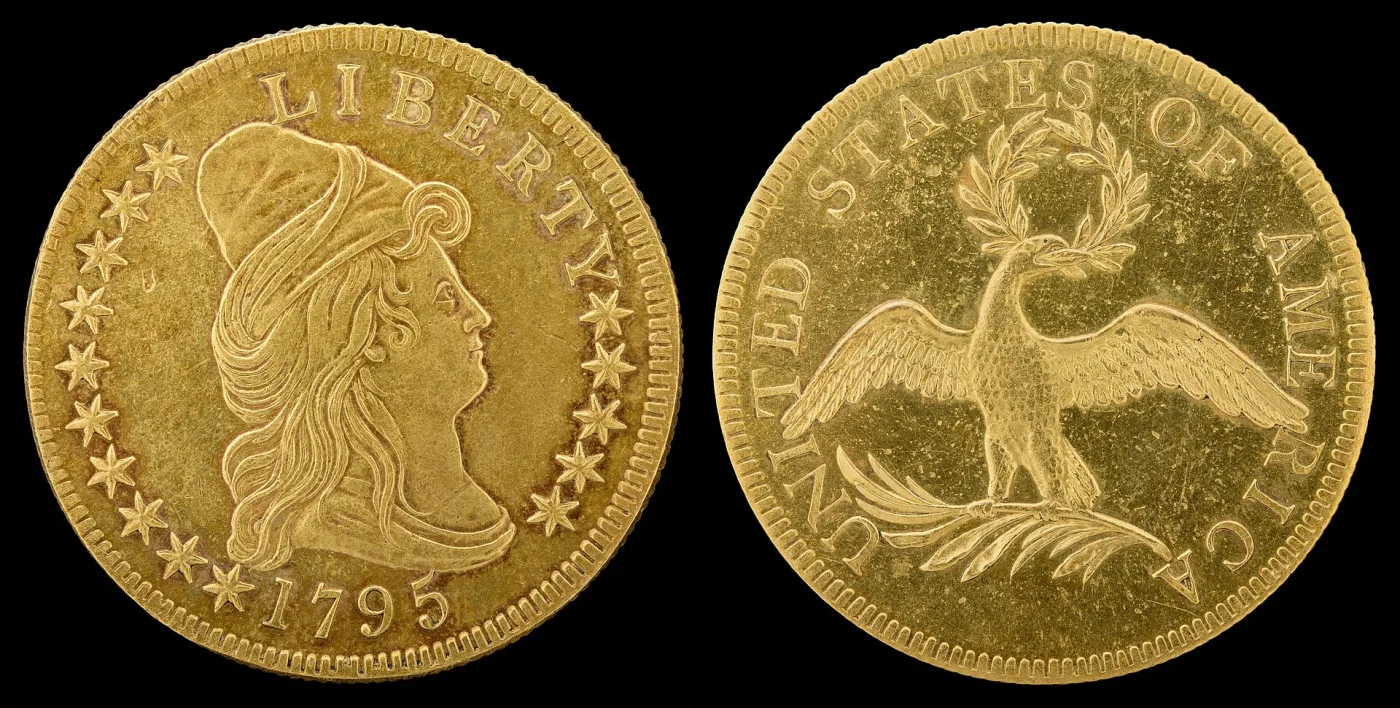
The Capped Bust Eagle is the largest, most valuable, and most prestigious coin of the early United States Mint. When gold coinage began in the summer of 1795, the eagle — the $10 gold piece — was the highest denomination the new nation produced, a coin that represented a substantial sum at a time when a skilled tradesman might earn a dollar or two a day. For nine years, from 1795 through 1804, this golden disc carried the dignity of the young republic in international commerce. Then, abruptly, it vanished: in 1804 the government suspended production of the eagle entirely, and no ten-dollar gold coin would be struck again for thirty-four years.
That sudden halt, combined with the relentless melting that consumed nearly all early American gold, has left the Capped Bust Eagle as one of the genuine cornerstones of advanced numismatics. Every date is scarce, several are rare, and the series culminates in the legendary 1804 — a coin so famous that the rare “Plain 4” variety, struck years later for diplomatic presentation sets alongside the equally celebrated 1804 silver dollar, ranks among the most coveted rarities in the entire American series. Few coins combine such historical weight, such beauty of design, and such authentic rarity.
This guide covers everything you need to identify, attribute, grade, authenticate, and value Capped Bust Eagles in the 2026 market. We will walk through the two major reverse types, the diagnostic star arrangements that define the early dates, the key dates and the 1804 mystery, how to grade these soft-struck early gold giants, how to detect the counterfeits and altered coins that target the series, and what genuine examples are worth today.
History and Background
The Coinage Act of 1792 established the United States Mint and authorized three gold denominations: the quarter eagle ($2.50), the half eagle ($5), and the eagle ($10). The eagle was the flagship — the largest coin and the highest unit of value the new nation would strike. Gold production could not begin immediately because the law required the Mint’s chief officers to post enormous personal surety bonds before they were trusted to handle precious metal, a requirement that took until 1795 to satisfy. When the presses finally rolled that summer, the $5 half eagle came first by a matter of weeks, and the $10 eagle followed close behind, making it the second gold coin and the largest denomination ever produced by the United States to that point.
For nine years the eagle served as the premier American gold coin, used in bank reserves, large transactions, and especially in international trade and settlement. It was struck at the Philadelphia Mint — the only mint then in operation — in modest quantities each year. But the same economic forces that plagued all early U.S. gold soon caught up with the eagle, and in 1804 President Jefferson’s administration ordered its production suspended. The denomination would not return until 1838, when the Liberty Head (Coronet) eagle revived the $10 gold coin under a new, lighter standard.
Chief Engraver Robert Scot
The Capped Bust Eagle was designed by Robert Scot, the Mint’s first Chief Engraver. Scot’s neoclassical vision of Liberty — a head in a soft conical cloth cap, facing right, surrounded by stars — defined the look of early American gold and silver alike. His hand is visible across the coinage of the 1790s, including the Draped Bust dollar and the early large cents. Collectors of Scot’s work will immediately recognize the family resemblance between the eagle’s obverse and that of its smaller gold sibling, the Capped Bust half eagle, which shares the same designer and the same Capped Bust Right portrait.
The Nickname “Turban Head”
Early collectors nicknamed this design the “Turban Head” because Liberty’s tall, soft cloth cap was mistaken for a turban. The name stuck for generations and still appears in older references, auction catalogs, and price guides. Modern numismatists prefer “Capped Bust” or “Capped Bust Right,” but if you encounter a “Turban Head eagle” in a dealer’s listing or an old book, it refers to exactly this coin. The cap is not the spiked Phrygian “liberty cap” of the half cents; it is a soft mob cap, which is why the design is classified as “Capped Bust.”
Why the Early Eagle Was Suspended and Why It Is Rare
Understanding why the eagle was discontinued in 1804 — and why so few survive — is the single most important piece of context for the entire series. The story is the same one that haunts all early American gold, only more acute because the eagle was the largest and most valuable coin.
The Bullion Problem
The Coinage Act of 1792 fixed the legal ratio of gold to silver at 15 to 1. As world markets shifted in the early 1800s, gold became worth more than that ratio implied, so a United States gold coin contained more than its face value in metal. Anyone holding eagles could profit by melting them or, more commonly, exporting them to Europe and the Caribbean, where they fetched a premium as bullion. Because the eagle was the largest gold coin, it was the most efficient to ship and melt — the most metal per coin — so it suffered the heaviest losses of all.
The 1804 Suspension
In late 1804 the Mint, under instruction from the Jefferson administration, suspended coinage of both the eagle and the silver dollar — the two largest denominations — precisely because they were being exported and melted as fast as they were produced. Striking them simply fed the bullion trade at the public’s expense. The decision left the half eagle as the largest gold coin in production, and it would remain so until the eagle returned in 1838. This is why the early eagle series ends so abruptly at 1804 and why there is a thirty-four-year gap before the next $10 gold coin.
The Great Melts
Even the coins that survived suspension were not safe. Throughout the 1810s, 1820s, and 1830s, as the gold-to-silver ratio in Europe made melting extremely profitable, vast quantities of early eagles were destroyed. The 1834 weight reduction that rescued later gold came far too late for the Capped Bust Eagle, every example of which predates that reform. The result is a series in which even the “common” dates are scarce by the standards of most American coins, and the survival population of the entire 1795-1804 run is measured in the thousands rather than the tens of thousands. The companion reform that finally made U.S. gold circulate produced affordable coins like the Classic Head series; the eagle never participated, because it had already been gone for decades.
The Two Major Reverse Types
The phrase “Capped Bust Eagle” covers the entire 1795-1804 early gold $10 series, which collectors and the grading services divide into two distinct types based on the reverse design. The obverse — Scot’s Capped Bust Right Liberty — stayed essentially the same throughout, so identifying the type means reading the reverse eagle. This is the first and most important step.
Type 1: Capped Bust Right / Small Eagle (1795-1797)
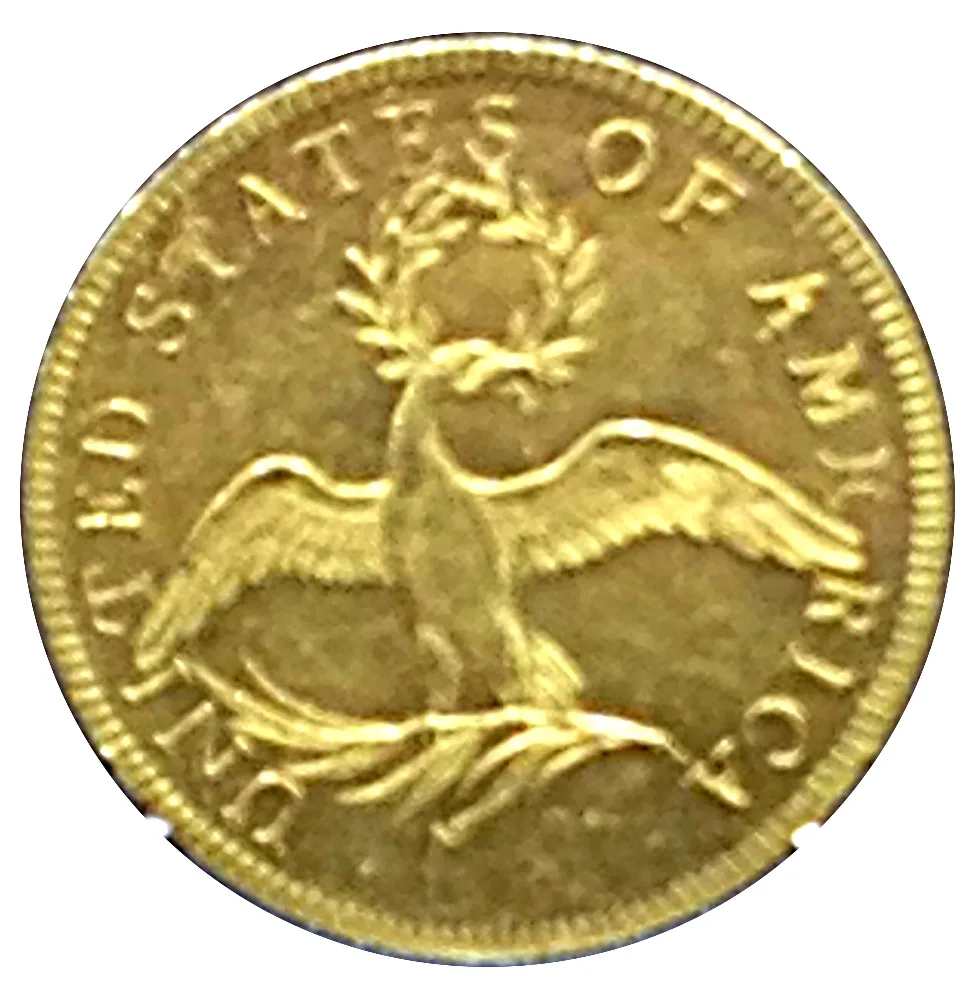
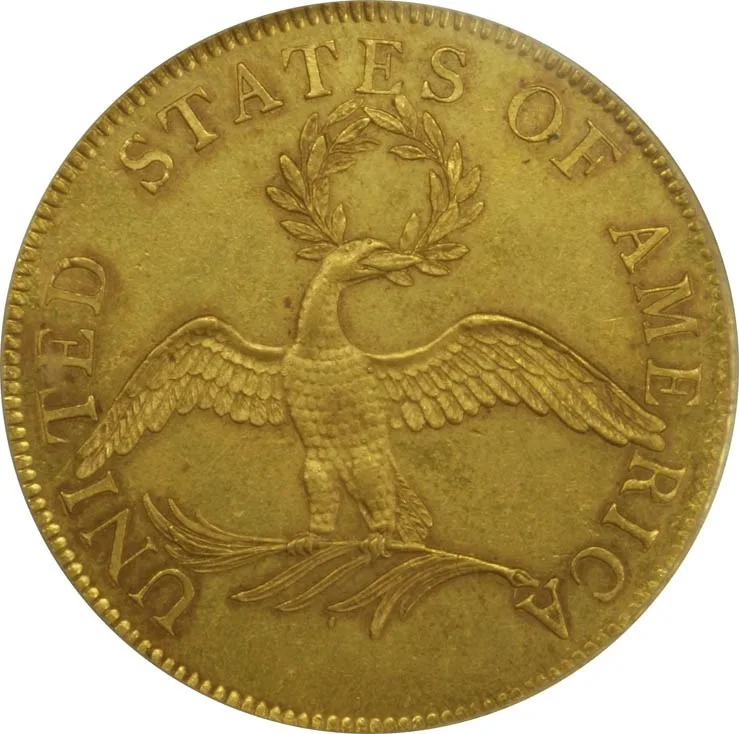
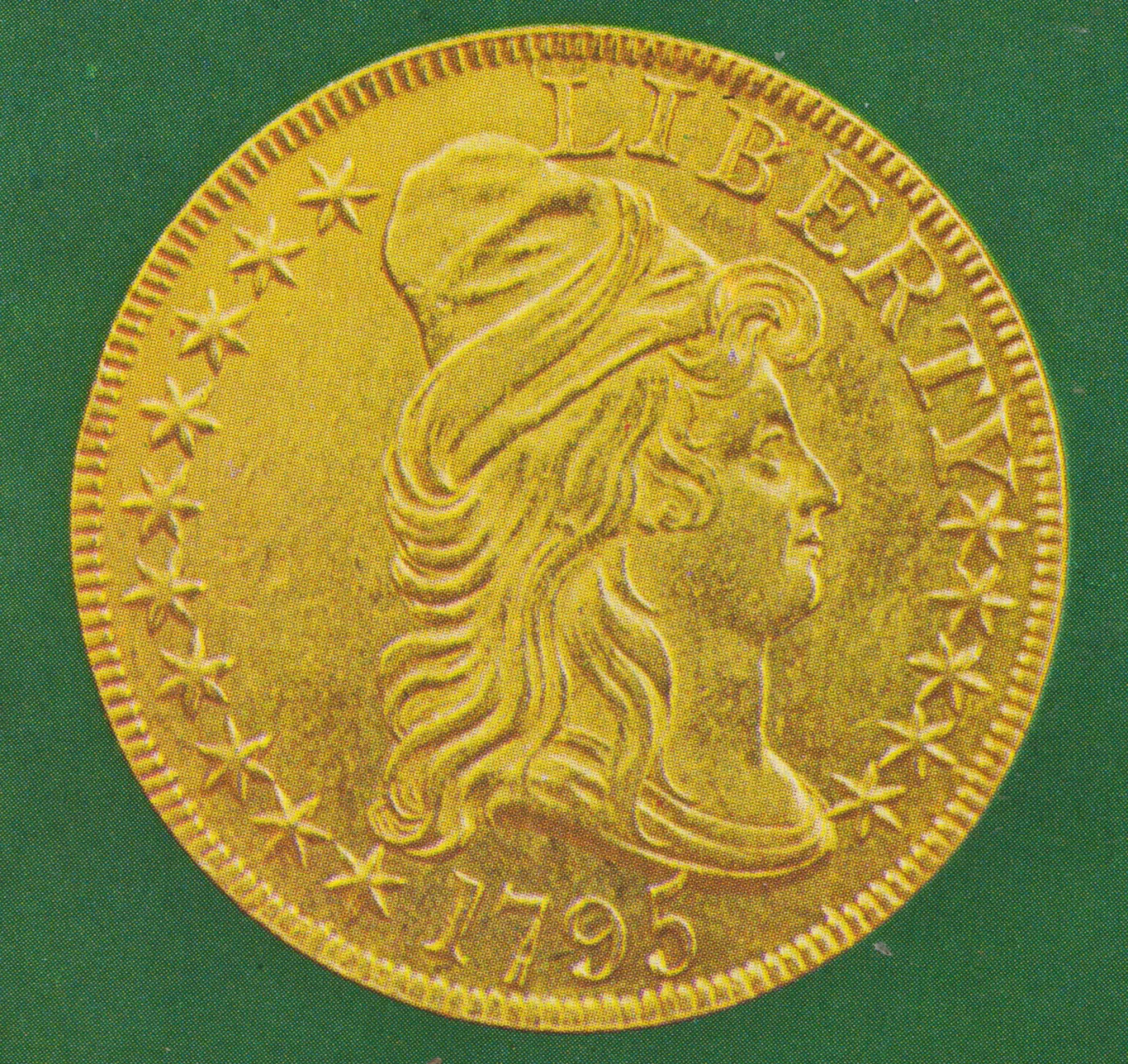
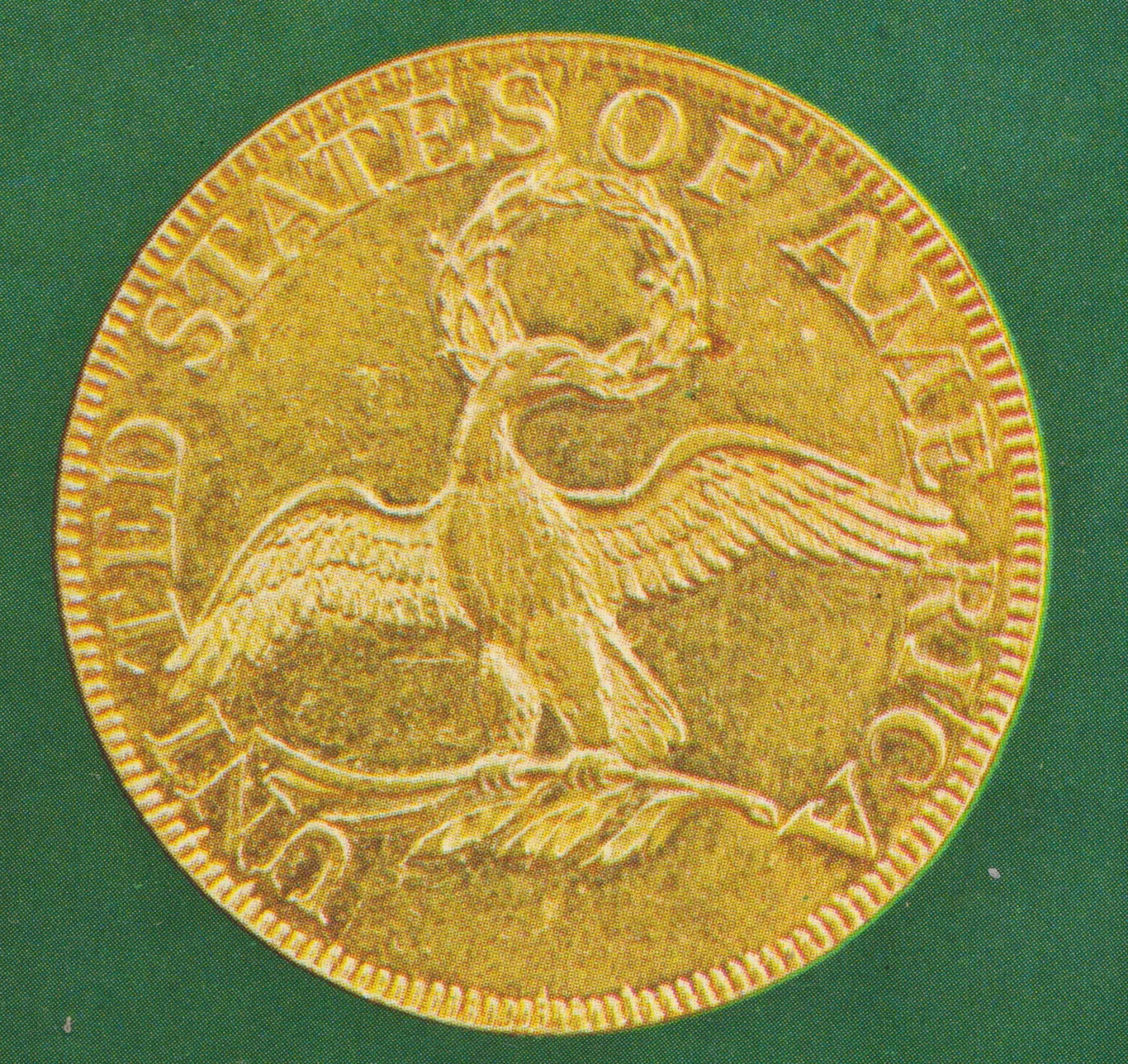
The earliest eagles show a small, delicate, naturalistic eagle on the reverse, perched on a palm branch and holding a wreath aloft in its beak, with no shield. The bird is slender and lifelike, modeled after a real eagle rather than a heraldic emblem, and the design has an intimate, almost European character. This Small Eagle type was struck only from 1795 through 1797 and is the rarer and more coveted of the two types.
Type 2: Capped Bust Right / Heraldic Eagle (1797-1804)
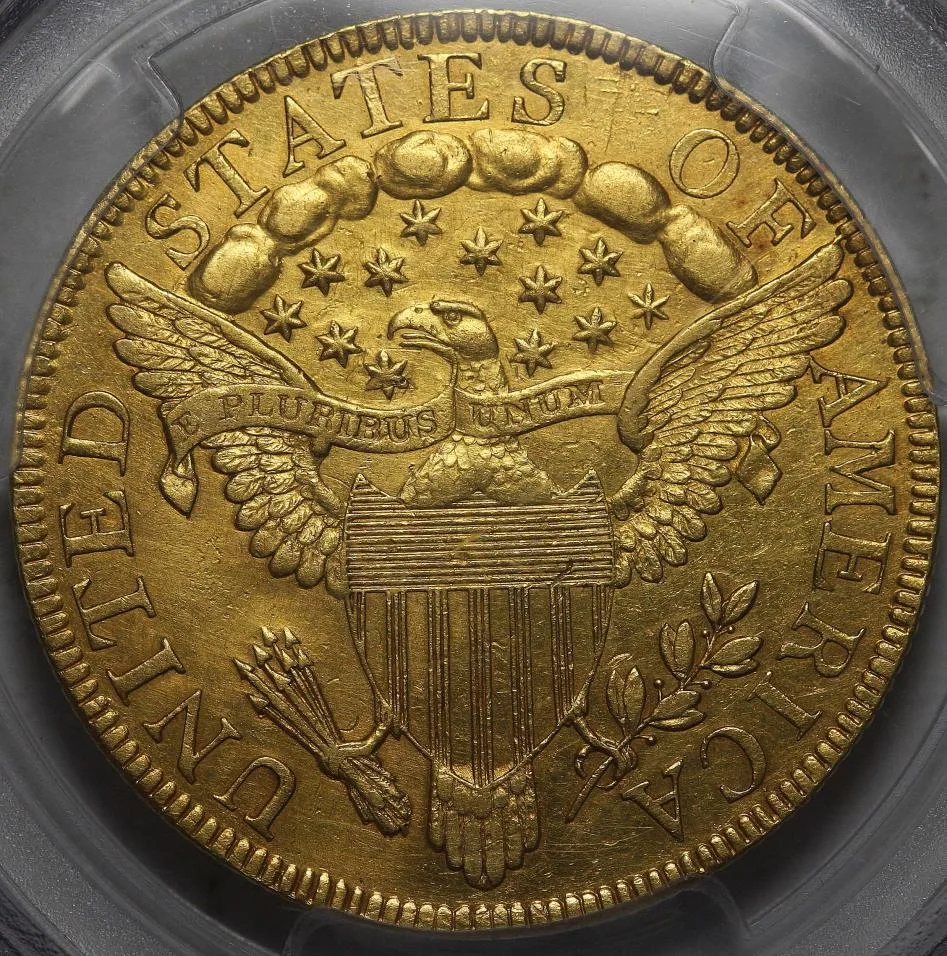
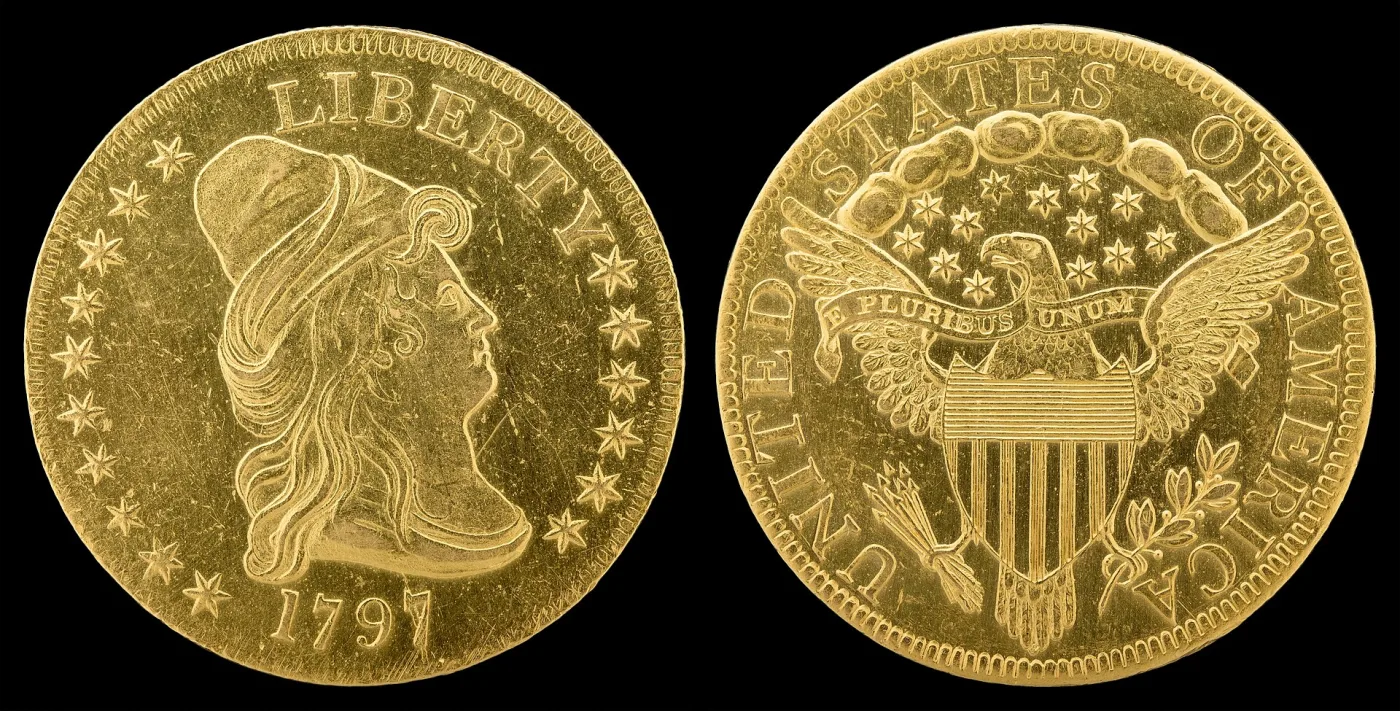
Beginning in 1797, the reverse changed to a large heraldic eagle modeled on the Great Seal of the United States. This bold eagle has its wings spread, a federal shield on its breast, an olive branch and a bundle of arrows in its talons, and a scroll above bearing the motto “E PLURIBUS UNUM,” with a cluster of stars and clouds over its head. The obverse kept Scot’s right-facing capped bust. This Heraldic Eagle type was produced from 1797 through 1804 and is the more frequently encountered (though still scarce) of the two, and it includes the great rarity of 1804.
Put the two reverses beside each other and the type answers itself:
The 1795-1797 Overlap
The transition was not perfectly clean. Both types were struck in 1797, so a 1797-dated eagle can be either Small Eagle or Heraldic Eagle, and the two 1797 varieties are collected as distinct coins. The Small Eagle 1797 is the scarcer of the two. Always check the reverse on a 1797 eagle to determine which type you have, because the difference materially affects both rarity and value.
Design and Symbolism
Across both types, the Capped Bust Eagle carries the standard symbolic vocabulary of early American coinage — Liberty, stars for the states, and the eagle of the republic — rendered at the largest scale the early Mint attempted.
Obverse: Liberty in a Cloth Cap
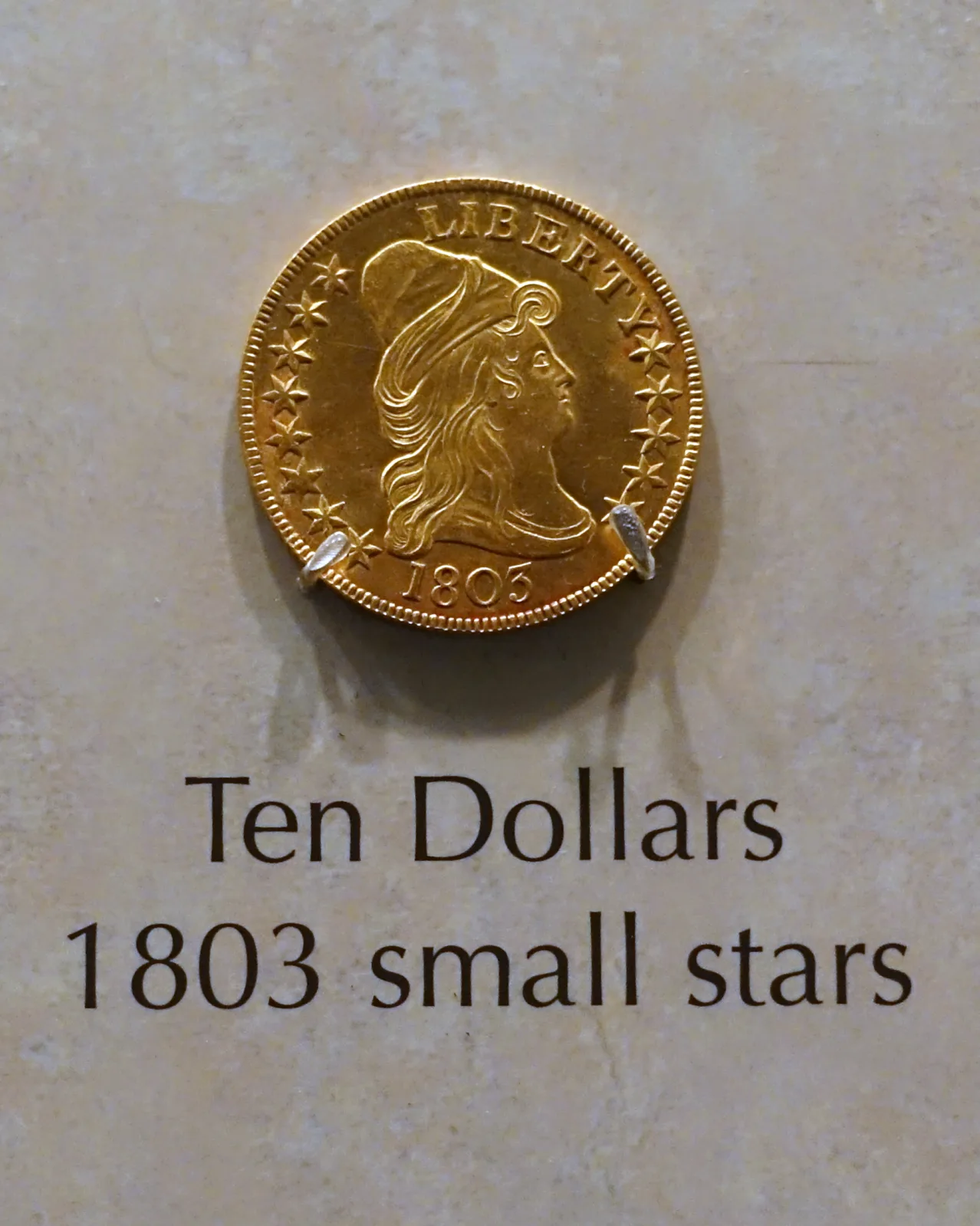
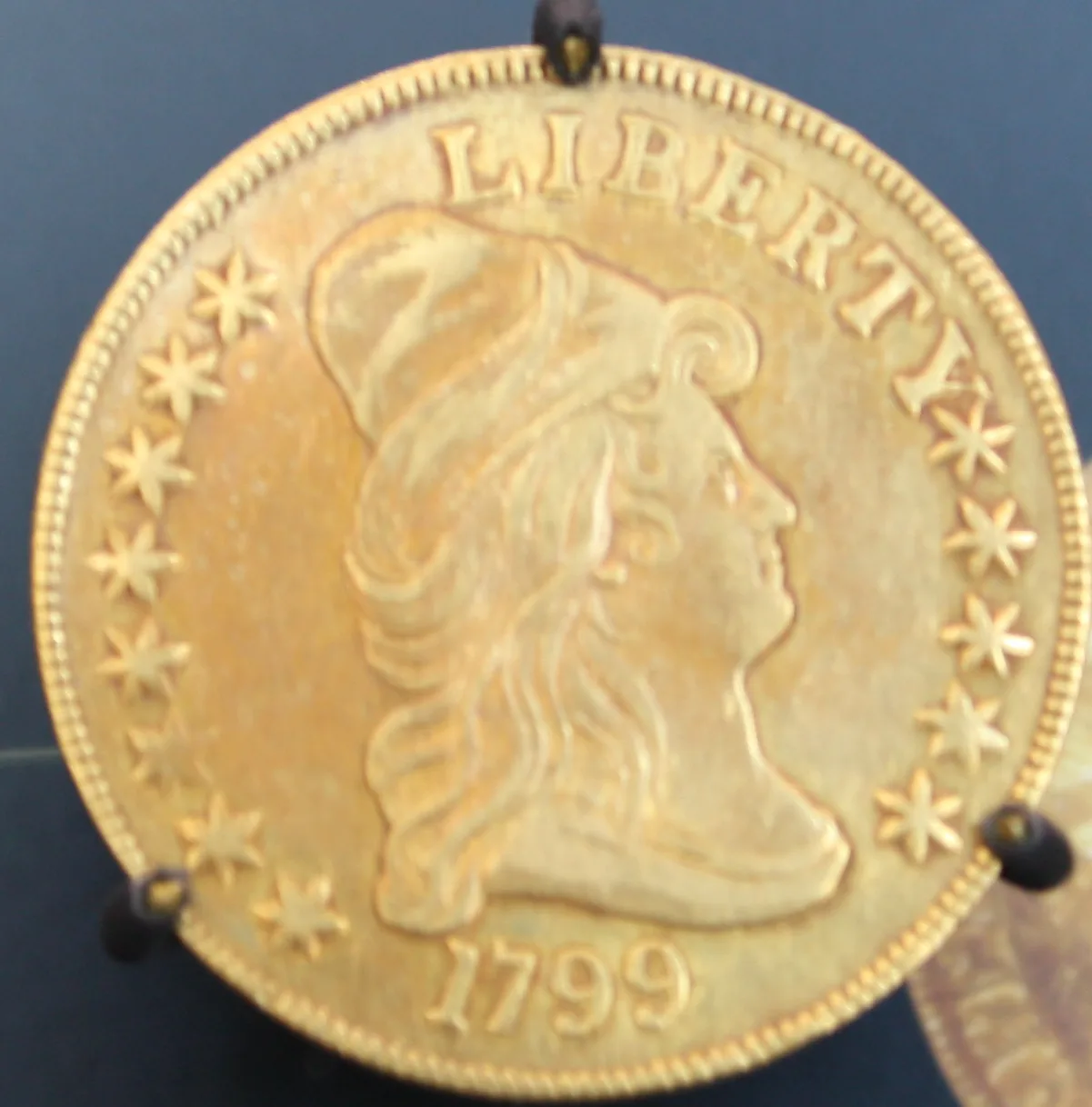
Every Capped Bust Eagle depicts the head of Liberty facing right, wearing a tall, soft conical cloth cap (the “turban”). Her hair flows out behind the cap in loose curls. Stars surround the portrait, the date appears at the bottom, and LIBERTY is lettered in an arc above the cap. That legend is easy to overlook on a worn coin, because it sits close to the rim and the cap intrudes into it, but it is present on every date of the series. The number and arrangement of the stars vary by date and are one of the most important diagnostic features of the series, discussed in detail below.
Reverse: From Small Eagle to Heraldic Eagle
The reverse tells the story of the type. The earliest coins (1795-1797) show the delicate small eagle on a palm branch, holding a wreath, encircled by the legend “UNITED STATES OF AMERICA.” From 1797 onward the reverse shows the bold heraldic eagle of the Great Seal, clutching an olive branch and arrows beneath a shield, with the motto “E PLURIBUS UNUM” on a scroll and a field of stars and clouds above. Crucially, the Capped Bust Eagle carries no mark of denomination anywhere on the coin — there is no “10 D.” or “TEN DOLLARS” legend. The value was understood from the coin’s size and weight, and the absence of a denomination is itself a useful authentication clue.
The Designer: Robert Scot
Robert Scot, the Mint’s first Chief Engraver, created both the obverse and the two reverse designs. Scot was a Scottish-born engraver whose neoclassical style set the template for the first decade of American coinage. His heraldic eagle reverse, in particular, became the standard reverse motif across the gold and silver of the era, echoed on coins designed by his successors. The visual lineage that runs from Scot through John Reich to Christian Gobrecht begins with these early eagles and half eagles.
Composition and Physical Specifications
The Capped Bust Eagle’s specifications stayed essentially constant across its 1795-1804 run, and these numbers are useful both for identification and for confirming authenticity by weight.
Key Specifications
Composition: .9167 fine gold (22 karat), the British “crown gold” standard, alloyed with silver and copper. Weight: 17.5 grams (270 grains). Diameter: approximately 33mm. Edge: reeded. Actual gold weight: approximately 0.5154 troy ounces. The eagle is a large, heavy coin — roughly twice the weight of the half eagle and about the diameter of a modern half dollar — and that substantial heft is one of the first things you notice when handling a genuine example.
The .9167 Fineness
Unlike modern .900 fine U.S. gold, the early eagle used the .9167 “crown gold” standard inherited from British practice. This higher gold content is one reason the coins were so attractive to melt and export. The fineness remained .9167 throughout the series; the 1834 reform that changed the weight and fineness of U.S. gold came long after the eagle had been suspended, so no Capped Bust Eagle was ever struck to the later standard.
Weight and Diameter as Authentication Tools
Because gold is dense, a genuine Capped Bust Eagle has a distinctive heft, and its weight should be very close to 17.5 grams allowing for minor wear. A precise jeweler’s scale reading significantly below this — or a diameter that does not match the roughly 33mm standard — is a serious red flag for a counterfeit or a coin of incorrect fineness. The reeded edge should be sharp and complete; cast fakes often show mushy, filed, or seamed edges. These same density-based checks help authenticate later U.S. gold such as the gold dollar.
How to Identify a Capped Bust Eagle
Work through these steps in order to identify and classify an early eagle. The goal is first to confirm it is an eagle, then to determine which reverse type it belongs to, and finally to read the date and star arrangement.
Step 1: Confirm It Is an Eagle
Early eagles carry no denomination mark, so you must judge by size and context. The eagle is about 33mm in diameter and weighs about 17.5 grams. The half eagle is about 25mm and 8.75 grams; the Capped Bust quarter eagle is about 20mm and 4.37 grams. The eagle is by far the largest of the three, so size alone usually settles the question. If you are unsure, weigh and measure the coin. For broader identification techniques across all U.S. coin types, see our complete coin identification guide.
Step 2: Confirm Liberty Faces Right
Every genuine Capped Bust Eagle shows Liberty facing right in a tall conical cap. If you have a $10 gold coin with Liberty facing left and a coronet inscribed “LIBERTY,” you are looking at the later Liberty Head eagle (1838-1907), not the Capped Bust type. If Liberty stands full-length in a war bonnet, it is the Indian Head eagle (1907-1933). The Capped Bust Eagle is the only $10 coin with the right-facing capped bust.
Step 3: Examine the Reverse Eagle
If the reverse shows a small, naturalistic eagle on a palm branch holding a wreath, you have the rare Small Eagle type (1795-1797). If it shows a large heraldic eagle with a shield on its breast, a scroll motto, and stars and clouds above, you have the Heraldic Eagle type (1797-1804). This single observation classifies the coin and is the most important attribution step.
Step 4: Read the Date
The date appears at the bottom of the obverse. Capped Bust Eagles are dated 1795 through 1804. Confirm the date carefully and look for signs of overdating (a digit punched over another), which occurs in this series — most famously the 1798/7 — and can significantly affect value.
Step 5: Count and Note the Star Arrangement
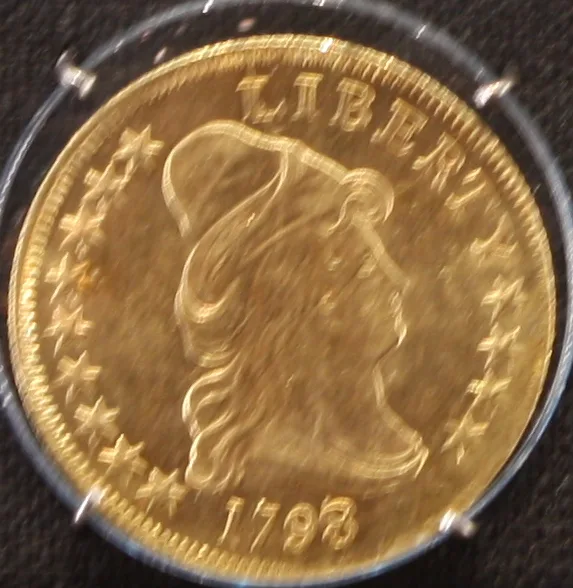
Count the obverse stars and note how they are divided to the left and right of the portrait. The early eagles show several distinct star configurations that define specific varieties (detailed in the next section). This is essential for proper attribution, especially for the 1795-1798 dates.
Step 6: Look for a Mint Mark (There Isn’t One)
Every Capped Bust Eagle was struck at the Philadelphia Mint and carries no mint mark. The branch mints did not open until 1838, decades after this type ended. Any 1795-1804 eagle bearing a “C,” “D,” “O,” or “S” mint mark is a counterfeit or an altered coin. Branch-mint $10 gold belongs only to the later Liberty Head and Indian Head eagle series.
Star Arrangements and How to Read Them
One of the defining characteristics of the Capped Bust Eagle series is the variation in the number and arrangement of obverse stars, which is central to attributing the early dates. The Mint had not yet standardized the star count, and the result is a sequence of collectible varieties that every specialist learns to read.
The 1795 Star Arrangements
The first-year 1795 eagles show fifteen stars on the obverse, representing the fifteen states in the Union at the time (the thirteen originals plus Vermont and Kentucky). These are typically arranged in patterns that specialists describe by how many stars fall to the left and right of Liberty. The 1795 also exists with different leaf counts on the reverse palm branch (the famous “13 Leaves” and “9 Leaves” reverses), which are major varieties in their own right.
The 1796 and 1797 Changes
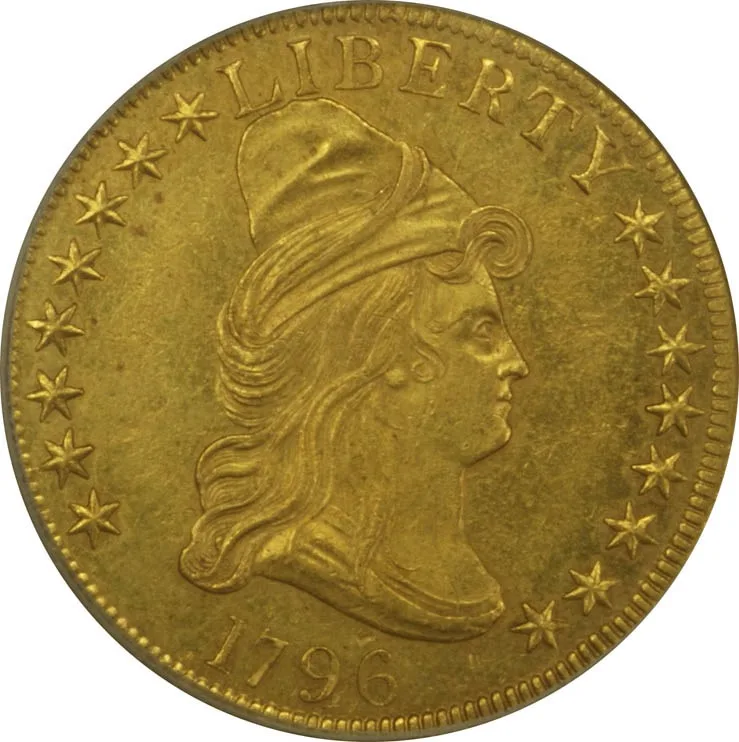
In 1796, with Tennessee’s admission, the star count rose to sixteen on some dies. The Mint soon realized that adding a star for every new state would quickly crowd the design, so it began to standardize. By 1797 on the Small Eagle coins, and continuing on the Heraldic Eagle type, the obverse settled on thirteen stars for the original colonies, though the precise arrangement still varied.
The “Stars Left and Right” Configurations
On the Heraldic Eagle type (1797-1804), the obverse stars are most often divided into groups to the left and right of the portrait, and specialists describe varieties by these counts — for example, arrangements with stars split as a certain number on the left and the remainder on the right. The 1797, 1798/7, and 1799 dates in particular show notable star-arrangement varieties (such as the famous 1798/7 with stars arranged 9 left and 4 right, versus 7 left and 6 right), which are cataloged as distinct die marriages and carry different rarity levels and values.
Why Star Counts Matter
Because the star arrangements define specific varieties, two coins of the same date can differ substantially in rarity and price depending on their stars. When identifying a Capped Bust Eagle, always count the stars and note the left/right split, then compare against an authenticated variety reference. The standard attribution system for early gold, the Bass-Dannreuther (BD) catalog, uses these features along with die characteristics to identify each marriage precisely.

Key Dates and Rarities
The Capped Bust Eagle series is short — only ten years — but every date is scarce, and several are major rarities. Because so many coins were melted and exported, even the “available” dates are difficult and expensive by ordinary standards, and the keys rank among the most prized coins in American numismatics.
1795 (Small Eagle)
The first year of issue and the first U.S. ten-dollar gold coin. The 1795 Small Eagle is intensely desirable as the inaugural eagle, and demand always outstrips supply. The 13 Leaves reverse is the more available variety; the 9 Leaves reverse is a famous rarity. Values run from roughly $30,000 to $50,000 in lower circulated grades into the high six figures (and beyond for the 9 Leaves) for choice Mint State examples.
Both sides of a first-year coin, from one plate photograph:
1796 (Small Eagle)
A scarce second-year issue with a modest mintage, the 1796 is a key Small Eagle date prized for its early date and low survival. Circulated examples command strong five-figure to low six-figure prices.
1797 Small Eagle
The final Small Eagle year and the scarcer of the two 1797 types. With the type changing mid-year, the Small Eagle 1797 survives in small numbers and is a cornerstone of any Small Eagle type set.
1798/7 Overdate
The 1798/7 (an 8 punched over a 7 in the date) is a notable Heraldic Eagle rarity, existing in two star-arrangement varieties (9 stars left / 4 right, and 7 left / 6 right). Both are scarce and the 1798/7 is one of the more challenging dates of the Heraldic Eagle type.
1799 and 1801 (Heraldic Eagle)
The 1799 and 1801 are the two most “available” dates of the entire series — which still means genuinely scarce coins. They are the dates most often chosen by collectors seeking a single representative Capped Bust Eagle, and they exist in enough quantity to appear at major auctions with some regularity. Even so, they command substantial five-figure prices in collectible grades.
1803 (Heraldic Eagle)
A scarcer Heraldic Eagle date with several varieties, including small-star and large-star reverses. More challenging than the 1799 and 1801.
1804 (Heraldic Eagle)
The final and most famous date of the series, and the key to the entire set. The 1804 exists in two distinct varieties — the original Crosslet 4 business strike and the later Plain 4 presentation rarity — discussed in detail in the next section. The 1804 is a blue-chip coin in any form and the crown of the series.
The 1804 Eagle: Plain 4 vs Crosslet 4
No discussion of the Capped Bust Eagle is complete without the 1804, the date that closes the series and that contains one of the most storied rarities in American numismatics. Understanding the two varieties of 1804 is essential, because they are radically different coins.
The 1804 Crosslet 4 (Original Business Strike)
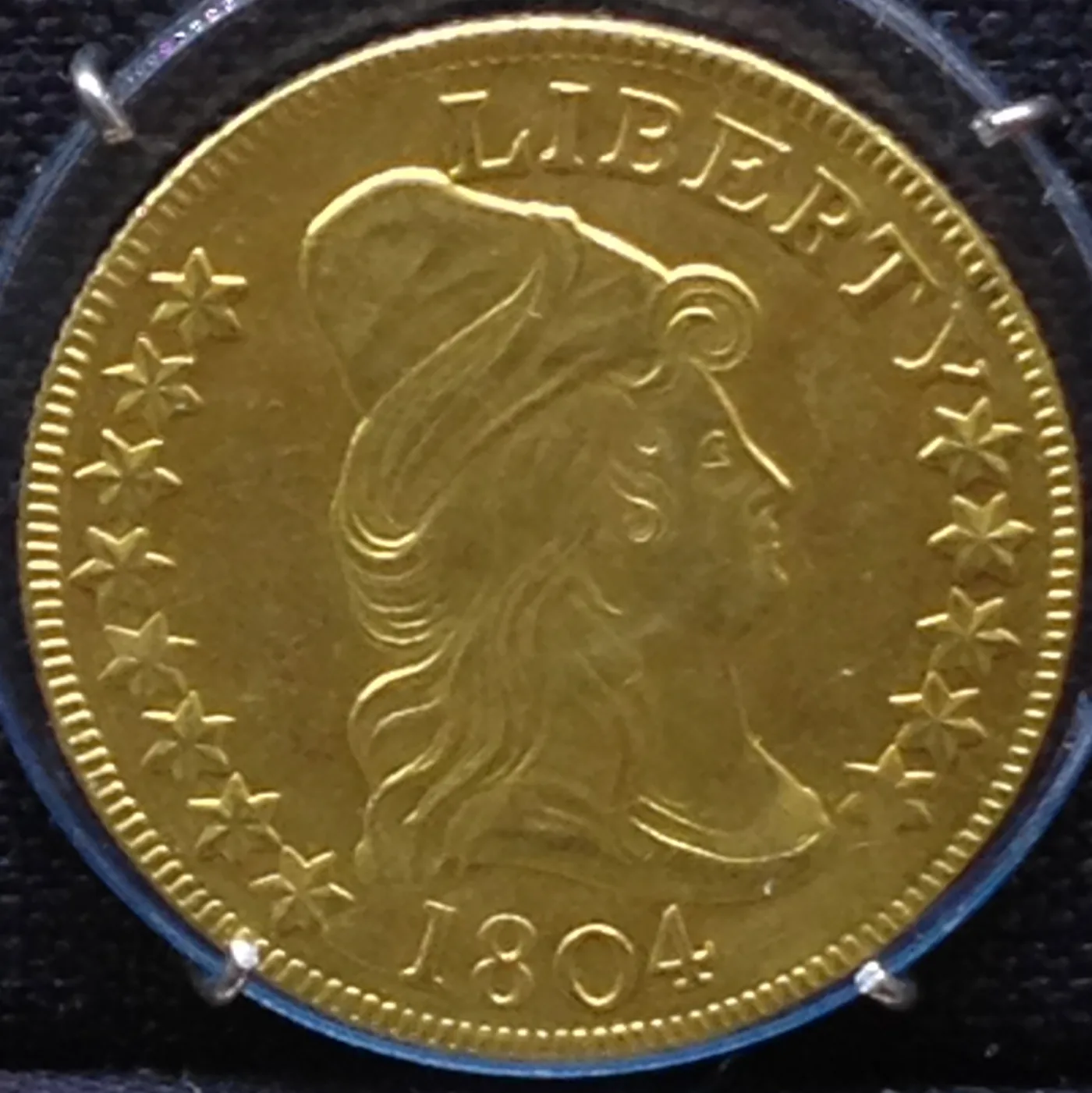
The original 1804 eagles were struck for circulation in 1804, the final year before suspension. These show the “Crosslet 4” in the date — a 4 with a small serif or crosslet at the right end of the horizontal bar. The Crosslet 4 is the genuine, contemporary 1804 eagle. It is rare, as a low-mintage final-year issue heavily melted afterward, and it is a major key to the series, but it is a coin that was actually made and used in 1804.
The 1804 Plain 4 (Proof Presentation Restrike)
The far more famous — and far rarer — 1804 is the “Plain 4,” in which the 4 has no crosslet. These were not struck in 1804 at all. They were produced in 1834-1835 as proof presentation pieces, made specifically for inclusion in the diplomatic gift sets that the U.S. government prepared for foreign rulers, the same sets that contained the legendary Class I 1804 silver dollar. Because the Mint needed an 1804-dated eagle to complete these prestige sets and the original dies were unavailable, it created new dies with a Plain 4. Only a handful of Plain 4 eagles exist, and they are proof rarities of the highest order, valued in the millions when they appear at auction.
The Connection to the 1804 Dollar
The 1804 Plain 4 eagle and the famous 1804 silver dollar share the same origin story: both were created in the 1830s as presentation pieces for diplomatic gift sets, not as contemporary 1804 coinage. This makes the Plain 4 eagle a numismatic cousin of “the King of American Coins.” The 1804 dollar itself belongs to the Draped Bust dollar series, and collectors who study one of these 1804 rarities inevitably encounter the other.
What This Means for Collectors
For practical purposes, the Plain 4 eagle is effectively uncollectible — there are only a few, and they trade once in a generation for fortunes. The Crosslet 4, while a genuine rarity, is the version a determined collector might actually pursue. If you ever believe you have found a Plain 4 1804 eagle, treat it with extreme skepticism: it is overwhelmingly likely to be an altered date or a counterfeit, and only PCGS or NGC can authenticate such a coin. The discovery of a previously unknown genuine Plain 4 would be a once-in-a-century event.
Major Varieties, Overdates, and Die Marriages
Capped Bust Eagles were struck from hand-prepared dies, and the series rewards variety specialists. The standard reference is the Bass-Dannreuther (BD) attribution system, which catalogs the die marriages of early U.S. gold in exhaustive detail, building on the foundational work of the Harry W. Bass Jr. collection.
Overdates
The most important overdate in the series is the 1798/7, where an 8 was punched over a 7 in a reused date. Overdates occur because the Mint frequently repunched older dies with a new date to conserve steel. An overdate can be worth significantly more than an ordinary date, so examining the date under magnification for traces of an underlying digit is always worthwhile — the same care that rewards study of other hand-struck early coinage.
Leaf and Star Varieties
The 1795 Small Eagle exists with 13 Leaves and 9 Leaves on the reverse palm branch, the 9 Leaves being a celebrated rarity. The Heraldic Eagle dates show small-star and large-star reverse varieties, and the obverse star arrangements (the left/right splits described earlier) define additional marriages. The number of berries, the placement of clouds, and the alignment of letters all distinguish specific dies.
Bass-Dannreuther Die Marriages
Specialists pursue specific BD die marriages, some of which are extreme rarities even when the date itself is more available. The Bass-Dannreuther reference, drawing on the unparalleled Bass collection of early gold, transformed the study of these coins, and serious collectors attribute their eagles by die marriage. As with the hand-cut dies of the early federal silver, careful study under magnification is richly rewarded and can turn an ordinary-looking coin into a significant rarity.
Proof and Presentation Strikes
Genuine proof Capped Bust Eagles are among the rarest and most valuable coins in all of American numismatics, and they are inseparable from the story of the 1804.
The 1804 Plain 4 Proofs
The only true proof Capped Bust Eagles are the 1804 Plain 4 presentation pieces struck in 1834-1835 for diplomatic gift sets. These were made as special presentation strikes, not for public sale, since organized proof-set sales did not begin until 1858. They show fully mirrored fields and crisp, fully struck detail. Only a few exist, and they are landmark rarities valued in the millions.
Presentation and Specimen Strikes
Beyond the 1804 Plain 4, a small number of other early eagles show prooflike or specimen characteristics, struck with extra care for presentation. These are studied case by case and authenticated individually; the designation of any early gold coin as a “specimen” or “proof” requires expert certification and ideally published provenance.
Market Position
For all but a handful of the world’s wealthiest collectors, proof Capped Bust Eagles are a subject of study rather than acquisition. Collector attention focuses almost entirely on the business strikes, where genuine rarity and historical importance are available — at a price — across the dates of the series.
Grading Capped Bust Eagles
Grading early eagles requires understanding both the standard Sheldon scale and the specific high points where each design first shows wear. The soft, hand-struck nature of early gold means strike quality varies enormously and can be mistaken for wear.
Key Grading Focal Points
On the obverse, wear shows first on the highest points: the curls of Liberty’s hair, her cheek, and the folds of the cap. On the reverse, examine the small eagle’s breast and wing feathers (Small Eagle type) or the heraldic eagle’s neck, breast, wing tips, shield, and the clouds and stars above (Heraldic Eagle type). Because these large coins were struck with primitive equipment, the central devices are often the last to strike up and the first to wear, so the centers deserve special attention.
Strike vs Wear on Early Gold
Many early eagles were struck from worn or misaligned dies on imperfect planchets, so they can show softness in the centers that has nothing to do with circulation. Distinguishing a weak strike from honest wear is the single hardest part of grading this series and is a major reason these coins should be graded by professionals. Reading the luster in the protected areas — around the stars, in the recesses of the cap, between the eagle’s feathers — is essential to telling an original unworn coin from a circulated one.
Grade Descriptions
Fine to Very Fine (F-12 to VF-35): Moderate even wear. Major design outlines are clear; about half the hair and feather detail remains. This is a commonly encountered range for the type, since the coins circulated and were handled as large-value money.
Extremely Fine (EF-40 to EF-45): Light wear on the high points only. Most hair curls and feather groups are distinct. Traces of mint luster may survive in protected areas. A desirable and obtainable grade for a coin of this rarity.
About Uncirculated (AU-50 to AU-58): Only slight friction on the highest points — the topmost hair curls, the cap folds, the eagle’s wing tips. AU-58 examples retain most of their luster and appear nearly uncirculated. Genuine AU early eagles are scarce and command strong premiums.
Mint State (MS-60 to MS-65+): No wear. Differentiated by surface marks, luster quality, and strike. Mint State Capped Bust Eagles exist for the more available dates (1799, 1801) but are condition rarities for most issues; a Gem (MS-65 or finer) of any date is a major trophy. For a full explanation of the numerical grades and what each level means, see our coin grading guide.
Counterfeit Detection and Authentication
Capped Bust Eagles are among the most frequently counterfeited and altered U.S. gold coins. Their high value, the existence of legendary rarities like the 1804, and the abundance of cheap modern fakes make authentication absolutely essential.
Altered Dates
The most dangerous deceptions in this series are altered dates — a common-date coin reworked to imitate a rarity, or an ordinary 4 reshaped to mimic the Plain 4 of 1804. Examine the date under 10x to 20x magnification for tooling marks, disturbed metal, repunching that does not match known dies, or digits of slightly wrong shape or spacing. The 1804 in particular is a magnet for date alteration, so any 1804 eagle demands the highest scrutiny. Always compare against authenticated reference photographs of genuine die marriages.
Cast and Struck Counterfeits
Cast counterfeits show telltale signs: slightly soft or rounded detail, a grainy or pebbly surface texture under magnification, incorrect weight, mushy or filed edge reeding, and sometimes a visible seam on the edge. Modern struck counterfeits from false dies can be far more deceptive, but they often contain subtle errors in the star positions, the date logotype, the eagle’s feather detail, or the relationship of the lettering to the devices that do not match any genuine die. Many counterfeits also have the wrong “look” to the gold — too brassy, too red, or too uniform in color.
Weight and Diameter Check
A genuine coin weighs 17.5 grams (less a small amount for wear) and measures about 33mm. Significant deviation from these figures indicates a fake or a coin of incorrect fineness. These quick physical checks rule out a large fraction of crude counterfeits, the same way they help authenticate other early gold issues, and they should be the first step in evaluating any raw early eagle.
Professional Authentication Is Essential
For any Capped Bust Eagle, professional authentication and grading by PCGS or NGC is strongly recommended, and for any of the keys — especially the 1804, the 1795 9 Leaves, and the 1798/7 — it is mandatory. The price difference between a genuine rarity and a clever fake is measured in tens of thousands to millions of dollars, and certified encapsulation provides authentication, an objective grade, and tamper-evident protection. Never buy a five- or six-figure early eagle raw unless you are a specialist who can attribute the exact die marriage yourself.
Current Market Values by Type and Grade
Capped Bust Eagle values are driven by type, date, grade, strike quality, and variety. The range is vast — from low five figures for the most available dates in modest grade to seven figures and beyond for the 1804 Plain 4. The following are typical 2026 retail ranges for properly certified coins; raw coins and problem coins (cleaned, damaged, or “details” graded) sell at significant discounts.
Capped Bust Right, Small Eagle (1795-1797)
The rarer and more expensive type. The 1795 13 Leaves begins around $30,000 to $50,000 in lower circulated grades and runs well into six figures in higher grades; the 1795 9 Leaves and the 1796 and 1797 Small Eagle dates command strong premiums above that. Choice Mint State Small Eagles reach deep into six figures and beyond.
Capped Bust Right, Heraldic Eagle (1797-1804), Available Dates
The 1799 and 1801 are the most obtainable dates and the natural choice for a single representative coin. They typically run roughly $15,000 to $30,000 in Extremely Fine, $30,000 to $60,000 in About Uncirculated, and into six figures in Mint State. These are the entry point to the series, and even they are substantial coins.
Heraldic Eagle Scarcer Dates (1798/7, 1803)
The 1798/7 overdate and the scarcer 1803 varieties carry premiums over the 1799 and 1801, generally running well into five and six figures depending on grade and variety.
The 1804
The Crosslet 4 business strike is a major key, typically commanding six figures even in circulated grades and substantially more in higher grades. The Plain 4 proof presentation piece is a multi-million-dollar rarity that trades only at the most important auctions, on the rare occasions one becomes available.
Market Trends
The early gold market has been strong, with deep, steady demand for original, problem-free coins from a small but passionate community of early-gold specialists. Coins with original surfaces and good eye appeal bring substantial premiums over the cleaned and “details”-graded examples that dominate the surviving population. Underlying gold bullion prices provide a floor under even the more available dates, but for this series the numismatic value vastly exceeds melt for all but the most damaged coins. Because the eagle was the largest early gold coin, it carries a special prestige that supports strong, consistent collector demand.
Collecting Strategies and Tips
Because the Capped Bust Eagle series ranges from genuinely obtainable (at a price) to effectively impossible, collectors approach it at very different levels of ambition and budget.
Single Representative Coin
Most collectors who want a Capped Bust Eagle are content with a single example to represent the entire 1795-1804 era in a broader U.S. gold type set. A 1799 or 1801 Heraldic Eagle in EF or AU is the natural choice, offering genuine first-era American gold at the most accessible entry point the series allows. Such a coin anchors a type set that can run all the way through the later Indian Head eagle, telling the complete story of the $10 denomination.
Two-Type Collection
A popular and rewarding approach is to acquire one example of each reverse type — a Small Eagle (1795-1797) and a Heraldic Eagle (1797-1804) — to represent the full design evolution of the early eagle. Even a circulated two-type set is a significant accomplishment, since the Small Eagle type is genuinely rare and expensive.
Date and Die-Marriage Collecting
Advanced specialists pursue complete date sets or specific Bass-Dannreuther die marriages. A complete date set of Capped Bust Eagles is one of the most prestigious and expensive goals in American numismatics, requiring deep pockets, deep knowledge, and the patience to compete for keys at major auctions. The 1804 alone — even the Crosslet 4 — is a six-figure hurdle.
Buy the Coin, Not the Holder
Because strike quality varies so much, two coins in the same numerical grade can look very different. Prioritize original surfaces, good eye appeal, and strike sharpness over the number on the label. A well-struck, original EF-45 is often more desirable than a weakly struck, cleaned AU. Always buy certified coins, learn to read the population reports for true rarity by grade, and develop a relationship with a specialist dealer who handles early gold. For coins of this value, the dealer relationship and the certification are as important as the coin itself.
Proper Storage and Preservation
Gold is chemically stable and does not tone or corrode the way silver and copper do, but Capped Bust Eagles still require proper care to protect their surfaces and their substantial value.
Avoid PVC and Physical Contact
Never store gold coins in PVC-containing flips, which can leave a sticky green residue over time. Use inert Mylar flips, hard plastic capsules, or certified-grading-service holders. Although gold resists chemical damage, the soft 22-karat metal scratches easily, so minimizing handling and contact with other coins is essential to preserve grade and eye appeal. Given their size, eagles are heavy and can damage one another if stored loose together.
Handling
Always hold coins by their edges over a soft surface. Gold is softer than most collectors expect, so fingerprints, hairlines, and contact marks reduce eye appeal and value, particularly on higher-grade examples. Wear clean cotton or nitrile gloves when handling uncertified pieces, and never slide a coin across any surface.
Never Clean
Cleaning a gold coin leaves hairline scratches and an unnatural brightness that experienced graders and the major services detect immediately. A cleaned Capped Bust Eagle receives a “details” grade and sells at a steep discount — often 30% to 60% below an equivalent original coin, and on a five- or six-figure rarity that is an enormous sum. Even a coin that looks dull or has dirt in the recesses is worth far more left untouched than cleaned. Leave any conservation decision to professional services.
Environment and Security
Store in a cool, dry, stable environment. Given the high value of these coins, use a quality safe or a bank safe-deposit box, maintain an inventory with photographs and certification numbers for insurance purposes, and carry a numismatic insurance policy appropriate to the collection’s value. A single Capped Bust Eagle can represent a major financial asset, and it should be protected accordingly.
Frequently Asked Questions
What is a Capped Bust Eagle?
It is the United States $10 gold coin struck from 1795 to 1804, the first ten-dollar gold piece and the largest denomination of the early Mint. "Capped Bust" refers to Liberty's soft conical cloth cap, which older references nicknamed the "Turban Head." The series has two reverse types — a Small Eagle (1795-1797) and a Heraldic Eagle (1797-1804) — and was designed by the Mint's first Chief Engraver, Robert Scot.
Why was the eagle discontinued in 1804?
Because U.S. gold coins contained more than their face value in metal under the 1792 gold-to-silver ratio, the largest coins — the eagle and the silver dollar — were being exported and melted as fast as they were struck. In late 1804 the government suspended both denominations to stop feeding the bullion trade. The eagle did not return until 1838, a gap of thirty-four years.
How do I tell the two reverse types apart?
Look at the reverse eagle. If it is a small, naturalistic eagle perched on a palm branch holding a wreath, with no shield, it is the Small Eagle type (1795-1797). If it is a large heraldic eagle with a shield on its breast, a scroll motto "E PLURIBUS UNUM," and stars and clouds above, it is the Heraldic Eagle type (1797-1804). The 1797 date exists in both types, so always check the reverse.
What is the difference between the 1804 Plain 4 and Crosslet 4?
The Crosslet 4 is the original 1804 business strike, struck in 1804, with a small serif (crosslet) at the end of the 4's horizontal bar — a genuine, rare contemporary coin. The Plain 4 has no crosslet and was struck in 1834-1835 as a proof presentation piece for diplomatic gift sets, the same sets that held the famous 1804 silver dollar. Only a few Plain 4 eagles exist, and they are multi-million-dollar rarities.
Do Capped Bust Eagles have mint marks?
No. Every one was struck at the Philadelphia Mint and carries no mint mark. The branch mints (Charlotte, Dahlonega, New Orleans, San Francisco) did not open until 1838 or later, after the type had ended. Any 1795-1804 eagle with a mint mark is a counterfeit or altered coin.
How much is a Capped Bust Eagle worth?
Values depend heavily on type, date, grade, and variety. The most available dates (1799, 1801) typically run from the mid five figures in circulated grades into six figures in Mint State. The Small Eagle type and scarcer dates command more, and the 1804 ranges from six figures (Crosslet 4) to millions (Plain 4). Every date in the series is a substantial coin; there are no inexpensive Capped Bust Eagles.
What does "Turban Head" mean?
"Turban Head" is an old collector nickname for the Capped Bust design, based on the mistaken impression that Liberty's tall soft cloth cap was a turban. It is the same coin as the Capped Bust Eagle. The name still appears in older books, catalogs, and price guides, so it is useful to recognize, but modern references use "Capped Bust."
Should I clean a dull or dirty Capped Bust Eagle?
Never. Cleaning gold leaves hairline scratches and an unnatural surface that graders detect immediately, resulting in a "details" grade and a 30% to 60% loss in value. On a high-value early coin that loss is enormous. Original, even if dull, is always worth more than cleaned. Leave any conservation decision to professional services such as PCGS or NGC.
How can I be sure my early eagle is genuine?
Have it authenticated and graded by PCGS or NGC. Begin with a weight and diameter check — a genuine coin weighs 17.5 grams and measures about 33mm — but only professional authentication can rule out the sophisticated altered dates and struck counterfeits that target this series, especially the 1804. Never pay a five-figure-or-higher price for a raw early eagle unless you are an expert who can attribute the die marriage yourself.
Can I still find these in circulation?
No. The Capped Bust Eagle left circulation more than two centuries ago, and most were melted in the 1800s. All surviving examples are in collections, dealer inventories, museums, or estate holdings, and are acquired through specialist dealers and major auctions.