Capped Bust Quarter Eagle Identification Guide: 1796 No Stars, 1804 13-Star, Capped Right and Capped Head Types, and Values
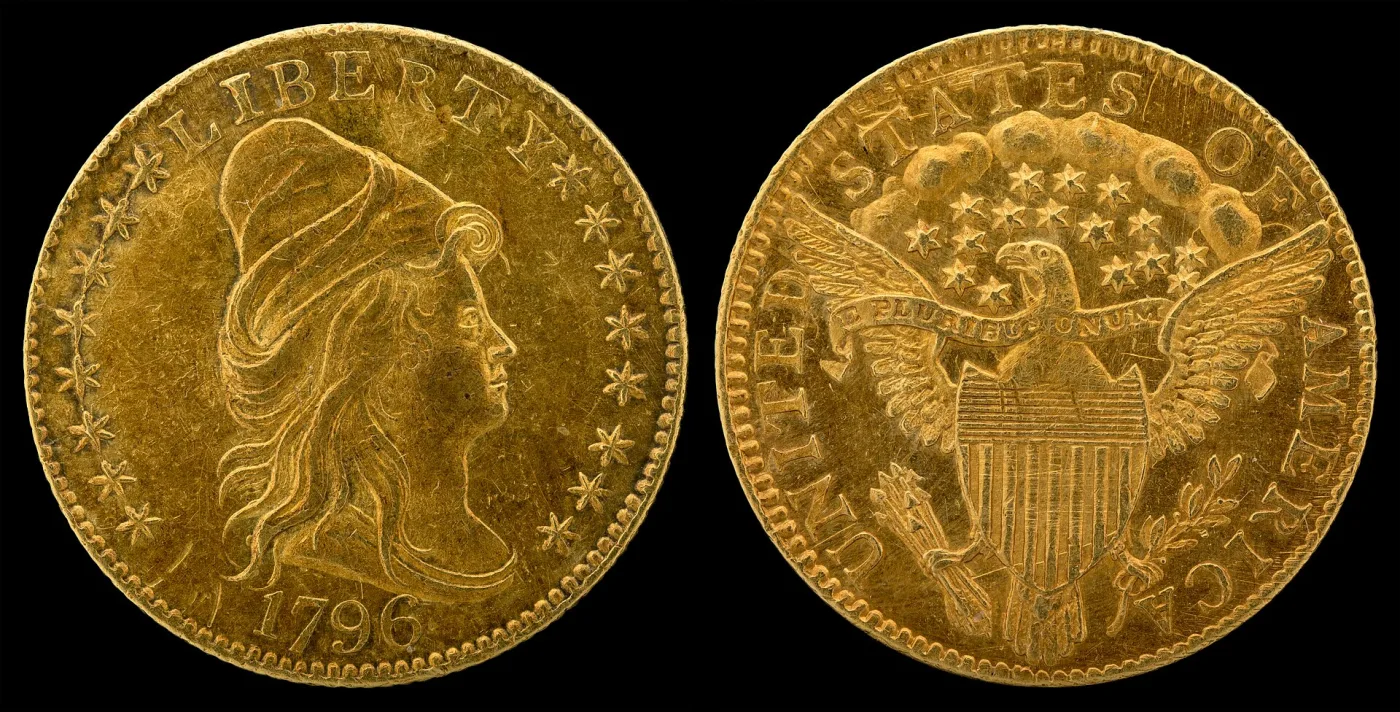
The Capped Bust Quarter Eagle is the very first $2.50 gold coin the United States ever struck, and it remains one of the most romantic and challenging series in all of American numismatics. Produced intermittently across nearly four decades — from 1796 through 1834 — it is not a single coin but a family of closely related types, designed by some of the earliest engravers of the fledgling Mint and struck in such tiny quantities that a complete collection is the work of a lifetime and a fortune. Every Capped Bust Quarter Eagle is genuinely scarce; many are rarities of the first rank; and a few are among the most famous coins in the entire federal series.
The story begins in 1796, when the Philadelphia Mint struck the first quarter eagles using a design adapted from Robert Scot’s Draped Bust portrait — collectors call this earliest version the “Capped Bust to Right” type. The first variety of all, the famous 1796 No Stars, carries a plain field with no stars around Liberty, making it instantly recognizable and one of the most coveted U.S. gold coins in existence. Over the following years the design evolved through several reverses and, eventually, an entirely reworked portrait by John Reich — the “Capped Head to Left” type of 1821 to 1834 — before the series gave way to the reduced-weight Classic Head Quarter Eagle in 1834.
This guide walks through everything you need to identify, attribute, grade, authenticate, and value Capped Bust Quarter Eagles in the 2026 market. Because the series spans multiple sub-types with overlapping names — and because the difference between them can mean a difference of hundreds of thousands of dollars — careful, methodical identification is essential. We will untangle the confusing “Capped Bust,” “Capped Head,” and “Turban Head” terminology, walk date by date through the entire run, and explain why these early gold pieces survive in such astonishingly small numbers.
History and Background
When the United States Mint opened in Philadelphia in the 1790s, the Coinage Act of 1792 had authorized three gold denominations: the quarter eagle ($2.50), the half eagle ($5), and the eagle ($10). Silver and copper coinage came first, but in 1795 the Mint struck its first gold — the half eagle and the eagle. The quarter eagle followed in 1796, completing the original gold trio and giving the new nation its smallest gold piece.
From the very beginning, the quarter eagle was a coin of limited purpose. It was too valuable for everyday transactions in a young, cash-poor agricultural economy, and like all early U.S. gold it suffered from the same fatal flaw: under the gold-to-silver ratio fixed in 1792, the coins were worth slightly more as bullion than as money. Anyone holding a quarter eagle had every incentive to melt or export it. The result was that mintages were tiny, production was sporadic, and survival rates were catastrophically low.
An Intermittent, Stop-and-Start Series
The Capped Bust Quarter Eagle was never struck in a continuous, year-after-year run. The Mint produced it only when depositors specifically requested quarter eagles, which happened irregularly. There are long gaps — no quarter eagles were struck at all in many years between 1796 and 1834. Entire stretches of the early 1800s and the 1810s have no quarter eagle coinage whatsoever. This stop-and-start pattern is the defining feature of the series and the reason its date runs are so short and incomplete.
The End of the Old Standard
By the 1830s the bullion problem had become untenable, and the Coinage Act of 1834 reduced the weight and fineness of all U.S. gold so the coins would finally circulate. That reform ended the Capped Bust Quarter Eagle and ushered in the lighter Classic Head type. As a result, the entire Capped Bust era — every coin from the 1796 No Stars to the last 1834 Capped Head — belongs to what numismatists call the “old tenor” gold: the heavier, pre-1834 standard whose coins were systematically destroyed. Understanding that backdrop is essential, because it explains why even the “common” dates of this series are major coins.
Untangling the Terminology: Capped Bust, Capped Head, Turban Head
No early U.S. gold series suffers from more confusing nomenclature than the quarter eagle of 1796 to 1834. Several names are used, sometimes interchangeably and sometimes for specific sub-types. Getting this straight is the first step to confident identification.
“Capped Bust” as the Umbrella Term
The entire 1796-1834 quarter eagle series is most often called “Capped Bust” because Liberty wears a soft cap throughout. Under this umbrella sit two visually distinct major types: the earlier Capped Bust to Right (1796-1807) and the later Capped Head to Left (1821-1834). Both show a capped Liberty, but they are different portraits facing different directions.
“Capped Bust to Right” vs the Draped Bust Connection
The 1796-1807 type is frequently described as the “Draped Bust” or “Capped Bust Right” quarter eagle because Robert Scot adapted the same Draped Bust portrait that appears on the era’s silver dollars and the Draped Bust quarter. Liberty faces right and wears a soft cap. You will see this type cataloged under both “Draped Bust” and “Capped Bust Right” — they refer to the same coins.
“Turban Head” — an Old Collector Nickname
Older references call the capped Liberty a “Turban Head” because the soft cap can resemble a turban. This nickname is applied loosely to early gold of this era, including the half eagle and eagle. It is descriptive slang, not an official type name, and modern catalogs prefer “Capped Bust” or “Capped Head.”
“Capped Head to Left” — the John Reich Redesign
In 1821 the Mint introduced an entirely new portrait by John Reich: a larger, rounder Liberty head wearing a cap, now facing left. This is the “Capped Head to Left” type, struck from 1821 to 1834. It is the same broad “Capped Bust” family but a distinct, redesigned coin. The same Reich Capped Head design appears on the half eagle of the period, which is why the two denominations look so similar in this era.
Design and Symbolism
Across nearly forty years, the Capped Bust Quarter Eagle carried several closely related designs. Understanding each helps date and attribute a coin at a glance.
Obverse: Liberty in a Soft Cap
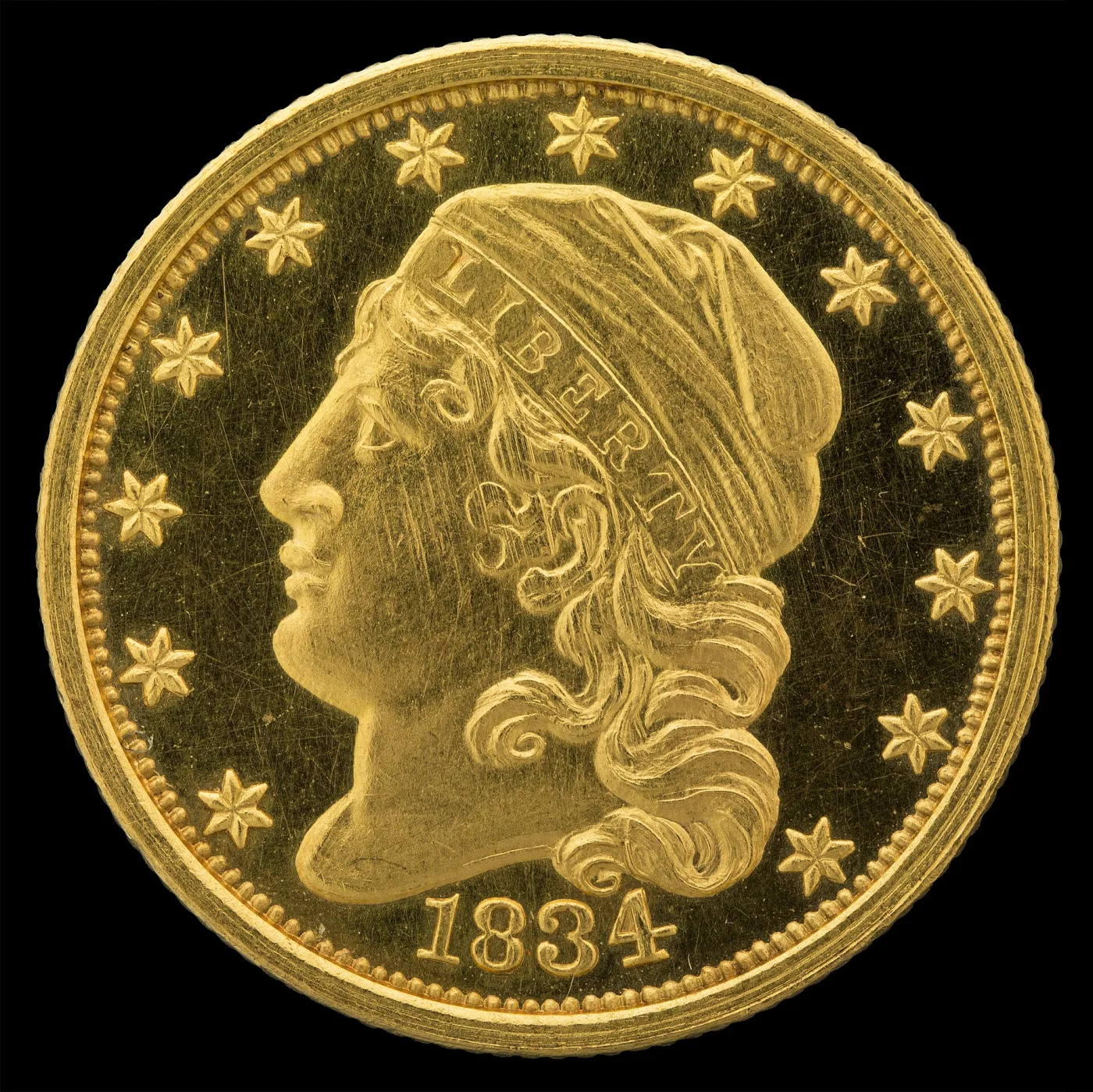
Every Capped Bust Quarter Eagle shows the head of Liberty wearing a soft, rounded cloth cap — often interpreted as a Phrygian liberty cap, the ancient symbol of freedom. On the 1796-1807 Capped Bust Right type, Liberty faces right with flowing hair beneath the cap, in the Draped Bust style. On the 1821-1834 Capped Head Left type, John Reich’s Liberty faces left with a fuller, more classical profile and the cap rendered larger and higher. The word “LIBERTY” appears on a band across the cap.
Obverse Stars and the 1796 No Stars Exception
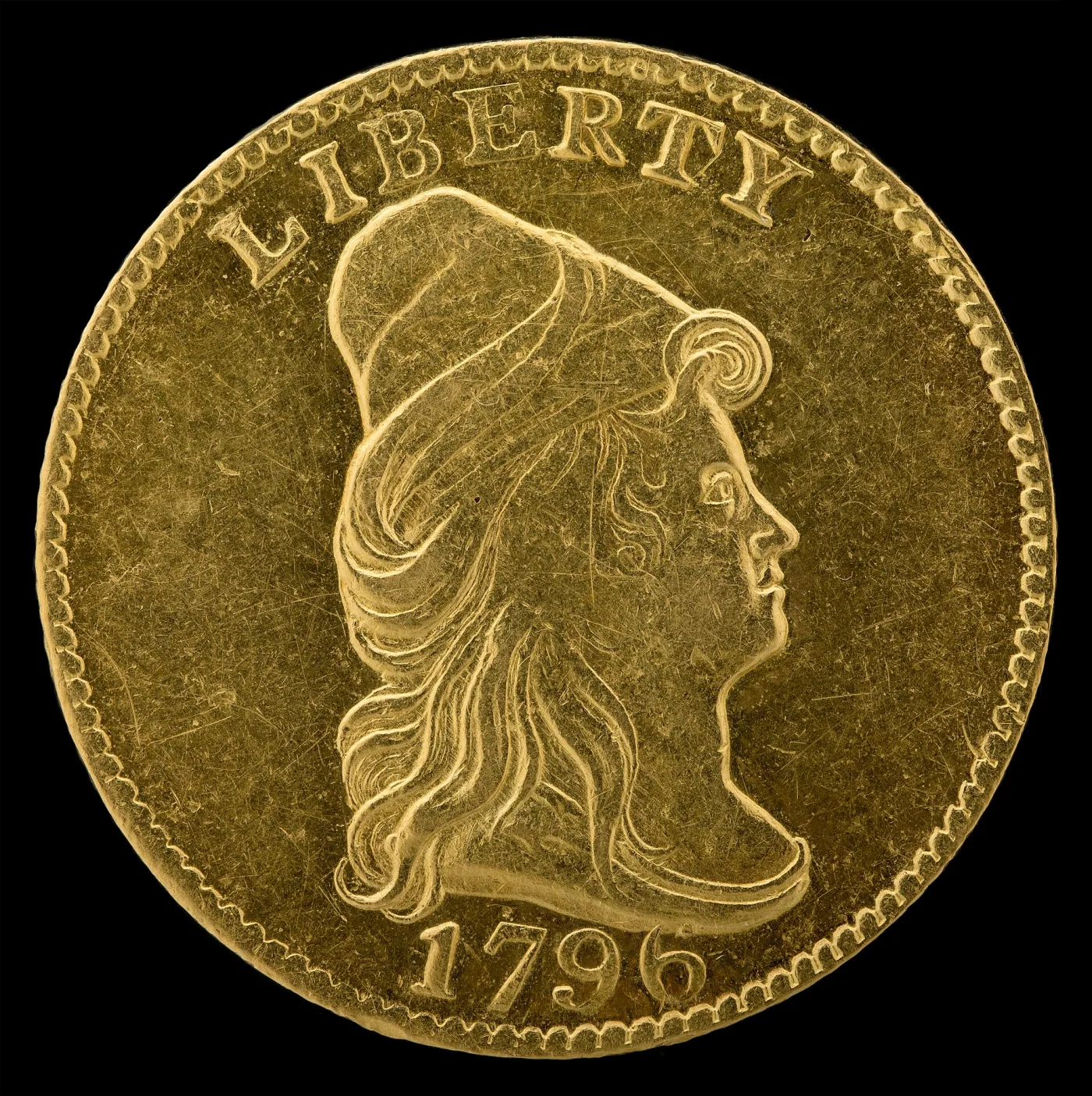
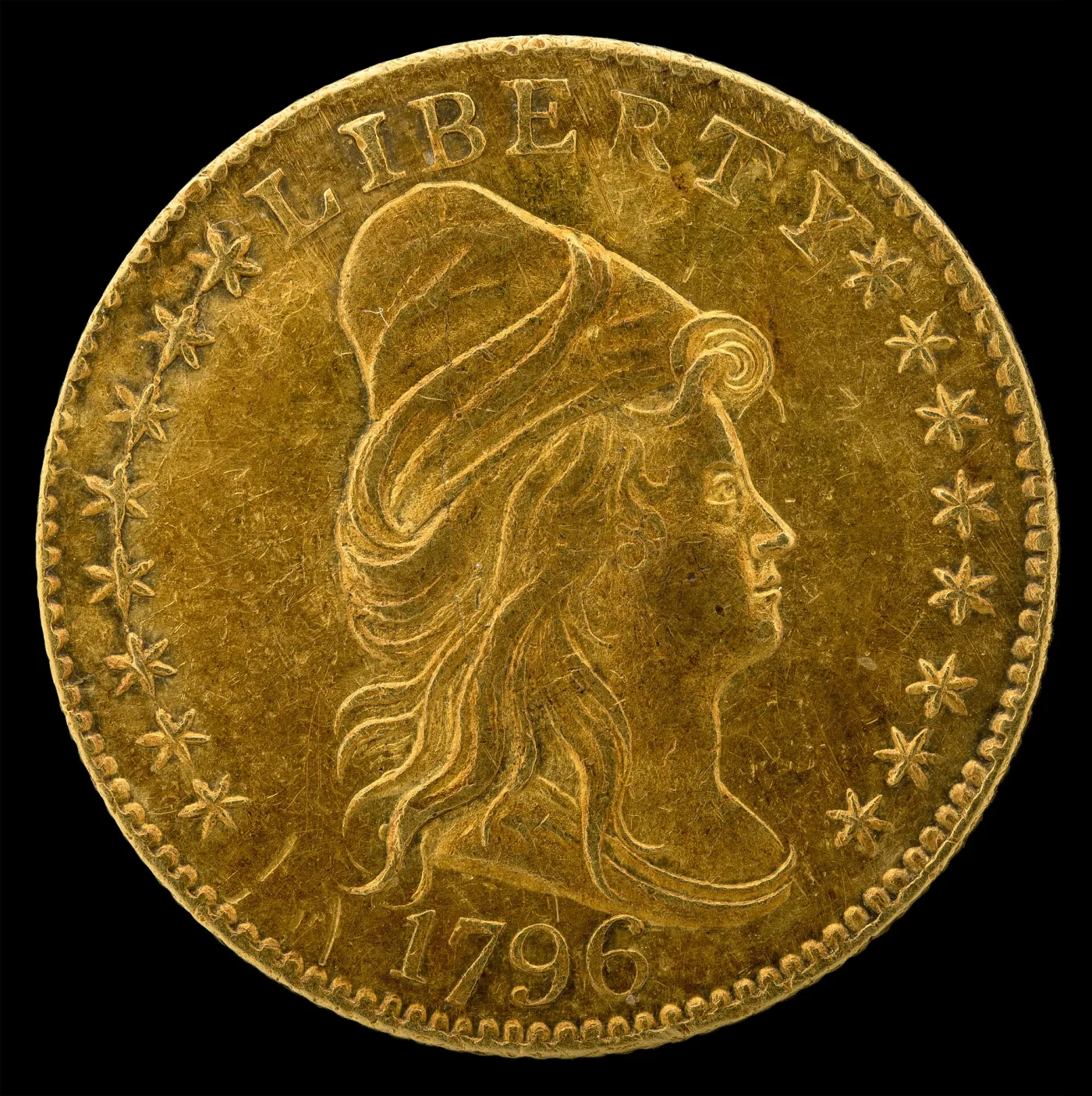
Stars representing the states surround Liberty on nearly every issue — but the very first variety, the 1796 No Stars, has a completely plain field with no stars at all, an open and elegant look unique in the series. Later in 1796 stars were added, and from that point the obverse carried a ring of stars (the count varying with design changes) plus the date at the bottom.
Both 1796 obverses survive in the National Numismatic Collection, which lets the two varieties be set side by side at the same scale.
Reverse: Heraldic Eagle from the First Year
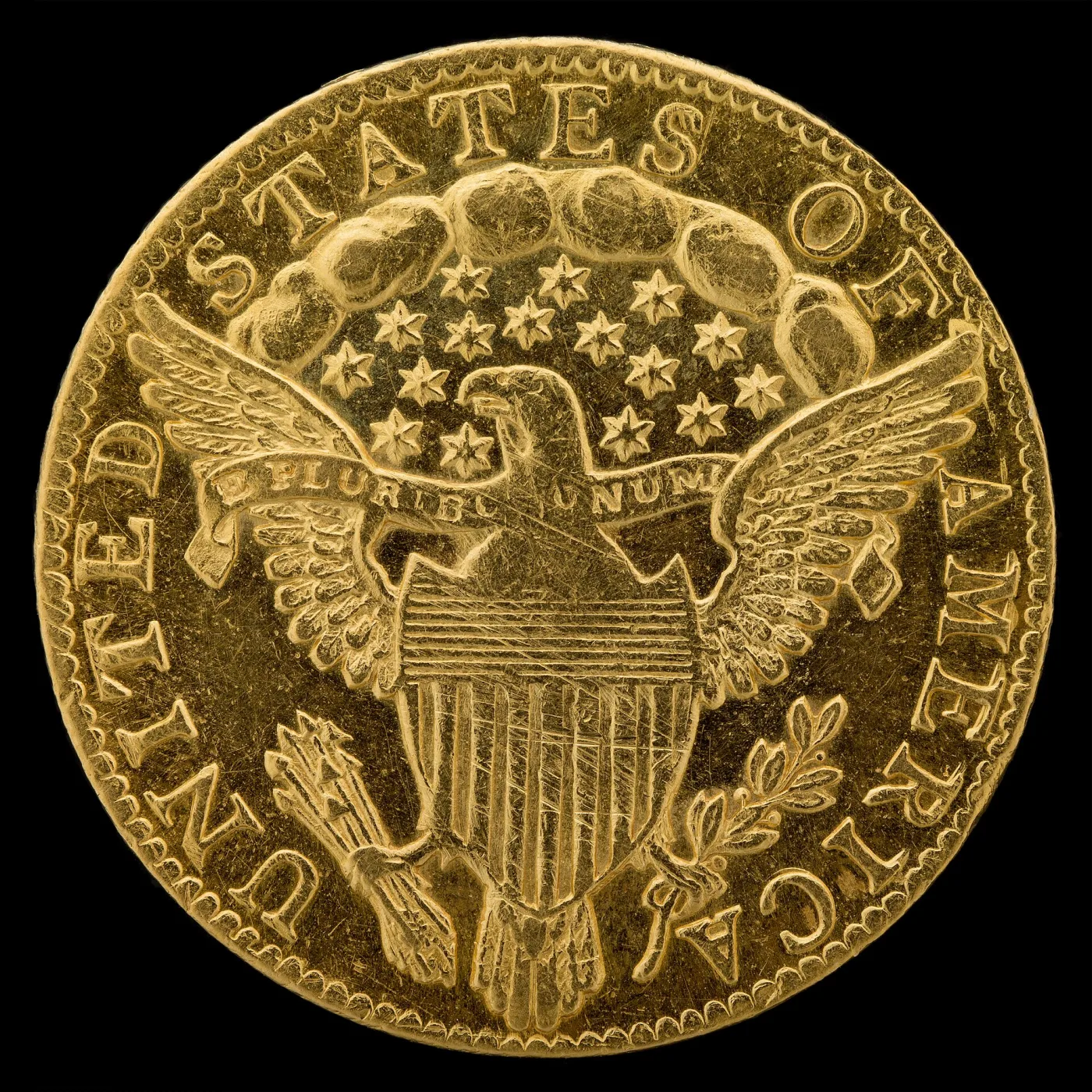
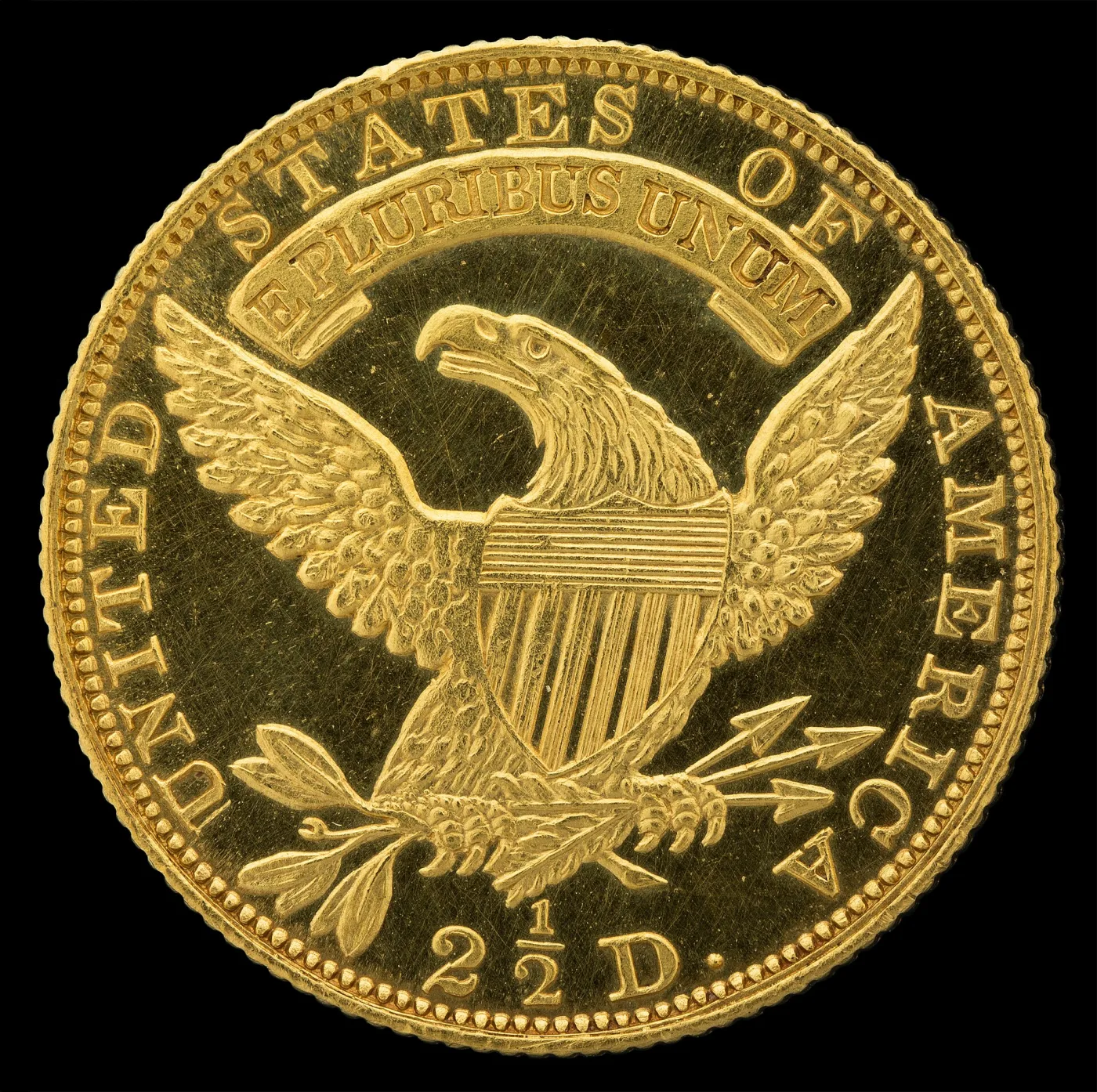
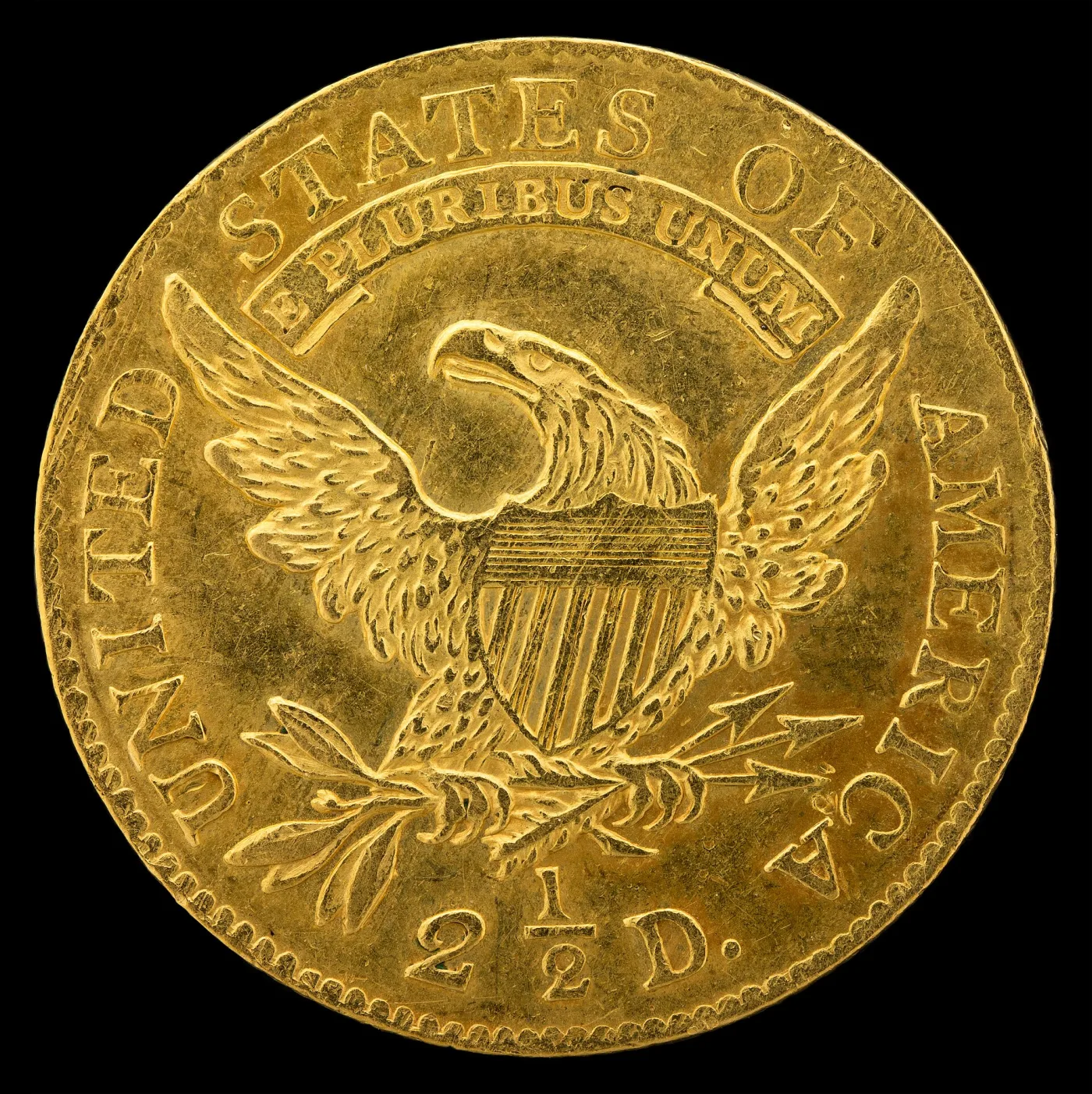
The quarter eagle did not follow the rest of early U.S. gold here. The half eagle and the eagle both began in 1795 with a “Small Eagle” reverse — a naturalistic bird on a palm branch holding a wreath in its beak — and changed to the Heraldic Eagle later. The quarter eagle was not struck until 1796, by which time the heraldic design was in hand, so every quarter eagle in this series carries the Heraldic Eagle reverse: a spread-winged eagle with a federal shield on its breast, clutching an olive branch and a bundle of arrows. There is no Small Eagle quarter eagle. What does change is the denomination — the 1796-1807 reverses state no value at all, and “2½ D.” appears only from 1808. The motto “E PLURIBUS UNUM” appears on a scroll above the eagle on the Heraldic Eagle reverses — a key diagnostic that separates this old-tenor gold from the later Classic Head, which removed the motto.
The first year of the series and the last, thirty-eight years apart, both from the National Numismatic Collection.
The Designers: Scot, Eckstein, and Reich
Robert Scot, the Mint’s first Chief Engraver, created the original Capped Bust Right design, with the obscure artist John Eckstein often credited for modeling the early portrait. John Reich, an assistant engraver, redesigned the obverse into the Capped Head Left in 1821; Reich’s work also defined the era’s Capped Bust half dollar and dime. The lineage of these engravers ties the quarter eagle directly to the broader early federal coinage.
The Major Sub-Types at a Glance
Before going date by date, it helps to fix the four key looks in mind. Identifying which sub-type you have narrows the date range immediately.
1. Capped Bust Right, No Stars (1796 only)
Liberty faces right in a soft cap; the obverse field is plain with no stars; Heraldic Eagle reverse, stating no denomination. A single-year, single-variety rarity and the first quarter eagle ever struck.
2. Capped Bust Right, With Stars (1796-1807)
Liberty faces right in a soft cap surrounded by stars; the reverse is Robert Scot’s Heraldic Eagle, carrying no statement of value. Struck irregularly in 1796, 1797, 1798, 1802, 1804, 1805, 1806, and 1807.
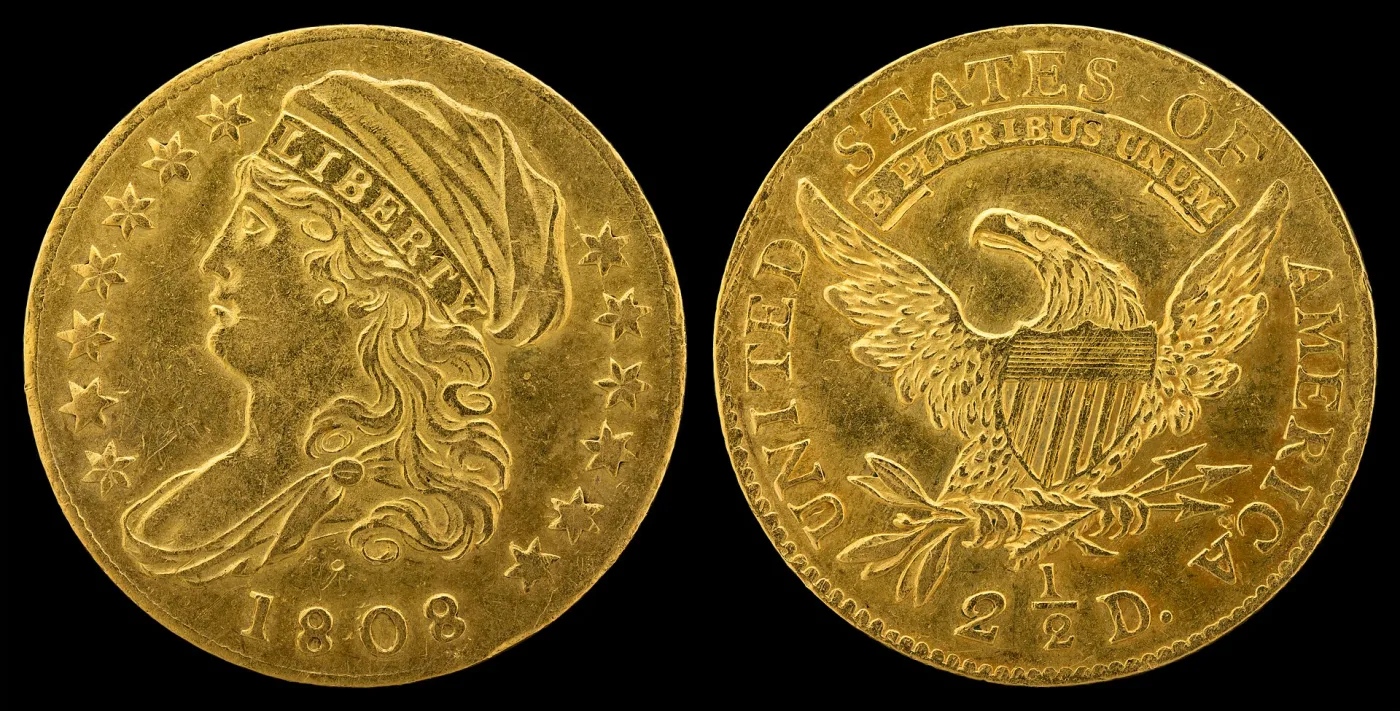
3. Capped Bust Left / Capped Draped Bust, Heraldic Eagle (1808 only)
A distinct one-year type for 1808 featuring John Reich’s first quarter eagle obverse paired with the Heraldic Eagle reverse. The 1808 is a famous one-year type and a cornerstone rarity.
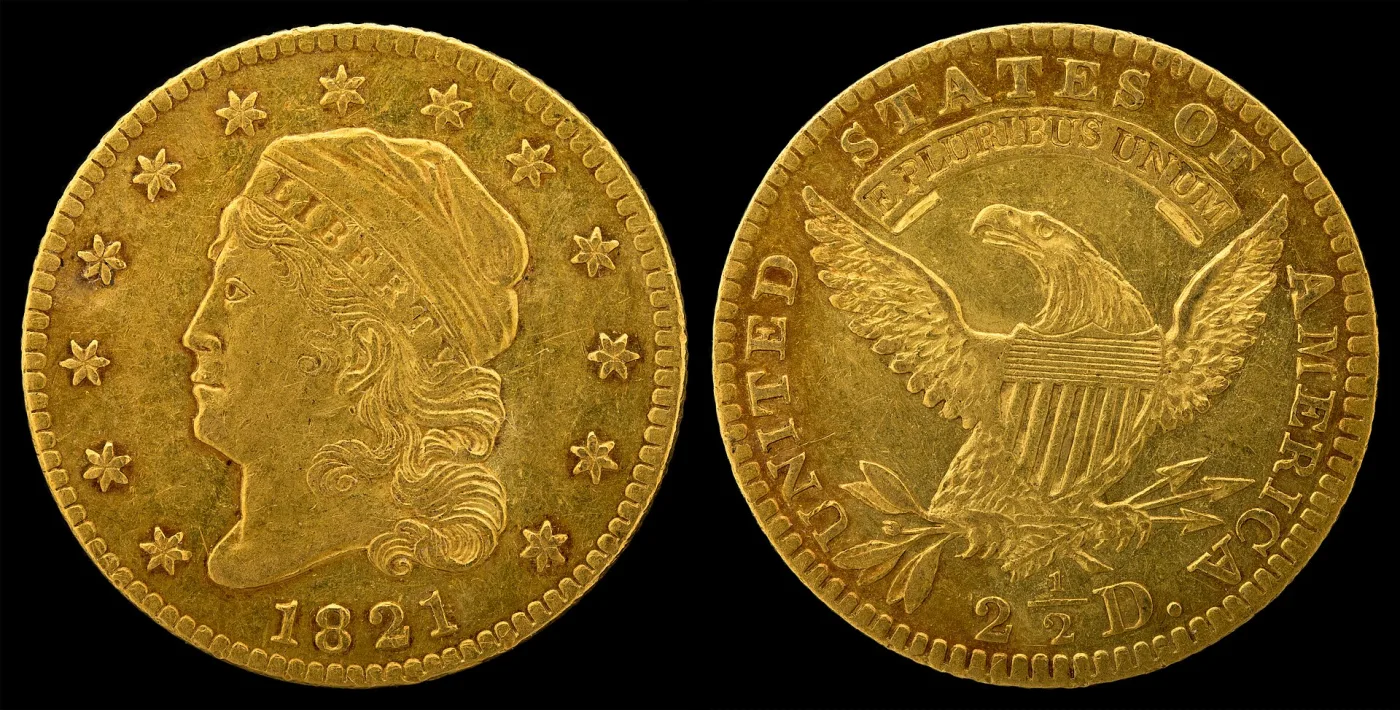
4. Capped Head Left, Heraldic Eagle (1821-1834)
John Reich’s larger Capped Head Liberty faces left, surrounded by stars, with the Heraldic Eagle reverse. Struck in 1821, 1824, 1825, 1826, 1827, 1829, 1830, 1831, 1832, 1833, and 1834. A reduced-diameter modification occurred partway through, in 1829.
Composition and Physical Specifications
The Capped Bust Quarter Eagle is a small coin, and its specifications shifted slightly over its long life. Knowing them helps both with identification and with authentication by weight.
Key Specifications
Weight: 4.37 grams throughout the old-tenor period. Composition: .9167 gold (22 karat, “crown gold”) with a copper-silver alloy balance. Actual gold weight: approximately 0.1289 troy ounces. Edge: reeded. Diameter: approximately 20mm on the early Capped Bust Right coins, reduced to about 18.2mm with the 1829 design modification on the Capped Head type. The coin is dense and heavy for its modest size because of its high gold content.
The 1829 Diameter Reduction
The single most important specification change came in 1829, when the Mint reduced the diameter of the Capped Head Quarter Eagle (and half eagle) while keeping the same weight, producing a thicker, smaller coin struck inside a close (restraining) collar that gave more uniform planchets. This is why a pre-1829 Capped Head coin measures noticeably wider than an 1829-1834 coin even though both weigh the same. We cover this in detail in its own section below.
Weight as an Authentication Tool
Because gold is so dense, any genuine Capped Bust Quarter Eagle has a distinctive heft and should weigh very close to 4.37 grams (allowing a small loss for wear). A coin reading significantly underweight is a red flag for a cast counterfeit, a lower-karat fake, or a gold-plated base-metal piece. Diameter and edge reeding should match the appropriate sub-type as well; the same checks help authenticate small gold across the early series, including the later gold dollar.
How to Identify a Capped Bust Quarter Eagle
Identification is a process of elimination. Work through these steps in order to place any coin precisely within the series.
Step 1: Confirm the Denomination
Check the reverse. A quarter eagle reads “2½ D.” at the bottom (on Heraldic Eagle reverses) or carries no denomination at all (on the 1796-1807 reverses, where size is the guide). Compare diameter: the quarter eagle is the smallest early gold coin. If the reverse reads “5 D.” you have the larger Capped Bust half eagle; “10 D.” or no denomination on a larger coin points to the eagle.
Step 2: Note Which Way Liberty Faces
If Liberty faces right, you have the 1796-1807 Capped Bust Right (Draped Bust) type. If Liberty faces left, you have either the one-year 1808 type or the 1821-1834 Capped Head Left type. This single observation cuts the series in half.
Step 3: Check for Stars (and Count Them)
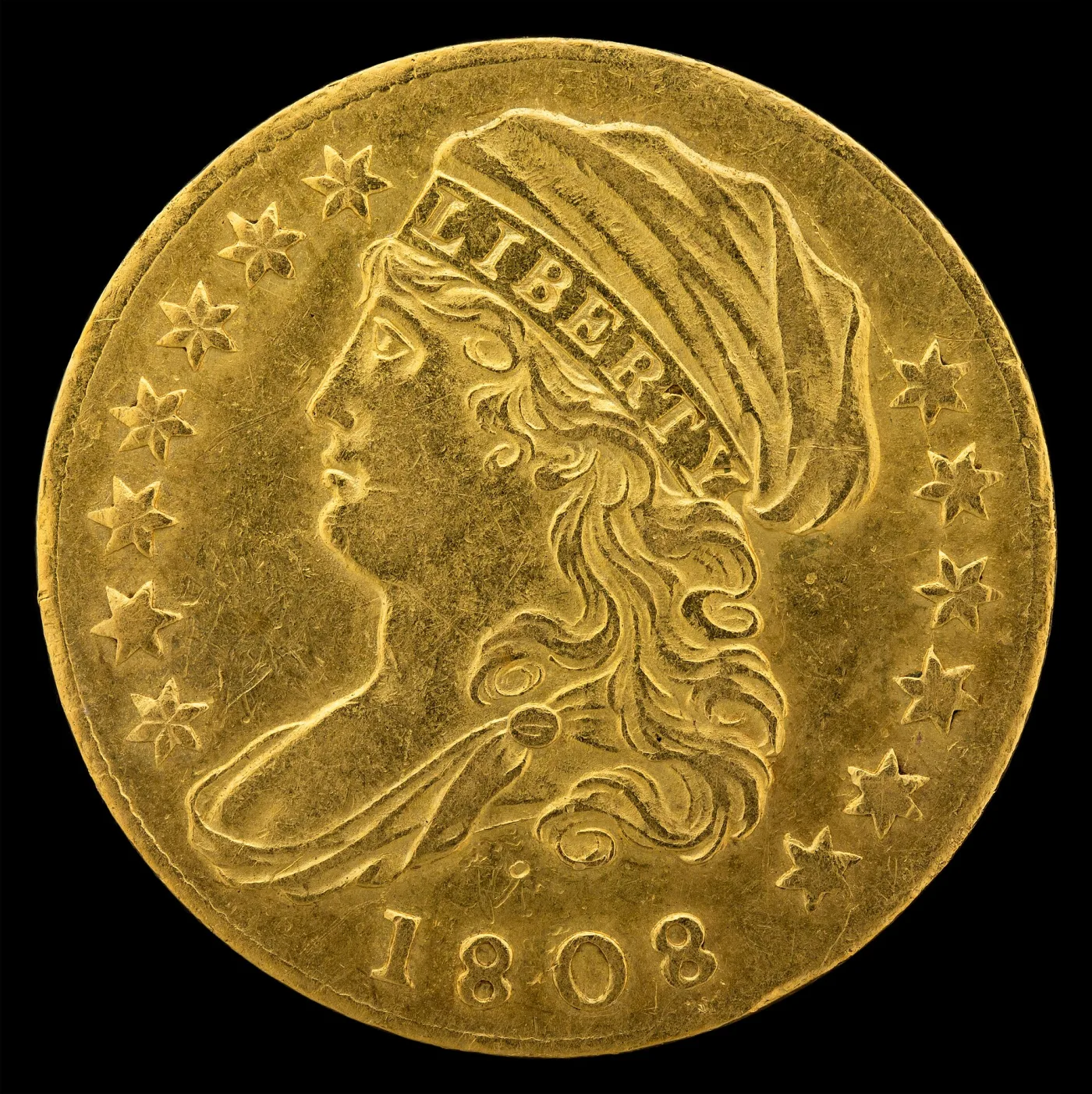
A plain obverse field with no stars means the 1796 No Stars — the rarest and most valuable single variety. Otherwise, the star count and arrangement help pin down the date, since the Mint changed the number and placement of stars over time.
Step 4: Examine the Reverse Eagle
Both halves of the series use a shield-breasted heraldic eagle, so the bird itself will not date the coin. Two things will. First, the denomination: a reverse reading “2½ D.” is 1808 or later, and a reverse stating no value at all is 1796-1807. Second, the talons. Scot’s early reverse reverses the Great Seal, putting the arrows in the eagle’s own right talon — the one on your left as you look at the coin — and the olive branch in its left. Reich’s reverse from 1808 restores the Great Seal order, with the arrows on your right.
Step 5: Read the Date and Confirm Diameter
Capped Bust Quarter Eagles are dated 1796-1834 only, but only certain years exist. If your date falls in a gap year (for example, any year from 1809 through 1820), the coin is misidentified, re-dated, or a forgery. On Capped Head coins, measuring the diameter distinguishes the wide pre-1829 strikes from the smaller 1829-1834 strikes. For broader identification techniques across all U.S. coin types, see our complete coin identification guide.
Why Early Quarter Eagles Are So Rare
It is difficult to overstate how scarce these coins are. Understanding why frames every other aspect of collecting the series.
Tiny Original Mintages
Quarter eagles were struck only on demand, and demand was small. Many dates have mintages in the hundreds or low thousands. The 1796 No Stars saw roughly 963 coins; several Capped Head dates of the 1820s number only a few hundred. By the standards of later U.S. coinage these are rounding errors.
The Melting Pot
Because the gold in each coin was worth more than $2.50 in the open market, the overwhelming majority were melted, exported, or recoined within a few years of striking. Surviving coins are the lucky few that escaped the crucible — typically because they ended up in a drawer, a foreign vault, or an early collection. This is the same dynamic that decimated the early silver dollar and the rest of the old-tenor gold.
No Contemporary Collectors at the Source
In the late 1700s and early 1800s there was essentially no organized coin collecting in America to save examples as they were issued. Most surviving Capped Bust Quarter Eagles were preserved by chance, not design, which is why high-grade survivors are extraordinary and why some die marriages are known from only a handful of coins. The result is a series where condition rarity compounds absolute rarity, and where a problem-free example of almost any date is a significant find.
Date-by-Date and Type-by-Type Analysis (1796-1834)
Below is the full roster of issues. Note the many gap years with no coinage. Values are typical 2026 retail ranges for properly certified, problem-free coins; rarities move at auction and figures should be treated as approximate.
1796 No Stars (Capped Bust Right)
Mintage: approximately 963. The first quarter eagle and the only No Stars issue. A blue-chip rarity. Values: VF $50,000, EF $90,000, AU $150,000+, Mint State into the high six figures.
1796 With Stars (Capped Bust Right)
Mintage: approximately 432. Stars added to the obverse later in 1796. Even rarer by mintage than the No Stars, though slightly less famous. Values: VF $35,000, EF $60,000, AU $110,000+.
1797 (Capped Bust Right)
Mintage: approximately 427. A major rarity. Values: VF $30,000, EF $55,000, AU $95,000+.
1798 (Capped Bust Right)
Mintage: approximately 1,094. More available than 1796-1797 but still very scarce. Values: VF $14,000, EF $24,000, AU $45,000+.
1802/1 (Capped Bust Right)
Mintage: approximately 3,035, all from an overdated die (1802 over 1801). One of the more obtainable early dates. Values: VF $9,000, EF $14,000, AU $26,000+.
1804 13-Star and 14-Star Reverse (Capped Bust Right)
Mintage: approximately 3,327 combined. The 1804 comes with two reverse star counts: the common 14-Star reverse and the rare 13-Star reverse, the latter a significant variety commanding a large premium. Values (14-Star): VF $9,000, EF $14,000, AU $26,000+; the 13-Star reverse is worth multiples of these figures.
1805 (Capped Bust Right)
Mintage: approximately 1,781. Values: VF $9,000, EF $14,000, AU $26,000+.
1806/4 and 1806/5 (Capped Bust Right)
Mintage: approximately 1,616 across two overdate varieties (1806/4 with stars 8x5, and 1806/5 with stars 7x6). Both are overdates and both are scarce; the 1806/5 is the rarer. Values: VF $9,000-$13,000, EF $15,000-$22,000, AU $28,000+.
1807 (Capped Bust Right)
Mintage: approximately 6,812 — the highest mintage of the Capped Bust Right type and the most obtainable early date. The logical type coin for the 1796-1807 design. Values: VF $8,000, EF $12,000, AU $22,000+.
1808 (Capped Bust Left, Heraldic Eagle) — One-Year Type
Mintage: approximately 2,710. John Reich’s first quarter eagle, struck for a single year and never repeated, making it one of the most famous one-year types in U.S. coinage. Always in demand from type collectors. Values: VF $40,000, EF $65,000, AU $110,000+.
The Gap: 1809-1820
No quarter eagles were struck for eleven years. Any coin dated in this range is not a genuine business strike.
1821 (Capped Head Left, Heraldic Eagle)
Mintage: approximately 6,448. The first Capped Head Left date and the type’s most obtainable early issue. Values: VF $7,000, EF $11,000, AU $18,000+.
1824/1 (Capped Head Left)
Mintage: approximately 2,600, an overdate. Values: VF $7,000, EF $11,000, AU $18,000+.
1825 (Capped Head Left)
Mintage: approximately 4,434. Values: VF $7,000, EF $10,500, AU $17,000+.
1826/5 (Capped Head Left)
Mintage: approximately 760, an overdate and a major rarity of the Capped Head type. Values: VF $14,000, EF $24,000, AU $45,000+.
1827 (Capped Head Left)
Mintage: approximately 2,800. Values: VF $7,500, EF $12,000, AU $19,000+.
1829 (Capped Head Left, Reduced Diameter)
Mintage: approximately 3,403 — the first reduced-diameter date. Values: VF $7,000, EF $10,000, AU $16,000+.
1830 (Capped Head Left, Reduced Diameter)
Mintage: approximately 4,540. Values: VF $7,000, EF $10,000, AU $16,000+.
1831 (Capped Head Left, Reduced Diameter)
Mintage: approximately 4,520. Values: VF $7,000, EF $10,000, AU $16,000+.
1832 (Capped Head Left, Reduced Diameter)
Mintage: approximately 4,400. Values: VF $7,000, EF $10,000, AU $16,000+.
1833 (Capped Head Left, Reduced Diameter)
Mintage: approximately 4,160. Values: VF $7,500, EF $11,000, AU $17,000+.
1834 With Motto (Capped Head Left, Reduced Diameter)
Mintage: approximately 4,000. The final old-tenor quarter eagle, struck early in 1834 before the August weight reduction. Critically, this coin has the “E PLURIBUS UNUM” motto, while the Classic Head that replaced it later in 1834 does not. The 1834 With Motto is a key transitional rarity. Values: VF $14,000, EF $24,000, AU $40,000+. Do not confuse it with the common 1834 No Motto Classic Head worth a fraction as much.

Key Dates and Rarities
Every Capped Bust Quarter Eagle is scarce, but a handful stand above the rest as legendary rarities and essential type pieces.
1796 No Stars — The First Quarter Eagle
The 1796 No Stars is the holy grail of the series: the very first U.S. quarter eagle and the only issue with a plain, starless obverse. Its combination of historical primacy, distinctive appearance, and tiny survival population places it among the most desirable of all American gold coins. Examples in any grade are six-figure coins.
1808 — The One-Year Type
The 1808 stands alone: a single year of John Reich’s first quarter eagle obverse, never repeated. Because a complete U.S. type set requires one example of every distinct design, the 1808 is a mandatory and famously expensive type coin, and demand consistently outstrips the tiny supply.
1826/5 and 1834 With Motto — Capped Head Keys
Within the Capped Head Left run, the low-mintage 1826/5 overdate and the transitional 1834 With Motto are the standout rarities. The 1834 With Motto in particular is a trap for the unwary, since a careless look might mistake it for the common Classic Head of the same year.
1796 With Stars, 1797, and the Earliest Dates
The earliest dates — 1796 With Stars, 1797, 1798 — are all major rarities by mintage, with survivors numbering in the dozens to low hundreds. Any genuine, problem-free example is a significant acquisition.
Why So Few Survive in High Grade
Because these coins circulated as bullion and were heavily melted, Mint State survivors of any date are condition rarities, and for many dates a single Gem can be a finest-known coin worthy of national attention. The interplay of absolute rarity and condition rarity is what makes this series a perennial centerpiece of major auctions.
Major Varieties and Die Marriages
Early quarter eagles were struck from hand-prepared dies, and specialists collect them by die marriage. The standard reference is the Bass-Dannreuther (BD) attribution system, which catalogs each obverse-reverse die pairing.
Overdates
Overdates are a hallmark of the series, reflecting the Mint’s frugal practice of re-punching an old die with a new date. The 1802/1, 1804/3 (on some dies), 1806/4, 1806/5, and 1824/1, 1826/5 overdates are all collected and carry premiums. Reading an overdate under magnification is part of attributing these coins.
1804 13-Star vs 14-Star Reverse
The 1804 reverse exists with both 13 and 14 stars above the eagle. The 13-Star reverse is the rarer and more valuable variety, and distinguishing the two is essential when valuing an 1804. This kind of star-count variety also appears on the contemporary Capped Bust eagle.
1806 Star Arrangements
The 1806 comes in two distinct star arrangements — Stars 8x5 (paired with the 1806/4 overdate) and Stars 7x6 (paired with the 1806/5 overdate). The arrangement and the overdate together define the variety and its rarity.
Bass-Dannreuther Numbers
Serious collectors of the series attribute coins by their BD number, and certain die marriages are dramatically rarer than others within the same date. As with the hand-struck early Capped Bust quarters and their Browning numbers, careful examination under good light and magnification is richly rewarded and can materially change a coin’s value.
The 1829 Reduced-Diameter Change
One mechanical change splits the Capped Head Left type into two looks, and recognizing it is a useful identification skill.
What Changed
In 1829 the Mint introduced improved minting technology, including the use of a close (restraining) collar, and reduced the diameter of the quarter eagle from roughly 20mm to about 18.2mm while keeping the weight at 4.37 grams. The smaller, thicker coins had sharper, more uniform rims and a more consistent appearance. The same modification was applied to the half eagle in the same period.
How to Tell the Difference
Pre-1829 Capped Head coins (1821-1827) are noticeably wider and flatter, with the design spread across a larger planchet. The 1829-1834 coins are smaller in diameter, thicker, and more sharply struck within the close collar, with finer detail and crisper rims. Side by side, the difference is obvious; even alone, a diameter measurement settles the question.
Why It Matters
Beyond identification, the change marks a technological turning point at the Mint that paved the way for the more uniform coinage of the 1830s and the reduced-weight Classic Head reform. Collectors who assemble a Capped Head type set often include one wide (large-diameter) and one reduced-diameter example to represent both phases of the design.
Proof Capped Bust Quarter Eagles
Proof examples exist but are among the rarest coins in all of numismatics — special presentation strikes from an era before proofs were sold to the public.
Extreme Rarity
The Mint struck a tiny number of proof quarter eagles in the Capped Head period as presentation pieces for dignitaries and special purposes. Organized proof-set sales to collectors did not begin until 1858, so any earlier proof is an individually-made rarity. Surviving proof Capped Bust Quarter Eagles of any date number in the low single digits, and most dates are not known in proof at all.
Identifying a Proof
Genuine proofs show fully mirrored fields, squared and sharp rims, and crisp, fully-struck design detail produced by carefully prepared dies and extra striking pressure. Because the survival population is so small and the financial stakes so high, any coin represented as a proof of this type must be authenticated by PCGS or NGC and ideally accompanied by published auction provenance tracing it through the great collections.
Market Position
When a genuine early proof quarter eagle appears at auction it is a landmark event, typically realizing a strong six-figure to seven-figure result. For nearly all collectors, proofs of this series are a subject of study rather than acquisition, and the focus remains firmly on the business strikes.
Grading Capped Bust Quarter Eagles
Grading early gold requires understanding both the Sheldon scale and the specific high points of each sub-type, plus an awareness that many of these coins were softly struck or adjusted at the Mint.
Key Grading Focal Points
On the Capped Bust Right obverse, wear shows first on the highest curls of Liberty’s hair, the cheek, and the drapery at the bust. On the Capped Head Left obverse, check the hair above the eye and the curls around the cap, plus the central detail of the face. On the reverse, the eagle’s breast feathers and wing tips flatten first. On the 1796-1807 reverses the clouds above the eagle’s head go early as well; Reich’s reverses from 1808 have no clouds, and there the scroll lettering is the next thing to soften. The word “LIBERTY” on the cap band should be sharp on higher grades.
Strike, Adjustment Marks, and Planchet Quality
Early gold was struck on hand-made planchets, and adjustment marks — fine parallel file lines where Mint workers filed an overweight planchet down to standard before striking — are common and are not defects or damage. Weak strikes are also frequent. Distinguishing a soft strike or an as-made adjustment mark from circulation wear or post-mint damage is the hardest part of grading this series and a major reason these coins should be evaluated by professionals.
Grade Descriptions
Very Fine (VF-20 to VF-35): Moderate even wear. Major hair and drapery detail visible but softened; LIBERTY readable. The most commonly encountered collectible grade for the rarer dates.
Extremely Fine (EF-40 to EF-45): Light wear on the high points only. Most hair detail distinct; LIBERTY sharp. Traces of luster may survive in protected areas. A strong grade for an early quarter eagle.
About Uncirculated (AU-50 to AU-58): Only slight friction on the highest points. AU-58 examples retain much of their original luster and are highly prized; for many dates AU is the realistic ceiling.
Mint State (MS-60 and finer): No wear. Differentiated by marks, luster, and strike. Genuine Mint State early quarter eagles are condition rarities, and a Gem of almost any date is a trophy coin. For a full explanation of the numerical grades and what each level means, see our coin grading guide.
Counterfeit Detection and Authentication
Given values that routinely reach five and six figures, Capped Bust Quarter Eagles are heavily targeted by counterfeiters and alterers. Vigilance and professional certification are non-negotiable.
Altered Dates and Added Features
A common deception is altering the date or removing/adding stars to transform a more available coin into a rarer variety — for example, attempting to create a “No Stars” look or manufacturing a rare overdate. Examine the date and fields under 10x to 20x magnification for tooling, smoothing, re-engraving, or inconsistent surface texture. Compare against authenticated photographs of the correct die marriage; genuine varieties match known dies exactly.
Cast and Struck Counterfeits
Cast fakes betray themselves with soft or rounded detail, a grainy or pebbly surface under magnification, incorrect (usually low) weight, mushy or filed edge reeding, and sometimes a seam on the edge. More dangerous struck counterfeits from false dies can be deceptive but typically contain subtle errors in star position, portrait detail, or the date logotype that do not match any genuine die. Many fakes also have the wrong diameter for their sub-type.
Weight and Specifications Check
A genuine coin weighs 4.37 grams (less a little for wear) and matches the correct diameter for its sub-type. Significant underweight or a wrong diameter exposes many fakes immediately. These quick physical checks rule out a large fraction of crude counterfeits, just as they help authenticate other early small gold like the three dollar gold piece.
Professional Authentication Is Essential
For any Capped Bust Quarter Eagle, professional authentication and grading by PCGS or NGC is strongly recommended. The price gap between a genuine rarity and a clever fake can be hundreds of thousands of dollars, and certified encapsulation provides authentication, an objective grade, attribution, and tamper-evident protection. Never buy a raw early quarter eagle unless you are an expert capable of attributing the exact die marriage yourself.
Current Market Values by Date and Grade
Values are driven by sub-type, date, variety, grade, and originality. Because every issue is scarce, even circulated coins are major purchases. The following are approximate 2026 retail ranges for certified, problem-free coins; cleaned, damaged, or “details”-graded pieces sell at steep discounts, and great rarities are ultimately auction-determined.
Capped Bust Right (1796-1807)
The 1796 No Stars and 1796 With Stars are six-figure coins in nearly all grades. The 1797 and the rarer overdates run from the mid-five figures upward. The more available dates — 1802/1, 1805, 1807 — typically run roughly $8,000-$14,000 in VF, $12,000-$22,000 in EF, and $22,000-$45,000 in AU, with Mint State far higher.
1808 One-Year Type
Roughly $40,000 in VF, $65,000 in EF, $110,000+ in AU, and well into six figures in Mint State, reflecting relentless type-set demand against a tiny supply.
Capped Head Left, Wide Diameter (1821-1827)
The more available dates (1821, 1825, 1827) run roughly $7,000-$8,000 in VF, $10,500-$12,000 in EF, and $17,000-$19,000 in AU. The 1826/5 is a major rarity worth multiples of these figures.
Capped Head Left, Reduced Diameter (1829-1834)
The 1829-1833 dates typically run roughly $7,000-$7,500 in VF, $10,000-$11,000 in EF, and $16,000-$17,000 in AU. The transitional 1834 With Motto is a key worth substantially more — into the mid-five figures and beyond.
Market Trends
The market for Capped Bust Quarter Eagles is driven by a small, knowledgeable, and committed collector base, and it has been firm for years. Original, never-cleaned coins with honest surfaces and good eye appeal bring strong premiums over the typical “details”-graded survivors that dominate the population. Famous rarities like the 1796 No Stars and the 1808 set records when fresh examples reach the market, and underlying gold prices provide a modest floor. Provenance to a notable collection adds meaningfully to value at this level.
Collecting Strategies and Tips
Few collectors complete this series, but several rewarding approaches exist at very different budget levels.
Type Collecting
The most common approach is to acquire one representative coin of each major design for a U.S. gold type set: a Capped Bust Right, the one-year 1808, a wide-diameter Capped Head, and a reduced-diameter Capped Head. Most type collectors choose the most affordable date within each type — typically the 1807 for the early type and an 1829-1833 issue for the reduced-diameter Capped Head — paired with the later Liberty Head quarter eagle and Indian Head quarter eagle to complete a quarter eagle type run.
Date Collecting by Sub-Type
Some specialists pursue a complete date set of just the Capped Head Left type (1821-1834), which is challenging but more achievable than the full series, with the 1826/5 and 1834 With Motto as the difficult keys. Others focus on the Capped Bust Right dates (1796-1807) as a unit.
Die-Marriage Collecting
Advanced collectors attribute every coin by its Bass-Dannreuther number and pursue specific rare die marriages. This is a deep, scholarly pursuit that rewards patience and reference study, and it can uncover undervalued rarities hiding in plain sight.
Buy the Coin, Not the Holder
Strike, surface quality, and originality vary enormously on early gold, so two coins in the same numerical grade can differ greatly in desirability. Prioritize original surfaces, good eye appeal, and minimal adjustment marks in prominent places. Always buy certified coins, study population reports to understand true condition rarity, and when possible review auction provenance. A well-chosen, original EF can be a better long-term holding than a marginal, processed AU.
Proper Storage and Preservation
Gold is chemically stable, but these are soft, valuable, historic coins that deserve careful handling and storage.
Avoid PVC and Physical Contact
Never store gold coins in PVC-containing flips, which can leave a sticky green residue over time. Use inert Mylar flips, hard plastic capsules, or certified-grading-service holders. Gold is soft and scratches easily, so minimizing handling and avoiding contact with other coins protects both grade and value.
Handling
Always hold coins by their edges over a soft surface, and wear clean cotton or nitrile gloves when handling uncertified pieces. Fingerprints, hairlines, and contact marks reduce eye appeal and value, particularly on the higher-grade examples where every mark matters.
Never Clean
Cleaning a gold coin leaves hairlines and an unnatural brightness that experienced graders and the major services detect immediately, resulting in a “details” grade and a large loss in value — often 30% to 60% below an equivalent original coin. Even a coin that looks dull or has dirt in the recesses is worth far more left untouched. Leave any conservation decision to professional services.
Environment and Security
Store in a cool, dry, stable environment, and given the high value of these coins, use a quality safe or a bank safe-deposit box. Maintain an inventory with photographs and certification numbers for insurance purposes, and seriously consider a dedicated numismatic insurance policy for a collection that includes coins of this caliber.
Frequently Asked Questions
What is a Capped Bust Quarter Eagle?
It is the first United States $2.50 gold coin, struck intermittently from 1796 to 1834. "Capped Bust" is an umbrella term for the whole series, which includes the early Capped Bust to Right type (1796-1807, Liberty facing right in the Draped Bust style), a one-year 1808 type, and the later Capped Head to Left type (1821-1834, John Reich's redesign with Liberty facing left). It belongs to the heavier "old tenor" gold that predates the 1834 weight reduction.
How do I tell a Capped Bust from a Classic Head quarter eagle?
Check the reverse motto and the date. The Capped Bust (1796-1834) Heraldic Eagle reverse carries "E PLURIBUS UNUM" on a scroll above the eagle, while the Classic Head (1834-1839) reverse has no motto. Both types were struck in 1834: the 1834 With Motto is the rare Capped Head; the 1834 No Motto is the common Classic Head. Always confirm the motto before assuming which type you have.
What is the 1796 No Stars and why is it so famous?
The 1796 No Stars is the very first U.S. quarter eagle and the only issue with a plain obverse field bearing no stars around Liberty. With a mintage of roughly 963 and a small survival population, it is one of the most coveted U.S. gold coins and a six-figure rarity in essentially any grade.
What is the difference between "Capped Bust Right" and "Capped Head Left"?
They are two distinct portraits within the same series. Capped Bust Right (1796-1807) shows Liberty facing right in the Draped Bust style, with a Heraldic Eagle reverse that states no denomination. Capped Head Left (1821-1834) is John Reich's larger, redesigned Liberty facing left with a Heraldic Eagle reverse. The 1808 is a separate one-year transitional type.
Why are there so many years with no quarter eagles?
Quarter eagles were struck only when depositors specifically requested them, which happened irregularly, so the Mint made none in many years. There is a complete gap from 1809 to 1820, for example. Any coin dated in a gap year is misidentified, altered, or counterfeit.
What does the 1829 diameter change mean?
In 1829 the Mint reduced the diameter of the Capped Head Quarter Eagle from about 20mm to about 18.2mm while keeping the same 4.37-gram weight, producing a smaller, thicker, more sharply struck coin made with a close collar. Pre-1829 Capped Head coins are wider and flatter; 1829-1834 coins are smaller and crisper.
How much is a Capped Bust Quarter Eagle worth?
Every date is scarce, so values are high. The more available dates run from roughly $7,000-$14,000 in circulated grades into the tens of thousands in About Uncirculated, while great rarities like the 1796 No Stars and the 1808 reach well into six figures. Exact value depends on sub-type, date, variety, grade, strike, and originality.
Should I clean a dull or dirty Capped Bust Quarter Eagle?
Never. Cleaning gold leaves hairlines and an unnatural surface that graders detect immediately, resulting in a "details" grade and a 30% to 60% loss in value. Original — even if dull — is always worth more than cleaned. Leave any cleaning or conservation to professional services.
Are adjustment marks on early quarter eagles a problem?
Not necessarily. Adjustment marks are fine parallel file lines made at the Mint to bring an overweight planchet to standard before striking. They are an as-made characteristic of early gold, not damage, though heavy adjustment marks across the central design can reduce eye appeal and value. Professional graders account for them in assigning a grade.
Can I still find these in circulation?
No. The Capped Bust Quarter Eagle left circulation roughly two centuries ago. All surviving examples are in collections, dealer inventories, museums, or estate holdings, and are acquired through specialist dealers and major auctions.