Seated Liberty Quarter Identification Guide: Types, Key Dates, and Values
The Seated Liberty Quarter — struck from 1838 through 1891 — is one of the most type-rich and historically layered classic US silver coins. Designed by Christian Gobrecht with hub modifications by Robert Ball Hughes, the series spans 54 years of American history: the Panic of 1837 aftermath, the California Gold Rush, the Civil War, the silver crisis of the 1870s, the Carson City branch mint era, and into the closing years of the 19th century. Across that span, the quarter went through six identifiable major sub-types (No Drapery, Drapery, Arrows and Rays, Arrows, With Motto, and With Motto continuation), passed through four mints (Philadelphia, New Orleans, San Francisco, Carson City), and produced some of the most legendary US silver rarities — the 1873-CC No Arrows, the 1870-CC, the 1871-CC, and the 1872-CC among them.
Seated Liberty Quarters reward collectors at every level. Common-date circulated examples trade for $30-$50, putting a genuine 19th-century US silver coin within reach of any budget. At the same time, the series contains absolute rarities, branch-mint condition keys, and dozens of die varieties catalogued by Larry Briggs that occupy specialists for decades. Carson City Seated Quarters carry the romance of frontier silver, the 1853 Arrows-and-Rays is a one-year visual standout, and the 1873-CC No Arrows — with only five examples known — is one of the great American numismatic rarities, on par with the 1804 dollar in collector lore.
This guide covers everything you need to identify, attribute, grade, and value Seated Liberty Quarters: Gobrecht and Hughes’s design lineage, the six major sub-types and how to distinguish them at a glance, mint marks and the famed Carson City branch, the 1853 weight-reduction Arrows-and-Rays issue, the With Motto transition of 1866, every key date including the four legendary Carson City keys, the Briggs variety system, grading by Liberty’s gown and shield detail, authentication strategies, current market values, and practical collecting paths. The same fundamental coin identification techniques apply here as for other 19th-century US silver, with several Seated-Liberty-specific quirks you must know.
History: A Quarter Across Six Decades
The Seated Liberty Quarter entered production in 1838 to replace the long-running Capped Bust Quarter, which had been minted in two distinct sizes between 1815 and 1838 and had itself succeeded the Draped Bust Quarter that began the denomination in 1796. The transition was part of a sweeping Mint program under Chief Engraver Christian Gobrecht to unify the design language of US silver coinage. Gobrecht had introduced the Seated Liberty motif on the silver dollar in 1836, and over the next several years it propagated to the half dime, dime, quarter, and finally the half dollar. By 1840, every US silver denomination from 5 cents to 50 cents wore essentially the same Liberty figure — visual coherence the Mint had never before achieved. The quarter joined this family in 1838, just as production was ramping up at the new New Orleans branch mint.
The 54-year run of the Seated Quarter was anything but quiet. Production climbed sharply during the California gold rush as gold flooded the economy and silver coins moved into heavy circulation. The Mint Act of 1853 reduced the silver weight of all subsidiary coinage to prevent silver coins from being hoarded and exported as bullion — producing the famous one-year Arrows and Rays type. The Civil War drove silver coins out of circulation entirely in many regions. The Coinage Act of 1873 added the motto IN GOD WE TRUST and made a tiny weight adjustment, producing the brief 1873-1874 Arrows sub-type, and the same Act authorized the short-lived Twenty Cent Piece that was rejected by the public for being too similar to the Seated Quarter itself. Production declined in the 1880s as the Bland-Allison Act diverted Mint silver to the new Morgan Dollar program. The Seated Quarter series ended in 1891 and was replaced in 1892 by the Barber Quarter.
The Designers: Christian Gobrecht and Robert Ball Hughes
Christian Gobrecht (1785-1844) was a Pennsylvania-born engraver who became Chief Engraver of the US Mint in 1840. His Seated Liberty design — a full-figure allegorical Liberty seated on a rock, steadying a Union shield with her right hand and holding a pole topped with a Phrygian liberty cap in her left — drew from neoclassical art and British coinage traditions (particularly the figure of Britannia). The 1838 quarter used Gobrecht’s original master hub.
In 1840, sculptor Robert Ball Hughes was commissioned to retouch the working hubs to strengthen the design — chiefly by adding the drapery fold below Liberty’s right elbow that the original 1838-1839 quarters lacked, and by re-engraving the head and shield. This Hughes modification produced the long-running “Drapery” sub-type. The Hughes touches also lengthened the gown folds and tightened the shield detail. The two designers’ fingerprints are clearly visible side-by-side when you compare an 1838 No Drapery to an 1840-O Drapery.
The quarter shares its design lineage closely with the Seated Liberty Dime, the Seated Liberty Half Dollar, and the Seated Liberty Dollar — all four coins share the same Liberty figure, the same wreath or eagle reverse family, and the same evolutionary history of motto, drapery, and arrow modifications.
Design: Liberty Seated on a Rock
Knowing every element of the Seated Liberty design is essential for accurate grading, sub-type identification, and authentication.
Obverse (Heads Side)
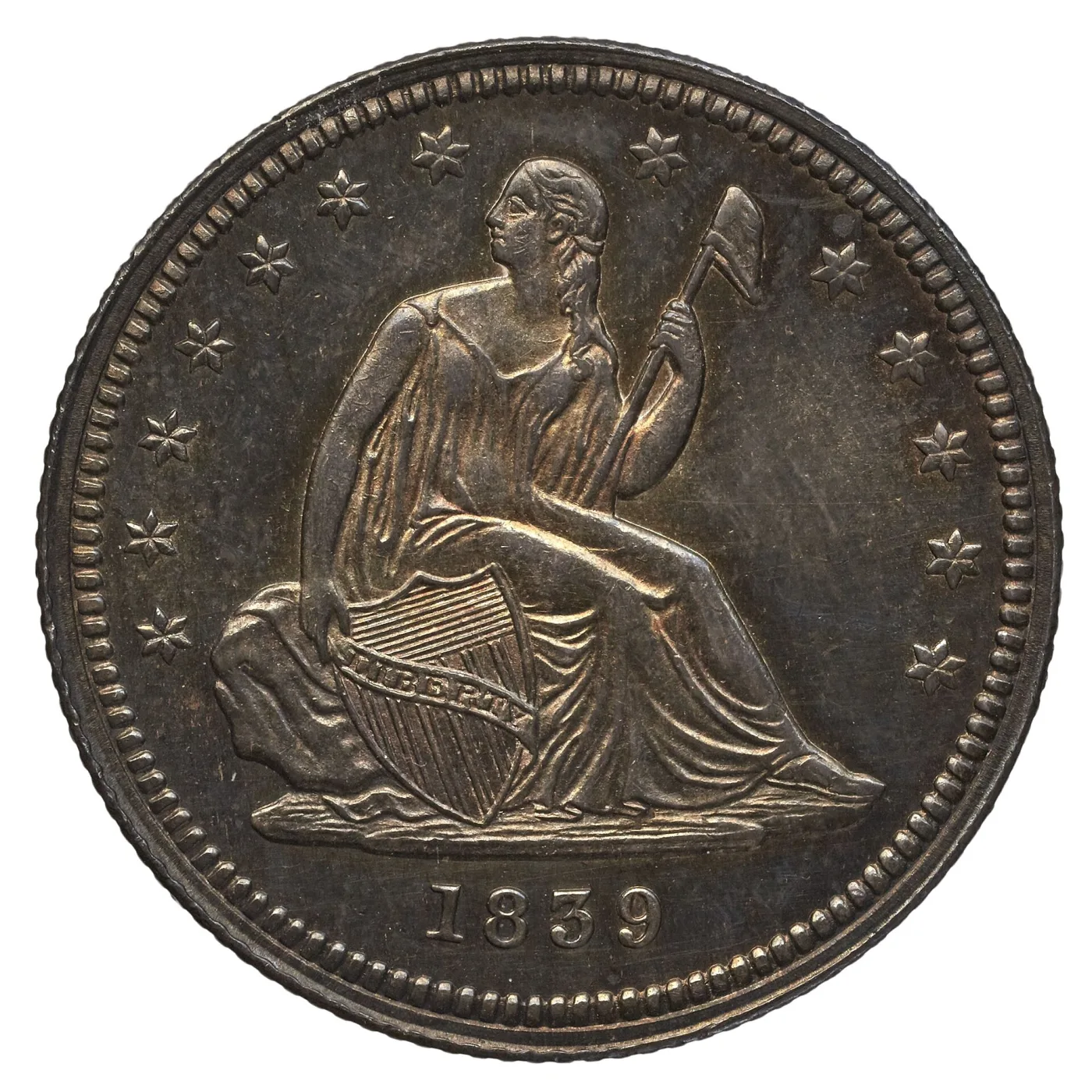
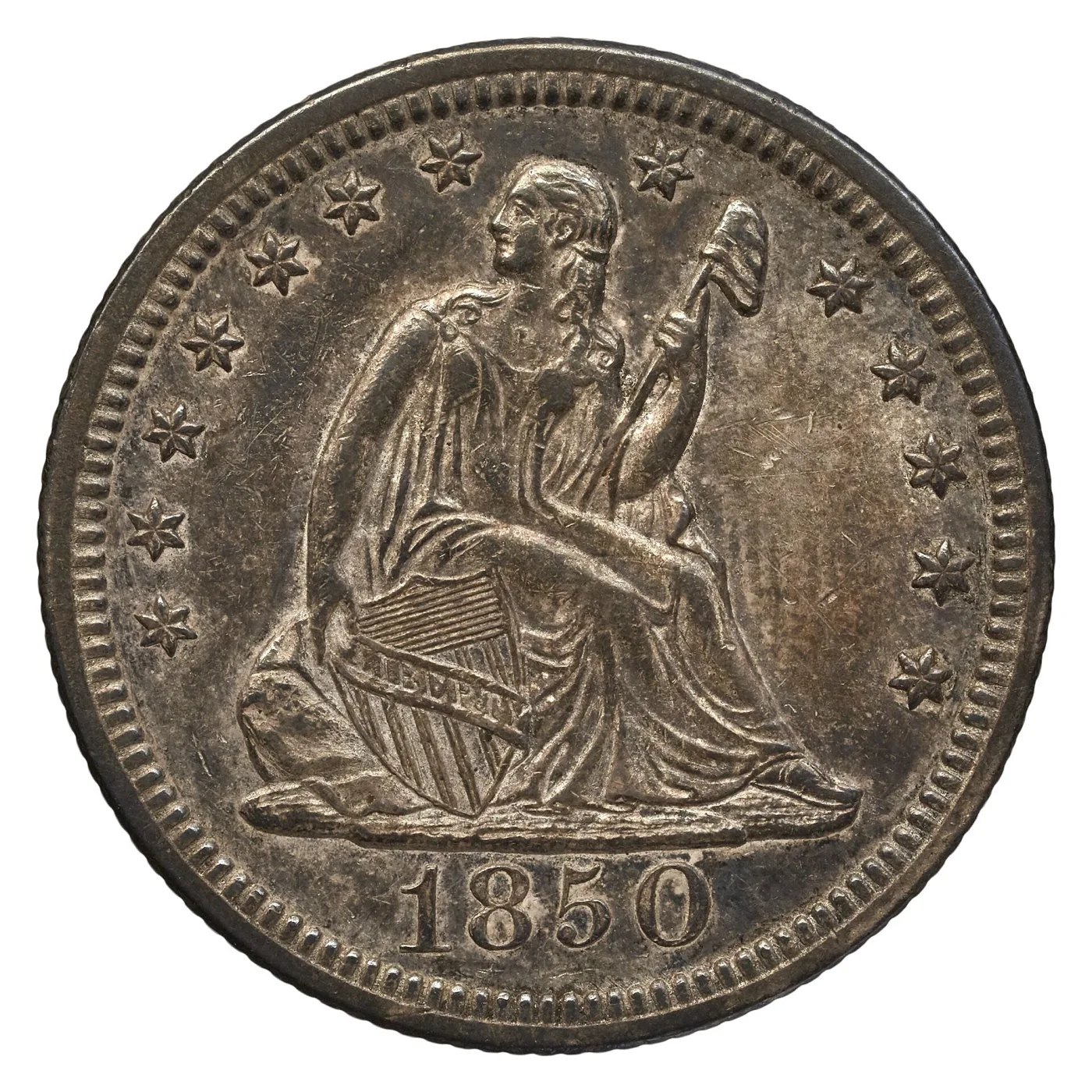
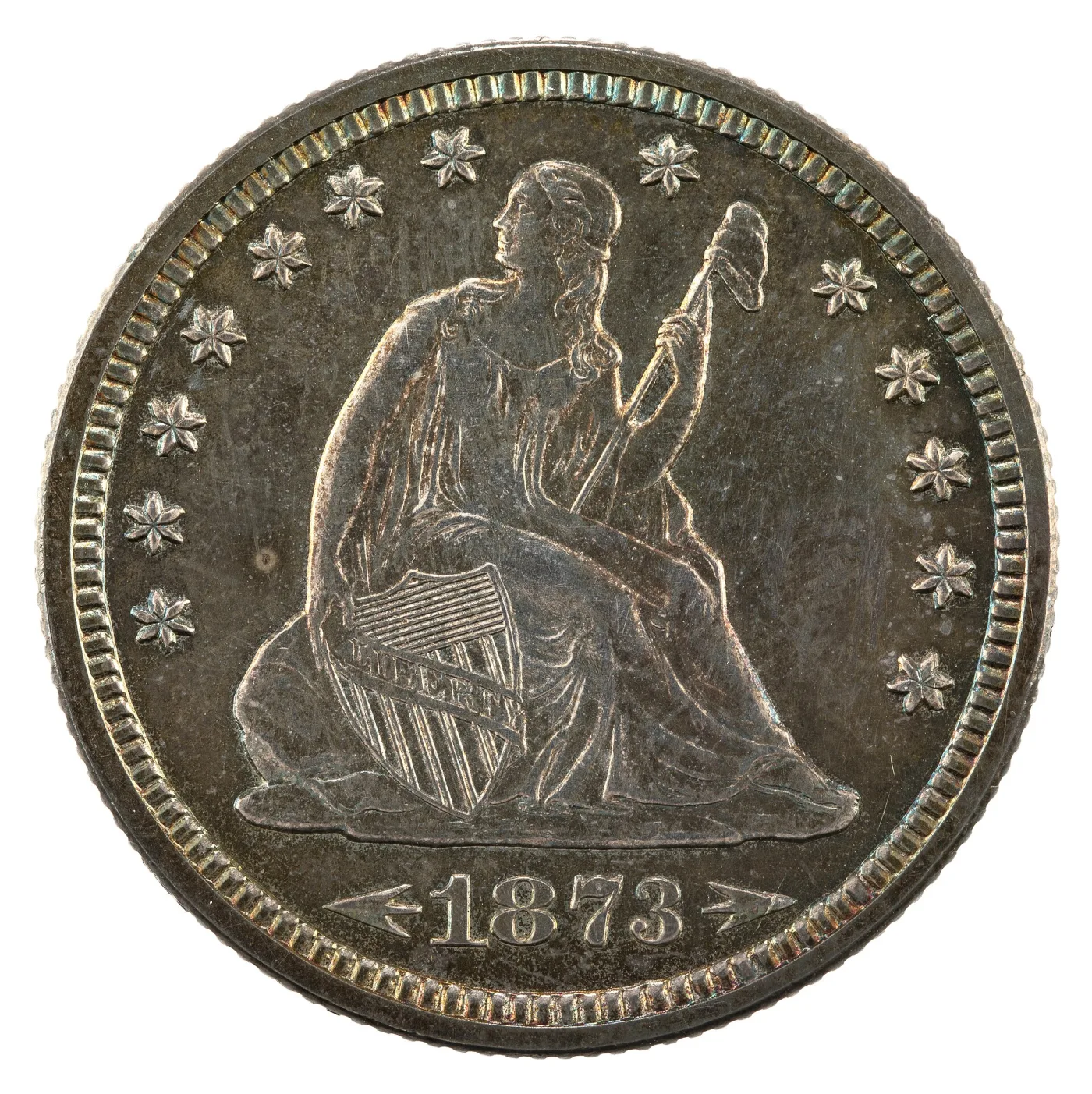
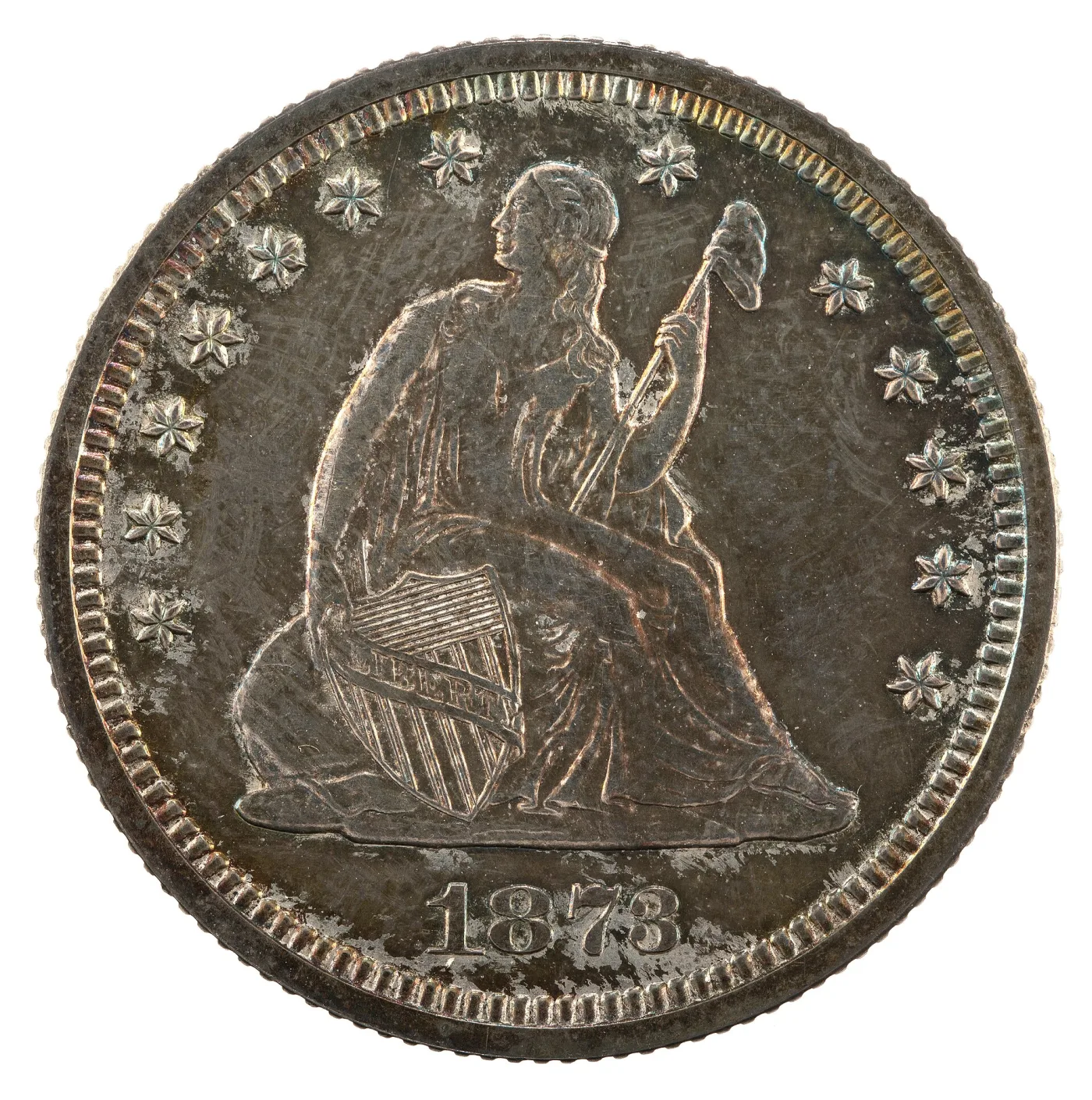
The obverse depicts Liberty seated on a rock, her body facing forward but her head turned to the left. She wears a flowing classical gown. Her right hand rests on a Union shield bearing the inscription LIBERTY on a ribbon across the top of the shield. Her left hand holds a pole topped with a Phrygian liberty cap (the cap on a pole is an ancient Roman symbol of manumitted slaves, adopted as a republican symbol). Thirteen six-pointed stars surround Liberty, representing the original colonies. The date appears in the exergue beneath the rock.
Critical sub-type-defining details on the obverse: the presence or absence of drapery from Liberty’s right elbow (No Drapery 1838-1840 vs Drapery 1840+), arrows beside the date (1853 only with rays, 1854-1855 without rays, 1873-1874 second arrows), and the rays around the eagle on the reverse (1853 only).
Reverse (Tails Side)
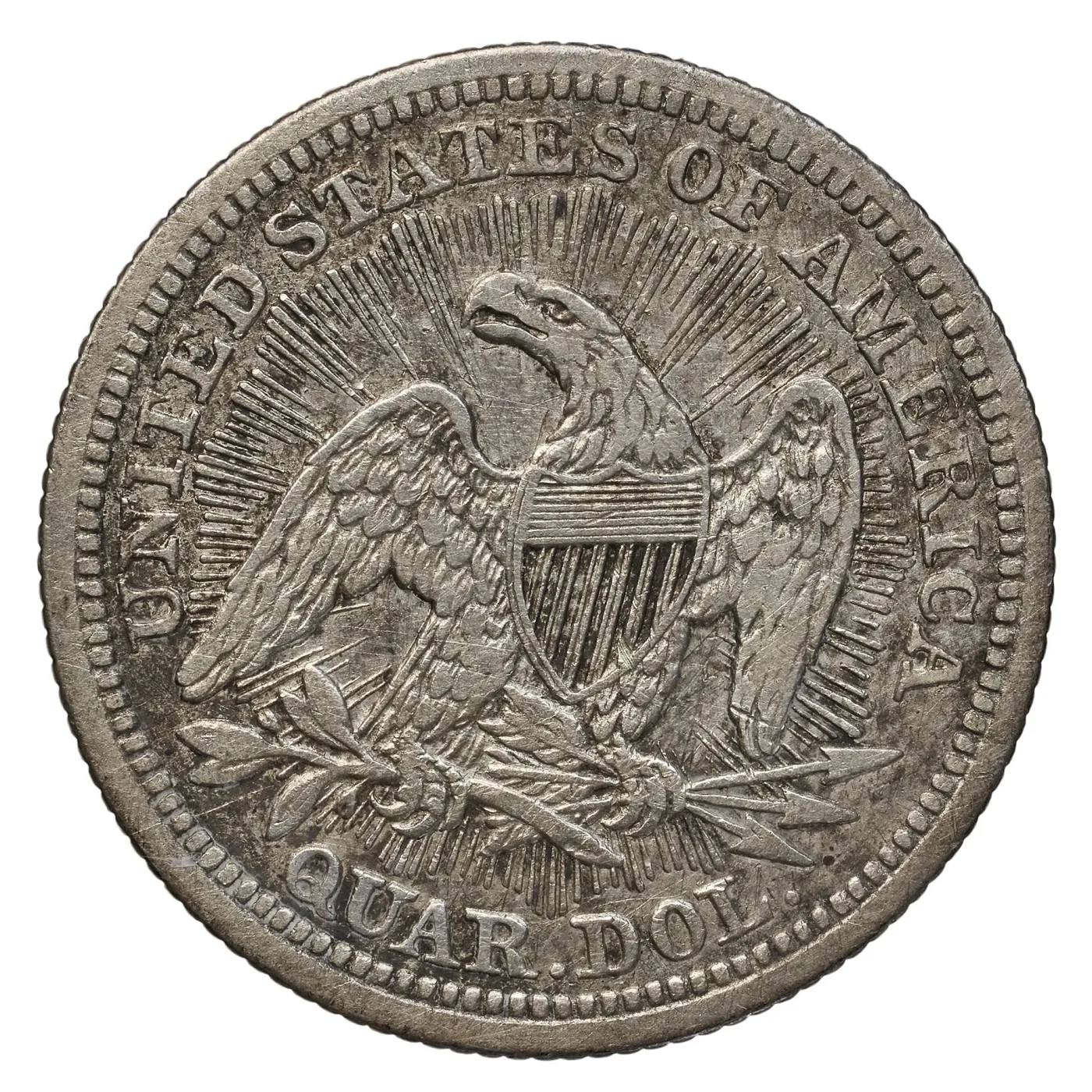
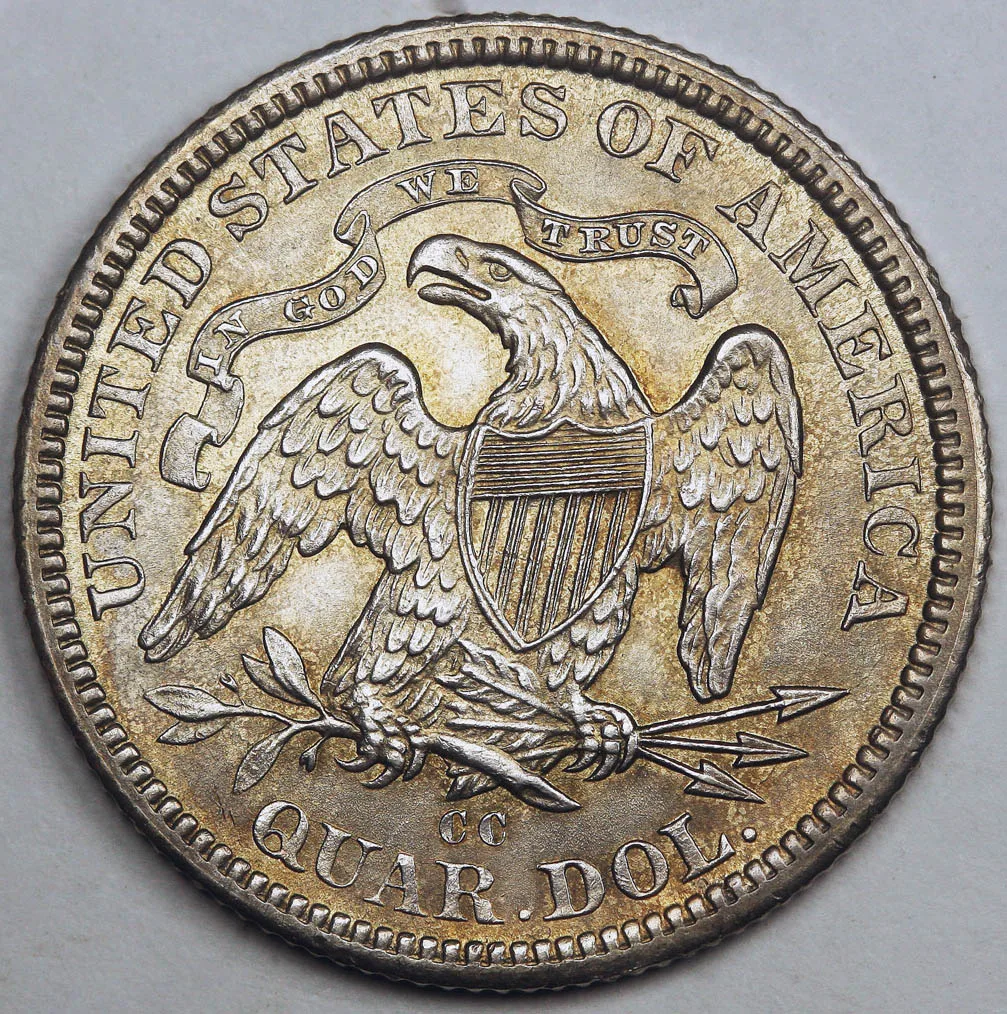
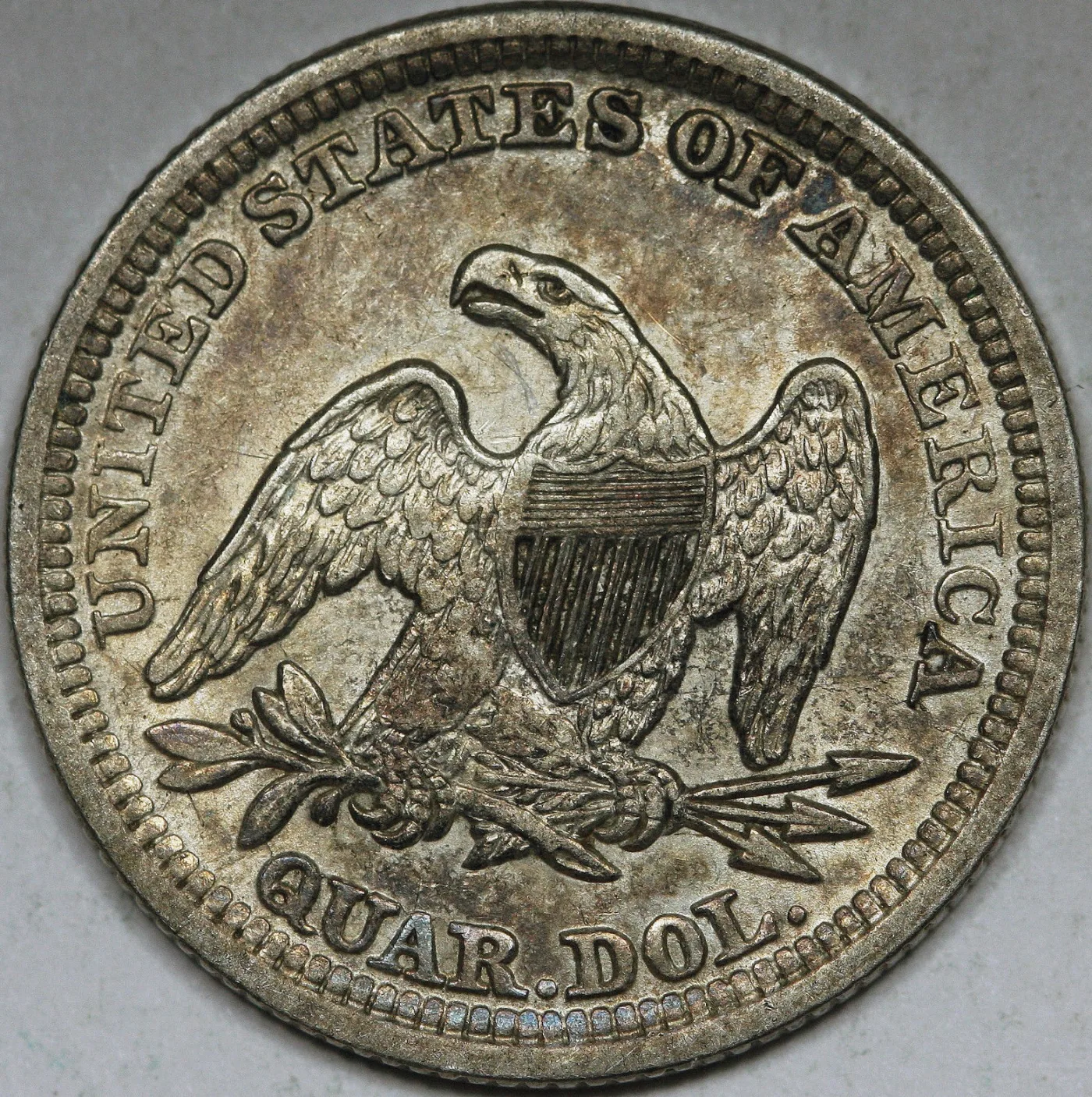
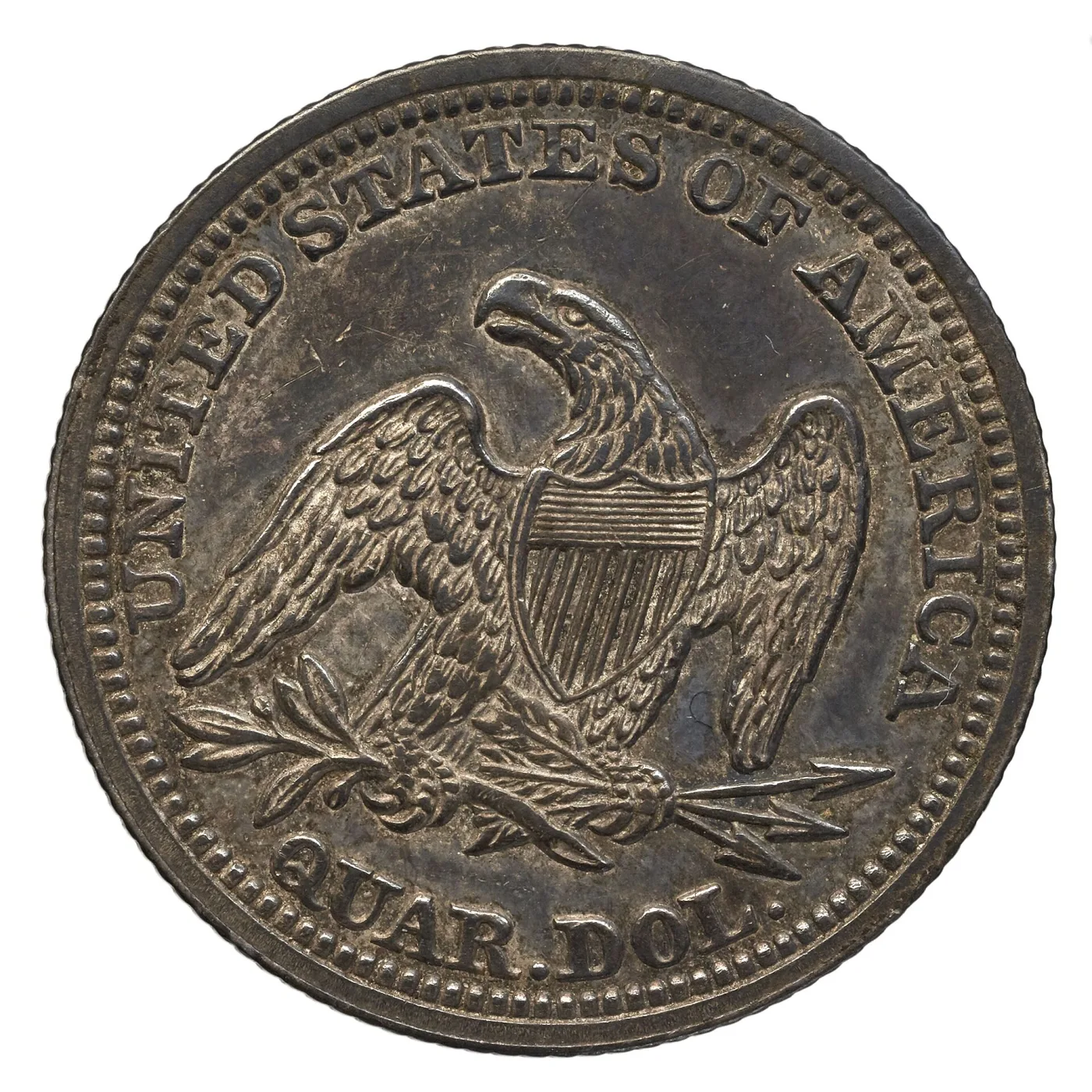
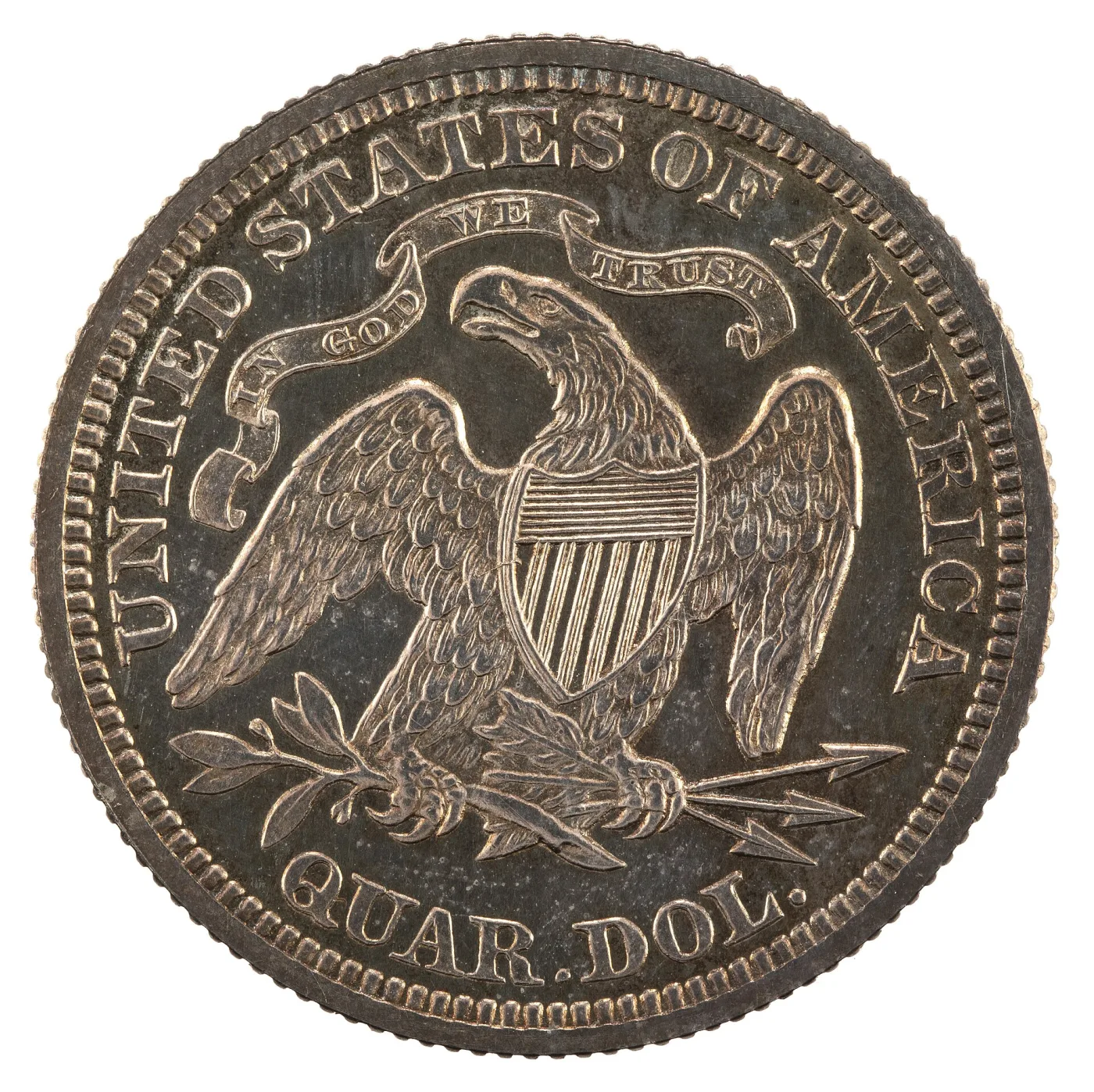
The reverse shows a heraldic eagle with a Union shield on its breast, holding three arrows in its left talon and an olive branch in its right talon. The legend UNITED STATES OF AMERICA arches around the top, and the denomination QUAR. DOL. appears at the bottom. Mint marks (when present) appear on the reverse below the eagle, between the eagle’s talons and the denomination. From 1866 onward, the reverse adds a scroll above the eagle with the motto IN GOD WE TRUST — a critical sub-type marker.
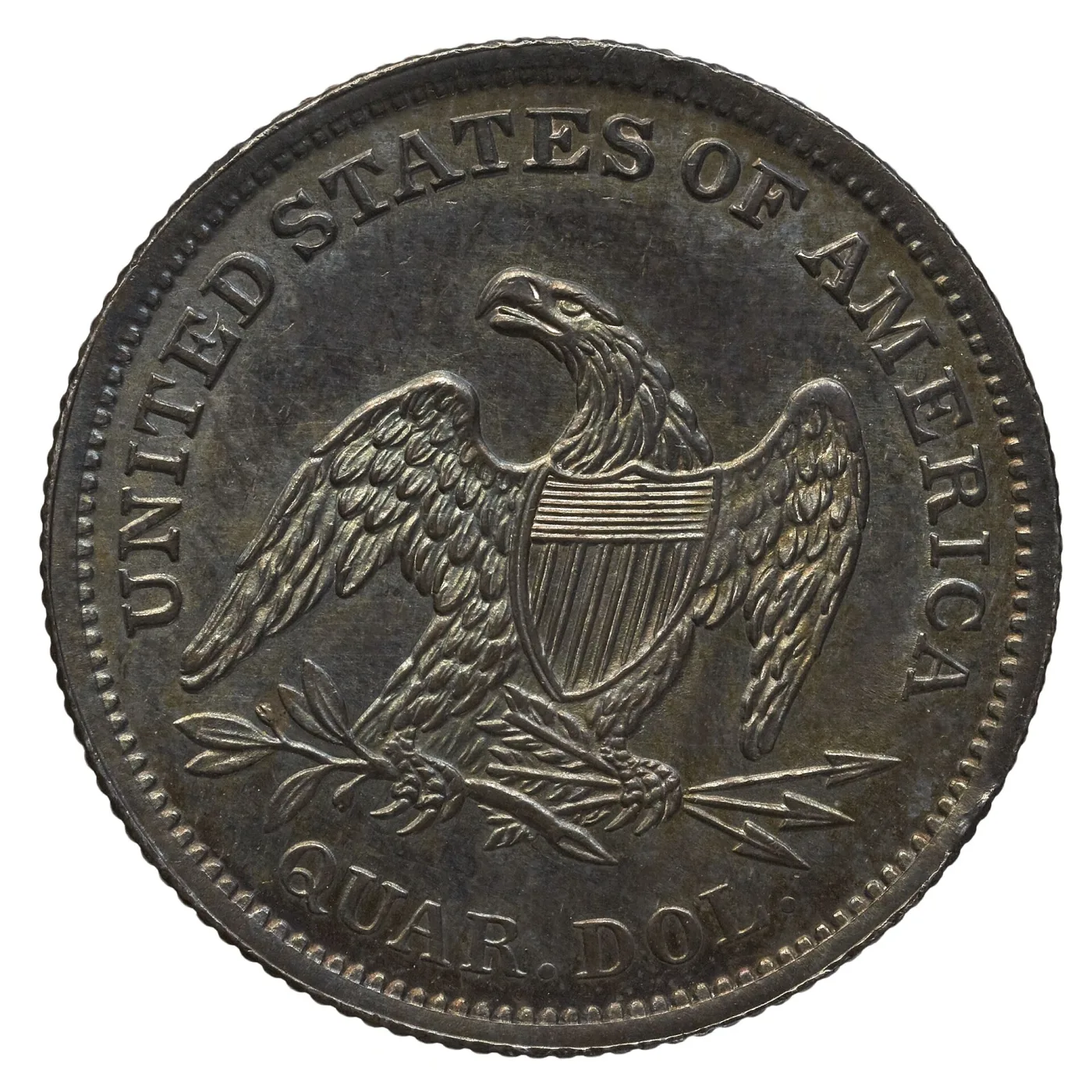
The eagle design is essentially shared across the entire Seated Liberty silver program. The shield horizontal lines, the eagle’s wing feathers, and the leaf detail in the olive branch are all important grading reference points.
Edge
All Seated Liberty Quarters have a reeded edge — vertical grooves applied during striking by the close-collar steam press. There is no lettered-edge variety in this series. A worn or damaged edge can indicate a counterfeit, a coin that has been mounted in jewelry, or one that has been “improved” by tooling.
The Six Major Sub-Types
Identifying the sub-type is the first step in attributing a Seated Liberty Quarter. The series is unusual in that the same basic design carried five distinct modifications across its 54-year run, and each modification creates a separate type for collectors who pursue type sets.
Type 1: No Drapery (1838-1840)
The very first Seated Liberty Quarters of 1838-1840 lacked drapery from Liberty’s right elbow. This was an aspect of Gobrecht’s original master hub. By mid-1840 (after Hughes’s hub modifications), drapery was added beneath the elbow, and the No Drapery sub-type ended. The No Drapery quarters are scarce in all grades and rare in higher grades. Identification: examine Liberty’s right elbow — if no drapery hangs from beneath it (just bare arm), the coin is the No Drapery type. The 1838 and 1839 are the cleanest No Drapery dates; the 1840-O exists in both No Drapery and Drapery varieties, with the No Drapery being earlier in the year’s production.
Type 2: Drapery, No Motto, No Arrows (1840-1853, 1856-1865)
The standard Seated Liberty Quarter after the Hughes drapery retouch and before the 1853 Mint Act change, and again after the 1856 return to no-arrows. This is the longest-running sub-type by years and the most common to encounter. Identification: drapery at elbow, no arrows beside date, no motto above eagle. Original weight is 6.68 g (0.900 silver) for 1840-1853, reduced to 6.22 g for 1856-1865.
Type 3: Arrows and Rays (1853 only)
The 1853 issues feature arrows at either side of the date and rays radiating around the eagle on the reverse — both visual markers of the Mint Act of 1853 weight reduction (from 6.68 g to 6.22 g). This sub-type was struck only at Philadelphia and New Orleans in 1853. The rays were considered visually cluttered and were dropped after one year. Identification: arrows at date PLUS rays around eagle = 1853 only. This is one of the most visually distinctive single-year US coins ever produced and is a “must-have” for any US silver type set.
Type 4: Arrows, No Rays (1854-1855)
For 1854 and 1855, the rays were removed but the arrows at the date were retained as continuing visual indicators of the reduced weight standard. Mints: Philadelphia, New Orleans, and San Francisco (1855-S was the first San Francisco quarter). Identification: arrows at date, no rays around eagle.
Type 5: No Arrows, No Motto (1856-1865)
From 1856, the arrows were dropped and the design returned to its original Drapery format — but at the new lighter 6.22 g weight. This sub-type ran until the addition of the motto in 1866. Identification: drapery at elbow, no arrows, no motto. Visually identical to Type 2 except for weight (6.22 g vs 6.68 g). Authentication: the weight difference is the most reliable distinguisher when the date is unclear from wear.
Type 6: With Motto, No Arrows (1866-1873, 1875-1891)
Beginning in 1866, the motto IN GOD WE TRUST was added on a scroll above the eagle, in response to the religious sentiment heightened by the Civil War. This is the long final-period sub-type. Identification: scroll with IN GOD WE TRUST above eagle. The 1866 transition year exists in both With Motto and No Motto versions for the quarter, with the 1866 No Motto being a famous unique-style rarity.
Type 7: With Motto, With Arrows (1873-1874)
The Coinage Act of 1873 made minor weight adjustments and the Mint added arrows at the date for 1873-1874 to mark the change (from 6.22 g to 6.25 g — a tiny increase). After 1874, the arrows were dropped while the motto was retained. Identification: arrows at date AND motto above eagle. The 1873-CC With Arrows is a key Carson City issue from this period. The 1873-CC No Arrows is a separate, far rarer issue — the most famous Seated Liberty Quarter of them all.
Composition and Specifications
Knowing the metal content and weight is essential for both authentication and bullion-floor valuation. The Seated Liberty Quarter standard changed three times across the series.
Weight Variations
- 1838-1853 (early): 6.68 g, 24.3 mm, 0.900 silver. Same standard as the late Capped Bust quarter.
- 1853-1873 (post-Act of 1853): 6.22 g, 24.3 mm, 0.900 silver. Reduced to prevent silver export.
- 1873-1891 (post-Act of 1873): 6.25 g, 24.3 mm, 0.900 silver. Slight increase to align with the metric system.
Silver Content
A pre-1853 Seated Liberty Quarter contains 0.1934 troy ounces of pure silver. A post-1853 issue contains 0.1800 troy ounces. A post-1873 issue contains 0.1809 troy ounces. At a silver spot price of $30/oz, the bullion floor ranges from $5.40 to $5.80. No problem-free Seated Liberty Quarter should ever sell for less than its melt value, even in cull condition.
Weight as Authentication Tool
Use a jeweler’s scale accurate to 0.01 grams. Tolerance is ± 0.10 g for genuine pieces. The most diagnostic use of weight is distinguishing pre-1853 (heavy 6.68 g) from post-1853 (light 6.22 g) issues when the date or arrows-marker is unclear due to wear. A “no arrows” quarter that weighs 6.68 g must be Type 2 (1840-1853), while one that weighs 6.22 g must be Type 5 (1856-1865). This is the same authentication logic that applies across the Seated Liberty silver family.
Mint Marks: Philadelphia, New Orleans, San Francisco, Carson City
Seated Liberty Quarters were struck at four mints across the series. Mint mark identification is essential for both attribution and valuation — branch-mint pieces often command large premiums over Philadelphia issues of the same date.
Mint Mark Locations
- Philadelphia (no mint mark): Main mint. No mint mark on any issue. Largest mintages by far.
- New Orleans (O): 1840-O through 1860-O, then briefly resumed for select dates after Reconstruction. Mint mark on reverse, below eagle, between talons and QUAR. DOL.
- San Francisco (S): 1855-S onward. Mint mark on reverse, below eagle.
- Carson City (CC): 1870-CC through 1878-CC. Mint mark on reverse, below eagle. Famous frontier branch issues.
The 1842 Small Date vs Large Date
The 1842 Philadelphia quarter exists in two varieties: a Small Date (proof-only, extremely rare) and a Large Date (the regular business strike). The 1842-O also exists in both. The Small Date 1842-O is one of the great Seated Quarter rarities, with values starting at $1,000+ in low grades.
The 1849-O — A First-Year-of-Resumption
New Orleans struck no quarters in 1845-1849. The 1849-O is the first New Orleans quarter after this gap and has a low mintage (16,000-ish). It is one of the keys to a New Orleans set, with strong values in any grade. Authentication is critical because counterfeit O mint marks have been added to common-date Philadelphia coins.
Branch Mint Premiums
Branch-mint issues generally carry premiums over Philadelphia for the same date and grade because mintages were lower and survival rates poorer (less collector preservation at frontier locations). The premium ratio varies dramatically: a common-date Philadelphia 1858 might bring $30 in F-12 while the 1858-S brings far more (modest premium), but a Philadelphia 1871 brings $40 while the 1871-CC brings $4,000+ (massive premium). Always check both date AND mint mark before pricing — the same logic that applies to the Seated Liberty Half Dollar applies even more dramatically to the quarter.
The 1853 Arrows and Rays — A One-Year Type
The 1853 Arrows and Rays Seated Liberty Quarter deserves its own section because it is one of the most visually distinctive single-year designs in all of American coinage.
Why the Mint Made the Change
By the early 1850s, the gold rush was flooding the American economy with new gold while silver remained scarce and increasingly valuable on world markets. US silver coins at the original weight standards contained more silver than their face value, making it profitable to export them as bullion. Silver coins literally disappeared from circulation. The Mint Act of February 21, 1853 reduced the silver weight of all subsidiary silver coinage (everything below the dollar) to keep coins in domestic circulation. The quarter dropped from 6.68 g to 6.22 g — a 6.9% weight reduction.
The Visual Markers
To distinguish reduced-weight coins from older heavy-weight pieces (which were being recalled and melted), the Mint added two visual markers:
- Arrows at date: Small horizontal arrows at either side of the date in the exergue, each pointing outward toward the rim, with the shafts running in toward the numerals.
- Rays around eagle: Sharp triangular rays radiating outward from around the eagle on the reverse, between the eagle and the surrounding lettering.
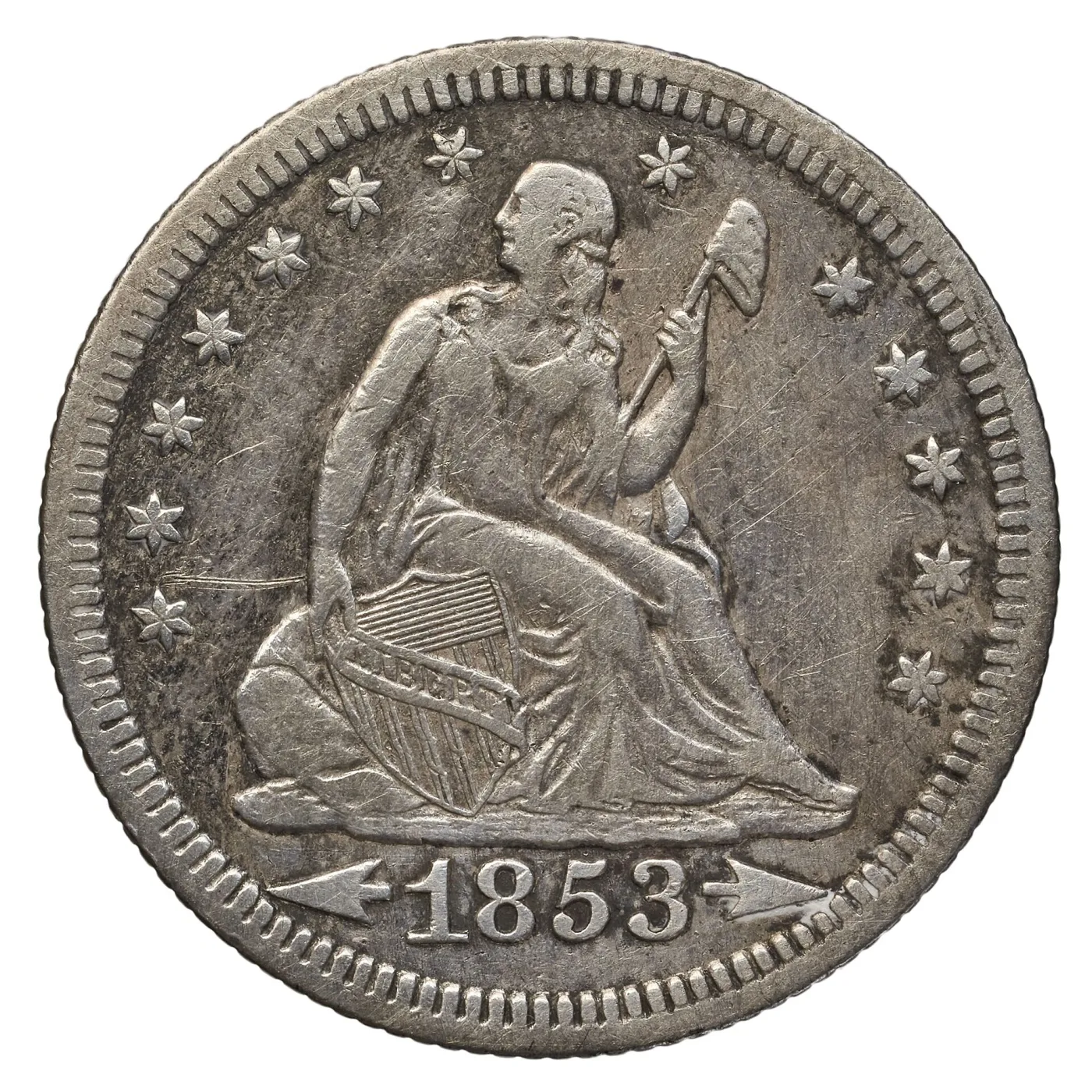
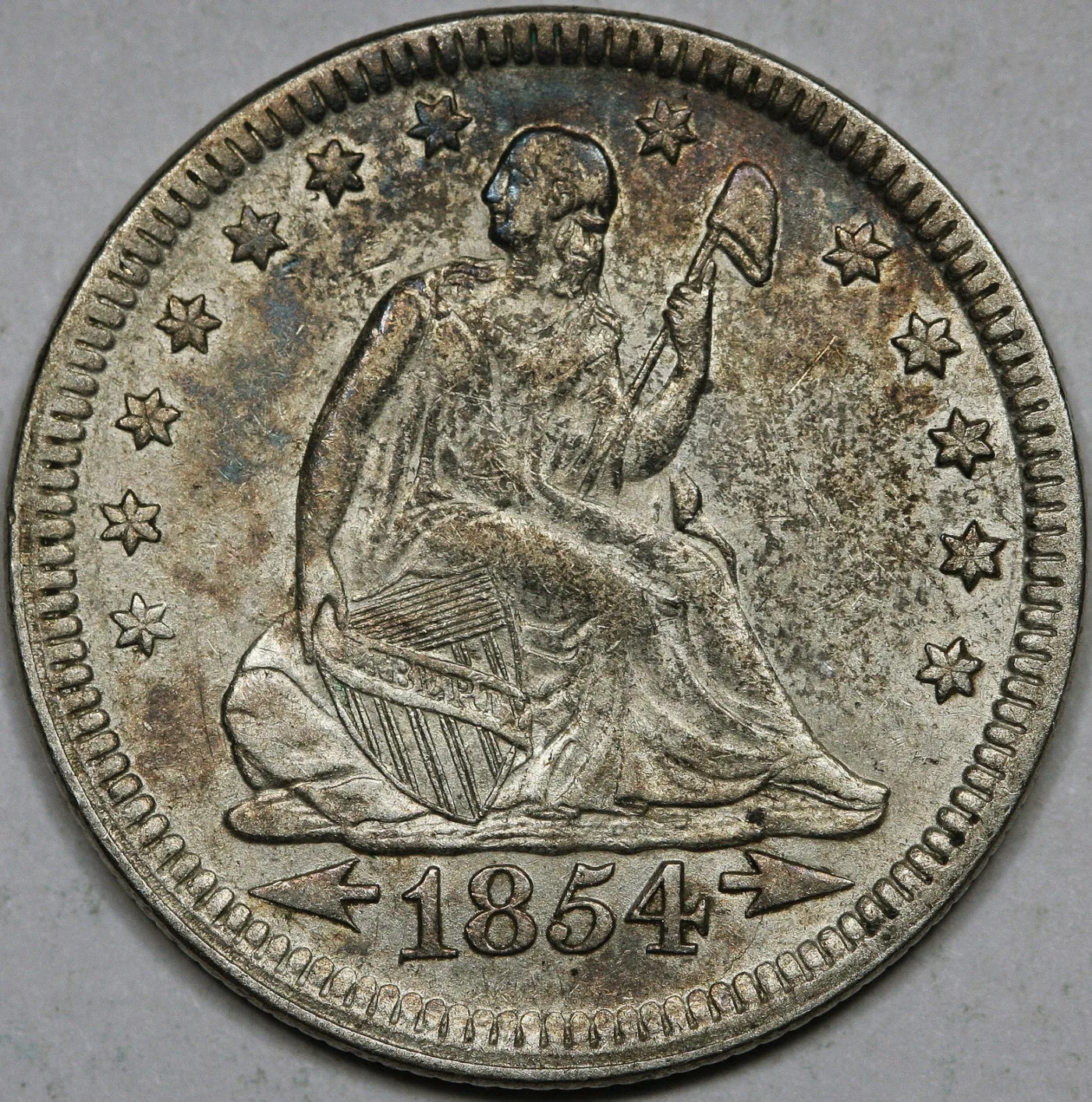
Both markers appear together only on 1853 issues. The rays were considered visually busy and crowded the design — they were removed for 1854. The arrows were retained for 1854-1855 as a continuing weight indicator, then also dropped.
1853 Mintages and Values
The 1853 Arrows and Rays quarter was struck at Philadelphia (15,254,220 mintage — a huge issue) and New Orleans (1,332,000 mintage). The 1853-O is the more challenging of the two but neither is rare. Both are essential for any type set of US silver. Approximate values: 1853 (P) F-12 $35, MS-63 $1,200. 1853-O F-12 $45, MS-63 $4,000. Watch carefully for the 1853 / 1853-O without arrows (an extreme rarity — different sub-type, leftover dies).
Collecting the 1853 Type
For collectors building a US silver type set, an 1853 Arrows and Rays quarter is a “must-have” that captures both the visual drama of the rays and the historical weight of the Mint Act of 1853. A pleasing F-12 example for $35-$50 is a great value relative to the historical significance.

The With Motto Transition of 1866
The motto IN GOD WE TRUST was added to many US coins in the wake of the Civil War as a response to heightened religious sentiment. The Two Cent Piece of 1864 carried the motto first (see our Two Cent Piece guide), and over the next several years the motto propagated through other denominations.
For the Seated Liberty Quarter, the motto arrived in 1866, placed on a scroll above the eagle on the reverse. The transition was abrupt: 1865 quarters are all No Motto, 1866 production at Philadelphia started With Motto. There is a famous 1866 No Motto unique pattern/proof rarity — only a single confirmed example exists, comparable to the 1866 No Motto Half Dollar and Dollar.
Identification at a glance: look at the area above the eagle’s head. A bare, empty field = No Motto (1838-1865). A scroll bearing IN GOD WE TRUST = With Motto (1866 onward). There are no clouds in that space on any Seated Liberty Quarter — clouds belong to the older heraldic-eagle reverses of the 1790s and early 1800s, and expecting them here is a common way to misread the coin.
Key Dates and Major Rarities
Across 54 years of production, Seated Liberty Quarters include several dates and varieties whose values vastly exceed common dates. Memorize these dates — they are what make the series interesting (and expensive).
The Big Five Carson City Keys
- 1870-CC: First-year Carson City quarter, mintage 8,340. F-12 ~$8,000, XF $25,000+.
- 1871-CC: Mintage 10,890. F-12 ~$5,000, XF $15,000+.
- 1872-CC: Mintage 22,850. F-12 ~$3,000, XF $10,000+.
- 1873-CC No Arrows: Only 5 known. Last sold for $1,000,000+ at auction. One of the great US numismatic rarities.
- 1873-CC With Arrows: Mintage 12,462. F-12 ~$3,500, XF $11,000+.
Other Notable Keys
- 1842-O Small Date: F-12 ~$1,200, XF $3,500+. Tiny date numerals.
- 1849-O: First New Orleans quarter after a four-year gap. F-12 ~$800, XF $2,500+.
- 1853 No Arrows: Extreme rarity from leftover dies. Six-figure values.
- 1853-O No Arrows: Similar — extreme rarity.
- 1866 No Motto: Unique pattern; museum piece, not a market commodity.
- 1872-S: Low San Francisco mintage. F-12 ~$500, XF $1,500+.
- 1874-CC: Last Carson City With Arrows. F-12 ~$3,000.
- 1878-CC: Last Carson City quarter. Better-condition example. F-12 ~$200, MS-63 $2,500+.
Condition Rarities
Even among common dates, high-grade examples (MS-65 and above) command large premiums because few collectors saved Seated coins in the 19th century — most circulated heavily. A common-date 1875-S that brings $40 in F-12 might bring $1,500 in MS-65. Knowing the difference between “rare date” and “rare grade” is critical for evaluation.
Carson City Seated Quarters: The Four Keys
The Carson City branch mint, established in 1870 to process Nevada Comstock Lode silver, produced Seated Liberty Quarters from 1870 through 1878. The CC mint mark is one of the most coveted in American numismatics, and the four CC keys of 1870-CC, 1871-CC, 1872-CC, and 1873-CC No Arrows are the most famous Seated Quarter rarities.
Why CC Mintages Are So Low
Carson City was a small frontier mint with limited equipment. Its primary mission was processing Comstock silver into dollars and eagles, not into smaller subsidiary coins. Quarter mintages at CC ran from a low of about 5,500 (1873-CC No Arrows leftovers) to about 75,000 — orders of magnitude below Philadelphia and San Francisco. Combine the low mintages with low survival rates (frontier circulation was rough), and the CC keys become genuinely rare in any grade.
The 1873-CC No Arrows Story
The Coinage Act of February 12, 1873 mandated a tiny weight increase (from 6.22 g to 6.25 g) and added arrows at the date as the visual marker. Carson City had already struck a small batch of 1873-CC quarters at the old No Arrows weight before the act took effect. Most of these were melted, but five examples are known to have survived. The 1873-CC No Arrows is therefore the great rarity of the entire Seated Liberty Quarter series, standing alongside the 1873-CC No Arrows Dime and the 1804 Dollar as legendary American rarities. The most recent auction example sold for over $1 million.
Authenticating CC Coins
Counterfeit CC mint marks have been added to common-date Philadelphia coins. Always check: the CC punch on a genuine Seated Quarter sits below the eagle, slightly to the right of center, with the two C’s tightly spaced. The serif terminations of the C’s are distinctive — modern counterfeits often get them wrong. Compare with photographs of certified examples, and for any coin over $1,000 in value, submit to PCGS or NGC. The same authentication discipline applies to Carson City Double Eagles and Trade Dollars.
Briggs Varieties and Die Marriages
For collectors who go beyond date-and-mint-mark sets, the Seated Liberty Quarter series offers a deep world of die varieties catalogued by Larry Briggs in his standard reference The Comprehensive Encyclopedia of United States Liberty Seated Quarters.
What Briggs Numbers Are
Each Briggs number identifies a unique die marriage — a specific pairing of obverse and reverse working dies. Across the series, hundreds of die marriages exist. Common dates may have a dozen or more Briggs marriages; key dates often have only one or two. Briggs numbers are written as Date-#, such as “1853 Briggs-1A” or “1875-S Briggs-2”.
The Most Famous Varieties
- 1842 Small Date / Large Date: The Small Date is proof-only in Philadelphia and ultra-rare in business strike at New Orleans.
- 1853 Recut Date: Several Briggs marriages show recut date digits — multiple punches visible on the date.
- 1856 / Inverted Date: A scarce Briggs marriage with an inverted date punch correction.
- 1876-CC Doubled Die: Several Carson City die marriages show heavy doubling on LIBERTY.
- 1877-S over Horizontal S: The S mint mark was first punched horizontally, then corrected vertically — visible at high magnification.
- 1891-O Repunched O: Reappearance issue at New Orleans, with a doubled mint mark on a known Briggs marriage.
How to Attribute Briggs Varieties
Briggs attribution requires good lighting, 10x-20x magnification, and the reference book. Most collectors begin by checking date punch shape, mint mark position, and any obvious die cracks or polish lines. The reference book diagrams each marriage’s diagnostic features. Briggs attribution can dramatically affect value — a common-date quarter with a famous variety attribution can sell for 5-10x the regular price.
Grading Seated Liberty Quarters
Grading follows the standard 70-point Sheldon scale. For Seated Liberty Quarters, the diagnostic wear points are Liberty’s gown, the shield, the eagle’s wing feathers, and the shield horizontal lines on the reverse.
Grade-by-Grade Diagnostics
- G-4 (Good): LIBERTY on the shield is mostly worn away (3-4 letters visible). Liberty’s figure is outlined only. Date readable. Major details flat.
- VG-8 (Very Good): LIBERTY shows 3 or more letters. Major design features are clear. Gown folds are smooth.
- F-12 (Fine): Full LIBERTY readable, though weak. Gown folds visible. Shield stripes partially visible.
- VF-20 (Very Fine): LIBERTY bold. All major design elements clear. Shield stripes fully visible. Gown folds sharp.
- XF-40 (Extremely Fine): All design details sharp. Light wear only on highest points (knee, shield, eagle’s breast).
- AU-50 (About Uncirculated): Trace wear on the highest points only. Most of the original luster remains.
- MS-60 to MS-70 (Mint State): No wear. Grading depends on luster, strike, surface marks, and eye appeal.
Strike and Eye Appeal
Seated Liberty Quarters from New Orleans and Carson City often show weak strikes — the Liberty head and stars are weakly defined even in higher grades. A sharply struck CC quarter is a real prize. Eye appeal also matters: original gray or attractive toning generally commands a premium over dipped or cleaned surfaces. Avoid coins with hairline scratches from cleaning, which can drop a coin’s value by 50% or more. The same grading principles apply to companion series like the Barber Quarter and Standing Liberty Quarter.
Professional Certification
For any Seated Liberty Quarter worth more than about $300, professional certification by PCGS or NGC is strongly recommended. Certification provides authentication, an accurate grade, and a tamper-evident holder. For the four CC keys and other rarities, certified examples typically bring 20-40% more than raw coins because buyers are wary of fakes and counterfeit mint marks.
Authentication and Spotting Counterfeits
Seated Liberty Quarters are counterfeited at multiple levels of sophistication, from crude cast fakes to expert die-struck transfers. Knowing the authentication red flags can save you from costly mistakes.
Common Counterfeit Types
- Cast counterfeits: Show porosity, soft details, and seams along the edge. Weight often slightly low.
- Altered mint marks: Common-date Philadelphia or New Orleans coins with an added or altered CC or O. Look for tool marks around the mint mark, a different finish on the mint mark vs surrounding field, or a mint mark in the wrong position.
- Altered dates: Common dates with one digit altered to create a rare date (e.g., 1873 to 1873/2 or 1853 No Arrows fakes from 1858).
- Modern Chinese die-struck counterfeits: Quite convincing visually, but often wrong weight (10-15% off) and wrong specific gravity. Use a digital scale.
Authentication Checklist
- Weigh: 6.68 g pre-1853, 6.22 g 1853-1873, 6.25 g 1873-1891. Tolerance ± 0.10 g.
- Diameter: 24.3 mm.
- Magnetism: No magnetic response (silver is non-magnetic).
- Edge: Reeded, with consistent reeds. No seam line.
- Mint mark: Compare position, font, and depth with a certified example.
- Date: Look for tool marks indicating alteration of digits.
When to Submit to a Grading Service
For any coin worth more than $300, professional authentication is worth the $25-$50 submission fee. For the four CC keys, the 1842 Small Date, and the 1849-O, do not buy a raw coin from a non-specialist seller. The grading services have seen every known counterfeit and can spot diagnostic features that even experienced collectors miss.
Current Market Values and Price Guide
Values below are approximate retail estimates for problem-free coins as of 2026. Prices for rarities are highly auction-dependent.
Common Dates (No Drapery, Drapery, No Motto, With Motto)
- G-4: $25-$35
- F-12: $40-$60
- VF-20: $60-$100
- XF-40: $100-$175
- AU-50: $200-$350
- MS-63: $700-$1,200
- MS-65: $2,500-$5,000
1853 Arrows and Rays
- F-12: $35-$50
- XF-40: $200-$300
- MS-63: $1,200-$1,500
- MS-65: $7,000-$10,000
Carson City Keys (1870-CC, 1871-CC, 1872-CC, 1873-CC W/A, 1874-CC)
- G-4: $1,500-$5,000
- F-12: $3,000-$10,000
- XF-40: $10,000-$30,000
- MS-63: $50,000+
1873-CC No Arrows
Auction record: $1,560,000+ (PCGS MS-64). Only five known. Not a practical collecting target — a numismatic icon.
Where to Buy
Reputable dealers (Heritage, Stack’s Bowers, GreatCollections, David Lawrence Rare Coins) and certified examples from major auctions are the safest channels. Avoid raw coins offered as “rare dates” by non-specialist sellers, online classified listings, and flea-market finds without authentication.
Building a Seated Liberty Quarter Collection
Several collecting paths are realistic, depending on budget and interest.
Type Set
A type set targets one example of each major sub-type — No Drapery, Drapery No Motto, Arrows and Rays, Arrows No Rays, With Motto No Arrows, With Motto With Arrows. Six coins. Budget: $500-$1,500 for circulated F/VF examples, $5,000-$15,000 for mid-Mint State. This is the most common path and a great introduction to the series.
Date Set
One quarter for each year 1838-1891. Fifty-four coins. Achievable in circulated condition over several years of collecting. Budget: $3,000-$8,000 depending on grade. This path is realistic and rewarding.
Date and Mint Mark Set
One quarter for each date / mint mark combination. About 100 coins. The four Carson City keys make this set genuinely difficult and expensive — most date-and-mint-mark collectors complete everything except the four CC keys and call the set “complete minus CC keys.”
Briggs Variety Set
For specialists — one example of each major Briggs marriage. Hundreds of coins. A lifetime project. The Briggs reference is essential.
Short Sets
- Sub-type representatives: 6-7 coins, $500-$2,000 budget.
- Civil War era set (1861-1865): 5-10 coins spanning the No Motto wartime issues.
- San Francisco set: All S-mint dates. About 30 coins.
- Pre-1853 / post-1853 weight pairs: Two coins showing the weight transition.
Storage and Preservation
Silver coins are reactive — they tone (and can corrode) over time. Proper storage preserves value.
Holders
For raw coins, use inert flips (Mylar or polyester) or hard plastic capsules. Avoid PVC flips, which release plasticizers that attack the coin surface. For certified coins, the PCGS or NGC holder is itself an excellent long-term storage solution.
Environment
Store in a cool, dry location. Humidity below 50% is ideal. Avoid wide temperature swings. A coin safe with desiccant packs is the standard solution. Do not store in cardboard 2x2s with staples — the staples rust and the cardboard releases sulfur compounds that tone silver.
Cleaning — Don’t
Never clean a Seated Liberty Quarter. Cleaning destroys the original surface and can drop the coin’s value by 50-90%. Professional conservators (NCS, the conservation arm of NGC) can sometimes safely remove harmful residues, but never attempt cleaning yourself. The original surface, even with toning, is what gives a 150-year-old coin its value.
Frequently Asked Questions
How can I tell if my Seated Liberty Quarter is real silver?
Weigh it. A pre-1853 quarter is 6.68 g, post-1853 is 6.22 g, post-1873 is 6.25 g. Diameter is 24.3 mm. Silver is non-magnetic. If your coin matches weight and diameter and is non-magnetic, it is almost certainly silver. For ultimate certainty, a specific gravity test (silver is 10.49 g/cm³) is decisive.
What is the most valuable Seated Liberty Quarter?
The 1873-CC No Arrows. Only five examples are known. The most recent auction example sold for over $1.5 million. After that, the 1870-CC, 1871-CC, and 1872-CC are the most valuable regular issues.
What is the difference between Seated Liberty and Standing Liberty?
Seated Liberty Quarters (1838-1891) depict Liberty seated on a rock, fully clothed in classical gown, holding a shield and a pole topped with a Phrygian cap. Standing Liberty Quarters (1916-1930) depict Liberty standing, in two design types, holding a shield and an olive branch. Completely different designs by different artists in different eras.
Why does my Seated Liberty Quarter have a CC mint mark?
The CC mint mark indicates the Carson City branch mint in Nevada, which struck quarters from 1870 to 1878. CC Seated Quarters are all scarce-to-rare and are among the most desired American silver coins. Have any CC quarter professionally authenticated — counterfeit CC mint marks are common.
Is the 1853 quarter rare?
The 1853 With Arrows and Rays is not rare in absolute terms — over 15 million were struck at Philadelphia — but it is extremely popular as a one-year type coin and commands a steady premium. A pleasing F-12 1853 Arrows and Rays trades for $35-$50. The 1853 / 1853-O No Arrows varieties (without arrows or rays) are extremely rare and valuable.
What does "No Drapery" mean?
No Drapery refers to Gobrecht's original 1838-1840 master hub, in which Liberty's right elbow has no drapery fold beneath it (just bare arm). In 1840, Robert Ball Hughes retouched the hubs to add the drapery fold. Coins from 1838, 1839, and early 1840-O are No Drapery; coins from late 1840 onward are Drapery. The difference is visible at the elbow.
What's the difference between Seated Liberty Quarter and Seated Liberty Half Dollar?
Size and weight. The quarter is 24.3 mm and 6.22-6.68 g; the half dollar is 30 mm and 12.44-13.36 g. The reverse denomination differs (QUAR. DOL. vs HALF DOL.). The obverse design (Liberty seated) is essentially identical. Both share the same sub-type progression (No Drapery, Drapery, Arrows and Rays, etc.).
Should I clean my Seated Liberty Quarter?
Absolutely not. Cleaning destroys the coin's surface and value. Even gentle cleaning with soap and water can leave hairlines visible under magnification. Professional grading services downgrade cleaned coins and sometimes refuse to grade them at all. If your coin has problems (PVC contamination, heavy dirt), submit it to NGC's NCS conservation service — never attempt cleaning yourself.
Can I find Seated Liberty Quarters in circulation?
Realistically, no. Silver Seated Liberty Quarters were pulled from circulation decades ago. Any silver quarter in circulation today is a far more recent Washington Quarter (1932-1964). To find Seated Quarters, buy from reputable dealers, attend coin shows, or bid at auction.