Capped Bust Quarter Identification Guide: Large Size vs Small Size, Browning Varieties, 1823/2 Overdate, Key Dates and Values
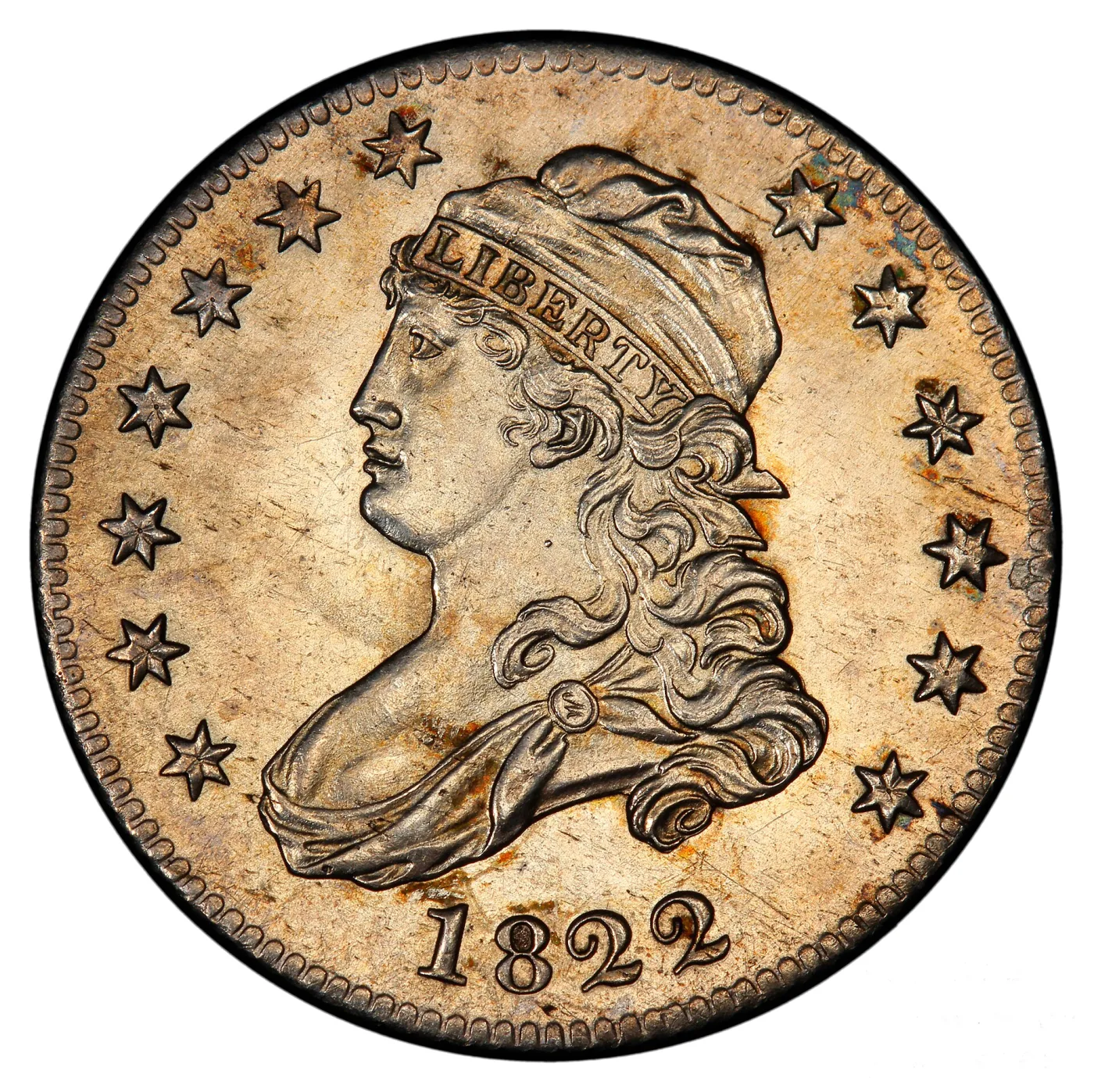
The Capped Bust Quarter is one of the most rewarding — and one of the most frustrating — early US silver series a collector can pursue. Struck at the Philadelphia Mint from 1815 through 1838, it spans a 23-year run in which the design itself never changed in any obvious way, yet the coin underwent a quiet but profound technological transformation in 1831 that split the series cleanly into two halves: the “Large Size” (1815-1828) and the “Small Size” (1831-1838). To the casual eye, every Capped Bust Quarter looks similar — Liberty in a soft cloth cap, a heraldic eagle on the reverse, 25 C. for the denomination. But within that visual sameness lurks a Browning-numbered universe of die varieties, an overdate that anchors every advanced collection (the 1823/2), proof-only restrikes, condition rarities, and a true four-year gap (1829, 1830) when no quarters were struck at all.
The series was designed by John Reich, the German-born engraver who also created the matching Capped Bust Dime, Capped Bust Half Dollar, and Capped Bust Half Dime. Reich’s “Capped Bust” Liberty — facing left, hair tied with a fillet beneath a soft cap inscribed LIBERTY — was a deliberate move away from the earlier Draped Bust designs of Robert Scot. The quarter joined the Capped Bust family in 1815, completing Reich’s silver redesign program. When the series ended in 1838, the Seated Liberty Quarter took its place, beginning Christian Gobrecht’s unified Seated Liberty silver family that would dominate US coinage for the rest of the 19th century.
This guide covers everything needed to identify, attribute, grade, and value Capped Bust Quarters: the Large Size and Small Size sub-series and how to tell them apart in seconds, the Browning variety system that catalogs every known die marriage, the famous 1823/2 overdate (the series key), the 1822 25/50 C. blundered reverse, the 1827 Original vs Restrike, the 1825 overdates, the production gap of 1829-1830, the proof issues, grading early silver, authentication, and 2026 market values across the full grade range. The general coin identification principles apply, but Capped Bust Quarters reward variety attribution far more than nearly any other US series — two coins of the same date and grade can differ in value by a factor of fifty depending on which die marriage is involved.
History: John Reich and the Capped Bust Family
John Reich arrived at the Philadelphia Mint as an assistant engraver in 1807, hired largely to relieve Chief Engraver Robert Scot, who by then was nearly seventy and overwhelmed by the Mint’s expanding workload. Within months Reich introduced his Capped Bust design on the half dollar, replacing Scot’s Draped Bust. The dime followed in 1809, and the quarter in 1815. Each used the same basic concept: a left-facing Liberty bust in a soft “mob cap” inscribed LIBERTY, stars or no stars depending on denomination, and a heraldic eagle reverse modeled loosely on the Great Seal of the United States.
The Capped Bust Quarter is notable for what happened in 1815, the very first year. The Mint had not struck quarters at all from 1808 through 1814 — a seven-year hiatus driven by a chronic shortage of silver bullion and the demands of the War of 1812. The last quarters before that gap had been Robert Scot’s Draped Bust Quarter of 1796-1807, the series that began the denomination. When production resumed in 1815, it did so under Reich’s new design, and Reich himself had grown disillusioned with the Mint by then. He resigned in 1817, leaving the series to be carried forward by assistant engraver William Kneass and the working die team. Mintages were modest, irregular, and shaped by silver availability rather than commercial demand.
Why Quarters Were Scarce in Circulation
Throughout the Capped Bust era, the quarter dollar was actually one of the less-used American coins. Spanish 2-reales pieces (the “two-bit” coin) circulated freely and were legal tender in the United States until 1857. Many Americans transacted in halves of Spanish dollars rather than US quarters. As a result, US quarter mintages stayed small — usually under 200,000 per year, and zero in 1816, 1817, 1826, 1829, and 1830 — and surviving Capped Bust Quarters today are scarcer than their nominal mintage figures suggest because so many were melted or exported.
End of the Series
The Capped Bust Quarter ended in 1838 with the introduction of the Seated Liberty Quarter. Christian Gobrecht’s Seated Liberty design had already appeared on the silver dollar in 1836; over 1837-1840 it propagated to the half dime, dime, quarter, and half dollar, finally giving US silver coinage a unified visual family.
Large Size vs Small Size: The 1831 Transition
The single most important distinction in the entire series is Large Size (1815-1828) vs Small Size (1831-1838). The two sub-series look superficially identical, but they were struck on different planchets, with different presses, and using different collar technology. Most collectors treat them as effectively two separate series.
Large Size (1815-1828)
- Diameter: 27 mm (approximately — variable from coin to coin)
- Striking technology: Open collar — the planchet was free to spread laterally during the strike, producing edges that vary in width and slightly tapered profiles
- Reverse legend: 25 C. (the denomination uses the letter C, abbreviating “cents”)
- Eagle: Heraldic eagle with E PLURIBUS UNUM on a scroll above its head
- Edge: Reeded but slightly variable in reed count and depth
Small Size (1831-1838)
- Diameter: 24.3 mm (uniform — about 2.7 mm smaller than Large Size)
- Striking technology: Close (restraining) collar — the planchet was confined laterally, producing perfectly circular coins with uniform diameter and crisp rims
- Reverse legend: 25 C. on most issues; E PLURIBUS UNUM removed from above the eagle — this is the most reliable instant visual difference
- Eagle: Same heraldic eagle but without the motto scroll
- Edge: Reeded with uniform reed count
How to Tell Them Apart Instantly
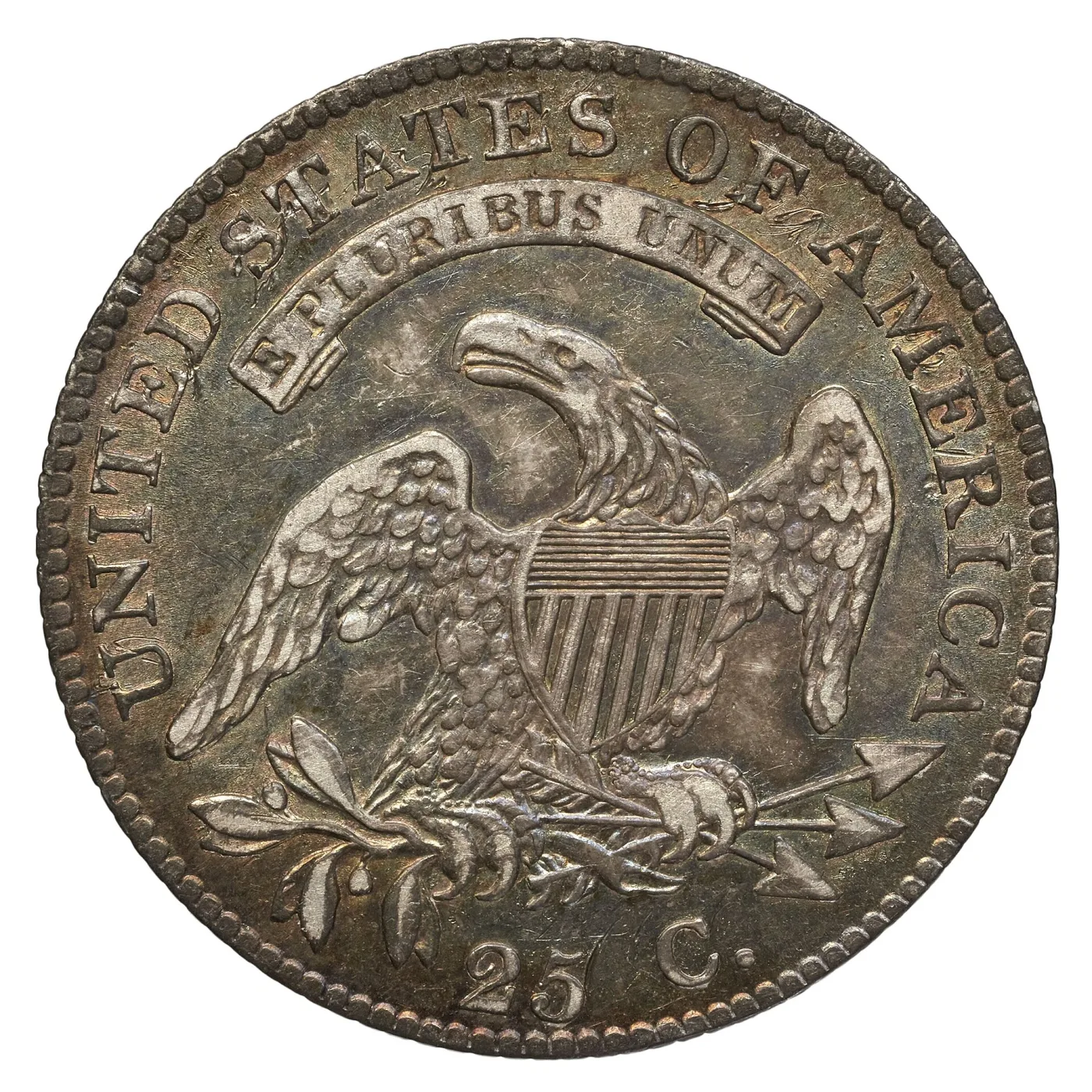
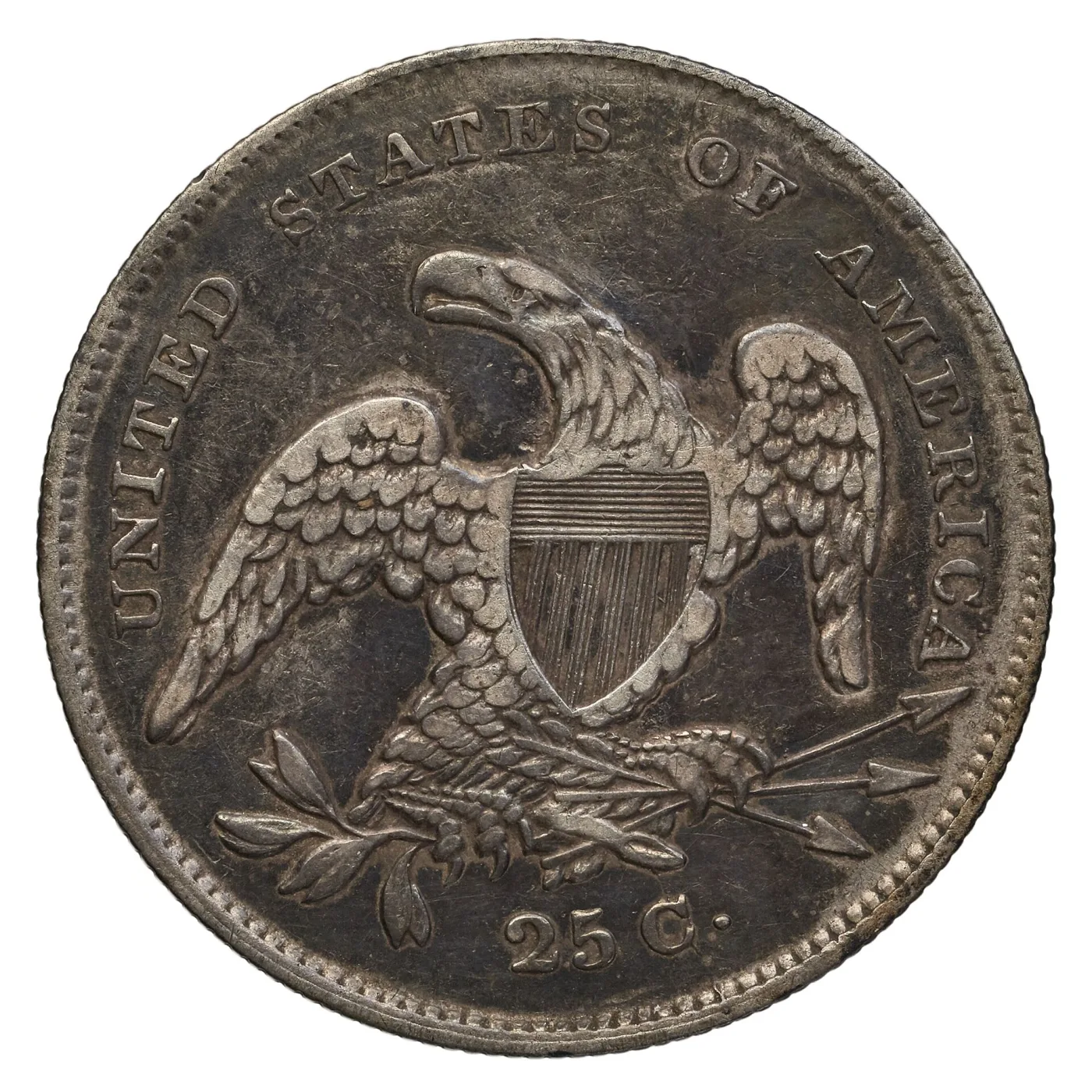
Two reliable tests: (1) diameter — a Large Size coin will look noticeably larger than a Small Size coin when placed side by side, and the diameter is the most diagnostic single measurement; (2) E PLURIBUS UNUM — present on Large Size, absent on Small Size. The motto sits on a scroll above the eagle’s head. If you see it, the coin is Large Size (1815-1828). If you do not, the coin is Small Size (1831-1838). Beginners sometimes worry the motto is just worn off a Small Size example, but it was physically not engraved on the reverse die — it cannot be “worn off.”
Two quarters photographed the same way, eleven years apart, make the test concrete:
The Three Missing Years
No Capped Bust Quarters dated 1829 or 1830 exist. The Mint did not strike quarters in those years while preparing the new Small Size collar technology. Production resumed in 1831 with the new design. Anyone claiming an “1829 quarter” or “1830 quarter” is either confused or attempting fraud — the dates simply do not exist for this series.
Design Details: Obverse and Reverse
The Obverse
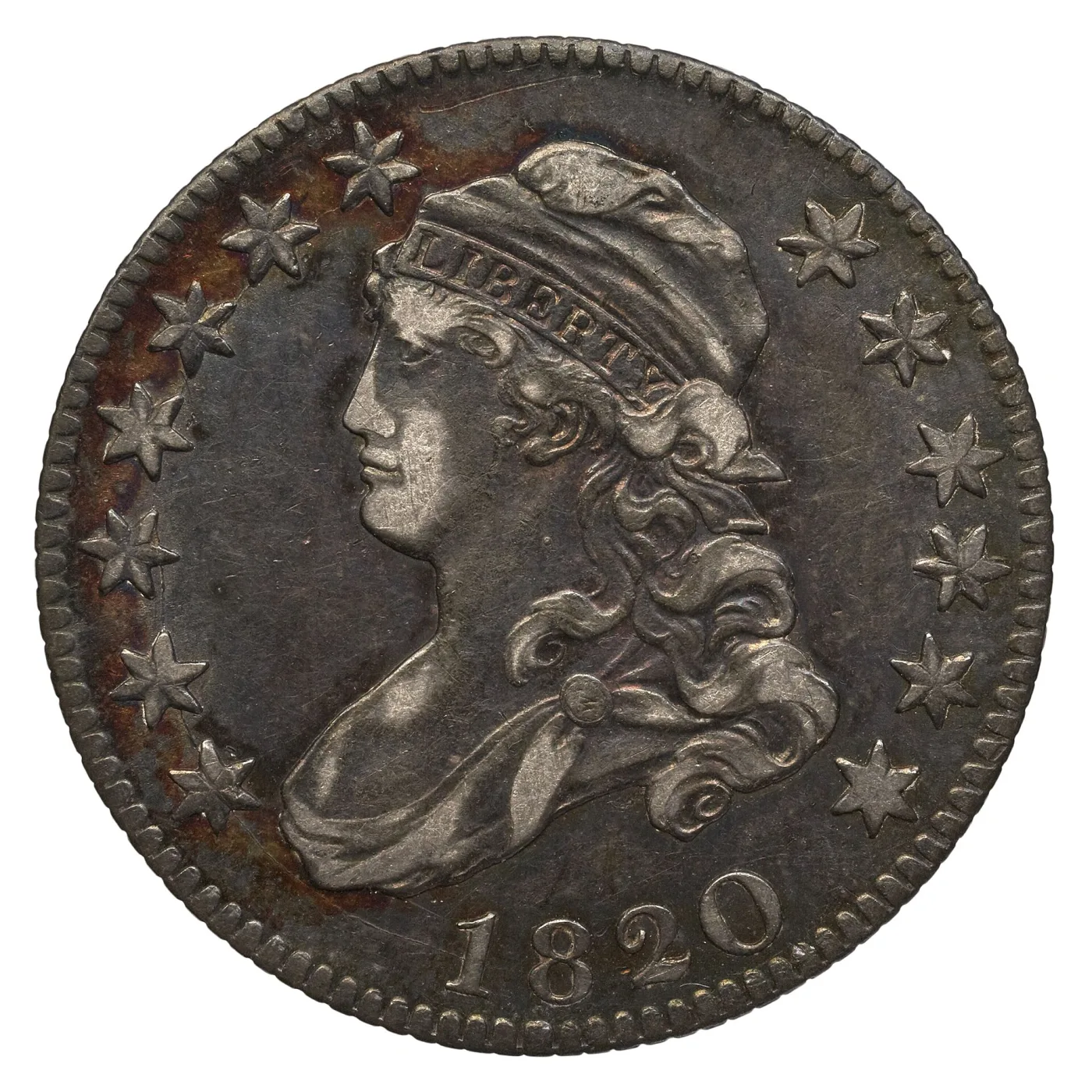
The obverse depicts Liberty facing left, wearing a soft cloth cap (a “mob cap” or “freedom cap”) with the word LIBERTY on a band across the cap. Hair flows from beneath the cap in loose curls down the neck, and Liberty’s bust is truncated at the shoulder with drapery folds. Seven stars arc to the left along the field, six stars to the right, with the date below in the exergue. The portrait is by John Reich, modeled (according to traditional but unverified Mint lore) on Reich’s mistress or a Philadelphia woman of the period — the historical record is unclear and the identification of the model has never been confirmed.
The Reverse — Large Size
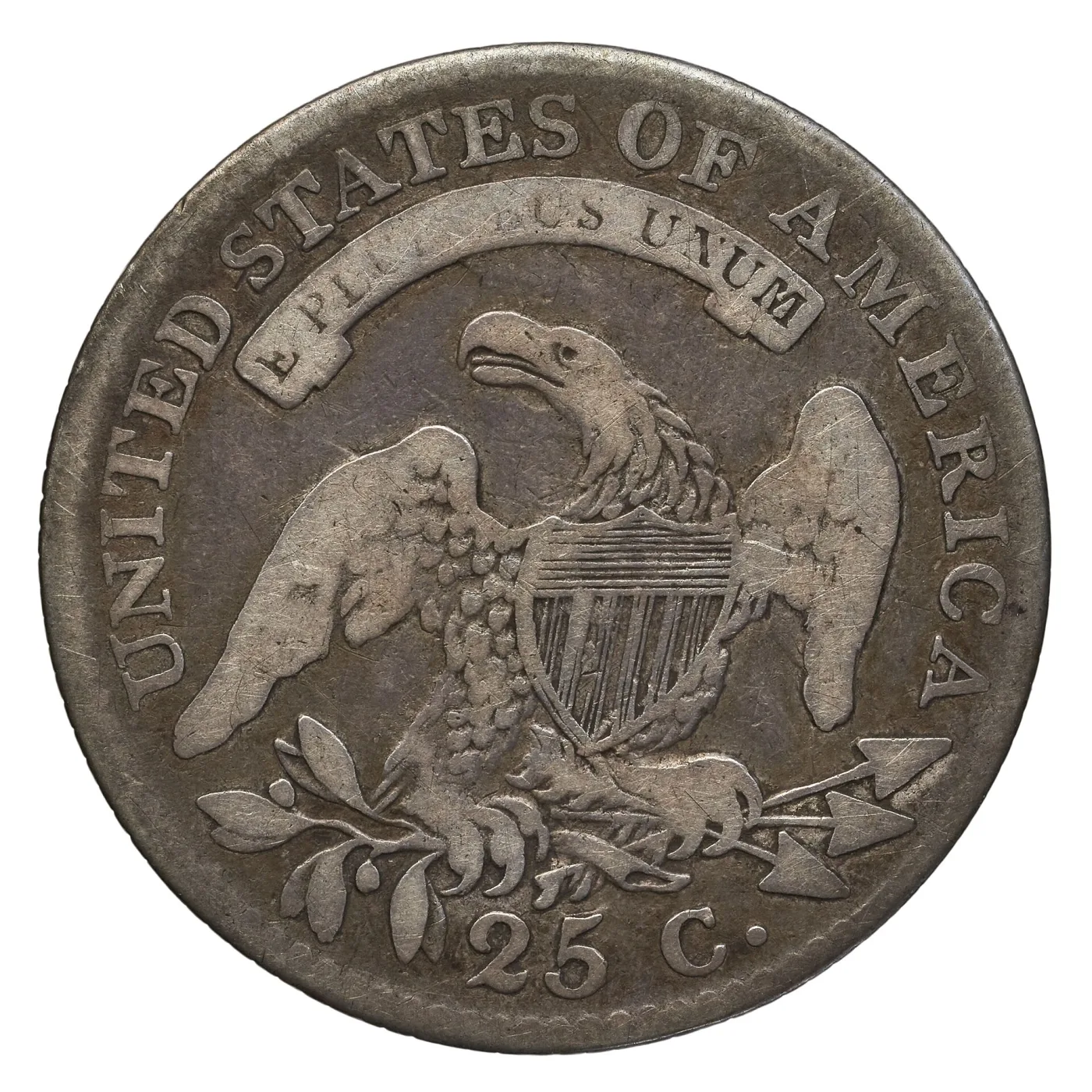
Heraldic eagle with wings displayed, holding three arrows in its left talon and an olive branch in its right. The eagle’s breast bears a Federal shield. Above the eagle’s head, on a curving scroll, runs the motto E PLURIBUS UNUM (“Out of many, one”). UNITED STATES OF AMERICA arcs above, with 25 C. for the denomination at the bottom.
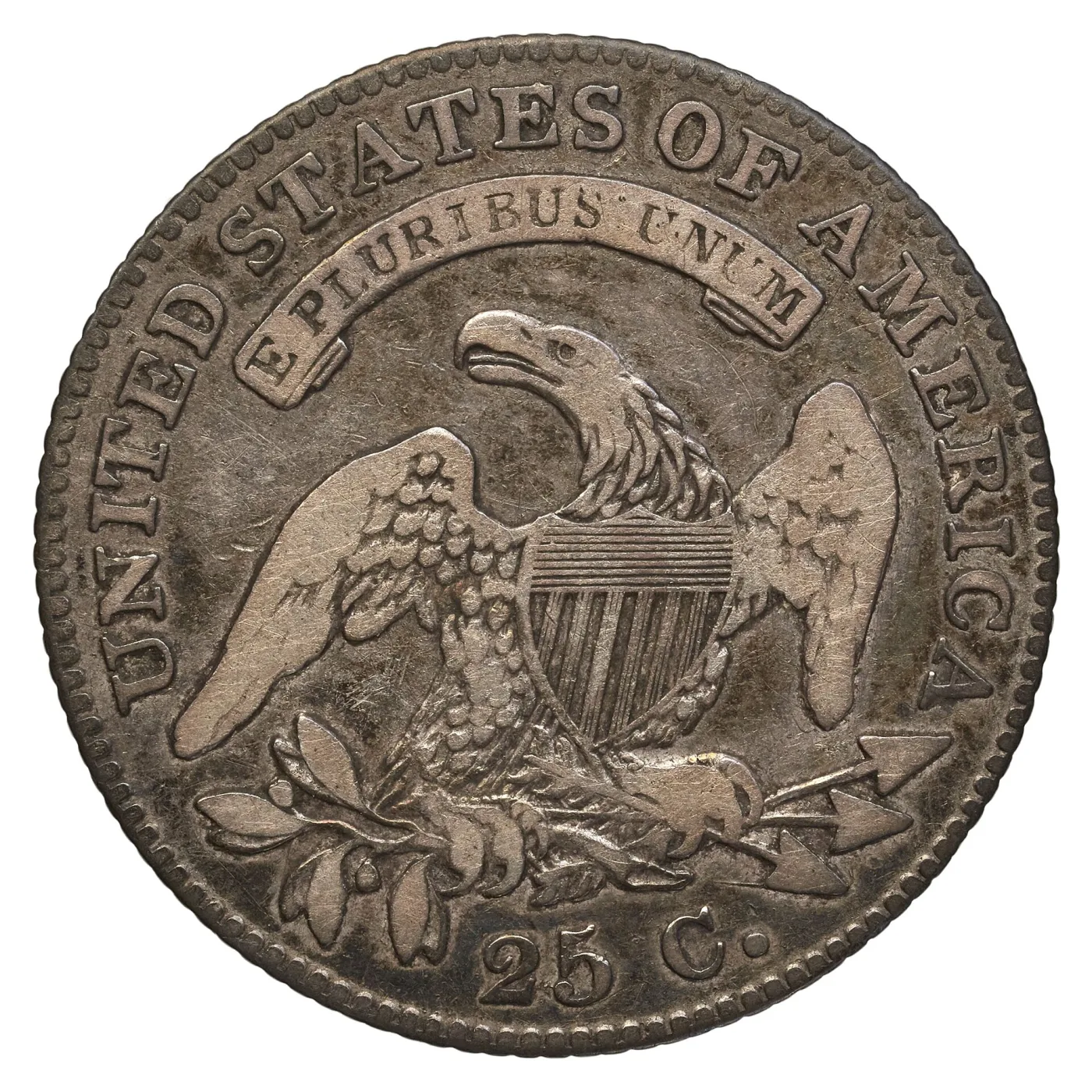
The Reverse — Small Size
Same heraldic eagle, same shield, same arrows and olive branch — but the E PLURIBUS UNUM scroll is gone. The eagle’s head sits beneath empty sky. UNITED STATES OF AMERICA still arcs above, and 25 C. remains at the bottom. The clean upper field of the Small Size reverse is the single most reliable visual identifier of the sub-type.
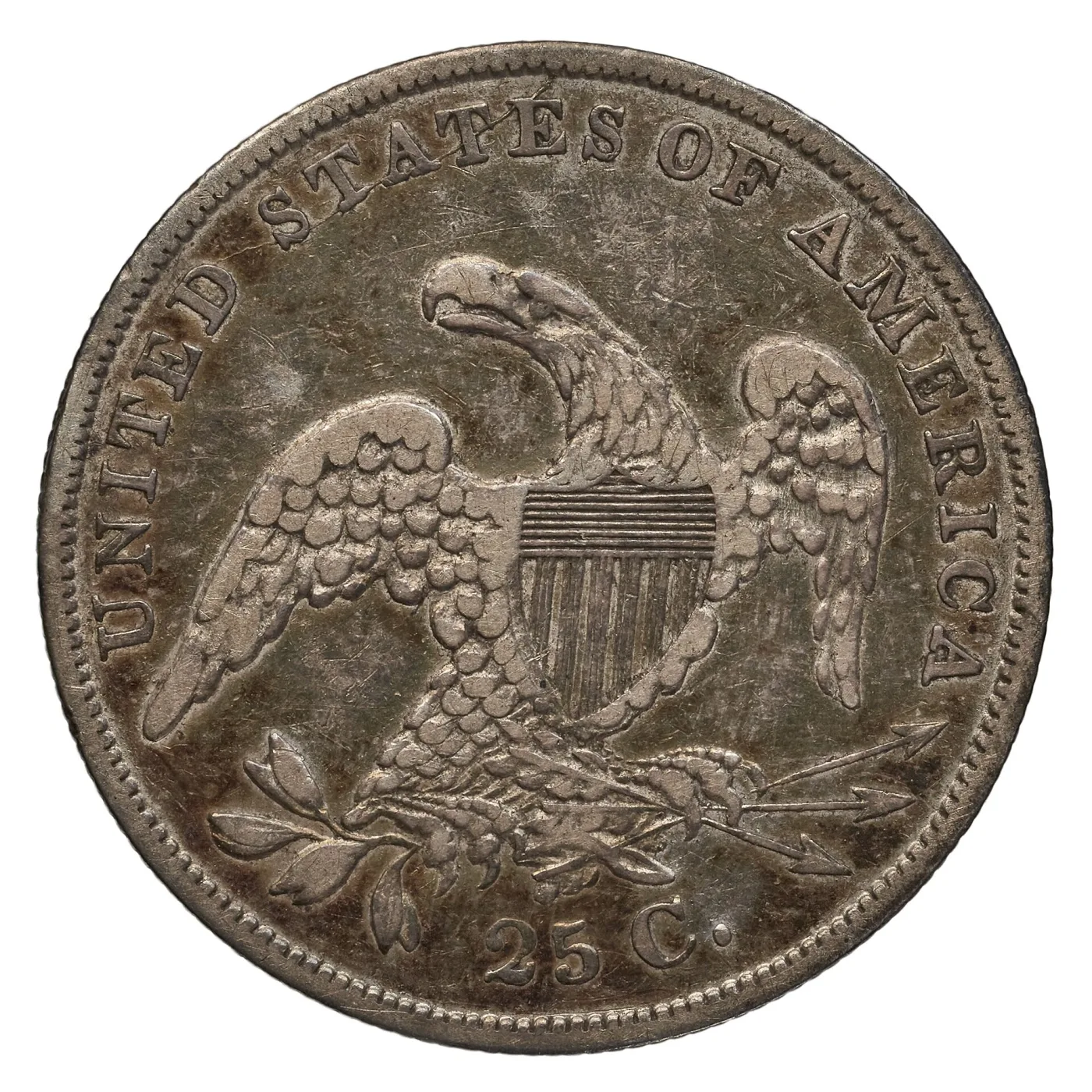
The Edge
Both Large and Small Size have reeded edges. There is no lettered edge on Capped Bust Quarters (the lettered edge convention applied to the Capped Bust Half Dollar through 1836, but quarters always had reeded edges).
Mint Marks
All Capped Bust Quarters were struck at the Philadelphia Mint. There are no mint marks on any Capped Bust Quarter — the branch mints at Charlotte, Dahlonega, New Orleans, and San Francisco had not yet opened (only New Orleans opened in 1838, the same year the series ended, and it did not strike quarters until the Seated Liberty era).
Composition and Specifications
Large Size (1815-1828)
- Composition: 89.24% silver, 10.76% copper (.8924 fine — the early US silver standard)
- Weight: 6.74 grams
- Diameter: ~27 mm (variable)
- Edge: Reeded
Small Size (1831-1838)
- Composition: 89.24% silver, 10.76% copper (unchanged)
- Weight: 6.74 grams (unchanged)
- Diameter: 24.3 mm (uniform — close collar technology)
- Edge: Reeded with uniform reed count
The weight and silver content did not change in 1831 — only the diameter and the striking technology. The Mint Act of 1837 later changed the silver standard to .900 fine for coinage struck from 1837 forward, but the bullion-content impact on the final years of the Capped Bust Quarter was minimal. At 2026 silver prices, the bullion content of a single Capped Bust Quarter is roughly $4-$5, but no problem-free Capped Bust Quarter sells for anywhere near melt value — even the most common dates carry strong numismatic premiums.
The Browning Variety System
Ard W. Browning published The Early Quarter Dollars of the United States 1796-1838 in 1925, cataloging every then-known die marriage of the series. Browning numbers are typically written as “B-1,” “B-2,” etc. for each date, and they remain the standard reference today, supplemented by later research from Karl Moulton, Steve Tompkins, and the John Reich Collectors Society (JRCS).
How Browning Numbers Work
Browning identified each unique combination of obverse and reverse dies used in a given year. Because the early Mint used dies until they failed, then paired surviving dies with new replacements, many marriages exist for some years. The 1818 has ten Browning numbers (B-1 through B-10). The 1828 has eight. The 1822 has four. Some years have only one (like 1815 with just B-1).
Why Variety Attribution Matters
Two 1818 quarters in the same EF-40 grade can differ in value by a factor of twenty depending on Browning number. A common 1818 B-1 in EF-40 might sell for $1,500. A rare 1818 B-2 (also called the “1818 8 over 5” overdate) in the same grade can bring $20,000+. This pattern repeats throughout the series. Serious Capped Bust Quarter collecting is Browning attribution — the date-only collection misses the entire numismatic significance of the series.
Diagnostic Markers
Browning attribution relies on small die markers: position of the date numerals relative to Liberty’s bust, alignment of stars, placement of the eagle’s tail feathers against the leaves, position of the C in “25 C.”, crack patterns in late die states, and overdate features. Most require 5x to 10x magnification and a good reference book (the JRCS’s current Tompkins reference is the gold standard). PCGS and NGC will attribute Browning numbers on their slabs for a small additional fee.
Rarity Within Browning Numbers
The JRCS publishes population estimates for each Browning number. Some marriages survive in hundreds (the common B-1 1818, for instance), while others are known from fewer than ten examples (some late die states of obscure marriages). Condition-census coins — the finest known of a given Browning number — command extraordinary premiums.

The 1823/2 Overdate: The Series Key
The 1823/2 Capped Bust Quarter is the undisputed king of the series. It is a true overdate, struck from an 1822 obverse die that was repunched with an 1823 numeral over the original 2. Under magnification, the lower curve of the 2 is plainly visible inside the 3.
Why It Exists
Mint die stocks were small in the 1820s, and the cost of cutting fresh dies was significant. When the calendar turned from 1822 to 1823, several leftover 1822 obverse dies were repunched with a 3 over the existing 2 rather than discarded. The result was a small mintage of 1823/2 quarters that entered circulation as ordinary 1823 quarters.
Mintage and Survival
Total 1823/2 mintage was approximately 17,800 pieces (combined with the regular 1823, which is itself extraordinarily rare and may consist entirely of overdates — numismatic scholarship still debates whether any “perfect 1823” Capped Bust Quarters exist, or whether all 1823 dates are 1823/2 with the underdigit barely visible). Surviving examples across all grades number in the low hundreds. Most known examples grade Good to Fine; AU and Mint State examples are auction events.
2026 Market Values
- G-4: $5,500-$7,000
- VG-8: $8,500-$11,000
- F-12: $14,000-$18,000
- VF-20: $25,000-$35,000
- EF-40: $55,000-$75,000
- AU-50: $110,000-$160,000
- MS-60: $250,000+
- MS-63 and above: Auction records exceed $500,000
Authentication
Because of the value, the 1823/2 is heavily counterfeited and altered. The two most common deceptions are: (1) altered 1828/3 or 1827/3 dates filed to mimic the 1823/2, and (2) outright cast fakes from genuine source coins. Any 1823/2 Capped Bust Quarter should be certified by PCGS, NGC, or ANACS without exception. Raw examples should be considered guilty until proven innocent.
The 1822 25/50 C. and Other Reverse Blunders
The 1820s Mint occasionally repunched denominations on reverse dies that had been originally cut for the wrong denomination. The most famous of these is the 1822 25/50 C., where a reverse die originally intended for a half dollar (50 C.) was corrected to 25 C., with the underdigits of the 50 still visible.
The 1822 25/50 C.
Look at the digits of “25 C.” under 10x magnification, not at the C. On the 25/50 C. variety the underlying “50” sits behind the “25”: a round outline of the 0 overlaps and doubles the lower bowl of the 5, extending past it to the left, and a short stroke — the top flag of the underlying 5 — breaks out to the lower left of the 2’s foot, running the wrong way for that numeral. The C itself is cleanly struck and carries nothing, so a clean C is not evidence against the variety. The variety is much rarer than the standard 1822 reverse. PCGS and NGC certify both varieties separately.
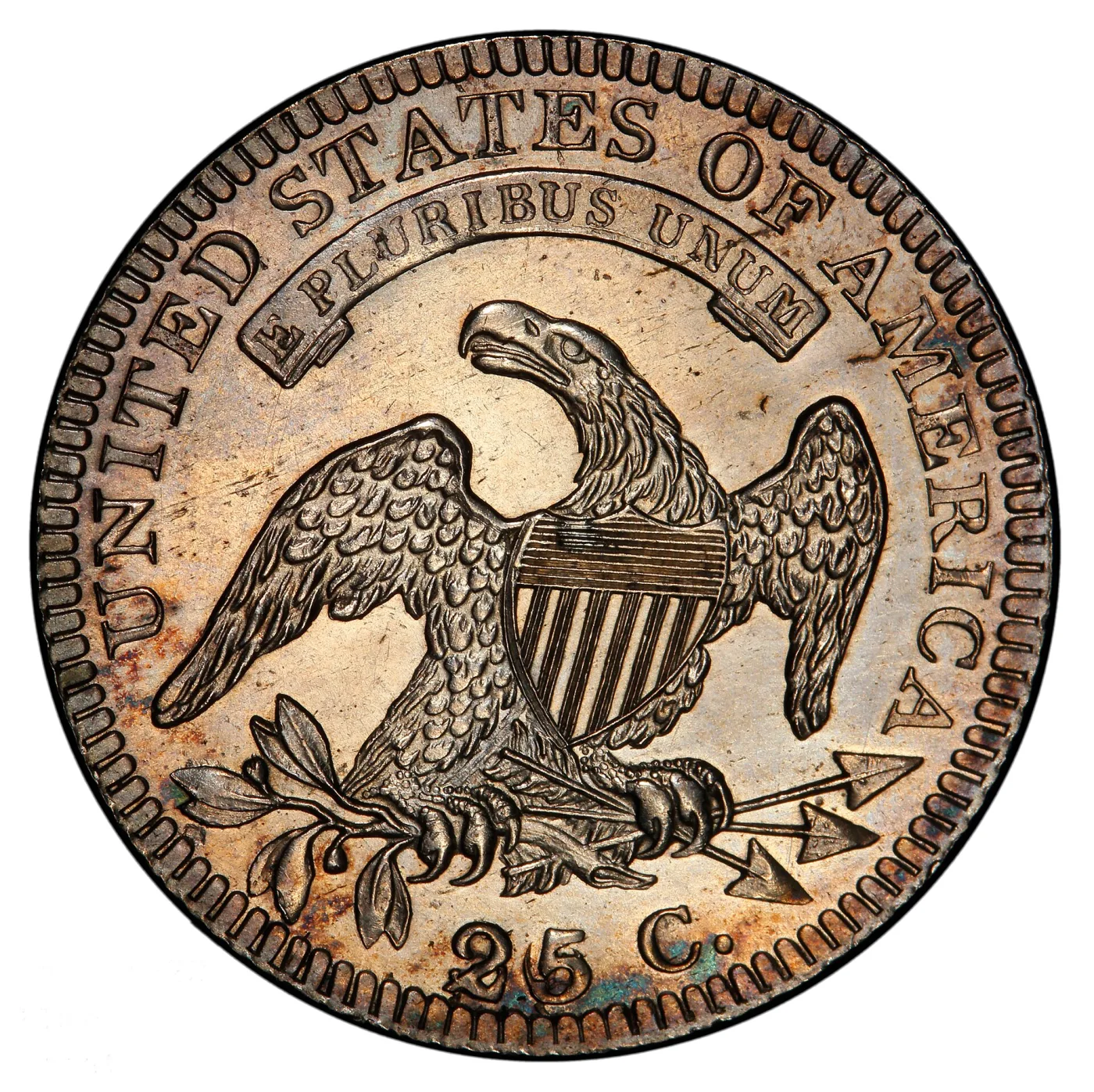
- 1822 25/50 C., VF-20: $5,000-$6,500
- 1822 25/50 C., EF-40: $11,000-$15,000
- 1822 25/50 C., AU-50: $22,000-$30,000
The 1828 25/50 C.
A similar blunder exists on certain 1828 quarters: a 50 C. reverse die was modified to 25 C., leaving traces of the 5 and 0 of 50 visible beneath the 2 and 5. The 1828 25/50 C. is somewhat more available than the 1822 version but still scarce. EF-40 examples run $4,000-$6,000.
The 1818 25/45 (?)
Older reference works occasionally mention an “1818 25/45 C.” reverse. Most modern numismatists consider this a misreading — the apparent “4” is more likely a die break or strike anomaly. PCGS and NGC do not separately attribute an 1818 25/45 variety. Treat any such claim with skepticism.
1825 Overdates: 1825/4 and 1825/3
The 1825 date exists in multiple overdate varieties, the result of leftover 1823 and 1824 dies being repunched with a 5. Three distinct varieties are commonly recognized:
- 1825/4 (B-1): An 1824 die repunched with 5 over 4. Under magnification, the upper curve of the 4 is visible inside the 5. Most common of the 1825 overdate varieties.
- 1825/3 (B-2): An 1823 die repunched with 5 over 3. The horizontal of the 3 is visible cutting across the 5. Somewhat scarcer than 1825/4.
- 1825/4/3 (B-3): A triple-punched date — an 1823 die first repunched with 4 over 3, then with 5 over the resulting 4. Extremely scarce; the most desirable 1825 variety.
All three are diagnosed under 10x magnification with raking light. Attribution by Browning number is essential. Premiums range from 50% over a “common” 1825 in low grades to several multiples in high grades.
1827 Original vs Restrike
The 1827 Capped Bust Quarter has its own legendary status. Original 1827 quarters are excessively rare — only four are believed to have been struck for circulation, plus a handful of proof originals (perhaps 10-15 known total). The Mint, recognizing collector demand, struck restrikes from the original 1827 obverse die paired with a later reverse die. The restrikes are distinguishable from originals by reverse die characteristics.
1827 Original
Square-base 2 in the date. Reverse uses the Browning-2 die (specific to 1819 quarters). Total population: approximately 10-15 known. Last auction sale of an AU original brought $400,000+. A proof original in PR-65 condition would likely bring well over $1 million today.
1827 Restrike
Curl-base 2 in the date. Reverse pairs a different reverse die showing later die state characteristics — particularly cracks visible on the eagle. Restrikes were made in proof finish at the Mint between approximately 1858 and 1876 for sale to collectors. They were never legal tender and were sold directly to numismatists. Restrike population is perhaps 100-150 examples, almost all in proof or near-proof grades. PR-65 restrikes sell for $80,000-$130,000.
How to Tell Them Apart
The shape of the 2 in the date is the primary diagnostic: square base = original, curl base = restrike. Secondary diagnostics include die state of the reverse (originals from fresh dies, restrikes from cracked dies) and the surface (originals can be mint state business strikes, restrikes are all proof-like). PCGS and NGC clearly distinguish the two on their labels.
The 1829-1830 Production Gap
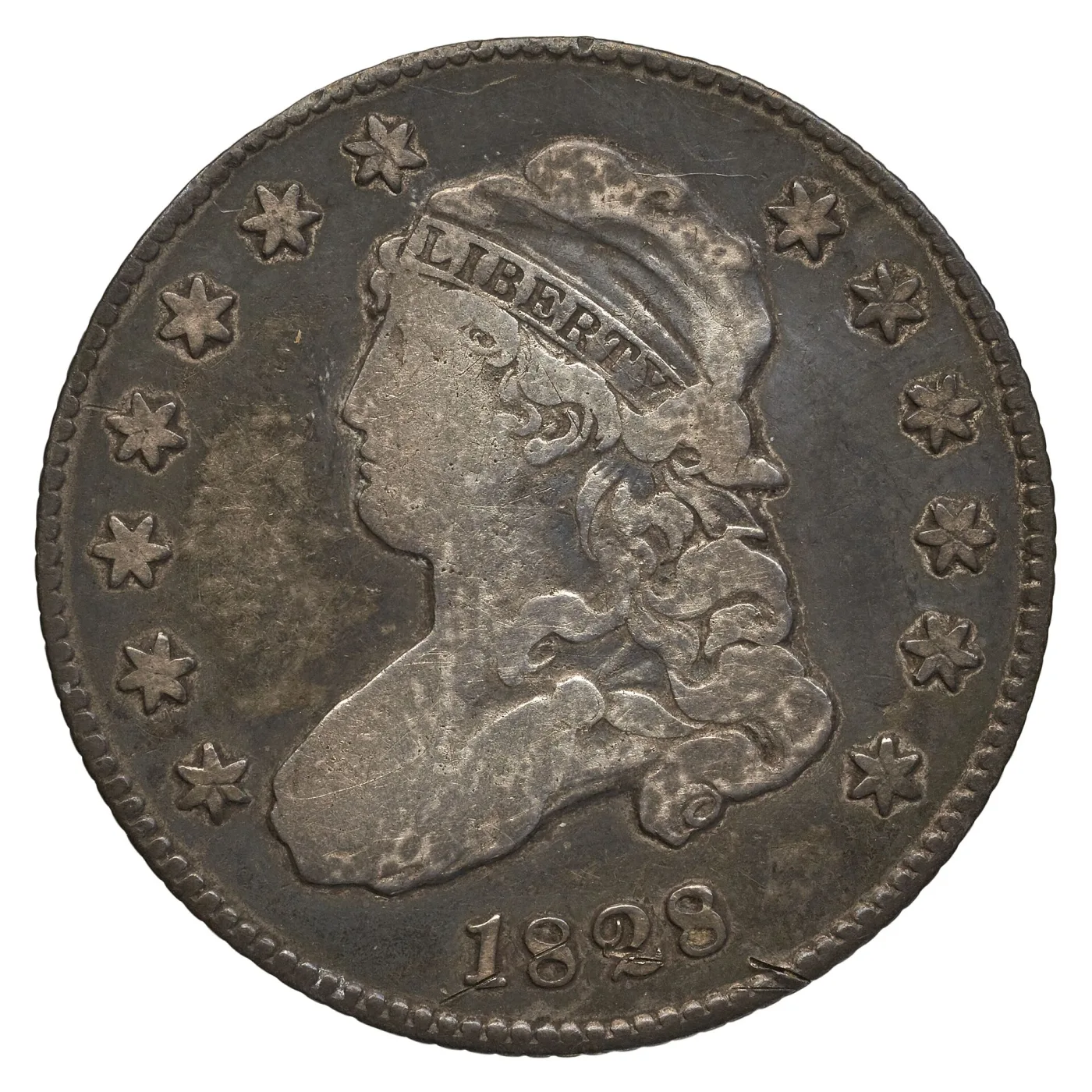
No Capped Bust Quarters were struck in 1829 or 1830. The Mint was simultaneously preparing the new Small Size design and dealing with broader issues of silver supply. The last Large Size quarters left the presses in 1828, and the first Small Size quarters were struck in 1831. The two-year gap is unique to the quarter denomination — the Capped Bust Dime and Capped Bust Half Dollar continued production through these years.
The two dates that sit either side of the hole, with nothing legitimate in between:
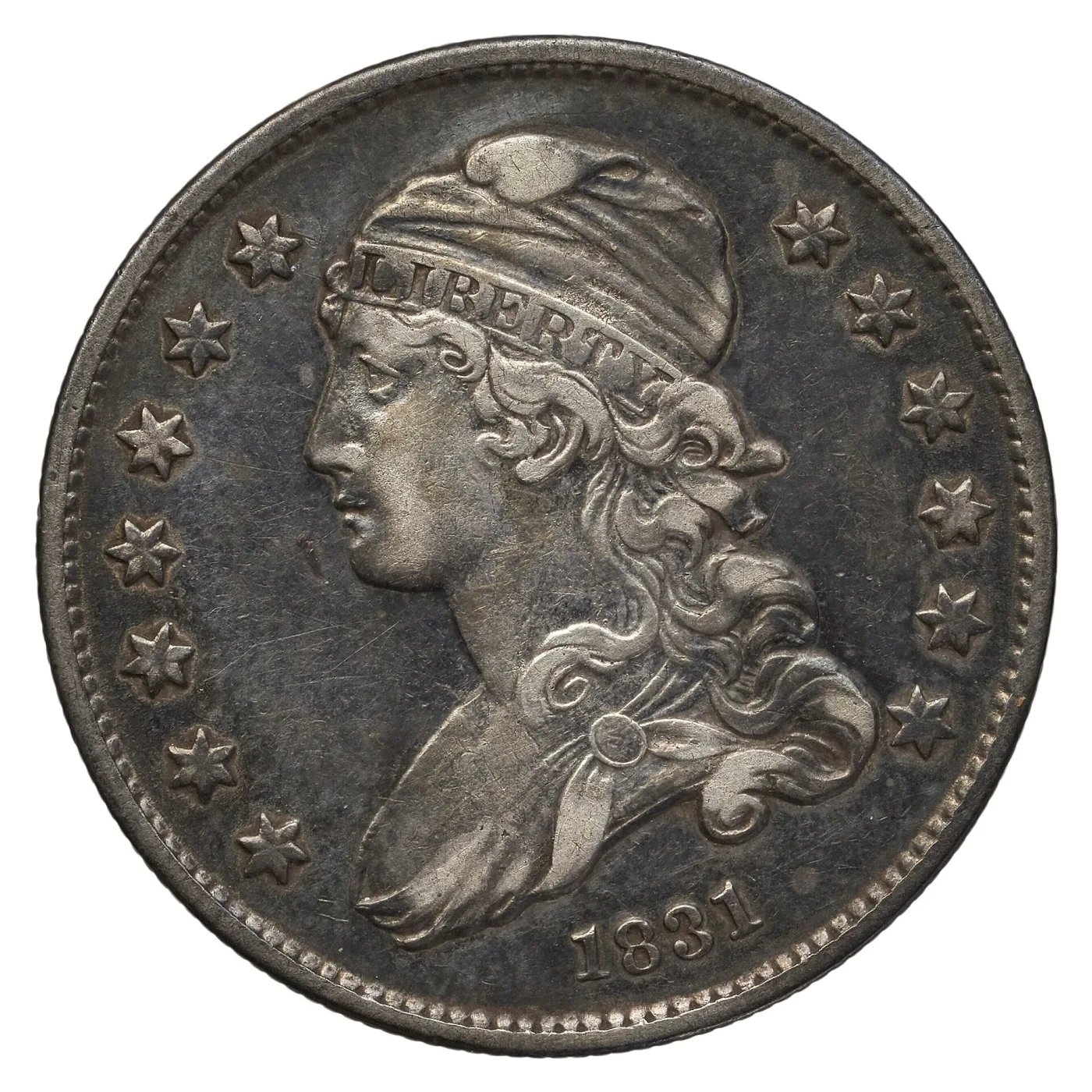
Why the Gap?
Several factors converged. First, the Mint was experimenting with close collar (restraining collar) technology, which produced uniformly circular coins and made design changes more practical. Second, the quarter denomination saw less circulation demand than the half dollar, and Treasury officials likely deprioritized it. Third, William Kneass (Reich’s successor as Chief Engraver) was busy on other projects and the new Small Size quarter dies were not ready until 1831. The combination produced a clean two-year suspension.
Implications for Collectors
Date sets of Capped Bust Quarters have no 1829 or 1830 slots. A “complete date set” includes 1815, 1818, 1819, 1820, 1821, 1822, 1823, 1824 (paired with 1825 — the 1824 dates are all part of 1824/2 overdates and the “1824” itself may not exist as a stand-alone date), 1825, 1827, 1828, 1831, 1832, 1833, 1834, 1835, 1836, 1837, and 1838. The series has 17-19 collectible dates depending on how overdates are counted.
Key Dates and Semi-Keys
1823/2 (and Possibly All 1823 Issues)
The absolute key. Mintage approximately 17,800. Surviving population in the low hundreds. See dedicated section above. Any 1823 Capped Bust Quarter is six-figure money in higher grades.
1827 Original
Approximately 10-15 known examples. Six-figure money in any grade. See dedicated section above.
1822
Mintage approximately 64,080. The base 1822 is a semi-key, and the 1822 25/50 C. variety is a significant rarity. EF-40 prices for the standard 1822 run $4,000-$5,500; the 25/50 C. variety is 2-3x.
1824/2 (the “1824 Date”)
The “1824” date essentially does not exist as a stand-alone — every known 1824-dated Capped Bust Quarter is the 1824/2 overdate. Mintage combined with 1825 was approximately 168,000. The 1824/2 is scarcer than the 1825 issues and commands premium prices in all grades.
1825/4 and 1825/3 Overdates
Both scarce, with the 1825/4/3 triple-punched variety being the rarest of the 1825 group. See dedicated section above.
1828 25/50 C.
A scarce blundered-reverse variety of the 1828. EF-40 prices $4,000-$6,000.
1838 (Last Year)
Mintage 832,000 — a high mintage for the series. Not rare, but historically significant as the last Capped Bust Quarter. Often collected as a transitional type alongside the 1838 Seated Liberty Quarter.
Common Dates
The 1818 (B-1), 1819, 1820, 1832, 1834, 1835, 1836, 1837, and 1838 are the most commonly encountered dates and Browning numbers. These can typically be acquired in F-VF grades for $300-$700 and in EF-AU for $1,200-$3,500. They are the natural starting point for type or date set collectors.
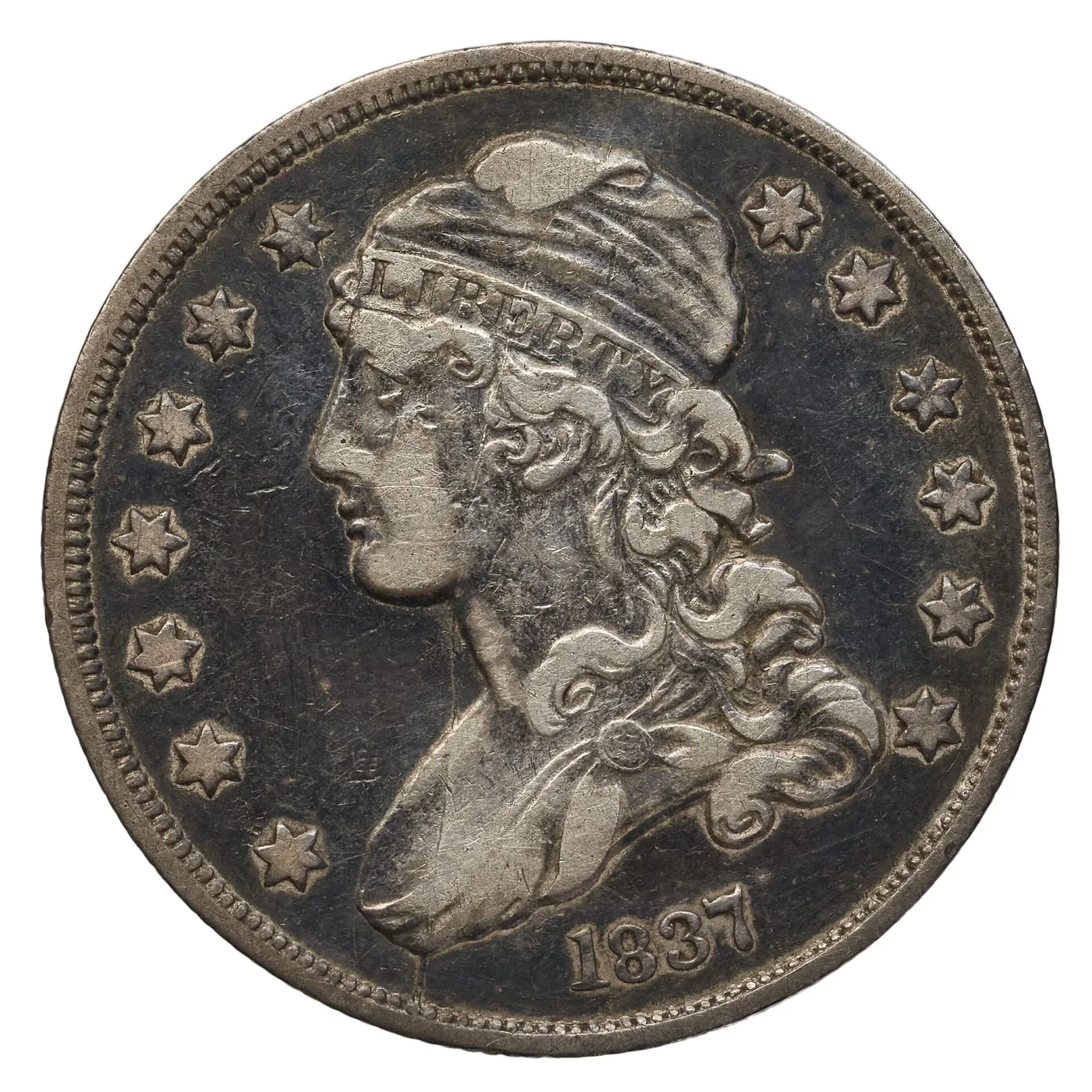
Proof Capped Bust Quarters
Proof Capped Bust Quarters were struck irregularly throughout the series for presentation purposes and for sale to collectors. Mintages were never recorded systematically — most proof years have estimated survival populations of fewer than 30 coins, and several years have fewer than 10.
Common Proof Dates
Proof Capped Bust Quarters exist for most dates in the series, with the Small Size years (1831-1838) generally being more available than Large Size proofs. The 1827 Restrike is technically a proof — see dedicated section above. Other notable proof years include 1818, 1820, 1821, 1825, 1831, 1833, 1834, 1835, 1836, 1837, and 1838.
Identification
Proof Capped Bust Quarters show fully reflective fields, fully struck design elements, and sharp square rims. Most are struck on planchets that were polished or specially prepared. PCGS and NGC certify proof status carefully — the distinction between an unusually well-struck business strike and a true proof can be subtle, and only graded coins should be considered for proof attribution.
Values
Proof Capped Bust Quarters in PR-63 range from $25,000 (more common dates) to over $200,000 (rarest dates). PR-65 examples typically bring $50,000-$500,000. The Capped Bust Quarter proof series is one of the most demanding and most expensive collecting goals in all of US numismatics.
Grading Early Silver
Grading Capped Bust Quarters requires understanding the wear patterns of early US silver and the strike characteristics of the open-collar (Large Size) and close-collar (Small Size) sub-series. The standards differ subtly between the two.
Wear Points
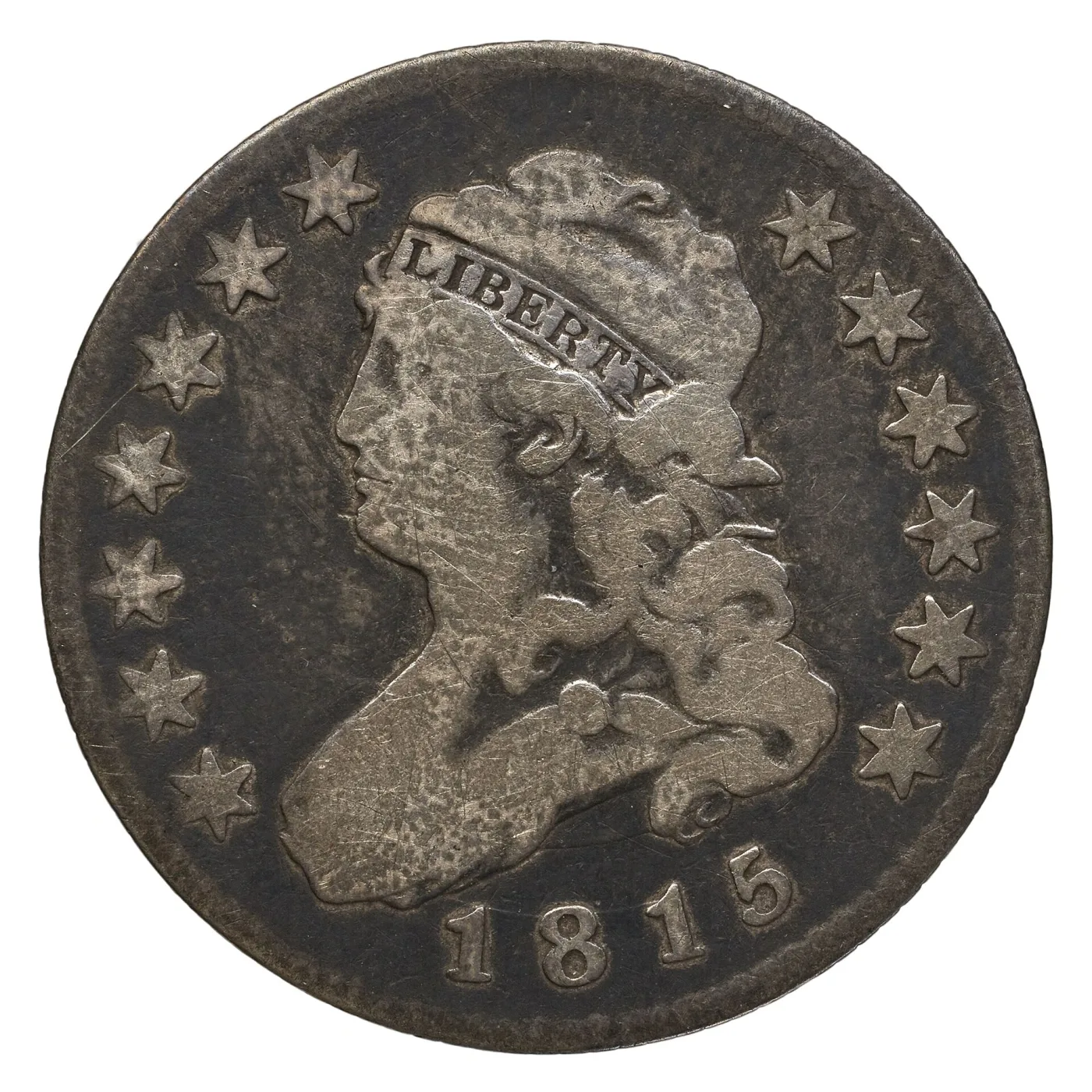
Obverse: The first wear shows on Liberty’s hair above the cap band, the cheek, and the cap folds. As wear progresses, the LIBERTY inscription on the cap band loses definition (this is a key grade marker), then the hair curls behind the cap, then the drapery folds at the shoulder.
Reverse: The eagle’s breast feathers are the highest point and wear first. Then the wing details, the leg feathers, and finally the shield lines. The motto E PLURIBUS UNUM (on Large Size only) is among the first areas to lose definition.
Both faces of one well-worn coin show the sequence better than a grading chart does:
Grade Definitions
- G-4 (Good): Major design outlines visible; LIBERTY worn smooth; date and stars clear
- VG-8 (Very Good): Some letters of LIBERTY visible; major design details outlined
- F-12 (Fine): LIBERTY mostly visible; hair details partially visible; eagle feathers outlined
- VF-20 (Very Fine): All letters of LIBERTY clear; hair curls visible; eagle feathers distinct
- EF-40 (Extremely Fine): Light wear on highest points; all design details sharp; most feather detail visible
- AU-50 (About Uncirculated): Trace wear on highest points; significant original luster
- AU-58: Sliver of wear; full luster; very popular grade in this series
- MS-60 and above: No wear; varying degrees of bag marks and luster
- MS-63: Average bag marks, strong luster, good strike
- MS-65 and above: Gem quality — very scarce in this series
Strike Quality and Adjustment Marks
Capped Bust Quarters are notorious for adjustment marks — parallel file marks from Mint adjusters who filed planchets to correct weight before striking. Adjustment marks are mint-made and do not lower a coin’s grade, but they affect eye appeal and price. Coins without adjustment marks generally command 15-25% premiums over otherwise equivalent examples.
Strike weakness is common on Large Size issues because the open-collar press did not always strike up the full design. Weak strikes appear especially on the eagle’s leg feathers and on stars 7-10 of the obverse. A weak strike is not a wear feature and should not be graded down for it, but the market does pay strike premiums.
Authentication and Counterfeit Detection
Capped Bust Quarters are counterfeited at multiple levels: cast fakes of common dates by amateur fraudsters, sophisticated struck counterfeits of key dates by professional forgers, and altered-date examples (1823/2 from other dates, fake 25/50 C. overdates, fake 1827 originals).
Weight and Diameter
Large Size: 6.74 grams, ~27 mm. Small Size: 6.74 grams, 24.3 mm. A digital scale and caliper rule out the crudest counterfeits immediately. Real examples can vary slightly due to wear (down to ~6.5 grams) but not dramatically.
Silver Test
Genuine Capped Bust Quarters are 89.24% silver. They ring true on a “ping” test, have proper specific gravity (~10.3), and respond appropriately to silver-acid tests (though acid tests should never be used on a coin you intend to keep — they damage the surface). Modern XRF non-destructive testing is preferred for any high-value example.
Die Diagnostics
Every Browning number has specific die diagnostics — star positions, date placement, crack patterns, and lettering positions. Compare any suspect coin against published Browning plates (Tompkins is the current standard reference). Authentic coins match published diagnostics exactly; counterfeits and alterations rarely do.
Surface Examination
Under 10x magnification, authentic Capped Bust Quarters show even toning patterns (the natural progression of silver oxidation over 190+ years), consistent strike characteristics across the design, and no porosity or casting bubbles. Cast counterfeits often show small pits or “moon craters” on flat surfaces.
Third-Party Grading
Any Capped Bust Quarter worth more than $500 should be in a PCGS, NGC, or ANACS holder, with Browning attribution where relevant. For 1823/2, 1827, 1822 25/50 C., 1825 overdates, and any Mint State example of any date, certified status is essentially mandatory.
Current Market Values
Capped Bust Quarter prices in 2026 reflect strong collector demand and stable silver prices. The market for early American silver has been robust for the past decade.
Common Dates (1818 B-1, 1819, 1820, 1832, 1834, 1835, 1836, 1837, 1838)
- G-4: $90-$130
- VG-8: $150-$200
- F-12: $250-$350
- VF-20: $400-$600
- EF-40: $900-$1,400
- AU-50: $1,800-$2,600
- AU-58: $2,800-$3,800
- MS-60: $4,000-$5,500
- MS-63: $7,500-$11,000
- MS-65: $30,000-$45,000
Better Dates (1815, 1821, 1825/4, 1828, 1831, 1833)
Premiums of 25-100% over common dates depending on grade and Browning rarity. The 1815 (first year of issue) carries an especially strong premium in Mint State grades.
1822 (Standard Reverse)
- F-12: $550-$750
- VF-20: $1,100-$1,500
- EF-40: $2,800-$3,800
- AU-50: $5,500-$7,500
- MS-63: $20,000+
1822 25/50 C.
- F-12: $1,800-$2,400
- VF-20: $3,800-$5,000
- EF-40: $9,500-$13,000
- AU-50: $22,000-$28,000
- MS-63: $90,000+
1824/2
- F-12: $400-$550
- VF-20: $850-$1,200
- EF-40: $2,400-$3,200
- AU-50: $5,500-$7,500
- MS-63: $25,000+
1823/2 (Series Key)
See dedicated section above. Six-figure money in higher grades.
1827 Original / Restrike
See dedicated section above. Six-figure (restrike) to seven-figure (original) prices.
Building a Collection
Type Set Approach
For a US type set, two slots are typically required: one Large Size (1815-1828) and one Small Size (1831-1838). An XF-AU example of each in common Browning numbers runs $1,500-$5,000 total. This is the most cost-effective way to represent the Capped Bust Quarter in a US silver type set.
Date Set
A complete date set (ignoring overdates and varieties) is achievable in F-VF grades for $8,000-$15,000 total. The 1822 and 1823/2 are the major obstacles. Many collectors substitute a high-grade common date in place of the 1823/2 for budgetary reasons and label the set “complete except for the 1823/2.”
Browning Variety Set
A complete Browning variety set is one of the most ambitious early American collecting projects. Including all known marriages across both Large and Small Size, with all overdate and blundered-reverse varieties, the set comprises roughly 80-110 distinct varieties depending on attribution standards. Total cost in matched VF-EF grades exceeds $200,000, with key varieties pushing seven figures. Few complete Browning sets have ever been assembled — the John J. Pittman, Eliasberg, and Eric P. Newman collections are among the most famous attempts.
Specialty Approach: Overdate Set
A focused collection of just the overdates and blundered-reverse varieties — 1818/5, 1823/2, 1822 25/50 C., 1824/2, 1825/3, 1825/4, 1825/4/3, 1828 25/50 C., and a few minor varieties — is a manageable advanced project. Total cost in VF-EF grades runs $80,000-$130,000.
Frequently Asked Questions
Why is the Capped Bust Quarter rarer than the half dollar of the same year?
Quarter mintages were always much smaller than half dollar mintages during this era. Americans transacted in Spanish two-reales pieces (which were legal tender) for "two-bit" amounts, suppressing demand for US quarters. Half dollars were used for larger transactions and saw heavier production. As a result, the Capped Bust Half Dollar is generally more available than the Capped Bust Quarter of the same year, especially in Mint State grades.
What's the easiest way to tell Large Size from Small Size?
Two tests: (1) measure the diameter — Large Size is ~27 mm, Small Size is 24.3 mm — and the difference is visible to the eye when comparing two coins side by side; (2) check the reverse for the E PLURIBUS UNUM motto on a scroll above the eagle. Present = Large Size (1815-1828). Absent = Small Size (1831-1838).
Are 1829 and 1830 Capped Bust Quarters rare?
They don't exist. The Mint did not strike quarters in those two years while preparing the new Small Size design. Anyone claiming an 1829 or 1830 Capped Bust Quarter is either mistaken (misreading a date) or attempting fraud.
Who designed the Capped Bust Quarter?
John Reich, the German-born engraver who joined the Philadelphia Mint as assistant engraver in 1807. Reich also designed the matching Capped Bust Dime (1809-1837) and Capped Bust Half Dollar (1807-1839). He resigned from the Mint in 1817, so the design carried on under William Kneass and the working die team through 1838.
What is the 1823/2 Capped Bust Quarter?
An overdate created when leftover 1822 obverse dies were repunched with a 3 over the existing 2. Under magnification, the lower curve of the 2 is visible inside the 3. The 1823/2 is the series key, with approximately 17,800 struck and only a few hundred surviving across all grades.
Are 1827 quarters real?
Yes, but only about 10-15 originals exist. The Mint later struck restrikes (around 1858-1876) for collectors, which are distinguishable from originals by the shape of the 2 in the date (square base on originals, curl base on restrikes) and by reverse die characteristics. Both originals and restrikes are extremely valuable, but originals are dramatically rarer.
What is a Browning number?
A catalog number assigned by Ard W. Browning in his 1925 reference work identifying each unique die marriage of the Capped Bust Quarter series. Browning numbers (B-1, B-2, etc.) are used to identify and price specific varieties within a date. Modern attribution often uses updated Tompkins references published by the John Reich Collectors Society.
How do I tell if my Capped Bust Quarter has been cleaned?
Look at the surface under 10x magnification with raking light. Cleaned coins show hairline marks running in one direction (the direction of the cleaning motion), unnatural brightness, or "frosty white" surfaces that lack the warm gray patina of natural aging. PCGS and NGC will body-bag (refuse to grade) any coin showing cleaning evidence. A cleaned Capped Bust Quarter is worth 30-60% less than an equivalent problem-free example.
Should I clean my Capped Bust Quarter?
No. Never. Cleaning destroys numismatic value irreversibly. Even gentle cleaning (water and soft cloth) can leave hairlines visible under magnification. The natural toning on a 190-year-old silver coin is part of its history and value — preserve it, don't remove it. This applies equally to all early US silver, from the Capped Bust Dime through the Seated Liberty Dollar.
What replaced the Capped Bust Quarter?
The Seated Liberty Quarter, designed by Christian Gobrecht and introduced in 1838 — the same year the Capped Bust Quarter ended. The Seated Liberty design ran until 1891, when it was replaced by the Barber Quarter. The full progression of US quarter designs runs: Draped Bust (1796, 1804-1807), Capped Bust (1815-1838), Seated Liberty (1838-1891), Barber (1892-1916), Standing Liberty (1916-1930), and Washington Quarter (1932-present).