Walking Liberty Half Dollar Identification Guide: Key Dates, Mint Marks, and Values
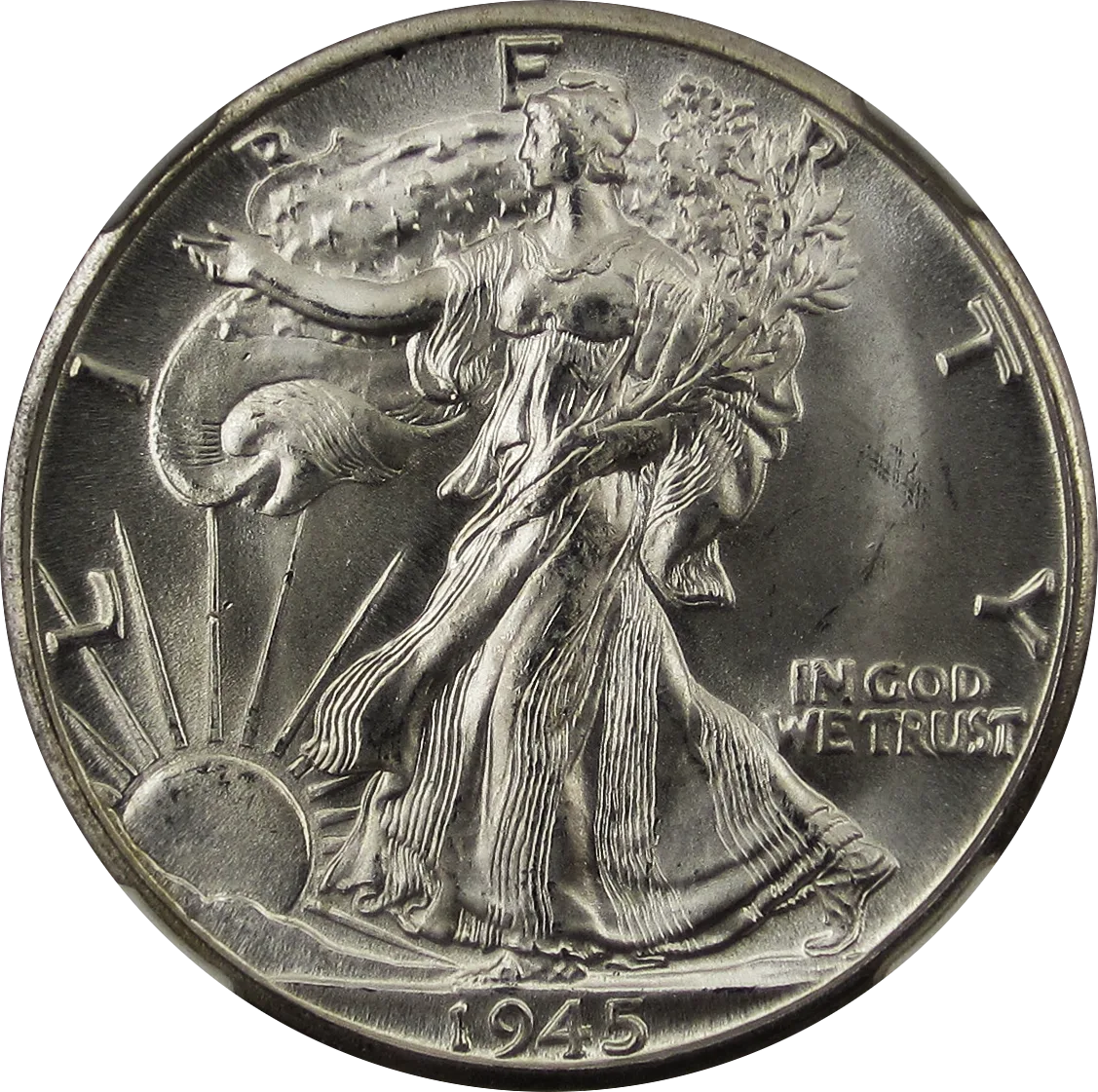
The Walking Liberty Half Dollar is widely considered the most beautiful coin ever produced by the United States Mint. Designed by Adolph A. Weinman and minted from 1916 to 1947, this silver half dollar replaced the Barber Half Dollar — part of the same Liberty Head series as the Barber Dime and Barber Quarter, and the latest in a half dollar lineage that stretches back through the Seated Liberty Half Dollar era to the early Capped Bust Half Dollar — and features Lady Liberty striding confidently toward the sunrise, draped in an American flag, carrying branches of laurel and oak. The design was so beloved that the U.S. Mint revived it in 1986 for the American Silver Eagle bullion coin.
For collectors and numismatists, the Walking Liberty Half Dollar series offers a fascinating range of rarities, mint mark varieties, and grading challenges. From the scarce 1916-S to the low-mintage 1921 issues, this series includes some of the most sought-after coins in American numismatics. Understanding how to properly identify, grade, and value these coins is essential for building a meaningful collection.
This guide covers every aspect of Walking Liberty Half Dollar identification, from mint mark locations and design variations to key dates, grading standards, and current market values. Whether you found one in a family collection or are actively building a set, the information here will help you determine exactly what you have and what it may be worth.
History and Background
The Walking Liberty Half Dollar emerged from a broader redesign of American coinage in the early 20th century. President Theodore Roosevelt had championed the idea of making U.S. coins more artistic, leading to the hiring of prominent sculptors to redesign several denominations. While Augustus Saint-Gaudens handled the gold coinage with his celebrated Saint-Gaudens Double Eagle and the companion Indian Head $10 Eagle, the silver denominations were opened to competition in 1915.
The U.S. Mint invited several sculptors to submit designs for the new half dollar, dime, and quarter. Adolph Alexander Weinman, a German-born American sculptor, won the competition for both the dime (creating the Mercury Dime) and the half dollar. His Walking Liberty design was selected over competing entries from Hermon Atkins MacNeil, who would later design the Standing Liberty Quarter.
Production Timeline
The Walking Liberty Half Dollar was produced from 1916 through 1947, spanning more than three decades of American history. Production occurred at three mint facilities: Philadelphia (no mint mark), Denver (D), and San Francisco (S). During the early years, mint marks appeared on the obverse of the coin, but starting in 1917, some coins had the mint mark moved to the reverse. From 1917 onward, mintage varied significantly based on economic conditions and wartime demand for coinage.
The series saw interruptions and fluctuations in production. No half dollars were struck in 1922, 1924, 1925, 1926, 1930, 1931, 1932, or 1933, primarily due to the economic conditions of the era and sufficient existing stock in circulation. Production resumed consistently from 1934 through 1947, when the design was replaced by the Franklin Half Dollar, designed by John R. Sinnock, which itself gave way to the Kennedy Half Dollar in 1964. If you are interested in the broader context of early 20th century American coinage, our complete coin identification guide provides an excellent overview of identification techniques used across all eras.
Adolph Weinman’s Vision
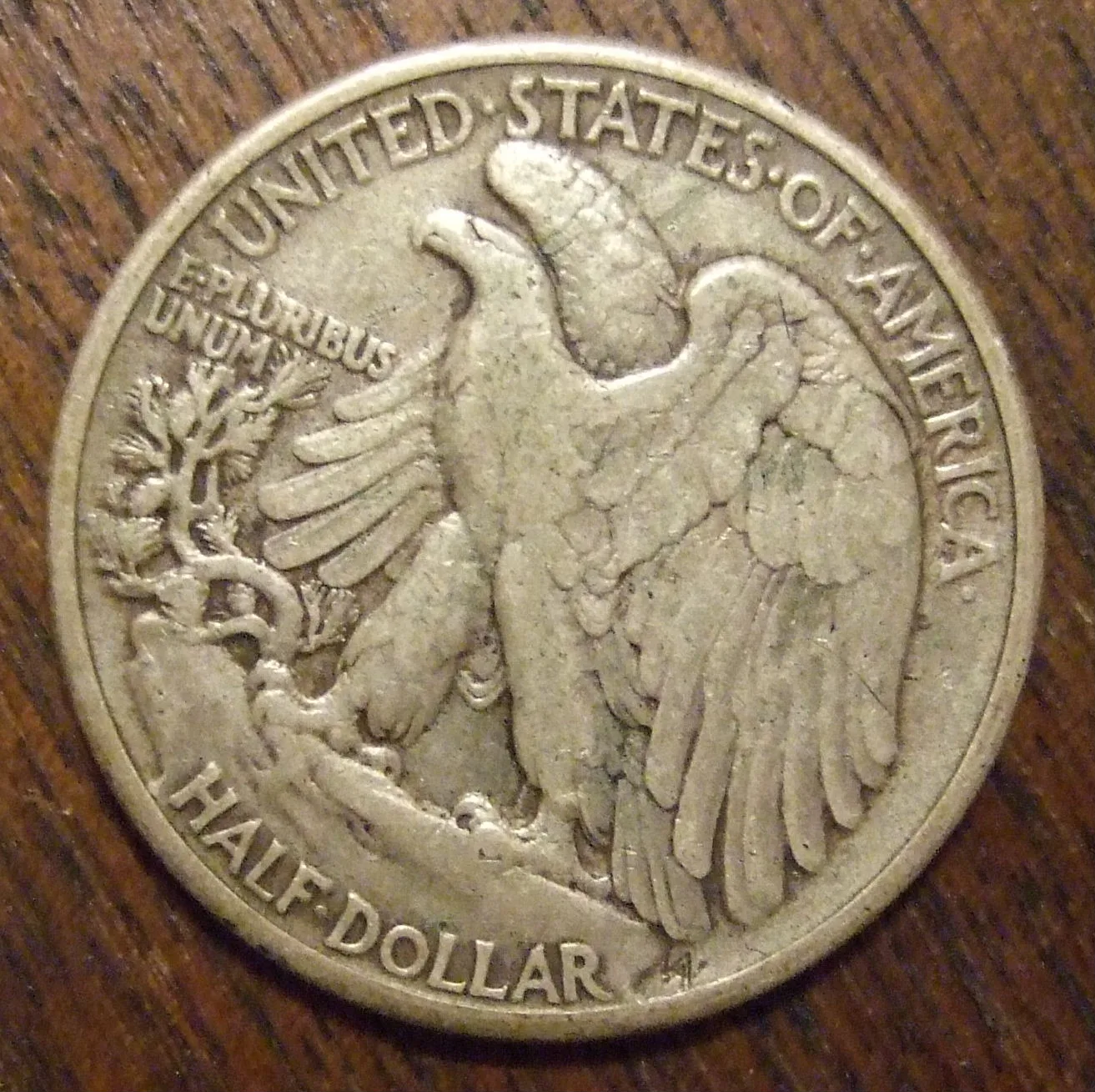
Weinman drew inspiration from classical themes, depicting Liberty in full figure rather than just a portrait bust. The obverse shows Liberty walking toward the sunrise, symbolizing the nation’s forward progress. She carries branches of laurel and oak, representing civil and military glory. The reverse features a bold American eagle perched on a rocky crag, wings partially spread, with a mountain pine growing from the rock below.
Design Details and Specifications
Obverse Design
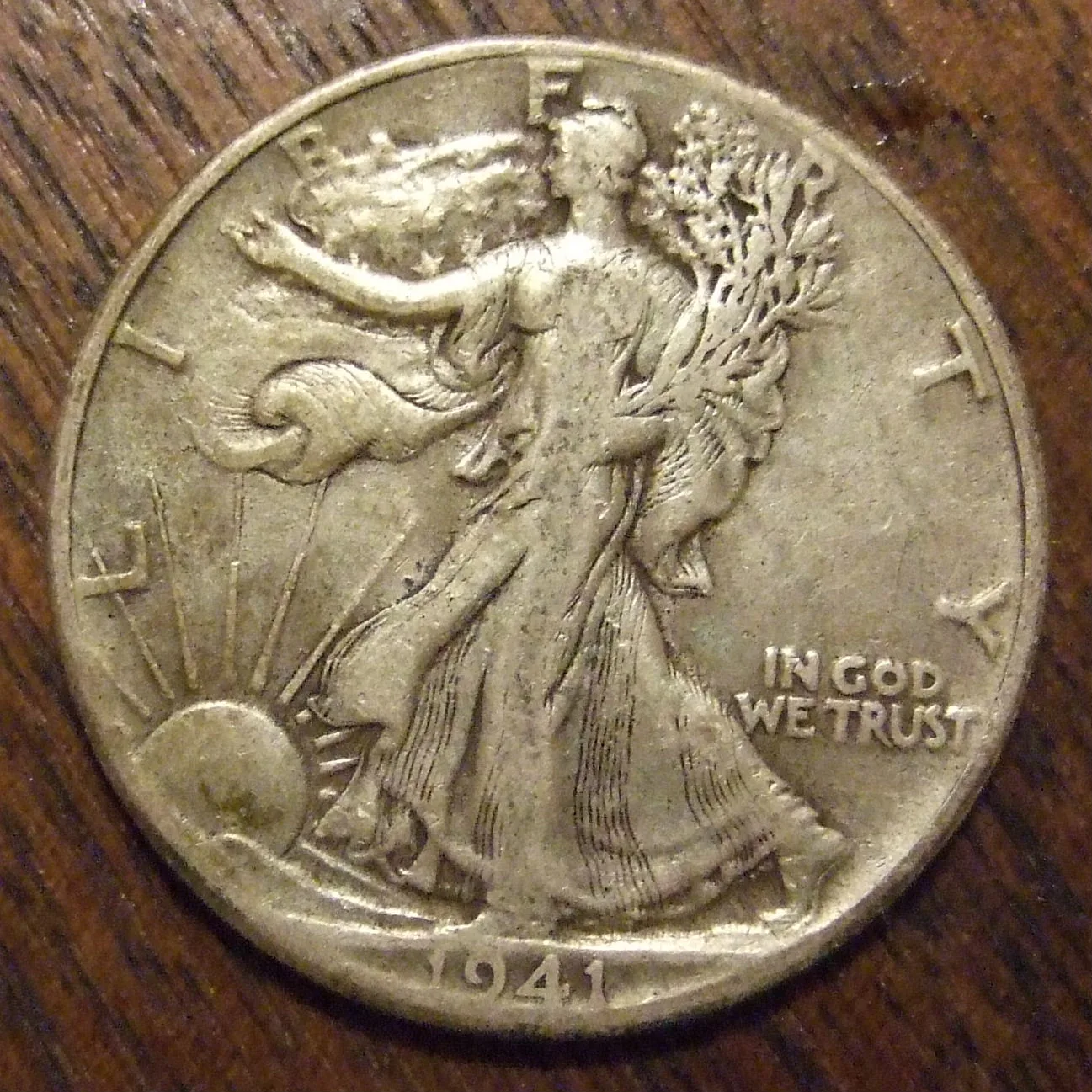
The obverse of the Walking Liberty Half Dollar shows a full-length figure of Liberty walking to the left (toward the viewer’s right). She wears a Phrygian cap and is draped in an American flag that flows behind her in the wind. Her right hand is extended outward as if sowing seeds of freedom, while her left arm cradles branches of laurel and oak against her body. The word “LIBERTY” arcs across the top, and “IN GOD WE TRUST” appears to the lower right. The date is positioned at the bottom center.
Reverse Design
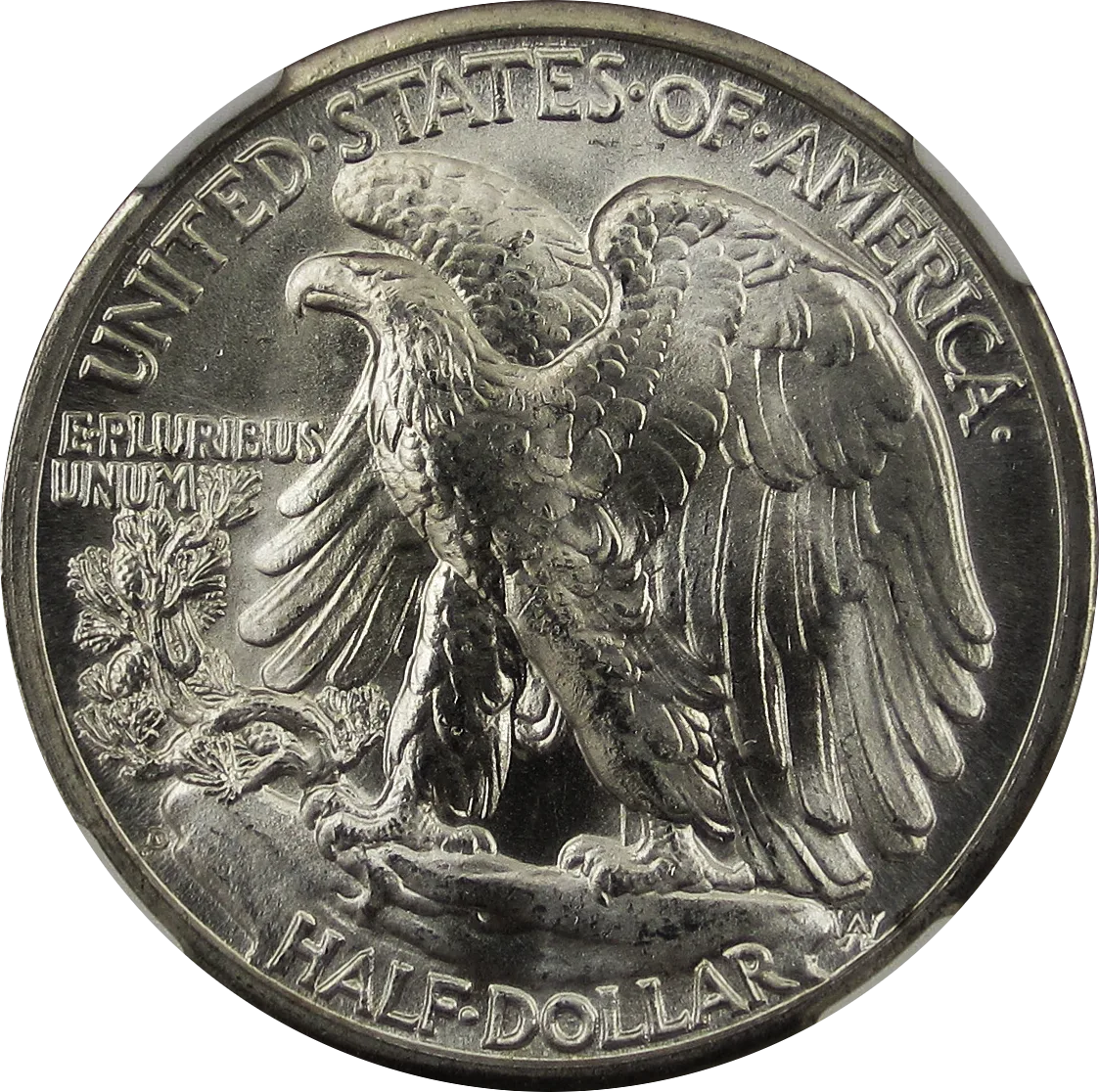
The reverse features a bald eagle standing on a rocky outcrop with its wings partially spread. A small mountain pine sapling grows from the rock beneath the eagle. “UNITED STATES OF AMERICA” runs around the top rim, “HALF DOLLAR” appears at the bottom, and “E PLURIBUS UNUM” is placed to the right of the eagle. The mint mark, when present, appears to the left of the eagle’s tail feathers on coins from 1917 onward.
Physical Specifications
Every Walking Liberty Half Dollar shares the same core specifications established by the Coinage Act: a composition of 90% silver and 10% copper, with a total weight of 12.50 grams (0.3617 troy ounces of pure silver). The diameter is 30.6 millimeters, and the edge features reeding (small raised lines). The coins were struck on the standard half dollar planchet used for all silver fifty-cent pieces of the era. These specifications are important when comparing to other silver coins like the Morgan Dollar, which shares the same 90/10 silver-copper composition but in a larger format.
Mint Mark Locations and Varieties
One of the most distinctive features of the Walking Liberty Half Dollar series is the change in mint mark location during 1917. Understanding this change is critical for proper identification and valuation.
1916 Mint Marks
In the first year of production (1916), mint marks appear on the obverse of the coin, located on the lower right side beneath the motto “IN GOD WE TRUST.” Only Philadelphia (no mint mark), Denver (D), and San Francisco (S) struck coins in 1916. The obverse mint mark placement was shared with the 1917 first-type coins.
1917 Transition Year
The year 1917 is unique in the series because coins were produced with mint marks in two different positions. Early 1917 coins carry the mint mark on the obverse (like 1916 coins), while later 1917 coins have the mint mark on the reverse, to the left of the word “HALF” near the eagle’s tail feathers. This creates four collectible varieties for 1917 D and S coins: the 1917-D obverse, 1917-D reverse, 1917-S obverse, and 1917-S reverse.
1918-1947 Mint Marks
From 1918 through the end of the series in 1947, all mint marks appear on the reverse, positioned at about the 8 o’clock position relative to the eagle, just to the left of the “HALF” text. Philadelphia-minted coins continued to carry no mint mark throughout the entire series run.
How to Locate Mint Marks
Because the Walking Liberty Half Dollar is a high-relief design, mint marks can sometimes be difficult to spot, especially on well-circulated coins. Use a magnifying glass or loupe of at least 5x magnification. On obverse-marked coins, look just below “IN GOD WE TRUST” near Liberty’s foot area. On reverse-marked coins, look at the lower left area of the reverse, near the base of the rocky outcrop below the eagle. Proper mint mark identification is a fundamental skill covered in our coin identification guide.
Key Dates and Rarities
The Walking Liberty Half Dollar series contains several coins that are significantly rarer and more valuable than common issues. These key dates are the coins every collector seeks and every seller should know about.
1916-S (Obverse Mint Mark)
The 1916-S is the undisputed key date of the entire Walking Liberty Half Dollar series, with a mintage of just 508,000 coins. This was the lowest production figure for any date in the series. In Good condition, a 1916-S typically sells for $150 to $250, while choice uncirculated examples can bring $5,000 to $15,000 or more depending on eye appeal. This coin is frequently counterfeited, making authentication essential for any significant purchase.
1921-S
The 1921-S had a mintage of only 548,000, making it the second rarest date in the series. After several years with no half dollar production, the 1921 coins are often found weakly struck, which makes high-grade examples exceptionally scarce. A 1921-S in Fine condition typically sells for $100 to $200, and uncirculated examples are quite rare, often bringing $5,000 to $20,000.
1921-D
With a mintage of 208,000, the 1921-D is actually the lowest-mintage coin in the entire series by total number struck. However, more examples survived than the 1916-S because fewer entered heavy circulation. Still, this is an extremely rare coin. Values start around $150 in Good condition and climb rapidly, with uncirculated examples potentially worth $10,000 to $25,000.
1921 (Philadelphia)
The 1921 Philadelphia issue had a mintage of 246,000, making all three 1921-dated Walking Liberty Half Dollars key coins. The Philadelphia version is slightly more available than the Denver issue but still commands strong premiums. Expect to pay $75 to $150 in Good condition and significantly more for higher grades.
1916 (Philadelphia)
The first-year Philadelphia coin had a mintage of 608,000. While not as rare as the 1916-S, it remains a desirable coin due to its first-year status. Values range from $50 to $100 in lower grades and can reach several thousand dollars in uncirculated condition.

Semi-Key Dates Worth Watching
Beyond the major key dates, several Walking Liberty Half Dollars carry premiums above common-date values. These semi-key dates are affordable enough for most collectors but scarce enough to hold strong value.
1916-D
The 1916-D had a mintage of 1,014,400, higher than the 1916-S but still relatively low for the series. It carries a moderate premium, especially in higher grades. Values range from $40 to $80 in circulated grades.
1917-S (Obverse Mint Mark)
With a mintage of 952,000, the 1917-S obverse variety is scarcer than the reverse variety (5,554,000). Collectors seeking the obverse variant must pay a premium, particularly in Very Fine or better condition.
1917-D (Obverse Mint Mark)
Similar to the 1917-S obverse, the 1917-D obverse (765,400 minted) is scarcer than its reverse counterpart (1,940,000). Both 1917 obverse varieties are popular with type collectors who want an example of the early mint mark placement.
1919-D and 1919-S
Both Denver and San Francisco issues from 1919 had relatively low mintages (1,165,000 and 1,552,000 respectively) and see strong demand. These coins are frequently found weakly struck, making sharp examples worth significant premiums.
1938-D
The 1938-D is the last semi-key date in the series, with a mintage of 491,600. While this is low, many were saved by collectors who recognized the coin’s scarcity, so uncirculated examples are more available than one might expect from the mintage figure. Still, it commands a premium in all grades. The practice of saving low-mintage coins is something collectors of Peace Dollars will recognize, as similar hoarding occurred with the 1928 Philadelphia issue.
Grading Walking Liberty Half Dollars
Grading is one of the most important skills for any Walking Liberty Half Dollar collector. The coin’s high-relief design means that certain areas wear quickly, making grade distinctions both challenging and consequential for value.
High Points That Wear First
On the obverse, the first areas to show wear are Liberty’s head, her left hand and the branches she carries, and her forward knee and thigh area. The lines on the flag draping across her body also lose definition quickly. On the reverse, the eagle’s breast feathers and the upper surfaces of the wings are the first areas to exhibit wear.
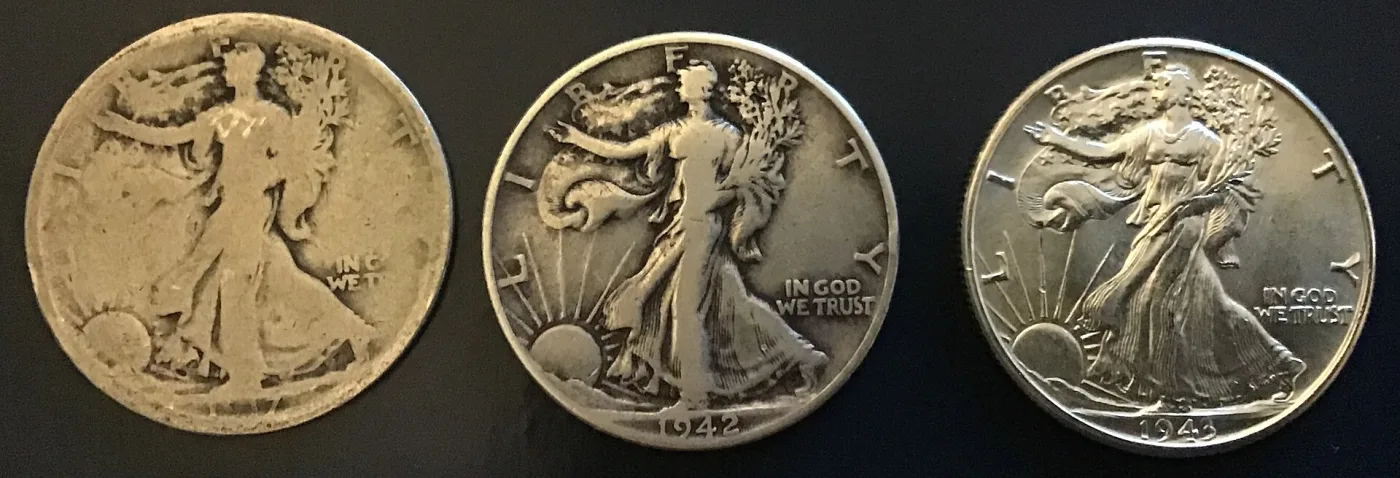
Good (G-4 to G-6)
In Good condition, the outline of Liberty is visible but most details are worn smooth. The date and mint mark must be fully readable. The rim may show some wear but should be mostly intact. On the reverse, the eagle’s outline is clear but feather details are almost entirely worn away. Most circulated Walking Liberty Half Dollars found in pocket change or old collections fall into this range.
Very Good (VG-8 to VG-10)
At the Very Good level, about half of the skirt lines on Liberty are visible, and some detail shows on the flag. Liberty’s head shows some definition, though the hair detail is mostly smooth. The motto “IN GOD WE TRUST” is fully readable. On the reverse, the eagle shows some wing feather detail near the edges.
Fine (F-12 to F-15)
Fine examples show clear detail on the skirt lines and flag. The sandal and toes on Liberty’s forward foot are visible. Hair detail shows around the ear, and the laurel and oak branches show some leaf definition. The reverse eagle displays moderate feather detail throughout the wings.
Very Fine (VF-20 to VF-35)
At Very Fine, most of Liberty’s gown lines are clear, with wear confined to the highest points. The flag details are well-defined, and the branches show distinct leaves. On the reverse, the eagle’s feathers are sharp with only minor wear on the breast and wing tips. Most collectors consider VF the minimum grade for a visually appealing example.
Extremely Fine (EF-40 to EF-45)
Extremely Fine coins show only slight wear on the highest points: Liberty’s head, the left hand, and the forward knee. All gown lines, flag details, and branch leaves are sharp. The reverse eagle is nearly fully detailed with only trace wear on the breast feathers. These standards are similar to those used for grading Indian Head Pennies, where high points also show the first signs of wear.
About Uncirculated (AU-50 to AU-58)
About Uncirculated coins retain most of their original mint luster with only the slightest traces of wear on the very highest points. At AU-58, the coin may appear uncirculated to the naked eye but shows minor friction under magnification. Full luster is visible in the protected areas.
Mint State (MS-60 to MS-70)
Uncirculated Walking Liberty Half Dollars display no wear whatsoever. The grade distinctions within the Mint State range are based on surface marks, luster quality, and eye appeal. MS-60 to MS-63 coins may have significant contact marks, while MS-64 and above are increasingly clean and lustrous. MS-65 and higher gems are scarce for most dates and command substantial premiums.
Full Head and Strike Quality
While not as widely used as the “Full Bands” designation for Mercury Dimes or “Full Bell Lines” for Franklin Half Dollars, the quality of the strike on Walking Liberty Half Dollars significantly affects their value. Collectors and grading services pay close attention to several specific areas.
Liberty’s Hand Details
The fingers on Liberty’s extended right hand should show complete separation between each finger. Weakly struck coins often show the fingers merged together. Fully struck hand details are considered a positive attribute that adds value, especially on coins grading MS-64 and above.
Head and Cap Details
Liberty’s head, including the details of the Phrygian cap and the hair beneath it, should show sharp definition on a well-struck coin. Many Walking Liberty Half Dollars, particularly those from the San Francisco mint in the late 1910s and early 1920s, exhibit weak strikes in this area. A fully detailed head is a significant premium feature.
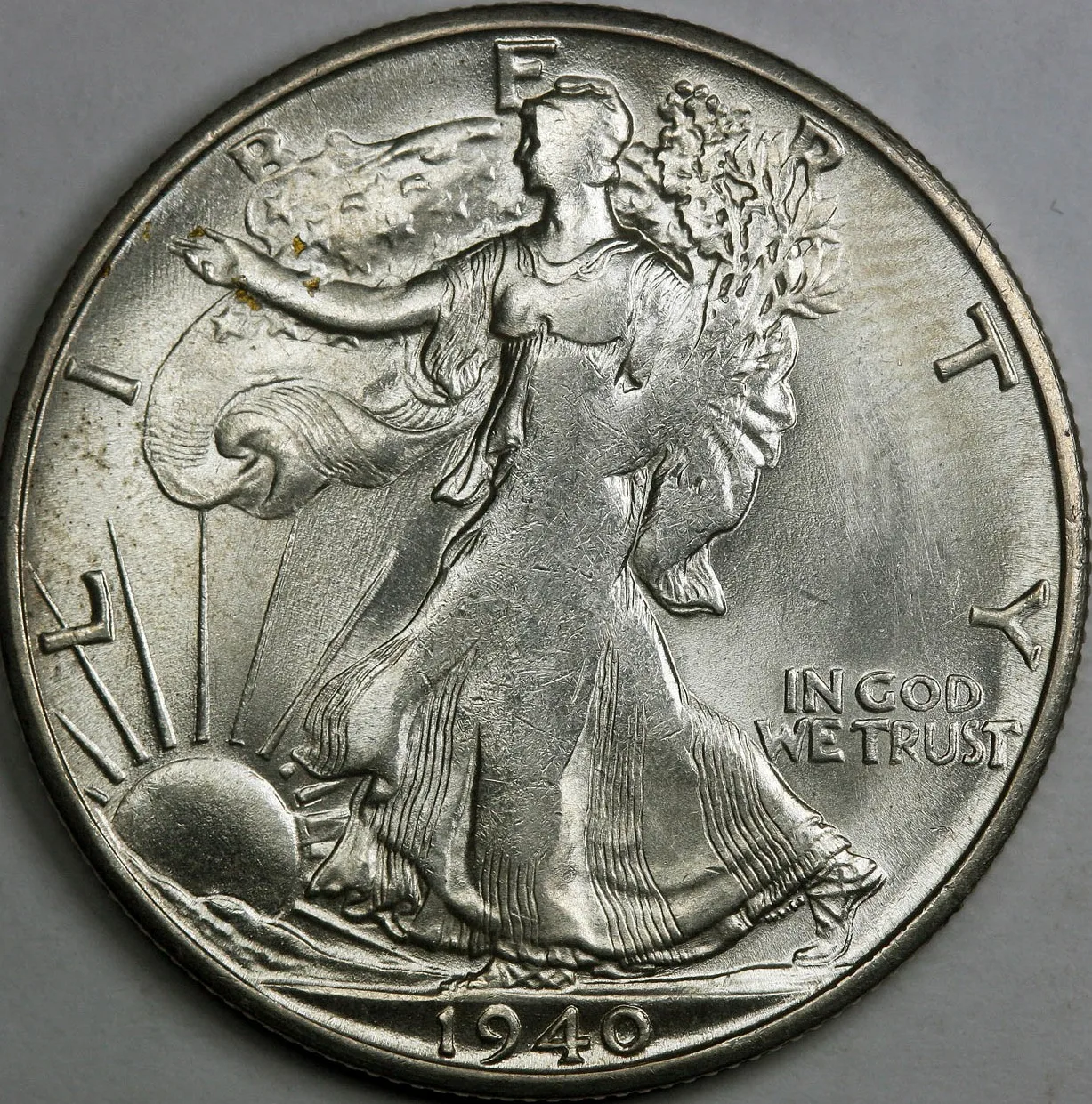
Skirt Lines
The horizontal lines across Liberty’s gown or skirt should be complete and evenly defined on well-struck examples. These lines are among the first to blur on weakly struck coins, even in the absence of wear. Examining the skirt lines is essential for distinguishing between a weakly struck uncirculated coin and a lightly circulated one.
The Thumb Issue
On many Walking Liberty Half Dollars, Liberty’s left thumb (holding the branches) is indistinct or missing entirely due to weak strikes. A coin showing a fully formed thumb is considered well-struck and commands a premium among knowledgeable collectors. This is a subtle detail that can significantly affect the coin’s desirability.
Die Varieties and Errors
The Walking Liberty Half Dollar series has fewer dramatic die varieties than series like the Morgan Silver Dollar with its extensive VAM catalog, but several notable varieties and errors exist.
1917 Obverse vs. Reverse Mint Mark
As discussed earlier, 1917 is the only year with two distinct mint mark placements for both the Denver and San Francisco issues. These are treated as separate collectible varieties by all major price guides and grading services.
1918-S “Broken S” Variety
Some 1918-S coins display a mint mark that appears to have a break or serif, making the S look slightly different from normal. While not a major rarity, this variety is collected by specialists and carries a modest premium.
Doubled Die Varieties
Several dates show minor doubled die obverse (DDO) or doubled die reverse (DDR) varieties. The most notable include doubling visible on the date digits or the “IN GOD WE TRUST” motto. These are generally collected by variety specialists and typically carry premiums of 20% to 100% above normal prices for the date.
Re-Punched Mint Marks
Re-punched mint marks (RPMs) are found throughout the series, where the mint mark was punched into the die more than once, resulting in a doubled or shifted appearance of the letter. These are most visible under magnification and are actively cataloged by variety collectors. The study of re-punched mint marks is a common practice across many US coin series, including Buffalo Nickels where similar RPMs have been documented.
Struck-Through Errors
Occasionally, a foreign object (grease, fabric thread, metal fragment) gets between the die and the planchet during striking, leaving an impression or blank area on the finished coin. These struck-through errors are relatively scarce on Walking Liberty Half Dollars and can add modest value depending on the size and visibility of the error.
Off-Center Strikes
Off-center Walking Liberty Half Dollars are quite rare because the Mint’s quality control for silver denominations was generally good. When found, coins with 5% to 15% off-center strikes can command significant premiums, especially if the date is still fully visible.
Authentication Tips
Counterfeiting of Walking Liberty Half Dollars is a significant concern, particularly for key dates. Knowing what to look for can protect you from expensive mistakes.
Weight and Dimensions
A genuine Walking Liberty Half Dollar should weigh exactly 12.50 grams (with minimal tolerance) and measure 30.6 mm in diameter. Any significant deviation from these specifications is a red flag. A precision digital scale accurate to 0.01 grams is an essential tool for authentication.
Checking the Edge
The edge reeding should be uniform and evenly spaced. Cast counterfeits often show irregular or poorly defined reeding, sometimes with a visible seam line along the edge where the two halves of the casting mold met. Run your fingernail along the edge to feel for irregularities.
Surface Characteristics
Genuine coins struck from steel dies exhibit a specific surface texture called “flow lines” under magnification. These tiny, parallel lines result from the metal flowing outward under the tremendous pressure of the striking process. Cast counterfeits lack these flow lines and instead show a grainy, porous surface texture.
Key Date Red Flags
Be especially cautious with 1916-S, 1921-D, 1921-S, and 1921 Philadelphia coins. Common counterfeiting methods include adding mint marks to common-date coins, altering dates from common years to rare ones, and casting reproductions. If a deal seems too good to be true on a key date, it probably is. For valuable coins, always seek professional certification from PCGS or NGC.
Altered Coins
Some counterfeits are actually genuine Walking Liberty Half Dollars that have been altered. The most common alterations include adding an “S” mint mark to a 1916 Philadelphia coin to create a fake 1916-S, or tooling the date area on a 1941 coin to create a fake 1921. Under magnification, look for disturbed metal, unnatural surface textures around the date or mint mark, and inconsistencies in the overall appearance.
Year-by-Year Production Summary
Understanding mintage figures helps collectors assess relative rarity. Here is a summary of Walking Liberty Half Dollar production by year and mint.
First Era: 1916-1921
The early years of the series produced some of the lowest mintages and most valuable coins. The 1916 Philadelphia (608,000), 1916-D (1,014,400), and 1916-S (508,000) were the inaugural issues. Production in 1917 was more robust, with both obverse and reverse mint mark varieties. The years 1918 through 1920 saw moderate production at all three mints. The series then hit its lowest point in 1921, with all three mints producing fewer than 550,000 coins each.
Gap Years: 1922-1933
No Walking Liberty Half Dollars were produced in 1922 through 1923, 1924 through 1925, 1926 through 1927 (Denver only in 1926), 1930 through 1933. The 1927-S (2,392,000) and 1928-S (1,940,000) are the only late-1920s issues, and both carry premiums. The 1929 issues from all three mints are relatively scarce as well.
Later Era: 1934-1947
Production resumed in earnest in 1934 and continued through 1947. Mintage figures during this period were generally much higher than the early years, often exceeding several million per mint per year. The 1938-D (491,600) stands out as the only key-date-level coin from this era. World War II years (1941-1945) saw extremely high production to meet wartime commerce demands, with some dates exceeding 50 million coins across all mints combined.
Current Market Values
Walking Liberty Half Dollar values vary dramatically based on date, mint mark, condition, and market demand. Below are general value ranges as of 2026 for the most commonly traded grades.
Common Dates (1934-1947, excluding 1938-D)
Most common-date Walking Liberty Half Dollars trade primarily for their silver content in lower circulated grades. In Good to Very Good condition, expect $12 to $18 per coin, roughly in line with the melt value of the 0.3617 troy ounces of silver they contain. In Very Fine to Extremely Fine, common dates bring $18 to $35. Uncirculated common dates range from $40 to $150 for MS-63, and $100 to $400 for MS-65 examples.
Better Dates (1916-D, 1917 varieties, 1918-1920 issues)
Better-date coins from the first era typically sell for $25 to $100 in circulated grades, depending on the specific date and condition. Uncirculated examples of these dates can range from $200 to $2,000, with particularly well-struck or high-grade specimens commanding even more.
Key Dates
The major key dates command the highest premiums:
1916-S: $150 (G) to $15,000+ (MS-65) 1921-D: $150 (G) to $25,000+ (MS-65) 1921-S: $100 (G) to $20,000+ (MS-65) 1921 (Phila.): $75 (G) to $10,000+ (MS-65) 1938-D: $60 (VG) to $2,000+ (MS-65)
Record Auction Sales
The most valuable Walking Liberty Half Dollar ever sold at auction is a 1916 proof in PR-68, which brought over $200,000. High-grade examples of the 1921-D in MS-66 or better have sold for $50,000 to $100,000. Even common dates in exceptional MS-67 or MS-68 condition have sold for thousands of dollars, proving that exceptional quality is always rewarded in the numismatic market.
Building a Walking Liberty Collection
There are several approaches to collecting Walking Liberty Half Dollars, each suited to different budgets and goals.
Complete Date and Mint Mark Set
A complete set includes every date and mint mark combination from 1916 through 1947, including both obverse and reverse mint mark varieties for 1917. This is a challenging and expensive goal, primarily because of the 1916-S and the three 1921 issues. Many collectors spend years or decades completing this set, purchasing key dates as opportunities arise.
Short Set (1941-1947)
A popular alternative is the “short set,” consisting of coins from 1941 through 1947. All of these dates are readily available and affordable, even in uncirculated grades. This approach allows collectors to enjoy the series without the major expense of key dates. It also makes a great starter project for new collectors.
Type Collecting
Type collectors need just one or two examples to represent the design. A common-date Walking Liberty in VF or EF condition can be purchased for under $30 and serves as an excellent representative of one of America’s most beautiful coin designs.
Grade-Focused Collecting
Some collectors focus on acquiring the best possible grade for each date. This approach emphasizes quality over quantity and can be very rewarding, especially when seeking coins with strong strikes and exceptional luster. PCGS and NGC registry sets have made grade-focused collecting increasingly popular.
Storage and Preservation
Proper storage is essential for maintaining the condition and value of your Walking Liberty Half Dollars. Silver coins are susceptible to toning, environmental damage, and surface degradation if not stored correctly.
Individual Holders
For valuable coins, use non-PVC plastic flips, Air-Tite capsules, or PCGS/NGC slab holders. Never use soft plastic “flips” that contain PVC, as this chemical will react with the silver surface over time, creating green, sticky deposits that permanently damage the coin.
Albums and Folders
Dansco, Whitman, and Littleton albums are popular for housing date sets. Dansco albums with clear slides allow viewing of both sides and provide good protection. Whitman blue folders are affordable but only show one side of each coin. Whichever you choose, store the album in a cool, dry location away from direct sunlight.
Environmental Considerations
Keep coins away from rubber bands, cardboard, paper, and other materials that can emit sulfur compounds. Store in a stable environment with moderate humidity (30-50% relative humidity). Avoid handling coins by their faces; hold them by the edges or wear cotton gloves. Never clean your coins, as cleaning reduces their numismatic value significantly. This applies equally to all silver coins, from Walking Liberty Half Dollars to Peace Dollars and beyond.
Selling Your Walking Liberty Half Dollars
If you decide to sell your Walking Liberty Half Dollars, understanding the market and your options will help you maximize your return.
Know What You Have
Before selling, accurately identify the date, mint mark, and approximate grade of each coin. Use this guide to determine whether any of your coins are key or semi-key dates. For coins that appear to be in high grade or are key dates, consider having them professionally graded by PCGS or NGC. The cost of certification ($30 to $50 per coin) is easily justified for coins worth $100 or more, as certified coins consistently sell for higher prices than raw coins.
Selling Options
Common-date coins in circulated grades are typically sold as bullion or at small premiums to dealers, coin shops, or through online marketplaces. Better-date and key-date coins can be sold through auction houses (Heritage, Stack’s Bowers, Great Collections), coin shows, or directly to specialists who deal in Walking Liberty Half Dollars. Online platforms like eBay can also yield good results for certified coins, as the global audience often drives competitive bidding.
Timing the Market
Silver coin values are influenced by both the numismatic market and the price of silver. When silver prices are high, even common-date coins in lower grades are worth more. Key dates and high-grade coins are somewhat insulated from silver price fluctuations because their value is driven primarily by collector demand rather than metal content.