Barber Dime Identification Guide: Key Dates, Mint Marks, and Values
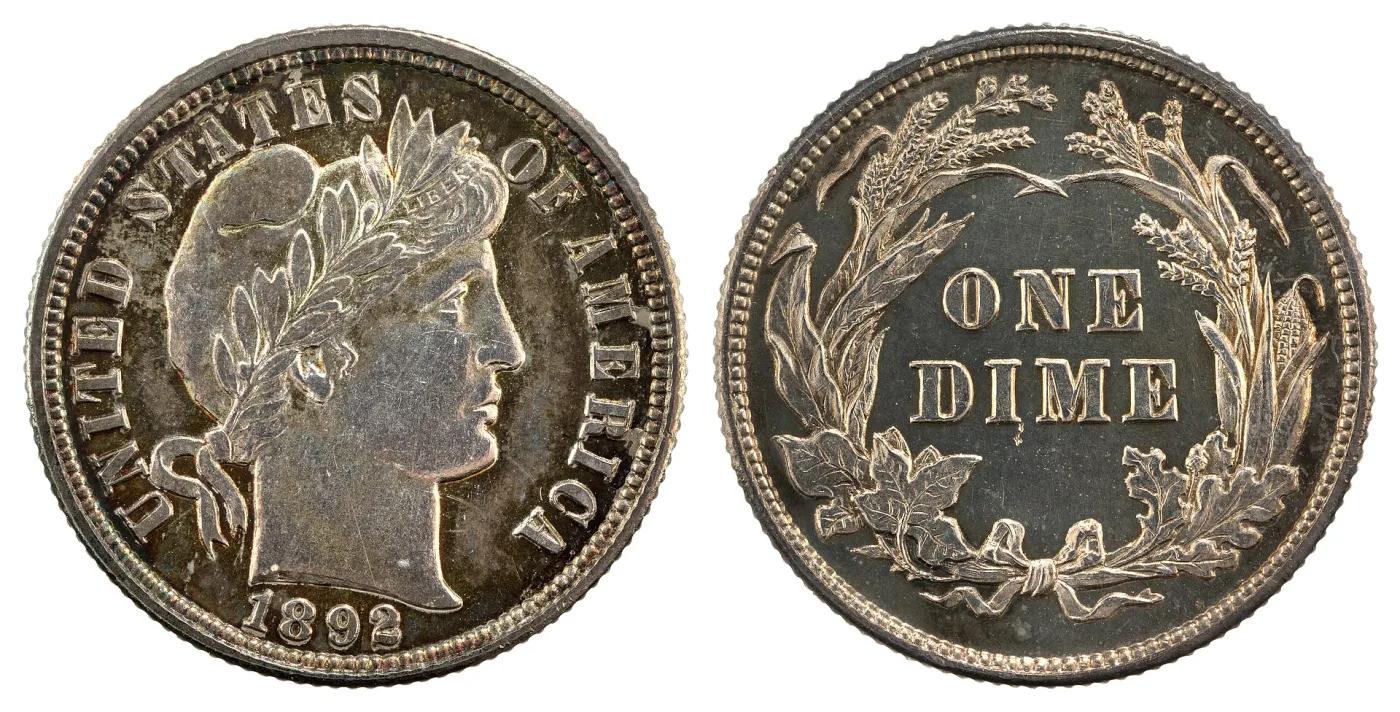
The Barber Dime — officially the Liberty Head Dime — is one of the most respected and misunderstood coins in American numismatics. Struck from 1892 through 1916, it bridges the gap between the delicate Seated Liberty Dime of the mid-19th century and the iconic Mercury Dime that followed. Designed by Chief Engraver Charles E. Barber, this diminutive silver ten-cent piece circulated for 25 years through the Gilded Age and into the early 20th century, and today it offers collectors a rich combination of affordable common dates, legitimately scarce key dates, and one of the most famous rarities in all of U.S. coinage: the 1894-S.
Barber Dimes reward patient study. Unlike flashier series, they hide their value in small details — a thin wreath leaf, a faint mint mark beneath the wreath, a sharp LIBERTY band across Liberty’s forehead. A worn common-date Barber Dime is worth melt, but a crisp 1895-O in high grade can bring five figures, and the legendary 1894-S is a seven-figure coin. Between those extremes lies a deep middle ground of collectable dates where careful grading and authentication make the difference between a $30 coin and a $300 coin.
This guide walks you through everything you need to confidently identify, grade, authenticate, and value Barber Dimes. You will learn how Charles Barber’s design actually works, where to find the tiny reverse mint marks, how to evaluate the crucial LIBERTY headband, and which dates to hunt for. If you are new to U.S. coin identification, start with our general coin identification guide and then come back here to dive deep into this historically important series.
History and Origins of the Barber Dime
By the late 1880s, the Seated Liberty design — which had appeared on American silver coinage for half a century — was showing its age. Critics complained the design was stale, the relief was too shallow, and the allegorical figure of Liberty seated on a rock felt out of step with a rapidly industrializing nation. In 1890, Congress passed legislation allowing the Treasury to redesign coins that had been in production for 25 years or more without a new act of Congress, and Mint Director James P. Kimball seized the opportunity.
A public design competition was held in 1891 for new designs on the dime, quarter, and half dollar. Ten prominent artists were invited, but the terms were unfavorable — only the single winning design would be paid, with no compensation for second place or runners-up. Every invited artist declined. After the competition collapsed, Mint Director Edward O. Leech instructed Chief Engraver Charles E. Barber to prepare the designs in-house. Barber, a career Mint employee and son of former Chief Engraver William Barber (designer of the Trade Dollar), produced a unified Liberty Head design that would appear on all three denominations — dime, quarter, and half dollar — beginning in 1892.
Charles E. Barber: The Designer
Charles Edward Barber served as Chief Engraver of the United States Mint from 1879 until his death in 1917. He was a traditionalist with strong opinions about what coinage should look like, and he frequently clashed with outside sculptors invited to design U.S. coins — including Augustus Saint-Gaudens, whose Indian Head gold eagle and Double Eagle Barber considered impractical for mass production. The Barber coinage — dimes, quarters, and halves — represents his most prominent personal design work and reflects his classical, workmanlike approach.
Production Timeline
Barber Dimes were struck continuously from 1892 through 1916 at four mints: Philadelphia (no mint mark), New Orleans (“O”), San Francisco (“S”), and Denver (“D,” beginning in 1906 when the Denver Mint opened). Total mintage across the series exceeded 500 million pieces, with annual outputs ranging from fewer than 500,000 coins in early years at some mints to more than 20 million in peak production years. The series ended in 1916, when it was replaced mid-year by Adolph Weinman’s Mercury Dime.
Historical Context
Barber Dimes circulated through a defining quarter-century of American history — the Gilded Age, the Panic of 1893, the Spanish-American War, the Progressive Era, and the outbreak of World War I. A Barber Dime could buy a loaf of bread, a glass of beer, or a streetcar ride. They passed through the hands of immigrants arriving at Ellis Island, factory workers in Chicago, and cowboys in the West. Most circulated heavily, which is why truly high-grade survivors command such strong premiums today.
Design Elements and How to Identify a Barber Dime
Barber Dimes are small coins with dense, classical design elements. Once you learn to recognize the Liberty Head and wreath reverse, they are unmistakable.
Obverse (Front) Design
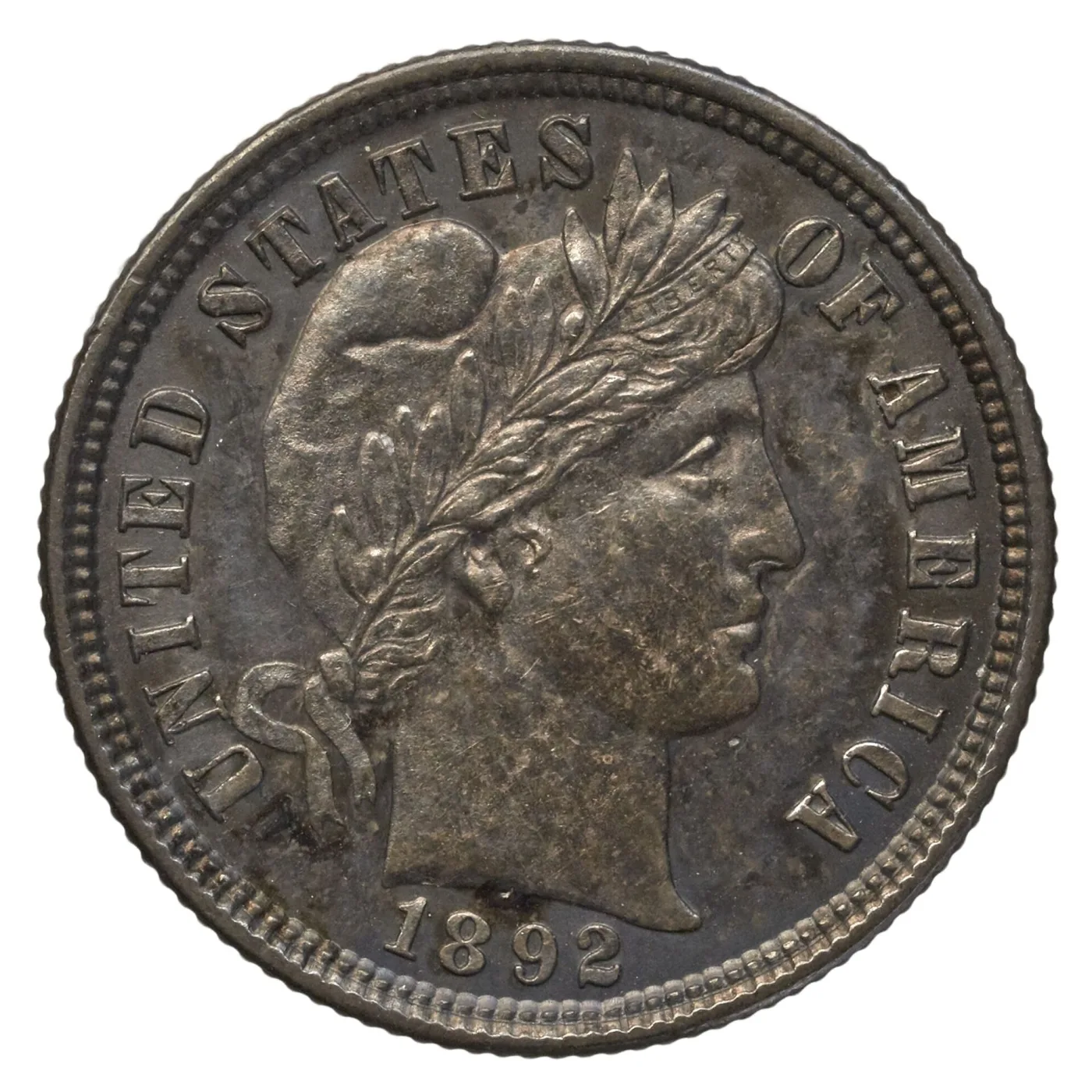
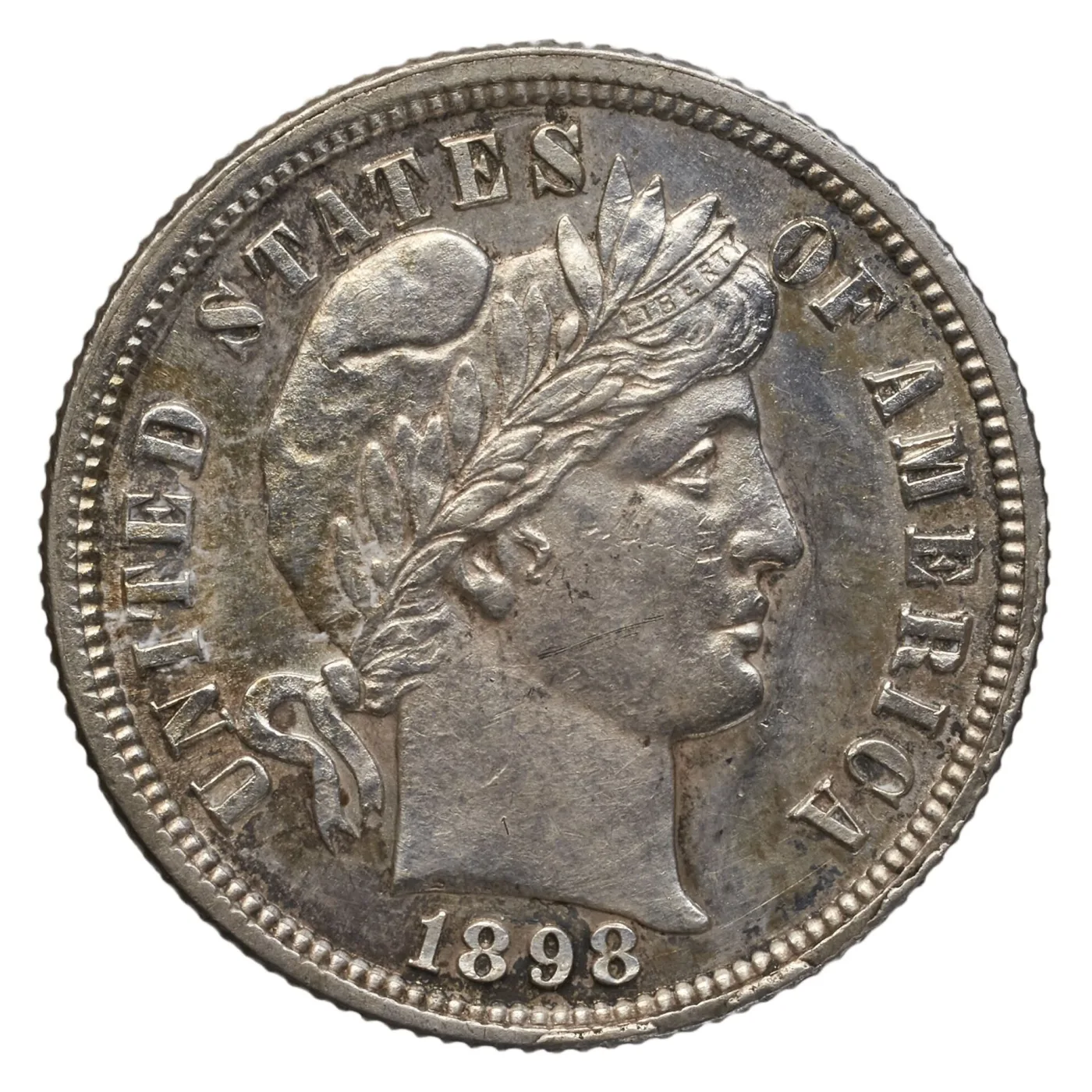
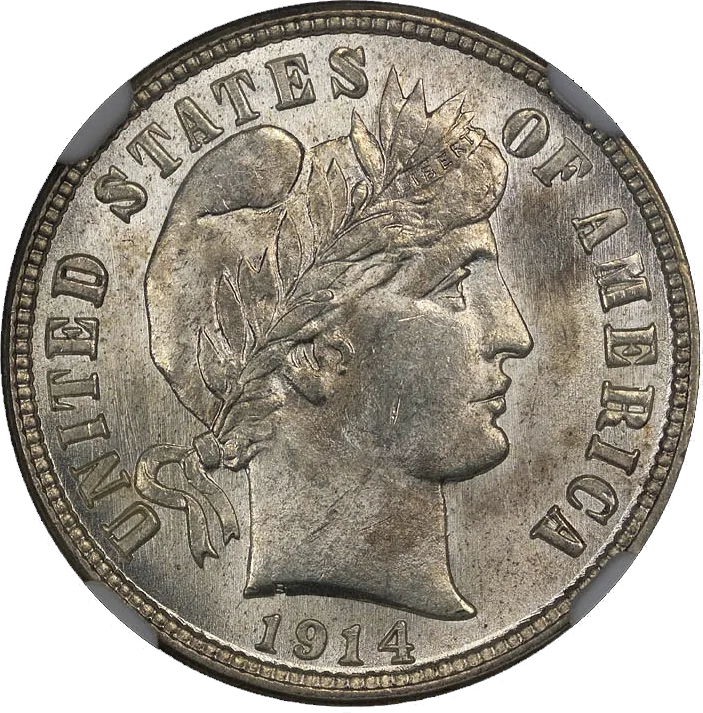
The obverse features a right-facing bust of Liberty wearing a Phrygian cap encircled by a laurel wreath and a headband bearing the word “LIBERTY” in raised letters. Thirteen stars would have been traditional, but Barber’s design instead uses the legend “UNITED STATES OF AMERICA” arcing around the upper two-thirds of the rim and the date “1892” (or whichever year) at the bottom. The cap, wreath, and hair above the forehead create a dense pattern that wears quickly on circulated examples.
A small detail worth noting: Barber’s initial “B” appears on the truncation of Liberty’s neck. It is tiny and easily overlooked, but its presence is one way to distinguish genuine Barber coinage from later fantasy pieces or counterfeits.
Reverse (Back) Design
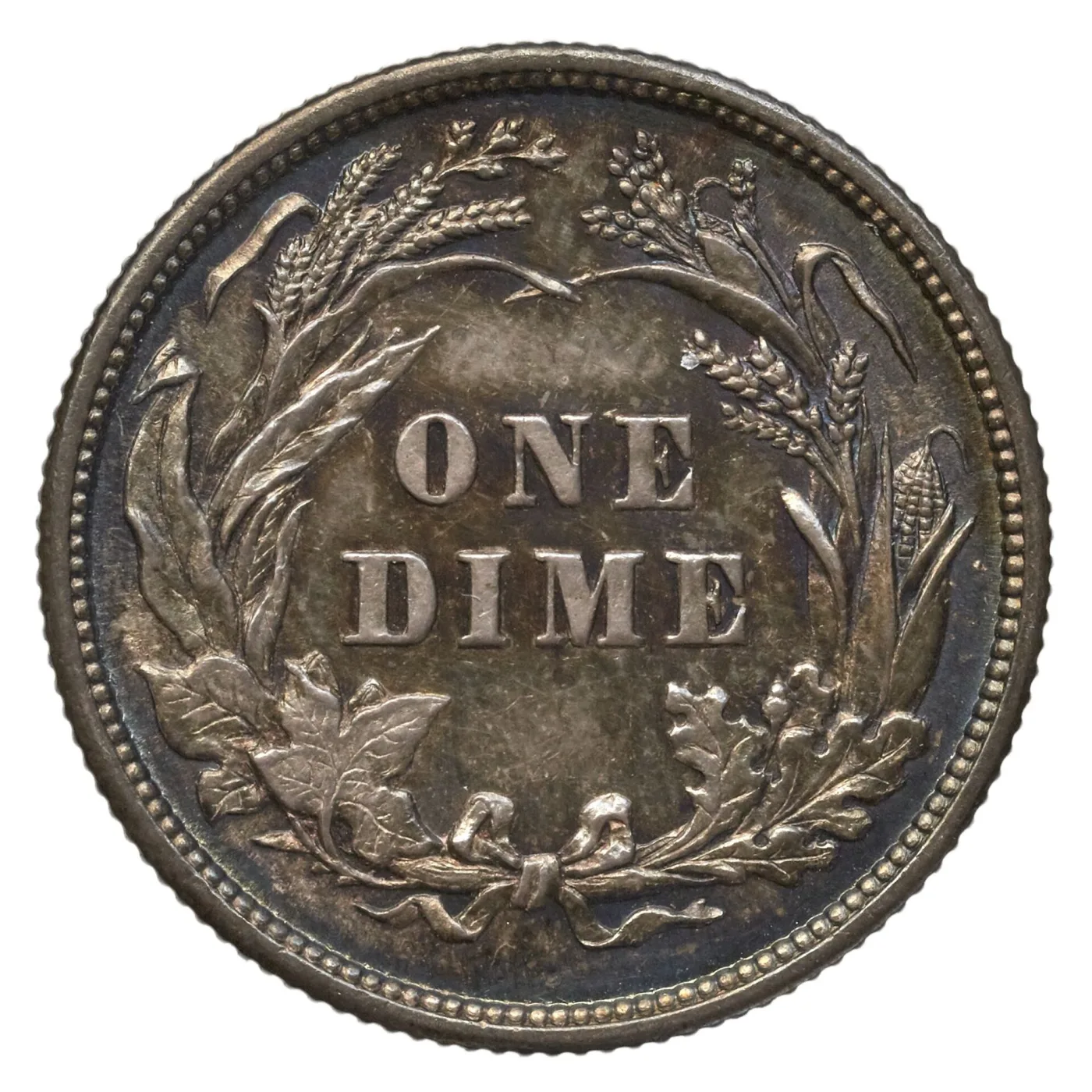
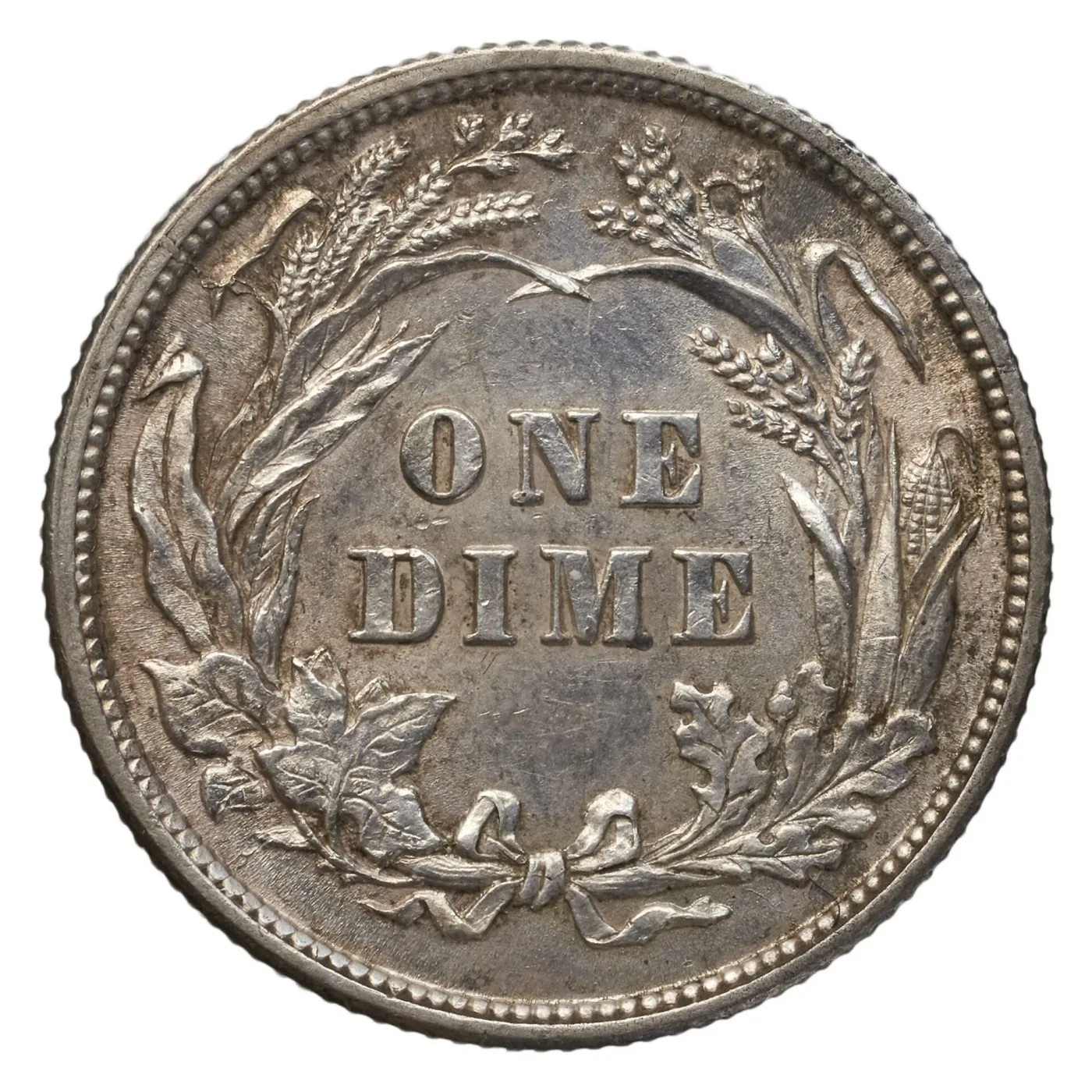
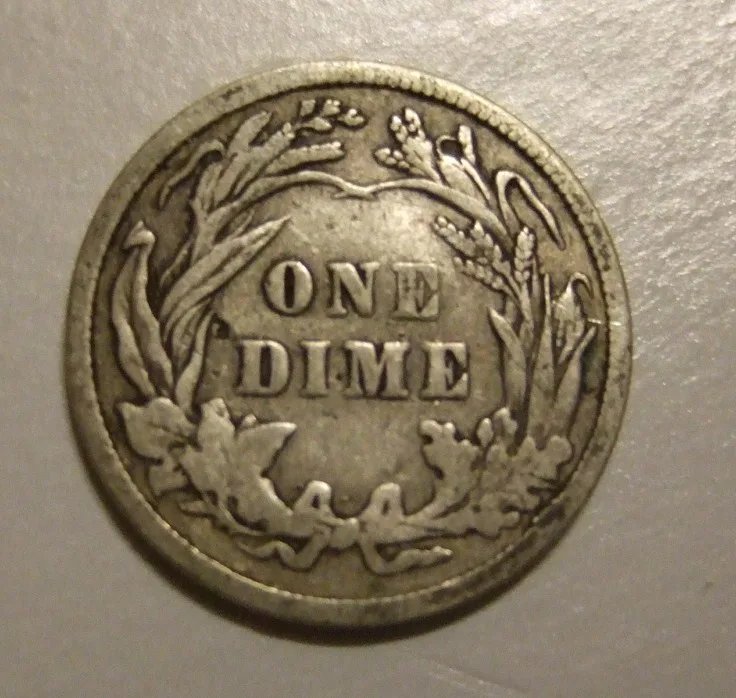
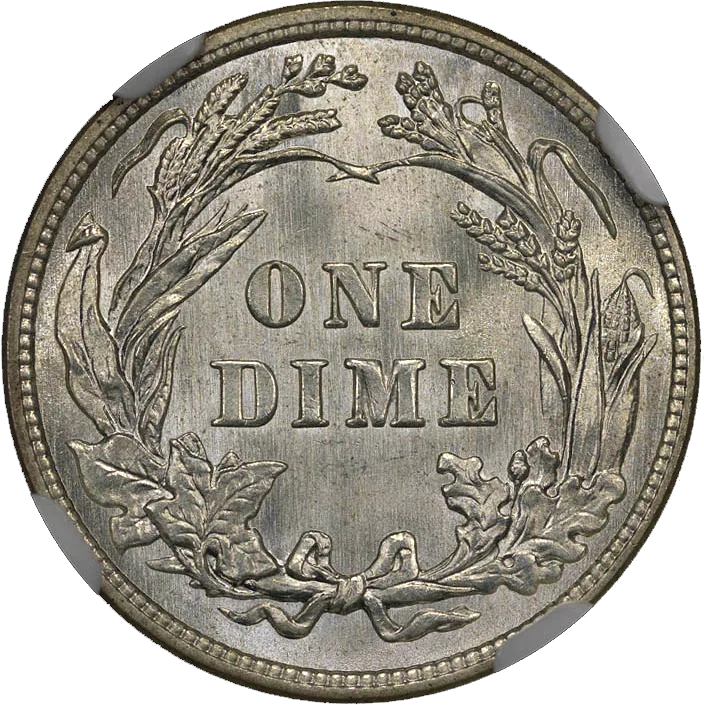
The reverse bears a wreath of corn, wheat, maple leaves, and oak leaves, tied at the bottom with a bow. Inside the wreath are the words “ONE DIME” stacked on two lines. This reverse is actually a holdover from the final years of the Seated Liberty Dime (1860-1891), which Barber retained to save the expense of a new reverse master hub. The wreath style is sometimes called the “Cereal Wreath” because of the agricultural bounty it depicts.
Importantly, Barber Dimes do not bear “E PLURIBUS UNUM” on either side, and the motto “IN GOD WE TRUST” is also absent. These were not yet required on the dime denomination during the Barber era. Their absence is a quick way to distinguish a Barber Dime from a later Mercury or Roosevelt Dime, both of which bear these mottoes.
Physical Specifications
Barber Dimes are composed of 90% silver and 10% copper (the standard U.S. silver coinage alloy of the era), weigh 2.50 grams, have a diameter of 17.9 millimeters, and feature a reeded edge with 118 reeds. Every Barber Dime shares these specifications — there are no composition changes across the entire 1892-1916 run. The silver content gives each coin an intrinsic melt value that tracks the silver market and provides a price floor even for worn common dates.
How to Quickly Distinguish a Barber Dime
If you have an old silver dime and are not sure whether it is a Barber Dime, check three things. First, the obverse features a right-facing head with a laurel wreath and LIBERTY on a headband — not a winged cap (Mercury) and not a seated figure (Seated Liberty). Second, the reverse has a full wreath surrounding “ONE DIME” with no fasces or torch. Third, the date will fall between 1892 and 1916. If all three check out, you have a Barber Dime.
Mint Marks and Where to Find Them
Mint mark identification is essential on Barber Dimes because the same date from different mints can differ in value by a thousand-fold. Thankfully, mint mark placement is consistent across the entire series.
Mint Mark Location
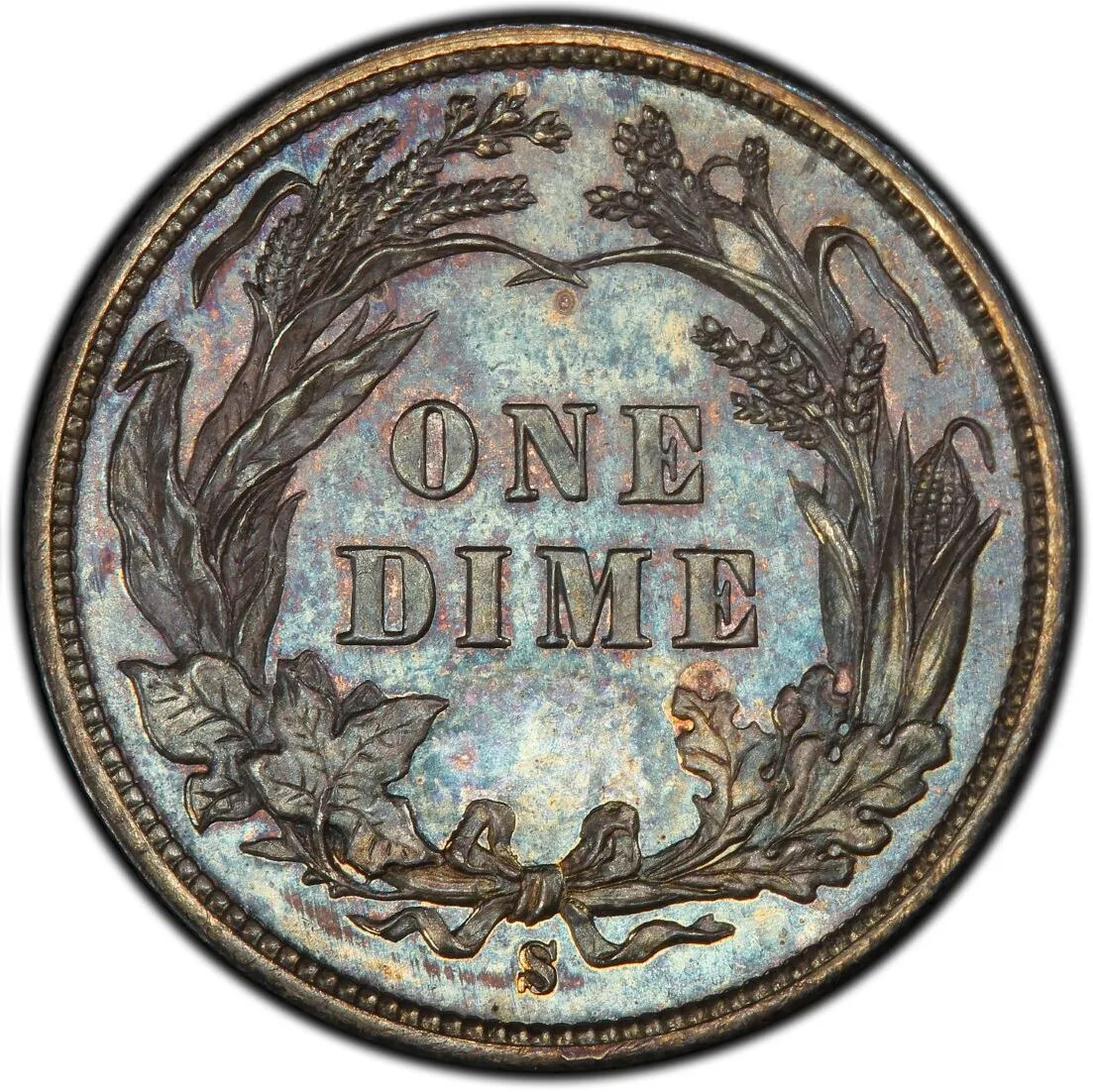
On every Barber Dime, the mint mark appears on the reverse, directly below the wreath, centered above (or touching) the bow. It is small — typically about 1 to 1.5 millimeters tall — and can be very hard to see on circulated coins where surface wear may have softened the letter. A magnifying loupe or 5x-10x magnifier is practically essential for reliable mint mark identification, especially on coins grading below VF.
Philadelphia (No Mint Mark)
Coins struck at the Philadelphia Mint bear no mint mark at all — the space below the wreath is blank. Philadelphia produced the largest share of Barber Dimes, and most common-date examples you encounter will be “P” coins (though they are not marked as such).
New Orleans (“O”)
New Orleans struck Barber Dimes from 1892 through 1909. Its mint mark is a small, slightly oval “O.” The 1895-O is one of the great key dates of the series. The New Orleans Mint closed permanently for coin production in 1909, so Barber Dimes from 1910 onward can never bear an “O” mint mark.
San Francisco (“S”)
San Francisco struck Barber Dimes from 1892 through 1916. Its “S” mint mark is small and slightly curvy. The legendary 1894-S Barber Dime — one of the most famous rarities in U.S. numismatics — bears this mint mark, as do several semi-keys. San Francisco struck Barber Dimes every year of the series.
Denver (“D”)
Denver began striking Barber Dimes in 1906, the second year of Denver Mint coinage production (the Denver Mint also struck the Buffalo Nickel and other denominations soon after opening). Its mint mark is a bold, rounded “D.” Denver produced Barber Dimes every year from 1906 through 1916. There are no scarce key dates from Denver, but the 1906-D as a first-year issue is sought after by type collectors.
Key Dates, Semi-Keys, and the 1894-S
The Barber Dime series has a clearer hierarchy of scarcity than many U.S. series. A handful of dates stand far above the rest, and understanding them is the single most valuable skill for a Barber Dime collector.
1894-S: The Legendary Rarity
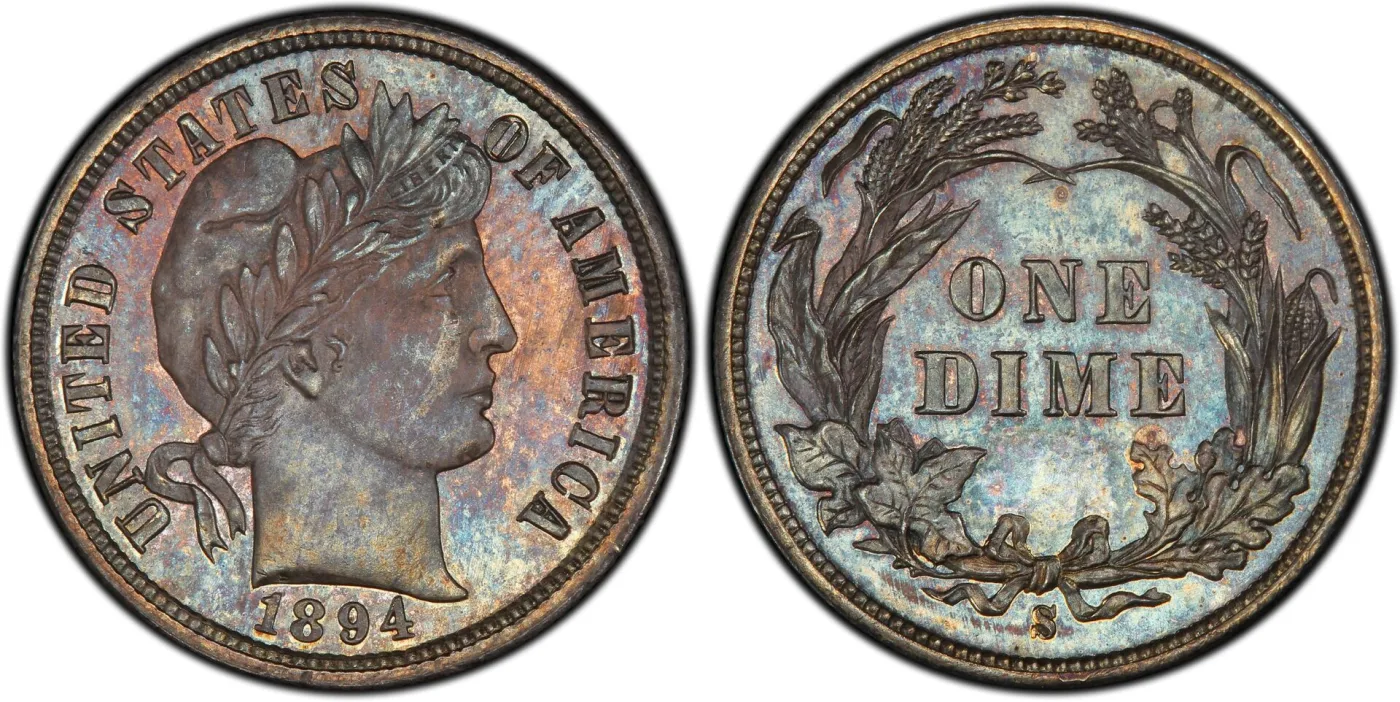
Only 24 Barber Dimes were struck at San Francisco in 1894, and just nine examples are known to survive today. Why so few were made remains a numismatic mystery — theories range from a Superintendent’s gift to his daughter, to an adjustment strike made to balance the Mint’s books at the end of the fiscal year, to proof presentation pieces. Whatever the reason, the 1894-S is one of the most famous rarities in American coinage. In 2007, a PCGS PR-66 example sold for $1.9 million. Examples cross the auction block only once every few years, and prices continue to rise. If you believe you have found a 1894-S, have it authenticated by PCGS or NGC immediately — counterfeits and altered-date fakes far outnumber genuine coins.
1895-O: The Accessible Key
With a mintage of just 440,000, the 1895-O is the rarest regular-issue Barber Dime and the top key that ordinary collectors can realistically acquire. Even in Good condition, an 1895-O sells for $500 to $700. In Fine, $1,500 to $2,500. In AU or Mint State, $10,000 to $40,000 or more. Because of its fame, the 1895-O is heavily counterfeited, and genuine examples should always be purchased in third-party holders.
1896-S: The Third Key
With 575,056 struck, the 1896-S is the third-rarest business-strike Barber Dime. Values range from $75 in Good to $600 in Fine, $1,800 in AU, and $4,500 or more in MS-63. Like the 1895-O, it is a coin that demands careful grading because the difference between VG-8 and F-12 can represent a $40 price swing.
Semi-Keys
Beyond the three major keys, several dates are semi-scarce and command notable premiums:
- 1901-S — mintage 593,022; $60 in G, $300 in F, $1,500 in AU.
- 1903-S — mintage 613,300; $45 in G, $250 in F, $1,200 in AU.
- 1913-S — mintage 510,000; $30 in G, $125 in F, $450 in AU.
- 1892-S — first-year San Francisco issue; $30 in G, $120 in F, $400 in AU.
- 1897-O — mintage 666,000; $40 in G, $200 in F, $1,000 in AU.
- 1898-S, 1899-S, 1902-S, 1904-S — all moderate semi-keys with circulated values of $15 to $75.
Notable Varieties and Die Characteristics
Barber Dimes are not a variety-rich series by the standards of Morgan Silver Dollar VAMs or Lincoln Cent doubled dies, but several varieties are worth knowing.
1905-O “Micro O”
The 1905-O comes with two distinct mint mark sizes. Most 1905-O coins have a normal-sized “O” mint mark. A smaller fraction show a visibly smaller “Micro O” punched from a different die. The Micro O variety is scarcer and sells for 2x to 5x the price of a normal-sized O in equivalent grade. In Fine, a normal 1905-O sells for about $8; a Micro O is $40 to $60.
1893/2 Overdate
A minor overdate variety exists for 1893, with faint traces of an underlying “2” beneath the final digit of the date. The variety is subtle and requires magnification to confirm. It commands a 25% to 50% premium over normal 1893 Barber Dimes.
Repunched Mint Marks
Numerous Barber Dime dates show minor repunched mint marks (RPM), particularly on New Orleans and San Francisco issues. These are popular with specialists but carry only modest premiums. Reference CONECA (Combined Organizations of Numismatic Error Collectors of America) listings for specifics.
Die Cracks and Cuds
Because Barber Dime dies were worked hard during long production runs, die cracks — thin raised lines across the coin’s surface — are common, especially on late-state strikes. Major cuds (raised blobs where a piece of the die has broken off) are rare and collectable. Neither significantly affects value unless the variety is listed in the Cherrypickers’ Guide.

The LIBERTY Headband and Grading
Nothing matters more to Barber Dime grading than the LIBERTY headband across Liberty’s forehead. The word “LIBERTY” in raised letters on the headband is the first design element to wear away as the coin circulates, and the presence or absence of specific letters anchors the entire grading scale from Good through Very Fine.
Grading by LIBERTY Letters Visible
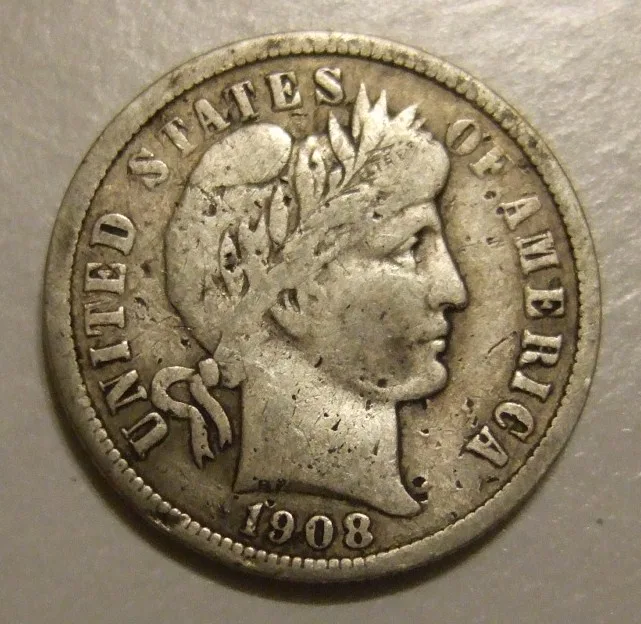
- Good (G-4): LIBERTY is completely worn smooth. No letters visible on the headband — the headband itself is a flat raised band with no lettering.
- Very Good (VG-8): At least three letters of LIBERTY are partially visible, typically “LIB” or “BE” or “TY” — any three letters meet the VG-8 threshold.
- Fine (F-12): All seven letters of LIBERTY are visible, though they may be weak or partially merged. The overall word is readable.
- Very Fine (VF-20): All seven letters of LIBERTY are bold and sharp. Individual letter strokes are clearly separated.
- Extremely Fine (EF-40): LIBERTY is fully sharp with all letters crisp; wear is visible only on the highest points of the cheek and wreath leaves.
Why LIBERTY Matters So Much
On circulated Barber Dimes, the jump from G-4 to VG-8 to F-12 often doubles or triples a coin’s value, especially on key and semi-key dates. An 1895-O in G-4 might sell for $500, in VG-8 for $900, and in F-12 for $1,800. On a common date the absolute dollar swing is smaller, but the proportional difference is identical. Mastering LIBERTY-based grading is the core skill of Barber series collecting.
Counterfeit Warning
Because LIBERTY is so grade-critical, a common alteration is to “re-engrave” or “tool” the LIBERTY letters on a worn coin to make it grade higher. Under 10x magnification, tooled letters show unnatural sharp edges, fresh metal that differs in color from the surrounding surface, and an overall “wrong” look compared to original strike. Third-party grading services catch these alterations reliably, which is why certified coins are preferred for any purchase above $100.
How to Grade Barber Dimes
Beyond LIBERTY, several other design elements inform the full grading picture for Barber Dimes.
Obverse Wear Points
After LIBERTY, the next wear points to check are Liberty’s cheek and the hair above her forehead and behind her ear. On EF-40 coins, you may see slight flattening of the high points on the cheek but most hair detail remains. On AU-50, wear appears as a faint flatness on the cheek and on the topmost waves of hair; three-quarters of the coin still displays mint luster. On MS-60, there should be no wear at all, though contact marks and bag abrasions may be present.
Reverse Wear Points
The reverse grades primarily on the wreath. Check the central leaves and the bow below “ONE DIME.” On VG-8, many outer leaves are merged together; on F-12, individual leaves are clearly separated; on VF-20, the central leaves show partial veining; on EF-40, all leaves are sharp with complete veining.
Mint State Grades
Mint State Barber Dimes are graded primarily on contact marks, luster, and strike. MS-60 to MS-62 coins typically have numerous bag marks and may be weakly struck. MS-63 is the “choice” grade with a few noticeable marks. MS-64 is “near gem” with only light marks. MS-65 gem coins have full luster and only minute marks visible under magnification. MS-66 and above are exceptional survivors, increasingly rare for most dates.
Full Head or Full Details?
Unlike Mercury Dimes (Full Bands) or Standing Liberty Quarters (Full Head), Barber Dimes do not have a formal strike designation. Collectors and graders do pay attention to strike quality — a fully struck Barber Dime shows every wreath leaf, every LIBERTY letter, and full feather details on the laurel branches. A weakly struck Barber Dime in an MS-65 holder is worth less than a fully struck equivalent, even though the grades match.
Strike Differences by Mint
As a rule of thumb, Philadelphia Barber Dimes tend to show the strongest strikes, followed by Denver, then New Orleans, with San Francisco often showing the weakest strikes — though individual coins vary. New Orleans coins of the 1890s are notorious for weak strikes on the reverse wreath, and this weakness is often mistaken for circulation wear.
Proof Barber Dimes
Proof Barber Dimes were struck at the Philadelphia Mint every year from 1892 through 1915. They are distinctly different coins from business strikes, with mirrored fields, sharp strikes, and frosted design elements on some years.
Identifying a Proof Barber Dime
A genuine proof Barber Dime shows watery, mirror-like fields, perfectly squared rims, and sharply detailed devices with no flow lines or flatness. Proofs were struck twice or more with polished dies under higher pressure, and on well-preserved examples you can see your reflection in the flat fields. Proofs were only struck at Philadelphia, so proof Barber Dimes bear no mint mark.
Proof Mintages
Proof mintages are small — typically between 400 and 1,200 coins per year. The 1894 proof had a mintage of only 972, the 1914 proof only 425, and the 1915 proof (the final year) only 450. Low mintages combined with the fact that many proofs have been lost, cleaned, or impaired over a century make high-grade proofs legitimately scarce.
Cameo and Deep Cameo
Proof Barber Dimes can show cameo contrast, where frosted devices stand out against mirrored fields. Cameo (CAM) and Deep Cameo (DCAM) proofs are significantly more valuable than brilliant proofs. A PR-65 brilliant Barber Dime might sell for $400 to $800; the same coin in PR-65 CAM could bring $1,500 to $3,000, and PR-65 DCAM $5,000 or more. Deep Cameo examples are extremely rare for most Barber Dime dates.
Proof Only Dates?
There are no “proof-only” Barber Dime dates — every year that struck proofs also struck circulation coinage. But 1894 proofs are sometimes confused with the legendary 1894-S business strike; they are entirely different coins. An 1894 proof has no mint mark and mirror fields; a 1894-S has an “S” mint mark and satin business-strike surfaces.
Authentication and Counterfeit Detection
Barber Dimes attract counterfeiters for the same reason collectors love them: meaningful value concentrated in small, discrete varieties that can be faked with simple alterations. Knowing what to watch for protects your collection.
Altered Dates
The most common Barber Dime deception is altering a common date to a key date. A 1898-S can be tooled into a “1895-S” (though 1895-S is not as rare as 1895-O, so this attack is uncommon). More commonly, a 1893 is altered to an “1894-S” by adding an “S” mint mark or modifying the date. Real 1894-S dimes have specific die characteristics (including a tall thin “4”) that experts recognize. Under magnification, altered dates show tool marks, disturbed surface metal, and incorrect digit shapes. Never purchase an uncertified 1894-S under any circumstances.
Added Mint Marks
A Philadelphia 1895 (relatively common) can have an “O” added to create a fake 1895-O. Genuine mint marks were punched into the die before striking, so they are integral to the coin’s surface. Added mint marks sit atop the coin rather than in it, and usually show a slight color or texture difference. Third-party grading catches these reliably.
Cast Counterfeits
Crude cast counterfeits occasionally appear, usually targeting the 1895-O or 1894-S. Cast fakes feel “soft” — rims are rounded rather than sharp, details are mushy, and under magnification the surface shows pitting or a granular texture rather than the smooth strike of a genuine coin. The weight may also be off; a genuine Barber Dime weighs exactly 2.50 grams (±0.03 g tolerance), and a cast fake often weighs noticeably more or less.
Chinese Counterfeits
Modern Chinese counterfeits of Barber coinage have become more sophisticated in the last decade, sometimes fooling even experienced eyes at first glance. They are usually struck rather than cast, giving them sharper details, but the devices still show small inaccuracies in letter spacing, star points, or wreath leaf shapes when compared side-by-side with genuine coins. The safest practice for any Barber Dime above $100 is purchasing it already in a PCGS, NGC, ANACS, or ICG holder.
Cleaning and Problem Coins
Many Barber Dimes have been harshly cleaned at some point in their 100+ year existence. Cleaned coins show hairline scratches in straight, parallel patterns (from cloth wiping) or overly bright, unnatural surfaces (from dipping). A coin in a PCGS or NGC “Genuine” or “Details” holder has been authenticated but found uncertifiable due to cleaning, damage, or alteration. Such coins sell for a fraction of problem-free examples. The same cautious approach applies to any 19th-century coinage, including the Indian Head Penny series.
Current Market Values by Date and Mint
Values below represent approximate retail prices as of 2026. Actual prices fluctuate with silver spot and collector demand. Use these as benchmarks, not quotes.
Common Dates (Most Philadelphia, plus Denver from 1906)
Common-date Barber Dimes sell for about $3 to $5 in G-4 (silver melt drives the floor), $6 to $10 in VG-8, $15 to $25 in F-12, $30 to $50 in VF-20, $75 to $150 in EF-40, $200 to $400 in AU-50, and $400 to $800 in MS-63. MS-65 examples of common dates run $1,000 to $2,500.
Semi-Keys
Semi-keys (1892-S, 1897-O, 1901-S, 1902-S, 1903-S, 1904-S, 1913-S, etc.) sell for $15 to $75 in G-VG, $100 to $300 in F-VF, $400 to $1,500 in AU, and $2,500 to $6,000 in MS-63. MS-65 examples are scarce and can reach $10,000 to $25,000.
Key Dates
The 1895-O sells for $500 to $700 in G-4, $1,500 to $2,500 in F-12, $3,500 to $6,000 in EF-40, $10,000 to $15,000 in AU-50, and $25,000 to $60,000+ in MS-63 through MS-65. The 1896-S runs $75 in G to $4,500 in MS-63. The 1894-S is effectively priceless — $1 million to $2 million+ depending on grade, with examples trading rarely.
Proofs
Proof Barber Dimes sell for $250 to $500 in PR-60, $500 to $1,000 in PR-63, $800 to $1,800 in PR-65, and $2,500 to $10,000+ in PR-66 CAM or higher. The low-mintage 1914 and 1915 proofs carry modest premiums over other dates.
Factors Affecting Value
Beyond date and technical grade, Barber Dime values are driven by strike quality, original surfaces (versus dipped), attractive toning, and eye appeal. A “technically accurate” MS-63 with a weak strike and dipped-bright surfaces may sell below guide, while an MS-63 with a sharp strike and original russet toning can bring MS-65 money.
Series Context: Before and After Barber
Understanding where the Barber Dime sits in the broader story of American coinage helps contextualize both its design and its collectability.
Predecessor: The Seated Liberty Dime (1837-1891)
The Barber Dime replaced the Seated Liberty Dime designed by Christian Gobrecht. Seated Liberty Dimes circulated for over 50 years in several sub-types — no stars, stars on obverse, arrows at date, legend on obverse — and represent one of the most varied and studied 19th-century U.S. series. Before the Seated Liberty Dime, the Capped Bust Dime (1809-1837) carried John Reich’s design across Large Size and Small Size sub-types. Barber adopted the Seated’s reverse wreath design nearly unchanged, which is why Barber Dime reverses closely resemble the 1860-1891 Seated Dime reverses.
Contemporary: Barber Quarter and Half Dollar
Charles Barber’s Liberty Head design appears on three denominations struck concurrently: the dime, quarter (1892-1916), and half dollar (1892-1915). The obverse portraits are essentially identical across all three denominations — only the size, reverse design, and a few peripheral details differ. Many Barber dime collectors eventually build Barber type sets with all three denominations.
Successor: The Mercury Dime (1916-1945)
In 1916, the Mint replaced all three Barber denominations with new designs as part of a broader beautification of U.S. coinage. Adolph Weinman’s Mercury Dime replaced the Barber Dime mid-year in 1916, meaning both series were struck in that transitional year. Weinman’s Walking Liberty Half Dollar replaced the Barber Half Dollar, and Hermon MacNeil’s Standing Liberty Quarter replaced the Barber Quarter (itself succeeded in 1932 by John Flanagan’s Washington Quarter). Together, these three new designs represent the high point of classical-style American coinage.
Why 1916 Matters for Collectors
Because 1916 was a transition year, both 1916 Barber Dimes and 1916 Mercury Dimes exist. A pairing of a 1916 Barber Dime and a 1916 Mercury Dime is a popular “last year / first year” display piece. Note that the 1916-S Barber Dime is common, while the 1916-D Mercury Dime is a famous key date — an inversion that catches new collectors off guard.
Storage, Handling, and Preservation
Barber Dimes are small, handled silver coins more than a century old. Proper storage protects both their condition and their value.
Handling
Always hold Barber Dimes by the edges. Their small size makes this awkward at first, but the LIBERTY headband and reverse wreath are extremely susceptible to hairlines from skin oils and from loose contact. Use soft cotton or nitrile gloves for any extended examination. Work over a velvet pad or soft cloth to prevent catastrophe if you drop the coin.
Holders and Flips
For low-grade circulated coins, 2x2 cardboard flips with Mylar windows are inexpensive and adequate. For Fine and better examples, consider individual Air-Tite capsules sized 17 mm or “dime” size. For any coin worth $100 or more, PCGS or NGC slabs offer the best combination of protection, authentication, and liquidity in the resale market. Never store silver coins in PVC-based soft flips — plasticizer migration causes permanent green gunk that severely impairs value.
Environmental Controls
Silver toning is natural and often beautiful, but uncontrolled environments accelerate harmful tarnish. Store coins in a cool, dry location with stable temperature. Silica gel packets in a sealed storage box absorb excess humidity. Avoid basements, attics, and uninsulated garages. Sulfur in newspaper, cardboard, and some paints can accelerate tarnish dramatically.
Cleaning: Don’t
Never clean a Barber Dime. Toning is a natural protective patina on silver, and removing it exposes fresh metal, destroys original surfaces, and almost always reduces value by 50% or more. Even heavily toned Barber Dimes should be left untouched. The same principle applies across U.S. silver coinage — whether you are preserving a Peace Dollar, a Mercury Dime, or a Barber Dime, original surfaces are paramount. If a coin has active corrosion or serious problems, consult a professional conservation service (NCS is the industry standard) rather than attempting home remedies.
Building a Barber Dime Collection
Barber Dimes offer multiple collecting approaches, from affordable type coins to ambitious complete date-and-mintmark sets. Choose the path that matches your budget and interests.
Type Collection
The easiest entry is a single Barber Dime for a 19th- or 20th-century type set. Budget $30 to $75 for a Very Fine common date, $150 to $300 for Extremely Fine, and $400 to $800 for About Uncirculated. A single gem Mint State Barber Dime for a high-grade type set runs $1,000 to $2,500.
Short Set (1892-1916 Philadelphia Only)
A complete Philadelphia-only date set (25 coins) in Fine can be built for roughly $500 to $1,000. This is a popular introduction to the series because it avoids the key dates (which are all branch-mint coins) and focuses on the design’s evolution across the full production span.
Complete Date-and-Mintmark Set (Business Strikes)
A complete 74-coin business-strike set in Good-VG costs roughly $2,500 to $4,500, driven almost entirely by the 1895-O and 1896-S (the 1894-S is excluded — it is essentially a separate collecting goal). In Fine, budget $6,000 to $12,000. In Mint State, $75,000 to $250,000+ depending on grade consistency.
Proof Set
A complete proof Barber Dime set (24 coins, 1892-1915) in PR-63 runs $8,000 to $15,000. In PR-65, $25,000 to $50,000. Cameo and Deep Cameo sets push into six figures.
Variety Set
A targeted variety set including the 1905-O Micro O, 1893/2 overdate, and selected repunched mint marks is manageable at $500 to $2,000 depending on grades chosen. This adds depth without the cost of chasing keys in high grade.
Budget Tips
Start with a common-date Fine or Very Fine for $20 to $40 to get familiar with the design. Add semi-keys one at a time as budget permits. Prioritize problem-free coins over higher-grade problem coins — a clean F-12 is a better long-term hold than a cleaned VF-20. For anything above $100, insist on PCGS or NGC certification. Attend coin shows to compare coins in person; Barber Dime strike and eye-appeal differences are dramatic and hard to see from online photos alone.
Frequently Asked Questions
How much is a Barber Dime worth?
Most common-date Barber Dimes in circulated condition are worth $3 to $10 depending on grade, with their floor set by about $2 in silver melt value. Better dates and higher grades can bring hundreds to thousands of dollars, and the legendary 1894-S sells for more than a million dollars at auction.
What is the rarest Barber Dime?
The 1894-S is by far the rarest Barber Dime, with a mintage of only 24 coins and just nine examples known today. Among regular-issue dates, the 1895-O is the rarest with 440,000 struck.
Are Barber Dimes made of silver?
Yes. Every Barber Dime struck from 1892 through 1916 is composed of 90% silver and 10% copper, weighing 2.50 grams. The silver content means even worn examples are worth more than face value based on the silver spot price alone.
Where is the mint mark on a Barber Dime?
The mint mark appears on the reverse, directly below the wreath and above the bow. Philadelphia coins have no mint mark at all. Look for "O" (New Orleans), "S" (San Francisco), or "D" (Denver, 1906 onward). A magnifying loupe helps because the mint mark is small and often weakly struck.
Why is LIBERTY so important for grading Barber Dimes?
The word LIBERTY appears in raised letters on the headband across Liberty's forehead and is the first detail to wear away. The number of visible LIBERTY letters determines the grade — zero letters is Good, three or more letters is Very Good, and all seven visible and complete is Fine. Grade jumps driven by LIBERTY visibility can double or triple a coin's value.
Who designed the Barber Dime?
Charles E. Barber, Chief Engraver of the United States Mint from 1879 to 1917, designed the Barber Dime. His initial "B" appears on the truncation of Liberty's neck on the obverse. Barber's Liberty Head design also appears on the Barber Quarter (1892-1916) and Barber Half Dollar (1892-1915), and his earlier work includes the Liberty Head V Nickel introduced in 1883.
What is the 1894-S Barber Dime?
The 1894-S is one of the most famous rarities in U.S. numismatics. Only 24 were struck at the San Francisco Mint, and only nine are known to survive today. The reason for the tiny mintage remains debated, but the coins exist and trade for millions of dollars when they appear at auction. Any claimed 1894-S must be authenticated by PCGS or NGC.
Should I clean my Barber Dime?
No. Cleaning removes the protective toning, introduces microscopic hairlines, and typically reduces a coin's value by 50% or more. Even heavily tarnished Barber Dimes should be left alone. If a coin has active corrosion, consult a professional conservation service rather than attempting cleaning yourself.
How can I tell a real Barber Dime from a counterfeit?
Check the weight (must be 2.50 grams), diameter (17.9 mm), and edge (reeded with 118 reeds). Examine the surfaces under 10x magnification — cast counterfeits show pitted or grainy surfaces, struck fakes may show slight letter-shape differences. For any Barber Dime worth $100 or more, buy only coins certified by PCGS, NGC, ANACS, or ICG.
What years were Barber Dimes made?
Barber Dimes were struck every year from 1892 through 1916. They were replaced by the Mercury Dime in 1916, so both series exist with 1916 dates.