Capped Bust Half Dollar Identification Guide: Overton Varieties, Key Dates, and Values
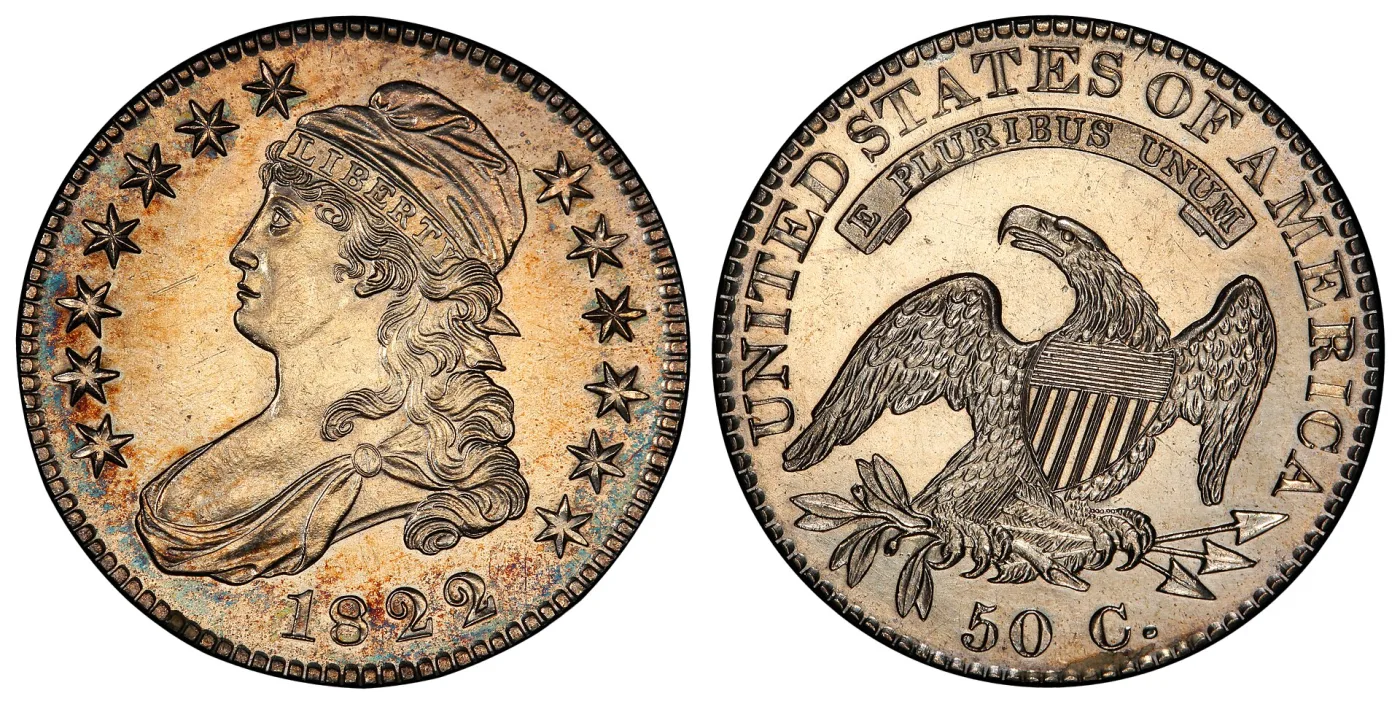
The Capped Bust Half Dollar — produced from 1807 through 1839 — is one of the most studied series in American numismatics. For more than three decades, the half dollar carried John Reich’s distinctive Liberty bust wearing a soft cloth cap — the same portrait used on the matching Capped Bust Dime, Capped Bust Quarter, and Capped Bust Half Dime — struck on hand-engraved dies that produced hundreds of identifiable varieties. Because the Mint had no working national gold or silver dollar coinage during much of this period (silver dollar production was suspended from 1804 until 1836), the half dollar served as the primary store-of-value silver coin in American commerce, and surviving examples often saw heavy circulation, bank-bag storage, or export.
What makes Capped Bust Halves uniquely collectible is the Overton variety system. Numismatist Al C. Overton catalogued the hand-engraved die marriages in his landmark 1967 reference, and “by Overton number” is now the standard way collectors discuss the series. A common-date 1832 might be worth $80 in well-circulated condition, but a specific Overton variety from the same year — distinguished only by a tiny date repunch or letter spacing — can be worth ten times as much. Collecting Capped Bust Halves is therefore a hybrid of date collecting, variety attribution, and detective work with a strong loupe.
This guide covers everything you need to identify, attribute, and value Capped Bust Halves: John Reich’s design, the critical lettered edge (1807-1836) vs reeded edge (1836-1839) transition, key dates and overdates, the Overton variety system in plain language, mint marks (the New Orleans branch arrived only at the very end), grading by Liberty’s cap and shield detail, authentication strategies, current market values across Good through Mint State, and practical advice on building a collection. The same fundamental coin identification techniques that apply to other classic US silver series apply here, with several Capped-Bust-specific quirks you must know.
History: A Half Dollar That Stood In for the Silver Dollar
To understand the Capped Bust Half Dollar, you must first understand the strange position of the silver dollar in early American coinage. Production of the original Flowing Hair and Draped Bust dollars effectively ended in 1804 (the famous 1804 dollars themselves were struck decades later as diplomatic gifts). For the next thirty-two years, the United States minted no silver dollars for circulation. The half dollar — a denomination that began with the rare Flowing Hair Half Dollar of 1794-1795, continued through the scarce Draped Bust Half Dollar of 1796-1807, and was struck in 0.8924 fineness silver at 13.48 grams — became the largest circulating silver coin in the country.
Banks loved the half dollar. State and territorial banks across the eastern seaboard treated bagged halves as a stable reserve asset, and large numbers were shipped between institutions in canvas bags rather than circulated person-to-person. This is why so many higher-grade Capped Bust Halves survived to the modern era: they spent decades sitting in bank vaults rather than rattling in pockets. By contrast, gold coinage of the same period — Capped Bust half eagles and eagles — was mostly melted or exported, which is why the early gold series are so much rarer in survivors than the silver. The Capped Bust Half lineage continues directly into the Seated Liberty Dollar era, with Christian Gobrecht’s redesign work bridging the two.
The Designer: John Reich
John Reich (1768-1833) was a German-American engraver hired in 1807 as Assistant Engraver under Robert Scot. The Capped Bust design was his first major commission, replacing Scot’s Draped Bust series across the half dollar, half eagle, and other denominations. Reich’s Liberty wears a soft cloth cap — sometimes called a “mob cap” — banded with the word LIBERTY. This was not the Phrygian liberty cap of revolutionary iconography (which sat on a pole) but a domestic head-covering that gave Liberty a more matronly, dignified appearance. Critics of the era complained that Reich’s Liberty looked like “the artist’s fat mistress,” but the design endured for thirty-two years across multiple denominations. Reich also designed the contemporary copper Classic Head Half Cent, which used a closely related Greek-revival Liberty portrait from 1809 through 1836.
Reich’s design language influenced subsequent US coinage for decades. The heraldic eagle reverse he refined for the half dollar would echo through the Seated Liberty era and into the Capped Bust quarter and Capped Bust Dime. When Christian Gobrecht took over engraving duties after Reich’s departure in 1817 and his death in 1833, Gobrecht inherited the Reich master hubs and continued evolving them — which is why the design appears so consistent across the long 1807-1839 span despite multiple engravers’ hands.
Design: Reich’s Liberty in a Cloth Cap
Knowing every element of the Capped Bust Half Dollar design is essential for accurate grading, variety attribution, and authentication. The design changed remarkably little across thirty-two years; what changed was the edge treatment, the size, and small details that distinguish Overton varieties.
Obverse (Heads Side)
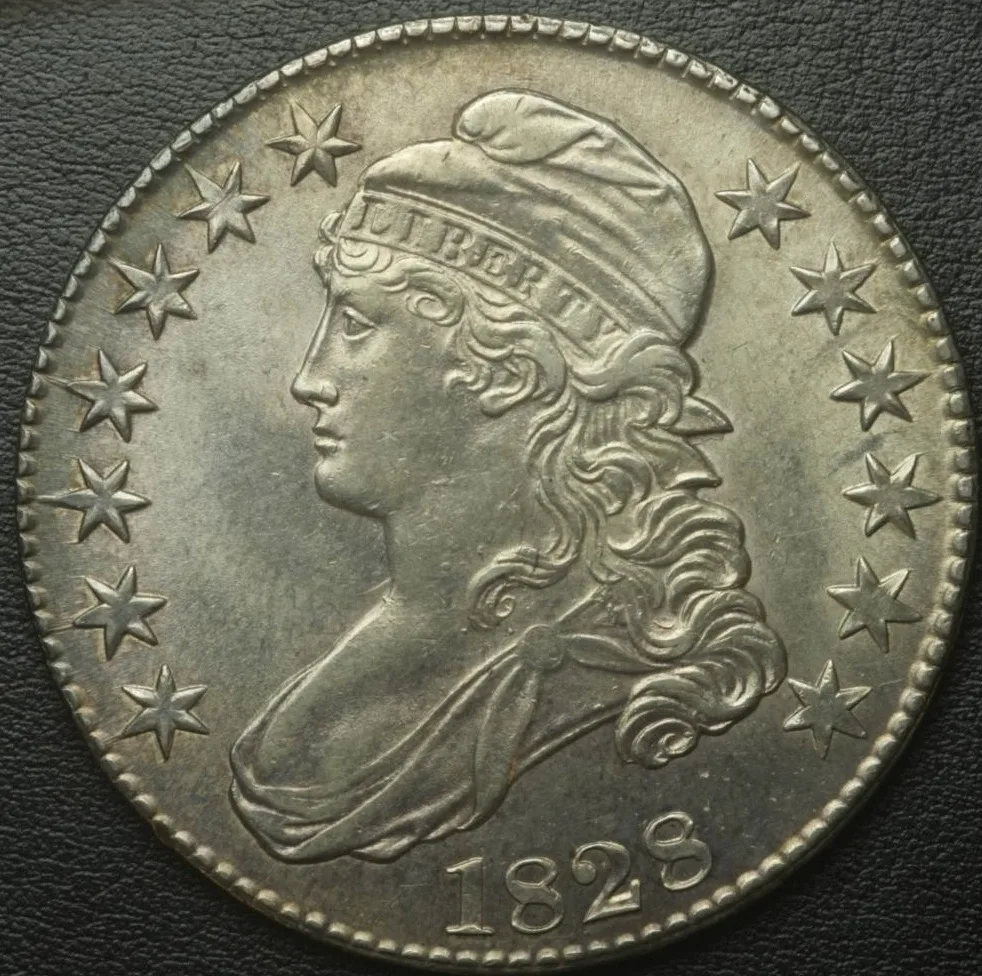
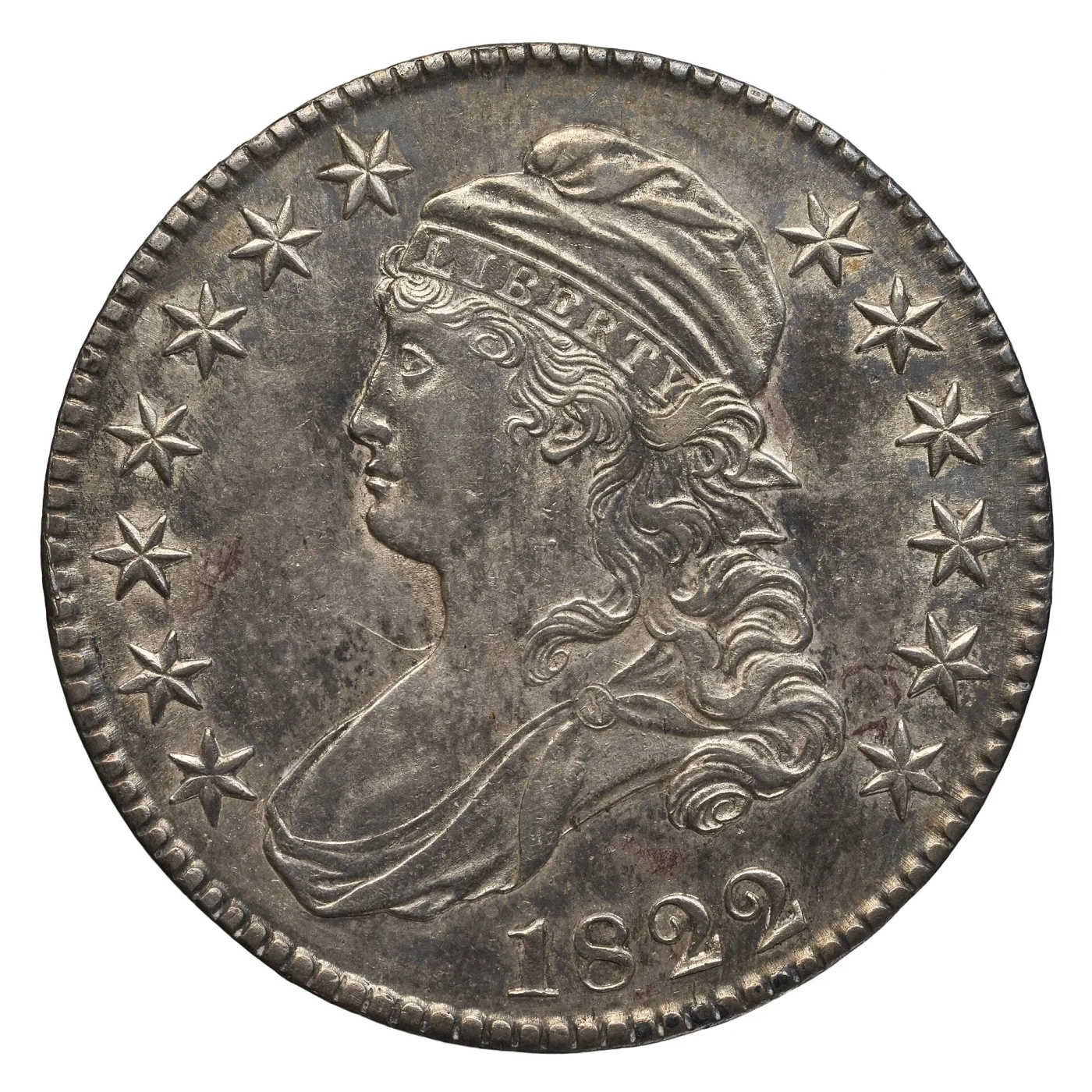
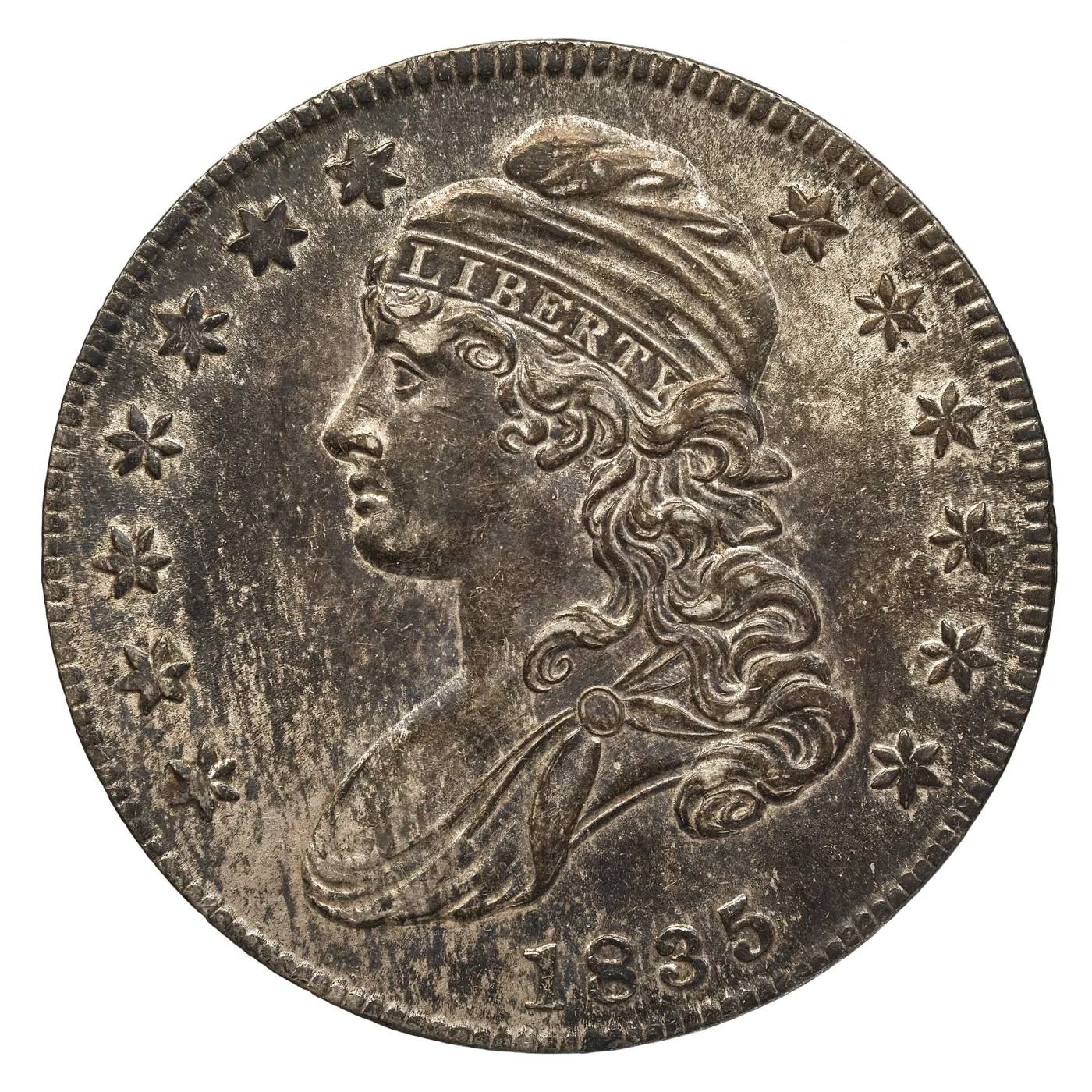
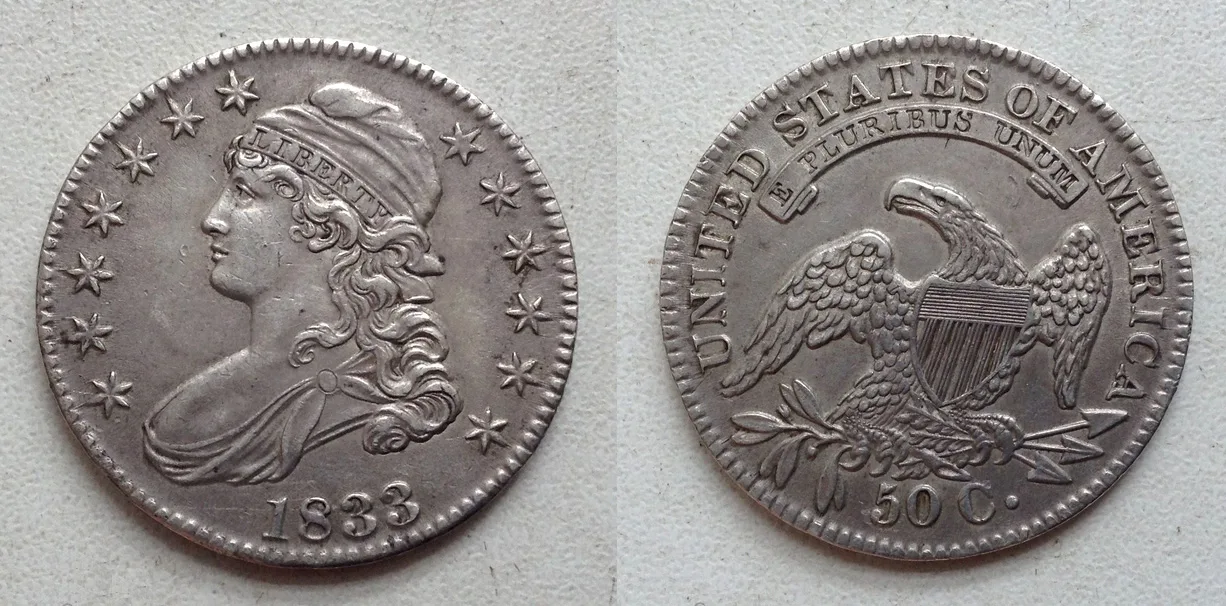
The obverse features Liberty’s bust facing left, wearing a soft cloth cap with the word LIBERTY banded across it. Hair curls flow from beneath the cap and down behind the neck. Seven stars appear to the left of Liberty and six to the right, totaling thirteen for the original colonies. The date appears in the exergue beneath the bust. The high points most vulnerable to wear are the cap band, the curl above the ear, the cheekbone, and the drapery clasp at the bust truncation.
The LIBERTY band on the cap is the primary obverse grading reference. Full LIBERTY visibility is required for grades above About Good-3. By Fine-12, the band lettering should be sharp; by Extremely Fine-40, the cap folds and individual hair curls should be visible. This grading logic mirrors what you see on the Seated Liberty Dollar — different design, same principle of graduated visibility on a focal element.
Reverse (Tails Side)
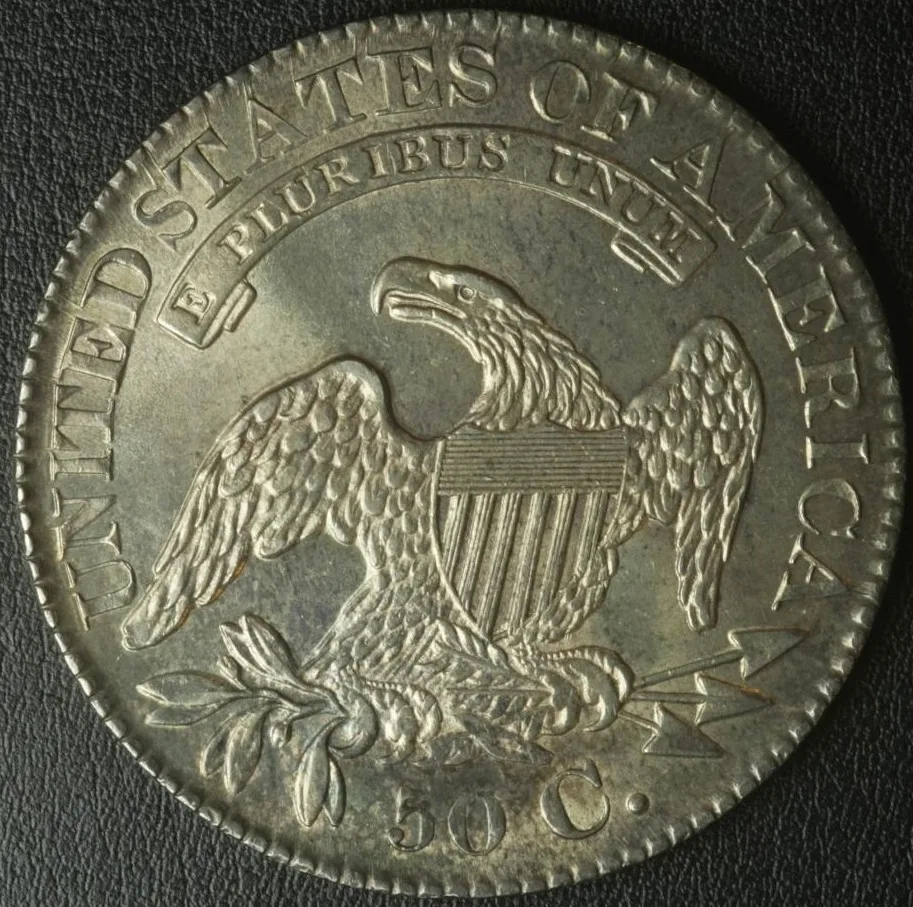
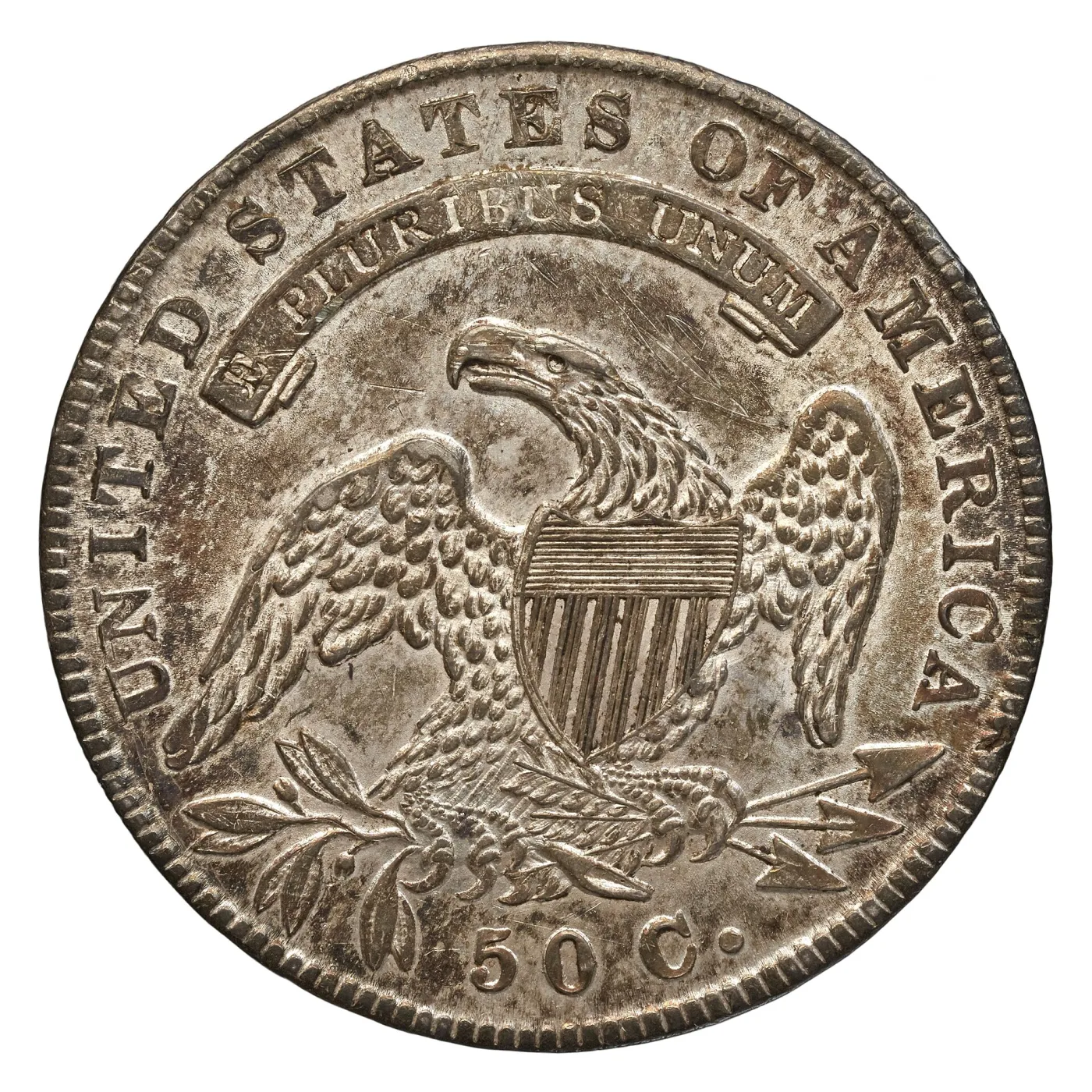
The reverse features a heraldic eagle with a Union shield on its breast, holding three arrows in its left talon and an olive branch with leaves and berries in its right talon. A scroll above the eagle reads E PLURIBUS UNUM. The legend UNITED STATES OF AMERICA arches across the top, and the denomination 50 C. (note the abbreviation, not “HALF DOLLAR”) appears at the bottom on lettered-edge issues, changing to HALF DOL. on reeded-edge issues from 1836. The eagle’s claw position relative to the arrows and branch, the number of horizontal lines in the shield, and the leaf detail in the branch are all variety-defining elements.
Edge Lettering (1807-1836)
The most distinctive feature of the early Capped Bust Half Dollar is the lettered edge. The edge is incused with the words FIFTY CENTS OR HALF A DOLLAR, applied by a Castaing machine before the planchet was struck. Stars or ornaments separate the words. This edge inscription was both a security feature (preventing edge-shaving of silver) and a denomination statement, since on heavily worn coins the obverse and reverse legends might be illegible while the edge remained readable. The lettered edge is one of the easiest at-a-glance ways to confirm an early Capped Bust Half rather than a later reeded-edge issue or a counterfeit.
Lettered Edge vs Reeded Edge: The 1836 Transition
The single most important variety distinction in the Capped Bust Half Dollar series is the change from lettered edge to reeded edge that began in 1836. This transition reflected the Mint’s adoption of steam-powered close-collar coinage, which simultaneously reeded the edge during striking and produced more uniform planchets. The change affected design, diameter, weight, and how the coins are collected.
Lettered Edge (1807-1836)
The lettered-edge variety is the long original run of the series. Specifications:
- Diameter: 32.5 mm (slightly variable due to open-collar striking)
- Weight: 13.48 grams
- Composition: 0.8924 silver, 0.1076 copper
- Edge: FIFTY CENTS OR HALF A DOLLAR, incused, with stars between words
- Reverse denomination: 50 C.
- Striking: Open-collar screw press
Reeded Edge (1836-1839)
The reeded-edge variety reflects the Mint’s transition to modern close-collar steam coinage. Specifications:
- Diameter: 30 mm (smaller, uniform)
- Weight: 13.36 grams (very slightly lighter)
- Composition: 0.900 silver, 0.100 copper (new standard adopted 1837)
- Edge: Reeded (vertical grooves)
- Reverse denomination: HALF DOL.
- Striking: Close-collar steam press
Identifying the Two Types
- Look at the edge first. Lettered = pre-1836 (with the rare 1836 lettered-edge transition piece). Reeded = 1836-1839.
- Measure the diameter. 32.5 mm = lettered edge. 30 mm = reeded edge. The size difference is visible to the naked eye when the two are placed side by side.
- Read the reverse denomination. “50 C.” = lettered edge. “HALF DOL.” = reeded edge.
- Quick check: If you cannot examine the edge directly (slabbed coin), use the diameter and the reverse abbreviation as confirming evidence.
The 1836 Transition Year
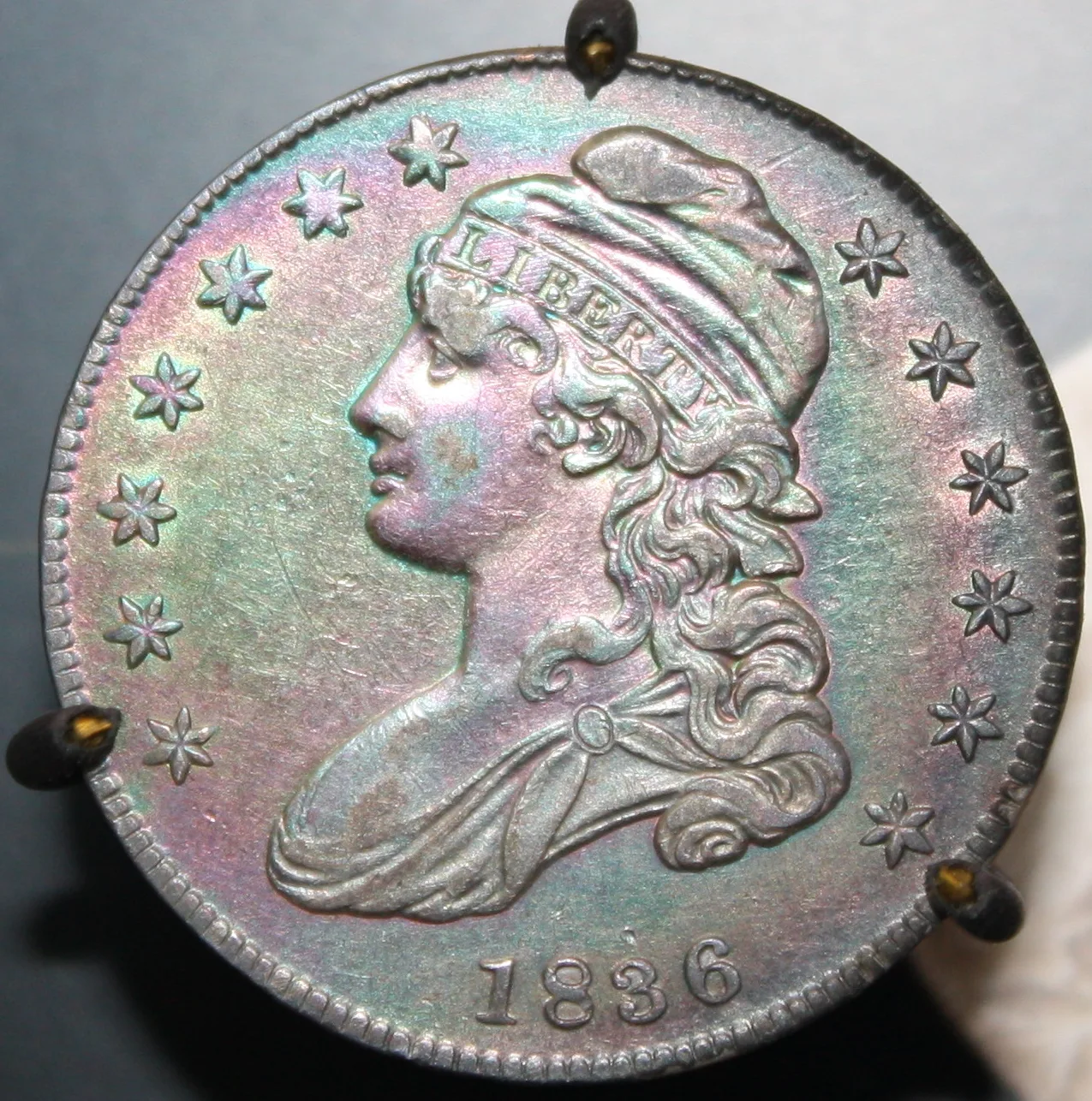
The 1836 date exists in both lettered-edge and reeded-edge formats. The 1836 reeded edge is one of the famous rarities of US numismatics: only about 1,200 were struck as proofs and circulation strikes combined, and a problem-free example in About Uncirculated runs $25,000 or more. The 1836 lettered edge, by contrast, is a common date with several Overton varieties available for under $200 in circulated grades.
Composition and Specifications
Knowing the metal content matters for both authentication and bullion-floor valuation. Capped Bust Halves were struck in 0.8924 silver from 1807 through 1836, then 0.900 silver from 1837 onward following the Mint Act of 1837 that standardized silver fineness across all US coinage. This same 0.900 standard would carry through to the Morgan Silver Dollar, the Walking Liberty Half Dollar, and beyond.
Silver Content
A Capped Bust Half Dollar contains approximately 0.3866 troy ounces of pure silver (lettered edge, 13.48 g at 0.8924) or 0.3866 troy ounces (reeded edge, 13.36 g at 0.900) — close enough to identical that the bullion floor is the same in practice. At a silver spot price of $30/oz, the melt value is approximately $11.60. This sets a hard floor on valuations: no problem-free Capped Bust Half should ever sell for less than its melt value, even in cull condition.
Weight as Authentication Tool
Use a jeweler’s scale accurate to 0.01 grams. A genuine lettered-edge Capped Bust Half should weigh 13.48 grams ± 0.15 grams. A genuine reeded-edge piece should weigh 13.36 grams ± 0.10 grams. Significant deviation (more than 0.3 g low) suggests either heavy wear (unusual on a coin already worn enough to weigh light), edge filing (check the edge for evidence), or a counterfeit. Modern silver-clad counterfeits often weigh correctly because they are full-silver fakes designed to fool weight testing alone — combine weight with diameter, edge, and design checks.
The Overton Variety System
The defining feature of Capped Bust Half collecting is the Overton variety system. Because every die was hand-engraved with date numerals and lettering punched individually into the working dies, no two dies are exactly alike. Al C. Overton’s 1967 reference (now in its updated Parsley editions) catalogues each die marriage — the unique combination of an obverse die paired with a reverse die — and assigns it a number like “1832 O.105.” There are roughly 450 known die marriages across the lettered-edge series alone.
Why Varieties Matter
For most dates, the basic date is common and varieties are roughly equal in value. But certain die marriages are scarce, rare, or famously prized. The 1817/4 overdate (O.102a) is one of the most valuable American coins of any series — fewer than ten examples are known, and one in Fine condition can bring over $400,000 at auction. The 1815/2 (the only date for which there is no non-overdate variety) is a permanent key in any complete set. The 1827 has several “square base 2” vs “curl base 2” varieties that affect price. Variety collecting transforms a thirty-three-year series into a near-infinite collecting universe.
How to Attribute by Overton Number
Attribution requires a strong loupe (10x minimum, 16x preferred), good lighting, and a copy of the Overton-Parsley reference (or a digital equivalent like the EAC database). The attribution process:
- Step 1: Identify the date precisely, including any overdate or repunching.
- Step 2: Examine star positions relative to the date and to Liberty’s bust. Distance and angle of nearest stars are diagnostic.
- Step 3: Look at letter spacing in LIBERTY on the cap band, particularly the position of the L relative to the cap edge.
- Step 4: Examine the reverse for arrow tail position relative to claws, leaf count and arrangement, and lettering placement in UNITED STATES OF AMERICA.
- Step 5: Match against the Overton plates. Each variety has photos of obverse and reverse with diagnostic markers identified.
Common Beginner Pitfalls
Two warnings for new variety collectors. First, do not mistake post-strike damage (a scratch, a dig, a planchet defect) for a die feature. Die features appear identically on all coins struck from that die marriage; damage is unique to the individual coin. Second, the most-cited diagnostic is sometimes not the most reliable — Overton himself noted that some dies wore and cracked over their working life, so a late-die-state coin may show features that a fresh-die-state coin lacks. Always confirm with multiple diagnostics, not just one.

Key Dates and Major Rarities
While most Capped Bust Halves are common in circulated grades, several dates and varieties are conditional rarities or absolute rarities. Knowing the key dates protects you from passing up a treasure or overpaying for a common piece sold as scarce.
1815/2 — The Only 1815
The 1815 Capped Bust Half exists only as an overdate (1815/2 — the 1815 die was made by re-engraving an 1812 die). Mintage was 47,150, the lowest of any business-strike date in the series. A Good-4 example brings $1,200; a Mint State example can bring $80,000+. Every collection of the series must address this date, and it is a permanent key.
1817/4 — The Legendary Overdate
Overton-102a is the 1817/4 overdate, where an 1817 die was punched over a previously-prepared 1814 die. Fewer than ten examples are known across all grades. This is among the rarest American coins of any series — when one appears at auction, it draws six-figure bids. Most collectors will never own one, but knowing it exists is essential to recognize one if it appears in an old collection or estate.
1836 Reeded Edge
The 1836 reeded edge represents the experimental first year of close-collar coinage. Mintage was only about 1,200. Surviving examples in problem-free Mint State bring $30,000-$80,000 depending on grade and provenance. Even in About Uncirculated, expect $20,000+. Authentication is critical — many counterfeit and altered-date examples exist.
1838-O and 1839-O — Branch Mint Rarities
The New Orleans branch mint struck its first half dollars in 1838-O — but only 20 proof-only examples were produced as a special striking, with no business-strike production for that date. The 1838-O is one of the most legendary American rarities, with examples bringing $300,000-$500,000+. The 1839-O is the first New Orleans business-strike half dollar, with a mintage of 178,976 and an O mint mark above the date on the obverse. The 1839-O is collectible (a Fine-12 brings $400; About Uncirculated $1,500), but it remains a key first-year branch-mint piece.
1839 Reeded Edge — Series Closing
The 1839 was the final year of Capped Bust Half production. Christian Gobrecht’s Seated Liberty Half Dollar design replaced the Capped Bust later in 1839, beginning a new chapter that would carry through the Civil War and to the Barber-era redesign of 1892. Late 1839 Capped Bust Halves were quickly hoarded as the last of their kind, which is why some dates are surprisingly available in higher grades.
Overdates and Repunched Dates
Overdates and repunched dates are among the most popular collectibles in the Capped Bust series. They occurred because dies were expensive to make, and the Mint frequently re-used a die from the previous year by re-engraving the date over the older one. The result is a date where you can see traces of both numerals if you look closely.
Major Overdates
- 1812/1: Two known varieties — small 8 and large 8. Both bring $200+ in Fine-12, more in higher grades.
- 1814/3: Underdigit 3 visible inside the upper loops of the 4. Common in Good but scarce in Mint State.
- 1815/2: The only 1815 issue. Always an overdate.
- 1817/3: Faint underdigit 3 visible. More common than the 1817/4.
- 1817/4: The legendary rarity. Fewer than ten known.
- 1820/19: Two varieties (square base 2 and curl base 2). Strong underdigit visible.
- 1823 patched 3 / “ugly 3”: Multiple repunched-date varieties.
- 1828/7: Faint underdigit 7. Subtle.
Authentication of Overdates
Overdates are easily faked by altering the date with a graver or chemical etching, especially for the 1817/4. Authentication keys: the underdigit must show the correct shape (not just a vague mark), it must align correctly with the overdate punch, and the surrounding fields must not show tooling marks. Use 16x magnification and compare against confirmed examples. For high-value overdates, only buy slabbed examples from PCGS, NGC, or ANACS — never raw, regardless of how good the seller’s reputation is.
Mint Marks: Philadelphia and New Orleans
Capped Bust Half Dollars were struck almost exclusively at the Philadelphia Mint, which used no mint mark. The New Orleans branch mint opened in 1838 and produced its first halves that year — the legendary 1838-O proof-only pieces. The 1839-O is the first business-strike branch issue.
Mint Mark Location
The O mint mark on 1838-O and 1839-O appears on the obverse, above the date in the field below Liberty’s bust. This is unusual — most subsequent US coinage placed mint marks on the reverse. The placement makes the mint mark vulnerable to wear, and worn examples may show only a faint trace. Authentication of branch-mint Capped Bust Halves should always include verification of the mint mark with strong magnification.
The Mint Mark and 19th-Century Coinage
Branch-mint coinage from New Orleans, Carson City, San Francisco, and other branches would become a major collecting focus throughout the 19th century. Carson City coinage is famously associated with the Morgan Silver Dollar and Trade Dollar series; New Orleans coinage stretches from these earliest 1838-O halves through the late 19th century. The 1838-O and 1839-O are foundational pieces in any history of US branch-mint coinage.
Grading Capped Bust Halves
Grading Capped Bust Halves uses the standard 70-point Sheldon scale with several series-specific reference points. The cap band, the curl above the ear, and the shield horizontal lines are the primary grading focal areas.
Circulated Grades
- Good-4 (G-4): LIBERTY visible on cap band but worn. Date legible. Major design elements outlined. Stars flat. Eagle’s head and shield outlined but worn.
- Very Good-8 (VG-8): LIBERTY complete and clear. Some hair detail visible behind the ear. Eagle feathers begin to show in protected areas.
- Fine-12 (F-12): Cap band crisp. Two or three hair curls visible. Shield horizontal lines partially visible. Eagle wing feathers show some separation.
- Very Fine-20 (VF-20): Most hair detail visible. Cap folds beginning to show. Shield lines mostly complete. Eagle feathers well-defined in most areas.
- Extremely Fine-40 (EF-40): All hair detail sharp. Cap folds clear. Shield horizontal lines complete. Light wear only on highest points.
- About Uncirculated-50 (AU-50): Trace of wear on highest points only — typically the cap band and the eagle’s neck feathers. Most luster present in protected areas.
Mint State Grades
- MS-60: No wear, but heavy bag marks, possible weak strike, dull luster.
- MS-63: Choice — moderate marks, decent luster, attractive eye appeal.
- MS-65: Gem — minimal marks, full luster, sharp strike, no major distractions.
- MS-67+: Near-perfect. Few examples exist. Premium pricing.
Strike vs Wear
An important distinction in this series: weak strike is not the same as wear. Many Capped Bust Halves were struck from worn dies or with insufficient pressure, leaving “weak” details on coins that are otherwise Mint State. Look at the fields and Liberty’s cheek — if these are smooth and lustrous with no friction, the coin is uncirculated even if the design details are soft. This same principle applies across early American silver and into Seated Liberty coinage.
Authentication and Spotting Counterfeits
Capped Bust Halves attract counterfeiters because of their high-value rarities (1815/2, 1817/4, 1836 reeded edge, 1838-O) and because they are old enough that crude fakes can sometimes be passed off as “early American” provenance pieces. Authentication strategy combines physical measurement, design diagnostics, and edge inspection.
Physical Tests
- Weight: 13.48 g (lettered) or 13.36 g (reeded), ± 0.15 g.
- Diameter: 32.5 mm (lettered) or 30 mm (reeded). Critical for distinguishing the two types.
- Magnetism: Silver is non-magnetic. A magnetic coin is fake.
- Specific gravity: Genuine 0.8924 silver = 10.3-10.4. Genuine 0.900 silver = 10.4. Significant deviation is suspicious.
Design Diagnostics
- Strike sharpness: Genuine coins show consistent strike across the design even when worn. Cast counterfeits show fuzzy lettering and missing fine details.
- Edge: Lettered edges should show clean, deep, evenly-spaced incused letters. Cast fakes show lettered edges with rounded, fuzzy letters or seams.
- Reeded edges: Should be sharp and uniform. Counterfeit reeded edges often show uneven or shallow reeds.
- Surface: Genuine surfaces show smooth flow lines under magnification; cast fakes show pebbly granular texture.
Slabbed Coin Strategy
For any Capped Bust Half priced over $500, strongly prefer slabbed examples from PCGS, NGC, ANACS, or ICG. The certification fee is small relative to the price, and the third-party graders are experienced at detecting counterfeits and altered dates. For lower-value common dates, raw coins from established dealers with return privileges are usually safe.
Current Market Values and Price Guide
Values vary widely by date, variety, and grade. The figures below reflect retail pricing as of 2026 and should be confirmed against current auction records before any major purchase. Wholesale and dealer-buy prices typically run 30-50% below retail.
Common Dates (1808-1814, 1818-1834, 1836-1839)
- Good-4: $80-$120
- Fine-12: $120-$180
- Very Fine-20: $200-$350
- Extremely Fine-40: $400-$700
- AU-50: $700-$1,200
- MS-63: $1,500-$3,500
- MS-65: $5,000-$15,000
Semi-Key Dates
- 1807 (first year): $200-$300 G-4; $3,000+ MS-63
- 1815/2: $1,200-$1,800 G-4; $80,000+ MS-63
- 1817/3 overdate: $200-$300 G-4; $5,000+ MS-63
- 1839-O (first business-strike branch mint): $400-$600 F-12; $5,000+ AU-50
Major Rarities
- 1817/4: $100,000+ in any grade. Auction records over $400,000.
- 1836 reeded edge: $20,000-$30,000 AU; $50,000+ MS.
- 1838-O proof: $300,000-$500,000+. Less than 20 known.
Bullion Floor
Even cull condition Capped Bust Halves carry a bullion floor of approximately $11-$12 (at $30/oz silver). Damaged, holed, or heavily polished examples often trade near melt plus a small numismatic premium. Never sell a Capped Bust Half below melt — and never pay melt for a clean Good-condition piece, which should always carry a $40-$60 numismatic premium minimum.
Building a Capped Bust Half Dollar Collection
Capped Bust Halves are one of the most rewarding series for serious collectors because the field is deep enough to occupy decades of pursuit. Here are the standard collecting paths.
Date Set (33 Coins)
The basic date set runs from 1807 through 1839, one coin per year. Most dates are affordable in Good through Fine; the 1815/2 is the only difficult inclusion. Total budget for a complete date set in average circulated condition: $5,000-$8,000. This is the standard entry point and an excellent way to learn the series before committing to varieties.
Type Set (3 Coins)
For collectors who want the design but not the depth: one lettered-edge example, one reeded-edge example, and one branch-mint example (1839-O). Total budget in middle circulated grades: $1,000-$2,000. This pairs naturally with type sets of other classic US silver — Seated Liberty Dollar, Morgan Dollar, Walking Liberty Half Dollar — to build a portrait of US silver design evolution.
Overton Variety Set
The deep collecting path. Some collectors pursue every Overton variety (impossible — over 450 lettered-edge varieties alone, with several known by only one or two specimens). More realistic targets: a complete date-and-major-variety set (about 100 coins), or a one-per-year-by-Overton-number set, or a single-year deep dive (every Overton variety of 1832, for example). The variety route is where Capped Bust Halves become a lifelong pursuit.
Where to Buy
Major auction houses (Heritage, Stack’s Bowers, Goldberg) handle the highest-value pieces. Specialist dealers in early American silver are the best source for variety material. Coin shows offer hands-on examination — invaluable for variety attribution. Online marketplaces work for slabbed common-date material but require caution for raw coins, where authentication risk is real.
Storage and Preservation
Capped Bust Halves have already survived nearly 200 years; your job is to ensure they survive another 200. Silver tarnishes; copper alloy components react; PVC contamination is permanent. The principles below apply broadly to early American silver, with parallels to Seated Liberty Dollar and other early US series preservation.
Holders
- Slabs (PCGS/NGC/ANACS): Best long-term storage. Inert plastic, sealed environment, third-party-graded.
- Inert Mylar flips: Acceptable for raw coins. Avoid PVC flips at all costs.
- Cardboard 2x2 holders: Acceptable short-term but cardboard releases sulfur over time.
- Coin albums: Use only albums with inert plastic pockets, never PVC vinyl.
Environment
- Humidity: Below 50% RH. Silica gel desiccant in storage area.
- Temperature: Stable, room temperature. Avoid temperature swings that cause condensation.
- Light: Dark storage. UV light can affect toning patterns.
- Air: Filtered or sealed. Ambient sulfur compounds tarnish silver.
Cleaning — Don’t
Never clean a Capped Bust Half. Cleaning destroys numismatic value, often reducing a coin’s price by 50-80%. Original toning, even when dark or splotchy, is part of the coin’s history and is valued by collectors. If a coin is severely contaminated (PVC residue, for example), professional conservation by NCS (Numismatic Conservation Services) is the only acceptable intervention — never DIY cleaning.
Frequently Asked Questions
How can I tell a Capped Bust Half Dollar from a Seated Liberty Half Dollar?
Look at the obverse. The Capped Bust shows a bust portrait of Liberty wearing a soft cloth cap. The Seated Liberty Half Dollar design (used on the half dollar from 1839 onward) shows a full-figure Liberty seated on a rock holding a shield. The transition occurred in 1839 — both designs exist for that year.
What is an "Overton number"?
An Overton number identifies a specific die marriage — the unique pairing of one obverse die with one reverse die. For example, "1832 O.105" means an 1832 Capped Bust Half struck from die marriage number 105 of that year. The Overton-Parsley reference catalogues all known marriages.
Are all 1815 Capped Bust Halves overdates?
Yes. The 1815 was struck only from dies that had been an 1812 die re-engraved with a new date — making every 1815 a 1815/2 overdate. There is no non-overdate 1815.
Should I clean a tarnished Capped Bust Half?
No. Cleaning destroys numismatic value. Original toning is desired by collectors, even when dark. If contamination requires intervention, use professional conservation (NCS) only.
What's the difference between a lettered edge and a reeded edge?
The lettered edge has the words FIFTY CENTS OR HALF A DOLLAR incused around the edge, applied before striking. The reeded edge has vertical grooves applied during striking by a close-collar die. Lettered edge = 1807-1836; reeded edge = 1836-1839.
How do I authenticate a high-value Capped Bust Half?
For any coin priced over $500, buy only PCGS, NGC, or ANACS slabbed examples. The certification fee is minimal compared to the value and provides authentication backed by guarantee. For raw coins, weigh, measure, and inspect the edge before purchase, and buy only from established dealers with return privileges.
What is the most valuable Capped Bust Half Dollar?
The 1838-O proof-only issue, with fewer than 20 known examples, is the most valuable — examples have brought $300,000-$500,000+ at auction. The 1817/4 overdate is the most valuable business-strike issue, with auction records over $400,000.
Are common Capped Bust Halves a good investment?
As bullion, yes — they always carry their silver value. As numismatic investments, common dates have appreciated steadily but not spectacularly. Key dates and rare varieties have outperformed common dates significantly, but require expertise to identify and authenticate. For most collectors, the value is in the collection itself, not as financial speculation.