Standing Liberty Quarter Identification Guide: Key Dates, Mint Marks, and Values
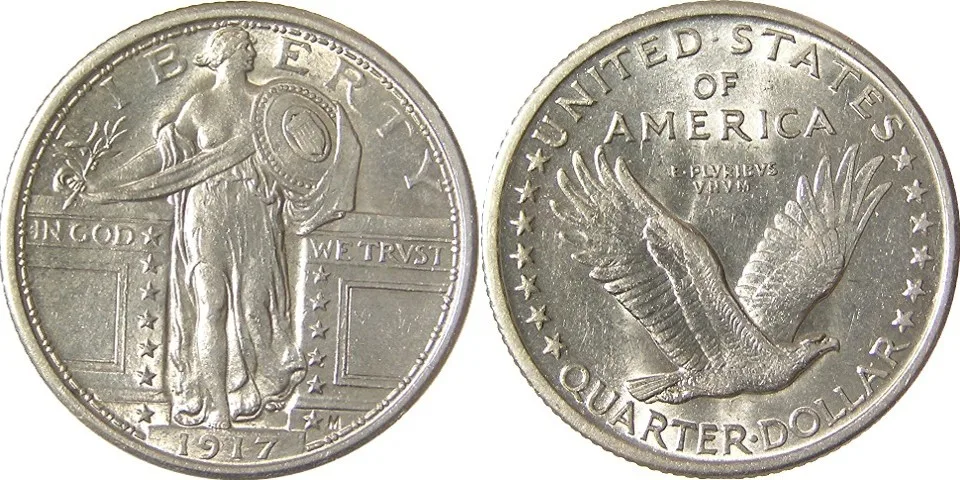
The Standing Liberty Quarter is one of the most artistically celebrated and controversial coins ever produced by the United States Mint. Designed by sculptor Hermon Atkins MacNeil and struck from 1916 through 1930, this silver quarter dollar replaced the long-running Barber Quarter — part of the same three-denomination Liberty Head series as the Barber Dime — and introduced a bold, neoclassical vision of Liberty that captured the turbulent spirit of World War I-era America.
The series is famously divided into two major types. Type 1, minted only in 1916 and part of 1917, shows Liberty with an exposed breast and an open gown. Public reaction, coupled with changing production needs, prompted a redesign later in 1917. Type 2 shows Liberty in chain mail armor, with the eagle repositioned higher on the reverse. These two types, along with later subtype variations and the infamous date-wear problem, make the Standing Liberty Quarter one of the most nuanced short series in American numismatics.
This guide walks through every major identification point for Standing Liberty Quarters: how to tell Type 1 from Type 2, where to find mint marks, which dates are keys, how Full Head designation affects value, how to recognize the 1918/7-S overdate, and what to pay for coins across grades. Whether you have inherited a small hoard of silver quarters or are assembling a complete date-and-mint set, the information below will help you identify and evaluate each coin accurately.
History and Design of the Standing Liberty Quarter
The Standing Liberty Quarter was born out of the same 1916 redesign initiative that produced the Mercury Dime and Walking Liberty Half Dollar. Treasury Secretary William McAdoo, under the Coinage Act of 1890, was permitted to redesign any coin after 25 years of continuous use. The Barber Quarter, designed by Charles Barber and in service since 1892, was eligible for replacement. The Treasury invited three sculptors to compete: Adolph Weinman, Albin Polasek, and Hermon Atkins MacNeil. Weinman won the dime and half dollar competitions, while MacNeil captured the quarter.
MacNeil was already an accomplished public sculptor, known for the Soldiers and Sailors Monument in Albany and work at the Pan-American Exposition. His quarter design reflects the period’s preoccupation with preparedness as the country watched World War I consume Europe. The obverse shows Liberty striding forward through an arched gate, holding a shield in her left hand for defense and extending an olive branch in her right for peace. The reverse displays a powerful eagle in flight.
The Original MacNeil Design
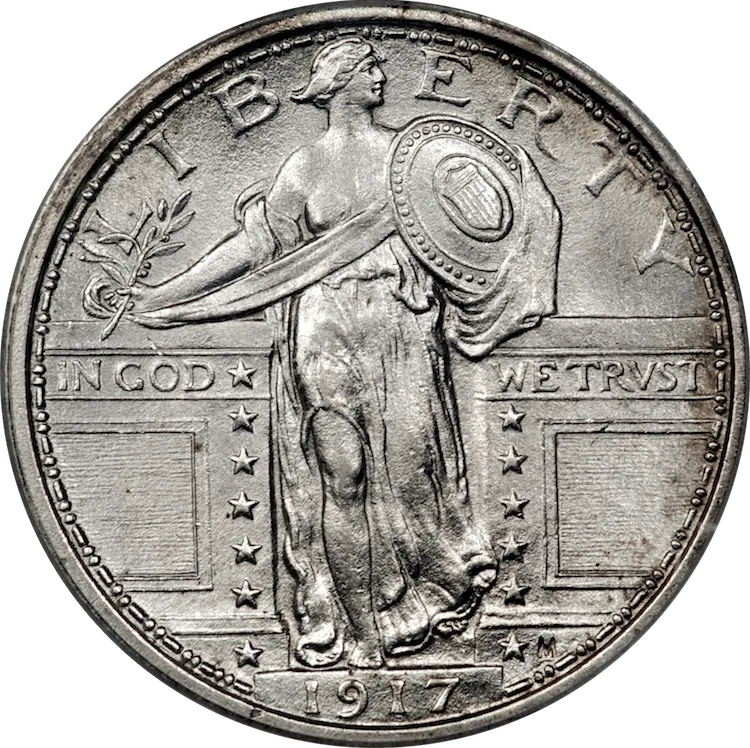
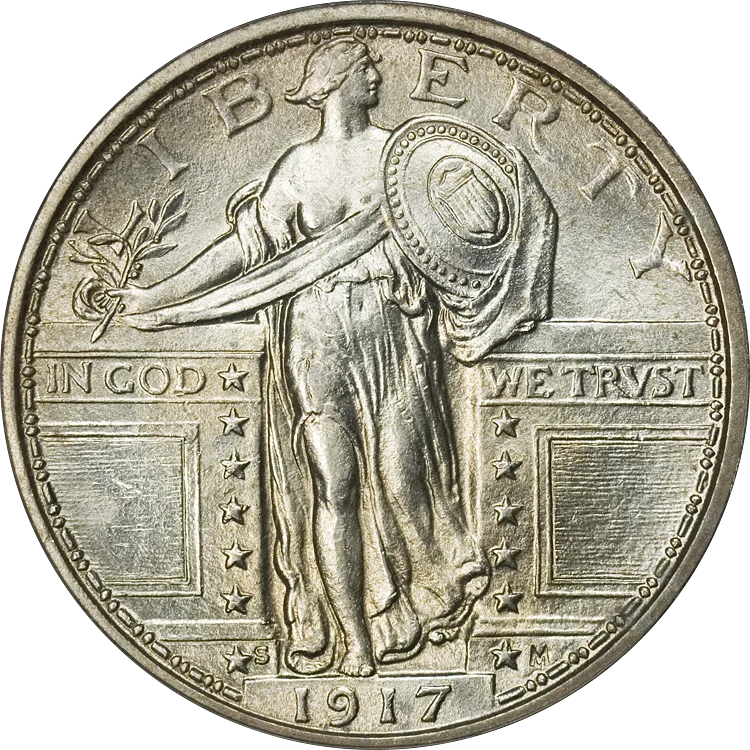
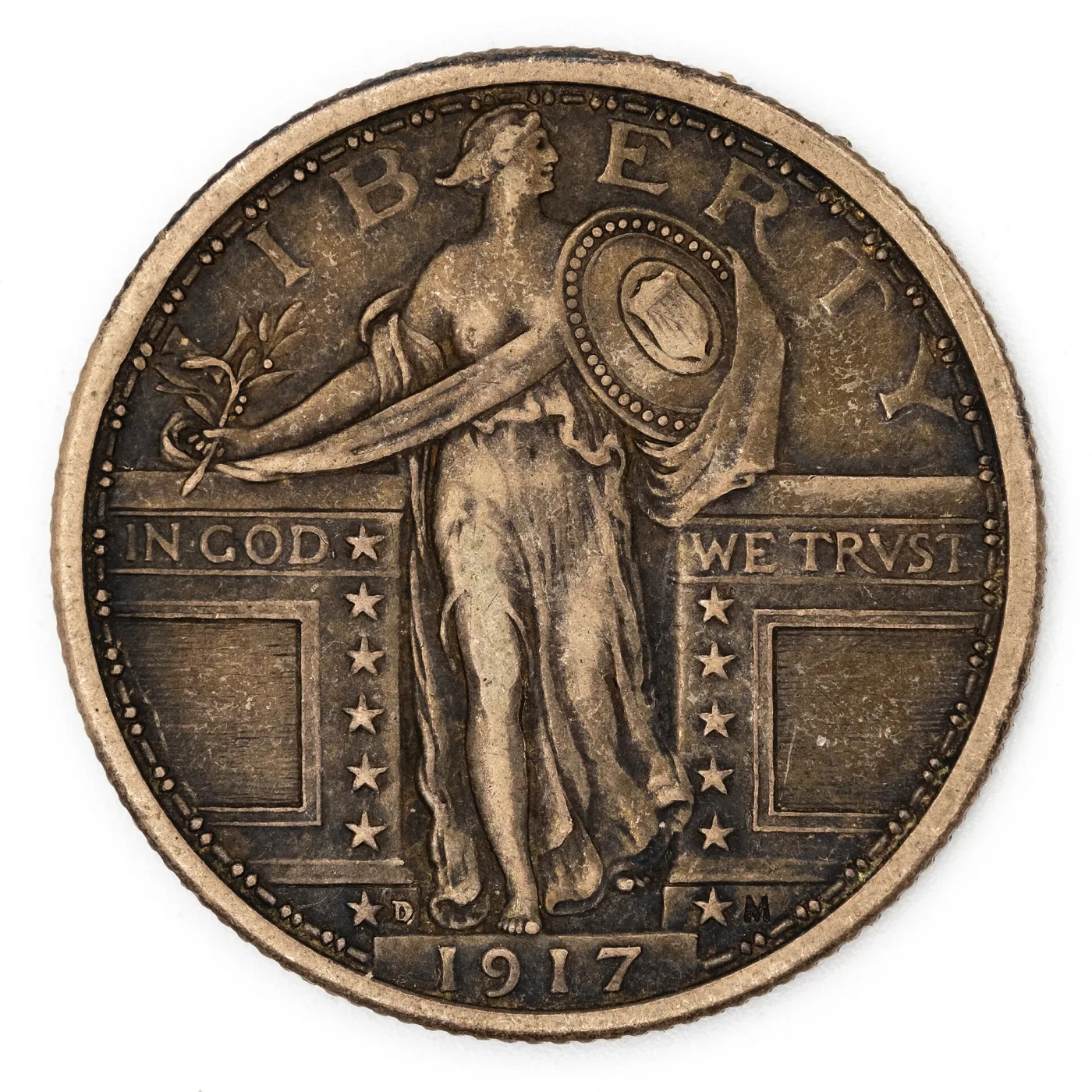
The first version, Type 1, depicts Liberty with her right breast exposed above an open gown. MacNeil’s intent was neoclassical: Liberty as a protective goddess echoing ancient Greek and Roman statuary. Thirteen stars flank the central gate, representing the original colonies. “LIBERTY” arcs across the top, “IN GOD WE TRUST” appears on either side of Liberty, split by the stone gate. The date is placed in the exergue below.
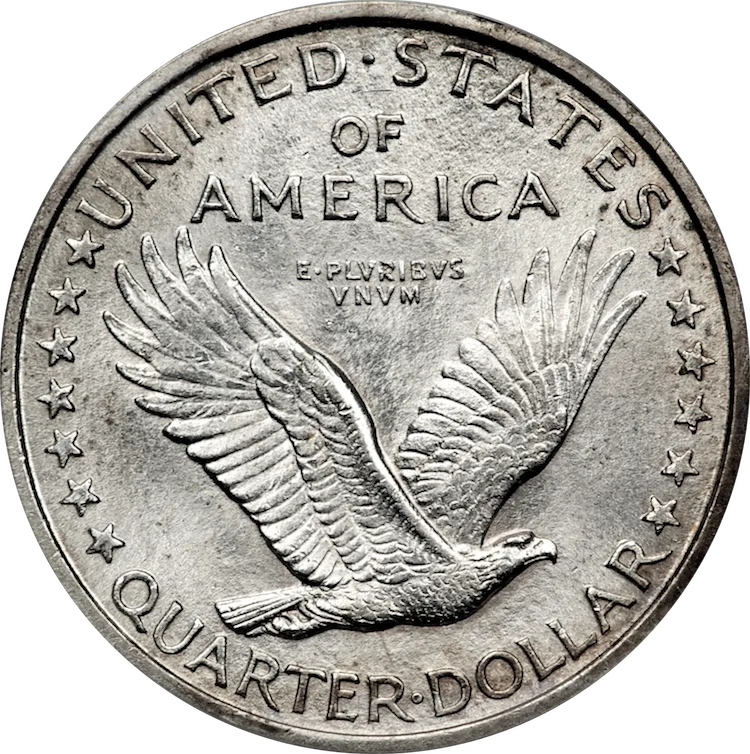
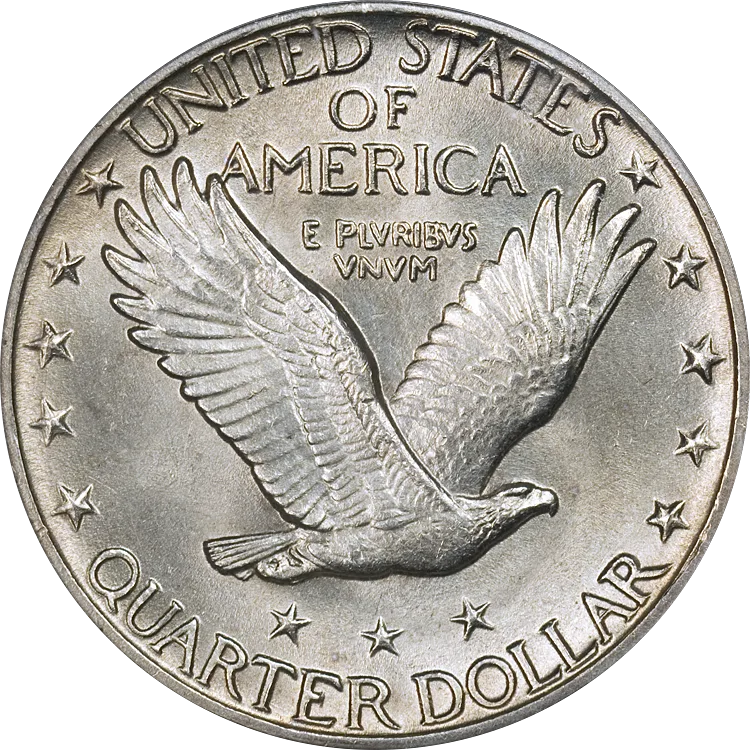
The reverse eagle flies freely across the coin, without any shield or cartouche. Thirteen stars surround the eagle, with “UNITED STATES OF AMERICA” curving above, “E PLURIBUS UNUM” below the eagle, and “QUARTER DOLLAR” along the lower rim. The overall composition is strikingly open and dynamic compared to the more static Morgan Silver Dollar that preceded it in the U.S. coinage lineup.
Production Timeline
Standing Liberty Quarters were struck from 1916 through 1930, with production suspended in 1922. The series spans 15 years and includes 37 regular date-and-mint combinations, making it substantially shorter than contemporaries like the Mercury Dime or Walking Liberty Half Dollar. The series ended in 1930 when the Washington Quarter was introduced to commemorate the bicentennial of George Washington’s birth in 1932.
Physical Specifications and Composition
Confirming a coin’s specifications is the first step in authentication. Standing Liberty Quarters share the same metal composition as other silver U.S. coins of the era, but their diameter and weight set them apart from modern issues.
Dimensions and Weight
Each Standing Liberty Quarter measures 24.3 millimeters in diameter and weighs exactly 6.25 grams. The thickness is approximately 1.75 millimeters, and the edge is reeded with 119 reeds. These specifications remained constant across both Type 1 and Type 2, making weight and size reliable authentication markers. A genuine coin should fall within a narrow tolerance; a coin that weighs significantly under 6.0 grams or over 6.5 grams warrants close inspection.
Metal Composition
The coins are composed of 90% silver and 10% copper. Each contains 0.18084 troy ounces of pure silver, giving even heavily worn examples a substantial melt value tied to current silver prices. The same 90% silver alloy was used for Mercury Dimes, Walking Liberty Half Dollars, and Peace Dollars, reflecting the silver standard of the era.
Strike Characteristics
Strike quality varies significantly across the series. The central details, especially Liberty’s head and the shield rivets, were positioned at the highest point of the die and often struck softly. San Francisco coins tend to show the softest strikes, Denver coins are intermediate, and Philadelphia coins are generally the sharpest. This strike variability is what drives the Full Head designation, discussed later in this guide.
Type 1 vs Type 2: The Great Redesign
Understanding the difference between Type 1 and Type 2 Standing Liberty Quarters is essential for both identification and valuation. The two types represent not only visual changes but also different production years, scarcities, and market dynamics.
Type 1 (1916 and Early 1917)
Type 1 Standing Liberty Quarters show Liberty with an exposed right breast and an open, flowing gown. On the reverse, the eagle flies low on the coin and all thirteen stars run around the sides, leaving the field between the eagle’s tail and QUARTER DOLLAR completely empty. Type 1 coins were produced in 1916 (only 52,000 minted, making it the series key date) and during the early months of 1917 at all three mints.
Type 2 (Mid-1917 through 1930)
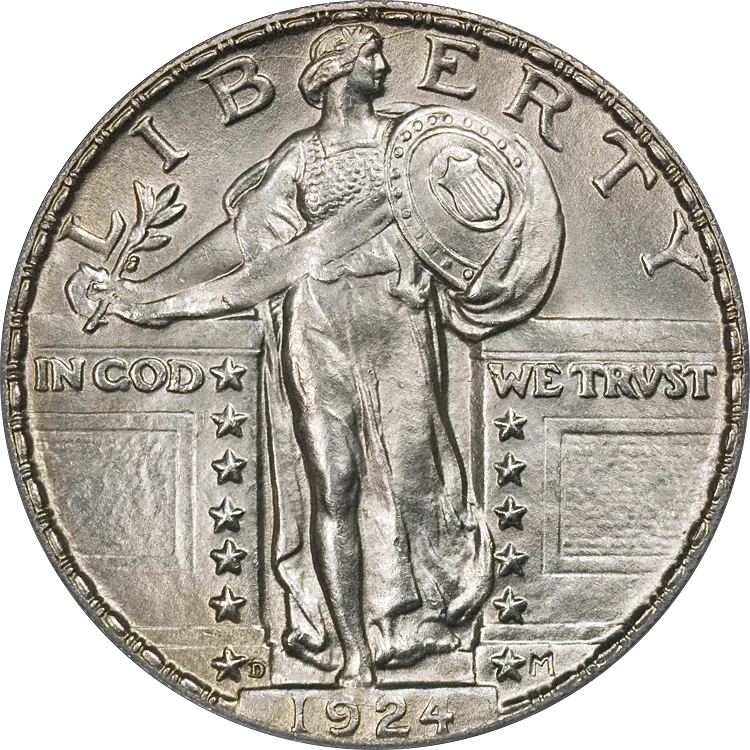
In mid-1917, MacNeil modified the design. Liberty is now shown wearing a coat of chain mail over her torso, covering the breast. The pose and overall composition remain similar, but the addition of armor gives a distinctly different silhouette. On the reverse, the eagle is repositioned higher on the coin, and three of the thirteen stars are moved down into the field it vacated, leaving ten to flank the eagle at the sides. Those three stars beneath the eagle are the quickest way to tell a Type 1 from a Type 2 on a coin whose obverse has worn smooth.
Why the Change?
The conventional narrative suggests that the design was altered due to public outcry over Liberty’s exposed breast, but numismatic research shows the story is more nuanced. MacNeil himself had been dissatisfied with the Mint’s execution of his original design, and he lobbied for modifications. The addition of chain mail also fit the mood of a nation that had just entered World War I, giving Liberty a more defensive, prepared posture. Some scholars argue the Mint quietly used the modesty narrative as cover for a design MacNeil wanted for other reasons.
Identifying Type 1 vs Type 2 at a Glance
- Obverse: Exposed breast = Type 1. Chain mail = Type 2.
- Reverse eagle position: Low, with no stars beneath the eagle = Type 1. Raised, with three stars beneath the eagle = Type 2.
- Year: All 1916 coins are Type 1. 1917 exists in both types. 1918-1930 are all Type 2.
Type 2a vs Type 2b (Recessed Date)
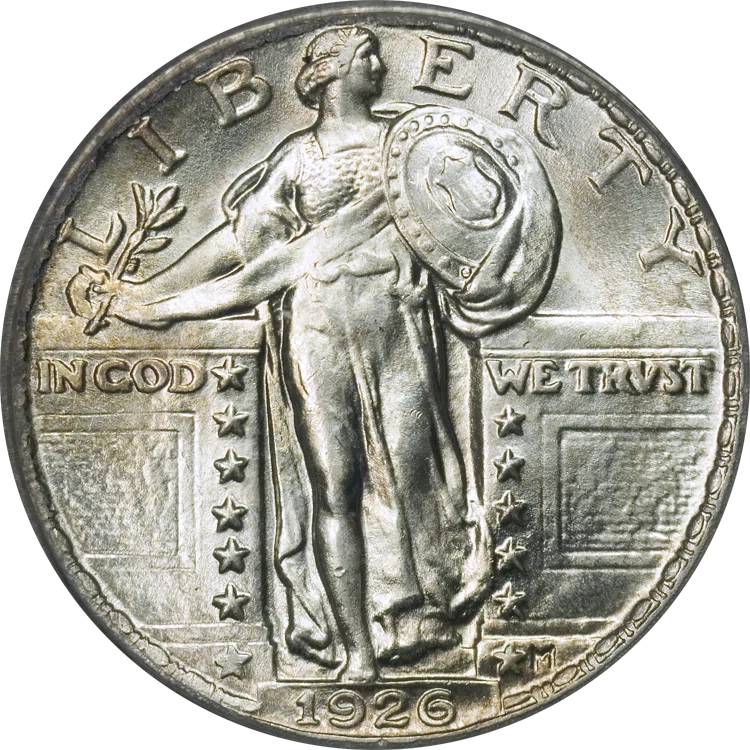
Within Type 2, collectors further distinguish between Type 2a (1917-1924) and Type 2b (1925-1930). Beginning in 1925, the date was recessed into a small pedestal to prevent the rapid wear that plagued earlier issues. This recessed-date subtype is the most common variation collectors will encounter today.
Mint Mark Locations and Identification
Mint marks on Standing Liberty Quarters appear on the obverse, not the reverse, unlike the Buffalo Nickel or Mercury Dime. Knowing exactly where to look will save you time and prevent misidentification.
Where to Find the Mint Mark
The mint mark is located on the obverse, on the left side of the coin, just above and to the left of the date. Specifically, it sits on the pedestal that supports Liberty, between her gown and the bottom of the stone gate. Because the mark is small and low-relief, a 7x or 10x loupe is helpful, especially on worn coins.
Mint Mark Types
- No mint mark (Philadelphia): Philadelphia struck quarters in most years of the series. Philadelphia issues carry no mint mark and are generally the most common.
- “D” (Denver): Denver struck Standing Liberty Quarters in several years, with 1927-D standing out as a notably scarce issue.
- “S” (San Francisco): San Francisco produced the key 1918/7-S overdate, the scarce 1917-S Type 1, and other conditionally rare issues. The 1916 is not among them — the series key was struck at Philadelphia and carries no mint mark.
Reading Worn or Missing Mint Marks
Because of the high-point wear typical of the series, mint marks can fade substantially. Tilting the coin under a single light source often reveals remnants. For pre-1925 coins with worn dates, identifying the mint mark becomes even more critical because without both data points, the coin cannot be attributed to a specific issue.
Key Dates and Rarities
The Standing Liberty Quarter series has several well-known key dates that every collector and dealer should be able to identify. Low mintage, conditional rarity, and overdate status all play roles.
1916: The Series Key
Only 52,000 Standing Liberty Quarters were struck in 1916, all at the Philadelphia Mint. This makes it the lowest-mintage issue in the series and one of the rarest regular-issue 20th-century U.S. coins. In Good-4 condition, a genuine 1916 starts around $4,000 to $5,000. In MS-65 Full Head, it can command $40,000 or more. Because of its value, the 1916 is heavily counterfeited, often by altering the date on a common 1917 Type 1.
1918/7-S Overdate
The 1918/7-S is the most famous die variety in the series. A 1917 die was reused in 1918 by punching an “8” over the “7,” leaving visible traces of the underlying digit. Mintage is uncertain but estimated in the low thousands. Prices start around $2,500 in Good-4 and can exceed $100,000 in MS-65 Full Head. Authentication by a third-party grading service is essential for any claimed 1918/7-S.
Other Major Keys
- 1919-D and 1919-S: Both are scarce, particularly in higher grades with Full Head.
- 1921 (Philadelphia): Mintage of 1,916,000, scarce in all grades.
- 1923-S: Mintage of 1,360,000, one of the scarcest issues of Type 2a.
- 1927-S: Mintage of 396,000, extremely rare with Full Head. MS-65 FH examples can exceed $200,000.
Semi-Keys and Better Dates
Several dates carry significant premiums without reaching key-date status: 1917-D Type 1, 1917-S Type 1, 1920-D, 1924-D, 1924-S, and 1926-S. These are all conditionally rare in Mint State with Full Head and should be studied individually before purchase.

The 1918/7-S Overdate
The 1918/7-S overdate deserves its own detailed discussion because it is among the most valuable and frequently misattributed coins in the Standing Liberty series.
How the Overdate Was Created
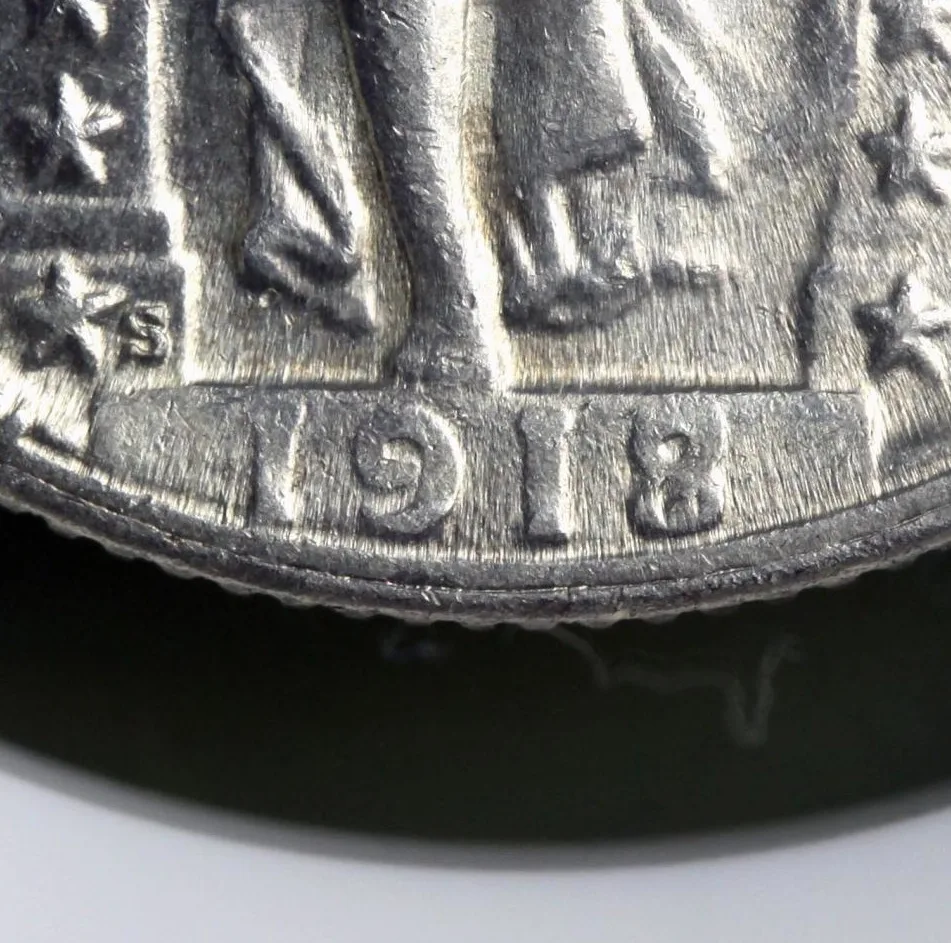
At the end of 1917, working dies with the 1917 date were prepared for use the following year. Rather than discarding the dies, the Mint repunched an “8” over the existing “7.” The result is a date that appears as “1918” at a glance but shows a distinct curve of the underlying “7” within the loop of the “8,” particularly near the top of the digit.
How to Spot It
Genuine 1918/7-S coins show a clear stroke of the “7” extending out of the upper-left portion of the “8.” Under magnification, you should see a secondary curve passing through the center of the “8,” where the top of the “7” crossed. A loupe of 10x or higher is recommended. Circulated examples retain traces of the overdate even in lower grades, though details become harder to see as wear progresses.
Authentication
Given the coin’s value, virtually all offered examples should carry certification from PCGS, NGC, or ANACS. Raw 1918/7-S coins should be treated with strong skepticism. Altered-date counterfeits are produced by adding an engraved “7” to a genuine 1918-S. These fakes typically show tool marks and lack the precise depth and angle of a genuine overdate.
Full Head Designation Explained
Just as Mercury Dimes have Full Bands and Franklin Half Dollars have Full Bell Lines, Standing Liberty Quarters have the coveted Full Head (FH) designation, which can multiply a coin’s value many times over.
What Constitutes Full Head
Full Head is determined by three specific details visible on Liberty’s head:
- Three complete leaves in Liberty’s hair
- A complete, unbroken hairline around her face
- A clear, indented ear hole
All three must be present for a coin to qualify for Full Head. PCGS uses slightly different criteria than NGC in edge cases, so some coins that grade FH at one service may not at another. For high-value purchases, always verify which grading standard applies.
Impact on Value
The Full Head premium varies by date. For common dates like 1930, an MS-65 might sell for $300 while an MS-65 FH can bring $450. For conditionally rare issues like 1927-S, the difference can be staggering. An MS-65 might sell for $30,000, while an MS-65 FH can command $200,000 or more. Collectors building registry sets will pay significant premiums for Full Head examples, especially on better dates.
Strike Variation by Mint
Philadelphia coins are most likely to show Full Head details due to generally sharper strikes. San Francisco issues are the least likely, with many issues having no known Full Head examples or only a handful certified. Denver falls in the middle. When evaluating a raw coin for Full Head potential, a sharp strike on Liberty’s body, shield rivets, and dated pedestal is often a good sign that the head details were also well struck.
The Infamous Date-Wear Problem
One of the most frustrating aspects of collecting early Standing Liberty Quarters is the rapid wear of the date. Because the date was placed in a raised position on the lower obverse, it took the brunt of circulation wear and often wore away completely, leaving the coin unattributable.
Why It Happens
On Type 1 and early Type 2a coins (1916-1924), the date sits atop a pedestal at the highest point of the obverse. Every time the coin sat on a flat surface or rubbed against another coin in a pocket, the date area received wear. After just a few years of circulation, many coins showed dates worn to illegibility. Mint officials recognized the problem and, starting in 1925, recessed the date into a small depression on the pedestal, producing Type 2b.
Dealing with Dateless Coins
Dateless Standing Liberty Quarters are often sold in bulk as “silver quarters” at close to melt value, typically $3 to $5 per coin depending on silver prices. They can still be attributed to Type 1 or Type 2 based on the obverse design, and often to a specific mint if the mint mark is legible. Some collectors use gentle acid treatments like nic-a-date to restore faded dates, though this destroys numismatic value and should only be considered for coins intended for type set display. A similar approach is sometimes used on dateless Buffalo Nickels, where date wear is also common.
Grading Standing Liberty Quarters
Grading Standing Liberty Quarters requires attention to both overall surface condition and specific high points that wear first. The following grade benchmarks apply to circulated and Mint State examples.
Good (G-4) to Very Good (VG-8)
The date is visible but may be weak. Liberty’s outline is complete but the figure is flat. The shield shows no interior detail. On the reverse, the eagle’s outline is complete but wing feathers are mostly worn smooth.
Fine (F-12) to Very Fine (VF-20)
The date is clear. Liberty shows some gown detail. About half of the shield rivets are visible. The eagle’s wing feathers show partial separation.
Extremely Fine (EF-40) to About Uncirculated (AU-50/55/58)
All major details are visible with only minor wear on the high points: Liberty’s head, right knee, shield edge, and the eagle’s breast feathers. AU-58 coins often look uncirculated to the naked eye but show slight friction wear.
Mint State (MS-60 through MS-67)
No wear, but contact marks and luster quality separate the grades. MS-63 shows moderate contact marks. MS-65 is considered “gem” with minimal marks and strong luster. MS-67 and above represent superb gem quality and are rare for any date. The Full Head designation can be applied to any Mint State grade and significantly affects value.
Proof Examples
Proof Standing Liberty Quarters are extraordinarily rare. Unlike the proof Walking Liberty Half Dollars and Mercury Dimes struck in the late 1930s, no regular proof Standing Liberty Quarters were issued after 1916. A small number of matte and satin proofs are known from 1916 and 1917, and any such coin requires expert authentication.
Authentication and Counterfeit Detection
Because Standing Liberty Quarters include several high-value issues, they attract counterfeiters. Learning to recognize genuine coins and common fakes is essential before spending significant money.
Common Counterfeits
- Altered 1916: The most common fake is a 1917 Type 1 with the “7” reshaped into a “6.” Look for tool marks in and around the date and compare the “6” shape to known genuine examples.
- Added mint marks: Rare issues like 1927-S may be faked by adding an “S” mint mark to a common Philadelphia coin. Examine the mint mark under magnification for tool marks, raised edges, or incorrect style.
- Altered 1918/7-S: Engraved overdates on genuine 1918-S coins typically show sharp tool marks and lack the rounded, struck appearance of a genuine overdate.
- Cast counterfeits: Early 20th-century Chinese counterfeits often show mushy details, incorrect weight, and porous or grainy surfaces. Always weigh and measure suspect coins.
Authentication Tools
A 10x loupe, digital scale accurate to 0.01 grams, and digital calipers are the three essential tools. For high-value purchases, always buy coins certified by PCGS, NGC, or ANACS. These services guarantee authenticity and also confirm grade. Many collectors also rely on a general coin identification workflow to cross-check details like edge reeding, metal composition, and die characteristics.
Year-by-Year Production Guide
The following summary highlights mintages and collector notes for each year of the series.
1916-1917 (Type 1)
1916: 52,000 struck (key date). 1917 Type 1: 8,740,000 Philadelphia, 1,509,200 Denver, 1,952,000 San Francisco. The 1917 Type 1 is the most accessible Type 1 coin and the one most collectors use to fill the “Type 1” slot in a type set. For the full Type 1 and Type 2 split by mint, including what share of each mint’s 1917 output was struck to which design, see the dedicated comparison.
1917 Type 2 and 1918-1924 (Type 2a)
1917 Type 2 exists in all three mints with mintages of 13,880,000 (P), 6,224,400 (D), and 5,552,000 (S). Subsequent years show declining mintages, with 1918/7-S as the major variety. No coins were struck in 1922.
1925-1930 (Type 2b, Recessed Date)
Beginning in 1925, the recessed date solved the wear problem. 1925-1930 issues are generally more common and better preserved than earlier dates. The highest mintages of the series occurred in 1928 (6,336,000 P) and 1929 (11,140,000 P).
Current Market Values
Values fluctuate with silver prices and collector demand. The ranges below represent typical retail prices as of 2026.
Common Dates
Common dates in circulated grades (G-4 to VF-20) generally sell for $10 to $40, largely driven by silver content. In Mint State, common dates like 1925, 1926, 1927-P, 1928, 1929, and 1930 range from $50 in MS-60 to $300 in MS-65, with Full Head examples bringing 50% to 100% premiums.
Better Dates
Better dates like 1918-D, 1919-D, 1919-S, 1920-D, 1923-S, 1924-D, 1924-S, and 1926-S range from $30 to $150 in circulated grades and $500 to $10,000 in Mint State depending on grade and strike quality.
Key Dates
- 1916: $4,000 (G-4) to $40,000+ (MS-65 FH)
- 1918/7-S: $2,500 (G-4) to $100,000+ (MS-65 FH)
- 1927-S: $40 (G-4) to $200,000+ (MS-65 FH)
- 1919-D: $100 (G-4) to $15,000+ (MS-65 FH)
Bullion Baseline
At current silver prices, each Standing Liberty Quarter contains about $5 worth of silver in a spot-price environment of $28 per ounce. This sets a floor for even the most worn or dateless examples. Collectors building by-type rather than by-date can find common Type 2 coins at modest premiums over melt.
Storage and Preservation
Standing Liberty Quarters are nearly a century old, and proper storage is essential to preserve both numismatic and metallic value.
Recommended Holders
For circulated or lower-value coins, inert archival flips made of Mylar or polyester are ideal. Avoid PVC flips, which can leach plasticizers and cause green corrosion over time. For Mint State coins worth more than $100, consider certified third-party slabs, which provide both protection and authentication.
Environmental Controls
Silver coins tone over time in response to humidity and airborne sulfur compounds. Store coins in a climate-controlled environment below 50% relative humidity. Silica gel packs in your storage box can help. Never store coins near rubber bands, cardboard with high sulfur content, or untested paper envelopes.
Cleaning Warning
Never clean Standing Liberty Quarters. Even a gentle wipe with a soft cloth produces hairlines that are permanently visible under magnification and will reduce the coin’s grade and value. Original surfaces, even with dark toning, are almost always worth more than cleaned examples. If a coin has problem surfaces, leave restoration to professional conservation services like NCS (a service of NGC) or PCGS Restoration.
Building a Standing Liberty Quarter Collection
The Standing Liberty Quarter series offers several collecting approaches for different budgets and goals.
Type Set Approach
The simplest approach is a three-coin type set: one Type 1 (1917 P is most affordable), one Type 2a with raised date (any common 1917-1924 issue), and one Type 2b with recessed date (any 1925-1930 issue). This set can be assembled for a few hundred dollars in attractive circulated grades.
Short-Set Approach
A popular intermediate approach is collecting 1925-1930 only. These six years represent the recessed-date subtype and are generally more affordable and easier to find in higher grades. A complete date-and-mint short set in MS-63 to MS-64 typically runs $3,000 to $6,000.
Full Date-and-Mint Set
The complete Standing Liberty Quarter set includes 37 coins (or 38 with the 1918/7-S overdate). Completing the set in circulated grades is achievable for $10,000 to $20,000, while Mint State sets range from $50,000 to several hundred thousand depending on grade and Full Head percentage. Registry set collectors routinely pay multiples of these figures for top-population coins.
Collecting Alongside Other 1916 Redesigns
Many collectors build parallel sets of the three 1916 redesigns: Standing Liberty Quarters, Mercury Dimes, and Walking Liberty Half Dollars. Together they represent the golden age of American coin design and showcase the Treasury’s commitment to artistic excellence in the early 20th century. Pairing these with a Peace Dollar set provides complete coverage of the classic silver coinage era.