Franklin Half Dollar Identification Guide: Key Dates, Mint Marks, and Values
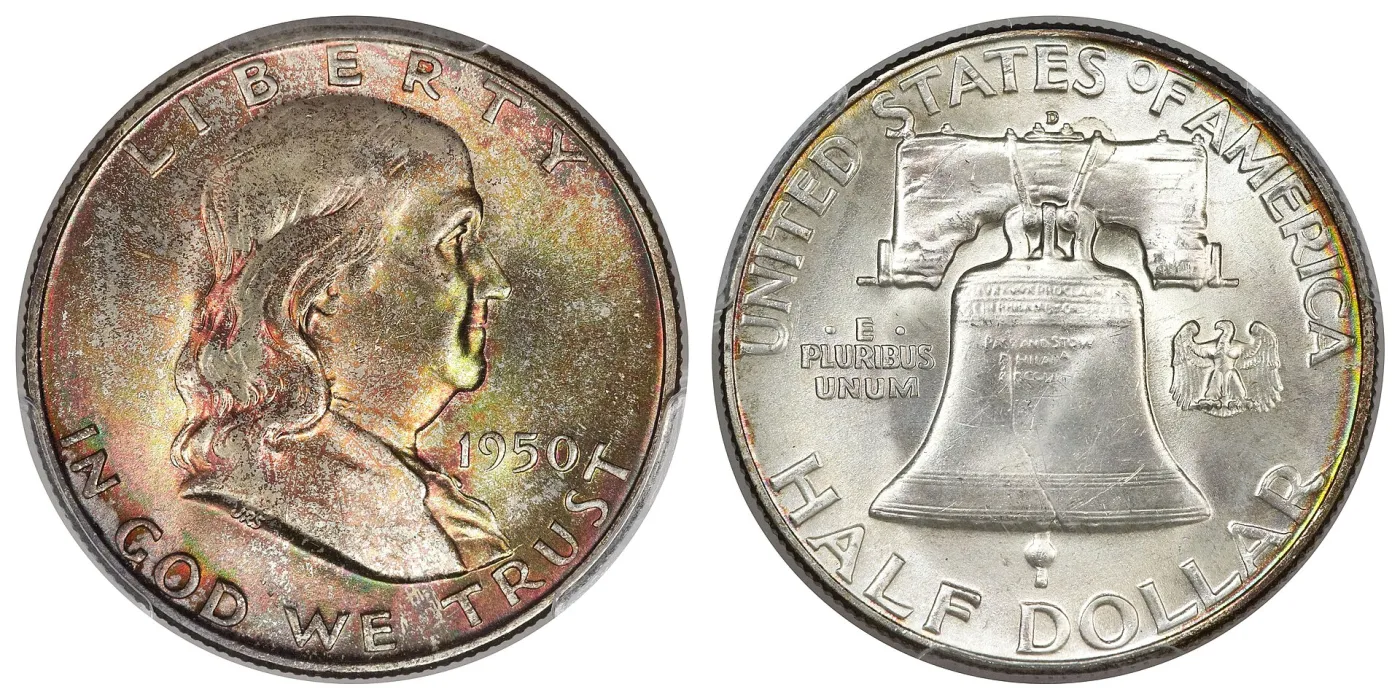
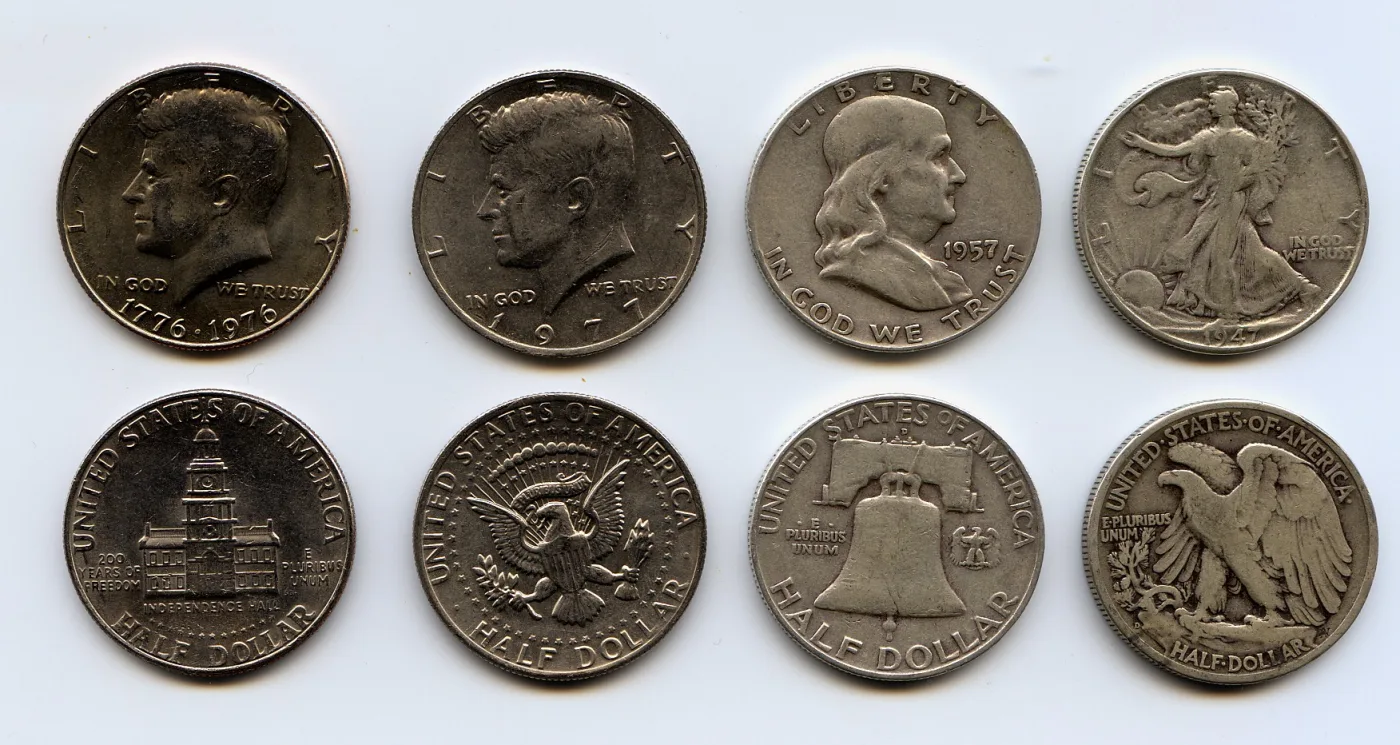
The Franklin Half Dollar is a short-lived but richly collectible series that bridges two very different eras of American coinage. Struck from 1948 to 1963, it replaced the graceful Walking Liberty Half Dollar and was itself retired after only sixteen years to make way for the Kennedy Half Dollar following the assassination of President John F. Kennedy in late 1963. In that compressed span, just 35 regular date-and-mintmark combinations were produced, making a complete set one of the most achievable and affordable “classic” silver collecting goals in American numismatics.
Despite its short run, the Franklin Half is anything but dull. It is the only circulating U.S. coin to feature Benjamin Franklin, a founding father who never served as president, and it pairs that portrait with one of the most iconic images in American history: the Liberty Bell. The series is also defined by one of the most specific and demanding grading designations in numismatics — Full Bell Lines, or FBL — which can turn an otherwise $30 coin into a four-figure rarity. Add in memorable varieties like the 1955 “Bugs Bunny” die-clash error, low-mintage keys like the 1949-S and 1953, and a consistent 90% silver composition, and Franklin Halves offer something for collectors at every budget.
This guide walks you through everything needed to confidently identify, grade, authenticate, and value Franklin Half Dollars. Whether you inherited a roll of old halves, picked one out of a dealer’s junk-silver bin, or are building a registry-quality set, the information below will help you separate common pieces from the genuinely scarce ones. If you are new to coin identification, this series is also an excellent teaching tool because its design is simple, its date range is short, and its varieties are visually distinctive.
History and Origins of the Franklin Half Dollar
The Franklin Half Dollar was the personal project of Mint Director Nellie Tayloe Ross, who wanted to honor Benjamin Franklin on American coinage. Ross had admired Franklin for years, particularly his thrift-themed aphorism “a penny saved is a penny earned.” By the mid-1940s, the Walking Liberty Half Dollar had been in circulation for the legally required 25 years, freeing the denomination for a new design without an act of Congress.
Ross commissioned Chief Engraver John R. Sinnock to prepare the design. Sinnock based the obverse portrait on a bust of Franklin by the 18th-century French sculptor Jean-Antoine Houdon, widely considered the most accurate likeness of Franklin from life. For the reverse, Sinnock adapted the Liberty Bell from his own earlier work on the 1926 Sesquicentennial Half Dollar, one of the classic commemoratives. Sinnock died in 1947 before the coin entered production, and the design was finalized by his successor, Gilroy Roberts — who would later design the Kennedy Half Dollar that replaced Franklin.
The Small Eagle Problem
Federal law had required an eagle on the reverse of all U.S. silver coins of the half dollar denomination or larger ever since the small-eagle Flowing Hair Half Dollar of 1794. To comply, a tiny eagle was tucked to the right of the Liberty Bell — so small and unobtrusive that it nearly disappears in the overall composition. This awkward afterthought is one of the series’ most recognizable design features and a frequent topic of collector conversation.
Production Timeline and Early End
Production began in 1948 at Philadelphia and continued through 1963. Denver came online in 1949, and San Francisco struck Franklin Halves from 1949 through 1954 before closing its half-dollar operations. After President Kennedy’s assassination in November 1963, Congress authorized a commemorative Kennedy Half Dollar, and the Franklin design was retired at the end of 1963 — nine years short of the 25-year minimum that would have protected it from replacement without legislation. This made Franklin one of the shortest-lived U.S. circulating coin designs of the 20th century.
Relationship to Other Silver Series
The Franklin Half Dollar sits at the tail end of America’s circulating silver era. It overlaps with the Mercury Dime’s successor (the Roosevelt Dime) and shares its 90% silver composition with the earlier Peace Dollar and Morgan Silver Dollar. When the Coinage Act of 1965 removed silver from dimes and quarters — ending the silver run of the Washington Quarter — and reduced the half dollar to 40% silver, it effectively closed the chapter on traditional silver coinage that the Franklin Half had helped conclude.
Design Elements and How to Identify a Franklin Half
Franklin Half Dollars are easy to identify once you know what to look for. The design is simple, the date range is narrow, and only one portrait and one reverse device were used throughout the entire series.
Obverse (Front) Design
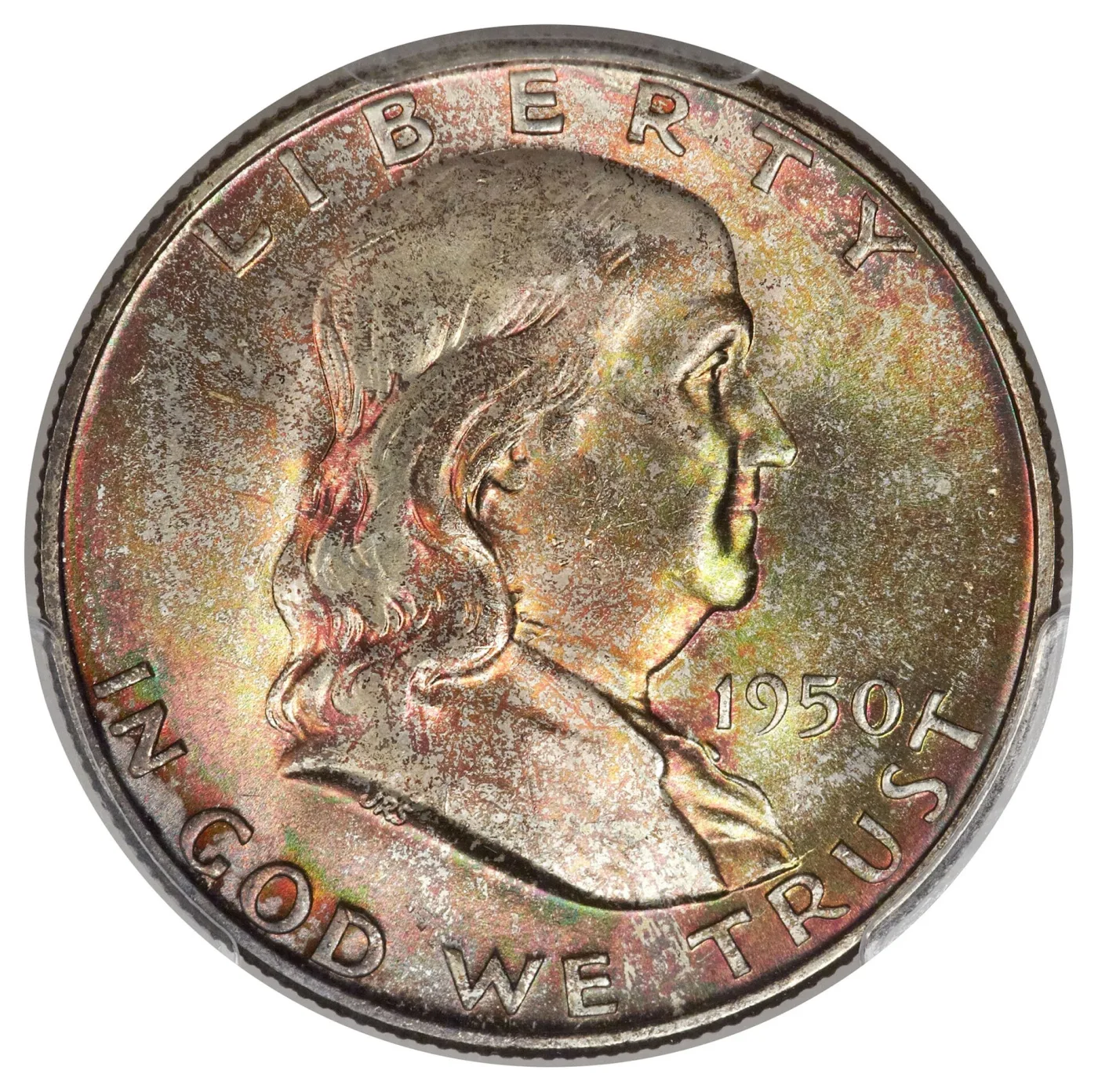
The obverse features a right-facing bust of Benjamin Franklin occupying most of the coin. “LIBERTY” arcs across the top above Franklin’s head, and “IN GOD WE TRUST” runs along the bottom rim beneath his shoulder. The date appears to the right of Franklin’s portrait, near the lower rim. Sinnock’s initials “JRS” appear in small letters below Franklin’s shoulder truncation.
Reverse (Back) Design
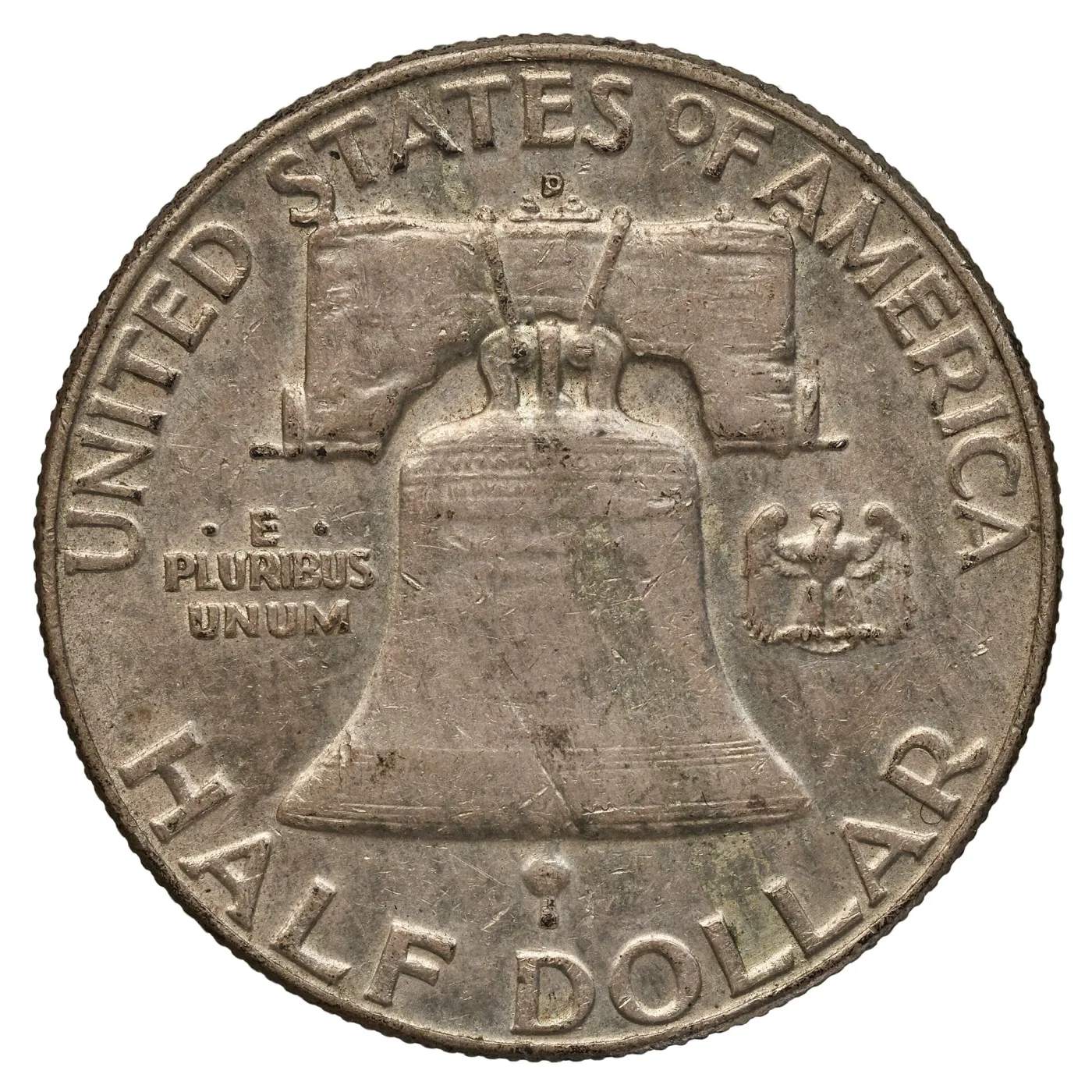
The reverse is dominated by the Liberty Bell, shown hanging from its wooden yoke. The bell’s famous crack is visible running down the right side. A small eagle with outstretched wings sits to the right of the bell. “UNITED STATES OF AMERICA” arcs across the top, “E PLURIBUS UNUM” appears to the left of the bell in small letters, “HALF DOLLAR” is at the bottom, and the mint mark (D or S, or no mark for Philadelphia) appears above the bell yoke.
Physical Specifications
Every Franklin Half Dollar shares these exact specifications: weight of 12.50 grams, diameter of 30.6 millimeters, thickness of 2.15 millimeters, a reeded edge with 150 reeds, and a composition of 90% silver and 10% copper. Each coin contains 0.36169 troy ounces of pure silver. These numbers are identical to the Walking Liberty and Barber Half Dollars and very close to the earlier Capped Bust Half Dollar, which means Franklin Halves stack seamlessly with earlier silver halves for bullion purposes.
Mint Marks and Where to Find Them
Franklin Half Dollars were struck at three United States Mint facilities, though not in every year. Identifying the mint mark is essential because it directly affects a coin’s rarity and value.
Mint Mark Location
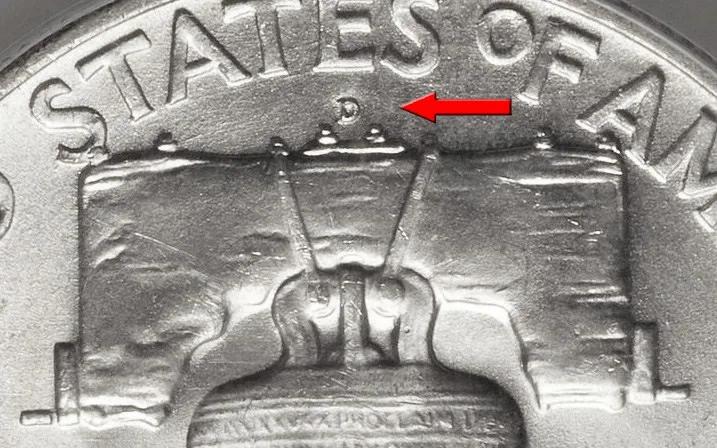
Unlike many earlier U.S. coins where the mint mark sits on the reverse near a denomination or device, on Franklin Halves the mint mark appears on the reverse above the center of the Liberty Bell’s yoke — the horizontal wooden beam at the top of the bell assembly. Look for a small letter in the narrow strip of field between the top of the yoke and the legend above it, on the vertical centre line of the coin. The eagle is no help in finding it: that sits far off to the right at the height of the bell’s waist, nowhere near. Use a loupe at 5x to 10x magnification for weak or worn examples.
The Three Mints
Philadelphia (no mint mark): Philadelphia struck Franklin Halves every year from 1948 through 1963. These are generally the most common issues in the series, though several Philadelphia dates (notably 1948, 1953, and 1955) are tougher than their mintages suggest, especially with Full Bell Lines.
Denver (D): Denver produced Franklin Halves from 1949 through 1963 (with no issue in 1955 or 1956). Denver coins are marked with a small “D” above the bell yoke. The Denver Mint is notorious for producing weakly struck Franklins, making Full Bell Lines examples from many D-mint dates far scarcer than raw mintage data would indicate.
San Francisco (S): San Francisco struck Franklins only from 1949 through 1954, after which the Mint halted half-dollar production there. S-mint coins carry a small “S” above the yoke. San Francisco produced the key-date 1949-S, and S-mint Franklins are generally well-struck, making FBL examples relatively more available proportionally than D-mint issues.
Full Bell Lines (FBL): The Designation That Changes Everything
No discussion of Franklin Half Dollars is complete without understanding Full Bell Lines. More than any other single factor besides outright wear, FBL status determines the value of a Franklin Half — and collectors routinely pay many multiples of the price of a non-FBL coin for one with the designation.
What Are the Bell Lines?
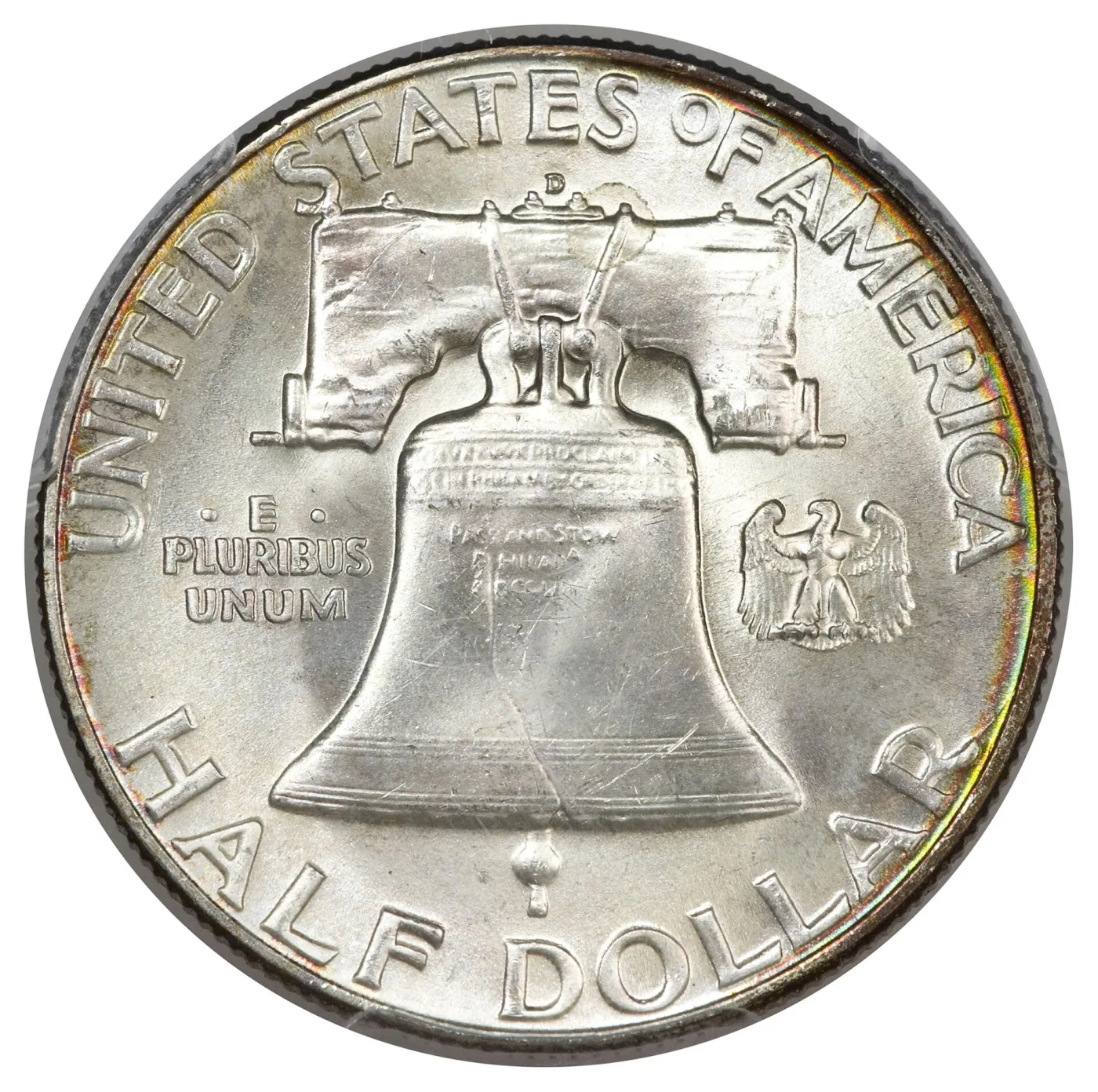
The Liberty Bell on the reverse shows horizontal incuse (recessed) lines near the bottom of the bell, representing the bands or rings around the lower portion. There are two distinct sets: the upper bell lines and, more importantly for grading, the lower bell lines — a set of parallel bands running horizontally across the bottom third of the bell, just above the rim.
The FBL Requirement
For a Franklin Half Dollar to earn the Full Bell Lines designation from PCGS or NGC, all of the lower lines must be complete, unbroken, and sharply defined from one end of the bell to the other. Any flatness, mushiness, contact marks, or die wear that interrupts the lines disqualifies the coin. Because the lower lines sit on the highest point of the bell’s relief, they are extremely vulnerable to both weak strikes and subsequent bag marks from rolling and handling in mint bags.
Why FBL Matters So Much
Franklin Halves were routinely stored and shipped in canvas bags of 1,000 coins each. The bell area, being the highest point on the reverse, took the brunt of coin-on-coin contact. Combine that with inconsistent striking pressure across different dies and mints, and a sharp FBL example in gem condition becomes genuinely hard to find for many dates. An MS-65 1953-S with Full Bell Lines might sell for $15,000, while a non-FBL MS-65 of the same date trades for a fraction of that. The same dynamic governs Full Bands on Mercury Dimes, Full Head on Standing Liberty Quarters, and Full Steps on Jefferson Nickels — strike designations consistently reward collectors who pay attention to the highest-relief details.
Near-FBL and the PCGS/NGC Split
PCGS and NGC use slightly different criteria. NGC generally requires the lower set of bell lines to be complete but allows minor contact marks that do not fully break the line. PCGS is stricter, typically demanding completely unbroken lower lines with no significant interruptions. As a result, a coin graded FBL by NGC may not receive the designation if re-submitted to PCGS. Experienced collectors often prefer PCGS FBL coins for that reason, though this preference does not always translate to a price premium across every date.

Key Dates and Semi-Keys
The Franklin Half Dollar series does not include any ultra-rare low-mintage coins on the order of the 1916-D Mercury Dime or 1893-S Morgan Dollar. Its “keys” are driven more by condition rarity, Full Bell Lines scarcity, and modest mintage combined with heavy circulation. Here are the dates every collector should know.
1949-S: The Mintage Key
Mintage: 3,744,000. The 1949-S is the lowest-mintage business-strike Franklin Half Dollar. In circulated grades, it is obtainable for $30 to $60, and Mint State examples without FBL typically run $100 to $300. With Full Bell Lines in MS-65, the 1949-S commands $1,500 to $3,500, and MS-66 FBL examples have sold for well over $15,000.
1953 Philadelphia
Mintage: 2,668,120. Despite having one of the lowest Philadelphia mintages in the series, the 1953 is often overshadowed by its proof counterpart. In MS-65 non-FBL, expect to pay $150 to $250. MS-65 FBL examples move into the $800 to $2,000 range, with MS-66 FBL coins reaching $10,000 or more at auction.
1953-S: The Condition Rarity King
Mintage: 4,148,000. The 1953-S is the most famous condition rarity in the Franklin series. San Francisco’s strikes were often well-detailed, but bag marks and handling meant almost no examples survived with unbroken bell lines at the gem level. An MS-65 non-FBL 1953-S sells for $150 to $400, while an MS-65 FBL is a major rarity worth $15,000 to $25,000. MS-66 FBL examples are legitimately rare across the entire series.
1955 “Bugs Bunny” (Philadelphia)
Mintage: 2,498,181 (total; variety included). The 1955 Philadelphia is already a lower-mintage date, and the famous “Bugs Bunny” variety (covered in detail below) adds another layer of demand. Standard 1955 MS-65 coins sell for $60 to $150, MS-65 FBL for $200 to $400, and gem Bugs Bunny examples command significant additional premiums.
1948 and 1948-D: First-Year Scarcity in FBL
The two 1948-dated issues are reasonably common overall but noticeably harder to find with Full Bell Lines. In MS-65 FBL, the 1948 Philadelphia runs $300 to $600, while the 1948-D is typically $250 to $500. These are ideal target coins for collectors who want to understand how the FBL premium structure works without paying key-date prices.
Other Semi-Key Dates
Several additional dates warrant attention for condition-rarity collectors: 1951-S, 1952-S, 1961 Proof (for its Doubled Die Reverse — see below), 1962, and 1963 Philadelphia are all harder than their mintages suggest, particularly in FBL or in cameo proof.
Notable Varieties: Bugs Bunny, Doubled Dies, and More
The Franklin Half Dollar series is relatively light on varieties compared to Morgan Dollars or Lincoln Wheat Pennies, but the ones that exist are dramatic and highly collected.
1955 “Bugs Bunny” Franklin
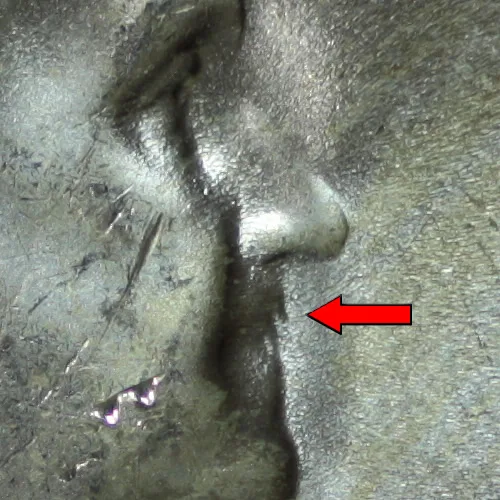
The most famous Franklin variety, the “Bugs Bunny” shows what appear to be buck teeth on Franklin’s upper lip. The effect is caused by die clash: the reverse die struck against the obverse die without a planchet in between, transferring the eagle’s wing feathers onto Franklin’s mouth area. When those clash marks were not fully polished away before production, the resulting coins show the feather outlines on Franklin’s lip, mimicking rabbit teeth. Premiums range from $30 to $80 over standard 1955 prices in circulated grades, and $150 to $1,500 in Mint State depending on grade and strike.
1961 Proof Doubled Die Reverse (DDR)
The 1961 Proof DDR shows strong doubling on “UNITED STATES OF AMERICA” and “E PLURIBUS UNUM.” This is one of the most valuable Franklin varieties because it appears only on proof coins. PR-65 examples sell for $1,500 to $3,000, and PR-67 cameo examples can exceed $10,000.
1951-D and 1952-D Double Profile Varieties
Several 1951-D and 1952-D Franklins show a secondary profile outline behind Franklin’s main portrait, caused by die bounce during striking. These “double profile” varieties carry collector premiums of $50 to $200 depending on the strength of the doubling.
Repunched Mint Marks
A handful of Franklin dates show repunched mint marks (RPMs), where the “D” or “S” was punched into the die more than once. Notable RPMs include the 1949-S/S, 1952-D/D, and several 1950s Denver issues. RPM premiums are generally modest — 25% to 75% over non-variety prices — except for the most dramatic examples.
No Designer’s Initials (1966-Present)
This is not a variety in the classic sense, but collectors sometimes confuse regular-issue Franklins with the reverse-punch-and-design elements on later half dollar varieties. Franklin Halves always carry Sinnock’s “JRS” below the bust; if the initials are missing, the coin is either heavily worn, counterfeit, or not a genuine Franklin Half.
Proof Franklins and Cameo Designations
Proof Franklin Halves were struck at the Philadelphia Mint every year from 1950 through 1963, with the exception of a brief pause. These coins are a major collecting focus in their own right, and the top examples regularly outperform even key-date business strikes.
Cameo and Deep Cameo Designations
Early proofs in the run often show a striking contrast between the frosted devices (Franklin’s portrait and the bell) and the mirrored fields. When this contrast is strong and consistent across both sides, PCGS and NGC assign a “Cameo” (CAM) designation; when it is extreme, they assign “Deep Cameo” (DCAM for PCGS, UCAM for NGC). These designations are particularly rare for 1950, 1951, 1952, and 1953 proofs because the dies were used extensively and the cameo effect faded quickly as they wore.
Key Proof Issues
The 1950 proof, with a mintage of just 51,386, is the lowest-mintage Franklin proof and commands significant premiums in all grades. PR-67 examples sell for $500 to $1,000, PR-67 Cameo for $3,000 to $8,000, and PR-67 Deep Cameo pieces can exceed $30,000. The 1951 and 1952 proofs are similarly scarce in cameo grades.
Proof Population Dynamics
Later proofs (1957 through 1963) were minted in much larger quantities — over three million for the 1963 — so common-grade examples trade for $20 to $40. However, even these higher-mintage dates become rare in PR-68 Deep Cameo, where eye appeal is everything and surface perfection is demanded.
Error Coins and Mint Mistakes
Mint errors on Franklin Half Dollars are less common than on smaller denominations but still exist for collectors who enjoy the category.
Off-Center Strikes
Off-center Franklin Halves are scarce. A modest 5% off-center example can add $200 to $500 to the coin’s value, while a dramatic 20% or greater off-center that still shows a full date can sell for $1,500 to $5,000. Off-center halves are much rarer than off-center dimes or cents because half-dollar planchets were handled more carefully and in smaller quantities.
Struck-Through Errors
Struck-through errors on Franklins range from minor (small grease-filled die debris) to dramatic (struck-through cloth, wire, or other objects). Minor examples add $50 to $200 to value, while spectacular struck-through errors can command $1,000 or more.
Clipped Planchets
Clipped planchet errors, where the blank was cut improperly and missing a curved section, occur occasionally on Franklin Halves. Single clips typically sell for $150 to $400; multiple clips or especially large clips can bring $500 to $1,500.
Wrong-Planchet Errors
A Franklin Half struck on a quarter-dollar planchet is an extreme rarity. These errors show a compressed design, light weight, and an incomplete edge. Authenticated examples sell for $10,000 to $30,000 depending on grade and the planchet involved.
How to Grade Franklin Half Dollars
Franklin Halves are graded on the Sheldon 70-point scale. Understanding the key wear points and how Full Bell Lines interacts with grade is essential for accurate assessment.
Key Wear Points on the Obverse
The first area to show wear is the top of Franklin’s head and the cheekbone. The hair strands behind his ear and the shoulder truncation also rub quickly. In Good (G-4) grades, these areas are completely smooth. By Very Fine (VF-20 to VF-35), individual hair strands become visible again and the cheek shows definition but still has minor flattening at the highest point.
Key Wear Points on the Reverse
The highest points on the reverse are the lower bell lines (the focus of the FBL designation) and the lettering “HALF DOLLAR.” Wear first appears on the bell at the lower rim and works upward. The eagle is tiny and takes wear on its tail and wing tips, but its small size protects it somewhat compared to the bell’s exposed lower band.
Grading Circulated Franklin Halves
Good (G-4 to G-6): Franklin’s portrait is fully outlined but most hair detail is smooth. Date and “LIBERTY” are readable. The bell shows only its basic outline on the reverse.
Fine (F-12 to F-15): Significant hair detail above Franklin’s ear returns. About half the hair strands are visible. The bell shows separation of the horizontal bands.
Very Fine (VF-20 to VF-35): Most hair strands are visible, with some flattening at the temple. The bell shows clear band separation and some of the lower lines begin to show.
Extremely Fine (EF-40 to EF-45): All hair strands are visible with only slight wear on the highest points. Most bell lines are complete, though usually not quite sharp enough for FBL.
About Uncirculated (AU-50 to AU-58): Only trace friction on the highest points. Most luster remains, especially in protected areas around the date and in the fields.
Grading Mint State Franklins
Mint State Franklins (MS-60 to MS-70) are graded on luster, strike, surface preservation, and eye appeal. MS-60 coins have no wear but abundant bag marks. MS-63 shows fewer marks and better overall appearance. MS-65 is a true gem with minimal marks and strong luster. MS-66 and MS-67 are exceptional, and MS-68 or higher is nearly impossible to find for most dates. Remember that MS grade and FBL designation are separate: a coin can be MS-66 without FBL, or MS-63 with FBL. Both designations affect value independently.
Authentication: Detecting Counterfeits
Franklin Half Dollars are not among the most frequently counterfeited U.S. coins, but fakes do exist — especially for the 1949-S and 1953-S keys and for high-grade FBL examples.
Weight and Dimensions Test
A genuine Franklin Half weighs 12.50 grams, with a tolerance of about 0.1 gram. The diameter is 30.6 mm and the thickness approximately 2.15 mm. Inexpensive digital scales and calipers are more than adequate for these checks. Any coin significantly outside these specifications warrants further investigation.
Reeded Edge
Franklin Halves have a reeded edge with 150 reeds. The reeding should be crisp, evenly spaced, and uniform in depth. Cast counterfeits frequently show mushy or irregular reeding, visible even without magnification.
Silver Tests
Franklin Halves are 90% silver. The ping test (balancing the coin on a fingertip and tapping it) produces a characteristic high-pitched ring that base-metal fakes cannot match. For greater confidence, an electronic precious-metal tester or a simple specific-gravity measurement can confirm silver content without damaging the coin.
Altered Dates and Mint Marks
Some counterfeiters alter common dates into key dates by modifying the mint mark — for example, adding an “S” to a 1949 to create a fake 1949-S. Under high magnification, altered mint marks typically show tool marks, inconsistent surface texture, or an incorrect font compared to genuine mint-struck marks. Compare the suspect mint mark to a reference photo of a known-genuine example from the same year.
Professional Authentication
For any Franklin Half valued over $500 — particularly key dates in MS-65 or higher, or any FBL example — professional authentication through PCGS or NGC is strongly recommended. The cost is modest relative to the protection it provides.
Current Market Values by Date and Mint
Franklin Half Dollar values are driven by silver spot price at the low end and by grade and FBL designation at the high end. The baseline melt value of any Franklin is currently around $7 to $9 based on spot silver, but collector premiums push most dates well above melt. Worn, common-date Franklins with no numismatic premium trade as 90% junk silver, priced purely on their silver weight.
Common Dates (VF-20 to MS-63)
Most common-date Franklins — including 1950 through 1952, 1954 through 1958, and 1960 through 1963 — sell for $12 to $20 in circulated grades and $20 to $50 in MS-63. The 1963 Philadelphia is the most common date overall, with a mintage of over 22 million.
Mint State Non-FBL (MS-64 to MS-65)
Common-date Franklins in MS-64 typically sell for $30 to $60, with MS-65 examples at $50 to $120. These are the entry-level “gem” coins that represent a reasonable upgrade from circulated examples without the premium of the FBL designation.
Mint State FBL (MS-65 FBL)
Common-date FBL examples in MS-65 sell for $100 to $400 depending on the specific date and strike. MS-66 FBL pushes into the $250 to $1,000 range for most dates, while MS-67 FBL is rare and commands $1,000 to $10,000 or more depending on population.
Key-Date Values
The 1949-S in MS-65 FBL sells for $1,500 to $3,500. The 1953-S in MS-65 FBL is a legitimate rarity at $15,000 to $25,000 and is nearly unobtainable in MS-66 FBL. The 1953 Philadelphia in MS-65 FBL runs $800 to $2,000. Proof 1950s are highly sought in cameo grades, with PR-67 Deep Cameo examples exceeding $30,000.
Factors Affecting Value
Beyond date and grade, strike quality, eye appeal, and certification all matter. A weakly struck MS-65 sells for less than a well-struck MS-65 of the same date, even without the FBL designation. Original luster (as opposed to dipped or cleaned surfaces) commands premiums, and attractive original toning — especially the rainbow iridescence that develops on coins stored in original mint bags or tubes — can add 50% to 200% to a coin’s value.
Condition Rarities and Registry Collecting
Franklin Halves are unusually driven by condition rarity rather than absolute rarity. Registry set collecting, which awards points based on grade and rarity, has amplified this dynamic by creating intense demand for the top one or two examples of each date.
The Condition Census
For every Franklin date, PCGS and NGC maintain population reports showing how many coins they have graded at each level. Many dates have fewer than ten examples graded MS-66 FBL, and several have only one or two MS-67 FBL examples known. These finest-known examples can sell for tens of thousands of dollars even for otherwise common dates.
Top Condition Rarities
Beyond the 1953-S mentioned earlier, other notable condition rarities include the 1952-S, 1951-S, and 1956 Type 1 (the early die state with a flat eagle). Each of these dates has a population structure that makes MS-66 FBL genuinely scarce and MS-67 FBL almost mythical.
Building a Registry Set
A complete Franklin registry set in MS-65 FBL or better is an achievable goal for a dedicated collector with a moderate budget. Target around $15,000 to $30,000 for a complete 35-coin MS-65 FBL set, or $100,000+ for an MS-66 FBL set. The condition rarities will be your budget bottlenecks rather than the mintage keys.
Storage, Handling, and Preservation
Franklin Halves are silver coins and require the same careful handling as any Walking Liberty or Morgan Dollar.
Handling Guidelines
Always hold coins by the edges. Never touch the surfaces with bare fingers — oils from your skin leave permanent marks visible under magnification. Use clean cotton or nitrile gloves for any extended handling. Work over a soft surface in case of accidental drops.
Storage Options
For circulated or low-grade Mint State Franklins, 2x2 cardboard flips with Mylar windows are inexpensive and effective. For MS-65 and higher examples, airtight capsules (in the 30.6 mm size) provide superior protection. For high-value coins, third-party certified holders from PCGS or NGC offer the best combination of protection, authentication, and market liquidity. Never use PVC-based soft flips — the plasticizers leach out over time and cause permanent green residue on silver surfaces.
Environmental Considerations
Store silver coins in a cool, dry, stable environment. Humidity is the primary enemy — it accelerates tarnishing and, in extreme cases, causes surface corrosion. Use silica gel packets or a small desiccant container in your storage area. Avoid basements, attics, and garages where temperature and humidity swing dramatically.
Cleaning: Don’t
Never clean a Franklin Half Dollar. Even coins with heavy tarnish or surface grime should be left untouched. Cleaning removes the natural patina, leaves microscopic scratches, and can reduce a coin’s value by 50% to 90%. If a coin has severe environmental damage, professional conservation services can address it non-destructively. The principle applies universally across collectible coins — whether you are preserving Buffalo Nickels, Franklin Halves, or Indian Head Pennies, the rule is the same: do not clean.
Building a Franklin Half Dollar Collection
Franklin Halves offer multiple collecting approaches suited to different budgets and interests. With only 35 regular issues plus a handful of major varieties, the set is one of the most approachable in American numismatics.
Complete Date Set (35 Coins)
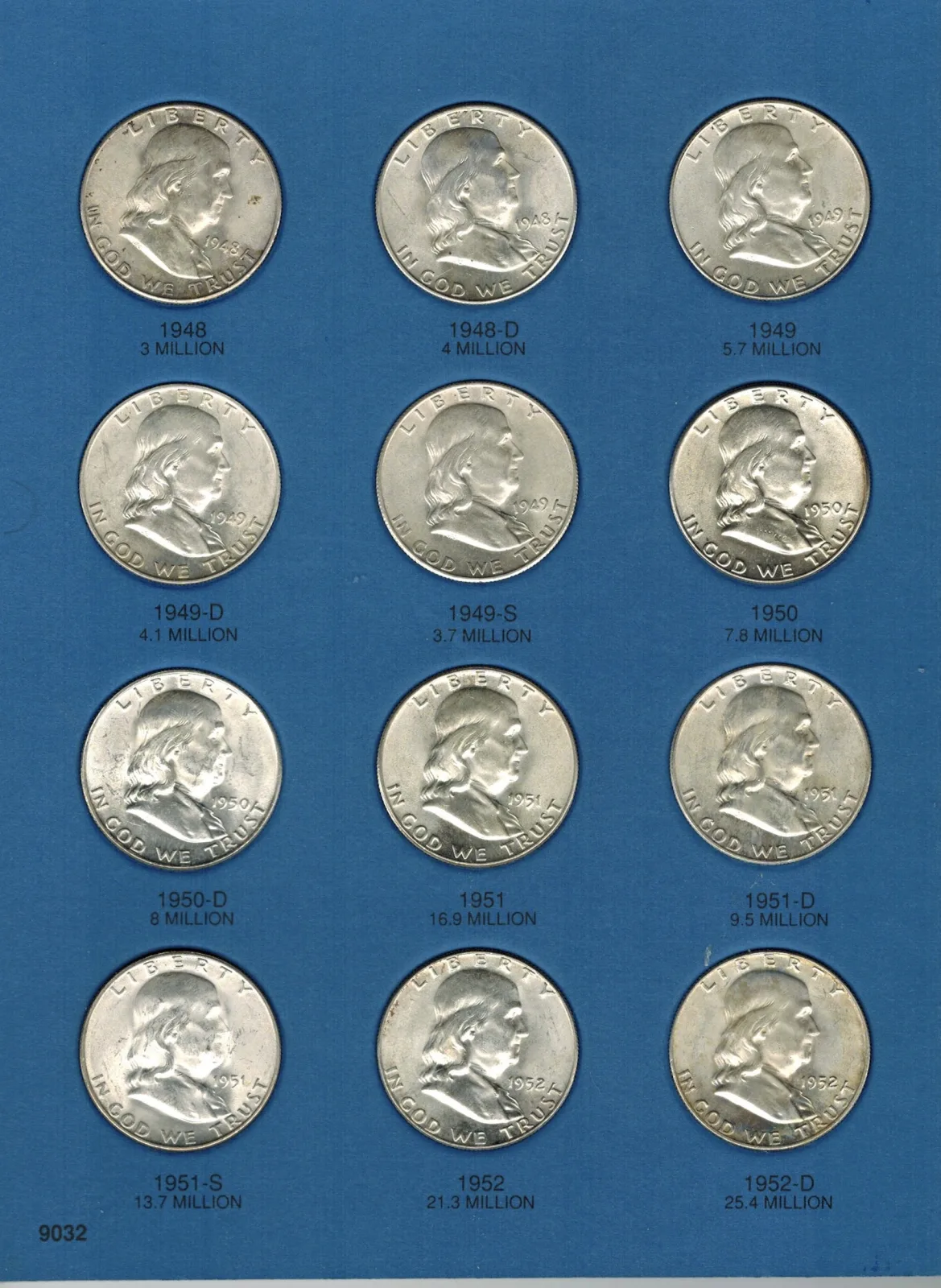
A complete business-strike date-and-mintmark set in circulated grades can be assembled for approximately $400 to $800, depending on silver prices. In MS-63 to MS-64, budget $1,500 to $3,000. In MS-65 non-FBL, expect to spend $3,000 to $6,000. The jump to MS-65 FBL is dramatic — figure $15,000 to $30,000 for a full set.
Proof Set
A complete proof Franklin set (1950-1963) has 14 coins. In basic PR-65, the set can be built for $800 to $1,500. Cameo examples push that to $3,000 to $8,000, and Deep Cameo sets with the 1950-1953 keys run into five or six figures.
Type Set
The simplest approach is a single Franklin Half, ideally in MS-65 FBL, to represent the series in a broader 20th-century type collection. A common-date MS-65 FBL can be purchased for $100 to $250, making this an excellent entry point for the series.
Variety Collection
For collectors who enjoy die varieties, the Franklin series offers a manageable target: the 1955 Bugs Bunny, 1961 Proof DDR, various RPMs, and the double profile varieties can be assembled as a separate specialty collection. This approach rewards careful examination and develops a sharp eye that transfers to other series.
Budget Tips
Start with common-date AU or low MS examples to learn the series. Buy one key date (the 1949-S is the most approachable) to anchor your set. Consider certified coins for anything MS-65 and above, and especially for FBL examples, where the designation is the value driver. Attend coin shows where dealers often discount bulk quantities of Franklin Halves — they remain widely available and modestly priced for a collector just getting started.
Frequently Asked Questions
How much is a Franklin Half Dollar worth?
Common-date Franklin Halves in circulated grades are worth their silver melt value, currently around $7 to $9 per coin. Nicer circulated examples sell for $12 to $20, Mint State common dates run $25 to $60, and MS-65 with Full Bell Lines commands $100 to $400. Key dates like the 1949-S and 1953-S in top grades can sell for thousands of dollars.
What is the rarest Franklin Half Dollar?
The rarest business-strike Franklin in terms of condition is the 1953-S in Full Bell Lines gem condition — MS-65 FBL examples sell for $15,000 to $25,000 and MS-66 FBL is nearly unobtainable. For proofs, the 1950 in PR-67 Deep Cameo is the top rarity, with examples selling for over $30,000.
What does FBL mean on a Franklin Half Dollar?
FBL stands for Full Bell Lines. It refers to the horizontal lines across the bottom of the Liberty Bell on the reverse. To earn the designation, all of the lower bell lines must be complete and unbroken from one side of the bell to the other. FBL coins typically sell for multiples of non-FBL coins in the same Mint State grade.
Where is the mint mark on a Franklin Half?
The mint mark appears on the reverse, directly above the horizontal wooden yoke at the top of the Liberty Bell. Philadelphia coins have no mint mark, Denver shows a "D," and San Francisco shows an "S." Use magnification for weak or worn examples.
Are Franklin Halves made of silver?
Yes. Every Franklin Half Dollar from 1948 through 1963 is 90% silver and 10% copper. Each coin contains 0.36169 troy ounces of pure silver, making them popular with both collectors and silver stackers.
What is the Bugs Bunny Franklin Half?
The 1955 Bugs Bunny is a die-clash variety where feathers from the reverse eagle's wing transferred onto Franklin's upper lip, creating the appearance of buck teeth. It is the most famous Franklin Half variety and commands significant premiums over standard 1955 prices.
Should I clean my Franklin Half?
No. Cleaning removes the natural patina, introduces microscopic scratches, and can destroy most or all of a coin's collector value. Even heavily tarnished coins should be left untouched. For severe environmental damage, consult a professional conservation service rather than attempting to clean the coin yourself.
Why was the Franklin Half Dollar replaced so quickly?
The Franklin Half was retired at the end of 1963, only 16 years into production, to make way for the Kennedy Half Dollar following President Kennedy's assassination. By law, a coin design is protected from change for 25 years, but Congress specifically authorized the earlier replacement as part of the national memorial response to Kennedy's death.