Kennedy Half Dollar Identification Guide: Key Dates, Mint Marks, and Values
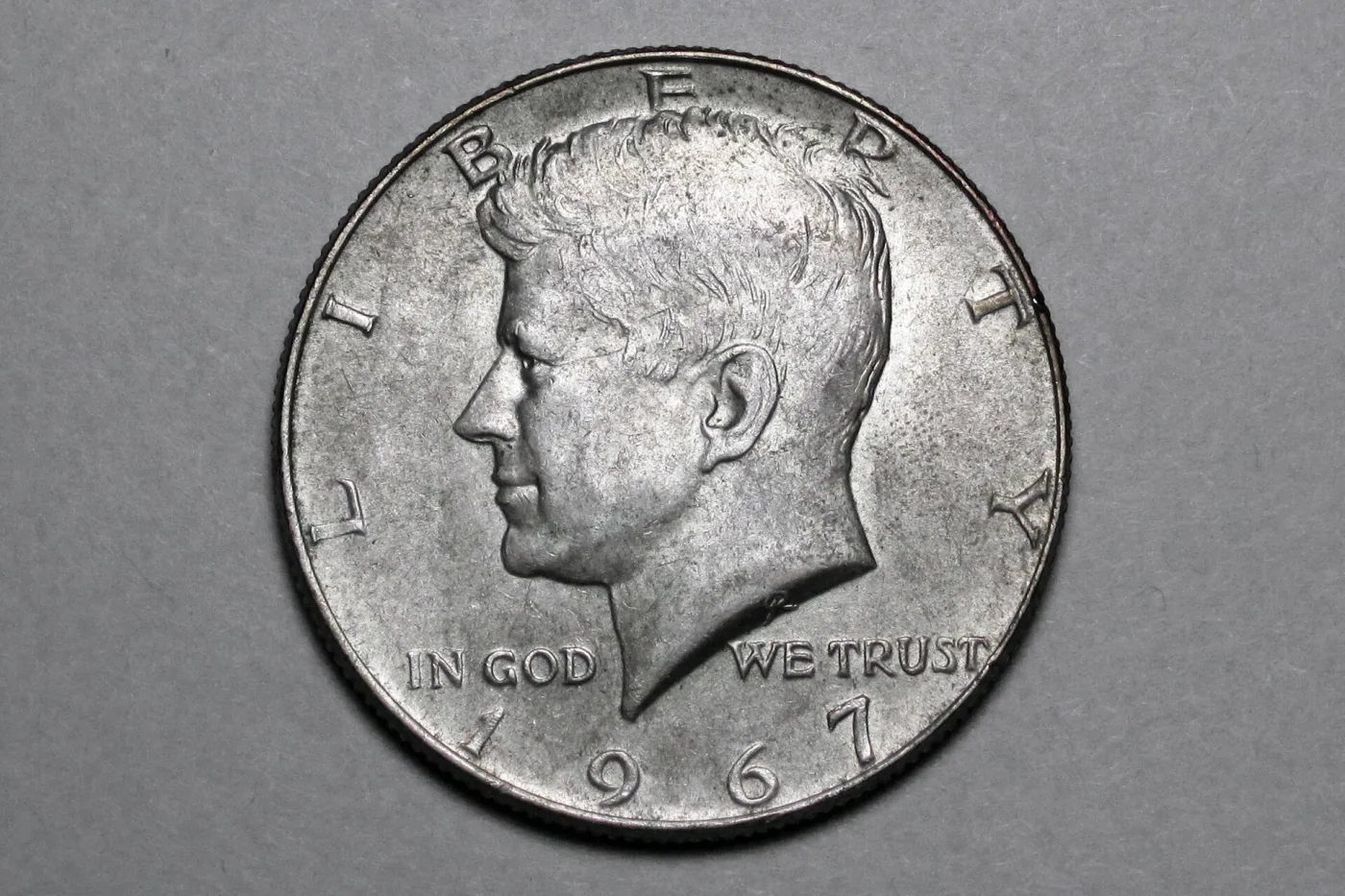
The Kennedy Half Dollar is one of the most emotionally charged coins ever produced by the United States Mint. Struck in record numbers beginning in 1964 as a national memorial to President John F. Kennedy following his assassination in November 1963, the coin was hoarded so aggressively in its first year that it effectively vanished from circulation almost immediately. Six decades later, it remains in production — but as a collector-only issue since 2002 — making it the longest-running active half dollar design in American history and the direct successor to the short-lived Franklin Half Dollar.
What makes the Kennedy Half Dollar especially fascinating is how many distinct eras it compresses into a single design. The 1964 issues are 90% silver, matching earlier classics. From 1965 to 1970, the coin was struck in 40% silver — a unique transitional composition found nowhere else in circulating U.S. coinage. Starting in 1971, Kennedys became copper-nickel clad like modern dimes and quarters, with only special collector issues returning to silver content. Layer in the 1976 Bicentennial dual-dated reverse, the famous 1964 Accented Hair proof variety, no-S proof rarities, and the 2014 fiftieth-anniversary gold and silver sets, and the series rewards collectors who enjoy depth over breadth.
This guide walks through everything you need to identify, grade, authenticate, and value Kennedy Half Dollars — from the 1964 first-year silver issues through the Bicentennial, the clad era, and the modern collector strikes. Whether you inherited a jar of old halves, bought a 40% silver roll from a dealer, or are building a full PCGS or NGC registry set, the information below separates the truly scarce from the merely old. If this is your first half dollar series, our broader coin identification guide is a good companion for the fundamentals, and the Flowing Hair Half Dollar guide traces the denomination all the way back to its 1794 origins.
History and Origins of the Kennedy Half Dollar
President John F. Kennedy was assassinated in Dallas on November 22, 1963. Within days, Mint Director Eva Adams asked Chief Engraver Gilroy Roberts and Assistant Engraver Frank Gasparro to begin designing a commemorative half dollar. Congress authorized the redesign on December 30, 1963, waiving the standard 25-year protection that the Franklin Half Dollar would otherwise have enjoyed until 1973.
Roberts adapted an existing portrait he had sculpted of Kennedy for the Presidential Series appreciation medal; Gasparro reworked the Presidential Seal he had previously used on that same medal for the reverse. Jacqueline Kennedy approved the designs after minor modifications to the hair detail above Kennedy’s ear. Production began in January 1964 at Philadelphia, with Denver following in February. The first coins were released to the public on March 24, 1964.
Immediate Hoarding
Public demand was unprecedented. Americans — grieving, sentimental, or simply speculative — pulled Kennedy Halves from circulation the moment they appeared. Mint production in 1964 totaled an enormous 430 million coins across both mints, but almost none stayed in day-to-day commerce. Within weeks of release, Kennedy Halves had effectively become a savings-and-souvenir coin rather than a working denomination — a role they never shed.
The Silver Problem
The hoarding crisis, combined with rising silver prices, forced Congress to pass the Coinage Act of 1965. Dimes and quarters lost their silver outright, but because the half dollar was already seen as a Kennedy memorial, Congress compromised by reducing it to a 40% silver clad composition rather than eliminating silver entirely. This 40% standard lasted from 1965 through 1970. In 1971, the half dollar finally followed the Washington Quarter and Roosevelt Dime into copper-nickel clad composition.
From Circulation to Collector Coin
Despite its massive mintages, the Kennedy Half never recovered as a circulating coin. Banks stopped ordering them in quantity, vending machines were never configured for them, and the public continued to treat them as special. In 2002, the Mint stopped producing Kennedy Halves for general circulation, making them available only through numismatic channels — rolls, bags, proof sets, and special issues. This collector-only status continues today, with Kennedy Halves struck annually but not released to banks for routine commerce.
Design Elements and How to Identify a Kennedy Half
The Kennedy Half Dollar uses a single obverse and a single regular reverse design (with one exception in 1976), making identification straightforward. The interesting work lies in reading the composition, mint mark, and variety rather than the design itself.
Obverse (Front) Design
The obverse features a left-facing bust of President Kennedy, cropped at the shoulders. “LIBERTY” arcs across the top, broken by the top of Kennedy’s head. “IN GOD WE TRUST” appears in two lines along the lower rim, flanking the truncation of Kennedy’s neck. The date is at the bottom center below the bust. Roberts’ initials “GR” appear in small letters on the truncation of Kennedy’s neck — a detail that frequently confuses new collectors who mistake them for a blemish.
Reverse (Back) Design — Regular
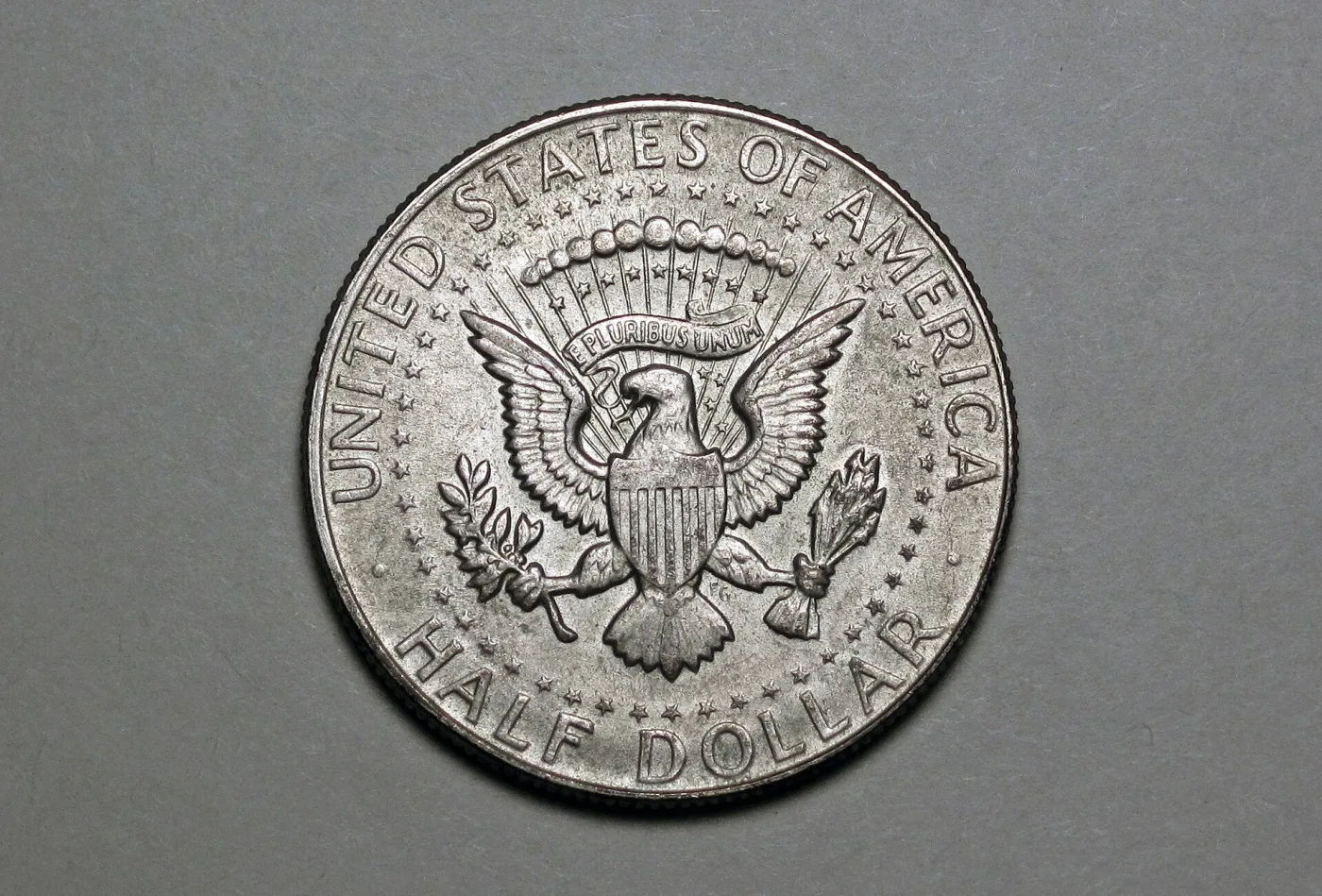
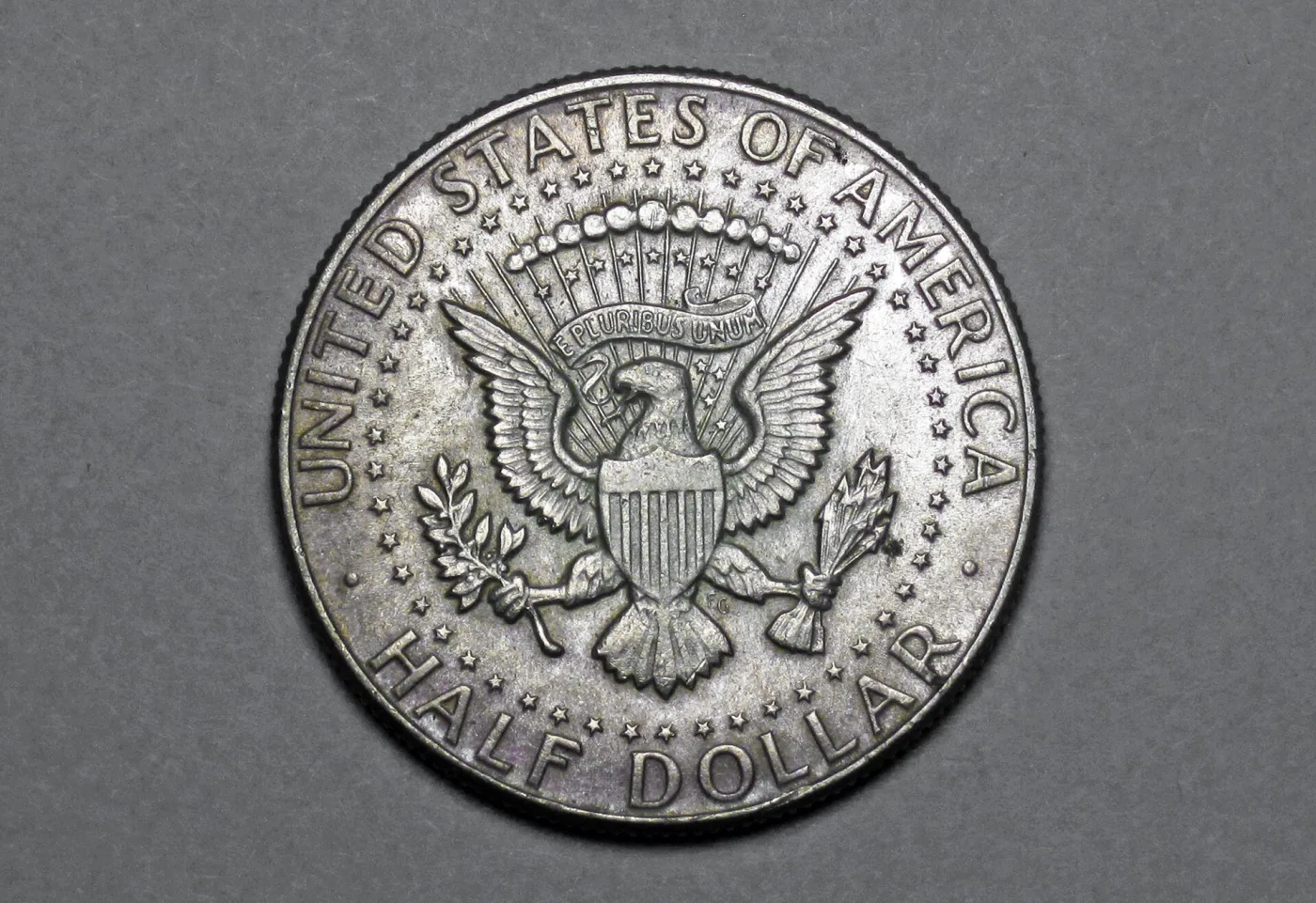
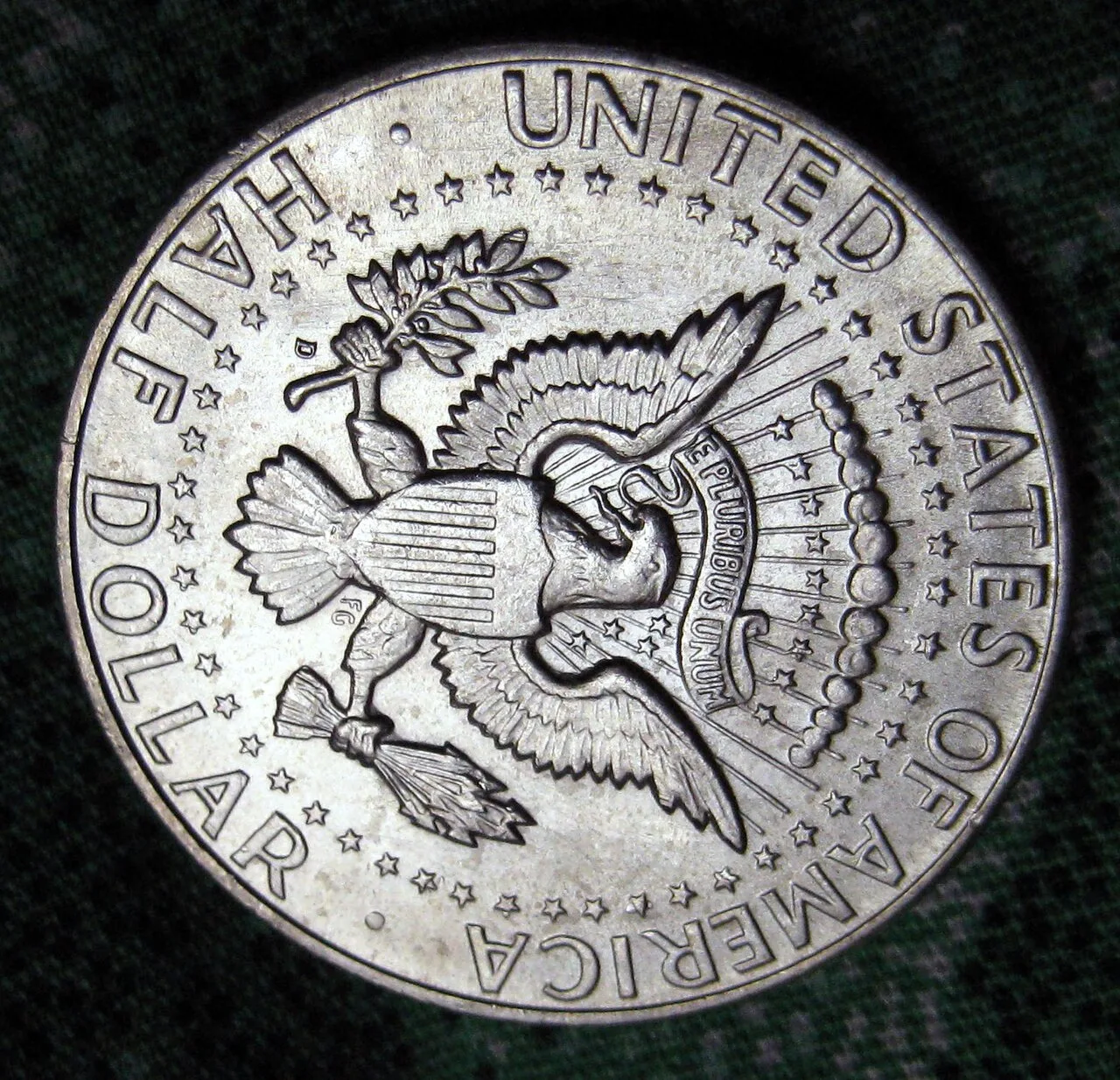
The standard reverse is a modified Presidential Seal: a heraldic eagle with outspread wings, clutching arrows and an olive branch, with a shield on its breast and a ring of fifty stars surrounding it. “UNITED STATES OF AMERICA” arcs across the top, “HALF DOLLAR” across the bottom, and “E PLURIBUS UNUM” runs on a scroll above the eagle. Gasparro’s initials “FG” appear in small letters between the eagle’s tail feathers and the leg on the right.
Reverse (Back) Design — Bicentennial (1975-1976)
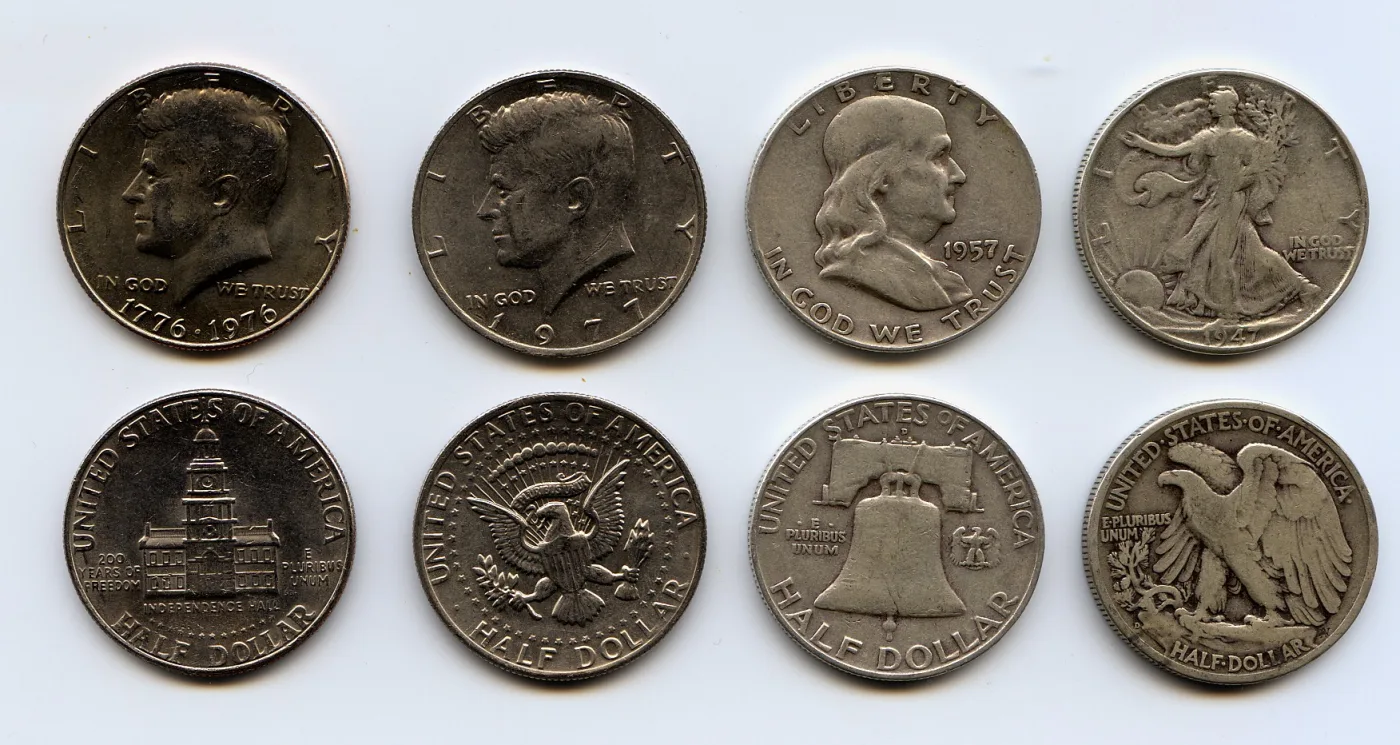
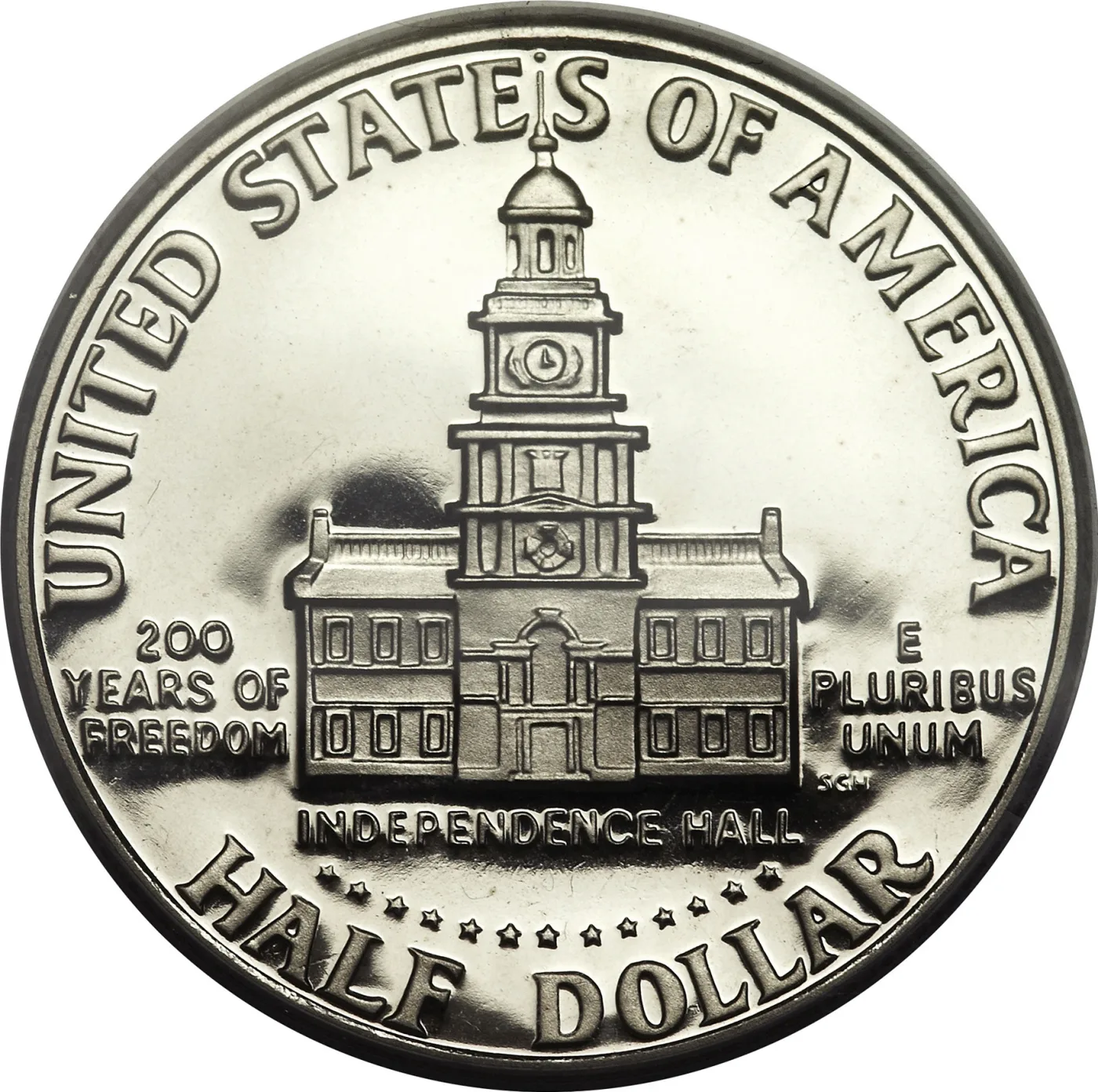
For the Bicentennial, reverse designer Seth Huntington replaced the eagle with Independence Hall in Philadelphia. “UNITED STATES OF AMERICA” arcs across the top, “INDEPENDENCE HALL” appears below the building, and “HALF DOLLAR” runs along the bottom. The obverse carries the dual date “1776-1976” instead of a single year. No Kennedy Halves were dated 1975 — all coins struck in 1975 and early 1976 used the dual date.
Physical Specifications
All Kennedy Halves share a 30.6 mm diameter and a reeded edge with 150 reeds, identical to Walking Liberty, Franklin, and Barber Halves. Weight varies with composition: 12.50 grams for 90% silver (1964 only), 11.50 grams for 40% silver clad (1965-1970 and select later issues), and 11.34 grams for copper-nickel clad (1971-present regular issues). The composition difference is the single most important identification step after reading the date.
The Four Compositions: Silver, 40% Silver, Clad, and Special Issues
Kennedy Halves have been struck in four distinct compositions across six decades. Knowing which composition you hold is essential because melt value alone can differ by a factor of twenty between a 1964 silver coin and a modern clad piece. The 1964 and 40% silver issues are prime targets for junk silver hunters searching bank rolls of half dollars.
1964: 90% Silver, 10% Copper
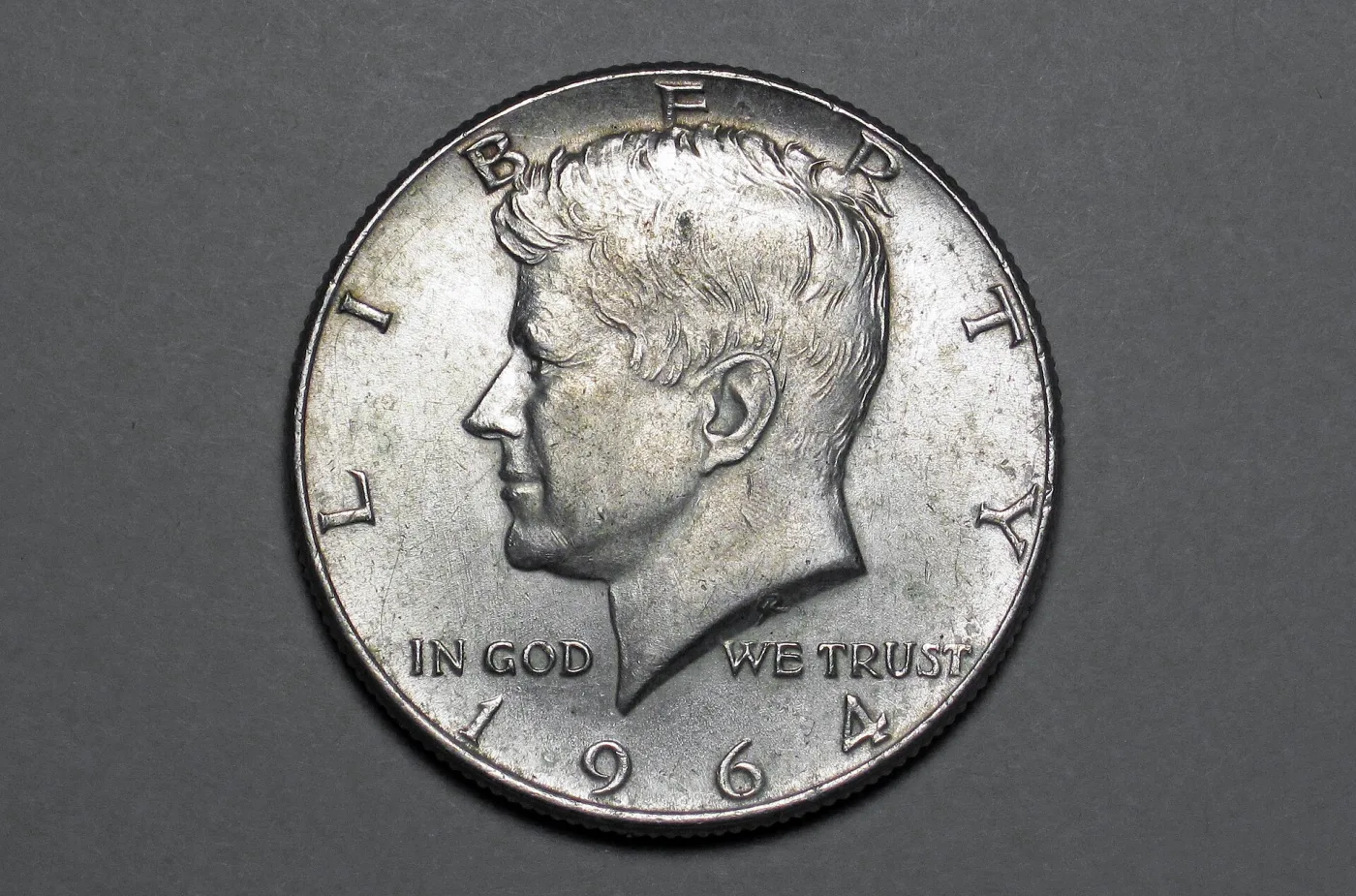
Only the 1964 and 1964-D issues are 90% silver (0.36169 oz pure silver per coin). These are the heaviest Kennedys at 12.50 grams and share their silver composition with the earlier Walking Liberty, Franklin, and even Barber series. At current silver prices, a circulated 1964 has roughly $7 to $9 in silver alone.
1965-1970: 40% Silver Clad
From 1965 through 1970, Kennedy Halves used a unique 40% silver outer layer bonded to a lower-silver inner core. The net silver content is 0.1479 troy ounces per coin — roughly 41% of a 1964’s silver content. These coins weigh 11.50 grams. This composition is unique to the half dollar; no other U.S. coin has ever been struck in 40% silver for circulation. A circulated 40% silver Kennedy carries roughly $3 to $4 in silver melt value.
1971-Present: Copper-Nickel Clad
Starting in 1971, regular-issue Kennedy Halves switched to the same copper-nickel clad sandwich used on modern dimes and quarters: 75% copper and 25% nickel outer layers over a pure copper core. This is the same clad standard used on the contemporary Eisenhower Dollar, though later dollar coins like the Sacagawea Dollar switched to a manganese-brass alloy for a distinct golden color. These coins weigh 11.34 grams and have no precious-metal content. They carry only face value for circulated examples and modest premiums for Mint State specimens of scarce dates.
Special Silver Issues (1992-Present)
Since 1992, the Mint has produced silver proof versions of the Kennedy Half for inclusion in annual Silver Proof Sets. These use 90% silver through 2018 and .999 fine silver beginning in 2019. They are struck only at San Francisco with an “S” mint mark and carry premiums well above their silver melt value. The 2014 fiftieth-anniversary set also included a four-coin silver tribute plus a small gold version — the only gold Kennedy Half ever produced (0.7500 troy oz of pure gold).
Quick Composition Test
If you cannot read the date, weight is the fastest identifier. A coin weighing 12.5 g is 1964 silver. At 11.5 g it is a 40% silver 1965-1970 issue or one of the later silver-proof or special-issue coins. At 11.34 g it is a clad coin from 1971 onward. The ring test also separates silver from clad: silver Kennedys produce a clear, sustained high tone when balanced and struck gently, while clad issues make a duller, shorter sound.
Mint Marks and Where to Find Them
Kennedy Halves have been struck at Philadelphia, Denver, San Francisco, and briefly at West Point. Mint mark placement moved once in the series, so where you look depends on the date.
1964: Mint Mark on Reverse
On 1964 and 1964-D coins, the mint mark appears on the reverse, between the eagle’s claw and the olive branch on the left side — small and easy to miss at a glance. Philadelphia coins carry no mint mark; Denver coins show a “D.” This matches the placement used on the Franklin Half Dollar that preceded it.
1968-Present: Mint Mark on Obverse
Beginning in 1968, the mint mark moved to the obverse, directly above the date. This is where you will find the mark on every Kennedy Half from 1968 to the present. Note that 1965, 1966, and 1967 coins carry no mint mark regardless of where they were struck — this was part of the Mint’s strategy to discourage coin hoarding during the silver-transition years.
The Four Mints
Philadelphia (no mint mark or “P”): Philadelphia struck Kennedys every year from 1964 onward. Coins from 1964 through 1979 show no mint mark. Starting in 1980, a small “P” appears on Philadelphia business strikes and proofs.
Denver (D): Denver produced Kennedys every year from 1964 onward. The “D” appears above the date (1968+) or on the reverse (1964 only).
San Francisco (S): San Francisco struck proofs from 1968 onward and also produced some Bicentennial business strikes in 1976. Modern silver proofs all carry the “S” mint mark.
West Point (W): Only the 2014 fiftieth-anniversary reverse-proof and gold issues were struck at West Point, with a “W” mint mark. Standard circulating Kennedys have never been struck at West Point.
Key Dates, Semi-Keys, and Low-Mintage Issues
Kennedy Halves are not a series defined by traditional low-mintage keys the way the Mercury Dime’s 1916-D or the Buffalo Nickel’s 1937-D Three-Legged are. Instead, the keys are driven by condition rarity, special-issue scarcity, and a handful of transitional or variety coins.
1970-D: The Transitional Key
The 1970-D was struck exclusively for inclusion in Mint Sets — none were released for circulation. With a mintage of only 2,150,000, it is the lowest-mintage regular-issue Denver Kennedy. Circulated examples are essentially nonexistent since the coins never entered commerce. MS-63 examples sell for $15 to $25, with MS-65 in the $30 to $60 range and MS-67 in the $200 to $500 range.
1987-P and 1987-D
Like the 1970-D, the 1987 Philadelphia and Denver Kennedy Halves were struck only for collector Mint Sets — no circulation strikes were released. With combined mintages just under 5 million for each mint, these are genuinely scarce in the series. MS-65 examples sell for $10 to $20, and MS-67 for $60 to $150.
1998-S Matte Finish Silver
A unique 90% silver matte-finish Kennedy was included in the 1998 Robert F. Kennedy Commemorative Set. With a mintage of only 62,000, it is the lowest-mintage modern Kennedy by a wide margin. Certified examples in SP-69 sell for $200 to $400.
2014-W Gold and Silver Enhanced Issues
The 2014 fiftieth-anniversary set produced several special Kennedy Halves: a 3/4-ounce .9999 fine gold issue (mintage 73,772) struck at West Point, plus silver proof, reverse-proof, and enhanced-uncirculated varieties. The gold version sells for approximately 1.1 to 1.3 times its gold melt value (currently $2,000 to $2,800 depending on gold spot). The silver four-coin set trades for $250 to $450 complete.
Condition-Rarity Keys in the Clad Era
Among regular-issue clad Kennedys, several dates are scarce in top grades simply because no one saved them. Notable condition rarities include the 1974-D in MS-67 (population under 50 certified), the 1977-D in MS-67, the 1981-P in MS-67, and the 1982-P “No FG” error (below) in any grade.
The 1964 Accented Hair Proof Variety
The single most famous variety in the Kennedy Half Dollar series is the 1964 Accented Hair proof. This was the earliest of the 1964 proof dies, and it shows additional sharp hair detail above Kennedy’s ear — specifically, a series of strong parallel lines that were subsequently smoothed out after Jacqueline Kennedy reportedly objected that the portrait’s hair looked too harsh.
How to Identify Accented Hair
Three diagnostics confirm an Accented Hair proof. First, there are strong, well-defined hair lines above and behind Kennedy’s ear — on the regular 1964 proof these lines are much softer and partly merged. Second, the lower serif of the “I” in “LIBERTY” is missing or dramatically reduced on Accented Hair coins, while it is bold and complete on the later, revised dies. Third, the overall detail in the hair is noticeably stronger and more chiseled in appearance. A side-by-side comparison with a standard 1964 proof makes the variety obvious.
Mintage and Values
Accented Hair proofs were struck from the first small batch of 1964 proof dies before the revision; estimated mintage is around 100,000 out of the total 3,950,762 1964 proofs. PR-65 examples sell for $70 to $120, PR-67 Cameo in the $250 to $500 range, and PR-69 Deep Cameo pieces can exceed $5,000 at auction. The variety is an approachable, affordable starting point for collectors who want a marquee Kennedy rarity in their set.

The 1976 Bicentennial Half Dollar
To celebrate America’s 200th birthday, the United States Mint issued special dual-dated Bicentennial versions of the quarter, half dollar, and dollar in 1975-1976. The Bicentennial Kennedy uses Seth Huntington’s Independence Hall reverse, paired with the standard Kennedy obverse and the dual date “1776-1976.” No Kennedy Halves were dated 1975 or 1976 with the regular reverse — every coin struck during that 18-month span used the Bicentennial design.
Composition Varieties
Three Bicentennial Kennedy compositions exist. The regular business strikes from Philadelphia and Denver, plus the San Francisco proofs, are copper-nickel clad. San Francisco also struck a separate 40% silver version for collector sets — these are noticeably heavier (11.50 g) and carry significant silver premium. And a copper-nickel clad proof-like version was included in the three-piece Bicentennial Mint Set sold at a modest premium.
Identifying Silver vs Clad Bicentennials
All silver Bicentennials carry the “S” mint mark. If a 1776-1976 Kennedy has no mint mark (Philadelphia) or a “D” (Denver), it is clad. An “S” coin requires a weight check: 11.50 g silver versus 11.34 g clad proof. The edge also shows a difference — silver coins have a fully silver edge, while clad coins show a distinct copper stripe when viewed edge-on.
Values
Bicentennial clad Kennedys in circulated grades carry only face value. MS-65 examples sell for $4 to $8. Silver Bicentennials from the three-piece set run $10 to $20 in BU, and certified SP-69 examples can reach $50 to $100. Major errors — doubled dies, off-metals, and off-center strikes on Bicentennial Kennedys — command significantly more.
No-S Proof Rarities
Every San Francisco proof Kennedy Half is supposed to carry an “S” mint mark. On rare occasions, a die was prepared without the mint mark and entered production, creating extremely scarce no-S proof varieties. These are among the most valuable modern Kennedy Halves.
1970 No-S, 1971 No-S, 1998 No-S
The best-documented Kennedy no-S proof varieties are occasional one-off escapees rather than broadly distributed issues. Unlike the 1971 No-S Jefferson Nickel or 1975 No-S Roosevelt Dime, no Kennedy Half has a confirmed, widely recognized no-S proof variety with a published population. That said, certified single pieces described as “No-S” in minor Kennedy varieties do appear at auction and require careful authentication to distinguish genuine die omissions from filled-mint-mark weak strikes.
Filled Mint Marks vs Genuine No-S
Many coins advertised as “No-S” are actually standard coins with the mint mark obscured by die grease. Under magnification, the outline or partial depression of the “S” remains visible in these cases. A true no-S issue shows a completely smooth field where the mint mark should be, with no trace of punching. Always submit suspected no-S Kennedy proofs to PCGS or NGC for attribution rather than relying on raw-coin listings.
Other Notable Varieties and Doubled Dies
Beyond the 1964 Accented Hair, several Kennedy Half varieties are collected by specialists.
1964 Doubled Die Obverse
Strong doubling on “IN GOD WE TRUST” and “LIBERTY” identifies the 1964 DDO. Circulated examples add a modest $30 to $80 premium, while MS-65 pieces sell for $300 to $700. Weaker doubled dies on 1964 are common and carry little premium.
1974-D Doubled Die Obverse
The 1974-D DDO shows clear doubling on “IN GOD WE TRUST.” It is one of the more collected clad-era Kennedy varieties. MS-63 examples sell for $40 to $80 and MS-65 for $150 to $400.
1982-P “No FG”
Some 1982-P Kennedys show no “FG” initials on the reverse (the designer mark of Frank Gasparro, who later created the entire Susan B. Anthony Dollar, between the eagle’s tail feathers and its right leg). This is an excessively polished die variety. MS-63 examples sell for $30 to $60, MS-65 for $80 to $200. Be careful not to confuse a weakly struck FG with a true missing-initials variety — the former retains a faint outline, the latter is completely smooth.
1966 SMS Doubled Die
Select 1966 Special Mint Set coins show doubling on the obverse. Certified SP-67 DDO examples sell for $500 to $1,500 depending on cameo designation.
Repunched Mint Marks
Several clad-era Kennedys show repunched mint marks (RPMs), particularly 1968-D/D, 1971-D/D, and 1979-D/D. Premiums are modest — 25% to 100% over standard prices — and the variety appeals mostly to specialists filling a dedicated Kennedy RPM collection.
SMS Coins, Proofs, and Special Collector Issues
From 1965 through 1967, the Mint did not produce traditional proof sets due to ongoing coinage shortages. Instead, it issued Special Mint Sets (SMS) with specially prepared business strikes that show satin-like surfaces between proof and uncirculated quality. Kennedy Halves from these sets are distinct from regular business strikes and are collected separately.
SMS Quality and Cameo Designations
Top-quality SMS Kennedys show strong cameo contrast between the frosted devices and satin fields. PCGS and NGC grade these as SP (Specimen) rather than MS, and assign Cameo or Deep Cameo designations where appropriate. SP-68 Cameo 1965-1967 Kennedys sell for $100 to $400 depending on year, and SP-69 Deep Cameo examples have reached $5,000 or more at auction.
Proof Kennedy Halves
Proof Kennedys from 1964 and 1968-present are traditional mirror-finish proofs with frosted devices. Most are readily available in PR-67 and PR-68 for modest premiums. The exception is the 1964 Accented Hair (above), the 1966 and 1967 SMS issues (technically specimens, not proofs), and the modern silver proof issues that carry silver-bullion premiums on top of collector demand.
Silver Proof Sets (1992-Present)
Beginning in 1992, the Mint has offered annual Silver Proof Sets containing 90% silver (1992-2018) or .999 silver (2019+) Kennedy Halves. These are always struck at San Francisco with an “S” mint mark. Premium over spot silver typically runs 50% to 200% depending on year, finish, and whether the set has been broken.
Reverse Proofs and Enhanced Uncirculated
Starting with the 2014 fiftieth-anniversary set, the Mint has occasionally issued reverse-proof Kennedys (mirror devices on satin fields) and enhanced-uncirculated examples (selectively laser-frosted surfaces). These are collected as part of modern Kennedy specialty sets and trade at premiums reflecting both their silver content and their modest mintages.
Error Coins and Mint Mistakes
Error Kennedy Halves exist across the entire series, though major errors are scarcer on halves than on smaller denominations because the Mint handled half-dollar planchets in smaller quantities and inspected them more carefully.
Off-Center Strikes
A 5% off-center Kennedy adds $40 to $150 to value; a dramatic 20%+ off-center that still shows a full date can reach $500 to $2,000. Off-metal errors — Kennedys struck on quarter or smaller planchets — are extreme rarities and routinely sell for $3,000 to $10,000+.
Struck-Through Errors
Minor struck-through errors (grease or debris) add modest premiums of $20 to $100. Dramatic struck-through errors — struck-through cloth, wire, washers, or foreign objects — can bring $500 to $3,000 depending on drama and visibility.
Clipped Planchets
Single-clip planchet errors on Kennedy Halves run $100 to $300. Multiple clips or large curved clips bring $300 to $1,000. Straight clips (end-of-strip errors) are scarcer and command slightly higher premiums.
Wrong-Planchet Strikes
A Kennedy struck on a quarter planchet shows a smaller-than-normal coin with compressed design and a weight close to 5.67 g. Authenticated examples routinely sell for $2,000 to $5,000. A Kennedy on a dime planchet is an even more dramatic error and can reach five figures. These are always best authenticated by PCGS or NGC because the compressed strike can mimic other errors superficially.
Doubled Strikes
A doubled-strike Kennedy shows overlapping design elements where the coin was struck a second time without being ejected properly. Depending on the offset and dramatic visual effect, these sell for $300 to $2,500.
How to Grade Kennedy Half Dollars
Kennedy Halves are graded on the Sheldon 70-point scale. Because most Kennedy Halves spent little or no time in circulation, the grading focus is almost entirely on Mint State quality — luster, marks, strike, and eye appeal.
Key Wear Points on the Obverse
The high points first to show wear are Kennedy’s temple, cheekbone, and the hair above the ear. On circulated examples, look for flattening at the temple and loss of hair detail as the first indicators of wear. “LIBERTY” and the date remain readable even at low circulated grades because they sit in recessed fields.
Key Wear Points on the Reverse
The highest point on the reverse is the eagle’s breast and the leg feathers. On the Bicentennial reverse, the central tower and flag of Independence Hall are the highest points. These are the first areas to show rub or wear.
Mint State Grading for Kennedy Halves
Because Kennedys rarely circulated, most collector-grade examples are MS-63 or better. MS-63 coins show moderate bag marks on Kennedy’s cheek and field; MS-65 coins have only minor marks and strong luster; MS-66 and MS-67 are premium gems with few marks; MS-68 is genuinely rare for most dates; and MS-69 or MS-70 essentially exists only for modern silver proofs and special issues.
The “Cheek Rule”
On Kennedy Halves, Kennedy’s cheek is the largest open field area and therefore the most exposed to bag contact. Marks on the cheek drop a coin’s grade faster than marks elsewhere. A Kennedy with a clean cheek often grades one full point higher than an otherwise identical coin with even a single significant mark in that area.
Proof Grading
Proof Kennedys are graded on surface perfection and cameo contrast. A PR-65 shows minor hairlines or contact visible under magnification; PR-68 is nearly perfect; PR-70 is essentially flawless. Cameo (CAM), Deep Cameo (DCAM), and Ultra Cameo (UCAM) designations add significant value, particularly on early proofs (1964-1972) where strong cameo contrast is much scarcer than on later, better-polished proofs.
Authentication: Detecting Counterfeits
Kennedy Halves are infrequently counterfeited because their values rarely reach levels that justify the effort. The exceptions are the 1964 Accented Hair, no-S proofs, the 1998-S matte silver, the 2014-W gold issues, and high-grade condition rarities.
Weight and Dimensions
Weight alone separates most fakes from genuine coins. A 1964 Kennedy must weigh 12.50 g (±0.1 g), a 40% silver must weigh 11.50 g, and a clad issue must weigh 11.34 g. Diameter is 30.6 mm for all Kennedys. A scale accurate to 0.01 g and a set of calipers are more than sufficient for initial authentication.
Edge Inspection
A Kennedy’s edge is reeded with 150 reeds. The reeding should be crisp and uniform. Clad coins show a visible copper stripe running around the middle of the edge, while silver coins (both 90% and 40%) show solid silver or silver with only a faint copper hint. Cast fakes almost always show mushy or irregular reeding.
Silver Tests
For 1964 silver Kennedys and 40% silver issues, a specific-gravity test or an electronic precious-metal tester confirms silver content. The ping test also distinguishes silver from clad — silver rings clearly, while clad coins produce a shorter, duller tone.
Die Characteristics for Varieties
The 1964 Accented Hair and other die varieties should be authenticated by comparing to published diagnostics. For Accented Hair specifically, check the “I” in LIBERTY (missing lower serif) and the strength of the hair lines above the ear. For no-S proofs, confirm the mint-mark area is completely smooth under high magnification, not merely weakly struck or grease-filled. For the 1982-P No FG, verify the tail-feather/leg area is completely smooth rather than weakly struck.
Professional Certification
For any Kennedy Half valued over $300, particularly varieties and condition rarities, PCGS or NGC certification is the safest path. Counterfeits of the 1964 Accented Hair and 1998-S matte silver have been reported, and certification both confirms authenticity and standardizes grade for resale.
Current Market Values by Date and Mint
Kennedy Half Dollar values are anchored by composition for common dates and by condition or variety for scarcer issues. Here is a practical snapshot of what to expect across the series.
1964 (90% Silver)
Circulated 1964 and 1964-D Kennedys trade at silver melt value (currently $7 to $9). MS-63 examples sell for $15 to $25, MS-65 for $40 to $80, and MS-66 for $150 to $400. The 1964 Accented Hair proof adds significant premium in top grades as covered above.
1965-1970 (40% Silver)
Common-date 40% silver Kennedys carry roughly $3 to $4 in silver melt. MS-65 examples sell for $10 to $25. The 1970-D and 1970-S (proof and SMS) are scarcer and command $30 to $150 in top grades. Strong strike and full luster add meaningful premium across this subset.
1971-1987 (Clad Era)
Most clad Kennedys from 1971 through 1987 are worth face value in circulated grades. MS-65 common dates sell for $3 to $10, MS-67 for $30 to $150. The 1987-P and 1987-D (Mint Set only) command the highest premiums in this range, and the 1974-D, 1977-D, and 1981-P are all scarcer than their mintages suggest in MS-67.
1988-2001 (Modern Clad Circulation)
Post-1987 circulation Kennedys are abundant in MS-65. Premium grades (MS-67+) still command $20 to $100 for most dates because few were preserved carefully. The 1998-S matte silver remains the major date to watch in this range.
2002-Present (Collector-Only)
From 2002 onward, Kennedy Halves were not released for general circulation. Annual Mint Set and Silver Proof Set issues dominate. Clad Mint Set Kennedys in MS-67 run $5 to $20. Silver proof Kennedys carry their silver value plus $10 to $40 in numismatic premium. The 2014 fiftieth-anniversary sets and the 2019 (first .999 fine silver proof) command higher premiums.
Factors Affecting Value
Beyond composition, condition, and variety, original Mint packaging matters for collector issues. A 2014-W proof Kennedy in its original box with COA sells for noticeably more than the same coin slabbed but separated from its packaging. Toning on 1964 silvers — particularly vivid rainbow iridescence — can multiply value several times over. And certified cameo or deep-cameo proofs always trade at significant premiums above raw or non-cameo examples.
Storage, Handling, and Preservation
Whether silver or clad, Kennedy Halves benefit from the same careful handling that any serious collector coin deserves.
Handling
Always hold by the edges, never by the faces. Skin oils cause permanent marks under magnification, and on highly mirrored proof surfaces a single fingerprint can drop a coin from PR-69 to PR-66. Use cotton or nitrile gloves for proofs, silver issues, and any coin grading MS-65 or higher.
Storage Options
For clad circulated coins, standard 2x2 cardboard flips with Mylar windows are fine. For silver issues (1964 and 40% silver), airtight capsules or certified holders prevent toning and environmental damage. Never use PVC flips — the plasticizers leach onto silver surfaces over time and cause permanent green residue that can ruin an otherwise high-grade coin. This rule applies across all classic silver: Mercury Dimes, Kennedy Halves, Morgans, and Peace Dollars all suffer the same PVC damage pattern.
Environment
Store in a cool, dry place with stable humidity. Silica gel packets or a small desiccant help prevent toning changes on silver coins. Avoid attics, basements, and garages — temperature and humidity swings accelerate surface changes. For Mint Set and Proof Set packaging, keep the original sealed envelope or case intact; opening Mint packaging permanently reduces collector value for certain issues.
Cleaning
Do not clean Kennedy Halves. Even a “just a rinse” approach leaves microscopic scratches visible under 10x magnification, and the hairlines from any wiping motion disqualify a coin from premium grades. A tarnished coin with original surfaces is always worth more than a “clean” coin with impaired surfaces. For environmental damage, use professional conservation through PCGS Restoration or NCS rather than attempting home treatment.
Building a Kennedy Half Dollar Collection
The Kennedy Half offers several collecting approaches depending on budget, time horizon, and depth of interest.
Date Set (All Regular Issues)
A complete business-strike date-and-mintmark Kennedy set from 1964 through today includes more than 120 coins, including the 40% silver transitional issues, the Bicentennials, and the post-2002 collector-only years. In MS-65, a full set can be assembled for $800 to $2,000 depending on silver prices and how many proofs you substitute for business strikes in years where only proofs were made. In MS-67, budget $5,000 to $15,000.
Composition Type Set
A simpler approach is a four-coin type set showing each Kennedy composition: a 1964 (90% silver), a 1965-1970 (40% silver), a 1971-1974 (early clad), and a modern silver proof. In MS-65 to MS-66, this set costs $100 to $300 and fits nicely in a single slab page or display case.
Proof Set
A proof-only Kennedy set from 1964 through today spans over 50 coins. In PR-68 Cameo, budget $800 to $2,500. The 1964 Accented Hair and modern silver proofs are the budget drivers, while the majority of clad and silver proofs are readily available in Deep Cameo for modest cost.
Variety Set
The Kennedy variety specialist can chase the 1964 Accented Hair, 1964 DDO, 1974-D DDO, 1982-P No FG, 1966 SMS DDO, and the various RPMs. A reasonable variety set in MS-65 runs $500 to $1,500, and a top-grade variety set with PR-69 Accented Hair can exceed $10,000.
Budget Tips
Start with a 1964 silver Kennedy — always the emotional anchor of the series — in MS-65. Add a 40% silver common date to round out composition. If you enjoy varieties, budget $80 to $120 for a PR-65 Accented Hair early. For registry collecting, focus on the 1970-D, 1987-P, 1987-D, and 1998-S matte silver — the “modern keys” that define population-based Kennedy sets. Attend coin shows for condition-rarity clad Kennedys, where dealers often discount tubes of Mint Set coins below what single-coin asking prices suggest.
Frequently Asked Questions
How much is a Kennedy Half Dollar worth?
It depends on date, composition, and condition. A 1964 (90% silver) is worth around $7 to $9 in melt alone, with MS-65 examples at $40 to $80. A 40% silver Kennedy (1965-1970) carries about $3 to $4 in silver. Common clad Kennedys (1971-present) are worth face value in circulated grades and $3 to $10 in MS-65. Key dates like the 1970-D, 1987-P/D, and 1998-S matte silver command significant premiums, and the 1964 Accented Hair proof can reach four figures in top grades.
Which Kennedy Half Dollars are silver?
The 1964 and 1964-D are 90% silver. The 1965 through 1970 issues (including the 1970-D Mint Set coin and the 1976-S Bicentennial silver) are 40% silver. Starting in 1992, San Francisco has struck silver proof Kennedys for the annual Silver Proof Set — 90% silver through 2018 and .999 fine silver from 2019 onward. All other Kennedys from 1971 to the present are copper-nickel clad with no silver.
What is the 1964 Accented Hair Kennedy?
The Accented Hair is an early-die proof variety with stronger hair detail above Kennedy's ear and a missing lower serif on the "I" in LIBERTY. Jacqueline Kennedy reportedly requested softer hair detail after seeing early proofs, prompting the Mint to revise the dies. Accented Hair proofs carry significant premiums: $70 to $120 in PR-65, $250 to $500 in PR-67 Cameo, and over $5,000 in PR-69 Deep Cameo.
Where is the mint mark on a Kennedy Half Dollar?
On 1964 and 1964-D coins, the mint mark is on the reverse, between the eagle's claw and the olive branch on the left side. Starting in 1968, the mint mark moved to the obverse, directly above the date. Coins dated 1965, 1966, and 1967 have no mint mark regardless of where they were struck.
Are Kennedy Halves still made?
Yes, Kennedy Halves are still produced by the Mint, but they have not been released for general circulation since 2002. They are available only through numismatic channels: rolls and bags sold directly by the Mint, annual Mint Sets, Proof Sets, Silver Proof Sets, and occasional commemorative or anniversary issues.
Is a 1776-1976 Kennedy Half Dollar silver?
Only if it has an "S" mint mark. Bicentennial Kennedys come in three varieties: Philadelphia (no mint mark) clad, Denver (D) clad, and San Francisco (S) clad proofs plus a separate 40% silver issue. A 1776-1976 Kennedy with no mint mark or a "D" is always clad. An "S" coin can be either clad proof or 40% silver — check the weight (11.34 g clad vs 11.50 g silver) to distinguish.
Should I clean my Kennedy Half Dollar?
No. Cleaning removes the natural patina, leaves microscopic scratches, and can reduce a coin's collector value by 50% to 90%. This applies equally to a heavily tarnished 1964 silver Kennedy and a spotty modern clad coin. For severe environmental damage, professional conservation through PCGS Restoration or NCS can address issues non-destructively.
Why did the Kennedy Half Dollar replace the Franklin Half?
Congress authorized the Kennedy design in December 1963, just weeks after President Kennedy's assassination, as a national memorial to the fallen president. The Franklin Half Dollar, introduced in 1948, had not yet reached its 25-year protected design period, but Congress explicitly waived that requirement to issue the Kennedy memorial coin in 1964.