Bank-Issued Gold Coins: How to Identify America's Private and Territorial Gold
If you have been told that a gold coin was “issued by a bank”, there are two very different things it can be. It can be a modern gold round or medal sold over a bank counter, which is bullion and nothing more. Or it can be one of the gold pieces that American bankers, assayers and metalworkers struck themselves between 1830 and 1861, when the federal mints could not keep up with the gold coming out of the ground. The second kind is a genuine chapter of US coinage, usually called private or territorial gold, and it is some of the rarest and most frequently copied material a collector will meet.
This guide covers how to tell which issuer struck a piece, what each one’s inscriptions say, and what to do before you believe a coin is real. For the federal gold these pieces imitated, see the Liberty Head double eagle and the gold dollar guides.
Why private gold coins existed
The Constitution forbids the states from coining money, but it says nothing about private persons. Through the 1830s, 1840s and 1850s that gap mattered, because gold was found far from the only mints that could turn it into coin. Miners in Georgia and North Carolina in the 1830s, California after 1848 and Colorado after 1858 had raw gold dust and nuggets, which were awkward to trade and easy to cheat with. A local firm that could weigh, refine and stamp the gold into a piece of stated value was performing a real service.
The better issuers struck coins of honest weight and fineness, and they circulated freely. The worse ones did not, and their reputations collapsed. Congress closed the door in 1864 by prohibiting the private manufacture of coins. Sources differ on which 1864 act to credit (some cite the Coinage Act of April 22, others the act of June 8), but they agree on the year and on the effect. Small California fractional gold pieces kept appearing for years after the ban, because it was not strictly enforced at first.
The six issuers at a glance
| Issuer | Where | Dated | What to look for |
|---|---|---|---|
| Templeton Reid | Georgia | 1830 | TEMPLETON REID ASSAYER; GEORGIA GOLD; $2.50, $5, $10 |
| Christopher and August Bechtler | Rutherfordton, North Carolina | 1831 to about 1852 | BECHTLER; CAROLINA or GEORGIA; weight in grains (G.) and fineness in carats |
| Moffat & Co. | San Francisco | 1849–1853 | MOFFAT & CO. on Liberty’s coronet; 1853 $20 |
| Mormon (Deseret Assay Office) | Salt Lake City | 1849–1860 | G.S.L.C.P.G., clasped hands, HOLINESS TO THE LORD |
| Wass, Molitor & Co. | San Francisco | 1852–1855 | WASS MOLITOR & CO.; the round 1855 $50 |
| Clark, Gruber & Co. | Denver | 1860–1861 | PIKES PEAK GOLD; CLARK GRUBER & CO. or CLARK & CO. on the coronet |
The issuer’s name is on every one of these coins. That is the first thing to read, and it is the quickest way to rule a piece in or out.
Clark, Gruber & Co.: the bankers’ gold
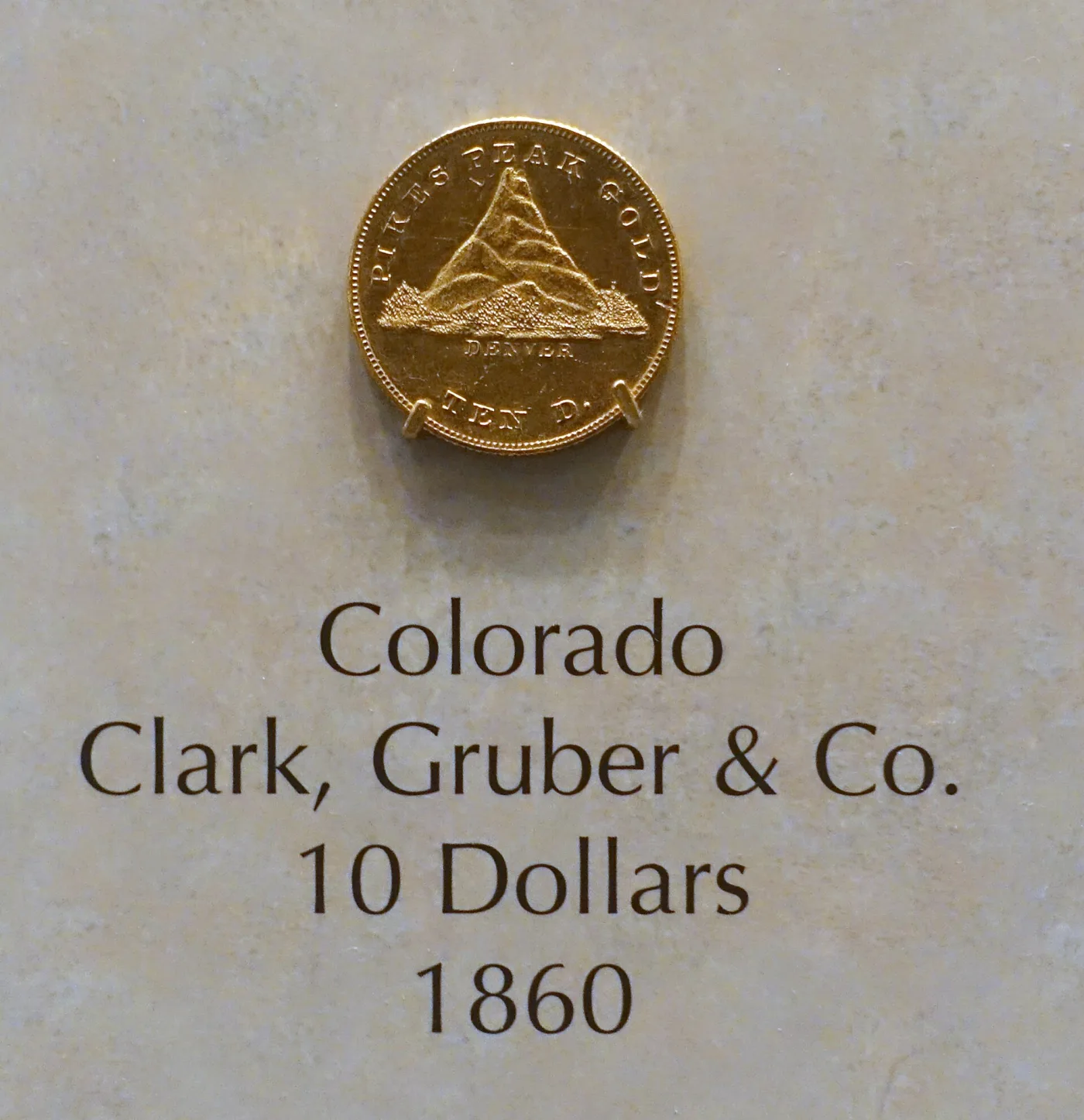
This is the issue that the phrase “bank-issued gold coin” most accurately describes. Austin and Milton Clark and Emanuel Gruber were already working as brokers, bankers and assayers in Denver when they built a mint there in 1860. Trial strikes of four denominations, $2.50, $5, $10 and $20, were ready by mid-July 1860, and regular coinage followed within about a week.
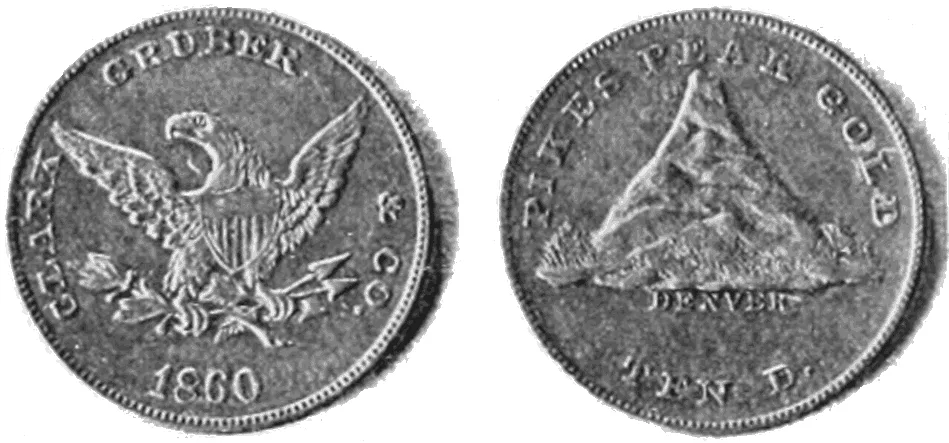
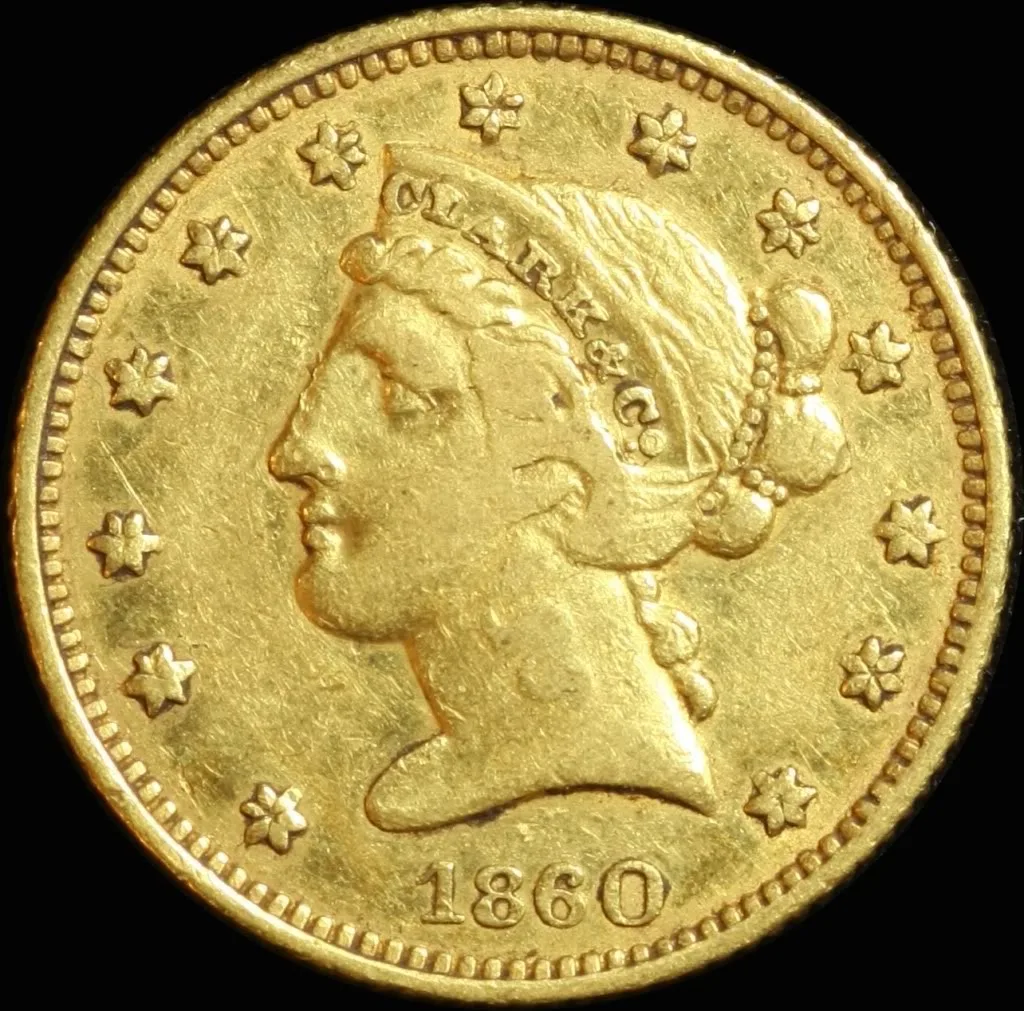
The 1860 $10 and $20 carry a stylised Pikes Peak with the legend PIKES PEAK GOLD. The smaller 1860 coins and the 1861 series use a Liberty head that looks like the federal coronet design, except for the lettering on the coronet itself.
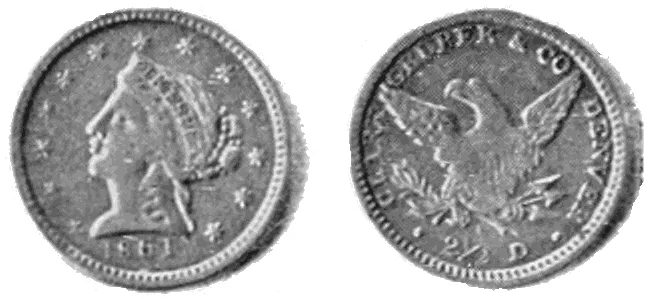
The firm’s own mint outlived its coinage. In 1863 the federal government bought the Clark, Gruber operation and opened a federal assay office on the site, which is part of the prehistory of the Denver Mint. Every Clark, Gruber coin is dated 1860 or 1861.
Templeton Reid: the first private gold
Templeton Reid, a Milledgeville, Georgia jeweler and gunsmith, struck the first private gold coins of the 19th century in 1830, in $2.50, $5 and $10 denominations. The design is plain lettering rather than a portrait: GEORGIA GOLD and the date on one side, and the denomination with TEMPLETON REID above it and ASSAYER below on the other.
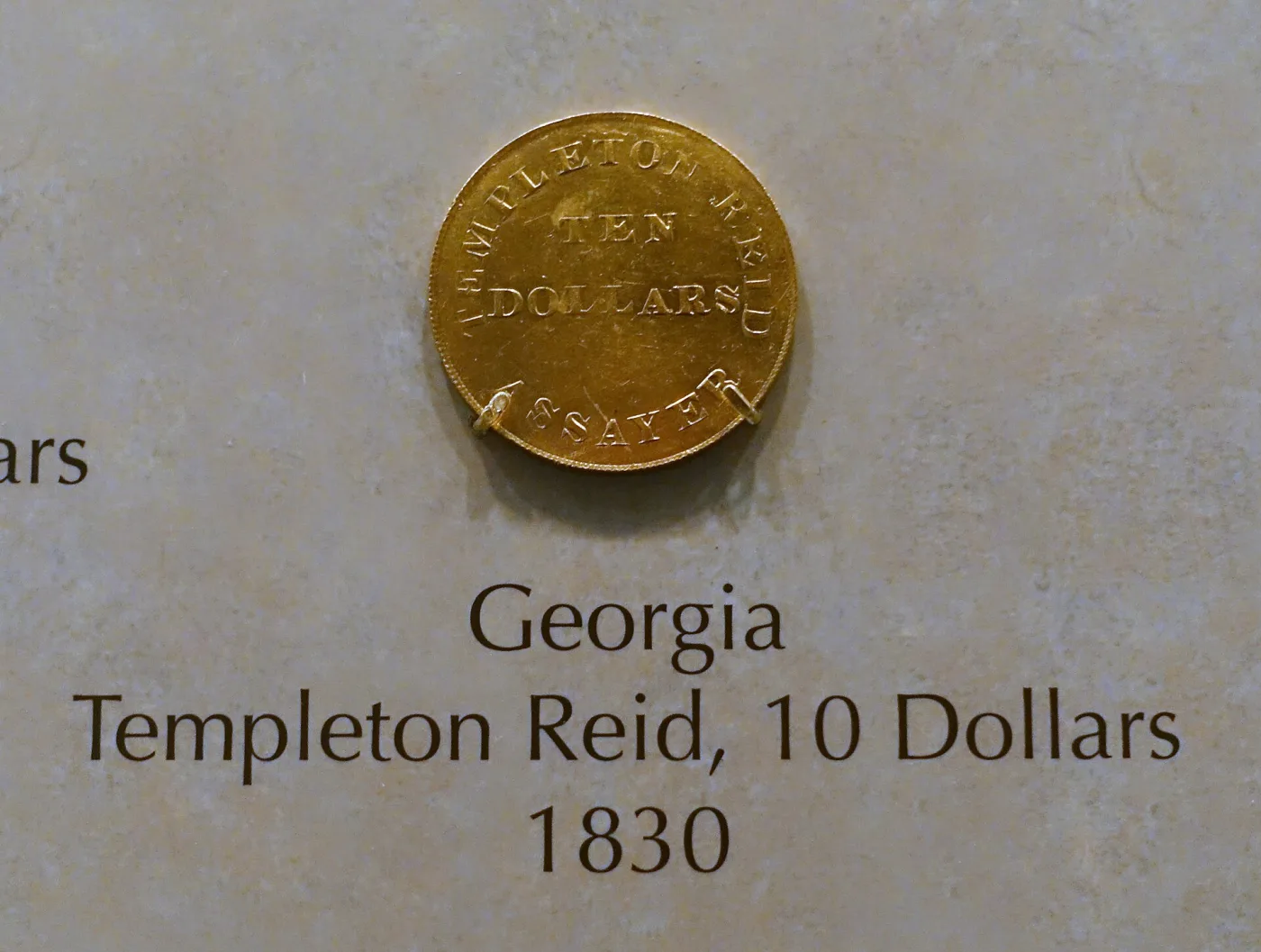
Reid’s weights were accurate, but his assays were not, and his coins came up slightly short of their stated value. He was attacked in the newspapers, lost the public’s confidence and closed before the end of 1830. Survivors are extremely rare. Sources disagree on how many are known, so treat any unverified Reid piece with a lot of suspicion.

The Bechtlers: the first American gold dollar
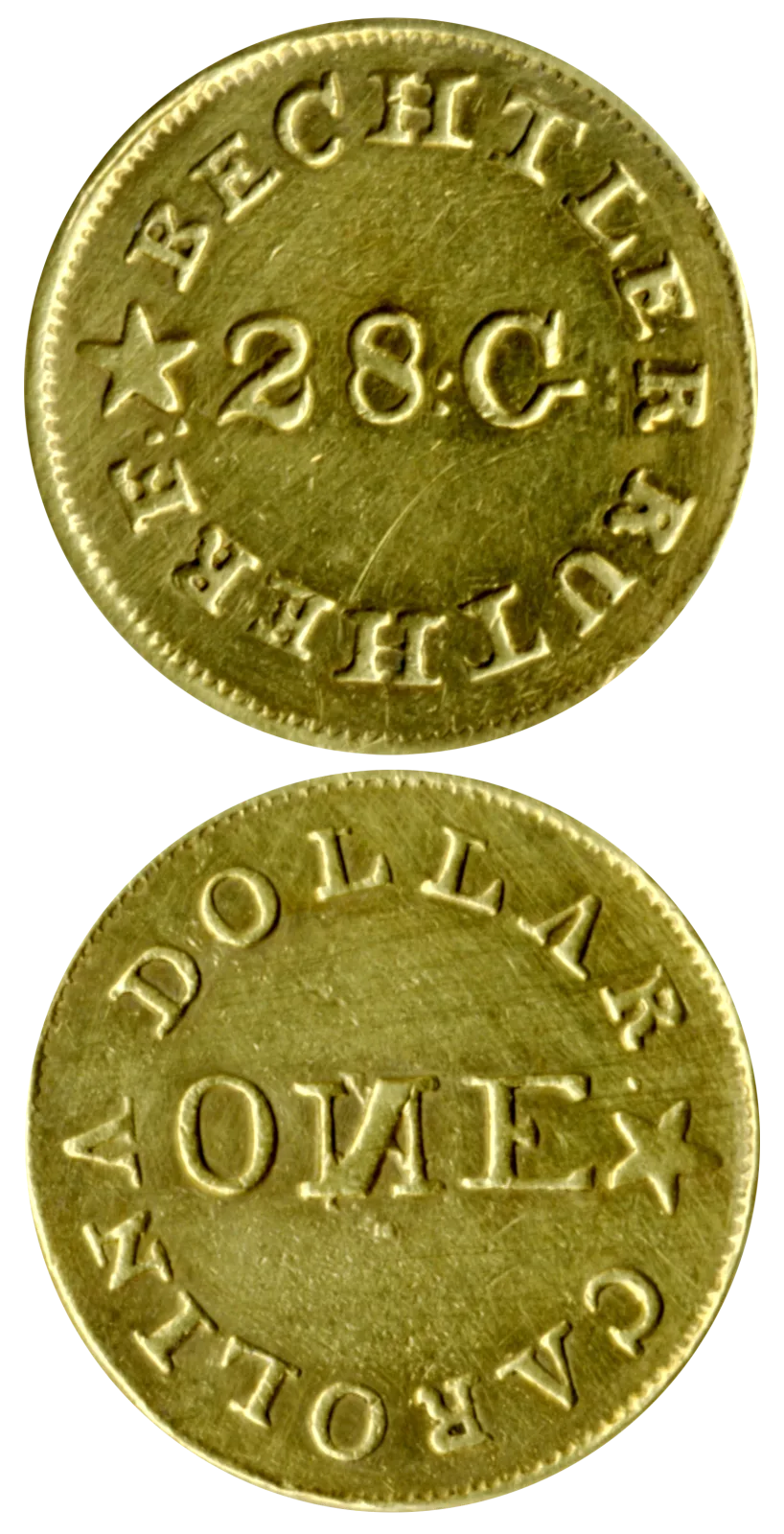
Christopher Bechtler, a German immigrant metalworker, and later his son August coined gold at Rutherfordton, North Carolina, from 1831. They began with $2.50 and $5 pieces and added a $1 gold coin in 1832. That was the first gold dollar struck in the United States, 17 years before the federal Mint made one.
Bechtler coins are the easiest private gold to read because they tell you what they are made of. Look for:
- The source of the gold: CAROLINA or GEORGIA.
- The weight in grains, followed by G., for example 28.G. on a dollar or 140.G. on a $5.
- The fineness in carats. The Bechtlers worked in 20, 21 and 22 carats.
- RUTHERF (Rutherfordton) and BECHTLER on the other side.
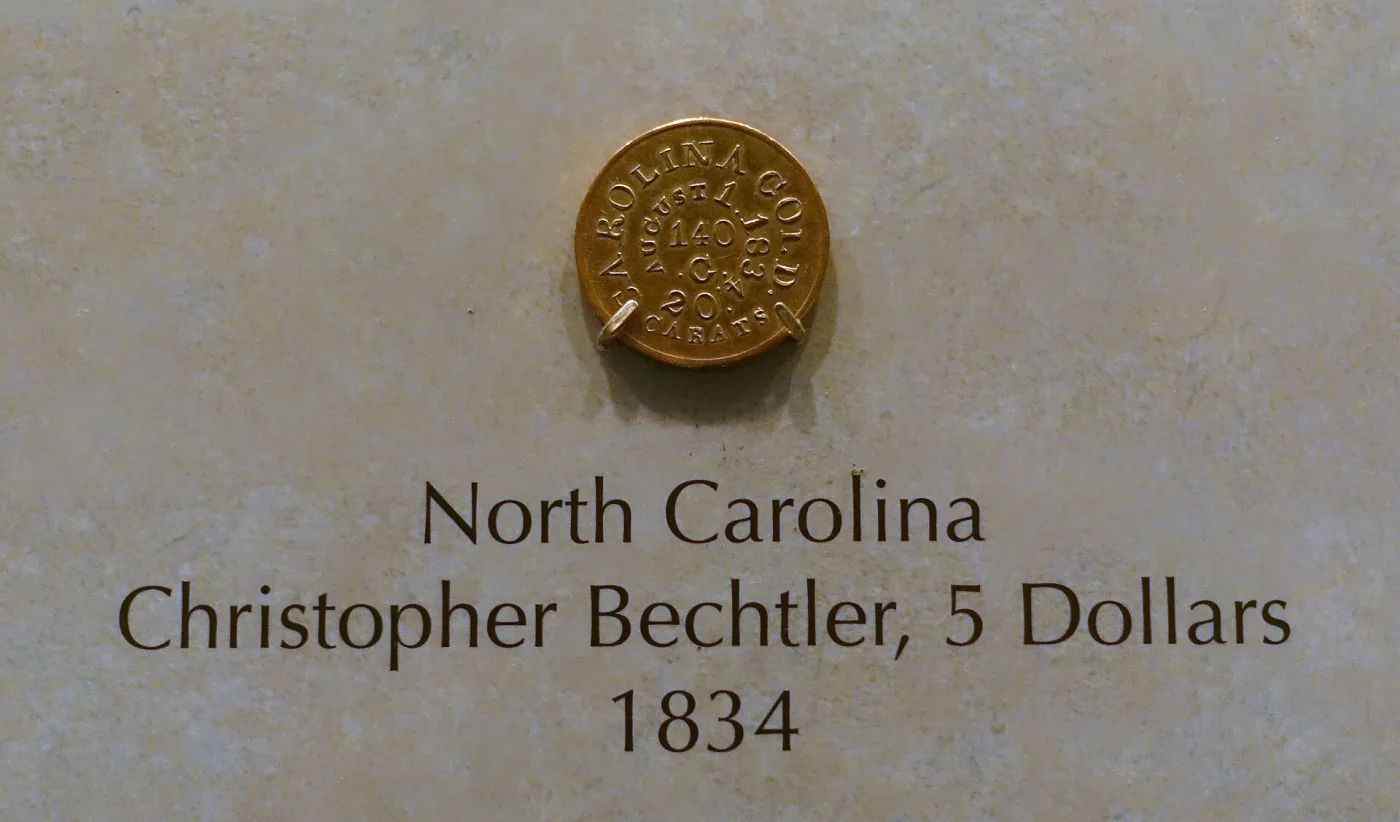
The date AUGUST 1. 1834 on some $5 pieces is the day the new, lighter federal gold standard of the Coinage Act of 1834 took effect. It shows that the coin was struck to that standard. It is not necessarily the day the coin was made. The arithmetic checks out: 140 grains at 20 carats is about 116.7 grains of pure gold, a shade over the 116 grains in a federal half eagle after 1834.
Moffat & Co. and Wass, Molitor & Co.: California
The California Gold Rush produced the largest group of private issuers. Two of the most important were San Francisco assayers.
Moffat & Co. issued rectangular gold ingots in 1849 before turning to coins. From 1850 to December 1853 the firm worked in a semi-official role alongside the United States Assay Office of Gold. Its 1853 $20, with MOFFAT & CO. on Liberty’s coronet, is catalogued with the Assay Office coinage rather than as a purely private issue. The Assay Office closed in December 1853, when the new federal San Francisco Mint was about to begin work.
Wass, Molitor & Co. was founded in 1851 by two Hungarian immigrants, Samuel Wass and Agoston Molitor. It struck $5 and $10 pieces in 1852, nothing dated 1853 or 1854, and then in 1855 a run of $10, $20 and a round $50. Its coins were struck to full weight and fineness.
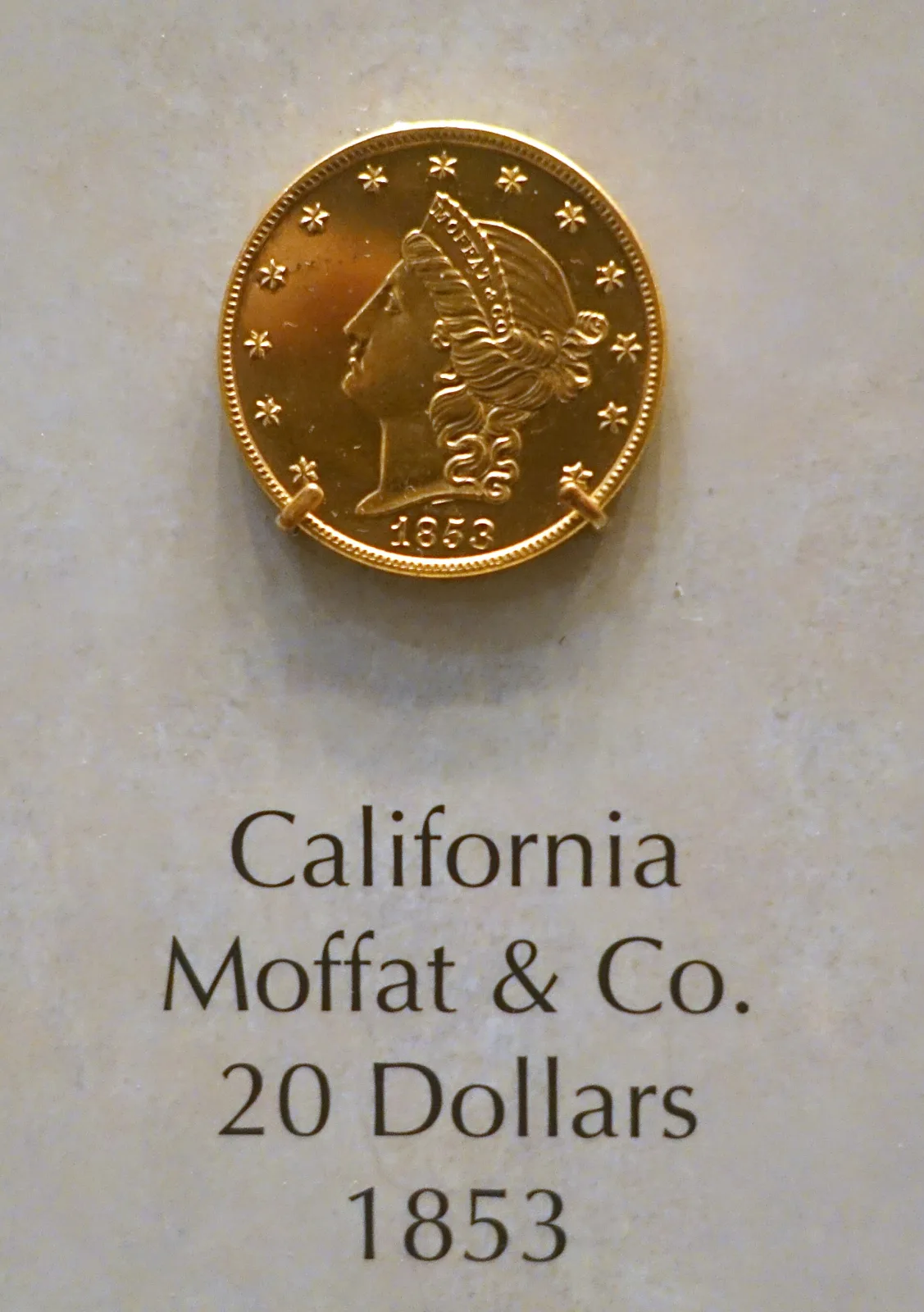
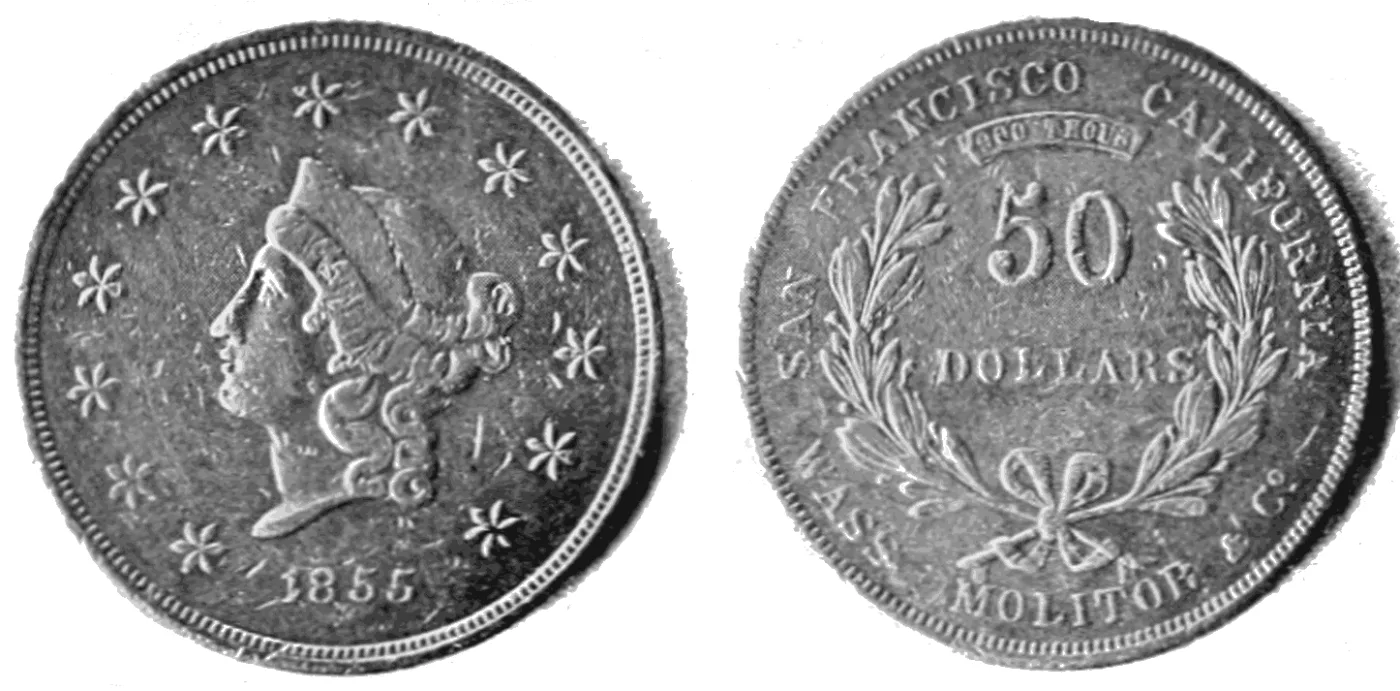
The Liberty-head California and Colorado pieces are the ones most easily mistaken for federal coins. Read the coronet before anything else. A federal coin says LIBERTY there, and a private one names its maker.
Mormon gold: Salt Lake City
The Church of Jesus Christ of Latter-day Saints struck gold at its Deseret Assay Office in Salt Lake City, beginning in 1849 with $2.50, $5, $10 and $20 pieces. The designs look nothing like federal coins:
- One side: clasped hands, the date, the denomination and G.S.L.C.P.G., for Great Salt Lake City Pure Gold.
- The other side: HOLINESS TO THE LORD around a three-pointed crown or mitre above an all-seeing eye.
- 1860 $5: a reclining lion on one side and an eagle with DESERET ASSAY OFFICE PURE GOLD on the other.
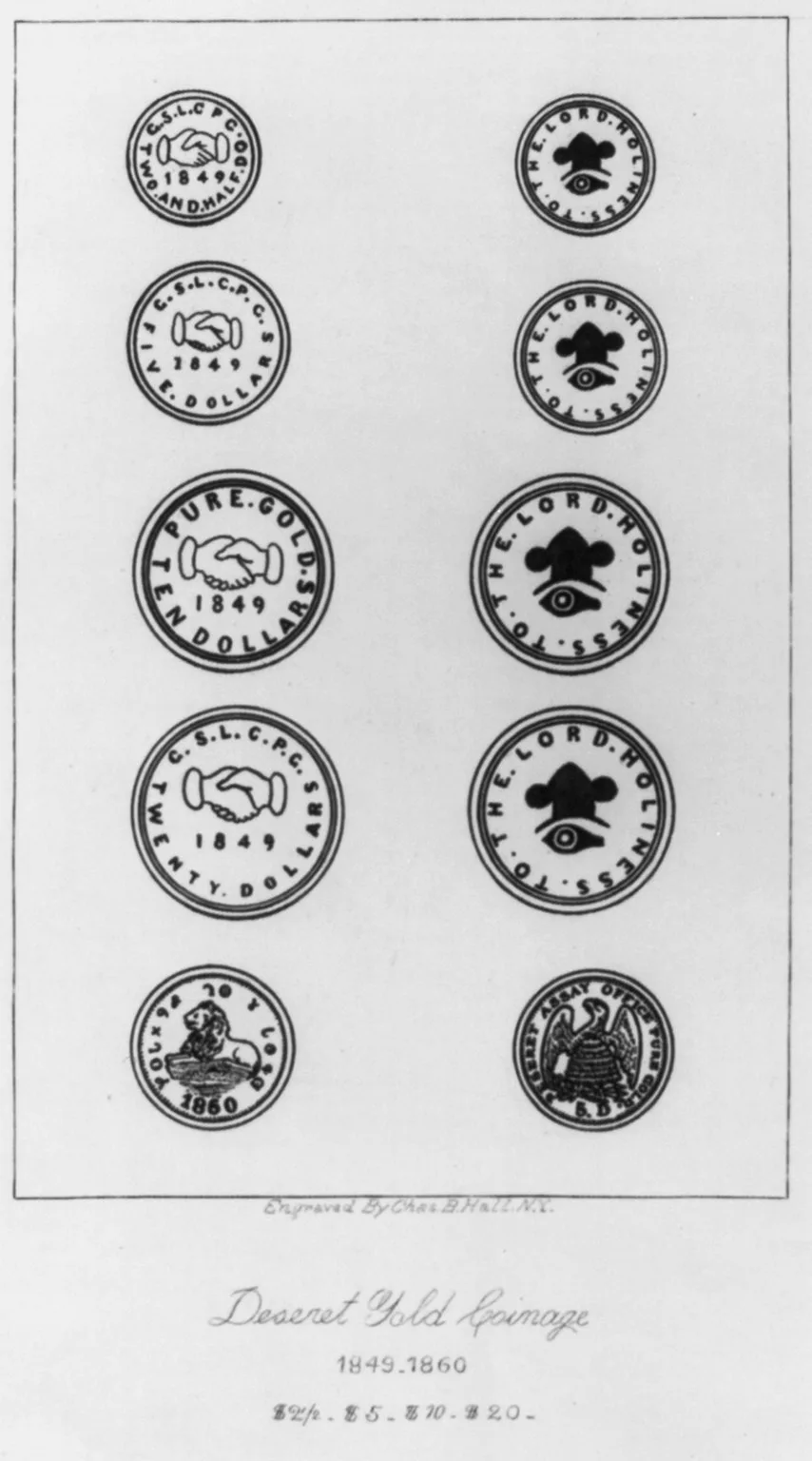
All Mormon gold is rare, and it is one of the most reproduced territorial series. Collector forums document unmarked Mormon gold replicas being sold online.
Copies, replicas and the COPY rule
Territorial gold is valuable and hard to verify, which makes it one of the most copied areas of American numismatics. Three checks catch most problems:
- Look for COPY. Under the Hobby Protection Act, an imitation numismatic item made for the US market must be permanently marked with the word COPY, incused in sans-serif letters of a minimum size. A marked piece is a replica, whatever the seller calls it.
- Check the issuer’s own claims. Bechtler and Wass, Molitor pieces state their weight or fineness on the coin. Weigh the piece. A “140 G.” coin that does not come near 140 grains (about 9.07 grams) has already told you what it is. The same method is described in our counterfeit detection guide.
- Be suspicious of availability. Genuine Templeton Reid and Mormon pieces are known in small numbers. A dealer with several, or a marketplace listing with a low price, is describing a reproduction.
Anything that passes those checks should go to a major third-party grader before money changes hands. See our third-party grading guide for how that works.
What about a gold coin from a bank today?
Banks and dealers sell gold, but they do not issue coins. A gold piece is legal tender only when a government issues it, such as the American Gold Eagle or the American Gold Buffalo. A modern round or medal carrying a bank’s or refiner’s name is bullion. It is valued by its weight and purity, so read the stamped weight and fineness and check them against a scale. It is not a successor to the Clark, Gruber $10, and it carries no numismatic premium for being “bank-issued”.
Private gold is also a cousin of two other kinds of non-government money covered on this site, the Hard Times tokens of the 1830s and the Civil War tokens of the 1860s. All three were made by private hands because official coin was scarce.
Frequently Asked Questions
Did American banks ever issue their own gold coins?
Yes, before 1864. The best-known case is Clark, Gruber & Co., a Denver firm of brokers, bankers and assayers that struck $2.50, $5, $10 and $20 gold pieces dated 1860 and 1861. Other private issuers, such as the Bechtlers in North Carolina and Moffat & Co. and Wass, Molitor & Co. in San Francisco, were assayers or metalworkers rather than banks, but their coins are collected together as private or territorial gold.
Were private gold coins legal?
The Constitution forbids the states from coining money but was silent about private persons, so private gold coinage was tolerated until Congress banned the private manufacture of coins in 1864. Small California fractional gold pieces kept appearing for years after the ban because it was not strictly enforced at first.
How can I tell a real territorial gold coin from a copy?
Start with the Hobby Protection Act: a legitimate modern replica made for the US market must carry the word COPY incused on it. Beyond that, genuine pieces are rare enough that any example should be weighed, measured and sent to a major grading service before money changes hands. A territorial coin that is common on an online marketplace is almost certainly a reproduction.
What does G.S.L.C.P.G. mean on a gold coin?
It stands for Great Salt Lake City Pure Gold. It appears with a pair of clasped hands on the 1849 Mormon gold pieces struck in Salt Lake City, whose other side carries HOLINESS TO THE LORD around a crown or mitre above an all-seeing eye.
Is a modern gold coin sold by my bank a bank-issued coin?
No. Banks and dealers sell gold, but a gold piece only has legal-tender status if a government issues it. A modern gold round or medal carrying a bank's or refiner's name is bullion valued by its weight and purity, not a coin in the sense that a Clark, Gruber $10 was, and it is worth checking the stamped weight and fineness against the seller's claim.
Why do some Bechtler coins say CAROLINA and others GEORGIA?
The Bechtlers of Rutherfordton, North Carolina coined gold brought in by miners from both states' goldfields, and they marked the source on the coin, together with its weight in grains and its fineness in carats.