Hard Times Tokens Identification Guide: Political Satire Pieces, Merchant Store Cards, Low and HT Numbers, Copper Varieties, and Values
Hard Times Tokens are among the most fascinating, affordable, and historically loaded objects an American collector can own — privately made copper pieces, roughly the size of a contemporary large cent, that circulated as small change and political propaganda during the economic turmoil of the 1830s and early 1840s. They were struck not by the United States Mint but by merchants, manufacturers, and political partisans during the “Hard Times” that followed Andrew Jackson’s war on the Second Bank of the United States and erupted into the Panic of 1837. With federal cents scarce and banks suspending payments, these tokens filled a desperate need for coinage — and, on their satirical varieties, doubled as the campaign buttons and protest placards of the age.
For the collector, this is a field where serious history, biting humor, and genuine numismatic depth meet at a price most people can afford. A single token can carry a caricature of Jackson as a jackass, a running boar labeled “MY SUBSTITUTE FOR THE U.S. BANK,” a sly “NOT ONE CENT” that let merchants dodge counterfeiting laws, or simply the name and trade of a New York hardware dealer who needed change to keep his shop running. They belong to the branch of the hobby called exonumia — coin-like objects that are not official coins — yet they are collected with the same intensity as regular federal series, catalogued by their own numbering systems and chased by date, die variety, and metal.
This guide is your complete 2026 reference for identifying, classifying, grading, authenticating, and valuing Hard Times Tokens. We explain exactly what they are and the history that produced them, walk through the two great families — political satire pieces and merchant store cards — decode the Low and HT cataloging numbers that organize the series, cover the famous die-sinkers and the unusual Feuchtwanger “German silver” cent, and show you how to tell a genuine period token from a modern copy. Whether you have inherited a mysterious “coin” that looks like an old cent but isn’t, or you want to build a focused collection of America’s protest money, you will leave knowing how to read these copper time capsules.
What Are Hard Times Tokens?
Hard Times Tokens are privately issued copper (and a few non-copper) pieces, struck mostly between 1832 and 1844, that circulated unofficially as one-cent pieces during a period of acute economic distress in the United States. They are not coins in the legal sense — no government authorized them — but they passed from hand to hand as money because genuine federal cents were in short supply and the public accepted any copper of roughly the right size. In numismatics they sit at the head of the broad category of exonumia: tokens, medals, and coin-like objects that are collected alongside, but are distinct from, official coinage.
Physically, the typical Hard Times Token closely imitates the contemporary Coronet Head large cent — about 28 to 29 millimeters across, struck in copper, and often deliberately styled to resemble a real cent so it would be accepted in trade. That visual kinship is no accident: the whole point was to provide a substitute for the cent that was missing from circulation. The name “Hard Times Tokens” was popularized by the pioneering 19th-century collector and cataloger Lyman H. Low, who used the phrase to describe these pieces and tie them to the “hard times” of the Jacksonian financial crisis.
Two Great Families
Collectors divide the series into two broad groups. The political satire tokens (sometimes called “civic” or “political” pieces) carry partisan slogans and caricatures attacking or defending Andrew Jackson, his successor Martin Van Buren, the national bank, and the economic policies of the day. The merchant store cards are advertising pieces bearing the name, address, and trade of a specific business — a grocer, hardware dealer, hat maker, or tavern — issued both to make change and to promote the shop. A handful of pieces blur the line, and the Feuchtwanger cent (a proposed alternative coinage in “German silver”) forms a distinctive third strand.
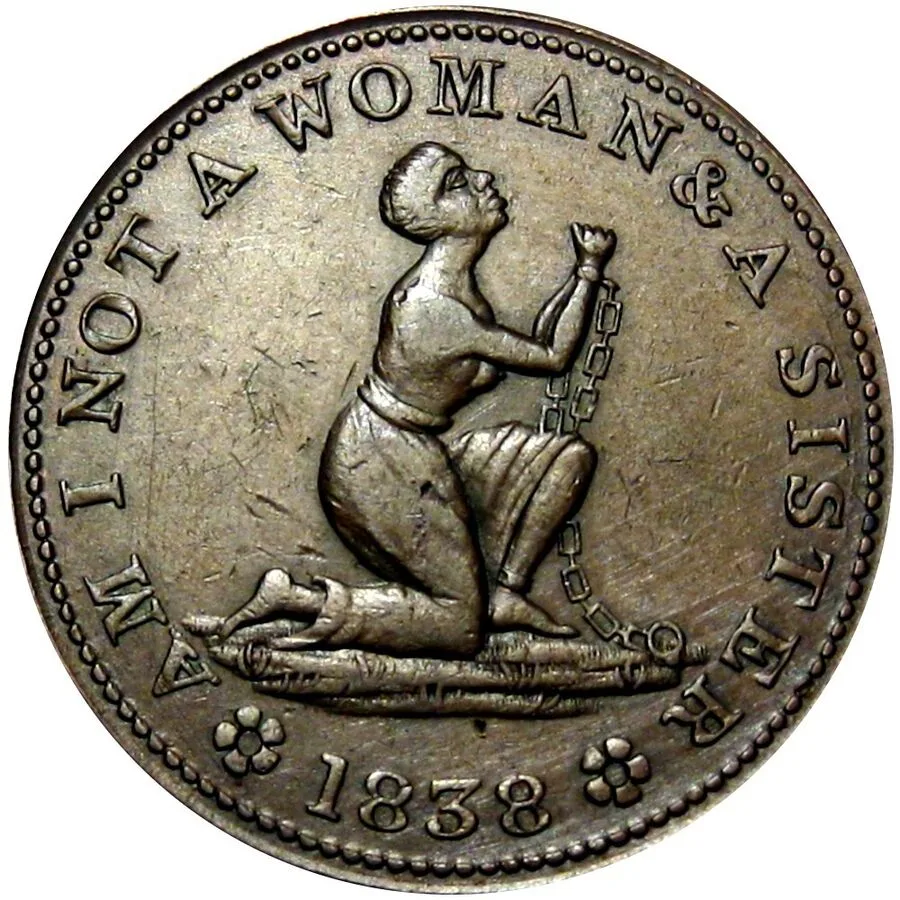 Wikimedia Commons, public domain
 Few classes of American money are so directly political. On a Hard Times Token you can hold a citizen’s actual opinion of Andrew Jackson, cast in copper and spent at the corner store. They are primary historical documents of the Jacksonian era, the Bank War, and the first great depression of the young republic — and because so many were made, they remain genuinely affordable, making them one of the best value-for-history fields in the entire hobby.
The History Behind Them: Jackson, the Bank, and the Panic
Understanding why these tokens exist is the key to identifying their imagery, because almost every political design is a direct comment on the events of 1832 to 1840. The story is one of banks, politics, and a coin shortage that turned private copper into national protest.
The Bank War
In 1832 President Andrew Jackson vetoed the recharter of the Second Bank of the United States, the powerful quasi-national bank he distrusted as a tool of eastern financial elites. Re-elected that year, he moved to dismantle it by withdrawing federal deposits and placing them in state “pet banks.” Jackson’s supporters cast him as a champion of the common man against a corrupt monopoly; his opponents — the emerging Whig party — saw reckless executive overreach that destabilized the nation’s finances. This “Bank War” is the single most common theme on the political tokens.
The Specie Circular and the Panic of 1837
Loose credit from the state banks fueled wild land speculation, and in 1836 Jackson issued the Specie Circular, requiring that public land be paid for in gold or silver (“specie”) rather than paper banknotes. The order drained hard money from the East, helped trigger a financial collapse, and in May 1837 — just after Martin Van Buren took office — banks across the country suspended specie payments. The resulting Panic of 1837 spiraled into a depression that lasted into the early 1840s: businesses failed, unemployment soared, and these were the literal “hard times” the tokens are named for.
The Coin Shortage That Created the Tokens
When banks stopped paying out gold and silver, people hoarded every real coin they could, and small change all but vanished from circulation. Federal copper cents — then the big, full-weight large cent — could not be produced fast enough to meet the need, and the lower-value half cent was barely struck at all in these years. Merchants who could not make change could not do business. Into that vacuum poured privately struck copper tokens, sized like cents and accepted as cents, that kept commerce moving. Necessity, not novelty, is the real reason they were made.
The End of the Era
As the economy slowly recovered in the early 1840s and federal coinage caught up, the need for substitute coppers faded, and the issuing of Hard Times Tokens tapered off around 1844. The genre did not vanish so much as evolve: the same impulse — privately struck cent-sized copper filling a coinage gap — returned on a far larger scale during the next great shortage, the Civil War Tokens of 1861 to 1865. Hard Times Tokens are best understood as the first major American token episode, a direct ancestor of that later wave.
How to Identify a Hard Times Token
Many people first encounter a Hard Times Token without knowing what it is — an “old penny” from a family hoard that, on closer look, is clearly not a regular coin. A consistent method quickly tells you what you have.
Step 1: Confirm It Is a Token, Not a Coin
A genuine U.S. cent of this era reads “UNITED STATES OF AMERICA” with “ONE CENT” in a wreath and a Liberty head with a coronet or classic headband. A Hard Times Token will instead carry a slogan, a caricature, a business name, or an oddly worded value like “NOT ONE CENT.” If the piece is cent-sized, copper, dated roughly 1832 to 1844, and says anything other than a normal federal legend, you are almost certainly holding a Hard Times Token rather than a coin. For the general method of distinguishing coins from tokens and medals, our complete coin identification guide lays out the first principles.
Step 2: Read Every Word and Slogan
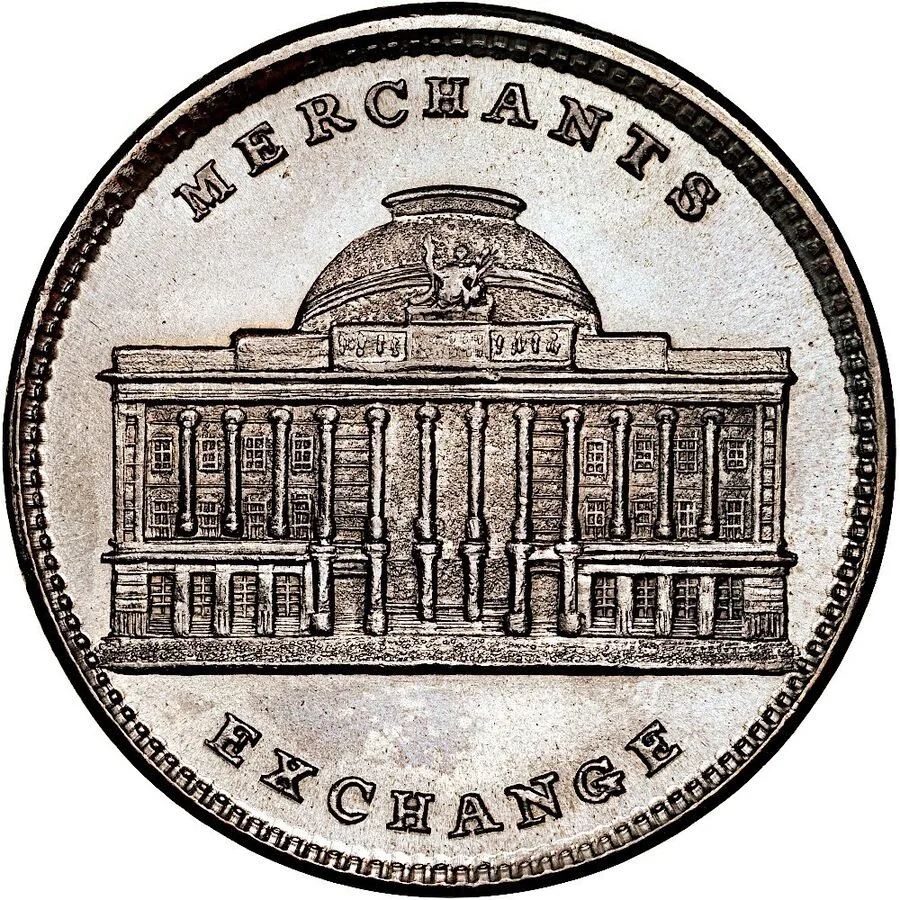
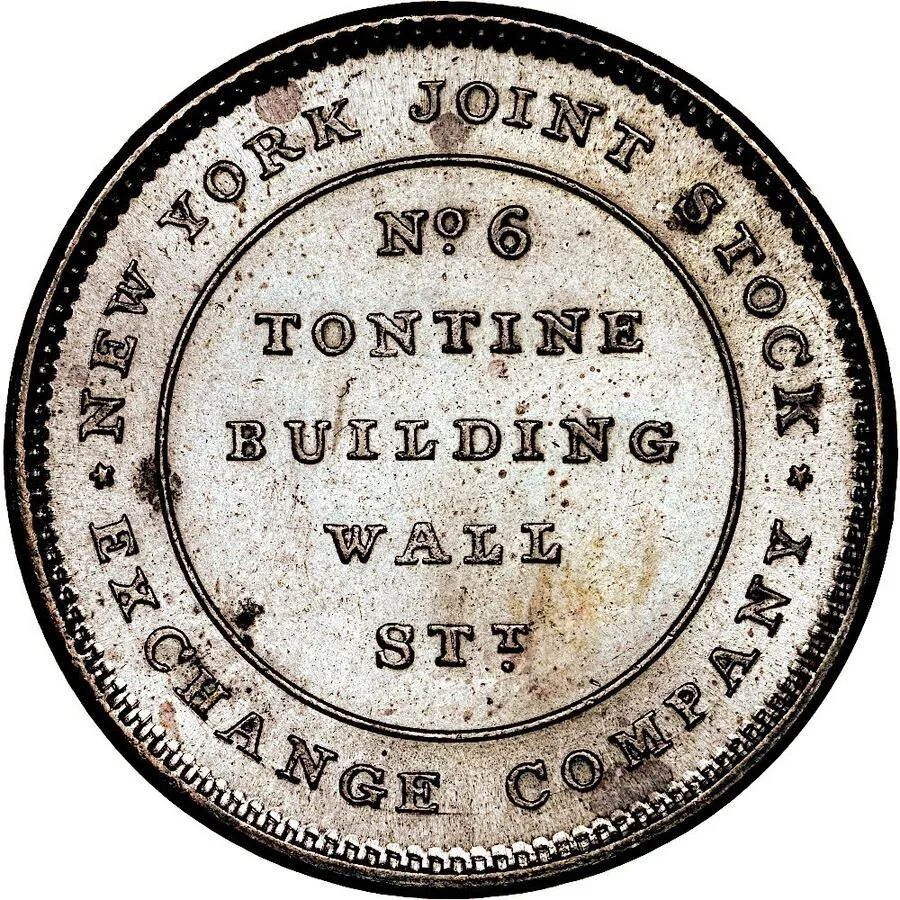
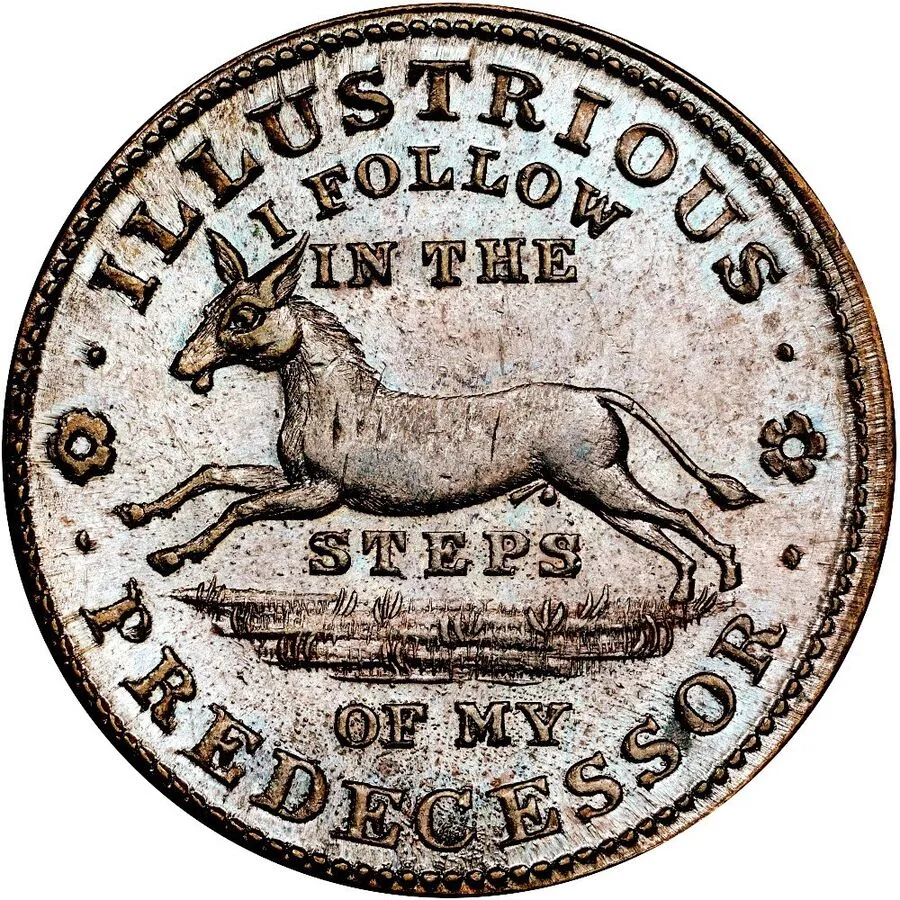
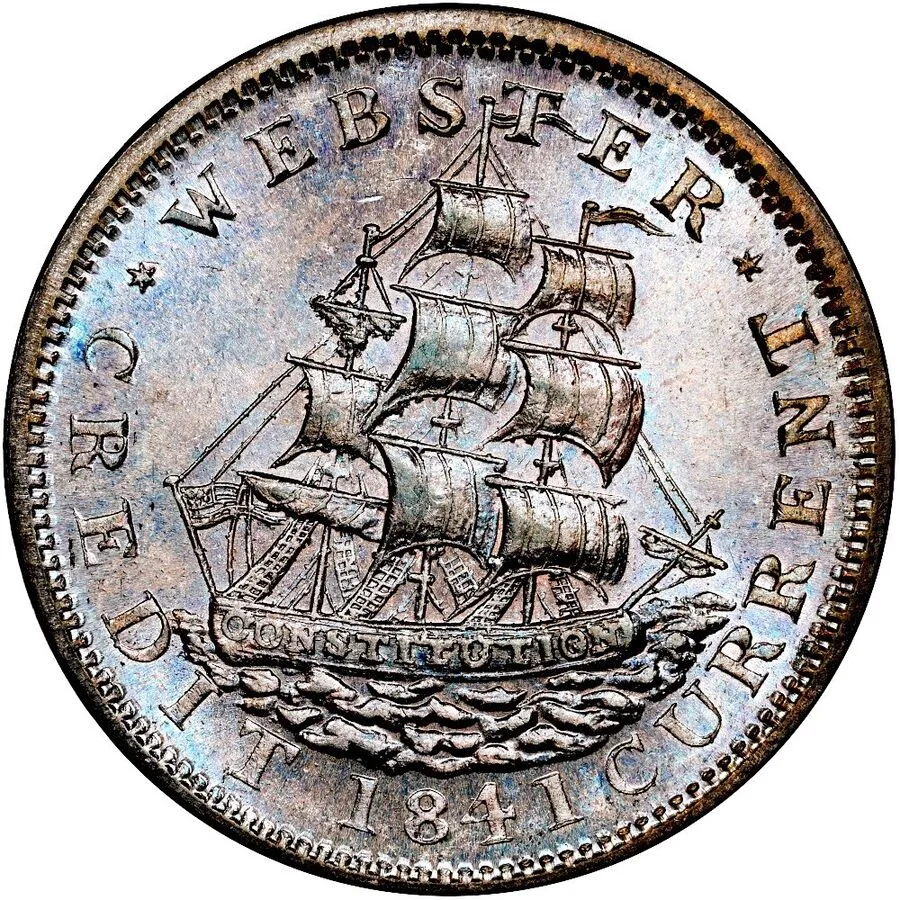
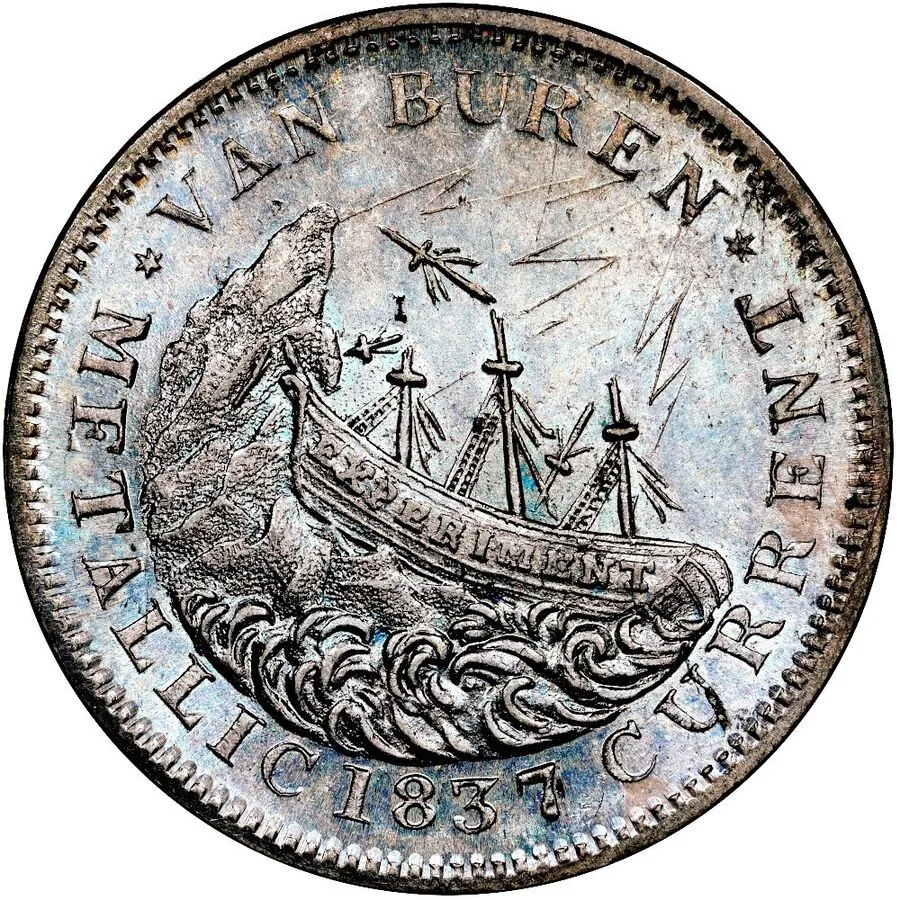
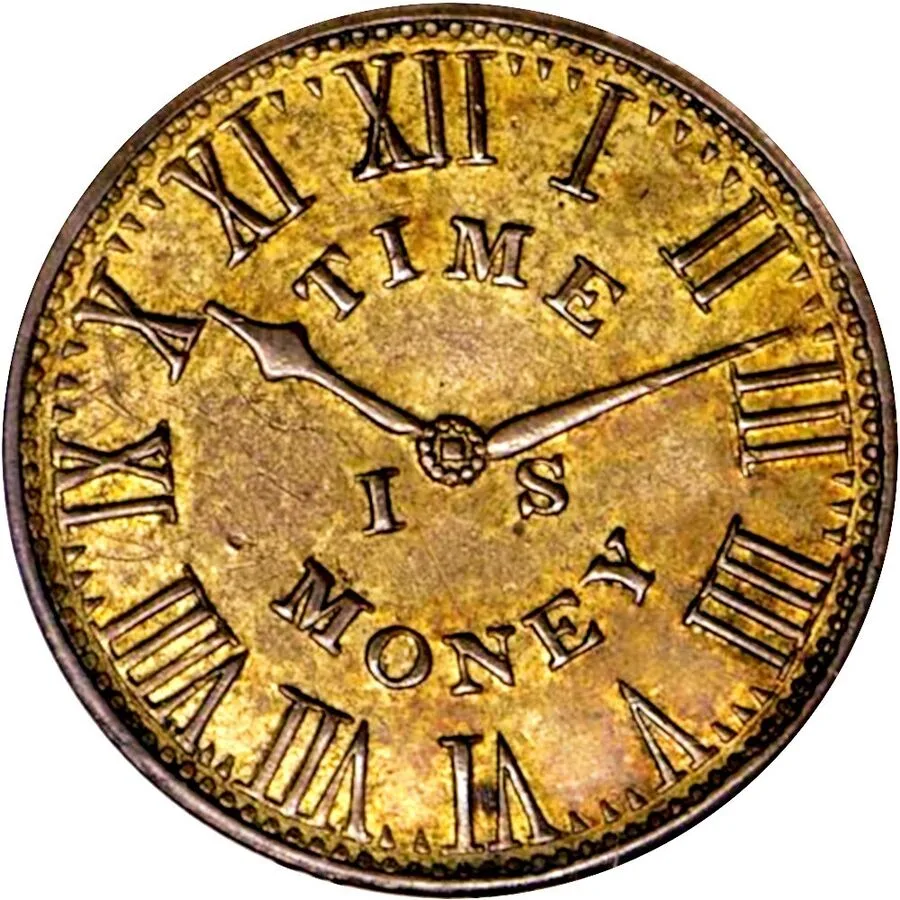
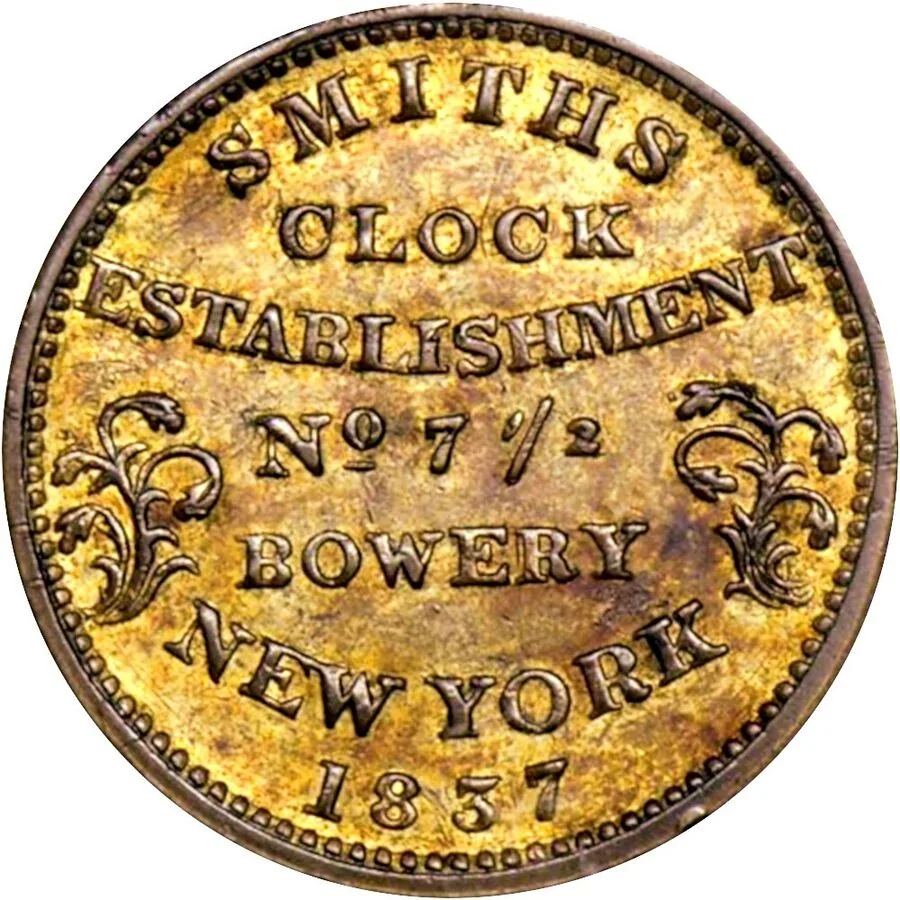
The inscriptions are the heart of identification. Political pieces shout their politics: MY SUBSTITUTE FOR THE U.S. BANK, NOT ONE CENT, ILLUSTRIOUS PREDECESSOR, EXECUTIVE EXPERIMENT, I TAKE THE RESPONSIBILITY, VAN BUREN METALLIC CURRENCY, MILLIONS FOR DEFENCE NOT ONE CENT FOR TRIBUTE, WEBSTER CREDIT CURRENT, or LOCO FOCO. Store cards instead spell out a merchant’s name, trade, and address (“ROBINSON’S JONES & CO.,” “SMITH’S CLOCK ESTABLISHMENT,” a street and city). Copy the full legend exactly; it is what catalog numbers are built on.
Step 3: Identify the Central Image
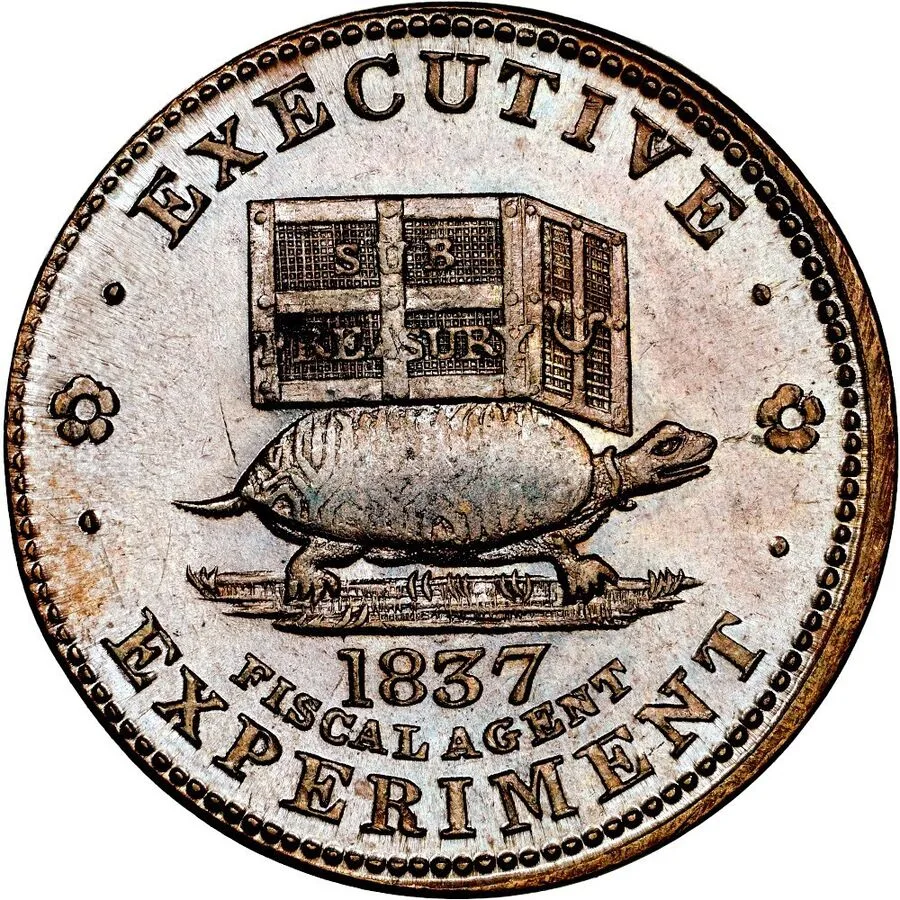
The pictures are vivid and specific. Look for a running boar or hog (the anti-Jackson “substitute for the U.S. Bank”), a jackass (mocking Jackson), a strongbox or safe with a key (the “experiment” with federal deposits), a ship in distress (the floundering ship of state under Van Buren), a Liberty head imitating the cent, a Phrygian liberty cap, or a tortoise carrying a strongbox labeled “EXECUTIVE EXPERIMENT FISCAL AGENT.” Each device ties to a known political theme or to a generic civic design.
Step 4: Find the Date and Decide the Type
Most political pieces are dated 1834, 1837, or 1841; many store cards carry a date too. Use the date to place the piece in the timeline — the satirical “Bank War” pieces cluster around 1834 and 1837, while Van Buren–era pieces and store cards run later toward the early 1840s. Be aware that undated pieces exist, and that the date confirms the period being referenced, not necessarily a precise year of striking.
Step 5: Attribute the Variety With a Reference
Like other early American series, Hard Times Tokens are catalogued by specialized die-variety numbers rather than by date and mint mark. The two systems you will meet are the older Low numbers (from Lyman Low’s catalog) and the modern HT numbers (from Russell Rulau’s standard reference). Matching your token’s legend and image to a Low/HT listing pins it down precisely. An AI identification app can often name the type from a clear photo of both sides before you reach for the catalog.
Political Satire Tokens
The political pieces are the soul of the series and the reason many people collect it. They are, in effect, the editorial cartoons and protest signs of the 1830s, struck in copper and spent as money. Knowing the recurring themes lets you read almost any example.
Attacks on Andrew Jackson
Anti-Jackson tokens dominate the political group. A famous design shows a jackass with the legend “THE CONSTITUTION AS I UNDERSTAND IT,” paired with a strongbox and “ROMAN FIRMNESS / I TAKE THE RESPONSIBILITY” — turning Jackson’s own defiant phrases against him and punning on “jackass.” Another shows a running boar (“a hog”) inscribed “MY SUBSTITUTE FOR THE U.S. BANK / MINT DROP” or “PERISH CREDIT PERISH COMMERCE,” mocking the idea that gold “mint drops” and pet banks could replace the national bank. The donkey, soon adopted as the symbol of Jackson’s Democratic party, makes some of its earliest appearances here.
The Strongbox, the Tortoise, and the “Experiment”
Jackson’s removal of federal deposits — derided by opponents as the “Experiment” — produced its own imagery. Tokens show a strongbox or safe with a key, sometimes carried on the back of a slow-moving tortoise labeled “EXECUTIVE EXPERIMENT / FISCAL AGENT / 1837,” ridiculing the clumsy handling of the nation’s money. The reverse often reads “SUB TREASURY” or carries a sailing ship in trouble, the classic emblem of a ship of state in danger.
Van Buren and the Ship of State
Martin Van Buren inherited the Panic, and tokens turned on him too. A widely seen pairing shows a safe/strongbox with “EXECUTIVE EXPERIMENT” on one side and a sinking or storm-tossed ship named “VAN BUREN / WEBSTER CREDIT CURRENT” on the other — Daniel Webster’s “credit” (a sound ship) contrasted with Van Buren’s “metallic currency” (a wreck). These pieces dramatize the partisan argument over paper credit versus hard money.
Loco Foco, Liberty, and Slogans
The radical hard-money Democrats were nicknamed “Loco Focos” after the self-igniting matches they once used to keep a meeting going when the gaslights were cut, and the term appears on tokens. Other pieces carry a Liberty head closely imitating the large cent (so they would pass as cents) combined with “LIBERTY” and a date, or patriotic slogans like “MILLIONS FOR DEFENCE NOT ONE CENT FOR TRIBUTE.” Reading the slogan and matching the image to these themes will identify the great majority of political pieces.

Merchant Store Cards
The other half of the series is the merchant store card — a token issued by a specific business that served simultaneously as advertising and as change. These pieces are quieter than the political ones but offer a remarkable window into the shops and trades of the 1830s.
What a Store Card Says
A store card typically names the proprietor, the type of business, and an address: a grocer, a hardware or “stove and tin” dealer, a hatter, a druggist, a jeweler, a clock maker, a tavern, or a dry-goods house. Many add a flattering line of advertising copy or a price (“CHEAP FOR CASH,” “WHOLESALE AND RETAIL,” “AT THE SIGN OF…”). Some pair a business name on one side with a generic patriotic or political design on the other, using a shared “stock” die that the die-sinker reused across many customers.
Famous and Common Issuers
Certain store cards are well known. Robinson’s Jones & Co. of Attleboro, Massachusetts (a maker of buttons and German-silver wares) issued widely collected pieces; Smith’s Clock Establishment in New York advertised clocks; H. Crossman, Peck & Co., and numerous New York hardware and grocery firms issued coppers; and merchants in Albany, Troy, Boston, Baltimore, and other cities are represented. New York City, the commercial capital, produced by far the largest number of store-card issuers.
Geography and the “Stock” Reverses
Because store cards name a place, they let you map the token economy directly. The same eagle, Liberty head, or “general store” reverse die often appears on cards from many different merchants — the die-sinker simply struck the customer’s name on a new obverse and reused an existing reverse. Recognizing these shared stock reverses helps you attribute a worn or partially legible piece by matching the reverse even when the merchant’s name is unclear.
Why Collectors Love Them
Store cards turn a token collection into a directory of antebellum American business. Specialists pursue them by city, by trade, or by die-sinker, and a worn copper naming a long-vanished New York grocer can be both historically evocative and surprisingly inexpensive. They are an ideal entry point for a collector who wants genuine 1830s history without the premium that famous political pieces command.
The “NOT ONE CENT” Loophole
One legend appears so often, and is so widely misunderstood, that it deserves its own explanation: the famous “NOT ONE CENT” tokens are a clever legal dodge, and recognizing them is central to understanding the series.
Why the Tokens Avoided Saying “Cent”
It was illegal to counterfeit United States coins, and a private copper that boldly claimed to be “ONE CENT” risked prosecution. Token makers sidestepped this by stamping a value that pointedly was not a claim to be a federal cent. The most common solution borrowed a patriotic slogan from the era of the Quasi-War with France — “MILLIONS FOR DEFENCE NOT ONE CENT FOR TRIBUTE” — and isolated the phrase “NOT ONE CENT” on the token. The piece spent as a cent in practice while literally declaring it was not one, providing legal cover.
How to Recognize and Read Them
These pieces usually show a Liberty head imitating the large cent on the obverse — surrounded by stars and a date such as 1837 — with “NOT ONE CENT” (often within a wreath, mimicking the federal “ONE CENT” reverse) on the other side. At a glance they look almost exactly like a real cent, which was the whole idea. The deliberate “NOT” is your tell: a federal coin would never say it, but a Hard Times Token proudly does.
Their Place in the Series
“NOT ONE CENT” tokens straddle the political and store-card families. Some carry a merchant’s name on the Liberty-head side; others are purely the value-and-Liberty type. Because they so closely copy the cent and were struck in large numbers, they are among the most frequently encountered Hard Times Tokens — and often the first one a new collector identifies in a box of old coppers.
The Feuchtwanger Cent and German Silver
A distinctive subgroup stands apart from the copper pieces: the Feuchtwanger cents, struck not as protest or advertising but as a serious proposal for a new kind of coinage.
A Proposal for a Better Cent
Dr. Lewis Feuchtwanger, a New York chemist and metallurgist, promoted an alloy he called “German silver” (actually a silvery mix of copper, nickel, and zinc containing no silver at all) as a hard, durable, attractive substitute for copper coinage. In the late 1830s he struck cent-sized — and rare three-cent-sized — tokens from this alloy and petitioned Congress to adopt it for the nation’s small change. Congress declined, but his pieces circulated as cents during the shortage and are collected as a celebrated part of the Hard Times series.
How to Identify Them
Feuchtwanger cents are easy to spot because they do not look like copper: the German-silver alloy gives them a pale, grayish, silvery appearance quite unlike the brown of the copper tokens. The most common type shows a standing eagle grasping a snake, with “FEUCHTWANGER’S COMPOSITION” and a date (commonly 1837), and “ONE CENT” within a wreath on the reverse. The distinctive metal color combined with the eagle-and-snake design and the Feuchtwanger name makes attribution straightforward.
Significance
Feuchtwanger’s experiment foreshadowed the future: decades later the U.S. Mint did adopt copper-nickel for small coinage, beginning with the Flying Eagle cent in the 1850s and continuing through the five-cent nickel. His German-silver cents are therefore not just Hard Times curiosities but a genuine precursor to America’s eventual base-metal coinage, which gives them outsized importance among collectors.
Cataloging: Low Numbers, HT Numbers, and Rulau
To attribute and value Hard Times Tokens you need to understand the two numbering systems that organize them, because dealers, auction houses, and certified holders refer to pieces by these numbers rather than by date alone.
Lyman Low and the “Low Numbers”
The foundational catalog was assembled by Lyman H. Low, whose Hard Times Tokens (first published in the 1890s and expanded in 1900) gave the series its name and its first systematic listing. Pieces are still widely cited by their “Low number” (for example, “Low 33”), and older references, collections, and auction catalogs use this system. For more than half a century, Low numbers were the standard language of the field.
Russell Rulau and the Modern “HT Numbers”
The modern standard reference is Russell Rulau’s work on early American tokens, which assigns each piece an “HT number” (Hard Times, e.g., “HT-70”). Rulau’s catalog is more comprehensive than Low’s, incorporates store cards more fully, and is the system used by the grading services and most current dealers. Many listings give both numbers — “Low 8, HT-9” — so you can cross-reference older and newer sources.
Rarity Ratings
Both catalogs assign rarity ratings that are essential to value. A common political type may be rated R-1 or R-2 (thousands known), while a scarce store card or an unusual die marriage can be R-6, R-7, or higher (only a handful known). Because two tokens in identical grade can differ in price by a hundredfold based on rarity, always pair the grade with the Low/HT number and its rarity rating when evaluating a piece.
How to Use the Numbers
In practice you identify the type by legend and image, find its Low and/or HT number in a catalog or reputable online listing, note the rarity rating, and then look up recent sales of that exact number in comparable grade. This is the same disciplined, variety-by-variety approach used across early American copper, and it is the only reliable way to value a token, since “a Hard Times Token” can mean anything from a $20 common piece to a five-figure rarity.
The Die-Sinkers and Major Makers
Hard Times Tokens were produced by a small number of skilled private die-sinkers and minters, and recognizing their hands helps with both attribution and appreciation of the craft.
The Leading Producers
The most important makers worked in the Northeast, especially New York and New England. Firms and engravers such as the Scovill Manufacturing Company of Waterbury, Connecticut (a major button and brass maker that struck many store cards), and die-sinkers like Edward Hulseman, James Bale, and Robert Lovett produced large numbers of these pieces. Their workshops cut the dies, supplied the copper planchets, and struck tokens to order for merchants and political committees alike.
Signed Dies and Shared Designs
Some die-sinkers signed their work with tiny initials or a name on the die, which can help attribution; others can be identified by their characteristic style, lettering, and the stock reverses they reused. Because a single shop served many clients, you will see the same eagle, Liberty head, or “general store” reverse on tokens for completely different merchants — a strong clue to the maker even when the design is unsigned.
Why the Maker Matters
For the specialist, collecting by die-sinker turns the series into a study of early American minting craft, and certain makers’ pieces carry premiums for their quality or scarcity. For the general collector, knowing that a recognizable stock reverse points to a particular shop is a practical shortcut to identifying and dating an otherwise puzzling token.
Composition and Physical Characteristics
Because they were privately made, Hard Times Tokens vary in their details, but a few consistent specifications help with both identification and authentication.
Copper Pieces
The great majority are struck in copper (or a copper-rich bronze), deliberately matched to the size and weight of the contemporary large cent — roughly 28 to 29 millimeters in diameter and broadly comparable in weight, though privately struck planchets vary. This intentional similarity to the cent is itself a defining characteristic: a token built to be mistaken for a cent will share the cent’s basic dimensions and reddish-brown copper color when it survives in better grades.
German Silver (Feuchtwanger) Pieces
The Feuchtwanger cents are struck in “German silver” — a copper-nickel-zinc alloy containing no actual silver — giving them a pale, grayish, silvery tone that immediately distinguishes them from the copper tokens. A handful of other off-metal strikings (in brass, white metal, or silver) exist for some types and are typically rare and valuable.
Edges, Dies, and Strike
Most Hard Times Tokens have plain edges, like the cents they imitated. Because they were struck on private equipment from hand-cut dies, expect occasional die cracks, clashing, weak areas, and some variation in centering — these are normal manufacturing traits, not damage. Many also exist in multiple die varieties (subtle differences in lettering, device placement, or punctuation) that the Low and HT systems catalog separately.
Why Specifications Help Authenticate
Knowing the expected metal and size is a first-line authentication check. A “Hard Times Token” that is plainly the wrong size, that shows cast graininess or an edge seam, or that is a Feuchtwanger piece in plain copper (instead of German silver) deserves suspicion. Measuring and weighing a piece against the known standard screens out many obvious reproductions before you even study the dies.
Grading Hard Times Tokens
Grading these tokens follows the same general principles as grading copper coins, but with a few adjustments that reflect how they were made and used.
The Sheldon Scale Applies, With Allowances
Hard Times Tokens are graded on the familiar 1-to-70 Sheldon scale used throughout U.S. numismatics, from well-worn Good up through Mint State. The same standards described in our coin grading guide apply, but graders make allowances for the crude private manufacture: weak strikes, minor die flaws, and planchet imperfections are judged more leniently than they would be on a federal coin, because they are inherent to how the tokens were produced.
Surface and Color Are Decisive on Copper
As with all copper, surface quality and color heavily influence both grade and value. An original brown token with smooth, glossy surfaces and good eye appeal is worth far more than a higher-detail piece that is porous, corroded, cleaned, or recolored. Traces of original red on an Uncirculated token add a strong premium, exactly as they do on early cents, while spots, environmental damage, and bright cleaning sharply reduce desirability.
Circulated Is Normal
Because these pieces actually circulated as money during a coin shortage, most survive only in circulated grades (Good to Extremely Fine), and that is entirely acceptable for the field. A problem-free, evenly worn token with a clear legend and pleasing patina is a perfectly collectible example; high-grade Uncirculated survivors exist but command real premiums, especially for the scarcer types.
Professional Grading and Attribution
The major services (PCGS and NGC) grade and encapsulate Hard Times Tokens, and crucially they attribute the Low and HT numbers on the holder. For any valuable or heavily collected piece, a certified, attributed holder both authenticates the token and confirms the exact variety — which, given how much value depends on the precise Low/HT number and rarity, is well worth it.
Counterfeit Detection and Authentication
Hard Times Tokens carry real counterfeit and alteration risk, and — as with colonial coppers — the situation is nuanced because some period pieces are themselves “imitations.” Sorting genuine from fake is essential before paying a premium.
Modern Reproductions and Fantasy Pieces
The popular political designs, especially the famous Jackson satires, have been reproduced as souvenirs and “fantasy” pieces. Be cautious of a token that looks too sharp, too bright, or machine-perfect; that shows cast characteristics such as a grainy surface, soft mushy detail, trapped air bubbles, or an edge seam; or that is struck in the wrong metal. Some modern copies carry (or once carried, before removal) a “COPY” stamp as required by the Hobby Protection Act.
Altered and “Improved” Genuine Tokens
More subtle problems involve genuine tokens that have been tampered with: surfaces smoothed or tooled to hide corrosion, dates or letters re-engraved, or common pieces altered to imitate a rarer die variety. Examine any premium token under 10x to 20x magnification for tooling marks, unnatural texture, and re-cut detail, and compare it against authenticated images of the specific Low/HT number.
Restrikes and Later Strikings
Some dies survived and were later restruck, occasionally in off metals, producing pieces that are genuine in the sense of using period dies but were not made during the Hard Times era. These restrikes have their own (usually lower) value and should not be confused with original circulation strikes; reference works note which types are known as restrikes.
When to Insist on Certification
For scarce store cards, rare die varieties, off-metal strikings, choice Feuchtwanger pieces, and any expensive token, buy only examples certified and attributed by PCGS or NGC. The price gap between a genuine rarity and a clever fake, a tooled coin, or a misattributed common piece is large, and professional certification is the surest protection a collector has in a field this rich in look-alikes.
Current Market Values
Values span a wide range, from inexpensive common coppers to four- and five-figure rarities. The figures below are approximate 2026 retail ranges for genuine, problem-free pieces; corroded, cleaned, or “details”-graded tokens sell at steep discounts, and scarce Low/HT numbers can multiply these numbers many times over.
Affordable Entry Points
Common political types and common store cards in well-worn but problem-free grades (Good to Fine) typically run from roughly $20 to $75, making genuine Hard Times Tokens one of the most accessible pieces of antebellum American history a collector can buy. Many “NOT ONE CENT” Liberty-head pieces and ordinary New York store cards fall in this band, and a beginner can assemble a varied starter group inexpensively.
Mid-Range Pieces
Better grades (Very Fine to Extremely Fine), more desirable political designs, the popular Jackson and Van Buren satires, and the common Feuchtwanger cents generally run from about $75 to several hundred dollars. Attractive, problem-free examples of well-known types, and many scarcer-but-not-rare store cards, occupy this middle ground, which is where most serious collecting activity happens.
Rarities and Trophies
The blue-chip pieces are valued from high hundreds into four and five figures: scarce store-card issuers known from only a few examples, rare die varieties, choice Uncirculated survivors with original color, off-metal strikings (brass, silver, white metal), the rarer Feuchtwanger three-cent pieces, and famous political rarities. As with all copper, exceptional eye appeal and high certified grades drive the strongest prices, and a great rarity in superb condition can far exceed these ranges.
Market Trends
Hard Times Tokens are supported by a dedicated, knowledgeable collector base (including the Token and Medal Society and specialist dealers), and the market for genuine, original-surface pieces has been steady and healthy for years. Eye appeal, original color, and scarce Low/HT numbers command large premiums; problem coins lag; and key rarities continue to perform well at auction. Because the supply of nice original coppers is limited, selectivity rewards the collector more than chasing quantity.
Collecting Strategies and Tips
Hard Times Tokens offer sensible entry points at every budget, and a clear plan turns a sprawling series into a rewarding pursuit.
Start With a Type or Theme Set
A great beginner goal is a small type set: one good example of each major theme — an anti-Jackson satire, a “NOT ONE CENT” Liberty-head piece, a Van Buren ship token, a Feuchtwanger cent, and a New York store card. This gives a broad, affordable, and visually varied collection that tells the whole story of the Hard Times era without requiring any single rarity.
Or Specialize
Many collectors fall for one corner of the series and pursue it in depth — political pieces by theme, store cards by city or trade, the issues of a single die-sinker, or a die-variety run of one popular type by Low/HT number. Specializing turns the field’s depth from a burden into the point, and the dedicated literature and clubs make it deeply satisfying.
Buy the Surface, Not Just the Grade
On copper tokens, originality and surface quality matter more than raw sharpness. Prioritize smooth, glossy, naturally patinated pieces with good eye appeal over higher-detail tokens that are porous, corroded, recolored, or tooled. A pleasing original “Fine” is almost always a better long-term holding than a problem-laden “Very Fine,” and it will be far easier to sell later.
Learn the References and Buy Certified Rarities
Invest in the standard references — Rulau’s catalog of early American tokens and Lyman Low’s classic work — and learn to read Low and HT numbers and rarity ratings before chasing scarce pieces. For any expensive token, insist on PCGS or NGC certification with Low/HT attribution. In a series with this many look-alikes and varieties, knowledge is the single best protection against overpaying or buying a fake.
Proper Storage and Preservation
Hard Times Tokens are old copper objects with irreplaceable original surfaces, so storage that preserves originality is essential — and copper is especially vulnerable to damage.
Protect Copper From Active Corrosion
Like all copper, these tokens can develop active corrosion (verdigris or “bronze disease,” a powdery green growth) in humid conditions, which slowly destroys the surface. Store them in a cool, dry, stable, low-humidity environment, use silica gel and anti-corrosion materials, and inspect periodically for any new green spotting that signals trouble.
Use Inert Holders and Avoid PVC
Never store copper tokens in PVC-containing flips, which leave a corrosive green residue over time. Use inert Mylar flips, hard plastic capsules, or certified-grading-service holders. For a token with a stable, original brown patina, an inert holder simply preserves what already exists — which is exactly the goal.
Never Clean, Tool, or “Improve”
Above all, never clean, polish, dip, or tool a Hard Times Token. Cleaning strips the original patina the market prizes and leaves an unnatural surface that ruins value; tooling to remove corrosion is detectable and treated as damage. A naturally toned — or even lightly corroded — original token is worth far more left untouched than any “improved” piece. Leave all conservation to professional services experienced with early copper.
Documentation and Security
Keep an inventory with photographs of both sides, the Low and HT numbers, rarity ratings, and any certification numbers, both for your own attribution and for insurance. For a collection that includes scarce or off-metal rarities, a quality safe or a bank safe-deposit box is sensible, and a dedicated numismatic insurance policy is worth considering for any significant holding.
Frequently Asked Questions
What are Hard Times Tokens?
Hard Times Tokens are privately made copper pieces, struck mostly between 1832 and 1844, that circulated unofficially as one-cent coins during the economic crisis of the Jacksonian era. They were not issued by the U.S. Mint but by merchants and political partisans, and they fall into two groups: political satire tokens attacking or defending Andrew Jackson and the national bank, and merchant store cards advertising a specific business. They belong to the collecting field called exonumia.
Why were Hard Times Tokens made?
They were made because a severe coin shortage left commerce without small change. Andrew Jackson's war on the Second Bank of the United States, the 1836 Specie Circular, and the Panic of 1837 caused banks to suspend specie payments and the public to hoard real coins. Federal cents could not be produced fast enough, so private copper tokens sized like cents filled the gap and kept business running, while many also carried political messages.
Are Hard Times Tokens worth anything?
Yes, and the range is wide. Common political types and common store cards in circulated grades typically sell for about $20 to $75, making genuine examples very affordable. Better grades, popular satirical designs, and Feuchtwanger cents run from roughly $75 into the hundreds, while scarce store cards, rare die varieties, off-metal strikings, and choice Uncirculated pieces with original color reach four and five figures. Value depends heavily on the exact Low/HT number, rarity rating, grade, and surface quality.
What is a "NOT ONE CENT" token?
"NOT ONE CENT" tokens carry a Liberty head imitating the large cent on one side and the words "NOT ONE CENT" (often in a wreath) on the other, closely resembling a real cent. The wording was a legal dodge: because counterfeiting U.S. coins was illegal, makers stamped a value that pointedly was not a claim to be a federal cent, borrowing the patriotic slogan "MILLIONS FOR DEFENCE NOT ONE CENT FOR TRIBUTE." The piece spent as a cent while literally declaring it was not one.
What is the difference between Low numbers and HT numbers?
Both are cataloging systems for Hard Times Tokens. "Low numbers" come from Lyman H. Low's classic catalog (which gave the series its name) and are the older standard, still widely cited. "HT numbers" come from Russell Rulau's modern, more comprehensive reference and are the system used by the grading services and most current dealers. Many listings give both — for example, "Low 8, HT-9" — so you can cross-reference older and newer sources.
What is a Feuchtwanger cent?
A Feuchtwanger cent is a token struck by Dr. Lewis Feuchtwanger, a New York chemist, in "German silver" — a copper-nickel-zinc alloy with no actual silver — which he promoted as a durable substitute for copper coinage. The common type shows a standing eagle grasping a snake with "FEUCHTWANGER'S COMPOSITION" and a date (often 1837), and "ONE CENT" in a wreath on the reverse. Its pale, silvery color distinguishes it instantly from the copper tokens, and it foreshadowed the Mint's later adoption of copper-nickel coinage.
How can I tell a Hard Times Token from a real cent?
A genuine U.S. cent of this era reads "UNITED STATES OF AMERICA" with "ONE CENT" in a wreath and a standard Liberty head. A Hard Times Token instead carries a political slogan, a caricature (a boar, jackass, strongbox, or ship), a merchant's name and address, or an oddly worded value like "NOT ONE CENT." If a cent-sized copper dated about 1832 to 1844 says anything other than the normal federal legend, it is almost certainly a Hard Times Token rather than a coin.
Are Hard Times Tokens the same as Civil War Tokens?
No, but they are close cousins. Hard Times Tokens were struck during the economic crisis of roughly 1832 to 1844, while Civil War Tokens were privately struck cent-sized coppers made during the coin shortage of 1861 to 1865. Both arose from the same cause — a lack of federal small change — and both include political and merchant (store-card) types, but they belong to different eras and are catalogued separately. Hard Times Tokens are the earlier of the two great American token episodes.
Where can I find Hard Times Tokens?
They are no longer in circulation, having left everyday use generations ago, and survive in collections, dealer inventories, estates, and occasional metal-detecting finds. Collectors acquire them mainly through specialist token and coin dealers, numismatic auctions, coin shows, and clubs such as the Token and Medal Society. Inherited boxes of "old pennies" sometimes contain them, which is why so many people first identify a Hard Times Token from a family hoard.
Should I clean a dirty or corroded Hard Times Token?
Never. Cleaning strips the original patina the market prizes and leaves an unnatural surface that destroys value, and tooling to remove corrosion is detectable and treated as damage. An original token — even toned, dirty, or lightly corroded — is worth far more left alone than any cleaned or "improved" piece. If a token shows active corrosion (powdery green bronze disease), have it stabilized by a professional conservation service rather than attempting it yourself.