Seated Liberty Half Dime Identification Guide: Types, Key Dates, and Values
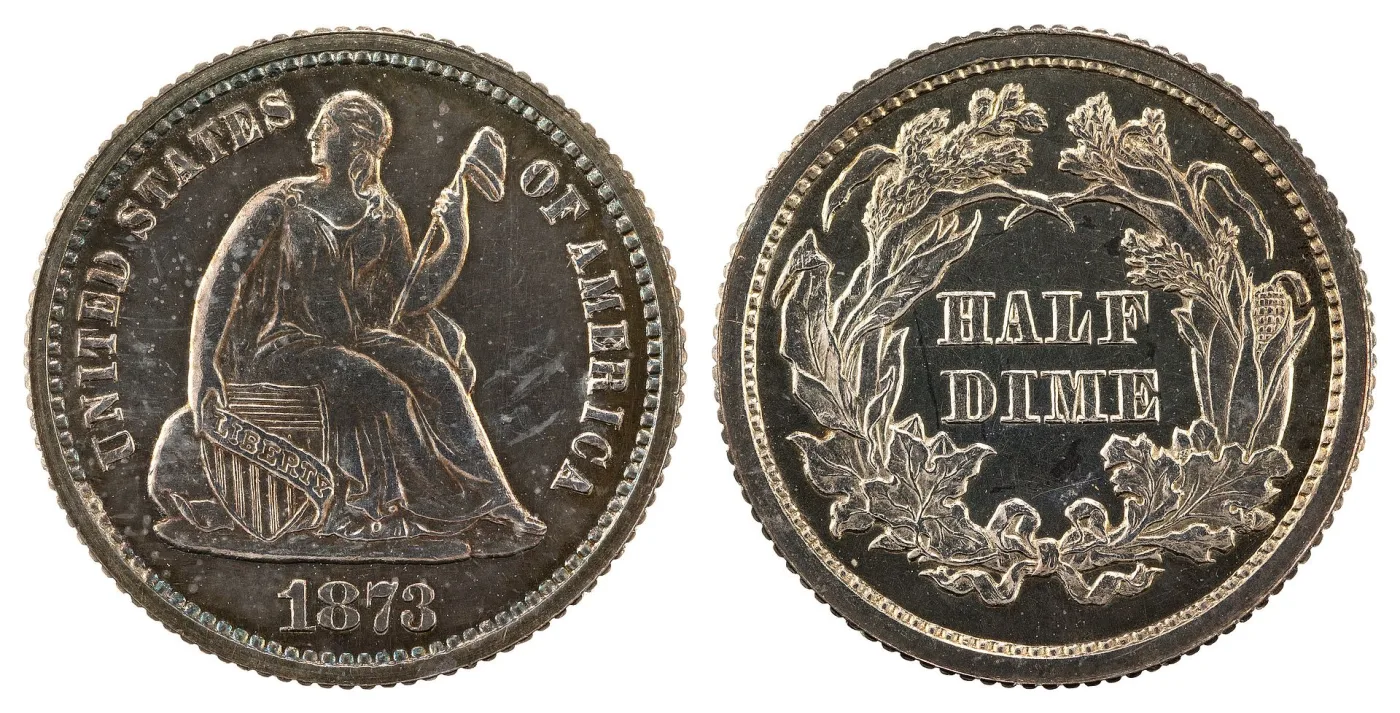
The Seated Liberty Half Dime is the smallest US silver coin ever struck for circulation — a tiny 15.5 mm disc weighing just 1.34 grams (1.24 grams after 1853), about the diameter of a modern pencil eraser. Struck from 1837 to 1873, it shared Christian Gobrecht’s seated allegorical Liberty with the dime, quarter, half dollar, and silver dollar of the same era. Its short, 37-year life and small physical size make the series compact, affordable, and historically rich — yet because survivors are easily lost, even common dates can be surprisingly hard to find in attractive condition.
This guide walks through every sub-type, every mint mark, every key date, and the design and authentication checkpoints that matter for accurate identification. The Seated Liberty Half Dime is a near-perfect entry to 19th-century silver collecting: it has the same six visual sub-types as the Seated Liberty Dime, but at a fraction of the price for most dates, and includes one true legend — the unique 1870-S, of which only one example is known to exist.
Whether you are attributing a flea-market find, building a type set, or chasing Valentine die varieties, the diagnostics below will help you place any half dime in the series and judge its value with confidence.
History: A Tiny Silver Coin’s 37-Year Run
The half dime is one of the oldest American denominations. Its origins predate the Mint itself — the 1792 “half disme” struck experimentally before regular operations is often credited as the first circulating coin made under federal authority. From 1794 to 1837 the half dime carried a series of bust designs (Flowing Hair, Draped Bust, Capped Bust) parallel to the larger silver denominations like the Flowing Hair Dollar and Draped Bust Dollar. The Seated Liberty design replaced the Capped Bust Half Dime in 1837, the same year Christian Gobrecht’s seated motif was introduced on the dime.
For 36 years the half dime quietly served as a workhorse for small transactions. It was struck at Philadelphia for the entire run, joined by New Orleans (1838-1860), San Francisco (1863-1873), and famously by the 1870-S unique. The Coinage Act of 1873 abolished the half dime, replacing it with the nickel five-cent piece that had debuted in 1866 as the Shield Nickel. The Mint Director felt the tiny silver coin was inefficient and easily lost, and the rise of base-metal coinage during the Civil War (when silver vanished from circulation) had already proven that a five-cent piece in copper-nickel worked perfectly well.
The Designers: Christian Gobrecht and Robert Ball Hughes
Christian Gobrecht (1785-1844), Chief Engraver of the US Mint from 1840 until his death, designed the seated Liberty figure that would unify US silver coinage for half a century. Gobrecht first used the design on the silver dollar pattern of 1836; over the next four years it propagated to the half dime, dime, quarter, and half dollar. The 1837 half dime used Gobrecht’s original “No Drapery” master hub.
In 1840 sculptor Robert Ball Hughes was commissioned to retouch the working hubs to strengthen the design. He added the drapery fold hanging from Liberty’s right elbow that Gobrecht’s original 1837-1840 hubs lacked, and he tightened the head and shield detail. The Hughes “Drapery” modification persisted for the rest of the series and is shared with the Seated Liberty Quarter and Seated Liberty Half Dollar.
Design: The Seated Allegory in Miniature
Despite measuring just 15.5 mm across, the Seated Liberty Half Dime carries the same design elements as its larger siblings. Knowing every feature is essential for sub-type identification and grading.
Obverse (Heads Side)
The obverse depicts Liberty seated on a rock, body facing forward but head turned to the left. She wears a flowing classical gown. Her right hand rests on a Union shield bearing LIBERTY on a ribbon across the top. Her left hand holds a pole topped with a Phrygian liberty cap. The date appears in the exergue beneath the rock.
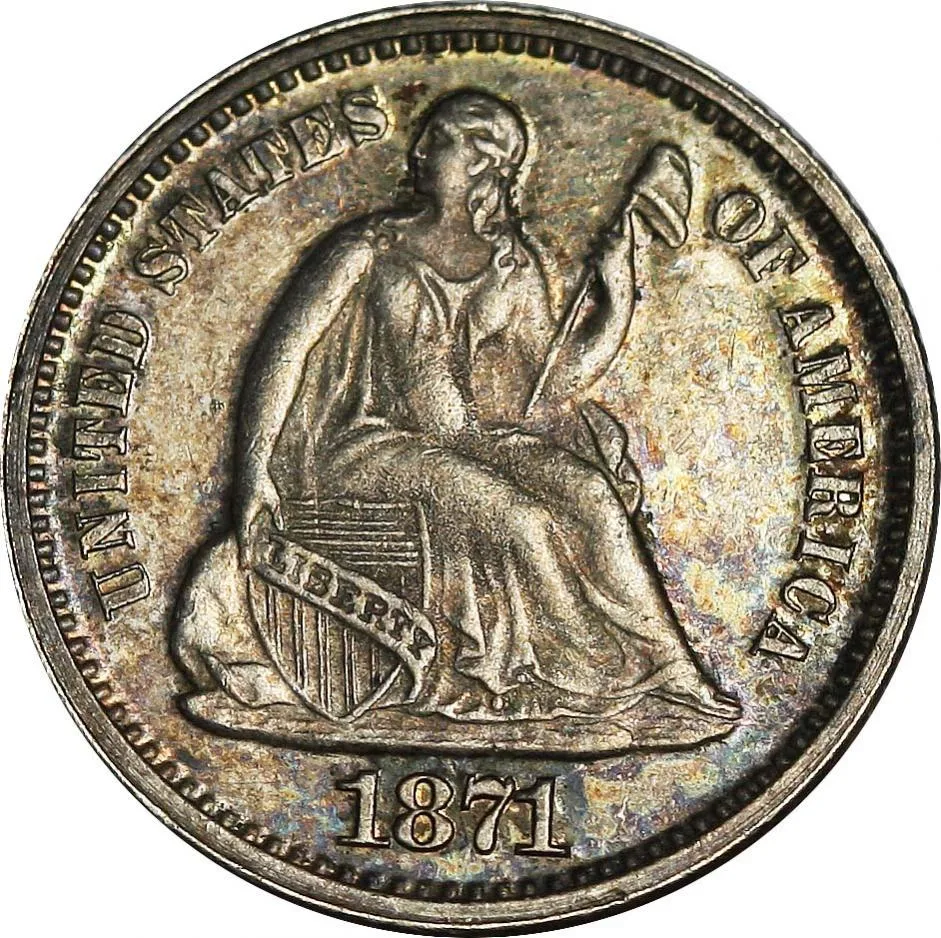
The obverse changes several times across the series. The earliest 1837 (Philadelphia) and 1838-O (New Orleans) issues have no stars around Liberty (the “No Stars” sub-type). From 1838 (Philadelphia) onward, thirteen six-pointed stars surround Liberty (the “Stars Obverse” sub-type). From 1860 onward, the stars are removed and replaced with the legend UNITED STATES OF AMERICA arched around Liberty (the “Legend Obverse” sub-type, persisting to 1873). This stars-to-legend transition is shared only with the dime — the larger Seated denominations kept stars throughout.
Reverse (Tails Side)
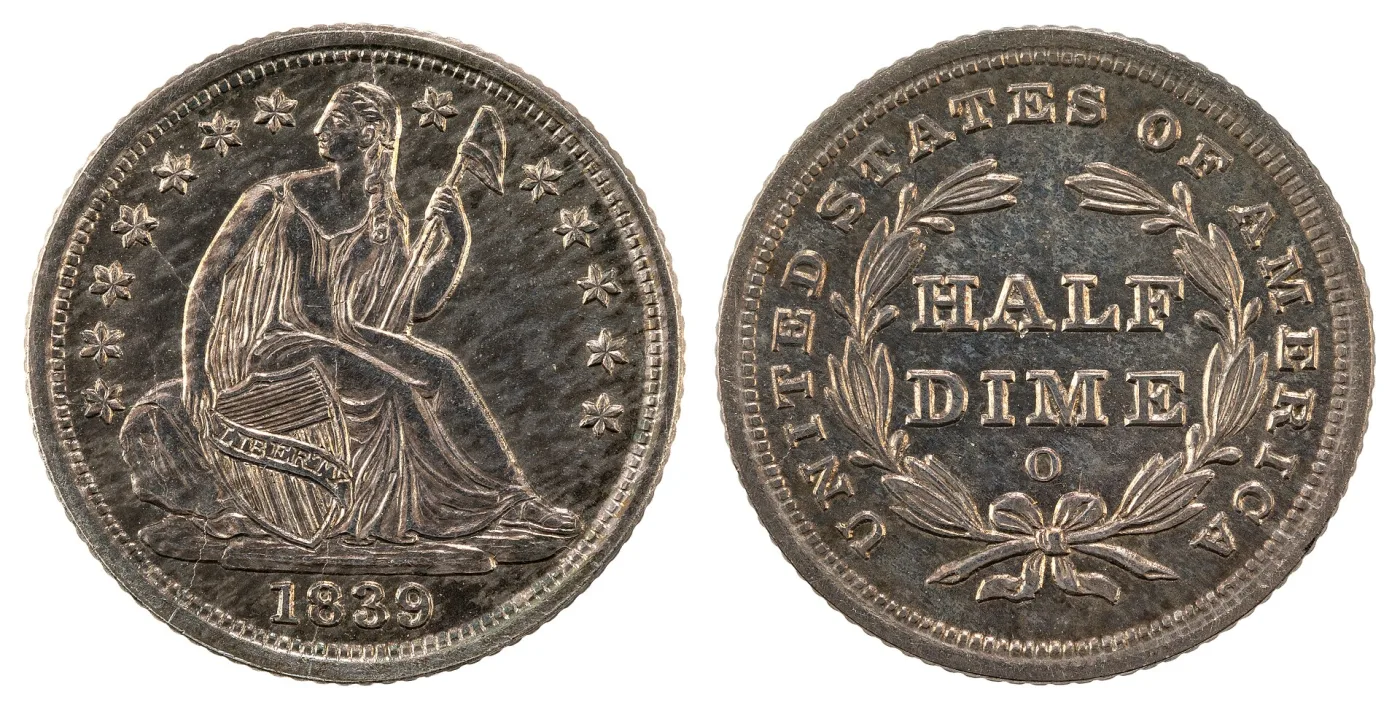
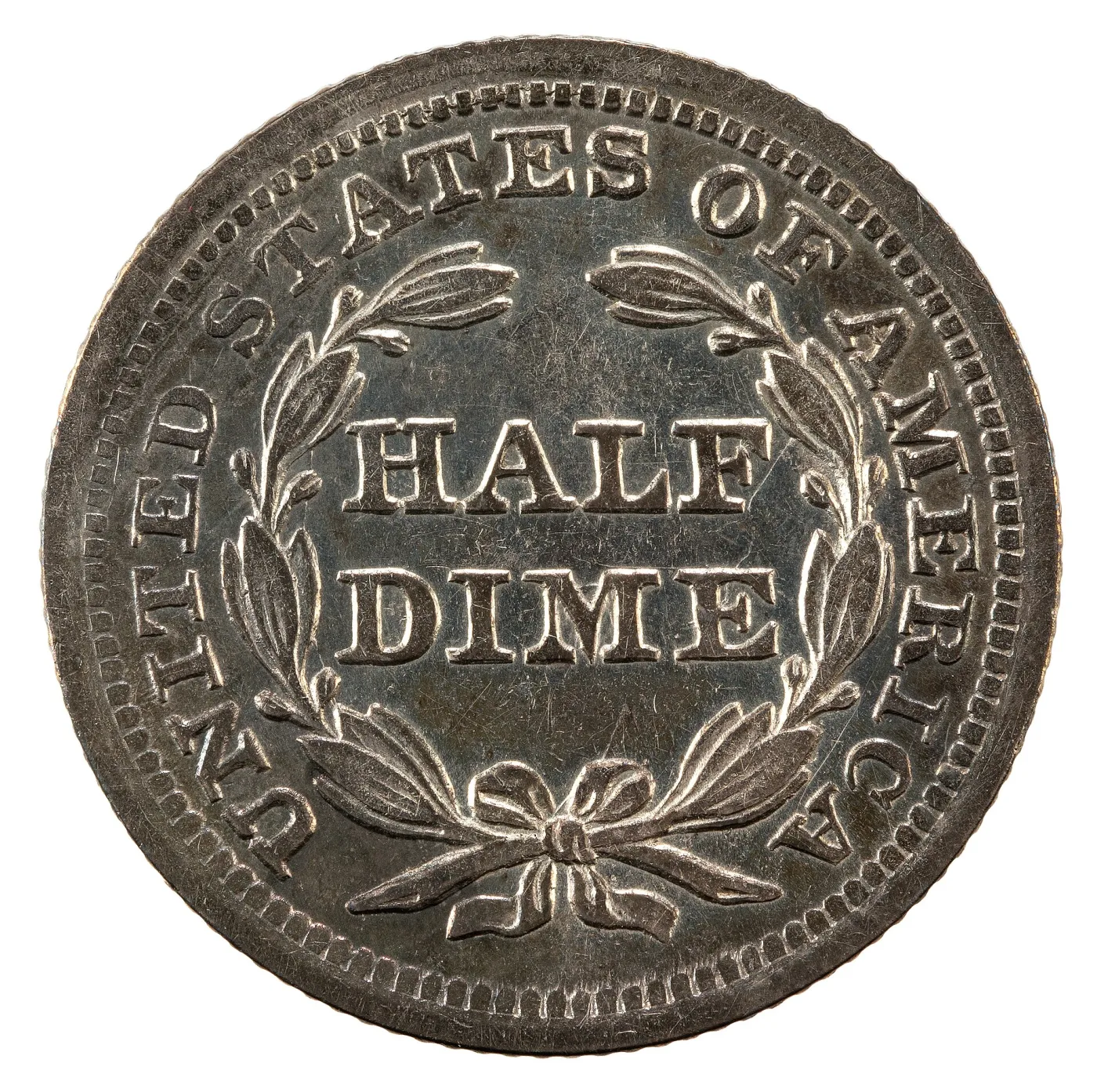
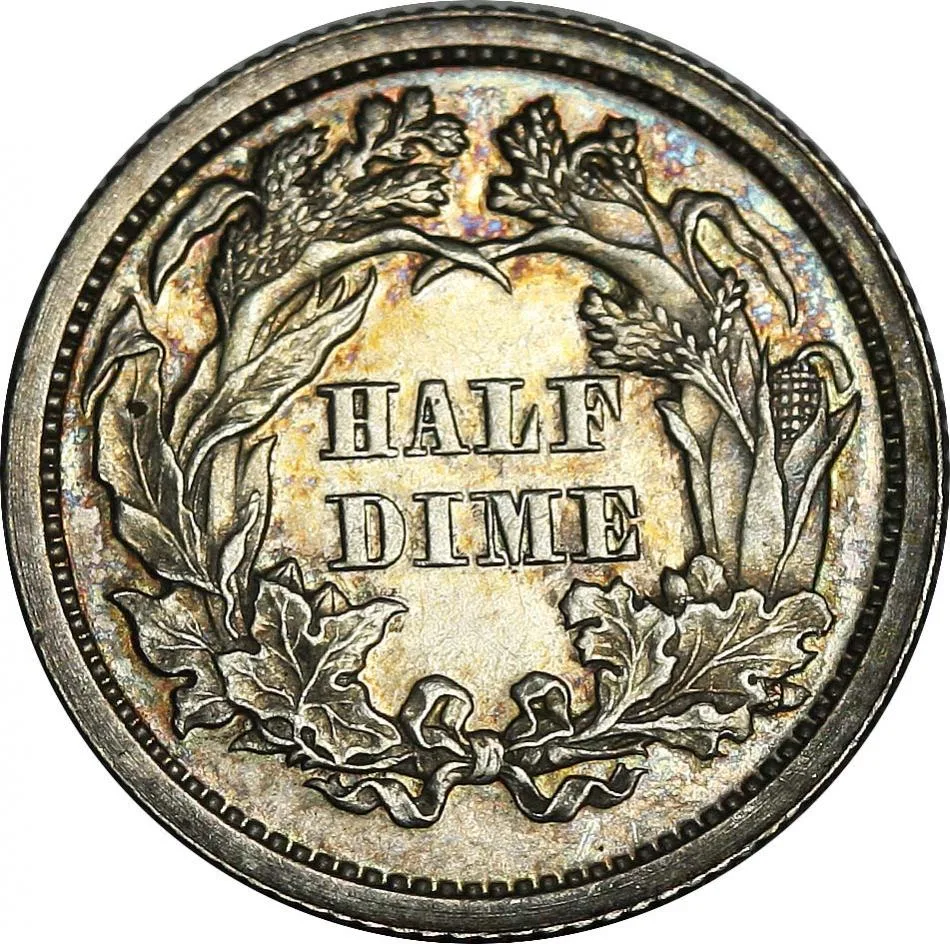
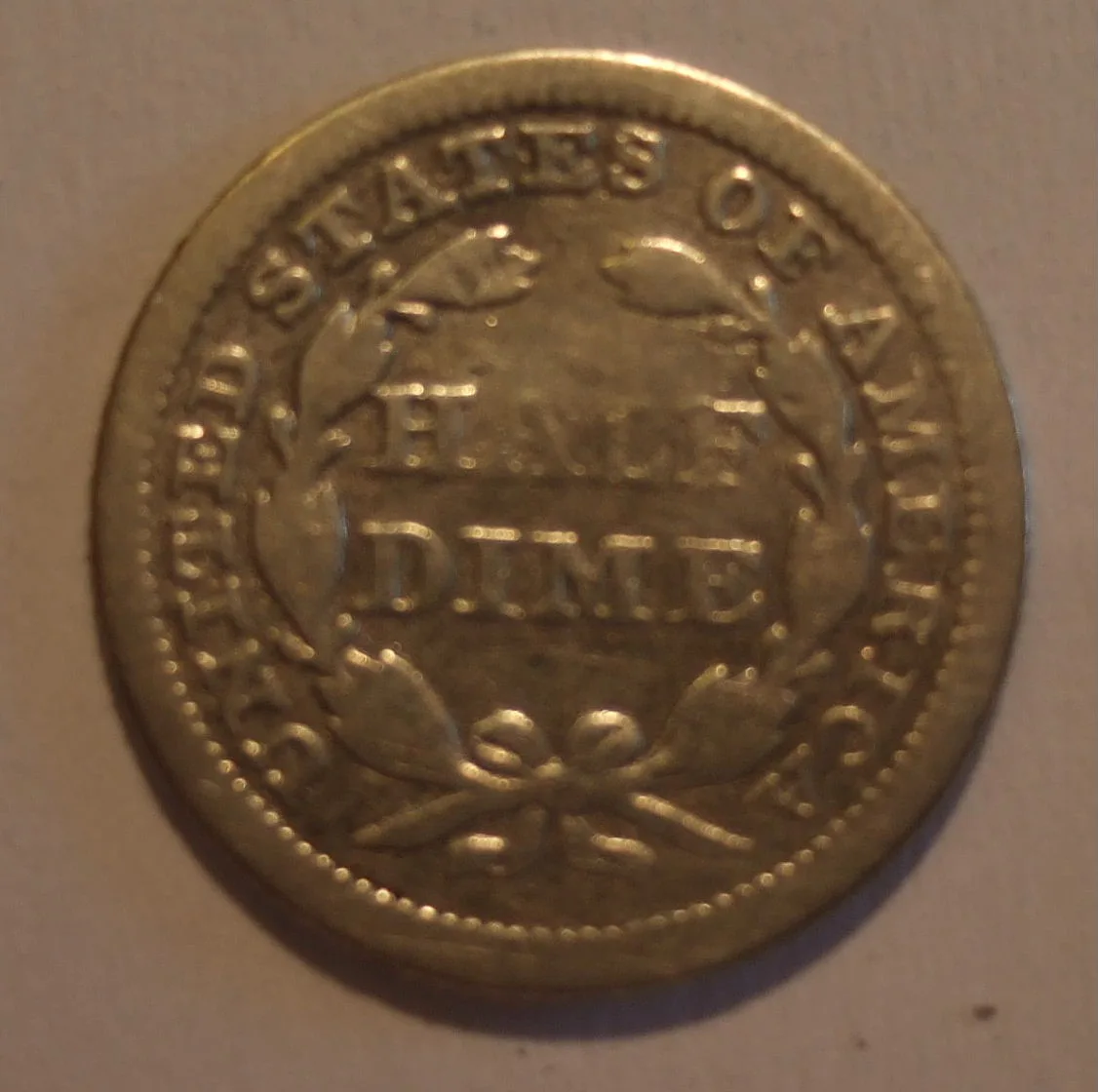
The reverse shows a wreath surrounding the denomination HALF DIME. Initially (1837-1859) the wreath was an open laurel wreath. Beginning in 1860, the wreath was redesigned as a much larger cereal wreath (oak, wheat, corn, and maple), and the legend UNITED STATES OF AMERICA was moved off the reverse to the obverse. Mint marks (when present) appear inside the wreath, below the denomination and above the bow, never beneath it — the 1839-O photographed below carries its O in exactly that gap. The denomination “HALF DIME” — two words — is unique to this series and is the most reliable way to distinguish a worn half dime from a similarly worn dime, which reads “ONE DIME.”
Edge
All Seated Liberty Half Dimes have a reeded edge — vertical grooves applied during striking. There is no lettered edge in this series.
The Six Major Sub-Types
Like the Seated Liberty Dime, the half dime carried five distinct modifications across its run, producing six visually distinct sub-types. Type-set collectors will pursue all six. Sub-type identification is the first step in attributing any half dime.
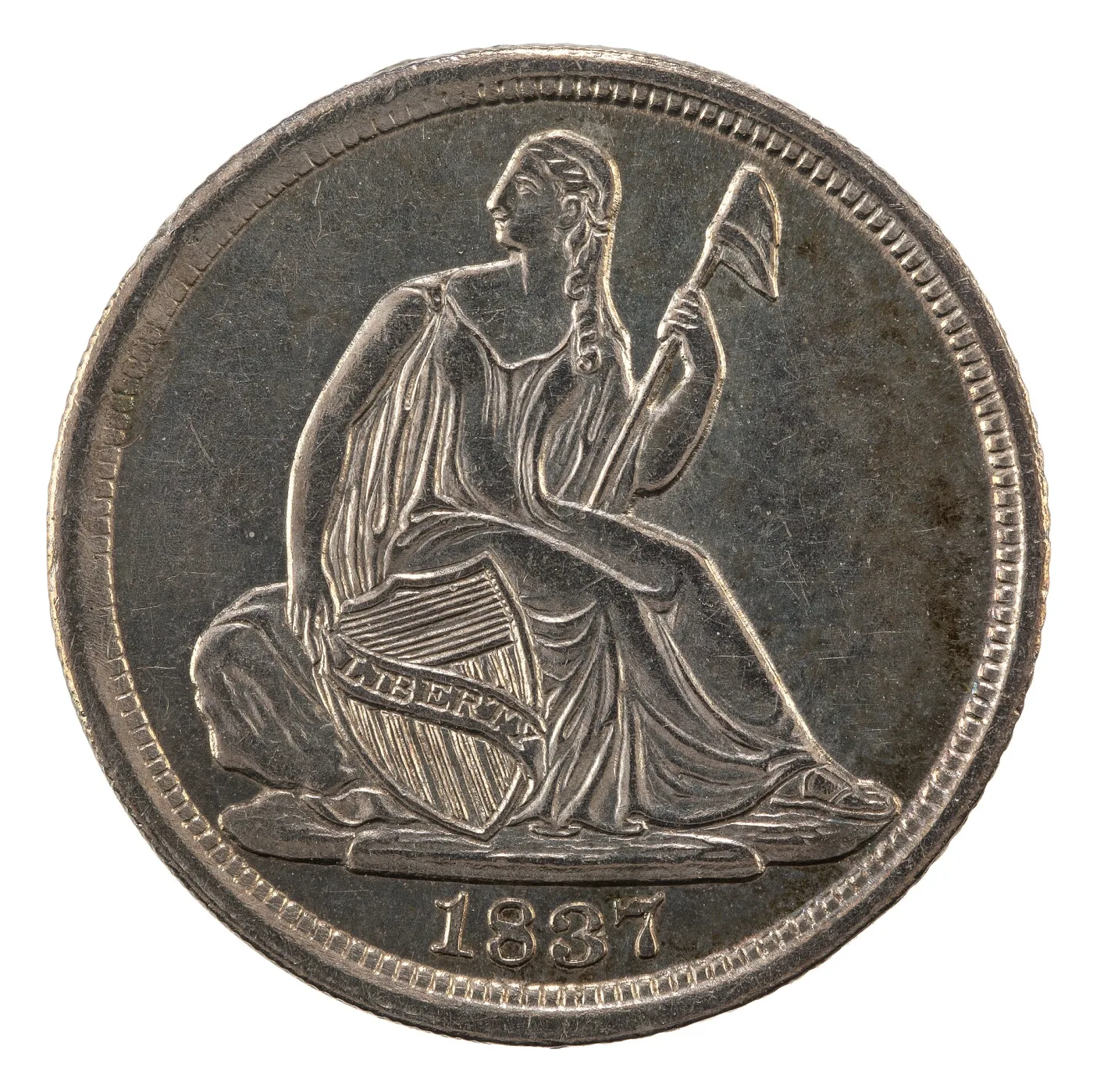
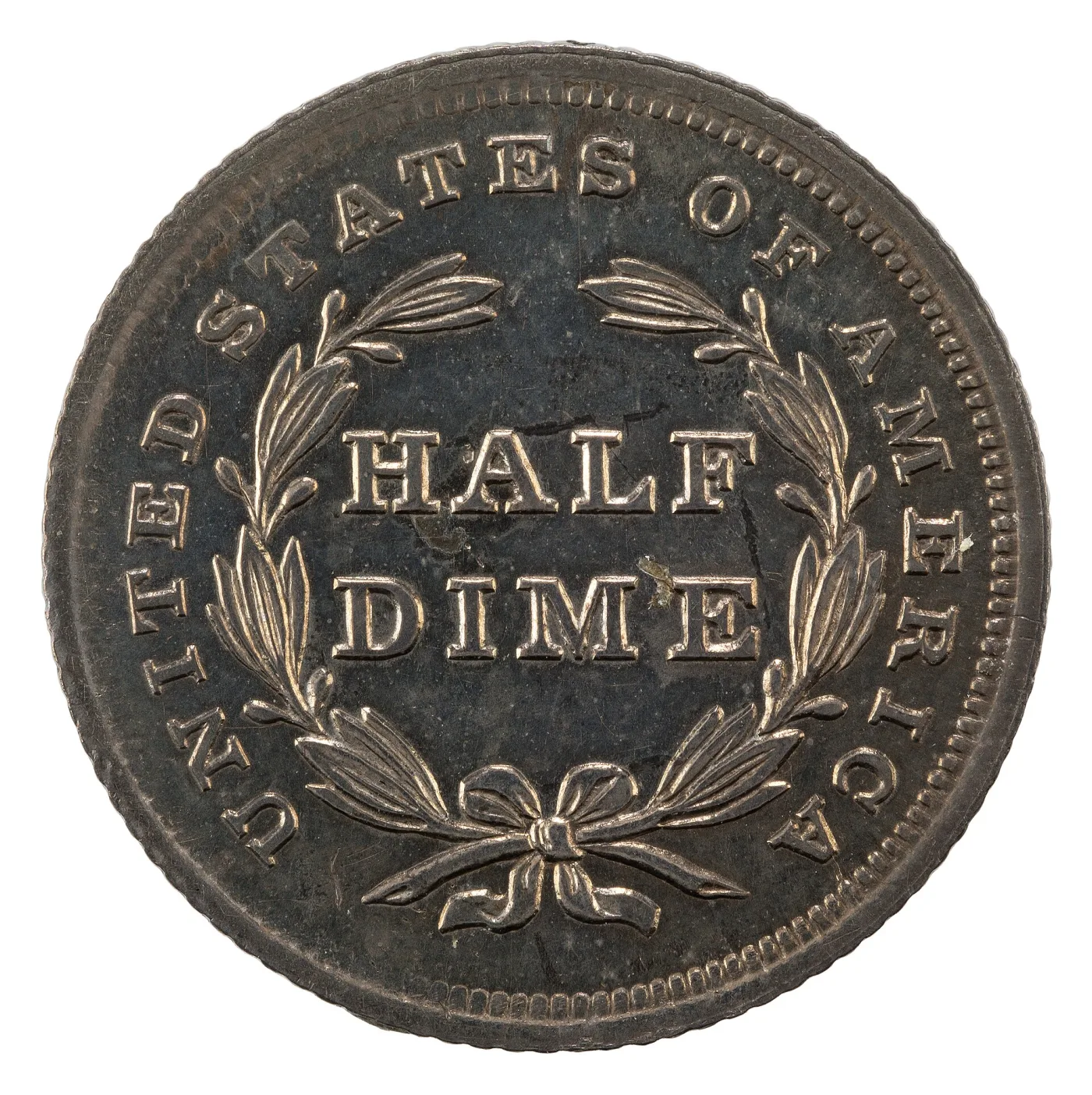
Type 1: No Stars, No Drapery (1837, 1838-O)
The very first Seated Liberty Half Dimes — 1837 (Philadelphia) and 1838-O (New Orleans) — have no stars around Liberty and no drapery beneath her right elbow. The obverse field is otherwise plain: just Liberty seated, with the date below. Both years are key issues. The 1837 comes in Large Date and Small Date varieties. The 1838-O is the first branch-mint half dime and one of the most desired type coins in the series.
Type 2: Stars Obverse, No Drapery (1838-1840)
From 1838 (Philadelphia) onward, thirteen stars were added around Liberty, but the drapery at her elbow was not yet present. This “Stars Obverse, No Drapery” sub-type ran for about two years before the Hughes hub modifications. Identification: thirteen stars surrounding Liberty, but no drapery beneath her right elbow. The 1840 exists in both No Drapery and With Drapery varieties at both Philadelphia and New Orleans.
Type 3: Stars Obverse, With Drapery (1840-1859)
The standard Seated Liberty Half Dime after Hughes added the drapery fold. Identification: thirteen stars, drapery hanging from left elbow, denomination HALF DIME inside laurel wreath on reverse. This is the longest-running of the early sub-types and is broken into two weight-standard periods (pre-1853 heavy weight, 1853 onward light weight). The 1853-1855 Arrows issues are a distinct visual sub-variant within this type.
Type 4: Arrows at Date (1853-1855)
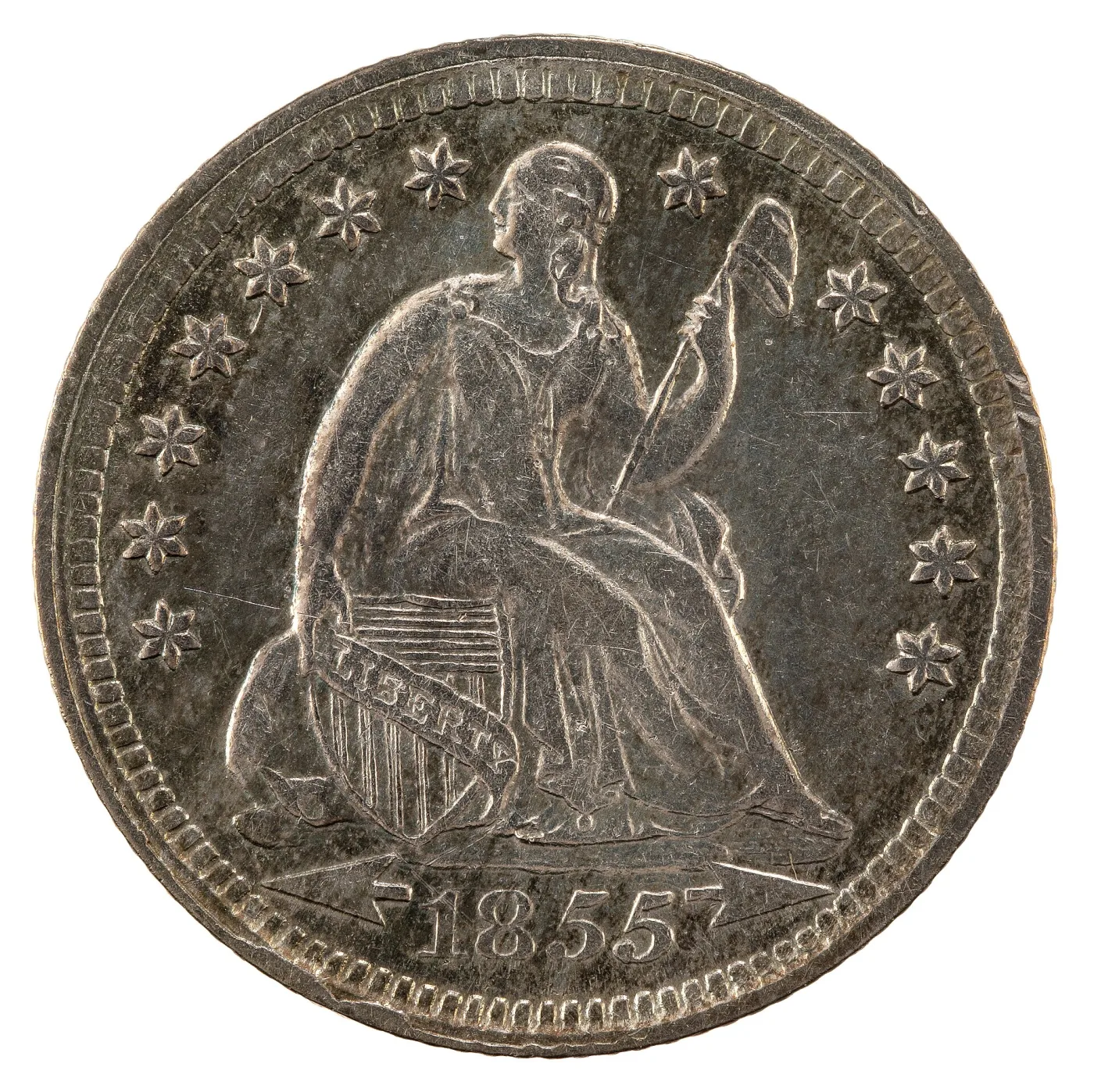
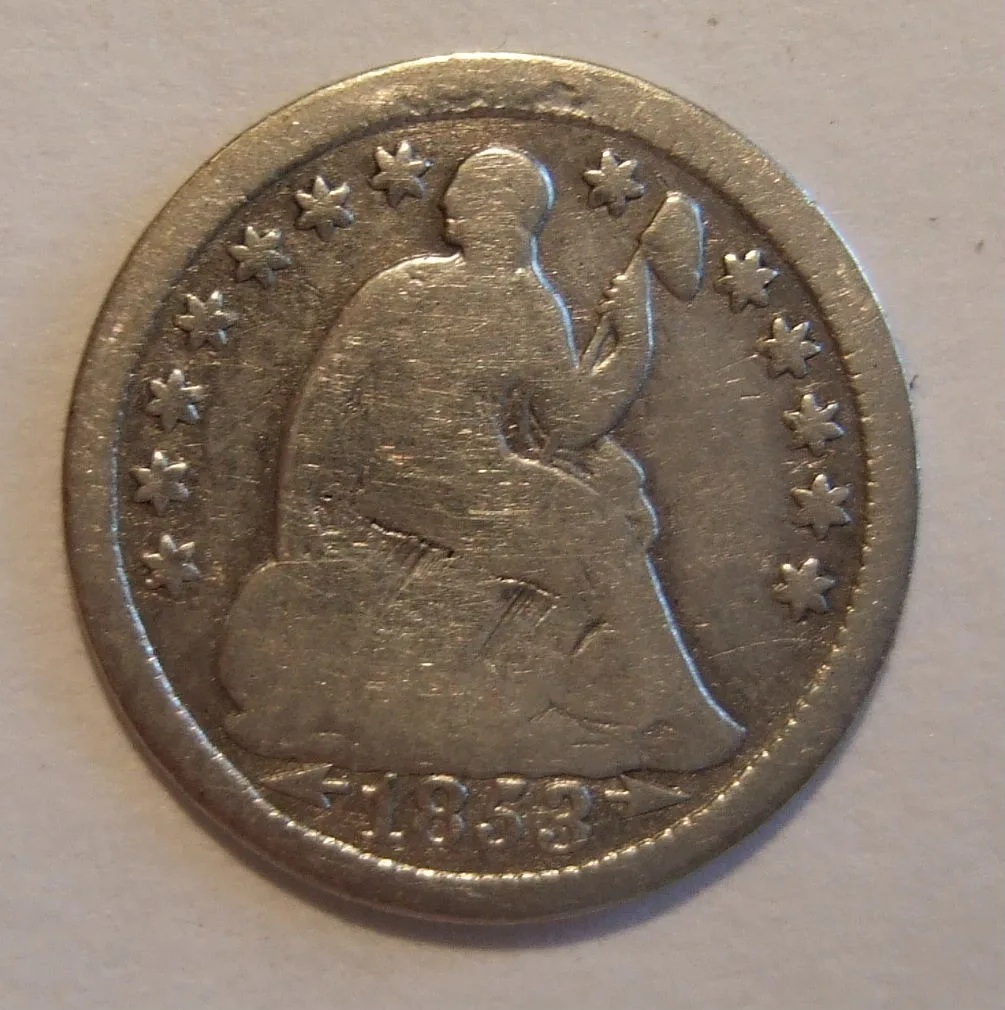
The Mint Act of 1853 reduced the silver weight of subsidiary coinage. To distinguish reduced-weight pieces from older heavy-weight coins, small arrows were added at either side of the date for 1853, 1854, and 1855. Unlike the quarter and half dollar of 1853, the half dime received no rays around the wreath — only the arrows. Identification: arrows flanking the date in the exergue, otherwise standard Stars Obverse design. After 1855 the arrows were dropped while the lighter weight standard continued.
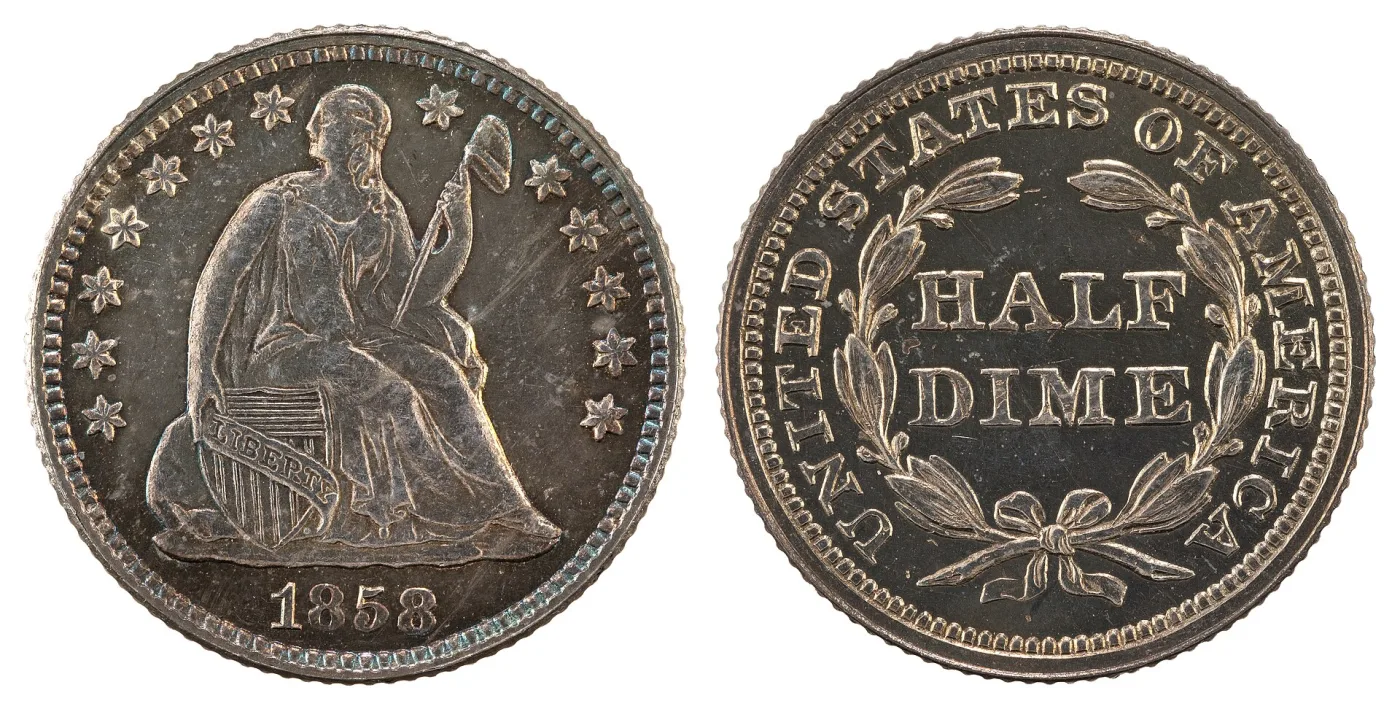
Type 5: Legend Obverse (1860-1873)
Beginning in 1860, the stars were removed from the obverse and replaced with the legend UNITED STATES OF AMERICA arched around Liberty. The reverse wreath was redesigned from a small laurel to a much larger cereal wreath enclosing HALF DIME. This is the final-period sub-type. Identification: legend instead of stars around Liberty, large cereal wreath on reverse. Unlike the dime, the half dime never received an arrows variant at the 1873 weight change because production ended in February 1873 before the arrows were added.
Type 6 (Half Dime): No “With Arrows” Legend Type
A distinction from the dime: the half dime has no “Legend Obverse, Arrows at Date” sub-type. The Coinage Act of February 12, 1873 added arrows to the dime and quarter to mark the new weight standard, but the half dime was abolished by the same act. The last half dimes were struck in early 1873 before the arrows modification took effect. So the half dime has only six sub-types total (one fewer than the dime), and the 1873 issues are all No-Arrows Legend Obverse coins.
Composition and Specifications
The Seated Liberty Half Dime is the smallest US silver coin by both diameter and weight. Knowing the metal content is essential for both authentication and bullion-floor valuation. The standard changed once across the series.
Weight Variations
- 1837-1853 (early): 1.34 g, 15.5 mm, 0.900 silver. Same standard as the late Capped Bust Half Dime.
- 1853-1873 (post-Act of 1853): 1.24 g, 15.5 mm, 0.900 silver. Reduced to prevent silver export.
Silver Content
A pre-1853 Seated Liberty Half Dime contains 0.0388 troy ounces of pure silver. A post-1853 issue contains 0.0359 troy ounces. At a silver spot price of $30/oz, the bullion floor is $1.08 to $1.16. No problem-free Seated Liberty Half Dime should ever sell for less than melt, but melt value alone is rarely the right framework — even cull common dates carry numismatic premiums of $10-$15.
Weight as Authentication Tool
Use a jeweler’s scale accurate to 0.01 grams. Tolerance is ± 0.03 g for genuine pieces given the small mass. The most diagnostic use of weight is distinguishing pre-1853 (heavy 1.34 g) from post-1853 (light 1.24 g) issues when the date or arrows-marker is unclear from wear. A “no arrows” half dime that weighs 1.34 g must be Type 3 pre-1853 (1840-1853), while one that weighs 1.24 g must be Type 3 post-1855 or Type 5 (1856-1873). The same logic applies across the Seated Liberty silver family — see the Seated Liberty Half Dollar guide for an extended discussion. Half dime weight tolerance is tighter than larger coins because there is less metal to work with.
Mint Marks: Philadelphia, New Orleans, San Francisco
Seated Liberty Half Dimes were struck at three mints during the regular series (Philadelphia, New Orleans, San Francisco) plus the unique 1870-S. Notably, no half dimes were struck at Carson City — the CC mint opened in 1870, the same year as the unique 1870-S, but Carson City focused on dollars and gold rather than the soon-to-be-abolished half dime.
Mint Mark Locations
- Philadelphia (no mint mark): Main mint. No mint mark on any issue. Largest mintages by far.
- New Orleans (O): 1838-O through 1860-O. Mint mark on reverse, inside the wreath, below HALF DIME (Stars Obverse) or inside the cereal wreath (Legend Obverse).
- San Francisco (S): 1863-S through 1873-S. Mint mark on reverse, inside the cereal wreath. The 1870-S is unique.
- Carson City (CC): None. No CC half dimes were ever struck. Any “CC” half dime offered for sale is a counterfeit or altered Philadelphia piece.
Mint Mark Position Variations
Within the Legend Obverse type (1860-1873), the mint mark sits inside the cereal wreath, below HALF DIME, just above the bow. Mint mark size varies by year and is one of the most useful diagnostic features for the Valentine variety system. The 1860-O, for instance, has a famously large O. New Orleans coins from the Stars Obverse type put the O in the same place, not between the wreath and the rim: the 1839-O photographed above carries it inside the laurel wreath, below DIME and above the bow. Verify the position before pricing, but expect to find the mint mark within the wreath on both types.
Branch Mint Premiums
Branch-mint issues generally carry premiums over Philadelphia for the same date and grade. The premium ratio ranges from modest (most San Francisco dates) to extreme (1846 Philadelphia, 1838-O, 1844-O, 1846, 1853-O No Arrows, 1864 Philadelphia, 1870-S). Always check both date AND mint mark before pricing — and beware altered mint marks added to common-date coins. The same authentication discipline that applies to the Trade Dollar applies even more strictly to the half dime because the small mint mark and tiny coin surface make alterations exceptionally hard to spot.
The 1853-1855 Arrows Issue
The 1853-1855 Arrows at Date Seated Liberty Half Dime deserves its own section because it is a distinct sub-type with its own type-set significance — and because the 1853 No Arrows half dimes are far rarer than the Arrows variety.
Why the Mint Made the Change
By the early 1850s, the California gold rush was flooding the American economy with new gold while silver remained scarce and increasingly valuable on world markets. US silver coins at the original weight standards contained more silver than their face value, making it profitable to export them as bullion. Silver coins literally disappeared from circulation. The Mint Act of February 21, 1853 reduced the silver weight of all subsidiary silver coinage to keep coins in domestic circulation. The half dime dropped from 1.34 g to 1.24 g — a 7.5% weight reduction.
The Visual Marker
Unlike the quarter and half dollar of 1853 — which received both arrows at date AND rays around the eagle — the half dime and dime received only arrows at date. The Mint considered the small field too crowded for added rays. The arrows appear as small horizontal arrowheads flanking the date, each one pointing outward toward the rim rather than inward at the digits — both the 1855 and the heavily worn 1853 photographed in this guide show the heads aimed away from the date. They were retained for 1853, 1854, and 1855, then dropped while the lighter weight standard continued.
1853-1855 Mintages and Values
The 1853 Arrows half dime had a massive mintage (13.2 million at Philadelphia and 2.2 million at New Orleans). The 1854 and 1855 Arrows half dimes were struck at both Philadelphia and New Orleans. Approximate values: 1853 (P) Arrows F-12 $25, MS-63 $300. 1853-O Arrows F-12 $30, MS-63 $700. 1854 F-12 $25, MS-63 $350. 1854-O F-12 $30, MS-63 $700. 1855 F-12 $25, MS-63 $400. 1855-O F-12 $35, MS-63 $1,000.
The Rare 1853 No Arrows
A small batch of 1853 Philadelphia (135,000 mintage) and 1853-O (160,000 mintage) half dimes was struck at the old heavy weight before the Act of 1853 took effect, then production switched to the new Arrows / light-weight standard for the remainder of the year. These No Arrows pieces are scarce. The 1853-O No Arrows is a genuine key date: F-12 around $350, MS-63 over $4,000. Always check the date area for the arrows marker before pricing an 1853 half dime — the no-arrows variety is worth 10-15x the arrows variety in any grade.
Collecting the Arrows Type
For collectors building a US silver type set, an 1853-1855 Arrows half dime is one of the most affordable sub-types in the entire Seated Liberty family. A pleasing 1853 Philadelphia F-12 for $25 captures both the visual marker and the historical weight of the Mint Act of 1853.
The Legend Obverse Transition of 1860
The 1860 transition from Stars Obverse to Legend Obverse is unique to the half dime and dime. The larger Seated Liberty denominations (quarter, half dollar, dollar) kept their stars throughout the series.
Why the Change Happened
The shift was largely aesthetic. Mint engravers felt the small half dime field looked cluttered with both stars around Liberty and the legend UNITED STATES OF AMERICA arched around the reverse wreath. By moving the legend to the obverse and replacing the stars, and by enlarging the reverse wreath to a more imposing cereal-wreath design, the half dime took on a noticeably more dignified appearance. The same change was applied to the dime simultaneously.
Identification at a Glance
Stars around Liberty + small laurel wreath around HALF DIME = Stars Obverse type (1838-1859). Legend UNITED STATES OF AMERICA around Liberty + large cereal wreath around HALF DIME = Legend Obverse type (1860-1873). The Arrows at Date sub-type only exists within the Stars Obverse type (1853-1855) on the half dime — there is no Legend-with-Arrows variety because production ended before the 1873 arrows modification.
The 1859 and 1860 Transitional Patterns
A small number of pattern half dimes were struck experimentally in 1859 with the Legend Obverse design (and in 1860 with the older Stars Obverse paired with the new wreath). These transitional patterns are extremely rare and command four- to five-figure values. The 1859 transitional pattern half dime, struck without the legend that would become standard a year later, is one of the most coveted Seated half dime collectibles.
Key Dates and Major Rarities
Across 36 years of production, Seated Liberty Half Dimes include several dates whose values vastly exceed common dates. Memorize these — they are what make the series interesting and expensive.
The Major Keys
- 1870-S: Unique. The only known example sold for $1.32 million in 2024 (previously $661,250 in 1986). A legendary American rarity, not listed in the original Mint records.
- 1846: Mintage 27,000 — the lowest Philadelphia Seated Half Dime mintage. F-12 ~$700, XF $2,500+, MS-63 $15,000+.
- 1853-O No Arrows: Mintage 160,000 (estimated, but most melted or pulled). F-12 ~$350, XF $1,200+, MS-63 $4,500+.
- 1844-O: Mintage 220,000. F-12 ~$200, XF $700+, MS-63 $3,500+.
- 1838-O No Stars: Mintage 70,000. First branch-mint half dime AND first-year No Stars New Orleans coin. F-12 ~$200, XF $1,000+, MS-63 $7,500+.
Other Notable Keys
- 1837 No Stars Small Date: Two date punch sizes for first-year Philadelphia. Small Date scarcer. F-12 ~$100, XF $400+, MS-63 $1,500+.
- 1840-O No Drapery: The brief No Drapery period at New Orleans. F-12 ~$50, XF $200+, MS-63 $2,000+.
- 1849-O: Mintage 140,000. F-12 ~$150, XF $500+, MS-63 $3,000+.
- 1853-O No Arrows: Covered above; the most famous half dime key after 1846 and 1870-S.
- 1864: Civil War mintage 48,000. F-12 ~$400, XF $1,000+.
- 1865: Mintage 13,000. F-12 ~$400, XF $1,000+.
- 1866: Mintage 10,000. F-12 ~$400, XF $1,000+.
- 1867: Mintage 8,000 — lowest Legend Obverse Philadelphia mintage. F-12 ~$500, XF $1,200+.
- 1872-S Mintmark Above Bow: A variety of the 1872-S where the S sits above the wreath bow rather than within the wreath. Premium price.
Condition Rarities
Even among common dates, high-grade examples (MS-65 and above) command large premiums because few collectors saved Seated coins in the 19th century — most circulated heavily. A common-date 1871 that brings $25 in F-12 might bring $450 in MS-65 and $2,000+ in MS-67. Knowing the difference between “rare date” and “rare grade” is critical for evaluation.

The Unique 1870-S Half Dime
The 1870-S Seated Liberty Half Dime is one of the great mysteries of American numismatics — and one of its most valuable coins. Only one example is known to exist.
The Story
San Francisco Mint records show no half dime mintage for 1870. Yet a single 1870-S half dime exists, surfaced in the late 1970s. The most widely accepted theory is that the coin was struck as a single specimen for the cornerstone of the new San Francisco Mint building (laid in 1870), with one extra impression retained by a Mint official. A matching unique 1870-S three-dollar gold piece (see the Three Dollar Gold guide) was likely struck the same day for the same ceremony.
Provenance and Value
The unique 1870-S half dime first surfaced publicly when discovered by collector and dealer Stack’s in 1978. It sold privately for $425,000 in 1978, then $661,250 at public auction in 1986 (Brand Sale). After decades of private ownership, the coin reappeared at auction in 2024 and sold for approximately $1.32 million — making it one of the most valuable half dimes ever sold and a fixture on every list of US numismatic legends.
Practical Implication
The 1870-S is not a collecting target — it is a one-of-one rarity. But it is important context: it means any 1870-S half dime offered for sale is, with virtually 100% certainty, a counterfeit. The same logic applies to the 1873-CC No Arrows Seated Liberty Dime (also unique) and the unique 1870-S Three Dollar Gold. If you encounter an “1870-S” anything in a non-major-auction context, do not buy without independent expert authentication.
Valentine Varieties and Die Marriages
For collectors who go beyond date-and-mint-mark sets, the Seated Liberty Half Dime series offers a rich world of die varieties. The standard reference is Daniel W. Valentine’s 1931 work The United States Half Dimes, updated and extended in modern catalogs and online resources.
What Valentine Numbers Are
Each Valentine number identifies a unique die marriage — a specific pairing of obverse and reverse working dies. Valentine numbers are written as Date V-NUM, such as “1853 V-2” or “1838-O V-1.” Common dates may have several Valentine marriages; key dates often have only one or two.
The Most Famous Varieties
- 1837 Large Date / Small Date: Both have similar mintages but the Large Date is more common. Date punch size visible to the naked eye.
- 1838 Large Stars / Small Stars: Two star sizes for the first Stars Obverse year.
- 1839-O Repunched Mintmark: Famous early branch-mint variety with bold mintmark repunching.
- 1840 No Drapery / With Drapery: The transitional year showing both variants from the Hughes hub change.
- 1848 Large Date / Medium Date: Two date punch sizes.
- 1858 / Inverted Date: A scarce blunder showing repunched, inverted date digits.
- 1861 / 0: An overdate (or possibly heavy date repunching). Premium price.
- 1872-S Mintmark Above Bow / In Wreath: Two mintmark positions; Above Bow is the famous variety.
How to Attribute Valentine Varieties
Valentine attribution requires good lighting and 10x-20x magnification. Most collectors begin by checking date punch shape, mintmark position, and any obvious die cracks or polish lines. Variety attribution can dramatically affect value — a common-date half dime with a famous variety attribution can sell for 5-10x the regular price.
Grading Seated Liberty Half Dimes
Grading follows the standard 70-point Sheldon scale. For Seated Liberty Half Dimes, the diagnostic wear points are LIBERTY on the shield, Liberty’s gown folds, and the leaves of the wreath on the reverse. The half dime’s tiny size makes grading harder than for larger coins — small wear spots loom larger proportionally, and weak strikes are common.
Grade-by-Grade Diagnostics
- G-4 (Good): LIBERTY on the shield is mostly worn away (3 or fewer letters visible). Liberty’s figure is outlined only. Date readable. Reverse wreath outlined, HALF DIME readable.
- VG-8 (Very Good): LIBERTY shows 3 or more letters. Major design features clear. Gown folds smooth. Reverse wreath shows some leaf detail.
- F-12 (Fine): Full LIBERTY readable, though weak. Gown folds visible. Some shield stripes partially visible. Reverse wreath has clearer leaves.
- VF-20 (Very Fine): LIBERTY bold. All major design elements clear. Shield stripes fully visible. Gown folds sharp. Wreath leaves separated.
- XF-40 (Extremely Fine): All design details sharp. Light wear only on highest points (Liberty’s knee, the shield, the wreath’s high leaves).
- AU-50 (About Uncirculated): Trace wear on the highest points only. Most original luster remains.
- MS-60 to MS-70 (Mint State): No wear. Grading depends on luster, strike, surface marks, and eye appeal.
Strike and Eye Appeal
Seated Liberty Half Dimes from New Orleans frequently show weak strikes — the LIBERTY headband and stars (or legend letters) are weakly defined even in higher grades. The 1840-O No Drapery and 1853-O are notorious for weak strikes. A sharply struck branch-mint half dime is a real prize. Original gray or attractive toning generally commands a premium over dipped or cleaned surfaces. The same grading principles apply to companion series like the Mercury Dime and Barber Dime — though the half dime’s miniature scale makes high grades especially elusive.
Professional Certification
For any Seated Liberty Half Dime worth more than about $200, professional certification by PCGS or NGC is strongly recommended. The certification fee ($25-$50) buys authentication, an accurate grade, and a tamper-evident holder. For the key dates (1846, 1853-O No Arrows, 1838-O, 1844-O, the low-mintage Legend Obverse Philadelphia issues), certified examples typically bring 25-40% more than raw coins because buyers know how easily small-coin grading can be fudged.
Authentication and Spotting Counterfeits
Seated Liberty Half Dimes are counterfeited at multiple levels of sophistication. The tiny coin surface makes both alteration and complete fakery harder to detect than on larger coins. Knowing the authentication red flags can save you from costly mistakes.
Common Counterfeit Types
- Altered mint marks: Common Philadelphia coins with an added “O” or “S.” Look for tool marks around the mint mark and inconsistent finish. Any “CC” half dime is a counterfeit — no CC half dimes were ever struck.
- Altered dates: Common dates with one digit altered to create a rare date (e.g., 1856 altered to 1846, or 1844 created from 1849). Inspect every digit under 10x magnification.
- Cast counterfeits: Show porosity, soft details, and seams along the edge. Weight often slightly low.
- Modern Chinese die-struck counterfeits: Quite convincing visually, but often wrong weight (5-15% off) and wrong specific gravity. Use a digital scale.
- “1870-S” offers: Always fake unless it is the documented unique specimen in a major auction.
Authentication Checklist
- Weigh: 1.34 g pre-1853, 1.24 g post-1853. Tolerance ± 0.03 g.
- Diameter: 15.5 mm.
- Magnetism: No magnetic response (silver is non-magnetic).
- Edge: Reeded, with consistent reeds. No seam line.
- Mint mark: Compare position, font, and depth with a certified example. Beware “CC” — none exist.
- Date: Look for tool marks indicating alteration of digits.
- Denomination: Reverse must read “HALF DIME” — two words. A “ONE DIME” reverse is a Seated Dime, not a half dime.
When to Submit to a Grading Service
For any coin worth more than $200, professional authentication is worth the $25-$50 submission fee. For the 1846, the 1838-O, the 1844-O, the 1853-O No Arrows, the low-mintage Civil War Philadelphia issues, and especially anything labeled “1870-S,” do not buy raw from a non-specialist seller. The grading services have seen every known counterfeit and can spot diagnostic features that even experienced collectors miss.
Current Market Values and Price Guide
Values below are approximate retail estimates for problem-free coins as of 2026. Prices for rarities are highly auction-dependent.
Common Dates (Stars and Legend Obverse, No Arrows)
- G-4: $15-$25
- F-12: $25-$40
- VF-20: $40-$70
- XF-40: $70-$120
- AU-50: $130-$220
- MS-63: $250-$450
- MS-65: $700-$1,500
No Stars 1837 / 1838-O
- 1837 Large Date (P): G-4 $40, F-12 $90, XF-40 $325, MS-63 $1,200.
- 1837 Small Date (P): G-4 $50, F-12 $110, XF-40 $400, MS-63 $1,500.
- 1838-O No Stars: G-4 $80, F-12 $200, XF-40 $1,000, MS-63 $7,500.
1853-1855 Arrows
- 1853 (P) Arrows F-12: $25, MS-63: $300.
- 1853-O Arrows F-12: $30, MS-63: $700.
- 1854 F-12: $25, MS-63: $350.
- 1854-O F-12: $30, MS-63: $700.
- 1855 F-12: $25, MS-63: $400.
- 1855-O F-12: $35, MS-63: $1,000.
Major Keys
- 1846 F-12: $700, XF-40: $2,500, MS-63: $15,000+.
- 1853-O No Arrows F-12: $350, XF-40: $1,200, MS-63: $4,500+.
- 1844-O F-12: $200, XF-40: $700, MS-63: $3,500+.
- 1849-O F-12: $150, XF-40: $500, MS-63: $3,000+.
- 1864 (P) F-12: $400, XF-40: $1,000+.
- 1865 (P) F-12: $400, XF-40: $1,000+.
- 1866 (P) F-12: $400, XF-40: $1,000+.
- 1867 (P) F-12: $500, XF-40: $1,200+.
1870-S
Unique. Auction record approximately $1.32 million (2024 sale). Not a practical collecting target — a numismatic icon.
Where to Buy
Reputable dealers (Heritage, Stack’s Bowers, GreatCollections, David Lawrence Rare Coins) and certified examples from major auctions are the safest channels. Avoid raw coins offered as “rare dates” by non-specialist sellers, online classified listings, and flea-market finds without authentication. The half dime’s tiny size makes it an especially attractive target for date and mintmark alterations.
Building a Seated Liberty Half Dime Collection
Several collecting paths are realistic, depending on budget and interest. The half dime’s affordability for most dates makes it one of the most beginner-friendly 19th-century US silver series.
Type Set
A type set targets one example of each major sub-type — No Stars, Stars No Drapery, Stars With Drapery, Stars With Arrows, Legend Obverse. Five coins. Budget: $350-$1,000 for circulated F/VF examples, $3,000-$9,000 for mid-Mint State. This is the most common path and a great introduction to the series. Note: the half dime has five type-set sub-types, one fewer than the dime, because there is no Legend-with-Arrows variety.
Date Set
One half dime for each year 1837-1873. Thirty-seven coins. Achievable in circulated condition over several years of collecting. Budget: $2,000-$5,500 depending on grade. The Civil War keys (1864-1867) are the bottleneck.
Date and Mint Mark Set
One half dime for each date / mint mark combination. About 75 coins (excluding the unique 1870-S). Budget: $5,000-$15,000+ depending on grade. The 1846, 1838-O, 1844-O, and 1853-O No Arrows make this set genuinely challenging — most date-and-mint-mark collectors complete everything except those four and the Civil War rarities.
Valentine Variety Set
For specialists — one example of each major Valentine marriage. About 150 coins. A lifetime project. The Valentine reference (and its modern updates) is essential.
Short Sets
- Sub-type representatives: 5 coins, $350-$1,000 budget.
- Civil War era set (1861-1865): 5-7 coins spanning the wartime issues.
- San Francisco set: All S-mint dates 1863-1873 (excluding the unique 1870-S). About 10 coins.
- Pre-1853 / post-1853 weight pairs: Two coins showing the weight transition.
- Stars-to-Legend pair: An 1859 Stars Obverse and an 1860 Legend Obverse.
For collectors interested in the broader Seated Liberty family, the half dime pairs naturally with the Seated Liberty Dime, Seated Liberty Quarter, Seated Liberty Half Dollar, and Seated Liberty Dollar. A complete Seated Liberty type set across all five denominations is a classic American collecting goal.
Storage and Preservation
Silver coins are reactive — they tone (and can corrode) over time. Proper storage preserves value. The half dime’s small size makes it especially vulnerable to being lost or damaged.
Holders
For raw coins, use inert flips (Mylar or polyester) or hard plastic capsules sized for half dimes (15.5 mm). The half dime is small enough that some standard “dime” capsules are too large — always check the diameter. Avoid PVC flips, which release plasticizers that attack the coin surface. For certified coins, the PCGS or NGC holder is itself an excellent long-term storage solution.
Environment
Store in a cool, dry location. Humidity below 50% is ideal. Avoid wide temperature swings. A coin safe with desiccant packs is the standard solution. Do not store in cardboard 2x2s with staples — the staples rust and the cardboard releases sulfur compounds that tone silver. Half dimes in particular can develop unattractive black spots from prolonged cardboard contact.
Cleaning — Don’t
Never clean a Seated Liberty Half Dime. Cleaning destroys the original surface and can drop the coin’s value by 50-90%. The tiny coin surface makes any cleaning hairlines disproportionately visible. Professional conservators (NCS, the conservation arm of NGC) can sometimes safely remove harmful residues, but never attempt cleaning yourself. The original surface, even with toning, is what gives a 160-year-old coin its value.
Frequently Asked Questions
What is a half dime, and how is it different from a nickel?
A half dime is a silver five-cent coin struck from 1794 to 1873. A nickel is a copper-nickel five-cent coin introduced in 1866 (the Shield Nickel). Both denominations existed simultaneously from 1866 to 1873, when the Coinage Act of 1873 abolished the half dime in favor of the larger and more practical nickel. The half dime is silver, tiny (15.5 mm), and weighs 1.24-1.34 g; a nickel is copper-nickel, 21 mm, and weighs 5.0 g.
How can I tell if my Seated Liberty Half Dime is real silver?
Weigh it. A pre-1853 half dime is 1.34 g, post-1853 is 1.24 g. Diameter is 15.5 mm. Silver is non-magnetic. If your coin matches weight and diameter and is non-magnetic, it is almost certainly silver. For ultimate certainty, a specific gravity test (silver is 10.49 g/cm³) is decisive.
What is the most valuable Seated Liberty Half Dime?
The 1870-S. Only one example is known, and it sold for approximately $1.32 million in 2024. After that, the 1846 Philadelphia, the 1853-O No Arrows, the 1838-O No Stars, and the 1844-O are the most valuable regular issues.
What is the difference between a Seated Liberty Half Dime and a Seated Liberty Dime?
Size and weight, plus the denomination on the reverse. The half dime is 15.5 mm and 1.24-1.34 g; the Seated Liberty Dime is 17.9 mm and 2.49-2.67 g. The reverse reads "HALF DIME" (two words) on the half dime and "ONE DIME" on the dime. The obverse design (Liberty seated) is essentially identical.
Why does my Seated Liberty Half Dime have a CC mint mark?
It doesn't — at least not authentically. No Carson City half dimes were ever struck. Any "CC" half dime offered for sale is either a counterfeit, an altered Philadelphia piece, or in extremely rare cases a private fantasy strike. Submit any "CC" half dime to PCGS or NGC for authentication before paying any premium.
What does "No Drapery" mean?
No Drapery refers to Gobrecht's original 1837-1840 master hub, in which Liberty's right elbow has no drapery fold beneath it. In 1840 Robert Ball Hughes retouched the hubs to add the drapery fold. Coins from 1837, 1838, 1839, and early 1840 are No Drapery; coins from late 1840 onward are Drapery. The difference is visible at the elbow with the naked eye.
Why is the 1853 half dime sometimes worth $25 and sometimes worth $4,000?
Because there are two distinct 1853 sub-types. The 1853 Arrows (struck at the new lower weight after the Act of 1853) is common — F-12 around $25. The 1853 No Arrows (struck at the old heavy weight before the Act took effect, with mintage of only 135,000) is scarce — F-12 around $150 at Philadelphia and $350 at New Orleans, with MS-63 examples bringing thousands. Always check for the arrows flanking the date before pricing.
Why was the half dime abolished?
The Coinage Act of 1873 ended the half dime because the copper-nickel five-cent piece (Shield Nickel, 1866) had proven a more practical small denomination. The half dime was tiny, easily lost, and expensive to produce in silver. The five-cent nickel was larger, more durable, and required no silver. The dime continued, but the half dime did not.
Should I clean my Seated Liberty Half Dime?
Absolutely not. Cleaning destroys the coin's surface and value. The half dime's small surface makes any cleaning hairlines especially visible under magnification. Professional grading services downgrade cleaned coins and sometimes refuse to grade them at all. If your coin has problems (PVC contamination, heavy dirt), submit it to NGC's NCS conservation service — never attempt cleaning yourself.
Can I find Seated Liberty Half Dimes in circulation?
No. Silver half dimes were pulled from circulation more than a century ago, and the denomination itself was abolished in 1873. To find Seated Half Dimes, buy from reputable dealers, attend coin shows, or bid at auction.