Draped Bust Quarter Identification Guide: Small Eagle vs Heraldic Eagle, the 1796 One-Year Type, 1806/5 Overdate, Key Dates and Values
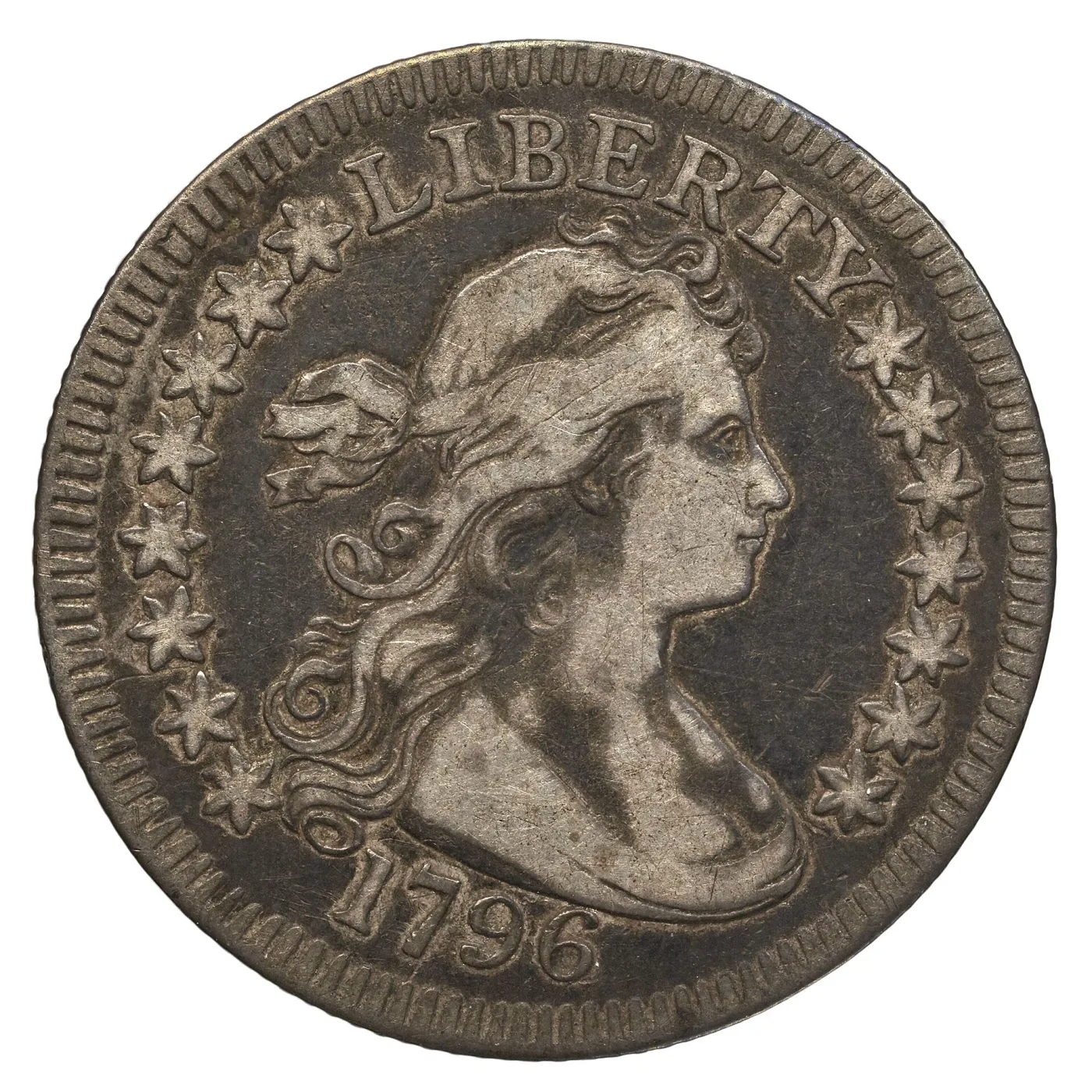
The Draped Bust Quarter is the coin that started the entire United States quarter dollar denomination — and it remains one of the most coveted prizes in all of early American numismatics. Struck at the Philadelphia Mint in just four years (1796, then 1804, 1805, 1806, and 1807), the series is defined by two famous facts: it begins with a single-year type coin, the 1796, of which only 6,146 were ever struck; and it then disappears for seven years before returning in 1804 with a completely redesigned reverse. No other early US silver series packs so much rarity, history, and design change into so few coins.
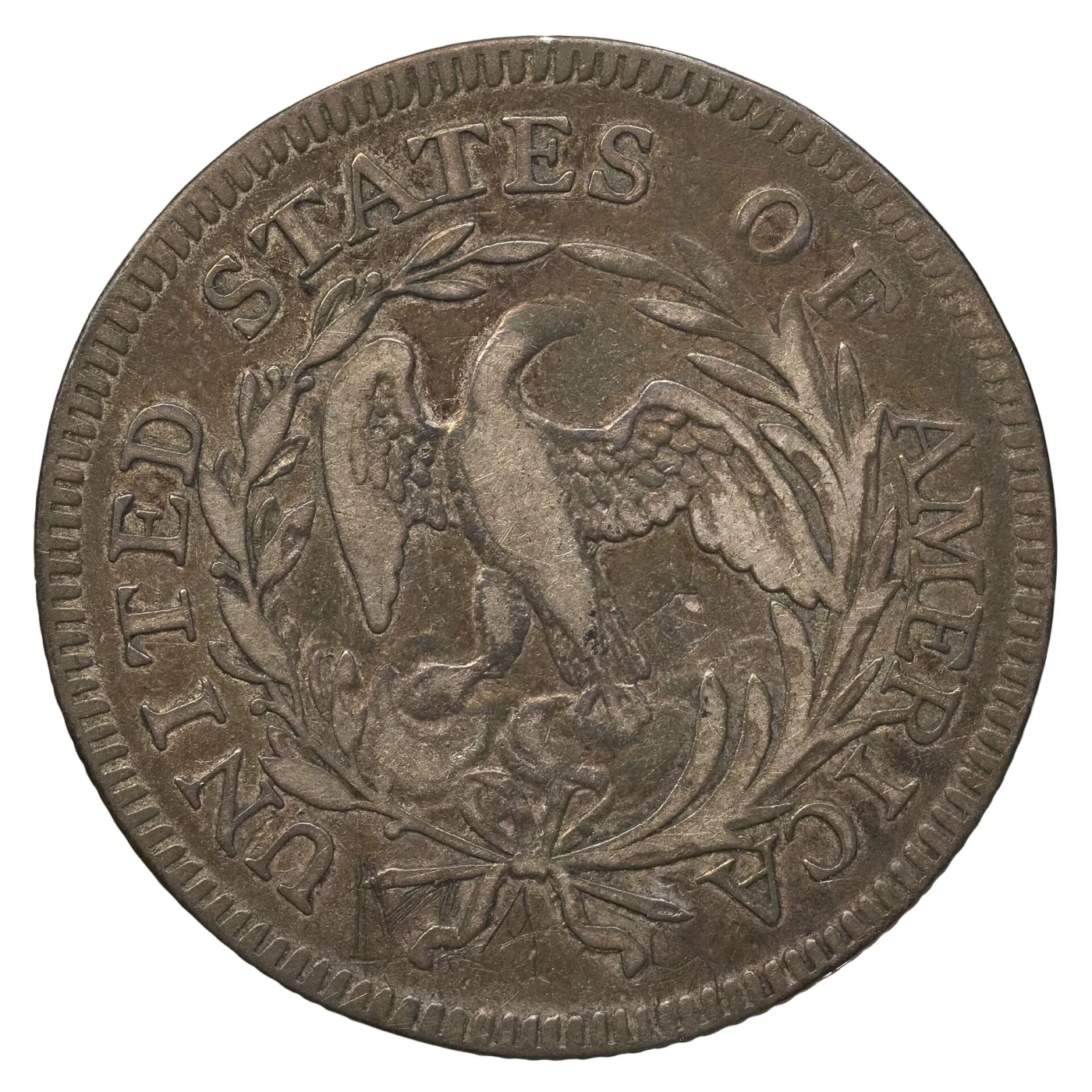
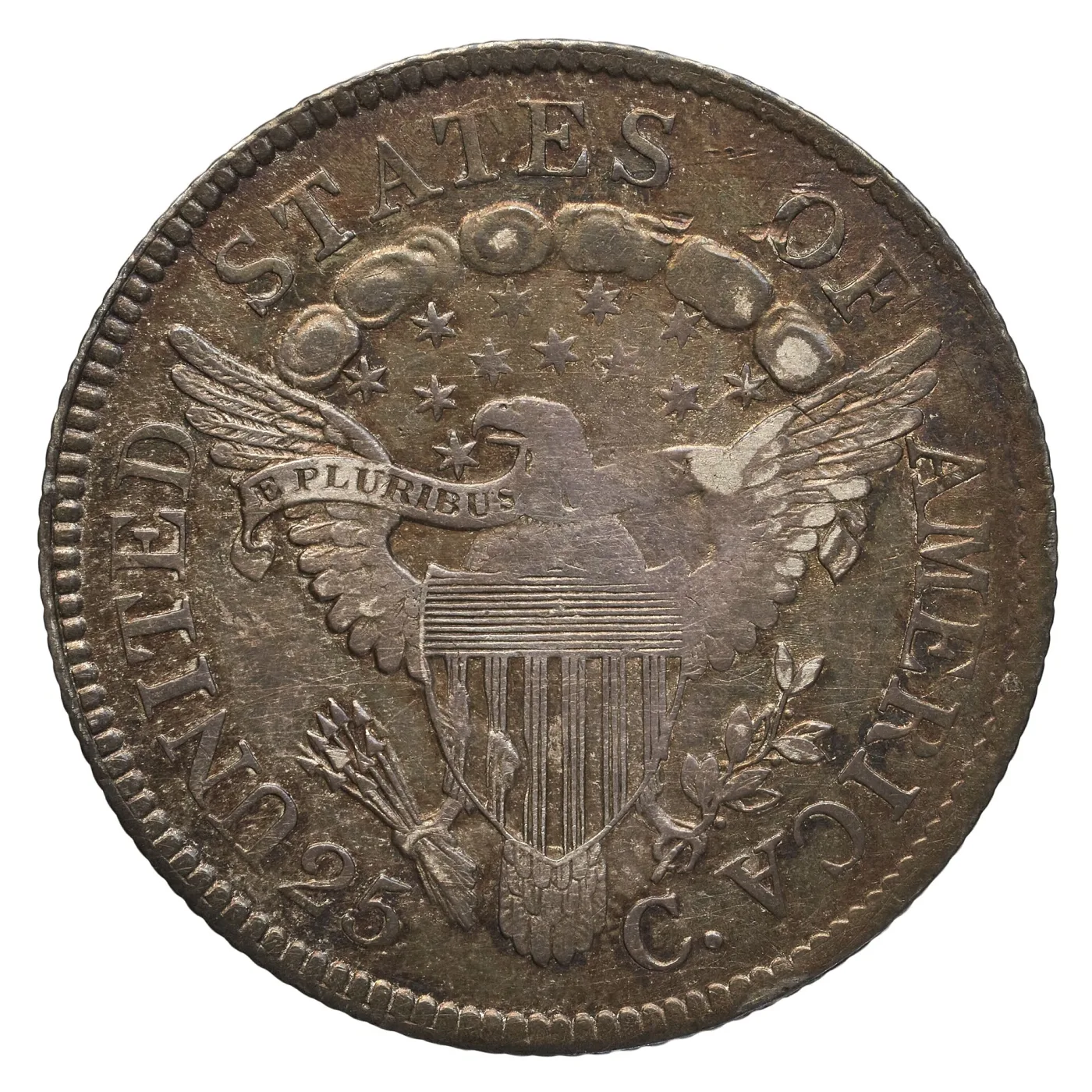
The series splits cleanly into two reverse types. The 1796 Small Eagle reverse shows a thin, naturalistic “perched” eagle on a cloud, surrounded by a wreath — a one-year-only design that makes the 1796 quarter a mandatory and expensive addition to any US type set. The 1804–1807 Heraldic Eagle (Large Eagle) reverse replaced it with a bold, shield-breasted heraldic eagle modeled on the Great Seal of the United States, matching the look already used on the Draped Bust Dollar and other denominations. The obverse — Robert Scot’s elegant Draped Bust Liberty — stayed essentially the same throughout, the same portrait that appears on the Draped Bust Half Dime and Draped Bust Half Cent.
This guide covers everything needed to identify, attribute, grade, and value Draped Bust Quarters: the two reverse types and how to tell them apart instantly, the legendary 1796 one-year issue, the seven-year production gap, the 1804–1807 Heraldic Eagle dates, the famous 1806/5 overdate, the 1806 “C over A” blunder, the Browning variety system, grading early silver, authentication of a heavily counterfeited series, and 2026 market values across the full grade range. The general coin identification principles apply throughout, but the Draped Bust Quarter is above all a study in scarcity — even the most common date is genuinely rare, and the 1796 is one of the most famous type coins in the entire US series.
History: The First US Quarter Dollar
When the Philadelphia Mint opened under the Coinage Act of 1792, the quarter dollar was authorized but not immediately produced. Silver coinage began with the half dime, half dollar, and dollar in 1794–1795. The quarter dollar finally made its debut in 1796 — the very last of the original authorized denominations to be struck — using Robert Scot’s Draped Bust obverse and the Small Eagle reverse already in use on contemporary half dimes, dimes, and the first gold Capped Bust quarter eagle of the very same year.
The 1796 quarter was struck in tiny numbers. Only 6,146 pieces left the presses, all dated 1796, before quarter production stopped entirely. The denomination was simply not in demand: Spanish two-reales pieces (worth a quarter dollar and known as “two bits”) circulated freely and were legal tender in the United States until 1857. Americans had no shortage of quarter-dollar coinage from the Spanish colonial mints, so the young US Mint — chronically short of silver bullion — prioritized half dollars and dollars instead.
The Robert Scot Design
Robert Scot, the Mint’s first Chief Engraver, created the Draped Bust portrait of Liberty that defines the obverse. The design is widely attributed to a drawing by the portraitist Gilbert Stuart, with the engraving model often credited to John Eckstein of Providence. The same Draped Bust Liberty appeared across the entire silver and copper lineup of the late 1790s and early 1800s, giving US coinage a unified family look. The quarter shared its obverse concept with the Draped Bust Dollar, Draped Bust Half Dime, and the cent and half cent of the era.
The Seven-Year Gap and Return
After 1796, the Mint struck no quarters at all until 1804. When the denomination returned, the obverse remained Scot’s Draped Bust Liberty, but the reverse had been completely redesigned: the delicate Small Eagle was replaced by the bold Heraldic Eagle, bringing the quarter into line with the rest of the silver series. Production then ran continuously (if modestly) through 1807, after which the Mint again paused the denomination — the next quarters would not appear until 1815, when John Reich’s Capped Bust Quarter began.
Small Eagle vs Heraldic Eagle: The Two Types
The single most important distinction in the Draped Bust Quarter series is the reverse type. There are exactly two, and they never overlap by date: the Small Eagle exists only on the 1796, and the Heraldic Eagle exists only on the 1804–1807 issues. Identifying the type is the first step in any attribution and the first thing that determines value.
Small Eagle Reverse (1796 Only)
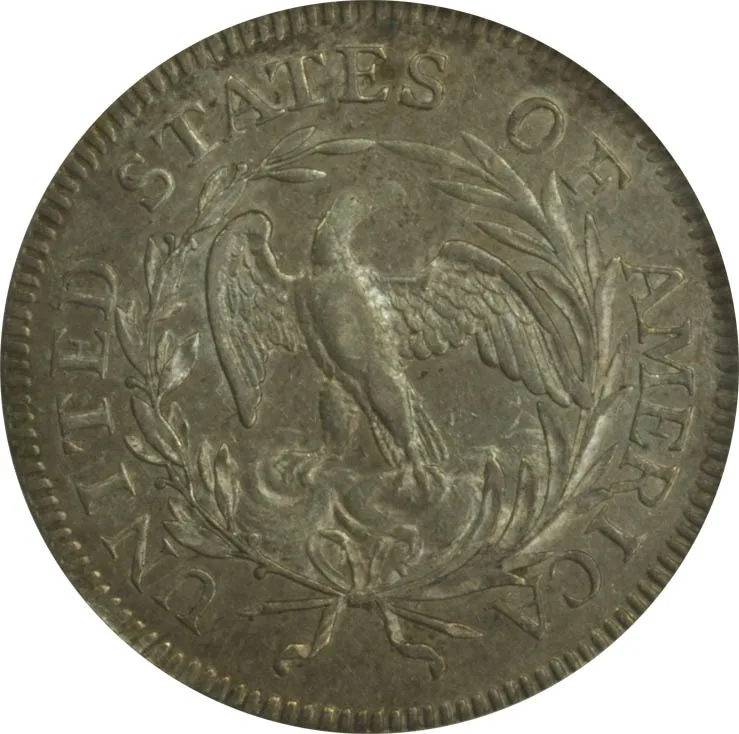
- The eagle: A small, thin, naturalistic eagle with raised wings, perched on a bed of clouds. It looks delicate and almost bird-like, nothing like a heraldic emblem.
- The wreath: The eagle is surrounded by an open wreath of palm and olive branches tied with a ribbon at the bottom.
- Legend: UNITED STATES OF AMERICA arcs around the top.
- No denomination on the coin: Remarkably, the 1796 quarter carries no mark of value anywhere — neither “25 C.” nor “QUARTER.” The denomination was understood by size alone.
- Exclusive to 1796: This reverse appears on no other quarter date.
Heraldic Eagle Reverse (1804–1807)
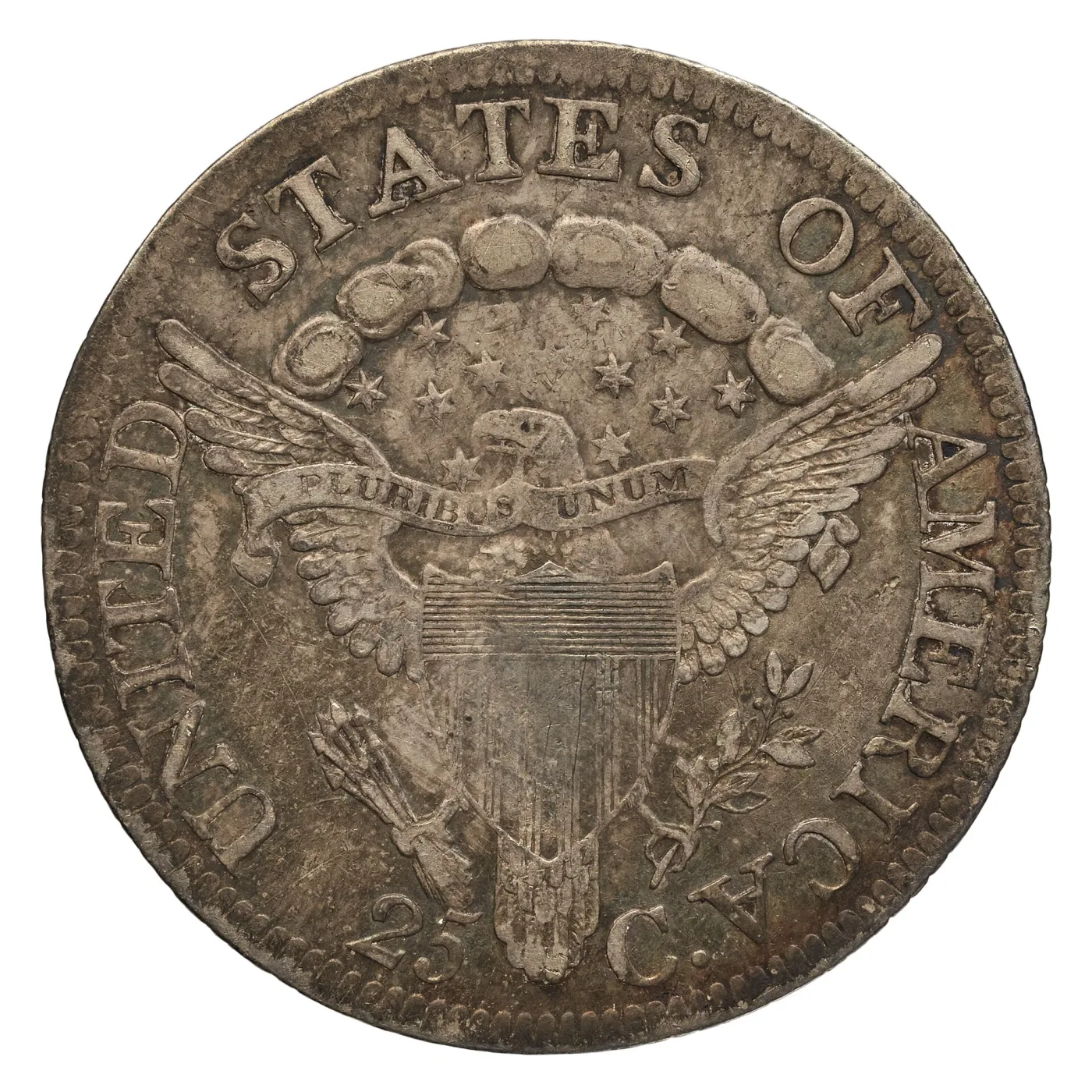
- The eagle: A large, bold heraldic eagle with a Federal shield on its breast, wings spread, holding an olive branch in one talon and a bundle of arrows in the other — modeled on the Great Seal of the United States.
- The motto: E PLURIBUS UNUM appears on a ribbon held in the eagle’s beak, with a cloud of stars and an arc of clouds above.
- Legend: UNITED STATES OF AMERICA arcs around the top.
- Denomination present: 25 C. appears below the eagle — the first time a quarter dollar carried its value on the coin.
- Exclusive to 1804–1807: Every 1804, 1805, 1806, and 1807 quarter uses this reverse.
How to Tell Them Apart Instantly
The fastest test is simply the eagle. A thin, perched, naturalistic eagle inside a wreath = Small Eagle = 1796. A big, shield-breasted heraldic eagle with E PLURIBUS UNUM and “25 C.” = Heraldic Eagle = 1804–1807. The presence or absence of the “25 C.” denomination is a second instant confirmation: only the Heraldic Eagle type shows it. Because the two types never share a date, reading the date alone also settles the question — but learning to recognize the eagles is essential, because the date on a worn early quarter can be hard to read while the reverse type is usually obvious at a glance.
Design Details: Obverse and Reverse
The Obverse (Both Types)
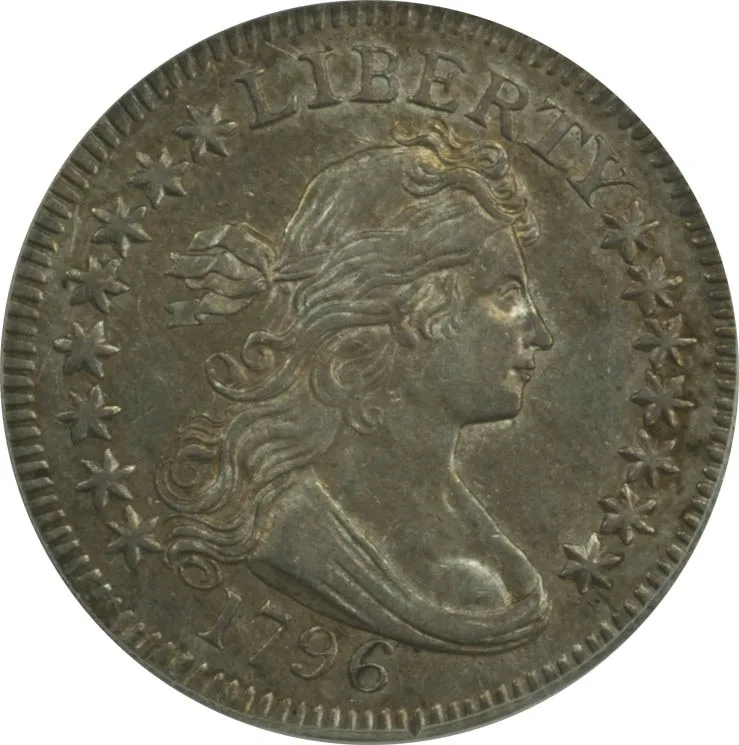
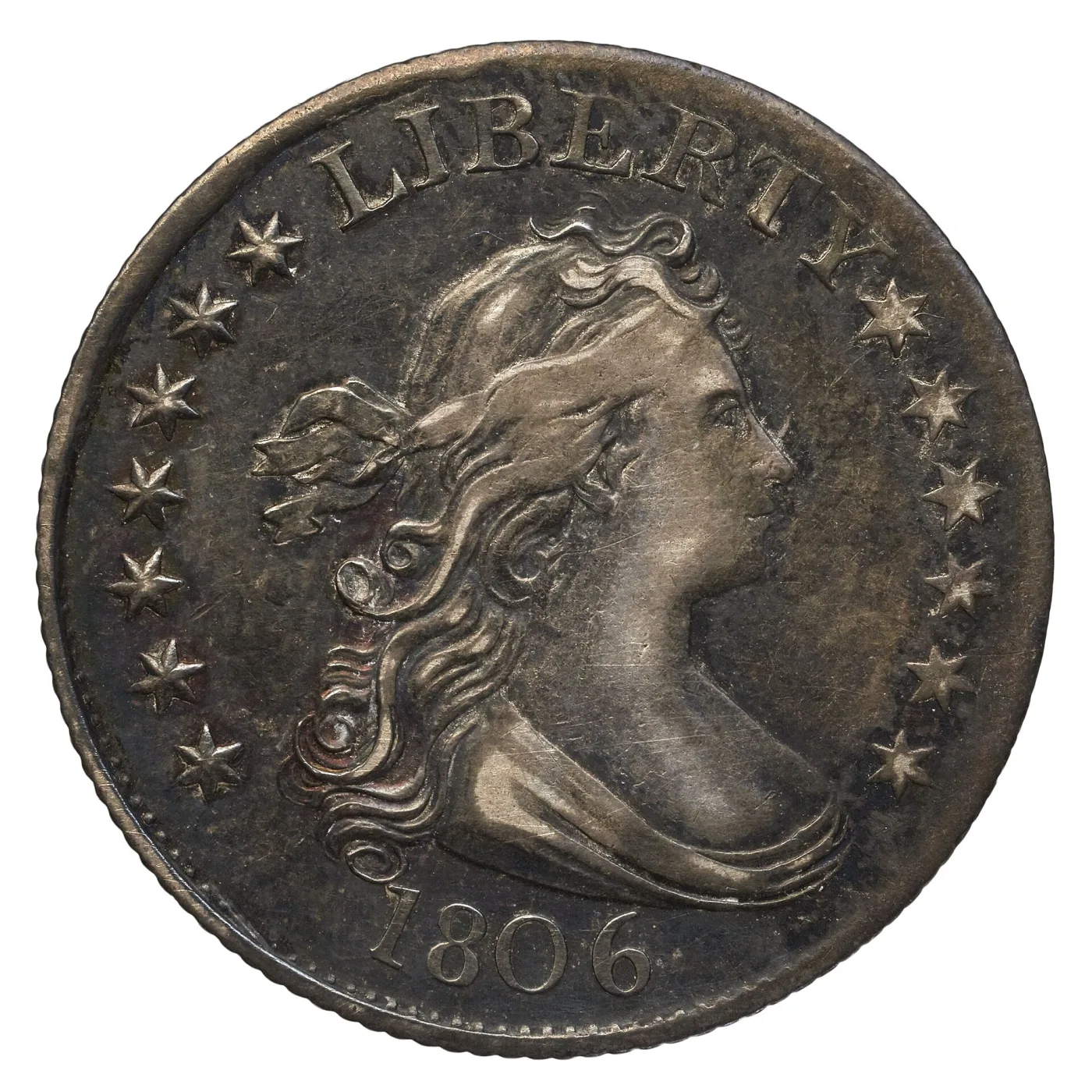
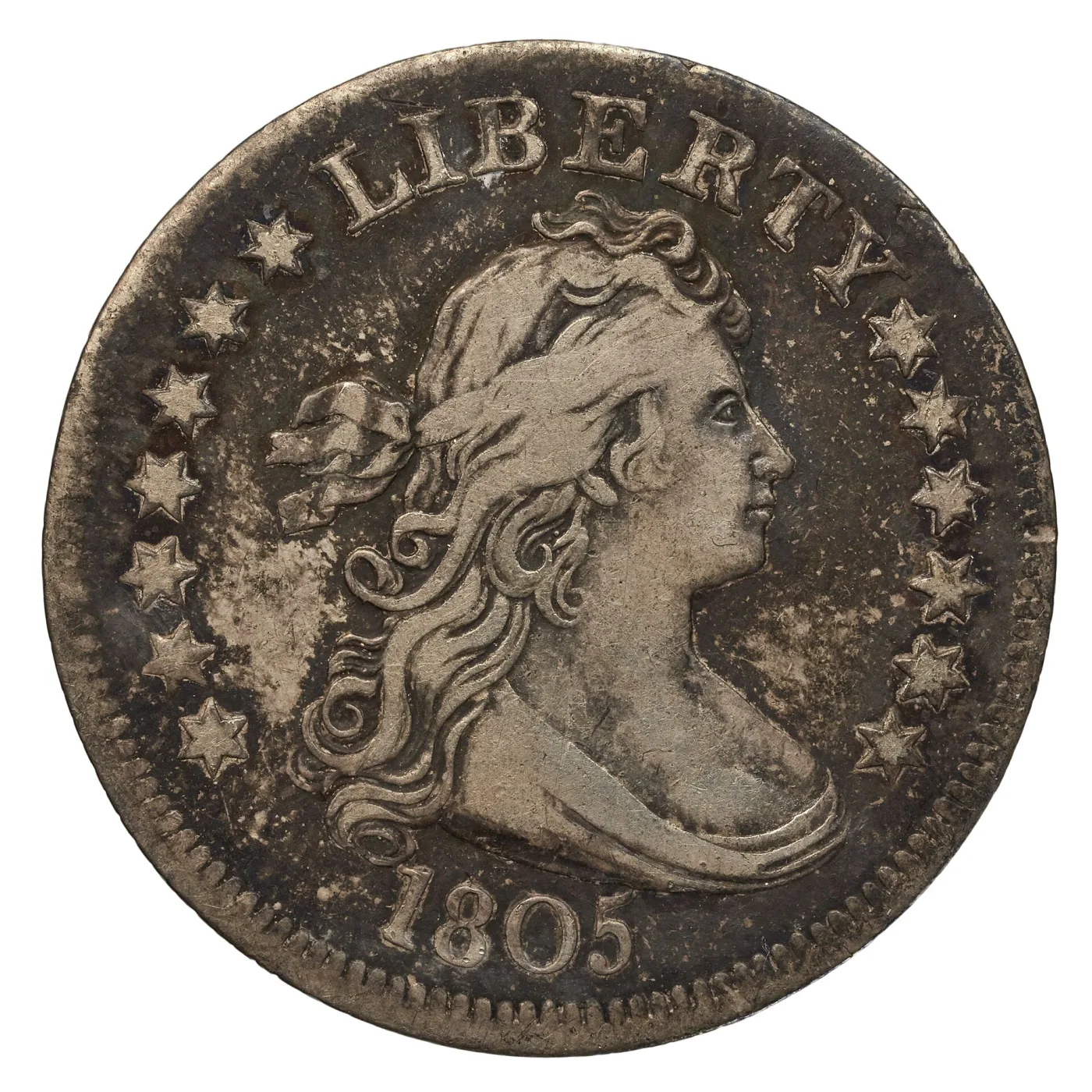
The obverse depicts Liberty facing right, her hair flowing loosely and tied behind with a ribbon, her bust draped in cloth (the “Draped Bust”). LIBERTY arcs across the top above her head, and the date sits in the exergue below the bust. Stars flank the portrait — and here is an important sub-detail: the 1796 has fifteen or sixteen stars (reflecting the number of states in the Union at the time), while the 1804–1807 issues use thirteen stars (seven left, six right), having reverted to the original thirteen-colony count. Star count is therefore a quick secondary diagnostic between the two types.
The Reverse — Small Eagle (1796)
A small, naturalistic eagle perches on a cloud with wings raised, framed by an open wreath of palm and olive. UNITED STATES OF AMERICA arcs above. There is no denomination and no motto. The overall effect is delicate and almost ornamental — a sharp contrast to the heraldic design that followed.
The Reverse — Heraldic Eagle (1804–1807)
A large heraldic eagle with a striped Federal shield on its breast, wings displayed, clutching an olive branch and a bundle of arrows. A ribbon in its beak reads E PLURIBUS UNUM. Above the eagle’s head, a cloud arc holds an array of stars. UNITED STATES OF AMERICA arcs around the top, and the denomination 25 C. appears at the bottom. This is the same heraldic motif used on the era’s silver dollars and gold coinage, unifying the look of US money.
The Edge
Both types have a reeded edge. There is no lettered edge on Draped Bust Quarters (lettered edges were used on the larger Draped Bust half dollars and dollars of the period, but the quarter always had a simple reeded edge).
Mint Marks
All Draped Bust Quarters were struck at the Philadelphia Mint. There are no mint marks on any Draped Bust Quarter — the branch mints did not exist yet (New Orleans, the first branch mint, opened only in 1838). Any Draped Bust Quarter bearing a mint mark is altered or counterfeit.
Composition and Specifications
The Draped Bust Quarter was struck to the early US silver standard established by the Coinage Act of 1792, and the specifications did not change across the series.
- Composition: 89.24% silver, 10.76% copper (.8924 fine — the early US silver standard)
- Weight: 6.74 grams
- Diameter: approximately 27.5 mm (struck on an open collar, so diameter varies slightly from coin to coin)
- Edge: Reeded
- Mint: Philadelphia only (no mint mark)
Because these coins were struck on an open collar — the planchet was free to spread laterally during striking — the diameter and edge can vary noticeably between examples, and the rims are often uneven. This is normal for the era and not a defect. At 2026 silver prices, the bullion content of a Draped Bust Quarter is roughly $4–$5, but this number is purely academic: no genuine Draped Bust Quarter trades anywhere near melt value. Even the most worn, common-date example carries a numismatic premium of dozens of times its silver content, because the entire series is genuinely scarce.
The 1796 One-Year Type: The Series Crown Jewel
The 1796 Draped Bust Quarter is one of the most famous and important type coins in all of US numismatics. It is the only quarter with the Small Eagle reverse, the only quarter without a denomination, and the first quarter dollar ever struck. For type-set collectors, it is unavoidable: a complete US type set must include a 1796 quarter, and there is no cheaper substitute date because the type existed for one year only.
Mintage and Survival
Only 6,146 examples were struck, all in 1796. PCGS estimates that roughly 650 survive across all grades, with fewer than 100 in Mint State. This makes the 1796 simultaneously a great rarity and — paradoxically — one of the better-preserved early type coins, because so many were saved as first-year curiosities and never circulated heavily. A surprising number of high-grade 1796 quarters exist relative to the issue’s tiny mintage, precisely because contemporaries recognized the coin as special.
Varieties
The 1796 is known in two die marriages, Browning-1 (B-1) and Browning-2 (B-2), distinguished by minute differences in star and date placement and in the reverse die. Both are collectible; neither is dramatically rarer than the other, though condition-census examples of each command strong premiums. The two marriages are catalogued in the standard Browning reference.
2026 Market Values
- G-4: $11,000–$16,000
- VG-8: $16,000–$22,000
- F-12: $24,000–$32,000
- VF-20: $40,000–$55,000
- EF-40: $65,000–$90,000
- AU-50: $110,000–$160,000
- MS-63: $300,000+
- MS-65 and above: Auction records exceed $1.5 million
In 2022, a superb-gem 1796 quarter sold for $1,740,000 at auction, illustrating the heights this one-year type can reach. Even in the lowest collectible grades, the 1796 is a five-figure coin — the single most expensive obstacle in assembling a US quarter type set.

The 1797–1803 Production Gap
No Draped Bust Quarters are dated 1797, 1798, 1799, 1800, 1801, 1802, or 1803. The Mint simply did not strike quarters during those seven years. Anyone offering an “1800 quarter” or “1799 quarter” of this design is mistaken or attempting fraud — the dates do not exist for this series.
Why the Gap Happened
Several factors converged. The quarter denomination saw little circulation demand because Spanish two-reales pieces filled the same role and circulated abundantly. The Mint was chronically short of silver bullion, and depositors who brought silver to be coined generally preferred the larger, more convenient half dollar and dollar denominations. With limited bullion and limited demand, the quarter was the easiest denomination to skip — and skip it the Mint did, for seven straight years.
Implications for Collectors
A “complete date set” of Draped Bust Quarters contains only five date slots: 1796, 1804, 1805, 1806, and 1807. There are no 1797–1803 holes to fill because no such coins were ever made. This makes the date set short in length but extremely expensive in practice, because every one of the five dates is scarce and the 1796 in particular is a major rarity.
The 1804–1807 Heraldic Eagle Dates
When the quarter returned in 1804, it wore the Heraldic Eagle reverse and the thirteen-star obverse. The four Heraldic Eagle dates differ enormously in rarity, ranging from the great rarity of the 1804 to the comparatively “available” 1807.
1804 (Heraldic Eagle)
Mintage approximately 6,738 — almost as low as the 1796. The 1804 is the key date of the Heraldic Eagle type and the second-rarest Draped Bust Quarter overall. Fewer than 400 are believed to survive across all grades, with only a handful in Mint State. The 1804 is exceptionally difficult to locate in any grade above Fine, and high-grade examples are major auction events.
1805 (Heraldic Eagle)
Mintage approximately 121,394 — a dramatic jump from 1804. The 1805 is the most affordable starting point for the Heraldic Eagle type, though “affordable” is relative for a 220-year-old silver coin. It exists in several Browning die marriages.
1806 (Heraldic Eagle)
Mintage approximately 206,124 — the highest of the series. The 1806 is the most commonly encountered Draped Bust Quarter and the usual choice for a type-set example of the Heraldic Eagle reverse. It is also the richest year for varieties, including the famous 1806/5 overdate and the “C over A” blunder (covered in the next section).
1807 (Heraldic Eagle)
Mintage approximately 220,643 — the final year and the highest mintage. The 1807 is comparable to the 1806 in availability and is the last Draped Bust Quarter before the eight-year hiatus that preceded the Capped Bust Quarter of 1815.
The 1806/5 Overdate and 1806 Blunders
The 1806 is the most variety-rich year of the Draped Bust Quarter series, and it includes two of the best-known early American die errors: the 1806/5 overdate and the 1806 “C over A” reverse blunder.
The 1806/5 Overdate
The 1806/5 was created when a leftover 1805 obverse die was repunched with a 6 over the existing 5. Under magnification, the loop and tail of the underlying 5 are visible inside and beneath the 6 of the date. This is the most popular and widely collected variety of the series after the 1796 itself, and it is recognized by all major grading services as a distinct, separately valued variety.
The 1806/5 carries a meaningful premium over the standard 1806, particularly in higher grades:
- 1806/5, G-4: $300–$450
- 1806/5, VG-8: $500–$700
- 1806/5, F-12: $750–$1,000
- 1806/5, VF-20: $1,400–$1,900
- 1806/5, EF-40: $3,000–$4,200
- 1806/5, AU-50: $6,500–$9,000
The 1806 “C Over A” Blunder
On certain 1806 reverse dies, the engraver first punched an A where the C of “25 C.” belongs, then corrected it by punching a C over the A. Under 10x magnification, traces of the A are visible beneath the C. This is a charming Mint blunder prized by die-variety specialists. It is scarcer than the standard 1806 and commands a premium, though it is less famous and less expensive than the 1806/5 overdate.
Why Overdates Happened
The early Mint made dies by hand, and each working die was expensive and time-consuming to produce. At year’s end, serviceable but undated or prior-dated dies were frequently salvaged by repunching the new year’s final digit over the old one rather than scrapping the die. This thrift produced overdates across nearly every early US series — the same phenomenon that gives us the 1823/2 on the later Capped Bust Quarter and overdates throughout early dimes, half dollars, and dollars.
The Browning Variety System
Ard W. Browning published The Early Quarter Dollars of the United States 1796–1838 in 1925, cataloging every then-known die marriage of the early quarter series. Browning numbers — written “B-1,” “B-2,” and so on for each date — remain the standard attribution reference, supplemented today by the research of Steve Tompkins and the John Reich Collectors Society (JRCS).
How Browning Numbers Work
Browning assigned a number to each unique combination (or “marriage”) of obverse and reverse dies used in a given year. Because the early Mint used dies until they cracked or failed, then paired survivors with new replacements, several marriages can exist for a single date. The 1806, the richest year, has many Browning numbers; the 1804 has just a few; the 1796 has two (B-1 and B-2).
Why Variety Attribution Matters
For the Draped Bust Quarter, variety attribution is somewhat less price-defining than it is for the later Capped Bust series, simply because every date is already scarce — but it still matters. Certain die marriages are condition rarities or are prized for dramatic die cracks (so-called “terminal die states”), and the named varieties (1806/5 overdate, 1806 C-over-A) carry clear premiums. Serious collectors attribute every coin by Browning number, and the major grading services will note the attribution on the holder.
Diagnostic Markers
Browning attribution relies on small die markers: the exact position of the date numerals beneath the bust, alignment and spacing of the stars, placement of the eagle’s elements relative to the lettering, the position of the C in “25 C.” on Heraldic Eagle reverses, and progressive die-crack patterns. Most require 5x to 10x magnification and a good reference. The current Tompkins/JRCS reference is the gold standard for the series.
Key Dates and Semi-Keys
1796 (The Crown Jewel)
The one-year Small Eagle type. Mintage 6,146; roughly 650 survivors. A five-figure coin in any collectible grade and the single most important type coin of the US quarter series. See the dedicated section above.
1804 (Key Date of the Heraldic Type)
Mintage approximately 6,738; fewer than 400 survivors. The 1804 is the rarest of the four Heraldic Eagle dates and the second-rarest Draped Bust Quarter overall. Even well-worn examples bring strong four-figure prices, and anything Fine or better is a significant coin.
1805 (Semi-Key)
Mintage approximately 121,394. The most accessible entry point to the Heraldic Eagle type after the 1806 and 1807, but still genuinely scarce in higher grades.
1806/5 Overdate (Popular Variety)
The most collected variety after the 1796 itself. Commands a clear premium over the standard 1806. See the dedicated overdate section above.
1806 and 1807 (the “Common” Dates)
These two highest-mintage dates are the usual choices for a Heraldic Eagle type coin. “Common” is relative — both are scarce by any normal standard, but they are the most available and the most affordable Draped Bust Quarters, and therefore the natural starting point for type collectors.
Grading Early Silver
Grading Draped Bust Quarters requires understanding the wear patterns of early US silver and the strike characteristics of open-collar coinage. Because the entire series is scarce, accurate grading has an outsized impact on value, and small differences in grade translate into large differences in price.
Wear Points
Obverse: The first wear shows on the high points of Liberty’s hair above the forehead and on the bust line and shoulder drapery. As wear progresses, the cheek flattens, the hair detail merges, and the drapery folds smooth out. The fine curls behind the neck are an important grade marker.
Small Eagle reverse (1796): The eagle’s breast and the tops of the wings wear first, followed by the wreath details. Heraldic Eagle reverse (1804–1807): The eagle’s breast feathers, the shield lines, and the cloud-and-star arc above the eagle’s head are the high points that wear earliest, followed by the wing and tail detail.
Grade Definitions
- AG-3 (About Good): Heavily worn; outline of bust and eagle visible; date and some lettering readable
- G-4 (Good): Major design outlines visible; rims worn into the tops of letters; date clear
- VG-8 (Very Good): Some interior detail in hair and eagle; LIBERTY partially visible on the obverse
- F-12 (Fine): Moderate wear; LIBERTY mostly visible; some hair and feather detail
- VF-20 (Very Fine): All major detail present; hair curls and eagle feathers distinct
- EF-40 (Extremely Fine): Light wear on the highest points only; sharp overall detail
- AU-50 (About Uncirculated): Trace wear on high points; significant original luster remaining
- AU-58: A sliver of wear; nearly full luster; a popular and value-rich grade in this scarce series
- MS-60 and above: No wear; grade determined by luster, strike, and the number and severity of marks
- MS-63 to MS-65: Choice to gem quality — extremely scarce for any date and exceedingly rare for the 1796 and 1804
Strike Quality and Adjustment Marks
Draped Bust Quarters frequently show adjustment marks — parallel file marks made by Mint adjusters who filed overweight planchets down to the legal standard before striking. Adjustment marks are mint-made and do not by themselves lower the grade, but heavy adjustment marks across Liberty’s face or the eagle’s breast hurt eye appeal and reduce price. Strike weakness is also common because the open-collar press did not always fill the design fully; weakly struck areas are not wear and should not be graded as wear, though the market does reward fully struck examples.
Authentication and Counterfeit Detection
Because of their rarity and value, Draped Bust Quarters — especially the 1796 and 1804 — are among the most counterfeited and altered US coins. Deceptions range from cast and struck fakes of the key dates to altered dates and added or removed varieties. Authentication is essential, and any significant Draped Bust Quarter should be third-party certified without exception.
Weight and Diameter
Genuine examples weigh 6.74 grams (allowing for minor wear, typically down to about 6.5 grams) and measure approximately 27.5 mm. A digital scale and caliper rule out the crudest counterfeits immediately. Coins that are dramatically underweight, overweight, or the wrong diameter are suspect.
Silver and Specific Gravity
Genuine coins are 89.24% silver, with a specific gravity near 10.3. Many counterfeits are struck in base metal or the wrong alloy and fail a specific-gravity test. Non-destructive XRF analysis is the preferred method for any high-value example, since acid testing damages the surface and destroys value.
Date and Variety Alterations
The most dangerous deceptions are altered dates — for instance, an 1804-dated quarter created by reworking the numerals of a more common date, or a fake 1806/5 overdate produced by tooling a standard 1806. Always compare the date and any claimed variety against published Browning diagnostics. Genuine overdates match the documented die markers exactly; tooled fakes do not.
Surface and Strike Examination
Under 10x magnification, authentic Draped Bust Quarters show even, natural toning consistent with two centuries of age, proper open-collar strike characteristics, and no casting porosity. Cast counterfeits often display tiny surface pits or a granular “orange-peel” texture, soft or mushy detail, and seam lines on the edge. Genuine coins have crisp, if sometimes weakly struck, detail and a smooth reeded edge.
Third-Party Grading
Any Draped Bust Quarter of meaningful value should be in a PCGS, NGC, or ANACS holder, ideally with Browning attribution. For the 1796, the 1804, the 1806/5 overdate, and any Mint State example of any date, certified status is effectively mandatory — the risk and cost of a counterfeit are simply too high to accept a raw coin.
Current Market Values
Draped Bust Quarter prices in 2026 reflect intense collector demand for a tiny, historically important series. The market for early American type coins has been strong for over a decade, and the five-date Draped Bust Quarter series sits near the top of that demand.
1796 (Small Eagle, One-Year Type)
See the dedicated section above. Roughly $11,000–$16,000 in G-4, rising into the six figures in AU and seven figures at the gem level.
1804 (Heraldic Eagle, Key Date)
- G-4: $3,500–$5,000
- VG-8: $5,500–$7,500
- F-12: $9,000–$13,000
- VF-20: $18,000–$26,000
- EF-40: $40,000–$60,000
- AU-50: $90,000+
1805 (Heraldic Eagle)
- G-4: $350–$500
- VG-8: $550–$750
- F-12: $900–$1,300
- VF-20: $1,800–$2,600
- EF-40: $4,500–$6,500
- AU-50: $9,000–$13,000
- MS-63: $35,000+
1806 and 1807 (Heraldic Eagle, Most Available)
- G-4: $300–$450
- VG-8: $450–$650
- F-12: $750–$1,100
- VF-20: $1,500–$2,200
- EF-40: $3,500–$5,500
- AU-50: $7,500–$11,000
- MS-63: $28,000+
- MS-65: $90,000+
1806/5 Overdate
See the dedicated overdate section above. A meaningful premium over the standard 1806 across all grades.
All values are approximate retail ranges for problem-free, certified coins as of 2026. Cleaned, damaged, holed, or otherwise impaired examples sell for substantial discounts — often 30% to 60% below the figures above. Because the series is so scarce and so valuable, even modest grade and quality differences move prices significantly, and auction results for the rarest dates can exceed these ranges.
Building a Collection
Type Set Approach
For a US silver type set, the Draped Bust Quarter requires two slots: one Small Eagle (only the 1796 fills it) and one Heraldic Eagle (usually a 1806 or 1807). The Small Eagle slot is the expensive one — the 1796 is a five-figure coin even in low grade — while the Heraldic Eagle slot can be filled in a circulated grade for a few hundred to a few thousand dollars. Many collectors acquire the affordable Heraldic Eagle example first and save toward the 1796 over time.
Date Set
A complete date set is short — just five coins: 1796, 1804, 1805, 1806, and 1807 — but it is one of the more expensive five-coin sets in US numismatics. The 1796 and 1804 together account for the great majority of the cost. A circulated date set (Good to Fine) can run from roughly $20,000 to $40,000 depending on the grades of the 1796 and 1804; a higher-grade set climbs quickly into six figures.
Variety Collection
A Browning variety collection of the Draped Bust Quarter is a focused, achievable advanced goal because the total number of marriages is modest compared with the later Capped Bust Quarter. The named varieties — the 1806/5 overdate and the 1806 C-over-A blunder — are the natural highlights and are widely available in circulated grades. Assembling all the Browning marriages of the 1806 alone is a satisfying sub-project for the variety specialist.
Where the Draped Bust Quarter Fits
The full progression of US quarter designs begins here: Draped Bust (1796, 1804–1807), then Capped Bust (1815–1838), Seated Liberty (1838–1891), Barber (1892–1916), Standing Liberty (1916–1930), and Washington (1932–present). Owning a Draped Bust Quarter means owning the very first link in that 230-year chain.
Frequently Asked Questions
Why is the 1796 Draped Bust Quarter so valuable?
Three reasons converge: it is the first quarter dollar ever struck, it is the only quarter with the Small Eagle reverse (a one-year type), and only 6,146 were made with roughly 650 surviving. Type-set collectors must own one and there is no cheaper substitute date, so demand vastly exceeds supply. Even a heavily worn 1796 is a five-figure coin.
How do I tell a Small Eagle from a Heraldic Eagle quarter?
Look at the reverse. A thin, naturalistic eagle perched on clouds inside a wreath, with no denomination, is the Small Eagle — and it exists only on the 1796. A large heraldic eagle with a shield on its breast, E PLURIBUS UNUM on a ribbon, and "25 C." below is the Heraldic Eagle — found only on 1804–1807. The presence of "25 C." is an instant giveaway for the Heraldic type.
Are there 1797–1803 Draped Bust Quarters?
No. The Mint struck no quarters at all from 1797 through 1803. The denomination went from its 1796 debut straight to a seven-year hiatus, returning only in 1804. Anyone offering a Draped Bust Quarter dated 1797–1803 is mistaken or attempting fraud — those dates do not exist.
What is the 1806/5 Draped Bust Quarter?
It is an overdate created when a leftover 1805 obverse die was repunched with a 6 over the existing 5. Under magnification, the underlying 5 is visible within the 6 of the date. The 1806/5 is the most popular Draped Bust Quarter variety after the 1796 itself and commands a premium over the standard 1806. The same die-thrift practice produced the famous 1823/2 on the later Capped Bust Quarter.
Who designed the Draped Bust Quarter?
Robert Scot, the Philadelphia Mint's first Chief Engraver, engraved the Draped Bust design, which is traditionally credited to a Gilbert Stuart drawing modeled by John Eckstein. The same Draped Bust Liberty appears on the era's Draped Bust Dollar, Draped Bust Half Dime, and Draped Bust Half Cent, giving US coinage of the late 1790s a unified family look.
Why doesn't the 1796 quarter show its value?
The 1796 Draped Bust Quarter carries no mark of value — no "25 C." and no "QUARTER" — anywhere on the coin. Early US silver coins were often identified by size and weight rather than by a stamped denomination, and the quarter's value was understood from its dimensions. The denomination "25 C." first appeared on the quarter only with the Heraldic Eagle reverse in 1804.
Should I clean my Draped Bust Quarter?
No. Never. Cleaning a 220-year-old silver coin destroys its natural toning and leaves hairlines that grading services will detect, dropping the value by 30% to 60% or causing the coin to be rejected outright (body-bagged). The original surface and patina are part of the coin's value and history — preserve them. This applies to all early US silver, from the Draped Bust Dollar through the Seated Liberty Quarter.
How can I tell if my Draped Bust Quarter is genuine?
Check weight (6.74 g) and diameter (~27.5 mm) first, then examine the surface under magnification for casting porosity, seam lines, or tooled date numerals. Because the 1796 and 1804 are heavily counterfeited and altered, any meaningful example should be certified by PCGS, NGC, or ANACS. Treat any raw "1796" or "1804" quarter as guilty until proven innocent.
What replaced the Draped Bust Quarter?
After the 1807 issue, the Mint struck no quarters until 1815, when John Reich's Capped Bust Quarter began. That series ran to 1838 and was followed by the Seated Liberty Quarter, the Barber Quarter, the Standing Liberty Quarter, and finally the Washington Quarter still in use today.
Is a Draped Bust Quarter a good investment?
Genuine, problem-free Draped Bust Quarters have been strong long-term performers because the series is tiny, historically important, and permanently scarce — no more can ever be made. That said, condition and authenticity are everything: a certified, original-surface coin in an accurate grade is the asset; a cleaned, damaged, or counterfeit coin is not. Buy the coin, not the story, and insist on third-party certification for any significant purchase.