Shield Nickel Identification Guide: Key Dates, Rays Varieties, and Values
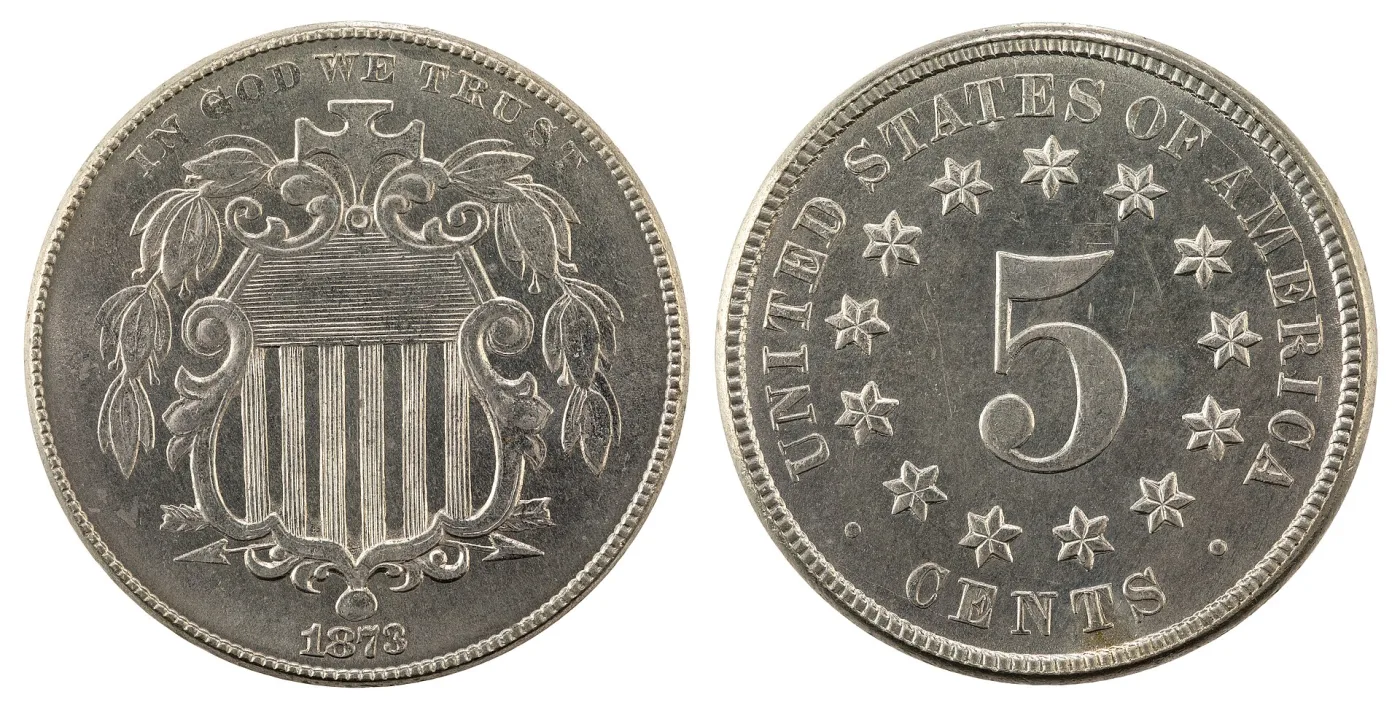
The Shield Nickel is the very first five-cent piece struck in copper-nickel by the United States Mint, produced from 1866 through 1883. Designed by Mint Chief Engraver James B. Longacre — the same artist responsible for the Indian Head Penny and the Three Dollar Gold piece — it replaced the silver half dime as America’s everyday five-cent coin during the chaotic financial aftermath of the Civil War. Compact, sturdy, and unmistakably patriotic in design, the Shield Nickel is one of the most historically meaningful coins of nineteenth-century America.
For collectors, the Shield Nickel offers a uniquely concentrated set of challenges and rewards. The series spans only eighteen years, but it includes a famous one-year subtype (the 1866–1867 With Rays reverse), several genuinely scarce dates (1877, 1878, and the elusive proof-only issues), a wealth of repunched-date varieties, and notorious striking and die-life problems that make truly well-struck specimens prized among advanced collectors. Yet because the series predates the more glamorous Liberty Head V Nickel that succeeded it, prices remain relatively reasonable compared with later classic series.
This guide walks you through everything you need to identify, grade, and value Shield Nickels: the historical context that produced the design, the With Rays vs. No Rays subtypes, all key and semi-key dates, the proof-only 1877 and 1878 issues, repunched-date varieties, the design’s notorious striking problems, authentication tips, current market values, and practical advice for assembling a collection. The same analytical framework used here applies broadly across nineteenth-century US coinage — many of these coin identification techniques work for the entire era.
History and Design: Longacre’s Shield Nickel
The Shield Nickel was born of necessity. The American Civil War (1861–1865) had triggered a wave of coin hoarding so severe that virtually all gold and silver vanished from circulation by mid-1862, replaced by paper “fractional currency,” privately issued tokens, and postage stamps. Even the small silver half dime — the standard five-cent piece since 1794 — disappeared from daily commerce. Congress responded with a series of base-metal substitutes, including the bronze Two Cent Piece in 1864 and the copper-nickel three-cent piece in 1865.
Mining magnate and industrialist Joseph Wharton, who controlled most of the domestic nickel supply, lobbied Congress aggressively for a new copper-nickel five-cent piece. His lobbying succeeded with the Act of May 16, 1866, which authorized a new five-cent coin made of 75% copper and 25% nickel — the same alloy still used in modern Jefferson Nickels, more than a century and a half later. Production began almost immediately, and the Shield Nickel entered circulation alongside the existing silver half dime, which would not be retired until 1873.
Mint Chief Engraver James B. Longacre prepared the design under tight deadlines. Longacre was a self-taught artist who had previously created the Indian Head Penny, the Flying Eagle Cent, and the gold dollar — a remarkable body of work for a man who never received formal artistic training. For the new five-cent piece, he chose a federal shield motif on the obverse, drawn from the same heraldic vocabulary that adorned the two-cent piece he had designed two years earlier. The reverse displayed a large numeral 5 surrounded by thirteen stars representing the original colonies, with rays radiating outward between the stars.
The Designer: James B. Longacre
James Barton Longacre served as Chief Engraver of the United States Mint from 1844 until his death in 1869 — a tenure that produced more circulating American coin designs than that of any other engraver before Charles Barber, who would later create the Barber Dime and Barber Quarter. Longacre’s style favored bold, simple iconography over delicate sculptural detail, a sensible choice given the limitations of mid-nineteenth-century coining technology and the hard, unforgiving nickel-copper alloy he was working with.
Longacre died only three years into Shield Nickel production, in January 1869. His successor as Chief Engraver, William Barber (Charles Barber’s father), maintained the design through the rest of the series with only minor modifications. Despite Longacre’s short involvement with the coin, the Shield Nickel design is unmistakably his — patriotic, restrained, and built for the harsh realities of mass production.
Design Details: Obverse and Reverse
Knowing every element of the Shield Nickel design is essential for accurate grading, variety attribution, and counterfeit detection.
Obverse (Heads Side)
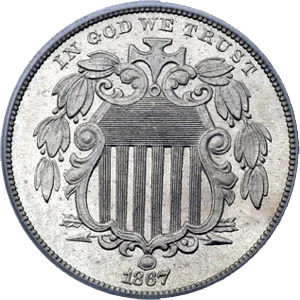
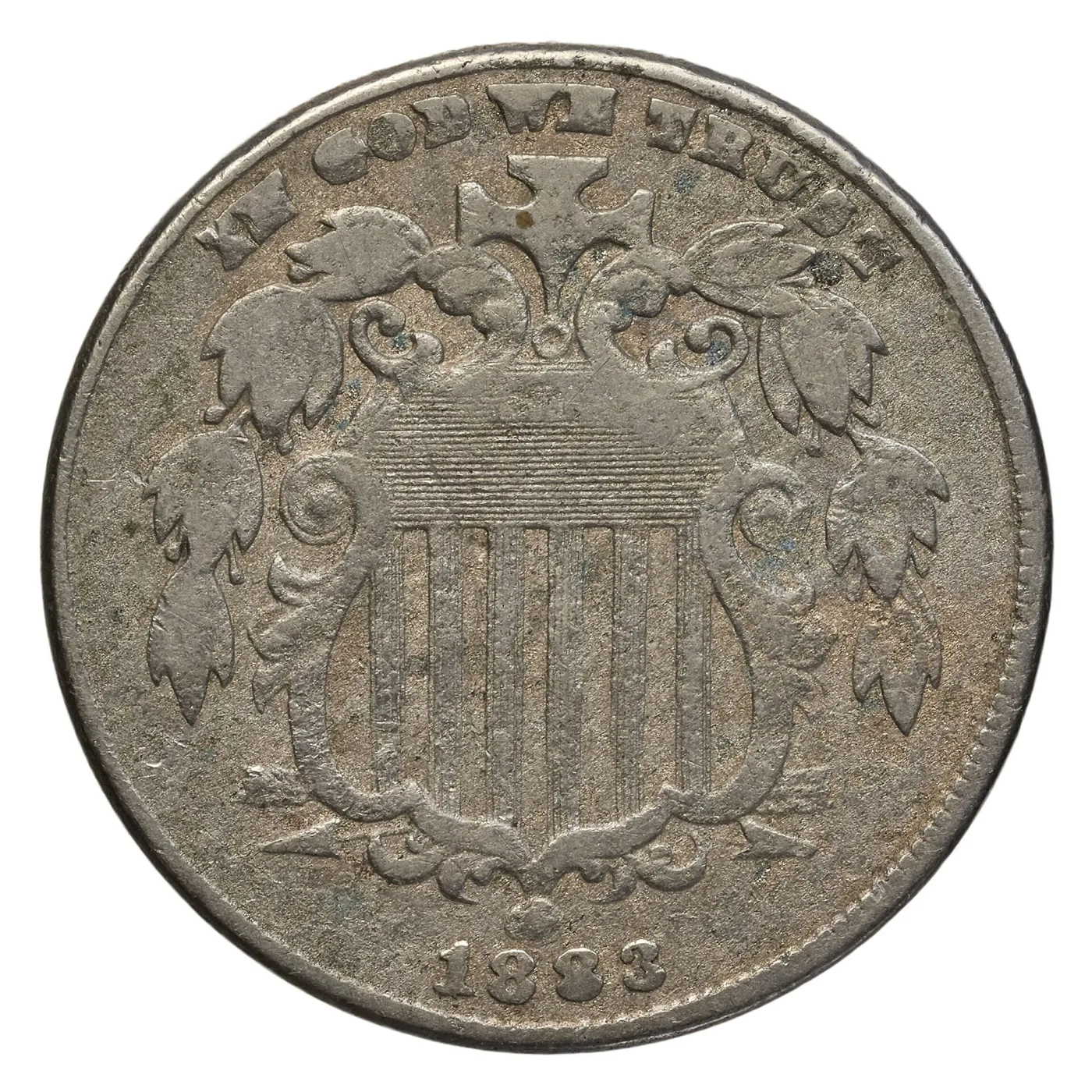
The obverse features a federal shield — the same heraldic device used on the Great Seal of the United States. The shield has a chief (horizontal band) at the top representing the unity of the federal government, with vertical pales (stripes) below representing the original states. A cross sits at the very top of the shield, flanked by olive branches that curl down on either side. Crossed arrows extend below the shield, symbolizing the nation’s readiness to defend itself. The motto IN GOD WE TRUST arches above the shield — the first regular-issue US five-cent coin to bear this motto. The date appears below the shield at the bottom of the coin.
The obverse carries no designer’s initial and no mint mark. There are no obverse design changes anywhere in the series — the same shield appears on every Shield Nickel from 1866 through 1883.
Reverse (Tails Side)
The reverse features a large numeral 5 at the center, surrounded by thirteen stars representing the original colonies. Above the stars and 5, the legend UNITED STATES OF AMERICA arches along the upper rim. Below the 5, the word CENTS appears in small letters near the rim.
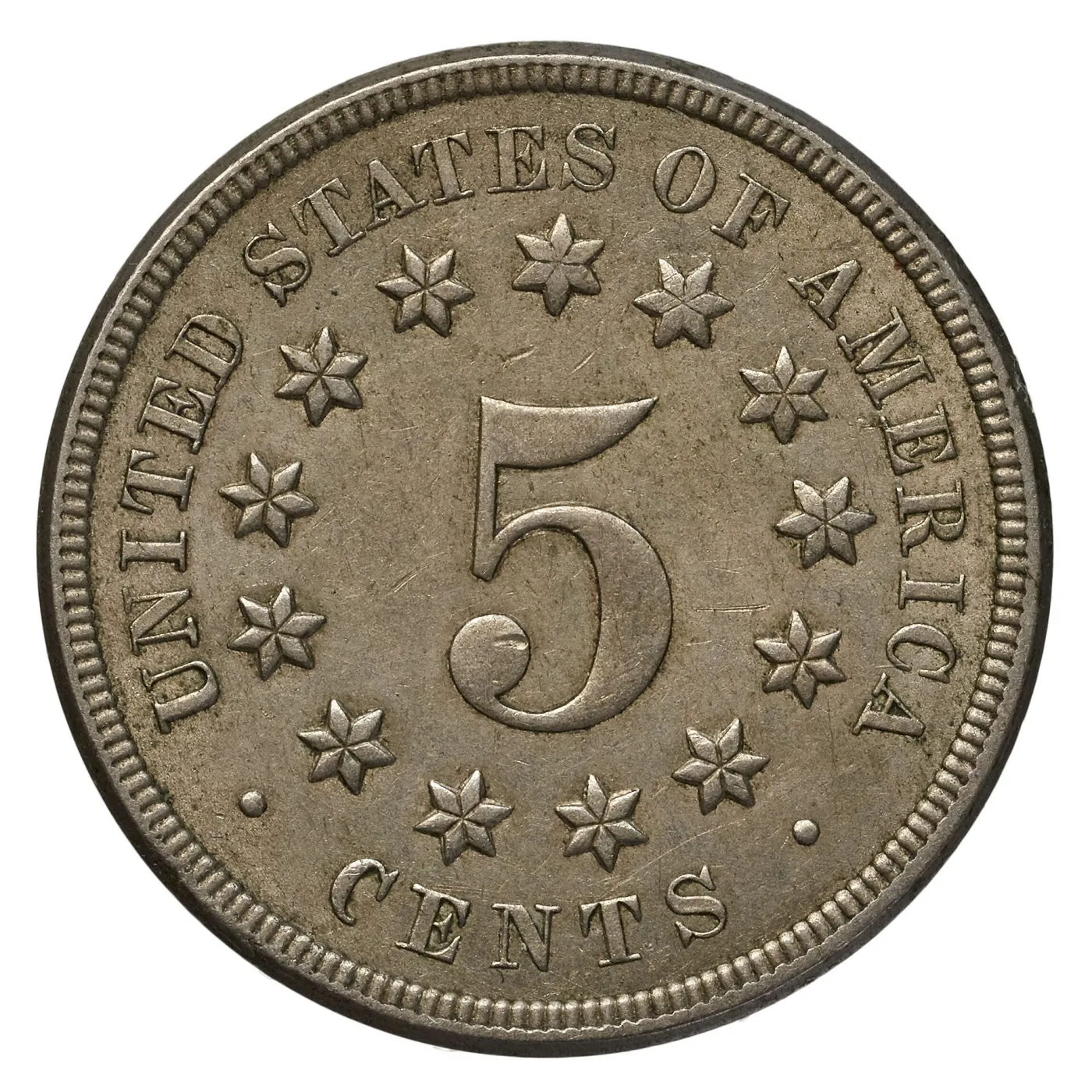
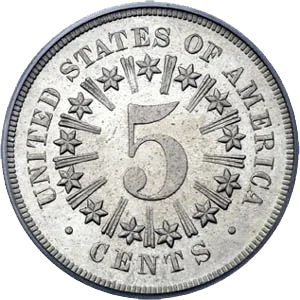
The reverse is where the most important variety distinction in the entire series occurs: from 1866 through early 1867, rays appeared between each of the thirteen stars, creating a sunburst pattern. From mid-1867 through 1883, the rays were eliminated, leaving only the stars surrounding the central 5. The rays were removed because they accelerated die wear dramatically — a problem we will examine in detail below.
Mint marks do not appear on Shield Nickels. Every Shield Nickel was struck at the Philadelphia Mint, and there are no branch-mint issues in the entire series.
With Rays vs. No Rays: The 1866–1867 Subtypes
The single most important subtype distinction in the Shield Nickel series is the presence or absence of rays on the reverse. Both varieties were produced in 1867, making this a critical year to examine carefully, and our photographic walkthrough of telling the rays from the no-rays reverse compares the two side by side at several grades.
With Rays (1866 and Early 1867)
The original 1866 Shield Nickel reverse featured rays radiating outward between each of the thirteen stars. Visually, the design is striking and unmistakably patriotic — but practically, it was a manufacturing nightmare. The high relief of the shield obverse, combined with the busy ray pattern on the reverse, demanded enormous striking pressure. Dies cracked, broke, and wore out at alarming rates. Mint workers complained, costs ballooned, and the Mint quickly recognized that a design change was needed.
All 1866 Shield Nickels feature the With Rays reverse, with a mintage of approximately 14,742,500 pieces. Production of the With Rays variety continued into early 1867, with a recorded partial-year mintage of 2,019,000 pieces before the design change took effect. The 1867 With Rays is by far the scarcer of the two 1867 varieties and commands a substantial premium across all grades.
No Rays (Mid-1867 through 1883)
By February 1867 the Mint had modified the reverse die to eliminate the rays entirely, leaving only the thirteen stars surrounding the central 5. Strike quality did improve — metal flowed more easily into the simplified die, and No Rays coins are generally better struck — but die life did not: heavy die cracks remained a routine feature of the series for the rest of its run. The No Rays reverse stayed in use through 1883, a span of seventeen years. The 1867 No Rays mintage was approximately 28,890,500 pieces, making it by far the more common of the two 1867 subtypes.
Identifying With Rays vs. No Rays at a Glance
The distinction is easy to see on any coin where the reverse is reasonably preserved:
- With Rays: Sun-like rays radiate outward between each of the thirteen stars surrounding the 5
- No Rays: The fields between the stars are empty; only the stars themselves appear around the 5
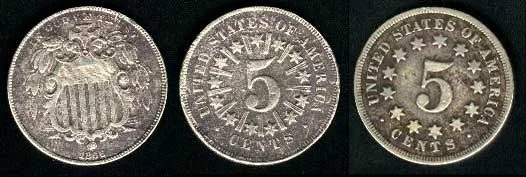
If you have an 1867 Shield Nickel, identifying which subtype it is is the first thing to check, because the value gap between the two is substantial in every grade. The 1866 is automatically With Rays, and 1868 onward is automatically No Rays — only 1867 requires the determination.
Key Dates and Semi-Keys
The Shield Nickel series spans 1866 through 1883 and includes only nineteen date-and-subtype combinations (counting With Rays and No Rays separately for 1867). Most dates are affordable in circulated grades, but several genuinely scarce dates command real money. The same disciplined approach to spotting key dates applies whether you’re looking at Shield Nickels, the Buffalo Nickel series, or the Mercury Dime that came later.
1877 (Proof-Only)
The 1877 is one of the most desirable Shield Nickels for one simple reason: no business strikes were made that year. Only proof coins were produced, with a tiny mintage of approximately 510 pieces. Because no circulation strikes exist, every 1877 Shield Nickel in collector hands is a proof — and supplies are correspondingly limited. The 1877 commands strong four-figure prices in any grade and is essential to any complete date set.
1878 (Proof-Only)
The 1878 follows the same pattern: no business strikes were produced, only proofs, with a mintage of approximately 2,350 pieces. While the 1878 is more available than the 1877 due to its higher proof mintage, it remains a key date and commands four-figure prices. Like the 1877, every 1878 in a collector’s hands is a proof coin.
1867 With Rays
The 1867 With Rays is scarce in every grade and especially elusive in Mint State. Because production of the With Rays subtype was halted partway through the year, surviving examples are far less common than the No Rays variant. Circulated examples are findable at modest premiums; high-grade Mint State examples can reach four figures.
1879, 1880, 1881
The late-1870s and early-1880s Philadelphia mintages dropped sharply as silver coinage returned to circulation following the Mint Act of 1873 and the resumption of specie payments in 1879. The 1879 (29,100 business strikes), 1880 (19,955), and 1881 (72,375) are all genuinely scarce, with the 1880 being the lowest-mintage business strike of the entire series. All three command meaningful premiums in every grade.
1873 Closed 3 vs. Open 3
The 1873 comes in two distinct varieties distinguished by the shape of the 3 in the date. The Closed 3 has a 3 with the upper and lower terminals nearly touching, almost forming a circle; the Open 3 has the terminals clearly separated. The Closed 3 was the earlier variety and is somewhat scarcer than the Open 3, particularly in higher grades. Both are collectible; the variety distinction matters most to specialists assembling complete date-and-variety sets.
Other Notable Semi-Keys
Beyond the absolute keys, several other dates deserve attention:
- 1882: Mintage of 11,476,600 — common in circulated grades but tougher in true Mint State than its mintage suggests
- 1883/2 Repunched Date: A famous overdate variety; the underlying 2 is visible inside the final 3 on well-preserved examples
- 1869/8: A repunched-date variety with traces of an underlying 8 visible inside the final 9
- 1872: Often weakly struck; well-struck examples are scarcer than mintage suggests
The remaining dates — particularly 1868, 1870, 1871, 1872, 1874, 1875, and 1876 — are quite common in circulated grades and reasonably available in Mint State, making them excellent starting points for new Shield Nickel collectors.

The 1877 and 1878 Proof-Only Issues
Two years in the Shield Nickel series saw no business-strike production at all: 1877 and 1878. The reasons reflect a confluence of economic, monetary, and Mint-policy decisions that shaped American coinage during the late 1870s.
Why No Business Strikes Were Made
By the mid-1870s the Treasury and Mint had accumulated enormous Shield Nickel stockpiles in their vaults. Banks and businesses were not requesting more, and the existing supply was sufficient to meet circulation needs for years. Rather than continuing wasteful production, the Mint simply struck no business coins for two years — but continued to produce small quantities of proof coins to satisfy collectors who maintained subscriptions for the annual proof set.
The 1877 proof mintage of approximately 510 pieces and the 1878 proof mintage of approximately 2,350 pieces represent the entire production of those years. Every 1877 and 1878 Shield Nickel in existence today began life as a proof coin destined for a collector cabinet.
Identifying Proof Strikes
Proof Shield Nickels are distinguished from business strikes by several characteristics: deeply mirrored fields, sharply squared rims, full strike detail on every design element, and the absence of die polish lines or the rough textures common on circulation coins. Some proofs received light circulation when collectors needed to spend coins from their collections during financial hardship — these “impaired proofs” still show traces of mirror finish in protected areas even when worn.
For 1877 and 1878 Shield Nickels, proof status is automatic — no business strikes exist for either year. For other years (1866 through 1876, 1879 through 1883), proofs and business strikes coexist and must be distinguished by the characteristics noted above.
Counterfeit and Altered 1877/1878 Concerns
Because both years are valuable, they are favorite targets for date alteration. Common dates such as 1873, 1875, or 1876 may be altered to read 1877 or 1878 by tampering with the final digit. Authentication for any 1877 or 1878 Shield Nickel should always be done by PCGS or NGC. The cost of certification is trivial compared with the financial risk of buying an altered coin, and certified examples are essential for any meaningful resale.
Repunched Dates and Die Varieties
The Shield Nickel series is rich in repunched-date varieties — a consequence of the manual die-preparation methods of the 1860s and 1870s. Date digits were entered into working dies one at a time using individual punches, and slight misalignments often led engravers to repunch a digit, leaving traces of the original strike visible on completed coins. These varieties are collectible and often add modest premiums over normal examples in the same grade.
1869/8 Repunched Date
The 1869/8 is one of the most popular Shield Nickel varieties. The original 1868 die was modified by punching a 9 over the underlying 8, but the final repunching was incomplete, leaving traces of the 8 visible inside the loop and along the lower curve of the 9. On well-preserved examples the underlying 8 is clearly visible under 5x magnification.
1883/2 Repunched Date
The 1883/2 is the most dramatic and famous repunched-date variety in the series. The original 1882 die was repurposed by overlaying a 3 onto the final 2, leaving prominent traces of the underlying 2 visible inside the upper loop of the 3. The variety commands a substantial premium over a normal 1883 in all grades and is particularly desirable in Mint State.
Other Repunched Varieties
Repunched-date varieties exist for many other Shield Nickel years, generally with less dramatic doubling than the 1869/8 and 1883/2:
- 1868 RPD: Several minor repunched-date varieties exist, primarily in the final digit
- 1872 RPD: Light repunching visible on the final 2
- 1873 Doubled Die Reverse: Minor doubling on the reverse stars and lettering
- 1879 RPD: Repunching on the 9, only visible under magnification
For collectors interested in variety attribution, specialized references like the Cherrypickers’ Guide and Fletcher’s Shield Nickel attribution work are essential. Many varieties are subtle enough that a 10x loupe is mandatory for accurate identification.
Striking Problems and Die Life
No discussion of the Shield Nickel is complete without acknowledging its notorious striking problems. The hard 75/25 copper-nickel alloy combined with Longacre’s high-relief design produced more die failures, weak strikes, and quality-control headaches than any other US coin series of the nineteenth century.
Why Strike Quality Suffered
Three factors compounded to make Shield Nickel production miserable:
- Hard alloy: Nickel is a relatively hard metal that resists flowing into deep die cavities under normal striking pressure
- High relief: Longacre’s shield design featured deeper recesses than were practical for the alloy and equipment available
- Inadequate equipment: The mid-nineteenth-century coining presses simply could not deliver the pressure needed to fully strike the design without breaking dies
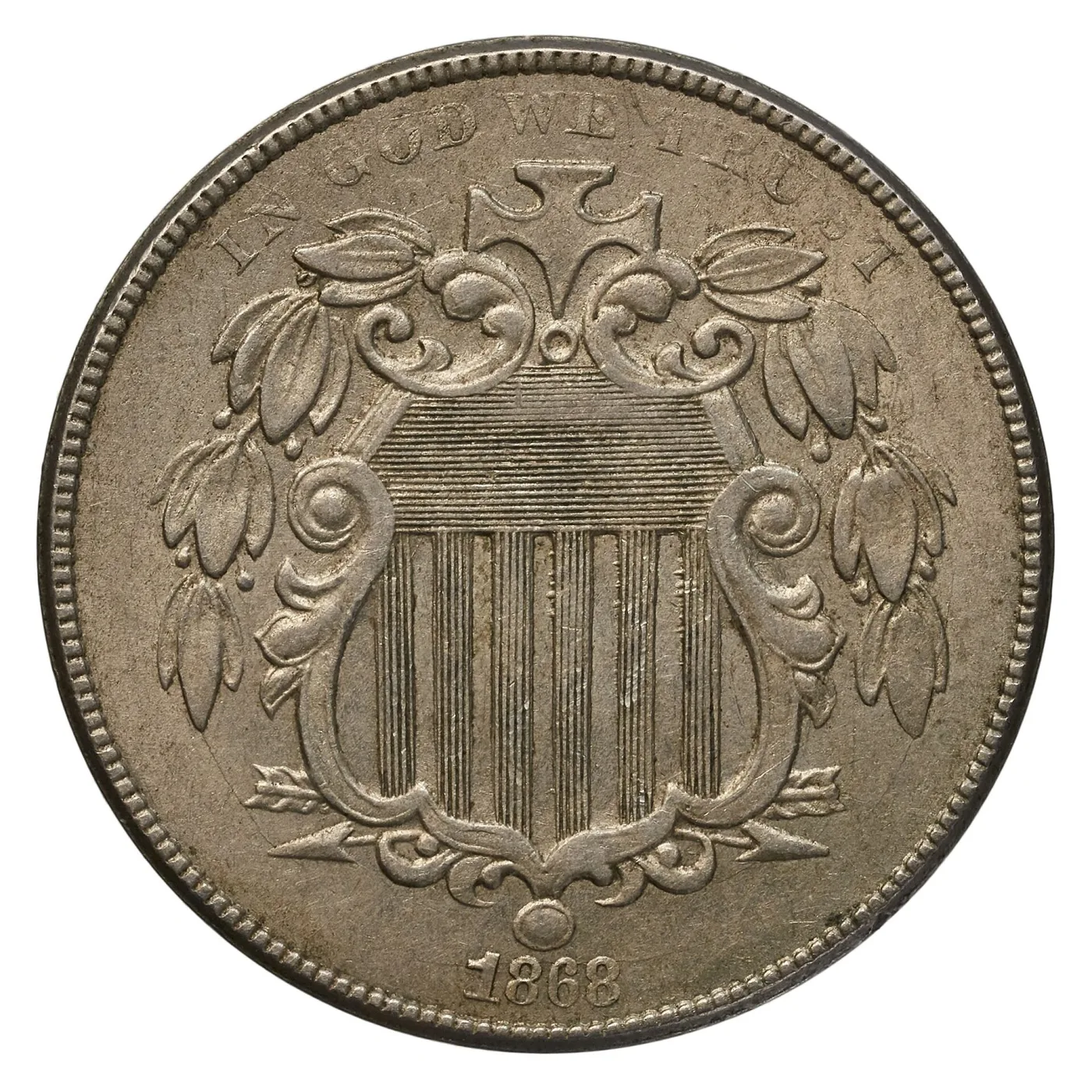
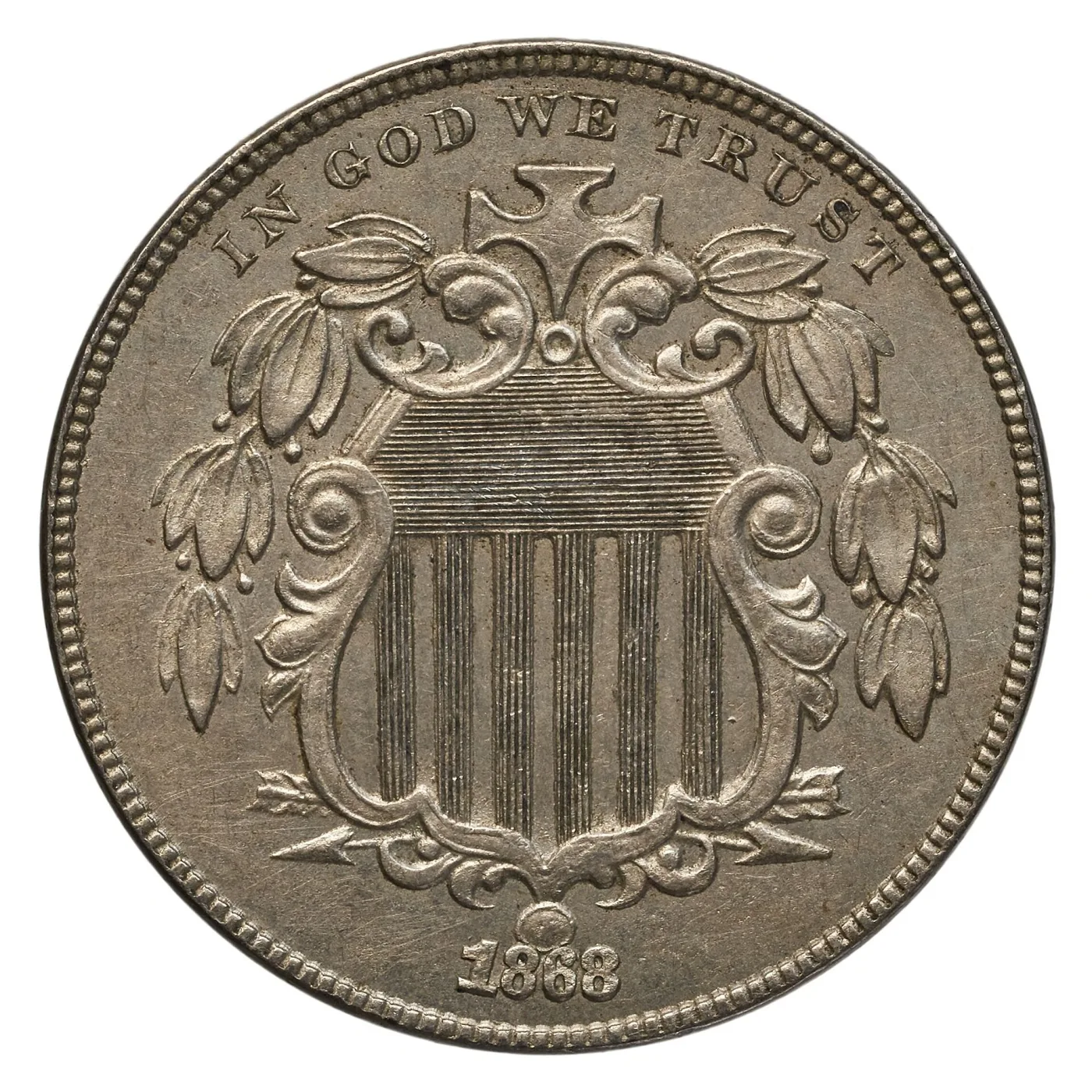
The result was a series in which weak strikes are the norm rather than the exception. Coins frequently show flat areas in the centers of both obverse and reverse, with details appearing crisp in the protected areas near the rim and mushy or absent in the high-pressure central regions.
Die Cracks, Breaks, and Cuds
Shield Nickel dies broke constantly. Surviving coins frequently show die cracks (raised lines on the coin’s surface from cracks in the die), die breaks (small chips of metal missing from the die), and cuds (large rim breaks where a piece of the die has fallen away). These imperfections are so common on Shield Nickels that they are often considered character rather than damage. Specialists collect particular die-state varieties, and dramatic cuds can add modest premiums.
What Constitutes a Well-Struck Shield Nickel
Identifying a fully-struck Shield Nickel requires checking specific high points:
- Obverse: The horizontal lines in the chief (top band) of the shield should be sharp and complete; the vertical pales (stripes) should show full contrast; the leaves of the olive branches should be distinct
- Reverse: The numeral 5 should be sharp and well-defined; each of the thirteen stars should show full points; on With Rays coins, the rays should be complete from base to tip
Coins that meet all these criteria are scarce in any grade, and exceptionally well-struck Mint State examples command significant premiums over typical strikes. PCGS and NGC do not award a “Full Strike” designation to Shield Nickels, but auction descriptions and specialist dealers note strike quality prominently when it is exceptional.
Mint Marks (Or the Lack Thereof)
The Shield Nickel series is unusual among classic US series in that no branch-mint issues exist. Every Shield Nickel ever produced was struck at the Philadelphia Mint between 1866 and 1883. There are no D, S, O, or CC mint marks on any Shield Nickel — and any coin claimed to bear one is, with absolute certainty, an alteration or counterfeit.
Why Only Philadelphia?
Branch-mint nickel production began only in 1912 with the 1912-D and 1912-S Liberty Head Nickels, decades after the Shield Nickel was retired. During the Shield Nickel era, the branch mints in San Francisco, Carson City, and New Orleans focused exclusively on gold and silver coinage, with Philadelphia handling all base-metal production for the entire country. This centralization simplifies Shield Nickel identification: there is only one mint to consider, and the date is the only variable distinguishing one issue from another.
The Absence of Mint Marks Simplifies Collecting
For new collectors, the lack of mint marks is actually an advantage. A complete Shield Nickel date set requires only nineteen coins (counting 1867 With Rays and 1867 No Rays separately). Compare this with the Lincoln Wheat Penny series, which spans 50 years, three mints, and well over 100 distinct issues. The compact size of the Shield Nickel series makes it one of the most achievable nineteenth-century series for a complete collection.
Grading Shield Nickels
Accurate grading is essential because price gaps between adjacent grades can be substantial — particularly for keys and semi-keys. The same fundamental grading methods that apply to other US coins work here, with attention to the specific high points unique to the shield design.
Key Wear Points
Shield Nickels show wear first in predictable areas:
Obverse:
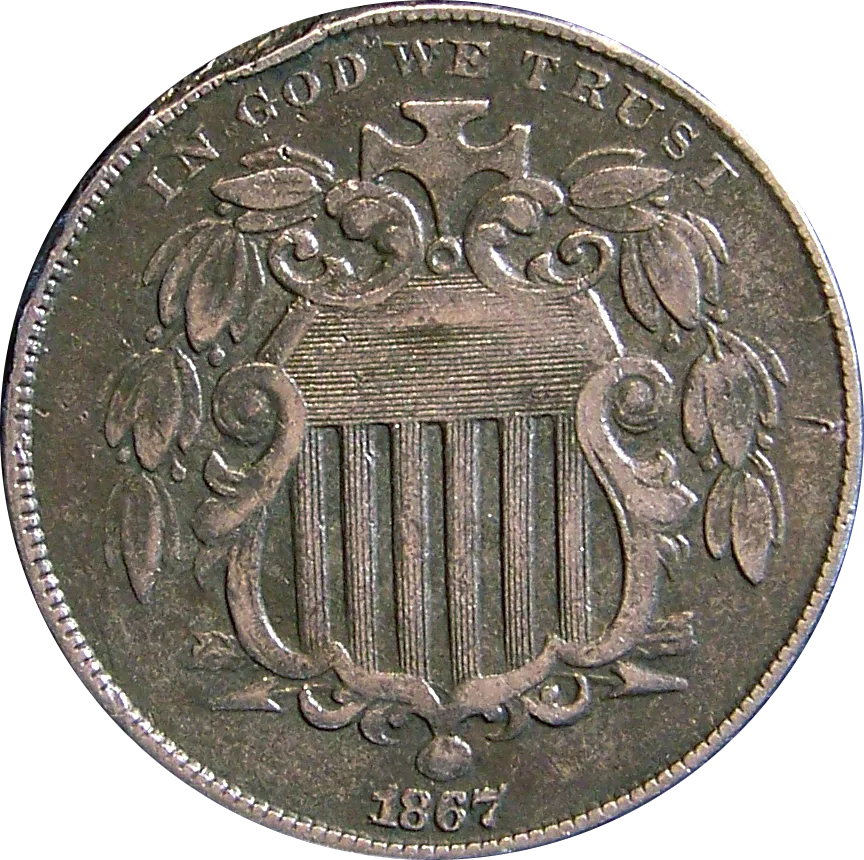
- Horizontal lines in the chief: The horizontal lines at the top of the shield are the highest point of the obverse and wear first. Complete, sharp lines indicate a higher grade; faded or missing lines indicate a lower grade.
- Cross at the top of the shield: The cross sits proud of the surrounding field and shows wear early. Sharp cross detail with crisp arms indicates VF or better.
- Olive leaves: The flanking olive branches lose leaf detail progressively as wear advances.
- Date: The date should remain readable through Good condition; partially worn dates indicate AG or lower grades.
Reverse:
- The numeral 5: The 5 wears slowly because it is large and broad, but its serifs and edges sharpen or dull noticeably with grade.
- Stars: Each of the thirteen stars should show full points in higher grades; on heavily worn coins the stars become flat-topped lumps.
- Rays (With Rays only): Rays are extremely high relief and wear quickly. Full rays from base to tip indicate VF or better; partial rays indicate F or lower.
- CENTS lettering: The word CENTS at the bottom is small and near the rim, often weakly struck and prone to early wear.
Grading Scale Overview
Good (G-4 to G-6): The shield is clearly outlined but flat; horizontal lines in the chief are mostly worn away. Date is fully readable. Stars on the reverse are reduced to flat shapes.
Very Good (VG-8 to VG-10): Some horizontal lines visible in the chief. Cross at top of shield is visible but worn. Stars on reverse show partial point definition.
Fine (F-12 to F-15): Most horizontal lines in the chief are visible. Cross is sharp. Most stars show point definition. On With Rays coins, partial rays remain.
Very Fine (VF-20 to VF-35): All horizontal lines in the chief are bold. Olive leaves show distinct detail. Stars show full points. With Rays examples show full rays.
Extremely Fine (EF-40 to EF-45): Light wear only on the highest points. Shield detail is nearly complete with only minor flatness on the very highest areas. Some original luster may remain in protected areas around the date and lettering.
About Uncirculated (AU-50 to AU-58): Only the slightest trace of wear on the high points. Significant original luster remains. Cross, leaves, and stars all sharp.
Mint State (MS-60 to MS-67): No wear. Graded by strike quality, luster, and the number, size, and severity of contact marks. Because Shield Nickels are notorious for weak strikes, even high-grade Mint State examples often show some central weakness — this is not penalized in the grade as long as the surfaces are mark-free and original.
Original Surfaces and Toning
Original-surface Shield Nickels often display attractive light golden, blue, or gray toning developed over more than a century of careful storage. Cleaned coins — common because earlier collectors often dipped or polished their coins to “improve” appearance — are easily detected by graders and are penalized severely. Avoid coins with unnaturally bright surfaces, hairlines visible under angled light, or pinkish/orange “dipped” coloration.
Authentication: Spotting Counterfeits and Alterations
Because key-date Shield Nickels can be worth thousands of dollars, counterfeiters and alterers have produced fraudulent examples for as long as collectors have paid premium prices. The same authentication principles that apply to coins like the Walking Liberty Half Dollar apply here as well.
Altered Dates
The most common Shield Nickel fraud involves altering common-date coins to resemble the 1877 or 1878 keys. A common 1873 might have its final 3 modified to a 7 or 8; a 1876 might have its final 6 modified to a 7 or 8. Examine date digits carefully under magnification:
- Look for tool marks adjacent to or within the digits
- Compare digit shapes against verified images of genuine specimens
- Check for unnatural smoothness or roughness near the date area
- Verify that the metal flow lines around the digits match the surrounding fields
Added “Mint Marks”
Some scammers attempt to pass off Shield Nickels with added “branch-mint” marks, hoping to fool inexperienced collectors who don’t know that no branch mint ever struck a Shield Nickel. Any Shield Nickel offered with a D, S, O, or CC mint mark is fraudulent — period. There are no exceptions.
Cast Counterfeits
Cast counterfeits — made by pressing a genuine coin into a mold and casting fakes from the impression — exist for higher-value Shield Nickels. Cast coins typically show grainy or porous surfaces, lack the sharp rim definition of a struck coin, and may be slightly underweight. A loupe and a precise scale identify most cast counterfeits quickly. Authentic Shield Nickels weigh 5.00 grams (with very small tolerance); a coin substantially below that weight is suspect.
“With Rays” Authenticity
Because the 1867 With Rays carries a substantial premium over the 1867 No Rays, fraudsters occasionally attempt to engrave rays onto a 1867 No Rays coin. Genuine With Rays coins show rays that are clearly part of the die strike — raised, smooth, and consistent in profile with surrounding design elements. Engraved “rays” added after striking will show tool marks under magnification, lack the smooth contour of struck features, and often have inconsistent depth or thickness.
Using Third-Party Grading Services
For any Shield Nickel worth more than $100, purchasing a coin already certified by PCGS or NGC is strongly recommended. Both services have examined tens of thousands of Shield Nickels and can detect alterations and counterfeits that elude even experienced collectors. The certification fee is small relative to the protection it provides on key-date and high-grade coins.
Current Market Values and Price Guide
Shield Nickel values span a wide range — from a few dollars for a common-date well-circulated coin to mid-four-figures for the proof-only 1877. The prices below reflect approximate retail values as of 2026 for problem-free, original-surface coins. Cleaned, damaged, or impaired examples are worth substantially less.
Common Dates (Most No Rays Years)
- Good-4: $20–$30
- Very Fine-20: $35–$55
- Extremely Fine-40: $65–$95
- MS-63: $200–$300
- MS-65: $475–$700
1866 With Rays
- Good-4: $30–$45
- Very Fine-20: $80–$120
- Extremely Fine-40: $150–$220
- MS-63: $550–$800
- MS-65: $1,500–$2,500
1867 With Rays
- Good-4: $40–$60
- Very Fine-20: $130–$180
- Extremely Fine-40: $250–$350
- MS-63: $1,400–$2,000
- MS-65: $5,000–$8,000
1877 (Proof-Only)
- PR-60: $2,200–$2,800
- PR-63: $3,000–$3,800
- PR-65: $4,500–$6,000
- PR-66 Cameo: $7,000–$10,000+
1878 (Proof-Only)
- PR-60: $1,000–$1,300
- PR-63: $1,400–$1,800
- PR-65: $2,200–$3,000
- PR-66 Cameo: $4,000–$6,000+
1879, 1880, 1881
- 1879 (G-4): $400–$550 | MS-63: $700–$1,000
- 1880 (G-4): $750–$1,000 | MS-63: $4,500–$6,500
- 1881 (G-4): $250–$350 | MS-63: $500–$750
1883/2 Repunched Date
- Good-4: $90–$130
- Very Fine-20: $200–$300
- Extremely Fine-40: $400–$600
- MS-63: $1,500–$2,200
Note: These are retail price estimates. Actual sale prices at auction vary based on eye appeal, certification, surface originality, and current market demand. For important purchases, reference recent auction archives from Heritage Auctions, Stack’s Bowers, or similar venues alongside standard price guides.
Building a Shield Nickel Collection
The Shield Nickel series rewards collectors at every budget level. With only nineteen date-and-subtype combinations, it is one of the more achievable nineteenth-century American series for a complete set. The keys — while expensive — are far less out of reach than the rarities of larger series like the Morgan Silver Dollar or pre-1916 quarter eagles.
Type Set
The simplest collection is a two-coin type set: one With Rays (any 1866 or 1867 With Rays) and one No Rays (any year from mid-1867 through 1883). This can be assembled in higher circulated grades for under $200 total, or in solid Mint State for well under $1,000. Type sets are ideal for collectors who want representative examples without committing to a complete series.
Date Set
A complete date set of nineteen coins (1866 With Rays; 1867 With Rays and 1867 No Rays; 1868 through 1883) is achievable in circulated grades for $4,000 to $7,000, with the bulk of the cost concentrated in the 1877 and 1878 proof-only issues, the 1867 With Rays, and the 1879/1880/1881 keys. Building a date set in mid-grade Mint State is significantly more expensive — primarily because of those keys.
Specialty Approaches
- Variety set: Focus on repunched dates, especially the 1869/8 and 1883/2 overdate
- Proof set: Philadelphia struck proofs every year of the series; a complete proof run is sophisticated and visually striking
- Mint State type: Pursue the highest possible single example of each subtype as a “best of type” display
- Companion to Longacre coinage: Pair with Indian Head Pennies, Flying Eagle Cents, and gold dollars for a complete view of Longacre’s designs
- Strike-quality study: Build a date set focused on exceptionally well-struck examples — challenging but extraordinarily satisfying for advanced collectors
Practical Tips
- Start with a common-date No Rays: Inexpensive, plentiful, and a great way to develop your eye for the design
- Buy certified for the keys: 1877, 1878, and the 1879/1880/1881 keys should always be PCGS or NGC certified
- Watch for cleaning: Many Shield Nickels were cleaned in the early twentieth century; original surfaces command meaningful premiums
- Study the chief: The horizontal lines in the chief of the shield are the single best grading element — train your eye on them
- Embrace strike weakness: Almost all Shield Nickels show some weakness; look for coins with overall pleasing eye appeal rather than holding out for an unobtainable “perfect strike”
Storage and Preservation
Proper storage maintains the value and visual appeal of your collection. Even coins that survived 150 years of circulation can be damaged by improper modern storage.
What to Avoid
- PVC holders: Older soft plastic flips and some envelopes contain PVC, which outgasses a green sticky residue that etches into nickel surfaces. Use only “non-PVC” or “Mylar” labeled holders.
- Acidic paper: Some paper envelopes contain sulfur compounds or acids that accelerate toning. Use acid-free, archival-quality envelopes.
- Rubber bands: Rubber contains sulfur and will produce dark, irreversible spotting. Never store rubber near coins.
- High humidity: Moisture accelerates oxidation. Keep humidity below 50% with a dry storage environment.
- Direct sunlight: UV exposure can affect surfaces over time.
Recommended Storage
- PCGS or NGC slabs: Inert plastic holders that provide excellent long-term protection and authentication
- Non-PVC flips: Mylar or polyethylene flips for safe short-term storage and examination
- Cardboard 2x2 holders: Staple-sealed cardboard with non-PVC Mylar windows; a traditional and safe storage method
- Quality albums: Dansco, Whitman, and similar manufacturers use safe materials, but avoid forcing coins into tight holes (rim damage risk)
- Safe deposit box: For valuable specimens, secure storage adds another layer of protection
Handling
Always handle Shield Nickels by their edges. Even clean fingers leave oils that etch surfaces over time. Cotton gloves are appropriate for high-value coins. Never clean a Shield Nickel — virtually any cleaning reduces numismatic value, and dipped or polished coins are easily detected by experienced graders. If a coin appears to need conservation, consult a professional rather than attempting it yourself.
Frequently Asked Questions
What is a Shield Nickel and when was it made?
The Shield Nickel is the first United States five-cent coin struck in copper-nickel, produced from 1866 through 1883. Designed by Mint Chief Engraver James B. Longacre, it features a federal shield on the obverse and a large numeral 5 on the reverse. It replaced the silver half dime as America's everyday five-cent piece during the post–Civil War era.
How do I tell With Rays from No Rays?
Look at the reverse field between the thirteen stars surrounding the central 5. If sun-like rays radiate outward between each star, the coin is With Rays. If the field between the stars is empty, it is No Rays. All 1866 coins are With Rays; 1868 onward are all No Rays; only 1867 exists in both subtypes.
Are Shield Nickels made of silver?
No. Shield Nickels are composed of 75% copper and 25% nickel — the same alloy used for the later Buffalo Nickel, the Liberty Head V Nickel, and modern Jefferson Nickel. They contain no silver. Only the wartime Jefferson Nickels of 1942–1945 ever contained silver among American five-cent pieces.
Why do my Shield Nickels look weakly struck?
Weak strikes are the norm for Shield Nickels because of the hard copper-nickel alloy combined with the deep relief of Longacre's shield design. Even high-grade Mint State examples often show some softness in the central horizontal lines of the chief or in the reverse stars. Truly well-struck examples are scarce in any grade and command premiums among specialists.
Why are 1877 and 1878 Shield Nickels so expensive?
No business strikes were produced in either year — only proofs, with mintages of approximately 510 in 1877 and 2,350 in 1878. Every 1877 and 1878 Shield Nickel in existence began as a collector proof, and supplies are correspondingly limited. Always buy certified examples to avoid altered dates.
Are there Shield Nickels with mint marks?
No. Every Shield Nickel was struck at the Philadelphia Mint between 1866 and 1883. Branch-mint nickel production did not begin until 1912 with the Liberty Head V Nickel. Any Shield Nickel offered with a D, S, O, or CC mint mark is, with absolute certainty, an alteration or counterfeit.
How does the Shield Nickel compare with the Liberty Head V Nickel?
The Shield Nickel (1866–1883) was succeeded directly by the Liberty Head V Nickel (1883–1913). The replacement was driven primarily by the Shield Nickel's chronic striking problems, which the lower-relief V Nickel design largely solved. Many collectors pursue both series together as a complete portrait of nineteenth-century American five-cent coinage.
Is a Shield Nickel collection a good investment?
High-grade and key-date Shield Nickels have historically appreciated steadily over multi-decade horizons, particularly the 1877 and 1878 proofs and the 1879/1880/1881 keys. Common dates in circulated grades have shown limited appreciation and should be collected for enjoyment rather than financial return. As with any collectible, past performance does not guarantee future returns.
Can I find Shield Nickels in circulation today?
Realistically, no. Shield Nickels disappeared from circulation by the early twentieth century, withdrawn either by collectors or by attrition. Estate sales, coin shop bins, online auctions, and dealer inventories are now the only practical sources. Roll-searching nickels from your bank will not turn up Shield Nickels — only modern Jefferson issues.